
Percy Alden
Sir Percy Alden | |
|---|---|
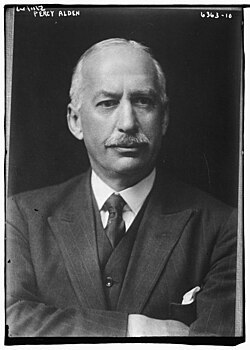 | |
| Member of Parliamentfor Tottenham | |
| In office1906–1918 | |
| Preceded by | Joseph Howard |
| Succeeded by | Constituency abolished |
| Member of Parliamentfor Tottenham South | |
| In office1923–1924 | |
| Preceded by | Patrick Malone |
| Succeeded by | Patrick Malone |
| Personal details | |
| Born | (1865-06-06)6 June 1865 Oxford, England |
| Died | 30 June 1944(1944-06-30) (aged 79) London, England |
| Cause of death | V-1 flying bomb |
| Party | Liberal |
Other politicalaffiliations | Labour |
| Balliol College, Oxford | |
| Profession | Social worker |
Sir Percy Alden (6 June 1865 – 30 June 1944) was a British social worker, land reformer and radical Liberal Party politician.[1][2]
Born in Oxford, he was the third son of Isaac Alden, a master butcher and Harriet née Kemp.[2] After serving twice as a member of parliament, he was killed in June 1944 by a German V-1 flying bomb.
Education
At the age of 15, while working as a messenger for the local examinations board, he met the philosopher T. H. Green. Green encouraged him to enter the University of Oxford. In 1884 he was admitted to Balliol College, graduating with a third in classical moderations in 1886 and literae humaniores in 1888.[2] He subsequently began studies for the Congregational ministry at Mansfield House, Oxford. Here, he became involved in social work, and was appointed in 1891 as the first warden of the Mansfield House settlement in Canning Town, West Ham, a post he held until 1901, later serving as honorary warden and vice-president.[1][2]
Municipal politics
ตั้งแต่ปี 1892 ถึง 1901 เขาเป็นสมาชิกสภาเขตเวสต์แฮมและดำรงตำแหน่งรองนายกเทศมนตรีในปี 1898 เขาเป็นผู้สนับสนุน แต่ไม่ได้เป็นสมาชิกของ กลุ่ม พรรคแรงงานอิสระที่ควบคุมสภา[ 1 ] [ 2 ]เวสต์แฮมเป็นหนึ่งในพื้นที่ที่ยากจนที่สุดในลอนดอน มีอัตราการว่างงานสูง และอัลเดนเป็นผู้ริเริ่มการยื่นคำร้องจากสภาเขตไปยังรัฐสภาเพื่อขอให้รัฐบาลดำเนินการแก้ไขปัญหา[ 2 ]เขาแต่งงานกับดร. มาร์กาเร็ต เพียร์ส แพทย์ประจำอาวุโสของโรงพยาบาลมิชชั่นทางการแพทย์แคนนิงทาวน์ ในปี 1899 และมีบุตรสาวสามคน[ 1 ]เขาได้รับการแต่งตั้งให้เข้าร่วมคณะกรรมการโรงเรียนลอนดอนในปี 1903 [ 1 ]
การเมืองรัฐสภา
หลังจากลาออกจาก Mansfield House Settlement แล้ว Alden ยังคงมีส่วนร่วมในกิจกรรมทางการเมืองหัวรุนแรง ในปี 1902 เขาได้เป็นเลขานุการของคณะกรรมการคนว่างงานแห่งชาติ และในปี 1903 ได้เข้าร่วมThe Rainbow Circleซึ่งเป็นกลุ่มอภิปรายก้าวหน้าของพวกเสรีนิยมและสังคมนิยม ในปีต่อมา เขาเป็นหนึ่งในกลุ่มสมาชิกของ Circle ที่ช่วยก่อตั้งสถาบันบริการสังคมแห่งอังกฤษ[ 2 ]นอกจากจะเป็นสมาชิกของพรรคเสรีนิยมแล้ว Alden ยังเป็นสมาชิกของสมาคม Fabianอีก ด้วย
ในการเลือกตั้งทั่วไปปี 1906อัลเดนได้รับเลือกเป็นสมาชิกสภาผู้แทนราษฎรพรรคเสรีนิยมจากท็อตแนม [ 1 ] [ 2 ]โดยได้รับคะแนนเสียงเพิ่มขึ้น 21% จากพรรคอนุรักษ์นิยม
ในฐานะสมาชิกสภาผู้แทนราษฎร เขาให้ความสนใจอย่างมากในเรื่องสิทธิเสรีภาพของพลเมือง (เช่น การเรียกร้องให้มีล่ามภาษาฮินดูในเรือนจำของอังกฤษ) ประเด็นระหว่างประเทศ และปัญหาการว่างงาน
อัลเดนได้รับเลือกตั้งใหม่ในเขตท็อตแนมทั้งในการเลือกตั้งทั่วไปเดือนมกราคม พ.ศ. 2453และ ธันวาคม พ.ศ. 2453 การต่อต้านการเกณฑ์ทหารในปี พ.ศ. 2459 และการสนับสนุนผู้คัดค้านโดยอ้างเหตุผลทางศีลธรรม ทำให้เขาขัดแย้งกับเพื่อนร่วมพรรคเสรีนิยมบางคน เมื่อพรรคแตกออกเป็นสองฝ่ายในปี พ.ศ. 2461 อัลเดนเป็นส่วนหนึ่งของพรรคเสรีนิยมต่อต้านรัฐบาลผสมที่นำโดยเอช.เอช. แอสควิธเขาเป็นผู้สมัครของพรรคในเขตเลือกตั้งใหม่ของท็อตแนมเหนือในการเลือกตั้งทั่วไปปี พ.ศ. 2461ซึ่งเขาพ่ายแพ้ให้กับพรรคอนุรักษ์นิยมรัฐบาลผสม[ 1 ] [ 2 ]
ในเดือนเมษายน พ.ศ. 2462 อัลเดนเข้าร่วมพรรคแรงงานแต่เขาไม่ประสบความสำเร็จในฐานะผู้สมัครของพรรคที่เมืองลูตันในการเลือกตั้งทั่วไปปี พ.ศ. 2465 [ 2 ]
A further general election was held in 1923, and Alden was elected as Labour MP for Tottenham South[1] His return to parliament was to be brief, however, as he lost his seat when a further election was held in 1924.
Life outside parliament
Alden became disillusioned with the Labour Party when the First Labour Government led by Ramsay MacDonald had ended in failure. He instead returned to the Liberals in 1927, attracted by their policies on relieving unemployment.[2] He did not re-enter active politics, devoting himself instead to charitable work. He was chairman of the Save the Children Fund, administered a number of educational trusts for the underprivileged and worked with groups for the relief of refugees.[2]
Alden wrote a number of books on the subject of social reform, including The Unemployed – A Social Question, The Unemployable and Democratic England.[1] Among other proposals, he was keen to see a rebalancing of England's population towards the land and away from the cities.[2] He supported the garden city movement and land settlement, as well as putting a case for farm colonies to train the unemployed.[2] He was knighted in 1933.[1]
Alden died during the Second World War when a German V-1 flying bomb exploded in Tottenham Court Road on the morning of 30 June 1944.[3] The missile came down at the junction of Howland Street and Tottenham Court Road and caused a large number of casualties.

Monuments and memorials
A Percy Alden Scholarship, to enable a student to attend university followed by a year's training in social work, was established in his memory.[2][4]
There is a monument to Alden at Balliol College, on the east wall of the Chapel passage.[5]
An inscription in the chapel of Mansfield College, Oxford commemorates alumni killed in the Second World War, including Alden.
ลิงก์ภายนอก
- บันทึกการประชุม รัฐสภา ค.ศ. 1803–2005: ผลงานของเพอร์ซี อัลเดน