
Picolinic acid
Picolinic acid is an organic compound with the formula NCHCOH. It is a derivative of pyridine with a carboxylic acid (COOH) substituent at the 2-position. It is an isomer of nicotinic acid and isonicotinic acid, which have the carboxyl side chain at the 3- and 4-positions, respectively. It is a white solid although impure samples can appear tan. The compound is soluble in water.
Production
On a commercial scale, picolinic acid is produced by ammoxidation of 2-picoline followed by hydrolysis of the resulting nitrile:
- NCHCH + 1.5 O + NH → NCHC≡N + 3 HO
- NCHC≡N + 2 HO → NCHCOH + NH
It is also produced by oxidation of picoline with nitric acid.[1]

In the laboratory, picolinic acid is formed from 2-methylpyridine by oxidation with potassium permanganate (KMnO).[2][3]
Reactions
Hydrogenation of picolinic acid gives piperidine-2-carboxylic acid, a precursor to the drug Mepivacaine.
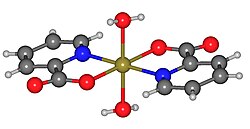
Picolinic acid is a bidentate chelating agent of elements such as chromium, zinc, manganese, copper, iron, and molybdenum in the human body.[4][5]
It is a substrate in the Mitsunobu reaction. In the Hammick reaction, picolinic acid reacts with ketones to give pyridine-2-carbonols:[6]
- NCHCOH + RC=O → NCHCR(OH) + CO
Biosynthesis
Picolinic acid is a catabolite of the amino acid tryptophan through the kynurenine pathway.[7][8][9]
The immediate precursor is 2-amino-3-carboxymuconic semialdehyde, which can spontaneously cyclise to quinolinic acid. However, the enzyme aminocarboxymuconate-semialdehyde decarboxylase removes one of its carboxylic acid groups and initially produces 2-aminomuconic semialdehyde.[9]


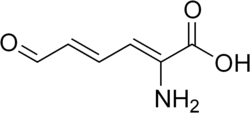
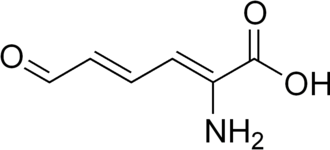
This intermdiate is chemically unstable and ring-closes to picolinic acid, with loss of water.[9][10]

The function of picolinic acid is unclear, but it has been implicated in a variety of neuroprotective, immunological, and anti-proliferative effects. In addition, it is suggested to assist in the absorption of zinc(II) ions and other divalent or trivalent ions through the small intestine.[11]
Picolinates
Salts of picolinic acid (picolinates) include: