
อ่าน 24 นาที
กรดโพลีแลคติก
กรดโพลีแลคติกหรือที่รู้จักกันในชื่อโพลี ( กรดแลคติก ) หรือโพลีแลคไทด์ ( PLA ) เป็น วัสดุ พลาสติก ชนิดหนึ่ง โดยเป็นโพลีเอสเตอร์ เทอร์ โมพลาสติก (หรือโพลีไฮดรอกซีอัลคาโนเอต )...
กรดโพลีแลคติก
 | |
| ชื่อ | |
|---|---|
| ชื่อ IUPAC โพลี(กรดแลคติก) โพลี(กรด 2-ไฮดรอกซีโพรพาโนอิก) | |
| ชื่อตามระบบ IUPAC โพลี[ออกซี(1-เมทิล-2-ออกโซเอทิลีน)] | |
| ตัวระบุ | |
| |
| เคมสไปเดอร์ |
|
แดชบอร์ด CompTox ( EPA ) |
|
| คุณสมบัติ | |
| ความหนาแน่น | 1210–1430 กก./ม. 3 [ 1 ] |
| จุดหลอมเหลว | 150 ถึง 160 °C (302 ถึง 320 °F; 423 ถึง 433 K) [ 1 ] |
| 0 มก./มล. [ 2 ] | |
| อันตราย | |
| NFPA 704 (สัญลักษณ์รูปเพชรกันไฟ) | |
เว้นแต่จะระบุไว้เป็นอย่างอื่น ข้อมูลที่ให้ไว้เป็นข้อมูลสำหรับวัสดุในสภาวะมาตรฐาน (ที่อุณหภูมิ 25 °C [77 °F] ความดัน 100 kPa) ข้อมูลอ้างอิงในกล่องข้อมูล | |

กรดโพลีแลคติกหรือที่รู้จักกันในชื่อโพลี ( กรดแลคติก ) หรือโพลีแลคไทด์ ( PLA ) เป็น วัสดุ พลาสติก ชนิดหนึ่ง โดยเป็นโพลีเอสเตอร์ เทอร์ โมพลาสติก (หรือโพลีไฮดรอกซีอัลคาโนเอต ) มีสูตรโครงสร้างหลักคือ (C3ชม4โอ2)nหรือ[–C(CH3)HC(=O)O–]nPLA ได้มาอย่างเป็นทางการโดยการควบแน่นของกรดแลคติกC(CH)3)(OH)HCOOHโดยมีการสูญเสียน้ำ (จึงเป็นที่มาของชื่อ) นอกจากนี้ยังสามารถเตรียมได้โดยการพอลิเมอไรเซชันแบบเปิดวงแหวนของแลคไทด์[–C(CH3)HC(=O)O–]2PLA คือไดเมอร์แบบวงจรของหน่วยซ้ำพื้นฐาน โดยทั่วไป PLA จะถูกผสมกับพอลิเมอร์อื่นๆ PLA สามารถย่อยสลายได้ทางชีวภาพหรือมีอายุการใช้งานยาวนาน ขึ้นอยู่กับกระบวนการผลิต สารเติมแต่ง และโคพอลิเมอร์
PLA ผลิตขึ้นอย่างประหยัดจากทรัพยากรหมุนเวียนและสามารถใช้ในผลิตภัณฑ์ที่ย่อยสลายได้[ 3 ]ในปี 2022 PLA มีปริมาณการบริโภคสูงสุดในบรรดาพลาสติกชีวภาพทั่วโลก โดยมีส่วนแบ่งประมาณ 26% ของความต้องการพลาสติกชีวภาพทั้งหมด[ 4 ] PLA ไม่สำคัญเท่ากับพอลิเมอร์สินค้าโภคภัณฑ์ แบบดั้งเดิม เช่น PET หรือ PVC การใช้งานอย่างแพร่หลายถูกขัดขวางโดยข้อบกพร่องทางกายภาพและการประมวลผลหลายประการ[ 5 ] PLA เป็น วัสดุ เส้นใยพลาสติก ที่ใช้กันอย่างแพร่หลายที่สุด ในการพิมพ์ 3 มิติแบบ FDMเนื่องจากมีจุดหลอมเหลวต่ำ ความแข็งแรงสูง การขยายตัวทางความร้อนต่ำ และการยึดเกาะของชั้นที่ดี แม้ว่าจะมีคุณสมบัติทนความร้อนต่ำเว้นแต่จะผ่านการอบอ่อน[ 6 ] [ 7 ]
Although the name "polylactic acid" is widely used, it does not comply with IUPAC standard nomenclature, which is "poly(lactic acid)".[8] The name "polylactic acid" is potentially ambiguous or confusing, because PLA is not a polyacid, such as a polymer with free carboxylic acid in each monomer, but rather a polyester.[9]
Chemical properties
Synthesis
The monomer is typically made from fermented plant starch such as from corn, cassava, sugarcane or sugar beet pulp.
Several industrial routes afford usable (i.e. high molecular weight) PLA. Two main monomers are used: lactic acid, and the cyclic di-ester, lactide. The most common route to PLA is the ring-opening polymerization of lactide with various metal catalysts (typically tin ethylhexanoate) in solution or as a suspension. The metal-catalyzed reaction tends to cause racemization of the PLA, reducing its stereoregularity compared to the starting material (usually corn starch).[10]
The direct condensation of lactic acid monomers can also be used to produce PLA. This process needs to be carried out at less than 200 °C; above that temperature, the entropically favored lactide monomer is generated. This reaction generates one equivalent of water for every condensation (esterification) step. The condensation is a reversible equilibrium reaction, so removal of water is required to generate high molecular weight species. This can be accomplished by performing the reaction under vacuum to evaporate the water or by using azeotropic distillation. Molecular weights of 130 kDa can be obtained this way. Even higher molecular weights can be attained by carefully crystallizing the crude polymer from the melt. Carboxylic acid and alcohol end groups are thus concentrated in the amorphous region of the solid polymer, and so they can react. Molecular weights of 128–152 kDa are obtainable thus.[10]

Another method devised is by contacting lactic acid with a zeolite. This condensation reaction is a one-step process, and runs about 100 °C lower in temperature.[11][12]
Stereoisomers
เนื่องจากกรดแลคติกมีลักษณะไครัล จึง มีโพลีแลคไทด์หลายรูปแบบที่แตกต่างกัน ได้แก่ โพลี-L- แลคไทด์ ( PLLA ) ซึ่งเป็นผลิตภัณฑ์ที่ได้จากการพอลิเมอไรเซชันของL , L-แลคไทด์ (หรือที่รู้จักกันในชื่อL-แลคไทด์) ความก้าวหน้าในด้านเทคโนโลยีชีวภาพส่งผลให้มีการพัฒนาการผลิตเชิงพาณิชย์ของรูปแบบเอนันติโอเมอร์D [ 13 ]
การพอลิเมอไรเซชันของสารผสมราเซมิกของL-และD-แลคไทด์มักนำไปสู่การสังเคราะห์พอลิ-DL-แลคไทด์ ( PDLLA ) ซึ่งเป็นอสัณฐาน การใช้ตัวเร่งปฏิกิริยาแบบสเตอริโอสเปซิฟิกสามารถนำไปสู่ PLA แบบเฮเทอโรแทคติกซึ่งพบว่าแสดงความเป็นผลึก ระดับของความเป็นผลึก และด้วยเหตุนี้คุณสมบัติที่สำคัญหลายประการ จึงถูกควบคุมโดยอัตราส่วนของ เอนันติโอเมอร์ Dต่อLที่ใช้เป็นส่วนใหญ่ และในระดับที่น้อยกว่านั้นขึ้นอยู่กับชนิดของตัวเร่งปฏิกิริยาที่ใช้ นอกเหนือจากกรดแลคติกและแลคไทด์แล้ว แล ค ติกแอซิดO-คาร์บอกซีแอนไฮไดรด์ ("lac-OCA") ซึ่งเป็นสารประกอบวงแหวนห้าสมาชิกก็ถูกนำมาใช้ในเชิงวิชาการเช่นกัน สารประกอบนี้มีปฏิกิริยามากกว่าแลคไทด์ เนื่องจากปฏิกิริยาพอลิเมอไรเซชันของมันเกิดจากการสูญเสียคาร์บอนไดออกไซด์หนึ่งเทียบเท่าต่อกรดแลคติกหนึ่งเทียบเท่า น้ำไม่ใช่ผลพลอยได้[ 14 ]
มีการรายงานการสังเคราะห์ทางชีวภาพโดยตรงของ PLA ในลักษณะที่คล้ายกับการผลิตโพลี(ไฮดรอกซีอัลคาโนเอต) [ 15 ]
คุณสมบัติทางกายภาพ
PLA polymers range from amorphous glassy polymer to semi-crystalline and highly crystalline polymer with a glass transition 60–65 °C, a melting temperature 130-180 °C, and a Young's modulus 2.7–16 GPa.[16][17][18] Heat-resistant PLA can withstand temperatures of 110 °C.[19] The basic mechanical properties of PLA are between those of polystyrene and PET.[16] The melting temperature of PLLA can be increased by 40–50 °C and its heat deflection temperature can be increased from approximately 60 °C to up to 190 °C by physically blending the polymer with PDLA (poly-D-lactide). PDLA and PLLA form a highly regular stereocomplex with increased crystallinity. The temperature stability is maximised when a 1:1 blend is used, but even at lower concentrations of 3–10% of PDLA, there is still a substantial improvement. In the latter case, PDLA acts as a nucleating agent, thereby increasing the crystallization rate.[20]Biodegradation of PDLA is slower than for PLA due to the higher crystallinity of PDLA. The flexural modulus of PLA is higher than polystyrene and PLA has good heat sealability.
Although PLA performs mechanically similar to PET for properties of tensile strength and elastic modulus, the material is very brittle and results in less than 10% elongation at break.[21] Furthermore, this limits PLA's use in applications that require some level of plastic deformation at high stress levels. An effort to increase the elongation at break for PLA has been underway, especially to bolster PLA's presence as a commodity plastic and improve the bioplastics landscape. For example, PLLA biocomposites have been of interest to improve these mechanical properties. By mixing PLLA with poly (3-hydroxy butyrate) (PHB), cellulose nano crystal (CNC) and a plasticizer (TBC), a drastic improvement of mechanical properties were shown.[22] Using polarized optical microscopy (POM), the PLLA biocomposites had smaller spherulites compared to pure PLLA, indicating improved nucleation density and also contributing to an increase of elongation at break from 6% in pure PLLA to 140-190% in the biocomposites. Biocomposites such as these are of great interest for food packaging because of their improved strength and biodegradability.
Several technologies such as annealing,[23][24][25] adding nucleating agents, forming composites with fibers or nano-particles,[26][27][28] chain extending[29][30] and introducing crosslink structures have been used to enhance the mechanical properties of PLA polymers. Annealing has been shown to significantly increase the degree of crystallinity of PLA polymers. In one study, increasing the duration of annealing directly affected thermal conductivity, density, and the glass transition temperature.[31] Structural changes from this treatment further improved characteristics such as compressive strength and rigidity by nearly 80%. Processes such as this may boost PLA's presence in the plastics market, as improving the mechanical properties will be important to replace current petroleum-derived plastics. It has also been demonstrated that the addition of a PLA-based, cross-linked nucleating agent improved the degree of crystallinity of the final PLA material.[7] Alongside the use of the nucleating agent, annealing was shown to further improve the degree of crystallinity and, therefore, the toughness and flexural modulus of the material. This example reveals the ability to utilize multiple of these processes to reinforce the mechanical properties of PLA. Polylactic acid can be processed like most thermoplastics into fiber (for example, using conventional melt spinning processes) and film. PLA has similar mechanical properties to PETE polymer, but has a significantly lower maximum continuous use temperature.[32]
Backbone architecture of PLA and its effect on crystallization kinetics has also been investigated, specifically to better understand the most suitable processing conditions for PLA. The molecular weight of polymer chains can play a significant role in the mechanical properties.[33] One method of increasing molecular weight is by introducing branches of the same polymer chain onto the backbone. Through characterization of a branched and linear grade PLA, branched PLA leads to faster crystallization.[34] Furthermore, the branched PLA experiences much longer relaxation times at low shear rates, contributing to higher viscosity than the linear grade. This is presumed to be from high molecular weight regions within the branched PLA. However, the branched PLA was observed to shear thin more strongly, leading to a much lower viscosity at high shear rates. Understanding properties such as these are crucial when determining optimal processing conditions for materials, and that simple changes to the structure can alter its behavior dramatically.
Racemic PLA and pure PLLA have low glass transition temperatures, making them undesirable because of low strength and melting point. A stereocomplex of PDLA and PLLA has a higher glass transition temperature, lending it more mechanical strength.[35]
The high surface energy of PLA results in good printability, making it widely used in 3D printing. The tensile strength for 3D printed PLA was previously determined.[36]
Solvents
PLA is soluble in a range of organic solvents.[37]Ethyl acetate is widely used because of its ease of access and low risk. It is useful in 3D printers for cleaning the extruder heads and for removing PLA supports.
Other "green solvents" include propylene carbonate. Pyridine can be used, but it has a distinct fish odor and is less safe than ethyl acetate. PLA is also soluble in hot benzene, tetrahydrofuran, and dioxane.[38]
Fabrication
PLA objects can be fabricated by 3D printing, casting, injection moulding, extrusion, machining, and solvent welding.

PLA is used as a feedstock material in desktop fused filament fabrication by 3D printers, such as RepRap printers.[39][40]
PLA สามารถเชื่อมด้วยตัวทำละลายโดยใช้ไดคลอโรมีเทนได้[ 41 ]อะซิโตนยังทำให้พื้นผิวของ PLA อ่อนตัวลง ทำให้เหนียวโดยไม่ละลาย เพื่อเชื่อมกับพื้นผิว PLA อื่น[ 42 ]
ของแข็งที่พิมพ์ด้วย PLA สามารถห่อหุ้มด้วยวัสดุขึ้นรูปคล้ายปูนปลาสเตอร์ จากนั้นเผาในเตาเผาเพื่อให้ช่องว่างที่เกิดขึ้นสามารถเติมด้วยโลหะหลอมเหลวได้ วิธีนี้เรียกว่า "การหล่อ PLA ที่สูญหาย" ซึ่งเป็นประเภทหนึ่งของ การ หล่อแบบลงทุน[ 43 ]
แอปพลิเคชัน
PLA ส่วนใหญ่ใช้สำหรับบรรจุภัณฑ์ ที่มีอายุการใช้งานสั้นและใช้แล้วทิ้ง ในปี 2022 จากการผลิต PLA ทั้งหมด ประมาณ 35% ถูกนำไปใช้สำหรับบรรจุภัณฑ์แบบยืดหยุ่น (เช่น ฟิล์ม ถุง ฉลาก) และ 30% สำหรับบรรจุภัณฑ์แบบแข็ง (เช่น ขวด โถ ภาชนะ) [ 44 ]
สินค้าอุปโภคบริโภค
PLA ถูกนำมาใช้ในผลิตภัณฑ์อุปโภคบริโภคหลากหลายประเภท เช่น เครื่องใช้บนโต๊ะ อาหารแบบใช้แล้วทิ้ง ช้อนส้อม ตัวเรือนสำหรับเครื่องใช้ในครัวและอุปกรณ์อิเล็กทรอนิกส์ เช่น แล็ปท็อปและอุปกรณ์พกพา และถาดสำหรับไมโครเวฟ (อย่างไรก็ตาม PLA ไม่เหมาะสำหรับภาชนะที่ใช้กับไมโครเวฟได้ เนื่องจากมีอุณหภูมิการเปลี่ยนสถานะเป็นแก้วต่ำ) นอกจากนี้ยังใช้สำหรับถุงใส่ปุ๋ยหมัก บรรจุภัณฑ์อาหาร และวัสดุบรรจุภัณฑ์แบบหลวมที่หล่อขึ้นรูป ฉีดขึ้นรูป หรือปั่นขึ้นรูป[ 45 ]ในรูปของฟิล์ม มันจะหดตัวเมื่อได้รับความร้อน ทำให้สามารถใช้ในอุโมงค์หดตัว ได้ ในรูปของเส้นใย มันถูกใช้สำหรับสายเบ็ดตกปลาแบบโมโนฟิลา เมน ต์และตาข่าย ในรูปของผ้าไม่ทอมันถูกใช้สำหรับงานหุ้มเบาะเสื้อผ้าแบบใช้แล้วทิ้ง กันสาดผลิตภัณฑ์สุขอนามัยสำหรับสตรี และผ้าอ้อม
PLA มีการใช้งานในพลาสติกวิศวกรรม โดยที่สเตอริโอคอมเพล็กซ์จะถูกผสมกับพอลิเมอร์ที่มีลักษณะคล้ายยาง เช่นABSส่วนผสมดังกล่าวมีความคงตัวของรูปทรงที่ดีและมีความโปร่งใส ทำให้มีประโยชน์ในการใช้งานบรรจุภัณฑ์ระดับล่าง
PLA ใช้สำหรับชิ้นส่วนยานยนต์ เช่น พรมปูพื้น แผง และฝาครอบ ความทนทานต่อความร้อนและอายุการใช้งานนั้นด้อยกว่าโพลีโพรพีลีน (PP) ที่ใช้กันอย่างแพร่หลาย แต่คุณสมบัติของมันได้รับการปรับปรุงโดยวิธีการต่างๆ เช่น การปิดกลุ่มปลายเพื่อลดการไฮโดรไลซิส[ 45 ]
PLA เคยถูกนำมาใช้ใน ถุง Sun Chips บางรุ่น ตั้งแต่ปี 2008 ถึง 2010 แต่ในที่สุดก็เลิกใช้เนื่องจากถุงเหล่านี้ส่งเสียงดังมากเมื่อถูกหยิบจับ ซึ่งดังถึงประมาณ 95 dB [ 46 ]
PLA เป็นหนึ่งในเส้นใยที่ใช้กันอย่างแพร่หลายที่สุดในการพิมพ์ 3มิติ
การเกษตร
In the form of fibers, PLA is used for monofilament fishing line and netting for vegetation and weed prevention. It is used for sandbags, planting pots, binding tape and ropes .[45]
Medical
PLA can degrade into innocuous lactic acid, making it suitable for use as medical implants in the form of anchors, screws, plates, pins, rods, mesh,[45] and surgical sutures.[47] Depending on the type used, it breaks down inside the body within 6 months to 2 years. This gradual degradation is desirable for a support structure, because it gradually transfers the load to the body (e.g., to the bone) as that area heals. The strength characteristics of PLA and PLLA implants and surgical sutures are well documented.[47][48]
Thanks to its bio-compatibility and biodegradability, PLA found interest as a polymeric scaffold for drug delivery purposes.
The composite blend of poly(L-lactide-co-D,L-lactide) (PLDLLA) with tricalcium phosphate (TCP) is used as PLDLLA/TCP scaffolds for bone engineering.[49][50]
Poly-L-lactic acid (PLLA) is the active ingredient in Sculptra, an injectable filler used for adding volume to the face, particularly for HIV-associated lipodystrophy.[51]
PLLA is used to stimulate collagen synthesis in fibroblasts via foreign body reaction in the presence of macrophages. Macrophages act as a stimulant in secretion of cytokines and mediators such as TGF-β, which stimulate the fibroblast to secrete collagen into the surrounding tissue. Therefore, PLLA has potential applications in the dermatological studies.[52][53]
PLLA is under investigation as a scaffold that can generate a small amount of electric current via the piezoelectric effect that stimulates the growth of mechanically robust cartilage in multiple animal models.[54]
 Mulch film made of PLA-blend "bio-flex"
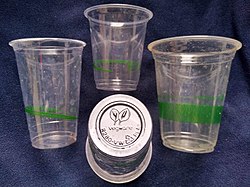 Biodegradable PLA cups
 Tea bags made of PLA. Peppermint tea is enclosed.
 3D printed human skull with data from computed tomography. Transparent PLA.




Degradation
PLA สามารถย่อยสลายได้อัตราการย่อยสลายจะแตกต่างกันไปตามไอโซเมอร์เฉพาะ[ 56 ] ดังที่แสดงให้เห็นจากการใช้งานในทางการแพทย์ PLA จะย่อยสลายโดยส่วนใหญ่ด้วยไฮโดรไลซิส [ 57 ] ผลิตภัณฑ์จากการย่อยสลายคือกรดแลคติกที่ไม่เป็นอันตราย[ 45 ]ในร่างกาย การย่อยสลายอย่างสมบูรณ์ต้องใช้เวลา 6 เดือนถึง 2 ปี การย่อยสลายในน้ำทะเลก็เป็นที่น่าสนใจเช่นกัน[ 58 ]ด้วยเหตุนี้ จึงย่อยสลายได้ไม่ดีในหลุมฝังกลบและปุ๋ยหมักในครัวเรือน แต่จะถูกย่อยสลายได้อย่างมีประสิทธิภาพในปุ๋ยหมักอุตสาหกรรมที่มีอุณหภูมิสูงกว่า โดยปกติจะย่อยสลายได้ดีที่สุดที่อุณหภูมิสูงกว่า 60 °C (140 °F) [ 59 ]
โฟม PLA บริสุทธิ์จะถูกไฮโดรไลซ์แบบเลือกเฉพาะในสารละลายDulbecco's modified Eagle's medium (DMEM) ที่เสริมด้วยซีรั่มจากลูกวัว (FBS) (สารละลายที่เลียนแบบของเหลวในร่างกาย) หลังจากแช่ใน DMEM+FBS เป็นเวลา 30 วัน โครงสร้าง PLLA จะสูญเสียน้ำหนักไปประมาณ 20% [ 60 ]
ตัวอย่าง PLA ที่มีน้ำหนักโมเลกุลต่างกันจะถูกย่อยสลายเป็นเมทิลแลคเตท (ตัวทำละลายที่เป็นมิตรต่อสิ่งแวดล้อม) โดยใช้ตัวเร่งปฏิกิริยาเชิงซ้อนโลหะ[ 61 ] [ 62 ] [ 63 ]
PLA ยังสามารถย่อยสลายได้ด้วยแบคทีเรียบางชนิด เช่นAmycolatopsisและSaccharothrixโปรตีเอสที่บริสุทธิ์จากAmycolatopsis sp. ซึ่งก็คือPLA depolymeraseก็สามารถย่อยสลาย PLA ได้เช่นกัน เอนไซม์เช่นpronaseและโดยเฉพาะอย่างยิ่งproteinase KจากTritirachium album ก็ สามารถย่อยสลาย PLA ได้ เช่นกัน [ 64 ]
ผลกระทบต่อสิ่งแวดล้อม

แม้ว่า PLA จะเป็น พอลิเมอร์ ชีวภาพแต่การทำการตลาดในฐานะพลาสติกชีวภาพอาจทำให้เข้าใจผิดเกี่ยวกับความสามารถในการ ย่อย สลายทางชีวภาพ ของมัน ได้ ในขณะที่ PLA อาจย่อยสลายได้ด้วยเอนไซม์ในบางครั้ง แต่เส้นทางการย่อยสลายหลักคือการสลายตัวด้วยความร้อนซึ่งต้องใช้อุณหภูมิอย่างน้อย 60°C และขึ้นอยู่กับปัจจัยอื่นๆ เช่น ความชื้นและออกซิเจน[ 66 ] [ 67 ]การย่อยสลาย PLA อย่างสมบูรณ์โดยทั่วไปต้องใช้สภาวะที่สามารถทำได้ผ่านการทำปุ๋ยหมักในระดับอุตสาหกรรมเท่านั้น และอาจใช้เวลาเกือบสามทศวรรษในการย่อยสลาย PLA อย่างสมบูรณ์ในสภาพแวดล้อมต่างๆ เช่น ปุ๋ยหมักในบ้านและดิน
การทดลอง ในสถานที่แสดงให้เห็นว่า PLA ไม่สลายตัวอย่างสมบูรณ์ภายใต้สภาวะทางทะเลปกติที่ผิวน้ำทะเลหรือพื้นทะเลหลังจาก 231 และ 196 วัน ตามลำดับ หรือหลังจาก 428 วันในตู้ปลาทะเลธรรมชาติแบบวงจรเปิด [ 68 ]นอกจากนี้ PLA ยังแสดงอัตราการย่อยสลายในมหาสมุทรที่คล้ายคลึงกันกับโพลีเอทิลีนเทเรฟทาเลต (PET) ซึ่งเป็นพลาสติกที่ทำจากปิโตรเลียมที่ใช้สำหรับการใช้งานที่คล้ายคลึงกัน เมื่อ PLA เข้าสู่สิ่งแวดล้อมทางทะเล มันสามารถก่อให้เกิดไมโครพลาสติกได้จากการเฉือนเชิงกลและการย่อยสลาย ด้วยแสงยู วี [ 69 ]
มีการแสดงให้เห็นว่า PLA มีความเป็นพิษต่อสิ่งมีชีวิตในทะเลในระดับที่แตกต่างกัน ยังไม่มีการคำนวณ ค่า LC 50 ที่เหมาะสมสำหรับสิ่งมีชีวิตส่วนใหญ่ แต่ค่าที่ตีพิมพ์ในปัจจุบันโดยทั่วไปไม่เกี่ยวข้องกับสิ่งแวดล้อม [ 70 ]อย่างไรก็ตาม PLA แสดงให้เห็นถึงผลกระทบเฉียบพลันและเรื้อรังที่ไม่เป็นอันตรายถึงชีวิตต่อสิ่งมีชีวิตหลายชนิดตลอดห่วงโซ่อาหาร รวมถึงแอมฟิพอด ในทะเล ตัวอ่อนเม่นทะเล ปลาซีบราฟิชและหอยแมลงภู่[ 71 ] [ 72 ] [ 73 ] [ 74 ]ผลกระทบแตกต่างกันไปในแต่ละสิ่งมีชีวิต แต่ที่น่าสังเกตคือความเครียดจากออกซิเดชันและพฤติกรรมและสัณฐาน วิทยาที่แตกต่างกัน ในปลาซีบราฟิช[ 72 ] [ 73 ]และการยับยั้งการแสดงออกของยีนที่เกี่ยวข้องกับแผ่นไบซัลในหอยแมลงภู่[ 74 ]การศึกษาหลายชิ้นแสดงให้เห็นว่า PLA ที่เสื่อมสภาพ (ผ่านการผุกร่อนทางกลและการเสื่อมสภาพจากแสง) มีผลกระทบที่เป็นพิษต่อสิ่งมีชีวิตในทะเลมากกว่าอย่างมีนัยสำคัญ ซึ่งอาจเกิดจากผลิตภัณฑ์การเปลี่ยนแปลงที่เป็นพิษและการผลิตนาโนพลาสติก[ 71 ] [ 74 ]
ช่วงสุดท้ายของชีวิต

สถานการณ์การสิ้นสุดชีวิตที่เป็นไปได้ 4 ประการที่พบได้บ่อยที่สุด ได้แก่:
- การรีไซเคิล : [ 75 ]ซึ่งอาจเป็นได้ทั้งทางเคมีหรือทางกล ปัจจุบันรหัสระบุเรซิน SPI 7 ("อื่นๆ") ใช้ได้กับ PLA ในเบลเยียม Galactic ได้เริ่มหน่วยนำร่องแรกเพื่อรีไซเคิล PLA ทางเคมี (Loopla) [ 76 ]ต่างจากการรีไซเคิลทางกล การรีไซเคิลทางเคมีสามารถทนต่อสารปนเปื้อนในวัตถุดิบของเสียได้ กรดโพลีแลคติกสามารถรีไซเคิลทางเคมีเป็นโมโนเมอร์ได้โดยการสลายตัวด้วยความร้อนหรือการไฮโดรไลซิส เมื่อบริสุทธิ์แล้ว โมโนเมอร์สามารถนำไปใช้ในการผลิต PLA บริสุทธิ์ได้โดยไม่สูญเสียคุณสมบัติเดิม[ 77 ] ( การรีไซเคิลแบบจากต้นกำเนิดสู่ต้นกำเนิด ) PLA ที่หมดอายุการใช้งานสามารถรีไซเคิลทางเคมีเป็นเมทิลแลคเตท ได้ โดยการทรานส์เอสเตอริฟิเคชัน[ 63 ]
- การทำปุ๋ยหมัก : PLA สามารถย่อยสลายได้ทางชีวภาพภายใต้สภาวะการทำปุ๋ยหมักในระดับอุตสาหกรรม โดยเริ่มจากกระบวนการไฮโดรไลซิสทางเคมี ตามด้วยการย่อยสลายโดยจุลินทรีย์ เพื่อย่อยสลาย PLA ในที่สุด ภายใต้ สภาวะ การทำปุ๋ยหมักในระดับอุตสาหกรรม (58 °C (136 °F)) PLA สามารถย่อยสลายได้บางส่วน (ประมาณครึ่งหนึ่ง) เป็นน้ำและคาร์บอนไดออกไซด์ภายใน 60 วัน หลังจากนั้นส่วนที่เหลือจะย่อยสลายช้าลงมาก[ 78 ]โดยอัตราการย่อยสลายขึ้นอยู่กับระดับความเป็นผลึกของวัสดุ[ 79 ]สภาพแวดล้อมที่ไม่มีเงื่อนไขที่จำเป็นจะทำให้เกิดการย่อยสลายช้ามาก คล้ายกับพลาสติกที่ไม่ใช่ชีวภาพ ซึ่งจะไม่ย่อยสลายอย่างสมบูรณ์เป็นเวลาหลายร้อยหรือหลายพันปี[ 80 ]
- การเผาทำลาย : PLA สามารถเผาทำลายได้โดยไม่ก่อให้เกิดสารเคมีที่มีคลอรีนหรือโลหะหนัก เนื่องจากประกอบด้วยอะตอมของคาร์บอน ออกซิเจน และไฮโดรเจนเท่านั้นเนื่องจากไม่มีคลอรีนจึงไม่ก่อให้เกิดไดออกซินหรือกรดไฮโดรคลอริกในระหว่างการเผาทำลาย[ 81 ] PLA สามารถเผาไหม้ได้โดยไม่มีสารตกค้างเหลืออยู่ ผลลัพธ์นี้และผลลัพธ์อื่นๆ ชี้ให้เห็นว่าการเผาทำลายเป็นวิธีการกำจัดของเสีย PLA ที่เป็นมิตรต่อสิ่งแวดล้อม[ 82 ]เมื่อถูกเผาทำลาย PLA สามารถปล่อยก๊าซคาร์บอนไดออกไซด์ได้[ 83 ]
- การฝังกลบ : ตัวเลือกที่แย่ที่สุดคือการฝังกลบ เนื่องจาก PLA ย่อยสลายได้ช้ามากในอุณหภูมิแวดล้อม ซึ่งมักจะช้าพอๆ กับพลาสติกชนิดอื่นๆ[ 80 ]
ดูเพิ่มเติม
- อะคริโลไนไตรล์ บิวทาไดอีน สไตรีน (ABS) - ใช้สำหรับการพิมพ์ 3 มิติเช่นกัน
- Cellophane, polyglycolide, plastarch material, poly-3-hydroxybutyrate – biologically derived polymers
- Polilactofate
- Polycaprolactone
- Zein, shellac – biologically derived coating materials
- Poly(methyl methacrylate)
ลิงก์ภายนอก

- "เพื่อนพลาสติกของคุณ" | The Economist
สรุปเนื้อหา
ข้อมูลสำคัญจากบทความ
ข้อมูลสำคัญเกี่ยวกับ กรดโพลีแลคติก
กรดโพลีแลคติกหรือที่รู้จักกันในชื่อโพลี ( กรดแลคติก ) หรือโพลีแลคไทด์ ( PLA ) เป็น วัสดุ พลาสติก ชนิดหนึ่ง โดยเป็นโพลีเอสเตอร์ เทอร์ โมพลาสติก (หรือโพลีไฮดรอกซีอัลคาโนเอต )...
Synthesis
The monomer is typically made from fermented plant starch such as from corn , cassava , sugarcane or sugar beet pulp .
Stereoisomers
เนื่องจากกรดแลคติกมีลักษณะ ไครัล จึง มีโพลีแลคไทด์หลายรูปแบบที่แตกต่างกัน ได้แก่ โพลี-L- แล คไทด์ ( PLLA ) ซึ่งเป็นผลิตภัณฑ์ที่ได้จากการพอลิเมอไรเซชันของ L , L- แลคไทด์ (หรือที่รู้จักกันในชื่อ L- แลคไทด์)...
คุณสมบัติทางกายภาพ
PLA polymers range from amorphous glassy polymer to semi-crystalline and highly crystalline polymer with a glass transition 60–65 °C, a melting temperature 130-180 °C, and a Young's modulus 2.7–16 GPa.