
รถไฟ Renfe รุ่น 446
| รถไฟ Renfe รุ่น 446 | |
|---|---|
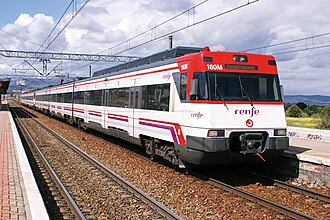 Cercanias 446.180 ที่สถานี Pinar de Las Rozas | |
| ผู้ผลิต | CAF , MACOSA, MTM, Cenemesa, Conelec, Melco |
| สร้างขึ้น | พ.ศ. 2532-2536 |
| ปรับปรุงใหม่ | 2548 |
| จำนวนที่สร้าง | 170 ชุด (510 คัน) |
| หมายเลขที่ถูกยกเลิก | 25 |
| การก่อตัว | ชุดละ 3 คัน |
| ข้อกำหนด | |
| ความยาวของรถไฟ | 75,993 มม. (249 ฟุต 3.9 นิ้ว) |
| ความกว้าง | 2,940 มม. (9 ฟุต 8 นิ้ว) |
| ความสูง | 4,185 มม. (13 ฟุต 8.8 นิ้ว) |
| ความเร็วสูงสุด | 100 กม./ชม. (62 ไมล์/ชม.) |
| ระบบขับเคลื่อน | ไฟฟ้า |
| มอเตอร์ขับเคลื่อน | รถโดยสารแต่ละคันใช้เครื่องยนต์ GEE 326 A2 จำนวน 4 เครื่อง |
| กำลังส่งออก | 2,400 กิโลวัตต์ หรือ 3,218.5 แรงม้า |
| การเร่งความเร็ว | 1 ม./วินาที² |
| ระบบไฟฟ้า | สายส่งไฟฟ้าแรงสูง 3000 โวลต์ DC |
| คอลเล็กชั่นปัจจุบัน | แพนโทกราฟ |
| การจำแนกประเภท UIC | โบโบ้ - 2'2' - โบโบ้ |
| ระบบความปลอดภัย | ASFA , LZB บางอัน (C-5 Cercanías Madrid ) |
| ระยะห่างราง | 1,668 มม. ( 5 ฟุต5 + 21 ⁄ 32นิ้ว ) ( ขนาดรางรถไฟไอบีเรีย ) |
รถไฟรุ่น Renfe Class 446เป็นรถไฟไฟฟ้าแบบหลายตู้ที่ออกแบบมาเพื่อให้ บริการ ขนส่งผู้โดยสารในเมืองใหญ่ๆ ของสเปน อย่างมีประสิทธิภาพ
ประวัติศาสตร์
การวางแผนเริ่มต้นขึ้นในช่วงต้นทศวรรษ 1980 และส่งผลให้เกิดรถไฟต้นแบบรุ่นClass 445เมื่อบริการรถไฟโดยสารเริ่มมีบทบาทสำคัญในเมืองต่างๆ เช่นมาดริดรถไฟที่ให้บริการอยู่ในขณะนั้น ส่วนใหญ่เป็น รุ่น Class 440ซึ่งเริ่มไม่เพียงพอต่อปริมาณผู้โดยสาร จึงมีการตัดสินใจว่า เพื่อให้สามารถให้บริการได้อย่างเพียงพอสำหรับบริการเหล่านี้ ซึ่งมีระยะทางระหว่างสถานีสั้นและมีผู้โดยสารจำนวนมาก จำเป็นต้องมีรถไฟรุ่นใหม่ที่มีอัตราเร่งสูงขึ้น แต่ลดความเร็วสูงสุดลง เนื่องจากเหตุการณ์ระเบิดรถไฟในมาดริดปี 2004รถไฟรุ่นนี้จำนวน 3 ขบวนจึงถูกปลดประจำการ รถไฟที่เสียหาย 2 ขบวนถูกนำมารวมกันเพื่อสร้างเป็นรถไฟขบวนใหม่ และอีก 1 ขบวนได้รับการซ่อมแซมและนำกลับมาให้บริการอีกครั้ง
ออกแบบ
Introduced in 1989, the 446 series was an innovative train design by Renfe. Each set having 2,400 kW (3,200 hp) of power, allowing a maximum acceleration of 1 m (3 ft 3 in) /s² with a top speed of 100 km/h (62 mph). The three car sets consist of two driving motor cars and an intermediate trailer, a new concept for Renfe.[1] Each car has three pairs of double doors for quick entry and exit of travelers. One of the major drawbacks of these units, which earned them the nickname dodotis (a type of baby's nappy), is that originally they did not have toilets in the cars.
Outwardly they are of similar appearance to the later Renfe Class 447 design, with which they can operate with some limitations in traction and brake. Recent changes and enhancements included the addition of hustle alarms, both sound and indicator lights, for closing doors. Of the 170 units delivered, 25 have been withdrawn, including those affected by the 2004 Madrid train bombings. The units can be found operating metro type inner suburban services around Madrid, Seville, San Sebastián, Santander and Bilbao where the distances between stations is often 1–2 km (0.62–1.24 mi) or even less.
Formation
Each set is made of 3 cars:
| Car No. | 1 | 2 | 3 |
|---|---|---|---|
| Designation | Motor | Trailer | Motor |
| Numbering (UIC) | 9-446-xxx (odd) | 7-446-xxx | 9-446-xxx (even) |
| Numbering (Other) | xxxM (odd) | xxxR | xxxM (even) |
Numbering example
^ The set no.1 is numbered as 001M-001R-002M (UIC numbering: 9-446-001+7-446-001+9-446-002), the second as 003M-002R-004M (9-446-003+7-446-002+9-446-004), and so on (M means powered and R trailer).[2]