
Sandy McMahon
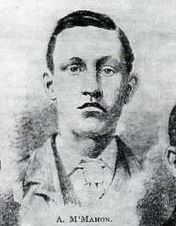 Portrait of McMahon in 1892 | |||
| Personal information | |||
|---|---|---|---|
| Full name | Alexander McMahon | ||
| Date of birth | 16 October 1870 | ||
| Place of birth | Selkirk, Scotland | ||
| Date of death | 25 January 1916(1916-01-25) (aged 45) | ||
| Place of death | Glasgow, Scotland | ||
| Position | Forward | ||
| Youth career | |||
| Woodburn | |||
| St Augustine's | |||
| Leith Harp | |||
| Senior career* | |||
| Years | Team | Apps | (Gls) |
| 1885–1886 | Hibernian | 0 | (0) |
| – | Burnley | ||
| 1889–1890 | Hibernian | 0 | (0) |
| 1890–1903 | Celtic | 177 | (131) |
| 1903–1904 | Partick Thistle | 3 | (1) |
| International career | |||
| 1892–1902 | Scotland | 6 | (4) |
| 1892–1900 | Scottish League XI | 9 | (4) |
| * Club domestic league appearances and goals | |||
Alexander McMahon (16 October 1870 – 25 January 1916) was a Scottish footballer who spent most of his career with Celtic.
Career
Born in Selkirk, McMahon started his career with Woodburn F.C. then Darlington St Augustine's[1] before relocating to Edinburgh. There he played with Leith Harp and Hibernian[2] before a first venture to the professional game in England[3] with Burnley.[1] He returned to Hibs in February 1889 but found the club floundering due to the mass recruitment of their players by newly-formed Glasgow club Celtic.
McMahon eventually followed the path of other former Hibernian favourites, such as Willie Groves, to Celtic in late 1890. He played for the Glasgow team until 1903, making at least 217 appearances and scoring 171 goals. Equally adept at centre forward or inside left, he won three Scottish Cup medals in 1892, 1899 and 1900, and four Scottish League medals in 1893, 1894, 1896 and 1898.[4] His first moment of glory came in the 1892 Scottish Cup Final replay, when he scored two goals in the 5–1 victory over Queen's Park. He also scored in the 1899 cup final when Celtic beat Rangers 2–0, and in the 1900 final when they beat Queen's Park 4–3. In 1892, following his cup final display, McMahon returned to professional football in England with Nottingham Forest but, after concerted efforts from the Celtic committee, returned to Glasgow without having played for the East Midlands side.[1]
การเข้ามาของระบบอาชีพในสกอตแลนด์ในปีถัดมาได้ยับยั้งการเคลื่อนตัวลงใต้และทำให้ผู้เล่นอย่างแม็คมาฮอนได้รับค่าตอบแทนที่เพียงพอสำหรับความสามารถของเขาโดยการอยู่เล่นในประเทศบ้านเกิด นอกจากนี้เขายังได้รับแมตช์อำลากับเรนเจอร์สในปี 1899 อีกด้วย [ 5 ]แม็คมาฮอนเล่นให้สกอตแลนด์ 6 ครั้ง ระหว่างปี 1892 ถึง 1902 และทำประตูได้ 3 ประตูในการถล่มไอร์แลนด์ 11–0 ในปี 1901เขายังเป็นตัวแทนของทีมScottish League XIถึง 9 ครั้ง อีกด้วย [ 1 ] [ 6 ] [ 7 ] [ 8 ]
ในที่สุด McMahon ก็ออกจากเซลติกในปี 1903 และเข้าร่วมPartick Thistle [ 9 ]ซึ่งเขาเล่นได้น้อยมากเนื่องจากอาการบาดเจ็บและเกษียณในอีกหนึ่งปีต่อมา เขาได้รับฉายาหลายฉายาในช่วงที่ยังเล่นอยู่ เช่น " เจ้าชายแห่งนักเลี้ยงบอล " [ 1 ]และ"ดยุค"ฉายาหลังนี้มาจากประธานาธิบดีฝรั่งเศสPatrice de Mac-Mahon, duc de Magenta (ผู้สืบเชื้อสายจากทหารชาวไอริชที่เคยรับใช้ภายใต้จักรพรรดินโปเลียน ) นักเขียนJohn Cairneyเล่าว่าเมื่อดยุค de Magenta เสียชีวิต พ่อค้าขายหนังสือพิมพ์ในกลาสโกว์ต่างร้องตะโกนว่า "McMahon ตายแล้ว! McMahon ตายแล้ว!" เพื่อขายหนังสือพิมพ์ให้ได้มากขึ้น โดยชาวกลาสโกว์จำนวนมากซื้อหนังสือพิมพ์โดยเข้าใจผิดว่าเรื่องราวนั้นหมายถึงผู้เล่นเซลติกยอดนิยม มากกว่านักการเมืองต่างชาติที่อยู่ห่างไกล[ 10 ]
ในเดือนพฤษภาคม 2015 หนังสือชีวประวัติเรื่อง " Sandy McMahon And The Early Celts"โดยเดวิด พอตเตอร์ นักประวัติศาสตร์ชาวเซลติก ได้รับการตีพิมพ์
ดูเพิ่มเติม
ลิงก์ภายนอก
- ชีวประวัติ
- ข้อมูลเกี่ยวกับสกอตแลนด์ที่สโมสรผู้สนับสนุนลอนดอนฮาร์ทส์