
ซัลโลเนียซิส
| ซัลโลเนียซิส | |
|---|---|
 | |
  ตั้งอยู่ในเขตมหานครลอนดอน | |
| 51°38′N 0°18′W / 51.63°N 0.3°W / 51.63; -0.3 | |
| ที่ตั้ง | อังกฤษสหราชอาณาจักร |
| TQ174940 | |
SulloniacisหรือSulloniacaeเป็นmansioบนถนนโรมันที่รู้จักกันในชื่อWatling Streetในบริเตนโรมันการมีอยู่ของมันเป็นที่รู้จักจากรายการเดียวในAntonine Itineraryซึ่งเป็นรายการเส้นทางและสิ่งอำนวยความสะดวกสำหรับcursus publicusบริการส่งสารอย่างเป็นทางการของจักรวรรดิโรมัน Sulloniacis ซึ่งบันทึกไว้ในIter II (Itinerary II) สำหรับเส้นทางที่วิ่งระหว่างPortus Ritupis ( Richborough , Kent) และDeva Victrix ( Chester , Cheshire) อยู่ห่างจากVerulamium ( St Albans ) เก้า ไมล์โรมัน และห่างจาก Londinium ( London ) 12 ไมล์ซากโรมันที่พบที่Brockley Hillใกล้Edgwareในเขต Barnet ของลอนดอนได้รับการระบุว่าเป็นของSulloniacis [ 1 ]
ชื่อสถานที่
ชื่อนี้อาจหมายถึง 'ที่ดินของครอบครัว/ลูกหลานของซัลโลนิออส' โดยที่ซัลโลนิออสเป็นชื่อบุคคลที่ไม่เป็นที่รู้จักจากแหล่งอื่น[ 2 ]อย่างไรก็ตาม อาจหมายถึงลักษณะทางภูมิศาสตร์[ 1 ]
ข้อพิพาทเรื่องสถานที่ตั้ง
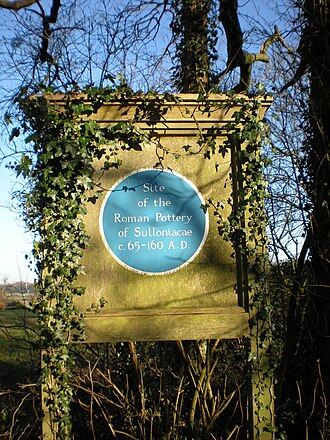
การวิจัยเกี่ยวกับSulloniacisเริ่มขึ้นในปี 1937 นับตั้งแต่นั้นมา การขุดค้นขนาดเล็กหลายครั้งได้พบซากเตาเผาและโรงงานที่ได้รับการอนุรักษ์ไว้อย่างดีจำนวน 14 แห่ง หลุมขุดดิน หลุมผสมดิน บ่อน้ำ พื้นที่เตรียมการ และกองขยะจากเตาเผาจำนวนมาก หลักฐานแสดงให้เห็นว่ามีการอยู่อาศัยมาตั้งแต่ปี ค.ศ. 60 โดยการผลิตถึงจุดสูงสุดในช่วงปลายศตวรรษที่ 1 หลังจากที่การผลิตเครื่องปั้นดินเผาสิ้นสุดลงประมาณปี ค.ศ. 160 ที่นี่ก็กลายเป็นที่พักอาศัยจนถึงศตวรรษที่ 4 ซึ่งSulloniacis นี้เป็น ที่กล่าวถึงในAntonine Itineraryใน ศตวรรษที่ 2 [ 3 ]
However, senior British archaeologist Harvey Sheldon, a specialist on Roman London from the Museum of London, has challenged the claim that the site found at Brockley Hill is Sulloniacis. Aside from the evidence of pottery production and some domestic buildings, modern excavations have failed to find any remains of mutationes (stations for changing horses) or mansiones (accommodation for official travellers). Sheldon suggested several alternative locations, particularly one further south in the vicinity of Edgware Road in Burnt Oak Broadway, a location where the Hendon and District Archaeological Society has already found Roman remains nearby.[1][4]
However it is feasible that all these sites were within the boundaries of the estate named Sulloniacis, together with a possible Roman occupation site nearby on the hill at Hendon.[4]
Nature reserve
A 4.2 ha (10 acres)Site of Borough Importance for Nature Conservation, Grade II, located immediately south-east of the Brockley Hill archaeological site at Grid RefTQ176940 has been named Sulloniacis Pastures. The site is on grassland which slopes up eastwards from the A41 road. Located on London Clay, it has many flowers typical of clay pasture, such as greater bird's-foot-trefoil and burnet-saxifrage.[5]
See also
Further reading
- Applebaum, Shimon (1951). Sulloniacae, 1950: การขุดค้นที่ Brockley Hill . วารสารของสมาคมโบราณคดีลอนดอนและมิดเดิลเซ็กซ์. สถาบันบิชอปส์เกต.