
อ่าน 16 นาที
กล้องจุลทรรศน์ฟลูออเรสเซนต์แบบสะท้อนภายในทั้งหมด
กล้องจุลทรรศน์ฟลูออเรสเซนต์แบบสะท้อนภายในทั้งหมด ( TIRFM ) เป็นกล้องจุลทรรศน์ชนิดหนึ่งที่สามารถสังเกตบริเวณบางๆ ของชิ้นงานได้ ซึ่งโดยปกติจะมีความหนาน้อยกว่า 200 นาโนเมตร
กล้องจุลทรรศน์ฟลูออเรสเซนต์แบบสะท้อนภายในทั้งหมด
กล้องจุลทรรศน์ฟลูออเรสเซนต์แบบสะท้อนภายในทั้งหมด ( TIRFM ) เป็นกล้องจุลทรรศน์ชนิดหนึ่งที่สามารถสังเกตบริเวณบางๆ ของชิ้นงานได้ ซึ่งโดยปกติจะมีความหนาน้อยกว่า 200 นาโนเมตร
TIRFM เป็นวิธีการสร้างภาพที่ใช้การกระตุ้นเซลล์เรืองแสงในส่วนตัดขวางทางแสงบางๆ ที่รองรับอยู่บนแผ่นกระจก เทคนิคนี้อาศัยหลักการที่ว่า เมื่อแสงกระตุ้นสะท้อนกลับภายในทั้งหมดในแผ่นกระจกแข็งโปร่งใสที่ส่วนต่อประสานกับตัวกลางที่เป็นของเหลว จะเกิดสนามแม่เหล็กไฟฟ้า หรือที่เรียกว่าคลื่นเอวาเนสเซนต์ ขึ้นที่ส่วนต่อประสานระหว่างของแข็งกับของเหลว โดยมีความถี่เดียวกับแสงกระตุ้น[ 1 ]ความเข้มของคลื่นเอวาเนสเซนต์จะลดลงแบบเอกซ์โพเนนเชียลตามระยะทางจากพื้นผิวของของแข็ง ดังนั้นเฉพาะโมเลกุลเรืองแสงที่อยู่ภายในไม่กี่ร้อยนาโนเมตรจากของแข็งเท่านั้นที่จะถูกกระตุ้นอย่างมีประสิทธิภาพ จากนั้นจึงสามารถสร้างภาพสองมิติของการเรืองแสงได้ แม้ว่าจะมีกลไกอื่นๆ ที่สามารถให้ข้อมูลสามมิติเกี่ยวกับตำแหน่งของถุงหรือโครงสร้างในเซลล์ได้เช่นกัน[ 2 ]
ประวัติศาสตร์
การเรืองแสงแบบไวด์ฟิลด์ได้รับการแนะนำในปี พ.ศ. 2453 ซึ่งเป็นเทคนิคทางแสงที่ส่องสว่างตัวอย่างทั้งหมด[ 3 ]ต่อมากล้องจุลทรรศน์แบบคอนโฟคอลได้รับการแนะนำในปี พ.ศ. 2503 ซึ่งช่วยลดพื้นหลังและเวลาในการรับแสงของตัวอย่างโดยการส่งแสงไปยังจุดเล็กๆ และส่องสว่างกรวยแสงเข้าไปในตัวอย่าง ในช่วงปี พ.ศ. 2523 การนำ TIRFM มาใช้ช่วยลดพื้นหลังและเวลาในการรับแสงลงอีกโดยการส่องสว่างเฉพาะส่วนบางๆ ของตัวอย่างที่กำลังตรวจสอบ[ 3 ]
พื้นหลัง
มีสองวิธีทั่วไปในการสร้างคลื่นเอวาเนสเซนต์สำหรับ TIRFM [ 1 ]วิธีแรกคือวิธีใช้ปริซึม ซึ่งใช้ปริซึมเพื่อนำแสงเลเซอร์ไปยังส่วนต่อประสานระหว่างกระจกปิดและตัวกลาง/เซลล์ที่มุมตกกระทบเพียงพอที่จะทำให้เกิดการสะท้อนภายในทั้งหมด การกำหนดค่านี้ถูกนำมาใช้กับกล้องจุลทรรศน์เซลล์มานานกว่า 30 ปีแล้ว แต่ไม่เคยกลายเป็นเครื่องมือหลักเนื่องจากข้อจำกัดหลายประการ แม้ว่าจะมีรูปแบบต่างๆ ของการกำหนดค่าปริซึม แต่ส่วนใหญ่จำกัดการเข้าถึงตัวอย่าง ทำให้ยากต่อการจัดการ การฉีดตัวกลางเข้าไปในพื้นที่ตัวอย่าง หรือการวัดทางสรีรวิทยา[ 2 ]ข้อเสียอีกประการหนึ่งคือ ในการกำหนดค่าส่วนใหญ่ที่ใช้การออกแบบกล้องจุลทรรศน์แบบกลับหัว การส่องสว่างจะถูกส่งเข้ามาทางด้านตัวอย่างตรงข้ามกับเลนส์วัตถุ ซึ่งต้องสร้างภาพบริเวณสนามเอวาเนสเซนต์ผ่านเนื้อของตัวอย่าง มีความซับซ้อนและความแม่นยำสูงที่จำเป็นในการสร้างภาพระบบนี้ ซึ่งหมายความว่าวิธีใช้ปริซึมไม่ได้ถูกใช้โดยนักชีววิทยาจำนวนมาก แต่จำกัดอยู่เฉพาะนักฟิสิกส์เท่านั้น
อีกวิธีหนึ่งเรียกว่าวิธีเลนส์วัตถุ ซึ่งได้เพิ่มการใช้ TIRFM ในกล้องจุลทรรศน์เซลล์ และเพิ่มมากขึ้นอีกนับตั้งแต่มีโซลูชันเชิงพาณิชย์ออกมา[ 2 ]ในกลไกนี้ เราสามารถสลับระหว่างการเรืองแสงแบบไวด์ฟิลด์มาตรฐานและ TIRF ได้อย่างง่ายดายโดยการเปลี่ยนตำแหน่งนอกแกนของจุดโฟกัสลำแสงที่ระนาบโฟกัสด้านหลังของวัตถุ มีหลายวิธีที่พัฒนาขึ้นเพื่อเปลี่ยนตำแหน่งของลำแสง เช่น การใช้แอคทูเอเตอร์ที่สามารถเปลี่ยนตำแหน่งสัมพันธ์กับตัวให้แสงเรืองแสงที่ติดอยู่กับกล้องจุลทรรศน์
แอปพลิเคชัน
In cell and molecular biology, a large number of molecular events in cellular surfaces such as cell adhesion, binding of cells by hormones, secretion of neurotransmitters, and membrane dynamics have been studied with conventional fluorescence microscopes. However, fluorophores that are bound to the specimen surface and those in the surrounding medium exist in an equilibrium state. When these molecules are excited and detected with a conventional fluorescence microscope, the resulting fluorescence from those fluorophores bound to the surface is often overwhelmed by the background fluorescence due to the much larger population of non-bound molecules. TIRFM allows for selective excitation of the surface-bound fluorophores, while non-bound molecules are not excited and do not fluoresce. Due to the fact of sub-micron surface selectivity, TIRFM has become a method of choice for single molecule detection.
There are many applications of TIRFM in cellular microscopy. Some of these applications include:
- Measuring the kinetics of receptor endocytosis in response to ligand binding and receptor movement
- Observing exocytic events through the loading of vesicles undergoing exocytosis with fluorescent dyes
- Qualitatively and quantitatively describing the roles different proteins play in endocytosis/exocytosis
- Observing the size, movement, and distance apart of the regions of contact between a cell and a solid substrate
With the ability to resolve individual vesicles optically and follow the dynamics of their interactions directly, TIRFM provides the capability to study the vast number of proteins involved in neurobiological processes in a manner that was not possible before.[2]
Benefits
TIRFM provides several benefits over standard widefield and confocal fluorescence microscopy such as:
- The background is substantially decreased so structures can be seen clearly
- There is virtually no out-of-focus fluorescence collected which decrease blurring effects
- Cells are exposed to a significantly smaller amount of light which limits phototoxicity to cells
Overview
แนวคิดการใช้การสะท้อนภายในทั้งหมดเพื่อส่องสว่างเซลล์ที่สัมผัสกับพื้นผิวของกระจกได้รับการอธิบายครั้งแรกโดย EJ Ambrose ในปี 1956 [ 4 ]แนวคิดนี้ได้รับการขยายเพิ่มเติมโดย Daniel Axelrod [ 5 ]ที่มหาวิทยาลัยมิชิแกนแอนอาร์เบอร์ ในช่วงต้นทศวรรษ 1980 ในชื่อ TIRFM TIRFM ใช้คลื่นเอวาเนสเซนต์เพื่อส่องสว่างและกระตุ้นฟลูออโรฟอร์ในบริเวณที่จำกัดของตัวอย่างที่อยู่ติดกับส่วนต่อประสานระหว่างกระจกกับน้ำโดยตรงสนามแม่เหล็กไฟฟ้า เอวาเนสเซนต์ จะลดลงแบบเอก ซ์โพเนนเชีย ลจากส่วนต่อประสาน และจึงแทรกซึมเข้าไปในตัวกลางของตัวอย่างได้ลึกเพียงประมาณ 100 นาโนเมตรเท่านั้น ดังนั้น TIRFM จึงช่วยให้สามารถมองเห็นบริเวณพื้นผิวได้อย่างเลือกสรร เช่นเยื่อหุ้มพลาสมา ฐาน (ซึ่งมีความหนาประมาณ 7.5 นาโนเมตร) ของเซลล์ อย่างไรก็ตาม โปรดทราบว่าบริเวณที่มองเห็นได้นั้นมีความกว้างอย่างน้อยสองสามร้อยนาโนเมตร ดังนั้นโซนไซโตพลาสมิกที่อยู่ใต้เยื่อหุ้มพลาสมาจึงจำเป็นต้องมองเห็นได้นอกเหนือจากเยื่อหุ้มพลาสมาในระหว่างการใช้กล้องจุลทรรศน์ TIRF การแสดงภาพเฉพาะส่วนของเยื่อหุ้มเซลล์ทำให้สามารถมองเห็นลักษณะและเหตุการณ์ต่างๆ บนเยื่อหุ้มเซลล์ในเซลล์ที่มีชีวิตได้อย่างละเอียดด้วยความ ละเอียด ในแนวแกนสูง
TIRF ยังสามารถใช้เพื่อสังเกตการเรืองแสงของโมเลกุลเดี่ยว ได้อีกด้วย [ 6 ] [ 7 ]ทำให้เป็นเครื่องมือสำคัญในด้านชีวฟิสิกส์และชีววิทยาเชิงปริมาณ กล้องจุลทรรศน์ TIRF ยังถูกนำไปใช้ในการตรวจจับโมเลกุลเดี่ยวของไบโอมาร์กเกอร์ DNA และการจำแนก SNP อีกด้วย[ 8 ]
เรขาคณิตแบบซิส (TIRFM แบบผ่านเลนส์วัตถุ) และเรขาคณิตแบบทรานส์ (TIRFM แบบใช้ปริซึมและตัวนำแสง) แสดงให้เห็นว่าให้คุณภาพของผลกระทบของการสะท้อนภายในทั้งหมดที่แตกต่างกัน ในกรณีของเรขาคณิตแบบทรานส์ เส้นทางแสงกระตุ้นและช่องทางการปล่อยแสงจะแยกออกจากกัน ในขณะที่ในกรณีของ TIRFM แบบใช้เลนส์วัตถุ จะใช้เลนส์วัตถุและองค์ประกอบทางแสงอื่นๆ ของกล้องจุลทรรศน์ร่วมกัน เรขาคณิตแบบใช้ปริซึมแสดงให้เห็นว่าสร้างคลื่นเอวาเนสเซนต์ที่สะอาด ซึ่งการลดลงแบบเอกซ์โพเนนเชียลนั้นใกล้เคียงกับฟังก์ชันที่ทำนายไว้ทางทฤษฎี[ 9 ] อย่างไรก็ตาม ในกรณีของ TIRFM แบบใช้เลนส์วัตถุ คลื่นเอวาเนสเซนต์จะปนเปื้อนด้วยแสงกระเจิง ที่รุนแรง ความเข้มของแสงกระเจิงแสดงให้เห็นว่ามีปริมาณ 10–15% ของคลื่นเอวาเนสเซนต์ ซึ่งทำให้ยากต่อการตีความข้อมูลที่ได้จาก TIRFM แบบใช้เลนส์วัตถุ[ 10 ] [ 11 ]
กลไก

- ลำแสงกระตุ้น
- ตัวอย่างชิ้นงาน
- ช่วงคลื่นเอวาเนสเซนต์
- แผ่นปิดหน้ากระดาษ
- น้ำมันแช่
- ลำแสงปล่อย (สัญญาณ)
- เลนส์วัตถุ
- ปริซึมควอตซ์
The basic components of TIRFM devices are in the figure to the right.
Objective-based vs prism-based
Key differences between objective-based (cis) and prism-based (trans) TIRFM are that prism based TIRFM requires usage of a prism/solution interface to generate the evanescent field, while objective-based TIRFM does not require a prism and utilizes a cover slip/solution interface to generate the evanescent field. Typically objective-based TIRFM are more popularly used, however have lowered imaging quality due to stray light noise within the evanescent wave.
Prism-based
- Less extraneous scattering
- Much cheaper (hundreds instead of thousands of dollars)
- Best for low-mid range magnification and water immersion objectives
- Easiest with free collimated laser sources
- Larger range of incidence angles
- Desirable to achieve smallest evanescent field depth

Objective-based
- High magnification and aperture
- Stable, easy to set up and align
- Works with free collimated laser, optical fiber, or conventional arc sources
Methodology
Fundamental physics
TIRFM is predicated on the optical phenomena of total internal reflection, in which waves arriving at a medium interface do not transmit into medium 2 but are completely reflected back into medium 1. Total internal reflection requires medium 2 to have a lower refractive index than medium 1, and for the waves must be incident at sufficiently oblique angles on the interface. An observed phenomena accompanying total internal reflection is the evanescent wave, which spatially extends away perpendicularly from the interface into medium 2, and decays exponentially, as a factor of wavelength, refractive index, and incident angle. It is the evanescent wave which is used to achieve increased excitation of the fluorophores close to the surface of the sample, and diminished excitation of superfluous fluorophores within solution.
For practical purposes, in objective based TIRF, medium 1 is typically a high refractive index glass coverslip, and medium 2 is the sample in solution with a lower refractive index. There may be immersion oil between the lens and the glass coverslip to prevent significant refraction through air.
Evanescent wave
The critical angle for excitatory light incidence can be derived from Snell's law:
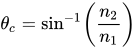
For the refractive index of sample, the refractive index of the cover slip.


Thus, as the angle of incidence reaches , we begin observing effects of total internal reflection and evanescent wave, and as it surpasses these effects are more prevalent.

The intensity of the evanescent wave is given by:
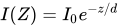
With penetration depth given by:


Typically, ≤~100 nanometers, which is typically much smaller than the wavelength of light, and much thinner than a slice from confocal microscopes.[1][12]
For TIRFM imaging the wavelength of the excitation beam within the sample can be selected for by filtering. Additionally, the range of incident angles is determined by the numerical aperture (NA) of the objective, and requires that NA > . This parameter can be adjusted by changing the angle the excitation beam enters the objective lens. Finally, the reflective indices () of the solution and cover slip can be experimentally found or reported by manufacturers.


Excitation beam
For complex fluoroscope microscopy techniques, lasers are the preferred light source as they are highly uniform, intense, and near-monochromatic. However, it is noted that ARC LAMP light sources and other types of sources may also work. Typically the wavelength of excitation beam is designated by the requirements of the fluorophores within the sample, with most common excitation wavelengths being in the 400–700 nm range for biological samples.
In practice, a lightbox will generate a high intensity multichromatic laser, which will then be filtered to allow the desired wavelengths through to excite the sample. For objective-based TIRFM, the excitation beam and fluoresced emission beam will be captured via the same objective lens. Thus, to split the beams, a dichromatic mirror is used to reflect the incoming excitation beam towards the objective lens, and allow the emission beam to pass through into the detector. Additional filtering may be required to further separate emission and excitation wavelengths.
Emission beam
When excited with specific wavelengths of light, fluorophore dyes will reemit light at longer wavelengths (which contain less energy). In the context of TIRFM, only fluorophores close to the interface will be readily excited by the evanescent field, while those past ~100 nm will be highly attenuated. Light emitted by the fluorophores will be undirected, and thus will pass through the objective lens at varying locations with varying intensities. This signal will then pass through the dichromatic mirror and onward to the detector.
Cover slip and immersion oil
Glass cover slips typically have a reflective index around , while the immersion oil refractive index is a comparable . The medium of air, which has a refractive index of , would cause refraction of the excitation beam between the objective and the coverslip, thus the oil is used to buffer the region and prevent superfluous interface interactions before the beam reaches the interface between coverslip and sample.


Objective lens
The objective lensnumerical aperture (NA) specifies the range of angles over which the system can accept or emit light.
To achieve the greatest incident angles, it is desirable to pass light at an off-axis angle through the peripheries of the lens.
Back focal plane (BPF)
The back focal plane (also called "aperture plane") is the plane through which the excitatory beam is focused before passing through the objective. Adjusting the distance between the objective and BPF can yield different imaging magnification, as the incident angle will become less or more steep. The beam must be passed through the BPF off-axis in order to pass through the objective at its ends, allowing for the angle to be sufficiently greater than the critical angle. The beam must also be focused at the BPF because this ensures that the light passing through the objective is collimated, interacting with the cover slip at the same angle and thus all totally internally reflecting.[12]
Sample
The sample should be adsorbed to the surface of the glass cover slide and stained with appropriate fluorophores to resolve the features desired within the sample. This is in protocol with any other fluorescent microscopy technique.
Dichroic (dichromatic) filter
The dichroic filter is an edge filter used at an oblique angle of incidence (typically 45°) to efficiently reflect light in the excitation band and to transmit light in the emission band. The 45° angle of the filter separates the path of the excitation and emission beam. The filter is composed of a complex system of multiple layers of metals, metal salts and dielectrics which have been vacuum-deposited onto thin glass.[13] This coating is designed to have high reflectivity for shorter wavelengths and high transmission for longer wavelengths.[14] While the filter transmits the selected excitation light (shorter wavelength) through the objective and onto the plane of the specimen, it also passes emission fluorescence light (longer wavelength) to the barrier filter and reflecting any scattered excitation light back in the direction of the laser source.[15] This maximizes the amount of exciting radiation passing through the filter and emitted fluorescence beam that is detected by the detector.[16]
Barrier filter
The barrier filter mainly blocks off undesired wavelengths, especially shorter excitation light wavelengths. It is typically a bandpass filter that passes only the wavelengths emitted by the fluorophore and blocks all undesired light outside this band. More modern microscopes enable the barrier filter to be changed according to the wavelength of the fluorophore's specific emission.[13]
Image detection and resolution
The image is detected by a charged-coupled device (CCD) digital camera. CCD cameras have photon detectors, which are thin silicon wafers, assembled into 2D arrays of light-sensitive regions. The detector arrays capture and store image information in the form of localized electrical charge that varies with incident light intensity.[2] As shown in the schematic the photons are transformed into electrons by the detectors and the electrons are converted to readable electrical signal in the circuit board.[17] The electrical signal is then convoluted with a point spread function (PSF) to sample the original signal. As such, image resolution is highly dependent on the number of detectors and the point spread function will determine the image resolution.[18]
Image artifact and noise
Most fluorescence imaging techniques exhibit background noise due to illuminating and reconstructing large slices (in the z-direction) of the samples. Since TIRFM uses an evanescent wave to fluoresce a thin slice of the sample, there is inherently less background noise and artifacts. However, there are still other noises and artifacts such as poisson noise, optical aberrations, photobleaching, and other fluorescence molecules.
Poissonian noise are fundamental uncertainties with the measurement of light. This will cause uncertainties during the detection of fluorescence photons.[18] If N photons are measured in a particular measurement, there is a 63% probability that the true average value is in the range between N +√N and N −√N.[19] This noise may cause misrepresentation of the object at incorrect pixel locations.
Optical aberrations can arise from diffraction of fluorescence light or microscope and objective misalignment. Diffraction of light on the sample slide can spread the fluorescence signal and result in blurring in the convoluted images. Similarly, if there is a misalignment between the objective lens, filter, and detector, the excitation or emission beam may not be in focus and can cause blurring in the images.[14]
Photobleaching can occur when the covalent or noncovalent bonds in the fluorophores are destructed by the excitation light and can no longer fluoresce.[20] The fluorescing substances will always degrade to some extent by the energy of the exciting radiation and will cause the fluorescence to fade and result in a dark blurry image.[21] Photobleaching is inevitable but can be minimized by avoiding unwanted light exposure and using immersion oils to minimize light scattering.[13]
Autofluorescence can occur in certain cell structures where the natural compound in the structure would fluoresce after being excited at relatively shorter wavelengths (similar to that of the excitation wavelength).[18] Induced fluorescence can also occur when certain non-autofluorescent compounds become fluorescent after binding to certain chemicals (such as formaldehyde).[13] These fluorescence can result in artifacts or background noise in the image. Noise from other fluorescence compounds can be effectively eliminated by using filters to capture the desired fluorescence wavelength, or by making sure the autofluorescence compounds are not present in the sample.
Current and future work
Modern fluorescence techniques attempt to incorporate methods to eliminate some blurring and noises. Optical aberrations are generally deterministic (it is constant throughout the image process and across different samples).[18] Deterministic blurring can be eliminated by deconvoluting the signal and subtracting the known artifact. The deconvolution technique is simply using an inverse fourier transform to obtain the original fluorescence signal and remove the artifact.[19]
Nevertheless, deconvolution has only been shown to work if there is a strong fluorescence signal or when the noise is clearly identified. In addition, deconvolution performs poorly because it does not include statistical information and can not reduce non-deterministic noise such as poissonian noise. To obtain better image resolution and quality, researchers have used statistical techniques to model the probability where photons may be distributed on the detector.[18][22] This technique, called the maximum likelihood method, is being further improved by algorithms to improve its performance speed.[22]
External links
- Interactive Fluorescence Dye and Filter Database Carl Zeiss Interactive Fluorescence Dye and Filter Database.
- TIRF Microscopy: Introduction and ApplicationsTIRF Tutorial from Microscopy U
- TIRF Microscopy: OverviewTIRF Tutorial from Olympus Microscopy Resource Center
- Olympus TIRFM Microscopescommercial TIRF microscope systems
- Carl Zeiss Laser TIRF 3commercial TIRF microscope systems
- Lightguide- and prism-based TIRF microscopyTIRF-Labs.com :Commercial TIRF Microscopy and Spectroscopy. Selecting TIRFM geometry for your application
- TIRF FLIM microscopyLambert Instruments TIRF - FLIM microscopy
- Schwartz Research Group, CU-BoulderSingle Molecule Imaging Research Group
สรุปเนื้อหา
ข้อมูลสำคัญจากบทความ
ข้อมูลสำคัญเกี่ยวกับ กล้องจุลทรรศน์ฟลูออเรสเซนต์แบบสะท้อนภายในทั้งหมด
กล้องจุลทรรศน์ฟลูออเรสเซนต์แบบสะท้อนภายในทั้งหมด ( TIRFM ) เป็นกล้องจุลทรรศน์ชนิดหนึ่งที่สามารถสังเกตบริเวณบางๆ ของชิ้นงานได้ ซึ่งโดยปกติจะมีความหนาน้อยกว่า 200 นาโนเมตร
ประวัติศาสตร์
การเรืองแสงแบบไวด์ฟิลด์ได้รับการแนะนำในปี พ.ศ. 2453 ซึ่งเป็นเทคนิคทางแสงที่ส่องสว่างตัวอย่างทั้งหมด [ 3 ] ต่อมากล้องจุลทรรศน์แบบคอนโฟคอลได้รับการแนะนำในปี พ.ศ.
พื้นหลัง
มีสองวิธีทั่วไปในการสร้าง คลื่นเอวาเนสเซนต์ สำหรับ TIRFM [ 1 ] วิธีแรกคือวิธีใช้ปริซึม ซึ่งใช้ปริซึมเพื่อนำแสงเลเซอร์ไปยังส่วนต่อประสานระหว่างกระจกปิดและตัวกลาง/เซลล์ที่มุมตกกระทบเพียงพอที่จะทำให้เกิดการสะท้อนภายในทั้งหมด...
แอปพลิเคชัน
In cell and molecular biology , a large number of molecular events in cellular surfaces such as cell adhesion , binding of cells by hormones , secretion of neurotransmitters , and membrane dynamics have been studied with conventional fluorescence microscopes .