เวกเตอร์ฮาร์มอนิกทรงกลม (Learn how and when to remove this message ) ในทางคณิตศาสตร์ ฮาร์มอนิกทรงกลมเวกเตอร์ ( VSH ) เป็นส่วนขยายของฮาร์มอนิกทรงกลมส เกลาร์ เพื่อใช้กับฟิลด์เวกเตอร์ ส่วนประกอบของ VSH เป็น ฟังก์ชัน ค่าเชิงซ้อน ที่แสดงใน เวก เตอร์ ฐานพิกัดทรงกลม
คำนิยาม มีการใช้ข้อตกลงหลายประการในการกำหนด VSH [ 1 ] [ 2 ] [ 3 ] [ 4 ] [ 5 ] et al. โดยกำหนดให้ ฮาร์ มอนิกทรงกลม แบบสเกลาร์ Y ℓm ( θ , φ )
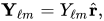
Y ℓ m = Y ℓ m r ^ , {\displaystyle \mathbf {Y} _{\ell m}=Y_{\ell m}{\hat {\mathbf {r} }},} Ψ ℓ m = r ∇ Y ℓ m , {\displaystyle \mathbf {\Psi } _{\ell m}=r\nabla Y_{\ell m},} Φ ℓ m = r × ∇ Y ℓ m , {\displaystyle \mathbf {\Phi } _{\ell m}=\mathbf {r} \times \nabla Y_{\ell m},} โดยที่ เป็นเวกเตอร์หน่วย ตามทิศทางรัศมีในพิกัดทรงกลม และเป็นเวกเตอร์ตามทิศทางรัศมีที่มีขนาดเท่ากับรัศมี กล่าวคือปัจจัยรัศมีถูกรวมไว้เพื่อรับประกันว่ามิติของ VSH จะเหมือนกับมิติของฮาร์มอนิกทรงกลมทั่วไป และ VSH จะไม่ขึ้นอยู่กับพิกัดทรงกลมในแนวรัศมี r ^ {\displaystyle {\hat {\mathbf {r} }}} r {\displaystyle \mathbf {r} } r = r r ^ {\displaystyle \mathbf {r} =r{\hat {\mathbf {r} }}}
จุดเด่นของสนามเวกเตอร์ใหม่เหล่านี้คือการแยกการพึ่งพาเชิงรัศมีออกจากการพึ่งพาเชิงมุมเมื่อใช้พิกัดทรงกลม ทำให้สนามเวกเตอร์สามารถขยายแบบมัลติโพลได้
E = ∑ ℓ = 0 ∞ ∑ m = − ℓ ℓ ( E ℓ m r ( r ) Y ℓ m + E ℓ m ( 1 ) ( r ) Ψ ℓ m + E ℓ m ( 2 ) ( r ) Φ ℓ m ) . {\displaystyle \mathbf {E} =\sum _{\ell =0}^{\infty }\sum _{m=-\ell }^{\ell }\left(E_{\ell m}^{r}(r)\mathbf {Y} _{\ell m}+E_{\ell m}^{(1)}(r)\mathbf {\Psi } _{\ell m}+E_{\ell m}^{(2)}(r)\mathbf {\Phi } _{\ell m}\right).}
ป้ายกำกับบนส่วนประกอบต่างๆ สะท้อนให้เห็นว่าคือส่วนประกอบแนวรัศมีของสนามเวกเตอร์ ในขณะที่และคือส่วนประกอบแนวขวาง (เมื่อเทียบกับเวกเตอร์รัศมี) E ℓ m r {\displaystyle E_{\ell m}^{r}} E ℓ m ( 1 ) {\displaystyle E_{\ell m}^{(1)}} E ℓ m ( 2 ) {\displaystyle E_{\ell m}^{(2)}} r {\displaystyle \mathbf {r} }
ในวิชาฟิสิกส์ ในฟิสิกส์ เวกเตอร์ทรงกลมฮาร์มอนิกถูกกำหนดให้เป็นฟังก์ชัน เฉพาะ ของสปินของตัวดำเนินการโมเมนตัมเชิงมุม , และโดยที่คือโมเมนตัมเชิงมุมรวม[ 6 ] -Gordan Y j , ℓ , s m j {\displaystyle \mathbf {Y} _{j,\ell ,s}^{m_{j}}} s = 1 {\textstyle s=1} J 2 , J z , L 2 {\textstyle J^{2},J_{z},L^{2}} S 2 {\textstyle S^{2}} J = L + S {\textstyle \mathbf {J} =\mathbf {L} +\mathbf {S} } Y j , ℓ , 1 m j ( k ) = ∑ m ℓ = − ℓ + ℓ ∑ m s = − 1 + 1 ⟨ j m j | ℓ 1 m ℓ m s ⟩ Y ℓ m ℓ ( k ) e ^ m s , {\displaystyle \mathbf {Y} _{j,\ell ,1}^{m_{j}}(\mathbf {k} )=\sum _{m_{\ell }\,=\,-\ell }^{+\ell }~\sum _{m_{s}\,=\,-1}^{+1}\langle j~m_{j}|\ell ~1~m_{\ell }~m_{s}\rangle Y_{\ell }^{m_{\ell }}(\mathbf {k} )\,{\hat {\mathbf {e} }}_{m_{s}},} Y ℓ m ℓ {\displaystyle Y_{\ell }^{m_{\ell }}} e ^ ± 1 = ∓ x ^ ± i y ^ 2 , e ^ 0 = z ^ . {\displaystyle {\hat {\mathbf {e} }}_{\pm 1}=\mp {\frac {{\hat {\mathbf {x} }}\pm i{\hat {\mathbf {y} }}}{\sqrt {2}}},\quad {\hat {\mathbf {e} }}_{0}={\hat {\mathbf {z} }}.} ⟨ j m j | ℓ 1 m ℓ m s ⟩ {\displaystyle \langle j~m_{j}|\ell ~1~m_{\ell }~m_{s}\rangle }
Because vector bosons such as the photon are spin-one, the vector spherical harmonics are commonly used in physics to describe vector and pseudovector interactions, such as electromagnetic transitions, in atomic and nuclear systems. They are a special (s = 1 {\textstyle s=1} spin spherical harmonics .
To derive these relations, one begins with the plane-wave expansion for plane waves with vector polarization.
Main properties
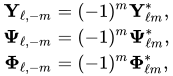
Symmetry Like the scalar spherical harmonics, the VSH satisfy
Y ℓ , − m = ( − 1 ) m Y ℓ m ∗ , Ψ ℓ , − m = ( − 1 ) m Ψ ℓ m ∗ , Φ ℓ , − m = ( − 1 ) m Φ ℓ m ∗ , {\displaystyle {\begin{aligned}\mathbf {Y} _{\ell ,-m}&=(-1)^{m}\mathbf {Y} _{\ell m}^{*},\\\mathbf {\Psi } _{\ell ,-m}&=(-1)^{m}\mathbf {\Psi } _{\ell m}^{*},\\\mathbf {\Phi } _{\ell ,-m}&=(-1)^{m}\mathbf {\Phi } _{\ell m}^{*},\end{aligned}}}
which cuts the number of independent functions roughly in half. The star indicates complex conjugation .
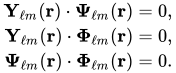
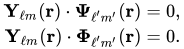
Orthogonality The VSH are orthogonal in the usual three-dimensional way at each point r {\displaystyle \mathbf {r} }
Y ℓ m ( r ) ⋅ Ψ ℓ m ( r ) = 0 , Y ℓ m ( r ) ⋅ Φ ℓ m ( r ) = 0 , Ψ ℓ m ( r ) ⋅ Φ ℓ m ( r ) = 0. {\displaystyle {\begin{aligned}\mathbf {Y} _{\ell m}(\mathbf {r} )\cdot \mathbf {\Psi } _{\ell m}(\mathbf {r} )&=0,\\\mathbf {Y} _{\ell m}(\mathbf {r} )\cdot \mathbf {\Phi } _{\ell m}(\mathbf {r} )&=0,\\\mathbf {\Psi } _{\ell m}(\mathbf {r} )\cdot \mathbf {\Phi } _{\ell m}(\mathbf {r} )&=0.\end{aligned}}}
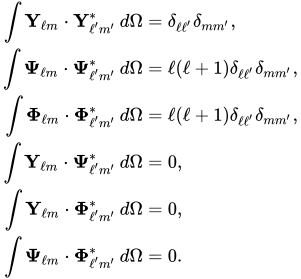
They are also orthogonal in Hilbert space :
∫ Y ℓ m ⋅ Y ℓ ′ m ′ ∗ d Ω = δ ℓ ℓ ′ δ m m ′ , ∫ Ψ ℓ m ⋅ Ψ ℓ ′ m ′ ∗ d Ω = ℓ ( ℓ + 1 ) δ ℓ ℓ ′ δ m m ′ , ∫ Φ ℓ m ⋅ Φ ℓ ′ m ′ ∗ d Ω = ℓ ( ℓ + 1 ) δ ℓ ℓ ′ δ m m ′ , ∫ Y ℓ m ⋅ Ψ ℓ ′ m ′ ∗ d Ω = 0 , ∫ Y ℓ m ⋅ Φ ℓ ′ m ′ ∗ d Ω = 0 , ∫ Ψ ℓ m ⋅ Φ ℓ ′ m ′ ∗ d Ω = 0. {\displaystyle {\begin{aligned}\int \mathbf {Y} _{\ell m}\cdot \mathbf {Y} _{\ell 'm'}^{*}\,d\Omega &=\delta _{\ell \ell '}\delta _{mm'},\\\int \mathbf {\Psi } _{\ell m}\cdot \mathbf {\Psi } _{\ell 'm'}^{*}\,d\Omega &=\ell (\ell +1)\delta _{\ell \ell '}\delta _{mm'},\\\int \mathbf {\Phi } _{\ell m}\cdot \mathbf {\Phi } _{\ell 'm'}^{*}\,d\Omega &=\ell (\ell +1)\delta _{\ell \ell '}\delta _{mm'},\\\int \mathbf {Y} _{\ell m}\cdot \mathbf {\Psi } _{\ell 'm'}^{*}\,d\Omega &=0,\\\int \mathbf {Y} _{\ell m}\cdot \mathbf {\Phi } _{\ell 'm'}^{*}\,d\Omega &=0,\\\int \mathbf {\Psi } _{\ell m}\cdot \mathbf {\Phi } _{\ell 'm'}^{*}\,d\Omega &=0.\end{aligned}}}
An additional result at a single point r {\displaystyle \mathbf {r} } ℓ , m , ℓ ′ , m ′ {\displaystyle \ell ,m,\ell ',m'}
Y ℓ m ( r ) ⋅ Ψ ℓ ′ m ′ ( r ) = 0 , Y ℓ m ( r ) ⋅ Φ ℓ ′ m ′ ( r ) = 0. {\displaystyle {\begin{aligned}\mathbf {Y} _{\ell m}(\mathbf {r} )\cdot \mathbf {\Psi } _{\ell 'm'}(\mathbf {r} )&=0,\\\mathbf {Y} _{\ell m}(\mathbf {r} )\cdot \mathbf {\Phi } _{\ell 'm'}(\mathbf {r} )&=0.\end{aligned}}}
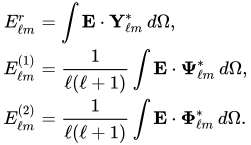
Vector multipole moments The orthogonality relations allow one to compute the spherical multipole moments of a vector field as
E ℓ m r = ∫ E ⋅ Y ℓ m ∗ d Ω , E ℓ m ( 1 ) = 1 ℓ ( ℓ + 1 ) ∫ E ⋅ Ψ ℓ m ∗ d Ω , E ℓ m ( 2 ) = 1 ℓ ( ℓ + 1 ) ∫ E ⋅ Φ ℓ m ∗ d Ω . {\displaystyle {\begin{aligned}E_{\ell m}^{r}&=\int \mathbf {E} \cdot \mathbf {Y} _{\ell m}^{*}\,d\Omega ,\\E_{\ell m}^{(1)}&={\frac {1}{\ell (\ell +1)}}\int \mathbf {E} \cdot \mathbf {\Psi } _{\ell m}^{*}\,d\Omega ,\\E_{\ell m}^{(2)}&={\frac {1}{\ell (\ell +1)}}\int \mathbf {E} \cdot \mathbf {\Phi } _{\ell m}^{*}\,d\Omega .\end{aligned}}}
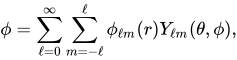
The gradient of a scalar field Given the multipole expansion of a scalar field
ϕ = ∑ ℓ = 0 ∞ ∑ m = − ℓ ℓ ϕ ℓ m ( r ) Y ℓ m ( θ , ϕ ) , {\displaystyle \phi =\sum _{\ell =0}^{\infty }\sum _{m=-\ell }^{\ell }\phi _{\ell m}(r)Y_{\ell m}(\theta ,\phi ),}
we can express its gradient in terms of the VSH as
∇ ϕ = ∑ ℓ = 0 ∞ ∑ m = − ℓ ℓ ( d ϕ ℓ m d r Y ℓ m + ϕ ℓ m r Ψ ℓ m ) . {\displaystyle \nabla \phi =\sum _{\ell =0}^{\infty }\sum _{m=-\ell }^{\ell }\left({\frac {d\phi _{\ell m}}{dr}}\mathbf {Y} _{\ell m}+{\frac {\phi _{\ell m}}{r}}\mathbf {\Psi } _{\ell m}\right).}
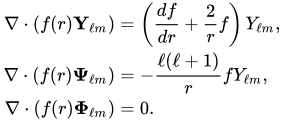
Divergence For any multipole field we have
∇ ⋅ ( f ( r ) Y ℓ m ) = ( d f d r + 2 r f ) Y ℓ m , ∇ ⋅ ( f ( r ) Ψ ℓ m ) = − ℓ ( ℓ + 1 ) r f Y ℓ m , ∇ ⋅ ( f ( r ) Φ ℓ m ) = 0. {\displaystyle {\begin{aligned}\nabla \cdot \left(f(r)\mathbf {Y} _{\ell m}\right)&=\left({\frac {df}{dr}}+{\frac {2}{r}}f\right)Y_{\ell m},\\\nabla \cdot \left(f(r)\mathbf {\Psi } _{\ell m}\right)&=-{\frac {\ell (\ell +1)}{r}}fY_{\ell m},\\\nabla \cdot \left(f(r)\mathbf {\Phi } _{\ell m}\right)&=0.\end{aligned}}}
By superposition we obtain the divergence of any vector field:
∇ ⋅ E = ∑ ℓ = 0 ∞ ∑ m = − ℓ ℓ ( d E ℓ m r d r + 2 r E ℓ m r − ℓ ( ℓ + 1 ) r E ℓ m ( 1 ) ) Y ℓ m . {\displaystyle \nabla \cdot \mathbf {E} =\sum _{\ell =0}^{\infty }\sum _{m=-\ell }^{\ell }\left({\frac {dE_{\ell m}^{r}}{dr}}+{\frac {2}{r}}E_{\ell m}^{r}-{\frac {\ell (\ell +1)}{r}}E_{\ell m}^{(1)}\right)Y_{\ell m}.}
We see that the component on Φ ℓm solenoidal .
Curl For any multipole field we have
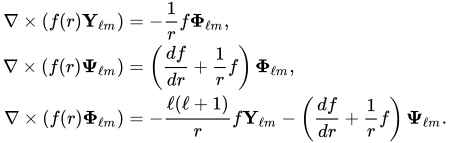
∇ × ( f ( r ) Y ℓ m ) = − 1 r f Φ ℓ m , ∇ × ( f ( r ) Ψ ℓ m ) = ( d f d r + 1 r f ) Φ ℓ m , ∇ × ( f ( r ) Φ ℓ m ) = − ℓ ( ℓ + 1 ) r f Y ℓ m − ( d f d r + 1 r f ) Ψ ℓ m . {\displaystyle {\begin{aligned}\nabla \times \left(f(r)\mathbf {Y} _{\ell m}\right)&=-{\frac {1}{r}}f\mathbf {\Phi } _{\ell m},\\\nabla \times \left(f(r)\mathbf {\Psi } _{\ell m}\right)&=\left({\frac {df}{dr}}+{\frac {1}{r}}f\right)\mathbf {\Phi } _{\ell m},\\\nabla \times \left(f(r)\mathbf {\Phi } _{\ell m}\right)&=-{\frac {\ell (\ell +1)}{r}}f\mathbf {Y} _{\ell m}-\left({\frac {df}{dr}}+{\frac {1}{r}}f\right)\mathbf {\Psi } _{\ell m}.\end{aligned}}}
By superposition we obtain the curl of any vector field:
∇ × E = ∑ ℓ = 0 ∞ ∑ m = − ℓ ℓ ( − ℓ ( ℓ + 1 ) r E ℓ m ( 2 ) Y ℓ m − ( d E ℓ m ( 2 ) d r + 1 r E ℓ m ( 2 ) ) Ψ ℓ m + ( − 1 r E ℓ m r + d E ℓ m ( 1 ) d r + 1 r E ℓ m ( 1 ) ) Φ ℓ m ) . {\displaystyle \nabla \times \mathbf {E} =\sum _{\ell =0}^{\infty }\sum _{m=-\ell }^{\ell }\left(-{\frac {\ell (\ell +1)}{r}}E_{\ell m}^{(2)}\mathbf {Y} _{\ell m}-\left({\frac {dE_{\ell m}^{(2)}}{dr}}+{\frac {1}{r}}E_{\ell m}^{(2)}\right)\mathbf {\Psi } _{\ell m}+\left(-{\frac {1}{r}}E_{\ell m}^{r}+{\frac {dE_{\ell m}^{(1)}}{dr}}+{\frac {1}{r}}E_{\ell m}^{(1)}\right)\mathbf {\Phi } _{\ell m}\right).}
Laplacian The action of the Laplace operator Δ = ∇ ⋅ ∇ {\displaystyle \Delta =\nabla \cdot \nabla }
Δ ( f ( r ) Z ℓ m ) = ( 1 r 2 ∂ ∂ r r 2 ∂ f ∂ r ) Z ℓ m + f ( r ) Δ Z ℓ m , {\displaystyle \Delta \left(f(r)\mathbf {Z} _{\ell m}\right)=\left({\frac {1}{r^{2}}}{\frac {\partial }{\partial r}}r^{2}{\frac {\partial f}{\partial r}}\right)\mathbf {Z} _{\ell m}+f(r)\Delta \mathbf {Z} _{\ell m},} Z ℓ m = Y ℓ m , Ψ ℓ m , Φ ℓ m {\displaystyle \mathbf {Z} _{\ell m}=\mathbf {Y} _{\ell m},\mathbf {\Psi } _{\ell m},\mathbf {\Phi } _{\ell m}}
Δ Y ℓ m = − 1 r 2 ( 2 + ℓ ( ℓ + 1 ) ) Y ℓ m + 2 r 2 Ψ ℓ m , Δ Ψ ℓ m = 2 ℓ ( ℓ + 1 ) r 2 Y ℓ m − 1 r 2 ℓ ( ℓ + 1 ) Ψ ℓ m , Δ Φ ℓ m = − 1 r 2 ℓ ( ℓ + 1 ) Φ ℓ m . {\displaystyle {\begin{aligned}\Delta \mathbf {Y} _{\ell m}&=-{\frac {1}{r^{2}}}(2+\ell (\ell +1))\mathbf {Y} _{\ell m}+{\frac {2}{r^{2}}}\mathbf {\Psi } _{\ell m},\\\Delta \mathbf {\Psi } _{\ell m}&={\frac {2\ell (\ell +1)}{r^{2}}}\mathbf {Y} _{\ell m}-{\frac {1}{r^{2}}}\ell (\ell +1)\mathbf {\Psi } _{\ell m},\\\Delta \mathbf {\Phi } _{\ell m}&=-{\frac {1}{r^{2}}}\ell (\ell +1)\mathbf {\Phi } _{\ell m}.\end{aligned}}}
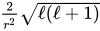
Also note that this action becomes symmetric , i.e. the off-diagonal coefficients are equal to 2 r 2 ℓ ( ℓ + 1 ) {\textstyle {\frac {2}{r^{2}}}{\sqrt {\ell (\ell +1)}}} normalized VSH.
Examples
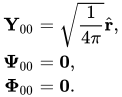
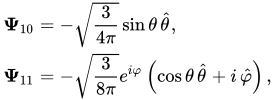
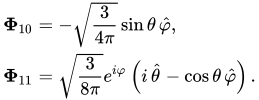
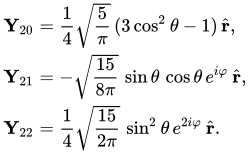
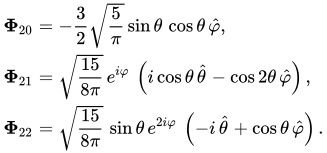
First vector spherical harmonics ℓ = 0 {\displaystyle \ell =0} Y 00 = 1 4 π r ^ , Ψ 00 = 0 , Φ 00 = 0 . {\displaystyle {\begin{aligned}\mathbf {Y} _{00}&={\sqrt {\frac {1}{4\pi }}}{\hat {\mathbf {r} }},\\\mathbf {\Psi } _{00}&=\mathbf {0} ,\\\mathbf {\Phi } _{00}&=\mathbf {0} .\end{aligned}}} ℓ = 1 {\displaystyle \ell =1} Y 10 = 3 4 π cos θ r ^ , Y 11 = − 3 8 π e i φ sin θ r ^ , {\displaystyle {\begin{aligned}\mathbf {Y} _{10}&={\sqrt {\frac {3}{4\pi }}}\cos \theta \,{\hat {\mathbf {r} }},\\\mathbf {Y} _{11}&=-{\sqrt {\frac {3}{8\pi }}}e^{i\varphi }\sin \theta \,{\hat {\mathbf {r} }},\end{aligned}}} Ψ 10 = − 3 4 π sin θ θ ^ , Ψ 11 = − 3 8 π e i φ ( cos θ θ ^ + i φ ^ ) , {\displaystyle {\begin{aligned}\mathbf {\Psi } _{10}&=-{\sqrt {\frac {3}{4\pi }}}\sin \theta \,{\hat {\mathbf {\theta } }},\\\mathbf {\Psi } _{11}&=-{\sqrt {\frac {3}{8\pi }}}e^{i\varphi }\left(\cos \theta \,{\hat {\mathbf {\theta } }}+i\,{\hat {\mathbf {\varphi } }}\right),\end{aligned}}} Φ 10 = − 3 4 π sin θ φ ^ , Φ 11 = 3 8 π e i φ ( i θ ^ − cos θ φ ^ ) . {\displaystyle {\begin{aligned}\mathbf {\Phi } _{10}&=-{\sqrt {\frac {3}{4\pi }}}\sin \theta \,{\hat {\mathbf {\varphi } }},\\\mathbf {\Phi } _{11}&={\sqrt {\frac {3}{8\pi }}}e^{i\varphi }\left(i\,{\hat {\mathbf {\theta } }}-\cos \theta \,{\hat {\mathbf {\varphi } }}\right).\end{aligned}}} ℓ = 2 {\displaystyle \ell =2} Y 20 = 1 4 5 π ( 3 cos 2 θ − 1 ) r ^ , Y 21 = − 15 8 π sin θ cos θ e i φ r ^ , Y 22 = 1 4 15 2 π sin 2 θ e 2 i φ r ^ . {\displaystyle {\begin{aligned}\mathbf {Y} _{20}&={\frac {1}{4}}{\sqrt {\frac {5}{\pi }}}\,(3\cos ^{2}\theta -1)\,{\hat {\mathbf {r} }},\\\mathbf {Y} _{21}&=-{\sqrt {\frac {15}{8\pi }}}\,\sin \theta \,\cos \theta \,e^{i\varphi }\,{\hat {\mathbf {r} }},\\\mathbf {Y} _{22}&={\frac {1}{4}}{\sqrt {\frac {15}{2\pi }}}\,\sin ^{2}\theta \,e^{2i\varphi }\,{\hat {\mathbf {r} }}.\end{aligned}}} Ψ 20 = − 3 2 5 π sin θ cos θ θ ^ , Ψ 21 = − 15 8 π e i φ ( cos 2 θ θ ^ + i cos θ φ ^ ) , Ψ 22 = 15 8 π sin θ e 2 i φ ( cos θ θ ^ + i φ ^ ) . {\displaystyle {\begin{aligned}\mathbf {\Psi } _{20}&=-{\frac {3}{2}}{\sqrt {\frac {5}{\pi }}}\,\sin \theta \,\cos \theta \,{\hat {\mathbf {\theta } }},\\\mathbf {\Psi } _{21}&=-{\sqrt {\frac {15}{8\pi }}}\,e^{i\varphi }\,\left(\cos 2\theta \,{\hat {\mathbf {\theta } }}+i\cos \theta \,{\hat {\mathbf {\varphi } }}\right),\\\mathbf {\Psi } _{22}&={\sqrt {\frac {15}{8\pi }}}\,\sin \theta \,e^{2i\varphi }\,\left(\cos \theta \,{\hat {\mathbf {\theta } }}+i\,{\hat {\mathbf {\varphi } }}\right).\end{aligned}}} Φ 20 = − 3 2 5 π sin θ cos θ φ ^ , Φ 21 = 15 8 π e i φ ( i cos θ θ ^ − cos 2 θ φ ^ ) , Φ 22 = 15 8 π sin θ e 2 i φ ( − i θ ^ + cos θ φ ^ ) . {\displaystyle {\begin{aligned}\mathbf {\Phi } _{20}&=-{\frac {3}{2}}{\sqrt {\frac {5}{\pi }}}\sin \theta \,\cos \theta \,{\hat {\mathbf {\varphi } }},\\\mathbf {\Phi } _{21}&={\sqrt {\frac {15}{8\pi }}}\,e^{i\varphi }\,\left(i\cos \theta \,{\hat {\mathbf {\theta } }}-\cos 2\theta \,{\hat {\mathbf {\varphi } }}\right),\\\mathbf {\Phi } _{22}&={\sqrt {\frac {15}{8\pi }}}\,\sin \theta \,e^{2i\varphi }\,\left(-i\,{\hat {\mathbf {\theta } }}+\cos \theta \,{\hat {\mathbf {\varphi } }}\right).\end{aligned}}} Expressions for negative values of m are obtained by applying the symmetry relations.
Applications
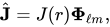
Electrodynamics The VSH are especially useful in the study of multipole radiation fields . For instance, a magnetic multipole is due to an oscillating current with angular frequency ω {\displaystyle \omega }
J ^ = J ( r ) Φ ℓ m , {\displaystyle {\hat {\mathbf {J} }}=J(r)\mathbf {\Phi } _{\ell m},}
and the corresponding electric and magnetic fields, can be written as
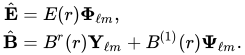
E ^ = E ( r ) Φ ℓ m , B ^ = B r ( r ) Y ℓ m + B ( 1 ) ( r ) Ψ ℓ m . {\displaystyle {\begin{aligned}{\hat {\mathbf {E} }}&=E(r)\mathbf {\Phi } _{\ell m},\\{\hat {\mathbf {B} }}&=B^{r}(r)\mathbf {Y} _{\ell m}+B^{(1)}(r)\mathbf {\Psi } _{\ell m}.\end{aligned}}}
Substituting into Maxwell equations, Gauss's law is automatically satisfied
∇ ⋅ E ^ = 0 , {\displaystyle \nabla \cdot {\hat {\mathbf {E} }}=0,}
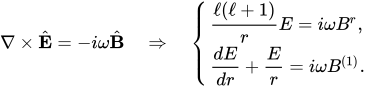
while Faraday's law decouples as
∇ × E ^ = − i ω B ^ ⇒ { ℓ ( ℓ + 1 ) r E = i ω B r , d E d r + E r = i ω B ( 1 ) . {\displaystyle \nabla \times {\hat {\mathbf {E} }}=-i\omega {\hat {\mathbf {B} }}\quad \Rightarrow \quad {\begin{cases}{\dfrac {\ell (\ell +1)}{r}}E=i\omega B^{r},\\{\dfrac {dE}{dr}}+{\dfrac {E}{r}}=i\omega B^{(1)}.\end{cases}}}
Gauss' law for the magnetic field implies
∇ ⋅ B ^ = 0 ⇒ d B r d r + 2 r B r − ℓ ( ℓ + 1 ) r B ( 1 ) = 0 , {\displaystyle \nabla \cdot {\hat {\mathbf {B} }}=0\quad \Rightarrow \quad {\frac {dB^{r}}{dr}}+{\frac {2}{r}}B^{r}-{\frac {\ell (\ell +1)}{r}}B^{(1)}=0,}
and Ampère–Maxwell's equation gives
∇ × B ^ = μ 0 J ^ + i μ 0 ε 0 ω E ^ ⇒ − B r r + d B ( 1 ) d r + B ( 1 ) r = μ 0 J + i ω μ 0 ε 0 E . {\displaystyle \nabla \times {\hat {\mathbf {B} }}=\mu _{0}{\hat {\mathbf {J} }}+i\mu _{0}\varepsilon _{0}\omega {\hat {\mathbf {E} }}\quad \Rightarrow \quad -{\frac {B^{r}}{r}}+{\frac {dB^{(1)}}{dr}}+{\frac {B^{(1)}}{r}}=\mu _{0}J+i\omega \mu _{0}\varepsilon _{0}E.}
In this way, the partial differential equations have been transformed into a set of ordinary differential equations.
Alternative definition Angular part of magnetic and electric vector spherical harmonics. Red and green arrows show the direction of the field. Generating scalar functions are also presented, only the first three orders are shown (dipoles, quadrupoles, octupoles). In many applications, vector spherical harmonics are defined as fundamental set of the solutions of vector Helmholtz equation in spherical coordinates.[ 7] [ 8]
In this case, vector spherical harmonics are generated by scalar functions, which are solutions of scalar Helmholtz equation with the wavevector k {\displaystyle \mathbf {k} } ψ e m n = cos m φ P n m ( cos ϑ ) z n ( k r ) ψ o m n = sin m φ P n m ( cos ϑ ) z n ( k r ) {\displaystyle {\begin{array}{l}{\psi _{emn}=\cos m\varphi P_{n}^{m}(\cos \vartheta )z_{n}({k}r)}\\{\psi _{omn}=\sin m\varphi P_{n}^{m}(\cos \vartheta )z_{n}({k}r)}\end{array}}} P n m ( cos θ ) {\displaystyle P_{n}^{m}(\cos \theta )} associated Legendre polynomials , and z n ( k r ) {\displaystyle z_{n}({k}r)} spherical Bessel functions .
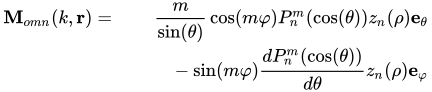
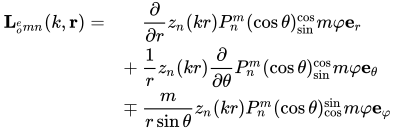
Vector spherical harmonics are defined as:
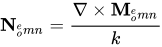
longitudinal harmonics L o e m n = ∇ ψ o e m n {\displaystyle \mathbf {L} _{^{e}_{o}mn}=\mathbf {\nabla } \psi _{^{e}_{o}mn}} magnetic harmonics M o e m n = ∇ × ( r ψ o e m n ) {\displaystyle \mathbf {M} _{^{e}_{o}mn}=\nabla \times \left(\mathbf {r} \psi _{^{e}_{o}mn}\right)} electric harmonics N o e m n = ∇ × M o e m n k {\displaystyle \mathbf {N} _{^{e}_{o}mn}={\frac {\nabla \times \mathbf {M} _{^{e}_{o}mn}}{k}}} Here we use harmonics real-valued angular part, where m ≥ 0 {\displaystyle m\geq 0}
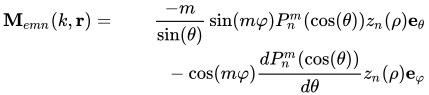
Let us introduce the notation ρ = k r {\displaystyle \rho =kr} M e m n ( k , r ) = − m sin ( θ ) sin ( m φ ) P n m ( cos ( θ ) ) z n ( ρ ) e θ − cos ( m φ ) d P n m ( cos ( θ ) ) d θ z n ( ρ ) e φ {\displaystyle {\begin{aligned}{\mathbf {M} _{emn}(k,\mathbf {r} )=\qquad {{\frac {-m}{\sin(\theta )}}\sin(m\varphi )P_{n}^{m}(\cos(\theta ))}z_{n}(\rho )\mathbf {e} _{\theta }}\\{{}-\cos(m\varphi ){\frac {dP_{n}^{m}(\cos(\theta ))}{d\theta }}}z_{n}(\rho )\mathbf {e} _{\varphi }\end{aligned}}} M o m n ( k , r ) = m sin ( θ ) cos ( m φ ) P n m ( cos ( θ ) ) z n ( ρ ) e θ − sin ( m φ ) d P n m ( cos ( θ ) ) d θ z n ( ρ ) e φ {\displaystyle {\begin{aligned}{\mathbf {M} _{omn}(k,\mathbf {r} )=\qquad {{\frac {m}{\sin(\theta )}}\cos(m\varphi )P_{n}^{m}(\cos(\theta ))}}z_{n}(\rho )\mathbf {e} _{\theta }\\{{}-\sin(m\varphi ){\frac {dP_{n}^{m}(\cos(\theta ))}{d\theta }}z_{n}(\rho )\mathbf {e} _{\varphi }}\end{aligned}}}
N e m n ( k , r ) = z n ( ρ ) ρ cos ( m φ ) n ( n + 1 ) P n m ( cos ( θ ) ) e r + cos ( m φ ) d P n m ( cos ( θ ) ) d θ 1 ρ d d ρ [ ρ z n ( ρ ) ] e θ − m sin ( m φ ) P n m ( cos ( θ ) ) sin ( θ ) 1 ρ d d ρ [ ρ z n ( ρ ) ] e φ {\displaystyle {\begin{aligned}{\mathbf {N} _{emn}(k,\mathbf {r} )=\qquad {\frac {z_{n}(\rho )}{\rho }}\cos(m\varphi )n(n+1)P_{n}^{m}(\cos(\theta ))\mathbf {e} _{\mathbf {r} }}\\{{}+\cos(m\varphi ){\frac {dP_{n}^{m}(\cos(\theta ))}{d\theta }}}{\frac {1}{\rho }}{\frac {d}{d\rho }}\left[\rho z_{n}(\rho )\right]\mathbf {e} _{\theta }\\{{}-m\sin(m\varphi ){\frac {P_{n}^{m}(\cos(\theta ))}{\sin(\theta )}}}{\frac {1}{\rho }}{\frac {d}{d\rho }}\left[\rho z_{n}(\rho )\right]\mathbf {e} _{\varphi }\end{aligned}}}
N o m n ( k , r ) = z n ( ρ ) ρ sin ( m φ ) n ( n + 1 ) P n m ( cos ( θ ) ) e r + sin ( m φ ) d P n m ( cos ( θ ) ) d θ 1 ρ d d ρ [ ρ z n ( ρ ) ] e θ + m cos ( m φ ) P n m ( cos ( θ ) ) sin ( θ ) 1 ρ d d ρ [ ρ z n ( ρ ) ] e φ {\displaystyle {\begin{aligned}\mathbf {N} _{omn}(k,\mathbf {r} )=\qquad {\frac {z_{n}(\rho )}{\rho }}\sin(m\varphi )n(n+1)P_{n}^{m}(\cos(\theta ))\mathbf {e} _{\mathbf {r} }\\{}+\sin(m\varphi ){\frac {dP_{n}^{m}(\cos(\theta ))}{d\theta }}{\frac {1}{\rho }}{\frac {d}{d\rho }}\left[\rho z_{n}(\rho )\right]\mathbf {e} _{\theta }\\{}+{m\cos(m\varphi ){\frac {P_{n}^{m}(\cos(\theta ))}{\sin(\theta )}}}{\frac {1}{\rho }}{\frac {d}{d\rho }}\left[\rho z_{n}(\rho )\right]\mathbf {e} _{\varphi }\end{aligned}}} ρ {\displaystyle \rho } ρ {\displaystyle \rho }
Longitudinal harmonics: L o e m n ( k , r ) = ∂ ∂ r z n ( k r ) P n m ( cos θ ) sin cos m φ e r + 1 r z n ( k r ) ∂ ∂ θ P n m ( cos θ ) sin cos m φ e θ ∓ m r sin θ z n ( k r ) P n m ( cos θ ) cos sin m φ e φ {\displaystyle {\begin{aligned}\mathbf {L} _{^{e}_{o}{mn}}(k,\mathbf {r} ){}=\qquad &{\frac {\partial }{\partial r}}z_{n}(kr)P_{n}^{m}(\cos \theta ){^{\cos }_{\sin }}{m\varphi }\mathbf {e} _{r}\\{}+{}&{\frac {1}{r}}z_{n}(kr){\frac {\partial }{\partial \theta }}P_{n}^{m}(\cos \theta ){^{\cos }_{\sin }}m\varphi \mathbf {e} _{\theta }\\{}\mp {}&{\frac {m}{r\sin \theta }}z_{n}(kr)P_{n}^{m}(\cos \theta ){^{\sin }_{\cos }}m\varphi \mathbf {e} _{\varphi }\end{aligned}}}
Orthogonality The solutions of the Helmholtz vector equation obey the following orthogonality relations:[ 8] ∫ 0 2 π ∫ 0 π L o e m n ⋅ L o e m n sin ϑ d ϑ d φ = ( 1 + δ m , 0 ) 2 π ( 2 n + 1 ) 2 ( n + m ) ! ( n − m ) ! k 2 { n [ z n − 1 ( k r ) ] 2 + ( n + 1 ) [ z n + 1 ( k r ) ] 2 } ∫ 0 2 π ∫ 0 π M o e m n ⋅ M o e m n sin ϑ d ϑ d φ = ( 1 + δ m , 0 ) 2 π 2 n + 1 ( n + m ) ! ( n − m ) ! n ( n + 1 ) [ z n ( k r ) ] 2 ∫ 0 2 π ∫ 0 π N o e m n ⋅ N o e m n sin ϑ d ϑ d φ = ( 1 + δ m , 0 ) 2 π ( 2 n + 1 ) 2 ( n + m ) ! ( n − m ) ! n ( n + 1 ) { ( n + 1 ) [ z n − 1 ( k r ) ] 2 + n [ z n + 1 ( k r ) ] 2 } ∫ 0 π ∫ 0 2 π L o e m n ⋅ N o e m n sin ϑ d ϑ d φ = ( 1 + δ m , 0 ) 2 π ( 2 n + 1 ) 2 ( n + m ) ! ( n − m ) ! n ( n + 1 ) k { [ z n − 1 ( k r ) ] 2 − [ z n + 1 ( k r ) ] 2 } {\displaystyle {\begin{aligned}\int _{0}^{2\pi }\int _{0}^{\pi }\mathbf {L} _{^{e}_{o}mn}\cdot \mathbf {L} _{^{e}_{o}mn}\sin \vartheta d\vartheta d\varphi &=(1+\delta _{m,0}){\frac {2\pi }{(2n+1)^{2}}}{\frac {(n+m)!}{(n-m)!}}k^{2}\left\{n\left[z_{n-1}(kr)\right]^{2}+(n+1)\left[z_{n+1}(kr)\right]^{2}\right\}\\[3pt]\int _{0}^{2\pi }\int _{0}^{\pi }\mathbf {M} _{^{e}_{o}mn}\cdot \mathbf {M} _{^{e}_{o}mn}\sin \vartheta d\vartheta d\varphi &=(1+\delta _{m,0}){\frac {2\pi }{2n+1}}{\frac {(n+m)!}{(n-m)!}}n(n+1)\left[z_{n}(kr)\right]^{2}\\[3pt]\int _{0}^{2\pi }\int _{0}^{\pi }\mathbf {N} _{^{e}_{o}mn}\cdot \mathbf {N} _{^{e}_{o}mn}\sin \vartheta d\vartheta d\varphi &=(1+\delta _{m,0}){\frac {2\pi }{(2n+1)^{2}}}{\frac {(n+m)!}{(n-m)!}}n(n+1)\left\{(n+1)\left[z_{n-1}(kr)\right]^{2}+n\left[z_{n+1}(kr)\right]^{2}\right\}\\[3pt]\int _{0}^{\pi }\int _{0}^{2\pi }\mathbf {L} _{^{e}_{o}mn}\cdot \mathbf {N} _{^{e}_{o}mn}\sin \vartheta d\vartheta d\varphi &=(1+\delta _{m,0}){\frac {2\pi }{(2n+1)^{2}}}{\frac {(n+m)!}{(n-m)!}}n(n+1)k\left\{\left[z_{n-1}(kr)\right]^{2}-\left[z_{n+1}(kr)\right]^{2}\right\}\end{aligned}}}
All other integrals over the angles between different functions or functions with different indices are equal to zero.
Rotation and inversion Illustration of the transformation of vector spherical harmonics under rotations. One can see that they are transformed in the same way as the corresponding scalar functions. Under rotation, vector spherical harmonics are transformed through each other in the same way as the corresponding scalar spherical functions , which are generating for a specific type of vector harmonics. For example, if the generating functions are the usual spherical harmonics , then the vector harmonics will also be transformed through the Wigner D-matrices [ 9] [ 10] [ 11] D ^ ( α , β , γ ) Y J M ( s ) ( θ , φ ) = ∑ M ′ = − J J [ D M M ′ ( J ) ( α , β , γ ) ] ∗ Y J M ′ ( s ) ( θ , φ ) , {\displaystyle {\hat {D}}(\alpha ,\beta ,\gamma )\mathbf {Y} _{JM}^{(s)}(\theta ,\varphi )=\sum _{M'=-J}^{J}[D_{MM'}^{(J)}(\alpha ,\beta ,\gamma )]^{*}\mathbf {Y} _{JM'}^{(s)}(\theta ,\varphi ),}
ภายใต้การผกผัน ฟังก์ชันฮาร์มอนิกทรงกลมไฟฟ้าและตามยาวจะมีพฤติกรรมเหมือนกับฟังก์ชันทรงกลมแบบสเกลาร์ กล่าวคือ ส่วนฟังก์ชันฮาร์มอนิ กทรงกลมแม่เหล็กจะมีพาริตีตรงข้ามกัน: I ^ N J M ( θ , φ ) = ( − 1 ) J N J M ( θ , φ ) , {\displaystyle {\hat {I}}\mathbf {N} _{JM}(\theta ,\varphi )=(-1)^{J}\mathbf {N} _{JM}(\theta ,\varphi ),} I ^ M J M ( θ , φ ) = ( − 1 ) J + 1 M J M ( θ , φ ) , {\displaystyle {\hat {I}}\mathbf {M} _{JM}(\theta ,\varphi )=(-1)^{J+1}\mathbf {M} _{JM}(\theta ,\varphi ),}
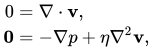
พลศาสตร์ของไหล ในการคำนวณกฎของสโตกส์ สำหรับแรงต้านที่ของเหลวหนืดกระทำต่ออนุภาคทรงกลมขนาดเล็ก การกระจายความเร็วเป็นไปตามสมการนาเวียร์-สโตกส์ โดย ไม่คำนึงถึงแรงเฉื่อย กล่าวคือ
0 = ∇ ⋅ v , 0 = − ∇ p + η ∇ 2 v , {\displaystyle {\begin{aligned}0&=\nabla \cdot \mathbf {v} ,\\\mathbf {0} &=-\nabla p+\eta \nabla ^{2}\mathbf {v} ,\end{aligned}}}
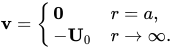
โดยมีเงื่อนไขขอบเขต
v = { 0 r = a , − U 0 r → ∞ . {\displaystyle \mathbf {v} ={\begin{cases}\mathbf {0} &r=a,\\-\mathbf {U} _{0}&r\to \infty .\end{cases}}}
โดยที่U คือความเร็วสัมพัทธ์ ของอนุภาคเทียบกับของไหลที่อยู่ไกลจากอนุภาค ในระบบพิกัดทรงกลม ความเร็วที่ระยะอนันต์นี้สามารถเขียนได้ดังนี้
U 0 = U 0 ( cos θ r ^ − sin θ θ ^ ) = U 0 ( Y 10 + Ψ 10 ) . {\displaystyle \mathbf {U} _{0}=U_{0}\left(\cos \theta \,{\hat {\mathbf {r} }}-\sin \theta \,{\hat {\mathbf {\theta } }}\right)=U_{0}\left(\mathbf {Y} _{10}+\mathbf {\Psi } _{10}\right).}
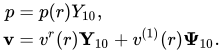
นิพจน์สุดท้ายเสนอการขยายในรูปฮาร์มอนิกทรงกลมสำหรับความเร็วของของเหลวและความดัน
p = p ( r ) Y 10 , v = v r ( r ) Y 10 + v ( 1 ) ( r ) Ψ 10 . {\displaystyle {\begin{aligned}p&=p(r)Y_{10},\\\mathbf {v} &=v^{r}(r)\mathbf {Y} _{10}+v^{(1)}(r)\mathbf {\Psi } _{10}.\end{aligned}}}
การแทนค่าในสมการนาเวียร์-สโตกส์จะสร้างชุดสมการเชิงอนุพันธ์สามัญสำหรับสัมประสิทธิ์
ความสัมพันธ์เชิงปริพันธ์ ในที่นี้จะใช้คำจำกัดความต่อไปนี้:
Y e m n = cos m φ P n m ( cos θ ) Y o m n = sin m φ P n m ( cos θ ) {\displaystyle {\begin{aligned}Y_{emn}&=\cos m\varphi P_{n}^{m}(\cos \theta )\\Y_{omn}&=\sin m\varphi P_{n}^{m}(\cos \theta )\end{aligned}}}
X o e m n ( k k ) = ∇ × ( k Y e o m n ( k k ) ) {\displaystyle \mathbf {X} _{^{e}_{o}mn}\left({\frac {\mathbf {k} }{k}}\right)=\nabla \times \left(\mathbf {k} Y_{^{o}_{e}mn}\left({\frac {\mathbf {k} }{k}}\right)\right)}
Z e o m n ( k k ) = i k k × X o e m n ( k k ) {\displaystyle \mathbf {Z} _{^{o}_{e}mn}\left({\frac {\mathbf {k} }{k}}\right)=i{\frac {\mathbf {k} }{k}}\times \mathbf {X} _{^{e}_{o}mn}\left({\frac {\mathbf {k} }{k}}\right)} ฟังก์ชันเบสเซลทรงกลม ด้วยความช่วยเหลือของการขยายคลื่นระนาบ เราสามารถได้รับความสัมพันธ์เชิงอินทิกรัลต่อไปนี้: [ 12 ] z n {\displaystyle z_{n}}
N p m n ( 1 ) ( k , r ) = i − n 4 π ∫ Z p m n ( k k ) e i k ⋅ r d Ω k {\displaystyle \mathbf {N} _{pmn}^{(1)}(k,\mathbf {r} )={\frac {i^{-n}}{4\pi }}\int \mathbf {Z} _{pmn}\left({\frac {\mathbf {k} }{k}}\right)e^{i\mathbf {k} \cdot \mathbf {r} }d\Omega _{k}}
M p m n ( 1 ) ( k , r ) = i − n 4 π ∫ X p m n ( k k ) e i k ⋅ r d Ω k {\displaystyle \mathbf {M} _{pmn}^{(1)}(k,\mathbf {r} )={\frac {i^{-n}}{4\pi }}\int \mathbf {X} _{pmn}\left({\frac {\mathbf {k} }{k}}\right)e^{i\mathbf {k} \cdot \mathbf {r} }d\Omega _{k}}
ในกรณีที่เป็นฟังก์ชัน Hankel ทรงกลม ควรใช้สูตรที่แตกต่างกัน[ 13 ] [ 12 ] z n {\displaystyle z_{n}}
M p m n ( 3 ) ( k , r ) = i − n 2 π k ∬ − ∞ ∞ d k ‖ e i ( k x x + k y y ± k z z ) k z X p m n ( k k ) {\displaystyle \mathbf {M} _{pmn}^{(3)}(k,\mathbf {r} )={\frac {i^{-n}}{2\pi k}}\iint _{-\infty }^{\infty }dk_{\|}{\frac {e^{i\left(k_{x}x+k_{y}y\pm k_{z}z\right)}}{k_{z}}}\mathbf {X} _{pmn}\left({\frac {\mathbf {k} }{k}}\right)}
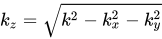
N p m n ( 3 ) ( k , r ) = i − n 2 π k ∬ − ∞ ∞ d k ‖ e i ( k x x + k y y ± k z z ) k z Z p m n ( k k ) {\displaystyle \mathbf {N} _{pmn}^{(3)}(k,\mathbf {r} )={\frac {i^{-n}}{2\pi k}}\iint _{-\infty }^{\infty }dk_{\|}{\frac {e^{i\left(k_{x}x+k_{y}y\pm k_{z}z\right)}}{k_{z}}}\mathbf {Z} _{pmn}\left({\frac {\mathbf {k} }{k}}\right)} k z = k 2 − k x 2 − k y 2 {\textstyle k_{z}={\sqrt {k^{2}-k_{x}^{2}-k_{y}^{2}}}} ( 3 ) {\displaystyle (3)}
ดูเพิ่มเติม
ลิงก์ภายนอก เวกเตอร์ฮาร์มอนิกทรงกลม ที่ Mathworld ของ Eric Weisstein

































![{\displaystyle {\begin{aligned}{\mathbf {N} _{emn}(k,\mathbf {r} )=\qquad {\frac {z_{n}(\rho )}{\rho }}\cos(m\varphi )n(n+1)P_{n}^{m}(\cos(\theta ))\mathbf {e} _{\mathbf {r} }}\\{{}+\cos(m\varphi ){\frac {dP_{n}^{m}(\cos(\theta ))}{d\theta }}}{\frac {1}{\rho }}{\frac {d}{d\rho }}\left[\rho z_{n}(\rho )\right]\mathbf {e} _{\theta }\\{{}-m\sin(m\varphi ){\frac {P_{n}^{m}(\cos(\theta ))}{\sin(\theta )}}}{\frac {1}{\rho }}{\frac {d}{d\rho }}\left[\rho z_{n}(\rho )\right]\mathbf {e} _{\varphi }\end{aligned}}}](https://wikimedia.org/api/rest_v1/media/math/render/svg/8331b5c5a9b7381413a4230f6dd294ea6e29ddca)
![{\displaystyle {\begin{aligned}\mathbf {N} _{omn}(k,\mathbf {r} )=\qquad {\frac {z_{n}(\rho )}{\rho }}\sin(m\varphi )n(n+1)P_{n}^{m}(\cos(\theta ))\mathbf {e} _{\mathbf {r} }\\{}+\sin(m\varphi ){\frac {dP_{n}^{m}(\cos(\theta ))}{d\theta }}{\frac {1}{\rho }}{\frac {d}{d\rho }}\left[\rho z_{n}(\rho )\right]\mathbf {e} _{\theta }\\{}+{m\cos(m\varphi ){\frac {P_{n}^{m}(\cos(\theta ))}{\sin(\theta )}}}{\frac {1}{\rho }}{\frac {d}{d\rho }}\left[\rho z_{n}(\rho )\right]\mathbf {e} _{\varphi }\end{aligned}}}](https://wikimedia.org/api/rest_v1/media/math/render/svg/2d56063fb7f9fabaf20e04730bd1eeaf79296847)

![{\displaystyle {\begin{aligned}\int _{0}^{2\pi }\int _{0}^{\pi }\mathbf {L} _{^{e}_{o}mn}\cdot \mathbf {L} _{^{e}_{o}mn}\sin \vartheta d\vartheta d\varphi &=(1+\delta _{m,0}){\frac {2\pi }{(2n+1)^{2}}}{\frac {(n+m)!}{(nm)!}}k^{2}\left\{n\left[z_{n-1}(kr)\right]^{2}+(n+1)\left[z_{n+1}(kr)\right]^{2}\right\}\\[3pt]\int _{0}^{2\pi }\int _{0}^{\pi }\mathbf {M} _{^{e__{o}mn}\cdot \mathbf {M} _{^{e__{o}mn}\sin \vartheta d\vartheta d\varphi &=(1+\delta _{m,0}){\frac {2\pi }{2n+1}}{\frac {(n+m)!}{(nm)!}}n(n+1)\left[z_{n}(kr)\right]^{2}\\[3pt]\int _{0}^{2\pi }\int _{0}^{\pi }\mathbf {N} _{^{e__{o}mn}\cdot \mathbf {N} _{^{e__{o}mn}\sin \vartheta d\vartheta d\varphi &=(1+\delta _{m,0}){\frac {2\pi }{(2n+1)^{2}}}{\frac {(n+m)!}{(nm)!}}n(n+1)\left\{(n+1)\left[z_{n-1}(kr)\right]^{2}+n\left[z_{n+1}(kr)\right]^{2}\right\}\\[3pt]\int _{0}^{\pi }\int _{0}^{2\pi }\mathbf {L} _{^{e__{o}mn}\cdot \mathbf {N} _{^{e}_{o}mn}\sin \vartheta d\vartheta d\varphi &=(1+\delta _{m,0}){\frac {2\pi }{(2n+1)^{2}}}{\frac {(n+m)!}{(nm)!}}n(n+1)k\left\{\left[z_{n-1}(kr)\right]^{2}-\left[z_{n+1}(kr)\right]^{2}\right\}\end{aligned}}}](https://wikimedia.org/api/rest_v1/media/math/render/svg/4f3423865810fc65f5eb7bc80cfd88e8c9c9f16b)

![{\displaystyle {\hat {D}}(\alpha ,\beta ,\gamma )\mathbf {Y} _{JM}^{(s)}(\theta ,\varphi )=\sum _{M'=-J}^{J}[D_{MM'}^{(J)}(\alpha ,\beta ,\gamma )]^{*}\mathbf {Y} _{JM'}^{(s)}(\ทีต้า ,\วาร์ฟี ),}](https://wikimedia.org/api/rest_v1/media/math/render/svg/95badc97e00d533b5a7ba1dba9d762bfb9bcaca2)