
ความแตกต่าง
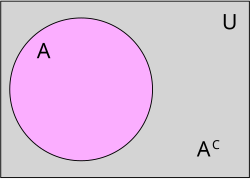
การแบ่งแบบทวิภาค ( / d aɪ ˈ k ɒ t ə m i / ) คือการแบ่งส่วนทั้งหมด (หรือเซต) ออกเป็นสองส่วน (เซตย่อย) กล่าวอีกนัยหนึ่งคือ ส่วนทั้งสองนี้จะต้อง
- ครอบคลุมทุกด้านร่วมกัน : ทุกสิ่งทุกอย่างต้องเป็นของส่วนใดส่วนหนึ่งหรือทั้งสองส่วน และ
- ไม่ สามารถอยู่ร่วมกันได้ : ไม่มีสิ่งใดสามารถอยู่ในทั้งสองส่วนพร้อมกันได้
ถ้ามีแนวคิด A และมันถูกแบ่งออกเป็นส่วน B และส่วนที่ไม่ใช่ B แล้ว ส่วนเหล่านั้นจะก่อให้เกิดทวิภาค: พวกมันแยกจากกันโดยสิ้นเชิง เนื่องจากไม่มีส่วนใดของ B ที่อยู่ในส่วนที่ไม่ใช่ B และในทางกลับกัน และพวกมันครอบคลุมทุกส่วนของ A ร่วมกัน เนื่องจากพวกมันครอบคลุมทุกส่วนของ A และเมื่อรวมกันแล้วจะได้ A อีกครั้ง
การแบ่งส่วนแบบนี้มักเรียกว่าการแบ่งส่วนแบบทวิภาค (bipartition) ส่วนสองส่วนที่เกิดขึ้นนั้นเรียกว่าส่วนเติมเต็ม (complement ) ในทางตรรกศาสตร์การแบ่งส่วนจะเป็นสิ่งที่ตรงข้ามกันหากมีประพจน์หนึ่งที่ใช้ได้กับส่วนหนึ่งแต่ใช้ไม่ได้กับอีกส่วนหนึ่ง การพิจารณาตัวแปรต่อเนื่องหรือตัวแปรหลายประเภทเป็นตัวแปรไบนารีเรียกว่าการแบ่ง แบบทวิภาค (dichotomization ) ข้อผิดพลาดในการแบ่งแบบทวิภาคที่เกิดขึ้นนั้นจะถูกละเลยชั่วคราวเพื่อวัตถุประสงค์ ใน การสร้างแบบจำลอง
นิรุกติศาสตร์
คำว่าdichotomyมาจากภาษากรีก: διχοτομία dichotomía "การแบ่งออกเป็นสองส่วน" ซึ่งมาจาก δίχα dícha "เป็นสอง แยกออกจากกัน" และ τομή tomḗ "การตัด การผ่า"
การใช้งานและตัวอย่าง
- ในทฤษฎีเซตความสัมพันธ์แบบสองขั้วRเป็นเช่นนั้นaRbหรือbRaแต่ไม่ใช่ทั้งสองอย่าง[ 1 ]
- การแบ่งแยกเท็จเป็นความผิดพลาดที่ไม่เป็นทางการซึ่งประกอบด้วยการแบ่งแยกที่สมมติขึ้นซึ่งไม่ตรงตามเงื่อนไขข้อใดข้อหนึ่งหรือทั้งสองข้อ: ไม่ครอบคลุมทั้งหมดร่วมกันและ/หรือไม่แยกออกจากกันโดยสิ้นเชิง ในรูปแบบที่พบได้บ่อยที่สุด จะมีการนำเสนอสองสิ่งราวกับว่าครอบคลุมทั้งหมด ในขณะที่ความจริงแล้วมีทางเลือกอื่นที่เป็นไปได้ ในบางกรณี อาจมีการนำเสนอราวกับว่าแยกออกจากกันโดยสิ้นเชิง ทั้งๆ ที่มีจุดกึ่งกลางที่กว้างขวาง[ 2 ] (ดูเพิ่มเติมที่จุดกึ่งกลางที่ไม่ได้กระจาย )
- One type of dichotomy is dichotomous classification – classifying objects by recursively splitting them into two groups. As Lewis Carroll explains, "After dividing a Class, by the Process of Dichotomy, into two smaller Classes, we may sub-divide each of these into two still smaller Classes; and this Process may be repeated over and over again, the number of Classes being doubled at each repetition. For example, we may divide "books" into "old" and "new" (i.e. "not-old"): we may then sub-divide each of these into "English" and "foreign" (i.e. "not-English"), thus getting four Classes."[3]
- In statistics, dichotomous data may only exist at first two levels of measurement, namely at the nominal level of measurement (such as "British" vs "American" when measuring nationality) and at the ordinal level of measurement (such as "tall" vs "short", when measuring height). A variable measured dichotomously is called a dummy variable.
- In computer science, more specifically in programming-language engineering, dichotomies are fundamental dualities in a language's design. For instance, C++ has a dichotomy in its memory model (heap versus stack), whereas Java has a dichotomy in its type system (references versus primitive data types).
- In astronomy dichotomy is when the Moon or an inferior planet is exactly half-lit as viewed from Earth. For the Moon, this occurs slightly before one quarter Moon orbit and slightly after the third quarter of the Moon's orbit at 89.85° and 270.15°, respectively. (This is not to be confused with quadrature which is when the Sun-Earth-Moon/superior planet angle is 90°.)
- In botany, branching may be dichotomous or axillary. In dichotomous branching, the branches form as a result of an equal division of a terminal bud (i.e., a bud formed at the apex of a stem) into two equal branches. This also applies to root systems as well.[4][5]
See also
 The dictionary definition of dichotomy at Wiktionary
- Binary opposition
- Bipartite (disambiguation)
- Class (set theory)
- Dichotomy paradox
- Dilemma
- Dualism
- Law of excluded middle, which in logic asserts the existence of a dichotomy
- Taxonomy
- Trichotomy (disambiguation)