
อ่าน 8 นาที
Blister
A blister is a small pocket of body fluid ( lymph , serum , plasma , blood , or pus ) within the upper layers of the skin , usually caused by forceful rubbing ( friction ),...
Blister
| Blister | |
|---|---|
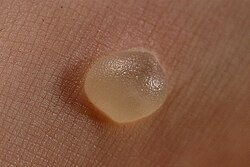 | |
| Blisters from abrasive rubbing are common on the feet. | |
| Specialty | Dermatology |
| Causes | Heat, cold, electricity, chemicals, friction, radiation |
A blister is a small pocket of body fluid (lymph, serum, plasma, blood, or pus) within the upper layers of the skin, usually caused by forceful rubbing (friction), burning, freezing, chemical exposure or infection. Most blisters are filled with a clear fluid, either serum or plasma.[1] However, blisters can be filled with blood (known as "blood blisters") or with pus (for instance, if they become infected).
Smaller blisters are called blebs. The word "blister" entered English in the 14th century. It came from the Middle Dutchbluyster and was a modification of the Old Frenchblostre, which meant a leprous nodule—a rise in the skin due to leprosy.
In dermatology, the words vesicle and bulla refer to blisters of smaller or greater size, respectively.[2]
Some sources recommend not to pop a blister. If popped, bacteria can enter. Excess skin should not necessarily be removed as the top layer protects the soft tissue underneath. However, some sources also recommend that if a blister is too big, it should indeed be popped.[3]
Causes


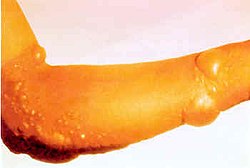
ตุ่มพองอาจเกิดขึ้นได้เมื่อผิวหนังได้รับความเสียหายจากการเสียดสีการถู ความร้อน ความเย็น หรือการสัมผัสสารเคมี ของเหลวจะสะสมอยู่ระหว่างชั้นผิวหนัง ด้านบน ( หนังกำพร้า ) และชั้นผิวหนังด้านล่าง ( หนังแท้ ) ของเหลวนี้จะช่วยรองรับเนื้อเยื่อด้านล่าง ปกป้องเนื้อเยื่อจากความเสียหายเพิ่มเติม และช่วยให้เนื้อเยื่อฟื้นตัว
แรงเสียดทาน
การเสียดสีอย่างรุนแรงอาจทำให้เกิดตุ่มพองได้ เช่นเดียวกับการเสียดสีบนผิวหนังหากเกิดขึ้นต่อเนื่องเป็นเวลานาน ตุ่มพองชนิดนี้มักเกิดขึ้นหลังจากเดินเป็นระยะทางไกลหรือจากการสวมรองเท้าเก่าหรือไม่พอดี[ 4 ] [ 5 ] [ 6 ]ตุ่มพองมักเกิดขึ้นที่มือและเท้า เนื่องจากส่วนปลายเหล่านี้มีความเสี่ยงต่อการเกิดตุ่มพองขณะเดิน วิ่ง หรือทำกิจกรรมซ้ำๆ เช่น การบังคับจอยสติ๊กขณะเล่นวิดีโอเกมบางประเภท กีฬาบางประเภท (เช่น การขว้างเบสบอล) การขุดดินด้วยพลั่ว การเล่นกีตาร์หรือเบส เป็นต้น ตุ่มพองเกิดขึ้นได้ง่ายกว่าบนผิวหนังที่ชื้นกว่าบนผิวหนังที่แห้งหรือเปียก[ 7 ]และมักเกิดขึ้นในสภาพอากาศอบอุ่น การเสียดสีที่ไม่รุนแรงมากนักเป็นเวลานานอาจทำให้ เกิด หนังด้านแทนที่จะเป็นตุ่มพอง ทั้งแผลพุพองและหนังด้านสามารถนำไปสู่ภาวะแทรกซ้อนที่ร้ายแรงกว่า เช่นแผลที่ เท้า และการติดเชื้อ โดยเฉพาะอย่างยิ่งเมื่อความรู้สึกหรือการไหลเวียนโลหิตบกพร่อง เช่น ในกรณีของโรคเบาหวานโรคเส้นประสาทหรือโรคหลอดเลือดแดงส่วนปลายตีบ (PAD)
การเผาไหม้
การเกิดตุ่มพองประเภทนี้เป็นหนึ่งในวิธีการที่ใช้ในการประเมินระดับความรุนแรงของแผลไหม้แผลไหม้ระดับที่หนึ่งและระดับที่สองอาจทำให้เกิดตุ่มพองที่ผิวหนังได้ อย่างไรก็ตาม ลักษณะเฉพาะของแผลไหม้ระดับที่สองคือจะเกิดตุ่มพองทันที ในขณะที่แผลไหม้ระดับที่หนึ่งอาจเกิดตุ่มพองหลังจากนั้นสองสามวัน นอกจากนี้ การถูกแดดเผาก็อาจทำให้เกิดตุ่มพองได้เช่นกัน
ตุ่มพองอาจเกิดขึ้นที่มือและเท้าอันเป็นผลมาจากความเสียหายของเนื้อเยื่อที่เกิดจาก ภาวะเนื้อเยื่อถูก ความเย็นกัด[ 8 ]
การสัมผัสสารเคมี
Sometimes, the skin will blister when it comes into contact with a cosmetic, detergent, solvent, or other chemical such as nickel sulfate, Balsam of Peru,[9] or urushiol (poison ivy, poison oak, poison sumac).[10] This is known as contact dermatitis. Blisters can also develop as a result of an allergic reaction to an insect bite or sting. Some chemical warfare agents, known as blister agents or vesicants, cause large, painful blisters wherever they contact skin; an example is mustard gas.
Blood blister
A blood blister usually forms when a minute blood vessel close to the surface of the skin ruptures (breaks), and blood leaks into a tear between the layers of skin. This can happen if the skin is crushed, pinched or aggressively squeezed.
Medical conditions
There are also a number of medical conditions that cause blisters. The most common are chickenpox, herpes, impetigo, and a form of eczema called dyshidrosis. Other, much rarer conditions that cause blisters include:
- Bullous pemphigoid: a skin disease that causes large, tightly filled blisters to develop, usually affecting people over the age of 60.
- Pemphigus: a serious skin disease in which blisters develop if pressure is applied to the skin; the blisters burst easily, leaving raw areas that can become infected.
- Dermatitis herpetiformis: a skin disease that causes intensely itchy blisters, usually on the elbows, knees, back and buttocks. The blisters usually develop in patches of the same shape and size on both sides of the body.
- Chronic bullous dermatosis: a disease that causes clusters of blisters on the face, mouth or genitals.
- Cutaneous radiation syndrome
- Epidermolysis bullosa:[11] a genetic disorder that results in a detachment in the skin layers, resulting in easy bruising.
Pathophysiology
Friction blisters
Friction blisters are caused by excess shear stress between the bottom and surface of the skin and the body. The strata of skin around the stratum spinosum are most susceptible to shear. As the stratum spinosum tears away from the connecting tissues below, plasma from the cells diffuses out. This plasma solution helps new cells divide and grow into new connective tissues and epidermal layers.
The clear fluid will be reabsorbed as new cells develop and the swollen appearance will subside. Painful blisters located on hands (palmar surface) and feet (plantar surface) are due to tissue shearing deeper in the epidermis, near nerve endings. Lower tissues are more susceptible to infection.
Prevention
Friction blisters
Friction blisters, caused by rubbing against the skin, can be prevented by reducing the friction to a level where blisters will not form.[4][5][6][12] This can be accomplished in a variety of ways.
Blisters on the feet can be prevented by wearing comfortable, well-fitting shoes and clean socks. Inherently ill-fitting or stiffer shoes, such as high heels and dress shoes, present a larger risk of blistering. Blisters are more likely to develop on skin that is moist, so socks that manage moisture or frequent sock changes will aid those with particularly sweaty feet. While exercising or playing sports, special sports socks can help keep feet drier and reduce the chance of blisters.[13] Before going for a long walk, it is also important to ensure that shoes or hiking boots have been properly broken in.
Even before a "hot" or irritated area on the foot is felt, taping a protective layer of padding or a friction-reducing interface between the affected area and the footwear can prevent the formation of a blister.[14] Bandages, moleskin and tapes generally must be applied to the foot daily, and most have a very high coefficient of friction (COF), but a friction-management patch applied to the shoe will remain in place much longer, throughout many changes of socks and insoles. This type of intervention may be used with footwear that is worn daily, with specialty shoes and boots like hockey skates, ice skates, inline skates, ski boots and cleats, or even with orthotic braces and splints. For periods of sustained use such as hiking and trail running, especially where water ingress or moisture build up in the shoe or boot can occur, moisture wicking liner socks can provide the required friction protection.
To avoid friction blisters on the hands, gloves should be worn when using tools such as a shovel or pickaxe, doing manual work such as gardening, or using sports equipment like golf clubs or baseball bats. Oars used for competitive rowing are known for causing frequent blisters on the hands of oarsmen. Weightlifters are also prone to blisters as are gymnasts from the friction developed by the rubbing against the bars. To further reduce the occurrence one can tape the hands, and there are also a number of products on the market that claim to reduce the occurrence of blisters. These are all intended to be worn as a liner underneath a glove. The majority of these offerings simply add padding, and create a layer that reduces the coefficient of friction between the skin and the glove.
A lubricant, typically talcum powder, can be used to reduce friction between skin and apparel in the short term. People put talcum powder inside gloves or shoes for this purpose, although this type of lubricant can actually increase the friction in the long term as it absorbs moisture. Increased friction makes blisters more likely.
Other
Sunscreen and protective clothing should also be used during the hottest part of the day to avoid blisters from sunburn. Avoiding sunlight during midday is the best way to avoid blisters from sunburn. Protective gloves should be worn when handling detergents, cleaning products, solvents and other chemicals.
External links
 Media related to blisters at Wikimedia Commons
 The dictionary definition of blister at Wiktionary


สรุปเนื้อหา
ข้อมูลสำคัญจากบทความ
ข้อมูลสำคัญเกี่ยวกับ Blister
A blister is a small pocket of body fluid ( lymph , serum , plasma , blood , or pus ) within the upper layers of the skin , usually caused by forceful rubbing ( friction ),...
Causes
ตุ่มพองอาจเกิดขึ้นได้เมื่อผิวหนังได้รับความเสียหายจาก การเสียดสี การถู ความร้อน ความเย็น หรือการสัมผัสสารเคมี ของเหลวจะสะสมอยู่ระหว่างชั้น ผิวหนัง ด้านบน ( หนังกำพร้า ) และชั้นผิวหนังด้านล่าง ( หนังแท้ ) ของเหลวนี้จะช่วยรองรับเนื้อเยื่อด้านล่าง...
แรงเสียดทาน
การเสียดสีอย่างรุนแรงอาจทำให้เกิดตุ่มพองได้ เช่นเดียวกับการเสียดสีบนผิวหนังหากเกิดขึ้นต่อเนื่องเป็นเวลานาน ตุ่มพองชนิดนี้มักเกิดขึ้นหลังจากเดินเป็นระยะทางไกลหรือจากการสวมรองเท้าเก่าหรือไม่พอดี [ 4 ] [ 5 ] [ 6 ] ตุ่มพองมักเกิดขึ้นที่มือและเท้า...
การเผาไหม้
การเกิดตุ่มพองประเภทนี้เป็นหนึ่งในวิธีการที่ใช้ในการประเมิน ระดับความรุนแรงของแผลไหม้ แผลไหม้ ระดับที่หนึ่งและระดับที่สองอาจทำให้เกิดตุ่มพองที่ผิวหนังได้ อย่างไรก็ตาม ลักษณะเฉพาะของแผลไหม้ระดับที่สองคือจะเกิดตุ่มพองทันที...