
อ่าน 19 นาที
Scale (map)
The scale of a map is the ratio of a distance on the map to the corresponding distance on the ground.
Scale (map)


The scale of a map is the ratio of a distance on the map to the corresponding distance on the ground. This simple concept is complicated by the curvature of the Earth's surface, which forces scale to vary across a map. Because of this variation, the concept of scale becomes meaningful in two distinct ways.
The first way is the ratio of the size of the generating globe to the size of the Earth. The generating globe is a conceptual model to which the Earth is shrunk and from which the map is projected. The ratio of the Earth's size to the generating globe's size is called the nominal scale (also called principal scale or representative fraction). Many maps state the nominal scale and may even display a bar scale (sometimes merely called a "scale") to represent it.
The second distinct concept of scale applies to the variation in scale across a map. It is the ratio of the mapped point's scale to the nominal scale. In this case 'scale' means the scale factor (also called point scale or particular scale).
If the region of the map is small enough to ignore Earth's curvature, such as in a town plan, then a single value can be used as the scale without causing measurement errors. In maps covering larger areas, or the whole Earth, the map's scale may be less useful or even useless in measuring distances. The map projection becomes critical in understanding how scale varies throughout the map.[1][2] When scale varies noticeably, it can be accounted for as the scale factor. Tissot's indicatrix is often used to illustrate the variation of point scale across a map.
History
The foundations for quantitative map scaling goes back to ancient China with textual evidence that the idea of map scaling was understood by the second century BC. Ancient Chinese surveyors and cartographers had ample technical resources used to produce maps such as counting rods, carpenter's squares, plumb lines, compasses for drawing circles, and sighting tubes for measuring inclination. Reference frames postulating a nascent coordinate system for identifying locations were hinted by ancient Chinese astronomers that divided the sky into various sectors or lunar lodges.[3]
The Chinese cartographer and geographer Pei Xiu of the Three Kingdoms period created a set of large-area maps that were drawn to scale. He produced a set of principles that stressed the importance of consistent scaling, directional measurements, and adjustments in land measurements in the terrain that was being mapped.[3]
Terminology
Representation of scale
Map scales may be expressed in words (a lexical scale), as a ratio, or as a fraction. Examples are:
- 'one centimetre to one hundred metres' or 1:10,000 or 1/10,000
- 'one inch to one mile' or 1:63,360 or 1/63,360
- 'one centimetre to one thousand kilometres' or 1:100,000,000 or 1/100,000,000. (The ratio would usually be abbreviated to 1:100M)
Bar scale vs. lexical scale
In addition to the above many maps carry one or more (graphical)bar scales. For example, some modern British maps have three bar scales, one each for kilometres, miles and nautical miles.
A lexical scale in a language known to the user may be easier to visualise than a ratio: if the scale is an inch to two miles and the map user can see two villages that are about two inches apart on the map, then it is easy to work out that the villages are about four miles apart on the ground.
A lexical scale may cause problems if it expressed in a language that the user does not understand or in obsolete or ill-defined units. For example, a scale of one inch to a furlong (1:7920) will be understood by many older people in countries where Imperial units used to be taught in schools. But a scale of one pouce to one league may be about 1:144,000, depending on the cartographer's choice of the many possible definitions for a league, and only a minority of modern users will be familiar with the units used.
Large scale, medium scale, small scale
- Contrast to spatial scale.
แผนที่มาตราส่วนเล็กครอบคลุมพื้นที่ขนาดใหญ่ เช่นแผนที่โลกทวีป หรือประเทศขนาดใหญ่ กล่าวอีกนัยหนึ่งคือ แสดงพื้นที่ขนาดใหญ่บนพื้นที่ขนาดเล็ก เรียกว่าแผนที่มาตราส่วนเล็กเพราะสัดส่วนการแสดงผลค่อนข้างเล็ก
แผนที่ มาตราส่วนใหญ่แสดงรายละเอียดของพื้นที่ขนาดเล็กได้มากกว่า เช่น แผนที่ระดับอำเภอหรือแผนผังเมือง แผนที่เหล่านี้เรียกว่าแผนที่มาตราส่วนใหญ่เพราะสัดส่วนที่แสดงในแผนที่นั้นค่อนข้างใหญ่ ตัวอย่างเช่น แผนผังเมืองซึ่งเป็นแผนที่มาตราส่วนใหญ่ อาจมีมาตราส่วน 1:10,000 ในขณะที่แผนที่โลกซึ่งเป็นแผนที่มาตราส่วนเล็ก อาจมีมาตราส่วน 1:100,000,000
ตารางต่อไปนี้แสดงช่วงค่าทั่วไปสำหรับมาตราส่วนเหล่านี้ แต่ไม่ควรนำไปใช้เป็นข้อมูลอ้างอิงที่แน่นอน เนื่องจากไม่มีมาตรฐานที่เป็นที่ยอมรับ:
| การจำแนกประเภท | พิสัย | ตัวอย่าง |
|---|---|---|
| ขนาดใหญ่ | 1:0 – 1:600,000 | แผนที่แสดงการแพร่กระจายของไวรัส มาตราส่วน 1:0.00001; แผนที่เดินชมเมือง มาตราส่วน 1:5,000 |
| ขนาดกลาง | 1:600,000 – 1:2,000,000 | แผนที่ประเทศ |
| ขนาดเล็ก | 1:2,000,000 – 1:∞ | แผนที่โลกมาตราส่วน 1:50,000,000; แผนที่กาแล็กซี มาตราส่วน 1: 10,21 |
บางครั้งคำศัพท์เหล่านี้ถูกใช้ในความหมายสัมบูรณ์ตามตาราง แต่บางครั้งก็ใช้ในความหมายเชิงสัมพัทธ์ ตัวอย่างเช่น ผู้ที่อ่านแผนที่ซึ่งงานของเขาอ้างอิงเฉพาะแผนที่มาตราส่วนใหญ่ (ตามที่แสดงในตารางข้างต้น) อาจเรียกแผนที่มาตราส่วน 1:500,000 ว่าแผนที่มาตราส่วนเล็ก
ในภาษาอังกฤษ คำว่า " large-scale"มักใช้ในความหมายว่า "extensive" (กว้างขวาง) อย่างไรก็ตาม ดังที่ได้อธิบายไว้ข้างต้น นักทำแผนที่ใช้คำว่า "large scale" เพื่ออ้างถึง แผนที่ที่มีขอบเขต ไม่ กว้างนัก กล่าวคือ แผนที่ที่แสดงพื้นที่ขนาดเล็กกว่า แผนที่ที่แสดงพื้นที่กว้างขวางเรียกว่าแผนที่ "small scale" ซึ่งอาจทำให้เกิดความสับสนได้
การเปลี่ยนแปลงขนาด
การทำแผนที่พื้นที่ขนาดใหญ่ทำให้เกิดความบิดเบี้ยวที่เห็นได้ชัด เนื่องจากเป็นการทำให้พื้นผิวโค้งของโลกแบนราบลงอย่างมาก การกระจายตัวของความบิดเบี้ยวขึ้นอยู่กับการฉายภาพแผนที่มาตราส่วนแตกต่างกันไปทั่วแผนที่และมาตราส่วนแผนที่ที่ระบุไว้เป็นเพียงค่าประมาณเท่านั้น ซึ่งจะกล่าวถึงรายละเอียดเพิ่มเติมด้านล่าง
แผนที่ขนาดใหญ่ที่ไม่คำนึงถึงความโค้ง
The region over which the earth can be regarded as flat depends on the accuracy of the survey measurements. If measured only to the nearest metre, then curvature of the earth is undetectable over a meridian distance of about 100 kilometres (62 mi) and over an east-west line of about 80 km (at a latitude of 45 degrees). If surveyed to the nearest 1 millimetre (0.039 in), then curvature is undetectable over a meridian distance of about 10 km and over an east-west line of about 8 km.[4] Thus a plan of New York City accurate to one metre or a building site plan accurate to one millimetre would both satisfy the above conditions for the neglect of curvature. They can be treated by plane surveying and mapped by scale drawings in which any two points at the same distance on the drawing are at the same distance on the ground. True ground distances are calculated by measuring the distance on the map and then multiplying by the inverse of the scale fraction or, equivalently, simply using dividers to transfer the separation between the points on the map to a bar scale on the map.
Point scale (or particular scale)
As proved by Gauss’s Theorema Egregium, a sphere (or ellipsoid) cannot be projected onto a plane without distortion. This is commonly illustrated by the impossibility of smoothing an orange peel onto a flat surface without tearing and deforming it. The only true representation of a sphere at constant scale is another sphere such as a globe.
Given the limited practical size of globes, we must use maps for detailed mapping. Maps require projections. A projection implies distortion: A constant separation on the map does not correspond to a constant separation on the ground. While a map may display a graphical bar scale, the scale must be used with the understanding that it will be accurate on only some lines of the map. (This is discussed further in the examples in the following sections.)
Let P be a point at latitude and longitude on the sphere (or ellipsoid). Let Q be a neighbouring point and let be the angle between the element PQ and the meridian at P: this angle is the azimuth angle of the element PQ. Let P' and Q' be corresponding points on the projection. The angle between the direction P'Q' and the projection of the meridian is the bearing. In general . Comment: this precise distinction between azimuth (on the Earth's surface) and bearing (on the map) is not universally observed, many writers using the terms almost interchangeably.


นิยาม: มาตราส่วนจุดที่ P คืออัตราส่วนของระยะทางสองค่า P'Q' และ PQ เมื่อ Q เข้าใกล้ P เราเขียนสิ่งนี้ได้ดังนี้
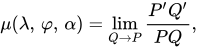
โดยสัญลักษณ์ดังกล่าวบ่งชี้ว่ามาตราส่วนของจุดนั้นเป็นฟังก์ชันของตำแหน่งของ P และทิศทางขององค์ประกอบ PQ ด้วย
คำจำกัดความ:ถ้า P และ Q อยู่บนเส้นเมริเดียนเดียวกันจะใช้สัญลักษณ์ แทนมาตราส่วนเส้นเมริเดียน


นิยาม:ถ้า P และ Q อยู่บนเส้นขนานเดียวกัน จะ ใช้ สัญลักษณ์ แทนเส้นขนานนั้น


นิยาม:ถ้ามาตราส่วนของจุดขึ้นอยู่กับตำแหน่งเท่านั้น ไม่ขึ้นอยู่กับทิศทาง เราจะกล่าวว่าจุดนั้นเป็นไอโซโทรปิก และโดยทั่วไปจะ ใช้ ตัวประกอบมาตราส่วนขนานเพื่อแทนค่าของจุดนั้นในทิศทางใดๆ

นิยาม:การฉายภาพแผนที่แบบคอนฟอร์มอล (Conformal)คือแผนที่ที่มุมระหว่างเส้นตรงสองเส้นที่ตัดกัน ณ จุด P มีค่าเท่ากับมุมระหว่างเส้นตรงที่ฉายลงบนระนาบ ณ จุด P' สำหรับทุกคู่เส้นตรงที่ตัดกัน ณ จุด P แผนที่แบบคอนฟอร์ม อล จะมีค่าตัวประกอบมาตราส่วนแบบไอโซโทรปิก (Isotropic scale factor) ในทางกลับกัน ค่าตัวประกอบมาตราส่วนแบบไอโซโทรปิกทั่วทั้งแผนที่หมายถึงการฉายภาพแบบคอนฟอร์มอล
ความสมมาตรของมาตราส่วนหมายความว่า องค์ประกอบ ขนาดเล็กจะถูกยืดออกอย่างเท่าเทียมกันในทุกทิศทาง กล่าวคือ รูปร่างขององค์ประกอบขนาดเล็กจะได้รับการรักษาไว้ นี่คือคุณสมบัติของออร์โธมอร์ฟิซึม (จากภาษากรีก 'รูปร่างที่ถูกต้อง') คำว่า 'เล็ก' หมายความว่าที่ความแม่นยำในการวัดที่กำหนดไว้ จะไม่สามารถตรวจพบการเปลี่ยนแปลงของตัวประกอบมาตราส่วนบนองค์ประกอบได้ เนื่องจากภาพฉายแบบคอนฟอร์มอลมีตัวประกอบมาตราส่วนแบบสมมาตร จึงถูกเรียกว่าภาพฉายแบบออร์โธมอร์ฟิก ด้วย เช่นกัน ตัวอย่างเช่น ภาพฉายเมอร์เคเตอร์เป็นภาพฉายแบบคอนฟอร์มอล เนื่องจากถูกสร้างขึ้นเพื่อรักษามุม และตัวประกอบมาตราส่วนของมันเป็นแบบสมมาตร ซึ่งเป็นฟังก์ชันของละติจูดเท่านั้น: ภาพฉายเมอร์เคเตอร์รักษารูปร่างในบริเวณเล็กๆ ได้
คำจำกัดความ:ในการฉายภาพแบบคอนฟอร์มอลที่มีมาตราส่วนไอโซโทรปิก จุดที่มีค่ามาตราส่วนเดียวกันสามารถเชื่อมต่อกันเพื่อสร้างเส้นไอโซสเกลได้ เส้นเหล่านี้ไม่ได้ถูกพล็อตลงบนแผนที่สำหรับผู้ใช้ปลายทาง แต่ปรากฏอยู่ในตำรามาตรฐานหลายเล่ม (ดู Snyder [ 1 ]หน้า 203—206)
เศษส่วนตัวแทน (RF) หรือมาตราส่วนหลัก
มีหลักการสองอย่างที่ใช้ในการกำหนดสมการของการฉายภาพใดๆ ตัวอย่างเช่น การฉายภาพทรงกระบอกแบบเอกภาคสามารถเขียนได้ดังนี้
- นักทำแผนที่:
- นักคณิตศาสตร์:


ในที่นี้เราจะใช้หลักการแรก (ตามการใช้งานในงานสำรวจของสไนเดอร์) เห็นได้ชัดว่าสมการการฉายภาพข้างต้นกำหนดตำแหน่งบนทรงกระบอกขนาดใหญ่ที่พันรอบโลกแล้วคลี่ออก เรากล่าวว่าพิกัดเหล่านี้กำหนดแผนที่การฉายภาพซึ่งต้องแยกแยะออกจาก แผนที่ ที่พิมพ์ (หรือดู) จริงๆ หากนิยามของมาตราส่วนจุดในส่วนก่อนหน้านี้อยู่ในรูปของแผนที่การฉายภาพ เราก็คาดได้ว่าค่าตัวประกอบมาตราส่วนจะใกล้เคียงกับหนึ่ง สำหรับการฉายภาพทรงกระบอกสัมผัสปกติ มาตราส่วนตามเส้นศูนย์สูตรคือ k=1 และโดยทั่วไปมาตราส่วนจะเปลี่ยนไปเมื่อเราเคลื่อนออกจากเส้นศูนย์สูตร การวิเคราะห์มาตราส่วนบนแผนที่การฉายภาพคือการตรวจสอบการเปลี่ยนแปลงของ k ที่เบี่ยงเบนไปจากค่าที่แท้จริงคือหนึ่ง
แผนที่ที่พิมพ์จริงนั้นผลิตขึ้นจากแผนที่ฉายภาพโดยใช้ มาตราส่วน คงที่ซึ่งแสดงด้วยอัตราส่วน เช่น 1:100 ล้าน (สำหรับแผนที่โลกทั้งใบ) หรือ 1:10000 (สำหรับแผนผังเมือง) เพื่อหลีกเลี่ยงความสับสนในการใช้คำว่า 'มาตราส่วน' เศษส่วนมาตราส่วนคงที่นี้เรียกว่าเศษส่วนตัวแทน (RF) ของแผนที่ที่พิมพ์ และต้องระบุให้ตรงกับอัตราส่วนที่พิมพ์บนแผนที่ พิกัดแผนที่ที่พิมพ์จริงสำหรับการฉายภาพทรงกระบอกแบบเอกภาคคือ
- แผนที่ที่พิมพ์แล้ว:


ข้อตกลงนี้ช่วยให้สามารถแยกแยะความแตกต่างระหว่างการปรับขนาดการฉายภาพภายในและการปรับขนาดการลดทอนได้อย่างชัดเจน
จากจุดนี้ไป เราจะไม่สนใจ RF และทำงานกับแผนที่การฉายภาพแทน
การแสดงภาพมาตราส่วนจุด: มาตรวัดจุดของ Tissot

พิจารณาวงกลมเล็กๆ บนพื้นผิวโลกที่มีจุดศูนย์กลางอยู่ที่จุด P ที่ละติจูดและลองจิจูดเนื่องจากมาตราส่วนของจุดจะแปรผันตามตำแหน่งและทิศทาง การฉายภาพของวงกลมลงบนแผนที่จึงจะเกิดการบิดเบี้ยวทิสโซต์พิสูจน์แล้วว่า ตราบใดที่การบิดเบี้ยวไม่มากเกินไป วงกลมจะกลายเป็นวงรีบนแผนที่ โดยทั่วไปแล้ว มิติ รูปร่าง และทิศทางของวงรีจะเปลี่ยนแปลงไปตามแผนที่ การซ้อนทับวงรีที่บิดเบี้ยวเหล่านี้ลงบนแผนที่จะแสดงให้เห็นถึงวิธีที่มาตราส่วนของจุดเปลี่ยนแปลงไปตามแผนที่ วงรีที่บิดเบี้ยวนี้เรียกว่าอินดิเคทริกซ์ของทิสโซต์ตัวอย่างที่แสดงในที่นี้คือการฉายภาพแบบ Winkel tripleซึ่งเป็นการฉายภาพมาตรฐานสำหรับแผนที่โลกที่จัดทำโดยNational Geographic Societyการบิดเบี้ยวน้อยที่สุดอยู่ที่เส้นเมริเดียนกลางที่ละติจูด 30 องศา (เหนือและใต้) (ตัวอย่างอื่นๆ[ 5 ] [ 6 ] )
มาตราส่วนจุดสำหรับการฉายภาพทรงกระบอกปกติของทรงกลม

หัวใจสำคัญของ การทำความเข้าใจ เชิงปริมาณเกี่ยวกับมาตราส่วนคือการพิจารณา องค์ประกอบ ขนาดเล็กมากบนทรงกลม รูปแสดงจุด P ที่ละติจูดและลองจิจูดบนทรงกลม จุด Q อยู่ที่ละติจูดและลองจิจูดเส้น PK และ MQ เป็นส่วนโค้งของเส้นเมริเดียนที่มีความยาวโดยที่คือรัศมีของทรงกลม และมี หน่วย เป็นเรเดียนเส้น PM และ KQ เป็นส่วนโค้งของวงกลมขนานที่มีความยาวโดยมีหน่วยเป็นเรเดียน ในการหาคุณสมบัติของจุด ฉายภาพ ที่ P นั้น เพียงพอที่จะพิจารณาองค์ประกอบขนาดเล็กมาก PMQK บนพื้นผิว: ในกรณีที่ Q เข้าใกล้ P องค์ประกอบดังกล่าวจะมีแนวโน้มเป็นสี่เหลี่ยมผืนผ้าระนาบขนาดเล็กมาก


การฉายภาพทรงกระบอกปกติของทรงกลมจะมี ค่าเท่ากับฟังก์ชันของละติจูดเท่านั้น ดังนั้น องค์ประกอบขนาดเล็ก PMQK บนทรงกลมจะฉายภาพไปยังองค์ประกอบขนาดเล็ก P'M'Q'K' ซึ่งเป็น สี่เหลี่ยมผืนผ้าที่ สมบูรณ์แบบที่มีฐานและความสูง โดยการเปรียบเทียบองค์ประกอบบนทรงกลมและการฉายภาพ เราสามารถอนุมานนิพจน์สำหรับตัวประกอบมาตราส่วนบนเส้นขนานและเส้นเมริเดียนได้ทันที (การพิจารณามาตราส่วนในทิศทางทั่วไปสามารถพบได้ด้านล่าง )


- ปัจจัยมาตราส่วนขนาน
- ปัจจัยมาตราส่วนเมริเดียน

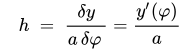
โปรดทราบว่าตัวประกอบมาตราส่วนขนาน ไม่ขึ้นอยู่กับคำจำกัดความดังนั้นจึงเหมือนกันสำหรับภาพฉายทรงกระบอกปกติทั้งหมด เป็นประโยชน์ที่จะทราบว่า


- ที่ละติจูด 30 องศา เส้นขนานคือ
- ที่ละติจูด 45 องศา เส้นขนานคือ
- ที่ละติจูด 60 องศา เส้นขนานคือ
- ที่ละติจูด 80 องศา เส้นขนานคือ
- ที่ละติจูด 85 องศา เส้นขนานคือ





ตัวอย่างต่อไปนี้แสดงภาพฉายทรงกระบอกปกติสามแบบ และในแต่ละกรณี จะแสดงการเปลี่ยนแปลงของมาตราส่วนตามตำแหน่งและทิศทางโดยใช้ดัชนีของทิสโซต์
ตัวอย่างสามแบบของการฉายภาพทรงกระบอกปกติ
การฉายภาพแบบเอกรูปสี่เหลี่ยมผืนผ้า

การฉายภาพแบบเอกรูปสี่เหลี่ยมจัตุรัส [ 1 ] [ 2 ] [ 4 ]หรือที่รู้จักกันในชื่อPlate Carrée (ภาษาฝรั่งเศสแปลว่า "สี่เหลี่ยมจัตุรัสแบน") หรือ (ซึ่งอาจทำให้เข้าใจผิดเล็กน้อย) การฉายภาพแบบระยะห่างเท่ากัน ถูกกำหนดโดย


where is the radius of the sphere, is the longitude from the central meridian of the projection (here taken as the Greenwich meridian at ) and is the latitude. Note that and are in radians (obtained by multiplying the degree measure by a factor of /180). The longitude is in the range and the latitude is in the range .


![{\displaystyle [-\pi ,\pi ]}](https://wikimedia.org/api/rest_v1/media/math/render/svg/cb064fd6c55820cfa660eabeeda0f6e3c4935ae6)
![{\displaystyle [-\pi /2,\pi /2]}](https://wikimedia.org/api/rest_v1/media/math/render/svg/cd702a5a7041be010f870c0e23750d98ba9919f5)
Since the previous section gives

- parallel scale,
- meridian scale
For the calculation of the point scale in an arbitrary direction see addendum.
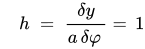
The figure illustrates the Tissot indicatrix for this projection. On the equator h=k=1 and the circular elements are undistorted on projection. At higher latitudes the circles are distorted into an ellipse given by stretching in the parallel direction only: there is no distortion in the meridian direction. The ratio of the major axis to the minor axis is . Clearly the area of the ellipse increases by the same factor.

It is instructive to consider the use of bar scales that might appear on a printed version of this projection. The scale is true (k=1) on the equator so that multiplying its length on a printed map by the inverse of the RF (or principal scale) gives the actual circumference of the Earth. The bar scale on the map is also drawn at the true scale so that transferring a separation between two points on the equator to the bar scale will give the correct distance between those points. The same is true on the meridians. On a parallel other than the equator the scale is so when we transfer a separation from a parallel to the bar scale we must divide the bar scale distance by this factor to obtain the distance between the points when measured along the parallel (which is not the true distance along a great circle). On a line at a bearing of say 45 degrees () the scale is continuously varying with latitude and transferring a separation along the line to the bar scale does not give a distance related to the true distance in any simple way. (But see addendum). Even if a distance along this line of constant planar angle could be worked out, its relevance is questionable since such a line on the projection corresponds to a complicated curve on the sphere. For these reasons bar scales on small-scale maps must be used with extreme caution.

Mercator projection

การฉายภาพแบบเมอร์เคเตอร์จะแมปทรงกลมไปยังสี่เหลี่ยมผืนผ้า (ที่มีขนาดอนันต์ใน ทิศทาง -) โดยใช้สมการ[ 1 ] [ 2 ] [ 4 ]

![{\displaystyle y=a\ln \left[\tan \left({\frac {\pi }{4}}+{\frac {\varphi }{2}}\right)\right]}](https://wikimedia.org/api/rest_v1/media/math/render/svg/3fd7eea496725653f6c780bcf3c49947d2b48064)
โดยที่ a และ เป็นไปตามตัวอย่างก่อนหน้านี้ เนื่องจากตัวประกอบมาตราส่วนคือ:


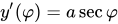
- มาตราส่วนคู่ขนาน
- มาตราเมริเดียน
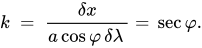
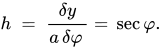
ในส่วนเพิ่มเติม ทางคณิตศาสตร์ แสดงให้เห็นว่า มาตราส่วนจุดในทิศทางใดๆ ก็เท่ากับเช่นกันดังนั้นมาตราส่วนจึงเป็นแบบไอโซโทรปิก (เท่ากันในทุกทิศทาง) โดยขนาดของมาตราส่วนจะเพิ่มขึ้นตามละติจูดเป็นในแผนภาพทิสโซต์ องค์ประกอบวงกลมขนาดเล็กแต่ละอันจะรักษารูปทรงเดิมไว้ แต่จะขยายใหญ่ขึ้นเรื่อยๆ เมื่อละติจูดเพิ่มขึ้น
การฉายภาพแบบพื้นที่เท่ากันของแลมเบิร์ต

การฉายภาพพื้นที่เท่ากันของ Lambertจะแปลงทรงกลมเป็นสี่เหลี่ยมผืนผ้าจำกัดโดยใช้สมการ[ 1 ] [ 2 ] [ 4 ]

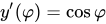
โดยที่ a และ เป็นไปตามตัวอย่างก่อนหน้านี้ เนื่องจากตัวประกอบมาตราส่วนคือ
- มาตราส่วนคู่ขนาน
- มาตราเมริเดียน
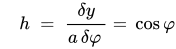
วิธีการคำนวณมาตราส่วนจุดในทิศทางใดๆ แสดงไว้ด้านล่าง
ในขณะนี้ มาตราส่วนแนวตั้งและแนวนอนจะชดเชยกัน (hk=1) และในแผนภาพทิสโซต์ องค์ประกอบวงกลมขนาดเล็กแต่ละอันจะถูกบิดเบี้ยวให้กลายเป็นวงรีที่มี พื้นที่ เท่ากับวงกลมที่ไม่บิดเบี้ยวบนเส้นศูนย์สูตร
กราฟของตัวประกอบมาตราส่วน

กราฟแสดงการเปลี่ยนแปลงของตัวประกอบมาตราส่วนสำหรับตัวอย่างทั้งสามข้างต้น กราฟด้านบนแสดงฟังก์ชันมาตราส่วนแบบไอโซโทรปิกของเมอร์เคเตอร์: มาตราส่วนบนเส้นขนานเท่ากับมาตราส่วนบนเส้นเมริเดียน กราฟอื่นๆ แสดงตัวประกอบมาตราส่วนเส้นเมริเดียนสำหรับการฉายภาพแบบเอกภาคังกูลาร์ (h=1) และสำหรับการฉายภาพแบบแลมเบิร์ตแบบพื้นที่เท่ากัน การฉายภาพสองแบบหลังนี้มีมาตราส่วนเส้นขนานเหมือนกับของกราฟเมอร์เคเตอร์ สำหรับแลมเบิร์ต โปรดสังเกตว่ามาตราส่วนเส้นขนาน (เช่นเดียวกับเมอร์เคเตอร์ A) เพิ่มขึ้นตามละติจูด และมาตราส่วนเส้นเมริเดียน (C) ลดลงตามละติจูดในลักษณะที่ hk=1 ซึ่งรับประกันการอนุรักษ์พื้นที่
การเปลี่ยนแปลงมาตราส่วนในการฉายภาพแบบเมอร์เคเตอร์
มาตราส่วนจุดของแผนที่เมอร์เคเตอร์มีค่าเท่ากับ 1 ที่เส้นศูนย์สูตร เนื่องจากทรงกระบอกเสริมที่ใช้ในการสร้างแผนที่นั้นสัมผัสกับพื้นโลกที่เส้นศูนย์สูตร ด้วยเหตุนี้ การฉายภาพแบบปกติจึงควรเรียกว่าการฉายภาพแบบสัมผัส มาตราส่วนจะแปรผันตามละติจูดเป็น σ² = σ² + ...
เกณฑ์มาตรฐานสำหรับแผนที่ขนาดใหญ่ที่ดีคือ ความแม่นยำควรอยู่ภายใน 4 ส่วนใน 10,000 หรือ 0.04% ซึ่งสอดคล้องกับเนื่องจาก ค่านี้ได้ที่องศา (ดูรูปด้านล่าง เส้นสีแดง) ดังนั้น การฉายภาพแบบแทนเจนต์เมอร์เคเตอร์จึงมีความแม่นยำสูงภายในแถบความกว้าง 3.24 องศาที่อยู่ตรงกลางเส้นศูนย์สูตร ซึ่งสอดคล้องกับระยะทางเหนือ-ใต้ประมาณ 360 กิโลเมตร (220 ไมล์) ภายในแถบนี้ การฉายภาพแบบเมอร์เคเตอร์นั้น ดี มากมีความแม่นยำสูง และรักษารูปทรงได้ดี เนื่องจากเป็นการฉายภาพแบบคอนฟอร์มอล (รักษาองศา) ข้อสังเกตเหล่านี้กระตุ้นให้เกิดการพัฒนาการฉายภาพแบบทรานส์เวอร์สเมอร์เคเตอร์ ซึ่งเส้นเมริเดียนจะถูกพิจารณา 'เหมือนเส้นศูนย์สูตร' ของการฉายภาพ เพื่อให้เราได้แผนที่ที่แม่นยำภายในระยะทางแคบๆ จากเส้นเมริเดียนนั้น แผนที่ดังกล่าวเหมาะสำหรับประเทศที่วางตัวเกือบเหนือ-ใต้ (เช่นสหราชอาณาจักร ) และชุดแผนที่ดังกล่าว 60 แผนที่ถูกใช้สำหรับระบบพิกัดยูนิเวอร์แซลทรานส์เวอร์สเมอร์เคเตอร์ (UTM ) โปรดทราบว่าในการฉายภาพทั้งสองแบบนี้ (ซึ่งอิงตามทรงรีต่างๆ) สมการการแปลงสำหรับ x และ y และนิพจน์สำหรับตัวประกอบมาตราส่วนนั้นเป็นฟังก์ชันที่ซับซ้อนของทั้งละติจูดและลองจิจูด


การฉายภาพแบบเซแคนต์ หรือการฉายภาพแบบดัดแปลง

แนวคิดพื้นฐานของการฉายภาพแบบซีแคนต์คือ การฉายภาพทรงกลมไปยังทรงกระบอกที่ตัดกับทรงกลมที่เส้นขนานสองเส้น เช่นเส้นเหนือและเส้นใต้ เห็นได้ชัดว่ามาตราส่วนจะถูกต้องที่ละติจูดเหล่านี้ ในขณะที่เส้นขนานที่อยู่ต่ำกว่าละติจูดเหล่านี้จะถูกหดลงโดยการฉายภาพ และค่าตัวประกอบมาตราส่วน (ของเส้นขนาน) จะต้องน้อยกว่าหนึ่ง ผลลัพธ์ที่ได้คือ การเบี่ยงเบนของมาตราส่วนจากหนึ่งจะลดลงในช่วงละติจูดที่กว้างขึ้น


ตัวอย่างเช่น การฉายภาพแบบซีแคนท์เมอร์เคเตอร์ที่เป็นไปได้แบบหนึ่งนั้นกำหนดโดย

The numeric multipliers do not alter the shape of the projection but it does mean that the scale factors are modified:
- secant Mercator scale,

Thus
- the scale on the equator is 0.9996,
- the scale is k = 1 at a latitude given by where so that degrees,
- k=1.0004 at a latitude given by for which degrees. Therefore, the projection has , that is an accuracy of 0.04%, over a wider strip of 4.58 degrees (compared with 3.24 degrees for the tangent form).






This is illustrated by the lower (green) curve in the figure of the previous section.
Such narrow zones of high accuracy are used in the UTM and the British OSGB projection, both of which are secant, transverse Mercator on the ellipsoid with the scale on the central meridian constant at . The isoscale lines with are slightly curved lines approximately 180 km east and west of the central meridian. The maximum value of the scale factor is 1.001 for UTM and 1.0007 for OSGB.


The lines of unit scale at latitude (north and south), where the cylindrical projection surface intersects the sphere, are the standard parallels of the secant projection.
Whilst a narrow band with is important for high accuracy mapping at a large scale, for world maps much wider spaced standard parallels are used to control the scale variation. Examples are

- Behrmann with standard parallels at 30N, 30S.
- Gall equal area with standard parallels at 45N, 45S.

The scale plots for the latter are shown below compared with the Lambert equal area scale factors. In the latter the equator is a single standard parallel and the parallel scale increases from k=1 to compensate the decrease in the meridian scale. For the Gall the parallel scale is reduced at the equator (to k=0.707) whilst the meridian scale is increased (to k=1.414). This gives rise to the gross distortion of shape in the Gall-Peters projection. (On the globe Africa is about as long as it is broad). Note that the meridian and parallel scales are both unity on the standard parallels.
Mathematical addendum
For normal cylindrical projections the geometry of the infinitesimal elements gives

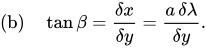
The relationship between the angles and is
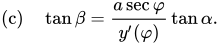
สำหรับ การฉาย ภาพแบบเมอร์เคเตอร์ มุมต่างๆ จะถูกรักษาไว้ (ไม่น่าแปลกใจเลย เพราะนี่คือความสัมพันธ์ที่ใช้ในการสร้างการฉายภาพแบบเมอร์เคเตอร์) สำหรับการฉายภาพแบบระยะเท่ากันและแบบแลมเบิร์ต เราจะได้และตามลำดับ ดังนั้นความสัมพันธ์ระหว่างและจึงขึ้นอยู่กับละติจูด ให้ P เป็นมาตราส่วนของจุดเมื่อองค์ประกอบเล็กๆ PQ ทำมุม กับเส้นเมริเดียนโดยซึ่งกำหนดโดยอัตราส่วนของระยะทาง:


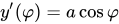



การกำหนดและแทนค่าจากสมการ (a) และ (b) ตามลำดับจะได้

![{\displaystyle \mu _{\alpha }(\varphi )=\sec \varphi \left[{\frac {\sin \alpha }{\sin \beta }}\right].}](https://wikimedia.org/api/rest_v1/media/math/render/svg/55cb43751c9ca5425b86d60bba0f3464394bd09f)
สำหรับการฉายภาพแบบอื่นที่ไม่ใช่แบบเมอร์เคเตอร์ เราต้องคำนวณจากและใช้สมการ (c) ก่อน จึงจะสามารถหาค่าได้ตัวอย่างเช่น การฉายภาพแบบเอกรูปสี่เหลี่ยมผืนผ้าจะมีค่าดังนี้



ถ้าเราพิจารณาเส้นตรงที่มีความชันคงที่ บนภาพฉาย ทั้งค่าที่สอดคล้องกันและตัวประกอบมาตราส่วนตามแนวเส้นตรงนั้นเป็นฟังก์ชันที่ซับซ้อนของไม่มีวิธีง่ายๆ ในการแปลงระยะห่างจำกัดทั่วไปไปสู่มาตราส่วนแท่งและได้ผลลัพธ์ที่มีความหมาย
สัญลักษณ์อัตราส่วน
แม้ว่า โดย ทั่วไปจะใช้เครื่องหมายโคลอนเพื่อแสดงอัตราส่วน แต่ยูนิโค้ดสามารถแสดงสัญลักษณ์เฉพาะสำหรับอัตราส่วนได้ โดยจะยกขึ้นเล็กน้อย: U+ 2236 ∶ RATIO ( ∶ )
ดูเพิ่มเติม

- ระยะทางทางภูมิศาสตร์
- มาตราส่วน (เครื่องมือวิเคราะห์)
- มาตราส่วน (อัตราส่วน)
- การปรับขนาด (เรขาคณิต)
- มาตราส่วนเชิงพื้นที่
- ว่าด้วยความแม่นยำในวิทยาศาสตร์
หมายเหตุ
- ^ข้อความ "1 ซม. = 6 กม." เป็นการใช้สัญลักษณ์เท่ากับอย่างไม่หลักแล้ว 1 ซม. = 0.00001 กม. ตามนิยามของคำนำหน้าหน่วยเมตริก
สรุปเนื้อหา
ข้อมูลสำคัญจากบทความ
ข้อมูลสำคัญเกี่ยวกับ Scale (map)
The scale of a map is the ratio of a distance on the map to the corresponding distance on the ground.
History
The foundations for quantitative map scaling goes back to ancient China with textual evidence that the idea of map scaling was understood by the second century BC.
Representation of scale
Map scales may be expressed in words (a lexical scale), as a ratio, or as a fraction. Examples are:
Bar scale vs. lexical scale
In addition to the above many maps carry one or more (graphical) bar scales . For example, some modern British maps have three bar scales, one each for kilometres, miles and nautical miles.