
โทนเสียงชิเชวา
ภาษา ชิเชวา (ภาษาบันตูในแอฟริกาตอนกลาง หรือที่รู้จักกันในชื่อ เชวา, นยานจา หรือ ชินยานจา) เป็นภาษาหลักที่พูดกันในมาลาวี ตอนใต้และตอนกลาง และใช้พูดกันในระดับที่น้อยกว่าในแซมเบีย โมซัมบิก และซิมบับเว เช่นเดียวกับภาษาบันตูอื่นๆ ส่วนใหญ่ ภาษาชิเชวาเป็นภาษาที่มีวรรณยุกต์กล่าวคือ รูปแบบระดับเสียงเป็นส่วนสำคัญของการออกเสียงคำ ตัวอย่างเช่น คำว่า chí manga (สูง-ต่ำ-ต่ำ) 'ข้าวโพด' สามารถแยกแยะได้จาก china ngwá (ต่ำ-ต่ำ-สูง) 'มันสำปะหลัง' ไม่เพียงแต่จากพยัญชนะเท่านั้น แต่ยังรวมถึงรูปแบบระดับเสียงด้วย รูปแบบเหล่านี้จะคงที่ในทุกบริบทที่ใช้คำนามเหล่านั้น
รูปแบบเสียงวรรณยุกต์ยังมีบทบาทสำคัญทางไวยากรณ์ในคำกริยาภาษาชิเชวา ช่วยแยกแยะกาลต่างๆ และคำกริยาในอนุประโยคย่อยออกจากคำกริยาในประโยคหลัก นอกจากนี้ เสียงวรรณยุกต์ยังใช้ในการเน้นเสียงและการแบ่งวรรคตอนด้วย
โดยทั่วไปแล้ว ภาษาชิเชวาจะกล่าวกันว่ามีเสียงสูง (H) และเสียงต่ำ (L) อย่างไรก็ตาม มีการโต้แย้งว่าการคิดว่ามันมีพยางค์เสียงสูงมากกว่าพยางค์ที่ไม่มีเสียงนั้นแม่นยำกว่า[ 1 ] [ 2 ]
ไม่ใช่ทุกคำจะมีเสียงสูง คำนามมากกว่าหนึ่งในสามไม่มีเสียงสูง และออกเสียงโดยทุกพยางค์อยู่ในระดับเสียงต่ำ เมื่อคำนามมีเสียงสูง มักจะมีเพียงเสียงเดียว และมักจะได้ยินในพยางค์สามพยางค์สุดท้าย อย่างไรก็ตาม คำนามบางคำ เช่นnyé nye zí 'ดาว' มีสองเสียงสูง หรือเช่นtsábólá 'พริกไทย' มีช่วงเสียงสูงสามพยางค์
ดังนั้นในบางแง่มุม ภาษาชิเชวาจึงถือได้ว่าเป็นภาษาที่มีการเน้นเสียงสูงต่ำโดยมี 'คุณสมบัติการเน้นเสียงและวรรณยุกต์ผสมกัน' [ 3 ]อย่างไรก็ตาม นักวิชาการบางคน โดยเฉพาะแลร์รี ไฮแมนได้โต้แย้งว่าคำว่า 'ภาษาที่มีการเน้นเสียงสูงต่ำ' เป็นการทำให้ง่ายเกินไปและควรหลีกเลี่ยง ในมุมมองของเขา เป็นการดีที่สุดที่จะพิจารณาภาษาดังกล่าวว่าเป็นเพียงรูปแบบหนึ่งของภาษาวรรณยุกต์[ 4 ]
เสียงโทนเป็นอย่างไร
ตัวอย่างที่ 1
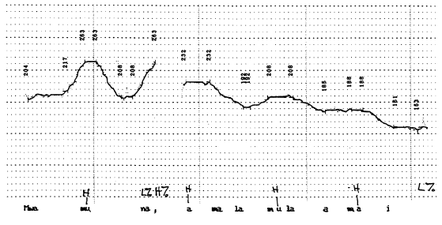
ภาพประกอบจาก Myers [ 5 ]แสดงให้เห็นถึงน้ำเสียงทั่วไปของประโยคบอกเล่าในภาษาชิเชวา:
- mwa mú na, á -ma-la mú la a má yi 'ผู้ชาย เขาปกครองผู้หญิง'
เสียงสูงทั้งสี่เสียง ซึ่งมีเครื่องหมาย H ในการถอดเสียง จะลดระดับลงทีละขั้น ซึ่งเป็นกระบวนการที่พบได้ทั่วไปในหลายภาษา และเรียกว่าdowndrift , automatic downstepหรือ catathesis กระบวนการนี้มักเกิดขึ้น (โดยมีข้อยกเว้นบ้าง) เมื่อใดก็ตามที่เสียงสูงสองเสียงถูกคั่นด้วยเสียงต่ำหนึ่งเสียงขึ้นไป แต่จะไม่เกิดขึ้นเมื่อเสียงสูงสองเสียงอยู่ในพยางค์ที่อยู่ติดกัน
นอกจากนี้ ในแทร็กเสียงยังแสดงให้เห็นโทนเสียงที่ออกเสียงสูงต่ำ ซึ่งเรียกว่าโทนเสียงขอบเขตหรือ 'การเพิ่มขึ้นต่อเนื่อง' [ 6 ]ที่มีเครื่องหมาย L%H% การเพิ่มขึ้นของระดับเสียงนี้มักจะได้ยินในช่วงหยุดชั่วคราวกลางประโยค เช่น ในที่นี้ ซึ่งเป็นการบ่งบอกหัวข้อ: 'ผู้ชายคนหนึ่ง เขาปกครองผู้หญิง' โทนเสียงขอบเขตนี้ไม่จำเป็นต้องมีอยู่เสมอไป และไมเยอร์สได้พิมพ์แทร็กเสียงอีกแทร็กหนึ่งของประโยคเดียวกันในกรณีที่ไม่มีโทนเสียงขอบเขตนี้
พยางค์ที่ไม่มีวรรณยุกต์มักจะต่ำกว่าพยางค์ที่ มีวรรณยุกต์สูง อย่างไรก็ตาม พยางค์แรกของmá yiจะบ่งบอกถึงวรรณยุกต์สูงที่ตามมาและเกือบจะอยู่ในระดับเดียวกัน พยางค์สุดท้ายของá -ma-la mú la ก็สูงขึ้นเช่นกัน การ กระจายวรรณยุกต์จากวรรณยุกต์สูงก่อนสุดท้ายนี้มักได้ยินเมื่อคำกริยาตามด้วยกรรม ทางไวยากรณ์ทันที สามพยางค์แรกของá -ma-la mú laยังแสดงการเลื่อนลง โดยmaสูงกว่าla
เสียงวรรณยุกต์รองสุดท้ายของmwa mú na 'ผู้ชาย' และa má yi 'ผู้หญิง' เป็นวรรณยุกต์เชิงคำศัพท์ หมายความว่าวรรณยุกต์เหล่านี้จะปรากฏอยู่ในคำเหล่านี้เสมอ ส่วนวรรณยุกต์ของá mala mú la 'เขาปกครอง' เป็นวรรณยุกต์เชิงไวยากรณ์ ซึ่งจะพบได้เสมอในกาลปัจจุบันกาลปกติ ส่วนรากคำกริยาเอง ( lamula 'ปกครอง') นั้นไม่มีวรรณยุกต์
ตัวอย่างที่ 2
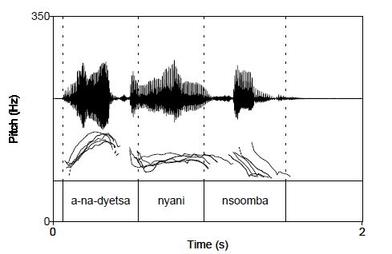
ภาพประกอบที่สอง[ 7 ]แสดงแทร็กเสียงของประโยคต่อไปนี้:
- a nádyé tsa nya ní nsó mba 'พวกเขาเลี้ยงปลาลิงบาบูน (บางตัว)'
ประโยคนี้มีโทนไวยากรณ์ของกาลสมบูรณ์ระยะไกล (Remote Perfect tense) คือ a ná dyetsa 'พวกเขาเลี้ยง' และมีโทนคำศัพท์ของnya ní 'ลิงบาบูน' และnsó mba 'ปลา'
ในตัวอย่างนี้ ในคำว่าa ná dyetsaจุดสูงสุด (จุดเสียงสูง) ของสำเนียงไม่ได้ตรงกับพยางค์ แต่กลับล่าช้าออกไป ทำให้ดูเหมือนว่าเสียงนั้นกระจายไปสองพยางค์ กระบวนการนี้เรียกว่า 'การเพิ่มเสียงเป็นสองเท่า' หรือ 'การเลื่อนจุดสูงสุด' และเป็นลักษณะเฉพาะของผู้พูดในบางภูมิภาคของประเทศมาลาวี
คำที่สองnya ní 'ลิงบาบูน' มีการเน้นเสียงที่พยางค์สุดท้าย แต่โดยปกติแล้วการเน้นเสียงสุดท้ายจะกระจายไปด้านหลังจนถึงพยางค์รองสุดท้าย แสดงให้เห็นถึงระดับเสียงที่เกือบจะคงที่หรือค่อยๆ สูงขึ้น โดยมีเพียงเสียงn แรกเท่านั้น ที่มีระดับเสียงต่ำ อีกคุณลักษณะหนึ่งของการเน้นเสียงสุดท้ายคือมักจะไม่สูงมากนัก[ 8 ]ในกรณีนี้ ระดับเสียงจะต่ำกว่าระดับเสียงสูงของnsó mbaที่ตามมา เล็กน้อย
เมื่อคำที่มีวรรณยุกต์สุดท้าย เช่นnya níมาอยู่ท้ายประโยค มักจะออกเสียงเป็นnyă niโดยมีวรรณยุกต์สูงขึ้นที่พยางค์รองสุดท้ายและพยางค์สุดท้ายต่ำ แต่ถ้ามีการเพิ่มคำต่อท้ายเข้าไป การเน้นเสียงจะย้ายไปที่พยางค์รองสุดท้ายใหม่ และคำนั้นจะออกเสียงโดยมีวรรณยุกต์สูงเต็มที่ที่พยางค์สุดท้าย: nya ní -yo 'ลิงบาบูนตัวนั้น' [ 9 ]
คำที่สามnsó mba 'ปลา' มีเสียงเน้นที่พยางค์รองสุดท้าย เนื่องจากคำนี้เป็นคำสุดท้ายของประโยค เสียงจึงลดลงจากสูงไปต่ำ
เช่นเดียวกับตัวอย่างก่อนหน้านี้ มีการลดระดับเสียงจากวรรณยุกต์แรกไปยังวรรณยุกต์ที่สอง แต่เมื่อมีวรรณยุกต์สองวรรณยุกต์อยู่ในพยางค์ที่อยู่ติดกัน เช่นในคำว่าnya ní nsó mbaจะไม่มีการลดระดับเสียง
ค่าความเข้มเสียงที่แสดงอยู่ด้านบนสุดของแทร็กเสียง บ่งชี้ว่าความเข้มเสียง (ความดัง) สูงที่สุดในพยางค์รองสุดท้ายของแต่ละคำ
ประเภทของโทนเสียง
หมายเหตุ: ในบทความนี้ พยางค์ที่มีวรรณยุกต์ทางคำศัพท์หรือไวยากรณ์โดยกำเนิดจะแสดงด้วยเครื่องหมายเน้นเสียง (acute accent) และเน้นพยางค์นั้นด้วยตัวหนา (เพื่อให้มองเห็นได้ง่าย) วรรณยุกต์ที่แผ่มาจากพยางค์อื่นจะแสดงด้วยเครื่องหมายเน้นเสียงเช่นกัน แต่จะไม่เน้นด้วยตัวหนา การขีดเส้นใต้ใช้เพื่อเน้นตำแหน่งที่วรรณยุกต์สูงแผ่กระจายออกมา
วรรณยุกต์
คำนาม
พยางค์บางพยางค์ในคำภาษาชิเชวาเกี่ยวข้องกับระดับเสียงสูง โดยปกติจะมีระดับเสียงสูงหนึ่งเสียงต่อคำหรือหน่วยคำ แต่บางคำก็ไม่มีเสียงสูง ในคำนาม ระดับเสียงสูงมักจะอยู่ในพยางค์สามพยางค์สุดท้าย: [ 10 ]
- chí manga 'maize'
- chi kó ndi 'ความรัก'
- จีนngwá 'มันสำปะหลัง' (ออกเสียง chină ngwáหรือ chi nă ngwa )
ในคำนามบางคำ (มักเป็นคำประสม) มีวรรณยุกต์สูงสองวรรณยุกต์ หากวรรณยุกต์เหล่านี้คั่นด้วยพยางค์ที่ไม่เน้นเสียงเพียงพยางค์เดียว มักจะรวมกันเป็นกลุ่มวรรณยุกต์สูงสามพยางค์ กล่าวคือ HLH จะกลายเป็น HHH ในทำนองเดียวกัน วรรณยุกต์แรกของคำที่ลงท้ายด้วย HLLH สามารถกระจายออกไปเป็น HHLH ได้
- bí rí má nkhwe'กิ้งก่า'
- tsá bó lá 'pepper'
- chi zó ló we zí / chi zó lowe zí 'นิสัย'
นอกจากนี้ยังมีคำนามจำนวนมากที่ไม่มีเสียงสูง แต่ถึงแม้จะเน้นเสียงหรือออกเสียงหนัก ก็ยังออกเสียงทุกพยางค์เป็นเสียงต่ำ:
- โรงพยาบาลชิปาตาลา
- mkaka 'นม'
- nyama 'สัตว์'
นอกจากนี้ เสียงสูงยังสามารถตัดกับพยางค์ที่ไม่มีเสียง ทำให้เกิดคำที่แตกต่างออกไปได้:
- m té ngo 'ต้นไม้'
- ราคา mtengo
การเน้นเสียงตามวรรณยุกต์แตกต่างจากการเน้นเสียงตามจังหวะในภาษาต่างๆ เช่น ภาษาอังกฤษ ตรงที่การเน้นเสียงตามวรรณยุกต์จะคงระดับเสียงเดิมเมื่อเทียบกับพยางค์รอบข้างเสมอ ดังนั้นเสียงสูงของ-kó- ใน chi kó ndiจึงมักมีระดับเสียงสูงกว่าchi-และ-ndi ไม่เคยต่ำกว่าเลย
คำกริยาที่มีน้ำเสียงสูง
รากศัพท์ส่วนใหญ่ในภาษาชิเชวา รวมถึงคำกริยาพยางค์เดียวทั้งหมด ไม่มีวรรณยุกต์ ดังต่อไปนี้:
- ธันดิซ่า 'ช่วยด้วย'
- พิต้า 'โก'
- -dya 'กิน'
- -ฟ้า 'ตาย'
อย่างไรก็ตาม รากศัพท์บางคำมีวรรณยุกต์ ซึ่งจะได้ยินที่สระตัวสุดท้าย-aของคำกริยา:
- thama ngá 'วิ่ง'
- thoko zá 'ขอบคุณ'
โทนเสียงไม่ได้สืบทอดมาจากภาษาโปรโต-บันตู และไม่สอดคล้องกับการแบ่งแยกเสียงสูง-ต่ำของรากคำกริยาในภาษาบันตู อื่นๆ แต่ดูเหมือนจะเป็นการพัฒนาที่เป็นอิสระในภาษาชิเชวา[ 11 ]
บ่อยครั้งที่คำกริยามีวรรณยุกต์ ไม่ใช่เพราะรากศัพท์มีวรรณยุกต์อยู่แล้ว แต่เป็นเพราะมีการเติมส่วนขยายที่แสดงสภาวะหรือความเข้มข้นเข้าไป:
- dziwa 'รู้'
- dziwi ká 'เป็นที่รู้จัก'
- funa 'ต้องการ'
- funitsi tsá 'ต้องการมาก'
เมื่อมีการเพิ่มส่วนขยาย ไม่ว่าจะเป็นเสียงสูงหรือเสียงต่ำ ต่อท้ายคำกริยาเสียงสูง จะได้ยินเพียงเสียงเดียวในส่วนสุดท้าย:
- pe zá 'ค้นหา'
- pezere rá 'จับใครบางคนได้คาหนังคาเขา'
- thamangi rá 'วิ่งตาม'
โทนเสียงทางไวยากรณ์
รูปแบบเสียงวรรณยุกต์ของกาลเวลา
นอกจากวรรณยุกต์ตามคำศัพท์ที่กล่าวมาข้างต้นแล้ว คำกริยาในภาษาชิเชวายังมีวรรณยุกต์ตามไวยากรณ์อีกด้วย แต่ละกาลจะสอดคล้องกับทำนองวรรณยุกต์เฉพาะ ซึ่งจะเหมือนกันสำหรับทุกคำกริยาในกาลนั้น (โดยมีการปรับเปลี่ยนตามความยาวของคำกริยา) ตัวอย่างเช่น กาลต่อไปนี้จะมีวรรณยุกต์สูงทันทีหลังเครื่องหมายแสดงกาล:
- ndi-ku- thá ndiza 'ฉันกำลังช่วย'
- ndi-ma- thá ndiza 'ฉันกำลังช่วย'
- ndi-na- thá ndiza 'ฉันช่วยแล้ว (เมื่อกี้)'
คำต่อไปนี้มีวรรณยุกต์สองแบบ แบบหนึ่งอยู่ที่เครื่องหมายแสดงกาล และอีกแบบอยู่ที่พยางค์รองสุดท้าย:
- ndi-n ká -tha ndí za 'ฉันเคยช่วย'
- ndi- zí -tha ndí za 'ฉันควรจะช่วย'
- ndi-ka- má -tha ndí za 'ถ้าฉันช่วย'
กาลต่อไปนี้ไม่มีวรรณยุกต์:
- nd-a-thandiza 'ฉันได้ช่วยเหลือแล้ว'
- ndi-nga-thandize 'ฉันช่วยได้'
- ndi-ka-thandiza 'ถ้าฉันช่วย'
และอื่นๆ มีรูปแบบเสียงวรรณยุกต์ที่แตกต่างกันอย่างน้อยแปดแบบในกริยาบอกเล่า นอกเหนือจากรูปแบบเพิ่มเติมที่ใช้ในกาลปฏิเสธและในกริยาอนุประโยคสัมพัทธ์[ 12 ]
การเพิ่มเครื่องหมายวัตถุ
รูปแบบเสียงวรรณยุกต์มักจะเปลี่ยนแปลงอีกครั้งเมื่อมีการเพิ่มหน่วยคำอื่น ๆ เช่น คำบ่งชี้ลักษณะกริยา หรือคำบ่งชี้กรรม เข้าไปในคำกริยา ตัวอย่างเช่น:
- ndi-ku- thá ndiza 'ฉันกำลังช่วย'
- ndi-ku- mú -thandi zá 'ฉันกำลังช่วยเขา'
รายละเอียดเพิ่มเติมจะอธิบายไว้ด้านล่างในหัวข้อเกี่ยวกับรูปแบบกาลต่างๆ
รูปแบบกาลเชิงลบ
โดยปกติแล้ว กริยาปฏิเสธจะมีรูปแบบเสียงวรรณยุกต์ที่แตกต่างจากกริยาบอกเล่าในกาลเดียวกัน และบางครั้งอาจมีรูปแบบเสียงวรรณยุกต์ปฏิเสธที่แตกต่างกันสองแบบ ขึ้นอยู่กับความหมาย ตัวอย่างเช่น:
- sí - ndí -thandiza 'ฉันไม่ช่วย'
- si-ndi-tha ndí za 'ฉันจะไม่ช่วย'
- sí - ndí -na-tha ndí ze 'ฉันไม่ได้ช่วย'
- สิ-นทิ-นา-ทานิซ 'ฉันยังไม่ได้ช่วยเลย'
รูปแบบอนุประโยค
ในกาลต่างๆ รูปแบบเสียงวรรณยุกต์จะเปลี่ยนไปเมื่อใช้คำกริยาในประโยคย่อยที่แสดงความสัมพันธ์ทางไวยากรณ์ เวลา หรือเงื่อนไข บางครั้ง การเปลี่ยนแปลงรูปแบบเสียงวรรณยุกต์เพียงอย่างเดียวก็เพียงพอที่จะแสดงว่าคำกริยานั้นถูกใช้ในลักษณะดังกล่าว การเปลี่ยนแปลงหลักคือการเพิ่มเสียงวรรณยุกต์ที่พยางค์แรกของคำกริยา และมักจะมีเสียงวรรณยุกต์ที่พยางค์รองสุดท้ายด้วยเช่นกัน
- cha ká chatha 'ปีได้สิ้นสุดลงแล้ว'
- cha ká chá tha 'ปีที่สิ้นสุดลงแล้ว (เช่น ปีที่แล้ว)'
- ali ku Lilongwe 'เขาอยู่ในลิลองเว'
- á lí ku Lilongwe'เมื่อเขาอยู่ที่ลิลองเว'
- ndi-ka- dá -thandiza 'ฉันจะช่วย'
- ndí -ka-da-tha ndí za 'ถ้าฉันได้ช่วย'
วรรณยุกต์ผสมผสานกับรูปแบบวรรณยุกต์
เมื่อรากคำกริยามีเสียงสูง เสียงสูงนั้นจะปรากฏให้เห็นในพยางค์สุดท้าย นอกเหนือจากรูปแบบเสียงวรรณยุกต์:
- ndi-ka- dá -thandiza 'ฉันจะช่วย'
- ndi-ka- dá -thama ngá 'ฉันน่าจะวิ่ง' (สามารถได้ยินน้ำเสียง)
อย่างไรก็ตาม หากรูปแบบเสียงวรรณยุกต์ของกาลนั้นวางเสียงวรรณยุกต์ไว้ที่พยางค์รองสุดท้ายหรือพยางค์สุดท้าย เสียงวรรณยุกต์ของคำนั้นจะถูกทำให้เป็นกลางและไม่สามารถได้ยินได้
- si-ndi-tha ndí za 'ฉันจะไม่ช่วย'
- si-ndi-tha má nga 'ฉันจะไม่วิ่ง' (ลบคำศัพท์แล้ว)
- ndi-thandi zé 'ฉันควรช่วย'
- ndi-thama ngé 'ฉันควรวิ่ง'
หากรูปแบบวรรณยุกต์วางวรรณยุกต์ไว้ที่พยางค์ก่อนสุดท้ายของคำกริยาที่มีวรรณยุกต์สูง วรรณยุกต์ทั้งสองจะรวมกันเป็นช่วงเสียงคงที่:
- ndi-ku- thá má ngá 'ฉันกำลังวิ่ง'
- nd-a- mú -pé zá 'ฉันพบเขาแล้ว'
ระดับเสียงสูงต่ำ
นอกจากวรรณยุกต์ทางคำศัพท์และไวยากรณ์แล้ว ยังมีวรรณยุกต์ทางน้ำเสียงอีกด้วย วรรณยุกต์ที่พบได้ทั่วไปอย่างหนึ่งคือวรรณยุกต์คั่นกลางที่ค่อยๆ สูงขึ้นจากต่ำไปสูง ซึ่งจะได้ยินเมื่อใดก็ตามที่มีการหยุดชั่วคราวในประโยค เช่น หลังประโยคหลักหรือประโยคย่อย
มีการเพิ่มวรรณยุกต์ให้กับคำถามด้วย ตัวอย่างเช่น คำที่ไม่มีวรรณยุกต์อย่างkuti 'ที่ไหน?' จะกลายเป็นkú tiในคำถามต่อไปนี้:
- คุณคิดอย่างไร?บ้านของคุณอยู่ที่ไหน?
รายละเอียดเพิ่มเติมเกี่ยวกับระดับเสียงสูงต่ำมีดังต่อไปนี้
จำนวนโทนเสียง
ระดับเสียงสองระดับ คือ สูงและต่ำ ซึ่งโดยทั่วไปเขียนว่า H และ L ถือว่าเพียงพอที่จะอธิบายโทนเสียงของภาษาชิเชวาได้[ 13 ]ในภาษาชิเชวาเอง โทนเสียงสูงเรียกว่าmngóli wókwéza ('โทนเสียงแห่งการยกขึ้น') และโทนเสียงต่ำเรียกว่าmngóli wótsítsa ('โทนเสียงแห่งการลดลง') [ 14 ]ผู้เขียนบางคน[ 15 ]เพิ่มโทนเสียงระดับกลาง แต่ส่วนใหญ่ไม่ได้เพิ่ม แต่ถือว่าโทนเสียงระดับกลางเป็นเพียงหน่วยเสียงย่อยของโทนเสียงสูงที่อยู่ใกล้เคียง
อย่างไรก็ตาม จากมุมมองทางทฤษฎี มีการโต้แย้งว่าเสียงวรรณยุกต์ของภาษาชิเชวาควรพิจารณาไม่ใช่ในแง่ของ H และ L แต่ในแง่ของ H และ Ø กล่าวคือ พยางค์เสียงสูงเทียบกับพยางค์เสียงต่ำ[ 1 ]เหตุผลก็คือ เสียงวรรณยุกต์ H มีพลวัตมากกว่าเสียงวรรณยุกต์ L มาก และมีบทบาทสำคัญในปรากฏการณ์เสียงวรรณยุกต์ ในขณะที่พยางค์เสียงต่ำค่อนข้างเฉื่อยชา[ 16 ]
ในการเขียนหนังสือและหนังสือพิมพ์ภาษาชิเชวาแบบมาตรฐานนั้น ไม่ได้มีการระบุระดับเสียงสูง แต่โดยทั่วไปแล้วนักภาษาศาสตร์จะระบุระดับเสียงสูงโดยการเขียนด้วยเครื่องหมายเน้นเสียง (acute accent) เช่นเดียวกับพยางค์แรกของ คำว่า nsó mba ส่วน ระดับเสียงต่ำนั้นโดยทั่วไปจะไม่ระบุเครื่องหมายใดๆ
ผลงานที่บรรยายถึงโทนเสียงของชาวชิเชวา
งานเขียนชิ้นแรกสุดที่ระบุระดับเสียงของคำในภาษาชิเชวาคืองาน เขียน ของ นักวิชาการชาวแอฟริกันอเมริกันเรื่อง A Grammar of Chichewa (1937) ชื่อ Mark Hanna Watkinsซึ่งถือเป็นงานบุกเบิก เนื่องจากไม่เพียงแต่เป็นงานเขียนเกี่ยวกับภาษาชิเชวาชิ้นแรกที่รวมระดับเสียงไว้เท่านั้น แต่ยังเป็นไวยากรณ์ภาษาแอฟริกันภาษาแรกที่เขียนโดยชาวอเมริกันอีกด้วย[ 17 ]ผู้ให้ข้อมูลที่ Watkins ใช้คือKamuzu Banda วัยหนุ่ม ซึ่งต่อมาในปี 1966 จะกลายเป็นประธานาธิบดีคนแรกของสาธารณรัฐมาลาวี
ไวยากรณ์อีกเล่มหนึ่งที่รวมถึงวรรณยุกต์ของภาษาชิเชวาคือคู่มือที่เขียนขึ้นสำหรับอาสาสมัครหน่วยสันติภาพStevickและคณะหลักสูตรพื้นฐานภาษาชินยานจา (1965) ซึ่งให้ข้อมูลโดยละเอียดเกี่ยวกับวรรณยุกต์ของประโยค และยังระบุระดับเสียงสูง ต่ำด้วย [ 18 ] เล่มต่อมาคือ การเรียนรู้ภาษาชิเชวาของScotton และ Orr (1980) [ 19 ]มีรายละเอียดน้อยกว่ามาก งานทั้งสามชิ้นนี้มีให้ใช้งานบนอินเทอร์เน็ตหนังสือ Chichewa: A Practical Course (1987) [1980] ของ JK Louw ซึ่งมีเครื่องหมายวรรณยุกต์ ปัจจุบันหมดจากตลาดแล้ว
ตั้งแต่ปี 1976 เป็นต้นมา มีบทความทางวิชาการจำนวนมากจากนักวิชาการชาวมาลาวีและตะวันตกตีพิมพ์เกี่ยวกับแง่มุมต่างๆ ของวรรณยุกต์ในภาษาชิเชวา งานวิจัยล่าสุดที่กล่าวถึงวรรณยุกต์ของภาษาชิเชวาคือ " สัทวิทยาของภาษาชิเชวา" (The Phonology of Chichewa ) (2017) โดย ลอร่า ดาวนิง และ อัล มเทนเจ
พจนานุกรมสี่เล่มยังระบุโทนเสียงของคำในภาษาชิเชวาด้วย เล่มแรกสุดคือเล่มที่ 3 ของChichewa: A Practical Course (1987) ของ JK Louw [1980]; พจนานุกรม Chichewa-English, English-Chichewa สำหรับผู้เรียนโดย Botne และ Kulemeka (1991), Mtanthauziramawu wa Chinyanja/Chichewa ฉบับภาษาเดียว (ประมาณปี 2000) ที่จัดทำโดยศูนย์การศึกษาภาษาของมหาวิทยาลัยมาลาวี (มีให้ใช้งานออนไลน์) [ 20 ]และพจนานุกรม Common Bantu On-Line Chichewa Dictionary (2001) ซึ่งเดิมเผยแพร่ทางออนไลน์โดยมหาวิทยาลัยแคลิฟอร์เนียในเบิร์กลีย์[ 21 ]
จนถึงปัจจุบัน งานวิจัยทั้งหมดที่ตีพิมพ์เกี่ยวกับวรรณยุกต์ของภาษาชิเชวา ล้วนเกี่ยวข้องกับภาษาชิเชวาในมาลาวี ยังไม่มีข้อมูลตีพิมพ์ใดๆ เกี่ยวกับวรรณยุกต์ของภาษาชินยานจาที่พูดในแซมเบียและโมซัมบิก
ปรากฏการณ์ทางเสียงบางอย่าง
เพื่อให้เข้าใจเสียงวรรณยุกต์ในภาษาชิเชวา จำเป็นต้องเข้าใจปรากฏการณ์ทางวรรณยุกต์ต่างๆ ที่อาจเกิดขึ้นเสียก่อน ซึ่งจะอธิบายโดยสังเขปด้านล่างนี้
ดาวน์ดริฟท์
โดยปกติในประโยคภาษาชิเชวา เมื่อใดก็ตามที่เสียงสูงสองเสียงถูกคั่นด้วยพยางค์ที่ไม่มีเสียงหนึ่งพยางค์ขึ้นไป (เช่น เมื่อเสียงมาในลำดับ HLH หรือ HLLH หรือ HLLLH) เสียงสูงที่สองมักจะต่ำกว่าเสียงแรกเล็กน้อย ตัวอย่างเช่น ในคำว่าá -ma-la mú la 'เขามักจะปกครอง' ในตัวอย่างที่แสดงไว้ข้างต้น เสียงของพยางค์แรกá จะออกเสียงสูงกว่าเสียงของพยางค์ที่สอง múเล็กน้อยดังนั้นโดยทั่วไปแล้วเสียงที่สูงที่สุดในประโยคคือเสียงแรก ปรากฏการณ์นี้ซึ่งพบได้ทั่วไปในภาษาบันตูหลายภาษา เรียกว่า ' downdrift ' [ 22 ]หรือ 'catathesis' [ 23 ]หรือ 'automatic downstep' [ 24 ]
อย่างไรก็ตาม มีข้อยกเว้นหลายประการสำหรับกฎนี้ ตัวอย่างเช่น การลดระดับเสียงจะไม่เกิดขึ้นเมื่อผู้พูดกำลังถามคำถาม[ 25 ]หรือท่องรายการสิ่งของโดยเว้นจังหวะหลังจากแต่ละรายการ หรือบางครั้งหากออกเสียงคำใดคำหนึ่งด้วยระดับเสียงสูงเพื่อเน้นย้ำ นอกจากนี้ยังไม่มีการลดระดับเสียงในคำเช่นwá pó lí si 'ตำรวจ' (มาจากwá 'บุคคลของ' + po lí si 'ตำรวจ') ซึ่งเสียงสูงสองเสียงในลำดับ HLH ถูกเชื่อมต่อกันเพื่อสร้างเสียงสูง HHH (ดูด้านล่าง)
การกระจายเสียงสูง (HTS)
ในบางสำเนียง เสียงสูงอาจแผ่ขยายไปยังพยางค์ถัดไปได้ ซึ่งเรียกว่า 'การแผ่ขยายเสียงสูง' หรือ 'การซ้ำเสียง' [ 26 ]ดังนั้น ในขณะที่ผู้พูดบางคนพูดว่าndi ná thandiza 'ฉันช่วย' คนอื่นๆ ก็จะพูดว่าndi náthá ndiza [ 27 ] นักสัทศาสตร์บางคนโต้แย้งว่า สิ่งที่เกิดขึ้นที่นี่ อย่างน้อยในบางกรณี คือ ส่วนที่สูงที่สุดหรือ 'จุดสูงสุด' ของเสียงจะเคลื่อนไปข้างหน้า ทำให้เกิดความรู้สึกว่าเสียงนั้นครอบคลุมสองพยางค์ ซึ่งเป็นกระบวนการที่เรียกว่า 'การหน่วงจุดสูงสุด' [ 28 ]ตัวอย่างของการหน่วงจุดสูงสุดสามารถเห็นได้อย่างชัดเจนในแทร็กเสียงของคำว่าa ná dyetsa 'พวกเขาเลี้ยง' ที่แสดงไว้ข้างต้น ซึ่งออกเสียงว่าa nádyé tsaใน Downing et al. (2004)
มีรูปแบบคำกริยาบางรูปแบบที่ไม่มีการเพิ่มเสียงวรรณยุกต์ เช่น ในกาลปัจจุบันกาลปกติ ซึ่งจะมีเสียงวรรณยุกต์ต่ำในพยางค์ที่สองเสมอ: [ 29 ]
- á Mala mú la 'พวกเขามักจะปกครอง'
เพื่อให้เกิด HTS ต้องมีพยางค์อย่างน้อย 3 พยางค์ตามหลังเสียงวรรณยุกต์ แม้ว่าจะไม่จำเป็นต้องอยู่ในคำเดียวกันก็ตาม ดังนั้นเสียงวรรณยุกต์แรกอาจกระจายในพยางค์ที่สองของแต่ละคู่ด้านล่าง แต่ไม่ใช่ในพยางค์แรก: [ 30 ]
- zí komo 'ขอบคุณ'
- zíkó mo kwámbí riขอบคุณมาก
- tambala 'ไก่ตัวผู้'
- mtengo wá tá mbala 'ราคาของไก่'
การใช้เสียงวรรณยุกต์ซ้ำกันที่พบบ่อยอย่างหนึ่งคือการเชื่อมคำสองคำเข้าด้วยกันเป็นวลีเดียว ซึ่งมักเกิดขึ้นจากพยางค์รองสุดท้าย แต่ในบางสำเนียงก็อาจเกิดขึ้นจากพยางค์ก่อนรองสุดท้ายได้เช่นกัน ตัวอย่างเช่น เมื่อคำกริยาตามด้วยกรรม:
- aku sá ka 'พวกเขากำลังล่า'
- aku sáká m ká ngo 'พวกเขากำลังล่าสิงโต' [ 31 ]
- ku phí ka 'ทำอาหาร'
- ku phíká nyama 'ปรุงเนื้อสัตว์' [ 32 ]
- ku sá mala 'ดูแล'
- ku sámá la m ká zi 'ดูแลภรรยา' [ 33 ]
ปรากฏการณ์นี้สามารถเห็นได้จากแทร็กเสียงของประโยคmwa mú na, á mala mú la a má yi ที่ยกตัวอย่าง ไว้ในตอนต้นของบทความนี้ ซึ่งเสียงวรรณยุกต์ของ-mú-ถูกขยายออกไปเป็นá mala múlá a má yi
การซ้ำเสียงวรรณยุกต์ยังพบได้เมื่อคำนามตามด้วยสรรพนามชี้เฉพาะหรือสรรพนามแสดงความเป็นเจ้าของ:
- mi ká ngo 'สิงโต'
- mi kángó iyo 'สิงโตเหล่านั้น' [ 34 ]
- chí manga 'maize'
- chímá nga chá nga 'ข้าวโพดของฉัน' [ 35 ]
ที่ราบสูงโทนเสียง
บางครั้งลำดับ HLH ในภาษาชิเชวาจะกลายเป็น HHH ทำให้เกิด 'ระดับ' ของเสียง ระดับเสียงมักเกิดขึ้นหลังคำนำหน้าá 'ของ' และndí 'และ', 'กับ': [ 36 ]
- wá pó lí si'ตำรวจ' (จาก wá '(บุคคล) ของ' และpo lí si'ตำรวจ')
- chá kú dyá 'อาหาร' (จาก chá '(สิ่ง) ของ' และku dyá 'กิน')
- ndí Má lá wi'และมาลาวี'
ก่อนหยุดชั่วคราว เสียงสุดท้ายอาจลดลง แต่เสียงของพยางค์กลางยังคงสูงอยู่ เช่นchákú dyaบางครั้งลำดับเสียงจะเชื่อมต่อกันด้วยวิธีนี้ เช่นgú le wá m kú lu 'นักเต้น สวมหน้ากาก' ด้วยเสียงสูงต่อเนื่องยาวจากgúถึงkú [ 37 ]
อีกสถานที่หนึ่งที่มักพบช่วงเสียงคงที่คือหลังจากเสียงสูงเริ่มต้นของกริยาในอนุประโยค เช่น ตัวอย่างต่อไปนี้:
- á kú thá ndiza'เมื่อเขาช่วยเหลือ'; 'ใครกำลังช่วยเหลือ'
- ndí tá thá ndiza'หลังจากที่ฉันช่วย'
หากเสียงวรรณยุกต์ในตอนท้ายของคำเป็น HLH มักจะมีช่วงเสียงคงที่ (plateau) เกิดขึ้น
- m ká mwí ní 'ลูกเขย'
- a tsá mú ndá 'ชาวอาณานิคม' (แปลตรงตัวว่า 'เจ้าของพื้นที่การเกษตร')
- ku sí yá ná 'ความแตกต่าง'
- ku lé mé rá 'น้ำหนัก, หนัก'
อย่างไรก็ตาม มีข้อยกเว้น ตัวอย่างเช่น ในคำว่าnyé nye zí 'ดาว' เสียงวรรณยุกต์ทั้งสองจะแยกออกจากกัน ดังนั้นคำนี้จึงออกเสียงว่าnyé nyē zī (โดยที่īแทนเสียงวรรณยุกต์ที่ต่ำกว่าí เล็กน้อย ) [ 38 ]
นอกจากนี้ยังมีรูปแบบกาลเสียงวรรณยุกต์บางอย่าง (เช่น รูปแบบบอกเล่าเชิงบวกที่ 5 และ 6 ที่อธิบายไว้ด้านล่าง) ซึ่งเสียงวรรณยุกต์ทั้งสองจะยังคงแยกจากกันแม้ว่าลำดับจะเป็น HLH ก็ตาม:
- ndi-n ká -tha ndí za 'ฉันกำลังช่วย' (รูปแบบเสียง 5)
- ndí -ma- dyá 'ฉันมักจะกิน' (รูปแบบเสียง 6)
ไม่สามารถเกิดช่วงเสียงคงที่ได้เมื่อลำดับเสียงพื้นฐานเป็น HLLH แม้ว่าการกระจายเสียงจะกลายเป็น HHLH ก็ตาม:
- chi zó ló we zí 'นิสัย'
การเปลี่ยนโทนเสียง ('การกระแทก')
เมื่อคำหรือวลีที่เชื่อมโยงกันอย่างใกล้ชิดลงท้ายด้วย HHL หรือ HLHL ในภาษาชิเชวา มีแนวโน้มที่เสียง H ตัวที่สองจะเคลื่อนไปยังพยางค์สุดท้ายของคำ กระบวนการนี้เรียกว่า 'การเปลี่ยนโทนเสียง' [ 39 ]หรือ 'การเลื่อน' [ 40 ]มีสองประเภทที่โทนเสียงที่สองเคลื่อนไปข้างหน้า ได้แก่ การเลื่อนแบบท้องถิ่นและการเลื่อนแบบไม่ท้องถิ่น นอกจากนี้ยังมีการเลื่อนแบบย้อนกลับ ซึ่งโทนเสียงแรกเคลื่อนไปข้างหลัง
การชนกันในพื้นที่
ใน 'การกระแทกเฉพาะที่' หรือ 'การเปลี่ยนโทนเสียงเฉพาะที่' LHHL ที่ท้ายคำหรือวลีจะกลายเป็น LHHH ซึ่งโทนเสียงทั้งสองจะรวมกันเป็นระดับคงที่ สิ่งนี้สามารถเกิดขึ้นได้เมื่อคำที่มีโทนเสียงสุดท้ายตามด้วยคำคุณศัพท์แสดงความเป็นเจ้าของ และยังเกิดขึ้นกับคำว่าína 'อื่นๆ' และyénse/ónse 'ทั้งหมด': [ 41 ]
- nyu mbá + yá nga > nyu mbá yángá 'บ้านของฉัน'
- nyu mbá + í na > nyu mbá íná 'บ้านอื่น'
- nyu mbá + zó nse > nyu mbá zónsé 'บ้านทั้งหมด'
ในคำสามพยางค์ที่ HHL เกิดจากการเพิ่มคำต่อท้าย เช่น-nso 'เช่นกัน, อีกครั้ง', -di 'แน่นอน' หรือ-be 'ยังคง' ระดับเสียงจะเปลี่ยนเป็น HHH เช่นเดียวกัน: [ 42 ]
- nsómbá -nso > nsómbá-nsó 'ปลาด้วย'
- a-ku- pítá -di > a-ku- pítá-dí 'เขาจะไปจริงๆ'
- a-ku- pítá -be > a-ku- pítá-bé 'เขายังคงไป'
การเปลี่ยนโทนเสียงยังเกิดขึ้นในคำกริยาเมื่อคำกริยาจะลงท้ายด้วย LHHL: [ 43 ]
- a- ná-mú -pha > a ná-mú-phá 'พวกเขาฆ่าเขา'
เมื่อจบประโยค เสียงสูงสุดท้ายอาจลดลงอีกครั้ง ทำให้คำนั้นกลับไปเป็นa- ná -mú -pha
ในคำกริยารูปแบบที่ 5 และรูปแบบเชิงลบ 3a (ดูด้านล่าง) มีทางเลือกระหว่างการสร้างระดับคงที่และการพิจารณาโทนเสียงสุดท้ายแยกต่างหาก: [ 44 ]
- ndi- zí-pí ta > ndi- zí-pítá / ndi- zí -pi tá 'ฉันควรจะไป'
- si-ndi- ngá-mé nye > si-ndi- ngá-ményé / si-ndi- ngá -me nyé 'ฉันไม่สามารถตี'
ในคำศัพท์ HHL ที่พยางค์แรกมาจาก á 'ของ' จะไม่มีการชนกันของพยางค์ :
- kwá-mbí ri 'มาก'
- wá-ntchíแปลว่า 'คนงาน'
การกระแทกนอกพื้นที่
ในการเปลี่ยนโทนเสียงอีกแบบหนึ่ง (เรียกว่า 'การกระแทกแบบไม่เฉพาะที่') เสียง HLHL ที่ท้ายคำหรือวลีจะเปลี่ยนเป็น HLLH หรือหากมีการกระจายเสียงสูงตัวแรก จะกลายเป็น HHLH:
- mbú zi yá nga > mbúzí ya ngá / mbú zi ya ngá ) 'แพะของฉัน'
- bá nja ló nse > bánjá lo nsé 'ทั้งครอบครัว'
- chi- mó dzi- mó dzi > chi- mó dzi-mo dzí / chi- módzí -mo dzí 'ในลักษณะเดียวกัน'
แต่ไม่มีการชนกันในรูปแบบกาลที่ 5 และ 6 หรือรูปแบบเชิงลบที่ 3 เมื่อเสียงวรรณยุกต์ที่ท้ายคำเป็น HLHL:
- ndí -ma- pí ta 'ฉันมักจะไป'
- si-ndi- ngá -tha ndí ze 'ฉันช่วยไม่ได้'
การชนย้อนกลับ
ปรากฏการณ์ที่เกี่ยวข้อง แต่ในทางตรงกันข้าม พบได้เมื่อเติมคำต่อท้าย-tú 'จริงๆ' ซึ่งทำให้เสียงวรรณยุกต์ที่ปกติอยู่ท้ายคำเลื่อนไปหนึ่งพยางค์ ทำให้ LHH ที่อยู่ท้ายคำกลายเป็น HLH:
- ndipi té 'ฉันควรจะไป' > ndi pí te- tú 'ฉันควรจะไปจริงๆ'
- chifu kwá 'เพราะ' > chi fú kwa- tú 'เพราะในความเป็นจริง'
คำต่อท้ายเอนคลิติก
คำต่อท้ายบางคำที่เรียกว่าคำเสริม (enclitics ) จะเพิ่มเสียงสูงให้กับพยางค์สุดท้ายของคำที่นำมาต่อท้าย เมื่อต่อท้ายคำที่ไม่มีเสียงวรรณยุกต์ หรือคำที่ลงท้ายด้วย LL เสียงสูงนี้จะได้ยินได้ชัดเจน:
- ลิลองเว > Lilo ngwé -nso 'ลิลองเวด้วย':
การชนกันของคำจะไม่เกิดขึ้นเมื่อมีการเพิ่มคำต่อท้ายเข้าไปในคำที่ลงท้ายด้วย HLL:
- a-ku- thá ndiza 'เขากำลังช่วยเหลือ' > a-ku- thá ndi zá -be 'เขายังคงช่วยเหลืออยู่'
แต่เมื่อคำต่อท้ายถูกรวมเข้ากับคำที่ลงท้ายด้วย HL จะเกิดการขยับเสียงเฉพาะที่ และผลลัพธ์ที่ได้คือช่วงเสียงสามระดับ:
- nsó mba 'ปลา' > nsó mbá- nsó 'ปลาด้วย'
เมื่อเพิ่มเข้าไปในคำที่มีเสียงสูงตอนท้าย จะทำให้เสียงสูงขึ้นไปอีก (ในภาษาถิ่นภาคกลาง เสียงสูงขึ้นในพยางค์แรกของคำเช่นnyŭmbáก็หายไปเช่นกัน) [ 45 ]
- nyŭ mbá > nyu mbá -nso 'บ้านด้วย'
ไม่ใช่ว่าคำต่อท้ายทุกคำจะเพิ่มเสียงวรรณยุกต์ในลักษณะนี้เสมอไป ตัวอย่างเช่น เมื่อเติมคำต่อท้ายบอกสถานที่ เช่น-ko, -ku, -po, -pa, -mo, -mu ต่อท้ายคำนามหรือคำสรรพนาม จะไม่เพิ่มเสียงวรรณยุกต์:
- ku Lilongwe-ko 'ที่นั่นในลิลองเว'
- pa mé ne-pa 'ตรงจุดนี้'
- m' bó kosi-mu 'ภายในกล่องนี้'
อย่างไรก็ตาม เมื่อเติมคำต่อท้ายเหล่านี้เข้าไปในคำกริยา จะเพิ่มโทนเสียงแบบเอนคลิติกเข้าไปด้วย:
- wa-cho ká -po 'เขาไม่อยู่บ้าน' (แปลตรงตัวว่า 'เขาเพิ่งออกไปเมื่อสักครู่')
- nd-ao ná -mo 'ฉันได้เห็นข้างในแล้ว'
คำนำหน้าโปรคลิติก
ในทางกลับกัน คำนำหน้าบางคำจะทำให้พยางค์ที่ตามมามีเสียงสูง คำนำหน้าประเภทนี้เรียกว่า 'proclitic' [ 31 ]หรือ 'post-accenting' ตัวอย่างเช่น คำนำหน้าku-ของคำกริยาไม่ผันจะทำให้พยางค์ที่ตามมามีเสียงสูง
- ku- thá ndiza 'เพื่อช่วยเหลือ'
รูปแบบกริยาประเภทอื่นๆ ที่คล้ายกันนี้จะอธิบายไว้ในรูปแบบกริยาบอกเล่าข้อที่ 4 และ 8 ด้านล่าง
เครื่องหมายกรรม เช่น-ndí- 'ฉัน' หรือ-mú- ' เขา/เธอ' เป็นต้น จะกลายเป็นคำนำหน้าเมื่อเพิ่มเข้าไปในกริยาคำสั่งหรือกริยาแสดง ความปรารถนาในกริยาที่มีสี่หรือห้าพยางค์ เสียงวรรณยุกต์ของเครื่องหมายกรรมจะได้ยินที่จุดเริ่มต้นของกริยาและอาจกระจายออกไป: [ 46 ]
- mu-ndi- fótó koze ré 'โปรดอธิบายให้ฉันฟังหน่อย'
ในคำกริยาสามพยางค์ เสียงวรรณยุกต์จะทำให้เกิดช่วงเสียงคงที่:
- ndi- thá ndí zé -ni! 'ช่วยฉันด้วย!'
- mu-ndi- thá ndí zé 'คุณช่วยฉันได้ไหม?'
ในคำกริยาสองพยางค์ เสียงวรรณยุกต์ที่สองจะหายไป:
- mu- gwí re-ni! 'จับเขาให้ได้!'
แต่ในคำกริยาที่มีพยางค์เดียว เสียงวรรณยุกต์แรกจะยังคงอยู่ที่คำบ่งชี้กรรม และเสียงวรรณยุกต์ที่สองจะหายไป:
- ti- mú -phe! 'มาฆ่าเขากันเถอะ!'
การตัดเสียงวรรณยุกต์ (กฎของเมอสเซิน)
กฎของเมอสเซ่น (Meeussen's Rule)เป็นกระบวนการในภาษาบันตูหลายภาษาที่ลำดับเสียง HH กลายเป็น HL กระบวนการนี้พบได้บ่อยในคำกริยา เมื่อเสียงวรรณยุกต์ก่อนสุดท้ายทำให้เสียงวรรณยุกต์สุดท้ายหายไป:
- ku -góná > ku - góna
เสียงวรรณยุกต์ที่ถูกลบโดยกฎของ Meeussen สามารถแทนที่ได้ด้วยการแพร่กระจาย ดังนั้นแม้ว่าku- gó naจะสูญเสียวรรณยุกต์สุดท้ายไป แต่วรรณยุกต์แรกก็สามารถแพร่กระจายได้ในวลีเช่นku- góná bwino 'นอนหลับสบาย' [ 47 ]
ตัวอย่างหนึ่งที่กฎของ Meeussen ไม่สามารถใช้ได้ในภาษา Chichewa คือเมื่อมีการเพิ่มเครื่องหมายแสดงลักษณะ-ká- 'ไปและ' เข้ากับคำกริยา เช่นa- ná-ká -thandiza 'เขาไปและช่วย ' แทนที่จะถูกลบ เสียงวรรณยุกต์นี้กลับสามารถแพร่กระจายไปยังพยางค์ถัดไปได้ เช่นa- ná-ká-thá ndiza [ 48 ] อย่างไรก็ตาม เสียงวรรณยุกต์ของเครื่องหมายแสดงกรรม เช่น-mú- 'เขา' ในตำแหน่งเดียวกัน จะถูกลบออกโดยกฎของ Meeussen แล้วจึงแทนที่ด้วยการแพร่กระจาย เสียงวรรณยุกต์นั้นจะไม่แพร่กระจายเอง เช่นa- ná -mú -thandiza 'เขาช่วยเขา' ในภูมิภาคทางใต้ การแพร่กระจายจะไม่เกิดขึ้น และเสียงวรรณยุกต์จะเป็นa- ná -mu- thandiza
ระดับเสียงของพยัญชนะ
เช่นเดียวกับในภาษาอังกฤษ ที่ในคำอย่างzooหรือwoodหรือnowพยัญชนะเสียงแรกจะมีระดับเสียงต่ำกว่าสระที่ตามมา ภาษาชิเชวาก็เช่นเดียวกัน ดังนั้น Trithart จึงทำเครื่องหมายโทนเสียงของพยัญชนะต้น เช่น [m], [n], [z] และ [dz] ในบางคำเป็น Low [ 49 ]
อย่างไรก็ตามพยัญชนะนาสิก ตัวแรก ไม่ได้ออกเสียงด้วยระดับเสียงต่ำเสมอไป หลังจากเสียงสูง พยัญชนะนั้นก็สามารถมีเสียงสูงได้เช่นกัน เช่นwá ḿ sodzi 'ของชาวประมง' [ 50 ] พยัญชนะnและmก็สามารถมีเสียงสูงได้เช่นกันเมื่อย่อมาจากndí 'และ' หรือ -mú-ที่มีเสียงสูงเช่นḿ ma khálá kuti? (ย่อมาจากmú ma khálá kuti? ) 'คุณอาศัยอยู่ที่ไหน?' [ 51 ]
ในภาษาบันตูบางภาษาในแอฟริกาตอนใต้ เช่น ภาษาซูลูพยัญชนะเสียงก้องที่อยู่ต้นพยางค์ไม่เพียงแต่มีระดับเสียงต่ำเท่านั้น แต่ยังสามารถลดระดับเสียงของสระที่ตามมาทั้งหมดหรือบางส่วนได้อีกด้วย พยัญชนะดังกล่าวเรียกว่า ' พยัญชนะลดระดับเสียง ' คำถามที่ว่าภาษาชิเชวา (Chichewa) มีพยัญชนะลดระดับเสียงหรือไม่นั้น ได้รับการพิจารณาครั้งแรกโดย Trithart (1976) และต่อมาโดย Cibelli (2012) จากข้อมูลที่รวบรวมโดย Cibelli พบว่า พยัญชนะเสียงก้องหรือพยัญชนะนาสิกมีผลเล็กน้อยต่อระดับเสียงของสระที่ตามมา ทำให้ระดับเสียงต่ำลงครึ่งเสียงหรือมากกว่านั้น ตัวอย่างเช่น สระตัวที่สองของku -gúla ' ซื้อ ' จะมีระดับเสียงต่ำกว่าku - kúla 'ปลูก' หรือku- khála 'นั่ง' เล็กน้อย เมื่อสระไม่มีเสียง ผลกระทบจะน้อยลง แต่ดูเหมือนว่ายังคงมีความแตกต่างเล็กน้อยอยู่ อย่างไรก็ตาม ผลกระทบของพยัญชนะกดเสียงในภาษาชิเชวา ปรากฏให้เห็นน้อยกว่าในภาษาซูลูมาก
วรรณยุกต์
วรรณยุกต์คือระดับเสียงของคำแต่ละคำ ระดับเสียงสูงจะยังคงสูงอยู่เสมอ แม้ว่าคำนั้นจะถูกใช้ในบริบทที่แตกต่างกันก็ตาม
คำนาม
ในพจนานุกรม CBOLD Chichewa [ 21 ]ประมาณ 36% ของคำนาม Chichewa ไม่มีวรรณยุกต์ 57% มีวรรณยุกต์เดียว และเพียง 7% เท่านั้นที่มีวรรณยุกต์มากกว่าหนึ่งวรรณยุกต์ เมื่อมีวรรณยุกต์เดียว โดยทั่วไปจะอยู่ที่พยางค์สามพยางค์สุดท้าย คำนามที่มีวรรณยุกต์มากกว่าสามพยางค์จากท้ายคำนั้น แทบจะเป็นคำยืมจากต่างประเทศทั้งหมด เช่นsé kondale 'โรงเรียนมัธยม'
การเปรียบเทียบกับภาษาบันตูอื่นๆ แสดงให้เห็นว่าโดยส่วนใหญ่แล้ววรรณยุกต์ของคำนามในภาษาชิเชวาจะสอดคล้องกับวรรณยุกต์ของคำที่มีรากศัพท์เดียวกันในภาษาบันตูอื่นๆ และจึงมีแนวโน้มที่จะสืบทอดมาจากภาษาบันตูในยุคก่อนหน้า[ 52 ]ข้อยกเว้นคือคำนามที่ในยุคก่อนหน้านี้มีวรรณยุกต์ HH (เช่นnsó mba 'ปลา' จากภาษาโปรโตบันตู * cómbá ) ได้เปลี่ยนเป็น HL ในภาษาชิเชวาตามกฎของ Meeussenดังนั้นคำนามสองพยางค์ในภาษาชิเชวาจึงสามารถมีวรรณยุกต์ HL, LH หรือ LL ได้ โดยทั้งสามวรรณยุกต์นี้พบได้บ่อยพอๆ กัน แต่ (หากไม่นับข้อเท็จจริงที่ว่าคำที่มีวรรณยุกต์ LH มักจะออกเสียงเป็น HH ในทางปฏิบัติ) จะไม่มีคำนามใดที่มีวรรณยุกต์พื้นฐานเป็น HH [ 53 ]
คำนำหน้าชั้นของคำนาม เช่น (ชั้น 7) chi-ในchi kó ndi 'ความรัก' หรือ (ชั้น 3) m-ในm té ngo 'ต้นไม้' มักจะไม่มีวรรณยุกต์ อย่างไรก็ตาม มีข้อยกเว้นบางประการ เช่นchí manga 'ข้าวโพด', chí windi 'ตับ' คำนามสามคำdí so 'ตา', dzí no 'ฟัน' และlí wu 'เสียงหรือคำ' เป็นคำนามที่ไม่ปกติตรงที่วรรณยุกต์สูงจะย้ายจากคำนำหน้าไปยังรากศัพท์ในรูปพหูพจน์ ทำให้เกิดma só , ma nóและma wúตามลำดับ[ 54 ]
คำนามที่ไม่มีวรรณยุกต์
- แบมโบ 'พ่อ สุภาพบุรุษ'
- ชัคเวรา 'ชัคเวรา' (นามสกุล)
- chimfine 'หวัด' (ความเจ็บป่วย)
- ชิงเว 'เชือก'
- ชินทู 'สิ่งของ'
- ชิปินดา '(ห้องนอน)'
- เขตเดรา
- dzanja 'มือ' (กรุณา. manja 'มือ')
- fungo (ไม่มีรูปพหูพจน์) 'กลิ่น'
- funso 'คำถาม'
- ganizo 'ความคิด, ไอเดีย'
- กลุ่มกูลู
- kabudula 'กางเกงขาสั้น'
- คัมวา 'ปาก'
- khomo 'ประตู, ทางเข้า'
- lamulo 'กฎหมาย, ระเบียบ'
- ลิลงเว 'ลิลงเว'
- khalidwe 'พฤติกรรม'
- นิตยสาร 'เลือด'
- magetsi 'ไฟฟ้า'
- งานศพมาลิ
- สุสานมันดา
- mayeso 'สอบ'
- mbale 'จาน'
- mbewa 'หนู'
- mfuti 'ปืน'
- mkaka 'นม'
- mlimi 'ชาวนา'
- โมวา 'เบียร์'
- moyo 'ชีวิต' (pl. miyoyo 'ชีวิต')
- mpando 'เก้าอี้'
- mpeni 'มีด'
- mphunzitsi 'ครู'
- mpira 'ลูกบอล, ฟุตบอล'
- msewu 'ถนน'
- msika 'ตลาด'
- msonkhano 'การประชุม'
- ราคา mtengo
- mtsogoleri 'ผู้นำ'
- mtundu 'ชนิด, ประเภท, สี'
- มุดซี 'หมู่บ้าน'
- มุลุงกู 'พระเจ้า'
- munthu 'คน' (กรุณา anthu 'คน')
- มวัมโบ 'ประเพณี, ขนบธรรมเนียม'
- mwayi 'ขอให้โชคดี'
- mwendo 'ขา' (pl. miyendo 'ขา')
- มซินดา 'เมือง'
- mzungu 'ชาวยุโรป, ชายผิวขาว'
- ndodo 'แท่ง'
- ndondomeko 'โปรแกรม ระบบ'
- ng'ombe 'วัว, กระทิง'
- njala 'ความหิว'
- njira 'เส้นทาง'
- njovu 'ช้าง'
- nkhanza 'ความโหดร้าย'
- nyama 'สัตว์, เนื้อ'
- nyengo 'ฤดูกาล'
- nyerere 'มด'
- เพมเฟโร 'คำอธิษฐาน'
- พุนซิโร 'บทเรียน'
- ทัมบา 'กระเป๋า'
- ทูปี 'ร่างกาย'
- tsamba 'ใบ, หน้า' (pl. masamba 'ผัก')
- tsoka 'โชคร้าย'
- ยันโค 'คำตอบ'
คำยืมจากต่างประเทศบางครั้งก็มีสำเนียงแบบนี้เช่นกัน:
- bomba 'ระเบิด' (ภาษาโปรตุเกส: bomba )
- chipatala 'โรงพยาบาล' (จากภาษาอังกฤษ hospital , ภาษาแอฟริกา hospitaalหรือ Port. hospitalผ่านทางภาษาโชนา)
- damu 'เขื่อน, บ่อปลา'
- โฟมู (โฟโลมู) 'แบบฟอร์ม' (ในโรงเรียน)
- juzi 'jersey, pullover' (เทียบกับ Shona júzi, jézi )
- Katolika 'Catholic' (พอร์ต. católica )
- คลองชลประทาน ngalande [ 55 ]
- poto 'หม้อหุงข้าว'
- saka 'กระสอบ' (จากภาษาอังกฤษ sack , ภาษาแอฟริกา sakหรือภาษาโปรตุเกส saca, saco )
คำนามที่มีเสียงวรรณยุกต์ท้าย
โดยปกติแล้ว คำเหล่านี้จะออกเสียงว่าbwālō , Chichēwāเป็นต้น โดยลงท้ายด้วยวรรณยุกต์กลางสองวรรณยุกต์ หรือในบางสำเนียง อาจออกเสียงว่าbwălò , Chichĕwà ในตอนท้ายของวลี โดยมีวรรณยุกต์รองสุดท้ายสูงขึ้น และวรรณยุกต์สุดท้ายต่ำลง เมื่อเติมคำต่อท้าย-o 'ที่' (ซึ่งแตกต่างกันไปตามประเภทของคำนาม) วรรณยุกต์จะกลายเป็นวรรณยุกต์รองสุดท้ายปกติ เช่นnyu mbá -yo 'บ้านหลังนั้น', mu ndá -wo 'สวนนั้น' ทำให้ฟังวรรณยุกต์ได้ง่ายขึ้น
ในบทความนี้ วรรณยุกต์สุดท้ายจะเขียนเป็นวรรณยุกต์สุดท้าย แม้ว่าในทางปฏิบัติอาจออกเสียงแตกต่างกันได้ก็ตาม
- bwa ló 'พื้นที่โล่ง, สนาม'
- cha ká 'ปี' (pl. za ká 'ปี')
- cha lá 'นิ้วมือ, นิ้วเท้า'
- Chiche wá 'Chichewa'
- chifu kwá 'เหตุผล'
- china ngwá 'มันสำปะหลัง'
- Chinya njá 'Chinyanja'
- chipo ngwé 'ความหยาบคาย'
- chi swé 'termite(s)'
- fu mbí 'ฝุ่น'
- ga lú 'สุนัข'
- kalu lú 'กระต่ายป่า'
- katswi rí 'ผู้เชี่ยวชาญ'
- kho ndé 'verandah'
- khu tú 'หู'
- ku njá 'ข้างนอก'
- liko dzó 'bilharzia'
- li wú 'เสียง; คำ'
- lu só 'ทักษะ'
- ma dzí 'น้ำ'
- madzu ló '(บ่ายแก่ๆ, เย็น)'
- ma ló 'สถานที่'
- ma nó 'ฟัน'
- มานทา 'ความกลัว, ความวิตกกังวล'
- manya zí 'ความอับอาย, ความอับอาย'
- mas ó 'ดวงตา'
- ma wú 'คำพูด, เสียง'
- m'ba lé 'ญาติ, พี่ชาย'
- mchimwe né 'พี่ชาย'
- mla ndú 'คดีความ'
- mle ndó 'คนแปลกหน้า, แขก'
- mma wá 'ตอนเช้า'
- mnyama tá (เช่นมnyá mata ) 'boy'
- มฟากา 'แมว'
- mtanthauzirama wú 'พจนานุกรม'
- mte dzá 'ถั่วลิสง'
- mu ndá 'สวน (สำหรับข้าวโพดหรือพืชผลอื่นๆ)'
- mu tú 'หัว'
- mvu ú 'ฮิปโปโปเตมัส'
- mwa lá 'หิน'
- mwa ná 'เด็ก'
- mwe zí 'ดวงจันทร์, เดือน'
- mwi ní 'เจ้าของ' (กรุณา e ní )
- nde ndé 'คุก'
- ndu ná 'รัฐมนตรี (ของรัฐบาล)'
- ngongo lé 'loan'
- nji ngá 'จักรยาน'
- nsa lú 'ผ้า'
- nya ní 'ลิงบาบูน'
- nya njá 'ทะเลสาบ'
- nyu mbá 'บ้าน'
- nze rú (pl.) 'ปัญญา, ความฉลาด'
- pa nsí 'พื้นดิน, พื้น'
- pha zí 'เท้า' (pl. mapa zí 'เท้า')
- tsogo ló 'อนาคต, ด้านหน้า'
- ubwi no 'ข้อดี, ความดี'
- udzu dzú 'ยุง'
- u fá 'แป้ง'
- ufu lú 'เสรีภาพ'
- ule ndó 'การเดินทาง'
- u tá 'โค้งคำนับ'
- Zo mbá 'Zomba'
คำยืมจากต่างประเทศที่มีสำเนียงแบบนี้พบได้ไม่บ่อยนัก:
- be lú 'ระฆัง'
- bu lú 'ลา' (พอร์ต. burro )
- ka má 'เตียง' (ภาษาโปรตุเกส: cama )
- ma ngó 'mango(es)' (ร้องเพลงบาngó )
คำนามที่มีวรรณยุกต์รองสุดท้าย
- Bá nda 'บันดา' (ชื่อส่วนตัว) [ 56 ]
- bá la 'บาดแผล'
- bá nja 'ครอบครัว'
- bó dza 'โกหก'
- bó ma 'รัฐบาล'
- bú ngwe 'องค์กร'
- chi kó ndi 'ความรัก'
- chi tsá nzo 'ตัวอย่าง'
- chi thú nzi 'รูปภาพ'
- díดังนั้น 'ตา' (pl. ma só 'ตา')
- dzí ko 'ประเทศ' (pl. ma í ko 'ประเทศ')
- dzí na 'ชื่อ' (กรุณามาí na 'ชื่อ')
- dzí no 'ฟัน' (กรุณามาno 'ฟัน')
- dzú ngu 'ฟักทอง' (pl. ma ú ngu 'ฟักทอง')
- dzú wa 'ดวงอาทิตย์'
- gú le 'เต้นรำ'
- ka tú ndu 'สินค้า, สัมภาระ'
- khó lo 'ผู้ปกครอง' (pl. ma kó lo 'ผู้ปกครอง')
- ma fú ta 'น้ำมัน'
- Ma lá wi 'Malawi'
- ma nkhwa la 'medicine'
- ma té nda 'โรค'
- má yi 'แม่, ผู้หญิง'
- mbá li 'ด้านข้าง'
- mbé wu 'เมล็ดพันธุ์, พืชผล'
- m bú sa 'คนเลี้ยงสัตว์, รัฐมนตรีคริสตจักร'
- mbú zi 'แพะ'
- mfí ti 'แม่มด'
- mfú mu 'หัวหน้า'
- mí mba 'ท้อง'
- m ká ngo 'สิงโต'
- m ká zi 'ภรรยา'
- m ké ka 'เสื่อใบปาล์ม'
- m kú lu 'อย่างเป็นทางการ'
- m nzá nga, m nzá ke 'เพื่อนของฉัน เพื่อนของเขา'
- móแปลว่า 'ไฟ'
- m pí ngo 'คริสตจักร การชุมนุม'
- mphá mvu (pl.) 'ความแข็งแกร่ง'
- mphá tso 'ของขวัญ'
- m té ngo 'ต้นไม้'
- m tí ma 'หัวใจ'
- m tsí nje 'แม่น้ำ'
- mvú la 'ฝน'
- mwa mú na 'man'
- ndí wo (pl.) 'รสชาติ'
- nkhá ni 'เรื่องราว, ข่าว'
- nkhú ku 'ไก่, แม่ไก่'
- nsí ma 'แป้งข้าวโพดสุก'
- nsó mba 'ปลา'
- ntchíแปลว่า 'ทำงาน'
- nthá wi 'เวลา'
- nyí mbo 'เพลง'
- tsí ku 'วัน' (พหูพจน์ ma sí ku )
- u sí ku 'กลางคืน' (ไม่มีรูปพหูพจน์)
- vúแปลว่า 'ปัญหา'
นอกจากนี้ยังมีคำยืมจากต่างประเทศจำนวนมากที่มีโทนเสียงแบบนี้ เช่น คำต่อไปนี้:
- á dyo 'กระเทียม' (Port. alho )
- asili ká li 'ทหาร' (ภาษาสวาฮิลีอา สกา รี ผ่านทางเหยา )
- bá fa 'ห้องน้ำ'
- bá nki 'ธนาคาร'
- bá si 'bus'
- bú ku ( bú khu ) 'หนังสือ'
- bu lé di 'ขนมปัง'
- bwá na 'เจ้านาย' (ภาษาสวาฮิลี bwana )
- chinge ré zi 'ภาษาอังกฤษ' (พอร์ต inglês )
- chi pá ni 'พรรคการเมือง' (ภาษาแอฟริกันแปลว่า 'ทีมวัว' ผ่านโชนา )
- di ré si 'dress'
- fete ré za 'fertiliser'
- fó dya 'ยาสูบ' (ท่าเรือ folha )
- fó ni 'phone'
- gá nyu 'ชิ้นงาน' (ท่าเรือ ganho )
- ho té ra 'hotel'
- ka chá su 'วิญญาณ (ดื่ม)' (ท่าเรือ cachaça )
- ka né ma 'โทรทัศน์ ภาพยนตร์' (Eng. kinema ) [ 57 ]
- khá nsa 'มะเร็ง'
- khó ti 'ศาล'
- kilo mí ta 'กิโลเมตร'
- kí yi 'กุญแจ'
- chinge ré zi 'ภาษาอังกฤษ' (พอร์ต inglês )
- ma sá mu 'maths' (Eng. sum )
- mbe ndé ra 'ธง' (พอร์ต bandera )
- nda lá ma 'เงิน' (ดิรฮัมภาษา อาหรับ )
- ó la 'ชั่วโมง' (Port. hora )
- pa pá ya 'papaya' (ท่าเรือ papaia )
- shú ga 'น้ำตาล'
- si kú mba 'anorak' (ซูลูอิซิกุมบา )
- si tí ma 'รถไฟ, เรือ'
- si tó lo 'store, shop'
- só po 'สบู่'
- su kú lu 'โรงเรียน'
- tí yi 'ชา'
- to má to 'มะเขือเทศ'
- wí ndo 'หน้าต่าง'
- ze né ra 'หน้าต่าง' (พอร์ต janela )
คำต่อไปนี้ออกเสียงลงท้ายเหมือนกับkíyiและtíyi :
- komi ti (ออกเสียงว่า komi tí yi ) 'คณะกรรมการ'
- taki si (ออกเสียงว่า tak sí yi ) 'แท็กซี่'
คำนามที่มีวรรณยุกต์ก่อนสุดท้าย
- bú luzi 'จิ้งจก'
- chí manga 'maize'
- chí windi 'ตับ'
- ká chisi 'ศาลเจ้า, วัด'
- khwa ngwala 'อีกา'
- ma sé wero 'sport'
- mbá lame 'นก'
- m ndá ndanda 'แถว, รายการ'
- mphé pete 'ด้านข้าง, ขอบ'
- m pó ngozi 'แม่ยาย'
- m sú ngwana 'เด็กสาววัยรุ่น'
- m sú weni 'ลูกพี่ลูกน้อง'
- m tsí kana 'girl'
- ná mwali 'เริ่มต้น'
- njé njete 'house-cricket'
- sí ng'anga 'แพทย์แผนโบราณ'
กลุ่มคำนี้พบได้น้อยกว่าสามกลุ่มแรก คำที่มีเสียงวรรณยุกต์นี้ส่วนใหญ่เป็นคำยืมจากภาษาโปรตุเกสหรือภาษาอังกฤษ เช่น:
- á pozi 'แอปเปิล'
- bó kosi 'กล่อง; โลงศพ'
- bó tolo 'ขวด'
- chi tó kosi 'jail' (อังกฤษ 'หุ้น' ผ่าน Shona chi tó kisi ) [ 58 ]
- do tolo 'หมอ' (พอร์ต door )
- jé kete 'แจ็คเก็ต'
- ká lata 'letter' (พอร์ต.คาร์ตา )
- ká ndulo 'เทียน'
- khí tchini 'ห้องครัว'
- kó ndomu 'ถุงยางอนามัย'
- má kina 'machine' (พอร์ต. máquina )
- masi pé yala 'อะไหล่'
- ma tí mati 'มะเขือเทศขนาดเล็ก' (พอร์ต. tomate )
- mbá tata 'มันเทศ' (พอร์ต. batata )
- mba tá tesi 'มันฝรั่ง' (พอร์ต. batatas )
- Mu thá rika 'Mutharika' (นามสกุลจากลมเว )
- nsá pato 'รองเท้า' (ท่าเรือ sapato )
- ó fesi 'สำนักงาน'
- pé pala 'กระดาษ'
- pé tulo 'petrol'
- tchá litchi 'โบสถ์'
- té bulo 'โต๊ะ'
- ú vuni 'เตาอบ'
เสียงสูงก่อนสุดท้ายในคำเช่นnjénjeteและkóndomuจะแผ่ไปยังn ที่ตาม มา
เสียงวรรณยุกต์ที่สี่พยางค์จากท้ายสุด
ในการยืมคำจากต่างประเทศ เสียงวรรณยุกต์อาจอยู่ห่างจากท้ายคำสี่พยางค์ ในสี่คำแรกด้านล่าง สระที่ตามหลังเสียงวรรณยุกต์เป็นสระแทรกที่เพิ่มเข้ามาเพื่อให้คำนั้นออกเสียงได้ง่ายขึ้น[ 59 ]เมื่อสระที่เพิ่มเข้ามาเป็นuหรือi (เช่นในláputopu 'แล็ปท็อป' หรือíntaneti 'อินเทอร์เน็ต') มักจะสั้นมากหรือแทบจะไม่ออกเสียงเลย: [ 60 ]
- dó kotala 'หมอ'
- lá putopu 'คอมพิวเตอร์แล็ปท็อป'
- Má ngalande 'England'
- pu ló galamu 'โปรแกรม'
- โรงเรียนมัธยมศึกษาตอนปลาย sé kondale
อย่างไรก็ตาม ในกรณีที่สระตัวที่สองคือiเสียงวรรณยุกต์จะกระจายออก:
- kámí solo 'bra'
- málí kisi 'เครื่องหมาย'
- míní basi 'minibus'
- píní folo 'ผ้ากันเปื้อน'
- pu láyí male 'primary school'
- thi lánsí poti 'ค่าขนส่ง'
- wáyí lesi ( wáí lesi) 'วิทยุ'
- wílí bara 'รถเข็นล้อเดียว'
ในคำนามประสมต่อไปนี้ เสียงวรรณยุกต์ขององค์ประกอบที่สอง ( bó yi 'เด็กชาย', mó to 'ไฟ' และbé di 'เตียง') จะหายไป:
- hédí boyi 'หัวหน้าห้อง'
- gálí moto 'รถยนต์'
- shítí bedi 'ผ้าปูที่นอน'
น้ำเสียงขององค์ประกอบที่สองก็หายไปในคำถัดไปเช่นกัน ซึ่งมาจากคำว่า mfú mu yáíká zi 'หัวหน้าหญิง':
- mfúmú kazi 'ราชินี'
มีระดับเสียงที่คล้ายกันคือคำต่อไปนี้ ซึ่ง-péń-เทียบเท่ากับสองพยางค์:
- kali péń tala 'ช่างไม้'
ตัวอย่างต่อไปนี้มีลักษณะคล้ายกัน โดยมีเสียงวรรณยุกต์ห้าพยางค์ก่อนถึงท้ายคำ:
- kásí tomala 'ลูกค้า'
- íń taneti 'อินเทอร์เน็ต'
คำนามที่มีสองวรรณยุกต์
คำนามที่ประกอบขึ้นจากคำนำหน้าแสดงความสัมพันธ์áซึ่งมีเสียงสูง สามารถมีเสียงวรรณยุกต์ได้สองเสียง คือเสียงหนึ่งอยู่ที่áและอีกเสียงหนึ่งอยู่ที่ตัวคำนามเอง:
- wántchíเป็น 'คนงาน' (จาก wá + ntchíถึง )
- wán gongo lé 'เจ้าหนี้'
ในบริเวณที่เสียงวรรณยุกต์ถูกคั่นด้วยพยางค์ที่ไม่มีวรรณยุกต์เพียงพยางค์เดียว เสียงวรรณยุกต์ทั้งสองจะก่อให้เกิดช่วงเสียงคงที่:
- wá pó lí si'ตำรวจ' (จาก wá +po lí si)
- wá má dzí 'คนขายน้ำ' (จาก wá +ma dzí )
- wá kú bá 'ขโมย'
- chá kú dyá 'อาหาร'
- Lá chí wí ri'วันอังคาร'
เมื่อ เติม áไว้ข้างหน้าคำกริยาในรูป infinitive ที่มีมากกว่าหนึ่งพยางค์ โดยปกติแล้ว áและku-จะรวมกันเป็นสระó :
- Lólé mba 'วันจันทร์' (จาก lá + ku- lé mba , 'วันแห่งการเขียน')
- Lówé ruka 'วันเสาร์'
- wódwá la 'คนป่วย'
- wóphú nzira 'pupil'
- zófú nda 'ผ้าปูที่นอน'
- zóó na 'ความจริง'
คำนำหน้าchi-ในบางคำจะเพิ่มเสียงสูงสองเสียง เสียงหนึ่งตามหลังchi-และอีกเสียงหนึ่งอยู่ท้ายคำ เสียงแรกอาจแผ่ไปข้างหน้า และเสียงที่สองแผ่ไปข้างหลัง แต่เสียงทั้งสองจะแยกจากกัน โดยเสียงที่สองจะต่ำกว่าเสียงแรก
- chi zó lowe zíหรือ chi zó ló we zí 'นิสัย, ธรรมเนียม'
- chi lá kola kó 'ความปรารถนา'
- chi pwí riki tí 'riot'
- chi thú nzithu nzí 'รูปภาพ'
- chi tsé kere ró 'stopper'
- chi vú ndiki ró 'lid'
- chi wó ngole ró 'พวงมาลัย'
ถ้ามีเพียงสามพยางค์ตามหลังคำนำหน้าchi-เสียงวรรณยุกต์ทั้งสองจะเชื่อมต่อกันเป็นเสียง HHH:
- chi kwángwání 'แบนเนอร์, ป้าย'
- chi pólówé 'ความรุนแรง, การจลาจล'
รูปแบบ (L)HHH ยังพบได้ในคำอื่นๆ อีกเล็กน้อย (ส่วนใหญ่เป็นคำประสม):
- ku síyáná 'ความแตกต่าง'
- lálánjé 'สีส้ม' (ภาษาโปรตุเกส laranja )
- ma sómphényá 'vision'
- mk ámwíní 'ลูกเขย'
- tsábólá 'พริกไทย'
- a tsámúndá 'นักล่าอาณานิคม'
- ma tálálá 'ลูกเห็บ'
- m gónéró 'อาหารเย็น'
- nan kálízí 'แมงป่อง'
เสียงสามโทนยังพบได้ใน:
- bírímá nkhwe 'chameleon'
- gúlúgú fe 'ผีเสื้อกลางคืน, ผีเสื้อกลางวัน'
- mbíyáng'á mbe 'คนขี้เมา'
- nkhúkúndé mbo 'ไก่งวง' (นก)
นอกจากนี้ยังพบได้ในคำยืมบางคำด้วย:
- bu lákíbó lodi 'กระดานดำ'
- gólókí pa 'ผู้รักษาประตู'
- hédímá sitala 'ครูใหญ่'
- nyúzípé pala 'newspaper'
คำนามต่อไปนี้มีวรรณยุกต์สองระดับที่แยกจากกันและไม่มีช่วงเสียงคงที่ วรรณยุกต์ที่สองต่ำกว่าวรรณยุกต์แรก:
- nyé nye zí (เช่น nyé nyezi ) 'ดาว' [ 61 ]
- ká nga ché pe 'สินบนเล็ก ๆ น้อย ๆ ' (จุด 'ถึงแม้มันอาจจะน้อยก็ตาม')
คำคุณศัพท์
คำคุณศัพท์ในภาษาชิเชวาโดยทั่วไปจะสร้างขึ้นโดยใช้คำว่าá ( wá , yá , chá , zá , kwáเป็นต้น ตามประเภทคำนาม) 'ของ' ซึ่งเรียกว่า 'คำนำหน้าเชื่อมโยง' [ 62 ]ซึ่งมีเสียงสูง:
- wá -bwino 'ดี' [ 63 ]
- wá-tsópánó 'ใหม่'
เมื่อมีลำดับเสียง HLH เสียงต่างๆ จะเชื่อมต่อกันเพื่อสร้างเสียง HHH:
- wá-kálé 'เก่า'
คำคุณศัพท์เจ็ดคำที่มีคำนำหน้าสองคำ ( - mú na 'เพศชาย', - ká zi 'เพศหญิง', - tá li 'ยาว', - fú pi 'สั้น', - wí si 'สด', - kú lu 'ใหญ่', - ng'ó no 'เล็ก' ทั้งหมดมีเสียงวรรณยุกต์รองสุดท้าย[ 62 ]สามพยางค์แรกในคำคุณศัพท์เหล่านี้ถูกเชื่อมเข้าด้วยกันเป็นเสียงคงที่:
- munthu wá-ḿtá li 'คนตัวสูง'
- nyu mbá yá-íkú lu 'บ้านหลังใหญ่'
- มวานาวา-ḿká zi 'เด็กผู้หญิง'
- mwa ná wá-mwámú na 'เด็กผู้ชาย'
เมื่อรวมกับคำกริยาไม่ผันáและku- มักจะรวมกัน (ยกเว้นในคำกริยาพยางค์เดียว) เป็น ó-ที่มีเสียงสูง: [ 64 ]
- wó-í pa 'ไม่ดี'
- wó-pé nga 'บ้า'
- wó-dwá la 'ป่วย' [ 65 ]
- wá-kúbá 'การขโมย; โจร'
ลำโพงบางตัวอาจมีช่วงเสียงที่ลดลงเล็กน้อยระหว่างสองโทนเสียง:
- wô-dú la 'แพง' [ 66 ]
เมื่อใช้ร่วมกับกริยาไม่ผันในเชิงลบ คำคุณศัพท์จะมีโทนเสียงที่พยางค์รองสุดท้าย โทนเสียงเหล่านี้ไม่ได้เชื่อมต่อกันจนเกิดเป็นระดับคงที่:
- wó -sa- mvé ra 'ไม่เชื่อฟัง'
คำคุณศัพท์แสดงความเป็นเจ้าของก็สร้างด้วยá -เช่นกัน ดังที่อธิบายไว้ในหัวข้อเกี่ยวกับการเปลี่ยนเสียง โทนเสียงของคำคุณศัพท์เหล่านี้อาจเปลี่ยนไปเมื่อตามหลังคำนามที่ลงท้ายด้วย HL, LH หรือ HH ตารางแสดงการผันคำด้านล่างนี้ใช้สำหรับคำนามประเภทที่ 1 และ 2:
- wá nga 'ของฉัน'
- wá ko 'ของคุณ'
- wá ke 'ของเขา, ของเธอ, ของมัน (รวมถึง 'ของพวกเขา' สำหรับผู้ครอบครองที่ไม่ใช่บุคคล)
- wá thu 'ของเรา'
- wá nu 'ของคุณ' (สำหรับพวกคุณหลายคน หรือแบบสุภาพ)
- wá o 'ของพวกเขา' (หรือ 'ของเขา, ของเธอ' ในการพูดแบบสุภาพ)
คำคุณศัพท์wí na 'another, a some' มีน้ำเสียงคล้ายกับwá nga 'my':
- wí na (พหูพจน์ é na ) 'อีกอันหนึ่ง'
อย่างไรก็ตาม คำคุณศัพท์wamba ที่แปลว่า 'ธรรมดา' นั้นไม่ได้สร้างจากเสียงáและมีเสียงต่ำในทั้งสองพยางค์ พยางค์แรกwaในคำนี้ไม่เปลี่ยนแปลงตามประเภทของคำนาม:
- มุนทู วัมบะ 'คนธรรมดา'
- anthu wamba 'คนธรรมดา'
คำคุณศัพท์สรรพนาม
คำคุณศัพท์สามคำต่อไปนี้มีรูปกริยาเฉพาะของตัวเองและไม่ได้สร้างขึ้นโดยใช้áโดยแสดงไว้พร้อมกับรูปกริยาของกลุ่มที่ 1 และ 2:
- yé nse (พหูพจน์ ó nse ) 'ทั้งหมด'
- yé mwe (พหูพจน์ ó mwe ) 'ตัวเขาเอง'
- yé kha (พหูพจน์ ó kha ) 'เท่านั้น'
เช่นเดียวกับคำแสดงความเป็นเจ้าของ เสียงสูงของคำเหล่านี้อาจเปลี่ยนไปโดยการชนหลังคำนามหรือคำคุณศัพท์ที่ลงท้ายด้วย HL หรือ LH หรือ HH [ 67 ] [ 68 ]
- madengu ááng'ónó o nsé 'ตะกร้าเล็ก ๆ ทั้งหมด'
- nda lámá za ngá zó nsé 'เงินทั้งหมดของฉัน'
ในกรณีทั้งสามนี้ เสียงสูงจะเปลี่ยนไปก่อนคำต่อท้ายที่แสดงการชี้เฉพาะด้วย:
- ye mwé -yo 'คนเดียวกันนั้น'
- zo nsé -zi 'ทั้งหมดนี้' [ 69 ]
ในเรื่องนี้ พวกมันแตกต่างจากwá ngaและwí naซึ่งไม่เปลี่ยนโทนเสียงด้วยคำต่อท้ายแสดงการชี้เฉพาะ เช่นanthu é na-wa 'คนอื่นๆ เหล่านี้' โทนเสียงยังเปลี่ยนไปในคำว่า 'แต่ละ' ซึ่งá liมีโทนเสียงของกริยาในอนุประโยคสัมพัทธ์[ 70 ]
- alí -ye nsé / alíyénsé 'ทุกคน'
คำคุณศัพท์ชี้เฉพาะต่อไปนี้ (แสดงไว้ที่นี่พร้อมกับคำที่สอดคล้องกับคำนามประเภทที่ 1 และ 2) มักจะมีโทนเสียงต่ำ: [ 71 ]
- uyo (พหูพจน์ awo ) 'อันนั้น'
- uyu (พหูพจน์ awa ) 'อันนี้'
- uno (พหูพจน์ ano ) 'อันนี้ที่เราอยู่'
- uja (พหูพจน์ aja ) 'อันที่คุณพูดถึง'
- uti? (พหูพจน์ ati? ) 'อันไหน?'
อย่างไรก็ตาม คำสุดท้ายนี้มักจะมีน้ำเสียงสูงต่ำตามหลังคำว่าndi 'is':
- คุณคิดอย่างไร ? 'ถนนไหน?'
คำแรกเหล่านี้uyoสามารถออกเสียงว่าú yo!ด้วยน้ำเสียงสูงหากหมายถึงคนที่อยู่ไกลออกไป[ 72 ]
ตัวเลข
ภาษาชิเชวามีตัวเลข 1 ถึง 5 และ 10 ตัวเลขเหล่านี้ทั้งหมดมีวรรณยุกต์สูงในพยัญชนะรองสุดท้าย ยกเว้น-sanu 'ห้า' ซึ่งไม่มีวรรณยุกต์ คำคุณศัพท์ที่มีความหมายว่า 'จำนวนเท่าใด?' และ 'หลาย' ก็ใช้การผันตามจำนวนเช่นกัน และสามารถพิจารณาได้ว่าเป็นส่วนหนึ่งของกลุ่มนี้ ตัวอย่างต่อไปนี้แสดงให้เห็นด้วยการผันตามจำนวนสำหรับคำนามประเภทที่ 1 และ 2 ( khúmi 'สิบ' ไม่มีคำผันตามจำนวน):
- munthu m mó dzi 'หนึ่งคน'
- anthu a wí ri 'สองคน'
- anthu a tá tu 'คนสามคน'
- anthu a ná yi 'สี่คน'
- อันธู อาซานู 'ห้าคน' (ไม่มีเสียง)
- อันธู อาซานู ndí ḿmó dzi 'หกคน'
- อันธู อาซานู ndí áwí ri 'เจ็ดคน'
- anthu khú mi 'คนสิบคน'
- อันธู มาkúmí a wí ri 'ยี่สิบคน'
- แล้วคุณล่ะ ? 'กี่คน?'
- anthu a ngá po 'หลายคน'
ตัวเลขza ná '100' (พหูพจน์maza ná ) และchi kwí '1000' (พหูพจน์zi kwí ) มีอยู่จริง แต่ไม่ค่อยได้ใช้ เป็นไปได้ที่จะสร้างตัวเลขอื่นๆ โดยใช้คำอธิบายเพิ่มเติม (เช่น 'ห้าสิบและหน่วยห้าและสอง' = 57) แต่ก็ไม่ค่อยได้ยินกัน โดยปกติแล้วจะใช้ตัวเลขภาษาอังกฤษแทน
สรรพนามส่วนบุคคล
สรรพนามบุรุษที่หนึ่งและบุรุษที่สองไม่มีวรรณยุกต์ แต่สรรพนามบุรุษที่สามมีวรรณยุกต์สูง: [ 73 ]
- ine 'ฉัน'
- iwe 'you sg.'
- i yé 'he, she'
- ชีวิต 'เรา'
- inu 'คุณ (พหูพจน์, คุณ (สุภาพ))'
- i wó 'พวกเขา, เขา/เธอ (แบบสุภาพ)'
สิ่งเหล่านี้จะรวมกับndi 'am, is, are' ดังต่อไปนี้:
- ndine 'ฉันคือ'
- ndi yé 'เขาคือ' (เป็นต้น)
- sí ndine 'ฉันไม่ใช่'
- síndíyé 'เขาไม่ใช่' (หรือ 'แน่นอน')
คำพยางค์เดียว
คำพยางค์เดียวต่อไปนี้เป็นคำที่ใช้กันทั่วไป คำต่อไปนี้ไม่มีวรรณยุกต์:
- ndi 'ใช่ พวกเขาเป็น'
- ku 'ใน, ถึง, จาก'
- pa 'on, at'
- มิว (ม' ) 'อิน'
คำต่อไปนี้มีโทนเสียงสูง:
- á (เช่น wá , yá , zá , kwáฯลฯ ตามคำนามชั้น) 'ของ'
- ndí 'ด้วย และ'
- sí 'มันไม่ใช่'
คำเหล่านี้เชื่อมต่อกันตามจังหวะกับคำถัดไป เสียงสูงสามารถกระจายไปยังพยางค์แรกของคำถัดไปได้ หากคำนั้นมีอย่างน้อยสามพยางค์: [ 74 ]นอกจากนี้ยังสามารถสร้างระดับเสียงคงที่กับคำถัดไปได้ หากเสียงเป็น HLH:
- Lilongwe 'Lilongwe' > á Lí longwe 'ของ Lilongwe'
- pemphero 'การอธิษฐาน' > ndí pé mphero 'ด้วยการอธิษฐาน'
- Ma lá wi > á Málá wi 'ของมาลาวี'
เมื่อpaเป็นคำบุพบทที่มีความหมายว่า 'บน' หรือ 'ที่' โดยปกติแล้วจะไม่มีวรรณยุกต์:
- pa bé di 'บนเตียง, ในเตียง'
แต่คำว่า páมีวรรณยุกต์เมื่อใช้ในความหมายว่า 'ของ' ตามหลังคำนามประเภทที่ 16:
- pans í pá bé di 'ใต้ (ของ) เตียง'
นอกจากนี้ ยังมีน้ำเสียงในสำนวนบางอย่าง เช่นpá -yekhaหรือpá-yé kha ที่แปล ว่า 'ด้วยตัวของเขาเอง'
เครื่องดนตรีประเภทตีความ
นักภาษาศาสตร์ยังได้ศึกษาโทนเสียงของคำเลียนเสียงธรรมชาติ (คำแสดงอารมณ์) ด้วย [ 75 ]ตัวอย่างเช่น: bálálábálálá 'กระจายไปทุกทิศทาง' (ทุกพยางค์สูงมาก), ló lolo 'มากมาย' (มีโทนเสียงค่อยๆ ลดลง) รูปแบบโทนเสียงของคำเลียนเสียงธรรมชาติไม่จำเป็นต้องสอดคล้องกับรูปแบบของคำอื่นๆ ในภาษา
วรรณยุกต์ของคำกริยา
กริยาในภาษาชิเชวาส่วนใหญ่ไม่มีวรรณยุกต์ในรูปแบบพื้นฐาน แม้ว่าจะมีบางคำที่มีวรรณยุกต์สูง (โดยปกติอยู่ที่สระตัวสุดท้าย) อย่างไรก็ตาม ต่างจากกรณีของวรรณยุกต์ของคำนาม ไม่มีความสัมพันธ์ใดๆ ระหว่างกริยาที่มีวรรณยุกต์สูงในภาษาชิเชวาและกริยาที่มีวรรณยุกต์สูงในภาษาบันตูอื่นๆ ข้อสรุปที่ชัดเจนคือ วรรณยุกต์สูงของกริยาไม่ได้สืบทอดมาจากภาษาบันตูในยุคก่อนหน้า แต่พัฒนาขึ้นอย่างอิสระในภาษาชิเชวา[ 11 ]
เมื่อมีการเติมส่วนขยายคำกริยาเข้าไปในรากคำกริยาที่มีเสียงสูง คำกริยาที่ได้ก็มักจะมีเสียงสูงเช่นกัน เช่น
- ไปná 'นอน' > gona ná 'นอนด้วยกัน'
ส่วนขยายบางอย่าง โดยเฉพาะอย่างยิ่งส่วนขยายที่เปลี่ยนกริยาจากกริยาที่ต้องการกรรมเป็นกริยาที่ไม่ต้องการกรรม หรือที่ทำให้กริยานั้นมีความหมายเข้มข้น จะเพิ่มระดับเสียงด้วย ตามที่ Kanerva (1990) และ Mchombo (2004) กล่าวไว้ว่า คำลงท้ายกริยา passive -idwa/-edwaยังเพิ่มระดับเสียงสูงด้วย แต่ดูเหมือนว่าจะเป็นจริงเฉพาะกับภาษาถิ่น Nkhotakota ที่พวกเขาอธิบายไว้เท่านั้น[ 76 ]
รากคำกริยาที่มีเสียงสูงค่อนข้างหายาก (เพียงประมาณ 13% ของรากคำ) [ 77 ]แม้ว่าสัดส่วนจะเพิ่มขึ้นเมื่อรวมคำกริยาที่มีส่วนขยายแสดงสภาวะและความเข้มข้นเข้าไปด้วย นอกจากนี้ยังมีคำกริยาจำนวนหนึ่ง เช่นpeza/pe zá 'หา' ซึ่งสามารถออกเสียงได้ทั้งสองแบบ ในพจนานุกรมภาษาเดียวMtanthauziramawu wa Chinyanjaมีคำกริยา 2683 คำ โดย 10% ถูกทำเครื่องหมายว่าเป็นคำกริยาที่มีเสียงสูง และ 4% ถูกทำเครื่องหมายว่ามีเสียงใดเสียงหนึ่งก็ได้ ในภูมิภาคทางใต้ของมาลาวี ผู้พูดบางคนไม่ออกเสียงเสียงของคำกริยาที่มีเสียงสูงเลย หรือออกเสียงเพียงบางครั้งเท่านั้น
ความแตกต่างระหว่างกริยาเสียงสูงและเสียงต่ำจะหมดไปเมื่อใช้ในกาลกริยาที่มีเสียงสูงในพยางค์รองสุดท้ายหรือพยางค์สุดท้าย
มีคำกริยาไม่ปกติ 3 คำที่มีเสียงวรรณยุกต์ในพยางค์รองสุดท้าย:
- - té ro 'ทำเช่นนั้น'
- - té re 'ทำแบบนี้'
- - tá ni? 'ทำอะไร?'
มุมมองที่ Mtenje (1986) ยึดถือว่า Chichewa ก็มีกริยาที่มีเสียงสูงเช่นกันนั้น ได้ถูกยกเลิกไปในงานล่าสุดของเขา[ 78 ]
คำกริยาเสียงต่ำ
- bwera 'มา'
- ชิตะ 'โด'
- โชกะ 'ไปให้พ้น'
- dziwa 'รู้'
- ฟิกา 'มาถึง'
- fotokoza 'อธิบาย'
- funa 'ต้องการ'
- funsa 'ถาม'
- กานิซ่า 'คิด'
- กูลา 'ซื้อ'
- กุลิทซา 'ขาย'
- กวิรา 'ยึดครอง'
- อิมบ้า 'ร้องเพลง'
- khala 'นั่ง, อาศัย'
- คูมานะ 'พบ'
- lankhula/yankhula 'พูด'
- lemba 'เขียน'
- ไอโอวา 'เข้า'
- mwalira 'ตาย'
- เนน่า 'พูด'
- ออน่า 'ดู'
- panga 'ทำ, สร้าง'
- patsa 'ให้ (ใครบางคน)'
- pereka 'ส่งมอบ'
- พิต้า 'โก'
- เซกะ 'หัวเราะ'
- สินฐา 'การเปลี่ยนแปลง'
- เทงกะ 'เทค'
- ธันดิซ่า 'ช่วยด้วย'
- uza 'บอก'
- vala 'สวมใส่ (เสื้อผ้า)'
- vuta 'ยากลำบาก'
- ยัมบา 'เริ่มต้น'
- ยันคา 'คำตอบ'
- เยนด้า 'ไป เดิน'
คำกริยาพยางค์เดียว
คำกริยาพยางค์เดียว เช่นคำต่อไปนี้ ล้วนมีเสียงต่ำ แม้ว่าคำนามที่ได้มาจากคำกริยาเหล่านั้น เช่นimfá 'ความตาย' และchigwá 'หุบเขา' จะมีเสียงสูงก็ตาม:
- -ba 'ขโมย'
- -da 'จงมืดมน จงดำ'
- -dya 'กิน'
- -ฟ้า 'ตาย'
- -gwa 'ตก'
- -kha 'รั่ว'
- -mva 'ได้ยิน'
- -mwa 'ดื่ม'
- -nga 'เหมือน, คล้ายคลึง'
- -pha 'ฆ่า'
- -psa 'สุกงอม'
- -swa 'เบรก'
- -ที่ทำให้ 'สำเร็จ สามารถทำได้'
- -thwa 'เฉียบคม'
- -ya 'be deep'
นอกจากนี้ยังมีคำกริยาพยางค์เดียวที่ไม่เป็นไปตามกฎอีกสองคำที่ลงท้ายด้วย -i:
- -li 'เป็น'
- -ti 'พูด'
คำกริยาที่มีน้ำเสียงสูง
- bi sá 'ซ่อน (บางสิ่ง)'
- bisa lá 'ซ่อนตัว'
- da bwá 'ประหลาดใจ'
- dandau lá 'บ่น'
- go ná 'นอนหลับ'
- iwa lá 'ลืม'
- ka ná 'ปฏิเสธ'
- ko ndá 'ความรัก'
- la kwá 'เกิดความผิดพลาด'
- lephe rá 'ล้มเหลว'
- phunzi rá 'เรียนรู้'
- si yá 'ออกไป'
- ta yá 'ทิ้งไป'
- thama ngá 'วิ่ง'
- to pá 'เหนื่อย'
- tsa lá 'คงอยู่'
- vulal á 'ได้รับบาดเจ็บ'
- yene rá 'ควร'
- zi má / thi má 'ดับ (ไฟหรือแสงไฟ)'
คำกริยาที่มีวรรณยุกต์ใดวรรณยุกต์หนึ่ง
- i pá 'ทำไม่ดี'
- kho tá 'โค้งงอ'
- kwi yá 'โกรธ'
- na má 'โกหก'
- pe wá 'หลีกเลี่ยง'
- pe zá 'ค้นหา'
- ดังนั้นwá 'คิดถึง, หายไป'
- thoko zá 'ขอบคุณ'
- ya bwá 'ระคายเคือง, ทำให้คัน'
กริยาแสดงสภาพ
กริยาไม่ต้องการกรรมส่วนใหญ่ที่มีคำลงท้ายว่า-iká , -eká , -uká , -okáซึ่งมาจากรากคำกริยาที่เรียบง่ายกว่า มักจะมีระดับเสียงสูง โดยเฉพาะอย่างยิ่งเมื่อกริยาต้องการกรรมถูกเปลี่ยนให้เป็นกริยาไม่ต้องการกรรมโดยการเติมคำต่อท้าย:
- chiti ká 'เกิดขึ้น' (cf. chita 'do')
- du ká 'be cut' (cf. dula 'cut')
- dziwi ká 'เป็นที่รู้จัก' (เทียบกับ dziwa 'รู้')
- funi ká 'จำเป็นต้องมี' (เทียบกับ funa 'ต้องการ')
- masu ká 'สบายใจได้' (เทียบกับ masula 'อิสระ')
- mvek á 'เข้าใจ' (เทียบกับ mva 'ได้ยิน')
- ononge ká 'ได้รับความเสียหาย' (cf. ononga 'ความเสียหาย')
- ká แปลว่า'เป็นไปได้' (เทียบกับ tha แปลว่า 'สำเร็จ, จัดการให้สำเร็จ')
- thyo ká 'แตกหัก' (เทียบกับ thyola 'แตก')
- ulu ká 'บิน; เปิดเผย' (เทียบกับ ulula 'เปิดเผย')
- vuti ká 'อยู่ในภาวะลำบาก' (เทียบกับ vutissa 'ก่อให้เกิดปัญหา')
อย่างไรก็ตาม มีข้อยกเว้นบางประการที่พบได้ทั่วไป เช่น ตัวอย่างต่อไปนี้ ซึ่งเป็นตัวอย่างที่มีโทนเสียงต่ำ:
- oneka 'ดูเหมือน' (เทียบกับ ona 'เห็น')
- tuluka 'ออกมา, ปรากฏ' (เทียบกับ tula 'ขจัดภาระ')
คำลงท้าย-ika / -ekaจะมีเสียงต่ำเมื่อมีความหมายเป็นกริยาที่ต้องการกรรม เว้นแต่ว่ากริยาต้นทางจะมีเสียงสูง:
- imika 'จอดรถ' (เทียบกับ ima 'จอด')
- gone ká 'พาไปนอน (เช่น ในโรงพยาบาล)' (เทียบกับ go ná 'นอนลง, หลับ')
กริยาเข้มข้น
กริยาเน้นความหมายที่มีคำลงท้าย-(its)-i tsáและ-(ets)-e tsáจะมีเสียงสูงที่พยางค์สุดท้ายเสมอ แม้ว่าจะมาจากกริยาเสียงต่ำก็ตาม กริยาเน้นความหมายบางคำที่มีคำลงท้าย-iri ráหรือ-ere ráก็มีเสียงสูงเช่นกัน: [ 79 ]
- funitsi tsá 'ต้องการมาก' (เทียบกับ funa 'ต้องการ')
- onetse tsá 'ตรวจสอบ' (เปรียบเทียบ ona 'ดู')
- mvetse tsá 'เข้าใจดี' (cf. mva 'ได้ยิน')
- menye tsá 'ตีอย่างรุนแรง' (เปรียบเทียบ menya 'hit')
- yang'anitsi tsá 'ตรวจสอบอย่างรอบคอบ' (เทียบกับ yang'ana 'ดูที่')
- yese tsá 'พยายามอย่างหนัก' (เทียบกับ yesa 'ลอง')
- pitiri rá 'ไปไกลกว่านี้' (เทียบกับ pita 'go')
- psere rá 'สุกเกินไป' (เทียบกับ psa 'ไหม้, สุกงอม')
โทนเสียงทางไวยากรณ์ของคำกริยา
รูปแบบเสียงวรรณยุกต์เชิงบวก
แต่ละกาลในภาษาชิเชวาจะมีความสัมพันธ์กับรูปแบบเสียงวรรณยุกต์เฉพาะ ซึ่งจะเหมือนกันสำหรับทุกคำกริยาในกาลนั้นๆ โดยอนุญาตให้มีการปรับเปลี่ยนได้เมื่อคำกริยามีเพียงหนึ่งหรือสองพยางค์ ตัวเลขที่ใช้ในที่นี้สำหรับกาลบอกเล่าเป็นไปตามที่ระบุไว้ใน Downing & Mtenje (2017) เครื่องหมายขีดและเครื่องหมายเน้นเสียงถูกเพิ่มเข้ามาเพื่อความชัดเจน ไม่ใช่ส่วนหนึ่งของการเขียนภาษาชิเชวาหรือชินยานจามาตรฐาน
รูปแบบที่ 1 (-a-)
กาลต่อไปนี้ไม่มีเสียงวรรณยุกต์: [ 80 ]
- nd-a-thandiza 'ฉันได้ช่วยเหลือ' (สมบูรณ์แบบ)
- ndi-nga-thhandize 'ฉันช่วยได้' (ศักยภาพ)
- ndi-ka-thandiza 'ถ้า / เมื่อฉันช่วย' ( ka - เงื่อนไข) [ 81 ]
- pa-chi-panda i yé 'ถ้าไม่ใช่เพราะเขา' [ 82 ]
นอกจากนี้ คำสั่งแบบไม่มีวรรณยุกต์ก็ไม่มีวรรณยุกต์เช่นกัน ซึ่งจะกล่าวถึงในหัวข้อแยกต่างหากด้านล่าง:
- ธันดิซ่า! 'ช่วยด้วย!'
หากรากคำกริยามีเสียงสูง เสียงนั้นจะได้ยินชัดเจนในพยางค์สุดท้าย:
- nd-a-thama ngá 'ฉันวิ่งหนี'
เมื่อมีการเติมคำบ่งชี้กรรม เช่น-mú- 'เขา'/'เธอ' จะสามารถได้ยินวรรณยุกต์ได้ง่ายขึ้น วรรณยุกต์อาจกระจายออกไปในคำกริยาที่มี 3 พยางค์ขึ้นไปได้:
- nd-a- mú -fotokozera / nd-a- mú-fó tokozera 'ฉันได้อธิบายให้เขาฟังแล้ว'
- nd-a- mú -thandiza / nd-a- mú-thá ndiza 'ฉันได้ช่วยเขาแล้ว'
- nd-a- mú -ona 'ฉันเคยเห็นเขา'
- nd-a- mú -pha 'ฉันได้ฆ่าเขาแล้ว'
ในคำกริยาที่มีเสียงสูง จะมีเสียงวรรณยุกต์อยู่ที่พยางค์สุดท้ายของคำกริยา ในคำกริยาสองพยางค์ จะมีเสียงวรรณยุกต์คงที่กับเครื่องหมายกรรม: [ 83 ]
- nd-a- mú-pézá 'ฉันพบเขาแล้ว'
ในภาษาถิ่นส่วนใหญ่ เครื่องหมายสะท้อน-dzí-มีโทนเสียงเดียวกับ-mú-แต่ผู้พูดบางคน เช่น ในภาษา Nkhotakota -dzí-จะเพิ่มโทนเสียงพิเศษที่พยางค์รองสุดท้าย ทำให้เกิดรูปแบบที่ 5: [ 84 ]
- nd-a- dzí-thá ndiza 'ฉันช่วยเหลือตัวเอง' (ลิลองเว)
- nd-a- dzí -tha ndí za 'ฉันได้ช่วยตัวเองแล้ว' (Nkhotakota)
รูปแบบที่ 2 (-é)
ในรูปแบบนี้มีเสียงวรรณยุกต์ที่สระตัวสุดท้าย กาลหลักที่มีรูปแบบนี้คือกาลปัจจุบันกาลแบบกริยาแสดงความปรารถนา สระตัวสุดท้ายเปลี่ยนเป็น-e : [ 85 ]
- ndi-fotoko zé 'ฉันควรจะอธิบาย'
- ndi-thandi zé 'ฉันควรช่วย'
- ndi-o né 'ฉันควรจะเห็น'
- ndi- dyé 'ฉันควรจะกิน'
จะได้ยินเสียงวรรณยุกต์เดียวกันเมื่อเติม คำบ่งชี้ลักษณะกริยา -ká- 'ไปและ' หรือ-dzá- 'มาและ' เข้าไปในประโยคคำสั่ง ส่วนคำบ่งชี้ลักษณะกริยานั้นจะไม่มีวรรณยุกต์
- ka-thandi zé 'ไปช่วยด้วย!'
- dza-o né 'มาดูสิ!'
หากมีการเพิ่มเครื่องหมายกรรม เช่น-mú- 'เขา, เธอ' เสียงวรรณยุกต์ของเครื่องหมายกรรมจะได้ยินในพยางค์ถัดจากเครื่องหมายกรรม ยกเว้นในคำกริยาพยางค์เดียว ในคำกริยาสามพยางค์ เสียงวรรณยุกต์ทั้งสองจะเชื่อมต่อกันเป็นเสียงคงที่ ในคำกริยาหนึ่งและสองพยางค์ เสียงวรรณยุกต์สุดท้ายจะถูกตัดออกตามกฎของ Meeussen: [ 86 ]
- ndi-mu- fó tokoze ré / ndi-mu- fótó koze ré 'ฉันควรจะอธิบายให้เขาฟัง'
- ndi-mu- thándízé 'ฉันควรช่วยเขา'
- ndi-mu -óne 'ฉันควรไปพบเขา'
- ndi- mú -phe 'ฉันควรฆ่าเขา'
ในทำนองเดียวกัน หากมีการเพิ่มเครื่องหมายแสดงกรรมเข้าไปในประโยคคำสั่ง ก็จะมีเสียงวรรณยุกต์ตามหลังเครื่องหมายแสดงกรรมนั้นด้วย:
- mu- thándízé 'ช่วยเขาด้วย!'
- ka-mu- thándízé 'ไปช่วยเขาด้วย!'
- dza-mu -ó ne 'มาดูเขาสิ!'
แต่ถ้า เติมคำบ่งชี้ลักษณะกริยา-ká- 'ไปและ' หรือ-dzá- 'มาและ' เข้าไปในกริยาแสดงความปรารถนา เสียงวรรณยุกต์จะเปลี่ยนไปเป็นแบบที่ 5 (ดูด้านล่าง):
- ndi- ká -tha ndí ze 'ฉันควรจะไปช่วย'
- ndi- ká -mu-tha ndí ze 'ฉันควรจะไปช่วยเขา'
เมื่ออยู่ในรูปปฏิเสธ กริยาในรูปประธานจะมีคำแทรก-sa-และเสียงวรรณยุกต์จะอยู่ที่พยางค์รองสุดท้าย ยกเว้นในกริยาพยางค์เดียว (ดูแบบปฏิเสธที่ 2 ด้านล่าง) เสียงวรรณยุกต์อื่นๆ ทั้งหมด เช่น เสียงวรรณยุกต์ของคำบ่งชี้กรรม จะถูกละทิ้งไป
- ndi-sa-tha ndí ze 'ฉันไม่ควรช่วย'
- ndi-sa-mu-tha ndí ze 'ฉันไม่ควรช่วยเขา'
แต่ถ้า เติมเครื่องหมายแสดงลักษณะ-má- เข้าไปในรูปปฏิเสธ โทนเสียงจะเปลี่ยนเป็นรูปแบบที่ 5:
- mu-sa- má -tha ndí ze 'คุณไม่ควรช่วย'
- มู-สะ- มา -มู-ธาndí ze “เธอไม่ควรช่วยเขาเลย”
รูปแบบที่ 3 (-ná-, -dá-)
ในรูปแบบนี้ จะมีโทนเสียงอยู่ที่เครื่องหมายกาลเอง ในบางสำเนียง โทนเสียงนี้จะกระจายออกไปเมื่อคำกริยามีสามพยางค์ขึ้นไป กาลสมบูรณ์ระยะไกล (อดีตกาลธรรมดา) สามารถสร้างได้ด้วย-ná-หรือ-dá- ( โดยนิยมใช้ -dá-ในการเขียน: [ 87 ]
- ndi- ná -fotokoza / ndi- ná-fó tokoza 'ฉันอธิบายแล้ว ฉันได้อธิบายแล้ว' [ 88 ]
- ndi- ná -thandiza / ndi- ná-thá ndiza 'ฉันช่วย'
- ndi- ná -ona 'ฉันเห็น'
- ndi- ná -dya 'ฉันกิน'
เมื่อเพิ่มตัวบ่งชี้ลักษณะ-ká- 'ไปและ' หรือตัวบ่งชี้กรรม เช่น-mú-จะมีเสียงวรรณยุกต์ เสียงวรรณยุกต์ของ-ká-สามารถกระจายได้ แต่เสียงวรรณยุกต์ของตัวบ่งชี้กรรมจะไม่กระจาย: [ 48 ] [ 43 ]
- ndi- ná-ká-thá ndiza 'ฉันไปช่วย'
- ndi- ná-mú -thandiza “ฉันช่วยเขา”
เมื่อคำกริยาเป็นพยางค์เดียว ระดับเสียงจะเป็นดังนี้ ระดับเสียงของ-ká-ยังคงคงที่ แต่ระดับเสียงของ-mú-จะถูกเลื่อนไปอยู่ท้ายสุด: [ 48 ]
- ndi- na-ká -pha 'ฉันไปฆ่า'
- ndi- ná-mú-pha 'ฉันฆ่าเขา'
รูปปฏิเสธของกาลนี้สร้างขึ้นโดยใช้คำนำหน้าsí-ซึ่งมีเสียงวรรณยุกต์กระจายออกไป นอกจากนี้ยังมีเสียงวรรณยุกต์ที่พยางค์รองสุดท้าย สระตัวสุดท้ายเปลี่ยนเป็น -e:
- sí-ndí -na-foto kó ze 'ฉันไม่ได้อธิบาย'
- sí-ndí -na-tha ndí ze 'ฉันไม่ได้ช่วย'
- sí-ndí -na- ó ne 'ฉันไม่เห็น'
- sí-ndí-na-dyé 'I didn't eat'
Another tense with this pattern is the Perfect Potential. This can be made with -kadá-, -kaná-, or sometimes -daká-:
- ndi-kadá-thandiza / ndi-kadá-thándiza 'I would have helped'[89]
Pattern 4 (-ku-)
In pattern 4, the tone is right-shifted or proclitic, and is heard on the syllable following the tense-marker. A typical tense with this tone pattern is the Present Continuous:[90]
- ndi-ku-fótokoza 'I am explaining'
- ndi-ku-thándiza 'I am helping'
- ndi-ku-bwéra 'I am coming'
- ndi-ku-dyá 'I am eating'
If the verb is monosyllabic, the tone sometimes spreads backwards or regresses to the penultimate:
- ndi-ku-dyá (also pronounced ndi-kú-dyá or ndi-kú-dya)[91] 'I am eating'
Other tenses in this pattern are the Imperfect and the Recent Past, the infinitive, and tenses which include the infix -ta-:
- ndi-ma-thándiza 'I was helping'
- ndi-na-thándiza 'I helped (today)' (Recent Past)
- ku-thándiza 'to help'
- ta-thándiza! 'help (at once)!'[92]
- n'-ta-thándiza! 'let me help!'
The pattern is also found when the aspect-marker -ngo- 'just' is added to a toneless tense:
- i-ngo-thándiza! 'just help!'
- ndi-ka-ngo-thándiza 'if I just help'
However, when -ngo- 'just' is added to other tenses, there are tones before and after -ngo- (pattern 8):[93]
- ndi-kú-ngo-thándiza 'I am just helping'
- ndi-má-ngo-thándiza 'I was just helping'
- ndí-má-ngo-thándiza 'I usually just help'
When an object-marker or the aspect-marker -ká- or -dzá- is added to tenses in this pattern or pattern 8, an extra tone is heard. In 4 or 5-syllable verbs this second tone is heard on the penultimate, in three-syllable verbs on the final, in two-syllable verbs on the final with a plateau. In one-syllable verbs it disappears. The first tone can spread in longer verbs:[94]
- ndi-ku-mú-fótokozéra / ndi-ku-mú-fotokozéra 'I am explaining to him'
- ndi-ku-mú-thándizá / ndi-ku-mú-thandizá 'I am helping him'
- ndi-ku-mú-ményá 'I am hitting him'
- ndi-ku-mú-pha 'I am killing him'
But when -má- is added to -ku-, the tones change to pattern 5:
- ndi-ku-má-thandíza 'I am always helping'
- ku-má-thandíza 'to be regularly helping'
The negative of the Present Continuous, Imperfect, and Recent Past remains in the same pattern but with the addition of sí- at the beginning. The tone of sí- spreads to the subject-marker:
- sí-ndí-ku-thándiza 'I am not helping'
- sí-ndí-ma-thándiza 'I was not helping'
- sí-ndí-na-thándiza 'I did not help (just now)' (rarely used)
The negative infinitive, on the other hand, has negative tone pattern 2:
- ku-sa-thandíza 'not to help'
Pattern 5 (-nká-)
In this pattern there is a tone on the tense-marker and on the penultimate. The first tone does not spread, but there is a fall to a low tone after it. The second tone is lower in pitch than the first. In a two-syllable verb, the second tone is 'bumped' to the final, and there may either be a plateau, or the two tones may be separate. In a monosyllabic verb, the second tone is lost by Meeussen's Rule. An example of this pattern is the Remote Imperfect with -nká-:[44]
- ndi-nká-fotokóza 'I used to explain, I was explaining (in the past)'
- ndi-nká-thandíza 'I used to help, I was helping'
- ndi-nká-ményá / ndi-nká-menyá 'I used to hit, I was hitting'
- ndi-nká-dya 'I used to eat, I was eating'
Other tenses with this pattern are the subjunctives with -zí-, -dzá- and -ká-, various tenses with the aspect-marker -má-, and tenses with negative pattern 3a (see below):
- ndi-zí-thandíza 'I should be helping'
- ndi-dzá-thandíze 'I should help (later)'
- ndi-ká-thandíze 'I should help (there)'
- ndi-ka-má-thandíza 'whenever I help'
- ku-má-thandíza 'to be helping, to help regularly'
- ndi-ku-má-thandíza 'I'm always helping'[95]
- si-ndi-ngá-thandíze 'I can't help'[96]
Also included in this group is the Continuative Subjunctive, but because the tense-marker has two syllables, the tones in shorter verbs are slightly different from the above:[97]
- ndi-báa-thandíza 'I should help meanwhile'
- ndi-báa-píta 'let me go meanwhile'
- ndi-báa-dyá 'let me eat meanwhile'
The Continuative Subjunctive is also heard with tone pattern 9, i.e. with a single tone on the penultimate.
With all tenses in pattern 5, when an object-marker such as -mú- 'him/her' or the aspect-marker -ká- 'go and' is added, it loses its tone. A monosyllabic verb with an object-marker acts like a two-syllable verb that has no object-marker:[98]
- ndi-nká-mu-thandíza 'I used to help him'
- ndi-nká-mu-ménya 'I used to hit him'
- ndi-nká-zí-phá / ndi-nká-zi-phá 'I used to kill them'
In relative clauses and after ngati 'if', pattern 5 affirmative verbs change to pattern 6:
- améné á-nka-thandíza 'who used to help, who was helping'
When negative, pattern 5 has various patterns according to the tense. The Remote Imperfect has three separate tones.[99] The second is slightly lower than the first, and the third a little lower than the second:
- sí-ndí-nká-thandíza 'I wasn't helping, I didn't use to help'
The negative Future Subjunctive has a single tone on the penultimate. All earlier tones are deleted:
- ndi-sa-dza-thandíze 'I shouldn't help (in future)'
- ndi-sa-ka-thandíze 'I shouldn't go and help'
The -zí- subjunctive has no direct negative, but the negative subjunctive with -má- is often used instead. It has pattern 5. The negative of the continuous infinitive also has pattern 5:
- ndi-sa-má-thandíze 'I should never be helping'
- ku-sa-má-thandíza 'never to be helping'
The Continuative Subjunctive has no negative.[96]
Pattern 6 (-ma-)
The most common tense in this pattern is the Present Habitual, in which, just as with pattern 5, there is a sharp fall after the first tone, with no spreading:[100]
- ndí-ma-fotokóza 'I usually explain'
- ndí-ma-thandíza 'I usually help'
- ndí-ma-píta 'I usually go'
- ndí-ma-dyá 'I usually eat'
The imperfective future tenses with -zi- are also in this pattern. (These should not be confused with the necessitative -zi- above, which has pattern 5.)
- ndí-zi-thandíza 'I will be helping (soon)'[101]
- ndí-zi-dza-thandíza 'I will be helping (at a future time)'[102]
Downing and Mtenje also include the Remote Past tense in this pattern, in which there are tones on the first two syllables:
- ndí-ná-a-thandíza 'I had helped'
In relative clauses, because there is already a tone on the initial syllable, there is no change of tone.
When an object-marker such as -mú- or the aspect-marker -ká- 'go and' is added, it loses its tone, except in a one-syllable verb:
- ndí-ma-mu-thandíza 'I usually help him'
- ndí-ma-zí-dya 'I usually eat them'
When negative, the Present Habitual has negative pattern 4, in which the penultimate tone appears only when an object-marker is added, but the Remote Past has the penultimate tone even without an object-marker:
- sí-ndí-má-thandiza 'I never usually help'
- sí-ndí-má-mu-thandíza 'I never usually help him'
- sí-ndí-náa-thandíza 'I had not helped' (rarely used)
Pattern 7 (-dzá-)
Downing and Mtenje's pattern 7 can also be divided into two varieties. The Present Simple (Near Future) has a tone on the subject-prefix which may spread if the verb has three or more syllables:[103]
- ndí-fotokoza / ndí-fótokoza 'I will explain' (near future)
- ndí-thandiza / ndí-thándiza 'I will help'
- ndí-pita 'I will go'
- ndí-dya 'I will eat'
In the Remote Future (or Distant Future) and Contingent Future[104] tenses there is usually a tone on the subject-marker and another on -dzá- (which may spread):
- ndí-dzá-thandiza / ndí-dzá-thándiza 'I am going to help (in future)'
- ndí-ká-thandiza / ndí-ká-thándiza 'I am going to help (when I get there)'
But some speakers pronounce these two tenses with a tone on the tense-marker only:[103]
- ndi-dzá-thandiza / ndi-dzá-thándiza 'I am going to help (in future)'
- ndi-ká-thandiza / ndi-ká-thándiza 'I'm going to help' (today)
When an object-marker such as -mú- 'him, her' is added, it keeps its tone; but it does not spread. In a monosyllabic verb, the tone of the object-marker is not lost but is bumped to the final, with a plateau:[105]
- ndí-mú-thandiza 'I'll help him'
- ndí-mú-menya 'I'll hit him'
- ndí-mú-phá 'I'll kill him'
The tones are the same when -dzá- is added:[105]
- ndí-dzá-mú-thandiza 'I'm going to help him'
- ndí-dzá-mú-menya 'I'm going to hit him'
- ndí-dzá-mú-phá 'I'm going to kill him'
The negative of all three tenses has negative pattern 2, with a single tone on the penultimate, earlier tones being deleted:[106]
- si-ndi-mu-thandíza 'I am not going to help him' (near future)
- si-ndi-dza-mu-thandíza 'I am not going to help him' (remote future)
- si-ndi-ka-mu-thandíza 'I am not going to help him (there)' (contingent future)
Pattern 8 (-ngo-)
In this pattern there is a tone before and after the aspect-marker -ngo- (which itself always has a low tone):[107]
- ndí-ngo-thándiza 'I will just help'
- ndi-kú-ngo-thándiza 'I am just helping'
The infix -ngo- always has this intonation with a tone before and after it, except when added to a toneless tense. In this case the first tone is absent:
- nd-a-ngo-thándiza 'I have just helped'
- ndi-ka-ngo-thándiza 'if I just help'
- i-ngo-thándiza 'just help!'
Downing and Mtenje also include the following tense in this pattern, although it is slightly different, since the two tones usually join into a plateau:
- ndí-tá-thándiza 'after I helped, having helped'
In this pattern, when an object-marker is added, the tones in the second half of the verb are the same as for pattern 4.
Pattern 9 (persistive -kada-)
Pattern 9 consists of a single tone on the penultimate (or final if the verb is monosyllabic). It is used for the Persistive tense with -kada- or -daka- (rare except with the verb -li); also for the imperatives prefixed by zi- and baa-:
- ndi-kada-thandíza 'I am still helping'[108]
- ndi-kada-lí / ndi-ka-lí 'I am still'
- zi-thandíza 'be helping'[109]
- baa-thandíza 'carry on helping meanwhile'[109]
Forms like the following with chi-...-re also have this pattern:
- áli chi-yimíre 'while he was standing' (cf. ku-íma 'to stand')[108]
- chi-yambíre-ni 'since beginning' (cf. ku-yámba 'to begin)
- munthu wá-chi-kulíre 'an old person' (cf. ku-kúla 'to grow old')
Negative patterns
Negative pattern 1
Under the heading negative pattern 1, Downing & Mtenje group together tenses which have the same tone pattern as the affirmative tense, apart from the addition of the negative-marker sí- (which has a doubled tone) at the beginning.[110]
The following have the affirmative pattern 4 ending both when negative and affirmative. When negative they have in addition the prefix sí-, of which the tone spreads to the subject-marker:
- sí-ndí-ku-thándiza 'I am not helping'
- sí-ndí-ma-thándiza 'I was not helping'
- sí-ndí-kú-ngo-thándiza 'I am just helping'
Another tense in this group is the Remote Imperfect (-nká-), which has three tones, the second of which is on the tense-marker itself and the third on the penultimate:
- sí-ndí-nká-thandíza 'I didn't use to help, I wasn't helping (in the past)'
Mtenje adds the negatives of the Recent Past and the Remote Past, with final vowel -a. However, these are almost never found in modern standard Chichewa:[111]
- sí-ndí-na-thándiza 'I did not help (just now)'
- sí-ndí-ná-a-thandíza 'I had not helped'
Negative pattern 2
The negative pattern of this group is a single tone on the penultimate syllable (or final in a monosyllabic verb). This pattern is used for the negative near future:[112]
- si-ndi-fotokóza 'I won't explain'
- si-ndi-thandíza 'I won't help'
- si-ndi-píta 'I won't go'
- si-ndi-dyá 'I won't eat'
Other negative tenses with this intonation are the Remote Future, negative subjunctive and future subjunctive, the negative infinitive, and the negative Perfect:
- si-ndi-ka-thandíza 'I will not help'
- ndi-sa-thandíze 'I should not help'
- ndi-sa-dza-thandíze 'I should not help (later)'
- ku-sa-thandíza 'not to help'
- si-ndi-na-thandíze 'I have not helped (yet)'
All tones earlier in the verb (except for -má- and -zí-) are deleted, so when an object-marker is added, it too is toneless, unless the verb is monosyllabic:
- si-ndi-na-mu-thandíze 'I have not helped him (yet)'
- si-ndi-na-mu-thandízé-pó 'I have never helped him'
But -má-, -zí- and -ngá- add a tone, making pattern 5 (= negative pattern 3a):
- si-ndi-zí-thandíza 'I will not be helping' (near future)
- si-ndi-má-dza-thandíza 'I will not be helping' (remote future)
- ku-sa-má-thandíza 'never to help'
- si-ndi-ngá-thandíze 'I can't help'
When these tenses are used with a one-syllable verb the tone is normally heard on the final syllable:
- si-ndi-dyá 'I won't eat'
- ndi-sa-dyé 'I should not eat'
- ku-sa-dyá 'not to eat'
But when the infix -dzá-, -ká-, -ná- is present, or an object-marker such as -mú- 'him, her', the tone is on that:
- si-ndi-dzá-dya 'I am not going to eat'
- si-ndi-ná-dye 'I haven't eaten yet'
- ndi-sa-mú-phe 'I should not kill him'
Negative pattern 3a
Downing and Mtenje include two different patterns under the heading of negative pattern 3. One has tones on the tense or aspect-marker and the penultimate. The first tone does not spread, so that it resembles affirmative pattern 5. This pattern is found in the negative of the Present Potential, and also when the negative subjunctive, infinitive, and Remote Future have the continuous aspect-marker -má-:
- si-ndi-ngá-thandíze 'I can't help' (first pronunciation)
- ndi-sa-má-thandíze 'I shouldn't be helping'
- ku-sa-má-thandíza 'not to be helping'
- si-ndi-má-dza-thandíza 'I won't be helping'
Negative pattern 3b
The other pattern has tones on the initial syllable (which spreads) and penultimate, and so resembles affirmative pattern 6. This pattern is found in the negative of the Remote Perfect (Past Simple) and also as an alternative pronunciation of the negative Present Potential:
- sí-ndí-na-thandíze 'I didn't help'
- sí-ndí-nga-thandíze 'I can't help' (alternative pronunciation)
In both patterns, just as with affirmative patterns 5 and 6, when the aspect-marker -ká- 'go and' or an object-marker such as -mú- 'him, her' is added, it loses its tone.
Negative pattern 4
In this pattern, the verb stem itself is toneless, unless an object-marker is added:[113]
- sí-ndí-thandiza 'I don't help'[114]
- sí-ndí-má-thandiza 'I never help'
- sí-ndí-kadá-thandiza 'I wouldn't (or couldn't) have helped'
When an object-marker is added, there is a tone on the penultimate. The object-marker itself loses its tone:
- sí-ndí-mu-thandíza 'I don't help him'[115]
- sí-ndí-má-mu-thandíza 'I never help him'
- sí-ndí-kadá-mu-thandíza 'I wouldn't have helped him'
In monosyllabic verbs, in the Central Region, the tone on the subject-marker disappears in the Present Simple and the tones are:[114]
- sí-ndi-dya 'I don't eat'
Relative clause patterns
Certain tenses have a different tonal pattern when used in relative clauses. Stevick calls this intonation the 'relative mood' of the verb.[116] Often the use of relative clause intonation alone, without a relative pronoun, can show that a verb is being used in the meaning of a relative clause. Mchombo gives the following example:[117]
The same intonation patterns can also be found in some types of temporal, conditional, or concessive clause.
Relative pattern 1
In some tenses the relative clause pattern is the same as the main clause pattern. This includes all affirmative tenses (including the Remote Future) which already have a high tone on the initial syllable, and all negative tenses, even those starting with a low tone. Downing & Mtenje refer to these as Relative tone pattern 1.[118]
Relative pattern 2
Relative pattern 2 is the relative clause version of affirmative pattern 4. There is a high tone on the initial syllable of the verb, which often links in a plateau with the tone after the tense-marker:
- á-kú-thándiza 'who is helping'
- á-má-thándiza 'who was helping'
- á-ná-thándiza 'who helped (just now)' (Recent Past tense)
The same intonation is also found in certain temporal and conditional clause verbs:
- ndí-kú-thándiza '(while) I am/was helping'
- ndí-tá-thándiza 'after I helped'; 'if I were to help'[119]
Relative pattern 3
In this pattern, in longer verbs, a high tone is added to the initial syllable and the penultimate. However, there are slightly different versions of this pattern according the tense.
In the Present Potential tense, the first tone does not spread and the infix -nga- always has a low tone. The second tone remains on the penultimate, except in a monosyllabic verb:[120]
- á-nga-fotokóze 'who can explain'
- á-nga-thandíze 'who can help'
- á-nga-óne 'who can see'
- á-nga-fé 'who can die'
The Remote Imperfect with -nká- has the same tones:
- á-nka-fotokóza 'who was explaining'
- á-nka-thandíza 'who was helping'
- á-nka-óna 'who was seeing'
- á-nka-fá 'who was dying'
However, in the Remote Perfect (Past Simple) tense, the intonation is slightly different. Here the first tone usually doubles, and in a two-syllable verb, the second tone is often 'bumped' to the final syllable:
- á-ná-fotokóza 'who explained'
- á-ná-thandíza 'who helped'
- á-na-óna / á-ná-oná 'who saw' (yesterday or earlier)
- á-na-fá 'who died'
In the Perfect tense, the first tone also often spreads, and in three or four-syllable verbs, the second tone is often bumped to the final syllable. When the verb is monosyllabic the second tone is lost:[121]
- w-á-fótokóza 'who has explained'
- wá-thandíza / w-á-thándizá 'who has helped'
- w-á-óná 'who has seen'
- w-á-fa 'who has died'
Relative pattern 3 intonation is also used in some kinds of temporal and conditional clause verbs:
- ndí-sa-na-malíze / ndí-sá-na-malíze 'before I finish'
- ndí-kada-thandíza 'if I had helped'
Relative intonation of the subjunctive
In the relative subjunctive, a tone is added on the initial syllable, but the second tone remains on the final:
- chíchitiké chichitiké 'what may happen, let it happen' (i.e., 'come what may')
In the future subjunctive, the tones similarly are on the initial and final syllables:
- paméné ndí-dza-thandizé 'when I help (in future)'
This intonation is also found after ngati 'if':
- ngati múkondé 'if you like it'
Relative patterns of ndili 'I am'
The irregular verb ndili 'I am', which is normally toneless, becomes ndíli in a relative or temporal clause:
- imani pomwé múli 'stay where you are!'
- ndílí mwaná 'when I was a boy'[122]
The applied form, used in clauses of manner, is ndílílí:
- momwé álílí 'the way he is'
- momwé á-ná-lílí 'the way he was (this morning)'
- momwé á-na-a-líli 'the way he was (yesterday)'
The Present Persistive tense of this verb, ndi-kada-lí 'I am still', has tones on the first and last syllable when used in a relative or temporal clause. It is often heard in the following phrase:
- pá-ká-da-lí pano 'at the moment' (lit. 'it still being now')
Where the relative intonation is used
The relative clause intonation is frequently used in relative clauses, for example after améne or yemwé 'who'. The tone of améne spreads to make a plateau with the high tone of the relative clause verb:[123]
- Malálánjé améné múnágulá alí kuti?[124]'Where are the oranges which you bought?'
- Ápézá galú améné ánámusowétsa[125]'He will find the dog which he lost'
With the relative pronoun omitted, the relative clause intonation alone shows that the verb is being used in a relative way:
- mwezí wátha[126]'the month which has finished', i.e. last month
- sabatá íkúbwéra-yi'This week which is coming', i.e. next week.
Questions with ndaní? 'who?' and nchiyáni? 'what?' are expressed as cleft sentences, using relative clause intonation:
- Wákhálá pa-mpando ndaní?'Who is sitting on the chair?' (lit. 'the one who has sat down on the chair is who?')
- Cháchítiká n'chiyáni?'What's happened?' (lit. 'the thing that has happened is what?')
A common idiom is to use a form of the verb yamba 'begin' followed by the relative Perfect:
- Yambani mwádyá nsíma, tikambirané'Eat some nsima first, then let's talk'
Temporal clauses
The relative clause intonations are also used in temporal clauses after paméne 'when', which is derived from the relative pronoun:
- Amavála paméné ndímálówa'He was getting dressed when I entered'
- Múdzákhala mútádyá paméné ndídzafiké kwánu.'You will have eaten by the time I get to your house'
The word ndíli with dependent clause intonation is often used as a temporal clause.[122] It can refer to past or present circumstances, according to the context. When followed by another word, the tone is doubled, making ndílí:
- Ankádwálá kwámbíri álí mwaná[122]'He was very sick when he was a child'
- Mvúláílí kugwá[127]'When rain is falling'
The participial tenses with -ku-, -ta-, -sana- and the persistive -kada- also all use the relative clause intonation. These refer to actions simultaneous with, earlier than, or subsequent to the main verb:[128][129]
- Ndidámúona ákúkwérá bási'I saw him getting on a bus'
- Átáóná ndalámayo, sádakhulupiríre'When he saw the money, he didn't believe it'
- Ndináfika anthu ásanagóne'I arrived before people had gone to bed'
- Ndidáyamba ndíkadalí ku sukúlu'I began when I was still at school'
Clauses of manner
Clauses of manner are also expressed as a form of relative clause following momwé or mméne.[130] These usually use the applied form of the verb ending in -ira or -era. The applied form of -li is -lili:
- Momwé ánkachitíra'As he used to do'
- Mméné zinthu zílílí'The way things are'
Conditional clauses
The dependent clause intonation is also used in conditional clauses, notably those with -kada- and -ta-:
- Ndíkadadzíwa ndikadáphika thereré[131]'If I had known (that you would come back from the hunt empty-handed), I would have cooked some vegetables.'
- Ndítápíta chíngachitíke n'chiyáni?
- 'If I were to go, what might happen?'
But the conditional tenses with -ka- and -chi- are toneless:
- Pachipanda asíng'anga sí bwenzi mnyamatáyu álí ndí moyo[132]'Were it not for the traditional doctor(s), this boy would not be alive'
The relative intonation is similarly used after ngati 'if':
- Sízíkudzíwíká ngati wámwálirá (wámwalíra)'It isn't known if she has died'
However, when ngati means 'as if', the ordinary intonation is used.
Concessive clauses
This intonation can also make a concessive clause with the tense -nga-.[133][134]
- Ángapíte sakampéza[133]'Even if he goes, he won't find him there'
- Ndíngasaúke chótáni, sindidandaúla[108]'However much I may suffer, I shan't complain'
- Kángachépe'Tip; small reward' (lit. 'though it be small')
The word ngakhále can also sometimes be followed by the relative intonation:
- Ngakhálémvúla íkubvúmba[135]'Even when rain is falling'
Infinitive
The Infinitive has a proclitic tone, that is, a high tone is heard on the syllable immediately following the prefix -ku-. This tone may spread in a verb of four syllables or longer:[136]
- ku-fótokoza / ku-fótókoza 'to explain'
- ku-thándiza 'to help'
- ku-óna 'to see'
- ku-dyá 'to eat'
With a high-toned verb, the extra tone can be heard on the final only in verbs of three or more syllables. In a three-syllable verb, the tones form a plateau; in a two-syllable verb the second tone disappears by Meeussen's Rule. There are no high-toned monosyllabic verbs:[137]
- ku-khúlulukirá / ku-khúlúlukirá 'to forgive'
- ku-dándaulá / ku-dándáulá 'to complain'
- ku-námízá 'to deceive'
- ku-góna 'to sleep'
When an object-marker or one of the aspect-markers -ká- or -dzá- are added, a tone is added on the penultimate in 5 or 4-syllable verbs, but on the final in verbs of three or two syllables. In monosyllabic verbs the second tone is deleted:[138]
- ku-mú-fotokozéra 'to explain to him'
- ku-mú-thandizá 'to help him' (second tone on the final)
- ku-mú-óná 'to see him'
- ku-mú-pha 'to kill him'
- ku-ká-fotokóza 'to go and explain'
- ku-ká-thandizá 'to go and help' (second tone on the final)
- ku-ká-óná 'to go and see'
- ku-ká-dya 'to go and eat'
However, when the aspect-marker -má- is added, the tones change to pattern 5:
- ku-má-fotokóza 'to be regularly explaining'
- ku-má-thandíza 'to be regularly helping' (second tone on the penultimate)
- ku-má-óná 'to be regularly seeing'
- ku-má-dya 'to be regularly eating'
The negative Infinitive is formed with the infix -sa-. There is a single tone on the penultimate (or final in monosyllabic verbs):
- ku-sa-fotokóza 'not to explain'
- ku-sa-thandíza 'to fail to help'
- ku-sa-óna 'not to see'
- ku-sa-dyá 'not to eat'
The tone of an object-marker such as -mú- or of the aspect-markers -ká- and -dzá- is deleted, except in a monosyllabic verb, where it carries the tone:[139]
- ku-sa-mu-fotokozéra 'not to explain to him'
- ku-sa-mu-thandíza 'to fail to help him'
- ku-sa-mu-óna 'not to see him'
- ku-sa-mú-pha 'not to kill him'
Imperative
The imperative is toneless, except in verbs that have their own lexical high tone on the final syllable. A monosyllabic verb requires a supporting vowel i-:[140]
- fotokoza! 'explain'
- thandiza! 'help'
- ona! 'see'
- i-dya! 'eat'
The suffix -ni makes the imperative plural or polite:
- i-dya-ni! 'eat'
The tone on the final syllable in intensive verbs can be heard:[141]
- yesetsá-ni! 'try!'
If an object-marker is added, its tone is transferred to the following syllable, except in a monosyllabic verb, and the final vowel changes to -é, as in the subjunctive.[142] An object-marker and monosyllabic verb together have the same intonation as a two-syllable verb:
- ndi-fótokozeré! / ndi-fótókozeré! 'explain to me!'
- ndi-thándízé! 'help me!'
- ndi-óne 'see me!' (the final tone disappears by Meeussen's Rule)
- mú-phe 'kill him!'
The bare imperative in this form is said to be 'extremely rude'; it is more polite to add the prefix mu- to make a subjunctive: mu-ti-péze! 'please find us!'.[143]
The imperative may be prefixed by various prefixes, which are generally reduced forms of auxiliary verbs (muka 'go', (i)dza 'come', chita 'do', (i)-nga 'be like', yamba 'begin') followed by a subjunctive, infinitive, or relative perfect. All the prefixes, when used in the imperative, are toneless.
When -ka- 'go and' or -dza- 'come and' are added, the subjunctive tone of the verb itself remains on the final -é:[144]
- ka-thandizé 'go and help'
- ka-oné 'go and see'
- dza-oné-ni 'come and see!'
- ka-dyé-ni 'go and eat!'
Another prefix added to the imperative is ta-, used when begging someone to do something at once. This places a tone on the syllable which follows, as with pattern 4. The final vowel is -a:[92]
- ta-fúlumira-ni 'hurry up!'
- ta-thándiza 'help!'
- ta-bwéra 'do come!'
- ta-dyá 'eat!'
When an object-marker is added as well, the tones are the same as in pattern 4. The final vowel is usually -a:
- ta-ndí-fotokozéra 'explain to me!'
- ta-ndí-thandizá 'help me!'
- ta-ndí-úzá 'tell me!'
- ta-ndí-dya 'eat me!'
The aspect-marker -ngo- 'just' may be added to an imperative as well, either with the supporting vowel i- or with the prefix tá-. The final vowel is always -a and the tones are pattern 4:
- i-ngo-ndí-úzá 'just tell me!'
- tá-ngo-ndí-úzá 'just tell me!'
The prefixes baa- and zi- (dzi-) add a tone on the penultimate (pattern 9):
- baa-thandíza 'help meanwhile'
- zi-thandíza 'keep helping!'
The negative of the imperative is derived from á 'of' with the negative infinitive. The tones are pattern 6 with a tone on ó-' (which does not spread) and a second tone on the penultimate:[145]
- ó-sa-fulumíra 'don't hurry!'
If an object-marker is added the negative subjunctive form is usually used,[145] although the form with ó is also possible.[146] In the subjunctive, the only tone is on the penultimate syllable:
- mu-sa-ndi-fúnse 'don't ask me!'
- (ó-sa-ndi-fúnsa 'don't ask me!')
- mu-sa-ka-i-mánge 'don't go and tie them (the mats) up!'[144]
Tones of -li ('am', 'are', 'is')
As well as the word ndi 'is/are' used for identity (e.g. 'he is a teacher') Chichewa has another verb -li 'am, are, is' used for position or temporary state (e.g. 'he is well', 'he is in Lilongwe'). The tones of this are irregular in that in the Present Simple, there is no tone on the subject-marker.[147] For the Remote Past, both á-naa-lí and a-ná-li[148] can be heard, apparently without difference of meaning. In the dependent Applied Present (-lili), used in clauses of manner, the two tones make a plateau.
In main clauses the tones are as follows:
- ndi-li 'I am'
- ndi-na-lí 'I was (recent)'
- ndí-náa-lí / ndídáalí 'I was' (remote)
- ndi-ná-li, ndi-dá-li 'I was' (same as above)
- ndi-kada-lí (or ndi-ka-lí) 'I am still'
Negative tenses:
- sí-ndi-li 'I am not'
- sí-ndí-na-lí 'I was not' (recent)
- sí-ndí-na-a-lí 'I was not' (remote)
In relative clauses:
- améné áli 'who is'
- améné á-ná-lí 'who was' (recent)
- améné á-naa-lí 'who was' (remote)
- momwé ndí-lílí 'the way that I am'
- momwé ndí-ná-lílí 'the way that I was' (recent)
- momwé ndí-naa-líli 'the way that I was' (remote)
In temporal clauses:
- ndí-lí 'when I am/was'
- ndí-kada-lí (or á-ka-lí) 'when I am/was still'[149]
The dependent-clause form of the Persistive tense is frequently heard in the phrase pá-kada-lí pano 'at the present time' (literally, 'it still being now').
Aspect-markers
Between the tense-marker and the object-marker it is possible to add one or more aspect-markers. If more than one is added, they usually come in the order -má-, -ká-, -dzá-, -ngo-. Another, much less common, marker is -ba- or -baa-. These infixes were originally independent verbs that have become incorporated into the tenses system: muka 'go', -dza 'come', -nga 'be like', yamba 'begin'.[150] They retain traces of the tones they originally had as independent verbs; for example, in the imperative, they are toneless. The verb stem itself, when used with an aspect-marker, often has a tone on the penultimate syllable; but with -ngo-, the tone follows the infix.
Tones of -má-
The aspect-marker -má-, marking continuity or regularity, is usually pronounced with tone pattern 5, that is, with a tone on itself and on the penultimate. The tone on -má- does not spread:
- ndi-ka-má-thandíza 'whenever I help'
- ku-má-thandíza 'to be helping regularly'
- ku-sa-má-thandíza 'not to be helping'
If -ngo- 'just' is added, the second tone follows -ngo-, as in affirmative pattern 8:
- ndi-ku-má-ngo-thándiza 'I am always just helping'
-má- loses its tone in the Present Habitual tense, but the tone returns in the negative. The penultimate tone is lost in the negative, but it reappears if there is an object-marker:
- ndí-ma-thandíza 'I usually help'
- sí-ndí-má-thandiza 'I never help'
- sí-ndí-má-mu-thandíza 'I never help him'
Tones of -ká-
The aspect-marker -ká- 'go and' normally has a tone, which may spread in longer verbs. There is no tone on the penultimate:
- ndí-ká-thandiza (ndí-ká-thándiza) 'I will help (there)'
- ndi-ná-ká-thandiza (ndi-ná-ká-thándiza) 'I went and helped'
When added to pattern 4, -ká- causes the same changes as an object-marker, that is an extra tone is added to the penultimate; but in two or three-syllable verbs it is heard on the final. The tone of -ká- can spread:[138]
- ndi-ku-ká-fótokóza 'I will explain (when I get there)'
- ndi-ku-ká-thándizá 'I will help'
- ndi-ku-ká-óná 'I will see'
- ndi-ku-ká-dya 'I will eat'
Combined with the subjunctive, -ká- keeps its tone and makes pattern 5. There is no spreading:
- ndi-ká-thandíze 'I should go and help'
But with the imperative, -ká- is toneless:
- ka-thandizé 'go and help!'
It is also toneless if added to negative pattern 2, except with a monosyllabic verb:
- si-ndi-ka-thandíza 'I am not going to help'
- si-ndi-ká-dya 'I am not going to eat'
Similarly it has a low tone when added to other patterns which have penultimate tone, such as patterns 5 and 6 or negative pattern 3. In these patterns the first tone does not spread:
- ndi-zí-ka-thandíza 'I should be going to help'
- si-ndi-ngá-ka-thandíze 'I can't go and help'
Tones of -dzá-
The aspect-marker -dzá-, which either means 'come and' or refers to the future, has exactly the same tones as for -ká- described above.
Tones of -ngo-
When added to a toneless tense, -ngo- 'just' has a tone after it, as in tone pattern 4:
- i-ngo-thándiza 'just help!'
- nd-a-ngo-thándiza 'I have just helped'
- ndi-ka-ngo-thándiza 'if I just help'
With other tenses it has the tones of pattern 8, that is, it has a tone before it and after it, while -ngo- itself is low:
- ndi-má-ngo-thándiza 'I was just helping' (Imperfect)
- ndí-dzá-ngo-thándiza 'I will just help' (Remote Future)
Tones of -ba-/-baa-
The aspect-marker -ba-, usually pronounced -baa- 'meanwhile', is referred to by Mchombo[151] and by Downing and Mtenje[152] as the 'continuative'. When used with as an imperative, the infix is toneless, but there is a tone on the penultimate:
- baa-thandíza 'help meanwhile'
As a subjunctive, it has tones on both -baa- and the penultimate, i.e. pattern 5.[152] In a monosyllabic verb the second tone is on the final. The final vowel is always a:
- ndi-báa-thandíza 'let me help meanwhile'
- ti-báa-mwá 'let's have a drink meanwhile'
Intonational tones
In addition to the ordinary lexical tones which go with individual words, and the grammatical tones of verb tenses, other tones can be heard which show phrasing or indicate a question.
Boundary tones
Quite often, if there is a pause in the middle of sentence, such as might be indicated by a comma in writing, the speaker's voice will rise on the syllable just before the pause. This rising tone is called a boundary tone.[153] A boundary tone is typically used after the topic of a sentence, at the end of a dependent clause, after items on a list, and so on. The illustration included here of the sentence Mwamúna, ámulamúlá amáyi ('A man, he rules women')[154] clearly shows the rise in the voice on the last syllable of the word mwamúna, which is here taken to be the topic of the sentence.
A typical sentence where the dependent clause precedes the main clause is the following:
- mu-ka-chí-kónda↗, mu-chi-gúle[155] 'if you like it, please buy it'
As Kanerva points out, the rising boundary tone is not used when the order is reversed and the dependent clause follows the main clause.[156]
Another kind of tone considered to be a boundary tone, but this time a low one, is the optional fall in the speaker's voice at the end of sentences which causes the final high tone on words like chákúdyá 'food' to drop to become chákúdya. The end-of-sentence boundary tone is marked L% in Myers' illustration.
Both Kanerva and Stevick also mention a 'level' boundary tone, which occurs mid-sentence, but without any rise in pitch.[157]
Tones of questions
Wh-Questions
Questions in Chichewa often add high tones where an ordinary statement has no tone. For example, with the word kuti? 'where?', liti 'when?', yani 'who?' or chiyáni 'what?' some people add a tone on the last syllable of the preceding word. This tone does not spread backwards, although it may form a plateau with an antepenultimate tone, as in the 3rd and 4th examples below:
- alí kuti? 'where is he?'[158]
- ndiwé yani? 'who are you?'
- mu-ná-fíká liti? 'when did you arrive?'[159]
- mu-ká-chítá chiyáni? 'what are you going to do there?'[160]
But as Stevick points out, not all speakers do this, and others may say mu-ná-fika liti?[161]
When kuti? 'which place?' or liti? 'which day?' are preceded by ndi 'is', they take a high tone on the first syllable:
- kwánú ndi kúti? 'where is your home?'[162]
It appears that with some speakers the high tone after ndi is heard on the final syllable in forms of this adjective which begin with a vowel; but with other speakers it is heard on the first syllable:[163]
- mipando yáikúlu ndi ití? 'which are the large chairs?'
- msewu wópíta ku Blántyre ndi úti? 'which is the road going to Blantyre?'
A high tone also goes on the final syllable in ndaní? '(it is) who?' (which is derived from ndi yani?)[164] Before this word and nchiyáni? '(is) what?', since such questions are phrased as a cleft sentence or relative clause, the verb has its relative-clause intonation:
- wákhálá pampando ndaní? '(the one who is) sitting on the chair is who?', i.e. 'who is it who's sitting on the chair?'
The relative-clause intonation of the verb is also used when a question begins with bwánji? 'how come?', but not when it ends with bwánji?, when it has the meaning 'how?'
Yes–no questions
With yes–no questions, intonations vary. The simplest tone is a rising boundary tone on the final syllable:
- mwa-landirá? 'did you receive it?'[165]
A more insistent question often has a HL falling boundary tone on the last syllable. Pitch transcriptions show that the voice rises up on the penultimate and falls on the final:[166]
- mwa-landirâ? 'did you receive it?'
But in other dialects, it seems that this fall may begin on the penultimate syllable:
- ku Zómba? 'in Zombá?'[167]
If there is already a penultimate high tone it may simply be raised higher:
- ku Baláka? 'in Baláka?'[168]
Alternatively, there can be two successive falling tones, one on the penultimate, and another on the final.[169]
Sometimes, however, there is no particular intonational tone and the question has the same intonation as a statement, especially if the question starts with the question-asking word kodí.[170]
When there is a choice between two things in a disjunctive question, the first half of the question ends in a high boundary tone, but the voice drops in the second half:[171]
- mukufúná khófí (H%), kapéná thíyi (L%)? 'do you want coffee or (would you prefer) tea?'
Other idiomatic tones
Some speakers add intonational tones also with the toneless word kale 'already', making not only the final syllable of kale itself high but also the last syllable of the verb which precedes it:
Other speakers do not add these intonational tones, but pronounce ndavina kale with Low tones.
Occasionally a verb which is otherwise low-toned will acquire a high tone in certain idiomatic usages, e.g. ndapitá 'I'm off' (said on parting), from the normally toneless pita 'go'. This can perhaps also be considered a kind of intonational tone.
Focus and emphasis
In European languages it is common for a word which is picked out for contrast to be pronounced on a higher pitch than the other words in a sentence, e.g. in the sentence they fed the baboon fish, not the elephant, it is likely that the speaker will draw attention to the word baboon by pronouncing it on a high pitch, while the word fish, which has been mentioned already, will be on a low pitch. This kind of emphasis is known as 'focus'. In tonal languages it appears that this raising or lowering of the pitch to indicate focus is either absent or much less noticeable.[173]
A number of studies have examined how focus is expressed in Chichewa and whether it causes a rise in pitch.[174] One finding was that for most speakers, focus has no effect on pitch. For some speakers, however, it appears that there is a slight rise in pitch if a word with a tone is focussed.[175] A toneless word, when in focus, does not appear to rise in pitch.
A different kind of emphasis is emphasis of degree. To show that something is very small, or very large, or very distant, a Chichewa-speaker will often raise the pitch of his or her voice considerably, breaking the sequence of downdrift. For example, a word such as kwámbíri 'very much' or pang'óno 'a little' is sometimes pronounced with a high pitch. The toneless demonstrative uyo 'that man' can also acquire a tone and become úyo! with a high pitch to mean 'that man over there in the distance'.[72]
Tonal minimal pairs
Sometimes two nouns are distinguished by their tone patterns alone, e.g.
- mténgo 'tree' vs mtengo 'price'
- khúngu 'blindness' vs khungú 'skin'
Verbs can also sometimes be distinguished by tone alone:
- ku-lémera 'to be rich' vs ku-lémérá 'to be heavy'
- ku-pwéteka 'to hurt' vs ku-pwétéká 'to be hurt'
There is also a distinction between:
- ndi 'it is' vs ndí 'and, with'
However, minimal pairs of this kind which differ in lexical tone are not particularly common.
More significant are minimal pairs in verbs, where a change of tones indicates a change in the tense, or a difference between the same tense used in a main clause and in a subordinate clause, for example:
- ndí-ma-werénga 'I usually read' vs ndi-ma-wérenga 'I was reading'
- sá-na-bwére 'he did not come' vs sa-na-bwére 'he has not come yet'
- ndi-kaná-pita 'I would have gone' vs ndí-kana-píta 'if I had gone'
- chaká chatha 'the year has finished' vs chaká chátha 'last year'
Reduplicated words
Reduplicated words are those in which an element is repeated, such as chipolopolo 'bullet'. The tones of these have been extensively studied in the literature.[176]
Reduplication in nouns
In nouns, the two elements join as follows (note that hyphens have been added here for clarity, but are not used in the standard orthography of Chichewa).
LL + LL becomes LLLL (i.e. there is no additional tone):
- chi-ng'ani-ng'ani 'lightning'
- chi-were-were 'sex outside marriage'
LH + LH becomes LHLL (i.e. the second tone is dropped):
- chi-masó-maso 'adultery'
- m-lengá-lenga 'sky, atmosphere'
- chi-bolí-boli 'wooden carving'
HL + HL becomes HLLH (or HHLH), by 'bumping':
- chi-láko-lakó (or chi-lákó-lakó) 'desire'
- chi-thúnzi-thunzí (or chi-thúnzí-thunzí) 'picture'
- a-múna-muná (or a-múná-muná) 'real men'
Reduplication in adverbs
When adverbs are reduplicated, however, and there is an element of emphasis, the first two types have an additional tone. Thus:
LL + LL becomes LLHL (i.e. there is an additional high tone on the second element):
- bwino-bwíno 'very carefully'
- kale-kále 'long ago' (or 'far off in the future')
LH + LH is also different when emphatic, becoming LHHH (or in the Southern Region HHHH):
- kwení-kwéní (or kwéní-kwéní) 'really'[177]
- okhá-ókhá (or ókhá-ókhá) 'only, exclusively'
When a three-syllable element is repeated, there is no special change:
- pang’óno-pang’óno 'gradually'
- kawíri-kawíri 'often'
Reduplication in verbs
A high tone following a proclitic tense-marker does not repeat when the verb is reduplicated:[178]
- ku-thándiza-thandiza 'to help here and there'
However, a final or penultimate tone will usually repeat (unless the verb has only two syllables, in which case the middle tone may be suppressed):[179]
- ti-thandizé-thandizé 'let's help here and there'
- ndí-ma-thandíza-thandíza 'I usually help here and there'
- á-ma-yenda-yénda 'they move about here and there'
Reduplication in ideophones
Ideophones (expressive words) have slightly different types of reduplication. Moto (1999) mentions the following types:
All high:
- góbédé-góbédé (noise of dishes clattering)
- bálálá-bálálá (scattering of people or animals in all directions)
All low:
- dzandi-dzandi (walking unsteadily)
High on the first syllable only:
- chéte-chete (in dead silence)
Bibliography
- Botne, Robert D. & Andrew Kulemeka (1991). A learner's Chichewa-English, English-Chichewa dictionary. Köln: Rüdiger Köppe Verlag.
- Clark, Mary (1988). "An Accentual Analysis of the Zulu Noun", in Harry van der Hulst & Norval Smith, Autosegmental Studies in Pitch Accent. Dordrecht: Foris.
- Cibelli, Emily (2012). "The Phonetic Basis of a Phonological Pattern: Depressor Effects of Prenasalized Consonants". UC Berkeley Phonology Lab Annual Report, 55–71. (Now published in Joaquín Romero, María Riera (2015) The Phonetics–Phonology Interface: Representations and methodologies, 335, 171–192.)
- Cruttenden, Alan (1986). Intonation. Cambridge University Press.
- Downing, Laura J. (2008). "Focus and Prominence in Chichewa, Chitumbuka, and Durban Zulu", ZAS Papers in Linguistics 49, 47–65.
- Downing, Laura J., Al D. Mtenje, & Bernd Pompino-Marschall (2004). "Prosody and Information Structure in Chichewa", ZAS Working Papers in Linguistics 37, 167–186.
- Downing, Laura J. & Al D. Mtenje (2010). "The prosody of relative clauses in Chichewa". Workshop on Relative Clauses in Bantu Languages LAM, Paris, 8–9 January 2010.
- Downing, Laura J. & Al D. Mtenje (2011). "Un-WRAP-ping prosodic phrasing in Chichewa", in Nicole Dehé, Ingo Feldhausen & Shinichiro Ishihara (eds.). The Phonology-Syntax Interface, Lingua 121, 1965–1986.
- Downing, Laura J. & Bernd Pompino-Marschall (2013). "The focus prosody of Chichewa and the Stress-Focus constraint: a response to Samek-Lodovici (2005)". Natural Language and Linguistic Theory, Volume 31, Issue 3, pp 647–681.
- Downing, Laura J. (2017). "Tone and intonation in Chichewa and Tumbuka". In Laura J. Downing & Annie Rialland (eds) Intonation in African Tone Languages. de Gruyter, Berlin/Boston, pp. 365–392.
- Downing, Laura J.; Mtenje, Al (2017). The Phonology of Chichewa. Oxford University Press.
- Hyman, Larry M. & Al D. Mtenje (1999a). "Prosodic Morphology and tone: the case of Chichewa" in René Kager, Harry van der Hulst and Wim Zonneveld (eds.) The Prosody-Morphology Interface. Cambridge University Press, 90–133.
- Hyman, Larry M. & Al D. Mtenje (1999b). "Non-Etymological High Tones in the Chichewa Verb", Malilime: The Malawian Journal of Linguistics no.1.
- Hyman, Larry M. (2000). "Privative Tone in Bantu". Paper presented at the Symposium on Tone ILCAA, Tokyo, December 12–16, 2000.
- Hyman, Larry M. (2007). "Tone: Is it Different?". Draft prepared for The Handbook of Phonological Theory, 2nd Ed., Blackwell (John Goldsmith, Jason Riggle & Alan Yu, eds)
- Hyman, Larry M. (2009). "How (not) to do phonological typology: the case of pitch-accent". Language Sciences 31, 213–238.
- Kamwendo, Gregory H. (1999). "Work in Progress: The Monolingual Dictionary Project in Malawi", Malilime: The Malawian Journal of Linguistics no.1.
- Kanerva, Jonni M. (1990). Focus and Phrasing in Chichewa Phonology. New York, Garland.
- Kimenyi, Alexandre (2009). "The Multiple Syntagmatic Positions and Various Meanings and Functions of the Morpheme nga in Bantu." California State University.
- Kishindo, Pascal, 2001. "Authority in Language: The Role of the Chichewa Board (1972–1995) in Prescription and Standardization of Chichewa"Archived 2016-03-03 at the Wayback Machine. Journal of Asian and African Studies, No. 62.
- Kulemeka, Andrew T. (2002). Tsinde: Maziko a Galamala ya Chichewa, Mother Tongue editions, West Newbury, Massachusetts.
- Louw, Johan K. (1987). Pang'onopang'ono ndi Mtolo: Chichewa: A Practical Course. UNISA Press. Part 3: Wordlist (tones marked)
- Maxson, Nate (2011). Chicheŵa for English Speakers: A New and Simplified Approach. Assemblies of God Literature Press, Malawi.
- Mchombo, Sam (2004). Syntax of Chichewa. Cambridge University Press.
- Mchombo, Sam; Moto, Francis (1981). "Tone and the Theory of Syntax". In W.R. Leben (ed.) Précis from the 12th Conference on African Linguistics, Stanford UniversityArchived 2018-04-26 at the Wayback Machine, pp. 92–95.
- Moto, Francis (1983). "Aspects of Tone Assignment in Chichewa", Journal of Contemporary African Studies, 3:1.
- Moto, Francis (1999). "The tonal phonology of Bantu ideophones", in Malilime: The Malawian Journal of Linguistics no.1, 100–120.
- Mtanthauziramawu wa Chinyanja/Chichewa: The first Chinyanja/Chichewa monolingual dictionary (c2000). Blantyre (Malawi): Dzuka Pub. Co. (Also published online at the website of the Centre for Language Studies of the University of Malawi.)
- Mtenje, Al D. (1986). Issues in the Non-Linear Phonology of Chichewa part 1. Issues in the Non-Linear Phonology of Chichewa part 2. PhD Thesis, University College, London.
- Mtenje, Al D. (1987). "Tone Shift Principles in the Chichewa Verb: A Case for a Tone Lexicon", Lingua 72, 169–207.
- Mtenje, Al D. (1988). "On Tone and Transfer in Chichewa Reduplication". Linguistics 26, 125–55.
- Mtenje, Al D. (1995). "Tone Shift, Accent and the Domains in Bantu: the Case of Chichewa", in Katamba, Francis. Bantu Phonology and Morphology: LINCOM Studies in African Linguistics 06.
- Mtenje, Al D. (2001). Comparative Bantu On-Line Dictionary (CBOLD) Chichewa Dictionary. This is an abridged version of Clement Scott and Alexander Hetherwick's 1929 Dictionary of the Nyanja Language, with tones added by Al Mtenje.
- Myers, Scott (1988). "Surface Underspecification of Tone in Chichewa", Phonology, Vol. 15, No. 3, 367–91.
- Myers, Scott (1996). "Boundary tones and the phonetic implementation of tone in Chichewa", Studies in African Linguistics 25, 29–60.
- Myers, Scott (1999a). "Downdrift and pitch range in Chichewa intonation", Proceedings of the 14th International Congress of Phonetic Sciences, vol. 3, pp. 1981–4.
- Myers, Scott (1999b). "Tone association and f0 timing in Chichewa", Studies in African Linguistics 28, 215–239.
- Myers, Scott (2004). "The Effects of Boundary Tones on the f0 Scaling of Lexical Tones". In Proceedings of the 4th International Symposium on Tonal Aspects of Languages 2014, pp. 147–150.
- Myers, Scott & Troi Carleton (1996). "Tonal Transfer in Chichewa". Phonology, vol 13, (1) 39–72.
- Nurse, Derek & Gérard Philippson (2006). "Common tense-aspect markers in Bantu". Journal of African Languages and Linguistics. 27 (2): 155–196.
- Salaun, Rev. Fr. Noel (1993) [1969]. Chicheŵa Intensive Course, 3rd edition. Likuni Press and Publishing House, Malawi.
- Scotton, Carol Myers & Gregory John Orr, (1980). Learning Chichewa, Bk 1. Learning Chichewa, Bk 2. Peace Corps Language Handbook Series. Peace Corps, Washington, D.C.
- Stevick, Earl et al. (1965). Chinyanja Basic Course. Foreign Service Institute, Washington, D.C. Archived 2016-03-07 at the Wayback Machine
- Trithart, Lee (1976). "Desyllabified noun class prefixes and depressor consonants in Chichewa", in L.M. Hyman (ed.) Studies in Bantu Tonology, Southern California Occasional Papers in Linguistics 3, Los Angeles, CA: University of Southern California, 259–86.
- Watkins, Mark Hanna (1937). A Grammar of Chichewa: A Bantu Language of British Central Africa, Language, Vol. 13, No. 2, Language Dissertation No. 24 (Apr.-Jun., 1937), pp. 5–158.
- Yip, Moira (2002). Tone. Cambridge University Press.
See also
ลิงก์ภายนอก
- หลักสูตรพื้นฐานภาษาจีนชินยานจาของสถาบันการทูตสหรัฐอเมริกา (สตีวิคและคณะ)พร้อมบันทึกการสอน
- บันทึกการสอน ภาษาชิเชวาจากหนังสือ Learning Chichewaของ Scotton & Orr ที่เก็บถาวรไว้เมื่อวันที่ 11 ตุลาคม 2017 ในWayback Machine
- หมายเหตุเกี่ยวกับวรรณยุกต์ภาษาของชาวเมืองญานจาเก็บถาวรเมื่อวันที่ 1 เมษายน 2022 ที่Wayback Machine (ลี บิคมอร์, 2021)