
แครนอน
39°30′02″N 22°18′09″E / 39.50051°N 22.30245°E / 39.50051; 22.30245

Cranon ( กรีกโบราณ: Κρανών ) หรือCrannon (Κραννών) เป็นเมืองและโปลิส (นครรัฐ) [ 1 ]ของPelasgiotisในเทสซาลีโบราณตั้งอยู่ทางตะวันตกเฉียงใต้ของLarissaและอยู่ห่างจากGyrton 100 สตาเดียตามข้อมูล ของ Strabo [ 2 ]การสะกดคำที่แตกต่างกันระหว่างแหล่งที่มา: Κράννων และ ῂ Κράννωνοϛ; [ 3 ] Κραννών, [ 4 ] Κράννουν, [ 5 ]และ Κράννουϛ [ 6 ]ทางทิศตะวันตกติดกับอาณาเขตของAtraxและทางทิศตะวันออกติดกับอาณาเขตของScotussa ทางทิศใต้สันเขาของ Revenia แยก อาณาเขตนี้ออกจากหุบเขาของแม่น้ำEnipeus [ 7 ]
กล่าวกันว่าชื่อที่เก่าแก่ที่สุดของมันคือEphyra (Ὲφύρη หรือ Ὲφύρα) ซึ่งเรียกเช่นนั้นก่อนที่ชาวเธสซาเลียจะมาถึง[ 6 ]และโฮเมอร์ในบันทึกเกี่ยวกับสงครามของชาว Ephyri และ Phlegyae นั้น นักวิจารณ์โบราณสันนิษฐานว่าหมายถึงผู้คนที่ต่อมาเรียกว่าชาว Crannonian และ Gyrtonian ตามลำดับ[ 8 ] [ 9 ] [ 10 ]พินดาร์ก็พูดถึงชาว Crannonii ภายใต้ชื่อ Ephyraei เช่นกัน[ 11 ]
In the Ancient Olympic Games of 648 BCE, Crauxidas the Crannonian (or Craxilas) won the horse race.[12] In the 6th century BCE the most prominent family in the city's political life was the Scopadae,[13] whose numerous flocks and herds grazed in the fertile plain surrounding the city.[14] Diactorides, one of the Scopadae of Crannon, was a suitor for the hand of the daughter of Cleisthenes of Sicyon.[15]Simonides of Ceos resided some time at Crannon, under the patronage of the Scopadae; and there was a celebrated story current in antiquity respecting the mode in which the Dioscuri preserved the poet's life when the Scopadae were crushed by the falling in of the roof of a building.[16]
In the first year of the Peloponnesian War (431 BCE) the Crannonians, together with some of the other Thessalians, sent troops to the assistance of the Athenians.[17] In 394 BCE they are mentioned as allies of the Boeotians, who molested Spartan kingAgesilaus II in his march through Thessaly on his return from Asia.[18]
In 369 BCE the Aleuadae conspired with the inhabitants of Larissa to overthrow the tyrantAlexander of Pherae. They convinced the king of MacedonAlexander II to help them. While the tyrant was busy with the recruitment of troops, Alexander II presented himself with his army in Larissa and seized the city. He then took the acropolis and, afterwards Cranon was won for his cause,[19] and Alexander II presumably established a garrison at Cranon. That garrison was probably withdrawn as was a similar one from Larissa when Pelopidas at the head of the Boeotian forces invited by the Thessalians arrived to liberate their cities and overthrow the tyranny of Alexander of Pherae.[20]
หลังจากยุทธการที่ไครโอเนีย (338 ปีก่อนคริสตกาล) ชาวโฟเซียนได้ต่อสู้ในลาเมียและในยุทธการที่แครนนอนกับแอนติเพเตอร์และกองทัพของเขา[ 21 ]นี่เป็นยุทธการที่เด็ดขาดของสงครามลาเมียระหว่างมาซิโดเนียและเอเธนส์กับพันธมิตร
ในปี 191 ก่อนคริสตศักราช Crannon ถูกยึดครองโดยSelecuid king Antiochus III [ 22 ]มันถูกกล่าวถึงอีกครั้งในการทำสงครามกับเซอุสแห่งมาซีโดเนีย . ( ศตวรรษแรกก่อน คริ สตศักราช ) : "Deseritur Scyros: linquunt Phthiotica Tempe, Cranonisque domos, ac moenia Larissaea" [ 24 ]ชื่อของมันปรากฏในพลินี . [ 25 ]
ในศิลาจารึกสมัยศตวรรษที่ 1 ก่อนคริสต์ศักราช จารึกที่เกี่ยวข้องกับโพลิเซนัส บุตรชายของมิโนมาคัส ปรากฏเป็นการกระทำเพื่อการปลดปล่อยที่ครานอนในฐานะแม่ทัพและผู้ปลดปล่อย เนื่องจากเขาปลดปล่อยทาสในเมืองนี้ และจารึกไม่ได้ระบุเชื้อชาติของเขาบรูโน เฮลลีจึงสรุปว่าเขามาจากครานอน[ 26 ]ซึ่งขัดแย้งกับความคิดเห็นของฟรีดริช สเตห์ลิน [ 27 ] ที่อ้างว่า "ไม่พบแม่ทัพแห่งเทสซาลีที่มาจากครานอน"
โพลิส
การอ้างอิงepigraphicครั้งแรก เกี่ยวกับ โปลิสของชาว Cranionians (πόлις Κραννουνίων) อยู่ในพระราชกฤษฎีกาอันทรงเกียรติของศตวรรษที่ 3 ก่อน คริสตศักราช[ 28 ]
โบราณคดี
มีซากปรักหักพังของ Cranon อยู่ที่สถานที่ชื่อ Palealarissa ในเขตเทศบาลKrannonasใน ปัจจุบัน [ 29 ] [ 30 ]
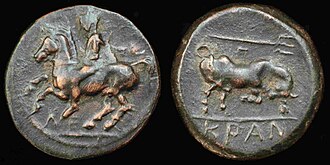
ในช่วงเวลาที่ไม่สามารถระบุได้แน่ชัด ครานอนเป็นเมืองที่มีกำแพงล้อมรอบและมีป้อมปราการ แต่แทบไม่มีใครรู้ข้อมูลเกี่ยวกับศูนย์กลางเมืองและอะโครโพลิส เลย ยกเว้นวิหารของเทพีอธีนาโพลิอัสที่ อาจ สร้างขึ้นบนนั้น[ 31 ]นอกจากนี้ยังมีวิหารของเทพแอสคลีปิ อุ สเทพอะพอลโลเทพโพไซดอนและเทพซุส [ 32 ] เมืองนี้ผลิตเหรียญเงินในศตวรรษที่ 5 ก่อนคริสต์ศักราช (480-400 ก่อนคริสต์ศักราช) และเหรียญทองสัมฤทธิ์ในศตวรรษที่ 4 ก่อนคริสต์ศักราชเหรียญดรัคมาเตโตรโบล ไตร โอโบล โอโบลและเฮมิโอโบล แบบ เอจินานได้รับการเก็บรักษาไว้ โดยมีคำจารึกว่า ΚΡΑ หรือ ΚΡΑΝ หรือ ΚΡΑΝΟ [ 33 ]