
Sport bike
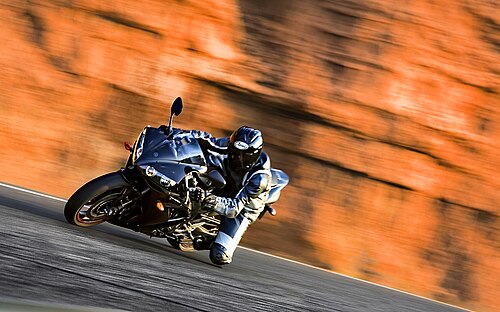
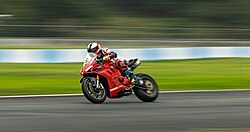
A sport bike, sports motorcycle, or sports bike is a motorcycle designed and optimized for speed, acceleration, braking, and cornering on asphalt concreterace tracks and roads. They are mainly designed for performance at the expense of comfort, fuel economy, safety, noise reduction and storage in comparison with other motorcycles.[1]
Sport bikes can be and are typically equipped with fairings and a windscreen to deflect wind from the rider to improve aerodynamics.
History
Soichiro Honda wrote in the owner's manual of the 1959 Honda CB92 Benly Super Sport that, "Primarily, essentials of the motorcycle consists in the speed and the thrill," while Cycle World's Kevin Cameron says that, "A sportbike is a motorcycle whose enjoyment consists mainly from its ability to perform on all types of paved highway – its cornering ability, its handling, its thrilling acceleration and braking power, even (dare I say it?) its speed."[2]
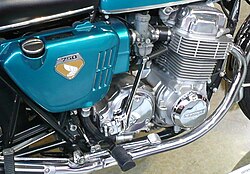
Motorcycles are versatile and may be put to many uses as the rider sees fit.[3] In the past there were few if any specialized types of motorcycles, but the number of types and sub-types has proliferated, particularly in the period since the 1950s.[4] The introduction of the Honda CB750 in 1969 marked a dramatic increase in the power and speed of practical and affordable sport bikes available to the general public.[5]
ต่อมาในช่วงทศวรรษ 1970 ได้มีการปรับปรุงระบบช่วงล่างและระบบเบรกให้สอดคล้องกับกำลังของเครื่องยนต์สี่สูบเรียง ขนาดใหญ่ ที่เริ่มเข้ามาครองตลาดรถจักรยานยนต์สปอร์ต ในช่วงทศวรรษ 1980 รถจักรยานยนต์สปอร์ตได้ก้าวไปอีกขั้น จนแทบแยกไม่ออกจากรถจักรยานยนต์แข่ง [ 6 ] ตั้งแต่ทศวรรษ 1990 เป็นต้นมา รถจักรยานยนต์สปอร์ตมีความหลากหลายมากขึ้น โดยเพิ่มรูปแบบใหม่ๆ เช่นรถจักรยานยนต์เปลือยและรถสตรีทไฟเตอร์ เข้ากับ รูปแบบรถจักรยานยนต์สปอร์ตแบบแข่งรถที่คุ้นเคย[ 4 ] [ 7 ] [ 8 ]
องค์ประกอบการออกแบบ

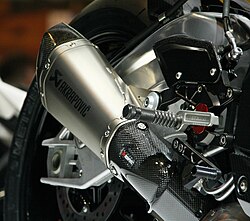
เนื่องจากรถจักรยานยนต์สปอร์ตเน้นที่ความเร็ว การเร่งความเร็ว การเบรก และความคล่องตัว จึงมีองค์ประกอบการออกแบบบางอย่างที่รถจักรยานยนต์ประเภทนี้ส่วนใหญ่จะมีร่วมกัน หลักสรีรศาสตร์ของผู้ขับขี่เน้นที่ฟังก์ชันการใช้งาน โดยทั่วไปหมายถึงที่พักเท้าที่สูงขึ้นซึ่งทำให้ขาอยู่ใกล้ลำตัวมากขึ้น และการเอื้อมมือไปยังชุดควบคุมที่ต่ำกว่า เช่น แฮนด์แบบคลิปออน ซึ่งทำให้ร่างกายและน้ำหนักอยู่ไปข้างหน้าและเหนือถังน้ำมัน[ 3 ] [ 9 ] รถจักรยานยนต์สปอร์ตมี เครื่องยนต์สมรรถนะสูงเมื่อเทียบกับ รถจักรยานยนต์ทั่วไป ที่ติดตั้งอยู่ภายในเฟรม ที่มีน้ำหนัก เบา[ 9 ]มักใช้วัสดุไฮเทคและราคาแพงในรถจักรยานยนต์สปอร์ตเพื่อลดน้ำหนัก[ 9 ]
ระบบเบรกใช้ผ้าเบรกประสิทธิภาพสูงและดิสก์เบรกพร้อมคาลิเปอร์แบบหลายลูกสูบที่จับกับโรเตอร์แบบมีรูระบายอากาศขนาดใหญ่ ระบบ ช่วงล่างได้รับการพัฒนาในแง่ของการปรับแต่งและวัสดุเพื่อเพิ่มเสถียรภาพและความทนทาน ยางหน้าและยาง หลัง มีขนาดใหญ่และกว้างกว่ายางที่พบในรถจักรยานยนต์ประเภทอื่น ๆ เพื่อให้สามารถเข้าโค้งด้วยความเร็วสูงขึ้นและเอียงตัวได้มากขึ้นแฟริ่งอาจมีหรือไม่มีก็ได้ในรถจักรยานยนต์สปอร์ต เมื่อมีแฟริ่งจะมีรูปทรงเพื่อลดแรงต้านอากาศให้มากที่สุดเท่าที่จะเป็นไปได้และให้การป้องกันลมแก่ผู้ขับขี่[ 9 ]
การผสมผสานระหว่างตำแหน่งผู้ขับขี่ ตำแหน่งของเครื่องยนต์และส่วนประกอบหนักอื่นๆ และรูปทรงเรขาคณิตของรถจักรยานยนต์ช่วยรักษาความสมบูรณ์ของโครงสร้างและความแข็งแกร่งของแชสซี และกำหนดพฤติกรรมของรถภายใต้การเร่งความเร็ว การเบรก และการเข้าโค้ง การกระจายน้ำหนักจากด้านหน้าไปด้านหลังที่ถูกต้องมีความสำคัญอย่างยิ่งต่อการควบคุมรถจักรยานยนต์สปอร์ต และตำแหน่งที่เปลี่ยนแปลงไปของร่างกายผู้ขับขี่จะเปลี่ยนแปลงการควบคุมรถจักรยานยนต์แบบไดนามิก[ 10 ]เนื่องจากความซับซ้อนของการจำลองการเคลื่อนไหวที่เป็นไปได้ทั้งหมดของผู้ขับขี่ที่มีขนาดแตกต่างกัน การปรับแต่งการกระจายน้ำหนักและระบบกันสะเทือนของรถจักรยานยนต์ให้สมบูรณ์แบบมักทำได้โดยการปรับแต่งรถจักรยานยนต์หรืออย่างน้อยก็ปรับให้เหมาะกับผู้ขับขี่เฉพาะราย[ 10 ]โดยทั่วไป รถจักรยานยนต์สปอร์ตสไตล์การแข่งรถบนถนนจะมีฐานล้อ สั้น กว่ารถที่ออกแบบมาเพื่อการท่องเที่ยวที่สะดวกสบายกว่า และแนวโน้มปัจจุบันในการออกแบบรถจักรยานยนต์สปอร์ตคือการใช้ฐานล้อที่สั้นลง ทำให้เลี้ยวได้เร็วขึ้น แต่ก็มีแนวโน้มที่จะเกิดการยกหน้าและเบรก โดยไม่ตั้งใจมากขึ้น ภายใต้การเร่งความเร็วและการเบรกอย่างรุนแรงตามลำดับ[ 10 ] [ 11 ] [ 12 ]รถจักรยานยนต์บางคันมีระบบป้องกันการยกหน้า โดยมีการออกแบบที่หลากหลาย รวมถึงการควบคุมการตั้งค่าแรงฉุดและการทรงตัวด้วยคอมพิวเตอร์ หรือคุณสมบัติการทรงตัวเชิงกล ซึ่งมีจุดประสงค์เพื่อลดการยกและการสูญเสียแรงฉุดของล้อหน้าขณะเร่งความเร็ว[ 13 ]
ชั้นเรียน
ไม่มีหน่วยงานใดกำหนดคำศัพท์เกี่ยวกับรถจักรยานยนต์สปอร์ตหรือรถจักรยานยนต์ประเภทอื่น ๆ อย่างเป็นทางการ คำจำกัดความทางกฎหมายนั้นจำกัดโดยเขตอำนาจศาลท้องถิ่น และองค์กรที่กำกับดูแลการแข่งขัน เช่นสมาคมนักขี่มอเตอร์ไซค์แห่งอเมริกา (AMA) และสหพันธ์รถจักรยานยนต์นานาชาติ (FIM) จะกำหนดกฎเกณฑ์ที่ใช้เฉพาะกับผู้ที่เลือกเข้าร่วมการแข่งขันเท่านั้น อย่างไรก็ตาม ตามมาตรฐานในปัจจุบันในยุโรป อเมริกาเหนือ และประเทศพัฒนาแล้วอื่นๆ รถจักรยานยนต์สปอร์ตมักถูกแบ่งออกเป็นสาม สี่ หรือห้าประเภทคร่าวๆ โดยสะท้อนถึงปริมาตรเครื่องยนต์แรงม้าราคา และการใช้งานที่คล้ายคลึงกัน โดยมีส่วนประกอบของความคิดเห็นส่วนตัวและการลดทอนความซับซ้อนอยู่บ้าง ข้อความทางการตลาดเกี่ยวกับรุ่นต่างๆ จากผู้ผลิตอาจแตกต่างจากฉันทามติของสื่อรถจักรยานยนต์และสาธารณชน บางครั้งประเภทที่ใช้ในการแข่งขันรถจักรยานยนต์จะถูกนำมาใช้ในรุ่นที่ผลิตออกจำหน่าย โดยมักเกี่ยวข้องกับการรับรองมาตรฐาน แต่ก็ไม่เสมอ ไป
คลาสของรถจักรยานยนต์สปอร์ตที่ใช้กันทั่วไป ได้แก่: [ 7 ] [ 14 ] [ 15 ]
- Lightweight: also called entry level or beginner bikes.[8][16][17] Some two strokes in this class have dramatically higher performance than the four strokes, being likened to miniature superbikes.[7] Sport bikes with engine displacements of up to about 600 cc (37 cu in) are usually in this class.[3]
- Middleweight:[14] mid-sized, mid-level,[8] or supersport bike.[7] Some of the models in this range qualify for racing in the classes AMA Supersport Championship, British Supersport Championship and the Supersport World Championship, but many middleweights do not have a significant presence in racing. Displacements of 600–1,000 cc (37–61 cu in) are typical.[3]
- Superbike:[14] liter-class, literbike, or heavyweight i.e. 1,000 cc (61 cu in) or higher.[3] As with supersport, many of the models in this class compete in superbike racing.
- Open class, hypersport or hyperbike,[16][18][19] are terms sometimes used in lieu of superbike as a catch-all for everything larger than middleweight.[20] Alternatively, these terms mark a class above the superbikes for the largest displacement sport bikes with the highest top speeds, with weights somewhat greater than the superbike class.[21]Hyperbike was in use by 1979.[22]
 The Kawasaki Ninja 250R lightweight sport bike.
 The Triumph Daytona 675triple is usually classed as a middleweight or supersport.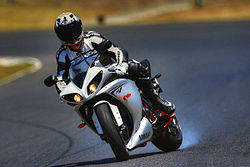
 Touring with a passenger on an open class Suzuki Hayabusa.
The terms supersport and superbike are sometimes applied indiscriminately to all high-performance motorcycles.[23] Categorization by engine displacement alone is a crude measure, particularly when comparing engines with different numbers of cylinders like inline or V fours with parallel and V twins, not to mention the greater power for a given displacement of two-stroke engines over four strokes.[8]
In the less developed world, smaller engine sizes are the norm, and relative terms like small, mid-sized and large displacement can have different meanings. For example, in India in 2002 there were about 37 million two-wheelers,[24] but as of 2008, there were only about 3,000 motorcycles, or fewer than one in 12,000, of displacement 1,000 cc (61 cu in) or more.[25] Similarly, the perception of relative sizes has shifted over time in developed countries, from smaller to larger displacements.[26] When the original superbike,[27][28] the Honda CB750, appeared in 1969, it was called a "big four,"[4] while today an inline four of 736.5 cc (44.94 cu in) would be classed in the middle range.
Besides having product lines that span from entry level through high end sport bikes, many manufacturers add depth[29] to that line by having pairs, or several pairs, of similar sport bikes aimed at riders of different levels. These are designed to appeal to riders seeking more or less extreme performance features. The more expensive model will be in the vein of a race replica, offering the latest technology updated with frequent design revisions, while the lower cost model typically relies on older technology, can have a more relaxed riding position, and is generally more practical for non-road racing tasks such as urban commuting and carrying passengers or baggage, and offering lower fuel, insurance and maintenance costs. Examples of these paired models are Buell's Firebolt and Lightning, Ducati's 916/748 through 1198/848 paired series, Honda's CBR600RR and F4i middleweights[4] and RC51 and CBR1000RR liter-class, several different concurrent models in Kawasaki's Ninja line, and Yamaha's R6 and 600R.[3]
Variations

Sport touring motorcycles share many features of sport bikes, but they are generally considered a class all their own. These are mid- to large-sized motorcycles that offer more carrying capacity, more relaxed ergonomics, and more versatility than specialized sport bikes, while being lighter and more agile than touring motorcycles.[30]
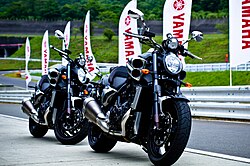
Some sport bikes are marketed as race replicas, implying that the model sold to the public is identical to the one used in racing, or at least is closer to the racing version than non-replica models. Suffixes R or RR applied to model codes can be interpreted as standing for replica or race replica. Race Replica was used in the late 1970s UK where 250 cc models customized with full bodykits providing race-styling in factory team colors themed to the top-level of sponsored riders of the time were available marketed towards 'learner' riders who had not passed a driving test enabling their progression to large-capacity machines.[31][32][33] In 1982 Yamaha described their 1983 RD350 YPVS launched at the Cologne motorcycle show as "the nearest thing to a road going racer ever produced".[34]
The term race replica was then also used to distinguish the period of sport bike production from Japan and Europe since the mid-1980s having integrated race-styled bodywork, representing an evolution from the superbike period that began in 1969.[5] The sport bike, or race replica, era began with the 1983 Suzuki RG250 Gamma, the 1984 Honda VF750F and the 1985 Suzuki GSX-R750, and had full fairings.[35][36] Sport bikes with small or no fairings have proliferated since the mid-1990s. These are called naked bikes or streetfighters,[7][37] and they retain many of the performance features of other sport bikes, but besides abbreviated bodywork, they give the rider a more upright posture by using, for example, higher handlebars instead of clip ons. The streetfighter name, associated with motorcycle stunt riding and perhaps hooliganism on public roads, can imply higher performance than the sometimes more tame naked bike, which in some cases is a synonym for a standard motorcycle.[8] Others define naked bikes as equal in power and performance to sport bikes, merely absent the bodywork.[38]
ในช่วงเวลาเดียวกันกับที่รถจักรยานยนต์แบบเปลือยและแบบสตรีทไฟเตอร์ได้รับความนิยม ก็มีการกลับมาของรถจักรยานยนต์มาตรฐานอเนกประสงค์อีกครั้ง เพื่อตอบสนองความต้องการรถจักรยานยนต์ญี่ปุ่นอเนกประสงค์ที่กลับมาอีกครั้ง[ 4 ] [ 9 ]รถจักรยานยนต์สไตล์ซูเปอร์โมโตซึ่งสร้างขึ้นโดยมีลำดับความสำคัญที่แตกต่างอย่างสิ้นเชิงจากรถจักรยานยนต์สปอร์ตแบบแข่งรถ ก็ได้เข้ามาสู่กระแสหลักเช่นกัน โดยนำเสนอทางเลือกอีกทางหนึ่งสำหรับผู้ขับขี่ที่ต้องการประสบการณ์การขับขี่ที่เร้าใจ ฉายา " มัสเซิล ไบค์ " ถูกนำมาใช้กับรถจักรยานยนต์สปอร์ตที่ให้ความสำคัญกับกำลังเครื่องยนต์มากกว่าการเบรก การควบคุม หรือหลักอากาศพลศาสตร์ ซึ่งย้อนกลับไปถึงซูเปอร์ไบค์ของญี่ปุ่นในทศวรรษ 1970 [ 9 ] [ 39 ] [ 40 ]ความรู้สึกที่คล้ายกันนี้ยังขับเคลื่อนรถจักรยานยนต์ที่เรียกว่าพาวเวอร์ครุยเซอร์ซึ่งมีพื้นฐานมาจาก รถจักรยานยนต์คลาส ครุยเซอร์แต่มีกำลังม้าเทียบเท่ากับซูเปอร์ไบค์[ 41 ]
ดูเพิ่มเติม
- ↑
- Hough, David L. (2003), การขับขี่มอเตอร์ไซค์อย่างมีประสิทธิภาพมากขึ้น: คู่มือขั้นสุดยอดสำหรับการขับขี่ที่ดี ( ฉบับที่ 2), สหรัฐอเมริกา: BowTie Press, หน้า 253, ISBN 1-931993-03-3สปอร์ต
ไบค์:รถจักรยานยนต์ที่ออกแบบมาเพื่อสมรรถนะที่ดุดดัน โดยเฉพาะการเข้าโค้ง
- "sport bike n." , พจนานุกรมภาษาอังกฤษฉบับ ออกซ์ฟอร์ ด OED ออนไลน์ ( ฉบับที่ 2), สำนักพิมพ์มหาวิทยาลัยออกซ์ฟอร์ด , 1989 , สืบค้นเมื่อ2010-06-04 ,
…(b) รถจักรยานยนต์ที่มีกำลังแรง น้ำหนักเบา ออกแบบมาเพื่อความเร็วและการควบคุมที่ดีที่สุด
- แมคครอว์, จิม (กรกฎาคม 2548), "เกี่ยวกับจักรยานคันนั้น..." , นิตยสาร Popular Mechanics , เล่มที่ 182, ฉบับที่ 7, สำนักพิมพ์ Hearst Magazines , หน้า68–70 , ISSN 0032-4558 , สืบค้นเมื่อ 4 มิถุนายน 2553
- โดมิโน, เควิน (2009), รถจักรยานยนต์ที่สมบูรณ์แบบ: วิธีเลือก ค้นหา และซื้อรถจักรยานยนต์ใหม่หรือมือสองที่สมบูรณ์แบบ , สำนักพิมพ์ 671, หน้า 22, 50– 51, 70, ISBN 0-9821733-3-4
- มาเฮอร์, เควิน; ไกรส์เลอร์, เบน (1998), คู่มือรถจักรยานยนต์ของชิลตัน , เฮย์นส์ นอร์ท อเมริกา , หน้า2–11–2–12 , ISBN 0-8019-9099-8
- เบนเน็ตต์, จิม (1995), คู่มือรถจักรยานยนต์ฉบับสมบูรณ์: คู่มือสำหรับผู้บริโภค , ข้อเท็จจริงในแฟ้มข้อมูล, หน้า15–16, 19–25 , ISBN 0-8160-2899-0
- Hough, David L. (2003), การขับขี่มอเตอร์ไซค์อย่างมีประสิทธิภาพมากขึ้น: คู่มือขั้นสุดยอดสำหรับการขับขี่ที่ดี ( ฉบับที่ 2), สหรัฐอเมริกา: BowTie Press, หน้า 253, ISBN 1-931993-03-3สปอร์ต
- ↑ Cameron, Kevin (1998), Sportbike Performance Handbook , Saint Paul, Minnesota : Motorbooks Workshop/MBI, หน้า5, ISBN 0-7603-0229-4
- 1 2 3 4 5 6 Domino, Kevin (2009), The Perfect Motorcycle: How to Choose, Find and Buy the Perfect New Or Used Bike , 671 Press, pp. 22, 50– 51, 70, ISBN 0-9821733-3-4
- 1 2 3 4 5 Holmstrom, Darwin (2001), The Complete Idiot's Guide to Motorcycles ( ฉบับที่ 2), Alpha Books, หน้า20–21 , 33–41 , 334–358 , 407, ISBN 0-02-864258-9
- 1 2
- โฮล์มสตรอม, ดาร์วิน (2001), คู่มือฉบับสมบูรณ์สำหรับมือใหม่หัดขับมอเตอร์ไซค์ ( ฉบับที่ 2), สำนักพิมพ์อัลฟาบุ๊คส์, หน้า20–21 , 33–41 , 334–358 , 407, ISBN 0-02-864258-9
- De Cet, Mirco (2004), Essential Superbike , Motorbooks International, หน้า8–9 , 18, 127, ISBN 0-7603-2007-1
- บราวน์, โรแลนด์ (2005), ประวัติศาสตร์ขั้นสุดยอดของรถจักรยานยนต์ความเร็วสูง , บาธ, อังกฤษ : พาร์รากอน , หน้า 9, ISBN 1-4054-5466-0
- จุดเริ่มต้นของซูเปอร์ไบค์: CB750 อันน่าทึ่งของฮอนด้า ,หอเกียรติยศรถจักรยานยนต์ , เก็บถาวรจากต้นฉบับเมื่อวันที่ 24 มิถุนายน 2016 , เรียกดูเมื่อ วันที่ 1 มิถุนายน 2010
- วอล์คเกอร์, มิก (2001), รถจักรยานยนต์สมรรถนะสูง , สำนักพิมพ์แอมเบอร์บุ๊คส์ จำกัด และสำนักพิมพ์ชาร์ตเวลล์บุ๊คส์ (บุ๊คเซลส์ อิงค์), หน้า26, 58, 76, 102 , ISBN 0-7858-1380-2
- ↑
- มาเฮอร์, เควิน; ไกรส์เลอร์, เบน (1998), คู่มือรถจักรยานยนต์ของชิลตัน , เฮย์นส์ นอร์ท อเมริกา , หน้า2–11–2–12 , ISBN 0-8019-9099-8
- De Cet, Mirco (2004), Essential Superbike , Motorbooks International, หน้า8–9 , 18, 127, ISBN 0-7603-2007-1
- วอล์คเกอร์, มิก (2001), รถจักรยานยนต์สมรรถนะสูง , สำนักพิมพ์แอมเบอร์บุ๊คส์ จำกัด และสำนักพิมพ์ชาร์ตเวลล์บุ๊คส์ (บุ๊คเซลส์ อิงค์), หน้า26, 58, 76, 102 , ISBN 0-7858-1380-2
- Mayershon, Norman (สิงหาคม 1984), "ซูเปอร์ไบค์รุ่นใหม่: เทคโนโลยีแห่งปัจจุบันที่มุ่งสู่รถยนต์แห่งอนาคต" , Popular Mechanics , เล่มที่ 161, ฉบับที่ 8, Hearst Magazines , หน้า82–85 , ISSN 0032-4558 , สืบค้นเมื่อ 2010-06-04
- 1 2 3 4 5 วอล์คเกอร์, มิก (2001), รถจักรยานยนต์สมรรถนะสูง , สำนักพิมพ์แอมเบอร์บุ๊คส์ จำกัด และสำนักพิมพ์ชาร์ตเวลล์บุ๊คส์ (บุ๊คเซลส์ อิงค์), หน้า26, 58, 76, 102 , ISBN 0-7858-1380-2
- 12345Kresnak, Bill (2008), Motorcycling for Dummies, Hoboken, New Jersey: For Dummies, Wiley Publishing, pp. 63–64, 66–70, 132–141, ISBN 0-470-24587-5
- 123456Bennett, Jim (1995), The Complete Motorcycle Book: A Consumer's Guide, Facts on File, pp. 15–16, 19–25, ISBN 0-8160-2899-0
- 123Cocco, Gaetano (2004), Motorcycle Design and Technology, Saint Paul, Minnesota: Motorbooks Workshop/MBI, pp. 20–21, 34, 46, ISBN 0-7603-1990-1
- ↑Cossalter, Vittore (2006), Motorcycle Dynamics (2nd ed.), Lulu.com, pp. 79–80, ISBN 1-4303-0861-3, retrieved 2010-06-05
- ↑Cameron, Kevin (1998), Sportbike Performance Handbook, Cyclepro Series, Motorbooks Workshop / MPI Pub. Co., pp. 93, 106, ISBN 9780760302293,
Wheelbase: The distance between the front and rear axle centerlines. This is a primary variable because it limits maximum acceleration, controls steering response speed, and has some stability effects. Intuition suggests that we use a long wheelbase for high-speed stability, and a short wheelbase for quick turning in lower speed going. Actually, that works in the reverse; at high speeds, gyro effects slow the steering down, so we need a short wheelbase to make the bike steer. High-speed circuits require taller gearing, which prevents the bike from wheelying much even with the short wheelbase. On lower speed going, a longer wheelbase is useful to allow use of more acceleration without lifting the front wheel. This is why big-engined Sportbikes have longer wheelbases.SINGLE PURPOSE SETUPS:A. If Braking Were Your Bike's Only Job To keep the rear tire on the ground and the bike steering controllably, major masses are moved rearward and lowered. Front suspension is stiff to carry percent of weight.[sic] Front tire is large for traction. Wheelbase is extended to prevent stoppies.B. If Corner Entry Were Your Bike's Only Job Masses are centralized to speed roll and turning. Rigid suspension eliminates suspension delays. Front tire is narrow for quick response. Wheelbase is minimum to speed steering.C. If Steady Turning Were Your Bike's Only Job Engine and rider are raised for cornering clearance, while suspension is supple to maintain maximum grip. F & R tires are equal sizes to carry equal loads.D. If Off-Corner Acceleration Were Your Bike's Only Job Major Masses are moved forward but not lowered (cornering clearance is needed initially). Wheelbase is long. Front suspension is soft to exploit grip with very light load.
- ↑Sports, Dorna. "Anti-wheelie technology in MotoGP: How does it work? | MotoGP". www.motogp.com. Retrieved 2020-05-26.
- 123Cernicky, Mark (September 2008), "Master Bike XI", Cycle World, vol. 47, no. 8, Newport Beach, California: Hachette Filipacchi Media U.S., ISSN 0011-4286
- ↑"Performance Index '10"(PDF), Motorcycle Consumer News, Bowtie Magazines, 2010, archived from the original(PDF) on February 15, 2010, retrieved January 3, 2010
- 12Broughton, Paul; Walker, Linda (2009), Motorcycling and leisure: understanding the recreational PTW rider, Ashgate Publishing, Ltd., pp. 3–4, ISBN 0-7546-7501-7, retrieved 2010-06-05
- ↑Hahn, Pat; Brasfield, Evans (2005), How to ride a motorcycle: a rider's guide to strategy, safety, and skill development, MotorBooks International, p. 45, ISBN 0-7603-2114-0
- ↑Atlas, Steve (January 25, 2010), "2009 Hyperbike Comparison (Suzuki Hayabusa, BMW K1300S)", MotorcycleUSA.com, archived from the original on 2015-06-15, retrieved 2010-06-05
- ↑"Poll: Are hyperbikes still relevant today?", Motor Cycle News, May 14, 2010,
It's 20 years since the launch of the first 'hyperbike' – Kawasaki's awesome 173mph ZZ-R1100 which reigned world's fastest production bike through the first half of the 1990s until usurped by new hyperbikes such as Honda's CBR1100XX Super Blackbird and Suzuki's Hayabusa
- ↑
- "Performance Index '10"(PDF), Motorcycle Consumer News, Bowtie Magazines, 2010, archived from the original(PDF) on February 15, 2010, retrieved January 3, 2010
- Broughton, Paul; Walker, Linda (2009), Motorcycling and leisure: understanding the recreational PTW rider, Ashgate Publishing, Ltd., pp. 3–4, ISBN 0-7546-7501-7, retrieved June 5, 2010
- MO Staff (April 6, 2001), "2001 Open Class Shootout; Four Big Devils in the City of Angels", Motorcycle.com, retrieved June 5, 2010
- MO Staff (April 24, 2004), "2004 Open Class Shootout: Aprilia RSV R; Ducati 999; RC51; CBR 1000RR; ZX 10R; GSXR 1000; 955i Daytona; YZF R1", Motorcycle.com, retrieved June 5, 2010
- "Yamaha Hones R1 for '07", American Motorcyclist, vol. 60, no. 12, Westerville, Ohio: American Motorcyclist Association, p. 16, December 2006, ISSN 0277-9358, retrieved 2010-06-05
- ↑
- Domino, Kevin (2009), The Perfect Motorcycle: How to Choose, Find and Buy the Perfect New Or Used Bike, 671 Press, pp. 22, 50–51, 70, ISBN 0-9821733-3-4
- โฮล์มสตรอม, ดาร์วิน (2001), คู่มือฉบับสมบูรณ์สำหรับมือใหม่หัดขับมอเตอร์ไซค์ ( ฉบับที่ 2), สำนักพิมพ์อัลฟาบุ๊คส์, หน้า20–21 , 33–41 , 334–358 , 407, ISBN 0-02-864258-9
- Madson, Bart (29 มิถุนายน 2009), "ภาพถ่ายรถทดสอบ Honda VFR1200 ปี 2010 หลุดออกมา" , MotorcycleUSA.com , สืบค้นเมื่อ 5 มิถุนายน 2010 ,
เมื่อพูดถึงCBR1100XX แล้ว VFRรุ่นใหม่ดูเหมือนจะเข้ามาแทนที่ XX และเป็นคู่แข่งที่มีศักยภาพในกลุ่มรถไฮเปอร์สปอร์ตเคียงข้างSuzuki Hayabusa , Kawasaki ZX-14และBMW K1300Sโดยเฉพาะอย่างยิ่งหากข่าวลือเรื่องกำลัง 200 แรงม้าเป็นความจริง
- De Cet, Micro (2003), คู่มือภาพประกอบรถจักรยานยนต์; คู่มือภาพประกอบ , MotorBooks International, หน้า 258, ISBN 0-7603-1417-9
- ↑
- นิตยสาร Motorcycle Sport (สหราชอาณาจักร) กรกฎาคม 1979 หน้า 343 จดหมายถึงบรรณาธิการ "...ส่วนตัวผมเองจะไม่ตั้งคำถามว่าควรมีการจำกัดขนาด จำนวนกระบอกสูบ ฯลฯ สำหรับรถจักรยานยนต์ในปัจจุบันหรืออนาคตหรือไม่ จนถึงตอนนี้ 'ไฮเปอร์ไบค์' เหล่านี้ก็ใช้งานได้ดี" เข้าถึงเมื่อ 2015-05-10
- ข่าวสารเกี่ยวกับรถจักรยานยนต์ ฉบับวันที่ 15 สิงหาคม 1979 หน้า 70 ข่าว “ซูซูกิกำลังดำเนินการทดสอบรถไฮเปอร์ไบค์รุ่นใหม่ ซึ่งคาดว่าจะเปิดตัวในงานแสดงรถจักรยานยนต์เอิร์ลส์คอร์ตที่จะเปิดในวันที่ 25 สิงหาคม” เข้าถึงและเพิ่มเติมเมื่อ 10 พฤษภาคม 2015
- ข่าวสารเกี่ยวกับรถจักรยานยนต์ ฉบับวันที่ 15 สิงหาคม 1979 หน้า 70 ข่าว “กู๊ดเยียร์กลับมาแล้ว!” “กู๊ดเยียร์กลับมาสู่ธุรกิจยางรถจักรยานยนต์ในยุโรปอีกครั้งหลังจากหายไปเกือบ 15 ปี ยางกู๊ดเยียร์รุ่นใหม่ครอบคลุมรถจักรยานยนต์ทุกประเภท ตั้งแต่รถใช้งานทั่วไปจนถึงไฮเปอร์ไบค์ความเร็วสูง” เข้าถึงและเพิ่มเติมเมื่อ 12 มิถุนายน 2015
- นิตยสาร Motor Cycle Newsฉบับวันที่ 14 พฤศจิกายน 1979 หน้า 6 บทความโดย บ็อบ เบอร์รี “กลับสู่พื้นฐาน พอล บัตเลอร์ จากยามาฮ่า อัมสเตอร์ดัม ดูเหมือนจะคิดว่าชาวญี่ปุ่นถูกบังคับให้สร้างรถไฮเปอร์ไบค์อย่าง CBX, GS1000, Z1300 เพราะพวกเรา สื่อมวลชนเกี่ยวกับรถจักรยานยนต์ เป็นผู้สร้างตลาดขึ้นมา” เข้าถึงและเพิ่มเติมเมื่อ 10 พฤษภาคม 2015
- ↑
- แฟรงค์, โทมัส (10 กันยายน 2007), "การศึกษา: รถจักรยานยนต์ 'ซูเปอร์สปอร์ต' เพิ่มความเสี่ยง" , USA Today , สืบค้นเมื่อ4 มิถุนายน 2010
- "Kawasaki Ninja 250 นัดหยุดงาน", หิมาลัยไทมส์ , กาฐมา ณ ฑุ, 2010-04-07
- "ผลการศึกษาของ IIHS: 'มีข้อบกพร่องร้ายแรง'"" , American Motorcyclist , vol. 41, no. 12, Westerville, Ohio : American Motorcyclist Association , pp. 18– 19, December 1987, ISSN 0277-9358 , สืบค้นเมื่อ 2010-06-04
- Wood, Bill (November 2007), "They're Baaack! After 20 years, IIHS still can't get this stuff right", American Motorcyclist, vol. 61, no. 11, Westerville, Ohio: American Motorcyclist Association, p. 14, ISSN 0277-9358, retrieved 2010-06-04
- ↑"Mopeds And Motorcycles Map No. 32". Worldmapper: The world as you've never seen it before. 2002. Archived from the original on 2018-03-20. Retrieved 2010-06-06. See data files for the statisticsArchived 2018-03-20 at the Wayback Machine
- ↑Srivastava, Samar (November 27, 2008), "Suzuki targets slump-defying superbike segment", livemint.com
- ↑Backus, Richard (March–April 2008), 1978–1982 Honda CX500, Motorcycle Classics, retrieved February 25, 2009
- ↑De Cet, Mirco (2004), Essential Superbike, Motorbooks International, pp. 8–9, 18, 127, ISBN 0-7603-2007-1
- ↑The Dawn of the Superbike: Honda's Remarkable CB750, Motorcycle Hall of Fame, archived from the original on June 24, 2016, retrieved 2010-06-01
- ↑Lamb, Charles W.; Hair, Joseph F. Jr.; McDaniel, Carl (2008), Essentials of Marketing (6th ed.), Cengage Learning, p. 279, ISBN 0-324-65620-3
- ↑
- Maher, Kevin; Greisler, Ben (1998), Chilton's Motorcycle Handbook, Haynes North America, pp. 2–11–2–12, ISBN 0-8019-9099-8
- Bennett, Jim (1995), The Complete Motorcycle Book: A Consumer's Guide, Facts on File, pp. 15–16, 19–25, ISBN 0-8160-2899-0
- Holmstrom, Darwin (2001), The Complete Idiot's Guide to Motorcycles (2nd ed.), Alpha Books, pp. 20–21, 33–41, 334–358, 407, ISBN 0-02-864258-9
- Kresnak, Bill (2008), Motorcycling for Dummies, Hoboken, New Jersey: For Dummies, Wiley Publishing, pp. 63–64, 66–70, 132–141, ISBN 0-470-24587-5
- Broughton, Paul; Walker, Linda (2009), Motorcycling and leisure: understanding the recreational PTW rider, Ashgate Publishing, Ltd., pp. 3–4, ISBN 0-7546-7501-7, retrieved 2010-06-05
- Allen, Mike (August 2001), "Cruise Missiles; Big-bore touring bikes with the handling and the brakes to cash all the checks the engine can write", Popular Mechanics, vol. 178, no. 8, Hearst Magazines, pp. 70–75, ISSN 0032-4558, retrieved 2010-06-04
- ↑Motor Cycle News 15 August 1979, p.69 Dealer's advert. Barry Sheene 250 X7 Race Replica. Complete machine as shown £1150. John Walker Superbikes, 213 Cromford Road, Langley Mill.. Accessed and added 2015-05-10
- ↑Motor Cycle News 14 November 1979, p.68 Dealer's advert. Kork Ballington KH250 FLF Race Replica. Full kit (as shown) in Team Kawasaki race colours £1245. Fox M/Cs, 705 Woodborough Road, Mapperley Topp.. Accessed and added 2015-05-10
- ↑Motor Cycle News 10 October 1979, p.44 Dealer's advert. The sensational Mann designed Z250 Race Replica as first seen at the M/Cycle Show. Bol d'Or Group of Companies, the UK's most progressive Kawasaki specialists. Accessed and added 2015-05-13
- ↑Motor Cycle News 22 September 1982, pp.28-31 Special issue, Europe's biggest bike show. "The factory claim the '83 RD unveiled in West Germany is the nearest thing to a road going racer ever produced". Accessed and added 2015-05-13
- ↑
- For the 1983 Suzuki RG250 Gamma, see:
- Kodack, Anthony (October 17, 2007). "Suzuki GSX-R750 Model Timeline". TopSpeed.com. Retrieved October 8, 2013.
With the 1983 RG250 Gamma, Suzuki was the first factory to deliver a true racer replica using race-bred technology to the public. The next step was to build a 4-stroke 400cc machine for the Japanese home market and a year later a 750cc machine, culmination to the Suzuki's racing experiences in the World Endurance, AMA Superbike and Championship. The GSX-R750 was first presented at the 1984 IFMA Cologne Show in West Germany. Although it was fully street legal, it was clear that it was built even to compete in the various Worldwide Championships.
- "Suzuki RG250 Gamma". 240 Landmarks of Japanese Automotive Technology. Society of Automotive Engineers of Japan. Retrieved September 12, 2013.
The Suzuki RG250G was the dream machine of road bikes, developed using technologies that Suzuki had accumulated on the Grand Prix racing circuit. Every imaginable technology was packed into the machine, including the first aluminum square-pipe frame in the world to be used on a mass-market motorcycle.
- Chaterji, Pablo (February 18, 2005). "Suzuki RG 250 Gamma - Gamma Ray". Business Standard. Archived from the original on January 16, 2021. Retrieved September 5, 2013.
Cue 1983, when Suzuki presented the RG250 Gamma and turned the class on its head. Although many motorcycles had been called road-legal racers before the Gamma, the RG was perhaps the first mass-produced motorcycle with a lightweight aluminum frame and a racing-type aerodynamic fairing, and it started a new trend in the process. Suzuki used all their two-stroke knowledge and racetrack experience when building the Gamma and it showed – it was light, fast, handled superbly and was an instant box-office hit in the racing circuits.
- Kodack, Anthony (October 17, 2007). "Suzuki GSX-R750 Model Timeline". TopSpeed.com. Retrieved October 8, 2013.
- For the 1984 Honda VF750F see:
- Mayershon, Norman (August 1984), "New Superbikes: Today's Technology Destined for Tomorrow's Cars", Popular Mechanics, vol. 161, no. 8, Hearst Magazines, pp. 82–85, ISSN 0032-4558, retrieved June 4, 2010
- "1984 Honda VF750F Superbike", American Motorcyclist, vol. 51, no. 7, Westerville, Ohio: American Motorcyclist Association, p. 79, July 1997, ISSN 0277-9358, retrieved 2010-06-04
- For the 1985 Suzuki GSX-R750 see:
- De Cet, Mirco (2004), Essential Superbike, Motorbooks International, pp. 8–9, 18, 127, ISBN 0-7603-2007-1
- Walker, Mick (2001), Performance Motorcycles, Amber Books, Ltd. and Chartwell Books (Book Sales, Inc.), pp. 26, 58, 76, 102, ISBN 0-7858-1380-2
- Kodack, Anthony (October 17, 2007). "Suzuki GSX-R750 Model Timeline". TopSpeed.com. Retrieved October 8, 2013.
With the 1983 RG250 Gamma, Suzuki was the first factory to deliver a true racer replica using race-bred technology to the public. The next step was to build a 4-stroke 400cc machine for the Japanese home market and a year later a 750cc machine, culmination to the Suzuki's racing experiences in the World Endurance, AMA Superbike and Championship. The GSX-R750 was first presented at the 1984 IFMA Cologne Show in West Germany. Although it was fully street legal, it was clear that it was built even to compete in the various Worldwide Championships.
- For the 1983 Suzuki RG250 Gamma, see:
- ↑Maher, Kevin; Greisler, Ben (1998), Chilton's Motorcycle Handbook, Haynes North America, pp. 2–11–2–12, ISBN 0-8019-9099-8
- ↑Fraser, Colin (May 12, 2000), "It may be naked and a street fighter, but don't call Buell a UJM", National Post, Don Mills, Ontario, p. F.4
- ↑Eldridge, Earle (March 31, 2004), "Sales pop a wheelie as motorcycles get naked", USA Today, p. 03B,
The industry is buzzing about "naked bikes," high-performance sport motorcycles that are stripped of the large, colorful and curvy plastic moldings called fairings mounted around the engine, frame and underbody of most sport bikes.
- ↑Stermer, Bill (December 2002), "The Next Wave; The future of motorcycling is on display at Germany's Itermot Show", American Motorcyclist, American Motorcyclist Association, pp. 32–35, 55, retrieved 2010-06-04
- ↑"Monster Ducati", American Motorcyclist, American Motorcyclist Association, p. 29, February 1993, retrieved 2010-06-04
- ↑Stermer, Bill (January 2002), "Road Star Warrior; Yamaha arms its entrant in the power cruiser wars", American Motorcyclist, American Motorcyclist Association, p. 19, retrieved June 4, 2010