
อ่าน 12 นาที
ฟังก์ชันคู่และคี่
ใน ทางคณิตศาสตร์ ฟังก์ชัน คู่ คือ ฟังก์ชันจริง ที่สำหรับทุกค่าใน โดเมน ของฟังก์ชันนั้น ในทำนองเดียวกัน ฟังก์ชันคี่ คือ ฟังก์ชันที่สำหรับทุกค่าในโดเมนของฟังก์ชันนั้น เอฟ ( − x ) =...
ฟังก์ชันคู่และคี่


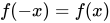
ในทางคณิตศาสตร์ฟังก์ชันคู่คือฟังก์ชันจริงที่สำหรับทุกค่าในโดเมน ของฟังก์ชันนั้น ในทำนองเดียวกันฟังก์ชันคี่คือ ฟังก์ชันที่สำหรับทุกค่าในโดเมนของฟังก์ชันนั้น


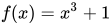
ฟังก์ชันเหล่านี้ได้รับการตั้งชื่อตามความเท่าเทียมกันของกำลังของฟังก์ชันกำลังที่ตรงตามเงื่อนไขแต่ละข้อ กล่าวคือ ฟังก์ชันจะเป็นฟังก์ชันคู่ถ้าnเป็นจำนวนเต็มคู่และจะเป็นฟังก์ชันคี่ถ้าnเป็นจำนวนเต็มคี่

ฟังก์ชันคู่ คือฟังก์ชันจำนวนจริงที่มีกราฟสมมาตรในตัวเองเทียบกับแกนyและฟังก์ชันคี่ คือฟังก์ชันที่มีกราฟสมมาตรในตัวเองเทียบกับจุด กำเนิด
ถ้าโดเมนของฟังก์ชันจริงมีความสมมาตรในตัวเองเทียบกับจุดกำเนิด ฟังก์ชันนั้นจะสามารถแยกออกเป็นผลรวมของฟังก์ชันคู่และฟังก์ชันคี่ได้อย่างไม่ซ้ำกัน
ประวัติศาสตร์ยุคแรก
แนวคิดเรื่องฟังก์ชันคู่และฟังก์ชันคี่ดูเหมือนจะย้อนกลับไปถึงช่วงต้นศตวรรษที่ 18 โดยเลออนฮาร์ด ออยเลอร์มีบทบาทสำคัญในการวางรากฐานแนวคิดนี้ ออยเลอร์ได้แนะนำแนวคิดเรื่องฟังก์ชันคู่และฟังก์ชันคี่ (โดยใช้คำภาษาละตินว่าparesและimpares ) ในงานเขียนของเขาเรื่อง Traiectoriarum Reciprocarum Solutioในปี 1727 อย่างไรก็ตาม ก่อนหน้าออยเลอร์ไอแซค นิวตันได้พัฒนาวิธีการทางเรขาคณิตในการหาค่าสัมประสิทธิ์ของอนุกรมกำลังเมื่อเขียนหนังสือPrincipia (1687) และได้รวมเทคนิคทางพีชคณิตไว้ในร่างแรกของหนังสือQuadrature of Curves ของเขา แม้ว่าเขาจะลบออกไปก่อนที่จะตีพิมพ์ในปี 1706 ก็ตาม นอกจากนี้ยังเป็นที่น่าสังเกตว่านิวตันไม่ได้ระบุชื่อหรือเน้นที่การแยกส่วนฟังก์ชันคู่และฟังก์ชันคี่อย่างชัดเจน งานของเขาเกี่ยวกับอนุกรมกำลังจะเกี่ยวข้องกับการทำความเข้าใจคุณสมบัติที่เกี่ยวข้องกับกำลังคู่และกำลังคี่
คำจำกัดความและตัวอย่าง
โดยทั่วไปแล้ว ความเป็นฟังก์ชันคู่และฟังก์ชันคี่จะพิจารณาจากฟังก์ชันจริงนั่นคือฟังก์ชันที่มีค่าเป็นจำนวนจริงของตัวแปรจริง อย่างไรก็ตาม แนวคิดเหล่านี้อาจถูกกำหนดในเชิงกว้างกว่าสำหรับฟังก์ชันที่มีโดเมนและโคโดเมนที่มีแนวคิดของตัวผกผันการบวกซึ่งรวมถึงกลุ่มอาเบเลียนวงแหวนทั้งหมดฟิลด์ทั้งหมดและปริภูมิเวกเตอร์ ทั้งหมด ดังนั้น ตัวอย่างเช่น ฟังก์ชันจริงอาจเป็นฟังก์ชันคี่หรือฟังก์ชันคู่ (หรือไม่ใช่ทั้งสองอย่าง) เช่นเดียวกับ ฟังก์ชันที่มีค่าเป็น จำนวนเชิงซ้อนของตัวแปรเวกเตอร์ และอื่นๆ
ตัวอย่างที่ยกมาเป็นฟังก์ชันจริง เพื่อแสดงให้เห็นถึงสมมาตร ของกราฟ ของ ฟังก์ชันเหล่านั้น
แม้กระทั่งฟังก์ชันต่างๆ


ฟังก์ชันจริงfจะเป็น ฟังก์ชัน คู่ก็ต่อเมื่อสำหรับทุกxในโดเมนของมัน− xก็อยู่ในโดเมนของมันด้วย และ[ 1 ] : หน้า 11 หรือเทียบเท่า

ในทางเรขาคณิต กราฟของฟังก์ชันคู่จะสมมาตรกับ แกน yซึ่งหมายความว่ากราฟจะไม่เปลี่ยนแปลงหลังจากสะท้อนกับแกน y
ตัวอย่างของฟังก์ชันคู่ ได้แก่:
- ค่าสัมบูรณ์
- สำหรับจำนวนคู่ใดๆ
- โคไซน์
- โคไซน์ไฮเปอร์โบลิก
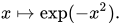
- ฟังก์ชันเกาส์เซียน


ฟังก์ชันคี่


ฟังก์ชันจริงfเป็นฟังก์ชันคี่ถ้าสำหรับทุกxในโดเมนของมัน− xก็อยู่ในโดเมนของมันด้วย และ[ 1 ] : หน้า 72 หรือเทียบเท่า

ในทางเรขาคณิต กราฟของฟังก์ชันคี่จะมีสมมาตรแบบหมุนรอบจุดกำเนิดซึ่งหมายความว่ากราฟของฟังก์ชันนั้นจะไม่เปลี่ยนแปลงหลังจากหมุน 180 องศารอบจุดกำเนิด
ถ้าอยู่ ในโดเมนของฟังก์ชันคี่แล้ว


ตัวอย่างของฟังก์ชันคี่ ได้แก่:
- ฟังก์ชันเครื่องหมาย
- ฟังก์ชันเอกลักษณ์
- สำหรับจำนวนเต็มคี่ใดๆ
- สำหรับจำนวนเต็มบวกคี่ใดๆ
- ไซน์
- ไซน์ไฮเปอร์โบลิก
- ฟังก์ชันข้อผิดพลาด


![{\displaystyle x\mapsto {\sqrt[{n}]{x}}}](https://wikimedia.org/api/rest_v1/media/math/render/svg/9f6dc6c72b6adc06584f94fb29f182d65e8ff246)


คุณสมบัติพื้นฐาน
ความเป็นเอกลักษณ์
- ถ้าฟังก์ชันเป็นทั้งฟังก์ชันคู่และฟังก์ชันคี่ ฟังก์ชันนั้นจะมีค่าเท่ากับ 0 ทุกที่ที่ฟังก์ชันนั้นถูกกำหนดไว้
- ถ้าฟังก์ชันเป็นฟังก์ชันคี่ค่าสัมบูรณ์ของฟังก์ชันนั้นจะเป็นฟังก์ชันคู่
การบวกและการลบ
- ผลรวมของฟังก์ชันคู่สองฟังก์ชันก็เป็นฟังก์ชันคู่เช่นกัน
- ผลรวมของฟังก์ชันคี่สองฟังก์ชันก็เป็นฟังก์ชันคี่เช่นกัน
- ผลต่างระหว่างฟังก์ชันคี่สองฟังก์ชันก็คือผลต่างของฟังก์ชันคี่นั่นเอง
- ผลต่างระหว่างฟังก์ชันคู่สองฟังก์ชันก็เป็นจำนวนคู่เช่นกัน
- The sum of an even and odd function is not even or odd, unless one of the functions is equal to zero over the given domain.
Multiplication and division
- The product and quotient of two even functions is an even function.
- This implies that the product of any number of even functions is also even.
- This implies that the reciprocal of an even function is also even.
- The product and quotient of two odd functions is an even function.
- The product and both quotients of an even function and an odd function is an odd function.
- This implies that the reciprocal of an odd function is odd.
Composition
- The composition of two even functions is even.
- The composition of two odd functions is odd.
- The composition of an even function and an odd function is even.
- The composition of any function with an even function is even (but not vice versa).
Inverse function
- If an odd function is invertible, then its inverse is also odd.
Even–odd decomposition
If a real function has a domain that is self-symmetric with respect to the origin, it may be uniquely decomposed as the sum of an even and an odd function, which are called respectively the even part (or the even component) and the odd part (or the odd component) of the function, and are defined by and
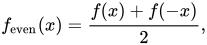
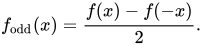
It is straightforward to verify that is even, is odd, and



This decomposition is unique since, if

where g is even and h is odd, then and since



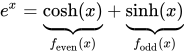
For example, the hyperbolic cosine and the hyperbolic sine may be regarded as the even and odd parts of the exponential function, as the first one is an even function, the second one is odd, and
- .
Fourier's sine and cosine transforms also perform even–odd decomposition by representing a function's odd part with sine waves (an odd function) and the function's even part with cosine waves (an even function).
Further algebraic properties
- Any linear combination of even functions is even, and the even functions form a vector space over the reals. Similarly, any linear combination of odd functions is odd, and the odd functions also form a vector space over the reals. In fact, the vector space of all real functions is the direct sum of the subspaces of even and odd functions. This is a more abstract way of expressing the property in the preceding section.
- The space of functions can be considered a graded algebra over the real numbers by this property, as well as some of those above.
- The even functions form a commutative algebra over the reals. However, the odd functions do not form an algebra over the reals, as they are not closed under multiplication.
Analytic properties
A function's being odd or even does not imply differentiability, or continuity. For example, the Dirichlet function is even, but is nowhere continuous.
In the following, properties involving derivatives, Fourier series, Taylor series are considered, and these concepts are thus supposed to be defined for the considered functions.
Basic analytic properties
- The derivative of an even function is odd.
- The derivative of an odd function is even.
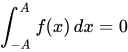
- If an odd function is integrable over a bounded symmetric interval, the integral over that interval is zero; that is[2]
- .
- This implies that the Cauchy principal value of an odd function over the entire real line is zero.
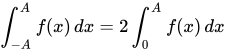
- If an even function is integrable over a bounded symmetric interval , the integral over that interval is twice the integral from 0 to A; that is[3]
- .
- This property is also true for the improper integral when , provided the integral from 0 to converges.
![{\displaystyle [-A,A]}](https://wikimedia.org/api/rest_v1/media/math/render/svg/f30ed42787a0511b07f6cc4622e0f6a812d39add)


Series
- The Maclaurin series of an even function includes only even powers.
- The Maclaurin series of an odd function includes only odd powers.
- The Fourier series of a periodic even function includes only cosine terms.
- The Fourier series of a periodic odd function includes only sine terms.
- The Fourier transform of a purely real-valued even function is real and even. (see Fourier analysis § Symmetry properties)
- The Fourier transform of a purely real-valued odd function is imaginary and odd. (see Fourier analysis § Symmetry properties)
Harmonics
In signal processing, harmonic distortion occurs when a sine wave signal is sent through a memory-less nonlinear system, that is, a system whose output at time t only depends on the input at time t and does not depend on the input at any previous times. Such a system is described by a response function . The type of harmonics produced depend on the response function f:[4]

- When the response function is even, the resulting signal will consist of only even harmonics of the input sine wave;
- The fundamental is also an odd harmonic, so will not be present.
- A simple example is a full-wave rectifier.
- The component represents the DC offset, due to the one-sided nature of even-symmetric transfer functions.
- When it is odd, the resulting signal will consist of only odd harmonics of the input sine wave;
- The output signal will be half-wave symmetric.
- A simple example is clipping in a symmetric push-pull amplifier.
- When it is asymmetric, the resulting signal may contain either even or odd harmonics;
- Simple examples are a half-wave rectifier, and clipping in an asymmetrical class-A amplifier.




This does not hold true for more complex waveforms. A sawtooth wave contains both even and odd harmonics, for instance. After even-symmetric full-wave rectification, it becomes a triangle wave, which, other than the DC offset, contains only odd harmonics.
Generalizations
Multivariate functions
Even symmetry:
A function is called even symmetric if:


Odd symmetry:
A function is called odd symmetric if:

Complex-valued functions
The definitions for even and odd symmetry for complex-valued functions of a real argument are similar to the real case. In signal processing, a similar symmetry is sometimes considered, which involves complex conjugation.[5][6]
Conjugate symmetry:
A complex-valued function of a real argument is called conjugate symmetric if


A complex valued function is conjugate symmetric if and only if its real part is an even function and its imaginary part is an odd function.
A typical example of a conjugate symmetric function is the cis function

Conjugate antisymmetry:
ฟังก์ชันค่าเชิงซ้อนของอาร์กิวเมนต์ที่เป็นจำนวนจริงเรียกว่าฟังก์ชันสมมาตรผกผันแบบสังยุคถ้า:

ฟังก์ชันค่าเชิงซ้อนจะเป็นฟังก์ชันสมมาตรผกผันเชิงคอนจูเกตก็ต่อเมื่อส่วนจริง ของ ฟังก์ชันเป็นฟังก์ชันคี่และส่วนจินตนาการเป็นฟังก์ชันคู่
ลำดับความยาวจำกัด
นิยามของสมมาตรคี่และสมมาตรคู่ขยายไปถึงลำดับN จุด (เช่น ฟังก์ชันในรูปแบบ ) ดังต่อไปนี้: [ 6 ] : หน้า 411

ความสมมาตรที่เท่ากัน:
ลำดับNจุด เรียกว่าสมมาตรแบบสังยุคถ้า

ลำดับดังกล่าวโดยทั่วไปเรียกว่าลำดับพาลินโดรมดูเพิ่มเติมที่ พหุนามพาลินโดรม
ความสมมาตรที่แปลกประหลาด:
ลำดับNจุด เรียกว่า ลำดับแอนติสมมาตรแบบคู่ควบถ้า

ลำดับดังกล่าวบางครั้งเรียกว่าลำดับแอนติพาลินโดรม (Anti-palindromic sequence ) ดูเพิ่มเติมที่ พหุนามแอนติพาลินโดรม (Antipalindromic polynomial )
ดูเพิ่มเติม
- ฟังก์ชันเฮอร์มิเชียนสำหรับการวางนัยทั่วไปในจำนวนเชิงซ้อน
- ซีรี่ส์เทย์เลอร์
- อนุกรมฟูริเยร์
- วิธีการโฮลสไตน์-เฮอร์ริ่ง
- ความสมมาตร (ฟิสิกส์)
หมายเหตุ
- อรรถ เป็นขGel'Fand , IM ; กลาโกเลวา, EG ; ชนอล, อีอี (1990) ฟังก์ชันและกราฟ บีร์เควเซอร์. ไอเอสบีเอ็น 0-8176-3532-7.
- ^ W., Weisstein, Eric. "ฟังก์ชันคี่" . mathworld.wolfram.com .
{{cite web}}: CS1 maint: multiple names: authors list (link) - ^ W., Weisstein, Eric. "ฟังก์ชันคู่" . mathworld.wolfram.com .
{{cite web}}: CS1 maint: multiple names: authors list (link) - ^ Berners, Dave (ตุลาคม 2005). "ถามหมอ: ฮาร์โมนิกส์หลอดสุญญากาศเทียบกับฮาร์โมนิกส์โซลิดสเตท" . UA WebZine . Universal Audio . สืบค้นเมื่อ2016-09-22 .
สรุปได้ว่า ถ้าฟังก์ชัน f(x) เป็นฟังก์ชันคี่ อินพุตโคไซน์จะไม่สร้างฮาร์โมนิกส์คู่ ถ้าฟังก์ชัน f(x) เป็นฟังก์ชันคู่ อินพุตโคไซน์จะไม่สร้างฮาร์โมนิกส์คี่ (แต่อาจมีส่วนประกอบ DC) ถ้าฟังก์ชันไม่ใช่ทั้งฟังก์ชันคี่หรือฟังก์ชันคู่ ฮาร์โมนิกส์ทั้งหมดอาจปรากฏในเอาต์พุต
- ^ Oppenheim, Alan V. ; Schafer, Ronald W. ; Buck, John R. (1999). การประมวลผลสัญญาณเวลาไม่ต่อเนื่อง (ฉบับที่ 2). Upper Saddle River, NJ: Prentice Hall. หน้า 55. ISBN 0-13-754920-2.
- ^ a b Proakis, John G.; Manolakis, Dimitri G. (1996), การประมวลผลสัญญาณดิจิทัล: หลักการ อัลกอริทึม และการประยุกต์ใช้ (ฉบับที่ 3), Upper Saddle River, NJ: Prentice-Hall International, ISBN 9780133942897, sAcfAQAAIAAJ
สรุปเนื้อหา
ข้อมูลสำคัญจากบทความ
ข้อมูลสำคัญเกี่ยวกับ ฟังก์ชันคู่และคี่
ใน ทางคณิตศาสตร์ ฟังก์ชัน คู่ คือ ฟังก์ชันจริง ที่สำหรับทุกค่าใน โดเมน ของฟังก์ชันนั้น ในทำนองเดียวกัน ฟังก์ชันคี่ คือ ฟังก์ชันที่สำหรับทุกค่าในโดเมนของฟังก์ชันนั้น เอฟ ( − x ) =...
ประวัติศาสตร์ยุคแรก
แนวคิดเรื่องฟังก์ชันคู่และฟังก์ชันคี่ดูเหมือนจะย้อนกลับไปถึงช่วงต้นศตวรรษที่ 18 โดย เลออนฮาร์ด ออยเลอร์ มีบทบาทสำคัญในการวางรากฐานแนวคิดนี้ ออยเลอร์ได้แนะนำแนวคิดเรื่องฟังก์ชันคู่และฟังก์ชันคี่ (โดยใช้คำภาษาละตินว่า pares และ impares ) ในงานเขียนของเขา เรื่อง...
คำจำกัดความและตัวอย่าง
โดยทั่วไปแล้ว ความเป็นฟังก์ชันคู่และฟังก์ชันคี่จะพิจารณาจาก ฟังก์ชันจริง นั่นคือฟังก์ชันที่มีค่าเป็นจำนวนจริงของตัวแปรจริง อย่างไรก็ตาม แนวคิดเหล่านี้อาจถูกกำหนดในเชิงกว้างกว่าสำหรับฟังก์ชันที่มี โดเมน และ โคโดเมน ที่มีแนวคิดของ ตัวผกผันการบวก ซึ่งรวมถึง...
แม้กระทั่งฟังก์ชันต่างๆ
ฟังก์ชัน จริง f จะเป็น ฟังก์ชัน คู่ก็ต่อ เมื่อสำหรับทุก x ในโดเมนของมัน − x ก็อยู่ในโดเมนของมันด้วย และ [ 1 ] : หน้า 11 หรือเทียบเท่า เอฟ ( − x ) = เอฟ ( x ) {\displaystyle f(-x)=f(x)} เอฟ ( x ) − เอฟ ( − x ) = 0. {\displaystyle f(x)-f(-x)=0.}