
อ่าน 5 นาที
G 1 phase
The G 1 phase , gap 1 phase , or growth 1 phase , is the first of four phases of the cell cycle that takes place in eukaryotic cell division.
G1 phase

The G1 phase, gap 1 phase, or growth 1 phase, is the first of four phases of the cell cycle that takes place in eukaryotic cell division. In this part of interphase, the cell synthesizes mRNA and proteins in preparation for subsequent steps leading to mitosis. G1 phase ends when the cell moves into the S phase of interphase. Around 30 to 40 percent of cell cycle time is spent in the G1 phase.
Overview
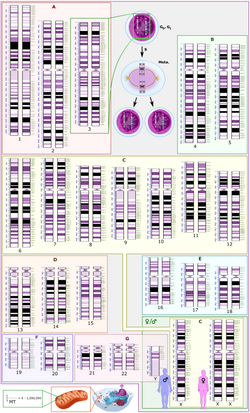
G1 phase together with the S phase and G2 phase comprise the long growth period of the cell cyclecell division called interphase that takes place before cell division in mitosis (M phase).[1]
During G1 phase, the cell grows in size and synthesizes mRNA and protein that are required for DNA synthesis. Once the required proteins and growth are complete, the cell enters the next phase of the cell cycle, S phase. The duration of each phase, including the G1 phase, is different in many different types of cells. In human somatic cells, the G1 stage of the cell cycle lasts about 10 hours.[2] However, in Xenopus embryos, sea urchin embryos, and Drosophila embryos, the G1 phase is barely existent and is defined as the gap, if one exists, between the end of mitosis and the S phase.[2]
G1 phase and the other subphases of the cell cycle may be affected by limiting growth factors such as nutrient supply, temperature, and room for growth. Sufficient nucleotides and amino acids must be present in order to synthesize mRNA and proteins. Physiological temperatures are optimal for cell growth. In humans, the normal physiological temperature is around 37 °C (98.6 °F).[1]
G1 phase is particularly important in the cell cycle because it determines whether a cell commits to division or to leaving the cell cycle.[2] If a cell is signaled to remain undivided, instead of moving onto the S phase, it will leave the G1 phase and move into a state of dormancy called the G0 phase. Most nonproliferating vertebrate cells will enter the G0 phase.[1]
Regulation
Within the cell cycle, there is a stringent set of regulations known as the cell cycle control system that controls the timing and coordination of the phases to ensure a correct order of events. Biochemical triggers known as cyclin-dependent kinases (Cdks) switch on cell cycles events at the corrected time and in the correct order to prevent any mistakes.[2]
There are three checkpoints in the cell cycle: the G1/S Checkpoint or the Start checkpoint in yeast; the G2/M checkpoint; and the spindle checkpoint.[1]
Biochemical regulators
During G1 phase, the G1/S cyclin activity rises significantly near the end of the G1 phase.
Complexes of cyclin that are active during other phases of the cell cycle are kept inactivated to prevent any cell-cycle events from occurring out of order. Three methods of preventing Cdk activity are found in G1 phase: pRB binding to E2F family transcription factors downregulate expression of S phase cyclin genes; anaphase-promoting complex (APC) is activated, which targets and degrades S and M cyclins (but not G1/S cyclins); and a high concentration of Cdk inhibitors is found during G1 phase.[2]
Restriction point
จุดจำกัด ( R ) ในระยะ G1 แตกต่างจากจุดตรวจสอบ เนื่องจากไม่ได้กำหนดว่าสภาวะของเซลล์เหมาะสมที่จะก้าวไปสู่ขั้นตอนต่อไปหรือไม่ แต่จะเปลี่ยนเส้นทางของเซลล์ หลังจากที่เซลล์ของสัตว์มีกระดูกสันหลังอยู่ในระยะ G1 ประมาณสามชั่วโมง เซลล์จะเข้าสู่จุดจำกัด ซึ่งจะตัดสินใจว่าเซลล์จะก้าวต่อไปในระยะ G1 หรือจะเข้าสู่ระยะG0 ที่อยู่ในภาวะพักตัว [ 3 ]
จุดนี้ยังแบ่งระยะ G1 ออกเป็นสองส่วนคือระยะหลังไมโทซิสและระยะก่อนไมโทซิส ระหว่างจุดเริ่มต้นของระยะ G1 (ซึ่งเกิดขึ้นหลังจากไมโทซิสแล้ว) และ R เซลล์จะอยู่ในซับเฟส G1 - pm หรือระยะหลังไมโทซิส หลังจาก R และก่อน S เซลล์จะอยู่ใน G1 - ps หรือช่วงก่อน S ของระยะG1 [ 4 ]
เพื่อให้เซลล์สามารถดำเนินต่อไปในระยะ G1 ได้จะต้องมีปัจจัยการเจริญเติบโตในปริมาณมากและอัตราการสังเคราะห์โปรตีนที่คงที่ มิฉะนั้นเซลล์จะเคลื่อนเข้าสู่ระยะG0 [ 4 ]
งานวิจัยที่ขัดแย้งกัน
ผู้เขียนบางคนกล่าวว่าจุดจำกัดและจุดตรวจสอบ G1 / S เป็นสิ่งเดียวกัน[ 1 ] [ 2 ]แต่การศึกษาล่าสุดได้โต้แย้งว่ามีจุดที่แตกต่างกันสองจุดในระยะ G1 ที่ตรวจสอบความก้าวหน้าของเซลล์ จุดจำกัดแรกขึ้นอยู่กับปัจจัยการเจริญเติบโตและกำหนดว่าเซลล์จะเคลื่อนเข้าสู่ระยะ G0 หรือไม่ในขณะที่จุดตรวจสอบที่สองขึ้นอยู่กับสารอาหารและกำหนดว่าเซลล์จะเคลื่อนเข้าสู่ระยะ S หรือไม่[ 3 ] [ 4 ]
จุดตรวจ G 1 /S
จุดตรวจสอบ G1 /Sคือจุดระหว่างระยะ G1 และ ระยะ S ซึ่งเซลล์จะถูกตรวจสอบว่าพร้อมที่จะเข้าสู่ระยะ S หรือไม่ สาเหตุ ที่ เซลล์ไม่สามารถเข้าสู่ระยะ S ได้ ได้แก่ การเจริญเติบโต ของเซลล์ไม่เพียงพอ ดีเอ็นเอเสียหาย หรือการเตรียมการอื่นๆ ยังไม่เสร็จสมบูรณ์
ที่จุดตรวจสอบ G 1 /S การสร้างไซคลิน G 1 /S กับ Cdk เพื่อสร้างคอมเพล็กซ์จะทำให้เซลล์เข้าสู่รอบการแบ่งตัวใหม่[ 2 ]จากนั้นคอมเพล็กซ์เหล่านี้จะกระตุ้นคอมเพล็กซ์ S-Cdk ที่เคลื่อนไปข้างหน้าพร้อมกับการจำลองดีเอ็นเอในระยะ S ในขณะเดียวกัน กิจกรรม ของคอมเพล็กซ์ส่งเสริมระยะแอนาเฟส (APC) จะลดลงอย่างมีนัยสำคัญ ทำให้ไซคลิน S และ M ถูกกระตุ้น
หากเซลล์ไม่สามารถผ่านไปยังระยะ S ได้ เซลล์จะเข้าสู่ระยะ G0 ที่ไม่มีการเจริญเติบโตหรือการแบ่งตัวของเซลล์[ 1 ]
ในโรคมะเร็ง
แหล่งข้อมูลหลายแห่งเชื่อมโยงความผิดปกติในระยะ G1 หรือจุดตรวจสอบ G1 / S กับการเติบโตของเนื้องอก ที่ไม่สามารถควบคุมได้ ในกรณีที่ระยะ G1 ได้รับผลกระทบ โดยทั่วไปแล้วมักเกิดจากโปรตีนควบคุมยีนใน กลุ่ม E2Fไม่ได้รับการควบคุมและเพิ่มการแสดงออกของยีนไซคลิน G1 / S ส่งผลให้เซลล์เข้าสู่รอบการแบ่งเซลล์อย่างไม่สามารถควบคุมได้[ 2 ]
อย่างไรก็ตาม การรักษาโรคมะเร็งบางชนิดยังอยู่ในระยะ G1 ของวงจรเซลล์ มะเร็งหลายชนิดรวมถึง มะเร็ง เต้านม[ 5 ]และมะเร็งผิวหนัง[ 6 ]ถูกยับยั้งไม่ให้แพร่กระจายโดยการทำให้เซลล์มะเร็งเข้าสู่ระยะ G1 ของวงจรเซลล์ ซึ่งป้องกันไม่ให้เซลล์แบ่งตัวและแพร่กระจาย
ดูเพิ่มเติม
สรุปเนื้อหา
ข้อมูลสำคัญจากบทความ
ข้อมูลสำคัญเกี่ยวกับ G 1 phase
The G 1 phase , gap 1 phase , or growth 1 phase , is the first of four phases of the cell cycle that takes place in eukaryotic cell division.
Overview
G 1 phase together with the S phase and G 2 phase comprise the long growth period of the cell cycle cell division called interphase that takes place before cell division in mitosis (M phase). [ 1 ]
Regulation
Within the cell cycle, there is a stringent set of regulations known as the cell cycle control system that controls the timing and coordination of the phases to ensure a correct order of events.
Biochemical regulators
During G 1 phase, the G 1 /S cyclin activity rises significantly near the end of the G 1 phase.