
อ่าน 3 นาที
Complete manifold
In mathematics, a complete manifold (or geodesically complete manifold) M is a (pseudo-) Riemannian manifold for which, starting at any point p of M, there are straight paths...
Complete manifold
In mathematics, a complete manifold (or geodesically complete manifold) M is a (pseudo-) Riemannian manifold for which, starting at any point p of M, there are straight paths extending infinitely in all directions.
Formally, a manifold is (geodesically) complete if for any maximal geodesic, it holds that .[1] A geodesic is maximal if its domain cannot be extended.


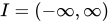
Equivalently, is (geodesically) complete if for all points , the exponential map at is defined on , the entire tangent space at .[1]


Hopf–Rinow theorem
The Hopf–Rinow theorem gives alternative characterizations of completeness. Let be a connected Riemannian manifold and let be its Riemannian distance function.


The Hopf–Rinow theorem states that is (geodesically) complete if and only if it satisfies one of the following equivalent conditions:[2]
- The metric space is complete (every -Cauchy sequence converges),
- All closed and bounded subsets of are compact.


Examples and non-examples
Euclidean space, the sphere, and the tori (with their natural Riemannian metrics) are all complete manifolds.


All compact Riemannian manifolds and all homogeneous manifolds are geodesically complete. All symmetric spaces are geodesically complete.
Non-examples


A simple example of a non-complete manifold is given by the punctured plane (with its induced metric). Geodesics going to the origin cannot be defined on the entire real line. By the Hopf–Rinow theorem, we can alternatively observe that it is not a complete metric space: any sequence in the plane converging to the origin is a non-converging Cauchy sequence in the punctured plane.

There exist non-geodesically complete compact pseudo-Riemannian (but not Riemannian) manifolds. An example of this is the Clifton–Pohl torus.
ในทฤษฎีสัมพัทธภาพทั่วไปซึ่งอธิบายแรงโน้มถ่วงในแง่ของเรขาคณิตแบบเสมือนรีมันน์ มีตัวอย่างสำคัญมากมายของปริภูมิที่ไม่สมบูรณ์ในเชิงจีโอเดสิก เช่นหลุมดำที่ไม่หมุนและไม่มีประจุหรือจักรวาลวิทยาที่มีบิ๊กแบงข้อเท็จจริงที่ว่าความไม่สมบูรณ์ดังกล่าวค่อนข้างเป็นเรื่องปกติในทฤษฎีสัมพัทธภาพทั่วไปนั้นแสดงให้เห็นได้จาก ทฤษฎีบทเอกภาวะ ของ เพนโรส-ฮอว์คิง
ความสามารถในการขยาย
ถ้าสมบูรณ์ตามหลักจีโอเดสิกแล้ว มันจะไม่สมมาตรกับซับแมนิโฟลด์แบบเปิดที่เหมาะสมของแมนิโฟลด์รีมันน์อื่นใด ในทางกลับกันจะไม่เป็นจริง[ 3 ]
สรุปเนื้อหา
ข้อมูลสำคัญจากบทความ
ข้อมูลสำคัญเกี่ยวกับ Complete manifold
In mathematics, a complete manifold (or geodesically complete manifold) M is a (pseudo-) Riemannian manifold for which, starting at any point p of M, there are straight paths...
Hopf–Rinow theorem
The Hopf–Rinow theorem gives alternative characterizations of completeness.
Examples and non-examples
Euclidean space อาร์ n {\displaystyle \mathbb {R} ^{n}} , the sphere เอส n {\displaystyle \mathbb {S} ^{n}} , and the tori ที n {\displaystyle \mathbb {T} ^{n}} (with their natural Riemannian metrics ) are all complete manifolds.
Non-examples
A simple example of a non-complete manifold is given by the punctured plane อาร์ 2 ∖ { 0 } {\displaystyle \mathbb {R} ^{2}\smallsetminus \lbrace 0\rbrace } (with its induced metric). Geodesics going to the origin cannot be defined on the entire real line.