
กระบวนการ Dirichlet แบบลำดับชั้น
ในทางสถิติและการเรียนรู้ของเครื่องกระบวนการDirichlet แบบลำดับชั้น ( HDP ) เป็น วิธีการ แบบเบย์เซียนที่ไม่ใช้พารามิเตอร์ สำหรับการจัดกลุ่มข้อมูล[ 1 ] [ 2 ]โดยใช้กระบวนการ Dirichlet สำหรับแต่ละกลุ่มข้อมูล โดยกระบวนการ Dirichlet สำหรับทุกกลุ่มจะใช้การแจกแจงพื้นฐานร่วมกัน ซึ่งได้มาจากกระบวนการ Dirichlet อีก ทีวิธีนี้ช่วยให้กลุ่มต่างๆ สามารถใช้ความแข็งแกร่งทางสถิติร่วมกันได้ผ่านการใช้คลัสเตอร์ร่วมกันระหว่างกลุ่ม การแจกแจงพื้นฐานที่ได้มาจากกระบวนการ Dirichlet นั้นมีความสำคัญ เพราะการสุ่มจากกระบวนการ Dirichlet เป็นการวัดความน่าจะเป็นแบบอะตอม และอะตอมเหล่านี้จะปรากฏในกระบวนการ Dirichlet ระดับกลุ่มทั้งหมด เนื่องจากอะตอมแต่ละตัวสอดคล้องกับคลัสเตอร์ คลัสเตอร์จึงถูกใช้ร่วมกันระหว่างทุกกลุ่ม แบบจำลอง นี้ได้รับการพัฒนาโดยYee Whye Teh , Michael I. Jordan , Matthew J. BealและDavid Bleiและตีพิมพ์ในวารสาร Journal of the American Statistical Associationในปี 2549 [ 1 ]โดยเป็นการกำหนดรูปแบบและขยายความของแบบจำลองมาร์คอฟที่ซ่อนอยู่แบบอนันต์ที่ตีพิมพ์ในปี 2545 [ 3 ]
แบบอย่าง
คำอธิบายโมเดลนี้มาจาก[ 1 ] HDP เป็นโมเดลสำหรับข้อมูลที่จัดกลุ่ม ซึ่งหมายความว่ารายการข้อมูลมีหลายกลุ่มที่แตกต่างกัน ตัวอย่างเช่น ในโมเดลหัวข้อคำต่างๆ จะถูกจัดระเบียบเป็นเอกสาร โดยแต่ละเอกสารประกอบด้วยกลุ่มคำ (รายการข้อมูล) การจัดทำดัชนีกลุ่มโดยสมมติว่าแต่ละกลุ่มประกอบด้วยรายการข้อมูล.


HDP ถูกกำหนดพารามิเตอร์โดยการแจกแจงพื้นฐานซึ่งควบคุมการกระจายตัวล่วงหน้าของรายการข้อมูล และพารามิเตอร์ความเข้มข้นจำนวนหนึ่งที่ควบคุมจำนวนคลัสเตอร์ล่วงหน้าและปริมาณการแบ่งปันระหว่างกลุ่มต่างๆกลุ่มนี้เกี่ยวข้องกับการวัดความน่าจะเป็นแบบสุ่มซึ่งมีการกระจายตัวตามกระบวนการ Dirichlet:



ที่ไหนคือพารามิเตอร์ความเข้มข้นที่เกี่ยวข้องกับกลุ่ม และเป็นการแจกแจงพื้นฐานที่ใช้ร่วมกันในทุกกลุ่ม ในทางกลับกัน การแจกแจงพื้นฐานทั่วไปนั้นมีการแจกแจงแบบกระบวนการ Dirichlet:



โดยมีพารามิเตอร์ความเข้มข้นและการกระจายฐานสุดท้ายนี้ เพื่อเชื่อมโยงกระบวนการ Dirichlet กลับไปยังข้อมูลที่สังเกตได้ แต่ละรายการข้อมูลเกี่ยวข้องกับพารามิเตอร์แฝง:


บรรทัดแรกระบุว่าพารามิเตอร์แต่ละตัวมีการแจกแจงความน่าจะเป็นล่วงหน้า (prior distribution)ที่กำหนดโดยในขณะที่บรรทัดที่สองระบุว่าข้อมูลแต่ละรายการมีการกระจายตัว parameterized by its associated parameter. The resulting model above is called a HDP mixture model, with the HDP referring to the hierarchically linked set of Dirichlet processes, and the mixture model referring to the way the Dirichlet processes are related to the data items.

To understand how the HDP implements a clustering model, and how clusters become shared across groups, recall that draws from a Dirichlet process are atomic probability measures with probability one. This means that the common base distribution has a form which can be written as:
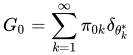
where there are an infinite number of atoms, , assuming that the overall base distribution has infinite support. Each atom is associated with a mass . The masses have to sum to one since is a probability measure. Since is itself the base distribution for the group specific Dirichlet processes, each will have atoms given by the atoms of , and can itself be written in the form:


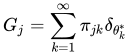
Thus the set of atoms is shared across all groups, with each group having its own group-specific atom masses. Relating this representation back to the observed data, we see that each data item is described by a mixture model:
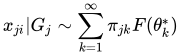
where the atoms play the role of the mixture component parameters, while the masses play the role of the mixing proportions. In conclusion, each group of data is modeled using a mixture model, with mixture components shared across all groups but mixing proportions being group-specific. In clustering terms, we can interpret each mixture component as modeling a cluster of data items, with clusters shared across all groups, and each group, having its own mixing proportions, composed of different combinations of clusters.


Applications
The HDP mixture model is a natural nonparametric generalization of Latent Dirichlet allocation, where the number of topics can be unbounded and learnt from data.[1] Here each group is a document consisting of a bag of words, each cluster is a topic, and each document is a mixture of topics. The HDP is also a core component of the infinite hidden Markov model,[3] which is a nonparametric generalization of the hidden Markov model allowing the number of states to be unbounded and learnt from data.[1][4]
Generalizations
HDP สามารถขยายความได้หลายทิศทาง กระบวนการ Dirichlet สามารถแทนที่ด้วยกระบวนการ Pitman-Yorและกระบวนการ Gammaส่งผลให้เกิดกระบวนการ Pitman-Yor แบบลำดับชั้นและกระบวนการ Gamma แบบลำดับชั้น ลำดับชั้นสามารถลึกขึ้นได้ โดยมีกลุ่มหลายระดับจัดเรียงเป็นลำดับชั้น การจัดเรียงดังกล่าวถูกนำไปใช้ประโยชน์ในsequence memoizerซึ่งเป็นแบบจำลอง Bayesian แบบไม่ใช้พารามิเตอร์สำหรับลำดับที่มีลำดับชั้นหลายระดับของกระบวนการ Pitman-Yor นอกจากนี้ แบบจำลอง Bayesian Multi-Domain Learning (BMDL) ยังได้มาจากการแสดงแทนแฝงที่ขึ้นอยู่กับโดเมนของข้อมูลการนับ ที่มีการกระจายเกิน โดยอาศัยการแยกตัวประกอบทวินามเชิงลบแบบลำดับชั้นเพื่อการจำแนกประเภทย่อยของมะเร็งที่แม่นยำแม้ว่าจำนวนตัวอย่างสำหรับมะเร็งชนิดใดชนิดหนึ่งจะมีน้อยก็ตาม[ 5 ]