
ธรณีเคมี
ธรณีเคมีเป็นวิทยาศาสตร์ที่ใช้เครื่องมือและหลักการทางเคมีเพื่ออธิบายกลไกเบื้องหลังระบบทางธรณีวิทยาที่สำคัญ เช่นเปลือกโลกและมหาสมุทร[ 1 ] : 1ขอบเขตของธรณีเคมีขยายออกไปนอกโลก ครอบคลุม ระบบสุริยะทั้งหมด[ 2 ]และมีส่วนสำคัญต่อความเข้าใจในกระบวนการต่างๆ มากมาย รวมถึงการพาความร้อนของเนื้อโลกการก่อตัวของดาวเคราะห์ และ ต้นกำเนิดของหินแกรนิตและหินบะซอลต์ [ 1 ] : 1เป็นสาขาที่บูรณาการของเคมีและธรณีวิทยา

ประวัติศาสตร์

คำว่าธรณีเคมีถูกใช้ครั้งแรกโดยนักเคมีชาวสวิส-เยอรมันChristian Friedrich Schönbeinในปี 1838: "ควรมีการเริ่มต้นธรณีเคมีเชิงเปรียบเทียบ ก่อนที่ธรณีวิทยาจะกลายเป็นธรณีวิทยา และก่อนที่ความลึกลับของการกำเนิดของดาวเคราะห์และสสารอนินทรีย์ของพวกมันจะถูกเปิดเผย" [ 3 ]อย่างไรก็ตาม ตลอดช่วงที่เหลือของศตวรรษ คำที่ใช้กันทั่วไปมากกว่าคือ "ธรณีวิทยาเคมี" และมีการติดต่อระหว่างนักธรณีวิทยาและนักเคมีน้อย มาก [ 3 ]
ธรณีเคมีเกิดขึ้นเป็นสาขาวิชาแยกต่างหากหลังจากมีการจัดตั้งห้องปฏิบัติการหลัก โดยเริ่มจากสำนักงานสำรวจทางธรณีวิทยาแห่งสหรัฐอเมริกา (USGS) ในปี 1884 ซึ่งเริ่มทำการสำรวจทางเคมีของหินและแร่ธาตุอย่างเป็นระบบ หัวหน้านักเคมีของ USGS คือแฟรงค์ วิกลส์เวิร์ธ คลาร์กได้สังเกตว่าโดยทั่วไปแล้วปริมาณของธาตุจะลดลงเมื่อน้ำหนักอะตอมเพิ่มขึ้น และได้สรุปงานวิจัยเกี่ยวกับปริมาณของธาตุไว้ในThe Data of Geochemistry [ 3 ] [ 4 ] : 2
องค์ประกอบของอุกกาบาตได้รับการตรวจสอบและเปรียบเทียบกับหินบนโลกตั้งแต่ปี ค.ศ. 1850 ในปี ค.ศ. 1901 Oliver C. Farringtonตั้งสมมติฐานว่า แม้จะมีความแตกต่างกัน แต่ปริมาณสัมพัทธ์ควรจะยังคงเหมือนเดิม[ 3 ] นี่คือจุดเริ่มต้นของสาขาเคมีจักรวาลและมีส่วนสำคัญอย่างมากต่อความรู้ที่เรามีเกี่ยวกับการก่อตัวของโลกและระบบสุริยะ[ 5 ]
ในช่วงต้นศตวรรษที่ 20 Max von LaueและWilliam L. Braggแสดงให้เห็นว่าการกระเจิงของรังสีเอกซ์สามารถใช้ในการกำหนดโครงสร้างของผลึกได้ ในช่วงทศวรรษที่ 1920 และ 1930 Victor Goldschmidtและเพื่อนร่วมงานที่มหาวิทยาลัยออสโลได้ประยุกต์ใช้วิธีการเหล่านี้กับแร่ธาตุทั่วไปหลายชนิดและกำหนดชุดกฎสำหรับการจัดกลุ่มธาตุ Goldschmidt ได้ตีพิมพ์ผลงานนี้ในชุด Geochemische Verteilungsgesetze der Elemente [กฎทางธรณีเคมีของการกระจายตัวของธาตุ] [ 4 ] : 2 [ 6 ]
งานวิจัยของManfred Schidlowskiตั้งแต่ช่วงปี 1960 จนถึงประมาณปี 2002 เกี่ยวข้องกับชีวเคมีของโลกยุคแรกโดยเน้นที่ไอโซโทป-ชีวธรณีเคมีและหลักฐานของกระบวนการชีวิตแรกสุดในยุคพรีแคมเบรียน[ 7 ] [ 8 ]
สาขาย่อย
สาขาย่อยบางส่วนของธรณีเคมี ได้แก่: [ 9 ]
- การศึกษา ธรณีเคมีทางน้ำศึกษาบทบาทของธาตุต่างๆ ในลุ่มน้ำ รวมถึงทองแดงกำมะถันปรอทและการแลกเปลี่ยนธาตุต่างๆ ผ่านปฏิสัมพันธ์ระหว่างบรรยากาศ-พื้นดิน-น้ำ[ 10 ]
- ชีวธรณีเคมีเป็นสาขาการศึกษาที่มุ่งเน้นผลกระทบของสิ่งมีชีวิตต่อเคมีของโลก[ 11 ] : 3
- คอสโมเคมีประกอบด้วยการวิเคราะห์การกระจายตัวของธาตุและไอโซโทปในจักรวาล[ 2 ] : 1
- ธรณีเคมีไอโซโทปเกี่ยวข้องกับการกำหนดความเข้มข้นสัมพัทธ์และสัมบูรณ์ของธาตุและไอโซโทป ของธาตุเหล่านั้น ในโลกและบนพื้นผิวโลก[ 12 ]
- ธรณีเคมีอินทรีย์คือการศึกษาบทบาทของกระบวนการและสารประกอบที่ได้มาจากสิ่งมีชีวิตหรือสิ่งมีชีวิตที่เคยมีชีวิตอยู่[ 13 ]
- โฟโตจีโอเคมีคือการศึกษาปฏิกิริยาเคมีที่เกิดจากแสงซึ่งเกิดขึ้นหรืออาจเกิดขึ้นในส่วนประกอบตามธรรมชาติของพื้นผิวโลก[ 14 ]
- ธรณีเคมีระดับภูมิภาครวมถึงการประยุกต์ใช้ในการศึกษาด้านสิ่งแวดล้อม อุทกวิทยา และการสำรวจแร่[ 15 ]
ธาตุเคมี
องค์ประกอบพื้นฐานของวัสดุคือธาตุทางเคมี ธาตุเหล่านี้สามารถระบุได้จากเลขอะตอม Z ซึ่งเป็นจำนวนโปรตอนในนิวเคลียส ธาตุหนึ่งๆ สามารถมีค่า N ซึ่ง เป็นจำนวนนิวตรอนในนิวเคลียสได้มากกว่าหนึ่งค่า ผล รวมของค่าเหล่านี้คือ เลขมวลซึ่งโดยประมาณเท่ากับมวลอะตอม อะตอมที่มีเลขอะตอมเดียวกันแต่มีจำนวนนิวตรอนต่างกันเรียกว่าไอโซโทปไอโซโทปแต่ละชนิดจะระบุด้วยตัวอักษรของธาตุตามด้วยตัวเลขยกกำลังของเลขมวล ตัวอย่างเช่น ไอโซโทปทั่วไปสองชนิดของคลอรีนคือ35Clและ37Clมีการรวมกันของ Z และ N ที่รู้จักประมาณ 1700 แบบ ซึ่งมีเพียงประมาณ 260 แบบเท่านั้นที่เสถียร อย่างไรก็ตาม ไอโซโทปที่ไม่เสถียรส่วนใหญ่ไม่พบในธรรมชาติ ในทางธรณีเคมี ไอโซโทปที่เสถียรใช้ในการติดตามเส้นทางและปฏิกิริยาทางเคมี ในขณะที่ไอโซโทปกัมมันตรังสีส่วนใหญ่ใช้ในการหาอายุของตัวอย่าง[ 4 ] : 13–17
พฤติกรรมทางเคมีของอะตอม – ความสัมพันธ์กับธาตุอื่น ๆและประเภทของพันธะที่มันสร้างขึ้น – ถูกกำหนดโดยการจัดเรียงอิเล็กตรอนในออร์บิทัลโดยเฉพาะอย่างยิ่งอิเล็กตรอนวงนอกสุด ( วาเลนซ์ ) การจัดเรียงเหล่านี้สะท้อนให้เห็นในตำแหน่งของธาตุในตารางธาตุ[ 4 ] : 13–17โดยพิจารณาจากตำแหน่ง ธาตุต่าง ๆ จะถูกจัดอยู่ในกลุ่มใหญ่ ๆ ได้แก่โลหะอัลคาไลน์โลหะอัลคาไลน์เอิร์ธ โลหะทรานซิชัน โลหะกึ่งตัวนำ (หรือที่เรียกว่าโลหะกึ่งโลหะ ) ฮาโลเจนก๊าซเฉื่อยแลนทานอยด์และแอกทินอยด์[ 4 ] : 20–23
Another useful classification scheme for geochemistry is the Goldschmidt classification, which places the elements into four main groups. Lithophiles combine easily with oxygen. These elements, which include Na, K, Si, Al, Ti, Mg and Ca, dominate in the Earth's crust, forming silicates and other oxides. Siderophile elements (Fe, Co, Ni, Pt, Re, Os) have an affinity for iron and tend to concentrate in the core. Chalcophile elements (Cu, Ag, Zn, Pb, S) form sulfides; and atmophile elements (O, N, H and noble gases) dominate the atmosphere. Within each group, some elements are refractory, remaining stable at high temperatures, while others are volatile, evaporating more easily, so heating can separate them.[1]:17[4]:23
Differentiation and mixing
The chemical composition of the Earth and other bodies is determined by two opposing processes: differentiation and mixing. In the Earth's mantle, differentiation occurs at mid-ocean ridges through partial melting, with more refractory materials remaining at the base of the lithosphere while the remainder rises to form basalt. After an oceanic plate descends into the mantle, convection eventually mixes the two parts together. Erosion differentiates granite, separating it into clay on the ocean floor, sandstone on the edge of the continent, and dissolved minerals in ocean waters. Metamorphism and anatexis (partial melting of crustal rocks) can mix these elements together again. In the ocean, biological organisms can cause chemical differentiation, while dissolution of the organisms and their wastes can mix the materials again.[1]:23–24
Fractionation
A major source of differentiation is fractionation, an unequal distribution of elements and isotopes. This can be the result of chemical reactions, phase changes, kinetic effects, or radioactivity.[1]:2–3 On the largest scale, planetary differentiation is a physical and chemical separation of a planet into chemically distinct regions. For example, the terrestrial planets formed iron-rich cores and silicate-rich mantles and crusts.[2]:218 In the Earth's mantle, the primary source of chemical differentiation is partial melting, particularly near mid-ocean ridges.[16]:68,153 This can occur when the solid is heterogeneous or a solid solution, and part of the melt is separated from the solid. The process is known as equilibrium or batch melting if the solid and melt remain in equilibrium until the moment that the melt is removed, and fractional or Rayleigh melting if it is removed continuously.[17]
Isotopic fractionation can have mass-dependent and mass-independent forms. Molecules with heavier isotopes have lower ground state energies and are therefore more stable. As a result, chemical reactions show a small isotope dependence, with heavier isotopes preferring species or compounds with a higher oxidation state; and in phase changes, heavier isotopes tend to concentrate in the heavier phases.[18] Mass-dependent fractionation is largest in light elements because the difference in masses is a larger fraction of the total mass.[19]:47
Ratios between isotopes are generally compared to a standard. For example, sulfur has four stable isotopes, of which the two most common are 32S and 34S.[19]:98 The ratio of their concentrations, R=34S/32S, is reported as
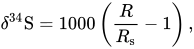
where R is the same ratio for a standard. Because the differences are small, the ratio is multiplied by 1000 to make it parts per thousand (referred to as parts per mil). This is represented by the symbol ‰.[18]:55
Equilibrium
Equilibrium fractionation occurs between chemicals or phases that are in equilibrium with each other. In equilibrium fractionation between phases, heavier phases prefer the heavier isotopes. For two phases A and B, the effect can be represented by the factor
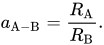
In the liquid-vapor phase transition for water, a at 20 degrees Celsius is 1.0098 for 18O and 1.084 for 2H. In general, fractionation is greater at lower temperatures. At 0 °C, the factors are 1.0117 and 1.111.[18]:59
Kinetic
When there is no equilibrium between phases or chemical compounds, kinetic fractionation can occur. For example, at interfaces between liquid water and air, the forward reaction is enhanced if the humidity of the air is less than 100% or the water vapor is moved by a wind. Kinetic fractionation generally is enhanced compared to equilibrium fractionation and depends on factors such as reaction rate, reaction pathway and bond energy. Since lighter isotopes generally have weaker bonds, they tend to react faster and enrich the reaction products.[18]:60
Biological fractionation is a form of kinetic fractionation since reactions tend to be in one direction. Biological organisms prefer lighter isotopes because there is a lower energy cost in breaking energy bonds. In addition to the previously mentioned factors, the environment and species of the organism can have a large effect on the fractionation.[18]:70
Cycles
Through a variety of physical and chemical processes, chemical elements change in concentration and move around in what are called geochemical cycles. An understanding of these changes requires both detailed observation and theoretical models. Each chemical compound, element or isotope has a concentration that is a function C(r,t) of position and time, but it is impractical to model the full variability. Instead, in an approach borrowed from chemical engineering,[1]:81 geochemists average the concentration over regions of the Earth called geochemical reservoirs. The choice of reservoir depends on the problem; for example, the ocean may be a single reservoir or be split into multiple reservoirs.[20] In a type of model called a box model, a reservoir is represented by a box with inputs and outputs.[1]:81[20]
แบบจำลองทางธรณีเคมีโดยทั่วไปเกี่ยวข้องกับปฏิกิริยาตอบกลับ ในกรณีที่ง่ายที่สุดของวัฏจักรเชิงเส้น ทั้งปริมาณสารที่ป้อนเข้าหรือปริมาณสารที่ส่งออกจากแหล่งกักเก็บจะเป็นสัดส่วนกับความเข้มข้น ตัวอย่างเช่นเกลือถูกกำจัดออกจากมหาสมุทรโดยการก่อตัวของแร่ระเหยและเมื่ออัตราการระเหยในแอ่งแร่ระเหยคงที่ อัตราการกำจัดเกลือควรเป็นสัดส่วนกับความเข้มข้นของเกลือ สำหรับองค์ประกอบC ที่กำหนด หากปริมาณสารที่ป้อนเข้าสู่แหล่งกักเก็บเป็นค่าคงที่aและปริมาณสารที่ส่งออกเป็นkCสำหรับค่าคงที่k บางค่า สม การสมดุลมวลจะเป็นดังนี้
| 1 |
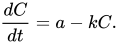
สิ่งนี้แสดงให้เห็นว่าการเปลี่ยนแปลงใดๆ ในมวลจะต้องสมดุลกับการเปลี่ยนแปลงในอินพุตหรือเอาต์พุต ในช่วงเวลาt = 1/kระบบจะเข้าสู่สภาวะคงที่ซึ่งC steady = a / kเวลาคงอยู่จะถูกกำหนดดังนี้

โดยที่IและO คืออัตราการป้อนเข้าและอัตราการส่งออก ในตัวอย่างข้างต้น อัตราการป้อนเข้าและอัตราการส่งออกในสภาวะคงที่เท่ากับa ทั้งคู่ ดังนั้นτ = 1/ k [ 20 ]
หากอัตราการป้อนเข้าและส่งออกเป็นฟังก์ชันที่ไม่เป็นเชิงเส้นของCพวกมันอาจยังคงสมดุลกันอย่างใกล้ชิดในช่วงเวลาที่ยาวนานกว่าเวลาการอยู่อาศัยมาก มิฉะนั้น จะมีการผันผวนขนาดใหญ่ในCในกรณีนั้น ระบบจะอยู่ใกล้สถานะคงที่เสมอ และการขยายลำดับต่ำสุดของสมการสมดุลมวลจะนำไปสู่สมการเชิงเส้นเช่นสมการ ( 1 ) ในระบบส่วนใหญ่ การป้อนเข้าและส่งออกอย่างใดอย่างหนึ่งหรือทั้งสองอย่างขึ้นอยู่กับCส่งผลให้เกิดการป้อนกลับที่มีแนวโน้มที่จะรักษาสถานะคงที่ หากแรงภายนอกรบกวนระบบ ระบบจะกลับคืนสู่สถานะคงที่ในช่วงเวลา1 / k [ 20 ]
ความอุดมสมบูรณ์ของธาตุต่างๆ
ระบบสุริยะ
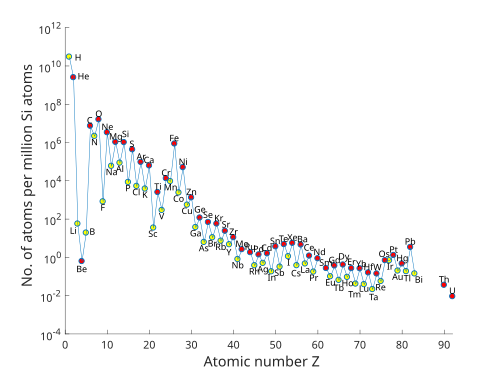
The composition of the Solar System is similar to that of many other stars, and aside from small anomalies it can be assumed to have formed from a solar nebula that had a uniform composition, and the composition of the Sun's photosphere is similar to that of the rest of the Solar System. The composition of the photosphere is determined by fitting the absorption lines in its spectrum to models of the Sun's atmosphere.[22] By far the largest two elements by fraction of total mass are hydrogen (74.9%) and helium (23.8%), with all the remaining elements contributing just 1.3%.[23] There is a general trend of exponential decrease in abundance with increasing atomic number, although elements with even atomic number are more common than their odd-numbered neighbors (the Oddo–Harkins rule). Compared to the overall trend, lithium, boron and beryllium are depleted and iron is anomalously enriched.[24]:284–285
The pattern of elemental abundance is mainly due to two factors. The hydrogen, helium, and some of the lithium were formed in about 20 minutes after the Big Bang, while the rest were created in the interiors of stars.[4]:316–317
Meteorites
Meteorites come in a variety of compositions, but chemical analysis can determine whether they were once in planetesimals that melted or differentiated.[22]:45Chondrites are undifferentiated and have round mineral inclusions called chondrules. With the ages of 4.56 billion years, they date to the early solar system. A particular kind, the CI chondrite, has a composition that closely matches that of the Sun's photosphere, except for depletion of some volatiles (H, He, C, N, O) and a group of elements (Li, B, Be) that are destroyed by nucleosynthesis in the Sun.[4]:318[22] Because of the latter group, CI chondrites are considered a better match for the composition of the early Solar System. Moreover, the chemical analysis of CI chondrites is more accurate than for the photosphere, so it is generally used as the source for chemical abundance, despite their rareness (only five have been recovered on Earth).[22]
Giant planets
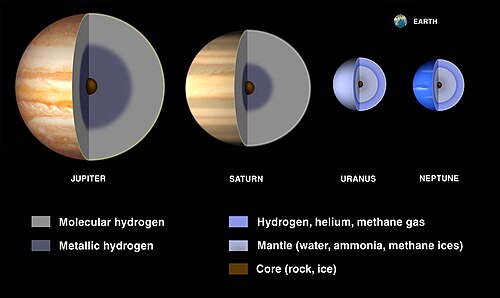
The planets of the Solar System are divided into two groups: the four inner planets are the terrestrial planets (Mercury, Venus, Earth and Mars), with relatively small sizes and rocky surfaces. The four outer planets are the giant planets, which are dominated by hydrogen and helium and have lower mean densities. These can be further subdivided into the gas giants (Jupiter and Saturn) and the ice giants (Uranus and Neptune) that have large icy cores.[25]:26–27,283–284
ข้อมูลโดยตรงส่วนใหญ่เกี่ยวกับองค์ประกอบของดาวเคราะห์ยักษ์มาจากสเปกโทรสโกปีตั้งแต่ทศวรรษ 1930 เป็นที่ทราบกันว่าดาวพฤหัสบดีประกอบด้วยไฮโดรเจนมีเทนและแอมโมเนียมในทศวรรษ 1960 อินเตอร์เฟอโรเมตรีช่วยเพิ่มความละเอียดและความไวของการวิเคราะห์สเปกตรัมอย่างมาก ทำให้สามารถระบุโมเลกุลได้มากขึ้น รวมถึงอีเทนอะเซทิลีนน้ำและคาร์บอนมอนอกไซด์[ 26 ] : 138–139 อย่างไรก็ตาม สเปกโทรสโกปีจากโลกทำได้ยากขึ้นเรื่อยๆ กับดาวเคราะห์ที่อยู่ไกลออกไป เนื่องจากแสงสะท้อน จากดวงอาทิตย์นั้นจางลงมาก และการวิเคราะห์สเปกโทรสโกปีของแสงจากดาวเคราะห์สามารถใช้ตรวจจับการสั่นสะเทือนของโมเลกุลเท่านั้น ซึ่งอยู่ใน ช่วงความถี่ อินฟราเรดสิ่งนี้จำกัดปริมาณของธาตุ H, C และ N [ 26 ] : 130ตรวจพบธาตุอื่นอีกสองชนิด ได้แก่ ฟอสฟอรัสในก๊าซฟอสฟีน (PH ) และเจอร์มาเนียมในเจอร์เมน (GeH ) [ 26 ] : 131
อะตอมของฮีเลียมมีการสั่นสะเทือนใน ช่วง อัลตราไวโอเลตซึ่งถูกดูดซับอย่างมากโดยชั้นบรรยากาศของดาวเคราะห์ชั้นนอกและโลก ดังนั้น แม้จะมีอยู่มากมาย ฮีเลียมจึงถูกตรวจพบเพียงครั้งเดียวเมื่อมีการส่งยานอวกาศไปยังดาวเคราะห์ชั้นนอก และตรวจพบโดยอ้อมผ่านการดูดซับที่เกิดจากการชนในโมเลกุลของไฮโดรเจน[ 26 ] : 209ข้อมูลเพิ่มเติมเกี่ยวกับดาวพฤหัสบดีได้มาจากยานสำรวจกาลิเลโอเมื่อถูกส่งเข้าไปในชั้นบรรยากาศในปี 1995 [ 27 ] [ 28 ]และภารกิจสุดท้ายของยานสำรวจแคสสินีในปี 2017 คือการเข้าไปในชั้นบรรยากาศของดาวเสาร์[ 29 ]ในชั้นบรรยากาศของดาวพฤหัสบดี พบว่าฮีเลียมมีปริมาณลดลง 2 เท่าเมื่อเทียบกับองค์ประกอบของดวงอาทิตย์ และนีออนลดลง 10 เท่า ซึ่งเป็นผลลัพธ์ที่น่าประหลาดใจ เนื่องจากก๊าซเฉื่อยอื่นๆ และธาตุ C, N และ S มีปริมาณเพิ่มขึ้น 2 ถึง 4 เท่า (ออกซิเจนก็ลดลงเช่นกัน แต่เป็นเพราะบริเวณที่แห้งผิดปกติที่กาลิเลโอเก็บตัวอย่าง) [ 28 ]
วิธีการทางสเปกโทรสโกปีสามารถเจาะทะลุชั้นบรรยากาศของดาวพฤหัสบดีและดาวเสาร์ได้ลึกเพียงระดับที่ความดันประมาณ 1 บาร์ ซึ่งใกล้เคียงกับ ความดันบรรยากาศของโลกที่ระดับน้ำทะเล [ 26 ] : 131ยานสำรวจกาลิเลโอสามารถเจาะทะลุได้ถึง 22 บาร์[ 28 ]นี่เป็นเพียงส่วนน้อยของดาวเคราะห์ ซึ่งคาดว่าจะมีความดันสูงกว่า 40 เมกะบาร์ เพื่อจำกัดองค์ประกอบภายใน จึงมีการสร้างแบบจำลองทางเทอร์โมไดนามิกโดยใช้ข้อมูลเกี่ยวกับอุณหภูมิจากสเปกตรัมการปล่อยรังสีอินฟราเรดและสมการสถานะสำหรับองค์ประกอบที่เป็นไปได้[ 26 ] : 131การทดลองความดันสูงทำนายว่าไฮโดรเจนจะเป็นของเหลวโลหะภายในดาวพฤหัสบดีและดาวเสาร์ ในขณะที่ในดาวยูเรนัสและดาวเนปจูนจะยังคงอยู่ในสถานะโมเลกุล[ 26 ] : 135–136การประมาณการยังขึ้นอยู่กับแบบจำลองสำหรับการก่อตัวของดาวเคราะห์ด้วย การควบแน่นของเนบิวลาก่อนดวงอาทิตย์จะส่งผลให้เกิดดาวเคราะห์ก๊าซที่มีองค์ประกอบเหมือนกับดวงอาทิตย์ แต่ดาวเคราะห์อาจก่อตัวขึ้นเมื่อแกนแข็งดักจับก๊าซเนบิวลา[ 26 ] : 136
ในแบบจำลองปัจจุบัน ดาวเคราะห์ยักษ์ทั้งสี่ดวงมีแกนกลางเป็นหินและน้ำแข็งที่มีขนาดใกล้เคียงกัน แต่สัดส่วนของไฮโดรเจนและฮีเลียมจะลดลงจากประมาณ 300 เท่าของมวลโลกในดาวพฤหัสบดี เหลือ 75 เท่าในดาวเสาร์ และเพียงไม่กี่เท่าในดาวยูเรนัสและดาวเนปจูน[ 26 ] : 220ดังนั้น ในขณะที่ดาวเคราะห์ยักษ์ก๊าซส่วนใหญ่ประกอบด้วยไฮโดรเจนและฮีเลียม ดาวเคราะห์ยักษ์น้ำแข็งส่วนใหญ่ประกอบด้วยธาตุหนัก (O, C, N, S) โดยส่วนใหญ่อยู่ในรูปของน้ำ มีเทน และแอมโมเนีย พื้นผิวเย็นพอที่จะทำให้ไฮโดรเจนโมเลกุลเป็นของเหลวได้ ดังนั้นส่วนใหญ่ของดาวเคราะห์แต่ละดวงจึงน่าจะเป็นมหาสมุทรไฮโดรเจนที่ทับซ้อนอยู่บนมหาสมุทรของสารประกอบที่หนักกว่า[ 30 ]นอกแกนกลาง ดาวพฤหัสบดีมีเนื้อโลกเป็นไฮโดรเจนโลหะเหลวและชั้นบรรยากาศเป็นไฮโดรเจนโมเลกุลและฮีเลียม ไฮโดรเจนโลหะไม่ผสมกับฮีเลียมได้ดี และในดาวเสาร์ อาจก่อตัวเป็นชั้นแยกต่างหากอยู่ใต้ไฮโดรเจนโลหะ[ 26 ] : 138
ดาวเคราะห์ภาคพื้นดิน
เชื่อกันว่าดาวเคราะห์ภาคพื้นดินมีต้นกำเนิดมาจากวัสดุเนบิวลาเดียวกันกับดาวเคราะห์ยักษ์ แต่พวกมันสูญเสียธาตุเบาส่วนใหญ่ไปและมีประวัติที่แตกต่างกัน ดาวเคราะห์ที่อยู่ใกล้ดวงอาทิตย์อาจคาดว่าจะมีสัดส่วนของธาตุที่ทนความร้อนสูงกว่า แต่ถ้าขั้นตอนการก่อตัวในภายหลังเกี่ยวข้องกับการชนกันของวัตถุขนาดใหญ่ที่มีวงโคจรที่สำรวจส่วนต่างๆ ของระบบสุริยะ ก็อาจไม่มีความสัมพันธ์ที่เป็นระบบกับตำแหน่งมากนัก[ 31 ] : 3–4
Direct information on Mars, Venus and Mercury largely comes from spacecraft missions. Using gamma-ray spectrometers, the composition of the crust of Mars has been measured by the Mars Odyssey orbiter,[32] the crust of Venus by some of the Venera missions to Venus,[31] and the crust of Mercury by the MESSENGER spacecraft.[33] Additional information on Mars comes from meteorites that have landed on Earth (the Shergottites, Nakhlites, and Chassignites, collectively known as SNC meteorites).[34]:124 Abundances are also constrained by the masses of the planets, while the internal distribution of elements is constrained by their moments of inertia.[4]:334
The planets condensed from the solar nebula, and much of the details of their composition are determined by fractionation as they cooled. The phases that condense fall into five groups. First to condense are materials rich in refractory elements such as Ca and Al. These are followed by nickel and iron, then magnesium silicates. Below about 700 kelvins (700 K), FeS and volatile-rich metals and silicates form a fourth group, and in the fifth group FeO enter the magnesium silicates.[35] The compositions of the planets and the Moon are chondritic, meaning that within each group the ratios between elements are the same as in carbonaceous chondrites.[4]:334
The estimates of planetary compositions depend on the model used. In the equilibrium condensation model, each planet was formed from a feeding zone in which the compositions of solids were determined by the temperature in that zone. Thus, Mercury formed at 1400 K, where iron remained in a pure metallic form and there was little magnesium or silicon in solid form; Venus at 900 K, so all the magnesium and silicon condensed; Earth at 600 K, so it contains FeS and silicates; and Mars at 450 K, so FeO was incorporated into magnesium silicates. The greatest problem with this theory is that volatiles would not condense, so the planets would have no atmospheres and Earth no atmosphere.[4]:335–336
ใน แบบ จำลองการผสมคอนไดรต์ องค์ประกอบของคอนไดรต์ถูกนำมาใช้เพื่อประมาณองค์ประกอบของดาวเคราะห์ ตัวอย่างเช่น แบบจำลองหนึ่งผสมส่วนประกอบสองส่วน ส่วนหนึ่งมีองค์ประกอบของคอนไดรต์ C1 และอีกส่วนหนึ่งมีเพียงส่วนประกอบที่ทนความร้อนของคอนไดรต์ C1 เท่านั้น[ 4 ] : 337ในแบบจำลองอื่น ปริมาณของกลุ่มการแยกส่วนห้ากลุ่มจะถูกประมาณโดยใช้ธาตุดัชนีสำหรับแต่ละกลุ่ม สำหรับกลุ่มที่ทนความร้อนมากที่สุด จะใช้ ยูเรเนียมเหล็กสำหรับกลุ่มที่สอง อัตราส่วนของโพแทสเซียมและแทลเลียมต่อยูเรเนียมสำหรับสองกลุ่มถัดไป และอัตราส่วนโมลาร์ FeO/(FeO+ MgO ) สำหรับกลุ่มสุดท้าย การใช้แบบจำลองความร้อนและแผ่นดินไหวร่วมกับการไหลของความร้อนและความหนาแน่น Fe สามารถจำกัดได้ภายใน 10 เปอร์เซ็นต์บนโลก ดาวศุกร์ และดาวพุธ U สามารถจำกัดได้ภายในประมาณ 30% บนโลก แต่ปริมาณของมันบนดาวเคราะห์ดวงอื่นขึ้นอยู่กับ "การคาดเดาอย่างมีเหตุผล" ความยากลำบากประการหนึ่งของแบบจำลองนี้คือ อาจมีข้อผิดพลาดที่สำคัญในการทำนายความอุดมสมบูรณ์ของสารระเหย เนื่องจากสารระเหยบางชนิดมีการควบแน่นเพียงบางส่วนเท่านั้น[ 35 ] [ 4 ] : 337–338
เปลือกโลก
ส่วนประกอบของหินส่วนใหญ่เกือบทั้งหมดเป็นออกไซด์คลอไรด์ซัลไฟด์และฟลูออไรด์เป็นข้อยกเว้นที่สำคัญเพียงอย่างเดียว และปริมาณรวมของสารเหล่านี้ในหินใดๆ มักจะน้อยกว่า 1% ในปี ค.ศ. 1911 เอฟ.ดับบลิว. คลาร์กได้คำนวณว่าเปลือกโลกประกอบด้วยออกซิเจน มากกว่า 47% ออกซิเจน ส่วนใหญ่อยู่ในรูปของออกไซด์ ซึ่งสารประกอบหลักได้แก่ซิลิกาอลูมินาเหล็กออกไซด์และคาร์บอเนต ชนิดต่างๆ ( แคลเซียมคาร์บอเนตแมกนีเซียมคาร์บอเนตโซเดียมคาร์บอเนต และโพแทสเซียมคาร์บอเนต ) ซิลิกาทำหน้าที่หลักเป็นกรด ก่อตัวเป็นซิลิเกต และแร่ธาตุที่พบได้ทั่วไปในหินอัคนี ทั้งหมด เป็นซิลิเกต จากการคำนวณโดยอิงจากการวิเคราะห์หินหลายชนิดจำนวน 1672 ครั้ง คลาร์กได้สรุปองค์ประกอบเฉลี่ยร้อยละของเปลือกโลกดังนี้: SiO =59.71, Al O =15.41, Fe O =2.63, FeO=3.52, MgO=4.36, CaO=4.90, Na O=3.55, K O=2.80, H O=1.52, TiO =0.60, P O =0.22 (รวม 99.22%) ส่วนประกอบอื่นๆ ทั้งหมดมีอยู่ในปริมาณน้อยมาก โดยปกติแล้วน้อยกว่า 1% [ 36 ]
ออกไซด์เหล่านี้รวมตัวกันอย่างไม่เป็นระเบียบ ตัวอย่างเช่นโพแทส (โพแทสเซียมคาร์บอเนต) และโซดา ( โซเดียมคาร์บอเนต ) รวมตัวกันเพื่อสร้างเฟลด์สปาร์ในบางกรณี อาจเกิดเป็นรูปทรงอื่น เช่นเนเฟลีนลิวไซต์และมัสโคไวต์แต่ในกรณีส่วนใหญ่จะพบใน รูปของ เฟลด์สปาร์ กรดฟอสฟอริกกับปูนขาว (แคลเซียมคาร์บอเนต) จะเกิดเป็นอะพาไทต์ไทเทเนียมไดออกไซด์กับเฟอร์รัสออกไซด์จะเกิดเป็นอิลเมไนต์ส่วนหนึ่งของปูนขาวจะเกิดเป็นปูนเฟลด์สปาร์ แมกนีเซียมคาร์บอเนตและเหล็กออกไซด์กับซิลิกาจะตกผลึกเป็นโอลิวีนหรือเอนสตาไทต์ หรือกับอะลูมินาและปูนขาว จะเกิดเป็นซิลิเกตเฟอร์โรแมกนีเซียมเชิงซ้อน ซึ่งไพรอกซีนแอมฟิโบลและไบโอไทต์เป็นส่วนประกอบหลัก ซิลิกาที่มากเกินไปกว่าที่จำเป็นในการทำให้เบส เป็นกลางจะแยก ตัวออกมาเป็นควอตซ์อลูมินาส่วนเกินจะตกผลึกเป็นคอรันดัมสิ่งเหล่านี้ต้องถือว่าเป็นเพียงแนวโน้มทั่วไปเท่านั้น การวิเคราะห์หินสามารถบอกได้คร่าวๆ ว่าหินนั้นมีแร่ธาตุอะไรบ้าง แต่ก็มีข้อยกเว้นมากมายสำหรับกฎใดๆ ก็ตาม[ 36 ]
องค์ประกอบแร่ธาตุ
ยกเว้นใน หินอัคนีที่ เป็นกรด หรือมีซิลิกามาก ซึ่งมี ซิลิกามากกว่า 66% เรียกว่า หิน เฟลซิกควอตซ์จะไม่พบมากนักในหินอัคนี ในหินพื้นฐาน (มีซิลิกา 20% หรือน้อยกว่า) มักพบซิลิกาในปริมาณน้อย ซึ่งเรียกว่าหินมาฟิก หาก แมกนีเซียมและเหล็ก มี ปริมาณสูงกว่าค่าเฉลี่ยในขณะที่ซิลิกามีปริมาณต่ำ อาจพบ โอลิวีนได้ ในบริเวณที่มีซิลิกามากกว่าแร่เฟอร์โรแมกนีเซียม เช่นออไจต์ฮอร์นเบลนด์เอนสตาไทต์หรือไบโอไทต์ แทนที่จะเป็นโอลิวี นเว้นแต่ว่าโพแทสเซียมจะมีปริมาณสูงและซิลิกามีปริมาณต่ำลิวไซต์จะไม่พบ เนื่องจากลิวไซต์ไม่เกิดขึ้นร่วมกับควอตซ์อิสระ ในทำนองเดียวกัน เนเฟลีนมักพบในหินที่มีโซดามากและซิลิกาน้อย ในบริเวณที่มีด่าง สูง อาจพบไพรอกซีนและแอมฟิโบลที่มีโซดา เป็นองค์ประกอบได้ ยิ่งเปอร์เซ็นต์ของซิลิกาและอัลคาไลต่ำลงเท่าใด ก็ยิ่งพบเฟลด์สปาร์แพลจิโอเคลส มากขึ้นเท่านั้น เมื่อเปรียบเทียบกับเฟลด์สปาร์โซดาหรือโพแทส[ 36 ]
เปลือกโลกประกอบด้วยแร่ซิลิเกต 90% และความอุดมสมบูรณ์ของแร่เหล่านี้ในโลกมีดังนี้: เฟลด์สปาร์แพลจิโอเคลส (39%), เฟลด์สปาร์อัลคาไล (12%), ควอตซ์ (12%), ไพรอกซีน (11%), แอมฟิโบล (5%), ไมกา (5%), แร่ดินเหนียว (5%); แร่ซิลิเกตที่เหลือประกอบเป็นอีก 3% ของเปลือกโลก มีเพียง 8% ของโลกเท่านั้นที่ประกอบด้วยแร่ที่ไม่ใช่ซิลิเกต เช่นคาร์บอเนตออกไซด์และซัลไฟด์[ 37 ]
ปัจจัยกำหนดอีกประการหนึ่ง คือ สภาพทางกายภาพที่เกี่ยวข้องกับการรวมตัวกันนั้น โดยรวมแล้วมีบทบาทน้อยกว่า แต่ก็ไม่สามารถมองข้ามได้เลย แร่ธาตุบางชนิดพบได้เฉพาะในหินอัคนีแทรกซึมที่อยู่ลึก เช่น ไมโครไคลน์ มัสโคไวต์ และไดอัลเลจ ลิวไซต์นั้นหายากมากในมวลหินอัคนีแทรกซึม แร่ธาตุหลายชนิดมีลักษณะเฉพาะในระดับจุลภาคแตกต่างกันไปตามว่าพวกมันตกผลึกในระดับความลึกหรือใกล้ผิวดิน เช่น ไฮเปอร์สทีน ออร์โทเคลส และควอตซ์ มีตัวอย่างที่น่าสนใจบางอย่างของหินที่มีองค์ประกอบทางเคมีเหมือนกัน แต่ประกอบด้วยแร่ธาตุที่แตกต่างกันโดยสิ้นเชิง เช่น ฮอร์นเบลนไดต์แห่งแกรนในนอร์เวย์ ซึ่งประกอบด้วยฮอร์นเบลนด์เพียงอย่างเดียว มีองค์ประกอบเหมือนกับแคมป์โทไนต์ บางชนิด ในบริเวณเดียวกันที่ประกอบด้วยเฟลด์สปาร์และฮอร์นเบลนด์ชนิดอื่น ในส่วนนี้ เราอาจกล่าวซ้ำสิ่งที่ได้กล่าวไว้ข้างต้นเกี่ยวกับการกัดกร่อนของแร่ธาตุแบบพอฟิริติกในหินอัคนี ในไรโอไลต์และแทรไคต์ ผลึกฮอร์นเบลนด์และไบโอไทต์ในระยะแรกอาจพบได้เป็นจำนวนมากซึ่งถูกแปลงเป็นออไจต์และแมกเนไทต์บางส่วน ฮอร์นเบลนด์และไบโอไทต์มีความเสถียรภายใต้ความดันและสภาวะอื่นๆ ใต้พื้นผิว แต่ไม่เสถียรในระดับที่สูงขึ้น ในเนื้อพื้นของหินเหล่านี้ ออไจต์มีอยู่เกือบทุกที่ แต่หินแกรนิตและไซเอไนต์ซึ่งเป็นตัวแทนของหินอัคนีชนิดเดียวกันนั้น มีไบโอไทต์และฮอร์นเบลนด์มากกว่าออไจต์มาก[ 36 ]
หินอัคนีเฟลซิก อินเตอร์มีเดียท และมาฟิก
Those rocks that contain the most silica, and on crystallizing yield free quartz, form a group generally designated the "felsic" rocks. Those again that contain the least silica and most magnesia and iron, so that quartz is absent while olivine is usually abundant, form the "mafic" group. The "intermediate" rocks include those characterized by the general absence of both quartz and olivine. An important subdivision of these contains a very high percentage of alkalis, especially soda, and consequently has minerals such as nepheline and leucite not common in other rocks. It is often separated from the others as the "alkali" or "soda" rocks, and there is a corresponding series of mafic rocks. Lastly, a small sub-group rich in olivine and without feldspar has been called the "ultramafic" rocks. They have very low percentages of silica but much iron and magnesia.
Except these last, practically all rocks contain felspars or feldspathoid minerals. In the acid rocks, the common feldspars are orthoclase, perthite, microcline, and oligoclase—all having much silica and alkalis. In the mafic rocks labradorite, anorthite, and bytownite prevail, being rich in lime and poor in silica, potash, and soda. Augite is the most common ferromagnesian in mafic rocks, but biotite and hornblende are on the whole more frequent in felsic rocks.[36]
| Most Common Minerals | Felsic | Intermediate | Mafic | Ultramafic | |
|---|---|---|---|---|---|
| Quartz Orthoclase (and Oligoclase), Mica, Hornblende, Augite | Little or no Quartz: Orthoclase hornblende, Augite, Biotite | Little or no Quartz: Plagioclase Hornblende, Augite, Biotite | No Quartz Plagioclase Augite, Olivine | No Felspar Augite, Hornblende, Olivine | |
| Plutonic or Abyssal type | Granite | Syenite | Diorite | Gabbro | Peridotite |
| Intrusive or Hypabyssal type | Quartz-porphyry | Orthoclase-porphyry | Porphyrite | Dolerite | Picrite |
| Lavas or Effusive type | Rhyolite, Obsidian | Trachyte | Andesite | Basalt | Komatiite |
Rocks that contain leucite or nepheline, either partly or wholly replacing felspar, are not included in this table. They are essentially of intermediate or of mafic character. We might in consequence regard them as varieties of syenite, diorite, gabbro, etc., in which feldspathoid minerals occur, and indeed there are many transitions between syenites of ordinary type and nepheline — or leucite — syenite, and between gabbro or dolerite and theralite or essexite. But, as many minerals develop in these "alkali" rocks that are uncommon elsewhere, it is convenient in a purely formal classification like that outlined here to treat the whole assemblage as a distinct series.[36]
| Most Common Minerals | Alkali Feldspar, Nepheline or Leucite, Augite, Hornblend, Biotite | Soda Lime Feldspar, Nepheline or Leucite, Augite, Hornblende (Olivine) | Nepheline or Leucite, Augite, Hornblende, Olivine |
|---|---|---|---|
| Plutonic type | Nepheline-syenite, Leucite-syenite, Nepheline-porphyry | Essexite and Theralite | Ijolite and Missourite |
| Effusive type or Lavas | Phonolite, Leucitophyre | Tephrite and Basanite | Nepheline-basalt, Leucite-basalt |
This classification is based essentially on the mineralogical constitution of the igneous rocks. Any chemical distinctions between the different groups, though implied, are relegated to a subordinate position. It is admittedly artificial, but it has grown up with the growth of the science and is still adopted as the basis on which more minute subdivisions are erected. The subdivisions are by no means of equal value. The syenites, for example, and the peridotites, are far less important than the granites, diorites, and gabbros. Moreover, the effusive andesites do not always correspond to the plutonic diorites but partly also to the gabbros. As the different kinds of rock, regarded as aggregates of minerals, pass gradually into one another, transitional types are very common and are often so important as to receive special names. The quartz-syenites and nordmarkites may be interposed between granite and syenite, the tonalites and adamellites between granite and diorite, the monzonites between syenite and diorite, norites and hyperites between diorite and gabbro, and so on.[36]
Trace metals in the ocean
Trace metals readily form complexes with major ions in the ocean, including hydroxide, carbonate, and chloride and their chemical speciation changes depending on whether the environment is oxidized or reduced.[38] Benjamin (2002) defines complexes of metals with more than one type of ligand, other than water, as mixed-ligand-complexes. In some cases, a ligand contains more than one donor atom, forming very strong complexes, also called chelates (the ligand is the chelator). One of the most common chelators is EDTA (ethylenediaminetetraacetic acid), which can replace six molecules of water and form strong bonds with metals that have a plus two charge.[39] With stronger complexation, lower activity of the free metal ion is observed. One consequence of the lower reactivity of complexed metals compared to the same concentration of free metal is that the chelation tends to stabilize metals in the aqueous solution instead of in solids.[39]
ความเข้มข้นของโลหะติดตามแคดเมียมทองแดงโมลิบเดนัมแมงกานีส รีเนียมยูเรเนียมและวานาเดียมในตะกอนบันทึกประวัติรีดอกซ์ของมหาสมุทร[ 40 ]ภายในสภาพแวดล้อมทางน้ำ แคดเมียม(II) สามารถอยู่ในรูป CdCl + ใน น้ำ ที่มีออกซิเจนหรือ CdS(s) ในสภาพแวดล้อมที่ลดลง ดังนั้น ความเข้มข้นของ Cd ที่สูงขึ้นในตะกอนทะเลอาจบ่งชี้ถึงสภาวะศักยภาพรีดอกซ์ต่ำในอดีต สำหรับทองแดง(II) รูปแบบที่พบได้ทั่วไปคือ CuCl + (aq) ภายในสภาพแวดล้อมที่มีออกซิเจน และ CuS(s) และ Cu S ภายในสภาพแวดล้อมที่ลดลง สภาพแวดล้อมน้ำทะเลที่ลดลงนำไปสู่สถานะออกซิเดชันที่เป็นไปได้สองสถานะของทองแดง คือ Cu(I) และ Cu(II) [ 40 ]โมลิบเดนัมมีอยู่ในสถานะออกซิเดชัน Mo(VI) ในรูป MoO 2− ในสภาพแวดล้อมที่มีออกซิเจน Mo(V) และ Mo(IV) มีอยู่ในสภาพแวดล้อมที่ลดลงในรูปแบบ MoO + และ MoS [ 40 ] รีเนียมมีอยู่ในสถานะออกซิเดชัน Re(VII) ในรูป ReO −ภายใต้สภาวะที่มีออกซิเจน แต่จะถูกลดลงเป็น Re(IV) ซึ่งอาจก่อตัวเป็น ReO หรือ ReS ยูเรเนียมอยู่ในสถานะออกซิเดชัน VI ใน UO (CO ) 4− (aq) และพบในรูปแบบที่ลดลง UO (s) [ 40 ]วานาเดียมอยู่ในหลายรูปแบบในสถานะออกซิเดชัน V(V); HVO 2−และ H VO −รูปแบบที่ลดลงของมันสามารถรวมถึง VO + , VO(OH) −และ V(OH) [ 40 ] ความเด่นสัมพัทธ์ของสปีชีส์เหล่านี้ ขึ้นอยู่กับpH
In the water column of the ocean or deep lakes, vertical profiles of dissolved trace metals are characterized as following conservative–type, nutrient–type, or scavenged–type distributions. Across these three distributions, trace metals have different residence times and are used to varying extents by planktonic microorganisms. Trace metals with conservative-type distributions have high concentrations relative to their biological use. One example of a trace metal with a conservative-type distribution is molybdenum. It has a residence time within the oceans of around 8 × 10⁵ years and is generally present as the molybdate anion (MoO2−). Molybdenum interacts weakly with particles and displays an almost uniform vertical profile in the ocean. Relative to the abundance of molybdenum in the ocean, the amount required as a metal cofactor for enzymes in marine phytoplankton is negligible.[41]
Trace metals with nutrient-type distributions are strongly associated with the internal cycles of particulate organic matter, especially the assimilation by plankton. The lowest dissolved concentrations of these metals are at the surface of the ocean, where they are assimilated by plankton. As dissolution and decomposition occur at greater depths, concentrations of these trace metals increase. Residence times of these metals, such as zinc, are several thousand to one hundred thousand years. Finally, an example of a scavenged-type trace metal is aluminium, which has strong interactions with particles as well as a short residence time in the ocean. The residence times of scavenged-type trace metals are around 100 to 1000 years. The concentrations of these metals are highest around bottom sediments, hydrothermal vents, and rivers. For aluminium, atmospheric dust provides the greatest source of external inputs into the ocean.[41]
Iron and copper show hybrid distributions in the ocean. They are influenced by recycling and intense scavenging. Iron is a limiting nutrient in vast areas of the oceans and is found in high abundance along with manganese near hydrothermal vents. Here, many iron precipitates are found, mostly in the forms of iron sulfides and oxidized iron oxyhydroxide compounds. Concentrations of iron near hydrothermal vents can be up to one million times the concentrations found in the open ocean.[41]
Using electrochemical techniques, it is possible to show that bioactive trace metals (zinc, cobalt, cadmium, iron, and copper) are bound by organic ligands in surface seawater. These ligand complexes serve to lower the bioavailability of trace metals within the ocean. For example, copper, which may be toxic to open ocean phytoplankton and bacteria, can form organic complexes. The formation of these complexes reduces the concentrations of bioavailable inorganic complexes of copper that could be toxic to sea life at high concentrations. Unlike copper, zinc toxicity in marine phytoplankton is low and there is no advantage to increasing the organic binding of Zn2+. In high-nutrient, low-chlorophyll regions, iron is the limiting nutrient, with the dominant species being strong organic complexes of Fe(III).[41]
See also
อ่านเพิ่มเติม
- Faure, Gunter ; Mensing, Teresa M. (2005). ไอโซโทป : หลักการและการประยุกต์ใช้ ( ฉบับที่ 3). นิวเจอร์ซีย์: Wiley. ISBN 0471384372.
- Holland, HD; Turekian, KK, บรรณาธิการ (2003). ตำราธรณีเคมี ( ฉบับพิมพ์ครั้งที่ 1). อ็อกซ์ฟอร์ด: Elsevier Science. ISBN 978-0-08-043751-4.
- Marshall, CP; Fairbridge, RW, บรรณาธิการ (2006). ธรณีเคมี . เบอร์ลิน: SpringerLink. ISBN 1-4020-4496-8.
- สภาวิจัยสิ่งแวดล้อมธรรมชาติ. "แบบจำลองข้อมูลธรณีเคมี" . EarthDataModels.org . เก็บถาวรจากต้นฉบับเมื่อวันที่ 23 ธันวาคม 2014 . เรียกดูเมื่อวันที่ 9 ตุลาคม 2017 .
- โรลลินสัน, ฮิวจ์ อาร์. (1996). การใช้ข้อมูลทางธรณีเคมี : การประเมิน การนำเสนอ การตีความ (ฉบับพิมพ์ซ้ำ ). ฮาร์โลว์: ลองแมน. ISBN 978-0-582-06701-1.
- ไวท์, วิลเลียม เอ็ม. ธรณีเคมี (ไม่ตีพิมพ์)หน้า 1. เก็บถาวรจากต้นฉบับเมื่อวันที่ 16 มิถุนายน 2014 สืบค้นเมื่อวันที่ 14 มีนาคม 2012
ลิงก์ภายนอก
- ธรณีเคมีของหินอัคนี (Gunn Interactive Ltd.)