
Hmong–Mien languages
| Hmong–Mien | |
|---|---|
| Miao–YaoYangtzean | |
| Geographicdistribution | China, Southeast Asia |
| Linguistic classification | One of the world's primary language families |
| Proto-language | Proto-Hmong–Mien |
| Subdivisions | |
| Language codes | |
| ISO 639-5 | hmx |
| Glottolog | hmon1336 |
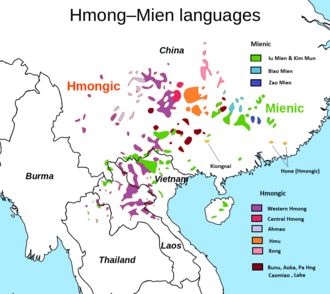 Distribution of Hmong-Mien languages | |
The Hmong–Mien languages (also known as Miao–Yao and rarely as Yangtzean)[1] are a highly tonallanguage family of southern China and northern Southeast Asia. They are spoken in mountainous areas of southern China, including Guizhou, Hunan, Yunnan, Sichuan, Guangxi, Guangdong and Hubei provinces. The speakers of these languages are predominantly "hill people", in contrast to the neighboring Han Chinese, who have settled the more fertile river valleys. Since their migration about four centuries ago, Hmong–Mien populations have also established communities in northern Vietnam and Laos.
Relationships
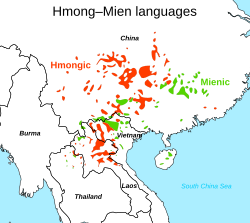
Hmongic (Miao) and Mienic (Yao) are closely related, but clearly distinct. For internal classifications, see Hmongic languages and Mienic languages. The largest differences are due to divergent developments in their phonological systems. The Hmongic languages appear to have kept the large set of initial consonants featured in the protolanguage but greatly reduced the distinctions in the syllable finals, in particular losing all glides and stop codas. The Mienic languages, on the other hand, have largely preserved syllable finals but reduced the number of initial consonants.
Early linguistic classifications placed the Hmong–Mien languages in the Sino-Tibetan family, where they remain in many Chinese classifications. The current consensus among Western linguists is that they constitute a family of their own, the lexical and typological similarities among Hmong–Mien and Sinitic languages being attributed to contact-induced influence.[2]
Paul K. Benedictนักวิชาการชาวอเมริกัน ได้ขยายทฤษฎี Austricให้ครอบคลุมถึงภาษาฮมง-เมี่ยน อย่างไรก็ตาม สมมติฐานนี้ไม่ได้รับการยอมรับมากนักสำหรับภาษาฮมง-เมี่ยน[ 3 ] Kosaka (2002) ได้โต้แย้งโดยเฉพาะเกี่ยวกับตระกูล ภาษาเมี่ยว- ได[ 4 ]
บ้านเกิด
ถิ่นกำเนิดที่เป็นไปได้มากที่สุดของภาษาฮมง-เมี่ยนอยู่ในจีนตอนใต้ระหว่าง แม่น้ำ แยงซีและ แม่น้ำ โขงแต่ผู้พูดภาษาเหล่านี้อาจอพยพมาจากจีนตอนกลางไม่ว่าจะเป็นส่วนหนึ่งของ การขยายตัว ของชาวฮั่นหรือเป็นผลมาจากการถูกเนรเทศจากถิ่นกำเนิดเดิมของชาวฮั่น[ 5 ]การอพยพของผู้คนที่พูดภาษาเหล่านี้จากจีนตอนใต้ไปยังเอเชียตะวันออกเฉียงใต้เกิดขึ้นในช่วงศตวรรษที่ 17 (ค.ศ. 1600-1700) หลักฐาน ดีเอ็นเอ โบราณ ชี้ให้เห็นว่าบรรพบุรุษของผู้พูดภาษาฮมง-เมี่ยนเป็นประชากรที่มีลักษณะทางพันธุกรรมแตกต่างจากประชากรต้นกำเนิดภาษาไท-กะไดและภาษาออสโตรเนเซียนในบริเวณแม่น้ำแยงซี [ 6 ] หลักฐานทางวิวัฒนาการของ Y-DNA ล่าสุดสนับสนุนข้อเสนอที่ว่าผู้คนที่พูดภาษาฮมง-เมี่ยนสืบเชื้อสายมาจากประชากรที่มีความสัมพันธ์ห่างไกลกับผู้ที่พูดภาษามอญ-เขมรในปัจจุบัน[ 7 ]
Sagart, Blench และ Sanchez-Mazas ได้ ประมาณอายุของภาษาโปรโต-ม้ง-เมี่ยนไว้ที่ประมาณ 2500 ปีก่อนคริสตกาล (500 ปีก่อนคริสตกาล) โดยใช้วิธีการแบบดั้งเดิมที่ใช้หลักฐานหลายอย่าง และประมาณ 4243 ปีก่อนคริสตกาล (2250 ปีก่อนคริสตกาล) โดยใช้โปรแกรม Automated Similarity Judgment Program (ASJP) ซึ่งเป็นอัลกอริธึมทดลองสำหรับการสร้างแผนภูมิวิวัฒนาการตามหลักสัทวิทยาโดยอัตโนมัติ[ 8 ]
ชื่อ
ชื่อภาษาจีนกลางของภาษาเหล่านี้คือ MiáoและYáo
ในภาษาเวียดนามชื่อเรียกชาวม้งคือH'Môngและชื่อเรียกชาวเมี่ยนคือDao (หรือ Yao) แม้ว่าคำว่า Miềnก็มีการใช้เช่นกัน
Meo, Hmu, Mong, Hmao, and Hmong are local names for Miao, but since most Laotian refugees in the United States call themselves Hmong/Mong, this name has become better known in English than the others in recent decades. However, except for some scholars who prefer the word, the term 'Hmong/Mong' is only used within certain Hmong/Miao language speaking communities in China, where the majority of the Miao speakers live. In Mandarin, despite the fact that it was once a derogatory term, the word Miao (Chinese: 苗; the tone varies according to the Sinitic dialect) is now commonly used by members of all nationalities to refer to the language and the ethnolinguistic group.[9]
The Mandarin name Yao, on the other hand, is for the Yao nationality, which is a multicultural rather than ethnolinguistic group. It includes peoples speaking Mien, Kra–Dai, Yi, and Miao languages, the latter called Bùnǔ rather than Miáo when spoken by Yao. For this reason, the ethnonymMien may be preferred as less ambiguous.
Characteristics
Like many languages in southern China, the Hmong–Mien languages tend to be monosyllabic and syntactically analytic. They are some of the most highly tonal languages in the world: Longmo and Zongdi Hmong have as many as twelve distinct tones.[10] They are notable phonologically for the occurrence of voicelesssonorants and uvular consonants; otherwise their phonology is quite typical of the region.
They are SVO in word order but are not as rigidly right-branching as the Tai–Kadai languages or most Mon–Khmer languages, since they have genitives and numerals before the noun like Chinese. They are extremely poor in adpositions: serial verb constructions replace most functions of adpositions in languages like English. For example, a construction translating as "be near" would be used where in English prepositions like "in" or "at" would be used.[11]
Besides their tonality and lack of adpositions, another striking feature is the abundance of numeral classifiers and their use where other languages use definite articles or demonstratives to modify nouns.
Mixed languages
กลุ่มชาติพันธุ์ เมี่ยวและเหยาพูดภาษาจีนที่ไม่ได้รับการจัดประเภทหลายภาษา ภาษาเหล่านี้ได้รับการเสนอแนะต่างๆ ว่ามีพื้นฐานมา จาก ภาษา ฮมง-เมี่ยน หรือเป็นภาษาผสมรวมถึงภาษาต่างๆ เช่น ภาษาจีน เช่ อ ภาษาลาบา ภาษา หลิงหลิงภาษา เหมา เจีย ภาษา บาดงเหยาภาษาเหยาที่ราบลุ่มต่างๆ รวมถึงภาษาเย่เหนีภาษา เส้า โจวทูฮวาและภาษาถิ่น ต่างๆ ของผิงฮวา
ดูเพิ่มเติม
- ภาษาโปรโต-ม้ง-เมี่ยน
- รายการคำศัพท์เปรียบเทียบภาษาฮมง-เมี่ยน (วิกิพจนานุกรม)
- อักษรม้ง
อ่านเพิ่มเติม
- เฉินซีกวง [陈其光] (2013) ภาษาแม้วและเหยา [苗瑶语文]. ปักกิ่ง: สำนักพิมพ์ชาติพันธุ์ [民族出版社]. ไอเอสบีเอ็น 9787566003263(ชุดข้อมูล CLDF บน Zenodo doi : 10.5281/zenodo.3537712 )
- Paul K. Benedict (1942). "ไทย, กะได และอินโดนีเซีย: การจัดเรียงใหม่ในเอเชียตะวันออกเฉียงใต้" American Anthropologist 44.576-601.
- พอล เค. เบเนดิกต์ (1975). ภาษาและวัฒนธรรมออสโตร-ไทย พร้อมอภิธานศัพท์รากศัพท์ . นิวเฮเวน: สำนักพิมพ์ HRAF. ISBN 0-87536-323-7.
- เอนวอลล์, เจ. (1995). ระบบการเขียนของชาวม้งในเวียดนาม: กรณีศึกษาเกี่ยวกับนโยบายภาษาชนกลุ่มน้อยของเวียดนามสตอกโฮล์ม สวีเดน: ศูนย์ศึกษาเอเชียแปซิฟิก
- เอ็นวอลล์, เจ. (1994). ตำนานกลายเป็นความจริง: ประวัติศาสตร์และการพัฒนาของภาษาเขียนเมี่ยว . เอกสารวิชาการเอเชียตะวันออกแห่งสตอกโฮล์ม เล่มที่ 5-6. [สตอกโฮล์ม?]: สถาบันภาษาตะวันออก มหาวิทยาลัยสตอกโฮล์ม. ISBN 91-7153-269-2
- Lombard, SJ และ Purnell, HC (1968). พจนานุกรม Yao-English .
- ไลแมน, ทีเอ (1979). ไวยากรณ์ของภาษามงจัว (เมี่ยวเขียว): การศึกษาทางภาษาศาสตร์เชิงพรรณนา [แปลโดยผู้เขียน]
- ลายแมน, TA (1974) พจนานุกรมมอง Njua: ภาษาแม้ว (แม้ว) ของเอเชียตะวันออกเฉียงใต้ Janua linguarum, 123. กรุงเฮก: Mouton.
- ไลแมน, ทีเอ (1970). พจนานุกรมพกพาอังกฤษ/มีโอ . กรุงเทพฯ ประเทศไทย: สถาบันวัฒนธรรมเยอรมัน สถาบันเกอเธ่.
- Purnell, HC (1965). สัทวิทยาของภาษาถิ่นเยียวที่พูดในจังหวัดเชียงรายประเทศไทย . Hartford studies in linguistics, no. 15.
- แรทลิฟฟ์, มาร์ธา (2010). ประวัติศาสตร์ภาษาฮมง-เมี่ยน . แคนเบอร์รา, ออสเตรเลีย: Pacific Linguistics. hdl : 1885/146760 . ISBN 978-0-85883-615-0.
- Smalley, WA , Vang, CK, & Yang, GY (1990). Mother of writing: the origin and development of a Hmong messianic script . Chicago: University of Chicago Press. ISBN 0-226-76286-6
- Smith, P. (1995). พจนานุกรมภาษาเมี่ยน-อังกฤษที่ใช้ในชีวิตประจำวัน = Mienh in-wuonh dimv nzangc sou . วิซาเลีย, แคลิฟอร์เนีย: [sn].
ลิงก์ภายนอก
- รายการคำศัพท์พื้นฐานของภาษาฮมง-เมี่ยน