
Poor relief in England

In English and British history, poor relief refers to government and ecclesiastical action to relieve poverty, particularly before the Liberal welfare reforms beginning in 1906. Beginning in 1551, the Parliaments of England and of Great Britain and the United Kingdom made legal provision for government and ecclesiastical funds to be used to alleviate extreme poverty. The Poor Relief Act 1601 established the system that would operate without major changes until the Poor Law Amendment Act 1834, which reorganized the system, aiming to curb abuses and cut overall spending on relief.
Beginning in the late 19th century, changing attitudes to poverty and the widening of the franchise to include at first some and then all working-class people through a series of Representation of the People Acts led to the development of the first predecessors of the modern welfare state. Between 1906 and 1914, the Liberal Party created a suite of basic welfare programs that reduced dependence on the Poor Law system but did not abolish it. The vestiges of the system remained until 1948 with the passage of the Attlee ministry’sNational Assistance Act, which transferred non-National Insurance poor relief efforts to the new National Assistance programme. Today, welfare benefits such as Universal Credit provide financial resources for those with little or no income.
Tudor era

ในช่วงปลายศตวรรษที่ 15 รัฐสภาได้ดำเนินการแก้ไขปัญหาความยากจนที่เพิ่มขึ้น โดยมุ่งเน้นไปที่การลงโทษผู้ที่เป็น " คนเร่ร่อน " และขอทานในปี ค.ศ. 1495 ในรัชสมัยของพระเจ้าเฮนรีที่ 7รัฐสภาได้ออกกฎหมาย ว่า ด้วยคนเร่ร่อนและขอทาน ค.ศ. 1494ซึ่งบัญญัติให้เจ้าหน้าที่ตำรวจจับกุมและควบคุมตัว "คนเร่ร่อน คนเกียจคร้าน และบุคคลต้องสงสัยที่ใช้ชีวิตอย่างน่าสงสัยทั้งหมด และนำไปใส่เครื่องพันธนาการไว้เป็นเวลาสามคืน โดยให้กินเพียงขนมปังและน้ำเท่านั้น และหลังจากสามวันสามคืนแล้ว ให้นำตัวออกมาปล่อยตัว และสั่งให้หลีกเลี่ยงเมือง" [ 1 ]ดังที่นักประวัติศาสตร์ Mark Rathbone ได้กล่าวถึงในบทความของเขาเรื่อง "Vagabond!" [ 1 ]พระราชบัญญัตินี้อาศัยคำจำกัดความของคนเร่ร่อนที่ค่อนข้างหลวมๆ และไม่ได้แยกแยะระหว่างผู้ที่ว่างงานและกำลังหางานทำกับผู้ที่เลือกที่จะใช้ชีวิตเป็นคนเร่ร่อน นอกจากนี้ พระราชบัญญัตินี้ยังไม่รับรองคนยากจนที่ไร้ความสามารถ ผู้ที่ไม่สามารถเลี้ยงดูตัวเองได้ ซึ่งรวมถึงคนป่วย คนชรา และคนพิการ การขาดคำจำกัดความที่ชัดเจนของคนเร่ร่อนนี้จะเป็นอุปสรรคต่อประสิทธิภาพของพระราชบัญญัติคนเร่ร่อนและขอทาน ค.ศ. 1494ในอีกหลายปีข้างหน้า
การยุบอาราม

ปัญหาความยากจนในอังกฤษทวีความรุนแรงขึ้นในช่วงต้นศตวรรษที่ 16 เนื่องจากการเพิ่มขึ้นอย่างมากของประชากร ซึ่งเพิ่มขึ้น "จากมากกว่า 2 ล้านคนในปี 1485 ... [เป็น] ประมาณ 2.8 ล้านคนเมื่อสิ้นสุด รัชสมัยของ พระเจ้าเฮนรีที่ 7 (1509)" ประชากรเติบโตเร็วกว่าความสามารถของเศรษฐกิจในการจัดหาโอกาสในการจ้างงาน[ 1 ]ปัญหานี้รุนแรงขึ้นเพราะในช่วงการปฏิรูปศาสนาในอังกฤษพระเจ้าเฮนรีที่ 8ได้แยกการปกครองทางศาสนาของราชอาณาจักรอังกฤษและไอร์แลนด์ และตั้งพระองค์เองเป็นประมุขสูงสุดของคริสตจักรแห่งอังกฤษซึ่งเกี่ยวข้องกับการยุบอารามในอังกฤษและเวลส์ ทรัพย์สินของสถาบันทางศาสนาที่ร่ำรวยหลายร้อยแห่ง รวมถึงที่ดินขนาดใหญ่ ถูกยึดโดยราชสำนัก สิ่งนี้ส่งผลกระทบอย่างร้ายแรงต่อการบรรเทาความยากจน ตามที่พอล สแล็ค นักประวัติศาสตร์ กล่าวไว้ ก่อนการยุบอาราม “มีการประมาณการว่าอารามต่างๆ เพียงอย่างเดียวได้บริจาคทานเป็นเงิน 6,500 ปอนด์ต่อปีก่อนปี 1537 [ เทียบเท่ากับ 4,600,000 ปอนด์ในปี 2025 [ 2 ] ]; และเงินจำนวนนั้นไม่ได้รับการชดเชยด้วยการบริจาคส่วนตัวจนกระทั่งหลังปี 1580” [ 3 ]นอกจากการปิดอารามแล้ว โรงพยาบาลส่วนใหญ่ (ซึ่งในศตวรรษที่ 16 โดยทั่วไปแล้วเป็นบ้านพักคนชรามากกว่าสถาบันทางการแพทย์) ก็ถูกปิดเช่นกัน เนื่องจาก “ถูกมองว่าเป็นบ้านทางศาสนาประเภทพิเศษ” [ 4 ]ทำให้ผู้สูงอายุและผู้ป่วยจำนวนมากไม่มีที่พักหรือการดูแล
พระราชบัญญัติคนเร่ร่อน

ในปี ค.ศ. 1531 พระราชบัญญัติคนเร่ร่อนและขอทาน ค.ศ. 1494 ได้รับการแก้ไข และรัฐสภาได้ผ่านพระราชบัญญัติฉบับใหม่ คือพระราชบัญญัติคนเร่ร่อน ค.ศ. 1530ซึ่งได้กำหนดบทบัญญัติบางประการสำหรับคนยากจนในแต่ละชนชั้น ผู้ป่วย ผู้สูงอายุ และคนพิการจะได้รับใบอนุญาตให้ขอทานได้ แต่ผู้ที่ตกงานและกำลังหางานทำก็ยังคงไม่ได้รับการยกเว้นโทษ ตลอดศตวรรษที่ 16 ความกลัวต่อความไม่สงบทางสังคมเป็นแรงจูงใจหลักในการออกกฎหมายจำนวนมากโดยรัฐสภา ความกลัวต่อความไม่สงบทางสังคมนี้ยังคงดำเนินต่อไปในรัชสมัยของพระเจ้าเอ็ดเวิร์ดที่ 6มีการนำบทลงโทษระดับใหม่มาใช้ในพระราชบัญญัติคนเร่ร่อน ค.ศ. 1547 ของดยุคแห่งซัมเมอร์เซ็ต[ 5 ] " การเป็นทาสสองปีและการตีตราด้วย 'V' เป็นโทษสำหรับการกระทำผิดครั้งแรก และการพยายามหลบหนีจะถูกลงโทษด้วยการเป็นทาสตลอดชีวิต และหากกระทำผิดเป็นครั้งที่สองจะถูกประหารชีวิต" [ 1 ]อย่างไรก็ตาม “ไม่มีหลักฐานว่ามีการบังคับใช้พระราชบัญญัตินี้” [ 1 ]ในปี ค.ศ. 1550 บทลงโทษเหล่านี้ได้รับการแก้ไขในพระราชบัญญัติฉบับใหม่ที่ผ่านการอนุมัติพระราชบัญญัติคนเร่ร่อน ค.ศ. 1549อ้างถึงการบังคับใช้บทลงโทษที่กำหนดไว้ในพระราชบัญญัติคนเร่ร่อน ค.ศ. 1547 อย่างจำกัด โดยระบุว่า “ความสุดโต่งของบาง [กฎหมาย] เป็นเหตุให้ไม่ได้มีการบังคับใช้” [ 1 ]
รัฐสภาและเขตปกครอง
หลังจากการแก้ไขพระราชบัญญัติคนเร่ร่อน ค.ศ. 1547รัฐสภาได้ผ่านพระราชบัญญัติคนยากจน ค.ศ. 1551ซึ่งมุ่งเน้นการใช้เขตปกครองเป็นแหล่งเงินทุนเพื่อต่อสู้กับปัญหาความยากจนที่เพิ่มมากขึ้น พระราชบัญญัตินี้ได้แต่งตั้ง "ผู้ดูแล" สองคนจากแต่ละเขตปกครองเพื่อรวบรวมเงินที่จะแจกจ่ายให้กับคนยากจนที่ถือว่าเป็นสมาชิกของเขตปกครองนั้น ผู้ดูแลเหล่านี้จะต้อง "ขอร้องอย่างสุภาพ" ให้บริจาคเพื่อบรรเทาความยากจน หากปฏิเสธก็จะนำไปสู่การพบกับบิชอปประจำท้องถิ่นซึ่งจะ "ชักจูงและโน้มน้าว" ผู้ที่ไม่ยอมบริจาค[ 1 ]อย่างไรก็ตาม บางครั้งแม้แต่การพบกับบิชอปก็มักจะไม่ประสบความสำเร็จตามวัตถุประสงค์
เมื่อเห็นว่าการบริจาคโดยสมัครใจไม่มีประสิทธิภาพ รัฐสภาจึงผ่านกฎหมายใหม่ คือพระราชบัญญัติคนยากจน ค.ศ. 1562ในปี ค.ศ. 1563 และเมื่อพระราชบัญญัตินี้มีผลบังคับใช้ ชาวบ้านสามารถถูกนำตัวโดยบิชอปไปต่อหน้าผู้พิพากษาได้และการปฏิเสธอย่างต่อเนื่องอาจนำไปสู่การจำคุกจนกว่าจะมีการบริจาค[ 1 ]อย่างไรก็ตาม แม้แต่พระราชบัญญัติคนยากจน ค.ศ. 1562 ก็ยังคงมีข้อบกพร่องอยู่ เพราะบุคคลสามารถตัดสินใจเองได้ว่าจะบริจาคเงินเท่าใดเพื่อแลกกับอิสรภาพของตน
A more structured system of donations was established by the Vagabonds Act 1572. After determining the amount of funds needed to provide for the poor of each parish, justices of the peace were granted the authority to determine the amount of the donation from each parish's more wealthy property-owners. This act finally turned these donations into what was effectively a local tax.[6]
In addition to creating these new imposed taxes, the Vagabonds Act 1572 created a new set of punishments to inflict upon the population of vagabonds. These included being "bored through the ear" for a first offense and hanging for "persistent beggars".[1] Unlike the previous brutal punishments established by the Vagabonds Act 1547, these extreme measures were enforced with great frequency.
However, despite its introduction of such violent actions to deter vagabonding, the Vagabonds Act 1572 was the first time that Parliament had passed legislation which began to distinguish between different categories of vagabonds. "Peddlers, tinkers, workmen on strike, fortune tellers, and minstrels" were not spared these gruesome acts of deterrence. This law punished all able bodied men "without land or master" who would neither accept employment nor explain the source of their livelihood.[1] In this newly established definition of what constituted a vagabond, men who had been discharged from the military, released servants, and servants whose masters had died were specifically exempted from the act's punishments. This legislation did not establish any means to support these individuals.
A new approach
A system to support individuals who were willing to work, but who were having difficulty in finding employment, was established by the Poor Act 1575. As provided for in this, justices of the peace were authorized to provide any town which needed it with a stock of flax, hemp, or other materials on which paupers could be employed and to erect a "house of correction" in every county for the punishment of those who refused work.[6] This was the first time Parliament had attempted to provide labour to individuals as a means to combat the increasing numbers of "vagabonds".
Two years after the Poor Act 1575 was passed into law, yet more dramatic changes were made to the methods to fight vagabondage and to provide relief to the poor. The Act of 1578 transferred power from the justices of the peace to church officials in the area of collecting the new taxes for the relief of poverty established in the Vagabonds Act 1572. In addition, this Act of 1578 also extended the power of the church by stating that "vagrants were to be summarily whipped and returned to their place of settlement by parish constables."[1] By eliminating the need for the involvement of the Justices, law enforcement was streamlined.
End of the Elizabethan Era to 1750

Starting as early as 1590, public authorities began to take a more selective approach to supporting the poor. Those who were considered to be legitimately needy, sometimes called the "deserving poor" or "worthy poor", were allowed assistance, while those who were idle were not. People incapable of providing for themselves, such as young orphans, the elderly, and the mentally and physically handicapped, were seen to be deserving, whereas those who were physically able but were too lazy to work were considered as "idle" and were seen as of bad moral character, and thus undeserving of help.[7] Most poor relief in the 17th century came from voluntary charity which mostly was in the form of food and clothing. Parishes distributed land and animals. Institutionalized charities offered loans to help craftsmen to alms houses and hospitals.[8]
The Poor Relief Act 1597 provided the first complete code of poor relief, established overseers of the poor and was later amended by the Poor Relief Act 1601, which was one of the longest-lasting achievements of her reign, left unaltered until 1834. This law made each parish responsible for supporting the legitimately needy in their community.[6] It taxed wealthier citizens of the country to provide basic shelter, food and clothing, though they were not obligated to provide for those outside of their community.
Parishes responsible for their own community caused problems because some were more generous than others. This caused the poor to migrate to other parishes that were not their own. In order to counteract this problem, the Poor Relief Act 1662, also known as the Settlement Act, was implemented. This created many sojourners, people who resided in different settlements that were not their legal one.[8] The Settlement Act allowed such people to be forcefully removed, and garnered a negative reaction from the population. In order to fix the flaws of the 1662 act, the Poor Relief Act 1691 came into effect such that it presented methods by which people could gain settlement in new locations. Such methods included "owning or renting property above a certain value or paying parish rates, but also by completing a legal apprenticeship or a one-year service while unmarried, or by serving a public office" for that identical length of time.[8]
During the 16th and 17th centuries, the population of England nearly doubled.[7]Capitalism in the agricultural and manufacturing arenas started to emerge, and trade abroad significantly increased. Despite this flourishing of expansion, sufficient employment rates had yet to be attained by the late 1600s. The population increased at alarming rates, outpacing the increase in productivity, which resulted inevitably in inflation.[6] Concurrently, wages decreased, declining to a point roughly half that of average wages of a century before.
"The boom-and-bust nature of European trade in woolen cloth, England's major manufacture and export" caused a larger fraction of the population of England to fall under poverty. With this increase in poverty, all charities operated by the Catholic Church were abolished due to the impact of protestant reformation.[6]
Workhouse Test Act
A law passed by the Parliament of Great Britain and sponsored by Sir Edward Knatchbull in 1723 required people to join workhouses to be eligible to receive aid, known as a "workhouse test". The act was intended to reduce the number of frivolous claims on poor rates.[9]
The Industrial Revolution
Child labour

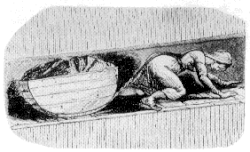

By the mid to late 18th century most of the British Isles was involved in the process of industrialization in terms of production of goods, manner of markets and concepts of economic class. In some cases, factory owners "employed" children without paying them, thus exacerbating poverty levels.[10] Furthermore, the Poor Laws of this era encouraged children to work through an apprenticeship, but by the end of the 18th century the situation changed as masters became less willing to apprentice children, and factory owners then set about employing them to keep wages down.[10] This meant that there were not many jobs for adult labourers.[10] For those who could not find work there was the workhouse as a means of sustenance.
Gilbert's Act
The 1782 poor relief law proposed by Thomas Gilbert aimed to organise poor relief on a county basis, counties being organised into parishes which could set up workhouses between them. However, these workhouses were intended to help only the elderly, sick and orphaned, not the able-bodied poor. The sick, elderly and infirm were cared for in poorhouses whereas the able-bodied poor were provided with poor relief in their own homes.
Speenhamland system
The Speenhamland system was a form of outdoor relief intended to mitigate rural poverty at the end of the 18th century and during the early 19th century. The system was named after a 1795 meeting at the Pelican Inn in Speenhamland, Berkshire, where a number of local magistrates devised the system as a means to alleviate the distress caused by high grain prices. The increase in the price of grain most probably occurred as a result of a poor harvest in the years 1795–96, though at the time this was subject to great debate. Many blamed middlemen and hoarders as the ultimate architects of the shortage.
The authorities at Speenhamland approved a means-tested sliding scale of wage supplements in order to mitigate the worst effects of rural poverty. Families were paid extra to top up wages to a set level according to a table. This level varied according to the number of children and the price of bread.
ในปี พ.ศ. 2477 รายงานของคณะกรรมการราชวงศ์เกี่ยวกับการดำเนินงานของกฎหมายคนยากจน พ.ศ. 2475เรียก Speenhamland System ว่าเป็น "ระบบคนยากจนทั่วไป" ระบบนี้อนุญาตให้นายจ้าง รวมถึงเกษตรกรและนักอุตสาหกรรมเกิดใหม่ในเมือง จ่ายค่าจ้างต่ำกว่าค่าครองชีพ เนื่องจากทางตำบลจะชดเชยส่วนต่างและช่วยให้คนงานมีชีวิตอยู่ได้ ดังนั้นรายได้ต่ำของคนงานจึงไม่เปลี่ยนแปลง และผู้จ่ายเงินสมทบภาษีคนยากจนก็ช่วยอุดหนุนเกษตรกร[ 11 ]
กฎหมายคนยากจนฉบับใหม่ ค.ศ. 1834
การบรรเทาทุกข์ในร่มเทียบกับการบรรเทาทุกข์กลางแจ้ง
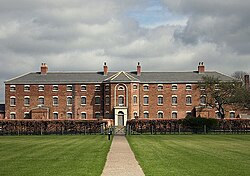

หลังจากการเริ่มต้นของการปฏิวัติอุตสาหกรรมในปี 1834 รัฐสภาแห่งสหราชอาณาจักรได้แก้ไขพระราชบัญญัติบรรเทาความยากจน ค.ศ. 1601หลังจากศึกษาเงื่อนไขที่พบในปี 1832 ในช่วงทศวรรษต่อมา พวกเขาเริ่มทยอยยกเลิกการช่วยเหลือภายนอกและผลักดันให้คนยากจนเข้ารับการช่วยเหลือภายในความแตกต่างระหว่างสองอย่างนี้ก็คือ การช่วยเหลือภายนอกเป็นการให้เงินช่วยเหลือแก่ผู้ยากไร้ ในขณะที่การช่วยเหลือภายในหมายถึงการส่งบุคคลนั้นไปยังสถานสงเคราะห์คนยากจนแห่งใดแห่งหนึ่ง
ความอดอยากครั้งใหญ่ (ไอร์แลนด์)

หลังจากการปฏิรูปกฎหมายคนยากจนในปี 1834 ไอร์แลนด์ประสบกับโรคระบาดในมันฝรั่งอย่างรุนแรงซึ่งกินเวลาระหว่างปี 1845 ถึง 1849 และคร่าชีวิตผู้คนไปประมาณ 1.5 ล้านคน ผลกระทบจากภาวะอดอยากกินเนื้อยังคงดำเนินต่อไปจนถึงปี 1851 ในช่วงเวลานี้ ประชาชนชาวไอร์แลนด์สูญเสียที่ดินและงานจำนวนมาก และได้ร้องขอความช่วยเหลือจากรัฐสภาเวสต์มินสเตอร์ความช่วยเหลือนี้โดยทั่วไปมาในรูปแบบของการจัดตั้งโรงงานทำงานเพิ่มเติมเพื่อบรรเทาทุกข์ภายในอาคาร[ 12 ]บางคนโต้แย้งว่าในขณะที่สหราชอาณาจักรบริเตนใหญ่และไอร์แลนด์อยู่ในช่วงรุ่งเรืองในฐานะจักรวรรดิก็สามารถให้ความช่วยเหลือเพิ่มเติมในรูปแบบของเงิน อาหาร หรือเงินอุดหนุนค่าเช่าได้
ในส่วนอื่นๆ ของสหราชอาณาจักร การแก้ไขและการนำกฎหมายเกี่ยวกับคนยากจนมาใช้เกิดขึ้นในช่วงเวลาเดียวกัน ตัวอย่างเช่น ในสกอตแลนด์พระราชบัญญัติกฎหมายคนยากจน (สกอตแลนด์) ปี 1845ได้แก้ไขกฎหมายคนยากจนที่บังคับใช้ภายใต้พระราชบัญญัติปี 1601