
ปริศนาตรรกะ
| ส่วนหนึ่งของชุดบทความเกี่ยวกับ |
| ปริศนา |
|---|
 |
ปริศนาตรรกะคือปริศนา ที่ มาจากสาขาคณิตศาสตร์ ด้าน การอนุมาน
ประวัติศาสตร์
ปริศนาตรรกะนี้ถูกสร้างขึ้นครั้งแรกโดยCharles Lutwidge Dodgsonซึ่งเป็นที่รู้จักกันดีในนามปากกา Lewis Carroll ผู้เขียนAlice's Adventures in WonderlandในหนังสือThe Game of Logicของ เขา เขาได้แนะนำเกมเพื่อแก้ปัญหาต่างๆ เช่น การยืนยันข้อสรุปที่ว่า "สุนัขเกรย์ฮาวด์บางตัวไม่อ้วน" จากข้อความ "ไม่มีสิ่งมีชีวิตที่อ้วนวิ่งได้ดี" และ "สุนัขเกรย์ฮาวด์บางตัววิ่งได้ดี" [ 1 ]ปริศนาแบบนี้ ซึ่งเราได้รับรายการของข้อตั้งต้นและถูกถามว่าสามารถอนุมานอะไรได้จากข้อตั้งต้นเหล่านั้น เรียกว่าตรรกะแบบอนุมาน (syllogism ) Dodgson ได้สร้างปริศนาที่ซับซ้อนมากขึ้นซึ่งประกอบด้วยข้อตั้งต้นมากถึงแปดข้อ
ในช่วงครึ่งหลังของศตวรรษที่ 20 นักคณิตศาสตร์เรย์มอนด์ เอ็ม. สมัลลียันได้สานต่อและขยายขอบเขตของปริศนาตรรกะด้วยหนังสือต่างๆ เช่นThe Lady or the Tiger?, To Mock a MockingbirdและAlice in Puzzle-Landเขาทำให้ปริศนา " อัศวินและคนโกง " เป็นที่นิยม ซึ่งประกอบด้วยอัศวินผู้พูดความจริงเสมอ และคนโกงผู้โกหกเสมอ
นอกจากนี้ยังมีปริศนาตรรกะที่ไม่เกี่ยวข้องกับคำพูดโดยสิ้นเชิง รูปแบบที่เป็นที่นิยมบางอย่าง ได้แก่ซูโดกุซึ่งเกี่ยวข้องกับการใช้การอนุมานเพื่อวางตัวเลขลงในตารางให้ถูกต้อง โนโนแกรมหรือที่เรียกว่า "ระบายสีตามตัวเลข" ซึ่งเกี่ยวข้องกับการใช้การอนุมานเพื่อเติมตารางด้วยช่องสี่เหลี่ยมสีดำและสีขาวให้ถูกต้องเพื่อสร้างภาพ และเขาวงกตตรรกะซึ่งเกี่ยวข้องกับการใช้การอนุมานเพื่อหาว่ากฎของเขาวงกตคืออะไร[ 2 ]
ปริศนาตารางตรรกะ
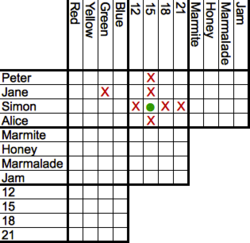
Another form of logic puzzle, popular among puzzle enthusiasts and available in magazines dedicated to the subject, is a format in which the set-up to a scenario is given, as well as the object (for example, determine who brought what dog to a dog show, and what breed each dog was), certain clues are given ("neither Misty nor Rex is the German Shepherd"), and then the reader fills out a matrix with the clues and attempts to deduce the solution. These are often referred to as "logic grid" puzzles. The data set of a logic grid puzzles can be any number of categories, but are limited by the corresponding increase in complexity, with most having only two, three, or even four categories.
While designed more as a table-based puzzle than a matrix, the most famous example of a logic-grid puzzle may be the so-called Zebra Puzzle, which asks the question Who Owned the Zebra?.
Common in logic puzzle magazines are derivatives of the logic grid puzzle called "table puzzles" that are deduced in the same manner as grid puzzles, but lack the grid either because a grid would be too large, or because some other visual aid is provided. For example, a map of a town might be present in lieu of a grid in a puzzle about the location of different shops.
See also
- Category:Logic puzzles, a list of different logic puzzles
- List of puzzle video games
- Logic programming
- Mechanical puzzle
- Recreational mathematics
- Muddy Children Puzzle
- Survo puzzle
- Murdle
Sources
- Carroll, Lewis (1886). The Game of Logic. London: Macmillan.