
Muhammad of Ghazni
| Muhammad bin Mahmud | |||||
|---|---|---|---|---|---|
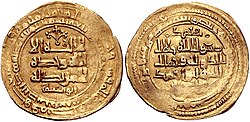 Gold dinar minted in Ghazna dated 419 AH (1028/9 CE). | |||||
| Sultan of Ghaznavid Empire | |||||
| 1st Reign | 30 April 1030 – 1030 | ||||
| Predecessor | Mahmud | ||||
| Successor | Mas'ud I | ||||
| 2nd Reign | 1040 – 19 March 1041[1] | ||||
| Predecessor | Mas'ud I | ||||
| Successor | Mawdud | ||||
| Born | c.998Ghazni, Ghaznavid Empire | ||||
| Died | 19 March 1041 (aged 42–43)Ghazni Ghaznavid Empire | ||||
| Burial | c.1041 Ghazni | ||||
| Consort | Daughter of Abu'l-Nasr Muhammad | ||||
| Issue | 'Abd al-RahmanAhmad | ||||
| |||||
| House | Ghaznavid Dynasty | ||||
| Father | Mahmud of Ghazni | ||||
| Religion | Sunni Islam | ||||
Muhammad of Ghazni (Persian: محمد غزنوی; b. 998 – d. 1041) was Sultan of the Ghaznavid Empire briefly in 1030, and then later from 1040 to 1041. He ascended the throne upon the death of his father Mahmud in 1030. He was the younger of a set of twins; this circumstance resulted in civil strife.[2] His reign lasted five months before he was overthrown by his twin Ma'sud I, after which he was blinded and imprisoned on the order of Ma'sud I. According to Ferishta, his reign lasted only 50 days. Nine years later he was reinstated for a year before being slain by his nephew Maw'dud after losing a battle in Nangrahar.
Biography
Muhammad was born, along with his elder twin brother Mas'ud, in 998 in the Ghaznavid capital of Ghazni. In ca. 1008, Mohammad married the daughter of the Farighunid ruler Abu'l-Nasr Muhammad. Two years later after the death of Abu'l-Nasr Muhammad, Muhammad was appointed by his father as the governor of Guzgan, thus putting an end to the native Farighunid dynasty of Guzgan.
ในปี ค.ศ. 1030 มะห์มุด เนื่องจากความสัมพันธ์ที่ไม่ดีกับมาซูดผู้สืบทอดตำแหน่ง จึงเปลี่ยนใจและแต่งตั้งมุฮัมมัดเป็นผู้สืบทอดตำแหน่งแทน[ 3 ]ซึ่งมีประสบการณ์ด้านการปกครองและการทหารน้อยกว่ามาซูดมาก มะห์มุดเสียชีวิตในเวลาไม่นาน และมุฮัมมัดได้ขึ้นครองราชย์ต่อ โดยได้แต่งตั้งอบู ซาห์ล ฮัมดูวีเป็นเสนาบดีในช่วงที่มุฮัมมัดขึ้นครองราชย์ อำนาจส่วนใหญ่ของรัฐอยู่ภายใต้เสนาบดีคนก่อนคือฮาซานัก มิคาลีและนายทหารอาลี อิบนุ อิล-อาร์สลานซึ่งบริหารราชการแผ่นดินอย่างดีเยี่ยม มุฮัมมัดได้แต่งตั้งยูซุฟ อิบนุ ซาบุคติกิน ลุงของเขาเป็นผู้บัญชาการทหารสูงสุดในเวลาไม่นาน แม้ว่ามุฮัมมัดจะไม่มีอำนาจที่แท้จริง แต่จักรวรรดิของเขาก็เจริญรุ่งเรือง[ 4 ]อย่างไรก็ตาม ในไม่ช้า กองทหารทาส ( ghulam ) ของมูฮัมหมัดก็ก่อกบฏภายใต้การนำของอบูอัลนัจม์ อายาซ ผู้ซึ่งเปลี่ยนความจงรักภักดีอย่างเปิดเผยไปอยู่กับมาซูด น้องชายของมูฮัมหมัด ผู้ซึ่งการรณรงค์ทางทหารในอิหร่านตะวันตกทำให้เขามีชื่อเสียงอย่างมาก[ 3 ]ไม่นานนัก อายาซก็ได้รับการสนับสนุนจากนายทหารคนอื่นๆ เช่นอาลี ดายามูฮัมหมัดจึงส่งกองทัพภายใต้การนำของแม่ทัพสุเวนธารายไปปราบปรามการกบฏ แต่ในที่สุดพวกกบฏก็ได้รับชัยชนะและสังหารสุเวนธาราย พวกกบฏที่ได้รับชัยชนะจึงไปหามาซูดซึ่งอยู่ที่นิชาปูร์[ 4 ]
ในที่สุด ยูซุฟ อิบนุ ซาบุคติกิน และอาลี อิบนุ อิล-อาร์สลาน พร้อมด้วยกองทัพกาซนาวิดที่เหลือก็เข้าร่วมกับมาสอูด[ 3 ]จากนั้นมาสอูดก็เดินทัพไปยังกาซนี ซึ่งเขาได้เอาชนะมูฮัมหมัดและคุมขังเขาไว้ พร้อมทั้งสวมมงกุฎให้ตัวเองเป็นสุลต่านองค์ใหม่ของจักรวรรดิกาซนาวิด
ตามที่เฟริชตาได้กล่าวไว้ ความขัดแย้งระหว่างมูฮัมหมัดและมาซูดผู้เป็นพี่น้องฝาแฝดของเขาทวีความรุนแรงขึ้นเรื่อยๆ ในช่วงเวลานั้น ในที่สุด มูฮัมหมัดได้เตรียมกองทัพเพื่อโจมตีมาซูด เขาตั้งค่ายกับกองทัพของเขาที่สถานที่ชื่อ "นาคียา-อาบาด/นาคบัต-อาบาด" เป็นเวลาหนึ่งเดือน ซึ่งผู้นำและทหารส่วนใหญ่ของเขาก่อกบฏต่อเขา พวกเขาจับกุมและคุมขังมูฮัมหมัด และต้อนรับมาซูดในฐานะผู้นำคนใหม่ของพวกเขา
ต่อมา เมื่อพวกเซลจุกกำลังรุกรานดินแดนทางตะวันตกของจักรวรรดิกาซนาวิด การก่อกบฏในหมู่ทหารกาซนาวิดทำให้มุฮัมมัดกลับคืนสู่บัลลังก์ และเขาก็สั่งจำคุกมาสอูดน้องชายของเขาแทน เขายกฐานะอะห์มัดบุตรชายของเขาขึ้นเป็นกษัตริย์ และเป็นพันธมิตรกับสุไลมาน อิบนุ ยูซุฟ มอบอำนาจการบริหารราชการแผ่นดินให้แก่เขา มีรายงานว่าพวกเขาอยู่เบื้องหลังการลอบสังหารมาสอูดที่ 1 ขณะที่เขาถูกจำคุก
Muhammad sent a missive to Mas'ud's son, Mawdud, in Tukharistan explaining his father's murder was an act of revenge perpetrated by the sons of Mas'ud's former general in India.[5] Upon learning of his father's murder, Maw'dud marched his army toward Ghazni.[6]
Muhammad fled with his army in the face of Maw'dud's invasion, losing Ghazni in the process.[6] Maw'dud wintered in Ghazni,[6] then met Muhammad's army on 19 March 1041 in the province of Nangarhar.[7] Maw'dud personally led the attack, defeating Muhammad's army; thereafter, Maw'dud had Muhammad and his family executed.[8]
See also
Sources
- Bosworth, C. E. (1975). "The early Ghaznavids". In Frye, R. N. (ed.). The Cambridge History of Iran, Volume 4: From the Arab Invasion to the Saljuqs. Cambridge: Cambridge University Press. pp. 162–198. ISBN 0-521-20093-8.
- Bosworth, C. Edmund (1985). "ʿALĪ B. IL-ARSLAN QARĪB". Encyclopaedia Iranica, Vol. I, Fasc. 8. London et al.: C. Edmund Bosworth. p. 872.
- Bosworth, C. E (1995). The Later Ghaznavids: Splendour and Decay: The Dynasty in Afghanistan and Northern India 1040–1186. Munshiram Manoharlal Publishers Private, Limited. ISBN 9788121505772. Retrieved 9 May 2014.
- Bosworth, C.E. (1996). The New Islamic Dynasties. Columbia University Press.
- Bosworth, C. E. (2011). The Ornament of Histories: A History of the Eastern Islamic Lands AD 650–1041: The Persian Text of Abu Sa'id 'Abd Al-Hayy Gardizi. I.B.Tauris. pp. 1–169. ISBN 978-1-84885-353-9.