
Pentyl group
 | |
| Identifiers | |
|---|---|
| |
3D model (JSmol) |
|
| ChemSpider |
|
PubChemCID |
|
| |
| |
| Properties | |
| −CH | |
| Molar mass | 71.143 g·mol−1 |
Except where otherwise noted, data are given for materials in their standard state (at 25 °C [77 °F], 100 kPa). Infobox references | |

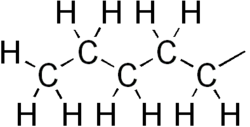
Pentyl is a five-carbonalkyl group or substituent with chemical formula−CH. It is the substituent form of the alkanepentane.
In older literature, the common non-systematic name amyl was often used for the pentyl group. Conversely, the name pentyl was used for several five-carbon branched alkyl groups, distinguished by various prefixes. The nomenclature has now reversed, with "amyl" being more often used to refer to the terminally branched group also called isopentyl, as in amobarbital.
A cyclopentyl group is a ring with the formula −CH.
The name is also used for the pentyl radical, a pentyl group as an isolated molecule. This free radical is only observed in extreme conditions.[1] Its formula is often written "CH•" or "• CH" to indicate that it has one unsatisfied valence bond. Radicals like pentyl are reactive, they react with neighboring atoms or molecules (like oxygen, water, etc.)
Older "pentyl" groups
The following names are still used sometimes:
| Name | Structure | SMILES | IUPAC status | IUPAC recomm. | Examples |
|---|---|---|---|---|---|
| n-pentyl, amyl | HC−(CH)− | CCCCC- | pentyl | [2] | |
| isopentyl, amyl, isoamyl | (HC−)CH−(CH)− | CC(C)CC- | No longer recommended[3] | 3-methylbutyl[3] | [4] |
| เพนทิลแอคทีฟ | ชม C−CH −(H C−)CH−CH − | ซีซีซี(ซี)ซี- | 2-เมทิลบิวทิล | ||
| เซค -เพนทิล | ชม C−(CH ) −(H C−)CH− | ซีซีซีซี(ซี)- | เพนทาน-2-อิล[ 5 ] (หรือ (1-เมทิลบิวทิล)) | [ 6 ] | |
| นีโอเพนทิล | ( ชม C−) C−CH − | ซีซี(ซี)(ซี)ซี- | ไม่แนะนำอีกต่อไป[ 3 ] | 2,2-ไดเมทิลโพรพิล[ 3 ] | [ 7 ] |
| เซค -ไอโซเพนทิล | ( ชม C−) CH−(H C−)CH− | ซีซี(ซี)ซี(ซี)- | 3-เมทิลบิวทาน-2-อิล (หรือ 1,2-ไดเมทิลโพรพิล) | ||
| เทอร์ท -เพนทิล | ชม C−CH −(H C−) C− | ซีซีซี(ซี)(ซี)- | ไม่แนะนำอีกต่อไป[ 3 ] | 2-เมทิลบิวทาน-2-อิล (หรือ 1,1-ไดเมทิลโพรพิล) [ 3 ] | [ 8 ] |
| 3-เพนทิล | ( ชม C−CH −) CH− | ซีซีซี(ซีซี)- | เพนทาน-3-อิล (หรือที่รู้จักกันในชื่อ 1-เอทิลโพรพิล) | [ 9 ] |
เพนทิลแรดิคัล
อนุมูลอิสระเพนทิลได้รับการศึกษาโดย J. Pacansky และ A. Gutierrez ในปี 1983 [ 1 ]อนุมูลอิสระนี้ได้มาจากการนำบิเชกซานอยล์เปอร์ออกไซด์ที่ถูกกักไว้ในอาร์กอน แช่แข็ง ไปสัมผัสกับแสงอัลตราไวโอเลตซึ่งทำให้เกิดการสลายตัวเป็นคาร์บอนไดออกไซด์ สองโมเลกุล ( CO ) ) โมเลกุลและอนุมูลเพนทิลสองตัว
ตัวอย่าง
- 1 2 J. Pacansky, A. Gutierrez (1983), "สเปกตรัมอินฟราเรดของ อนุมูล n -butyl และ n -pentyl" วารสารเคมีฟิสิกส์ เล่มที่ 87 ฉบับที่ 16 หน้า 3074–3079 doi : 10.1021/j100239a023
- ↑เอ็น-เพนทิลไนไตรต์อธิบายว่าเป็น "เอสเทอร์ไนไตรต์ที่มีเอ็น-เพนทิลเป็นหมู่แอลคิล" เข้าถึงเมื่อ 21 กุมภาพันธ์ 2556
- 1 2 3 4 5 6 การตั้งชื่อทางเคมีอินทรีย์: ข้อแนะนำและชื่อที่นิยมใช้ของ IUPAC ปี 2013 (หนังสือสีน้ำเงิน)เคมบริดจ์: ราชสมาคมเคมี 2014 หน้า607 doi : 10.1039/9781849733069- FP001 ISBN 978-0-85404-182-4.
- ↑กลุ่มไอโซเพนทิลที่ CHEBI เข้าถึงเมื่อ 21 กุมภาพันธ์ 2013
- ↑ การตั้งชื่อทางเคมีอินทรีย์: ข้อแนะนำและชื่อที่นิยมใช้ของ IUPAC ปี 2013 (หนังสือสีน้ำเงิน)เคมบริดจ์: ราชสมาคมเคมี 2014 หน้า362 doi : 10.1039/9781849733069- FP001 ISBN 978-0-85404-182-4.
- ↑เพนโทบาร์บิทัลที่ CHEBI อธิบายว่าเป็น "กรดบาร์บิทูริกที่ถูกแทนที่ที่ C-5 ด้วยหมู่เอทิลและเซค-เพนทิล" เข้าถึงเมื่อ 21 กุมภาพันธ์ 2013
- ↑ neopentylที่ CHEBI เข้าถึงเมื่อ 2013-02-21
- ↑ NCBI, tert -pentyl alcoholใน PubChem เข้าถึงเมื่อ 2013-02-21
- ↑กลุ่มเพนทาน-3-อิลที่ CHEBI เข้าถึงเมื่อ 21 กุมภาพันธ์ 2013