
ปากกามาร์กเกอร์
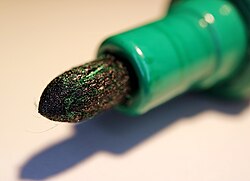
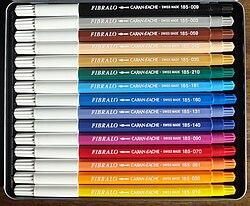
ปากกามาร์กเกอร์ปากกาไฟน์ไลเนอร์ ปากกามาร์กเกอร์ ปากกาปลายสักหลาดปากกาฟลายมาร์กเกอร์ปากกาเขียนป้าย (ในเกาหลีใต้ ) ปากกา ไวไวด์ (ในนิวซีแลนด์ ) ปากกาฟลอมาสเตอร์ (ในประเทศ สลาฟ ตะวันออกและใต้ ) ปากกาเท็กซ์ต้า (ในออสเตรเลีย ) ปากกาสเก็ ตช์ (ในเอเชียใต้ ) ปากกา โคกิ (ในแอฟริกาใต้ ) หรือเรียกง่ายๆ ว่ามาร์กเกอร์คือปากกา ที่มีแหล่ง หมึกของตัวเอง และปลาย ปากกาที่ทำจากเส้นใยอัดที่มีรูพรุน เช่นสักหลาด[ 1 ] ปากกามาร์กเกอร์ประกอบด้วยภาชนะ (แก้ว อะลูมิเนียม หรือพลาสติก) และแกนกลางที่ทำจากวัสดุดูดซับซึ่งกักเก็บหมึกไว้ ส่วนบนของปากกามาร์กเกอร์ประกอบด้วยหัวปากกาซึ่งในสมัยก่อนทำจากวัสดุสักหลาดแข็ง และฝาปิดเพื่อป้องกันไม่ให้ปากกามาร์กเกอร์แห้ง
จนกระทั่งช่วงต้นทศวรรษ 1990 ตัวทำละลายที่ใช้กันทั่วไปสำหรับหมึกในปากกาเมจิกถาวรคือโทลูอีนและไซลีนสารทั้งสองชนิดนี้เป็นอันตราย[ 2 ] [ 3 ]และมีกลิ่นแรงมาก ปัจจุบัน หมึกมักทำขึ้นโดยใช้แอลกอฮอล์เป็นส่วนประกอบหลัก (เช่น1-โพรพานอล , 1-บิวทานอล , ไดอะซีโตนแอลกอฮอล์และครีซอล )
ปากกาเขียนกระดานอาจเป็นแบบกันน้ำ แบบลบได้ด้วยปากกาไวท์บอร์ด แบบลบได้ด้วยปากกา ไวท์บอร์ด (เช่น ปากกาสำหรับเขียน บนแผ่นใส ) หรือแบบถาวร
ประวัติศาสตร์
ลี นิวแมน จดสิทธิบัตรปากกาปลายสักหลาดในปี พ.ศ. 2453 [ 4 ]ในปี พ.ศ. 2469 เบนจามิน ปาสคาช จดสิทธิบัตร "พู่กันน้ำพุ" [ 5 ]ตามที่เขาเรียก ซึ่งประกอบด้วยด้ามจับปลายฟองน้ำที่บรรจุสีต่างๆ ปากกาประเภทนี้เริ่มเป็นที่นิยมมากขึ้นเมื่อมีการจำหน่าย Magic Marker ของ ซิดนีย์ โรเซนธาล (พ.ศ. 2496) ซึ่งประกอบด้วยหลอดแก้วบรรจุหมึกและไส้สักหลาด ในปี พ.ศ. 2491 การใช้ปากกาปลายสักหลาดเป็นเรื่องปกติสำหรับการใช้งานที่หลากหลาย เช่น การเขียนตัวอักษร การติดฉลาก และการสร้างโปสเตอร์[ 6 ]ในปี พ.ศ. 2505 ได้มีการพัฒนาปากกาปลายไฟเบอร์สมัยใหม่ (ตรงข้ามกับปากกาทั่วไปที่มีปลายหนากว่า) โดยยูกิโอ โฮริเอะ จากบริษัทเครื่องเขียนโตเกียว (ซึ่งต่อมากลายเป็นเพนเทล )
ในช่วงทศวรรษ 1980 มีการนำเครื่องหมายรักษาความปลอดภัยตัวแรกมาใช้ ซึ่งใช้หมึกที่มองไม่เห็นแต่เรืองแสง หมึกนี้สามารถใช้ทำเครื่องหมายวัตถุมีค่าได้ และในกรณีที่ถูกขโมย เครื่องหมายเหล่านี้สามารถตรวจจับได้ด้วยแสงอัลตราไวโอเลต[ 7 ]ในปี 1987 มีการเปิดตัวเครื่องหมาย Copic Sketch ซึ่งทำให้เครื่องหมายเป็นที่นิยมมากขึ้นสำหรับการวาดภาพประกอบระดับมืออาชีพ[ 8 ]
ชิ้นส่วน
อ่างเก็บหมึกของปากกาทำจากโพลีเอสเตอร์ส่วน " สักหลาด " ที่ใช้ทำปลายปากกามักทำจากเส้นใยสังเคราะห์ที่อัดแน่นสูงหรือเซรามิกที่มีรูพรุนโทลูออลและไซลอลถูกใช้เป็นตัวทำละลายสำหรับสีย้อมและยังคงใช้สำหรับหมึกถาวรในปากกาเมจิก เนื่องจากความเป็นพิษ จึงมักถูกแทนที่ด้วยสารที่มีความสำคัญน้อยกว่า เช่นอัลคิลหรือไซคลิกอัลคิลีนคาร์บอเนต (เช่นโพรพิลีนคาร์บอเนต ) ในปากกาเมจิกประเภทอื่น ปริมาณน้ำในหมึกอาจสูงถึง 10% นอกจากตัวทำละลายและสีย้อมแล้ว หมึกอาจมีสารเติมแต่ง (เช่น โนนิลฟีนิลโพลีไกลคอลอีเทอร์, อัลคิลโพลีไกลคอลอีเทอร์, กรดไขมันโพลีไกลคอลเอสเทอร์ หรือเอทอกซาเลตแอลกอฮอล์ไขมัน) และสารกันบูด (เช่น2-ฟีนิลฟีนอลและเกลือโซเดียมของมัน, 6-อะซีทอกซี-2,4-ไดเมทิล-เอ็ม-ไดออกเซน ) [ 9 ] [ 10 ] [ 11 ]
ประเภท
ปากกาเมจิกถาวร
Permanent markers are porous pens that can write on surfaces such as glass, plastic, wood, metal, and stone. On most surfaces, the ink is generally resistant to rubbing and water, and can last for many years. However, on certain plastics like Teflon, polypropylene etc., the marks made by such pens are not permanent and can be erased easily. Depending on the surface and the marker used, the marks can often be removed with either vigorous scrubbing or chemicals such as acetone.
Highlighters
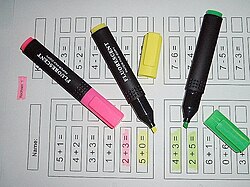
Highlighters are a form of marker used to highlight and cover over existing writing while still leaving the writing readable. They are generally produced in neon colours to allow for colour coding, as well as attract buyers to them. As early as 1963, the American company Carter's Ink Company developed fluorescent felt-tip pens.[12] Felt-tip pens with fluorescent ink were first developed and marketed in Germany in 1971 by Günter Schwanhäußer of Schwan-Stabilo.[13]
Whiteboard markers

A whiteboard marker—or dry-erase marker—uses an erasable ink, made to be used on a slick (or matte-finished), non-porous writing surface, for temporary writing with overhead projectors, whiteboards, glass, and the like. They are designed so that the user can easily erase the marks using a damp cloth, tissue, handkerchief, baby wipe, or other easily cleaned or disposable items. Generally, people use fabrics to do so, but others use items like paper, clothing items, some even use their bare hands to wipe it clear. The erasable ink does not contain the toxic chemical compounds xylene and/or toluene as have been used in permanent markers, being less of a risk to being used as a recreational drug.
Wet-wipe markers—or wet-erase markers—are another version that are used on overhead projectors, signboards, whiteboards, and other non-porous surfaces.
Security marker
Special "security" markers, with fluorescent but otherwise invisible inks, are used for marking valuables in case of burglary. The owner of a stolen, but recovered item can be determined by using ultraviolet light to make the writing visible.
Election marker
Marker pens with election ink (an indelible dye and often a photosensitive agent such as silver nitrate) used to mark the finger, and especially the cuticle, of voters in elections in order to prevent electoral fraud such as double voting. The stain stays visible for a week or two and may also be used to assist in vaccinations.
Porous point pen
A porous point pen contains a point that is made of some porous material such as felt or ceramic. Draftsman's pens usually have a ceramic tip since this wears well and does not broaden when pressure is applied while writing.
Dialectal variations
The use of the terms "marker" and "felt-tipped pen" varies significantly among different parts of the world. This is because most English dialects contain words for particular types of marker, often generic brand names, but there are no such terms in widespread international use.
Asia
In some parts of India, water-based felt-tip pens are referred to as "sketch pens" because they are mainly used for sketching and writing on paper or cardboard. The permanent ink felt-tip markers are referred to as just "markers". In Malaysia and Singapore, marker pens are simply called markers. In the Philippines, a marker is commonly referred to as a "Pentel pen", regardless of brand. In Indonesia, a marker pen is referred to as "Spidol". In South Korea and Japan, marker pens are referred to as "sign pens", "name pens", or "felt pens". In Iran, felt-tip pens are referred to as "Magic" or "Highlight" regardless of its brand.
Australia
In Australia, the term "marker" usually refers only to large-tip markers, and the terms "felt-tip" and "felt pen" usually refer only to fine-tip markers. Markers in Australia are often generically called "texta", after a brand name of a type of permanent marker. Some variation in naming convention occurs between the states, for example in Queensland the brand name "nikko" has been commonly adopted.
New Zealand
The generic terms for fine-tipped markers are usually "felt pen", "felt tip pen" or "felts". Large permanent markers are called "vivids" after a popular brand sold there, the Bic Stephens Vivid.
South Africa
ในแอฟริกาใต้คำว่า "Koki" ถูกใช้โดยชาวแอฟริกาใต้เพื่อเรียกทั้งปากกาเมจิกและปากกามาร์กเกอร์ รวมถึงใช้เรียก "ปากกามาร์กเกอร์" ทั่วไปด้วย
แคนาดาและสหรัฐอเมริกา
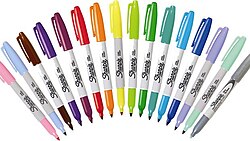
ในสหรัฐอเมริกา คำว่า "marker" ถูกใช้ควบคู่ไปกับ "magic marker" โดยคำหลังเป็นเครื่องหมายการค้าที่กลายเป็นคำสามัญไปแล้ว ส่วนคำว่า "sharpie" ก็ถูกใช้เป็นเครื่องหมายการค้าที่กลายเป็นคำสามัญเช่นกันSharpieเป็นแบรนด์ปากกาเมจิกแบบถาวรยอดนิยมที่ใช้สำหรับติดฉลาก ในบางส่วนของแคนาดา บางครั้งปากกาเมจิกก็ถูกเรียกว่า felt-pens หรือ felts ด้วย
ดูเพิ่มเติม
หมายเหตุและเอกสารอ้างอิง
- ^ www.sbctc.edu (ดัดแปลง). "โมดูล 6: สื่อสำหรับศิลปะ 2 มิติ" (PDF) . Saylor.org. เก็บถาวร(PDF)จากต้นฉบับเมื่อวันที่ 7 กันยายน 2012. สืบค้นเมื่อ2 เมษายน 2012 .
- ^ "โทลูอีน | แนวทางการจัดการทางการแพทย์ | พอร์ทัลสารพิษ | ATSDR" . www.cdc.gov .
- ^ "อย่างมีสุขภาพดี"อย่างมีสุขภาพดี
- ^ลี ดับเบิลยู. นิวแมน, ปากกาทำเครื่องหมาย,สิทธิบัตรสหรัฐอเมริกาหมายเลข 946,149 11 มกราคม 1910
- ^ "พู่กันน้ำพุ" (PDF) . Freepatentsonline.com . สืบค้นเมื่อ30 เมษายน 2557 .
- ^ประวัติของปากกาและเครื่องเขียน , เว็บไซต์เกี่ยวกับนักประดิษฐ์. สืบค้นเมื่อ 11 มีนาคม 2550.
- ↑ "มาร์กาดอร์ อัลตราไวโอเลตา" . HiSoUR Arte Cultura Historia (ภาษาสเปน) 11-12-2017 . สืบค้นเมื่อ2022-01-16 .
- ^ "ประวัติของ Copic [ส่วน: "1987 - การเปิดตัวปากกา Copic"]" . เก็บถาวรจากต้นฉบับเมื่อ 2025-01-14.
- ^ "วิธีการผลิตปากกามาร์กเกอร์ - วัสดุ การผลิต การทำ ประวัติ การใช้งาน ผลิตภัณฑ์ เครื่องจักร ประวัติ วัตถุดิบ" Madehow.com. 14 กรกฎาคม 1997. เก็บถาวรจากต้นฉบับเมื่อ 2 กุมภาพันธ์ 2017. เรียกดูเมื่อ15 กุมภาพันธ์ 2017 .
- ^ David A. Black (1966). "ปากกาปลายไฟเบอร์" . J. Crim. L. Criminology & Police Sci . 57 (4): 521– 525. doi : 10.2307/1140564 . JSTOR 1140564 . เก็บถาวรจากต้นฉบับเมื่อ 2017-11-07.
- ^ "ประวัติของปากกามาร์กเกอร์" . เก็บถาวรจากต้นฉบับเมื่อ 2016-12-13 . เรียกดูเมื่อ2017-01-31 .
- ^นิวยอร์กไทมส์: ปากกาไฮไลท์แบบพกพา
- ↑ Welt.de:Der Erfinder des Textmarkers ist tot
ลิงก์ภายนอก
 สื่อที่เกี่ยวข้องกับปากกามาร์กเกอร์ในวิกิมีเดียคอมมอนส์