
อ่าน 9 นาที
Temporal lobe
The temporal lobe is one of the four major lobes of the cerebral cortex in the brain of mammals .
Temporal lobe
| Temporal lobe | |
|---|---|
Lobes of the human brain (temporal lobe is shown in green) | |
 Section of brain showing upper surface of temporal lobe. | |
| Details | |
| Part of | Cerebrum |
| Artery | |
| Vein | |
| Identifiers | |
| Latin | lobus temporalis |
| MeSH | D013702 |
| NeuroNames | 125 |
| NeuroLex ID | birnlex_1160 |
| TA98 | A14.1.09.136 |
| TA2 | 5488 |
| FMA | 61825 |
| Anatomical terms of neuroanatomy | |
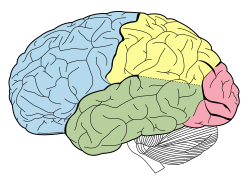
The temporal lobe is one of the four major lobes of the cerebral cortex in the brain of mammals. The temporal lobe is located beneath the lateral fissure on both cerebral hemispheres of the mammalian brain.[3]
The temporal lobe is involved in processing sensory input into derived meanings for the appropriate retention of visual memory, language comprehension, and emotion association.[4]: 21 Temporal refers to the head's temples.
Structure
The temporallobe consists of structures that are vital for declarative or long-term memory. Declarative (denotative) or explicit memory is conscious memory divided into semantic memory (facts) and episodic memory (events).[4]: 194
The medial temporal lobe structures are critical for long-term memory, and include the hippocampal formation, perirhinal cortex, parahippocampal, and entorhinal neocortical regions.[4]: 196 [5] The hippocampus is critical for memory formation, and the surrounding medial temporal cortex is currently theorized to be critical for memory storage.[4]: 21 The prefrontal and visual cortices are also involved in explicit memory.[4]: 21
Research has shown that lesions in the hippocampus of monkeys results in limited impairment of function, whereas extensive lesions that include the hippocampus and the medial temporal cortex result in severe impairment.[6]
A form of epilepsy that involves the medial lobe is usually known as mesial temporal lobe epilepsy.[7]
Function
Visual memories
The temporal lobe communicates with the hippocampus and plays a key role in the formation of explicit long-term memory modulated by the amygdala.[4]: 349
Processing sensory input
- Auditory
- Adjacent areas in the superior, posterior, and lateral parts of the temporal lobes are involved in high-level auditory processing. The temporal lobe is involved in primary auditory perception, such as hearing, and holds the primary auditory cortex.[8] The primary auditory cortex receives sensory information from the ears and secondary areas process the information into meaningful units such as speech and words.[8] The superior temporal gyrus includes an area (within the lateral fissure) where auditory signals from the cochlea first reach the cerebral cortex and are processed by the primary auditory cortex in the left temporal lobe.
- Visual
- The areas associated with vision in the temporal lobe interpret the meaning of visual stimuli and establish object recognition.[9] The ventral part of the temporal cortices appears to be involved in high-level visual processing of complex stimuli such as faces (fusiform gyrus)[10] and scenes (parahippocampal gyrus).[11] Anterior parts of this ventral stream for visual processing are involved in object perception and recognition.[8]

Language recognition
In humans, temporal lobe regions are critical for accessing the semantic meaning of spoken words, printed words, and visual objects.[12]Wernicke's area, which spans the region between temporal and parietal lobes of the dominant cerebral hemisphere (the left, in the majority of cases), plays a key role (in tandem with Broca's area in the frontal lobe) in language comprehension,[13] whether spoken language or signed language. FMRI imaging shows these portions of the brain are activated by signed or spoken languages.[14][15] These areas of the brain are active in children's language acquisition[16] whether accessed via hearing a spoken language, watching a signed language, or via hand-over-hand tactile versions of a signed language.[17]
The functions of the left temporal lobe are not limited to low-level perception but extend to comprehension, naming, and verbal memory.[18]
New memories
The medial temporal lobes (near the sagittal plane) are thought to be involved in encodingdeclarativelong term memory.[4]: 194–199 The medial temporal lobes include the hippocampi, which are essential for memory storage, therefore damage to this area can result in impairment in new memory formation leading to permanent or temporary anterograde amnesia.[4]: 194–199
Clinical significance
Unilateral temporal lesion
- Contralateral homonymous upper quadrantanopia (sector anopsia)
- Complex hallucinations (smell, sound, vision, memory)
Dominant hemisphere
- Receptive aphasia
- Dyslexia
- Impaired verbal memory
- Word agnosia, word deafness
Non-dominant hemisphere
- Impaired non-verbal memory
- Impaired musical skills
Bitemporal lesions (additional features)
- Deafness
- Apathy (affective indifference)
- Impaired learning and memory
- Amnesia, Korsakoff syndrome, Klüver–Bucy syndrome
Damage
บุคคลที่ได้รับความเสียหายที่กลีบขมับส่วนกลางจะมีปัญหาในการจดจำสิ่งเร้าทางสายตา การขาดการส่งสัญญาณประสาทนี้ไม่ได้เกิดจากการขาดการรับรู้สิ่งเร้าทางสายตา แต่เกิดจากความไม่สามารถตีความสิ่งที่รับรู้ได้[ 19 ]อาการที่พบบ่อยที่สุดของความเสียหายที่กลีบขมับส่วนล่างคือภาวะมองไม่เห็น (visual agnosia ) ซึ่งเกี่ยวข้องกับความบกพร่องในการระบุวัตถุที่คุ้นเคย อีกประเภทหนึ่งของความเสียหายที่กลีบขมับส่วนล่างที่พบน้อยกว่าคือภาวะจำใบหน้าไม่ได้(prosopagnosia)ซึ่งเป็นความบกพร่องในการจดจำใบหน้าและการแยกแยะลักษณะเฉพาะของใบหน้าแต่ละบุคคล[ 20 ]
ความเสียหายเฉพาะส่วนหน้าของกลีบขมับซ้ายสามารถทำให้เกิดกลุ่มอาการซาวันต์ได้[ 21 ]
ความผิดปกติ
โรค Pickหรือที่รู้จักกันในชื่อภาวะความจำเสื่อมส่วนหน้าและส่วนขมับ เกิดจากการฝ่อของกลีบสมองส่วนหน้าและส่วนขมับ[ 22 ]อาการทางอารมณ์ ได้แก่ การเปลี่ยนแปลงอารมณ์ ซึ่งผู้ป่วยอาจไม่รู้ตัว รวมถึงสมาธิสั้นและพฤติกรรมก้าวร้าวต่อตนเองหรือผู้อื่น อาการทางภาษา ได้แก่ การสูญเสียการพูด ความไม่สามารถอ่านหรือเขียน การสูญเสียคำศัพท์ และความเสื่อมถอยโดยรวมของความสามารถในการเคลื่อนไหว[ 23 ]
โรคลมชักกลีบขมับเป็นภาวะทางระบบประสาทเรื้อรังที่มีลักษณะเฉพาะคือการชักซ้ำๆ อาการต่างๆ ได้แก่ ภาพหลอนทางประสาทสัมผัส (การมองเห็น การได้ยิน การดมกลิ่น และการรับรส) หลายประเภท รวมถึงความไม่สามารถประมวลผลความทรงจำเชิงความหมายและเชิงเหตุการณ์ได้[ 24 ]
โรคจิตเภทเป็นความผิดปกติทางจิตอย่างรุนแรงที่มีลักษณะเฉพาะคือการสับสนอย่างรุนแรง อาการที่ชัดเจนที่สุดคือการรับรู้เสียงภายนอกในรูปแบบของภาพหลอนทางการได้ยิน สาเหตุของภาพหลอนดังกล่าวได้รับการระบุว่าเกิดจากความบกพร่องในกลีบขมับด้านซ้าย โดยเฉพาะอย่างยิ่งภายในคอร์เทกซ์การได้ยินหลัก[ 25 ] [ 26 ]การลดลงของเนื้อเยื่อสีเทา รวมถึงความบกพร่องของเซลล์อื่นๆ มีส่วนทำให้เกิดกิจกรรมทางประสาทที่เกิดขึ้นเองซึ่งส่งผลต่อคอร์เทกซ์การได้ยินหลักราวกับว่ากำลังได้รับข้อมูลการได้ยิน การแสดงคำพูดที่ผิดพลาดในคอร์เทกซ์การได้ยินส่งผลให้เกิดการรับรู้เสียงภายนอกในรูปแบบของภาพหลอนทางการได้ยินในผู้ป่วยโรคจิตเภท[ 27 ]เทคนิค MRI โครงสร้างและการทำงานได้รับการอธิบายถึงกิจกรรมทางประสาทนี้โดยการทดสอบบุคคลที่ได้รับผลกระทบและไม่ได้รับผลกระทบด้วยสิ่งเร้าทางการได้ยินจากภายนอก[ 25 ]
ดูเพิ่มเติม
ลิงก์ภายนอก

สรุปเนื้อหา
ข้อมูลสำคัญจากบทความ
ข้อมูลสำคัญเกี่ยวกับ Temporal lobe
The temporal lobe is one of the four major lobes of the cerebral cortex in the brain of mammals .
Structure
The temporal lobe consists of structures that are vital for declarative or long-term memory. Declarative (denotative) or explicit memory is conscious memory divided into semantic memory (facts) and episodic memory (events). [ 4 ] : 194
Visual memories
The temporal lobe communicates with the hippocampus and plays a key role in the formation of explicit long-term memory modulated by the amygdala . [ 4 ] : 349
Processing sensory input
Auditory Adjacent areas in the superior, posterior, and lateral parts of the temporal lobes are involved in high-level auditory processing. The temporal lobe is involved in primary auditory perception, such as hearing, and holds the primary auditory cortex .