
Two on a Tower
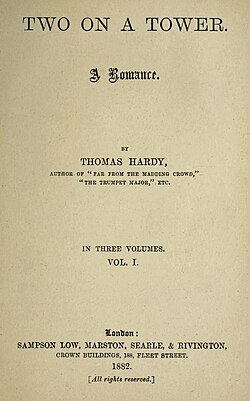 First edition title page | |
| Author | Thomas Hardy |
|---|---|
| Language | English |
| Genre | Novel |
| Publication date | 1882 |
| Publication place | United Kingdom |
| Media type | |
Two on a Tower: A Romance (1882) is a novel by English author Thomas Hardy,[1] classified by him as a romance and fantasy. It is regarded as one of his minor works. It is one of Hardy's Wessex novels, set in late VictorianDorset.
Epigraph
Hardy placed an epigraph at the beginning of this book. The epigraph is from a Richard Crashaw poem, Love's Horoscope. It reads:
"Ah, my heart her eyes and she Have taught thee new astrology. Howe'er Love's native hours were set, Whatever starry synod met, 'Tis in the mercy of her eye, If poor Love shall live or die."
Plot
Two on a Tower is a tale of star-crossed love in which Hardy sets the emotional lives of his two lovers against the background of the stellar universe. The unhappily married Lady Constantine breaks all the rules of social decorum when she falls in love with Swithin St. Cleeve, an astronomer who is ten years her junior. Her husband's death leaves the lovers free to marry, but the discovery of a legacy forces them apart. This is Hardy's most complete treatment of the theme of love across the class and age divide and the fullest expression of his fascination with science and astronomy.[2]
Background
In the 1895 preface Hardy wrote, "The scene of the action was suggested by two real spots in the part of the country specified, each of which has a column standing upon it. Certain surrounding peculiarities have been imported into the narrative from both sites." Wimborne was the location of the "little town" of "Warborne",[3] and Charborough House was the location of the "Welland House" in Two on a Tower.[4]
Hardy's intention, in his own words, was to "set the emotional history of two infinitesimal lives against the stupendous background of the stellar universe".[5]
Criticism
เนื่องจากหนังสือเล่มนี้ท้าทายบรรทัดฐานทางสังคมในสมัยนั้น เมื่อวางจำหน่ายจึงถูกเรียกว่าน่าตกใจ น่ารังเกียจ และนักวิจารณ์คนหนึ่งเรียกมันว่า "แย่ที่สุดเท่าที่ฮาร์ดี้เคยเขียนมา" [ 6 ]แคลร์ โทมาลิน ผู้เขียนชีวประวัติของฮาร์ดี้ กล่าวว่า ฮาร์ดี้ "เขียนเพื่อตีพิมพ์เป็นตอนๆ ซึ่งทำให้เขาต้องใส่เนื้อเรื่องมากเกินไป" และเขาเขียนเร็วเกินไป "โดยไม่มีเวลาคิดหรือพิจารณาใหม่" [ 7 ]
ฮาร์ดี้เขียนในจดหมายถึงเอ็ดมันด์ กอสส์ เมื่อวันที่ 10 ธันวาคม พ.ศ. 2325 ว่า "ผมได้รับคำวิจารณ์ที่แปลกประหลาดที่สุดเกี่ยวกับ T. on a T. นักวิจารณ์ผู้มีชื่อเสียงเขียนจดหมายมาบอกผมเป็นการส่วนตัวว่ามันเป็นผลงานที่แปลกใหม่ที่สุดที่ผมเคยทำ...ในขณะที่นักวิจารณ์ผู้มีชื่อเสียงคนอื่นๆ (ผมสงสัยว่าพวกเขาเป็นคนเดียวกันหรือไม่) พิมพ์คำตำหนิที่รุนแรงที่สุดเท่าที่คุณจะนึกออก—แสดงให้ผมเห็น (ด้วยความประหลาดใจของผม) ว่าผมเป็นคนไร้ศีลธรรมจริงๆ..." [ 8 ]
ดูเพิ่มเติม
ลิงก์ภายนอก
- หนังสือ Two on a Towerฉบับเต็ม สามารถอ่านได้ที่ Google Books
- สองคนบนหอคอยที่ Project Gutenberg
 หนังสือเสียงสาธารณะเรื่องTwo on a Tower ที่ LibriVox