กราฟของฟังก์ชันไฮเปอร์โบลิกผกผัน ฟังก์ชันไฮเปอร์โบลิกsinh , cosh และtanh เมื่อเทียบกับไฮเปอร์โบลาหน่วยนั้นคล้ายคลึงกับฟังก์ชันวงกลมsin , cos และtan เมื่อเทียบกับวงกลมหน่วย โดยอาร์กิวเมนต์ของฟังก์ชันไฮเปอร์โบลิกคือขนาดของมุมไฮเปอร์โบลิก ในทางคณิตศาสตร์ ฟังก์ชันไฮเปอร์โบลิกผกผัน คือฟังก์ชันผกผัน ของฟังก์ชันไฮเปอร์โบลิก คล้ายกับฟังก์ชันวงกลมผกผัน มีฟังก์ชันที่ใช้กันทั่วไป 6 ฟังก์ชัน ได้แก่ ไซน์ไฮเปอร์โบลิกผกผัน โคไซน์ไฮเปอร์โบลิกผกผัน แทนเจนต์ไฮเปอร์โบลิกผกผัน โคซีแคนต์ไฮเปอร์โบลิกผกผัน ซีแคนต์ไฮเปอร์โบลิกผกผัน และโคแทนเจนต์ไฮเปอร์โบลิกผกผัน โดยทั่วไปจะใช้สัญลักษณ์ของฟังก์ชันไฮเปอร์โบลิก นำหน้าด้วยarc- หรือar- หรือมีตัวยก(เช่นarcsinh , arsinh หรือ) − 1 {\displaystyle {-1}} สินห์ − 1 {\displaystyle \sinh ^{-1}}
สำหรับค่าที่กำหนดของฟังก์ชันไฮเปอร์โบลิก ฟังก์ชันไฮเปอร์โบลิกผกผันจะให้ค่ามุมไฮเปอร์โบลิก ที่สอดคล้องกัน ตัวอย่างเช่นและค่ามุมไฮเปอร์โบลิกคือความยาวของส่วนโค้ง ของไฮเปอร์โบลาหน่วย ที่วัดในระนาบโลเรนซ์ ( ไม่ใช่ ความยาวของส่วนโค้งไฮเปอร์โบลิกในระนาบยูคลิด ) และสองเท่าของพื้นที่ ของภาคส่วนไฮเปอร์โบลิก ที่สอดคล้องกัน นี่เป็นสิ่งที่คล้ายคลึงกับวิธีที่ค่ามุมวงกลม คือความยาวส่วนโค้งของส่วนโค้งของวงกลมหน่วย ในระนาบยูคลิดหรือสองเท่าของพื้นที่ของภาคส่วนวงกลม ที่สอดคล้อง กัน หรืออีกนัยหนึ่ง มุมไฮเปอร์โบลิกคือพื้นที่ของภาคส่วนของไฮเปอร์โบลาผู้เขียนบางคนเรียกฟังก์ชันไฮเปอร์โบลิกผกผันว่าฟังก์ชันพื้นที่ไฮเปอร์โบลิ ก[ 1 ] อาร์ซินห์ ( สินห์ เอ ) = เอ {\displaystyle \ตัวดำเนินการ {arsinh} (\sinh a)=a} สินห์ ( อาร์ซินห์ x ) = x . {\displaystyle \sinh(\ชื่อผู้ดำเนินการ {arsinh} x)=x.} x 2 − y 2 = 1 {\displaystyle x^{2}-y^{2}=1} x y = 1. {\displaystyle xy=1.}
ฟังก์ชันไฮเปอร์โบลิกปรากฏในการคำนวณมุมและระยะทางในเรขาคณิตไฮเปอร์โบลิก นอกจากนี้ยังปรากฏในคำตอบของสมการเชิงอนุพันธ์เชิง เส้นหลายสมการ (เช่น สมการที่กำหนดเส้นโค้งแคทเทนารี ) สมการกำลังสาม และสมการลาปลาส ในพิกัดคาร์ทีเซียน สมการลาปลาส มีความสำคัญในหลายสาขาของฟิสิกส์ รวมถึงทฤษฎีแม่เหล็กไฟฟ้า การถ่ายเทความร้อน พลศาสตร์ของไหล และ ทฤษฎีสั ม พัทธ ภาพ พิเศษ
สัญกรณ์ รังสีที่ลากผ่านไฮเปอร์โบลาหน่วย x² − y² = 1(cosh a , sinh a ) โดยที่a คือสองเท่าของพื้นที่ระหว่างรังสี ไฮเปอร์โบลาและ x สัญลักษณ์ที่เก่าแก่ที่สุดและได้รับการยอมรับอย่างกว้างขวางที่สุดใช้คำนำหน้าarc- (นั่นคือ: arcsinh , arccosh , arctanh , arcsech , arccsch , arccoth ) โดยเปรียบเทียบกับฟังก์ชันผกผันแบบวงกลม ( arcsin เป็นต้น) สำหรับไฮเปอร์โบลาหน่วย ("วงกลมลอเรนซ์") ในระนาบลอเรนซ์ ( ระนาบ ยูคลิดเทียม ของ ลายเซ็น (1, 1) ) [ 2 ] จำนวนไฮเปอร์โบลิก [ 3 ] วัดมุมไฮเปอร์โบลิก (อาร์กิวเมนต์ของฟังก์ชันไฮเปอร์โบลิก) ก็คือความยาวส่วนโค้ง ของส่วนโค้งไฮเปอร์โบลิก นั่นเอง
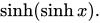
นอกจากนี้ การใช้สัญลักษณ์etc., [ 4 ] [ 5 ] ส่วนกลับ โดยเฉพาะอย่างยิ่ง การใช้ ตัวยก จำนวนเต็ม บวก เพื่อระบุเลขชี้กำลังแทนที่จะเป็นการประกอบฟังก์ชันนั้น ไม่สอดคล้องกัน เช่นตามธรรมเนียมแล้วหมายถึงและไม่ใช่ สินห์ − 1 , {\displaystyle \sinh ^{-1},} ไม้กระบอง − 1 , {\displaystyle \cosh ^{-1},} สินห์ − 1 x {\displaystyle \sinh ^{-1}x} สินห์ − 1 ( x ) {\displaystyle \sinh ^{-1}(x)} ( สินห์ x ) − 1 {\displaystyle (\sinh x)^{-1}} สินห์ ( x ) − 1 {\displaystyle \sinh(x)^{-1}} 1 / สินห์ x . {\displaystyle 1/\sinh x.} สินห์ 2 x {\displaystyle \sinh ^{2}x} ( สินห์ x ) 2 {\displaystyle (\sinh x)^{2}} สินห์ ( สินห์ x ) . {\displaystyle \sinh(\sinh x)}
เนื่องจากอาร์กิวเมนต์ของฟังก์ชันไฮเปอร์โบลิกไม่ใช่ ความยาวส่วนโค้งของส่วนโค้งไฮเปอร์โบลิกในระนาบยูคลิด ผู้เขียนบางคนจึงประณามคำนำหน้าarc- โดยโต้แย้งว่า ควรใช้คำนำหน้าar- (สำหรับ' area ' ) หรือarg- (สำหรับ' argument ' ) แทน [ 6 ] ISO 80000-2 จึงใช้คำนำหน้าar- (นั่นคือ: arsinh , arcosh , artanh , arsech , arcsch , arcoth )
ในภาษาการเขียนโปรแกรมคอมพิวเตอร์ ฟังก์ชันผกผันแบบวงกลมและแบบไฮเปอร์โบลิก มักจะใช้คำนำหน้าสั้นๆ ว่าa- ( asinh, เป็นต้น)
บทความนี้จะใช้คำนำหน้าar- อย่างสม่ำเสมอ เพื่อความสะดวก
นิยามในแง่ของลอการิทึม เนื่องจากฟังก์ชันไฮเปอร์โบลิก เป็นฟังก์ชันตรรกยะ กำลังสอง ของฟังก์ชันเลขชี้กำลัง จึงสามารถหาคำตอบได้โดยใช้สูตรกำลังสอง แล้วจึงเขียนให้อยู่ในรูปของลอการิทึม ธรรมชาติ เอ็กซ์ x , {\displaystyle \exp x,}
อาร์ซินห์ x = ln ( x + x 2 + 1 ) − ∞ < x < ∞ , อาร์โคช x = ln ( x + x 2 − 1 ) 1 ≤ x < ∞ , อาร์ตันห์ x = 1 2 ln 1 + x 1 − x − 1 < x < 1 , อาร์คช์ x = ln ( 1 x + 1 x 2 + 1 ) − ∞ < x < ∞ , x ≠ 0 , อาร์เซช x = ln ( 1 x + 1 x 2 − 1 ) 0 < x ≤ 1 , อาร์โคธ x = 1 2 ln x + 1 x − 1 − ∞ < x < − 1 หรือ 1 < x < ∞ . {\displaystyle {\begin{aligned}\operatorname {arsinh} x&=\ln \left(x+{\sqrt {x^{2}+1}}\right)&-\infty &<x<\infty ,\\[10mu]\operatorname {arcosh} x&=\ln \left(x+{\sqrt {x^{2}-1}}\right)&1&\leq x<\infty ,\\[10mu]\operatorname {artanh} x&={\frac {1}{2}}\ln {\frac {1+x}{1-x}}&-1&<x<1,\\[10mu]\operatorname {arcsch} x&=\ln \left({\frac {1}{x}}+{\sqrt {{\frac {1}{x^{2}}}+1}}\right)&-\infty &<x<\infty ,\ x\neq 0,\\[10mu]\operatorname {arsech} x&=\ln \left({\frac {1}{x}}+{\sqrt {{\frac {1}{x^{2}}}-1}}\right)&0&<x\leq 1,\\[10mu]\operatorname {arcoth} x&={\frac {1}{2}}\ln {\frac {x+1}{x-1}}&-\infty &<x<-1\ \ {\text{or}}\ \ 1<x<\infty .\end{aligned}}}
สำหรับ อาร์กิวเมนต์ ที่ซับซ้อน ฟังก์ชันผกผันแบบวงกลมและแบบไฮเปอร์โบลิก รากที่สอง และลอการิทึมธรรมชาติ ล้วนเป็นฟังก์ชัน หลายค่า
arsinh u ± arsinh v = arsinh ( u 1 + v 2 ± v 1 + u 2 ) {\displaystyle \operatorname {arsinh} u\pm \operatorname {arsinh} v=\operatorname {arsinh} \left(u{\sqrt {1+v^{2}}}\pm v{\sqrt {1+u^{2}}}\right)} arcosh u ± arcosh v = arcosh ( u v ± ( u 2 − 1 ) ( v 2 − 1 ) ) {\displaystyle \operatorname {arcosh} u\pm \operatorname {arcosh} v=\operatorname {arcosh} \left(uv\pm {\sqrt {(u^{2}-1)(v^{2}-1)}}\right)} artanh u ± artanh v = artanh ( u ± v 1 ± u v ) {\displaystyle \operatorname {artanh} u\pm \operatorname {artanh} v=\operatorname {artanh} \left({\frac {u\pm v}{1\pm uv}}\right)} arcoth u ± arcoth v = arcoth ( 1 ± u v u ± v ) {\displaystyle \operatorname {arcoth} u\pm \operatorname {arcoth} v=\operatorname {arcoth} \left({\frac {1\pm uv}{u\pm v}}\right)} arsinh u + arcosh v = arsinh ( u v + ( 1 + u 2 ) ( v 2 − 1 ) ) = arcosh ( v 1 + u 2 + u v 2 − 1 ) {\displaystyle {\begin{aligned}\operatorname {arsinh} u+\operatorname {arcosh} v&=\operatorname {arsinh} \left(uv+{\sqrt {(1+u^{2})(v^{2}-1)}}\right)\\&=\operatorname {arcosh} \left(v{\sqrt {1+u^{2}}}+u{\sqrt {v^{2}-1}}\right)\end{aligned}}}
อัตลักษณ์อื่นๆ 2 arcosh x = arcosh ( 2 x 2 − 1 ) for x ≥ 1 4 arcosh x = arcosh ( 8 x 4 − 8 x 2 + 1 ) for x ≥ 1 2 arsinh x = ± arcosh ( 2 x 2 + 1 ) 4 arsinh x = arcosh ( 8 x 4 + 8 x 2 + 1 ) for x ≥ 0 {\displaystyle {\begin{aligned}2\operatorname {arcosh} x&=\operatorname {arcosh} (2x^{2}-1)&\quad {\hbox{ for }}x\geq 1\\4\operatorname {arcosh} x&=\operatorname {arcosh} (8x^{4}-8x^{2}+1)&\quad {\hbox{ for }}x\geq 1\\2\operatorname {arsinh} x&=\pm \operatorname {arcosh} (2x^{2}+1)\\4\operatorname {arsinh} x&=\operatorname {arcosh} (8x^{4}+8x^{2}+1)&\quad {\hbox{ for }}x\geq 0\end{aligned}}}
ln ( x ) = arcosh ( x 2 + 1 2 x ) = arsinh ( x 2 − 1 2 x ) = artanh ( x 2 − 1 x 2 + 1 ) {\displaystyle \ln(x)=\operatorname {arcosh} \left({\frac {x^{2}+1}{2x}}\right)=\operatorname {arsinh} \left({\frac {x^{2}-1}{2x}}\right)=\operatorname {artanh} \left({\frac {x^{2}-1}{x^{2}+1}}\right)}
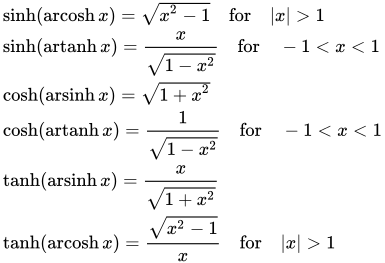
การประกอบฟังก์ชันไฮเปอร์โบลิกและฟังก์ชันไฮเปอร์โบลิกผกผัน sinh ( arcosh x ) = x 2 − 1 for | x | > 1 sinh ( artanh x ) = x 1 − x 2 for − 1 < x < 1 cosh ( arsinh x ) = 1 + x 2 cosh ( artanh x ) = 1 1 − x 2 for − 1 < x < 1 tanh ( arsinh x ) = x 1 + x 2 tanh ( arcosh x ) = x 2 − 1 x for | x | > 1 {\displaystyle {\begin{aligned}&\sinh(\operatorname {arcosh} x)={\sqrt {x^{2}-1}}\quad {\text{for}}\quad |x|>1\\&\sinh(\operatorname {artanh} x)={\frac {x}{\sqrt {1-x^{2}}}}\quad {\text{for}}\quad -1<x<1\\&\cosh(\operatorname {arsinh} x)={\sqrt {1+x^{2}}}\\&\cosh(\operatorname {artanh} x)={\frac {1}{\sqrt {1-x^{2}}}}\quad {\text{for}}\quad -1<x<1\\&\tanh(\operatorname {arsinh} x)={\frac {x}{\sqrt {1+x^{2}}}}\\&\tanh(\operatorname {arcosh} x)={\frac {\sqrt {x^{2}-1}}{x}}\quad {\text{for}}\quad |x|>1\end{aligned}}}
การประกอบฟังก์ชันไฮเปอร์โบลิกผกผันและฟังก์ชันวงกลม arsinh ( tan α ) = artanh ( sin α ) = ln ( 1 + sin α cos α ) = ± arcosh ( 1 cos α ) {\displaystyle \operatorname {arsinh} \left(\tan \alpha \right)=\operatorname {artanh} \left(\sin \alpha \right)=\ln \left({\frac {1+\sin \alpha }{\cos \alpha }}\right)=\pm \operatorname {arcosh} \left({\frac {1}{\cos \alpha }}\right)}
ln ( | tan α | ) = − artanh ( cos 2 α ) {\displaystyle \ln \left(\left|\tan \alpha \right|\right)=-\operatorname {artanh} \left(\cos 2\alpha \right)} [ 7 ]
การแปลง ln x = artanh ( x 2 − 1 x 2 + 1 ) = arsinh ( x 2 − 1 2 x ) = sgn ( x − 1 ) arcosh ( x 2 + 1 2 x ) {\displaystyle \ln x=\operatorname {artanh} \left({\frac {x^{2}-1}{x^{2}+1}}\right)=\operatorname {arsinh} \left({\frac {x^{2}-1}{2x}}\right)=\operatorname {sgn} (x-1)\operatorname {arcosh} \left({\frac {x^{2}+1}{2x}}\right)}
artanh x = arsinh ( x 1 − x 2 ) = sgn x arcosh ( 1 1 − x 2 ) {\displaystyle \operatorname {artanh} x=\operatorname {arsinh} \left({\frac {x}{\sqrt {1-x^{2}}}}\right)=\operatorname {sgn} x\operatorname {arcosh} \left({\frac {1}{\sqrt {1-x^{2}}}}\right)}
arsinh x = artanh ( x 1 + x 2 ) = sgn x arcosh ( 1 + x 2 ) {\displaystyle \operatorname {arsinh} x=\operatorname {artanh} \left({\frac {x}{\sqrt {1+x^{2}}}}\right)=\operatorname {sgn} x\operatorname {arcosh} \left({\sqrt {1+x^{2}}}\right)}
arcosh x = | arsinh ( x 2 − 1 ) | = | artanh ( x 2 − 1 x ) | {\displaystyle \operatorname {arcosh} x=\left|\operatorname {arsinh} \left({\sqrt {x^{2}-1}}\right)\right|=\left|\operatorname {artanh} \left({\frac {\sqrt {x^{2}-1}}{x}}\right)\right|}
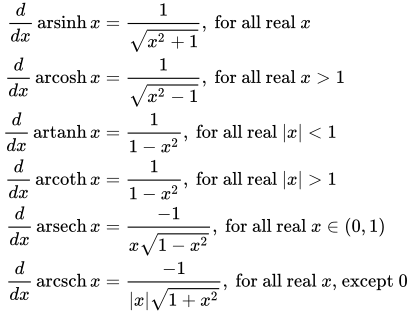
อนุพันธ์ d d x arsinh x = 1 x 2 + 1 , for all real x d d x arcosh x = 1 x 2 − 1 , for all real x > 1 d d x artanh x = 1 1 − x 2 , for all real | x | < 1 d d x arcoth x = 1 1 − x 2 , for all real | x | > 1 d d x arsech x = − 1 x 1 − x 2 , for all real x ∈ ( 0 , 1 ) d d x arcsch x = − 1 | x | 1 + x 2 , for all real x , except 0 {\displaystyle {\begin{aligned}{\frac {d}{dx}}\operatorname {arsinh} x&{}={\frac {1}{\sqrt {x^{2}+1}}},{\text{ for all real }}x\\{\frac {d}{dx}}\operatorname {arcosh} x&{}={\frac {1}{\sqrt {x^{2}-1}}},{\text{ for all real }}x>1\\{\frac {d}{dx}}\operatorname {artanh} x&{}={\frac {1}{1-x^{2}}},{\text{ for all real }}|x|<1\\{\frac {d}{dx}}\operatorname {arcoth} x&{}={\frac {1}{1-x^{2}}},{\text{ for all real }}|x|>1\\{\frac {d}{dx}}\operatorname {arsech} x&{}={\frac {-1}{x{\sqrt {1-x^{2}}}}},{\text{ for all real }}x\in (0,1)\\{\frac {d}{dx}}\operatorname {arcsch} x&{}={\frac {-1}{|x|{\sqrt {1+x^{2}}}}},{\text{ for all real }}x{\text{, except }}0\\\end{aligned}}}
สูตรเหล่านี้สามารถหาได้จากอนุพันธ์ของฟังก์ชันไฮเปอร์โบลิก ตัวอย่างเช่น ถ้าแล้วดังนั้น x = sinh θ {\displaystyle x=\sinh \theta } d x / d θ = cosh θ = 1 + x 2 , {\textstyle dx/d\theta =\cosh \theta ={\sqrt {1+x^{2}}},} d d x arsinh ( x ) = d θ d x = 1 d x / d θ = 1 1 + x 2 . {\displaystyle {\frac {d}{dx}}\operatorname {arsinh} (x)={\frac {d\theta }{dx}}={\frac {1}{dx/d\theta }}={\frac {1}{\sqrt {1+x^{2}}}}.}
การขยายซีรีส์ สามารถสร้างชุดส่วนขยายเพิ่มเติมสำหรับฟังก์ชันข้างต้นได้:
arsinh x = x − ( 1 2 ) x 3 3 + ( 1 ⋅ 3 2 ⋅ 4 ) x 5 5 − ( 1 ⋅ 3 ⋅ 5 2 ⋅ 4 ⋅ 6 ) x 7 7 ± ⋯ = ∑ n = 0 ∞ ( ( − 1 ) n ( 2 n ) ! 2 2 n ( n ! ) 2 ) x 2 n + 1 2 n + 1 , | x | < 1 {\displaystyle {\begin{aligned}\operatorname {arsinh} x&=x-\left({\frac {1}{2}}\right){\frac {x^{3}}{3}}+\left({\frac {1\cdot 3}{2\cdot 4}}\right){\frac {x^{5}}{5}}-\left({\frac {1\cdot 3\cdot 5}{2\cdot 4\cdot 6}}\right){\frac {x^{7}}{7}}\pm \cdots \\&=\sum _{n=0}^{\infty }\left({\frac {(-1)^{n}(2n)!}{2^{2n}(n!)^{2}}}\right){\frac {x^{2n+1}}{2n+1}},\qquad \left|x\right|<1\end{aligned}}}
arcosh x = ln ( 2 x ) − ( ( 1 2 ) x − 2 2 + ( 1 ⋅ 3 2 ⋅ 4 ) x − 4 4 + ( 1 ⋅ 3 ⋅ 5 2 ⋅ 4 ⋅ 6 ) x − 6 6 + ⋯ ) = ln ( 2 x ) − ∑ n = 1 ∞ ( ( 2 n ) ! 2 2 n ( n ! ) 2 ) x − 2 n 2 n , | x | > 1 {\displaystyle {\begin{aligned}\operatorname {arcosh} x&=\ln(2x)-\left(\left({\frac {1}{2}}\right){\frac {x^{-2}}{2}}+\left({\frac {1\cdot 3}{2\cdot 4}}\right){\frac {x^{-4}}{4}}+\left({\frac {1\cdot 3\cdot 5}{2\cdot 4\cdot 6}}\right){\frac {x^{-6}}{6}}+\cdots \right)\\&=\ln(2x)-\sum _{n=1}^{\infty }\left({\frac {(2n)!}{2^{2n}(n!)^{2}}}\right){\frac {x^{-2n}}{2n}},\qquad \left|x\right|>1\end{aligned}}}
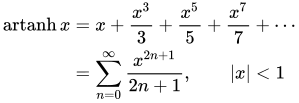
artanh x = x + x 3 3 + x 5 5 + x 7 7 + ⋯ = ∑ n = 0 ∞ x 2 n + 1 2 n + 1 , | x | < 1 {\displaystyle {\begin{aligned}\operatorname {artanh} x&=x+{\frac {x^{3}}{3}}+{\frac {x^{5}}{5}}+{\frac {x^{7}}{7}}+\cdots \\&=\sum _{n=0}^{\infty }{\frac {x^{2n+1}}{2n+1}},\qquad \left|x\right|<1\end{aligned}}}
arcsch x = arsinh 1 x = x − 1 − ( 1 2 ) x − 3 3 + ( 1 ⋅ 3 2 ⋅ 4 ) x − 5 5 − ( 1 ⋅ 3 ⋅ 5 2 ⋅ 4 ⋅ 6 ) x − 7 7 ± ⋯ = ∑ n = 0 ∞ ( ( − 1 ) n ( 2 n ) ! 2 2 n ( n ! ) 2 ) x − ( 2 n + 1 ) 2 n + 1 , | x | > 1 {\displaystyle {\begin{aligned}\operatorname {arcsch} x=\operatorname {arsinh} {\frac {1}{x}}&=x^{-1}-\left({\frac {1}{2}}\right){\frac {x^{-3}}{3}}+\left({\frac {1\cdot 3}{2\cdot 4}}\right){\frac {x^{-5}}{5}}-\left({\frac {1\cdot 3\cdot 5}{2\cdot 4\cdot 6}}\right){\frac {x^{-7}}{7}}\pm \cdots \\&=\sum _{n=0}^{\infty }\left({\frac {(-1)^{n}(2n)!}{2^{2n}(n!)^{2}}}\right){\frac {x^{-(2n+1)}}{2n+1}},\qquad \left|x\right|>1\end{aligned}}}
arsech x = arcosh 1 x = ln 2 x − ( ( 1 2 ) x 2 2 + ( 1 ⋅ 3 2 ⋅ 4 ) x 4 4 + ( 1 ⋅ 3 ⋅ 5 2 ⋅ 4 ⋅ 6 ) x 6 6 + ⋯ ) = ln 2 x − ∑ n = 1 ∞ ( ( 2 n ) ! 2 2 n ( n ! ) 2 ) x 2 n 2 n , 0 < x ≤ 1 {\displaystyle {\begin{aligned}\operatorname {arsech} x=\operatorname {arcosh} {\frac {1}{x}}&=\ln {\frac {2}{x}}-\left(\left({\frac {1}{2}}\right){\frac {x^{2}}{2}}+\left({\frac {1\cdot 3}{2\cdot 4}}\right){\frac {x^{4}}{4}}+\left({\frac {1\cdot 3\cdot 5}{2\cdot 4\cdot 6}}\right){\frac {x^{6}}{6}}+\cdots \right)\\&=\ln {\frac {2}{x}}-\sum _{n=1}^{\infty }\left({\frac {(2n)!}{2^{2n}(n!)^{2}}}\right){\frac {x^{2n}}{2n}},\qquad 0<x\leq 1\end{aligned}}}
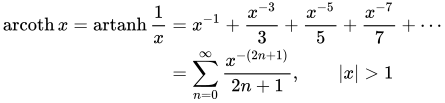
arcoth x = artanh 1 x = x − 1 + x − 3 3 + x − 5 5 + x − 7 7 + ⋯ = ∑ n = 0 ∞ x − ( 2 n + 1 ) 2 n + 1 , | x | > 1 {\displaystyle {\begin{aligned}\operatorname {arcoth} x=\operatorname {artanh} {\frac {1}{x}}&=x^{-1}+{\frac {x^{-3}}{3}}+{\frac {x^{-5}}{5}}+{\frac {x^{-7}}{7}}+\cdots \\&=\sum _{n=0}^{\infty }{\frac {x^{-(2n+1)}}{2n+1}},\qquad \left|x\right|>1\end{aligned}}} ขยายอนุกรมเชิงอะซิมโทติก สำหรับ arsinh กำหนดโดย
arsinh x = ln ( 2 x ) + ∑ n = 1 ∞ ( − 1 ) n − 1 ( 2 n − 1 ) ! ! 2 n ( 2 n ) ! ! 1 x 2 n {\displaystyle \operatorname {arsinh} x=\ln(2x)+\sum \limits _{n=1}^{\infty }{\left({-1}\right)^{n-1}{\frac {\left({2n-1}\right)!!}{2n\left({2n}\right)!!}}}{\frac {1}{x^{2n}}}}
ค่าหลักในระนาบเชิงซ้อน ฟังก์ชัน ไฮ เปอร์โบลิกผกผันเป็นฟังก์ชันหลายค่า ของตัวแปรเชิงซ้อน ซึ่งเป็น ฟังก์ชัน วิเคราะห์ ยกเว้นที่จุดจำนวนจำกัด สำหรับฟังก์ชันดังกล่าว มักมีการกำหนดค่าหลัก ซึ่งเป็นฟังก์ชันวิเคราะห์ค่าเดียวที่ตรงกับสาขาเฉพาะหนึ่งของฟังก์ชันหลายค่า บนโดเมนที่ประกอบด้วยระนาบเชิงซ้อน ซึ่งได้ตัด ส่วนโค้ง จำนวนจำกัด(โดยปกติจะเป็นครึ่งเส้นตรง หรือส่วนของเส้นตรง ) ออกไป ส่วนโค้งเหล่านี้เรียกว่ารอยตัดสาขา ค่าหลักของฟังก์ชันหลายค่าจะถูกเลือกที่จุดใดจุดหนึ่ง และค่าอื่นๆ ในโดเมนของการกำหนดจะถูกกำหนดให้สอดคล้องกับค่าที่พบโดยการต่อยอดเชิง วิเคราะห์
ตัวอย่างเช่น สำหรับรากที่สอง ค่าหลักถูกกำหนดให้เป็นรากที่สองที่มีส่วนจริง เป็นบวก ซึ่งกำหนดฟังก์ชันวิเคราะห์ที่มีค่าเดียว ซึ่งสามารถหาได้ทุกที่ ยกเว้นค่าจริงที่ไม่เป็นบวกของตัวแปร (ซึ่งรากที่สองทั้งสองมีส่วนจริงเป็นศูนย์) ค่าหลักของฟังก์ชันรากที่สองนี้จะถูกแสดงด้วยสัญลักษณ์ต่อไปนี้ ในทำนองเดียวกัน ค่าหลักของลอการิทึม ซึ่งแสดงด้วยสัญลักษณ์ต่อไปนี้ ถูกกำหนดให้เป็นค่าที่ส่วนจินตนาการ มีค่าสัมบูรณ์น้อยที่สุด ซึ่งสามารถหาได้ทุกที่ ยกเว้นค่าจริงที่ไม่เป็นบวกของตัวแปร ซึ่งค่าลอการิทึมสองค่าที่แตกต่างกันจะมีค่าต่ำสุด x {\displaystyle {\sqrt {x}}} Log {\displaystyle \operatorname {Log} }
สำหรับฟังก์ชันไฮเปอร์โบลิกผกผันทั้งหมด ค่าหลักอาจถูกกำหนดได้โดยใช้ค่าหลักของรากที่สองและฟังก์ชันลอการิทึม อย่างไรก็ตาม ในบางกรณี สูตรในหัวข้อ§ นิยามโดยใช้ลอการิทึม อาจไม่ได้ให้ค่าหลักที่ถูกต้อง เนื่องจากให้ขอบเขตของนิยามที่เล็กเกินไป และในบางกรณีก็ไม่เชื่อมต่อ กัน
ค่าหลักของฟังก์ชันผกผันไฮเปอร์โบลิกไซน์ ค่าหลักของฟังก์ชันผกผันของไซน์ไฮเปอร์โบลิกมีค่าดังนี้ arsinh z = Log ( z + z 2 + 1 ) . {\displaystyle \operatorname {arsinh} z=\operatorname {Log} (z+{\sqrt {z^{2}+1}}\,)\,.}
อาร์กิวเมนต์ของรากที่สองเป็นจำนวนจริง ที่ ไม่เป็นบวก ก็ต่อเมื่อ z [ i , + i ∞) และ(− i ∞, − i ] เท่านั้น ถ้าอาร์กิวเมนต์ของลอการิทึมเป็นจำนวนจริง อาร์กิวเมนต์นั้นจะเป็นบวก ดังนั้นสูตรนี้จึงกำหนดค่าหลักสำหรับ arsinh โดยมีจุดตัดสาขา[ i , + i ∞) และ(− i ∞, − i ] ซึ่งถือว่าเหมาะสมที่สุด เนื่องจากจุดตัดสาขาต้องเชื่อมต่อจุดเอกฐานi − i กับอนันต์
ค่าหลักของโคไซน์ไฮเปอร์โบลิกผกผัน สูตรสำหรับโคไซน์ไฮเปอร์โบลิกผกผันที่ให้ไว้ในหัวข้อ§ โคไซน์ไฮเปอร์โบลิกผกผัน นั้นไม่สะดวก เนื่องจากคล้ายกับค่าหลักของลอการิทึมและรากที่สอง ค่าหลักของ arcosh จะไม่สามารถกำหนดได้สำหรับz arcosh z = Log ( z + z + 1 z − 1 ) . {\displaystyle \operatorname {arcosh} z=\operatorname {Log} (z+{\sqrt {z+1}}{\sqrt {z-1}}\,)\,.}
ค่าหลักของรากที่สองนั้นถูกกำหนดไว้แล้ว ยกเว้นในกรณีที่z (−∞, 1] ถ้าอาร์กิวเมนต์ของลอการิทึมเป็นจำนวนจริงz (−∞, 1] ซึ่งเป็นการตัดสาขาที่ไม่ซ้ำกัน
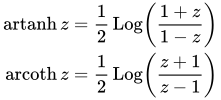
ค่าหลักของแทนเจนต์ไฮเปอร์โบลิกผกผันและโคแทนเจนต์ สูตรที่ให้ไว้ในหัวข้อ § นิยามในแง่ของลอการิทึม ชี้แนะ นิยามของค่าหลักของแทนเจนต์ไฮเปอร์โบลิกผกผันและโคแทนเจนต์ ในสูตรเหล่านี้ อาร์กิวเมนต์ของลอการิทึมจะเป็นจำนวนจริงก็ต่อเมื่อz (−∞, 0] ถ้าz (−∞, −1] หรือ[1, ∞) สำหรับ arcoth อาร์กิวเมนต์ของลอการิทึมจะอยู่ในช่วง(−∞, 0] ก็ต่อเมื่อz [−1, 1 ] artanh z = 1 2 Log ( 1 + z 1 − z ) arcoth z = 1 2 Log ( z + 1 z − 1 ) {\displaystyle {\begin{aligned}\operatorname {artanh} z&={\frac {1}{2}}\operatorname {Log} \left({\frac {1+z}{1-z}}\right)\\\operatorname {arcoth} z&={\frac {1}{2}}\operatorname {Log} \left({\frac {z+1}{z-1}}\right)\end{aligned}}}
ดังนั้น สูตรเหล่านี้จึงกำหนดค่าหลักที่สะดวก ซึ่งจุดตัดของสาขาคือ(−∞, −1] และ[1, ∞) สำหรับอินเวอร์สไฮเปอร์โบลิกแทนเจนต์ และ[−1, 1] สำหรับอินเวอร์สไฮเปอร์โบลิกโคแทนเจนต์
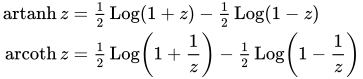
เพื่อให้ได้การประเมินเชิงตัวเลขที่ดีขึ้นใกล้กับจุดตัดสาขา ผู้เขียนบางท่านจึงใช้คำจำกัดความของค่าหลักดังต่อไปนี้ แม้ว่าคำจำกัดความที่สองจะทำให้เกิดภาวะเอกฐานที่กำจัดได้ ที่z = 0z โดยที่z > 1 และ คำจำกัดความของแตกต่างกันสำหรับค่าจริงของz โดยที่z ∈ [0, 1 ) artanh {\displaystyle \operatorname {artanh} } arcoth {\displaystyle \operatorname {arcoth} } artanh z = 1 2 Log ( 1 + z ) − 1 2 Log ( 1 − z ) arcoth z = 1 2 Log ( 1 + 1 z ) − 1 2 Log ( 1 − 1 z ) {\displaystyle {\begin{aligned}\operatorname {artanh} z&={\tfrac {1}{2}}\operatorname {Log} \left({1+z}\right)-{\tfrac {1}{2}}\operatorname {Log} \left({1-z}\right)\\\operatorname {arcoth} z&={\tfrac {1}{2}}\operatorname {Log} \left({1+{\frac {1}{z}}}\right)-{\tfrac {1}{2}}\operatorname {Log} \left({1-{\frac {1}{z}}}\right)\end{aligned}}}
ค่าหลักของโคเซแคนต์ไฮเปอร์โบลิกผกผัน สำหรับโคเซแคนต์ไฮเปอร์โบลิกผกผัน ค่าหลักถูกกำหนดดังนี้ arcsch z = Log ( 1 z + 1 z 2 + 1 ) . {\displaystyle \operatorname {arcsch} z=\operatorname {Log} \left({\frac {1}{z}}+{\sqrt {{\frac {1}{z^{2}}}+1}}\,\right).}
ค่าหลักของรากที่สองนั้นถูกกำหนดไว้ ยกเว้นในกรณีที่ตัวแปรของลอการิทึมและรากที่สองเป็นจำนวนจริงที่ไม่เป็นบวก ดังนั้น ค่าหลักของรากที่สองจึงถูกกำหนดไว้นอกช่วง[− i , i ] ของเส้นจินตนาการ หากตัวแปรของลอการิทึมเป็นจำนวนจริง แสดงว่าz
ดังนั้น ค่าหลักจึงถูกกำหนดโดยสูตรข้างต้นที่อยู่นอกขอบเขตการตัดสาขา ซึ่งประกอบด้วยช่วง[− i , i ] ของเส้นสมมติ
(ที่z = 0
ค่าหลักของซีแคนต์ไฮเปอร์โบลิกผกผัน ในกรณีนี้ เช่นเดียวกับกรณีของโคไซน์ไฮเปอร์โบลิกผกผัน เราต้องแยกตัวประกอบของรากที่สอง ซึ่งจะให้ค่าหลัก arsech z = Log ( 1 z + 1 z + 1 1 z − 1 ) . {\displaystyle \operatorname {arsech} z=\operatorname {Log} \left({\frac {1}{z}}+{\sqrt {{\frac {1}{z}}+1}}\,{\sqrt {{\frac {1}{z}}-1}}\right).}
ถ้าอาร์กิวเมนต์ของรากที่สองเป็นจำนวนจริง แสดงว่าz z (−∞, 0] และ[1, +∞) ถ้าอาร์กิวเมนต์ของลอการิทึมเป็นจำนวนจริงและเป็นลบ แสดงว่าz ที่เป็นจำนวน จริง(−∞, 0] และ[1, +∞ )
สำหรับz = 0
การแสดงผลเชิงกราฟิก ในภาพกราฟิกแสดงค่าหลักของฟังก์ชันไฮเปอร์โบลิกผกผันต่อไปนี้ เส้นแบ่งสาขาจะปรากฏเป็นความไม่ต่อเนื่องของสี ข้อเท็จจริงที่ว่าเส้นแบ่งสาขาทั้งหมดปรากฏเป็นความไม่ต่อเนื่อง แสดงให้เห็นว่าค่าหลักเหล่านี้อาจไม่สามารถขยายไปเป็นฟังก์ชันเชิงวิเคราะห์ที่กำหนดบนโดเมนที่ใหญ่กว่าได้ กล่าวอีกนัยหนึ่ง เส้นแบ่งสาขาที่กำหนดไว้ข้างต้น เป็น เส้นแบ่งสาขา ขั้นต่ำ
ฟังก์ชันไฮเปอร์โบลิกผกผันในระนาบ
z เชิงซ้อน: สี ณ แต่ละจุดในระนาบ
แสดงถึงค่าเชิงซ้อน ของฟังก์ชันนั้นๆ ณ จุดนั้น
ดูเพิ่มเติม
บรรณานุกรม
ลิงก์ภายนอก 







![{\displaystyle {\begin{aligned}\operatorname {arsinh} x&=\ln \left(x+{\sqrt {x^{2}+1}}\right)&-\infty &<x<\infty ,\\[10mu]\operatorname {arcosh} x&=\ln \left(x+{\sqrt {x^{2}-1}}\right)&1&\leq x<\infty ,\\[10mu]\operatorname {artanh} x&={\frac {1}{2}}\ln {\frac {1+x}{1-x}}&-1&<x<1,\\[10mu]\operatorname {arcsch} x&=\ln \left({\frac {1}{x}}+{\sqrt {{\frac {1}{x^{2}}}+1}}\right)&-\infty &<x<\infty ,\ x\neq 0,\\[10mu]\operatorname {arsech} x&=\ln \left({\frac {1}{x}}+{\sqrt {{\frac {1}{x^{2}}}-1}}\right)&0&<x\leq 1,\\[10mu]\operatorname {arcoth} x&={\frac {1}{2}}\ln {\frac {x+1}{x-1}}&-\infty &<x<-1\ \ {\text{or}}\ \ 1<x<\infty .\end{aligned}}}](https://wikimedia.org/api/rest_v1/media/math/render/svg/8601ab8dda675f60aaee1b115496565009e9c53b)