
อ่าน 3 นาที
Isogamy
Isogamy is a form of sexual reproduction that involves gametes of the same morphology (indistinguishable in shape and size), and is found in most unicellular eukaryotes.
Isogamy
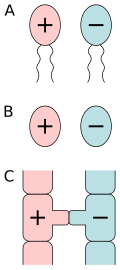
Isogamy is a form of sexual reproduction that involves gametes of the same morphology (indistinguishable in shape and size), and is found in most unicellular eukaryotes.[1] Because both gametes look alike, they generally cannot be classified as male or female.[2] Instead, organisms that reproduce through isogamy are said to have different mating types, most commonly noted as "+" and "−" strains.[3]
Etymology
The etymology of isogamy derives from the Greek adjective isos (meaning equal) and the Greek verb gameo (meaning to have sex/to reproduce), eventually meaning "equal reproduction" which refers to a hypothetical initial model of equal contribution of resources by both gametes to a zygote in contrast to a later evolutional stage of anisogamy.[4] The term isogamy was first used in the year 1891.[5][6]
Characteristics of isogamous species
Isogamous species often have two mating types (heterothallism), but sometimes can occur between two haploid individuals that are mitotic descendents (homothallism).[1][Note 1] Some isogamous species have more than two mating types, but the number is usually lower than ten. In some extremely rare cases, such as in some basidiomycete species, a species can have thousands of mating types.[7]
Under the strict definition of isogamy, fertilization occurs when two gametes fuse to form a zygote.[8] Sexual reproduction between two cells that does not involve gametes (e.g. conjugation between two mycelia in basidiomycete fungi), is often called isogamy, although it is not technically isogametic reproduction in the strict sense.[1]
Evolution
ไอโซกามีถือเป็นขั้นตอนแรกในวิวัฒนาการของการสืบพันธุ์แบบอาศัยเพศในสิ่งมีชีวิต ทุกชนิดที่รู้จัก โดยเชื่อกันว่าวิวัฒนาการของไอโซกามีเกิดขึ้นเพียงครั้งเดียวในสิ่งมีชีวิต เซลล์ เดียว ชนิด ยู คาริโอต ซึ่ง เป็นบรรพบุรุษร่วม ของ ยูคาริโอตทั้งหมดโดยทั่วไปเป็นที่ยอมรับกันว่าไอโซกามีเป็นสถานะบรรพบุรุษของอะนิโซกามี [ 1 ] [ 9 ] การสืบพันธุ์แบบไอโซกามีวิวัฒนาการอย่างอิสระในหลายสายพันธุ์ของพืชและสัตว์ไปสู่อะนิโซกามี (สายพันธุ์ที่มีแกมีตเพศผู้และเพศเมีย ) และต่อมาไปสู่โอโอกามี (สายพันธุ์ที่แกมีตเพศเมียมีขนาดใหญ่กว่าเพศผู้มากและไม่สามารถเคลื่อนที่ได้) รูปแบบนี้อาจถูกขับเคลื่อนโดยข้อจำกัดทางกายภาพของกลไกที่แกมีตสองตัวมารวมกันตามที่จำเป็นสำหรับการสืบพันธุ์แบบอาศัยเพศ[ 10 ]
นับตั้งแต่ปรากฏขึ้น ไอโซกามีก็ยังคงเป็นบรรทัดฐานในสิ่งมีชีวิตเซลล์เดียวแบบยูคาริโอตและเป็นไปได้ว่าไอโซกามีจะมีเสถียรภาพทางวิวัฒนาการในสิ่งมีชีวิตหลายเซลล์ด้วย[ 1 ]
การเกิดขึ้น
ยูคาริโอตเซลล์เดียวเกือบทั้งหมดมีการผสมพันธุ์แบบไอโซกามัส[ 11 ]ในบรรดาสิ่งมีชีวิตหลายเซลล์ การผสมพันธุ์แบบไอโซกามัสจำกัดอยู่เฉพาะ ใน เชื้อราและสาหร่าย ยูคาริ โอ ต [ 12 ] สาหร่ายสีเขียวหลายชนิดมีการผสมพันธุ์แบบไอโซกามั สซึ่งพบได้ทั่วไปในสกุลUlva , Hydrodictyon , Tetraspora , Zygnema , Spirogyra , UlothrixและChlamydomonas [ 1 ] [ 13 ]เชื้อราหลายชนิดก็มีการผสมพันธุ์แบบไอโซกามัสเช่นกัน รวมถึงชนิดเซลล์เดียว เช่นSaccharomyces cerevisiaeและSchizosaccharomyces pombe [ 1 ] [ 14 ]
ในเชื้อราหลายเซลล์บางชนิด เช่นบาซิดิโอไมซีสการสืบพันธุ์แบบอาศัยเพศเกิดขึ้นระหว่างไมซีเลียม สองเส้น แต่ไม่มีการแลกเปลี่ยนแกมีต[ 1 ]
ไม่มีตัวอย่างที่รู้จักของเมตาโซแอนไอโซ กามั สสาหร่ายแดงหรือพืชบก[ 1 ]
ดูเพิ่มเติม
ชีววิทยา
มานุษยวิทยาสังคม
หมายเหตุ
- ↑ไม่ควรสับสนกับภาวะไม่เข้ากันเองในพืช
เอกสารอ้างอิง
- 1 2 3 4 5 6 7 8 9 Lehtonen, Jussi; Kokko, Hanna; Parker, Geoff A. (2016-10-19). "สิ่งมีชีวิตไอโซกามัสสอนอะไรเราเกี่ยวกับเพศและเพศทั้งสอง?" . Philosophical Transactions of the Royal Society B: Biological Sciences . 371 (1706). doi : 10.1098/rstb.2015.0532 . ISSN 0962-8436 . PMC 5031617 . PMID 27619696 .
- ↑ Sawada, Hitoshi; Inoue, Naokazu; Iwano, Megumi (2014). การสืบพันธุ์แบบอาศัยเพศในสัตว์และพืช . Springer. หน้า216. ISBN 978-4-431-54589-7เก็บถาวรจากต้นฉบับเมื่อ 2024-04-04 เรียกดูเมื่อ2021-07-24
- ↑ Kumar R, Meena M, Swapnil P (2019). "Anisogamy". ใน Vonk J, Shackelford T (บรรณาธิการ). Anisogamy . สารานุกรมความรู้ความเข้าใจและพฤติกรรมของสัตว์ . Cham: Springer International Publishing. หน้า1–5 . doi : 10.1007/978-3-319-47829-6_340-1 . ISBN 978-3-319-47829-6.
- ↑ สารานุกรมชีววิทยาวิวัฒนาการเล่ม2 สำนักพิมพ์ Academic Press 14 เมษายน 2559 หน้า212 ISBN 978-0-12-800426-5เก็บถาวรจากต้นฉบับเมื่อ 2023-10-06 เรียกดูเมื่อ2021-08-14
- ↑ Hartog, M. (17 กันยายน 1891). "Isogamy การรวมตัวของเซลล์สืบพันธุ์ที่ไม่สามารถแยกแยะได้ในขนาด รูปร่าง และพฤติกรรม" Nature : 484.
- ↑ "คำจำกัดความของ ISOGAMOUS" . www.merriam-webster.com . เก็บถาวรจากต้นฉบับเมื่อ 2021-09-14 . เรียกดูเมื่อ2021-09-14 .
- ↑ Casselton, LA (2002-02-01). "การจดจำคู่ผสมพันธุ์ในเชื้อรา" . Heredity . 88 (2): 142– 147. doi : 10.1038/sj.hdy.6800035 . ISSN 1365-2540 .
- ↑ Krumbeck, Yvonne; Constable, George WA; Rogers, Tim (2020-02-26). "ความแตกต่างของความเหมาะสมยับยั้งจำนวนประเภทการผสมพันธุ์ในสายพันธุ์ไอโซกามัสที่กำลังวิวัฒนาการ" . Royal Society Open Science . 7 (2) 192126. arXiv : 1906.07117 . Bibcode : 2020RSOS....792126K . doi : 10.1098/rsos.192126 . ISSN 2054-5703 . PMC 7062084 . PMID 32257356 .
- ↑ Pitnick, Scott S.; Hosken, Dave J.; Birkhead, Tim R. (2008-11-21). ชีววิทยาของสเปิร์ม: มุมมองเชิงวิวัฒนาการ . สำนักพิมพ์ Academic Press. หน้า43–45 . ISBN 978-0-08-091987-4เก็บถาวรจากต้นฉบับเมื่อ 2023-10-06 เรียกดูเมื่อ2021-07-24
- ↑ Dusenbery, David B. (2009). Living at Micro Scale , บทที่ 20. สำนักพิมพ์มหาวิทยาลัยฮาร์วาร์ด, เคมบริดจ์, แมสซาชูเซตส์ ISBN 978-0-674-03116-6.
- ↑ เบลล์, เกรแฮม (2008). การคัดเลือก: กลไกแห่งวิวัฒนาการ . สำนักพิมพ์มหาวิทยาลัยออกซ์ฟอร์ด. หน้า439. ISBN 978-0-19-856972-5เก็บถาวรจากต้นฉบับเมื่อ 2023-10-06 เรียกดูเมื่อ2023-03-19
- ↑โทงาชิ, ทัตสึยะ; ค็อกซ์, พอล อลัน (14 เมษายน 2554). วิวัฒนาการของอะนิโซกามี: ปรากฏการณ์พื้นฐานที่อยู่เบื้องหลังการคัดเลือกทางเพศสำนักพิมพ์มหาวิทยาลัยเคมบริดจ์ หน้า96 ISBN 978-1-139-50082-1เก็บถาวรจากต้นฉบับเมื่อ 2023-10-06 เรียกดูเมื่อ2021-07-24
- ↑ Sharma, OP (1986-01-01). ตำราสาหร่าย . Tata McGraw-Hill Education. หน้า130. ISBN 978-0-07-451928-8เก็บถาวรจากต้นฉบับเมื่อ 2023-10-06 เรียกดูเมื่อ2021-07-24
- ↑ Heitman, Joseph; Howlett, Barbara J.; Crous, Pedro W.; Stukenbrock, Eva H.; James, Timothy Yong; Gow, Neil AR (10 กรกฎาคม 2020). อาณาจักรของเชื้อรา . สำนักพิมพ์ John Wiley & Sons. หน้า149. ISBN 978-1-55581-958-3เก็บถาวรจากต้นฉบับเมื่อ 2023-10-06 เรียกดูเมื่อ2021-07-24
- Sa Geng; Peter De Hoff; James G. Umen (8 กรกฎาคม 2014). "วิวัฒนาการของเพศจากการกำหนดลักษณะการผสมพันธุ์ของบรรพบุรุษ" PLOS Biology 12 ( 7) e1001904. doi : 10.1371/journal.pbio.1001904 . PMC 4086717 . PMID 25003332 .


สรุปเนื้อหา
ข้อมูลสำคัญจากบทความ
ข้อมูลสำคัญเกี่ยวกับ Isogamy
Isogamy is a form of sexual reproduction that involves gametes of the same morphology (indistinguishable in shape and size), and is found in most unicellular eukaryotes.
Etymology
The etymology of isogamy derives from the Greek adjective isos (meaning equal) and the Greek verb gameo (meaning to have sex/to reproduce), eventually meaning "equal reproduction" which refers to a hypothetical initial model of equal contribution of resources...
Characteristics of isogamous species
Isogamous species often have two mating types (heterothallism), but sometimes can occur between two haploid individuals that are mitotic descendents (homothallism).[1][Note 1] Some isogamous species have more than two mating types, but the number is usually...
Evolution
ไอโซกามีถือเป็นขั้นตอนแรกในวิวัฒนาการของการสืบพันธุ์แบบอาศัยเพศในสิ่งมีชีวิต ทุกชนิดที่รู้จัก โดยเชื่อกันว่าวิวัฒนาการของไอโซกามีเกิดขึ้นเพียงครั้งเดียวในสิ่งมีชีวิต เซลล์ เดียว ชนิด ยู คาริโอต ซึ่ง เป็นบรรพบุรุษร่วม ของ...