
Veps people
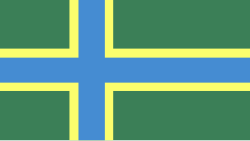 Veps flag[1] | |
| Total population | |
|---|---|
| 4,877 | |
| Regions with significant populations | |
 Russia Russia | 4,534 (2021)[2] |
 Ukraine Ukraine | 281 (2001)[3] |
 Estonia Estonia | 54 (2011)[4] |
 Belarus Belarus | 8 (2009)[5] |
| Languages | |
| Vepsian and Russian | |
| Religion | |
| Predominantly Eastern Orthodox | |
| Related ethnic groups | |
| Other Baltic FinnsEspecially Karelians, Izhorians, Votians, Estonians, and Finns | |
The Veps, or Vepsians (Veps: vepsläižed), are a Baltic Finnic people who speak the Veps language, which belongs to the Finnic branch of the Uralic languages.[6]
According to the 2002 Russian census, there were 8,240 Veps in Russia. Of the 281 Veps in Ukraine, 11 spoke Vepsian according to the 2001 Ukrainian census.
The self-designations of these people in various dialects are vepslaine, bepslaane, and (in northern dialects, southwest of Lake Onega) lüdinik and lüdilaine. Almost all Vepsians are fluent in Russian. The younger generation, in general, does not speak Vepsian; however, many have an understanding of the language.[7]
History
Prehistory
Archeological and linguistic studies suggest that Vepsians lived in the valleys of the Sheksna, the Suda, and the Syas rivers, developing, according to Kalevi Wiik, from the proto-Vepsian Kargopol culture to the east of Lake Onega. They probably also lived in East Karelia and on the northern coast of Lake Onega. It is possible that the earliest mention of the Veps dates to the sixth century CE, when the Gothic historian Jordanes mentioned a people called Vasina broncas, which may have indicated the Vepsians.[8] One of the eastern routes on which the Vikings went through their area, and the bjarm people mentioned by the Vikings as inhabiting the coast of the White Sea may have referred to the Veps.[9] Evidence from tombs proves that they had contact with Staraya Ladoga, Finland and Meryans, other Volga Finnic tribes and later with the Principality of Novgorod and other Russian states. Later Vepsians also inhabited the western and eastern shores of Onega.
Later history
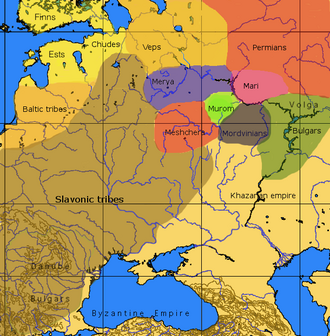
In medieval Russian chronicles, they are known as ves (весь);[6] in some Arabic sources, they are called Wisu. It is assumed that Bjarmians were at least partly Vepsians. From the 12th century, their history is connected with first Novgorod and then Muscovy. Russian settlement reached the Onega Veps in the 14th or 15th century.[10] Eastern Vepsians in the Kargopol area merged linguistically with the Russians before the 20th century.
The existence of the Vepsian people was not widely known until the mid-19th century. Despite its close relationship to the Karelian and the Finnish languages, the Vepsian language was thus one of the last Uralic languages to be recognized.
Vepsians numbered 25,607 in 1897. Some 7,300 of them inhabited East Karelia. In the beginning of the 20th century, there were some signs of national awakening among Vepsians. Early Soviet nationality politics supported this progress, and 24 administrative units with the status of national village soviets were formed. The alphabet and the written language were developed. Teachers started to instruct in Vepsian in some elementary schools. The Soviet authorities started to oppress the Vepsian culture in 1937. All national activities were stopped and the national districts were abolished. When Finland invaded East Karelia in the Continuation War, some Vepsians joined the so-called Kindred Battalion of the Finnish Army. These troops were relinquished to the Soviet Union after the war.[10][11][12]
In the post-war period, many Veps moved from their historic villages to larger cities. In 1983, on the initiative of national academics, an inquiry was carried out which showed that there were nearly 13,000 Veps in the Soviet Union, 5,600 of whom lived in Karelia, 4,000 in the Leningrad region and just under a 1,000 in the Vologda region.[10] The new Vepsian primerAbekirj and other elementary school books were published in Petrozavodsk in 1991. Kodima, a newspaper in Vepsian, has been published since 1993. The Vepsian rural community was formed in East Karelia in 1994, encompassing 8,200 square kilometers of land and 3,373 inhabitants, 42% of them Vepsian. The authorities of the Republic of Karelia granted some budgetary autonomy to the Vepsian community in 1996. The language was taught as a subject in two schools, in Shyoltozero and Rybreka. However, the cultural revival slowed in the second half of the 1990s and the federal authorities abolished the autonomy in 2006. Nowadays the younger generation in general does not speak the language.[12]
Geography
In modern times, they live in the area between Lake Ladoga, Lake Onega and Lake Beloye — in the Russian Republic of Karelia in the former Veps National Volost, in Leningrad Oblast along the Oyat River in the Podporozhsky and Lodeynopolsky Districts and further south in the Tikhvinsky and Boksitogorsky Districts, and in Vologda Oblast in the Vytegorsky and Babayevsky Districts.[13]
Demographics
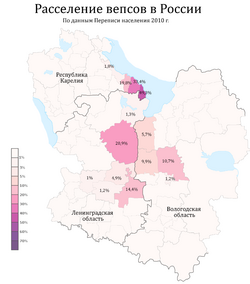
| Census | Population | Change (%) |
|---|---|---|
| 1897 | 25,607 | 0% |
| 1926 | 32,800 | +28% |
| 1937 | 29,500 | -10% |
| 1939 | 31,500 | +6.7% |
| 1959 | 16,400 | -47.9% |
| 1970 | 8,000 | -51.2% |
| 1979 | 8,000 | 0% |
| 1989 | 12,501 | +56.2% |
| 2002 | 8,240 | -34% |
| 2010 | 5,936 | -27.9% |
| 2021 | 4,534 | -23.6% |
Language
The Vepsian is a language belonging to the Northern Finnic branch of the Uralic languages, it is divided into three dialects:
- Northern Veps (spoken in the Prionezhsky District in the Republic of Karelia);
- Central Veps (spoken in the central parts of Podporozhsky District in the Leningrad Oblast and Babayevsky District in the Vologda Oblast);
- Southern Veps (spoken in the southern parts of Podporozhsky District in the Leningrad Oblast and Babayevsky District in the Vologda Oblast);
A number of Veps live outside the historical Vepsian Upland, mostly in other cities in the Republic of Karelia, Saint Petersburg and Moscow.
Genetics

Vepsians cluster with Karelians and Finns.[15][16] They share most of their autosomal ancestry with Europeans, but about 12% of their ancestry is Nganasan-like.[15][14] This Siberian-related component is linked to the spread of Uralic languages. Like other Baltic Finnic peoples, Vepsians have a high Steppe-related admixture.[15]
ชาวเวปเซียนมี กลุ่ม IBD (เอกลักษณ์โดยสายเลือด) ร่วมกับประชากรที่พูดภาษาอูราลิกหลายกลุ่ม รวมถึงกลุ่มที่อยู่ห่างไกลทางภูมิศาสตร์ เช่นชาวมันซีและชาวงานาซาน มากกว่าชาวรัสเซียหรือกลุ่มที่ไม่ใช่อูราลิกอื่นๆ ที่อยู่ใกล้เคียง ซึ่งสอดคล้องกับแนวคิดที่ว่าชนชาติที่พูดภาษาอูราลิกมีรากเหง้าร่วมกัน พวกเขายังมีกลุ่ม IBD ร่วมกับชาวดอล กันที่ พูดภาษาเตอร์กิก จากไซบีเรีย อย่างมีนัยสำคัญ อีกด้วย[ 15 ]
กลุ่มแฮปโลกรุ๊ปทางมารดาที่พบได้บ่อยที่สุดในชาวเวปเซียน ได้แก่H (57.6%) และU5 (16.8%) ซึ่งแสดงให้เห็นถึงความคล้ายคลึงกับกลุ่มฟินนิคบอลติกอื่นๆ ในงานวิจัยของ Tambets et al, 2018 พบว่า 56.4% ของผู้ชายชาวเวปเซียนมีแฮปโลกรุ๊ปNซึ่งมีต้นกำเนิดจากภาษาอูราลิกและพบได้ทั่วไปในประชากรที่พูดภาษาอูราลิก 38.5% อยู่ในกลุ่มย่อยN1a1a (M178)ซึ่งเป็นลักษณะเฉพาะของกลุ่มฟินโน-อูราลิกที่อยู่ใกล้เคียง และ 17.9% มีกลุ่มย่อยN-P43ซึ่งพบได้ทั่วไปในกลุ่มอูราลิกทางตะวันออกมากกว่า กลุ่มแฮปโลกรุ๊ป Y-DNA ที่พบมากเป็นอันดับสองในหมู่ชาวเวปเซียนคือR1a (35.9%) [ 15 ]สายเลือดทางบิดาของชาวเวปเซียนอาจได้รับอิทธิพลจากชาวซาโวลอชชูดซึ่งเชื่อกันว่าอาจมีการผสมผสานกับพวกเขา[ 17 ]บทความปี 2024 พบว่า Veps มีสายพันธุ์ N2a, N3a3 และ N3a4 คิดเป็นประมาณ 30% ของ y-DNA พร้อมกับการเพิ่มขึ้นของ I1 [ 18 ]
บุคคลสำคัญในเผ่าเวปเซียน
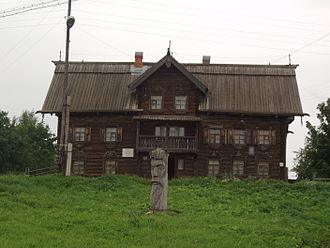
- นิโคไล อับราโมฟ (1961–2016) – กวี นักแปล และนักเขียนภาษาเวปเซียน
- อีวาน โกลูนอฟ (เกิดปี 1983) — นักข่าวสืบสวนชาวรัสเซียและนักข่าวต่อต้านการทุจริต[ 19 ]
- ไรซา ลาร์ดอต (เกิดปี 1938) นักเขียนชาวฟินแลนด์ที่เกิดในเมืองเวปส์
- แอนนา ลิซิซีนา (ค.ศ. 1922–1942) นักรบกองโจรโซเวียตวีรสตรี แห่งสหภาพโซเวียต
- ริวริก โลนิน (1930–2009) นักสะสมและนักเขียนเกี่ยวกับนิทานพื้นบ้านของชาวเวปส์
- อเล็กซานเดอร์ สวิร์สกี (ค.ศ. 1448–1533) นักบุญแห่งศาสนาคริสต์นิกายออร์โธดอกซ์ตะวันออก
แหล่งที่มา
- Grünthal, Riho (2022). "Veps". ใน Bakró-Nagy, Marianne; Laakso, Johanna; Skribnik, Elena (บรรณาธิการ). คู่มือภาษาอูราลิก ฉบับออกซ์ฟอร์ด . สำนักพิมพ์มหาวิทยาลัยออกซ์ฟอร์ด. ISBN 978-0-19-876766-4.
อ่านเพิ่มเติม
- Kurs, Ott (มีนาคม 2544). "ชาวเวปเซียน: ชาติพันธุ์ที่ถูกแบ่งแยกทางการปกครอง" Nationalities Papers . 29 (1): 69– 83. doi : 10.1080/00905990120036385 . S2CID 153956031 .
ลิงก์ภายนอก

- องค์กรเวสเซียน
- วิกิพีเดีย Veps
- ความพยายามในการฟื้นฟูภาษาเวปเซียน
- ชนเผ่าแห่งหนังสือสีแดง: เวปส์