
Faster-than-light
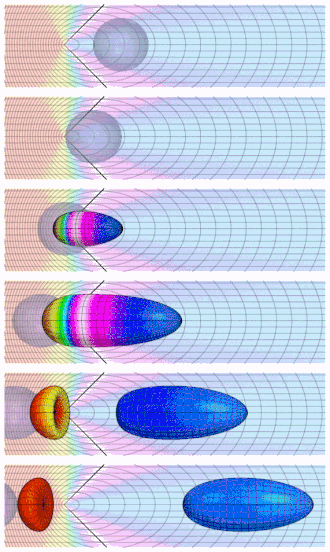
Faster-than-light (superluminal or supercausal) travel and communication are the conjectural propagation of matter or information faster than the speed of light in vacuum (c). The special theory of relativity implies that only particles with zero rest mass (i.e., photons) may travel at the speed of light, and that nothing may travel faster.
Particles whose speed exceeds that of light (tachyons) have been hypothesized, but their existence would violate causality and would imply time travel. The scientific consensus is that they do not exist.
According to all observations and current scientific theories, matter travels at slower-than-light (subluminal) speed with respect to the locally distorted spacetime region. Speculative faster-than-light concepts include the Alcubierre drive, Krasnikov tubes, traversable wormholes, and quantum tunneling.[1][2] Some of these proposals find loopholes around general relativity, such as by expanding or contracting space to make the object appear to be travelling greater than c. Such proposals are still widely believed to be impossible as they still violate current understandings of causality, and they all require fanciful mechanisms to work (such as requiring exotic matter).
Superluminal travel of non-information
In the context of this article, "faster-than-light" means the transmission of information or matter faster than c, a constant equal to the speed of light in vacuum, which is 299,792,458 m/s (by definition of the metre)[3] or about 186,282.397 miles per second. This is not quite the same as traveling faster than light, since:
- Some processes propagate faster than c, but cannot carry information (see examples in the sections immediately following).
- ในวัสดุบางชนิดที่แสงเดินทางด้วยความเร็วc/n (โดยที่nคือดัชนีหักเห ) อนุภาคอื่น ๆ สามารถเดินทางได้เร็วกว่าc/n (แต่ยังคงช้ากว่าc ) ซึ่งนำไปสู่การแผ่รังสีเชเรนคอฟ (ดูความเร็วเฟสด้านล่าง )
ปรากฏการณ์ทั้งสองนี้ไม่ได้ขัดแย้งกับทฤษฎีสัมพัทธภาพพิเศษหรือก่อให้เกิดปัญหาเกี่ยวกับความเป็นเหตุเป็นผลดังนั้นจึงไม่เข้าข่ายการเคลื่อนที่เร็วกว่าแสงตามที่อธิบายไว้ในที่นี้
ในตัวอย่างต่อไปนี้ อิทธิพลบางอย่างอาจดูเหมือนเดินทางเร็วกว่าแสง แต่พวกมันไม่ได้ส่งผ่านพลังงานหรือข้อมูลเร็วกว่าแสง ดังนั้นจึงไม่ขัดกับทฤษฎีสัมพัทธภาพพิเศษ
ภาพเคลื่อนไหวท้องฟ้าประจำวัน
สำหรับผู้สังเกตการณ์บนโลก วัตถุบนท้องฟ้าจะโคจรรอบโลกครบหนึ่งรอบในหนึ่งวัน ดาวฤกษ์Proxima Centauriซึ่งเป็นดาวฤกษ์ที่อยู่ใกล้ที่สุดนอกระบบสุริยะ อยู่ห่างออกไปประมาณสี่ปีแสง ครึ่ง [ 4 ]ในกรอบอ้างอิงนี้ ซึ่งดาวฤกษ์ Proxima Centauri ถูกมองว่าเคลื่อนที่ในวิถีโค้งเป็นวงกลมที่มีรัศมีสี่ปีแสง มันสามารถอธิบายได้ว่ามีความเร็วมากกว่าc หลายเท่า เนื่องจากความเร็วขอบของวัตถุที่เคลื่อนที่เป็นวงกลมเป็นผลคูณของรัศมีและความเร็วเชิงมุม[ 4 ] ในมุมมอง แบบจีโอสแตติก วัตถุเช่นดาวหาง ก็อาจเปลี่ยนแปลงความเร็วจากความเร็วต่ำกว่าแสงไปเป็นความเร็วเหนือแสงและในทางกลับกันได้เช่นกัน เพียงเพราะระยะห่างจากโลกเปลี่ยนแปลงไป ดาวหางอาจมีวงโคจรที่พาพวกมันออกไปไกลกว่า 1000 AU [ 5 ] เส้นรอบวงของวงกลมที่มีรัศมี 1000 AU มีขนาดใหญ่กว่าหนึ่งวันแสง กล่าวอีกนัยหนึ่ง ดาวหางที่อยู่ห่างไกลขนาดนั้นจะมีความเร็วเหนือแสงในกรอบอ้างอิง แบบสถิตของโลก ซึ่งไม่ใช่กรอบอ้างอิง เฉื่อย
จุดแสงและเงา
หากลำแสงเลเซอร์ถูกกวาดไปทั่ววัตถุที่อยู่ไกลออกไป จุดแสงเลเซอร์อาจดูเหมือนเคลื่อนที่ไปทั่ววัตถุด้วยความเร็วมากกว่าc [ 6 ]ในทำนองเดียวกัน เงาที่ฉายลงบนวัตถุที่อยู่ไกลออกไปก็ดูเหมือนจะเคลื่อนที่ไปทั่ววัตถุเร็วกว่าc [ 6 ]ในทั้งสองกรณี แสงไม่ได้เดินทางจากแหล่งกำเนิดไปยังวัตถุเร็วกว่าcและ ข้อมูลใดๆ ก็ไม่ได้เดินทางเร็วกว่าแสง ไม่มีวัตถุใดเคลื่อนที่ในตัวอย่างเหล่านี้ เพื่อเปรียบเทียบ ลองพิจารณาน้ำที่พุ่งออกมาจากสายยางรดน้ำต้นไม้ขณะที่แกว่งไปมา น้ำไม่ได้เคลื่อนที่ตามทิศทางของสายยางในทันที[ 6 ] [ 7 ] [ 8 ]
ความเร็วในการปิด
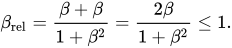
อัตราที่วัตถุสองชิ้นเคลื่อนที่เข้าใกล้กันในกรอบอ้างอิงเดียวกัน เรียกว่า ความเร็วร่วม หรือ ความเร็วเข้าใกล้ ซึ่งอาจเข้าใกล้สองเท่าของความเร็วแสง เช่น ในกรณีของอนุภาคสองอนุภาคที่เคลื่อนที่ด้วยความเร็วใกล้เคียงกับความเร็วแสงในทิศทางตรงกันข้ามเมื่อเทียบกับกรอบอ้างอิง
ลองนึกภาพอนุภาคสองอนุภาคที่เคลื่อนที่เร็วเข้าหากันจากด้านตรงข้ามของเครื่องเร่งอนุภาคแบบคอลไลเดอร์ ความเร็วในการเข้าใกล้กันจะเป็นอัตราที่ระยะห่างระหว่างอนุภาคทั้งสองลดลง จากมุมมองของผู้สังเกตการณ์ที่ยืนอยู่นิ่งเมื่อเทียบกับเครื่องเร่งอนุภาค อัตรานี้จะน้อยกว่าสองเท่าของความเร็วแสงเล็กน้อย
ทฤษฎีสัมพัทธภาพพิเศษไม่ได้ห้ามการกระทำนี้ แต่กลับบ่งชี้ว่าการใช้ทฤษฎีสัมพัทธภาพแบบกาลิเลโอในการคำนวณความเร็วของอนุภาคหนึ่งตามที่ผู้สังเกตซึ่งเคลื่อนที่ไปพร้อมกับอนุภาคอีกตัววัดได้นั้นเป็นสิ่งที่ไม่ถูกต้อง กล่าวคือ ทฤษฎีสัมพัทธภาพพิเศษให้สูตรการบวกความเร็ว ที่ถูกต้องสำหรับการคำนวณ ความเร็วสัมพัทธ์ดังกล่าว
การคำนวณความเร็วสัมพัทธ์ของอนุภาคที่เคลื่อนที่ด้วยความเร็วvและ −v ในกรอบอ้างอิงของเครื่องเร่งอนุภาค ซึ่งสอดคล้องกับความเร็วเข้าใกล้กันที่2v > c นั้นเป็นสิ่งที่มีประโยชน์ โดยแสดงความเร็วในหน่วยของcจะ ได้ β = v / c :
ความเร็วที่เหมาะสม
ถ้าหากยานอวกาศเดินทางไปยังดาวเคราะห์ที่อยู่ห่างจากโลกหนึ่งปีแสง (วัดในกรอบอ้างอิงของโลก) ด้วยความเร็วสูง เวลาที่ใช้ในการไปถึงดาวเคราะห์ดวงนั้นอาจน้อยกว่าหนึ่งปีเมื่อวัดจากนาฬิกาของผู้เดินทาง (แต่จะมากกว่าหนึ่งปีเสมอเมื่อวัดจากนาฬิกาบนโลก) ค่าที่ได้จากการหารระยะทางที่เดินทาง (วัดในกรอบอ้างอิงของโลก) ด้วยเวลาที่ใช้ (วัดจากนาฬิกาของผู้เดินทาง) เรียกว่า ความเร็วที่แท้จริง หรือความเร็วที่แท้จริงไม่มีข้อจำกัดใดๆ เกี่ยวกับค่าของความเร็วที่แท้จริง เนื่องจากความเร็วที่แท้จริงไม่ได้แสดงถึงความเร็วที่วัดในกรอบอ้างอิงเฉื่อยเพียงกรอบเดียว สัญญาณแสงที่ออกจากโลกในเวลาเดียวกันกับผู้เดินทางจะไปถึงจุดหมายปลายทางก่อนผู้เดินทางเสมอ
ความเร็วเฟสที่สูงกว่าc
The phase velocity of an electromagnetic wave, when traveling through a medium, can routinely exceed c, the vacuum velocity of light. For example, this occurs in most glasses at X-ray frequencies.[9] However, the phase velocity of a wave corresponds to the propagation speed of a theoretical single-frequency (purely monochromatic) component of the wave at that frequency. Such a wave component must be infinite in extent and of constant amplitude (otherwise it is not truly monochromatic), and so cannot convey any information.[10] Thus a phase velocity above c does not imply the propagation of signals with a velocity above c.[11]
Group velocities above c
The group velocity of a wave may also exceed c in some circumstances.[12][13] In such cases, which typically at the same time involve rapid attenuation of the intensity, the maximum of the envelope of a pulse may travel with a velocity above c. However, even this situation does not imply the propagation of signals with a velocity above c,[14] even though one may be tempted to associate pulse maxima with signals. The latter association has been shown to be misleading, because the information on the arrival of a pulse can be obtained before the pulse maximum arrives. For example, if some mechanism allows the full transmission of the leading part of a pulse while strongly attenuating the pulse maximum and everything behind (distortion), the pulse maximum is effectively shifted forward in time, while the information on the pulse does not come faster than c without this effect.[15] However, group velocity can exceedc in some parts of a Gaussian beam in vacuum (without attenuation). The diffraction causes the peak of the pulse to propagate faster, while overall power does not.[16]
Cosmic expansion
According to Hubble's law, the expansion of the universe causes distant galaxies to appear to recede from the Earth faster than the speed of light. However, the recession speed associated with Hubble's law, defined as the rate of increase in proper distance per interval of cosmological time, is not a velocity in a relativistic sense. Moreover, in general relativity, velocity is a local notion, and there is not even a unique definition for the relative velocity of a cosmologically distant object.[17] Faster-than-light cosmological recession speeds are entirely a coordinate effect.
There are many galaxies visible in telescopes with redshift numbers of 1.4 or higher. All of these have cosmological recession speeds greater than the speed of light. Because the Hubble parameter is decreasing with time, there can actually be cases where a galaxy that is receding from the Earth faster than light does manage to emit a signal which reaches the Earth eventually.[18][19][20]
However, because the expansion of the universe is accelerating, it is projected that most galaxies will eventually cross a type of cosmological event horizon where any light they emit past that point will never be able to reach the Earth any time in the infinite future,[21] because the light never reaches a point where its "peculiar velocity" towards the Earth exceeds the expansion velocity away from the Earth (these two notions of velocity are also discussed in Comoving and proper distances § Uses of the proper distance). The current distance to this cosmological event horizon is about 16 billion light-years, meaning that a signal from an event happening at present would eventually be able to reach the Earth in the future if the event was less than 16 billion light-years away, but the signal would never arrive if the event was more than 16 billion light-years away.[19]
Astronomical observations
Apparent superluminal motion is observed in many radio galaxies, blazars, quasars, and recently also in microquasars. The effect was predicted before it was observed by Martin Rees and can be explained as an optical illusion caused by the object partly moving in the direction of the observer,[22] when the speed calculations assume it does not. The phenomenon does not contradict the theory of special relativity. Corrected calculations show these objects have velocities close to the speed of light (relative to our reference frame). They are the first examples of large amounts of mass moving at close to the speed of light.[23] Earth-bound laboratories have only been able to accelerate small numbers of elementary particles to such speeds.
Quantum mechanics
Certain phenomena in quantum mechanics, such as quantum entanglement, might give the superficial impression of allowing communication of information faster than light. According to the no-communication theorem these phenomena do not allow true communication; they only let two observers in different locations see the same system simultaneously, without any way of controlling what either sees. Wavefunction collapse can be viewed as an epiphenomenon of quantum decoherence, which in turn is nothing more than an effect of the underlying local time evolution of the wavefunction of a system and all of its environment. Since the underlying behavior does not violate local causality or allow faster-than-light communication, it follows that neither does the additional effect of wavefunction collapse, whether real or apparent.
The uncertainty principle implies that individual photons may travel for short distances at speeds somewhat faster (or slower) than c, even in vacuum; this possibility must be taken into account when enumerating Feynman diagrams for a particle interaction.[24] However, it was shown in 2011 that a single photon may not travel faster than c.[25]
มีรายงานต่างๆ ในสื่อยอดนิยมเกี่ยวกับการทดลองการส่งผ่านที่เร็วกว่าแสงในด้านทัศนศาสตร์ — ส่วนใหญ่จะอยู่ในบริบทของ ปรากฏการณ์ การทะลุผ่านควอนตัม ชนิดหนึ่ง โดยปกติแล้ว รายงานดังกล่าวจะเกี่ยวข้องกับความเร็วเฟสหรือความเร็วกลุ่มที่เร็วกว่าความเร็วแสงในสุญญากาศ[ 26 ] [ 27 ]อย่างไรก็ตาม ดังที่กล่าวไว้ข้างต้น ความเร็วเฟสที่เร็วกว่าแสงไม่สามารถนำมาใช้สำหรับการส่งผ่านข้อมูลที่เร็วกว่าแสงได้[ 28 ] [ 29 ]
ปรากฏการณ์ฮาร์ทแมน
ปรากฏการณ์ฮาร์ทแมนคือปรากฏการณ์การทะลุผ่านสิ่งกีดขวาง โดยเวลาการทะลุผ่านมีแนวโน้มคงที่สำหรับสิ่งกีดขวางขนาดใหญ่[ 30 ] [ 31 ]ตัวอย่างเช่น อาจเป็นช่องว่างระหว่างปริซึมสองอัน เมื่อปริซึมสัมผัสกัน แสงจะผ่านตรงไป แต่เมื่อมีช่องว่าง แสงจะหักเห มีความน่าจะเป็นที่ไม่เป็นศูนย์ที่โฟตอนจะทะลุผ่านช่องว่างแทนที่จะตามเส้นทางการหักเห
อย่างไรก็ตาม มีการอ้างว่าผลกระทบของฮาร์ทแมนไม่สามารถนำมาใช้เพื่อละเมิดทฤษฎีสัมพัทธภาพได้จริง ๆ โดยการส่งสัญญาณที่เร็วกว่าcเนื่องจากเวลาการทะลุผ่าน "ไม่ควรเชื่อมโยงกับความเร็วเนื่องจากคลื่นเอวาเนสเซนต์ไม่แพร่กระจาย" [ 32 ]คลื่นเอวาเนสเซนต์ในผลกระทบของฮาร์ทแมนเกิดจากอนุภาคเสมือนและสนามสถิตที่ไม่แพร่กระจาย ดังที่กล่าวไว้ในส่วนข้างต้นสำหรับแรงโน้มถ่วงและแม่เหล็กไฟฟ้า
ปรากฏการณ์แคซิเมียร์
ในทางฟิสิกส์แรงแคสิเมียร์-โพลเดอร์คือแรงทางกายภาพที่กระทำระหว่างวัตถุที่แยกจากกัน เนื่องจากการสั่นพ้องของพลังงานสุญญากาศในพื้นที่ระหว่างวัตถุ บางครั้งมีการอธิบายในแง่ของอนุภาคเสมือนที่ปฏิสัมพันธ์กับวัตถุ เนื่องจากรูปแบบทางคณิตศาสตร์ของวิธีการคำนวณความแรงของผลกระทบวิธีหนึ่งที่เป็นไปได้ เนื่องจากความแรงของแรงลดลงอย่างรวดเร็วตามระยะทาง จึงสามารถวัดได้เฉพาะเมื่อระยะห่างระหว่างวัตถุมีขนาดเล็กมากเท่านั้น เนื่องจากผลกระทบนี้เกิดจากอนุภาคเสมือนที่ทำหน้าที่เป็นตัวกลางของผลกระทบสนามสถิต จึงอยู่ภายใต้ข้อสังเกตเกี่ยวกับสนามสถิตที่กล่าวถึงข้างต้น
ปรากฏการณ์ขัดแย้งของ EPR
ปรากฏการณ์ EPR (Electronic Percentage Persection) เป็นการทดลองทางความคิดของอัลเบิร์ต ไอน์สไตน์ , บอริส โพดอลสกีและนาธาน โรเซนและตั้งชื่อตามนามสกุลของพวกเขา ในการทดลองนี้ การวัด สถานะควอนตัม ที่พันกัน สองครั้ง จะมีความสัมพันธ์กัน แม้ว่าการวัดจะอยู่ห่างจากแหล่งกำเนิดและอยู่ห่างกันก็ตาม อย่างไรก็ตาม ไม่สามารถส่งข้อมูลใดๆ ผ่านทางนี้ได้ คำตอบว่าการวัดนั้นส่งผลกระทบต่อระบบควอนตัมอื่นหรือไม่นั้น ขึ้นอยู่กับการตีความกลศาสตร์ควอนตัมที่แต่ละคนยึดถือ
การทดลองที่ดำเนินการโดยNicolas Gisin ในปี 1997 ได้แสดงให้เห็นถึงความสัมพันธ์เชิงควอนตัมระหว่างอนุภาคที่แยกจากกันมากกว่า 10 กิโลเมตร[ 33 ]แต่ดังที่ได้กล่าวไว้ก่อนหน้านี้ ความสัมพันธ์ที่ไม่ใช่แบบโลคอลที่เห็นในการพัวพันนั้นไม่สามารถนำมาใช้ส่งข้อมูลแบบคลาสสิกได้เร็วกว่าแสง ดังนั้นความเป็นเหตุเป็นผลเชิงสัมพัทธภาพจึงยังคงอยู่ สถานการณ์นี้คล้ายกับการแบ่งปันการโยนเหรียญแบบซิงโครไนซ์ ซึ่งคนที่สองที่โยนเหรียญจะเห็นสิ่งที่ตรงกันข้ามกับสิ่งที่คนแรกเห็นเสมอ แต่ไม่มีใครสามารถรู้ได้ว่าใครเป็นคนโยนเหรียญคนแรกหรือคนที่สอง เว้นแต่จะสื่อสารกันแบบคลาสสิก ดูทฤษฎีบทการไม่สื่อสารสำหรับข้อมูลเพิ่มเติม การทดลองฟิสิกส์ควอนตัมในปี 2008 ซึ่งดำเนินการโดยนิโคลัส กิซินและเพื่อนร่วมงานของเขา ได้กำหนดว่าในทฤษฎีตัวแปรซ่อนเร้นที่ไม่ใช่แบบโลคอล สมมติฐานใดๆ ความเร็วของการเชื่อมต่อควอนตัมที่ไม่ใช่แบบโลคอล (สิ่งที่ไอน์สไตน์เรียกว่า "การกระทำที่น่าขนลุกในระยะไกล") นั้นมีความเร็วอย่างน้อย 10,000 เท่าของความเร็วแสง[ 34 ]
ตัวลบควอนตัมแบบเลือกช้า
ตัวลบควอนตัมแบบเลือกช้าเป็นรูปแบบหนึ่งของความขัดแย้ง EPR ซึ่งการสังเกต (หรือไม่สังเกต) การรบกวนหลังจากการผ่านของโฟตอนผ่านการทดลองช่องคู่ขึ้นอยู่กับเงื่อนไขของการสังเกตโฟตอนตัวที่สองที่พันกันกับโฟตอนตัวแรก ลักษณะเฉพาะของการทดลองนี้คือการสังเกตโฟตอนตัวที่สองสามารถเกิดขึ้นได้ในเวลาต่อมามากกว่าการสังเกตโฟตอนตัวแรก[ 35 ]ซึ่งอาจทำให้เกิดความรู้สึกว่าการวัดโฟตอนในภายหลัง "ย้อนหลัง" จะกำหนดว่าโฟตอนก่อนหน้านี้แสดงการรบกวนหรือไม่ แม้ว่ารูปแบบการรบกวนจะสามารถมองเห็นได้โดยการเชื่อมโยงการวัดของสมาชิกทั้งสองของทุกคู่เท่านั้น และจะไม่สามารถสังเกตได้จนกว่าจะมีการวัดโฟตอนทั้งสองตัวแล้ว ทำให้มั่นใจได้ว่าผู้ทำการทดลองที่เฝ้าดูเฉพาะโฟตอนที่ผ่านช่องจะไม่ได้รับข้อมูลเกี่ยวกับโฟตอนอื่นในลักษณะที่เร็วกว่าแสงหรือย้อนเวลากลับไป[ 36 ] [ 37 ]
การสื่อสารเหนือแสง
ตามทฤษฎีสัมพัทธภาพ การสื่อสารที่เร็วกว่าแสงเทียบเท่ากับการเดินทางข้ามเวลาสิ่งที่วัดได้ว่าเป็นความเร็วแสงในสุญญากาศ (หรือใกล้สุญญากาศ) แท้จริงแล้วคือค่าคงที่ทางฟิสิกส์พื้นฐานc ซึ่งหมายความว่าผู้สังเกตการณ์ เฉื่อยทั้งหมดและสำหรับความเร็วแสงในพิกัด ผู้สังเกตการณ์ที่ไม่เฉื่อย ไม่ว่าความเร็ว สัมพัทธ์ของพวกเขา จะเป็นเท่าใด ก็จะวัดอนุภาคที่มีมวลเป็นศูนย์ เช่นโฟตอนที่เดินทางด้วย ความเร็ว cในสุญญากาศเสมอ ผลลัพธ์นี้หมายความว่าการวัดเวลาและความเร็วในกรอบอ้างอิงที่แตกต่างกันจะไม่สัมพันธ์กันโดยการเลื่อนค่าคงที่อีกต่อไป แต่จะสัมพันธ์กันโดยการแปลงปวงกาเรการแปลงเหล่านี้มีนัยสำคัญที่สำคัญ:
- โมเมนตัมเชิงสัมพัทธภาพของ อนุภาค ที่มีมวลจะเพิ่มขึ้นตามความเร็วในลักษณะที่ว่า ที่ความเร็วแสง วัตถุจะมีโมเมนตัมอนันต์
- การเร่งความเร็ววัตถุที่มีมวล นิ่งไม่เป็นศูนย์ ให้ถึง ความเร็ว cนั้น จำเป็นต้องใช้เวลานานอนันต์ด้วยความเร่งที่มีค่าจำกัด หรือต้องใช้ความเร่งอนันต์ในช่วงเวลาจำกัด
- ไม่ว่าจะด้วยวิธีใด การเร่งความเร็วในระดับนี้ต้องใช้พลังงานมหาศาล
- ผู้สังเกตการณ์บางคนที่มีการเคลื่อนที่สัมพัทธ์ต่ำกว่าแสงจะไม่เห็นด้วยว่าเหตุการณ์สองเหตุการณ์ใดที่แยกจากกันด้วยช่วงเวลาคล้ายอวกาศจะ เกิดขึ้นก่อน กัน[ 38 ]กล่าวอีกนัยหนึ่ง การเดินทางใดๆ ที่เร็วกว่าแสงจะถูกมองว่าเป็นการเดินทางย้อนเวลากลับไปในกรอบอ้างอิงอื่นๆ ที่ถูกต้องเท่าเทียมกัน[ 39 ]หรือจำเป็นต้องสมมติสมมติฐานเชิงคาดการณ์เกี่ยวกับการละเมิดลอเรนซ์ที่เป็นไปได้ในระดับที่ยังไม่ถูกสังเกตในปัจจุบัน (เช่น ระดับพลังค์) ดังนั้น ทฤษฎีใดๆ ที่อนุญาตให้มีการเดินทางเร็วกว่าแสง "ที่แท้จริง" จะต้องรับมือกับการเดินทางข้ามเวลาและความขัดแย้งที่เกี่ยวข้องทั้งหมด[ 40 ]หรือมิฉะนั้นจะต้องสมมติว่าความไม่แปรผันของลอเรนซ์เป็นสมมาตรของลักษณะทางสถิติทางอุณหพลศาสตร์ (ดังนั้นจึงเป็นสมมาตรที่ถูกทำลายในระดับที่ยังไม่ถูกสังเกตในปัจจุบัน)
- In special relativity the coordinate speed of light is only guaranteed to be c in an inertial frame; in a non-inertial frame the coordinate speed may be different from c.[41] In general relativity no coordinate system on a large region of curved spacetime is "inertial", so it is permissible to use a global coordinate system where objects travel faster than c, but in the local neighborhood of any point in curved spacetime there can be defined a "local inertial frame" and the local speed of light will be c in this frame,[42] with massive objects moving through this local neighborhood always having a speed less than c in the local inertial frame.
Justifications
Casimir vacuum and quantum tunnelling
Special relativity postulates that the speed of light in a vacuum is invariant in inertial frames. That is, it will be the same from any frame of reference moving at a constant speed. The equations do not specify any particular value for the speed of light, which is an experimentally determined quantity for a fixed unit of length. Since 1983, the SI unit of length (the meter) has been defined using the speed of light.
การกำหนดค่าเชิงทดลองได้เกิดขึ้นในสุญญากาศ แต่สุญญากาศที่สังเกตได้นั้นไม่ใช่สุญญากาศเดียวที่เป็นไปได้ สุญญากาศมีพลังงานที่เกี่ยวข้อง ซึ่งเรียกง่ายๆ ว่าพลังงานสุญญากาศซึ่งอาจเปลี่ยนแปลงได้ในบางกรณี[ 43 ]เมื่อพลังงานสุญญากาศลดลง มีการคาดการณ์ว่าแสงจะเคลื่อนที่เร็วกว่าค่ามาตรฐานcปรากฏการณ์นี้เรียกว่าปรากฏการณ์ชาร์นฮอร์สต์สุญญากาศดังกล่าวสามารถสร้างขึ้นได้โดยการนำแผ่นโลหะเรียบสองแผ่นมาประกบกันโดยมีระยะห่างใกล้เคียงกับเส้นผ่านศูนย์กลางอะตอม เรียกว่าสุญญากาศแคสิเมียร์การคำนวณบ่งชี้ว่าแสงจะเคลื่อนที่เร็วขึ้นในสุญญากาศดังกล่าวในปริมาณเล็กน้อย โฟตอนที่เดินทางระหว่างแผ่นสองแผ่นที่ห่างกัน 1 ไมโครเมตรจะเพิ่มความเร็วของโฟตอนเพียงประมาณ 1 ส่วนใน 10 36 [ 44 ] ดังนั้นจึงยังไม่มีการตรวจสอบเชิงทดลองของการคาดการณ์นี้ การวิเคราะห์ล่าสุด[ 45 ]โต้แย้งว่าปรากฏการณ์ Scharnhorst ไม่สามารถใช้ส่งข้อมูลย้อนเวลากลับไปได้ด้วยแผ่นเดียว เนื่องจากกรอบอ้างอิงของแผ่นจะกำหนด " กรอบอ้างอิงที่ต้องการ " สำหรับการส่งสัญญาณ FTL อย่างไรก็ตาม ผู้เขียนตั้งข้อสังเกตว่า เมื่อมีแผ่นหลายคู่เคลื่อนที่สัมพันธ์กัน พวกเขาไม่มีข้อโต้แย้งใดที่สามารถ "รับประกันการไม่มีการละเมิดความเป็นเหตุเป็นผลโดยสิ้นเชิง" และอ้างถึงสมมติฐานการป้องกันลำดับเวลาเชิงคาด การณ์ของ Hawking ซึ่งชี้ให้เห็นว่าวงจรป้อนกลับของอนุภาคเสมือนจะสร้าง "ภาวะเอกฐานที่ควบคุมไม่ได้ในพลังงานความเครียดควอนตัมที่ปรับค่าใหม่" บนขอบเขตของเครื่องย้อนเวลาที่เป็นไปได้ และดังนั้นจึงต้องใช้ทฤษฎีแรงโน้มถ่วงควอนตัมในการวิเคราะห์อย่างครบถ้วน ผู้เขียนคนอื่นโต้แย้งว่าการวิเคราะห์ดั้งเดิมของ Scharnhorst ซึ่งดูเหมือนจะแสดงความเป็นไปได้ของสัญญาณที่เร็วกว่าcเกี่ยวข้องกับการประมาณค่าซึ่งอาจไม่ถูกต้อง ดังนั้นจึงไม่ชัดเจนว่าปรากฏการณ์นี้จะสามารถเพิ่มความเร็วของสัญญาณได้จริงหรือไม่[ 46 ]
It was later claimed by Eckle et al. that particle tunneling does indeed occur in zero real time.[47] Their tests involved tunneling electrons, where the group argued a relativistic prediction for tunneling time should be 500–600 attoseconds (an attosecond is one quintillionth (10−18) of a second). All that could be measured was 24 attoseconds, which is the limit of the test accuracy. Again, though, other physicists believe that tunneling experiments in which particles appear to spend anomalously short times inside the barrier are in fact fully compatible with relativity, although there is disagreement about whether the explanation involves reshaping of the wave packet or other effects.[48][49][50]
Give up (absolute) relativity
Because of the strong empirical support for special relativity, any modifications to it must necessarily be quite subtle and difficult to measure. The best-known attempt is doubly special relativity, which posits that the Planck length is also the same in all reference frames, and is associated with the work of Giovanni Amelino-Camelia and João Magueijo.[51][52] There are speculative theories that claim inertia is produced by the combined mass of the universe (e.g., Mach's principle), which implies that the rest frame of the universe might be preferred by conventional measurements of natural law. If confirmed, this would imply special relativity is an approximation to a more general theory, but since the relevant comparison would (by definition) be outside the observable universe, it is difficult to imagine (much less construct) experiments to test this hypothesis. Despite this difficulty, such experiments have been proposed.[53]
Spacetime distortion
Although the theory of special relativity forbids objects to have a relative velocity greater than light speed, and general relativity reduces to special relativity in a local sense (in small regions of spacetime where curvature is negligible), general relativity does allow the space between distant objects to expand in such a way that they have a "recession velocity" which exceeds the speed of light, and it is thought that galaxies which are at a distance of more than about 14 billion light-years the Earth today have a recession velocity which is faster than light.[19]Miguel Alcubierre theorized that it would be possible to create a warp drive, in which a ship would be enclosed in a "warp bubble" where the space at the front of the bubble is rapidly contracting and the space at the back is rapidly expanding, with the result that the bubble can reach a distant destination much faster than a light beam moving outside the bubble, but without objects inside the bubble locally traveling faster than light.[54] However, several objections raised against the Alcubierre drive appear to rule out the possibility of actually using it in any practical fashion. Another possibility predicted by general relativity is the traversable wormhole, which could create a shortcut between arbitrarily distant points in space. As with the Alcubierre drive, travelers moving through the wormhole would not locally move faster than light travelling through the wormhole alongside them, but they would be able to reach their destination (and return to their starting location) faster than light traveling outside the wormhole.
Gerald Cleaver and Richard Obousy, a professor and student of Baylor University, theorized that manipulating the extra spatial dimensions of string theory around a spaceship with an extremely large amount of energy would create a "bubble" that could cause the ship to travel faster than the speed of light. To create this bubble, the physicists believe manipulating the 10th spatial dimension would alter the dark energy in three large spatial dimensions: height, width and length. Cleaver said positive dark energy is currently responsible for speeding up the expansion rate of our universe as time moves on.[55]
Lorentz symmetry violation
The possibility that Lorentz symmetry may be violated has been seriously considered in the last two decades, particularly after the development of a realistic effective field theory that describes this possible violation, the so-called Standard-Model Extension.[56][57][58] This general framework has allowed experimental searches by ultra-high energy cosmic-ray experiments[59] and a wide variety of experiments in gravity, electrons, protons, neutrons, neutrinos, mesons, and photons.[60] The breaking of rotation and boost invariance causes direction dependence in the theory as well as unconventional energy dependence that introduces novel effects, including Lorentz-violating neutrino oscillations and modifications to the dispersion relations of different particle species, which naturally could make particles move faster than light.
In some models of broken Lorentz symmetry, it is postulated that the symmetry is still built into the most fundamental laws of physics, but that spontaneous symmetry breaking of Lorentz invariance[61] shortly after the Big Bang could have left a "relic field" throughout the universe which causes particles to behave differently depending on their velocity relative to the field;[62] however, there are also some models where Lorentz symmetry is broken in a more fundamental way. If Lorentz symmetry can cease to be a fundamental symmetry at the Planck scale or at some other fundamental scale, it is conceivable that particles with a critical speed different from the speed of light be the ultimate constituents of matter.
In current models of Lorentz symmetry violation, the phenomenological parameters are expected to be energy-dependent. Therefore, as widely recognized,[63][64] existing low-energy bounds cannot be applied to high-energy phenomena; however, many searches for Lorentz violation at high energies have been carried out using the Standard-Model Extension.[60] Lorentz symmetry violation is expected to become stronger as one gets closer to the fundamental scale.
Superfluid theories of physical vacuum
ในแนวทางนี้สุญญากาศ ทางกายภาพ ถูกมองว่าเป็นของไหลยิ่งยวด ควอนตัม ซึ่งโดยพื้นฐานแล้วไม่ใช่สัมพัทธภาพ ในขณะที่สมมาตรลอเรนซ์ไม่ใช่สมมาตรที่แน่นอนของธรรมชาติ แต่เป็นเพียงคำอธิบายโดยประมาณที่ใช้ได้เฉพาะกับความผันผวนเล็กน้อยของพื้นหลังของของไหลยิ่งยวดเท่านั้น[ 65 ]ภายในกรอบของแนวทางนี้ ได้มีการเสนอทฤษฎีที่คาดการณ์ว่าสุญญากาศทางกายภาพเป็นของไหลโบสควอนตัม ซึ่ง ฟังก์ชันคลื่นสถานะพื้นฐานอธิบายได้ด้วยสมการชโรดิงเกอร์แบบลอการิทึมแสดงให้เห็นว่าปฏิสัมพันธ์แรงโน้มถ่วงสัมพัทธภาพ เกิดขึ้นเป็น โหมดการกระตุ้นรวมที่มี แอม พลิจูดขนาดเล็ก[ 66 ]ในขณะที่อนุภาคพื้นฐาน สัมพัทธภาพ สามารถอธิบายได้ด้วยโหมดคล้ายอนุภาคในขีดจำกัดของโมเมนตัมต่ำ[ 67 ]ข้อเท็จจริงที่สำคัญคือที่ความเร็วสูงมาก พฤติกรรมของโหมดคล้ายอนุภาคจะแตกต่างจาก แบบสั มพัทธภาพ – พวกมันสามารถเข้าถึงขีดจำกัดความเร็วแสงได้ที่พลังงานจำกัด นอกจากนี้ การแพร่กระจายที่เร็วกว่าแสงยังเป็นไปได้โดยไม่ต้องอาศัยมวลจินตนาการ ของวัตถุที่ เคลื่อนที่[ 68 ] [ 69 ]
ผลการบินของนิวตริโนที่ความเร็วเหนือแสง
การทดลอง MINOS
การวัดความแม่นยำสูงจาก ความร่วมมือ MINOSสำหรับเวลาบินของนิวตริโน 3 GeV ให้ความเร็ว ( v / c −1) = (1.0±1.1)×10−6 ซึ่งเท่ากับความเร็วแสงถึงหนึ่งในล้านส่วน[ 70 ]
ความผิดปกติของนิวตริโน OPERA
เมื่อวันที่ 22 กันยายน พ.ศ. 2554 เอกสารฉบับร่าง[ 71 ]จากความร่วมมือ OPERAระบุว่าตรวจพบนิวตริโนมิวออน 17 และ 28 GeV ซึ่งถูกส่งเป็นระยะทาง 730 กิโลเมตร (454 ไมล์) จากCERNใกล้เมืองเจนีวา ประเทศสวิตเซอร์แลนด์ไปยังห้องปฏิบัติการแห่งชาติ Gran Sassoในประเทศอิตาลี โดยเดินทางเร็วกว่าแสงด้วยปริมาณสัมพัทธ์ของ2.48×10⁻⁵ (approximately 1 in 40,000), a statistic with 6.0-sigma significance.[72] On 17 November 2011, a second follow-up experiment by OPERA scientists confirmed their initial results.[73][74] However, scientists were skeptical about the results of these experiments, the significance of which was disputed.[75] In March 2012, the ICARUS collaboration failed to reproduce the OPERA results with their equipment, detecting neutrino travel time from CERN to the Gran Sasso National Laboratory indistinguishable from the speed of light.[76] Later the OPERA team reported two flaws in their equipment set-up that had caused errors far outside their original confidence interval: a fiber-optic cable attached improperly, which caused the apparently faster-than-light measurements, and a clock oscillator ticking too fast.[77]
Tachyons
In special relativity, it is impossible to accelerate an object to the speed of light, or for a massive object to move at the speed of light. However, it might be possible for an object to exist which always moves faster than light. The hypothetical elementary particles with this property are called tachyons or tachyonic particles. Attempts to quantize them failed to produce faster-than-light particles, and instead illustrated that their presence leads to an instability.[78][79]
Various theorists have suggested that the neutrino might have a tachyonic nature,[80][81][82][83] while others have disputed the possibility.[84]
General relativity
ทฤษฎีสัมพัทธภาพทั่วไปได้รับการพัฒนาต่อจากทฤษฎีสัมพัทธภาพพิเศษเพื่อรวมแนวคิดต่างๆ เช่นแรงโน้มถ่วงโดยยึดหลักการที่ว่าไม่มีวัตถุใดสามารถเร่งความเร็วไปถึงความเร็วแสงได้ในกรอบอ้างอิงของผู้สังเกตการณ์ใดๆ[ 85 ]อย่างไรก็ตาม ทฤษฎีนี้อนุญาตให้เกิดการบิดเบือนในกาลอวกาศที่ทำให้วัตถุเคลื่อนที่เร็วกว่าแสงได้จากมุมมองของผู้สังเกตการณ์ที่อยู่ห่างไกลการบิดเบือนอย่างหนึ่งคือAlcubierre driveซึ่งสามารถคิดได้ว่าเป็นการสร้างระลอกคลื่นในกาลอวกาศที่พาวัตถุไปด้วย อีกระบบหนึ่งที่เป็นไปได้คือรูหนอนซึ่งเชื่อมต่อสถานที่ห่างไกลสองแห่งราวกับเป็นทางลัด การบิดเบือนทั้งสองจะต้องสร้างความโค้งที่แข็งแกร่งมากในบริเวณกาลอวกาศที่จำกัด และสนามแรงโน้มถ่วงของพวกมันจะมีขนาดมหาศาล เพื่อที่จะต่อต้านธรรมชาติที่ไม่เสถียรและป้องกันไม่ให้การบิดเบือนยุบตัวลงภายใต้ 'น้ำหนัก' ของตัวเอง จำเป็นต้องแนะนำสสารแปลกใหม่หรือพลังงานลบ ในเชิงสมมติ
ทฤษฎีสัมพัทธภาพทั่วไปยังยอมรับว่าวิธี การเดินทางที่เร็วกว่าแสงใดๆก็ตาม สามารถนำมาใช้ในการเดินทางข้ามเวลา ได้เช่นกัน ซึ่งก่อให้เกิดปัญหาเกี่ยวกับความเป็นเหตุเป็นผลนักฟิสิกส์หลายคนเชื่อว่าปรากฏการณ์ข้างต้นเป็นไปไม่ได้ และทฤษฎีแรงโน้มถ่วง ในอนาคต จะห้ามไม่ให้เกิดขึ้น ทฤษฎีหนึ่งกล่าวว่ารูหนอนที่เสถียรนั้นเป็นไปได้ แต่ความพยายามใดๆ ที่จะใช้เครือข่ายรูหนอนเพื่อละเมิดความเป็นเหตุเป็นผลจะส่งผลให้รูหนอนเหล่านั้นสลายไป
ในนิยายและวัฒนธรรมสมัยนิยม
การเดินทางเร็วกว่าแสงเป็นกลไกพล็อตเรื่อง ทั่วไป ในนิยายวิทยาศาสตร์[ 86 ]
ดูเพิ่มเติม
หมายเหตุ
- ↑ "มีการวัดเวลาการทะลุผ่านควอนตัมโดยใช้อะตอมเย็นยิ่งยวด" . Physics World . 22 กรกฎาคม 2020.
- ↑ "นิตยสาร Quanta" . 20 ตุลาคม 2020.
- ↑ "The 17th Conférence Générale des Poids et Mesures (CGPM): นิยามของมิเตอร์ " bipm.org เก็บถาวรจากต้นฉบับเมื่อวันที่ 27 พฤษภาคม 2020 . สืบค้นเมื่อ 5 กรกฎาคม 2020 .
- 1 2กลุ่มการศึกษาด้านวิทยาศาสตร์ มหาวิทยาลัยยอร์ก (2001). หนังสือเรียนฟิสิกส์ขั้นสูงระดับ A2 ของ Salter Horner . ไฮเนมันน์. หน้า302–303 . ISBN 978-0-435-62892-5.
- ↑"The Furthest Object in the Solar System". Information Leaflet No. 55. Royal Greenwich Observatory. 15 April 1996.
- 123Gibbs, P. (1997). "Is Faster-Than-Light Travel or Communication Possible?". The Original Usenet Physics FAQ. Retrieved 20 August 2008.
- ↑Salmon, W. C. (2006). Four Decades of Scientific Explanation. University of Pittsburgh Press. p. 107. ISBN 978-0-8229-5926-7.
- ↑Steane, A. (2012). The Wonderful World of Relativity: A Precise Guide for the General Reader. Oxford University Press. p. 180. ISBN 978-0-19-969461-7.
- ↑Hecht, E. (1987). Optics (2nd ed.). Addison Wesley. p. 62. ISBN 978-0-201-11609-0.
- ↑Sommerfeld, A. (1907). . Physikalische Zeitschrift. 8 (23): 841–842.
- ↑Weber, J. (1954). "Phase, Group, and Signal Velocity". American Journal of Physics. 22 (9): 618. Bibcode:1954AmJPh..22..618W. doi:10.1119/1.1933858. Retrieved 2007-04-30.
- ↑Wang, L. J.; Kuzmich, A.; Dogariu, A. (2000). "Gain-assisted superluminal light propagation". Nature. 406 (6793): 277–279. Bibcode:2000Natur.406..277W. doi:10.1038/35018520. PMID 10917523. S2CID 4358601.
- ↑Bowlan, P.; Valtna-Lukner, H.; Lõhmus, M.; Piksarv, P.; Saari, P.; Trebino, R. (2009). "Measurement of the spatiotemporal electric field of ultrashort superluminal Bessel-X pulses". Optics and Photonics News. 20 (12): 42. Bibcode:2009OptPN..20...42M. doi:10.1364/OPN.20.12.000042. S2CID 122056218.
- ↑Brillouin, L. (1960). Wave Propagation and Group Velocity. Academic Press.
- ↑Withayachumnankul, W.; Fischer, B. M.; Ferguson, B.; Davis, B. R.; Abbott, D. (2010). "A Systemized View of Superluminal Wave Propagation"(PDF). Proceedings of the IEEE. 98 (10): 1775–1786. doi:10.1109/JPROC.2010.2052910. S2CID 15100571.
- ↑Horváth, Z. L.; Vinkó, J.; Bor, Zs.; von der Linde, D. (1996). "Acceleration of femtosecond pulses to superluminal velocities by Gouy phase shift"(PDF). Applied Physics B. 63 (5): 481–484. Bibcode:1996ApPhB..63..481H. doi:10.1007/BF01828944. S2CID 54757568. Archived(PDF) from the original on 2003-04-03.
- ↑Wright, E. L. (12 June 2009). "Cosmology Tutorial – Part 2". Ned Wright's Cosmology Tutorial. UCLA. Retrieved 2011-09-26.
- ↑See the last two paragraphs in Rothstein, D. (10 September 2003). "Is the universe expanding faster than the speed of light?". Ask an Astronomer.
- 123Lineweaver, C.; Davis, T. M. (March 2005). "Misconceptions about the Big Bang"(PDF). Scientific American. pp. 36–45. Archived(PDF) from the original on 2006-05-27. Retrieved 2008-11-06.
- ↑Davis, T. M.; Lineweaver, C. H. (2004). "Expanding Confusion: common misconceptions of cosmological horizons and the superluminal expansion of the universe". Publications of the Astronomical Society of Australia. 21 (1): 97–109. arXiv:astro-ph/0310808. Bibcode:2004PASA...21...97D. doi:10.1071/AS03040. S2CID 13068122.
- ↑Loeb, A. (2002). "The Long-Term Future of Extragalactic Astronomy". Physical Review D. 65 (4) 047301. arXiv:astro-ph/0107568. Bibcode:2002PhRvD..65d7301L. doi:10.1103/PhysRevD.65.047301. S2CID 1791226.
- ↑ Rees, MJ (1966). "การปรากฏตัวของแหล่งกำเนิดคลื่นวิทยุที่ขยายตัวตามทฤษฎีสัมพัทธภาพ" Nature . 211 (5048): 468– 470. Bibcode : 1966Natur.211..468R . doi : 10.1038/211468a0 . S2CID 41065207 .
- ↑ Blandford, RD ; McKee, CF; Rees, MJ (1977). "การขยายตัวเหนือแสงในแหล่งกำเนิดคลื่นวิทยุนอกกาแล็กซี" Nature . 267 (5608): 211– 216. Bibcode : 1977Natur.267..211B . doi : 10.1038/267211a0 . S2CID 4260167 .
- ↑ Grozin, A. (2007). Lectures on QED and QCD . World Scientific . หน้า89. ISBN 978-981-256-914-1.
- ↑ Zhang, S.; Chen, JF; Liu, C.; Loy, MMT; Wong, GKL; Du, S. (2011). "Optical Precursor of a Single Photon" (PDF) . Physical Review Letters . 106 (24) 243602. Bibcode : 2011PhRvL.106x3602Z . doi : 10.1103/PhysRevLett.106.243602 . PMID 21770570 . เก็บถาวร(PDF)จากต้นฉบับเมื่อ 2019-12-05.
- ↑ Kåhre, J. (2012). ทฤษฎีทางคณิตศาสตร์ของสารสนเทศ (ฉบับภาพประกอบ). Springer Science & Business Media . หน้า425. ISBN 978-1-4615-0975-2.
- ↑ Steinberg, AM (1994). เมื่อใดที่แสงสามารถเดินทางเร็วกว่าแสงได้? (วิทยานิพนธ์). มหาวิทยาลัยแคลิฟอร์เนีย เบิร์กลีย์ . หน้า100. รหัสบรรณานุกรม : 1994PhDT.......314S .
- ↑ Chubb, J.; Eskandarian, A.; Harizanov, V. (2016). ตรรกศาสตร์และโครงสร้างพีชคณิตในการคำนวณควอนตัม (ฉบับภาพประกอบ). สำนักพิมพ์มหาวิทยาลัยเคมบริดจ์หน้า61. ISBN 978-1-107-03339-9.
- ↑ Ehlers, J.; Lämmerzahl, C. (2006). ทฤษฎีสัมพัทธภาพพิเศษ: จะอยู่รอดต่อไปอีก 101 ปีหรือไม่? (ฉบับภาพประกอบ). Springer. หน้า506. ISBN 978-3-540-34523-7.
- ↑Martinez, J. C.; Polatdemir, E. (2006). "Origin of the Hartman effect". Physics Letters A. 351 (1–2): 31–36. Bibcode:2006PhLA..351...31M. doi:10.1016/j.physleta.2005.10.076.
- ↑Hartman, T. E. (1962). "Tunneling of a Wave Packet". Journal of Applied Physics. 33 (12): 3427–3433. Bibcode:1962JAP....33.3427H. doi:10.1063/1.1702424.
- ↑Winful, H. G. (2006). "Tunneling time, the Hartman effect, and superluminality: A proposed resolution of an old paradox". Physics Reports. 436 (1–2): 1–69. Bibcode:2006PhR...436....1W. doi:10.1016/j.physrep.2006.09.002.
- ↑Suarez, A. (26 February 2015). "History". Center for Quantum Philosophy. Retrieved 2017-06-07.
- ↑Salart, D.; Baas, A.; Branciard, C.; Gisin, N.; Zbinden, H. (2008). "Testing spooky action at a distance". Nature. 454 (7206): 861–864. arXiv:0808.3316. Bibcode:2008Natur.454..861S. doi:10.1038/nature07121. PMID 18704081. S2CID 4401216.
- ↑Kim, Yoon-Ho; Yu, Rong; Kulik, Sergei P.; Shih, Yanhua; Scully, Marlan O. (2000). "Delayed "Choice" Quantum Eraser". Physical Review Letters. 84 (1): 1–5. arXiv:quant-ph/9903047. Bibcode:2000PhRvL..84....1K. doi:10.1103/PhysRevLett.84.1. PMID 11015820. S2CID 5099293.
- ↑Hillmer, R.; Kwiat, P. (16 April 2017). "Delayed-Choice Experiments". Scientific American.
- ↑Motl, L. (November 2010). "Delayed choice quantum eraser". The Reference Frame.
- ↑Einstein, A. (1927). Relativity:the special and the general theory. Methuen & Co. pp. 25–27.
- ↑ Odenwald, S. "ถ้าเราเดินทางได้เร็วกว่าแสง เราจะย้อนเวลากลับไปได้ไหม?" . NASA Astronomy Café . สืบค้นเมื่อ7 เมษายน 2014 .
- ↑ Gott, JR (2002). การเดินทางข้ามเวลาในจักรวาลของไอน์สไตน์ . Mariner Books . หน้า82–83 . ISBN 978-0-618-25735-5.
- ↑ Petkov, V. (2009). ทฤษฎีสัมพัทธภาพและธรรมชาติของกาลอวกาศ . Springer Science & Business Media . หน้า219. ISBN 978-3-642-01962-3.
- ↑ Raine, DJ; Thomas, EG (2001). An Introduction to the Science of Cosmology . CRC Press . หน้า94. ISBN 978-0-7503-0405-4.
- ↑ "พลังงานจุดศูนย์ (หรือพลังงานสุญญากาศ) ในฟิสิกส์ควอนตัมคืออะไร? เป็นไปได้จริงหรือที่เราจะสามารถใช้ประโยชน์จากพลังงานนี้ได้?" Scientific American . 18 สิงหาคม 1997 . สืบค้นเมื่อ27 พฤษภาคม 2009 .
- ↑ชาร์นฮอร์สท์, เคลาส์ (1990-05-12). “ความลับของสุญญากาศ : แสงที่เร็วกว่า” . มหาวิทยาลัย Vrijeอัมสเตอร์ดัม สืบค้นเมื่อ27-05-2552 .
- ↑ Liberati, Stefano; Sonego, Sebastiano; Visser, Matt (2002). "สัญญาณที่เร็วกว่า c, ทฤษฎีสัมพัทธภาพพิเศษ และความเป็นเหตุเป็นผล". Annals of Physics . 298 (1): 167– 185. arXiv : gr-qc/0107091 . Bibcode : 2002AnPhy.298..167L . doi : 10.1006/aphy.2002.6233 . S2CID 48166 .
- ↑ Fearn, H. (2007). "สัญญาณแสงสามารถเดินทางเร็วกว่าcในสุญญากาศที่ไม่ธรรมดาในปริภูมิ-เวลาแบบราบได้หรือไม่? ความเป็นเหตุเป็นผลเชิงสัมพัทธภาพ II". Laser Physics . 17 (5): 695– 699. arXiv : 0706.0553 . Bibcode : 2007LaPhy..17..695F . doi : 10.1134/S1054660X07050155 . ISSN 1054-660X . S2CID 61962 .
- ↑Eckle, P.; Pfeiffer, A. N.; Cirelli, C.; Staudte, A.; Dorner, R.; Muller, H. G.; Buttiker, M.; Keller, U. (5 December 2008). "Attosecond Ionization and Tunneling Delay Time Measurements in Helium". Science. 322 (5907): 1525–1529. Bibcode:2008Sci...322.1525E. doi:10.1126/science.1163439. PMID 19056981. S2CID 206515239.
- ↑Winful, Herbert G. (December 2006). "Tunneling time, the Hartman effect, and superluminality: A proposed resolution of an old paradox"(PDF). Physics Reports. 436 (1–2): 1–69. Bibcode:2006PhR...436....1W. doi:10.1016/j.physrep.2006.09.002. Archived from the original(PDF) on 2011-12-18. Retrieved 2010-06-08.
- ↑For a summary of Herbert G. Winful's explanation for apparently superluminal tunneling time which does not involve reshaping, see Winful, Herbert (2007). "New paradigm resolves old paradox of faster-than-light tunneling". SPIE Newsroom. doi:10.1117/2.1200711.0927.
- ↑Sokolovski, D. (8 February 2004). "Why does relativity allow quantum tunneling to 'take no time'?". Proceedings of the Royal Society A. 460 (2042): 499–506. Bibcode:2004RSPSA.460..499S. doi:10.1098/rspa.2003.1222. S2CID 122620657.
- ↑Amelino-Camelia, Giovanni (1 November 2009). "Doubly-Special Relativity: Facts, Myths and Some Key Open Issues". Recent Developments in Theoretical Physics. Statistical Science and Interdisciplinary Research. Vol. 9. pp. 123–170. arXiv:1003.3942. doi:10.1142/9789814287333_0006. ISBN 978-981-4287-32-6. S2CID 118855372.
- ↑ Amelino-Camelia, Giovanni (1 กรกฎาคม 2545). "ทฤษฎีสัมพัทธภาพพิเศษสองเท่า" Nature . 418 (6893): 34– 35. arXiv : gr-qc/0207049 . Bibcode : 2002Natur.418...34A . doi : 10.1038/418034a . PMID 12097897 . S2CID 16844423 .
- ↑ Chang, Donald C. (22 มีนาคม 2017). "มีกรอบอ้างอิงที่หยุดนิ่งในจักรวาลหรือไม่? การทดสอบเชิงทดลองที่เสนอโดยอาศัยการวัดมวลอนุภาคอย่างแม่นยำ" The European Physical Journal Plus . 132 (3) 140. arXiv : 1706.05252 . Bibcode : 2017EPJP..132..140C . doi : 10.1140/epjp/i2017-11402-4 .
- ↑ Alcubierre, Miguel (1 พฤษภาคม 1994). "ระบบขับเคลื่อนวาร์ป: การเดินทางความเร็วสูงพิเศษภายในทฤษฎีสัมพัทธภาพทั่วไป". แรงโน้มถ่วงคลาสสิกและควอนตัม11 (5): L73– L77. arXiv : gr-qc/0009013 . Bibcode : 1994CQGra..11L..73A . CiteSeerX 10.1.1.338.8690 . doi : 10.1088/0264-9381/11/5/001 . S2CID 4797900 .
- ↑ "การเดินทางเร็วกว่าความเร็วแสง: แนวคิดใหม่ที่อาจทำให้เป็นไปได้" . www.newswise.com . สืบค้นเมื่อ2023-08-24 .
- ↑ Colladay, Don; Kostelecký, V. Alan (1997). "การละเมิด CPT และแบบจำลองมาตรฐาน". Physical Review D . 55 (11): 6760– 6774. arXiv : hep-ph/9703464 . Bibcode : 1997PhRvD..55.6760C . doi : 10.1103/PhysRevD.55.6760 . S2CID 7651433 .
- ↑ Colladay, Don; Kostelecký, V. Alan (1998). "การขยายแบบจำลองมาตรฐานที่ละเมิดกฎลอเรนซ์" Physical Review D . 58 (11) 116002. arXiv : hep-ph/9809521 . Bibcode : 1998PhRvD..58k6002C . doi : 10.1103/PhysRevD.58.116002 . S2CID 4013391 .
- ↑ Kostelecký, V. Alan (2004). "แรงโน้มถ่วง การละเมิดลอเรนซ์ และแบบจำลองมาตรฐาน" Physical Review D . 69 (10) 105009. arXiv : hep-th/0312310 . Bibcode : 2004PhRvD..69j5009K . doi : 10.1103/PhysRevD.69.105009 . S2CID 55185765 .
- ↑ Gonzalez-Mestres, Luis (2009). "ผลลัพธ์ AUGER-HiRes และแบบจำลองการละเมิดสมมาตร Lorentz" Nuclear Physics B - Proceedings Supplements . 190 : 191– 197. arXiv : 0902.0994 . Bibcode : 2009NuPhS.190..191G . doi : 10.1016/j.nuclphysbps.2009.03.088 . S2CID 14848782 .
- 1 2 Kostelecký, V. Alan; Russell, Neil (2011). "ตารางข้อมูลสำหรับการละเมิด Lorentz และ CPT". บทวิจารณ์ฟิสิกส์สมัยใหม่83 (1): 11– 31. arXiv : 0801.0287 . Bibcode : 2011RvMP...83...11K . doi : 10.1103/RevModPhys.83.11 . S2CID 3236027 .
- ↑ Kostelecký, VA; Samuel, S. (15 มกราคม 1989). "การแตกสมมาตรของ Lorentz ในทฤษฎีสตริงโดยธรรมชาติ" (PDF) . Physical Review D . 39 (2): 683– 685. Bibcode : 1989PhRvD..39..683K . doi : 10.1103/PhysRevD.39.683 . hdl : 2022/18649 . PMID 9959689 . เก็บถาวร(PDF)จากต้นฉบับเมื่อ 2021-07-13.
- ↑ "PhysicsWeb – การทำลายสมมาตรของลอเรนซ์" . PhysicsWeb. 5 เมษายน 2547. เก็บถาวรจากต้นฉบับเมื่อ 5 เมษายน 2547. เรียกดูเมื่อ26 กันยายน 2554 .
- ↑ Mavromatos, Nick E. (15 สิงหาคม 2545). "การทดสอบแบบจำลองสำหรับแรงโน้มถ่วงควอนตัม" . CERN Courier . เก็บถาวรจากต้นฉบับเมื่อ 23 เมษายน 2554 . สืบค้นเมื่อ25 กุมภาพันธ์ 2553 .
- ↑ Overbye, Dennis (31 ธันวาคม 2002). "การตีความรังสีคอสมิก" . เดอะนิวยอร์กไทมส์ . ISSN 0362-4331 . สืบค้นเมื่อ24 สิงหาคม 2023 .
- ↑ Volovik, GE (2003). "จักรวาลในหยดฮีเลียม". ชุดเอกสารทางฟิสิกส์นานาชาติ 117 : 1– 507 .
- ↑ Zloshchastiev, Konstantin G. (2011). "การแตกสมมาตรโดยธรรมชาติและการสร้างมวลเป็นปรากฏการณ์ในตัวในทฤษฎีควอนตัมแบบไม่เชิงเส้นลอการิทึม" Acta Physica Polonica B. 42 ( 2): 261– 292. arXiv : 0912.4139 . Bibcode : 2011AcPPB..42..261Z . doi : 10.5506/APhysPolB.42.261 . S2CID 118152708 .
- ↑ Avdeenkov, Alexander V.; Zloshchastiev, Konstantin G. (2011). "ของเหลวควอนตัมโบสที่มีความไม่เป็นเชิงเส้นแบบลอการิทึม: ความยั่งยืนด้วยตนเองและการเกิดขึ้นของขอบเขตเชิงพื้นที่" วารสารฟิสิกส์ B: ฟิสิกส์อะตอม โมเลกุล และทัศนศาสตร์44 (19) 195303. arXiv : 1108.0847 . Bibcode : 2011JPhB ...44s5303A . doi : 10.1088/0953-4075/44/19/195303 . S2CID 119248001 .
- ↑ Zloshchastiev, Konstantin G.; Chakrabarti, Sandip K.; Zhuk, Alexander I.; Bisnovatyi-Kogan, Gennady S. (2010). "ความไม่เป็นเชิงเส้นแบบลอการิทึมในทฤษฎีแรงโน้มถ่วงควอนตัม: ที่มาของเวลาและผลที่ตามมาจากการสังเกต". American Institute of Physics Conference Series . AIP Conference Proceedings. 1206 : 288– 297. arXiv : 0906.4282 . Bibcode : 2010AIPC.1206..112Z . doi : 10.1063/1.3292518 .
- ↑ Zloshchastiev, Konstantin G. (2011). "ปรากฏการณ์ Cherenkov ในสุญญากาศในทฤษฎีควอนตัมแบบไม่เชิงเส้นเชิงลอการิทึม" Physics Letters A . 375 (24): 2305– 2308. arXiv : 1003.0657 . Bibcode : 2011PhLA..375.2305Z . doi : 10.1016/j.physleta.2011.05.012 . S2CID 118152360 .
- ↑อดัมสัน, พี.; อันเดรโอปูลอส, ค.; อาร์ม, ก.; อาร์มสตรอง ร.; ออตี้ ด.; อาฟวาคูมอฟ ส.; ไอเรส ดี.; บัลเลอร์, บ.; และคณะ (2550) "การวัดความเร็วนิวตริโนด้วยเครื่องตรวจจับ MINOS และลำแสงนิวตริโน NuMI" การตรวจร่างกาย D. 76 (7) 072005. arXiv : 0706.0437 . Bibcode : 2007PhRvD..76g2005A . ดอย : 10.1103/ PhysRevD.76.072005 S2CID 14358300 .
- ↑ Adam, T. และคณะ ( OPERA Collaboration ) (22 กันยายน 2011). "การวัดความเร็วของนิวตริโนด้วยเครื่องตรวจจับ OPERA ในลำแสง CNGS". arXiv : 1109.4897v1 [ hep-ex ].
- ↑โช, เอเดรียน;นิวตริโนเดินทางเร็วกว่าแสง ตามการทดลองหนึ่งครั้ง , Science NOW, 22 กันยายน 2011
- ↑โอเวอร์บาย, เดนนิส (18 พฤศจิกายน 2011). "นักวิทยาศาสตร์รายงานการพบเห็นนิวตริโนที่เร็วกว่าแสงเป็นครั้งที่สอง"เดอะนิวยอร์กไทมส์ . เก็บถาวรจากต้นฉบับเมื่อ 2 มกราคม 2022. สืบค้นเมื่อ18 พฤศจิกายน 2011 .
- ↑ Adam, T. และคณะ ( OPERA Collaboration ) (17 พฤศจิกายน 2011). "การวัดความเร็วของนิวตริโนด้วยเครื่องตรวจจับ OPERA ในลำแสง CNGS". arXiv : 1109.4897v2 [ hep-ex ].
- ↑ "การศึกษาปฏิเสธการค้นพบอนุภาคที่ "เร็วกว่าแสง"" . รอยเตอร์ . 2011-11-20 . สืบค้นเมื่อ2023-08-24 .
- ↑ Antonello, M.; และคณะ ( ความร่วมมือ ICARUS ) (15 มีนาคม 2012). "การวัดความเร็วของนิวตริโนด้วยเครื่องตรวจจับ ICARUS ที่ลำแสง CNGS" Physics Letters B. 713 ( 1): 17– 22. arXiv : 1203.3433 . Bibcode : 2012PhLB..713...17A . doi : 10.1016/j.physletb.2012.05.033 . S2CID 55397067 .
- ↑ Strassler, M. (2012-04-02). "OPERA: What Went Wrong" . Of Particular Significance . สืบค้นเมื่อ2023-08-24 .
- ↑แรนดัลล์, ลิซ่า; Warped Passages: Unraveling the Mysteries of the Universe's Hidden Dimensions , หน้า 286: "ในตอนแรก ผู้คนคิดว่าแทคยอนเป็นอนุภาคที่เคลื่อนที่เร็วกว่าความเร็วแสง...แต่ตอนนี้เรารู้แล้วว่าแทคยอนบ่งชี้ถึงความไม่เสถียรในทฤษฎีที่ประกอบด้วยมัน น่าเสียดายสำหรับแฟนนิยายวิทยาศาสตร์แทคยอนไม่ใช่อนุภาคทางกายภาพที่แท้จริงที่ปรากฏในธรรมชาติ"
- ↑ Gates, S.James ; Nishino, Hitoshi (ตุลาคม 2000). "Will the real 4D, N=1 SG limit of superstring/M-theory please stand up?" . Physics Letters B . 492 ( 1– 2): 178– 186. arXiv : hep-th/0008206 . Bibcode : 2000PhLB..492..178G . doi : 10.1016/S0370-2693(00)01073-X .
- ↑ Chodos, A.; Hauser, AI; Alan Kostelecký, V. (1985). "นิวตริโนในฐานะแทคยอน". Physics Letters B . 150 (6): 431– 435. Bibcode : 1985PhLB..150..431C . doi : 10.1016/0370-2693(85)90460-5 . hdl : 2022/20737 .
- ↑ Chodos, Alan; Alan Kostelecký, V.; IUHET 280 (1994). "การทดสอบนิวเคลียร์แบบไม่มีผลสำหรับนิวตริโนแบบอวกาศ" Physics Letters B . 336 ( 3– 4): 295– 302. arXiv : hep-ph/9409404 . Bibcode : 1994PhLB..336..295C . doi : 10.1016/0370-2693(94)90535-5 . S2CID 16496246 .
{{cite journal}}: CS1 maint: numeric names: authors list ( link ) - ↑ Chodos, A.; Kostelecký, VA; Potting, R.; Gates, Evalyn (1992). "การทดลองศูนย์สำหรับมวลนิวตริโน" Modern Physics Letters A . 7 (6): 467– 476. Bibcode : 1992MPLA....7..467C . doi : 10.1142/S0217732392000422 .
- ↑ Chang, Tsao (2002). "การละเมิดสมมาตรพาริตีและมวลของนิวตริโน". วิทยาศาสตร์และเทคนิคทางนิวเคลียร์ 13 : 129– 133. arXiv : hep -ph/0208239 . Bibcode : 2002hep.ph....8239C .
- ↑ Hughes, RJ; Stephenson, GJ (1990). "ต่อต้านนิวตริโนแทคิออนิก" . Physics Letters B . 244 (1): 95– 100. Bibcode : 1990PhLB..244...95H . doi : 10.1016/0370-2693(90)90275-B .
- ↑ "เชิงสาเหตุ"สถาบันแม็กซ์พลังค์เพื่อฟิสิกส์แรงโน้มถ่วง (Einstein Online) สืบค้นเมื่อ17 มิถุนายน 2026
- ↑ "หัวข้อ: เร็วกว่าแสง: SFE: สารานุกรมนิยายวิทยาศาสตร์" . www.sf-encyclopedia.com . สืบค้นเมื่อ2021-09-01 .
อ่านเพิ่มเติม
- Falla, DF; Floyd, MJ (2002). "การเคลื่อนที่เหนือแสงในทางดาราศาสตร์". European Journal of Physics . 23 (1): 69– 81. Bibcode : 2002EJPh...23...69F . doi : 10.1088/0143-0807/23/1/310 . S2CID 250863474 .
- คาคุ, มิชิโอะ ( 2008). "เร็วกว่าแสง" ฟิสิกส์ของสิ่งที่เป็นไปไม่ได้อัลเลน เลนหน้า197–215 ISBN 978-0-7139-9992-1.
- นิมทซ์, กุนเทอร์ (2008). เวลาและอวกาศเป็นศูนย์ . ไวลีย์-วีเอช . ISBN 978-3-527-40735-4.
- Cramer, JG (2009). "Faster-than-Light-Impacts of Quantum Entanglement and Nonlocality". ใน Millis, MG และคณะ (บรรณาธิการ). Frontiers of Propulsion Science . American Institute of Aeronautics and Astronautics . หน้า509–529 . ISBN 978-1-56347-956-4.
- Alcubierre, Miguel (1994-05-01). "ระบบขับเคลื่อนวาร์ป: การเดินทางความเร็วสูงพิเศษภายในทฤษฎีสัมพัทธภาพทั่วไป". แรงโน้มถ่วงคลาสสิกและควอนตัม . 11 (5): L73– L77. arXiv : gr-qc/0009013 . Bibcode : 1994CQGra..11L..73A . doi : 10.1088/0264-9381/11/5/001 . ISSN 0264-9381 .
- Yan, Kun (2006). "สมการวิเคราะห์แนวโน้มของนิวไคลด์เสถียรและกฎการเคลื่อนที่ด้วยความเร็วเหนือแสงของสสารในอวกาศทางภูมิศาสตร์". ความก้าวหน้าทางธรณีฟิสิกส์ . 21 : 38. รหัสบรรณานุกรม : 2006PrGeo..21...38Y .
- Glasser, Ryan T. (2012). "การสร้างพัลส์แสงเหนือแสงแบบกระตุ้นด้วยการผสมคลื่นสี่คลื่น". Physical Review Letters . 108 (17) 173902. arXiv : 1204.0810 . Bibcode : 2012PhRvL.108q3902G . doi : 10.1103/PhysRevLett.108.173902 . PMID 22680868 . S2CID 46458102 .
- วิธายาชุมนันกุล, วิธาวาท; ฟิชเชอร์, เบิร์นด์ เอ็ม; เฟอร์กูสัน, แบรดลีย์; เดวิส, บรูซ อาร์; แอบบอตต์, เดเร็ก (ตุลาคม 2010). "มุมมองเชิงระบบของการแพร่กระจายคลื่นเหนือแสง" (PDF) . วารสาร Proceedings of the IEEE . 98 (10): 1775– 1786. doi : 10.1109/JPROC.2010.2052910 . ISSN 0018-9219 .
ลิงก์ภายนอก

- การวัดความเร็วของนิวตริโนด้วยเครื่องตรวจจับ OPERA ในลำแสง CNGS
- สารานุกรมฟิสิกส์และเทคโนโลยีเลเซอร์เกี่ยวกับ "การส่งผ่านแสงเหนือความเร็วแสง"พร้อมรายละเอียดเพิ่มเติมเกี่ยวกับความเร็วเฟสและความเร็วกลุ่ม และเกี่ยวกับความเป็นเหตุเป็นผล
- Markus Pössel: ความเร็วเหนือแสง (FTL) ในการทดลองการสร้างอุโมงค์: บรรณานุกรมพร้อมคำอธิบายจัดเก็บเมื่อ 2010-01-23 ที่Wayback Machine
- คำถามที่พบบ่อยเกี่ยวกับทฤษฎีสัมพัทธภาพและการเดินทางเร็วกว่าแสง
- คำถามที่พบบ่อยเกี่ยวกับฟิสิกส์ใน Usenet: การเดินทางหรือการสื่อสารที่เร็วกว่าแสงเป็นไปได้หรือไม่?
- ทฤษฎีสัมพัทธภาพ การเดินทางเร็วกว่าแสง และความเป็นเหตุเป็นผล
- เครื่องเร่งอนุภาคความเร็วเหนือแสงรูปทรงกรวยและพาราโบลา
- ทฤษฎีสัมพัทธภาพและการเคลื่อนที่เร็วกว่าแสง (FTL = การเคลื่อนที่เหนือแสง) หน้าหลักการท่องเที่ยว