
ประเภทการแข่งขันมวยปล้ำอาชีพ
| ส่วนหนึ่งของชุดบทความเกี่ยวกับ |
| มวยปล้ำอาชีพ |
|---|
 |
ในการแข่งขันมวยปล้ำอาชีพมี การแข่งขัน หลายประเภทซึ่งบางครั้งเรียกว่า " แมตช์ พิเศษ " ใน ศัพท์เฉพาะของวงการ บางแมตช์พิเศษนั้นพบเห็นได้บ่อยกว่าแมตช์อื่นๆ และมักใช้เพื่อดำเนินเรื่องหรือจบเรื่องราว ใน ประวัติศาสตร์อันยาวนานหลายทศวรรษของมวยปล้ำอาชีพบางแมตช์พิเศษได้ก่อให้เกิดรูปแบบต่างๆ มากมายของแนวคิดหลัก
การแข่งขันประเภทเดี่ยว
การแข่งขันประเภทเดี่ยวเป็นรูปแบบการแข่งขันมวยปล้ำอาชีพที่พบได้บ่อยที่สุด โดยมีผู้แข่งขันเพียงสองคนชิงชัยกันเพื่อชัยชนะเพียงครั้งเดียวการชนะสามารถทำได้โดยการกดนับสาม การทำให้ยอมแพ้ การน็อกเอาต์ การนับเวลา หรือการตัดสิทธิ์หนึ่งในรูปแบบที่พบได้บ่อยของการแข่งขันประเภทเดี่ยวคือการจำกัดวิธีการชนะที่เป็นไปได้
การแข่งขันแบบปิดตา
ในการแข่งขันแบบปิดตา ผู้เข้าร่วมทั้งสองคนต้องปิดตาด้วยผ้าปิดตาตลอดการแข่งขัน ตัวอย่างที่รู้จักกันดีคือ การแข่งขันในศึก WrestleMania VIIระหว่างเจค "เดอะ สเนค" โรเบิร์ตส์และริค มาร์เทล การ แข่งขัน ประเภทนี้ยังเป็นที่รู้จักในชื่อ " แมตช์เจ้าชายแห่งความมืด " อีกด้วย
การแข่งขันมวยปล้ำตามกฎกติกาแท้
การแข่งขันประเภทหนึ่งที่จัดขึ้นในRing of Honor Wrestling (ROH) โดยปกติจะเป็นการชิงแชมป์ROH Pure Championshipนักมวยปล้ำแต่ละคนได้รับอนุญาตให้ใช้เชือกได้เพียงสามครั้งเท่านั้น เมื่อใช้ครบแล้ว นักมวยปล้ำจะไม่สามารถใช้เชือกเพื่อหลบหนีจากการถูกกดหรือถูกล็อกได้ การกำหมัดแน่นเป็นสิ่งผิดกฎหมาย และการกระทำผิดครั้งแรก (หากกรรมการเห็น) จะได้รับคำเตือน การกระทำผิดครั้งที่สองจะถูกตัดสิทธิ์[ 1 ]
การแข่งขัน Bloodsport/Underground
อีเวนต์นี้มีกติกาที่แตกต่างจากมวยปล้ำอาชีพแบบดั้งเดิมตรงที่ทุกแมตช์ต้องจบลงด้วยการน็อกเอาต์หรือการยอมแพ้เท่านั้นเวทีมวยปล้ำ แบบดั้งเดิม ถูกแทนที่ด้วยผืนผ้าใบที่ไม่มีเชือกหรือเสาแบ่งเวที
GCW บลัดสปอร์ต
กิจกรรมนี้มี การแข่งขัน ชู้ตแบบจัดฉาก ในรูปแบบที่เลียนแบบ MMA และ มวยปล้ำแบบจับล็อกในยุคแรกๆเป็นเรื่องปกติที่ผู้เข้าแข่งขัน Bloodsport จะมีความรู้เกี่ยวกับกีฬาต่อสู้ประเภทอื่นๆ และ/หรือ MMA รวมถึงมวยปล้ำอาชีพด้วย เนื่องจากแมตช์แบบตัวต่อตัวเหล่านี้มักจะดูแข็งทื่อและให้ความรู้สึกเหมือนการต่อสู้มวยปล้ำแบบชู้ตสไตล์ คลาสสิก [ 2 ]
Raw/NXT Underground
ในเดือนสิงหาคม 2020 (ท่ามกลางการย้ายไปยัง สตูดิโอ ThunderDomeเนื่องจากการระบาดของ COVID-19 ) รายการ Rawได้แนะนำช่วงใหม่ในชั่วโมงที่สามที่เรียกว่าRaw UndergroundโดยมีShane McMahonเป็น ผู้ดำเนินรายการ เป็นแนวคิดที่ได้รับแรงบันดาลใจจาก Fight Clubโดยจัดขึ้นในชั้นใต้ดินของWWE Performance Centerการแข่งขันจัดขึ้นในเวทีที่ไม่มีเชือกและใช้ผ้าใบสีดำ เป็นการแข่งขันแบบสั้นๆสไตล์ชู้ตติ้ง และอาจจบลงด้วยการน็อกเอาต์ การยอมแพ้ หรือการตัดสินใจของ McMahon ช่วง Raw Undergroundออกอากาศตั้งแต่วันที่ 3 สิงหาคมถึง 21 กันยายน 2020 ใน 8 ตอนของRaw [ 3 ] [ 4 ]
จากนั้น แบรนด์ NXT ของ WWEก็ได้นำแนวคิดนี้มาใช้ โดยเริ่มตั้งแต่ตอนNXT วันที่ 4 กรกฎาคม ระหว่างEddy ThorpeและDamon Kempซึ่งแตกต่างจาก แมตช์ ใน Rawตรงที่แมตช์เหล่านี้จัดขึ้นในสตูดิโอหลักของรายการ โดยมีการถอดเชือกกั้นเวทีออกและคลุมเวทีด้วยผ้าใบสีดำ[ 5 ] ในตอนNXT วันที่ 26 ธันวาคม 2023 Thorpe เอาชนะDijakในแมตช์ NXT Underground ครั้งที่สอง[ 6 ] แมต ช์NXT Underground สำหรับผู้หญิงครั้งแรกเกิดขึ้นในสัปดาห์ที่ 2 ของNXT Spring Breakin' (2024)โดยLola ViceเอาชนะNatalya [ 7 ] Vice ซึ่งชื่อจริงคือ Valerie Loureda เคยแข่งขันใน MMA ระดับมืออาชีพในชีวิตจริง แมตช์นั้นจะเป็นแมตช์ประจำตัวของเธอ โดยเอาชนะ Shayna Baszler , Jaida ParkerและKelani Jordan [ 8 ] [ 9 ] [ 10 ]
แรงบันดาลใจเบื้องหลังกติกาของ Bloodsport, Underground และ Pure มาจากบริษัทต่างๆ ที่เกิดขึ้นในช่วงที่มวยปล้ำสไตล์ญี่ปุ่นเฟื่องฟูในยุค 1980 และ 1990 แม้ว่ากติกาเหล่านี้จะเน้นการชนะด้วยการน็อกเอาต์ การซับมิชชั่น หรือการยุติการแข่งขัน และโดยทั่วไปจะไม่นับการกดนับสาม แต่กติกาที่แน่นอนก็แตกต่างกันไปในแต่ละสมาคม นอกจากนี้ยังคงใช้เวทีมวยปล้ำ แบบดั้งเดิม เชือก และเสาเวที เนื่องจากเป็นส่วนหนึ่งของระบบ "คะแนน" ทั่วไป
สมาคมมวยปล้ำ UWF ที่กลับมาเปิดทำการอีกครั้งในปี 1988 เป็นต้นกำเนิดของระบบคะแนนแบบต้นแบบที่บริษัทมวยปล้ำอื่นๆ นำไปใช้ในภายหลัง เพื่อเป็นการให้รางวัลแก่ความเหนือกว่าโดยรวมในระหว่างการแข่งขัน พวกเขากำหนดว่านักมวยปล้ำสามารถชนะการแข่งขันได้ด้วยการ "น็อคดาวน์" 5 ครั้ง (โดยที่คู่ต่อสู้ไม่สามารถลุกขึ้นยืนได้ทันที) นอกจากนี้ การหลุดจากการถูกจับล็อกโดยการหลุดจากเชือก 3 ครั้ง นับเป็นการน็อคดาวน์ 1 ครั้ง
UWFi ซึ่งเป็นองค์กรสืบทอดของ UWF ยังคงใช้กฎเดิม แต่ปรับรูปแบบใหม่เป็น 15 "คะแนน" ที่นักมวยปล้ำแต่ละฝ่ายจะเริ่มต้นด้วย และจะเสียคะแนนหากถูกคู่ต่อสู้ล้มลง (3 คะแนน) หรือถูกเชือกดึงขาด (1 คะแนน) เมื่อคะแนนเหลือ 0 นักมวยปล้ำจะแพ้โดยอัตโนมัติ นอกจากนี้ยังเพิ่มการใช้ท่าโอเวอร์เฮด บริดจิ้ง ซูเพล็กซ์ใส่คู่ต่อสู้สำเร็จ ซึ่งจะทำให้คะแนนของคู่ต่อสู้ลดลง 1 คะแนน UWFi ยังส่งเสริมการแข่งขันแบบแท็กทีมและแท็กทีม 6 คน โดยคะแนนจะเพิ่มขึ้นเป็น 21 และ 30 สำหรับแต่ละฝ่ายตามลำดับ
การแข่งขันใน RINGS มีเวลาจำกัด 30 นาที และสามารถชนะได้ด้วยการน็อกเอาต์ 10 วินาที การซับมิชชั่น TKO (ตามที่กรรมการหรือแพทย์ข้างเวทีกำหนด) หรือกรรมการตัดสิน หากหมดเวลา ผู้เข้าแข่งขันแต่ละคนมีคะแนน 10 คะแนน และจะเสีย 1 คะแนนหากจับเชือกเพื่อบังคับให้คู่ต่อสู้ยอมแพ้ หรือเสีย 2 คะแนนหากถูกน็อคดาวน์ หากหมดเวลา ผู้ชนะคือผู้ที่เสียคะแนนน้อยกว่า หากคะแนนเท่ากัน กรรมการจะเป็นผู้ตัดสิน[ 11 ]
แพนเครสกำหนดให้การหลุดเชือกหนึ่งครั้งเท่ากับการน็อคดาวน์หนึ่งครั้ง และเริ่มต้นด้วยคะแนนสูงสุด 5 คะแนนสำหรับผู้เข้าแข่งขัน ต่อมาพวกเขาได้เปลี่ยนแปลงรายละเอียดหลายครั้ง ในปี 1996 พวกเขาลดคะแนนสำหรับแมตช์ที่ไม่ใช่การชิงแชมป์เหลือ 3 คะแนน ในขณะที่ในปี 1998 พวกเขากำหนดคะแนนตามเวลาจำกัดของแมตช์ (3 คะแนนสำหรับ 20 นาที, 2 คะแนนสำหรับ 15 นาที, 1 คะแนนสำหรับ 10 นาที)
รูปแบบต่างๆ ที่อิงจากเกมแบทเทิลรอยัล
แบทเทิลรอยัลเป็นการแข่งขันมวยปล้ำแบบหลายคน โดยนักมวยปล้ำจะถูกคัดออกจนเหลือเพียงคนเดียว โดยทั่วไปแล้ว แบทเทิลรอยัลจะเริ่มต้นด้วยผู้เข้าร่วม 20 คนขึ้นไปอยู่ในเวทีพร้อมกัน จากนั้นผู้เข้าร่วมจะถูกคัดออกโดยการโยนข้ามเชือกเส้นบนสุดและเท้าทั้งสองข้างแตะพื้นเวที
แบทเทิลโบว์ล
แบทเทิลโบวล์ (Battlebowl) เป็นการแข่งขันมวยปล้ำแบบสองเวทีที่ดัดแปลงมาจากแบทเทิลรอยัล (Battle Royale) ในการแข่งขันเหล่านี้ นักมวยปล้ำจะเริ่มต้นในเวทีแรกและพยายามเหวี่ยงนักมวยปล้ำคนอื่นเข้าไปในเวทีที่สอง หลังจากนั้นพวกเขาสามารถถูกกำจัดได้โดยการถูกเหวี่ยงออกจากเวทีนั้น นักมวยปล้ำคนสุดท้ายที่เหลืออยู่ในเวทีแรกสามารถพักได้จนกว่าจะเหลือนักมวยปล้ำเพียงคนเดียวในเวทีที่สอง หลังจากนั้นพวกเขาจะต่อสู้กันในทั้งสองเวทีจนกว่าจะมีคนใดคนหนึ่งถูกกำจัดและประกาศผู้ชนะ ในลักษณะเดียวกับ การแข่งขันแบบ แพ้สองครั้งตกรอบ (Double Elimination Tournament ) การแข่งขันนี้จัดขึ้นโดย World Championship Wrestling ใน งาน Starrcade ปี 1991 แต่การแข่งขันแบทเทิลโบวล์ในอนาคตจะแข่งขันกันภายใต้กฎกติกาแบทเทิลรอยัลปกติ
เขตสงคราม
โซนการต่อสู้เป็นการแข่งขันแบบแพ้คัดออกในเวทีเดียว โดยมีนักมวยปล้ำจำนวนเท่าใดก็ได้เข้าร่วม เป็นการต่อสู้แบบแบทเทิลรอยัลทั่วไป แต่ในแมตช์นี้จะมีโต๊ะที่หุ้มด้วยลวดหนาม หมุด และหลอดไฟอยู่นอกเวที ซึ่งอาจจะทำให้ผู้แข่งขันได้รับบาดเจ็บขณะถูกเหวี่ยงออกนอกเวที
บันค์เฮาส์ สแตมพีด
การแข่งขัน Bunkhouse Stampede ของ National Wrestling Alliance (NWA) เกี่ยวข้องกับนักมวยปล้ำที่สวมใส่สิ่งที่เรียกว่า "ชุดบังก์เฮาส์"—รองเท้าบูทคาวบอยกางเกงยีนส์ เสื้อยืด—แทนที่จะเป็นกางเกงรัดรูปสำหรับมวยปล้ำตามปกติ และไม่เพียงแต่ได้รับอนุญาต แต่ยังสนับสนุนให้มีการนำอาวุธ เข้ามา ด้วย ในปี 1988 NWA ได้ตั้งชื่อรายการเพย์เพอร์วิว ตามชื่อ Bunkhouse Stampedeโดยมีไฮไลท์คือการแข่งขัน Bunkhouse Stampede ที่จัดขึ้นภายในกรง[ 12 ] เมื่อเร็วๆ นี้ การแข่งขัน ดังกล่าวได้รับการฟื้นฟูโดย Ricky Morton จาก Rock n' Roll Express ที่สถาบันมวยปล้ำของเขาใน Chuckey รัฐเทนเนสซี
แบทเทิลรอยัล Last Blood
การแข่งขัน แบทเทิลรอยัลแบบเลือดสุดท้ายนั้นโดยพื้นฐานแล้วเป็นการแข่งขันแบบเลือดแรกที่ มีผู้เข้าร่วมหลายคน ผู้เข้าแข่งขันทุกคนเริ่มต้นพร้อมกัน และนักมวยปล้ำจะถูกคัดออกเมื่อเริ่มมีเลือดออก ผู้ชนะคือนักมวยปล้ำคนสุดท้ายในการแข่งขันที่ไม่มีเลือดออก การแข่งขันนี้จัดขึ้นในสมาคมมวยปล้ำไตรรัฐ ซึ่งเป็นองค์กรก่อนหน้าของExtreme Championship Wrestling [ 13 ]
แบทเทิลรอยัลแบบกลับด้าน
โดยทั่วไปแล้ว การแข่งขันแบบ Reverse Battle Royale จะใช้ในTNA / Impact Wrestlingซึ่งเริ่มต้นด้วยนักมวยปล้ำล้อมรอบเวทีแทนที่จะอยู่ภายในเวที ในช่วงเริ่มต้นของการแข่งขัน พวกเขาจะต่อสู้กันเพื่อให้นักมวยปล้ำครึ่งหนึ่งได้เข้าไปในเวที จากนั้นผู้ที่เหลือรอดเป็นคนสุดท้ายจะเป็นผู้ชนะใน Battle Royale นั้น
Cage Reverse Battle Royaleเป็นอีกรูปแบบหนึ่งของแมตช์ประเภทนี้ใน TNA ซึ่งประกอบด้วยสามขั้นตอน ขั้นตอนแรกเป็นการต่อสู้แบบแบทเทิลรอยัลแบบกลับด้าน โดยมีนักมวยปล้ำเข้าร่วม 15 คนขึ้นไป นักมวยปล้ำเจ็ดคนแรกที่เข้าไปในเวทีโดยข้ามกรงด้านบนจะผ่านเข้ารอบที่สอง ซึ่งเป็นแมตช์แบบ Gauntlet เมื่อเหลือนักมวยปล้ำเพียงสองคนในรอบสุดท้าย จะทำการแข่งขันแบบตัวต่อตัว โดยตัดสินด้วยการกดนับสามหรือการยอมแพ้[ 14 ]
รอบรองชนะเลิศ แบทเทิลรอยัล
การแข่งขันแบบแบทเทิลรอยัลรอบรองชนะเลิศ คือการแข่งขันที่เมื่อเหลือนักมวยปล้ำจำนวนหนึ่ง การแข่งขันจะสิ้นสุดลง และผู้ที่เหลืออยู่จะไปแข่งขันในแมตช์มวยปล้ำแบบปกติเพื่อชิงรางวัล ตัวอย่างเช่น ในรายการNXT ตอนเดือนมกราคม 2024 ที่มีนักมวยปล้ำหญิง 20 คนเข้าร่วมแข่งขันแบบแบทเทิลรอยัล ซึ่งเปลี่ยนเป็นการแข่งขันแบบ 4 เส้า เมื่อเหลือผู้เข้าแข่งขัน 4 คนสุดท้าย
ในAll Elite Wrestling (AEW) เรียกว่าDynamite Dozen Battle Royaleโดยมีผู้เข้าแข่งขัน 12 คน แข่งขันกันจนเหลือเพียง 2 คน และจะมีตอนต่อไปที่ผู้เข้าแข่งขัน 2 คนสุดท้ายจะแข่งขันกันอีกครั้ง ในกรณีนี้คือ "AEW Dynamite Diamond Ring" [ 15 ] [ 16 ]
ในศึก New Japan Pro-Wrestling (NJPW) ปี 2021 รายการ New Japan Rumble ที่Wrestle Kingdom 15จัดขึ้นในรูปแบบรอบรองชนะเลิศแบบแบทเทิลรอยัล โดยChase Owens , Bad Luck Fale , Tetsuya BushiและToru Yanoคือผู้เข้าแข่งขัน 4 คนสุดท้ายที่จะได้ชิงแชมป์ในวันถัดไป
สงครามโลกครั้งที่ 3
การแข่งขันแบทเทิลรอยัล World War 3 ถูกสร้างขึ้นโดย WCW ในปี 1995 โดยใช้เวทีสามวงและผู้เข้าแข่งขัน 60 คน โดยเริ่มต้นที่วงละ 20 คน และแข่งขันกันภายใต้กติกาแบทเทิลรอยัลปกติ เมื่อเหลือผู้เข้าแข่งขัน 30 คน (ยกเว้นปี 1997 ที่เหลือ 20 คน) ผู้เข้าแข่งขันทั้งหมดจะเข้าไปอยู่ในวงกลางและแข่งขันต่อภายใต้กติกาปกติจนกว่าจะเหลือผู้เข้าแข่งขันเพียงคนเดียว
การแข่งขันแบบภาพยนตร์
การแข่งขันแบบภาพยนตร์นั้นไม่ใช่ประเภทการแข่งขันโดยแท้จริง แต่เป็นคำที่ใช้เรียกการแข่งขันที่สร้างขึ้นโดยใช้เทคนิคภาพยนตร์ ต่างๆ กฎกติกาจะแตกต่างกันไปในแต่ละการแข่งขัน แต่โดยทั่วไปแล้วจะมีพื้นฐานมาจากมวยปล้ำแบบฮาร์ดคอร์ ต่างจากการแข่งขันมวยปล้ำปกติซึ่งถ่ายทำในเทคเดียวและมักจะแสดงต่อหน้าผู้ชมสด การแข่งขันแบบภาพยนตร์จะถ่ายทำเป็นเวลาหลายชั่วโมงโดยมีการถ่ายทำฉากต่างๆ คล้ายกับการสร้างภาพยนตร์ ซึ่งเกี่ยวข้องกับการผลิตที่มีงบประมาณสูงกว่า ผลลัพธ์สุดท้าย (การแข่งขันที่สมบูรณ์) โดยทั่วไปจะมีความยาว 20 ถึง 40 นาทีและออกอากาศในภายหลัง โดยทั่วไปจะเป็นรายการแบบจ่ายเงินเพื่อรับชม (pay-per-view) นอกจากนี้ยังมักจะถ่ายทำในสถานที่จริงหรือในฉากที่สร้างขึ้นโดยเฉพาะ[ 17 ] [ 18 ] [ 19 ]
เมื่อวันที่ 4 ตุลาคม พ.ศ. 2530 อันโตนิโอ อิโนกิเอาชนะมาสะ ไซโตะใน การแข่งขันเดธแมตช์บนเกาะ กันริวจิมะในเวทีริมชายฝั่งที่ไม่มีกรรมการ ซึ่งกินเวลานานถึงสองชั่วโมง อิโนกิเรียกการแข่งขันนี้ว่าเป็นการแสดงความเคารพต่อการดวลอันโด่งดังของเกาะระหว่างมิยาโมโตะ มูซาชิ และซาซากิ โคจิโร่ การแข่งขันถูกบันทึกภาพโดยทีมงานภาคพื้นดินที่ติดตั้งกล้องหลายตัว และจากทางอากาศโดยเฮลิคอปเตอร์ การกระทำส่วนใหญ่เกิดขึ้นในเวที และบางครั้งก็ขยายออกไปยังบริเวณรอบๆ เมื่อการแข่งขันดำเนินไปจนถึงช่วงเย็น มีการจุดคบเพลิงเพื่อส่องสว่างบริเวณโดยรอบ อิโนกิเอาชนะไซโตะด้วยท่าล็อกคอแม้ว่าชื่อการแข่งขันจะมีคำว่า "เดธแมตช์" อยู่ แต่ก็เป็นการแข่งขันที่เน้นการใช้ท่าล็อกมากกว่า การแข่งขันนี้ถือเป็นการแข่งขันแบบภาพยนตร์ครั้งแรก[ 20 ]
แม้ว่าในขณะนั้นจะไม่ได้ถูกจัดว่าเป็นแมตช์แบบภาพยนตร์ แต่แมตช์ Hollywood Backlot Brawl ระหว่างRoddy PiperและGoldustในศึกWrestleMania XIIปี 1996 ถือเป็นแมตช์แบบภาพยนตร์ยุคแรกๆ โดย World Wrestling Federation (ปัจจุบันคือWWE ) เนื่องจากมีการใช้เทคนิคที่ปัจจุบันใช้ในแมตช์แบบภาพยนตร์ แตกต่างจากแมตช์แบบภาพยนตร์ในอนาคต (ซึ่งโดยทั่วไปจะออกอากาศในช่วงเดียว) แมตช์นี้ออกอากาศในหลายช่วงระหว่างแมตช์ในเวที และมีทั้งฉากที่บันทึกไว้ล่วงหน้าด้านนอกArrowhead Pondที่ทั้งสองคนต่อสู้กัน รวมถึงฉากที่ Piper "ไล่ตาม" รถ Cadillac สีทองของ Goldust ด้วยรถFord Bronco สีขาว ซึ่งเป็นการอ้างอิงถึงคดีฆาตกรรม OJ Simpson ที่ กำลัง ดำเนินอยู่ในขณะนั้นอย่างชัดเจน ( วินซ์ แม็กมานกล่าวถึงในระหว่างการบรรยายโดยไม่ได้เปิดเผยความ จริงทั้งหมด ว่า "ภาพนั้นดูคุ้นเคยมาก" ในความเป็นจริงแล้ว ภาพเหตุการณ์การไล่ล่ารถบรองโกอันโด่งดังของซิมป์สันถูกนำมาใช้เป็นส่วนหนึ่งของการแข่งขัน) การแข่งขันจบลงบนเวทีแบบสดๆ เมื่อไพเปอร์ถอดเสื้อผ้าของโกลด์ดัสต์เหลือเพียงชุดชั้นในสตรีและจูบเขาเพื่อเป็นการ "ทำให้เขาเป็นผู้ชาย" [ 21 ] WrestleMania XII มีการแข่งขันแบบภาพยนตร์ครั้งที่สองระหว่าง " เดอะ ฮัคสเตอร์ " และ " นาโช แมน "
ใน ศึกซัมเมอร์สแลม ปี1996 ดิ อันเดอร์เทเกอร์เผชิญหน้ากับแมนไคนด์ในแมตช์ " บอยเลอร์รูม บรอลล์ " ซึ่งส่วนใหญ่เป็นการบันทึกเทปไว้ล่วงหน้า โดยมีการใช้พร็อพและมุมกล้องที่แปลกใหม่
ในปี 2016 Total Nonstop Action Wrestling (TNA) จัดการแข่งขันชื่อ "Final Deletion" ระหว่างพี่น้องMatt HardyและJeff HardyในรายการImpact Wrestling ตอนวันที่ 5 กรกฎาคม ซึ่งถ่ายทำที่ค่ายของ Matt Hardy เป็นการแข่งขันมวยปล้ำฮาร์ดคอร์แบบนับคะแนนได้ทุกที่[ 22 ]ภาคต่อเป็นการต่อสู้ระหว่างThe Broken HardysและDecayในชื่อ "Delete or Decay" [ 23 ] The Broken Hardys และ Decay ยังคงมีเรื่องบาดหมางกันในศึกBound for Gloryซึ่ง Decay เสียแชมป์ TNA World Tag Team Championship ให้กับ The Hardys ใน "The Great War" The Hardys ได้ประกาศการแข่งขันแท็กทีมแบบเปิดที่ค่ายของพวกเขาในรายการ Impact Wrestlingตอนวันที่ 15 ธันวาคมในชื่อTotal Nonstop Deletion โดย แมตช์หลักคือ "Tag Team Apocalypto" ซึ่ง The Hardys เอาชนะ Decay เป็นครั้งสุดท้าย[ 24 ]
แม้ว่าจะไม่ได้เป็นการแข่งขันอย่างเป็นทางการ แต่ WWE ก็ได้ถ่ายทำฉากต่อสู้แบบภาพยนตร์ระหว่างThe New Day ( Big E , Kofi KingstonและXavier Woods ) กับThe Wyatt Family ( Bray Wyatt , Erick RowanและBraun Strowman ) ที่จัดขึ้นที่ The Wyatt Family Compound และออกอากาศในรายการWWE Raw ตอนวันที่ 11 กรกฎาคม 2016 [ 25 ] จากนั้น WWE ก็ได้ถ่าย ทำแมตช์แบบภาพยนตร์ของตัวเองสำหรับรายการ Pay-per-view Payback ปี 2017 ซึ่งเรียกว่าแมตช์ House of Horrors ระหว่างRandy Ortonและ Bray Wyatt คล้ายกับแมตช์ "Final Deletion" ใน TNA แมตช์นี้จัดขึ้นในบ้านร้าง แต่แทนที่จะเป็นการนับคะแนนแบบใดก็ได้ แมตช์นี้ต้องจบลงในเวทีในอารีน่าที่จัดงาน (ฉาก House of Horrors ถ่ายทำไว้ล่วงหน้า ในขณะที่ส่วนในเวทีถ่ายทอดสด) [ 26 ]การแข่งขันแบบภาพยนตร์ครั้งต่อไปจะเกิดขึ้นในรายการRaw ตอนวันที่ 19 มีนาคม 2018 ซึ่งมี Matt Hardy ที่กลับมาสู่ WWE และกลายเป็น "Woken" Matt Hardy ปะทะกับ Bray Wyatt และถูกเรียกว่า "Ultimate Deletion" ซึ่งก็เหมือนกับ "Final Deletion" รวมถึงจัดขึ้นที่ค่ายของ Matt ด้วย[ 27 ]
การแข่งขันแบบภาพยนตร์เริ่มมีมากขึ้นในปี 2020 อันเป็นผลมาจากการระบาดของ COVID-19การระบาดเริ่มส่งผลกระทบต่อวงการมวยปล้ำอาชีพในเดือนมีนาคมของปีนั้น ทำให้โปรโมชั่นต่างๆ ต้องจัดงานโดยไม่มีผู้ชม WWE ได้จัดการแข่งขันแบบภาพยนตร์หลายรายการในเพย์เพอร์วิวระหว่างเดือนมีนาคมถึงสิงหาคม โดยได้รับการยกย่องอย่างมากสำหรับสองรายการที่เกิดขึ้นในWrestleMania 36ได้แก่ การแข่งขัน Boneyard ระหว่างThe UndertakerและAJ Stylesซึ่งเป็นการแข่งขัน Buried Alive ที่จัดขึ้นในสุสานที่สร้างขึ้นเป็นพิเศษในพื้นที่ออร์แลนโด[ 28 ] [ 17 ]และการแข่งขัน Firefly Fun House ระหว่างJohn Cenaและ "The Fiend" Bray Wyatt (แม้ว่าการแข่งขันจะจบลงด้วย The Fiend กด Cena ในเวที แต่ตัวการแข่งขันเองเป็นลำดับเหตุการณ์ที่เหมือนความฝันเกี่ยวกับอาชีพของ Cena แสดงให้เห็นถึงข้อบกพร่องของตัวละครที่เขามองเห็น ส่วนต่างๆ ถูกถ่ายทำที่ สำนักงานใหญ่ Titan Towers ของ WWE ในสแตมฟอร์ด รัฐคอนเนตทิคัต ) [ 29 ] [ 30 ]หลังจากนั้น การแข่งขันแบบภาพยนตร์เกิดขึ้นในศึกMoney in the Bankในเดือนพฤษภาคม ซึ่งเป็นการแข่งขันแบบบันไดที่จัดขึ้น ณ สำนักงานใหญ่ของ WWE [ 31 ]การแข่งขัน Backlot Brawl ระหว่างAdam ColeและVelveteen DreamในลานจอดรถของFull Sail Universityในศึก NXT TakeOver: In Your Houseในเดือนมิถุนายน[ 32 ]การแข่งขันเดี่ยวแบบภาพยนตร์ระหว่างEdgeและRandy Ortonในศึก Backlash (ซึ่งได้รับการขนานนามว่า "การแข่งขันมวยปล้ำที่ยิ่งใหญ่ที่สุดตลอดกาล") ในเดือนมิถุนายนเช่นกัน[ 33 ]และการแข่งขัน Wyatt Swamp Fight ระหว่าง Bray Wyatt และBraun Strowmanในศึก The Horror Show at Extreme Rulesในเดือนกรกฎาคม[ 34 ]หลังจากการเปิดตัว สนามแข่งขัน WWE ThunderDomeและCapitol Wrestling Center (CWC) ในเดือนสิงหาคมและตุลาคมตามลำดับ การใช้การแข่งขันแบบภาพยนตร์ก็ลดลงอย่างมาก เนื่องจากสนามแข่งขันใหม่เหล่านี้ทำให้แฟนๆ สามารถเข้าร่วมงานได้แบบเสมือนจริง เพื่อให้เข้ากับ ธีม ฮาโลวีนในศึก NXT : Halloween Havocเมื่อเดือนตุลาคม จึงมีการจัดแมตช์ Haunted House of Terrors ระหว่างDexter LumisและCameron Grimesซึ่งคล้ายกับแมตช์ House of Horrors จากศึก Payback 201735 ]การแข่งขันที่เกี่ยวข้องกับ Randy Orton, "The Fiend" Bray Wyatt และAlexa Blissยังใช้เทคนิคภาพยนตร์ เช่น การแข่งขัน Firefly Inferno ระหว่าง Orton และ The Fiend ในศึก TLC: Tables, Ladders & Chairsในเดือนธันวาคม ซึ่ง Orton จุดไฟเผาร่างกายของ The Fiend ทั้งหมด [ 36 ]และการแข่งขันระหว่างเพศระหว่าง Orton และ Bliss ในศึก Fastlaneในเดือนมีนาคม 2021 ซึ่ง Bliss ใช้พลังเหนือธรรมชาติ [ 37 ]นับตั้งแต่การกลับมาจัดทัวร์สดในเดือนกรกฎาคม 2021 WWE ได้หยุดการผลิตการแข่งขันแบบภาพยนตร์
นอกจากนี้ AEW ยังได้นำเอาแมตช์แบบภาพยนตร์มาใช้ในช่วงที่มีข้อจำกัดจากสถานการณ์โรคระบาดในปี 2020 และ 2021 โดยเฉพาะอย่างยิ่งแมตช์ Stadium Stampede ในศึกDouble or Nothing 2020ซึ่งเป็นแมตช์ 5 ต่อ 5 ในสนามที่ว่างเปล่าในสนามกีฬา TIAA Bank Field [ 38 ] [ 18 ]ในช่วงเวลานั้น AEW ได้นำเสนอแมตช์ภาพยนตร์อย่างน้อยหนึ่งแมตช์ใน PPV แต่ละรายการ ได้แก่ "แมตช์ฟันและเล็บ" ในAll Out 2020ระหว่างDr. Britt Baker, DMDและBig Swoleที่คลินิกทันตกรรมของ Baker [ 39 ]แมตช์ชื่อ "The Elite Deletion" ในFull Gear 2020ซึ่งมี Matt Hardy ปะทะกับSammy Guevaraและคล้ายกับแมตช์ "Deletion" อื่นๆ ที่เกี่ยวข้องกับ Hardy [ 19 ]และการต่อสู้แบบแท็กทีมระหว่างDarby AllinและStingกับTeam Taz ( Brian CageและRicky Starks ) ในRevolution 2021ซึ่งจัดขึ้นที่โกดังร้างแห่งหนึ่งในแอตแลนตารัฐจอร์เจีย[ 40 ]ในDouble or Nothing 2021แมตช์ Stadium Stampede เป็นแมตช์ภาพยนตร์แบบผสมผสาน โดยครึ่งแรกบันทึกไว้ที่ TIAA Bank Field จากนั้นจึงจบแบบสดๆ ที่Daily's Place ที่อยู่ติด กัน ผู้ชมที่เข้าร่วมชมการแข่งขันครึ่งแรกผ่านทางจอวิดีโอ ก่อนที่การแข่งขันจะขยายไปยังบริเวณอัฒจันทร์ นี่จะเป็นการแข่งขันแบบภาพยนตร์ครั้งสุดท้ายของ AEW ก่อนที่บริษัทจะกลับมาจัดการแข่งขันสดอีกครั้งในเดือนกรกฎาคมปีนั้น
Impact Wrestling กลับมาผลิตแมตช์แบบภาพยนตร์อีกครั้งในปี 2021 เมื่ออีธาน เพจปะทะกับตัวตนอีกด้านของเขา "เดอะ คาราเต้ แมน" ในศึกHard to Killใน แมตช์แบบภาพยนตร์สไตล์ Mortal Kombatซึ่งเดอะ คาราเต้ แมน "ฆ่า" เพจ ในการปรากฏตัวครั้งสุดท้ายของเพจกับ Impact ก่อนที่จะย้ายไป AEW
รูปแบบที่ใช้คอนเทนเนอร์
การแข่งขันบางประเภทจะมีภาชนะตั้งอยู่ในหรือใกล้กับเวที โดยมีเป้าหมายคือการดักจับนักมวยปล้ำฝ่ายตรงข้ามไว้ในภาชนะนั้น การแข่งขันทั้งหมดนี้อยู่ภายใต้กติกาฮาร์ดคอร์ และหลายๆ การแข่งขันจะใช้ชื่อของภาชนะนั้น เช่น การแข่งขันรถพยาบาล และการแข่งขันโลงศพ การแข่งขันประเภทเดียวกันนี้มีเป้าหมายเพื่อจำกัดการเคลื่อนไหวของนักมวยปล้ำฝ่ายตรงข้ามด้วยวิธีใดวิธีหนึ่ง และการแข่งขันมักจะใช้ชื่อของอุปกรณ์ที่ใช้จำกัดการเคลื่อนไหว เช่น การแข่งขันเปลหาม การแข่งขันเหล่านี้ไม่สามารถจบลงด้วยการกดนับสาม การยอมแพ้ การนับเวลา หรือการตัดสิทธิ์ได้
ภาชนะที่ใช้กันทั่วไปในการแข่งขันเหล่านี้ ได้แก่โลงศพ (ซึ่งเชื่อมโยงกับตัวตน "เดดแมน" ของดิ อันเดอร์เทเกอร์ โดยอาจใช้โลงศพแบบธรรมดาหรือโลงศพแบบสองชั้นสองชั้นกว้าง ซึ่งบางครั้งอาจออกแบบมาเป็นพิเศษสำหรับคู่ต่อสู้เฉพาะรายที่ดิ อันเดอร์เทเกอร์ต้องเผชิญหน้า) รถพยาบาลถังขยะ รถบรรทุกศพ (ที่รู้จักกันในชื่อ "แมตช์ลาสต์ไรด์" ซึ่งเชื่อมโยงกับกิมมิกของดิ อันเดอร์เทเกอร์เช่นกัน) และเปลหาม
รถพยาบาลตรงกัน
แมตช์รถพยาบาลเป็นการแข่งขันแบบฮาร์ดคอร์ คือ ห้ามกดนับสาม ห้ามใช้ท่าล็อก ห้ามตัดสิทธิ์ ห้ามการนับเวลา และวิธีเดียวที่จะชนะคือ นักมวยปล้ำคนใดคนหนึ่งต้องบังคับคู่ต่อสู้เข้าไปในรถพยาบาลแล้วปิดประตู แมตช์รถพยาบาลครั้งแรกใน WWE เกิดขึ้นในศึกSurvivor Series ปี 2003โดยKaneเอาชนะShane McMahonแมตช์รถพยาบาลครั้งที่สองใน WWE เกิดขึ้นในศึก Elimination Chamber (2012)ซึ่ง Kane ก็เป็นหนึ่งในผู้เข้าแข่งขันเช่นกัน คู่ต่อสู้ของเขาคือ John Cena ซึ่งเป็นผู้ชนะ โดยมีการเพิ่มกฎพิเศษคือ รถพยาบาลต้องออกไปก่อนจึงจะชนะ แมตช์รถพยาบาลครั้งที่สามใน WWE เป็นส่วนหนึ่งของแมตช์ Three Stages of Hell ในศึก WWE Payback เมื่อวันที่ 16 มิถุนายน 2013 ที่เมืองโรสโมント รัฐอิลลินอยส์ ระหว่างJohn CenaและRybackเพื่อชิงแชมป์WWEแมตช์รถพยาบาลครั้งล่าสุดที่ทราบกันดีคือในรายการ WWE Friday Night Smackdown เมื่อวันที่ 2 มกราคม 2026 ที่เมืองบัฟฟาโล รัฐนิวยอร์ก ระหว่างเดเมียน พรีสต์และอเลสเตอร์ แบล็ค ซึ่งมี เซลินา เวกาและเรีย ริปลีย์ปรากฏตัวเล็กน้อยด้วย ส่วนแมตช์ "Hell of War" อันโด่งดัง ของ Lucha Undergroundในปี 2017 ระหว่างดันเต้ ฟ็อกซ์ ( AR Fox ) และคิลช็อต ( Swerve Strickland ) เป็นแมตช์รถพยาบาลเพียงครั้งเดียวของสมาคมนั้นแมตช์เปลหามในAll Elite Wrestlingก็ใช้กติกาเดียวกับแมตช์รถพยาบาล โดยมีเป้าหมายคือการวางคู่ต่อสู้ลงบนเปลหาม เข็นเปลหามเข้าไปในรถพยาบาล และปิดประตูทั้งสองบานเพื่อคว้าชัยชนะ
การแข่งขันฝังทั้งเป็น
การ แข่งขัน ฝังทั้งเป็นเป็นการแข่งขันที่เป้าหมายคือให้นักมวยปล้ำคนหนึ่งโยนคู่ต่อสู้ลงไปในหลุมที่ขุดจากกองดินขนาดใหญ่ที่วางอยู่นอกเวที เมื่ออยู่ในหลุมแล้ว นักมวยปล้ำจะต้องฝังคู่ต่อสู้ด้วยดินตามดุลพินิจของกรรมการ[ 41 ] มักมีการจัดเตรียม อุปกรณ์ต่างๆ ตั้งแต่พลั่วและรถเข็นไปจนถึงรถดันดินเพื่อฝังคู่ต่อสู้ให้มิดชิด การแข่งขันฝังทั้งเป็นเป็นหนึ่งในสาม แมตช์ที่เป็นเอกลักษณ์ของ ดิ อันเดอร์เทคเกอร์ (แมตช์โลงศพและแมตช์ขี่ครั้งสุดท้ายเป็นอีกสองแมตช์)
มีการจัดการแข่งขัน Buried Alive ในรูปแบบภาพยนตร์ระหว่าง The Undertaker และAJ StylesในWrestleMania 36ซึ่งเรียกว่า "Boneyard match" การแข่งขันจัดขึ้นกลางแจ้งในสถานที่คล้ายสุสานใกล้กับโกดังร้าง แทนที่จะเป็นในเวทีแบบดั้งเดิม[ 42 ] [ 43 ]
การแข่งขันโลงศพ
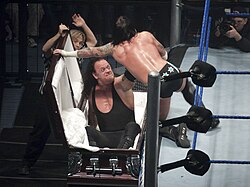
แมตช์โลงศพ (หรือที่รู้จักกันในชื่อแมตช์หีบศพ ) มีหีบศพอยู่ใกล้กับเวที โดยมีเป้าหมายของแมตช์คือการดักนักมวยปล้ำฝ่ายตรงข้ามไว้ข้างใน[ 44 ]แมตช์โลงศพเริ่มต้นขึ้นในฐานะแมตช์หีบศพแบบครั้งเดียวจบในช่วงทศวรรษ 1970 ซึ่งเป็นการแข่งขันระหว่างDusty RhodesและIvan Koloff [ 45 ] [ 46 ] [ 47 ] แมตช์หีบศพได้รับการฟื้นฟูให้เป็นหนึ่งในแมตช์ประจำตัวของThe Undertaker และปรากฏตัวครั้งแรกทางโทรทัศน์ใน รายการ Survivor Seriesในฐานะแมตช์หีบศพกับKamalaก่อนหน้านั้น ในรายการแสดงสดเมื่อวันที่ 14 กรกฎาคม 1991 Ultimate Warrior เอาชนะ The Undertaker ในแมตช์โลงศพที่สนาม Busch Stadium ในเมืองเซนต์หลุยส์ รัฐมิสซูรี มีแมตช์โลงศพทั้งหมด 17 ครั้ง โดย The Undertaker เป็นผู้ชนะ 11 ครั้ง การแข่งขันครั้งที่ 20 จัดขึ้นที่Halloween Havocและเป็นครั้งแรกหลังจากการเกษียณของ The Undertaker โดยมีGrayson WallerปะทะApollo Crewsซึ่ง Crews เป็นฝ่ายชนะ WWE จัดการแข่งขันโลงศพหญิงครั้งแรกในรายการNXT ตอนวันที่ 29 ตุลาคม 2024 โดยมีTatum PaxleyและWendy Choo ปะทะกัน ซึ่ง Paxley เป็นฝ่ายชนะ[ 48 ]
นอกจาก WWE แล้ว การแข่งขันแบบโลงศพยังถูกนำไปใช้ในTotal Nonstop Action Wrestling , All Elite WrestlingและLucha Undergroundโดย Lucha Underground เรียกการแข่งขันนี้ว่า Grave Consequences (ต่อมาคือ Graver Consequences) การแข่งขัน Last Rites เป็นรูปแบบหนึ่งของการแข่งขันใน Total Nonstop Action Wrestling ที่มีการหย่อนโลงศพลงไปตรงกลางเวที และเป้าหมายคือการทำให้คู่ต่อสู้เข้าไปในโลงศพ ซึ่งจะถูกยกขึ้นไปไว้บนเพดานหลังจากจบการแข่งขัน อีกรูปแบบหนึ่งของการแข่งขันแบบโลงศพที่ลดระดับลงคือการชนะโดยการจับกดหรือการยอมแพ้ ไม่ใช่การวางคู่ต่อสู้ลงในโลงศพ อย่างไรก็ตาม นักมวยปล้ำที่แพ้จะถูกวางลงในโลงศพ ในปี 2023 TNA Wrestling ได้นำการแข่งขัน Last Rites กลับมา แต่ได้ปรับเปลี่ยนให้คล้ายกับการแข่งขันแบบโลงศพทั่วไปมากขึ้น[ 49 ]
การจับคู่ถังขยะ
แมตช์ถังขยะเป็นแมตช์ฮาร์ดคอร์ที่ไม่มีการตัดสิทธิ์ ไม่มีการยอมแพ้ ไม่มีการนับนอกเวที และไม่มีการแพ้ชนะ โดยเป้าหมายเดียวในการชนะคือการบังคับให้คู่ต่อสู้เข้าไปในถังขยะแล้วปิดฝา แมตช์ประเภทนี้ครั้งแรกเกิดขึ้นในศึก WrestleMania XIVโดยเป็นการพบกันระหว่างThe New Age OutlawsกับCactus JackและChainsaw Charlie
แมตช์ Dumpster ครั้งล่าสุดเกิดขึ้นในรายการSmackdown ตอนวันที่ 4 ตุลาคม 2024 ซึ่งมิชินได้ใช้ท่า Powerbomb ใส่เชลซี กรีนจนทะลุโต๊ะและตกลงไปในถังขยะ
รูปแบบต่างๆ ที่เกิดจากการปิดล้อม
การแข่งขันบางแมตช์จะจัดขึ้นในสถานที่ปิดล้อมเฉพาะ แม้ว่าสถานที่ปิดล้อมส่วนใหญ่จะตั้งอยู่ภายในหรือรอบๆเวทีแต่บางแห่งก็ตั้งอยู่แยกต่างหาก ในทุกกรณี โครงสร้างนั้นถือว่า "อยู่ในสนามแข่งขัน" และการแข่งขันส่วนใหญ่ในสถานที่ปิดล้อมจะตัดสินด้วยการจับกดหรือการยอมแพ้ เว้นแต่จะมีการตกลงเงื่อนไขอื่นๆ ไว้ล่วงหน้า
การแข่งขันในกรงเหล็ก

กรงเหล็กเป็นหนึ่งในรูปแบบการกั้นที่เก่าแก่ที่สุดที่ใช้ในมวยปล้ำอาชีพ การแข่งขัน "กรงเหล็ก" ที่เก่าแก่ที่สุดเท่าที่ทราบเกิดขึ้นเมื่อวันที่ 9 มกราคม 1936 ในเมืองคาร์รูเธอร์สวิลล์ รัฐมิสซูรี ในรายการที่มีการแข่งขัน "รั้วลวดตาข่าย" สองแมตช์ระหว่างเจซกับออตโต ลุดวิก และโจ ดิลล์แมนกับชาร์ลส์ ซิงกีย์[ 50 ]การแข่งขันเหล่านี้เกิดขึ้นในเวทีที่ล้อมรอบด้วยลวดตาข่ายเพื่อให้นักกีฬาอยู่ภายในและป้องกันการรบกวนที่อาจเกิดขึ้น[ 51 ] กรงเหล็ก ได้พัฒนาไปมากเมื่อเวลาผ่านไป เปลี่ยนจากลวดตาข่าย[ 52 ]เป็นเหล็กเส้น และรั้วตาข่าย (ซึ่งปัจจุบันเป็นมาตรฐาน เนื่องจากมีราคาถูกกว่าในการผลิต น้ำหนักเบากว่าในการขนส่ง และมีความยืดหยุ่นมากกว่า จึงปลอดภัยกว่าสำหรับนักมวยปล้ำ)
แมตช์กรงเหล็กคือการแข่งขันที่เกิดขึ้นภายในกรงที่สร้างขึ้นโดยการวางแผ่นโลหะตาข่ายไว้รอบๆ ใน หรือชิดขอบของเวทีการต่อสู้วิธีการชนะที่พบได้บ่อยที่สุดคือการหนีออกจากกรง ไม่ว่าจะปีนข้ามกำแพงกรงโดยให้เท้าทั้งสองข้างแตะพื้นสนาม หรือหนีออกทางประตูของกรงโดยให้เท้าทั้งสองข้างแตะพื้นสนาม วิธีการชนะอื่นๆ ที่เกิดขึ้นได้บ้างในบางครั้งคือ การจับกดหรือการยอมแพ้
นอกจากนี้ยังเป็นไปได้ที่จะมีนักมวยปล้ำคนหนึ่งพยายามหนีข้ามกำแพงกรง ในขณะที่อีกคนพยายามหนีออกทางประตูกรง[ 53 ]ในเม็กซิโก การแข่งขันในกรงเหล็กจะชนะได้ด้วยการปีนขึ้นไปบนกำแพงกรง ในTNAการแข่งขันเหล่านี้เคยถูกเรียกว่าSix Sides of Steelเนื่องจากกรงล้อมรอบเวทีหกด้านของพวกเขา
การแข่งขันกรงเหล็กลวดหนาม
แมตช์กรงเหล็กลวดหนาม คือแมตช์ที่ใช้ลวดหนามในกรงเหล็กในรูปแบบใดรูปแบบหนึ่ง โดยปกติจะอยู่รอบๆ ส่วนบนของกรง การใช้ลวดหนามในกรงเหล็กธรรมดาไม่ได้ทำให้แมตช์นั้นเป็นแมตช์กรงเหล็กลวดหนามเสมอไป ลวดหนามต้องเป็นส่วนหนึ่งของการออกแบบกรง แมตช์ประเภทนี้แทบเป็นไปไม่ได้เลยที่จะหนีออกจากกรง เพราะนอกจากลวดหนามที่ป้องกันการหนีข้ามส่วนบนของกรงแล้ว ประตูของกรงยังถูกล็อคด้วยโซ่และกุญแจล็อค เหมือนกับแม ตช์ Hell in a Cellตัวอย่างเช่น แม ตช์ระหว่าง John "Bradshaw" LayfieldกับBig Showใน ศึก No Way Out 2005นอกจากลวดหนามแล้ว ยังมีลวดมีดโกนพันรอบส่วนบนของกรงเป็นวงกลม และอีกตัวอย่างหนึ่งคือ แมตช์ ระหว่าง Adam ColeกับJohnny Garganoในศึก NXT TakeOver: Toronto 2019นอกจากลวดหนามและประตูที่ล็อคด้วยโซ่แล้ว ยังมีอาวุธต่างๆ วางไว้ที่ด้านบนของกรงด้วย แต่กรงนี้ไม่มีลวดมีดโกน[ 54 ]
บันจี้แมตช์
บันจี้แมตช์เป็นการแข่งขันมวยปล้ำประเภทหนึ่งที่ผู้แข่งขันสองคนถูกขังอยู่ในกรงเหล็กที่มีด้านหนึ่งเปิดอยู่ แต่ละคนสวมสายรัดนิรภัยที่เชื่อมต่อกับเชือกบันจี้ และถูกแขวนไว้สูงในอากาศเพื่อทำการแข่งขันมวยปล้ำ ผู้ชนะคือผู้ที่เหวี่ยงคู่ต่อสู้ออกนอกกรง ทำให้คู่ต่อสู้แกว่งไปมาตามเชือก การแข่งขันนี้จัดขึ้นในGlobal Wrestling Federation ระหว่าง Chaz Taylor และ Steven Daneเมื่อวันที่ 14 สิงหาคม 1992 ซึ่ง Dane เป็นฝ่ายถูกเหวี่ยงออกนอกกรง
แมตช์กรงมรณะ
การแข่งขัน Cage of Death เป็นการแข่งขันในกรงเหล็กที่มีอาวุธหลากหลายชนิดวางอยู่ภายในกรง เช่น ผนังกรงไฟฟ้า ต้นกระบองเพชร โต๊ะ หลอดไฟ กระจก หมุดปักกระดาษ ไม้เบสบอล ลวดหนาม และอาวุธและวัตถุอื่นๆ อีกมากมาย การแข่งขันนี้มักจะเป็นคู่เอกของ การแสดงที่ยิ่งใหญ่ที่สุดของ CZWอย่าง Cage of Death บางครั้งการแข่งขันเหล่านี้จะจัดขึ้นภายใต้กติกาแบบ WarGames โดยใช้เวทีสองแห่ง
การแข่งขันสุดขีด
ในการแข่งขัน Chamber of Extreme ซึ่งคิดค้นโดยExtreme Canadian Championship Wrestling (ECCW) จะมีกรงเหล็กสูง 8 ฟุตล้อมรอบบริเวณข้างเวที โดยด้านบนจะพันด้วยลวดหนาม และมีอาวุธ "สุดขีด" กระจัดกระจายอยู่รอบเวทีและบริเวณข้างเวที การตัดสิทธิ์ การนับนอกเวที และการหลุดจากเชือกไม่มีผลบังคับใช้ ผู้ชนะจะตัดสินโดยการกดนับสาม การยอมแพ้ หรือการไม่สามารถยืนขึ้นได้เมื่อนับครบ 10
การแข่งขันดิกซีแลนด์
การแข่งขันแบบ Dixieland (ตั้งชื่อตามDixie Carter ประธาน TNA ผู้ซึ่ง "คิดค้น" การแข่งขันนี้) เป็นการแข่งขันแบบผสมผสานระหว่างกรงเหล็กและบันได นักมวยปล้ำเริ่มต้นการแข่งขันในเวทีที่ล้อมรอบด้วยกรงเหล็ก เพื่อที่จะชนะการแข่งขัน นักมวยปล้ำจะต้องปีนออกจากกรงก่อน จากนั้นขึ้นไปบนทางลาดทางเข้าซึ่งมีเข็มขัดแชมป์แขวนอยู่บนเพดาน และสุดท้ายปีนบันไดเพื่อคว้าเข็มขัด การแข่งขันประเภทนี้ครั้งแรกเกิดขึ้นระหว่างการ บันทึก เทป Impact Wrestling: Final Resolutionเมื่อวันที่ 3 ธันวาคม 2013 โดยMagnusเอาชนะJeff Hardyเพื่อเป็นแชมป์โลกรุ่นเฮฟวี่เวทของ TNA [ 55 ]
การแข่งขันกรงวันสิ้นโลก
เรียกอีกอย่างว่า Tower of Doom หรือ Doomsday Cage เป็นกรงสามชั้น โดยชั้นกลางแบ่งออกเป็นสองห้อง ซึ่งแต่ละชั้นเป็นที่สำหรับนักมวยปล้ำ เป้าหมายของการแข่งขันคือให้นักมวยปล้ำทีมหนึ่งต่อสู้ฝ่าฟันจากกรงชั้นบนสุดลงมายังชั้นล่างสุด ซึ่งจะมีการจับกดและใช้ท่าล็อกเพื่อเอาชนะ[ 56 ] [ 57 ]ในช่วงหลังของ WCW การแข่งขันประเภทนี้ถูกเรียกว่า Triple Decker Cage match ซึ่งเป็นการอ้างอิงถึงรูปแบบการแข่งขันที่ใช้ในตอนจบของภาพยนตร์เรื่องReady to Rumbleการแข่งขันที่โดดเด่นที่สุดในประเภทนี้เกิดขึ้นใน งาน Uncensored ของ WCW ในปี 1996 เมื่อHulk HoganและRandy Savageต่อสู้กับRic Flair , Arn Anderson , Meng , The Barbarian , Lex Luger , Kevin Sullivan , Z-GangstaและThe Ultimate Solution
การแข่งขันในกรงไฟฟ้า
แมตช์กรงไฟฟ้าเป็นรูปแบบหนึ่งของแมตช์กรงเหล็ก โดยเวทีจะถูกล้อมรอบด้วยกรงเหล็กที่มีกระแสไฟฟ้าไหลผ่าน กรงนี้สามารถใช้เป็นอาวุธได้ด้วย วิธีการชนะมีเพียงอย่างเดียวคือการกดนับสามหรือการยอมแพ้Lucha en Jaula Electrificadaเป็นอีกรูปแบบหนึ่งของแมตช์กรงไฟฟ้าที่วิธีการชนะมีเพียงอย่างเดียวคือการหนีออกมาได้ กรงจะถูกปิดเป็นช่วงเวลาหนึ่งเพื่อให้ผู้เข้าร่วมมีโอกาสหนีออกมาก่อนที่มันจะเปิดขึ้นอีกครั้ง แมตช์ประเภทนี้ใช้โดย สมาคม AAAในเม็กซิโก
การแข่งขัน Elimination Chamber
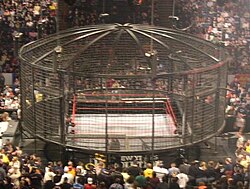
Elimination Chamber (หรือ No Escape ในเยอรมนี เพื่อหลีกเลี่ยงความผิดพลาดทางแบรนด์ ที่อาจเกิดขึ้น จากการอ้างอิงถึงห้องรมแก๊สในThe Holocaust ) ซึ่งเป็นผลมาจากแนวคิดของTriple Hและนำมาใช้โดย Eric Bischoff สำหรับ WWE ในปี 2002 เป็นกรงเหล็กที่มีโครงสร้างตาข่ายและโซ่เชื่อมต่อกัน พร้อมด้วยแท่งเหล็กค้ำยันที่ล้อมรอบเวทีทั้งหมด รวมถึงการสร้างพื้นที่พื้นตะแกรงเหล็ก (ต่อมาบุด้วยวัสดุรองรับ) บนขอบเวที ภายในกรง ที่มุมเวที แต่ละด้าน จะมีห้องใสที่ผู้เข้าแข่งขันรอเข้าร่วมการแข่งขัน ตามชื่อที่บ่งบอก นี่คือการแข่งขันแบบคัดออก ดังนั้นนักมวยปล้ำจะถูกคัดออกทีละคนโดยการกดนับสามหรือการยอมแพ้จนเหลือเพียงคนเดียว[ 58 ]
ห้องทดสอบแบบเดิมที่ใช้ตั้งแต่ปี 2002 ถึง 2016 มีรูปทรงกระบอกส่วนห้องทดสอบที่ได้รับการออกแบบใหม่ในปี 2017 มีรูปทรงลูกบาศก์แต่ยังคงใช้วัสดุแบบเดียวกันและมีช่องปิด 4 ช่องเหมือนเดิม
แมตช์Extreme Elimination Chamber จัดขึ้นในศึกDecember to Dismember ปี 2006 โดยนักมวยปล้ำแต่ละคนที่รอคิวจะได้รับ อาวุธนับตั้งแต่ปี 2010 เป็นต้นมา WWE ได้จัดศึก Elimination Chamber ในชื่อเดียวกันทุกเดือนกุมภาพันธ์ โดยแมตช์ประเภทนี้เป็นหนึ่งในแมตช์สำคัญ ในศึก Elimination Chamber ปี 2018ได้มีการจัดแมตช์ Elimination Chamber สำหรับผู้หญิงเป็นครั้งแรก รวมถึงแมตช์ Elimination Chamber แบบ 7 คนเป็นครั้งแรกด้วย
การแข่งขัน Fight Pit
การแข่งขัน Fight Pit เป็นรูปแบบหนึ่งของการแข่งขันในกรงเหล็ก โดยใช้กรงเหล็กเป็นเวทีแทนเชือกและเสาตั้ง และมีทางเดินรอบด้านบน ทางเดินนี้ยังมีรั้วตาข่ายล้อมรอบขอบด้านนอก (เดิมเป็นราวเหล็ก) ซึ่งนักมวยปล้ำสามารถปีนขึ้นไปและกระโดดลงมาได้ การแข่งขันนี้ยังมีกติกาห้ามกดนับสาม หมายความว่าสามารถชนะได้ด้วยการซับมิชชั่นหรือน็อกเอาต์เท่านั้น ไม่ว่าจะเป็นการทำให้คู่ต่อสู้ไม่สามารถยืนขึ้นได้เมื่อนับถึง 10 หรือน็อกเอาต์ทางเทคนิค ทำให้การแข่งขันนี้เป็นการผสมผสานระหว่างมวยปล้ำอาชีพและการต่อสู้แบบผสมผสาน (MMA) ซึ่งการต่อสู้แบบ MMA นั้นสามารถชนะได้ด้วยวิธีดังกล่าวเท่านั้น การแข่งขัน Fight Pit ครั้งแรกจัดขึ้นในรายการNXT ตอนวันที่ 27 พฤษภาคม 2020 ระหว่างMatt RiddleและTimothy Thatcher (โดยมีKurt Angleเป็นกรรมการพิเศษ) [ 59 ]มีการใช้สนามประลองแบบดัดแปลงที่มีรั้วตาข่ายเหล็กใน งาน Extreme Rulesระดับพรีเมียม ซึ่งแมตต์ ริดเดิลและเซธ โรลลินส์ยังคงแข่งขันกันต่อไป (โดยมีแดเนียล คอร์เมียร์ สมาชิก หอเกียรติยศ UFC เป็นกรรมการพิเศษ) การแข่งขันระหว่างริดเดิลและโรลลินส์เป็นการแข่งขันในสนามประลองครั้งแรกในรายการ PPV ของ WWE
แมตช์เฮลล์อินอะเซลล์

แมตช์ Hell in a Cell เป็นแมตช์เฉพาะรูปแบบหนึ่งของWWE ที่จัดขึ้น ภายในกรงเหล็กทรงสี่เหลี่ยม ขนาดใหญ่ ทำจากเหล็ก ตาข่ายโปร่งซึ่งยื่นออกมาจากขอบเวที ทำให้มีช่องว่างระหว่างขอบเวทีกับรั้วกรง ต่างจากกรงเหล็ก ทั่วไป รั้ว กรงในแมตช์นี้จะต่อเนื่องไปด้านบนเป็นเพดาน จึงเป็นที่มาของชื่อ 'Cell' ต่างจากแมตช์กรงเหล็กมาตรฐาน แมตช์ Hell in a Cell ไม่มีเงื่อนไขการหลบหนี เพราะหลังจากนักมวยปล้ำเข้าไปในกรงแล้ว ประตูของกรงจะถูกล็อคด้วยโซ่และกุญแจจากด้านนอกโดยกรรมการ เพื่อป้องกันไม่ให้นักมวยปล้ำหลบหนี (ถึงแม้ว่าแมตช์ Hell in a Cell มักจะเลยเถิดออกไปนอกกรงและไปถึงบนหลังคากรงก็ตาม) แมตช์นี้ไม่มีการตัดสิทธิ์ และสามารถชนะได้ด้วยการกดนับสามหรือการยอมแพ้ภายในเวทีเท่านั้น ข้อยกเว้นอาจเกิดขึ้นได้คือ Hell in a Cell ปี 2018 และ 2019 ที่แมตช์ชิงแชมป์ WWE Universal Championship จบลงด้วยการยุติการแข่งขัน
เนื่องจากกฎ "อะไรก็ได้" ทำให้แมตช์นี้มีชื่อเสียงในทางที่ไม่ดีในช่วงแรกๆ โดยปกติแล้วแมตช์นี้จะจัดขึ้นในรายการเพย์เพอร์วิว (มีข้อยกเว้นเพียง 5 ครั้งเท่านั้น: แมตช์กรงเหล็ก 4 ครั้งเกิดขึ้นในรายการ Raw : สองครั้งในปี 1998 หนึ่งครั้งในปี 2011 (เป็นแมตช์ลับ) และหนึ่งครั้งในปี 2021 ในขณะที่แมตช์กรงเหล็กครั้งแรกในรายการSmackdownเกิดขึ้นเมื่อวันที่ 18 มิถุนายน 2021) นักมวยปล้ำหลายคนได้รับบาดเจ็บจริง ๆ ในระหว่างแมตช์เหล่านี้ ( โดยเฉพาะมิก โฟลีย์ ) เนื่องจากการกระแทกที่อันตรายและรั้วตาข่ายเหล็กของกรงเหล็ก ในบทบาทสมมติมันถูกมองว่าเป็นแมตช์ที่อันตรายที่สุดในสมาคมทั้งหมดจิม รอสส์เรียกกรงเหล็กนั้นว่า "โครงสร้างปีศาจ" ที่ "สร้างขึ้นมาเพื่อการบาดเจ็บโดยเฉพาะ" จนถึงปัจจุบันมีแมตช์กรงเหล็กทั้งหมด 53 ครั้ง โดยดิอันเดอร์เทเกอร์เข้าร่วม 14 ครั้ง (ครั้งสุดท้ายที่WrestleMania 32 ) มากกว่านักมวยปล้ำคนอื่นๆ ใน WWE แมตช์ Hell in a Cell ครั้งแรกเกิดขึ้นระหว่างดิ อันเดอร์เทเกอร์และฌอน ไมเคิลส์ในศึกBadd Blood: In Your Houseที่เมืองเซนต์หลุยส์ในเดือนตุลาคม ปี 1997
การแข่งขันอินเฟอร์โน
ในการแข่งขันอินเฟอร์โน (การแข่งขันแบบไม่มีการตัดสิทธิ์ ไม่มีการนับสาม ไม่มีการยอมแพ้ และไม่มีการนับนอกเวที) เมื่อผู้เข้าแข่งขันทั้งสองคนเข้าสู่เวทีแล้ว เวทีจะถูกล้อมรอบด้วยเปลวไฟอย่างสมบูรณ์ วิธีเดียวที่จะชนะคือการจุดไฟเผาคู่ต่อสู้ การแข่งขันอินเฟอร์โนมักจะจบลงนอกเวที เพื่อให้เจ้าหน้าที่พยาบาลสามารถช่วยเหลือผู้แพ้ได้ เนื่องจากลักษณะที่อาจมีความรุนแรงหรืออันตราย การแข่งขันประเภทนี้จึงไม่ค่อยพบเห็นในอเมริกาเหนือณ เดือนธันวาคม2020 มีการแข่งขันอินเฟอร์โนเพียง 6 ครั้งใน WWE โดยเกือบทั้งหมดเกี่ยวข้องกับเคนซึ่งถือเป็นแมตช์ประจำตัวของเขา[ 60 ]
การแข่งขัน Inferno ครั้งแรกเกิดขึ้นในปี 1987 ที่สนามกีฬา Juan Pachin Vicens ในเมืองปอนเซ ประเทศเปอร์โตริโก โดยใช้เชือกที่ชุบน้ำมันเบนซินแล้วจุดไฟเผา การแข่งขันแบบนี้จัดขึ้นอีกครั้งในปี 1992 ที่FMWในญี่ปุ่น โดยใช้ชื่อว่า Hellfire Deathmatch ซึ่งใช้ลวดหนามเป็นเชือกแล้วจุดไฟเผา การแข่งขันครั้งนั้นล้มเหลวอย่างสิ้นเชิง นักมวยปล้ำอย่างSabu , The Original Sheik ( ลุงของเขา) และAtsushi Onitaต้องวิ่งออกจากเวทีหลังจากผ่านไปเพียงหนึ่งนาที เนื่องจากสภาพอากาศร้อนจัดจนทนไม่ไหว The Sheik ได้รับบาดเจ็บสาหัสจากไฟไหม้และหมดสติไป[ 61 ]การแข่งขัน WWF Inferno Match ครั้งแรกเกิดขึ้นระหว่าง Kane และThe Undertakerใน ศึก Unforgiven (1998)ที่เมือง Greensboro รัฐ North Carolina และเป็นการแข่งขันที่ปลอดภัยและเป็นมืออาชีพมากขึ้น โดยมีการนำผู้เชี่ยวชาญด้านเทคนิคพิเศษและดอกไม้ไฟจากฮอลลีวูดมาจัดเตรียมและควบคุมไฟรอบๆ เวที Kane ถูกเหวี่ยงออกไปนอกเวที และ The Undertaker ไม่มีทางโจมตีเขาได้เว้นแต่เขาเองจะออกไปนอกเวทีเช่นกัน การแข่งขันจบลงด้วยชัยชนะของ The Undertaker WCW ก็เคยพยายามจัดการแข่งขัน Inferno Match ซึ่งรู้จักกันในชื่อ Human Torch Match ในศึกThe Great American Bash ปี 2000 ระหว่างStingและVampiro
การแข่งขันอีกรูปแบบหนึ่งที่รู้จักกันในชื่อการแข่งขัน Firefly Infernoจัดขึ้นที่TLC: Tables, Ladders & Chairsในปี 2020 ระหว่าง"The Fiend" Bray WyattและRandy Orton โดยชื่อของการแข่งขันนี้อ้างอิงถึงกิมมิค " Firefly Fun House " ของ Wyatt นอกจากเวทีจะถูกล้อมรอบด้วยไฟแล้ว วัตถุอื่นๆ ที่วางอยู่รอบเวทีก็ถูกจุดไฟด้วยเช่นกัน[ 62 ]
การแข่งขันแบบ Inferno อีกรูปแบบหนึ่งที่เรียกว่าRing of Fire Matchเกิดขึ้นในศึก SummerSlamปี 2013 เมื่อKaneเผชิญหน้ากับBray Wyattแม้ว่าเวทีจะถูกล้อมรอบด้วยเปลวไฟเหมือนกับการแข่งขัน Inferno ทั่วไป แต่การแข่งขันจะตัดสินด้วยการกดนับสามหรือการยอมแพ้ ไม่ใช่การเผาคู่ต่อสู้ นอกจากนี้ เปลวไฟยังป้องกันไม่ให้ผู้อื่นเข้ามาแทรกแซงการแข่งขันได้ เช่นเดียวกับกรณีของLuke HarperและErick Rowanจาก The Wyatt Family
Infierno en el Ring
อินเฟีย ร์โน เอ็น เอล ริง (Infierno en el Ring) เป็นการแข่งขัน มวยปล้ำลูชาลิเบรแบบหลายคนในกรงเหล็กโดยมีผู้เข้าแข่งขันตั้งแต่ 4 ถึง 16 คน ผู้เข้าแข่งขันจะทยอยเข้าสู่เวที จากนั้นเมื่อทุกคนอยู่ในเวทีและผ่านไปแล้วระยะเวลาที่กำหนด ก็จะได้รับอนุญาตให้ออกจากกรงผู้เข้าแข่งขัน สองคนสุดท้าย ในเวทีจะทำการแข่งขันมวยปล้ำแบบแพ้ชนะในยกเดียว โดยผู้ชนะจะได้หน้ากากหรือผมของผู้แพ้
การแข่งขัน Lethal Lockdown
คล้ายกับแมตช์ WarGames ที่ใช้ใน WCW แมตช์ Lethal Lockdown ของ TNA/Impact Wrestling ประกอบด้วยเวทีเดียวที่ล้อมรอบด้วยกรงเหล็ก โดยมีสองทีมเผชิญหน้ากัน ระบบการเข้าเวทีแบบเหลื่อมเวลาเหมือนกัน แต่ในแมตช์นี้อนุญาตให้ใช้อาวุธได้ และมีอาวุธให้ใช้ด้วย เมื่อผู้แข่งขันทุกคนเข้าสู่เวทีแล้ว หลังคาจะถูกลดลงมาปิดด้านบนของกรง โดยมีอาวุธต่างๆ ห้อยอยู่ การชนะสามารถทำได้โดยการกดนับสามหรือการยอมแพ้ แมตช์นี้กลายเป็นส่วนสำคัญของ รายการ Pay-per-view Lockdown ของ TNA แต่ก็เคยปรากฏในรายการ Pay-per-view อื่นๆ ของ TNA ด้วยเช่นกัน
การแข่งขันในเรือนจำปัญจาบ

การแข่งขัน Punjabi Prison ซึ่งตั้งชื่อตาม รัฐ ปัญจาบที่The Great Khali (ผู้ก่อตั้งการแข่งขัน) มาจากนั้น ประกอบด้วย กรง ไม้ไผ่ เสริมเหล็กขนาดใหญ่สอง กรง กรงแรกมีสี่ด้านและสูง 16 ฟุต (4.8 เมตร) ในขณะที่กรงที่สองมีแปดด้านและสูง 20 ฟุต (6 เมตร) และล้อมรอบกรงแรก[ 63 ]
กรงด้านในมีประตูขนาดสี่ฟุต (1.2 ม.) คูณสี่ฟุตอยู่แต่ละด้าน โดยมีกรรมการคอยเปิดประตูตามคำขอของนักมวยปล้ำ ประตูแต่ละบานสามารถเปิดได้เพียงครั้งเดียวและอนุญาตให้เปิดได้เพียงหกสิบวินาทีเท่านั้น หลังจากนั้นจะถูกล็อคด้วยกุญแจหากประตูทั้งสี่บานถูกล็อคก่อนที่นักมวยปล้ำจะหนีออกมาได้ พวกเขาจะต้องปีนข้ามด้านบนซึ่งมีไม้ไผ่ที่ถูกดัดแปลงเป็นหนามแหลม บางครั้งจะมีโต๊ะสองตัววางอยู่ระหว่างกรงทั้งสอง โดยมีอาวุธ (ทั้งอาวุธมวยปล้ำแบบ "ยุคกลาง" และ "ไม้ไผ่") วางอยู่บนโต๊ะ นอกจากนี้ยังมีสายรัดที่มุมของกรงซึ่งสามารถใช้รัดคอคู่ต่อสู้ได้ เมื่อนักมวยปล้ำหนีออกจากกรงแรกได้แล้ว เขาจะต้องปีนข้ามและออกจากกรงที่สอง โดยนักมวยปล้ำคนแรกที่เท้าทั้งสองข้างแตะพื้นสนามจะเป็นผู้ชนะการแข่งขัน[ 64 ] [ 65 ]
การแข่งขันนี้ได้รับการนำกลับมาจัดใหม่พร้อมการปรับเปลี่ยนในปี 2017 ในฐานะแมตช์หลักของBattleground ซึ่งมี Jinder Mahalชาวอินเดีย-แคนาดาเผชิญหน้ากับRandy Ortonเพื่อชิงแชมป์ WWE; The Great Khali ได้เข้ามาช่วยเหลือ Mahal อย่างไม่คาดคิด[ 66 ]
ธันเดอร์เคจ
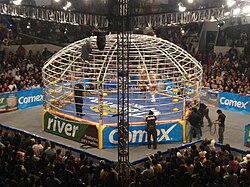
Thundercage ของ WCW ซึ่งได้รับแรงบันดาลใจจากภาพยนตร์เรื่องMad Max Beyond Thunderdomeเป็นโครงสร้างทรงโดมขนาดใหญ่ที่ทำจากเหล็กแท่ง ล้อมรอบเวทีไว้ แม้ว่าจะไม่มีหลังคา แต่ด้านข้างจะโค้งเข้าด้านในเพื่อป้องกันการหลบหนี
สมาคมมวยปล้ำ AAAของเม็กซิโกได้ปรับเปลี่ยนแนวคิดนี้ด้วยDomo de la Muerte ("โดมแห่งความตาย") ซึ่งใช้กรงที่คล้ายกัน แต่จะอนุญาตให้ผู้ชนะชนะได้ก็ต่อเมื่อหนีออกมาทางรูตรงกลางด้านบนเท่านั้น รูปแบบนี้ยังใช้ในTNA ด้วย โดยเรียกว่า TerrorDome หรือล่าสุดเรียกว่า Steel Asylum ใน AAA มักใช้สำหรับการแข่งขันแบบหลายคน "luchas de apuestas" (การแข่งขันเดิมพัน) โดยผู้ที่ยืนหยัดอยู่ในกรงเป็นคนสุดท้ายจะต้องเสียหน้ากากหรือผม ดูInfierno en el Ringด้านบน
Thunderdome เป็นรูปแบบหนึ่งของ Thundercage โดยบริเวณใกล้ด้านบนของกรงจะมีกระแสไฟฟ้าไหลผ่าน วิธีเดียวที่นักมวยปล้ำจะชนะการแข่งขัน Thunderdome ได้คือให้ "เทอร์มิเนเตอร์" ของฝ่ายตรงข้าม (โดยปกติจะเป็นผู้จัดการที่ยืนอยู่นอกเวที) โยนผ้าเช็ดตัวเพื่อยุติการแข่งขัน ในอีกรูปแบบหนึ่งของการแข่งขันนี้ ผู้เข้าแข่งขันที่ถูกจับกดทุกคนจะถูกใส่กุญแจมือติดกับกรง[ 67 ]คนสุดท้ายที่เหลืออยู่จะได้รับกุญแจเพื่อปลดล็อกเพื่อนร่วมทีมเพื่อโจมตีทีมตรงข้ามที่ยังคงถูกใส่กุญแจมืออยู่[ 67 ]น่าขันที่ชื่อ ThunderDome ถูกนำมาใช้สำหรับพื้นที่ปลอดภัยทางชีวภาพ ของ WWE ในช่วงการระบาดใหญ่ระหว่างปี 2020 และ 2021
การแข่งขันสามกรง
WCW และ Jim Crockett Promotions ซึ่งเป็นองค์กรก่อนหน้าของ WCW เคยจัดการแข่งขันในกรงสามชั้น โดยใช้กรงขนาดเล็กสองกรงวางซ้อนกันบนกรงที่ล้อมรอบเวทีหลัก
ใน การแข่งขัน The Great American Bashปี 1988 มีการแข่งขัน "Tower of Doom" ซึ่งสองทีมพยายามหาทางจากกรงบนสุดลงมายังกรงด้านล่าง โดยทีมที่ได้รับชัยชนะคือทีมที่สมาชิกทั้งห้าคนสามารถหนีออกมาทางประตูได้สำเร็จ กรงทั้งสองแยกออกจากกัน โดยมีประตูควบคุมจากภายนอกโดยกรรมการ ซึ่งจะเปิดประตูให้ทุกๆ สองนาทีเท่านั้น
ในศึก Uncensoredปี 1996 มีการแข่งขัน "Doomsday Cage Match" ซึ่งHulk HoganและRandy Savageปะทะกับกลุ่ม Alliance to End Hulkamania ที่ประกอบด้วยRic Flair , Arn Anderson , Lex Luger , The Taskmaster , Meng , The Barbarian , The Ultimate SolutionและZ-Gangsta Hogan และ Savage ต้องเริ่มต้นจากชั้นบนสุดของโครงสร้างสามชั้น และในแต่ละชั้นจะมีสมาชิกของกลุ่ม Alliance รออยู่ โครงสร้างมีนั่งร้านพร้อมบันไดเพื่อให้เหล่านักมวยปล้ำสามารถปีนป่ายได้ โดยมีเป้าหมายคือการไปให้ถึงกรงด้านล่างซึ่งเป็นที่ตั้งของเวที และจับกดเพื่อเอาชนะ
ใน การแข่งขันมวยปล้ำแบบสามกรงที่ศึกสแลมโบรีปี 2000 เดวิด อาร์เควตต์ , ไดมอนด์ ดัลลัส เพจและเจฟฟ์ จาร์เร็ตต์ จัดขึ้นในรูปแบบคล้ายกับการแข่งขันแบบบันได โดยมีเป้าหมายคือให้ผู้เข้าแข่งขันปีนขึ้นไปบนหลังคาของกรงที่สามและคว้าเข็มขัดแชมป์มาให้ได้ หลังคาของกรงแรก—ซึ่งยื่นออกไปนอกขอบเวที—มีประตูทางลับที่นำไปสู่กรงที่สองซึ่งมีอาวุธอยู่ ผู้เข้าแข่งขันต้องออกจากกรงที่สองทางประตูข้างและปีนขึ้นไปเพื่อคว้าเข็มขัดที่อยู่เหนือกรงที่สาม กรงที่สามมีกีตาร์อยู่ ซึ่งจาร์เร็ตต์ใช้สำหรับท่าไม้ตายประจำตัวของเขา
ในปีเดียวกันนั้น WCW ได้จัดการแข่งขันอีกแมตช์หนึ่งโดยใช้โครงสร้างเดียวกัน คือ "WarGames 2000: Russo 's Revenge" ในรายการWCW Monday Nitro แม้ว่าจะมีชื่อเหมือนกับ แมตช์ WarGamesที่โด่งดังของ WCW แต่ความคล้ายคลึงกันเพียงอย่างเดียวคือการใช้ทีม โดยจะมีเข็มขัดแชมป์วางไว้ในกรงด้านบนสุด และทีมแรกที่มีสมาชิกหนีออกมาจากกรงด้านล่างพร้อมกับเข็มขัดแชมป์ได้ จะเป็นผู้ชนะ
การแข่งขัน WarGames
บางครั้งอาจมีคำต่อท้ายว่า "The Match Beyond" การแข่งขัน WarGames มีลักษณะเป็นการแข่งขันในสองเวทีที่ล้อมรอบด้วยกรงเหล็กปิด (โดยปกติจะมีหลังคา) โดยมีสองทีม (หรือบางครั้งสามทีม) ทีมละสี่หรือห้าคนเผชิญหน้ากัน หลังจากช่วงหนึ่งของการแข่งขันที่ต่อสู้กันแบบตัวต่อตัว สมาชิกของทั้งสองทีมจะสลับกันเข้าไปในเวทีอีกด้านในช่วงเวลาที่เหลื่อมกัน (โดยลำดับจะถูกตัดสินด้วยการโยนเหรียญ) เมื่อสมาชิกของทั้งสองทีมเข้าไปในเวทีครบแล้ว ทีมแรกที่ทำคะแนนด้วยการซับมิชชั่นหรือยอมแพ้เหนือสมาชิกของทีมตรงข้ามจะถูกประกาศให้เป็นผู้ชนะ ทั้งนี้ขึ้นอยู่กับกฎที่ใช้ ทีมอาจชนะด้วยการน็อกเอาต์หรือการจับกดก็ได้
แมตช์นี้โด่งดังขึ้นมาจากการแข่งขันประจำปีGreat American Bash ของ Jim Crockett Promotions และต่อมาในรายการ Wrestle War ของ WCW ก่อนที่จะกลายเป็นประเพณีใน งาน Fall Brawlซึ่งเป็นรายการเพย์เพอร์วิวประจำปีของพวกเขาตั้งแต่ปี 1993 ถึง 1998 ในงานFall Brawl ปี 1998มีการแข่งขัน WarGames แบบสามทีม โดยนับคะแนนจากการกดนับสาม มีการจัดการแข่งขัน WarGames เวอร์ชันใหม่แต่เปลี่ยนชื่อเป็น "WarGames 2000" ในรายการWCW Monday Nitroตอน หนึ่ง
ECW จัดการแข่งขัน WarGames เวอร์ชันของตัวเองที่เรียกว่า "Ultimate Jeopardy steel cage match" (โดยทั่วไปเป็นส่วนหนึ่งของอีเวนต์ที่มีชื่อเดียวกัน ) โดยมีอาวุธให้ใช้ การนับคะแนนจะนับรวม และทีมที่แพ้จะได้รับเงื่อนไขพิเศษเป็นบทลงโทษ ในปี 2017 แบรนด์ NXT ของ WWE เริ่มจัดอีเวนต์สดที่รู้จักกันในชื่อNXT TakeOver: WarGamesซึ่งมีการแข่งขัน WarGames เวอร์ชันหนึ่งเป็นอีเวนต์หลัก เวอร์ชัน WarGames ของ NXT ไม่ได้ใช้กรงที่มีหลังคา และการนับคะแนนจะนับรวม[ 68 ] [ 69 ] ในปี 2022 การแข่งขันได้ย้ายไปอยู่ใน PPV Survivor Seriesของ WWE [ 70 ]
ในปี 2021 AEW ได้จัดการแข่งขัน WarGames ระหว่างThe PinnacleและThe Inner Circleในรูปแบบ "Blood and Guts match" ในตอนพิเศษของรายการDynamite รายสัปดาห์ AEW ได้นำกฎ WarGames ที่ WCW ใช้มาใช้ โดยมีกรงที่มีหลังคาและไม่มีการกดนับสาม[ 68 ] [ 69 ]
การแข่งขันธง
การแข่งขันชิงธงนั้นโดยพื้นฐานแล้วเป็นการ แข่งขันชิงธงในรูปแบบมวยปล้ำอาชีพสำหรับการแข่งขันนี้ จะมีการวางธงสองผืนไว้ที่มุมเวทีฝั่งตรงข้าม โดยแต่ละผืนเป็นตัวแทนของนักมวยปล้ำหรือทีมมวยปล้ำเฉพาะ และเป้าหมายของการแข่งขันคือการแย่งชิงธงของฝ่ายตรงข้ามและยกขึ้นพร้อมกับป้องกันธงในมุมของนักมวยปล้ำ[ 71 ]หากกรรมการล้มลงและไม่สามารถยอมรับชัยชนะได้ ฝ่ายป้องกันสามารถนำธงกลับไปวางไว้ที่เดิมเพื่อเริ่มการแข่งขันใหม่[ 72 ]
การแข่งขันแบบแฮนดิแคป
การแข่งขันแบบแฮนดิแคป คือการแข่งขันใดๆ ก็ตามที่นักมวยปล้ำหนึ่งคนหรือทีมนักมวยปล้ำหนึ่งทีมต้องเผชิญหน้ากับทีมนักมวยปล้ำที่มีจำนวนมากกว่า เช่น สองต่อหนึ่ง หรือสามต่อสอง โดยปกติแล้วฝ่ายฮีโร่มักจะมีจำนวนน้อยกว่าฝ่ายวายร้าย ซึ่งฝ่ายวายร้ายจะมีสมาชิกในทีมมากกว่าเพื่อให้ได้เปรียบอย่างไม่ยุติธรรม[ 73 ]ในการแข่งขันแบบแฮนดิแคปสองต่อหนึ่งบางรายการ ทีมที่มีจำนวนมากกว่าจะแข่งขันภายใต้กฎแท็กทีม โดยมีคนหนึ่งคนอยู่ในเวทีในแต่ละครั้ง ในขณะที่การแข่งขันแบบอื่นๆ เช่น การแข่งขันแบบแฮนดิแคปแท็กทีมทอร์นาโด ผู้แข่งขันทั้งหมดจะอยู่ในเวทีพร้อมกัน[ 74 ]ในช่วงทศวรรษ 1980 และ 1990 การแข่งขันแบบแฮนดิแคปถูกนำมาใช้ในการแข่งขันรอบคัดเลือกที่เกี่ยวข้องกับนักมวยปล้ำดาวเด่นร่างใหญ่ (โดยปกติจะเป็นฝ่ายวายร้าย) เช่นคิงคอง บันดี้บิ๊กแวนเวเดอร์หรือโยโกซูนะซึ่ง – เพื่อสร้างบุคลิก/กิมมิกฝ่ายวายร้ายที่น่าเกรงขามให้เป็นที่รู้จักในหมู่ผู้ชม – จะครอบงำคู่ต่อสู้อย่างสิ้นเชิงแม้ว่าฝ่ายหลังจะมีจำนวนมากกว่าก็ตาม
รูปแบบที่เน้นความหนักหน่วง
มวยปล้ำฮาร์ดคอร์ ซึ่งเป็นมวยปล้ำอาชีพประเภทที่รุนแรงและนองเลือดที่สุด เป็นประเภทย่อยที่กฎกติกาแบบดั้งเดิม บางส่วนหรือทั้งหมด ไม่สามารถนำมาใช้ได้ โดยส่วนใหญ่แล้วหมายความว่าไม่มีการตัดสิทธิ์ซึ่งหมายความว่าไม่มีการนับคะแนนทำให้สามารถตัดสินผลการแข่งขันได้ทุกที่ แมตช์ฮาร์ดคอร์หรือเดธแมตช์ส่วนใหญ่มักมีการผสมผสานประเภทการแข่งขันหลายประเภทเข้าด้วยกัน และมักใช้ชื่อการแข่งขันที่ซับซ้อน โดยเฉพาะอย่างยิ่งในรายการมวยปล้ำของญี่ปุ่น (ตัวอย่างเช่น "เดธแมตช์เชือกลวดหนาม กระดานลวดหนามระเบิด และระเบิดเวลาบนเวที")
สมาคมมวยปล้ำบางแห่ง เช่นFrontier Martial-Arts Wrestling , International Wrestling Association of Japan , International Wrestling Syndicate , Extreme Championship Wrestling , Big Japan Pro WrestlingและCombat Zone Wrestlingมีความเชี่ยวชาญเฉพาะด้านการแข่งขันแบบฮาร์ดคอร์ โดยการแข่งขันแบบ "มาตรฐาน" ที่ไม่ใช่ฮาร์ดคอร์นั้นเป็นข้อยกเว้น
การแข่งขันสุดโหด
แมตช์ฮาร์ดคอร์มาตรฐาน หรือที่รู้จักกันในชื่อแมตช์ Devil's Playground , Belfast BrawlหรือGuerrilla Warfareเป็นแมตช์ประเภทที่ไม่มีการตัดสิทธิ์ ไม่มีการนับนอกเวที การนับคะแนนเกิดขึ้นได้ทุกที่ โดยกฎเดียว (เว้นแต่จะระบุไว้เป็นอย่างอื่น) คือการจับกดหรือทำให้คู่ต่อสู้ยอมแพ้ ในแมตช์ฮาร์ดคอร์สามารถใช้อาวุธใดก็ได้ นักมวยปล้ำที่ไม่ได้อยู่ในรายชื่อสามารถเข้าร่วมและแทรกแซงได้ไม่จำกัดจำนวน การจับกดสามารถทำได้นอกเวที และสามารถใช้ท่าที่ผิดกติกาใดก็ได้ (ยกเว้นท่าที่ถูกห้ามโดยโปรโมชั่นที่จัดแมตช์ไว้ล่วงหน้า) แมตช์ฮาร์ดคอร์เริ่มเป็นที่นิยมในญี่ปุ่นในช่วงทศวรรษ 1970 และต่อมาในสหรัฐอเมริกาในช่วงทศวรรษ 1990 ในโปรโมชั่นต่างๆ เช่น ECW และ WWE วัตถุทื่อๆ เช่น เก้าอี้เหล็ก โต๊ะไม้ บันได บันไดเวทีมวยปล้ำ ไม้เคนโด ไม้เบสบอล แป้ง ถังขยะทรงกระบอกโลหะ ฝาถังขยะ และป้ายจราจร มักถูกนำมาใช้ในแมตช์ฮาร์ดคอร์
บางครั้งการแข่งขันฮาร์ดคอร์ก็ถูกเรียกผิดว่าเป็นการแข่งขันแบบไม่มีกติกา (No Holds Barred)หรือ การแข่งขัน สตรีทไฟท์ (Street Fight ) ซึ่งมีกติกาที่แตกต่างกัน เวิลด์แชมเปี้ยนชิพเรสต์ลิง (World Championship Wrestling)ใช้คำว่าการแข่งขันตามกฎของเรเวน (Raven's rules match)สำหรับการแข่งขันฮาร์ดคอร์ที่เกี่ยวข้องกับนักมวยปล้ำเรเวนพวกเขายังสร้างรูปแบบการแข่งขันฮาร์ดคอร์เฉพาะของตนเอง ซึ่งการแข่งขันจะเริ่มต้นที่หลังเวทีแทนที่จะเป็นในเวที[ 75 ]
การแข่งขันที่ไม่ได้รับการอนุมัติ
แมตช์ที่ไม่ได้รับ การรับรอง หรือที่รู้จักกันในชื่อแมตช์ที่ไม่ได้รับอนุญาตอย่างเป็นทางการ คือรูปแบบหนึ่งของแมตช์ฮาร์ดคอร์ ในบทบาทสมมติ แมตช์นี้ไม่ได้รับการ "รับรอง" อย่างเป็นทางการจากทางสมาคม และบางครั้งจะใช้เมื่อนักมวยปล้ำ "ได้รับบาดเจ็บ" (จากฝีมือของนักมวยปล้ำคนอื่น) และต้องการแก้แค้น แต่ไม่สามารถ "ได้รับการอนุญาตทางการแพทย์" ได้ ดังนั้นเขาจึงตกลงที่จะเข้าร่วมแมตช์ที่ไม่ได้รับอนุญาต ซึ่ง "ทางสมาคมจะไม่รับผิดชอบ" ต่อการบาดเจ็บใดๆ ที่เกิดขึ้นระหว่างการแข่งขัน แมตช์ปิดไฟ (Lights Out Match)เป็นรูปแบบที่เข้มข้นขึ้นของแมตช์ที่ไม่ได้รับการรับรอง โดยเฉพาะอย่างยิ่งที่ใช้โดยAll Elite Wrestlingในกรณีเหล่านี้ แมตช์จะถูกจัดไว้ท้ายสุดของรายการ และในเนื้อเรื่อง แมตช์ก่อนหน้าจะถูกถือว่าเป็น "แมตช์หลัก" และก่อนที่แมตช์จะเริ่มไฟในสนามจะกระพริบชั่วขณะเพื่อบ่งบอกถึงการสิ้นสุด "อย่างเป็นทางการ" ของรายการ
เดธแมทช์
เดธแมตช์ (Deathmatch)เป็นการแข่งขันที่รุนแรงกว่าฮาร์ดคอร์ (Hardcore) มาก โดยมีความรุนแรงและนองเลือดมากกว่า นอกจากอาวุธทื่อๆ และหมุดที่พบได้ทั่วไปในการแข่งขันฮาร์ดคอร์แล้ว เดธแมตช์มักจะมีองค์ประกอบที่อันตรายกว่า เช่น อิฐ ตะปู ปืนยิงตะปู วัตถุระเบิด ลวดหนาม หลอดไฟ เศษแก้ว เครื่องมือทำสวน (ตั้งแต่เกรียงไปจนถึงเครื่องตัดหญ้า) และแม้กระทั่งไฟที่เกิดจากน้ำมันไฟแช็กหรือน้ำมันเบนซิน คำอื่นๆ ที่ใช้เรียกเดธแมตช์อย่างสุภาพ ได้แก่ การแข่งขันแบบกฎสุดขั้ว ( Extreme Rules Match ) การแข่งขันแบบกฎรุนแรงมาก ( Ultraviolent Rules Match ) (การแข่งขันแบบกฎฮาร์ดคอร์มีเฉพาะในCZW เท่านั้น ) และการแข่งขัน HardKore X- Treme
การแข่งขันเชือกวงแหวนลวดหนาม
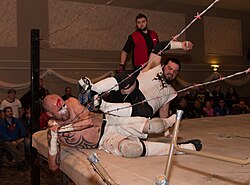
การแข่งขันแบบใช้ลวดหนามหรือการแข่งขันแบบไม่มีลวดหนามเป็นการแข่งขันแบบฮาร์ดคอร์ที่ใช้ลวดหนามแทนเชือกกั้นเวที มีสี่วิธีที่ทราบกันดีในการใช้ลวดหนามแทนเชือกกั้นเวที ได้แก่ การใช้ลวดหนามสามเส้นขึงจากมุมหนึ่งของเวทีไปยังอีกมุมหนึ่ง การใช้ลวดหนามห้าเส้นผูกเป็นรูปตัว "X" แบบ "ตาข่ายแมงมุม" ซึ่งไม่ได้ใช้ลวดหนามแทนเชือกกั้นเวที แต่ใช้ลวดหนามพันขึ้นลงตามเชือกเพื่อสร้างกำแพงลวดหนาม และสุดท้ายคือลวดหนามที่พันเป็นรูปตัว "X" ที่ถูกทำให้มีกระแสไฟฟ้าหรือติดตั้งระเบิด การแข่งขันประเภทนี้ได้รับความนิยมในช่วงปลายทศวรรษ 1970 และต้นทศวรรษ 1980 โดยโปรโมชั่นมวยปล้ำในอเมริกา รวมถึงโปรโมชั่นของญี่ปุ่นในช่วงทศวรรษ 1990 การแข่งขันประเภทนี้มักมีข้อกำหนดและอาวุธอื่นๆ รวมอยู่ด้วย[ 76 ]
การแข่งขันบู๊ทแคมป์
เป็นการแข่งขันแบบ ไม่มีกติกาใดๆ ทั้งสิ้นการแพ้ชนะนับทุกจังหวะและการแข่งขันจะจบลงได้ก็ต่อเมื่อมีการกดนับสามเท่านั้น
เซอร์คัส เดธแมทช์
การแข่งขัน Circus Deathmatch เป็นการแข่งขันแบบนั่งร้าน โดยมีนั่งร้านอยู่ในเวที และใต้นั่งร้านนั้นมีตาข่ายลวดหนามสูง 6 ฟุต นักมวยปล้ำคนแรกที่ตกลงมาจากนั่งร้านลงไปในตาข่ายลวดหนามจะเป็นผู้แพ้ การแข่งขันครั้งแรกเกิดขึ้นระหว่างMad Man PondoและRyuji Itoในญี่ปุ่น[ 76 ]
การแข่งขัน Clockwork Orange House of Fun
แมตช์ Clockwork Orange House of Fun หรือที่รู้จักกันในชื่อ "Raven's House of Fun" หรือเรียกสั้นๆ ว่า "House of Fun" ถูกสร้างขึ้นโดยนักมวยปล้ำอาชีพRaven ( อย่างถูกต้องตามกฎหมายเนื่องจาก Raven เสนอไอเดียนี้ให้กับทีมงานสร้างสรรค์ของ TNA ด้วยตัวเอง) เป็นแมตช์เดี่ยวที่มีเสาติดอยู่กับเสาของเวทีสูงประมาณห้าถึงหกฟุตเหนือมุมเวที โดยมีโซ่เส้นเดียวพันรอบและห้อยลงมาจากเสาไปยังจุดต่างๆ บนเวที และมีอาวุธจำนวนมากห้อยและติดอยู่กับโซ่เหล็กเหนือเวที บางครั้งก็มีกรงเหล็กติดอยู่และตั้งอยู่บนเวที[ 77 ] ในแมตช์แรก การใช้อาวุธเป็นสิ่งที่ถูกกฎหมาย และวิธีเดียวที่จะชนะคือการทำให้คู่ต่อสู้ทะลุโต๊ะสองตัวหลังจากโยนพวกเขาลงมาจาก "ที่นั่งของ Raven" ( โครงเหล็กขนาดเล็ก) [ 77 ]แต่ต่อมาได้เปลี่ยนเป็นกฎการนับคะแนนได้ทุกที่[ 78 ]
แมตช์มรณะระเบิดเวลา
การแข่งขัน Time Bomb Deathmatch เป็นการแข่งขันเดธแมตช์ประเภทหนึ่งที่ใช้ระเบิดหรือดอกไม้ไฟที่ติดตั้งไว้รอบเวที แล้วจุดชนวนหลังจากเวลาที่กำหนด การแข่งขันประเภทนี้มีต้นกำเนิดในประเทศญี่ปุ่นและจัดขึ้นหลายครั้งในช่วงทศวรรษ 1990 มิก โฟลีย์และเทอร์รี ฟังก์เข้าร่วมการแข่งขัน "Barbed Wire Rope, Exploding Barbed Wire Boards and Exploding Ring Time Bomb Deathmatch" ซึ่งเป็นการแข่งขันรอบชิงชนะเลิศของ การแข่งขัน Kawasaki Dream King of the Deathmatch ปี 1995 โดยมีแผ่นไม้อัดหลายแผ่นที่มีลวดหนามและวัตถุระเบิดติดอยู่กระจัดกระจายอยู่รอบเวที[ 76 ]
การแข่งขัน Falls Count Anywhere
การแข่งขันแบบ Falls Count Anywhere อนุญาตให้มีการจับกดเกิดขึ้นได้ทุกที่ โดยไม่คำนึงถึงกฎมาตรฐานที่ว่าการจับกดต้องเกิดขึ้นภายในเวทีและระหว่างเชือกเท่านั้น และการแข่งขันเหล่านี้ส่วนใหญ่มักเกิดขึ้นนอกเวที การยอมแพ้อาจรวมอยู่ด้วยหรือไม่ก็ได้ภายใต้กฎนี้ นอกจากนี้ยังยกเลิกกฎ " การนับออก " ตามปกติอีกด้วย กฎอีกรูปแบบหนึ่งระบุว่า เมื่อมีการจับกดเกิดขึ้นนักมวยปล้ำที่ถูกกดจะแพ้การแข่งขันหากไม่สามารถกลับเข้าสู่เวทีได้ภายในเวลาที่กำหนด โดยปกติจะเป็นการนับของกรรมการที่ 10 หรือ 30 วินาที หากนักมวยปล้ำที่ถูกกดสามารถกลับเข้าสู่เวทีได้ภายในเวลาดังกล่าว การแข่งขันจะดำเนินต่อไป[ 79 ]ในบางครั้ง ข้อกำหนดนี้จะระบุถึงอาณาเขตเฉพาะที่การนับคะแนนมีผลบังคับใช้ (เช่น รัฐ เขต หรือสถานที่ทั่วไปที่ทำการแข่งขัน) [ 80 ]เนื่องจากการแข่งขันอาจเกิดขึ้นในส่วนต่างๆ ของสนาม[ 81 ]การแข่งขันแบบนับคะแนนได้ทุกที่จึงเป็นการแข่งขันที่ไม่มีการตัดสิทธิ์และไม่มีการนับคะแนนออก เพื่อให้นักมวยปล้ำสามารถใช้วัตถุใดๆ ก็ได้ที่พวกเขาพบไม่ว่าจะแข่งขันกันที่ใดก็ตาม[ 82 ]
การแข่งขัน First Blood
แมตช์เฟิร์สต์บลัด (First Blood) คือแมตช์ที่ไม่มีการตัดสิทธิ์ ไม่มีการยอมแพ้ ไม่มีการนับสาม หรือนับสี่ โดยนักมวยปล้ำคนแรกที่เลือดออกไม่ว่าจะที่ใดก็ตามจะเป็นผู้แพ้ ขึ้นอยู่กับเงื่อนไข อาจรวมถึงเลือดกำเดาไหลด้วย ถึงแม้จะไม่มีการตัดสิทธิ์ แต่ห้ามมีการแทรกแซงจากภายนอกที่ทำให้ผู้เข้าร่วมเลือดออก แมตช์เฟิร์สต์บลัดที่ออกอากาศทางโทรทัศน์ครั้งแรกคือแมตช์ระหว่างสโตน โคลด์ สตีฟ ออสตินกับเคนใน ศึก คิงออฟเดอะริง ปี 1998แมตช์ประเภทนี้หายากขึ้นใน WWE ตั้งแต่ปี 2008 เป็นต้นมาเนื่องจากแทบจะไม่แสดงเลือดในรายการเพื่อให้เป็นไปตามมาตรฐานทีวีเรท PG แมตช์เฟิร์สต์บลัดล่าสุดใน WWE คือแมตช์ ระหว่าง จอห์น ซีน่ากับเจบีแอลใน ศึก วันไนท์สแตนด์ปี 2008 อย่างไรก็ตาม ในTNAปี 2010 ได้มีการจัดแมตช์เฟิร์สต์บลัดหญิงระหว่างทารากับแดฟฟ์นีย์
การแข่งขัน Doomsday Chamber of Blood
การแข่งขัน Doomsday Chamber of Blood ซึ่งสร้างโดยTotal Nonstop Action Wrestlingเป็นการแข่งขัน First Blood ที่จัดขึ้นภายในกรง ที่มี ลวดหนามอยู่ด้านบน[ 83 ]
การแข่งขันซาดิสม์ แมดเนส
การแข่งขัน Sadistic Madness ซึ่งสร้างโดยTotal Nonstop Action Wrestlingเป็นอีกรูปแบบหนึ่งของการแข่งขัน First Blood โดยความแตกต่างหลักคือคู่ต่อสู้จะต้องมีเลือดออกก่อนที่นักมวยปล้ำจะสามารถจับกดได้อย่างถูกต้องตามกฎ[ 84 ]
การแข่งขัน Four Corners of Pain
การแข่งขัน Four Corners of Pain เป็นการแข่งขันแบบฮาร์ดคอร์ โดยในแต่ละมุมของเวทีจะมีภาชนะบรรจุอาวุธหรือสิ่งของอันตรายประเภทอื่น การแข่งขันนี้ปรากฏครั้งแรกในการแข่งขัน IWA Mid-South King of the Deathmatch Tournament ปี 1997 [ 85 ]และมีการปรากฏตัวอีกครั้งในการ แข่งขัน Combat Zone Wrestling Tournament of Death II ปี 2003 และในการแข่งขัน IWA-MS Queen of the Deathmatch ปี 2006 โดย Amy Lee ได้ปะทะกับSexxxy Eddyในการแข่งขันนี้[ 76 ]
สระน้ำแห่งความห่วยแตก เดธแมทช์
การแข่งขัน Pools of Fuckery Deathmatch คล้ายกับการแข่งขัน Four Corners of Pain เพียงแต่สิ่งของที่เป็นอันตรายในแต่ละมุมจะอยู่ในสระพลาสติกขนาดเล็ก การแข่งขันนี้มีต้นกำเนิดในเดือนมีนาคม 2021 ในการแข่งขันมวยปล้ำอิสระ Asylum Wrestling Revolution (AMR) ซึ่งMickie Knucklesเผชิญหน้ากับ Akira [ 86 ]
แมตช์ดอนนีบรูคสุดคลาสสิก
การแข่งขัน Donnybrook แบบดั้งเดิม (Good Old Fashioned Donnybrook )เป็นกติกาแบบฮาร์ดคอร์ที่สร้างขึ้นโดยSheamus [ 87 ]ซึ่งตั้งชื่อตามงานแสดงสินค้าในดับลินในอดีตเป็นการแข่งขันแบบไม่มีการตัดสิทธิ์ โดยมีบาร์ถังไม้ ขนาดใหญ่ บรรจุบรั่นดีและไม้เท้าชิลเลแล็กให้บริการที่ข้างเวที[ 88 ] [ 89 ]การแข่งขันนี้จัดขึ้นครั้งแรกในรายการWWE SmackDown ตอนวันที่ 29 กรกฎาคม 2022 ระหว่าง Sheamus และDrew McIntyreโดยผู้ชนะจะได้เป็นผู้ท้าชิงอันดับหนึ่งสำหรับตำแหน่งแชมป์ WWE Undisputedใน ศึก Clash at the Castle [ 90 ]ในศึก Extreme Rules 2022กติกานี้ถูกนำมาใช้ในการแข่งขันแท็กทีม 6 คน ระหว่างThe Brawling Brutes ของ Sheamus และImperium [ 89 ] กติกานี้กลับมาอีกครั้งในศึก Clash in Parisปี 2025 โดยแข่งขันกันระหว่าง Sheamus และRusev [ 91 ]
การแข่งขันชาย/หญิงคนสุดท้ายที่ยืนหยัดอยู่ได้
การแข่งขันแบบ Last Man Standing (หรือ Last Woman Standing) เป็นการแข่งขันที่ไม่มีการตัดสิทธิ์ ไม่มีการนับนอกเวที ไม่มีการล้ม ไม่มีการยอมแพ้ โดยวิธีเดียวที่จะชนะนั้นคล้ายกับ กฎ การน็อกเอาต์ใน การแข่งขัน ชกมวยนักมวยปล้ำต้องน็อคคู่ต่อสู้ด้วยการใช้อาวุธหรือท่าไม้ตาย และคู่ต่อสู้จะแพ้หากไม่ลุกขึ้นยืนหลังจากกรรมการนับ 10 เพื่อหลีกเลี่ยงการแพ้ นักมวยปล้ำที่ล้มลงต้องลุกขึ้นยืนภายใน 10 แต่พวกเขาจะไม่แพ้หากออกจากเวทีหลังจากนับ 10 (Ring Out) หากพวกเขายังคงยืนอยู่ขณะฟื้นตัว[ 92 ]เนื่องจากลักษณะที่รุนแรงของการแข่งขัน การควบคุมคู่ต่อสู้ที่ล้มลงเป็นวิธีที่อนุญาตเพื่อให้แน่ใจว่าพวกเขาจะไม่ตอบสนองต่อการนับ 10 แม้ว่าพวกเขาจะสามารถทำได้ก็ตาม
เท็กซัสเดธแมทช์
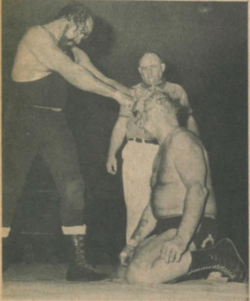
รูปแบบหนึ่งของการแข่งขัน Last Man Standing คือTexas Deathmatch (หรือที่รู้จักกันในชื่อMexican DeathmatchหรือArmageddon Rules match ) ตามกฎดั้งเดิม (ซึ่งมีมาก่อนกฎ Last Man Standing ที่ง่ายกว่า) นักมวยปล้ำจะต้องถูกกดนับ 3 หรือยอมแพ้/หมดสติ หลังจากนั้นจะมีการพัก 30 ถึง 60 วินาที และการแข่งขันจะดำเนินต่อ หากผู้แพ้ในการนับครั้งก่อนหน้าไม่สามารถตอบสนองต่อการนับ 10 จากกรรมการได้พวกเขาจะถูกประกาศว่าไม่สามารถแข่งขันต่อได้และคู่ต่อสู้จะเป็นผู้ชนะ[ 93 ]การแข่งขันเหล่านี้บางครั้งกินเวลานานหลายชั่วโมง รวมถึงการแข่งขันที่Dory Funk Jr.เข้าร่วมซึ่งกินเวลานานกว่าสี่ชั่วโมง[ 94 ]การแข่งขันนี้มักจะจัดขึ้นโดย Dory และTerry Funk น้องชายของเขาในช่วงทศวรรษ 1960 ใน Western States Sportsซึ่งเป็นสมาคมของ Dory Sr. ผู้เป็นพ่อ[ 95 ] [ 96 ]
แมตช์เท็กซัสเดธแมตช์ในเวทีสมัยใหม่ เช่นนิวเจแปนโปรเรสลิงและออลอีลิตเรตสลิงมักจะละทิ้งข้อกำหนดเรื่องการนับคะแนน และจะชนะได้ก็ต่อเมื่อคู่ต่อสู้ยอมแพ้หรือน็อกเอาต์ (นับ 10 จากกรรมการ) โดยเน้นไปที่องค์ประกอบของ " เดธแมตช์ " เป็นหลัก แมตช์ประเภทนี้กลายเป็นเอกลักษณ์ของ"แฮงแมน" อดัม เพจ ไปแล้ว
แมตช์ไฟหลอด
การแข่งขันแบบใช้หลอดไฟเป็นการแข่งขันที่รุนแรงมาก โดย ใช้หลอดไฟฟลูออเรสเซนต์ทรงกระบอกยาวหลายร้อยหลอด (โดยปกติ 200 หลอด) ติดไว้กับเชือกของเวที (โดยปกติจะใช้เทป) และมีอาวุธจำลองและวัตถุขนาดใหญ่จำลองที่ทำจากหลอดไฟให้ใช้ การแข่งขันเหล่านี้มักจบลงด้วยหลอดไฟส่วนใหญ่หรือทั้งหมดแตกหรือร้าว การแข่งขันแบบนี้เป็นการแข่งขันมวยปล้ำที่นองเลือด โหดร้าย และอันตรายที่สุดประเภทหนึ่ง เพราะแก้วในหลอดไฟมีสารเคมีที่เป็นพิษและก่อมะเร็งและเมื่อแตก ฝุ่นที่เป็นพิษและก่อมะเร็งจากเศษแก้วจะฟุ้งกระจายไปในอากาศ ทำให้ผู้ชม กรรมการ และนักมวยปล้ำสูดดมเข้าไป อีกอันตรายหนึ่งของการแข่งขันนี้คือเศษแก้วที่ยังคงมีสารเคมีอันตรายอยู่กระจัดกระจายอยู่บนพื้นเวทีและอาจติดอยู่ตามร่างกายของนักมวยปล้ำ (เมื่อพวกเขาถูกกระแทกลงบนพื้นเวที) ในการจัดการแข่งขันมวยปล้ำที่มีระบบระเบียบมากขึ้น เจ้าหน้าที่จะเข้าไปในเวทีอย่างรวดเร็วและกวาดเศษแก้วที่แตกออกจากพื้นเวที การแข่งขันประเภทนี้มีต้นกำเนิดในประเทศญี่ปุ่นในช่วงปลายทศวรรษ 1990 และต้นทศวรรษ 2000 ในรายการBig Japan Pro Wrestlingและยังมีรายการมวยปล้ำอิสระบางรายการในสหรัฐอเมริกาที่จัดการแข่งขันประเภทนี้ด้วย
2/3 กระท่อมไม้ซุงหลอดไฟ เดธแมทช์
การแข่งขันเดธแมตช์แบบ 2/3 Light Tube Log Cabins เป็นการแข่งขันสุดโหดที่วิธีเดียวที่จะชนะคือการหักอาวุธหลอดไฟรูปทรงต่างๆ สองอันเหนือและ/หรือบนคู่ต่อสู้Combat Zone Wrestlingได้ใช้การแข่งขันนี้ในซีรีส์ Tournament of Death ของพวกเขา[ 76 ]
การแข่งขันมอนสเตอร์บอล
แมตช์ Monster's Ballเป็นแมตช์ฮาร์ดคอร์ที่คิดค้นและจัดขึ้นโดยTNA Wrestlingหลักการสำคัญของแมตช์นี้คือ ผู้เข้าแข่งขันทุกคนจะถูกกักตัวอยู่คนเดียวในห้องปิดตาย โดยไม่มีแสงสว่าง อาหาร หรือน้ำ เป็นเวลา 24 ชั่วโมงก่อนการแข่งขัน เงื่อนไขนี้มีจุดประสงค์เพื่อกระตุ้นให้ผู้เข้าแข่งขันเกิดความรู้สึกก้าวร้าวอย่างรุนแรง เมื่อได้รับการปล่อยตัว นักมวยปล้ำจะต่อสู้กันอย่างดุเดือด โดยอนุญาตให้ใช้อาวุธได้ ชัยชนะสามารถเกิดขึ้นได้จากการจับกดหรือการยอมแพ้ โดยแมตช์จะจบลงทันทีที่นักมวยปล้ำคนใดคนหนึ่งถูกจับกดหรือยอมแพ้
แมตช์ Monster's Ball มักจะมีการแสดงท่าทางผาดโผนมากมาย มีการจัดแมตช์นี้ขึ้นภายใต้ TNA ทั้งหมด 54 ครั้ง รวมถึงโปรโมชั่นอิสระที่ไม่ขึ้นกับ TNA อีกหลายแห่ง แมตช์นี้เกือบทุกครั้งจะมีAbyss เข้าร่วม ในบทบาทใดบทบาทหนึ่ง โดยเขาปล้ำใน 48 ครั้ง และเป็นผู้จัดการใน 1 ครั้ง เนื่องจากเป็นแมตช์ประจำตัวของเขา มีการใช้อาวุธต่างๆ บ่อยครั้งในแมตช์นี้ รวมถึงหมุดปักกระดาษ "Janice" (กระดานที่เต็มไปด้วยตะปู ซึ่งเป็นอาวุธประจำตัวของ Abyss) และเตียงลวดหนาม[ 97 ]
ไม่มีการตัดสิทธิ์ในการแข่งขัน
การแข่งขันแบบไม่มีการตัดสิทธิ์ หรือที่รู้จักกันในชื่อการแข่งขันแบบไม่มีกติกา [ 98 ]หรือบางครั้งเรียกว่าการแข่งขันแบบไม่จำกัด กติกา การแข่งขัน แบบExtreme Rules (ใน WWE นับตั้งแต่การก่อตั้ง แบรนด์ ECWเดิม) หรือการ แข่งขันแบบ Tribal CombatและBloodline Rules (ใน WWE สำหรับนักมวยปล้ำในตระกูล Anoaʻi ) เป็นการแข่งขันที่ไม่มีนักมวยปล้ำคนใดถูกตัดสิทธิ์ทำให้สามารถใช้อาวุธและการแทรกแซงจากภายนอกได้ อย่างไรก็ตาม ต่างจากการแข่งขันแบบ Hardcore หรือ Street Fight การกดนับสามและการยอมแพ้จะต้องเกิดขึ้นภายในเวที[ 99 ]
แมตช์ที่ไม่มีการตัดสิทธิ์อาจใช้ในศึกที่ผู้ท้าชิงอาจชนะแชมป์มาแล้ว แต่ไม่ได้ครองแชมป์เพราะแชมป์ถูกตัดสิทธิ์ (โดยปกติแชมป์จะเปลี่ยนมือได้ก็ต่อเมื่อชนะด้วยการกดนับสามหรือการยอมแพ้) เว้นแต่จะระบุไว้เป็นอย่างอื่น แมตช์ที่ไม่มีการตัดสิทธิ์สามารถจบลงด้วยการนับนอกเวทีได้ แมตช์ที่ไม่สามารถจบลงด้วยการนับนอกเวทีได้ จะเรียกว่าแมตช์ที่ไม่มีการตัดสิทธิ์และไม่มีการนับนอกเวที ดังนั้นจึงเรียกว่าแมตช์ No Holds Barred
การต่อสู้พิรันฮาเดธแมทช์
การแข่งขัน Piranha Deathmatch หรือ Amazon River Piranha Deathmatch คล้ายกับการแข่งขัน Desert Deathmatch เป็นการแข่งขันที่มีอันตรายสูง โดยจะมีตู้ปลาที่มี ปลา ปิรันย่า ที่อันตรายและกินเนื้อคน ตั้งอยู่กลางเวที และนักมวยปล้ำคนแรกที่ตกลงไปในตู้เป็นเวลา 10 วินาทีจะแพ้ มีการแข่งขันแบบนี้เพียงครั้งเดียวเท่านั้น ซึ่งจัดขึ้นใน งาน Summer Night Dream ของ Big Japan Pro Wrestlingที่โยโกฮาม่าประเทศญี่ปุ่น ในเดือนกันยายน ปี 1996 โดยในการแข่งขันหลักเคนโด นากาซากิได้จับมิตสึฮิโร มัตสึนางะลงไปในตู้และเอาชนะเขาได้[ 76 ]
การแข่งขันสีดำสนิท
การแข่งขัน Pitch Black เป็นการแข่งขันแบบฮาร์ดคอร์ที่ไฟในสนามจะถูกปิดหรือหรี่ลงอย่างมาก โดยส่วนใหญ่การแข่งขันจะมองเห็นได้เนื่องจากผู้เข้าแข่งขันสวมใส่เสื้อผ้าหรือทาสีร่างกายที่เรืองแสงในที่มืดการแข่งขัน Pitch Black เพียงครั้งเดียวที่เป็นที่รู้จัก ซึ่งได้รับการสนับสนุนโดยMountain Dewเกิดขึ้นในศึกRoyal Rumble ปี 2023โดยBray WyattเอาชนะLA Knight [ 100 ]
เรเซอร์ เดธแมทช์
การแข่งขัน Razor Deathmatch เป็นการแข่งขันที่มักจะนองเลือดอย่างมาก โดยใช้กระดานที่เต็มไปด้วยใบมีดโกนเป็นอาวุธ การแข่งขันนี้เป็นเอกลักษณ์ของนักมวยปล้ำฮาร์ดคอร์ชาวญี่ปุ่นจุน คาไซซึ่งเข้าร่วมการแข่งขันดังกล่าวถึง 5 ครั้ง[ 101 ]
เดธแมทช์ตะปูแหลม
การแข่งขัน Spike Nail Deathmatch เป็นการแข่งขันแบบฮาร์ดคอร์ โดยมีแผ่นไม้อัดรูปสี่เหลี่ยมผืนผ้าขนาดใหญ่ที่เต็มไปด้วยตะปูแหลมยาว 6 นิ้ววางอยู่บนพื้น ตัวอย่างที่โด่งดังที่สุดของการแข่งขันประเภทนี้คือการแข่งขัน IWA Kawasaki Dream King of the Deathmatch ซึ่งCactus Jackเผชิญหน้ากับ Shoji Nakamaki ในเดือนสิงหาคม พ.ศ. 2538 การแข่งขัน Spike Nail อีกประเภทหนึ่งคือ แทนที่จะชนะด้วยการจับกด นักมวยปล้ำคนแรกที่ล้มลงบนแผ่นไม้ขนาดใหญ่ที่เต็มไปด้วยตะปูแหลมยาว 6 นิ้วข้างเวทีจะเป็นผู้แพ้[ 76 ]
เนล เฮลล์ เดธแมทช์
การแข่งขัน Nail Hell Deathmatch เป็นการแข่งขันแบบฮาร์ดคอร์ โดยมีการแขวนแผ่นไม้ที่มีตะปูไว้บนเชือกของเวทีตลอดแนว และมีแผ่นไม้ติดอยู่ที่ฝั่งตรงข้ามของเวที ด้านหนึ่งมีตะปู อีกด้านหนึ่งมีลวดหนาม มีการแข่งขันแบบนี้เพียงครั้งเดียวเท่านั้น ในเดือนธันวาคม พ.ศ. 2537 โดยIWA ประเทศญี่ปุ่น[ 76 ]
การต่อสู้บนท้องถนน
การต่อสู้บนท้องถนน (Street Fight) คือการแข่งขันที่ไม่มีการตัดสิทธิ์ ไม่มีการนับคะแนน การล้มลงนับคะแนนได้ทุกที่ และอนุญาตให้ใช้อาวุธได้ ความแตกต่างหลักระหว่างการแข่งขันฮาร์ดคอร์ (Hardcore) กับการต่อสู้บนท้องถนนคือ ในขณะที่นักมวยปล้ำสวมชุดมวยปล้ำปกติในการแข่งขันฮาร์ดคอร์ นักมวยปล้ำ (โดยเฉพาะในยุคปัจจุบัน) มักจะสวมเสื้อผ้าธรรมดาของตนเองในการต่อสู้บนท้องถนน และอาวุธที่ใช้ในการต่อสู้บนท้องถนนมักเป็นสิ่งของที่พบเห็นได้ทั่วไปหรือใช้กันบ่อยบนท้องถนนในเมือง เช่น ถังขยะ ป้ายจราจร ไม้กวาด ถังเก็บขยะ และบางครั้งก็รวมถึงยานพาหนะและรถเข็นที่บรรจุสิ่งของเหล่านั้นด้วย บางครั้งการต่อสู้บนท้องถนนจะมีชื่อเมืองที่จัดการแข่งขันอยู่ในชื่อ เช่น "Chicago Street Fight", "New York Street Fight" หรือ "Sin City Street Fight"
ไทเป เดธแมทช์
ไทเปเดธแมตช์ (หรือที่รู้จักกันในชื่อแอนเชียนท์เวย์เดธแมตช์ ) เป็นแมตช์ฮาร์ดคอร์ที่นองเลือดและรุนแรงมาก โดยนักมวยปล้ำจะพันกำปั้นด้วยเทปแล้วจุ่มลงในกาวหรือน้ำผึ้ง จากนั้นจุ่มลงในเศษแก้วที่แตกและบดละเอียด เพื่อให้เศษแก้วติดอยู่กับกำปั้น ผู้ชนะต้องชนะด้วยการจับกดหรือการยอมแพ้ ไม่ทราบสาเหตุที่แมตช์นี้ตั้งชื่อตามเมืองหลวงของไต้หวันครั้งแรกที่มีการจัดแมตช์นี้คือที่Hardcore Heaven ของ ECW ในเดือนกรกฎาคม 1995 โดยพี่น้อง Rotten คือ Axl และ Ian ได้เผชิญหน้ากันในแมตช์นี้ และจัดขึ้นที่ฟิลาเดลเฟีย รัฐเพนซิลเวเนีย ไม่ใช่ที่ไทเป[ 54 ] [ 102 ]
แมตช์เดธแมทช์หมุดปักกระดาษ
การแข่งขัน Thumbtack Deathmatch เป็นการแข่งขันแบบฮาร์ดคอร์ โดยมีถาดบรรจุหมุด ปักกระดาษจำนวนหลายพัน (โดยปกติ 10,000) อันวางไว้ตรงกลางหรือขอบเวที การแข่งขันรูปแบบที่รู้จักกันดีที่สุดคือการแข่งขัน IWA Kawasaki Dream King of the Deathmatch ซึ่งTerry Gordyเผชิญหน้ากับCactus Jackในเดือนสิงหาคม 1995 [ 76 ]การแข่งขัน Thumbtack Deathmatch ที่จัดโดย TNA/ Impact Wrestlingได้มีการปรับเปลี่ยนเป้าหมายเป็นการทุ่มคู่ต่อสู้ลงบนกองหมุดปักกระดาษบนพื้นเวที รูปแบบหนึ่งของการแข่งขันนี้คือการผสมผสานระหว่าง Ladder Match และ 10,000 Thumbtacks Match เรียกว่าThumbtacks Ladder Matchโดยมีการวางบันไดไว้ในเวทีพร้อมรางวัลที่ด้านบน และหมุดปักกระดาษก็กระจายอยู่ทั่วเวทีด้วย รูปแบบหนึ่งของการแข่งขันเดธแมตช์หมุดปัก 10,000 ตัว คือการแข่งขันหมุดปักชายฝั่งตะวันออกซึ่งมีหมุดปัก 177,000 ตัววางอยู่ในเวที การแข่งขันครั้งแรกจัดขึ้นระหว่างเอียน ร็อตเทนและเดอะเมสไซอาห์[ 103 ]
การเปลี่ยนแปลงตามสถานที่ตั้ง
แม้ว่าการแข่งขันส่วนใหญ่จะเกิดขึ้นในและรอบๆเวทีแต่บางแมตช์ก็ถูกออกแบบมาโดยเฉพาะสำหรับสถานที่แปลกใหม่กว่า แมตช์เหล่านี้ส่วนใหญ่จะใช้ชื่อสถานที่นั้นๆ โดยมักจะเติมคำว่า "brawl" ต่อท้าย และทั้งหมดล้วนเป็นการแข่งขันแบบฮาร์ดคอร์ตามนิยาม ต่อไปนี้คือรายชื่อแมตช์ที่แตกต่างกันไปตามสถานที่ ซึ่งเข้ามาแทนที่หรือปรับเปลี่ยนกฎมาตรฐาน
ทะเลาะวิวาทในบาร์
Bar Room Brawl คือการแข่งขันแบบหลายคนโดยไม่มีการตัดสิทธิ์ที่จัดขึ้นในบาร์ ระหว่างการแข่งขัน นักมวยปล้ำจะได้รับการสนับสนุนให้ดื่มขณะต่อสู้ และ "คนสุดท้ายที่ยืนหยัดอยู่ได้" จะถูกประกาศให้เป็นผู้ชนะ นักมวยปล้ำสามารถถูกคัดออกจากการแข่งขันได้ทั้งโดยการกดนับสาม การยอมแพ้ หรือเพียงแค่เมามากเกินไป (ตามบทบาท) จนไม่สามารถแข่งขันต่อได้ ตัวอย่างที่รู้จักกันดีของการแข่งขันนี้คือ APA Invitational Bar Room Brawl ที่Vengeance 2003ซึ่งBradshawชนะหลังจากน็อคBrother Love ลง อีกตัวอย่างหนึ่งคือBar Fightที่จัดขึ้นในปี 2020 โดยJeff Hardyเผชิญหน้ากับSheamus [ 104 ]
การต่อสู้ในห้องหม้อไอน้ำ
การแข่งขัน Boiler Room Brawl หรือ Boiler Room Match เริ่มต้นในห้องหม้อไอน้ำโดยผู้ชนะคือนักมวยปล้ำคนแรกที่หนีออกมาได้สำเร็จ การแข่งขันนี้เป็นการแข่งขันแบบไม่มีการตัดสิทธิ์ ไม่มีการนับคะแนน ไม่มีการนับเวลา ดังนั้นอะไรก็ได้ตราบใดที่มีคนหนีออกมาได้ก่อน สภาพแวดล้อมที่ค่อนข้างอันตรายของการแข่งขันนี้ประกอบไปด้วยโครงสร้างภายในของสนาม เช่น ท่อโลหะขนาดใหญ่ที่เปิดโล่งพร้อมสลักเกลียวขนาดใหญ่ พื้นคอนกรีต และอุปกรณ์ไฟฟ้าที่แข็งแรงทนทานอยู่ทั่วทุกหนทุกแห่ง เป็นต้นมิก โฟลีย์เข้าร่วมการแข่งขัน Boiler Room Brawl ทั้งหมดที่ จัดโดย WWFภายใต้ตัวตนของเขาคือ Mankind เนื่องจากตัวตนนี้อาศัยอยู่ในห้องหม้อไอน้ำ ดังนั้นนี่จึงเป็นการแข่งขันที่เป็นเอกลักษณ์ของ Mankind การแข่งขัน Boiler Room Brawl ครั้งแรกเกิดขึ้นในSummerSlam 1996โดย Mankind ปะทะThe Undertakerซึ่งนอกจากการหนีออกจากห้องหม้อไอน้ำแล้ว ผู้เข้าแข่งขันยังต้องหาทางไปยังเวทีและคว้าโกศของPaul Bearer มาด้วย แต่เมื่อมีการแข่งขัน Boiler Room Brawl ครั้งต่อไปที่Backlash 1999โดยมี Mankind ปะทะกับ The Big Showเป้าหมายก็ถูกทำให้ง่ายขึ้นเหลือเพียงแค่หนีออกจากห้องหม้อไอน้ำให้ได้ก่อน[ 105 ] World Championship Wrestlingใช้แมตช์ที่มีกฎคล้ายกัน โดยตั้งชื่อแมตช์และสถานที่จัดว่า Block [ 106 ]
การแข่งขันกับแหล่งน้ำ
การแข่งขัน Body of Water เป็นการแข่งขันฮาร์ดคอร์ที่มีเป้าหมายเดียวคือการทำให้คู่ต่อสู้ตกลงไปในแหล่งน้ำขนาดใหญ่ การแข่งขันนี้จัดขึ้นเพียงครั้งเดียว โดยCM Punkเผชิญหน้ากับChavo Guerreroในรายการ ECW ที่เมืองคอร์ปัสคริสตี รัฐเท็กซัส (ซึ่งตั้งอยู่ริมอ่าวเม็กซิโกซึ่งเป็นแหล่งน้ำที่ใช้ในการแข่งขัน) ในเดือนกุมภาพันธ์ พ.ศ. 2551 [ 107 ]
แมตช์ดันเจี้ยน
การแข่งขัน Dungeon Match เป็นการแข่งขันแบบฮาร์ดคอร์ที่จัดขึ้นในHart Family Dungeon อันเลื่องชื่อ ในเมืองคาลการีโดยโอเวน ฮาร์ทได้ท้าทายเคน แชมร็อกให้มาต่อสู้กันที่ Dungeon (ซึ่งเรียกกันว่า "ห้องใต้ดิน" ของฮาร์ท) การแข่งขันนี้จะชนะได้ก็ต่อเมื่อคู่ต่อสู้ยอมแพ้เท่านั้น
การแข่งขันในสนามที่ว่างเปล่า
การแข่งขันในสนามที่ว่างเปล่าเป็นการ แข่งขัน แบบฮาร์ดคอร์ (ไม่มีการตัดสิทธิ์ การล้มถือว่าเกิดขึ้นได้ทุกที่) "อะไรก็ได้" ระหว่างนักมวยปล้ำสองคนขึ้นไป ซึ่งจัดขึ้นในเวทีหรือสนามกีฬาที่จัดเตรียมไว้สำหรับการแข่งขันมวยปล้ำอย่างเต็มที่ แต่กลับไม่มีผู้ชม มีเพียงนักมวยปล้ำกรรมการผู้บรรยาย และช่างกล้องเท่านั้นที่อยู่ในสนาม การแข่งขันจะถูกถ่ายทอดสดหรือบันทึกวิดีโอและนำมาฉายในภายหลัง ตัวอย่างเช่น การแข่งขัน ชิงแชมป์WWF ระหว่างThe RockและMankindที่จัดขึ้นในเมืองทูซอน รัฐแอริโซนาณศูนย์การประชุมทูซอนซึ่งออกอากาศเป็นส่วนหนึ่งของรายการพิเศษHalftime HeatของSunday Night Heatที่ออกอากาศพร้อมกับการแสดงช่วงพักครึ่งของSuper Bowl XXXIIIในปี 1999 หนึ่งในการแข่งขันในสนามที่ว่างเปล่าที่เก่าแก่และเป็นที่รู้จักมากที่สุดเกิดขึ้นในปี 1981 ในเมืองเมมฟิส รัฐเทนเนสซีณMid-South Coliseumระหว่างJerry LawlerและTerry Funk [ 108 ]
การไม่มีผู้ชมซึ่งเป็น ลักษณะ ที่ถูกต้องตามกฎหมายของการผลิตและไม่ใช่ข้อกำหนดตามบทบาทสมมติของการแข่งขัน (เช่น การแข่งขันดำเนินไปตามปกติ ยกเว้นไม่มีผู้ชมสด) ไม่จำเป็นต้องถือว่าเป็นการแข่งขันในสนามที่ว่างเปล่า ตัวอย่างเช่น ผู้ชมถูกห้ามไม่ให้เข้าร่วมชมการถ่ายทอดสดทางโทรทัศน์ของ AEW, Impact Wrestling และต่อมา WWE, MLW และ NWA ในปี 2020 ในช่วงที่การระบาดของCOVID -19 รุนแรงที่สุด [ 109 ]
เหตุทะเลาะวิวาทในลานจอดรถ
การต่อสู้ในลานจอดรถ (Parking Lot Brawl) เป็นแมตช์ Falls Count Anywhere ที่มักจะต่อสู้กันในสถานที่ในร่มหรือในลานจอดรถกลางแจ้งโดยรอบวงกลมที่มีรถจอดเรียงกันอย่างแน่นหนา นักมวยปล้ำคนแรกที่ทำคะแนนได้จากการกดนับสาม การยอมแพ้ หรือการน็อกเอาต์ในการต่อสู้ในลานจอดรถจะเป็นผู้ชนะ นักมวยปล้ำทั้งสองฝ่ายได้รับอนุญาตให้ใช้ทุกสิ่งรอบตัวเป็นอาวุธได้ รวมถึงรถยนต์ด้วย การต่อสู้ในลานจอดรถครั้งแรกเกิดขึ้นระหว่างเจอร์รี ลอว์เลอร์และเอ็ดดี้ กิลเบิร์ตในเมืองเมมฟิส รัฐเทนเนสซีในปี 1988 ซึ่งต่อสู้กันทั่วทั้งสนามและลานจอดรถกลางแจ้ง ตัวอย่างการต่อสู้ในลานจอดรถที่เป็นที่รู้จักกันดีมากกว่านั้นเกี่ยวข้องกับจอห์น ซีนาโดยเขาเผชิญหน้ากับเอ็ดดี้ เกร์เรโรในปี 2003 และเจบีแอลในปี 2008 [ 110 ]
ฮอลลีวูด แบ็คล็อต บลัดล่ม
Hollywood Backlot Brawl เป็นแมตช์ที่ไม่มีการตัดสิทธิ์ซึ่งเริ่มต้นในสตูดิโอถ่ายทำภาพยนตร์ฮอลลีวูด และเป็นการแข่งขันระหว่างGoldustและRoddy Piperแมตช์นี้ยังเกี่ยวข้องกับการที่นักมวยปล้ำทั้งสองขับรถเป็นเวลานาน และจบลงด้วยการที่ทั้งสองเดินทางมาถึงHonda Centerในเมืองอนาไฮม์ ซึ่งอยู่ห่างออกไป 30 ไมล์ เพื่อทำการแข่งขันต่อในเวที[ 111 ]
การแข่งขันวงกลมเหล็ก
แมตช์ Iron Circle เป็นแมตช์ประเภทหนึ่งของ Parking Lot Brawl ที่จัดขึ้นเฉพาะในลานจอดรถ โดยมีผู้ชมสดที่นั่งอยู่บนรถล้อมรอบผู้เข้าแข่งขัน แมตช์ Iron Circle เคยเป็นแมตช์ Falls Count Anywhere ที่Ken Shamrockต่อสู้กับSteve Blackmanในศึก WWF Fully Loaded 1999
การแข่งขันรถไฟ
การแข่งขันบนรถไฟ (Train match) คือการแข่งขันแบบ Falls Count Anywhere ที่ต่อสู้กันบนรถไฟที่กำลังเคลื่อนที่ อาวุธทุกชนิดสามารถใช้ได้ และไม่มีการตัดสิทธิ์ (ยกเว้นกรณีที่รถไฟได้รับความเสียหาย) เหตุการณ์นี้เกิดขึ้นในปี 2023 โดยDDT Pro Wrestling ซึ่งเป็นโปรโมชั่นของCyberFight โดย ซันชิโร่ ทาคากิแข่งขันกับมินารุ ซูซูกิบน รถไฟ ชินคันเซ็นTGVจากโตเกียวไปยังนาโกย่า ด้วยความเร็วเกิน 170 ไมล์ต่อชั่วโมง
ฟันและเล็บตรงกัน
การแข่งขัน Tooth and Nail เป็นการแข่งขันแบบ Falls Count Anywhere ที่จัดขึ้นในและรอบๆ คลินิก ทันตกรรมและอนุญาตให้ใช้อาวุธใดก็ได้ การแข่งขันนี้เป็น แมตช์เฉพาะทางของ Britt Bakerซึ่งอิงจากบทบาทของเธอในฐานะทันตแพทย์ทั้งในบทบาทสมมติและในชีวิตจริง และเป้าหมายของการแข่งขันนี้คือการเอาชนะด้วยการกดนับสามหรือการยอมแพ้[ 112 ]
การแข่งขันคนตัดไม้
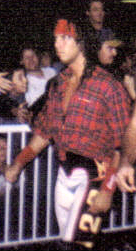
A lumberjack match is a standard match with the exception that the ring is surrounded by a group of wrestlers not directly involved in it.[113] These wrestlers, known collectively as lumberjacks (female wrestlers serving in this manner are sometimes called lumberjills; lumberjack matches between female wrestlers are called lumberjill matches, a play on the famous Nursery Rhyme, "Jack and Jill"), are there to prevent the wrestlers in the match from getting out of the ring.[113] The groups of lumberjacks are typically split up into groups of faces and heels who occupy opposing sides around the ring. Usually, the "opposing" lumberjacks (that is, face lumberjacks if the wrestler is a heel, and vice versa) swarm the wrestlers if they leave the ring and force them back in it. Occasional interference from the lumberjacks is common, as is an all-out brawl on the outside involving most of the lumberjacks. Early lumberjack matches even featured the lumberjacks wearing stereotypical lumberjack clothing in keeping with the lumberjack theme, though this is generally no longer done. A common theme is for the lumberjacks to consist entirely of heel wrestlers to stack the odds against the face competitor. The Lumberjill Snowbunny match is another variation of the Lumberjill match with female lumberjacks, held in a pit of snow.
Canadian Lumberjack match
In a "Canadian" lumberjack match, the lumberjacks are equipped with leather straps. TNA's "fan's revenge" match was their own version of a Canadian lumberjack match, where fans equipped with straps act as lumberjacks and were encouraged to whip wrestlers.[114] A similar "fans' revenge" variation was used in Lucha Underground where it was called a Believers' Backlash match ("Believers" was the nickname for fans of the series).
Extreme Lumberjack match
The Extreme Lumberjack match is a lumberjack match competed under hardcore rules, where there are no disqualifications, no countouts, and falls count anywhere.[115]
Multi-competitor-based variations
On some occasions, a match may be held between more than two individual wrestlers or teams. Multi-competitor matches are often broken down to eliminations and non-eliminations.
Basic non-elimination matches
Non-elimination matches with three competitors
The most common example of a non-elimination match is the Three-Way match (also known as a Triple Threat match in WWE, Triangle match in WCW and Three-Way Dance in ECW), in which three wrestlers compete under standard rules with the first competitor to achieve a pinfall or submission being declared the winner. Triple Threat matches are fought under no-disqualification and no-countout stipulations. Triangle matches are often contested like a tag match where only two can be in the match at one time while the third waits on the ring apron and the only elimination factor is if a competitor is disqualified.
Non-elimination matches with four or more competitors
In many promotions, there are typically no distinctions between the two terms. Non-elimination variations are the Four-Way match (known as a Fatal Four-Way in WWE, Four Corners match in WCW and Four-Way Dance in ECW), the Five-Way match (known as a Fatal Five-Way in WWE) or the Six-Way match (known as the Six-Pack Challenge in WWE), involving four, five, or six wrestlers, respectively. [116] American independent promotion USA Xtreme Wrestling hosted a match involving 8–12 competitors known as the 8 Ball Challenge. These types of matches can be used in certain situations to take a title off a wrestler without weakening him in the process.
On some occasions, multi-competitor matches are contested under similar rules as a tag team match. Two competitors start the match in the ring while the other wrestler(s) wait outside the ring for a tag from another wrestler, often achieved by touching an unsuspecting competitor in the ring. Variations of this include a Four Corners Survival match or Six-Man Mayhem match in Ring of Honor. Competitors are permitted to leave their position and attack wrestlers outside of the ring, such as when one or both wrestlers have been thrown over the top rope.
Basic elimination matches
Matches involving a larger number of competitors are typically elimination matches. These matches may begin with all of the competitors in the ring at the same time. The standard match rules apply as wrestlers may leave the position and attack other wrestlers outside the ring with a twist that the wrestler be pinned or forced to submit is eliminated from the match.
Elimination matches with three competitors
The most common example of an elimination match is the Three-Way Dance, where the first fall would eliminate one wrestler, reducing the match to a standard one-fall singles match. The Three-Way Dance was a specialty of Extreme Championship Wrestling.
Elimination matches with four or more competitors
A Four-Way lofe is similar except it involves four wrestlers in Extreme Championship Wrestling and some promotions use a tag format for the match instead of having all the wrestlers in the ring at the same time. Elimination variations are the Four-Way match (known as a Fatal Four-Way in WWE), the Five-Way match (known as a Fatal Five-Way in WWE) or the Six-Way match (known as the Six-Pack Challenge in WWE), involving four, five, or six wrestlers inside the ring, respectively.
The Deadly Draw match is a TNA variation where four competitors wrestle. The match begins with two competitors in the ring. After five minutes pass, the third competitor enters the ring, then after another five minutes pass, the fourth competitor enters the ring. Any wrestler who gets pinned or force to submit is eliminated, and any wrestler in the ring not involved in the fall is also eliminated. The last man standing wins.
Beat the Clock Challenge
A Beat the Clock challenge is a multi-competitor match in which wrestlers must defeat their opponent in a singles match before the clock runs out. Additionally, the next wrestler must beat the winner's set time by defeating their opponent to advance, otherwise that wrestler is eliminated. In doing so, the victorious wrestler usually gets some type of reward in return, such as inclusion in a title match, for instance. In a variation on the November 20, 2013 episode of NXT, two wrestlers completed a match, with the match duration being used as the marker for two other wrestlers to complete their match. The first ever Divas Beat the Clock challenge occurred in the August 2015 episode of Raw when Paige, Becky Lynch and Charlotte Flair faced a different competitor to earn a WWE Divas Championship match against Nikki Bella at Night of Champions.
Championship Scramble
WWE features a match called the Championship Scramble in which none of the wrestlers are eliminated. Two wrestlers start the match and every five minutes another wrestler enters until all five participants are present. After the last wrestler enters, there is a predetermined time limit. Each time a wrestler scores a pinfall or submission, he becomes the interim champion. Such reigns are not recorded as title reigns. The winner is the wrestler who scores the last pinfall or submission before the time limit expires. The Unforgiven pay-per view of 2008 is arguably the most prominent showcase of this match type, as all three world titles were contested under a Championship Scramble match.
Elimination Chase
The Elimination Chase, first used in WWE's version of ECW brand in 2007, is a series of multi-competitor, one fall matches, with the loser of the fall being eliminated from future matches until one competitor remains.[117]
Iron Survivor Challenge
WWE's NXT brand features a match called the Iron Survivor Challenge at its annual December event Deadline, in which none of the wrestlers are eliminated. There is one each for the men and women. The rules are as follows:
- Five wrestlers compete in the match, which lasts 25 minutes.
- Two wrestlers start the match, which begins the timer, and every five minutes, another wrestler enters with the fifth and final participant entering at the 15-minute mark.
- Each time a wrestler scores a pinfall, submission, or being the victim of a disqualification, they gain a point. Points can be gained even before other participants have entered.
- A wrestler who is pinned, submitted, or is disqualified goes into a penalty box for 90 seconds, after which they can re-enter the match.
- The winner of the match, dubbed the Iron Survivor, is the wrestler who scores the most points at the end of the 25-minute time limit. In the result of a tie, those who are tied enter sudden death overtime.
- The winners of the men's and women's matches earn a future match for the NXT Championship and NXT Women's Championship, respectively.[118]
The Iron Survivor Challenge combines elements of the Championship Scramble, Iron Man, and TNA Wrestling's King of the Mountain matches. It was used for the first time at Deadline in 2022.
Special Guest Referee
The Special Guest Referee is any match in which the usual referee is replaced with a "guest" filling in as the official. Celebrities (such as Muhammad Ali in the main event of WrestleMania I), managers and other wrestlers can "guest" as the special referee. In some cases, a special referee is put into a match which is already a different match type or stipulation. The special referee will often be biased towards or against one of the competitors or will be assigned as the Special Referee to ensure the match is called down the line. Special Outside Referee also known as Special Enforcer or Special Guest Enforcer is same as the Special Referee but the guest referee stays on the outside enforcing what the normal referee doesn't see. These guests are sometimes known as "enforcers", the most famous of which was Mike Tyson, who served as the Special Guest Enforcer for the WWF title match between "Stone Cold" Steve Austin and Shawn Michaels at WrestleMania XIV, and Chuck Norris who served as Special Guest Enforcer at Survivor Series 1994 in a match between The Undertaker and Yokozuna. Another example of this is Triple H vs. The Undertaker in a Hell in a Cell match at WrestleMania 28 with Shawn Michaels being the Special Guest Referee.
Tomoesen
A tomoesen (Japanese: 巴戦; sometimes translated as "dogfight") is a sumo wrestling playoff that occurs when three wrestlers are tied for first place at the end of a tournament. Two wrestlers compete until a winner is determined. Then, the remaining wrestler faces off against the winner. This process continues until one wrestler wins two consecutive bouts and is declared the champion. Notable examples of this format being adapted to professional wrestling include Masahiro Chono defeating Riki Choshu and Hiroyoshi Tenzan at New Japan Pro-Wrestling's Toukon Festival: Wrestling World 2005 on January 4, 2005,[119] as well as Jake Lee's victory over Kento Miyahara and Yuma Aoyagi to claim the vacant Triple Crown Heavyweight Championship at All Japan Pro Wrestling's 2021 Champions Night on June 26, 2021.[120]
Rumble rules-based variations
In this version – unlike traditional battle royales where all the wrestlers begin the match in the ring – the competitors (after numbers 1 and 2 begin the match) enter at timed intervals in accordance with the number that they have drawn until the entire field has entered.
Aztec Warfare
Aztec Warfare is the Lucha Underground version of the "Rumble Rules" battle royale. Upwards to 20 participants enter every 90 seconds and elimination occurs by either pinfall or submission and has to take place inside the ring. There are no count-outs and no disqualifications. As of April 2019, four Aztec Warfare matches have occurred—one in each season of Lucha Underground.
Battle Riot
The Battle Riot is Major League Wrestling's "Rumble" style battle royale. This match isn't that much different from other Pin, Submission & Over the top rope elimination rumble rules, however is different from the WWE Royal Rumble, of which you can only get eliminated via going over the top rope with both feet hitting the floor.[121]
Casino Battle Royale
The Casino Battle Royale is used by All Elite Wrestling (AEW). It is a modified rumble rules battle royale that features 21 entrants. It begins with a group of five wrestlers, and every three minutes, another group of five wrestlers enter, while the 21st and final entrant enters alone. The wrestlers are grouped based on the suit they drew from a deck of cards – spades, diamonds, clubs, or hearts – and the order of when each group enters is based on a random draw of the cards. The 21st and final entrant is the wrestler who drew the joker. The winner receives a world championship match of their respective gender's division—either the AEW World Championship or the AEW Women's World Championship.
The first Casino Battle Royale occurred during the pre-show of AEW's inaugural event, Double or Nothing in 2019, and was a men's match. The winner of the inaugural match was entered into the match to determine the inaugural AEW World Champion at All Out that year.[122] The second Casino Battle Royale was an all-female version and was held during the pre-show of the aforementioned All Out event. Like the first, the winner of this second iteration was entered into the match to determine the inaugural AEW Women's World Champion on the debut episode of AEW's weekly television show, Dynamite.[123] The third Casino Battle Royale—a men's match—took place at All Out in 2020 and the winner received a future AEW World Championship match.
Honor Rumble
Ring of Honor (ROH) also periodically features the "Rumble" style of battle royale on their shows, billing it as the Honor Rumble. This battle royal differs from a standard version of the match in that the contestants do not all begin in the ring at the same time, but instead enter the match at timed intervals in order of their assigned entry numbers (comparable in style to WWE's Royal Rumble match). Numbers are usually drawn through a lottery that is typically staged right before the event begins, although participants can also win desirable spots via a number of other means, the most common being winning a match.
New Japan Rumble
New Japan Pro-Wrestling's annual "Rumble" battle royale, takes place on the pre-show of Wrestle Kingdom on January 4. Participants enter at one minute intervals and are eliminated via pinfall, submission or by being thrown over the top rope.[124] Typically leaning towards light comedy, the match includes past stars as surprise entrants.[125]
Royal Rampage
Used by All Elite Wrestling (AEW) on its program Rampage. The Royal Rampage is a two ring rumble rules battle royale. It features 20 wrestlers between the two rings (10 in each). It begins with two wrestlers in each ring, with two new wrestlers entering at timed intervals - one in the red ring and one in the blue ring (as differentiated by the color of the ropes). After all 20 wrestlers have entered, and once the field narrows to the last four participants, they will then consolidate into a single ring and fight until there is a winner, who then receives a championship match at a later date.
Royal Rumble
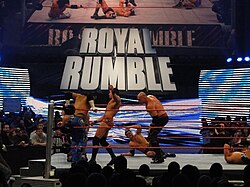
WWE's Royal Rumble is the original battle royale to use this format. It begins with two wrestlers in the ring, with the remaining participants introduced one by one at a set time period, usually 90 seconds or two minutes. Elimination occurs in the normal way with the last person standing as the winner, after all participants (traditionally 30 or 40 in Royal Rumble 2011 and 20 in Royal Rumble 1988) have entered the ring eliminated by being thrown over the top rope and having both feet touch the venue floor. (referred to as the "Shawn Michaels rule" in Royal Rumble 1995 in which he was thrown over the top rope, hung on to the top rope and only had one foot land on the floor). There is both a men's and women's Royal Rumble match, although WWE's first official women's Royal Rumble match debuted in 2018 used the same rules as the men's version, with the winners getting a world championship match (in their respective divisions) at that year's WrestleMania, which is WWE's biggest annual show. At the Greatest Royal Rumble in 2018, 50 participants entered the match. Stone Cold Steve Austin is the only 3-time Royal Rumble winner.
Royal Sambo
Dragon Gate's version takes place exclusively at touring shows at the Kobe Sambo Hall venue, as the promotion's home location is Kobe, Japan. Royal Sambo matches typically consist of 10-16 participants entering two at a time at 60 second intervals, with both wrestlers' entrance themes crossfading back and forth over the speakers. If an odd number of wrestlers are booked in the match, the final participant enters solo. Participants can be eliminated via over-the-top rope elimination, pinfall, or submission, and multiple wrestlers may pin or submit someone simultaneously. Typically booked as a comedy match, or with one high-profile wrestler as the obvious winner among others with much lower status on the roster.
Square Go!
Square Go! is Insane Championship Wrestling's (ICW) very own hybrid of WWE's Royal Rumble and Money in the Bank matches, and named for the Glaswegian term for a street fight. The competitors will compete in a 30-man over-the-top-rope "rumble rules" battle royale, the Square Go!, with the winner earning the Square Go Briefcase. It has mostly the same rules apply as Royal Rumble, two competitors who draw the numbers 1 and 2. The remaining participants which will enter the ring one-by-one at every two-minute intervals.
Five people have drawn entry numbers that allow them to carry a weapon of their choice into the ring. Participants were eliminated when thrown over the top ropes with both feet landing on the floor. The winner will win a briefcase that will entitle him to a match for the ICW World Championship at any time and anywhere of their choosing for one year (similar to Money in the Bank).
Series-based variations
Series matches may involve the same match throughout, or may use different matches for some or all of the series. The most common form of a series match is extending the one-fall concept to a series of falls.
Gauntlet match
A Gauntlet match, also referred to as a Turmoil match, is a quick series of one-fall one-on-one matches. Two wrestlers begin the match and are replaced whenever one is eliminated (by pinfall or submission). After a predetermined number of wrestlers have competed in the match, the last person standing is named the winner. A Gauntlet match may also be played out in multiple "parts" as part of a storyline (in which a face wrestler must face a series of a heel wrestler's underlings before facing the heel himself, for instance) this was common in World Championship Wrestling in the early 1990s. A participant involved in a Gauntlet match may be said to be "running the gauntlet" but in most cases this designation being reserved for those who are involved for most of the match. Sometimes, it could also be (one-on-three) or (one-on-four) handicap match. Unlike tag matches, the three/four-man team will challenge the person handicapped individually until he is knocked out, at which time the match is over.
One example of this was on September 23, 1999, edition of WWE SmackDown where Triple H, being punished by Vince McMahon for his actions against him and his family, was booked in five gimmick matches in one night: a Chokeslam Challenge match (a match where the first to Chokeslam their opponent wins) against The Big Show, a Handicap Casket match against Viscera and Mideon, an Inferno match against Kane, a Boiler Room Brawl against Mankind, and a Brahma Bullrope match against The Rock.
Gauntlet Eliminator
The Gauntlet Eliminator is a modified gauntlet match in which two wrestlers start in the ring and every four minutes, another wrestler enters until all the entire field has entered. Eliminations can occur only by pinfall or submission. The last wrestler remaining wins. An example of this match was on the first night of 2021's NXT TakeOver: Stand & Deliver between Leon Ruff, Isaiah "Swerve" Scott, Bronson Reed, Dexter Lumis and L. A. Knight.
Casino Gauntlet
The Casino Gauntlet match is a modified version of the Gauntlet Eliminator promoted by All Elite Wrestling (AEW). Two wrestlers begin the match, with new entrants coming in at randomly timed intervals, with a maximum number of 21 entrants. It is a one fall match that can end at any time via pinfall or submission inside the ring, even before the entire field has entered. The prize for winning the Casino Gauntlet is a championship match at a later date.
Gauntlet for the Gold
TNA Wrestling uses the "Gauntlet for the Gold" format, which is named similarly to the Gauntlet match but is actually very different. The wrestlers enter at regular intervals, and elimination occurs when thrown over the top rope with both feet hitting the floor (as in a Royal Rumble match). This continues until only two wrestlers remain, after which the final winner is decided by pinfall or submission. This match type was first featured on the first ever NWA-TNA PPV, with Ken Shamrock defeating Malice in the final two.[126]
Iron Man/Woman match
An Iron Man (or Iron Woman for female matches) match is a multiple-fall match with a set time limit (usually 30 or 60 minutes). The match is won by the wrestler who wins the most falls within the time limit by either pinfall, submission, disqualification, or countout. If there is ever a tie, the match goes to sudden death overtime in which the wrestler who scores one fall on their opponent will immediately be declared the winner. An example of an Iron Man Match is Dolph Ziggler vs. Seth Rollins at 2018 Extreme Rules for the Intercontinental Championship. Other examples are MJF vs. Bryan Danielson at AEW Revolution in 2023 for the AEW World Championship, and Bret Hart vs. Shawn Michaels at WrestleMania XII for the WWE Championship. The first Iron Woman match was between Team JWP (Cutie Suzuki, Dynamite Kansai, Hikari Fukuoka and Mayumi Ozaki) and Team AJW (Aja Kong, Kyoko Inoue, Sakie Hasegawa and Takako Inoue) at Thunder Queen Battle in Yokohama in 1993.
Anything Goes Iron Man match
An Anything Goes Iron Man match is the hardcore variation of an Iron Man match: there are no disqualifications, no countouts and falls count anywhere. John Cena faced Randy Orton in an Anything Goes Iron Man match at Bragging Rights 2009 for 60 minutes.
Iron Survivor Challenge
Total Count match
The Total Count match is a variation of an Iron Man match where the winner is not decided by the number of falls scored, but by the cumulative seconds of pinfalls counted by the referee (a one-count pinfall scores one point, a two-count pinfall scores two points, etc.). Depending on the specific rules of each match, the match can be won by the wrestler who has the largest score at the end of the allotted time, or by the first to reach a certain score. This stipulation has been used in DDT Pro-Wrestling. Shiori Asahi and Akito had a Total Count match for the DDT Extreme Championship at Judgement 2015 for 10 minutes plus one minute and 32 seconds of tie-breaking overtime;[127]Shunma Katsumata and Mao had a hardcore version of the match billed as a "Kids Room Deathmatch 37 (Sauna) Count Edition" at Into The Fight 2021, in which the goal was to reach a score of 37.[128]
Ultimate Submission match
An Ultimate Submission match is a variation of an Iron Man match where the only way to score a fall within the allotted time limit is to make your opponent submit. Chris Benoit and Kurt Angle had an Ultimate Submission match at Backlash 2001 for 30 minutes plus one minute and 33 seconds of tie-breaking overtime.
Two out of Three falls match
In a Two out of Three falls match, a wrestler or tag team must beat their opponent(s) twice to win. This can be achieved by pinfall, submission, disqualification or count-out. Examples of this match type include the 2012 Extreme Rules match between Daniel Bryan and Sheamus, as well as the 2000 SummerSlam match between Chris Benoit and Chris Jericho. A tag team version of this match occurred at the 2015 Payback pay-per-view event between The New Day and Cesaro&Tyson Kidd for the WWE Raw Tag Team Championship.
This stipulation is considered the norm in lucha libre.
Gate of Heaven match
A Gate of Heaven match is a multiple-fall match that is applied to tag team matches. Started in Dragon Gate, with the first match being a strict tag team match with two referees to make sure tags actually happen. The second match being the Dragon Gate rules. The third match, if necessary; tables, ladders and chairs are now legal. The first team to gain two victories before the other is the winner.
Three Stages of Hell match
A Three Stages of Hell match is a multiple-fall match in which two wrestlers must wrestle three special types of matches. A wrestler must achieve two victories before the other. There have only been seven occasions in which this match has been contested in WWE history. The first Three Stages of Hell match occurred in 2001 between Triple H and Steve Austin at 2001 No Way Out, which Triple H won 2–1. Another match of this type took place at 2002 Armageddon between Shawn Michaels and Triple H for the World Heavyweight Championship. The most recent example was on the January 9, 2026 edition of SmackDown, between Drew McIntyre and Cody Rhodes for the Undisputed WWE Championship.
Three Degrees of Pain match
The Three Degrees of Pain match is a hybrid match, a variation of Two out of Three Falls and Steel Cage match types where a wrestler must achieve a victory in the specific order before the other. The first victory is a pinfall, the second victory is a submission and if necessary, the third victory is to escape from the steel cage. There have only been two of these matches occurred in TNA history and both were feud-enders.
Three Strikes match
AEW's Three Strikes match features different stipulations for each fall, pinfall followed by submission followed by knockout. In the only occurrence of this match, Diamante faced Big Swole in a Three Strikes match on AEW Dark on September 7, 2021.[129][130]
Best of Series match
A "Best of Series" match is similar to a two out of three falls match but an extended series to five or seven; Even though it takes place over several nights to continue a feud rather than settle it in one night.
One variation is a Best of Five Series where a wrestler must win three matches to win the series. John Cena defeated Booker T 3–2 to win the WWE United States Championship at No Mercy (2004).
The Best of Seven Series is another variation, where a wrestler must win four matches to win the series. Chris Benoit and Booker T fought in such a series to determine the #1 contender for the WCW World Television Championship in 1998. The two resumed their Best of Seven series in 2006 for the WWE United States Championship. Sheamus and Cesaro ended in a 3–3 draw when their seventh match at Clash of Champions (2016) ended in a no-contest. Death Triangle (Pac, Penta El Zero Miedo, and Rey Fénix) wrestled The Elite (Kenny Omega and The Young Bucks (Matt Jackson and Nick Jackson)) in a series for the AEW World Trios Championship in 2022.
Stipulation-based variations
As professional wrestling seeks to also tell a story, some matches are made solely for the purposes of advancing the plot. This typically involves the loser of a match being penalized in some way.
Clock Strikes Midnight match
The Clock Strikes Midnight match is a singles match where a match is contested under different stipulations, and stipulations of the match keep changing after random intervals. This match was contested between Alexxis Falcon and Nina Samuels at the 2023 Super Strong Style 16. The stipulations changed from time to time from a singles match to different stipulations such as Tables match, First Blood match, Submission match, Last Man Standing match, and Deathmatch.
Crybaby match
A Crybaby match is a singles match with the exception that the loser would have to dress as a baby by wearing a nappy and sucking from a bottle. This match only occurred once between 1-2-3 Kid and Razor Ramon at the In Your House 6 pay-per-view.
Jailhouse match
A Jailhouse match is a singles match with the exception that the loser would have to spend the night in a New York City jail cell. This match featured heavy brawling by both competitors The Mountie and Big Bossman at SummerSlam 1991. At one point the Mountie tried to use his cattle prod, but missed. Bossman got the pin following a double leg slam and NYC police officers came down to handcuff the Mountie and take him to jail.
A variant of this match, entitled "Jailhouse Street Fight" is a hardcore match where the winner throws an opponent into a cage. This concept was introduced at NXT Roadblock 2023 where Tony D'Angelo defeated Dijak.
Kiss My Foot match
A Kiss My Foot match is a singles match with the exception that the loser must kiss the winner's bare foot. Such matches included Bret Hart vs. Jerry Lawler during the 1995 King of the Ring, Jerry Lawler vs. Michael Cole during the 2011 Over the Limit pay-per-view. A version of this match was used as a No Holds Barredkiss my foot match at Major League Wrestling's2023 Fury Road event between Matt Cardona and Mance Warner.
Kiss My Ass match
A Kiss My Ass match is a singles match in which the loser has to kiss the winner's bare buttocks, in front of the crowd; it became prominent during WWE's Attitude Era. A notable example is The Rock vs. Billy Gunn at SummerSlam 1999, which The Rock won. The match type made a reappearance for Sheamus vs. Dolph Ziggler at Extreme Rules 2015, where it was branded a Kiss Me Arse match in reference to Sheamus' Irish accent. Ziggler won, but Sheamus attacked him and forced Ziggler's unconscious self to kiss Sheamus' behind.
Last Chance match
A last chance match, also called a do or die match, is a championship match where, if the challenger does not win the title, they are banned from challenging for it again as long as the winner of the same match holds it.[131] Rarely, the loser may even be barred from challenging for that title for as long as he remains employed at the company, or in some cases never be able to challenge for the title under any circumstance. For example, at Slammiversary XI's main event, Sting was defeated by defending champion Bully Ray in a No Holds Barred variant of this match; as per the pre-match stipulation, he was barred from challenging for the TNA World Heavyweight Championship ever again no matter who holds it. Two similar situations would occur in All Elite Wrestling: at the 2019 Full Gear event, Cody Rhodes lost to AEW World ChampionChris Jericho, and as a result, could never challenge for the title again as long as he was employed by AEW; years later, in the leadup to the 2026 Revolution event, "Hangman" Adam Page invoked a stipulation for his AEW World Championship match against MJF at the event where, similarly to Sting's Slammiversary XI match, he would never challenge for the title ever again if he lost; he, like Sting, would also go on to lose the match, thus barring him from ever challenging for the title again. Tyson Kidd lost a last chance match against Adrian Neville for the NXT Championship in 2014. As a result, Tyson Kidd would never get another chance at the NXT Championship as long as he remained employed with WWE.
These matches are usually a way to finish a feud between the champion and a certain challenger. It can also be used as a way of keeping the same challenger a title feud with a multiple champions; someone who had previously lost a last chance match may issue a challenge to a new champion as soon as the previous champion - who won a last chance match - loses their title. An example of this would be Drew McIntyre, who lost a last chance match for Bobby Lashley's WWE Championship but immediately challenged new champion Big E when the latter won the belt from Lashley. A ban may also not be lifted in some other way, such as when Sting was able to challenge Magnus for the TNA World Heavyweight Championship in a No Disqualification Title vs. Career match at Genesis (2014), though Sting lost.
AEW introduced a variation on the Last Chance match called a "Championship" Eliminator. In this variation, if the challenger defeats or draws against the champion, they get a future match for the title, but if they lose, then they can no longer challenge that champion for as long as the champion holds the title.
Loser Leaves Town match
"Loser leaves town" is a generic term for any match in which the loser has to leave the current promotion or sub-division.[132] These matches were most often held during the "territorial days", when wrestlers frequently jumped from company to company. It has been held with greater frequency in WWE during the brand split; the losing wrestler typically leaves the brand (usually either Raw or SmackDown), only to go to the other brand. It is also used as a way to write a wrestler off TV to give them some time off.
Loser Wears A Chicken Suit match
Loser Wears a Chicken Suit match is a singles match where the loser must wear a chicken suit either following the match or at another event soon after. Col. Robert Parker had to wear a chicken suit on the January 29, 1994 episode of WCW Saturday Night following his loss to Flyin' Brian Pillman at Clash of the Champions XXVI.
Loser Wears Dress match
Loser Wears Dress match is a singles match where the loser must wear a woman's dress temporarily after the match occurred. The match is won by pinfall or submission. An example of this type of match is at Souled Out (1999) between Chris Jericho and Perry Saturn which Jericho won.
Luchas de Apuestas
Luchas de apuestas (in English meaning "gambling fights") are matches in which both wrestlers wager something specific (the mask or hair) on the outcome. The loser of the match then loses the item, being forced to take off their mask or be shaved bald. It is also possible for a wrestler to put someone else's item on the line, with the same stipulation applying in the event of a loss.[133] These matches have a storied history in Mexico.[134] Upon unmasking, it is not unheard of for a wrestler's real name and information to be published. As a form of further humiliation, the loser can be forced to physically hand the mask they just lost to the winner.[134]
The most popular types of wager are the mask of a masked wrestler or the hair of a non-masked wrestler, most commonly put against each other in mask vs. mask (in Spanish: máscara contra máscara), mask vs. hair (máscara contra cabellera), or hair vs. hair (cabellera contra cabellera) matches. Throughout Mexico, when masked wrestlers lose their masks, they are not allowed to compete under a mask with that same gimmick.[134] In addition to masks and hair, championships,[135] or careers[136] — as a form of retirement match — can be put up as the wager in any combination.
Can be combined with other stipulation types, like reversed torneo cibernetico matches, cage matches (see Infierno en el Ring), or multiple gimmicks at once.[137]
Bounty match
Similarly the mask can be used in a bounty match, which can be a single match or series of matches where a third party will reward whoever can unmask the targeted competitor. The match can also be used to defeat a targeted individual or take them out of action with a reward. Sometimes the reward is disclosed and sometimes not. An example of the mask bounty match was Flyin' Brian Pillman having a bounty by Barry Windham after making appearances as The Yellow Dog in order to continue wrestling after losing a loser leaves match.
Move match
The Move match has the objective of performing a specific move first. Usually a signature move or finisher of the wrestlers is selected, although on occasion it will be a generic move that is notoriously hard to perform on both wrestlers. The match usually takes the name of the target move if both wrestlers are trying to perform their finisher for the win. The best known of these was Yokozuna's Bodyslam Challenge, which Lex Luger won. Another famous move match was the $15,000 Body Slam Challenge between Andre The Giant and Big John Studd at the first WrestleMania. Another move match was the Masterlock Challenge which was created by Chris Masters. A Chokeslam Challenge match was also done between The Big Show and Triple H on WWE Smackdown in September 1999. A Stink Face Challenge match is another move match where whoever delivers the Stink Face to their opponent first wins.[138]
Banned Move match
The Banned Move match is a singles match when one or both of the competitors is not allowed to use their finishing move or else they will be disqualified. One of the competitors cannot be disqualified if that wrestler uses the move to give an unfair disadvantage. Sometimes this stipulation is used in a feud with wrestlers whose finishers are the same or similar, in these cases it is common to see the stipulation added that the losing wrestler is no longer allowed to use that move anymore. This type of match often forces the banned wrestler to get more creative and use moves they don't normally use in an attempt to win. An example of this match took place at Extreme Rules in 2015 between Seth Rollins and Randy Orton, where, in addition to the match taking place in a Steel Cage, Orton's finisher, the RKO, was banned. Another example was at the 2020 edition of AEW'sAll Out event, where AEW ChampionJon Moxley defended his title successfully against MJF. In that match, Moxley's finisher, the Paradigm Shift (a variation of a DDT), was banned, although he did use it when the referee had his back turned.
Retirement match
Also referred to as a "career ending match". The retirement stipulation can be applied to just one wrestler[139] or both wrestlers in a match can be wrestling for their careers (though in practice some wrestlers may resume their career later either inside or outside the promotion the match occurs in despite being "retired" per the stipulation of the match)[140].
Some examples of this stipulation of match are Randy Savage vs. Ultimate Warrior at WrestleMania VII, Shawn Michaels vs. Ric Flair at WrestleMania XXIV, Shawn Michaels vs. The Undertaker at WrestleMania XXVI,[141] and AJ Styles vs. Gunther at Royal Rumble in 2026. More loosely, the term can refer to the last match of a (usually "legendary") wrestler's career. Such a match is designed to be a last hurrah, showcasing the wrestler's talent one last time for their fans; examples of this type include Ric Flair's Last Match in 2022, Sting's retirement match at AEW Revolution in 2024 and John Cena's retirement match at Saturday Night's Main Event XLII in 2025.
Spin the Wheel, Make the Deal
The Spin the Wheel, Make the Deal concept was introduced in WCW at the 1992 Halloween Havoc to determine the stipulation for the match pitting Sting versus Jake Roberts. While not a match type in and of itself, Spin the Wheel, Make the deal involves a wheel of fortune featuring a number of match types. When the wheel is spun, the stipulation it lands on is the one used for the match. The concept was later used in TNA as the "Wheel of Dixie" and in WWE as "Raw Roulette". Since 2020, WWE has revived Spin the Wheel, Make the Deal for Halloween Havoc, which was itself revived as an event for the NXT brand.[142][143]
Strip matches
In two kinds of matches, a wrestler does not win by pinfall or submission, but only by stripping their opponent of their clothing.[144] Historically, these types of matches were contested between managers or valets, due to their supposed lack of wrestling ability. In the Attitude Era, however, full-time female wrestlers (known formerly as Divas in WWE) began engaging in strip matches for the purpose of titillation. A bra and panties match is usually contested by two or more female wrestlers where the only objective to win this match is to strip her opponent down to her bra and panties. An evening gown match is usually contested by two female competitors in evening gowns. The only objective to win this match is the wrestler must remove the evening gown from her opponent.[145][146][147] A tuxedo match is usually contested by two male competitors in tuxedos. The only objective to win this match is the wrestler must remove his opponent's tuxedo.[148]
Submission match
A submission match is typically a variation of a singles match in which pinfalls, count-outs, and disqualifications are not legal and the match could only end by making an opponent tap out to a submission hold.
Throw in the Towel match
A Throw in the Towel match, also known as a No Surrender Rules match in Total Nonstop Action Wrestling, is a singles match where there are one or more cornermen for each participant, and victory is obtained when an opponent's cornerman throws a towel into the ring to signal surrender on behalf of their wrestler. An example of this type of match is between Bob Backlund with Owen Hart as his cornermen and Bret Hart with The British Bulldog as his cornermen at the 1994 Survivor Series.
Catch-as-Catch Can match
A Catch-as-Catch Can match is a singles match where any submission hold are allowed that is not intended to inflict injury, which contained mostly submission amateur-style wrestling. This match is altered to stipulate that a wrestler may lose by going to or being forced to the arena floor, like in a battle royale. An example of this type of match is the infamous match between Dean Malenko and Billy Kidman during WCW's Souled Out (2000), where Malenko lost in two minutes by forgetting the rules and escaping to the floor after a barrage of attacks from Kidman.
"I quit" match
An "I quit" match is a singles match where a wrestler must force the other wrestler to submit in the form of saying the words "I quit" into a microphone to win. This match is run under hardcore rules - no disqualifications, no countouts and the submission can happen anywhere. The referee follows the action with a microphone in hand during the event.
Submissions Count Anywhere match
The Submissions Count Anywhere match is a variation of a Submission and Falls Count Anywhere match, and debuted at Breaking Point 2009 between D-Generation X and The Legacy. This is a tag-team stipulation where a wrestler can be submitted anywhere to win, and there are no pinfalls, no disqualifications and no countouts. This match occurred only once in WWE history.
Substance match
The match is contested in a large container filled with various substances, typically between two female individuals who may or may not have experience with wrestling. Substances can include anything from mud to chocolate milk. Sometimes, specialty substances are used for certain occasions like gravy for Thanksgiving and eggnog for Christmas.
A notable example of this match type was the Mimosa Mayhem match, which was contested between Chris Jericho and Orange Cassidy at All Elite Wrestling's All Out pay-per-view in September 2020, where the only ways to gain victory were by pinfall, submission or by knocking the opponent into a large vat of mimosa. Unlike the traditional reasoning, the theme fit with both parties' gimmicks: Jericho was promoting his own line of champagne, and Cassidy is billed as "Freshly Squeezed" as part of his gimmick (in the independent circuit Cassidy would often spit orange juice into his opponent's eyes).
Another example of this match was the Chocolate Pudding match when Candice Michelle defeated Melina in one of these matches.
Blood Bath match
A Blood Bath match is a no-disqualification match where the first to be covered in a vat of blood dispensed from a bucket loses. The Brood members Edge and Gangrel had a Blood Bath match on WWE Raw in August 1999.
Mud match
Perhaps the most notable substance match was a mud match, where wrestlers would wrestle in an area or container full of mud, usually away from the ring. Usually women would participate in these matches with some occasional male involvement.
Hog Pen match
A variation of a Mud Match is the Hog Pen match, which is a Mud Match held in a pig pen on a farm, often filled with mud and pig excrement. Hunter Hearst Helmsley and Henry O. Godwinn participated in a Hog Pen match at WWE's In Your House 5 in December 1995. The only objective to win is to be the first wrestler to throw his opponent into a pig pen.
Team matches
Matches are often contested between two or more teams, most often consisting of two members each. Tag team matches can range from two teams of two fighting, to multiple man teams challenging each other.
Tag Team match

On most occasions, one member of the team competes in the ring with one or more of his or her teammates standing behind the ropes. Wrestlers switch positions by "tagging" one another, usually similar to a high five and, as a result, these teams are referred to as tag teams. This can create tension during the match as an injured wrestler in the middle of the ring attempts to reach his or her teammates, often with the heel team preventing them from doing so. In typical tag team matches, standard wrestling rules apply with a match ending by pinfall, submission, countout, or disqualification. Tag team matches have also been seen in mixed martial arts and boxing.
Promotions usually have a tag team championship for a team of two wrestlers, and on rare occasion allies of the reigning tag team will be allowed to defend the title in the place of one of the reigning wrestlers under the Freebird rule. Though common in Mexican lucha libre, at one point, World Championship Wrestling (WCW) had a championship for teams of three. WWE also can have three (triple threat) or four (fatal four-way) tag teams going against each other as well. The Tag Team Triple Threat match (known as Tag Team Triangle match in WCW) involves three teams where a member of two teams are in the ring and can tag their partner or a member of the third team. The first team with an active competitor to win by pinfall or submission wins the match for the team.[149]
The Tag Team Four Corners match (also known as Tag Team Fatal Four-Way match) is another variation that starts off with four teams positioned as in a tag team match and two wrestlers active in the ring. The two wrestlers in the ring can tag their partner or members of a team not already represented in the match. It is an advantage to have a team member tagged into the match as you can only win by being a legal competitor in the match and the one who scores the fall wins the match for the team. One example was a four team match for the WWE Women's Tag Team Championship at Starrcade (2019).
Another variation of the four-way tag team match is to have a member of each of the four teams in competition while their partners are on the apron and the active member who scores a pinfall or submission wins the match for the team. One example of this variation was contested for the SmackDown Tag Team Championship at Clash of Champions (2017).
Sometimes a team will have members of three, four or five in non-elimination tag matches. They are often named based on the number of participants and gender involved. Six-Man (Six-Woman) Tag Team match (known as Trios match in AEW) is one variation. The Wyatt Family defeated The Shield at Elimination Chamber (2014) in a six-man tag team match.
Tornado Tag Team match
The tornado tag team match (Originally known as the Texas Tornado) is a hardcore-rules match where all wrestlers involved are allowed to be in and wrestle in the ring and elsewhere at the same time, and thus all wrestlers are vulnerable to having a fall scored against them. Whether or not it is truly a tag team match is debatable, as it involves no tagging, but it is contested between tag teams. The first match of this kind was held on October 2, 1937, in Houston between Milo Steinborn and Whiskers Savage against Tiger Daula and Fazul Mohammed. It was the brainchild of promoter Morris Sigel. Another well-known example of this match is when The Shield (Roman Reigns & Seth Rollins) challenged Team Hell No (Daniel Bryan & Kane) for the WWE Tag Team Championship at Extreme Rules (2013).
Elimination Tag Team match
Tag team matches are occasionally held under elimination rules; that is, the losing wrestler is eliminated from the match, but their team is allowed to continue with their remaining members until all members of one team are eliminated. WWE and other promotions also has three or four tag teams going against each other as well. Anyone can be tagged in by anyone else and can be subject to immediate disqualification for failure to accept a tag. When a wrestler is pinned or force to submit, the entire team is eliminated and the last team remaining wins.
In WWE, these matches are primarily featured during its Survivor Series pay-per-views, where they are billed as a "Survivor Series match". Teams of four or five, though on some occasions as many as seven, compete under elimination rules. All other standard rules apply, and team members may tag in and out in any order. While some teams are already established stables, others may need to recruit members for their team. In lucha libre promotions, a torneo cibernetico is a similar type of match between teams of up to eight wrestlers who enter in a predetermined order.
Captain's Fall match
A captain's fall match is a tag team elimination match where the two teams of four competitors to compete and captains are assigned to both teams. The purpose of the match is to score a fall over the captain to get the win. Eliminations may occur until the captain is pinned or force to submit; the team loses if the captain is eliminated. Although common in Mexican promotions, as well as certain Japanese promotions to an extent, the only time this match type occurred in WWE was at the August 20, 2019, edition of WWE 205 Live, between Team Drew Gulak vs. Team Lorcan.
Tag Team Turmoil
A tag team turmoil is another version of an elimination tag team match. The match has a team in each of the four corners to start the match, but as each team is eliminated another team takes its place, similar to a gauntlet match. There are five pay-per-view matches of the tag team turmoil took place at SummerSlam in 1999, Armageddon in 2003, Night of Champions in 2010, Night of Champions Kickoff Show in 2013 and Elimination Chamber in 2017. Two teams start, when one is eliminated a new team comes to the ring until all teams have competed, the remaining team is the winner. This was used on the May 31, 2011 episode of NXT, with a team consisting of a WWE pro and an NXT rookie. The winning team earned three redemption points for the rookie in this version. This was also used on the May 8, 2017 episode of Raw, where the winning team earned a number one contender's spot for MattandJeff Hardy's WWE Raw Tag Team Championship.
Ultimate Endurance match
Primarily associated with Ring of Honor (ROH), An Ultimate Endurance match is a tag team elimination match that typically includes three to four tag teams with the members of two. The match starts off with a particular set of special stipulations, with the stipulation changing every time a team is eliminated. These stipulations are predetermined and are not limited to any specific type.
Mixed Tag Team match
A mixed tag team match features mixed-gender teams that only wrestlers of the same gender may be in the ring at the same time will wrestle each other under the standard rules. For example, if a female wrestler tags her male partner, both women leave the ring and both men enter the ring, the roles is also reversed as well. The Mixed Match Challenge tournament was debuted on January 16, 2018, which both team winners The Miz and Asuka won season one while R-Truth and Carmella won season two, earning themselves the #30 spots in the 2019 Royal Rumble matches and an all-expenses-paid vacation.
Intergender Tag Team match
A intergender tag team match features mixed-gender teams but it differs from the "Mixed Tag Team match" in which that both men and women can be in the ring at the same time to wrestle each other under the tornado tag team rules. This concept was used and popularized in the early 2000s by Team Xtreme during the Attitude Era.
Stadium Stampede / Anarchy in the Arena match
A Stadium Stampede match is a type of hybrid tag team, location and cinematic match that originated in All Elite Wrestling. It has been run twice at their Double or Nothing pay-per-view event under this name and four times under the Anarchy in the Arena name, as well as once at their 2023 All In pay-per-view event for a total of seven times (when conducted indoors, it is called an Anarchy in the Arena match). This match typically involves 10 wrestlers in a 5 vs 5 match, and all five wrestlers of the two teams are each part of an established faction in AEW. This often violent and brutal match is contested under hardcore rules, and it starts in a ring in the middle of the stadium or arena and progresses through various environments, such as bars, cargo loading areas and offices. The 2020 edition of this match stayed within the empty TIAA Bank Field and featured the teams brawling around the stadium, while the 2021 edition of this match had the combatants exit the empty stadium and then finally end up in the audience-present central event space at the adjacent Daily's Place outdoor amphitheatre, where the match was finished in the Daily's Place ring. The first indoor edition took place under the name Anarchy in the Arena at Double or Nothing 2022. The third match under the Stadium Stampede name was held at All In inside London's Wembley Stadium in 2023. However, unlike the previous stadium editions, the entire match took place live in front of a crowd, instead of it being a cinematic match.[150][151]
List of Stadium Stampede matches
List of Anarchy in the Arena matches
Strange Bedfellows match
A Strange Bedfellows match is a standard tag team match where a member of one tag team has to team up with a member of another tag team they are feuding with. One example of this was when Matt Hardy had to team up with Christian against his brother/tag team partner Jeff Hardy and Christian's tag team partner Edge.
Weapon-based variations
Through the use of foreign objects, the matches generally take the name of the weapon being used ("Singapore cane match", "Chairs match"). In the following list of weapon-based matches, additional rules have supplanted or replaced the standard rules.
Arcade Anarchy match
An Arcade Anarchy match is a tag-team hardcore match that originated in AEW where various items found in arcades like air hockey tables, mallethammers (for Mogura Taiji (Whac-a-Mole)), various video game stalls, a claw crane, and even Teddy bears filled with Lego bricks are made available and placed around the ring. There is also a "prize wall" made available with traditional hardcore professional wrestling weapons hanging on this wall. This match was first done on AEW Dynamite on March 31, 2021.[152]
Beach Brawl
A Beach Brawl is a hardcore match where objects that are found at a beach, like surfboards, wooden benches, wooden tables, beach balls, sports balls and a kiddle pool filled with plastic balls are made available. The match is no-disqualification, so other weapons are also legal. The first Beach Brawl was between Sol Ruca and Blair Davenport in WWE NXT's Spring Breakin' in April 2024.
Bricks match
A Bricks match is a hardcore match where concrete bricks are made available as weapons. Bricks were often integrated into no-rope barbed wire deathmatches, and bricks first made their appearance in Japanese deathmatches in 1993.
Chairs match
A Chairs match is a standard weapons match with any number of steel chairs being the only legal weapon to be used. This match can be won by pinfall or submission. The first Chairs match was introduced at TLC 2009 between Batista vs. The Undertaker, which Undertaker won by pinfall.
Country Whipping match
A Country Whipping match is a hardcore match where all competitors are armed with leather belts, which is the only legal weapon in the match. This was known to be The Godwinns speciality match. Also called a Corporal Punishment match and a Badstreet deathmatch.
Crazy 8 match
The Crazy 8 match, used mostly in the defunct Pro Wrestling Unplugged promotion, involves placing a championship belt at the top of a scaffold with the first wrestler to retrieve it being declared the winner. Placed in and around the ring for the wrestlers to use during the match are one side of a steel cage, two trampolines, and four rope swings.[153]
Doors match
A Doors match is a standard hardcore match with any number of wooden doors as the legal weapons to be used.
Fans Bring the Weapons match
A Fans Bring the Weapons match is a type of dangerous hardcore match where the competing wrestlers take random blunt objects from audience members and use them in the match. This match was first pioneered in Extreme Championship Wrestling in the mid-1990s.
Good Housekeeping match
A Good Housekeeping match is a hardcore match where various items usually found in private homes such as trashcans, kitchen sinks, ironing boards, pans, tables, brooms, utensils and various raw food ingredients are made available as weapons and these are the only legal weapons. This match is fought under no-disqualification and no-countout rules. Jeff Jarrett fought Chyna in a Good Housekeeping match at WWF's No Mercy 1999.
Handcuff match
A Handcuff match is a hardcore match when the only way to win is a wrestler must retrieve a pair of handcuffs then handcuff the opposing wrestler to a ring fixture, sometimes so that the opposing wrestler is unable to make use of their hands.
Hangman's Horror match
The Hangman's Horror match was created by Raven to end his feud with Vampiro w/James Mitchell at TNA's IMPACT Wrestling on October 29, 2003. The objective in this match is to wrap your opponent's neck with a steel chain and then proceed in hanging him over the ring ropes. Once he is declared unconscious by the referee, the person in charge of the horrific hanging will gain the victory.
Kendo Stick match
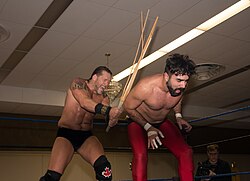
A kendo stick match (also known as a Singapore cane match or Dueling canes match) is a standard weapons match with a kendo stick being the only legal weapon. Often, the ring will be lined with many kendo sticks for the wrestlers to use. Hardcore wrestling promotion Combat Zone Wrestling has used this match with fluorescent light tubes instead of kendo sticks.
Ladder match
A ladder match is a no-disqualification style match in which a specific object (usually a title belt, a contract or a briefcase) is placed above the ring—out of the reach of the competitors—with the winner being the first person to climb a ladder and retrieve it. This is often used in WWE with their Money in the Bank matches.[154] The ladder may be used as a weapon.
Casino Ladder match
The Casino Ladder match was created by All Elite Wrestling as a variation of its Casino Battle Royale mixed with a traditional ladder match. A poker chip is hung above the ring beneath a ladder, which can be used as a weapon. The match starts with two wrestlers, with a new participant entering every 2 minutes. The first wrestler to grab the poker chip wins the match, and with it a future AEW World Championship match at a time and place of the wrestler's choosing. Notably, the match can be won before all of the intended participants have entered.
Full Metal Mayhem match
A Full Metal Mayhem match is a variation of a TLC match (see below), where in addition to tables and chairs being present, steel chains are also made available, and any other weapon that is metallic (trashcans, thumbtacks) often make appearances. This match originated in TNA/Impact Wrestling and this promotion has had at least one of these matches every year since 2005.
King of the Mountain match
The King of the Mountain match is described as a "reverse ladder match". Instead of retrieving an object hanging above the ring, the winner is the first person to use a ladder to hang a championship belt above the ring—after having scored a pinfall or submission (pinfalls count anywhere) to earn the right to try. A wrestler who has been pinned or forced to submit must spend two minutes in a penalty box. At Slammiversary (2022), the first-ever Queen of the Mountain match took place, with Jordynne Grace defeating champion Tasha Steelz, along with Chelsea Green, Deonna Purrazzo and Mia Yim to win the Impact Knockouts Championship. Four-time Knockouts World Champion Mickie James was the match's enforcer.[155]
Stairway to Hell match
Used in ECW, a Stairway to Hell match is a ladder match with a weapon hanging over the ring. Rather than winning the match by retrieving it, the first wrestler to climb a ladder and retrieve the weapon is allowed to use it in the match. The match is won by standard pinfall or submission.
TLC match
A tables, ladders and chairs match, often abbreviated as TLC match, is an extension of a ladder match with chairs and tables also being present as legal weapons.[156] This match was introduced because each of the three teams specialized in one of these weapons: Edge and Christian were known for their frequent use of steel folding chairs and the tandem "con-chair-to" move; the Dudley Boyz were known for their pioneering, hard-hitting use of slamming their opponents through wooden event tables; and the Hardy Boyz were known for their high-flying acrobatics off of twin-step ladders. There had been a similar type of match at WrestleMania 2000 called the Triangle Ladder match which also involved tables and chairs. But the first ever official TLC match took place between Edge and Christian, The Dudley Boyz and The Hardy Boyz at the WWF event SummerSlam 2000; and another at Wrestlemania X-Seven.
Due to the destructive, dangerous, violent, frenetic and physically demanding nature of these matches, every subsequent TLC match after the third one held a month after X-Seven was toned down to reduce the physical demands and risks this type of match poses. From 2009 to 2020, WWE has held a pay-per-view in December named TLC: Tables, Ladders & Chairs, which features this stipulation in its main event. The match has two variations: one is competed as a ladder match, which the person/people must retrieve an object suspended above the ring, and the other is a traditional style match won by pinfall or submission. In WWE, Edge has competed in the most TLC matches (7) including the first three, and has often used this match to gain an advantage in a storyline, with some referring to it as his specialty match.
This match has also been contested under hardcore match rules where a wrestler can win via pinfall or submission, and tables, ladders and chairs are heavily featured as weapons. Two examples were the “WeeLC” match in 2014 and the Tables, Ladders and Scares (a renamed TLC match) between Tony D’Angelo and Oba Femi in 2024.
Ultimate X match
The Ultimate X match is a "ladder match without the ladders" where two cables are strung metal structures rising from the four corners of the ring, crossing above the middle of the ring, forming an "X" pattern. The objective to win this match is to climb the turnbuckles and then climb hand-over-hand across the cables to claim the prize of the match, usually a championship belt. A signature match of Impact Wrestling's X Division, the match is contested by three or more wrestlers.
Nigerian Drum Fight
A Nigerian Drum Fight is a no-disqualification stipulation weapons match where various musical percussion instruments used in traditional Nigerian music, such as bongos and a gong are made available at ringside, as are tables and kendo sticks. Big E faced Apollo Crews at WrestleMania 37 in a Nigerian Drum Fight.
Object on a Pole match
The Object on a Pole match, whose name is usually derived from the object being hung, i.e. "Brass knuckles on a Pole", "Steel chair on a Pole", "Singapore cane on a Pole", "Paddle on a Pole", "Viagra on a Pole", "Contract on a pole", "Mistletoe on a Pole" or "Judy Bagwell on a Forklift", is the spiritual forebear of the ladder match. In this case, an object is placed on a pole that extends from one of the four turnbuckles on the ring with the wrestlers battling to reach it first.[157] Unlike the ladder match, however, reaching the object doesn't usually end the match; it simply allows that wrestler to use it as a weapon.[158] This is not a no-disqualification match; the weapon on the pole is merely an exception to the disqualification rule. However, this is sometimes a no-disqualification match in which any weapon, plus the one on the pole, can be used. This match is referred to by many wrestling critics as a "Russo Special", due to the propensity of WCW bookerVince Russo's use of Pole Matches during his tenure at the company. Another World Championship Wrestling specialty is the San Francisco 49ers match, where four boxes are placed in the four corners of the ring, one with the championship belt and the other three with weapons. You must find the box with the belt to win the match and the championship. To date, this match is only known to have happened in a major wrestling federation once, with Booker T defeating Jeff Jarrett to become the WCW World Heavyweight champion on October 2, 2000.
Multiple variations of the "Pole match" exist. In some cases the match is closer to the ladder match, in that reaching the object does end the match.[159] In others there will be objects above all of the turnbuckles.[160] Further still, there can be a mixture of the two, with an object placed at (though not above) each turnbuckle, one to end the match, the rest to be used as weapons.[161]Total Nonstop Action Wrestling used a "Pole match" as a setup to another match, placing objects at four of their six turnbuckles with the promise that the first wrestler to reach each object would be allowed to use them weeks later at an already scheduled cage match.[162] In a Feast or Fired match each case contains a contract to fight for a TNA World Heavyweight Championship, TNA Tag Team Championship or TNA X-Division Championship, with the final case contains a pink slip, mean the holder of that case would be fired immediately, but if the person holding the X-Division title shot briefcase went on to win that title, it cannot be cashed in right away for the World Heavyweight Championship (Option C). The Coal Miner's Glove match is a variation of the typical "Object on a Pole match" in which the object in question is a coal miner's glove, which can be used on one's opponent upon retrieval.
Biker Chain match
A Biker Chain match is a hardcore match where a chain is attached to a pole and is the only legal weapon, but the objective of this match is to pin your opponent. Brock Lesnar and The Undertaker did a Biker Chain match at WWE's No Mercy 2003.
Pillow Fight
A pillow fight is a weapons match with only pillows and a bed are placed in the ring.[146] The pillows may be used as weapons, but other than that, standard wrestling rules apply. Notably, Torrie Wilson once picked up the bed with Candice Michelle on it and threw it. Another variation, the Lingerie Pillow Fight, requires the participants to wear lingerie. Another variation, the Pajama Pillow Fight, requires the participants to wear pajamas.[146][163]
Straitjacket match
In a straitjacket match, a wrestler must put their opponent into a straitjacket, usually after knocking the opponent out or by rendering them unconscious by submission holds. It made its televised debut on TNA when Samuel Shaw beat Mr. Anderson by first rendering him unconscious with a chokehold and then putting him into the straitjacket.[164] On WWF Raw in June 1999, Ken Shamrock, who was the only participant confined to the straitjacket, still won his match with Jeff Jarrett after forcing him to submit to a headscissors submission hold.
Strap match
A strap match, known by many names and done with many slight variations, is any match in which the competitors are placed on the opposite ends of a restraint to keep them in close physical proximity. By definition, the strap and anything tied to it are considered legal and in play weapons. The most common rule for victory is to achieve a pinfall, but there is a common variation where one wrestler must circle the ring and touch all four corners in quick order, without interruption.[165] Because of the strap's legality, and subsequent use as a choking device, submissions are generally not allowed.[166][167]
The traditional strap match involves two wrestlers tied together via a leather strap, with the strap match being one of the most varied forms of professional wrestling match type, both in name and implements used. The name used for the match generally comes from the implement used and one or both of the participants. Common restraints include a belt, bullrope (length of rope with a cowbell the center), steel chains, one to two-foot "leash", or leather strap, where the wrestlers are tied together at one wrist. This match type is often named Caribbean Strap match when a wrestler from Puerto Rico (such as Savio Vega) is participating on the match or the match is being held on a Puerto Rican promotion like the International Wrestling Association.
Barbed Wire Chain Deathmatch
A Barbed Wire Chain Deathmatch is a strap match where instead of two wrestlers being bound together with a leather strap at the wrists, they are bound together with barbed wire at the wrists. This match was done a few times in 1995 in the IWA promotion in Japan with Shoji Nakamaki, Hiroshi Ono and Cactus Jack.
Dog collar match
A Dog Collar match is a type of strap match where instead of a leather strap at a wrist, the competing wrestlers are bound together by the neck via dog collars and chains. Made famous by the match between Roddy Piper and Greg Valentine at Starrcade '83: A Flare for the Gold, AEW has brought the match back in recent times, with Brodie Lee vs. Cody following the stipulation in 2020 (the last match of the former's career before his death later that year), and CM Punk vs. MJF at Revolution being highly regarded for their violence. Punk himself competed in another famously violent dog collar match against Raven at ROH Death Before Dishonour 2003.
Four Corners Strap match
The Four Corners Strap match is when the first wrestler to touch all four turnbuckle pads in succession without any form of interruption from his opponent or anyone else wins. If at any point a wrestler starts touching pads but is taken down before the wrestler can finish touching them all, they must start over again. There are no pinfalls, no submissions, no countouts, or no disqualifications in this match. At WCW's Uncensored 1995, Hulk Hogan actually dragged non-participant (Ric Flair) to all four corners to win his strap match against Big Van Vader. This match was renamed a Samoan Strap match for WWE's Extreme Rules 2009 pay-per-view with Umaga facing off against CM Punk. WCW has their own variation strap match as well named the Yapapi Indian Strap match between Hulk Hogan vs. Ric Flair at the 2000 Uncensored pay-per-view. A No Surrender Dog Collar Strap match is a strap match with the "No Surrender" stipulation added, meaning that neither competitor would be permitted to submit in the match. TNA had a main event at the TNA No Surrender 2005 pay-per-view for the NWA World Heavyweight Championship between Raven and Abyss, which Raven won. All Elite Wrestling (AEW) also has its own variation of the Four Corners Strap match, dubbed the South Beach Strap match, which has been used once in a match between Cody Rhodes and Q. T. Marshall at the Road Rager event in July 2021. It was named as such due to the event taking place in Downtown Miami, close to the neighbourhood of South Beach.
Russian chain match
A Russian Chain match is a type of strap match where instead of an elastic strap, a thick, 15-foot steel chain is used to bound the wrestlers, and this chain is often used as a weapon. This match has come under many names, including a Texas Chain match and a Tennessee Chain match. A Biker Chain match is a variation of an Object on a Pole match. The Russian Chain match was the speciality of Ivan Koloff and Boris Malenko.
Texas Bullrope match
A Texas Bullrope match is a type of strap match where the wrestlers are bound together by a thick cattle rope with a cowbell attached; the objective of this match is to achieve a single pinfall, or in another variation, victory is achieved by touching all four turnbuckles successively similar to a standard Strap Match (as in the case of JBL vs. Eddie Guerrero in The Great American Bash (2004)). The Rock had his own signature match, the Brahma Bullrope match which was a renamed Texas Bullrope match. Another variation of the match, a Texas Lariat match, has wrestlers bound to a lariat rope, instead of a bullrope.
Stretcher match
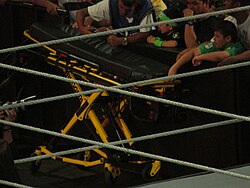
A Stretcher match is a hardcore match where a wrestler must incapacitate their opponent to such an extent that they are able to get them onto a stretcher and roll them to the finish line for the victory; usually past a line at the top of the entrance ramp. The stretcher can also be used as a weapon. Stretcher matches contested in All Elite Wrestling are a combination of a stretcher match and an ambulance match, where the objective is to place your opponent onto a stretcher, roll the stretcher into the back of an ambulance, and close both doors to gain the victory.
Steel Stairs match
A Steel Stairs match is a hardcore match where the only legal weapon are any number of steel stairs typically situated on the opposite sides of the ring that can be used to enter the ring. The Big Show faced Erick Rowan in a Steel Stairs match at the TLC 2014 WWE pay-per view.[168]
Symphony of Destruction match
A Symphony of Destruction match is a hardcore match where various musical instruments are available at ringside as weapons. This is Elias's speciality match and debuted in 2018 when Elias faced Braun Strowman.[169]
Tables match
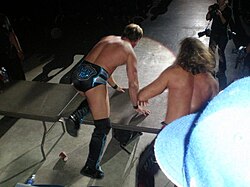
A Tables match is a hardcore match in which, to win, one's opponent must be driven through a table. It can only be won with an offensive maneuver.[170]
Tables matches can be contested with tag teams, under both elimination[171] and one fall rules. The first tables match was contested at ECW's 1995 Double Tables event between The Public Enemy and The Tazmaniac & Sabu for the ECW World Tag Team Championship, whilst the first in the WWE was a tag-team Tables match with The Hardy Boyz versus The Dudley Boyz at the 2000 Royal Rumble. The objective of both of these matches was to drive all opposing team members through tables with offensive moves, but subsequent WWE Tables matches have only required one member to be driven through a table. It is common for tables matches to also include a "no-disqualification" clause, turning them into hardcore matches (although this variation may also be known as a Hardcore Tables match). In some tag matches, a person can save his teammate by breaking the table with his own body. Apparently this does not count against the team.[172]
Flaming Tables match
A Flaming Tables match is an Extreme Championship Wrestling specialty match where the tables are set on fire and the only way to win is to put opponents through the flaming tables.[173]
Thanksgiving Leftovers Throwdown
The Thanksgiving Leftovers Throwdown is a specialty match based on the Thanksgiving holiday. It debuted on the November 26, 2021 Black Friday edition of SmackDown between Rick Boogs and Angel Garza. It is a standard wrestling match with a table by ringside covered with leftover foods. No competitor was thrown into the table although Humberto Carrillo, who distracted Boogs, was thrown into the table by Shinsuke Nakamura.[174]
Two out of Three Tables match
A Two out of Three Tables match is a hardcore match where it can only be won when a wrestler or tag team puts their opponent or opponent's team through two tables, but it does not have to be at the same time. Performing a move on double tables does not count as a victory. It is also a variation of a two out of three falls match.
Taped fist match
For a taped fist match, the wrestlers are allowed to tape and/or wrap their hands to allow them to punch harder without damaging their hands. The wrestlers must compete with their fists taped, the idea being that this would make it harder to grab each other while at the same time protecting their hands while punching, encouraging the athletes to "fight" instead of wrestle.[175] In one variation, the Taipei Deathmatch, the taped fists are dipped in super glue, then broken glass.[176]
Viking Rules match
The Viking Rules match is a viking-themed hardcore match with the ring decorated in a style of a viking ship. This match was introduced by The Viking Raiders on the September 2, 2022, edition of SmackDown (taped on August 26, 2022) against The New Day.[177]
Water Fight
A water fight is a weapons match which the ring is surrounded with buckets of water, water guns and water balloons to use as weapons. Other than that, standard wrestling rules apply. Notably, Jillian Hall once smacked Mickie James over the head with a water gun during this match.
Weapon Rumble
The Weapon Rumble is a hardcore match invented in DDT Pro-Wrestling in which, similarly to a Rumble rules match, with every time interval a new weapon is introduced in the match. The weapons are chosen by the participants beforehand and can widely vary due to the loose interpretation of the definition of a "weapon" that's used by the company in a comedic manner.[178]
Weapons Wild match
A Weapons Wild match is a hardcore match where various blunt weapons are made available along the padded barriers at ringside, and are all legal. Wrestlers are armed with at least one weapon when they start the match. This match originated in WWE's NXT promotion.
Winner Takes All match
Two scenarios constitute a Winner Takes All match; a title-versus-title match is a match in which both wrestlers (or teams if a tag team match) are champions going into the match, and the winner receives the championship of the loser, thus "taking all".[179][180] This differs from a championship unification match, where one championship is absorbed into the other and retired/deactivated. In a Winner Take All scenario, both titles are still active and defended as separate entities. Winner Takes All matches may also take the form of tag team matches, in which two separate titles are fought for in the same match; such as when Seth Rollins and Becky Lynch defended the Universal Championship and Raw Women's Championship respectively against Baron Corbin and Lacey Evans at 2019's Extreme Rules event.
Sources
 Text was copied from Wrestling match types at the Pro Wrestling wiki, which is released under a Creative Commons Attribution-Share Alike 3.0 (Unported) (CC BY-SA 3.0) license.
- Foley, Mick (2000). Have a Nice Day: A Tale of Blood and Sweatsocks. HarperCollins. ISBN 0-06-103101-1.
- Reynolds, R. D. (2003). Wrestlecrap: The Very Worst of Pro Wrestling. ECW Press. ISBN 1-55022-584-7.
- PWI Staff (2007). "Pro Wrestling Illustrated presents: 2007 Wrestling almanac & book of facts". Wrestling's historical cards. Kappa Publishing.
External links
- WWE.com – Specialty Matches