
อ่าน 37 นาที
กองพล (ทหาร)
กองพลคือหน่วยทหาร ขนาดใหญ่ หรือกองกำลังทหารโดยปกติประกอบด้วยทหารระหว่าง 6,000 ถึง 25,000 นาย ในกองทัพส่วนใหญ่ กองพลจะประกอบด้วยกรมหรือกองพล น้อยหลายกอง และในทางกลับกัน...
กองพล (ทหาร)
| สัญลักษณ์แผนที่ NATO [ 1 ] |
|---|
  |
| กองพลผสมที่เป็นมิตร |
 |
| กองพลผสมที่เป็นศัตรู |
 |
| กองพลทหารราบที่เป็นมิตร |
 |
| กองพลทหารราบพลร่มที่เป็นมิตร |
 |
| กองพลรถถังที่เป็นศัตรู |
กองพลคือหน่วยทหาร ขนาดใหญ่ หรือกองกำลังทหารโดยปกติประกอบด้วยทหารระหว่าง 6,000 ถึง 25,000 นาย ในกองทัพส่วนใหญ่ กองพลจะประกอบด้วยกรมหรือกองพล น้อยหลายกอง และในทางกลับกัน หลายกองพลจะรวมกันเป็น กองทัพน้อย
ในอดีต กองพลเป็น หน่วย ผสมกำลังรบ หลัก ที่สามารถปฏิบัติการ ได้อย่างอิสระ หน่วยผสมกำลังรบขนาดเล็กกว่า เช่นกองพันรบประจำกรม (RCT) ของสหรัฐฯ ในช่วงสงครามโลกครั้งที่สอง ถูกนำมาใช้เมื่อสถานการณ์เอื้ออำนวย ในปัจจุบัน กองทัพตะวันตกสมัยใหม่เริ่มนำกองพันรบระดับกองพล น้อย (คล้ายกับ RCT) มาใช้เป็นหน่วยผสมกำลังรบหลัก โดยที่กองพลที่สังกัดอยู่มีความสำคัญน้อยลง
คำที่คล้ายกันคือdivizion / divizijun / dywizjonก็ถูกใช้ในภาษาสลาฟ (เช่น รัสเซีย เซอร์โบ-โครเอเชีย และโปแลนด์) สำหรับ หน่วยปืน ใหญ่หรือหน่วยทหารม้าขนาดกองพัน ในการใช้งานทางทะเล คำว่า " division " มีความหมายที่แตกต่างกันอย่างสิ้นเชิง บนเรือของกองทัพเรืออังกฤษ คำว่า "division" หรือ "department" มักใช้แทนกันได้ และหมายถึงองค์กรบริหารที่ใช้ในการบริหารจัดการบุคลากร บนเรือของกองทัพเรือสหรัฐฯ (รวมถึง เรือ ยามฝั่งสหรัฐฯ ) ในหน่วยบัญชาการบนฝั่ง และในหน่วยการบินของกองทัพเรือสหรัฐฯ (รวมถึงกองทัพเรือ นาวิกโยธิน และการบินยามฝั่งของสหรัฐฯ) คำนี้หมายถึงหน่วยย่อยด้านการบริหาร/การปฏิบัติงานของแผนก (เช่น กองควบคุมการยิงของแผนกอาวุธ) หรืออาจหมายถึงหน่วยย่อยของเรือหลายลำภายในกองเรือหรือฝูงบินหรือส่วนของเครื่องบินสองหรือสามส่วนที่ปฏิบัติการภายใต้หัวหน้ากองที่ได้รับการแต่งตั้ง
ประวัติศาสตร์
ต้นกำเนิด
ในปี ค.ศ. 1577 กองทหารฝึกหัดเดวอนของอังกฤษถูกแบ่งออกเป็นสามกองพล แต่ละกองพลมีนายพันเอกสองคนและนายร้อยหกคน[ 2 ]ในบรรดานักทฤษฎีการทหารตะวันตก หนึ่งในคนแรกๆ ที่คิดถึงการจัดระเบียบกองทัพเป็นหน่วยผสมอาวุธขนาดเล็กคือมอริซ เดอ แซกซ์ (เสียชีวิต ค.ศ. 1750) จอมพลแห่งฝรั่งเศสในหนังสือMes Rêveries ของเขา เขาเสียชีวิตเมื่ออายุ 54 ปี โดยที่ยังไม่ได้นำแนวคิดของเขาไปปฏิบัติวิกเตอร์-ฟรองซัวส์ เดอ บรอกลีได้นำแนวคิดนี้ไปปฏิบัติ เขาได้ทำการทดลองเชิงปฏิบัติที่ประสบความสำเร็จของระบบกองพลในสงคราม เจ็ดปี
การแบ่งแยกในยุคแรก
สงครามครั้งแรกที่ใช้ระบบกองพลอย่างเป็นระบบคือสงครามปฏิวัติฝรั่งเศสลาซาร์ การ์โนต์จากคณะกรรมการความปลอดภัยสาธารณะซึ่งรับผิดชอบกิจการทหาร ได้ข้อสรุปเช่นเดียวกับรัฐบาลกษัตริย์ก่อนหน้านี้ และกองทัพจึงถูกจัดระเบียบเป็นกองพล
ระบบ นี้ทำให้กองทัพมีความยืดหยุ่นและเคลื่อนย้ายได้ง่ายขึ้น และยังทำให้กองทัพปฏิวัติฝรั่งเศส ขนาดใหญ่ สามารถบริหารจัดการได้ง่ายขึ้นด้วย ภายใต้ การปกครองของ นโปเลียนกองพลต่างๆ ถูกรวมเข้าด้วยกันเป็นกองทัพน้อยเนื่องจากขนาดของกองทัพที่ใหญ่ขึ้น ความสำเร็จทางทหารของนโปเลียนทำให้ระบบกองพลและกองทัพน้อยแพร่กระจายไปทั่วยุโรป จนกระทั่งสิ้นสุดสงครามนโปเลียนกองทัพทั้งหมดในยุโรปต่างก็ใช้ระบบนี้
สงครามโลกครั้งที่หนึ่ง
องค์ประกอบของกองพลต่างๆ มีความแตกต่างกันอย่างมากในช่วงสงครามโลกทั้งสองครั้ง และนอกจากนี้ คุณภาพก็ยังไม่สม่ำเสมอ แม้ว่ากองพลเหล่านั้นจะมีองค์ประกอบเหมือนกันก็ตาม
The size of infantry divisions deployed by the major belligerents at start of the Great War ranged from about 16,000 in the French[3] and Russian armies to 17,500 in the German imperial army[4] and about 18,000 in Austro-Hungarian[5] and British armies.[6]
As World War I went on, the size of divisions decreased significantly from those of 1914, with both British and Germans reducing the number of divisions' sub-units.[7] But, while the number of soldiers was lower, by 1917, divisions were much better armed.[8]
On the other hand, in 1917, the American infantry divisions that arrived in France numbered 28,061 officers and men, of which 17,666 were riflemen.[9][10]
World War II
The divisional system reached its numerical height during the Second World War. Beside the infantry and cavalry divisions created since Napoleonic era, new division types appeared during the Second World War, such as airborne, tank, mechanized, motorized.
The Soviet Union's Red Army consisted of more than a thousand division-sized units at any one time, and the number of rifle divisions raised during the Great Patriotic War of 1941–1945 is estimated by David M. Glantz as 482.[11]Nazi Germany had hundreds of numbered or named divisions, while the United States employed up to 91 divisions.
A notable change to divisional structures during the war was completion of the shift from square divisions (composed of two brigades each with two regiments) to triangular divisions (composed of three regiments with no brigade level) that many European armies had started using in World War I.[12] This was done to increase flexibility and to pare down chain-of-command overhead. The triangular division structure allowed the tactic of "two forward, one back", where two of the division's regiments could engage the enemy with one regiment in reserve.
All divisions in World War II were expected to have their own artillery formations, usually (depending upon the nation) the size of a regiment. Divisional artillery was occasionally seconded by corps-level command to increase firepower in larger engagements.
ในช่วงสงคราม สหรัฐฯ ยังใช้หน่วยรบระดับกรมโดยแบ่งหน่วยทหารจากกองพลน้อยที่สังกัดอยู่หรือหน่วยทหารจากกองพลน้อยอื่นๆ ออกไปประจำการในกรมทหารราบ ทำให้เกิดหน่วยรบผสมขนาดเล็กที่มีทั้งยานเกราะ ปืนใหญ่ และหน่วยสนับสนุนเป็นของตนเอง หน่วยรบเหล่านี้ยังคงอยู่ภายใต้การบังคับบัญชาของกองพลน้อย แต่มีอิสระในการปฏิบัติงานในสนามรบในระดับหนึ่ง
หน่วย อินทรีย์ภายในกองพลคือหน่วยที่ปฏิบัติการโดยตรงภายใต้การบังคับบัญชาของกองพลและโดยปกติจะไม่อยู่ภายใต้การควบคุมของกรม หน่วยเหล่านี้ส่วนใหญ่เป็นหน่วยสนับสนุน และรวมถึงกองร้อยสัญญาณ กองพันแพทย์ ขบวนเสบียง และฝ่ายบริหาร[ 13 ]
หน่วย เสริมเป็นหน่วยขนาดเล็กที่ถูกจัดให้อยู่ภายใต้การบังคับบัญชาของกองพลเป็นการชั่วคราวเพื่อปฏิบัติภารกิจเฉพาะอย่าง หน่วยเหล่านี้มักเป็นหน่วยรบ เช่น กองพันรถถัง กองพันรถถังพิฆาต หรือกองร้อยลาดตระเวนทหารม้า
แผนกสมัยใหม่
ในยุคปัจจุบัน กองทัพส่วนใหญ่ได้กำหนดโครงสร้างกองพลให้เป็นมาตรฐานแล้ว นี่ไม่ได้หมายความว่ากองพลจะมีขนาดหรือโครงสร้างเหมือนกันทุกประเทศ แต่โดยส่วนใหญ่แล้ว กองพลจะมีกำลังพลประมาณ 10,000 ถึง 15,000 นาย พร้อมด้วยกำลังสนับสนุนที่เพียงพอที่จะปฏิบัติการได้อย่างอิสระ โดยปกติแล้ว โครงสร้างโดยตรงของกองพลจะประกอบด้วยกองพล น้อย หรือกลุ่มรบหลัก 1-4 กลุ่ม พร้อมด้วยกองพลน้อยหรือกรมสนับสนุนการรบ (โดยปกติคือกองปืนใหญ่ ) และ กองพันที่ขึ้นตรงต่อกองพลจำนวนหนึ่งเพื่อปฏิบัติภารกิจสนับสนุนเฉพาะทางที่จำเป็น เช่นข่าวกรองการส่งกำลังบำรุง การลาดตระเวนและวิศวกรการรบกองทัพส่วนใหญ่กำหนดมาตรฐานกำลังพลที่เหมาะสมสำหรับกองพลแต่ละประเภท โดยระบุไว้ในตารางโครงสร้างและอุปกรณ์ (TO&E) ซึ่งระบุการมอบหมายหน่วย กำลังพล และอุปกรณ์ที่แน่นอนสำหรับกองพล
กองพลสมัยใหม่กลายเป็นหน่วยรบหลักที่สามารถระบุได้ในกองทัพหลายแห่งในช่วงครึ่งหลังของศตวรรษที่ 20 แทนที่กองพล น้อย อย่างไรก็ตาม แนวโน้มเริ่มกลับทิศทางตั้งแต่สิ้นสุดสงครามเย็นการใช้งานกองพลเป็นหน่วยรบหลักสูงสุดเกิดขึ้นในช่วงสงครามโลกครั้งที่ 2เมื่อคู่สงครามส่งกองพลเข้าร่วมรบกว่าพันกองพล ด้วยความก้าวหน้าทางเทคโนโลยีตั้งแต่นั้นมา กำลังรบของแต่ละกองพลจึงเพิ่มขึ้น
ประเภท
โดยทั่วไปแล้ว กองพลมักถูกจัดตั้งขึ้นเพื่อจัดระเบียบหน่วยประเภทใดประเภทหนึ่งเข้าด้วยกัน พร้อมด้วยหน่วยสนับสนุนที่เหมาะสม เพื่อให้สามารถปฏิบัติการได้อย่างอิสระ ในช่วงเวลาที่ผ่านมา กองพลส่วนใหญ่ถูกจัดตั้งขึ้นเป็นหน่วยผสมอาวุธ โดยมีหน่วย ย่อยที่แสดงถึงเหล่ารบต่างๆ ในกรณีเช่นนี้ กองพลมักจะยังคงใช้ชื่อของกองพลที่เชี่ยวชาญเฉพาะด้าน และอาจยังคงได้รับมอบหมายบทบาทหลักที่เหมาะสมกับความเชี่ยวชาญนั้นๆ
กองพลทหารราบ
กองพลทหารราบ คือหน่วยทหารที่ประกอบด้วยหน่วยทหารราบ เป็นหลัก โดยได้รับการสนับสนุนจากหน่วยรบ อื่นๆ ในสหภาพโซเวียตและรัสเซีย กองพลทหารราบมักถูกเรียกว่า "กองพลปืนไรเฟิล" กองพล ทหารราบยานยนต์คือกองพลที่มีหน่วยทหารราบส่วนใหญ่ขนส่งด้วยยานยนต์ที่ไม่ใช่ยานเกราะกองพลทหารราบยานเกราะ คือ กองพลที่มีหน่วยทหารราบส่วนใหญ่ขนส่งด้วยรถลำเลียงพลหุ้มเกราะ (APC) หรือยานรบทหารราบ (IFV) หรือทั้งสองอย่าง หรือแม้แต่ยานรบหุ้มเกราะ ประเภทอื่นๆ ที่ออกแบบมาเพื่อขนส่งทหารราบ กองพลทหารราบยานเกราะในนาซีเยอรมนีเรียกว่า " กองพลทหาร ราบยาน เกราะ " ในรัสเซียเรียกว่า "กองพลปืนไรเฟิลยานยนต์"
เนื่องจากความง่ายและความเรียบง่ายในการจัดตั้งกองพลทหารราบเมื่อเทียบกับหน่วยรบอื่นๆ กองพลทหารราบจึงมักเป็นหน่วยรบที่มีจำนวนมากที่สุดในสงครามในประวัติศาสตร์กองพลส่วนใหญ่ของสหรัฐฯ ในช่วงสงครามโลกครั้งที่สองเป็นกองพลทหารราบ
กองพลทหารราบยังคาดว่าจะเดินทางด้วยเท้าจากที่หนึ่งไปยังอีกที่หนึ่ง โดยใช้ยานพาหนะหรือม้าบรรทุกสัมภาระเพื่อเสริมการเดินทาง กองพลต่างๆ ได้พัฒนาขึ้นตามกาลเวลา ตัวอย่างเช่น ในปี 1944 นาซีเยอรมนีได้กำหนดให้หน่วยทหารราบบางส่วนเป็นกองพลทหารราบประชาชน(Volksgrenadier divisions) ซึ่งมีขนาดเล็กกว่ากองพลปกติเล็กน้อย และมีการแจกจ่ายปืนกลมือ ปืนอัตโนมัติ และอาวุธต่อต้านรถถังมากขึ้น เพื่อสะท้อนความเป็นจริงว่าพวกเขาจะต้องถูกใช้ในการทำสงครามป้องกัน ในปี 1945 นาซีเยอรมนีได้ดึงตัวสมาชิกของกองทัพเรือ (Kriegsmarine)มาจัดตั้ง "กองพลนาวิกโยธิน" (Naval divisions) ซึ่งมีคุณภาพต่ำกว่ากองพลทหารราบของกองทัพบก (Heer ) พวกเขายังจัดตั้ง " กองพลสนาม กองทัพอากาศ (Luftwaffe field divisions)" จากสมาชิกของกองทัพอากาศ (Luftwaffe)ด้วย
Infantry divisions were sometimes given the responsibility of garrison work. These were named "frontier guard divisions", "static infantry divisions" and "fortress divisions", and were used often by Nazi Germany. The Soviet Union organised Machine-Gun Artillery Divisions of artillery, multiple rocket launchers, and static gun positions for use East of the Urals. A 1997 report said they were generally composed of four brigades, though later data suggests this was inaccurate.[14]
Cavalry division
For most nations, cavalry was deployed in smaller units and was not therefore organized into divisions, but for larger militaries, such as that of the British Empire, United States, First French Empire, France, German Empire, Nazi Germany, Russian Empire, Empire of Japan, Second Polish Republic and Soviet Union, a number of cavalry divisions were formed. They were most often similar to the nations' infantry divisions in structure, although they usually had fewer and lighter support elements, with cavalry brigades or regiments replacing the infantry units, and supporting units, such as artillery and supply, being horse-drawn. For the most part, large cavalry units did not remain after World War II.
While horse cavalry had been found to be obsolete, the concept of cavalry as a fast force capable of missions traditionally fulfilled by horse cavalry made a return to military thinking during the Cold War. In general, two new types of cavalry were developed: air cavalry or airmobile, relying on helicopter mobility, and armored cavalry, based on an autonomous armored formation. The former was pioneered by the 11th Air Assault Division (Test), formed on 1 February 1963 at Fort Benning, Georgia. On 29 June 1965, the division was renamed the 1st Cavalry Division (Airmobile), before its departure for the Vietnam War.
After the end of the Vietnam War, the 1st Cavalry Division was reorganised and re-equipped with tanks and armored scout vehicles to form armored cavalry.
The concept of a fast-moving, armored reconnaissance force has remained in modern armies, but these units are now smaller and make up a combined arms force used in modern brigades and divisions, and are no longer granted divisional status.
"Light divisions" were German horse cavalry divisions organized early in World War II which included motorized units.
Armored division

The development of the tank during World War I prompted some nations to experiment with forming them into division-size units. Many did this the same way as they did cavalry divisions, by merely replacing cavalry with AFVs (including tanks) and motorizing the supporting units. This proved unwieldy in combat, as the units had many tanks but few infantry units. Instead, a more balanced approach was taken by adjusting the number of tank, infantry, artillery, and support units.
The terms "tank division" or "mechanized division" are alternative names for armored divisions. A "Panzer division" was an armoured division of the Wehrmacht and the Waffen-SS of Germany during World War II.
Since the end of the war, most armoured and infantry divisions have had significant numbers of both tank and infantry units within them. The difference has usually been in the mix of battalions assigned. Additionally, in some militaries, armoured divisions are equipped with more advanced or powerful tanks than other divisions.
Mountain division
Mountain divisions are infantry divisions given special training and equipment to operate in hilly, mountainous or arctic areas. Some examples of these formations include the US 10th Mountain Division, the German 1st Ski Division or the French 27th Alpine Infantry Division.
Nazi Germany also organized "Jäger divisions" to operate in more adverse terrain.
Italian Mountain divisions are called "Alpini divisions".
Airborne division
An airborne division is an infantry division given special training and equipment for arrival on the battlefield by air (typically via parachute or glider-borne).
The US, Britain, and Germany experimented during World War II with specialized light infantry divisions capable of being quickly transported by transport aircraft or dropped into an area by parachute or glider. This required both high-quality equipment and training, creating elite units in the process and usually crewed by volunteers rather than conscripts.
The German 1st Parachute Division, which was part of the Luftwaffe and not the Heer, was instrumental in the 1941 Battle of Crete. US and British airborne troops first participated during the 1943 invasion of Sicily. The use of airborne divisions during the Invasion of Normandy was crucial to its success. Further allied paratroop operations were made during the 1944 Operation Market Garden and the 1945 Operation Varsity.
When not being used for a specific airborne mission, airborne divisions usually functioned as light infantry divisions.
An "air assault division" is an airborne division that mainly uses helicopters to transport its troops.
Artillery division
The Soviet Union developed the concept of the specialized "artillery division" during the Eastern Front of the Second World War in 1942, although plans were in place since the later stages of the Russian Civil War. An artillery division serves as a specialized division using only artillery howitzers, anti-tank guns, rocket artillery (MRLs and tactical missiles) and mortars (both towed and self-propelled) (and historically siege artillery) and are usually tasked with providing concentrated firepower support to higher combined arms formations. They are mainly combat support formations most performing operations in support of the infantry and armor.
Security division
Nazi Germany organized Security divisions to operate in captured territory to provide rear-echelon security against partisans and maintain order among civilians. Structured like an infantry division, a security division was more likely to contain lower quality troops and was not intended to serve directly at the front. SS units of this type were called "SS Polizei divisions".
The Soviet Union's People's Commissariat for Internal Affairs (the NKVD) organized security divisions (see Category:Divisions of the NKVD in World War II). In a few cases, NKVD divisions were employed in front-line combat as rifle divisions.[15]
Nomenclature
Naming examples1st Division2nd Infantry DivisionDivision 60101st Airborne DivisionPanzer Lehr Division
Divisions are commonly designated by combining an ordinal number and a type name (e.g.: "13th Infantry Division"). Nicknames are often assigned or adopted, although these often are not considered an official part of the unit's nomenclature, with divisions of the Italian Army being one of the exceptions. In some cases, divisional titles lack an ordinal number, often in the case of unique units or units serving as elite or special troops. For clarity in histories and reports, the nation is identified before the number. This also helps in historical studies, but due to the nature of intelligence on the battlefield, division names and assignments are at times obscured. However, the size of the division rarely makes such obfuscation necessary.
In the years leading up to the end of the cold war and beyond, the type names of various divisions became less important. The majority of US Infantry divisions were now mechanized and had significant numbers of tanks and IFVs, becoming de facto armored divisions. US armored divisions had more tanks but less infantry than these infantry divisions. Moreover, the sole cavalry division was structured the same way as an armored division.
With the introduction of modular brigade combat teams (BCT) in modern divisions, the nomenclature type is even less important, since a division can now be made of up any combination of light infantry, Stryker and armored BCTs. For example, the US 1st Infantry Division currently consists of two armored BCTs along with support troops, with no light infantry units at all. By contrast, the current 1st Armored Division consists of two armored BCTs and a Stryker BCT along with its support troops.
Nevertheless, some US division types will retain their mission: The 82nd and 11th airborne divisions have airborne infantry BCTs, while the 10th Mountain Division has only light infantry BCTs.
National organizations
Australia
Historically, the Australian Army has fielded a number of divisions. During World War I, a total of six infantry divisions were raised as part of the all-volunteer Australian Imperial Force: 1st, 2nd, 3rd, 4th, 5th and 6th. The 1st Division and part of the 2nd saw service during the Gallipoli Campaign in 1915 before later taking part in the fighting on the Western Front between 1916 and 1918 along with the 3rd, 4th and 5th.[16] The 6th Division existed only briefly in 1917, but was disbanded without seeing combat to make up for manpower shortages in the other divisions.[17] Another infantry division, known as the New Zealand and Australian Division, was also formed from Australian and New Zealand troops and saw service at Gallipoli.[18] Two divisions of Australian Light Horse were also formed – the Australian Mounted Division (which also included some British and French units) and the ANZAC Mounted Division – both of which served in the Sinai and Palestine Campaign during the war.[19]

In the inter-war years, on paper the Australian Army was organised into seven divisions: five infantry (1st through to 5th) and two cavalry, albeit on a reduced manning scale.[20] During World War II, the size of Australia's force was expanded to eventually include 12 infantry divisions: 1st, 2nd, 3rd, 4th, 5th, 6th, 7th, 8th, 9th, 10th, 11th and 12th. Of these, four – the 6th, 7th, 8th and 9th – were raised as part of the all-volunteer Second Australian Imperial Force, while the others formed part of the Militia, and were maintained through a mixture of volunteers and conscripts. In addition to the infantry divisions, three armoured divisions were formed: 1st, 2nd and 3rd. The Australian divisions were used in various campaigns, ranging from North Africa, Greece, Syria and Lebanon, to the South West Pacific.[21]
The Australian army currently has two divisions. The 1st Division is a skeleton organisation that acts as a deployable force headquarters, while the 2nd is a Reserve formation.[22][23]
Bangladesh
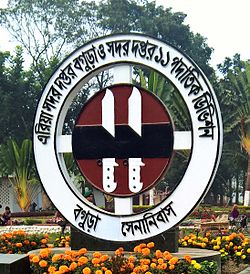
The 9th Infantry Division was raised on 20 November 1975 in Dhaka as the first division of the Bangladesh Army. Currently, Bangladesh Army has ten infantry divisions under its command. Each infantry division consists of one artillery brigade, 3 or 4 infantry brigades/regiments. In addition, few divisions have one armored brigade each. The active infantry divisions are:
- 7th Infantry Division, headquartered at Sheikh Hasina cantonment, Patuakhali
- 9th Infantry Division, headquartered at Savar Cantonment, Dhaka
- 10th Infantry Division, headquartered at Ramu Cantonment, Cox's Bazar
- 11th Infantry Division, headquartered at Bogra Cantonment, Bogra
- 17th Infantry Division, headquartered at Jalalabad Cantonment, Sylhet
- 19th Infantry Division, headquartered at Shahid Salahuddin Cantonment, Tangail
- กองพลทหารราบที่ 24มีกองบัญชาการอยู่ที่ค่ายทหารจิตตะกงจังหวัดจิตตะกง
- กองพลทหารราบที่ 33มีสำนักงานใหญ่อยู่ที่ฐานทัพโคมิลลา เมืองโคมิลลา
- กองพลทหารราบที่ 55มีสำนักงานใหญ่อยู่ที่ฐานทัพเจสโซเรเมืองเจสโซเร
- กองพลทหารราบที่ 66มีกองบัญชาการอยู่ที่ค่ายทหารรังปูร์จังหวัดรังปูร์
บราซิล
ปัจจุบัน กองทัพบกบราซิลมีกองพลทหารบก 5 กองพล ได้แก่ กองพลทหารบกที่ 1 ซึ่งตั้งอยู่ที่ริโอเดจาเนโรและขึ้นตรงต่อกองบัญชาการทหารภาคตะวันออก กองพล ทหารบกที่ 2 ซึ่งตั้งอยู่ที่เซาเปาโลและขึ้นตรงต่อกองบัญชาการทหารภาคตะวันออกเฉียงใต้กองพลทหารบกที่ 3 ซึ่งตั้งอยู่ที่ซานตามาเรี ย รัฐริโอเดจา เนโร กองพลทหารบกที่ 5 ซึ่งตั้งอยู่ที่คูริติบา รัฐเปอร์โตริโก กองพลทหารบกที่ 6 ซึ่งตั้งอยู่ที่ปอร์โตอาเลเกร รัฐริโอเดจาเนโร โดยสามกองพลหลังขึ้นตรงต่อกองบัญชาการทหารภาคใต้และกองพลทหารบกที่ 7 ซึ่งตั้งอยู่ที่เรซิเฟ รัฐเปอร์โตริโก และขึ้นตรงต่อกองบัญชาการทหารภาคตะวันออกเฉียงเหนือ
กำลังทหารส่วนอื่นๆ ของกองทัพบราซิลขึ้นตรงต่อกองบัญชาการทหารประจำพื้นที่ โดยไม่มีกองพลบัญชาการ ในกรณีนี้ การใช้งานกำลังทหารเหล่านี้จะได้รับการประสานงานโดยศูนย์ประสานงานปฏิบัติการของกองบัญชาการทหารประจำพื้นที่
แคนาดา
หน่วยทหารขนาดกองพลหน่วยแรกที่กองทัพแคนาดา จัดตั้งขึ้นคือ กอง กำลังรบพิเศษแคนาดาชุดที่ 1 (First Contingent of the Canadian Expeditionary Force ) ซึ่งจัดตั้งขึ้นในปี 1914 และเปลี่ยนชื่อเป็นกองพลแคนาดา (Canadian Division) ในต้นปี 1915 เมื่อออกปฏิบัติการในสนามรบ และ กลายเป็น กองพลแคนาดาที่ 1เมื่อกองพลแคนาดาที่ 2ออกปฏิบัติการในปลายปีเดียวกัน ต่อมากองพลแคนาดาที่ 3และที่ 4ได้เข้าร่วมปฏิบัติการในฝรั่งเศสและแฟลนเดอร์สในขณะที่กองพลแคนาดาที่ 5ถูกยุบในสหราชอาณาจักรและแยกย้ายกันไปเสริมกำลัง กองพลทั้งสี่ (รวมกันอยู่ภายใต้การบังคับบัญชาของกองทัพแคนาดา ) ถูกยุบในปี 1919
Canada had nominal divisions on paper between the wars, overseeing the Militia (part-time reserve forces), but no active duty divisions. On 1 September 1939, two divisions were raised as part of the Canadian Active Service Force; the 3rd Division was raised in 1940, followed by the 1st Canadian Armoured Division and the 4th Canadian Division. The 1st Armoured was renamed the 5th Canadian (Armoured) Division and the 4th Division also became an armoured division. The 1st and 5th Divisions fought in the Mediterranean between 1943 and early 1945; the 2nd, 3rd and 4th Divisions served in Northwest Europe. The 6th, 7th and 8th Divisions were raised for service in Canada, with one brigade of the 6th Division going to Kiska in 1943. By 1945, the latter three divisions were disbanded as the threat to North America diminished. The 3rd Canadian Division (Canadian Army Occupation Force) was raised in 1945 for occupation duty in Germany, organized parallel to the combatant 3rd Division, and a 6th Canadian Division (Canadian Army Pacific Force) was undergoing formation and training for the invasion of Japan when the latter country surrendered in September 1945. All five combatant divisions, as well as the CAOF and CAPF, were disbanded by the end of 1946.
The 1st Canadian Division Headquarters (later renamed simply 1st Division) was authorized once again in April 1946, but remained dormant until formally disbanded in July 1954. Simultaneously, however, another "Headquarters, 1st Canadian Infantry Division" was authorized as part of the Canadian Army Active Force (the Regular forces of the Canadian military), in October 1953. This, the first peacetime division in Canadian history, consisted of a brigade in Germany, one in Edmonton and one at Valcartier. This division was disbanded in April 1958.
The 1st Canadian Division was reactivated in 1988 and served until the 1990s when the headquarters of the division was transformed into the Canadian Forces Joint Headquarters and placed under the control of the Canadian Expeditionary Force Command. The CFJHQ was transformed back into Headquarters, 1st Canadian Division, on 23 June 2010, under command of the Canadian Joint Operations Command. The unit is based at Kingston. Canada currently has four other divisions and all these are under command of the Canadian Army.
 1st Canadian Division, headquarters is located in Kingston.
 2nd Canadian Division, headquarters is located in Montreal.
 3rd Canadian Division, headquarters is located in Edmonton.
 4th Canadian Division, headquarters is located in Toronto.
 5th Canadian Division, headquarters is located in Halifax.


The 1st Canadian Division has approximately 2,000 troops under its command, while the 2nd Canadian Division, 3rd Canadian Division, 4th Canadian Division, and 5th Canadian Division have approximately 10,000 troops each.
China
People's Republic
The People's Liberation Army Ground Force (PLAGF) is divided into five Theater Commands. The regular forces of the ground forces consist of 18 group armies: corps-size combined arms units each with 24,000–50,000 personnel. The group armies contained among them:
- 25 infantry divisions
- 9 armored divisions
- 2 artillery divisions
As of 2011, the PLA went from a division-dominated structure to a brigade-dominated one. Until 2017, there were a further three airborne divisions in the 15th Airborne Corps, but these were reformed into six airborne brigades and a special operations brigade as part of a reform program aimed at reorganizing all PLA divisions into brigades.
National Revolutionary Army
The NRA Division (Chinese: 整編師, 編制師) was a military unit of the Republic of China. The original pattern of the infantry division organization of the early Republic was a square division. It was formed with two infantry brigades of two infantry regiments of three infantry battalions, an artillery regiment of fifty-four guns and eighteen machineguns, a cavalry regiment of twelve squadrons, an engineer battalion of four companies, a transport battalion of four companies, and other minor support units.[24][25]
In the mid-1930s, the Nationalist government with the help of German advisors attempted to modernize their army and intended to form sixty Reorganized Divisions and a number of reserve divisions. Under the strains and losses of the early campaigns of the Second Sino-Japanese War, the Chinese decided in mid-1938 to standardize their Divisions as triangular divisions as part of their effort to simplify the command structure and placed them under Corps, which became the basic tactical units. The remaining scarce artillery and the other support formations were withdrawn from the Division and were held at Corps or Army level or even higher. During the Second Sino-Japanese War, the Chinese Republic mobilized at least 310 infantry divisions, 23 cavalry divisions, and one mechanized division (the 200th Division).
Colombia
ในกองทัพบกโคลอมเบีย กองพลประกอบด้วยกองพันทหารราบตั้งแต่สองกองพันขึ้นไป และมักมีพลตรีเป็นผู้บัญชาการ ปัจจุบัน กองทัพบกโคลอมเบียมีกองพลที่ปฏิบัติการอยู่แปดกองพล:
- ดิวิชั่นที่ 1 ( ซานตา มาร์ตา ) – เขตอำนาจศาลครอบคลุมพื้นที่ทางตอนเหนือของโคลอมเบียซึ่งมีแผนกต่างๆ ได้แก่ Cesar, La Guajira, Magdalena, Sucre, Bolívar และ Atlántico.
- กองที่ 2 ( บูการามังกา ) – เขตอำนาจศาลครอบคลุมภาคตะวันออกเฉียงเหนือของโคลอมเบีย ซึ่งประกอบด้วยจังหวัดนอร์เตเดซานตานเดร์ ซานตานเดร์ และอเรากา
- ส่วนที่ 3 ( Popayán ) – เขตอำนาจศาลครอบคลุมพื้นที่ทางตะวันตกเฉียงใต้ของโคลอมเบียซึ่งมีเขตการปกครองของNariño, Valle del Cauca, Cauca, Caldas, Quindio, ส่วนหนึ่งของ Santander และทางตอนใต้ของChocó.
- ส่วนที่ 4 ( วิลลาวิเซนซิโอ ) – เขตอำนาจศาลครอบคลุมพื้นที่ทางตะวันออกของโคลอมเบียซึ่งมีแผนกของ Meta, Guaviare และส่วนหนึ่งของ Vaupés.
- กองที่ 5 ( โบโกตา ) – เขตอำนาจศาลครอบคลุมภาคกลางของโคลอมเบีย ซึ่งประกอบด้วยจังหวัดกุนดินามาร์กา โบยากา ฮุยลา และโตลิมา
- ส่วนที่ 6 ( ฟลอเรนเซีย ) – เขตอำนาจศาลครอบคลุมพื้นที่ทางตอนใต้ของโคลอมเบียซึ่งมีแผนกต่างๆ ของ Amazonas, Caquetá, Putumayo และ Vaupés ทางตอนใต้.
- กองพลที่ 7 ( เมเดยิน ) – เขตอำนาจศาลครอบคลุมภูมิภาคตะวันตกของโคลอมเบีย ซึ่งประกอบด้วยจังหวัดคอร์โดบา จังหวัดอันติโอเกีย และบางส่วนของจังหวัดโชโก
- ส่วนที่ 8 ( โยปาล ) – เขตอำนาจศาลครอบคลุมพื้นที่ทางตะวันออกเฉียงเหนือของโคลอมเบียซึ่งมีแผนกต่างๆ ของ Casanare, Arauca, Vichada, Guainía และเทศบาล Boyaca of Cubará, Pisba, Paya, Labranzagrande และ Pajarito.
อียิปต์
ในกองทัพบกอียิปต์กองพลหนึ่งจะมีสี่หรือห้ากองพัน และโดยปกติจะอยู่ภายใต้การบังคับบัญชาของพลตรี แต่พลจัตวาก็สามารถบังคับบัญชากองพลได้เช่นกัน ปัจจุบันกองทัพบกอียิปต์มี 14 กองพล (8 กองพลยานยนต์ 1 กองพลทหารราบ 4 กองพลยานเกราะ และ 1 กองพลพิทักษ์สาธารณรัฐ) กองพลยานยนต์มีทหารราบมากกว่าและมีรถถังน้อยกว่ากองพลยานเกราะ ในขณะที่กองพลยานเกราะมีทหารน้อยกว่าและมีรถถังมากกว่ากองพลยานยนต์
- กองพลทหารราบที่ 2 (อียิปต์) – หนึ่งในหน่วยที่เก่าแก่ที่สุดของกองทัพอียิปต์ ก่อตั้งขึ้นในปี 1947 และปัจจุบันเป็นส่วนหนึ่งของเขตทหารกลาง (อียิปต์)เดิมทีเป็นกองพลทหารราบ แต่ได้เปลี่ยนเป็นกองพลยานยนต์ในช่วงปลายทศวรรษ 1980
- กองพลทหารราบยานยนต์ที่ 3 (อียิปต์) – ก่อตั้งขึ้นในปี 1951 ในฐานะกองพลทหารราบ และเปลี่ยนเป็นกองพลยานยนต์เต็มรูปแบบในปี 1972 ปัจจุบันเป็นส่วนหนึ่งของเขตทหารภาคเหนือ (อียิปต์)ร่วมกับกองพลยานเกราะอิสระที่ 11 กองพลนี้ได้เข้าร่วมในสงครามอ่าวเปอร์เซียเคียงข้างกองพลยานเกราะที่ 4 ของอียิปต์ในปฏิบัติการโล่ทะเลทราย
- กองพลทหารราบยานยนต์ที่ 7 – ก่อตั้งขึ้นในฐานะกองพลทหารราบในกลางทศวรรษ 1960 (ก่อนสงคราม六วัน ) ปัจจุบันเป็นส่วนหนึ่งของกองทัพที่สอง (อียิปต์ )
- กองพลทหารราบยานยนต์ที่ 16 – ก่อตั้งขึ้นในปี 1972 และเข้าร่วมในสงครามเดือนตุลาคม 1973ปัจจุบันเป็นส่วนหนึ่งของกองทัพที่สอง (อียิปต์)
- กองพลทหารราบยานยนต์ที่ 18 – ก่อตั้งขึ้นในปี 1972 และมีบทบาทสำคัญในสงครามเดือนตุลาคม 1973โดยได้ปฏิบัติภารกิจบุกโจมตีจุดยุทธศาสตร์เอลกันตาราของแนวบาร์เลฟและปลดปล่อยเมืองเอลกันตาราได้สำเร็จภายในวันที่ 6/7 ตุลาคม อีกทั้งยังสามารถหยุดยั้งและทำลายการโจมตีตอบโต้ของอิสราเอลหลายครั้งในพื้นที่ของตน ปัจจุบันเป็นส่วนหนึ่งของกองทัพที่สอง (อียิปต์)
- กองพลทหารราบที่ 19 – ก่อตั้งขึ้นในปี 1972 และเข้าร่วมในสงครามตุลาคม 1973และได้รับการยกย่องว่าเป็นหนึ่งในหน่วยที่โดดเด่นที่สุดของกองทัพอียิปต์เนื่องจากวีรกรรมอันกล้าหาญในช่วงสงครามตุลาคม 1973ซึ่งกองพลนี้เป็นกองพลเดียวที่ไม่แพ้แม้แต่การรบเดียว หนึ่งในการรบเหล่านั้นคือยุทธการที่สุเอซปัจจุบันเป็นส่วนหนึ่งของกองทัพที่สาม (อียิปต์ )
- กองพลที่ 20 ปาเลสไตน์/กาซา ในช่วงวิกฤตการณ์คลองสุเอซ
- กองพลทหารราบยานยนต์ที่ 23 – ก่อตั้งขึ้นในปี 1972 และเข้าร่วมในสงครามเดือนตุลาคม 1973ปัจจุบันเป็นส่วนหนึ่งของกองทัพที่สาม (อียิปต์)
- กองพลทหารราบยานยนต์ที่ 33 – ก่อตั้งขึ้นในช่วงต้นทศวรรษ 2000 และปัจจุบันเป็นส่วนหนึ่งของเขตทหารตะวันตก (อียิปต์ )
- กองพลยานเกราะที่ 4 (อียิปต์) – กองพลนี้ถือเป็นหนึ่งในหน่วยรบที่ยิ่งใหญ่ที่สุด เป็นที่เคารพนับถือ และเก่าแก่ที่สุดที่ยังคงประจำการอยู่ในกองทัพอียิปต์ก่อตั้งขึ้นในปี 1956 และเข้าร่วมในความขัดแย้งสมัยใหม่ทั้งหมดของอียิปต์ ด้วยเหตุนี้ กองพลจึงได้รับฉายาว่าอัศวินแห่งอียิปต์และมงกุฎแห่งกองทัพที่สามการปฏิบัติหน้าที่ที่โดดเด่นที่สุดคือในช่วงสงครามตุลาคม 1973เมื่อกองพลน้อยยานเกราะที่ 3 รุกคืบเข้าไปในคาบ Sinai ลึกถึง 12 กิโลเมตร (ในพื้นที่จริง) โดยปราศจากการสนับสนุนทางอากาศ การต่อต้านรถถัง และทหารราบตามที่ร้องขอ เมื่อกองพลน้อยโจมตีอย่างไม่ทันตั้งตัวใส่กองกำลังอิสราเอลที่มีจำนวนมากกว่ามาก พวกเขาสร้างความเสียหายอย่างหนักให้กับฝ่ายอิสราเอล แต่เนื่องจากหน่วยอิสราเอลได้รับการสนับสนุนทางอากาศ กองพลน้อยจึงไม่สามารถเอาชีวิตรอดได้และสูญเสียผู้บัญชาการและรถถังส่วนใหญ่ในการรบ ปัจจุบันยังคงเป็นส่วนหนึ่งของกองทัพที่สาม
- 6th Armored Division – formed in the mid-1960s as a Mechanized Division then by the late 1990s it was transformed into Armored Division. Currently part of the Second Army (Egypt).
- 9th Armored Division – formed in 1987 with the main objective of protecting Southern Cairo and currently serves as part of the Central Military Region (Egypt).
- 21st Armored Division – formed in the mid-1960s and participated in the Six-Day War and October 1973 War. Currently serving in the Western Military Region (Egypt).
France
On 1 July 1999, all French divisions were disbanded or converted into brigades. Four Task force headquarters (état-major de force) were created in order to oversee NATO standard divisions in case of emergency.
The divisional level (niveau divisionnaire) was reintroduced on 1 July 2016. The French Army has now two active combined divisions:
- 1re division (HQ in Besançon)
- 3e division (HQ in Marseille)
Each division consists of 25,000 personnel and is made up of three brigades (one light, one medium, and one heavy). The 1st Division also included the French elements of the Franco-German Brigade.
There are also several "divisional level" (niveau divisionnaire) specialized commands:
- Commandement des actions dans la profondeur et du renseignement (Strasbourg)
- Commandement de l'appui terrestre numérique et cyber (Cesson-Sévigné)
- Commandement de l'appui et de la logistique de théâtre (Lille)
- Commandement des actions spéciales Terre (Pau)
- Commandement de l'entraînement au combat interarmes (Mourmelon-le-Grand)
Germany
The German Army has three divisions:
 1st Panzerdivision, stationed in Hannover.
 10th Panzerdivision, stationed in Sigmaringen.
 Rapid Forces Division, stationed in Veitshöchheim.


India
An Indian Army division is intermediate between a corps and a brigade. Each division is headed by a General Officer Commanding (GOC) holding the rank of major general. It usually consists of 15,000 combat troops and 8,000 support elements. Currently, the Indian Army has 40 divisions: four RAPIDs ("Reorganised Army Plains Infantry Divisions"), 16 infantry, 14 mountain, three armoured, and three artillery. Each division consists of several brigades.
Indonesia
The Indonesian Army has 3 infantry divisions (Indonesian: Divisi Infanteri) within the Kostrad strategic reserves command which plays a role for strategic defense operations. Aside from the infantry divisions, the Indonesian Army also hosts operational combat units from the territorial commands known as "Kodams", which are equivalent to divisions and are similarly organized as infantry divisions. The infantry divisions from the Kostrad are:
 1st Kostrad Infantry Division at Depok, West Java
 2nd Kostrad Infantry Division at Malang, East Java
 3rd Kostrad Infantry Division at Gowa, South Sulawesi


The Kodam territorial commands are:
 I Military Regional Command/Bukit Barisan at Medan, North Sumatra
 II Military Regional Command/Sriwijaya at Palembang, South Sumatra
 III Military Regional Command/Siliwangi at Bandung, West Java
 IV Military Regional Command/Diponegoro at Semarang, Central Java
 V Military Regional Command/Brawijaya at Surabaya, East Java
 VI Military Regional Command/Mulawarman at Balikpapan, East Kalimantan
 IX Military Regional Command/Udayana at Denpasar, Bali
 XII Military Regional Command/Tanjungpura at Kubu Raya Regency, West Kalimantan
 XIII Military Regional Command/Merdeka at Manado, North Sulawesi
 XIV Military Regional Command/Hasanuddin at Makassar, South Sulawesi
 XV Military Regional Command/Pattimura at Ambon, Maluku
 XVII Military Regional Command/Cenderawasih at Jayapura, Papua
 XVIII Military Regional Command/Kasuari at Manokwari, West Papua
 Military Regional Command Jayakarta at East Jakarta, Jakarta
 Military Regional Command Iskandar Muda at Banda Aceh, Aceh


The Indonesian Marine Corps also operates 3 divisions which are:
- 1st Marine Forces (Pasmar-1) at Sidoarjo, East Java
- 2nd Marine Forces (Pasmar-2) at Cilandak, South Jakarta
- 3rd Marine Forces (Pasmar-3) at Sorong, West Papua
Kostrad infantry divisions are organized into two brigades of infantry (Raider qualified) and a field artillery regiment (the 3rd Division has no artillery regiment, instead it has artillery battalion, the 6th Field Artillery Battalion) as well as combat and service support elements. The regional commands' combat and combat support formations, organized operationally as infantry divisions, have one infantry brigade, an operational second brigade made up of battalions administratively under Military Areas and directly reporting infantry battalions under divisional command, and combat and service support battalions, plus an optional armoured cavalry reconnaissance troop. This organization may be adjusted to the individual needs of the regional commands, Kodam Jayakarta's infantry division is made up of one infantry brigade, one armored cavalry brigade and one air defense artillery regiment, together with the support elements. The Marine Corps divisions are organized into an infantry brigade, an armored regiment (assault amphibian), an artillery regiment and a combat support regiment, plus an administrative regiment responsible for Marine Corps battalions deployed in support of naval bases and shipyards.
Israel
The Israel Defense Forces operates 13 divisions of various sizes that are separated into three categories: regular, territorial and reserve. Regardless of type divisions are organized into brigades.
Regular divisions:


Territorial divisions:
 80th Territorial Division (Negev)
 91st Territorial Division (Galilee)
 96th Territorial Division (Jordan Valley)
 143rd Territorial Division (Gaza)
 210th Territorial Division (Bashan)
 877th Territorial Division (Judea and Samaria)


Divisions in reserve:
 99th Infantry Division (Reserve)
 กองพลยานเกราะที่ 146 ( กองพลสำรอง )
 กองพลยานเกราะที่ 252 ( สำรอง )


ญี่ปุ่น
กองพล ของกองกำลังป้องกันตนเองภาคพื้นดินของญี่ปุ่นเป็น หน่วย ผสมที่มีทั้งหน่วยทหารราบ หน่วยยานเกราะ หน่วยปืนใหญ่ หน่วยสนับสนุนการรบ และหน่วยสนับสนุนด้านโลจิสติกส์ แต่ละกองพลเป็นอิสระในระดับภูมิภาคและเป็นหน่วยงานถาวร กำลังพลของแต่ละกองพลมีจำนวนตั้งแต่ 6,000 ถึง 9,000 นาย ผู้บัญชาการกองพลคือพล โท
ปัจจุบันกองกำลังป้องกันตนเองภาคพื้นดินของญี่ปุ่น (JGSDF) มีกองพลประจำการ 9 กองพล (กองพลยานเกราะ 1 กองพล และกองพลทหารราบ 8 กองพล):
 ดิวิชั่น 1ในเนริมา
 ดิวิชั่น 2ที่อาซาฮิกาวะ
 กองพลที่ 3ที่อิตามิ
 กองพลที่ 4ที่เมืองคาสึกะ
 กองพลที่ 6ในฮิกาชิเนะ
 กองพลที่ 7 (ยานเกราะ) ที่เมืองชิโตเสะ
 กองพลที่ 8ในคุมาโมโตะ
 กองพลที่ 9ในอาโอโมริ
 กองพลที่ 10ในนาโกย่า


ปากีสถาน
กองพลในกองทัพบกปากีสถานมีสถานะอยู่ระหว่างกองทัพน้อยและกองพลน้อย เป็นกำลังรบที่ใหญ่ที่สุดในกองทัพ แต่ละกองพลมีผู้บัญชาการระดับนายพล (GOC) ซึ่งมียศพลตรี โดยปกติประกอบด้วยกำลังรบ 15,000 นาย และกำลังสนับสนุน 8,000 นาย ปัจจุบันกองทัพบกปากีสถานมี 29 กองพล ประกอบด้วย กองพลทหารราบ 20 กองพล กองพลยานเกราะ 2 กองพล กองพลยานยนต์ 2 กองพล กองพลป้องกันภัยทางอากาศ 2 กองพล กองพลยุทธศาสตร์ 2 กองพล และกองพลปืนใหญ่ 1 กองพล แต่ละกองพลประกอบด้วยกองพลน้อยหลายกอง
ฟิลิปปินส์
ปัจจุบัน กองทัพบกฟิลิปปินส์จัดกำลังเป็น 11 กองพลทหารราบ และ 1 กองพลทหารราบยานยนต์ กระจายอยู่ทั่วหมู่เกาะ โดยปกติแล้วแต่ละกองพลจะมีนายพลตรี เป็นผู้บัญชาการ และประกอบด้วย 3-4 กองพันทหารราบหรือกองพันยานเกราะ
- กองพลทหารราบที่ 1 "ทาบัก"
- กองพลทหารราบที่ 2 "นักรบป่า"
- กองพลทหารราบที่ 3 "พลทหารหัวหอก"
- กองพลทหารราบที่ 4 "ไดมอนด์"
- กองพลทหารราบที่ 5 "ดาว"
- กองพลทหารราบที่ 6 กัมปิลัน
- กองพลทหารราบที่ 7 "คอญเน่"
- กองพลทหารราบที่ 8 "หน่วยจู่โจม"
- กองพลทหารราบที่ 9 "หอก"
- กองพลทหารราบที่ 10 "อากิลา"
- กองพลทหารราบที่ 11 "อาลักดัน"
- กองพลยานเกราะ "ปัมบาโต"
รัสเซีย
สหภาพโซเวียต
In the Soviet Armed Forces, any of the armed services may have had formations termed 'division' (Russian: дивизия, Russian: diviziya), which included subunits appropriate to the service such as regiments and battalions, squadrons or naval vessels. Almost all divisions, irrespective of the service branch, had the 3+1+1 structure of major sub-units, which were usually regiments.
There is also a similarly named unit of military organization in Russian military terminology, called Russian: divizion (Russian: дивизион). A Russian: divizion is an artillery or cavalry battalion, a specific part of a ship's crew (korabel'nyy divizion, 'ship battalion'), or a group of naval vessels (divizion korabley).
In Imperial Russia, infantry formations were designated as (Russian: pekhoty), 'infantry'. But on 11 October 1918, all such formations in the new Red Army were re-designated as (Russian: strelkovaya), 'rifle'. This was deliberately chosen as a means of breaking with the Imperial past, while also giving these troops a sense of being an elite; in the Imperial Army, the riflemen had been the best of the foot soldiers outside the Guards.[26] The new designation also hearkened back to the Streltsy of the 16th to early 18th centuries, which were also elite troops.
All Soviet Army infantry, cavalry (until the 1950s) and tank divisions were organized in accordance with a Russian: shtat ("state"; establishment):
- Division HQ
- 3 infantry, cavalry or tank regiments (with an additional infantry (motor rifle) or tank regiment depending on divisional specialization)
- Divisional artillery brigade or later just one artillery regiment (horse artillery regiment and tachanka battalion for cavalry)
- One light and one heavy howitzer field artillery regiment for brigades
- Divisional tactical ballistic missile battalion
- Divisional anti-air defense artillery regiment or battalion (air defense guns, later argumented by air defense surface to air missile battalions)
- Divisional anti-tank artillery battalion
- Combat and service support companies or battalions
- CBRN defense
- Combat engineers
- Divisional reconnaissance
- Medical company
- Rear services (including transport)
- Signals
- Electronic warfare
Artillery and anti-aircraft artillery divisions were organized differently.
ก่อนสงครามโลกครั้งที่สอง นอกจากหน่วยยานยนต์แล้ว ยังมีกองพันรถถังอิสระอยู่ภายในกองพลทหารราบ กองพันเหล่านี้มีไว้เพื่อเสริมกำลังหน่วยทหารราบเพื่อเจาะแนวป้องกันของข้าศึก พวกเขาต้องปฏิบัติการร่วมกับทหารราบโดยไม่แยกตัวออกไป และถูกเรียกว่ารถถังสำหรับการสนับสนุนทหารราบโดยตรง ( ภาษารัสเซีย : tanki neposredstvennoy podderzhki pekhoty )
หลังปี 1945 กองพลปืนไรเฟิลของกองทัพแดงบางส่วนถูกเปลี่ยนเป็นกองพลยานยนต์ (ทหารราบ) ตั้งแต่ปี 1957 กองพลปืนไรเฟิลและกองพลยานยนต์ทั้งหมดกลายเป็น "กองพลปืนไรเฟิลยานยนต์" (MRD) กองพลเหล่านี้มักมีทหารประมาณ 12,000 นาย ในยุคโซเวียต มีตารางกำลังพลและอุปกรณ์ของ MRD ที่แตกต่างกัน 25 แบบ เพื่อสะท้อนถึงความต้องการที่แตกต่างกันของกองพลที่ประจำการอยู่ในส่วนต่างๆ ของสหภาพโซเวียต ประเทศในกลุ่มสนธิสัญญาวอร์ซอ และมองโกเลีย ตั้งแต่ปี 1970 ถึง 1983 มีการเพิ่มกรมปืนไรเฟิลยานยนต์เข้าไปในกองพลรถถัง และกองพันรถถังอิสระเข้าไปในกองพลปืนไรเฟิลยานยนต์ รวมถึงการเพิ่มปืนใหญ่ ปืนครก และรถลำเลียงพลหุ้มเกราะ อย่างมาก สอดคล้องกับการพัฒนาหลักการทางทหารของโซเวียต ซึ่งเริ่มตระหนักถึงความจำเป็นของยุทธวิธีแบบดั้งเดิม ซึ่งแตกต่างจากการปฏิบัติการนิวเคลียร์อย่างเดียวที่คาดหวังไว้ก่อนหน้านี้[ 27 ]
กองพลรถถังทั่วไปมีทหารประมาณ 10,000 นาย น้อยกว่ากองพลทหารราบ แต่มีโครงสร้างองค์กรที่เกือบจะเหมือนกัน ในยุคโซเวียต มีตารางกำลังพลและอุปกรณ์ของกองพลรถถังถึง 15 แบบ เพื่อสะท้อนความต้องการที่แตกต่างกันของกองพลที่ประจำการอยู่ในส่วนต่างๆ ของสหภาพโซเวียต ประเทศในกลุ่มสนธิสัญญาวอร์ซอ และมองโกเลีย
สหภาพโซเวียตได้จัดตั้งกองพลปืนใหญ่กล ซึ่งประกอบด้วยปืนใหญ่ เครื่องยิงจรวดหลายลำกล้อง และตำแหน่งปืนประจำที่ สำหรับใช้งานทางตะวันออกของเทือกเขาอูราลตั้งแต่ปี 1989 เป็นต้นมา
โครงสร้างหน่วยที่คล้ายคลึงกันนี้เคยเป็นส่วนหนึ่งของกองกำลังพลร่มรัสเซียใน อดีตและปัจจุบัน
กองพลบินแนวหน้าของโซเวียตโดยทั่วไปประกอบด้วยกรมบิน 3 กรม กองบินขนส่ง 1 กอง และหน่วยซ่อมบำรุงที่เกี่ยวข้อง จำนวนเครื่องบินในแต่ละกรมแตกต่างกันไป กรมเครื่องบินขับไล่และเครื่องบินขับไล่ทิ้งระเบิดมักจะมีเครื่องบินประมาณ 40 ลำ (36 ลำเป็นประเภทหลัก และอีกจำนวนหนึ่งเป็นเครื่องบินใช้งานและสำรอง) ในขณะที่กรมเครื่องบินทิ้งระเบิดมักจะมีเครื่องบิน 32 ลำ กองพลมักจะอยู่ภายใต้การบังคับบัญชาของพันเอกหรือพลตรี หรือพันเอกหรือพลตรีแห่งกองทัพอากาศ กองพลบินนาวีและกองพลขีปนาวุธยุทธศาสตร์ของโซเวียตมีพันเอกหรือพลตรีเป็นผู้บังคับบัญชา ในขณะที่กองพลเรือนำโดยนาวาเอกชั้น 1 หรือนาวาเอกชั้น 2
สหพันธรัฐรัสเซีย
After the dissolution of the Soviet Union, Russian tank and motor rifle divisions were reduced to near-cadre state, many being designated "bases for storage of weapons and equipment" (Russian acronym BKhVT). These bases, or "cadre" divisions, were equipped with all the heavy armaments of a full-strength motor-rifle or tank division, while having only skeleton personnel strength, as low as 500 personnel. The officers and men of a cadre division focus primarily on maintaining the equipment in working condition.[28] During wartime mobilization, such a division would be reinforced up to full manpower strength; however, in peacetime, a cadre division is unfit for any combat.
From 1989 the Soviet and Russian Ground Forces organized a total of eight Machine-Gun Artillery Divisions: the 18th Machine Gun Artillery Division; 122nd Guards Machine-Gun Artillery Division; 126th; 127th; 128th; 129th Guards; 130th; and 131st Guards Machine-Gun Artillery Divisions.[29] A 1997 report said they were generally composed of four brigades with a total of 12 battalions, including a mechanized regiment in each brigade, though later data suggests this was inaccurate.[30] Later data indicates that fortified areas were disestablished and converted to Machine-Gun Artillery Regiments which then joined the new MGADs.[31]
After the 2008 Russian military reforms, most active divisions were disbanded or converted into brigades.


In addition to the Army divisions, a division is currently on active duty within the ranks of the National Guard of Russia:
 Operational Purpose Division in Moscow.

Also, a number of Aviation Divisions and Air Defense Divisions have been reactivated within the Russian Air Force.
South Africa
South Africa has fielded several infantry and armoured divisions in its military history:
- 1 Infantry Division for battles waged in the North African theatre from 1940 to 1943.
- 2 Infantry Division also for the engagements of North Africa from 1940 to 1942.
- 6 Armoured Division for the Italian Campaign of 1943 to 1945.
- 7 Infantry Division for the Border War fought in Southern Africa. It existed from 1965 to 1990 and consisted of three brigades.
- 8 Armoured Division also for the Border War and existed from 1974 to 1997 and consisted of three brigades.
- 9 Infantry Division was formed for geographical purposes but only existed for a short period from 1992 to 1997.
United Kingdom

ในกองทัพบกอังกฤษกองพลจะอยู่ภายใต้การบังคับบัญชาของพลตรีโดยมีจ่าสิบเอก (WO1) เป็นจ่าสิบเอกประจำกองบัญชาการ และอาจประกอบด้วยกองพลทหารราบ กองพลยานยนต์ และ/หรือ กองพลยานเกราะ 3 กองพล และหน่วยสนับสนุนต่างๆ
ปัจจุบัน กองทัพบกอังกฤษมีกองพลที่ปฏิบัติการอยู่ 2 กองพล:

ก่อนหน้านี้ กองทัพบกอังกฤษมีกองพลอื่นอีกสี่กองพล
 ดิวิชั่น 2 – สกอตแลนด์และอังกฤษตอนเหนือมีสำนักงานใหญ่ตั้งอยู่ที่เอดินบะระ
- กองพลที่ 4 – ภาคใต้ของอังกฤษมีสำนักงานใหญ่อยู่ที่อัลเดอร์ชอต
 กองที่ 5 – เวลส์ ภาคกลางของอังกฤษ และภาคตะวันออกของอังกฤษมีสำนักงานใหญ่อยู่ที่ชรูว์สเบอรี
 กองพลที่ 6 (สหราชอาณาจักร)มีสำนักงานใหญ่อยู่ที่อูพาวอน


นอกจากนี้ กองทหารราบส่วนใหญ่ของกองทัพบกอังกฤษยังถูกจัดระเบียบเพื่อวัตถุประสงค์ด้านการบริหารเป็นหน่วยงานต่างๆ ที่เรียกว่า "กองพล"
- กองทหารรักษาพระองค์และกองพลร่ม – ปี 2022 – ปัจจุบัน
- แผนกสกอตแลนด์ เวลส์ และไอร์แลนด์ – ปี 2017 – ปัจจุบัน
- กองพลคิงส์ – ปี 1968 – ปัจจุบัน
- แผนกควีนส์ – ปี 1968 – ปัจจุบัน
- กองพลสกอตแลนด์ – 1968–2017
- กองพลเจ้าชายแห่งเวลส์ – 1968–2017
- กองพลทหารราบเบา – ปี 1968 – ปัจจุบัน
สหรัฐอเมริกา
หน่วยระดับกองพลในกองทัพบกสหรัฐฯ โดยทั่วไปประกอบด้วยทหาร 17,000 ถึง 21,000 นาย แต่สามารถเพิ่มขึ้นได้ถึง 35,000 ถึง 40,000 นาย หากรวมหน่วยสนับสนุนที่เกี่ยวข้องในระหว่างการปฏิบัติการ และอยู่ภายใต้การบังคับบัญชาของพลตรีโดยปกติแล้ว สองกองพลจะรวมกันเป็นกองทัพและแต่ละกองพลประกอบด้วยกองพลน้อยเคลื่อนที่ 3 กองพลน้อย กองพลน้อยบิน กองพลน้อยวิศวกรรม และกองพลปืนใหญ่ (สองกองพลน้อยหลังนี้ถูกแยกออกจากโครงสร้างกองพลตั้งแต่ปี 2007) พร้อมด้วยหน่วยเฉพาะทางขนาดเล็กอีกจำนวนหนึ่ง ในปี 2014 องค์กรกองพลปืนใหญ่ (DIVARTY) เริ่มปรากฏขึ้นอีกครั้ง โดยกองพลน้อยปืนใหญ่บางกองพลได้ปรับโครงสร้างใหม่เพื่อทำหน้าที่นี้[ 32 ]

ปัจจุบันกองทัพบกสหรัฐฯ มีกองพลปฏิบัติการอยู่ 11 กองพล และมีกองบัญชาการกองพลที่พร้อมเคลื่อนพลอีก 1 กองพล (กองพลทหารราบที่ 7):
 กองพลทหารราบที่ 1ณฟอร์ตไรลีย์รัฐแคนซัส
 กองพลยานเกราะที่ 1ณฟอร์ตบลิสรัฐเท็กซัส
 กองพลทหารม้าที่ 1ณป้อมคาวาซอสรัฐเท็กซัส
 กองพลทหารราบที่ 2 ประจำการอยู่ที่ค่ายฮัมฟรีย์สประเทศเกาหลีใต้ และฐานทัพร่วมลูอิส-แมคคอร์ดรัฐวอชิงตัน
 กองพลทหารราบที่ 3 ประจำการอยู่ที่ฟอร์ตสจ๊วตรัฐจอร์เจีย และที่ฟอร์ตเบนนิงรัฐจอร์เจีย
 กองพลทหารราบที่ 4ณฟอร์ตคาร์สันรัฐโคโลราโด
 7th Infantry Division (Division Headquarters only) at Joint Base Lewis-McChord, Washington
 10th Mountain Division (Light) at Fort Drum, New York and in Fort Johnson, Louisiana
 11th Airborne Division at Joint Base Elmendorf–Richardson, Alaska
 25th Infantry Division at Schofield Barracks, Hawaii
 82nd Airborne Division at Fort Bragg, North Carolina
 101st Airborne Division (Air Assault) at Fort Campbell, Kentucky


The Army National Guard has a further eight divisions:
 28th Infantry Division, Fort Indiantown Gap, Pennsylvania
 29th Infantry Division, Fort Belvoir, Virginia
 34th Infantry Division, Rosemount, Minnesota
 35th Infantry Division, Fort Leavenworth, Kansas
 36th Infantry Division, Camp Mabry, Texas
 38th Infantry Division, Indianapolis, Indiana
 40th Infantry Division, Los Alamitos JFTB, California
 42nd Infantry Division, Troy, New York


There are further ten divisions within the Army Reserve that are responsible for training and support operations:
 78th Division (Operations), Joint Base McGuire–Dix–Lakehurst, New Jersey
 86th Division (Decisive Action), Fort McCoy, Wisconsin
 87th Division (Training Exercise), at Birmingham
 91st Division (Operations), Fort Hunter Liggett, California
 94th Division (Force Sustainment), Fort Gregg-Adams, Virginia
 95th Division (Entry Training), Fort Sill, Oklahoma
 98th Division (Entry Training), Fort Benning, Georgia
 100th Division (Operational Support), Fort Knox, Kentucky
 102nd Division (Maneuver Support), Fort Leonard Wood, Missouri
 104th Division (Leader Training), Fort Lewis, Washington


The United States Marine Corps has a further three active divisions and one reserve division. They consist of a headquarters battalion, two or three infantry regiments, an artillery regiment, and a reconnaissance battalion. Additionally, all Marine divisions (MARDIV), except 3rd MARDIV, have an assault amphibian (AA) battalion, a reconnaissance battalion, a tank battalion, a light armored reconnaissance (LAR) battalion (two in 1st MARDIV), and a combat engineer (CE) battalion (two in 1st MARDIV). (3rd MARDIV has a combat assault battalion including one company each of AA, LAR, and CE. Tank support for 3rd MARDIV can be provided by tanks deployed with the 31st MEU or directly from one of the three divisional tank battalions under the Unit Deployment Program.)
 1st Marine Division at Camp Pendleton, California
 2nd Marine Division at Camp Lejeune, North Carolina
 3rd Marine Division at Camp Smedley D. Butler, Okinawa, Japan
 4th Marine Division (Reserve) with units located throughout the United States and headquartered in New Orleans, Louisiana


South Korea
Republic of Korea Army divisions are major tactical formations led by general officers. There are currently 39 Army and two Marine divisions. Of the 41 Army divisions, six are mechanized infantry divisions (combined arms formations centered around tanks, IFVs, APCs, and SPGs), 16 are infantry divisions (motorized divisions with various levels of mechanization), 12 are "Homeland Infantry Divisions" (향토보병사단, infantry divisions kept at a 40–50% manpower level, to be reinforced during national emergencies) and seven "Reserve Infantry Divisions" (동원보병사단, infantry divisions kept at 10–20% manpower level, to be reinforced during national emergencies). There are two Marine divisions organized similarly to their American counterparts. Though similarly formed, the 1st ROK Marine Division is specialized to perform amphibious landing operations while the 2nd ROK Marine Division performs more security operations and mans a sector of the DMZ facing the North Korean border.
Republic of Korea Army divisions are typically smaller than their foreign counterparts. Mechanized infantry divisions are fully formed at around 9,900, infantry divisions are fully formed at about 11,500 men, and other types of divisions are smaller in size during normal operations according to their reserve manpower levels. There are very few articles discussing ROK Marine Corps tactical organization, but an active duty force of 29,000 is divided into two divisions, two brigades, and its supporting units.
Mechanized infantry, infantry, Homeland Infantry, and Marine divisions are led by major generals, while Reserve Infantry Divisions are led by brigadier generals. As a general rule no major ROKAF formation contains the number four in its name due to cultural tetraphobia.
Venezuela
The Venezuelan Army is organized into 6 divisions, four of them infantry, one armored and one being armoured cavalry. All are organized into brigades or regiments, which in turn are organized into infantry battalions, cavalry squadrons, field artillery battalions, air defense artillery battalions and combat engineer battalions. They also contain any divisional service support elements. Usually there are two to five regiments or brigades per division.
The divisions are:
- 1st Infantry Division – with HQ in Maracaibo
- 2nd Infantry Division – HQ San Cristobal
- 3rd Infantry Division – HQ Caracas
- 4th Armored Division – HQ Maracay
- 5th Infantry Division (Jungle) – HQ Ciudad Bolívar
- 9th Cavalry Division – HQ San Fernando de Apure
See also
Notes
- ^APP-6C Joint Military Symbology(PDF). NATO. May 2011. Archived from the original(PDF) on 21 September 2015.
- ^Col. Henry Walrond, Historical Records of the 1st Devon Militia (4th Battalion The Devonshire Regiment), With a Notice of the 2nd and North Devon Militia Regiments, London: Longmans, 1897/Andesite Press, 2015, ISBN 978-1-376-17881-4
- ^The French division of 1914 was made of two brigades, each of two regiments with three battalions, plus a reserve regiment of two battalions, an artillery regiment of nine batteries (36 x 75 mm guns), a cavalry squadron and a company of engineers. The reserve division had two infantry brigades, each with three regiments of two battalions, two cavalry squadrons and three artillery groups of three batteries. "The army of 1914 in Seine-et-Marne". Archives départementales de Seine-et-Marne (in French). 20 October 2023. Retrieved 27 November 2023.
- ^กองพลทหารราบเยอรมันในปี 1914 จัดตั้งเป็น 2 กองพลน้อย แต่ละกองพลน้อยมี 2 กรม แต่ละกรมมี 3 กองพัน (นายทหาร 26 นายและพลทหาร 1,050 นายต่อกองพัน) และแต่ละกองพันมี 4 กองร้อย ดังนั้น กองพลจึงมี 12 กองพัน นอกจากปืนไรเฟิลแล้ว กองพลยังมีปืนกล 24 กระบอก และปืนใหญ่สนามจำนวน 72 กระบอก (ปืน 77 มม. 54 กระบอก และปืน 105 มม. 18 กระบอก) กองทัพน้อยของเยอรมัน นอกจากจะมีหน่วยส่งกำลังบำรุง หน่วยสื่อสาร และหน่วยพยาบาลแล้ว ยังมีปืนใหญ่หนักเพื่อสนับสนุนกองพล โดยมีปืนครก 150 มม. 32 กระบอก หรือปืนครก 210 มม. 16 กระบอก ( Schilling, Warner R. "Weapons, Strategy, & War: The Organization of Armies" . Columbia Center for Teaching & Learning . สืบค้นเมื่อ24 พฤศจิกายน 2023 .)
- ^กองพลทหารราบของออสเตรีย-ฮังการีมีจำนวนระหว่าง 12,000 ถึง 18,000 นาย ในขณะที่กองพลทหารม้ามีจำนวนเฉลี่ยน้อยกว่า 5,000 นาย แต่ละกองพลมีกองพลน้อยปืนใหญ่ (มีปืนใหญ่ 54 กระบอก แต่มีเพียงไม่กี่กองพลที่มีปืนใหญ่มากขนาดนั้น) และกองพลน้อยทหารราบหรือทหารม้าสองกองพลน้อย โดยแต่ละกองพลน้อยมีกรมทหารราบหรือทหารม้าสองกรม แต่ละกรมทหารราบมี 4 กองพัน จำนวน 1,100 นายเมื่อเต็มกำลังพล แม้ว่าในทางปฏิบัติ หลายกรมจะประจำการด้วยเพียงสามกองพันก็ตาม แต่ละกรมทหารม้ามี 2 กองพล (หน่วยขนาดกองพัน) จำนวนประมาณ 700 นายต่อกองพล เมื่อสงครามปะทุขึ้น กองทัพออสเตรีย-ฮังการีมีกองพลทหารราบ 48 กองพล (รวมถึงกองพลทหารราบ Landweher 7 กองพล และกองพลทหารราบ Honved 8 กองพล) และกองพลทหารม้า 11 กองพล (ซึ่ง 2 กองพลเป็นกองพลทหารราบ Honved) ในปี ค.ศ. 1914 กองทัพออสเตรีย-ฮังการีมีปืนใหญ่น้อยกว่ากองทัพอื่นๆ ในยุโรปส่วนใหญ่ ยกเว้นกองทัพอิตาลี กองทัพเยอรมันมีมากถึง 72 กระบอก ส่วนกองทัพรัสเซียมี 60 กระบอก (อ้างอิงจาก Schindler, John Richard (1995). A Hopeless Struggle: The Austro-Hungarian Army and Total War, 1914–1918 . McMaster University. pp. 38– 43. ISBN) 978-0-612-05866-8.
- ^กองพลทหารราบของอังกฤษในปี 1914 ประกอบด้วย 3 กองพลน้อย แต่ละกองพลน้อยมี 4 กองพัน (นายทหาร 35 นายและพลทหาร 1,000 นายต่อกองพัน) แต่ละกองพันมี 4 กองร้อย และแต่ละกองร้อยมี 4 หมวด ดังนั้น กองพลจึงมี 12 กองพัน นอกจากกำลังยิงปืนของกองพันแล้ว กองพลยังติดอาวุธด้วยปืนกล 24 กระบอก และปืนใหญ่สนามจำนวน 76 กระบอก (ปืน 18 ปอนด์ 54 กระบอก ปืนครก 4.5 นิ้ว 18 กระบอก และปืน 60 ปอนด์ 4 กระบอก) Schilling, Warner R. "Weapons, Strategy, & War: The Organization of Armies" . ccnmtl.columbia.edu . Columbia Center for Teaching & Learning . สืบค้นเมื่อ 24 พฤศจิกายน 2023 .
- ^By 1918, many British infantry divisions were down to about 15,000 men. Partially because in 1918 the number of battalions per brigade was reduced from 4 to 3, and in part because reinforcements did not fully replace losses (battalions might number 800 or 900 men, significantly below the authorized 1000). In 1917, the Germans eliminated their brigade structure and reduced the number of regiments per division to 3, each regiment having 3 battalions. Furthermore, the Germans, also reduced the number of companies in a battalion from 4 to 3. As such, the number of riflemen in the division dropped from 11,520 to 6,460; however, it more than gained in other weapons. Schilling, Warner R. "Weapons, Strategy, & War: The Organization of Armies". ccnmtl.columbia.edu. Columbia Center for Teaching & Learning. Retrieved 24 November 2023.
- ^For example, a German 1917 division now had 48 mortars, a weapon not in its 1914 inventory, and by the winter of 1917–18, the number of machine guns had increased from the initial 24 to 358 (142 heavy and 216 light) Schilling, Warner R. "Weapons, Strategy, & War: The Organization of Armies". ccnmtl.columbia.edu. Columbia Center for Teaching & Learning. Retrieved 24 November 2023.
- ^Beside rifle power, the US division had 260 machine guns, and 72 guns (48 75mm and 24 155mm), along with various units for engineering, communication, and supply Schilling, Warner R. "Weapons, Strategy, & War: The Organization of Armies". ccnmtl.columbia.edu. Columbia Center for Teaching & Learning. Retrieved 24 November 2023.
- ^An in depth analysis of US divisional organization in during the Great War Wilson, John B. (1 October 2001). Maneuver and Firepower: The Evolution of Divisions and Separate Brigades(PDF) (Illustrated ed.). University Press of the Pacific. pp. 47–78. ISBN 978-0-89875-498-8. Archived from the original(PDF) on 1 March 2014.
- ^David M. Glantz Colossus Reborn: The Red Army at War, 1941–1943. University Press of Kansas, 2005, p. 576.
- ^House, Jonathan M. (30 December 2009). "Toward Combined Arms Warfare: a Survey of 20th-Century Tactics, Doctrine, and Organization". U.S. Army Command and General Staff College. Archived from the original on 30 December 2009.
- ^War Department. (1945, January). Signal operations in the corps and army (Field Manual 11‑22). Retrieved July 30, 2025, from Internet Archive.
- ^Galeotti Jane's Intelligence Review 1997; Feskov et al. 2013.
- ^Zaloga, Steven J. The Red Army of the Great Patriotic War, 1941–45, Osprey Publishing, (1989), pp. 21–22
- ^Grey 2008, p. 100
- ^Grey 2008, p. 111
- ^Grey 2008, p. 92
- ^Grey 2008, pp. 99 & 117
- ^Keogh 1965, p. 37
- ^Johnston 2007, p. 10
- ^"1st Division". Australian Army. Retrieved 4 June 2013.
{{cite web}}: CS1 maint: deprecated archival service (link) - ^Palazzo 2002, p. 194
- ^Hsu Long-hsuen and Chang Ming-kai, History of The Sino-Japanese War (1937–1945) 2nd Ed., 1971. Translated by Wen Ha-hsiung, Chung Wu Publishing; 33, 140th Lane, Tung-hwa Street, Taipei, Taiwan Republic of China.
- ^History of the Frontal War Zone in the Sino-Japanese War, published by Nanjing University Press.
- ^Charles C. Sharp, "Red Legions", Soviet Rifle Divisions Formed Before June 1941, Soviet Order of Battle World War II, vol. VIII, Nafziger, 1996, p 1
- ^British Army, Army Field Manual Vol. II, Part 2, Soviet Operations, 1986, Army Code No.73157 (Part 2), p. 3-4 & 3–5. (Declassified; original classificated 'Restricted').
- ^Robinson, Colin. "Suvorov's 'Invisible' Divisions: A Preliminary Assessment." The Journal of Slavic Military Studies 30, no. 3 (3 July 2017): 399–409. https://doi.org/10.1080/13518046.2017.1341771.
- ^"Motorised Rifle Divisions".
- ^Galeotti Jane's Intelligence Review 1997; Feskov et al 2013.
- ^"135th Motorised Rifle Division".
- ^"Division Artillery returns to the Army". DVIDS. 23 July 2014. Retrieved 17 September 2014.
External links

- Infantry Divisions (British Army and British Indian Army) 1930–1956
| Military organization | ||||||||||||||||||||||||||||||||||||
|---|---|---|---|---|---|---|---|---|---|---|---|---|---|---|---|---|---|---|---|---|---|---|---|---|---|---|---|---|---|---|---|---|---|---|---|---|
 | ||||||||||||||||||||||||||||||||||||
สรุปเนื้อหา
ข้อมูลสำคัญจากบทความ
ข้อมูลสำคัญเกี่ยวกับ กองพล (ทหาร)
กองพลคือหน่วยทหาร ขนาดใหญ่ หรือกองกำลังทหารโดยปกติประกอบด้วยทหารระหว่าง 6,000 ถึง 25,000 นาย ในกองทัพส่วนใหญ่ กองพลจะประกอบด้วยกรมหรือกองพล น้อยหลายกอง และในทางกลับกัน...
ต้นกำเนิด
ในปี ค.ศ. 1577 กองทหารฝึกหัดเดวอน ของอังกฤษถูกแบ่งออกเป็นสามกองพล แต่ละกองพลมีนายพันเอกสองคนและนายร้อยหกคน [ 2 ] ในบรรดานักทฤษฎีการทหารตะวันตก หนึ่งในคนแรกๆ ที่คิดถึงการจัดระเบียบกองทัพเป็นหน่วยผสมอาวุธขนาดเล็กคือ มอริซ เดอ แซกซ์ (เสียชีวิต ค.ศ.
การแบ่งแยกในยุคแรก
สงครามครั้งแรกที่ใช้ระบบกองพลอย่างเป็นระบบคือ สงครามปฏิวัติฝรั่งเศส ลา ซาร์ การ์โนต์ จาก คณะกรรมการความปลอดภัยสาธารณะ ซึ่งรับผิดชอบกิจการทหาร ได้ข้อสรุปเช่นเดียวกับรัฐบาลกษัตริย์ก่อนหน้านี้ และกองทัพจึงถูกจัดระเบียบเป็นกองพล
สงครามโลกครั้งที่หนึ่ง
องค์ประกอบของกองพลต่างๆ มีความแตกต่างกันอย่างมากในช่วงสงครามโลกทั้งสองครั้ง และนอกจากนี้ คุณภาพก็ยังไม่สม่ำเสมอ แม้ว่ากองพลเหล่านั้นจะมีองค์ประกอบเหมือนกันก็ตาม