
อ่าน 15 นาที
Cailleach
In Gaelic ( Irish , Scottish and Manx ) myth, the Cailleach ( Irish: [ˈkal̠ʲəx, kəˈl̠ʲax] , Scottish Gaelic: [ˈkʰaʎəx] ) is a divine hag , associated with the creation of the...
Cailleach

| Cailleach | |
|---|---|
landscape, storms and winter | |
 Illustration by John Duncan in Wonder Tales from Scottish Myth and Legend (1917) | |
| Other names |
|
| Abodes | |
| Texts |
|
| Consorts |
|
In Gaelic (Irish, Scottish and Manx) myth, the Cailleach (Irish:[ˈkal̠ʲəx,kəˈl̠ʲax], Scottish Gaelic:[ˈkʰaʎəx]) is a divine hag, associated with the creation of the landscape and with the weather, especially storms and winter. The word literally means 'old woman, hag', and is found with this meaning in modern Irish and Scottish Gaelic,[1] and has been applied to numerous mythological and folkloric figures in Ireland, Scotland, and the Isle of Man.[2] In modern Irish folklore studies, she is sometimes known as The Hag of Beara, while in Scotland she is known as Beira, Queen of Winter.
Name

Cailleach ('old woman' or 'hag' in modern Irish and Scottish Gaelic)[1][4] comes from the Old IrishCaillech ('veiled one'), an adjectival form of caille ('veil'), an early loan from Latinpallium,[5] 'woollen cloak'.[6][7][8][9]
Cailleach มักเรียกกันว่าCailleach Bhéarraในภาษาไอริช และCailleach Bheurraในภาษาเกลิกแบบสก็อตแลนด์ Gearóid Ó Crualaoich เชื่อว่าคำนี้มาจากคำที่มีความหมายว่า 'คม แหลม ไร้เทียมทาน' ซึ่งก็คือbiorหรือbeurและหมายถึงความสัมพันธ์ของ Cailleach กับฤดูหนาวและถิ่นทุรกันดาร เช่นเดียวกับความสัมพันธ์ของเธอกับสัตว์มีเขาหรือวัวควาย[ 10 ] Nollaig Ó Muraíleกล่าวถึงเพื่อนร่วมงานคนหนึ่งที่ค้นพบคำภาษาถิ่นเคอร์รีทางตะวันตกเฉียงใต้béarachใช้เพื่อกำหนด "หินบนฝั่งทะเลที่ทะเลแหวกด้วยพลังอันยิ่งใหญ่" และแนะนำว่านี่เป็นความหมายดั้งเดิม[ 11 ]อย่างไรก็ตาม รูปแบบก่อนหน้านี้ของคำมีจุดจบที่เรียวยาวไม่ใช่คำที่กว้าง: Béirre (Ó Muraíle), [ 11 ] " Bérre , gen. Bérri , dat. Bérriu " (Meyer) [ 12 ]
บทกวีไอริชในศตวรรษที่ 8 ถึง 9 เรื่องThe Lament of the Old Womanกล่าวว่าชื่อของ Cailleach คือDigdi /ˈdʲiɣʲðʰi/หรือDigde /ˈdʲiɣʲðʰe/ [ 12 ] ใน The Hunt of Slieve Cuilinnเธอถูกเรียกว่า Milucra น้องสาวของÁineในนิทานเรื่องGlas Gaibhnennเธอถูกเรียกว่า Biróg ที่อื่น ๆ เธอถูกเรียกว่า Bui หรือ Bua[ch] [ 13 ]ในภาษาแมนซ์เกลิกเธอเป็นที่รู้จักในชื่อCaillagh [ 2 ] [ 14 ]
The plural of cailleach is cailleacha (pronounced[kɪˈl̠ʲaxə,ˈkal̠ʲəxə]) in Irish, cailleachan (pronounced[ˈkʰaʎəxən]) in Scottish Gaelic, and caillaghyn in Manx. The word is found as a component in terms like the Gaelic cailleach-dhubh ('nun') and cailleach-oidhche ('owl'),[1] as well as the Irish cailleach feasa ('wise woman, fortune-teller') and cailleach phiseogach ('sorceress, charm-worker'). Related words include the Gaelic caileag and the Irish cailín ('young woman, girl, colleen'), the diminutive of caile 'woman',[1] and the Lowland Scotscarline/carlin ('old woman, witch').[15] A more obscure word that is sometimes interpreted as 'hag' is the Irish síle, which has led some to speculate on a connection between the Cailleach and the stone carvings of Sheela na Gigs.[16]
Legends
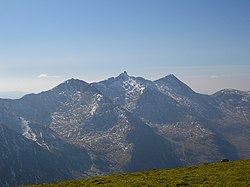
In Scotland, where she is also known as Beira, Queen of Winter (a name given by 20th-century folklorist Donald Alexander Mackenzie), she is credited with making numerous mountains and large hills, which are said to have been formed when she was striding across the land and accidentally dropped rocks from her creel or wicker basket. In other cases she is said to have built the mountains intentionally, to serve as her stepping stones. She carries a hammer for shaping the hills and valleys, and is said to be the mother of all the goddesses and gods. According to Mackenzie, Beira was a one-eyed giantess with white hair, dark blue skin, and rust-colored teeth.[17]
The Cailleach displays several traits befitting the personification of winter: she herds deer, she fights spring, and her staff freezes the ground.[18]
ในความร่วมมือกับเทพธิดาBrìghde Cailleach ถูกมองว่าเป็นเทพหรือวิญญาณตามฤดูกาล ปกครองช่วงฤดูหนาวระหว่างSamhainn (5 พฤศจิกายนหรือวันแรกของ Samhain) และBealltainn (1 พฤษภาคมหรือวันแรกของฤดูร้อน) ในขณะที่ Brìghde ปกครองช่วงฤดูร้อนระหว่าง Bealltainn และ Samhainn การตีความบาง อย่างมี Cailleach และ Brìghde เป็นสองหน้าของเทพธิดาองค์เดียวกัน[ 19 ]ในขณะที่คนอื่น ๆ อธิบายว่า Cailleach กลายเป็นหิน บน Bealltainn และเปลี่ยนกลับคืนสู่ร่างมนุษย์บน Samhainn ทัน เวลาที่จะ ปกครองตลอดเดือนฤดูหนาว ขึ้นอยู่กับสภาพอากาศในท้องถิ่น การถ่ายโอนอำนาจระหว่างเทพีแห่งฤดูหนาวและเทพีแห่งฤดูร้อนจะมีการเฉลิมฉลองในช่วงเวลาใดก็ได้ระหว่างLà Fhèill Brìghde ( Imbolc , 1 กุมภาพันธ์) เป็นอย่างเร็วที่สุด Latha na Cailliche (25 มีนาคม) หรือ Bealltainn (1 พฤษภาคม) เป็นอย่างช้าที่สุด และเทศกาลท้องถิ่นที่บ่งบอกถึงการมาถึงของสัญญาณแรกของฤดูใบไม้ผลิอาจตั้งชื่อตาม Cailleach หรือ Brìghde ก็ได้[ 19 ]
Là Fhèill Brìghdeยังเป็นวันที่ Cailleach รวบรวมฟืนสำหรับฤดูหนาวที่เหลืออยู่ ตำนานเล่าว่า หากเธอตั้งใจจะให้ฤดูหนาวคงอยู่นานขึ้น เธอจะทำให้แน่ใจว่าสภาพอากาศในวันที่ 1 กุมภาพันธ์นั้นสดใสและมีแดดจัด เพื่อที่เธอจะได้รวบรวมฟืนได้มากมายเพื่อทำให้ตัวเองอบอุ่นในอีกหลายเดือนข้างหน้า[ 2 ]ด้วยเหตุนี้ ผู้คนจึงรู้สึกโล่งใจโดยทั่วไปหาก Là Fhèill Brìghde เป็นวันที่สภาพอากาศเลวร้าย เพราะนั่นหมายความว่า Cailleach กำลังหลับ ฟืนจะหมดในไม่ช้า และดังนั้นฤดูหนาวจึงใกล้จะสิ้นสุดลงแล้ว[ 2 ] บนเกาะแมน ซึ่งเธอเป็นที่รู้จักในชื่อCaillagh ny Groamaghกล่าวกันว่า Cailleach ปรากฏตัวในวัน St. Brideในรูปของนกยักษ์ที่คาบกิ่งไม้ไว้ในปาก[ 2 ]
ตามที่แมคเคนซีกล่าวไว้คืนที่ยาวที่สุดของปีถือเป็นจุดสิ้นสุดรัชสมัยของเธอในฐานะราชินีแห่งฤดูหนาว ซึ่งในเวลานั้นเธอได้ไปเยี่ยมบ่อน้ำแห่งความเยาว์วัยและหลังจากดื่มน้ำวิเศษนั้น เธอก็กลับมาเยาว์วัยขึ้นทุกวัน[ 17 ]
ในสกอตแลนด์ Cailleachan (แปลตรงตัวว่า 'หญิงชรา') ยังเป็นที่รู้จักในชื่อ Storm Hags และถูกมองว่าเป็นตัวแทนของพลังธาตุแห่งธรรมชาติ โดยเฉพาะอย่างยิ่งในด้านการทำลายล้าง กล่าวกันว่าพวกเธอมีบทบาทอย่างมากในการก่อให้เกิดพายุลมแรงในฤดูใบไม้ผลิ ในช่วงเวลาที่เรียกว่าA' Chailleach [ 19 ] [ 20 ]

On the west coast of Scotland, the Cailleach ushers in winter by washing her great plaid (Gaelic: féileadh mòr) in the Gulf of Corryvreckan (Gaelic: Coire Bhreacain - 'whirlpool/cauldron of the plaid'). This process is said to take three days, during which the roar of the coming tempest is heard as far away as twenty miles (32 km) inland. When she is finished, her plaid is pure white and snow covers the land.[19]
In Scotland and Ireland, the first farmer to finish the grain harvest made a corn dolly, representing the Cailleach (also called "the Carlin or Carline"[21]), from the last sheaf of the crop. The figure would then be tossed into the field of a neighbor who had not yet finished bringing in their grain. The last farmer to finish had the responsibility to take in and care for the corn dolly for the next year, with the implication they'd have to feed and house the hag all winter. Competition was fierce to avoid having to take in the Old Woman.[22]
Some scholars believe the Old Irish poem "The Lament of the Old Woman of Beara" is about the Cailleach; Kuno Meyer states, "she had fifty foster-children in Beare. She had seven periods of youth one after another, so that every man who had lived with her came to die of old age, and her grandsons and great-grandsons were tribes and races."[23][24]
Ireland
In Ireland, the Cailleach is associated with craggy, prominent mountains and outcroppings, such as Hag's Head (Irish: Ceann Caillí, meaning 'hag's head') the southernmost tip of the Cliffs of Moher in County Clare.[3]
Labbacallee wedge tomb (Irish: Leaba Chaillí, meaning 'the hag's bed') is located near Glanworth, County Cork and is, according to folklore, the Cailleach's grave and former dwelling where she lived with her husband, Mogh Ruith, who she threw a boulder at, pinning him to the floor of the River Funshion.[25]

บน คาบสมุทรเบียราในเวสต์คอร์กที่คิลคาเธอรีนมีหินก้อนหนึ่งที่กล่าวกันว่ามีลักษณะคล้ายกับไคเลียช ในตำนานกล่าวว่าเธอได้กระโดดข้ามอ่าวจากคูลาห์มายังที่ตั้งปัจจุบันนี้
สุสานหินขนาดใหญ่ที่Loughcrewในเคาน์ตี Meathตั้งอยู่บนยอดเขาSlieve na Calliagh ( ภาษาไอริช : Sliabh na Caillíซึ่งหมายถึง 'ภูเขาของแม่มด') และมีหินขอบทางที่รู้จักกันในชื่อ "เก้าอี้ของแม่มด" [ 26 ] Cairn T บน Slieve na Calliagh เป็นสุสานทางเดิน แบบคลาสสิก ซึ่งแสงอาทิตย์ยามเช้าใน วัน วิษุวัตส่องลงมาตามทางเดินและส่องสว่างห้องด้านในที่เต็มไปด้วยรูปแกะสลักหินขนาดใหญ่[ 27 ]
ยอดเขาSlieve Gullionในเคาน์ตี Armaghมีสุสานทางเดินที่รู้จักกันในท้องถิ่นว่า 'บ้านของ Calliagh Beara' นอกจากนี้ยังมีทะเลสาบ ซึ่งว่ากันว่า Calliagh ได้เล่นกลกับนักรบในตำนานFionn mac Cumhaillโดยการแปลงร่างเป็นชายชราหลังจากดำดิ่งลงไปในทะเลสาบเพื่อเก็บแหวนที่ Calliagh หลอกให้เขาคิดว่าหายไป[ 28 ]
Aillenaally ( Aill na Caillí , "Hag Cliff") เป็นหน้าผาในCounty Galway [ 29 ]
สุสานทางเดิน Carrowmore บนคาบสมุทร Cúil IorraในCounty Sligoมีความเกี่ยวข้องกับ Cailleach แห่งหนึ่งเรียกว่าบ้านของ Cailleach a Bhéara [ 30 ]วิลเลียม บัตเลอร์ เยตส์เรียกสลิโก ไคลเลชว่า 'Clooth na Bare' [ 31 ]ใน County Sligo เธอก็เรียกว่าGaravogue Cailleach.
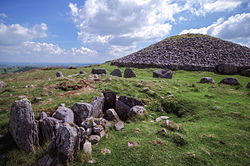 ซากศพทางเดินบนSlieve na Calliagh , County Meath


สกอตแลนด์
Cailleach เป็นตัวละครที่โดดเด่นในภูมิประเทศของArgyll and Buteประเทศสกอตแลนด์ ในนิทานยุคหลัง เธอเป็นที่รู้จักในชื่อCailleach nan Cruachan (“แม่มดแห่งBen Cruachan ”) Ben Cruachan เป็นภูเขาที่สูงที่สุดในภูมิภาคนี้ มีผ้าเช็ดจานและโปสการ์ดรูปเธอขายในร้านค้าสำหรับนักท่องเที่ยวของHollow Mountainซึ่งยังมีภาพจิตรกรรมฝาผนังที่แสดงถึงการสร้างLoch Aweโดย บังเอิญของเธออีกด้วย [ 32 ]ตำนานเล่าว่า Cailleach เหนื่อยล้าจากการต้อนกวางมาทั้งวัน บนยอด Ben Cruachan เธอเผลอหลับไปขณะเฝ้ายาม และบ่อน้ำที่เธอดูแลอยู่ก็ล้น น้ำไหลลงมาจากที่สูงและท่วมหุบเขาด้านล่าง ก่อตัวเป็นแม่น้ำ ก่อน แล้วจึง กลาย เป็นทะเลสาบ[ 32 ] [ 33 ]บ่อน้ำที่ล้นเป็นลวดลายที่พบได้ทั่วไปในนิทานการสร้างโลก ของชาว เกลิก ในท้องถิ่น เช่นเดียวกับการสร้างแม่น้ำ Boyne ของเทพธิดา Boannในไอร์แลนด์[ 34 ]การเชื่อมโยงอื่นๆ กับภูมิภาคนี้รวมถึงความสัมพันธ์อันแน่นแฟ้นกับกระแสน้ำวนอันรุนแรงในอ่าวคอร์รีฟเรคคานดัง ที่กล่าวไว้ข้างต้น [ 19 ]
นอกจากนี้ เธอยังมีความเกี่ยวข้องกับภูเขาอื่นๆ ในสกอตแลนด์อีกด้วยกล่าวกันว่าเบนเนวิส เป็น "บัลลังก์ภูเขา" ของเธอ [ 17 ]ภูเขาสองลูกบนเกาะสกายที่ชื่อว่าเบนน์นาไคลิช ( ตะวันตกและตะวันออก ) ตั้งชื่อตามเธอ ซึ่งมีพายุลูกเห็บและฝนรุนแรงตกลงมา สร้างความเสียหายและทำลายล้างพื้นที่เบื้องล่าง[ 19 ]

มี Gleann Cailliche อยู่ในGlen Lyonใน Perthshire ซึ่งมีลำธารชื่อ Allt Cailliche ไหลลงสู่Loch Lyonบริเวณนี้มีชื่อเสียงในเรื่องพิธีกรรมนอกรีตซึ่งตามตำนานกล่าวว่าเกี่ยวข้องกับ Cailleach มีกระท่อม เล็กๆ อยู่ในหุบเขา ซึ่งรู้จักกันในชื่อ Tigh nan Cailleach (ภาษาเกลิกสก็อต แปลว่าบ้านของหญิงชรา[ 35 ] ) หรือ Tigh nam Bodach (ภาษาเกลิกสก็อต แปลว่าบ้านของชายชรา[ 35 ] ) ซึ่งมีหินขนาดใหญ่ที่สึกกร่อนจากน้ำจำนวนมาก มีลักษณะคล้ายมนุษย์ตัวจิ๋ว[ 36 ]อาคารมีรูปทรงสี่เหลี่ยมผืนผ้าโดยประมาณ เดิมมีขนาด 2 เมตร x 1.3 เมตร x 0.4 เมตร สูง มีหลังคาหิน[ 37 ] หลังคาที่เปลี่ยนใหม่ซึ่งทำจากพาเลทไม้พังลง และอาคารทั้งหมดก็ทรุดโทรมไปบ้าง จึงได้รับการสร้างใหม่โดยช่างทำคันดินในท้องถิ่นในปี 2011 [ 38 ]
ตามตำนานท้องถิ่น หินเหล่านี้เป็นตัวแทนของ Cailleach สามีของเธอ Bodach และลูก ๆ ของพวกเขา[ 39 ] [ 40 ]และสถานที่แห่งนี้อาจเป็นศาลเจ้าแห่งเดียวที่ยังหลงเหลืออยู่ในบริเตนใหญ่[ 36 ]ตำนานท้องถิ่นกล่าวว่า Cailleach และครอบครัวของเธอได้รับที่พักพิงในหุบเขาโดยชาวบ้าน และในขณะที่พวกเขาอยู่ที่นั่น หุบเขาก็อุดมสมบูรณ์และเจริญรุ่งเรืองเสมอ เมื่อพวกเขาจากไป พวกเขามอบหินให้กับชาวบ้านพร้อมกับสัญญาว่าตราบใดที่หินเหล่านี้ถูกนำไปวางไว้เพื่อมองดูหุบเขาที่Bealltainnและนำกลับเข้าไปในที่พักพิงและทำให้ปลอดภัยสำหรับฤดูหนาวในSamhainหุบเขาก็จะยังคงอุดมสมบูรณ์ต่อไป[ 39 ]พิธีกรรมนี้ยังคงดำเนินต่อไปจนถึงทุกวันนี้[ 40 ] [ 41 ]
ในวัฒนธรรมสมัยนิยม
- ในวรรณกรรมเกลิกของสกอตแลนด์ Cailleach ถูกใช้เป็นสัญลักษณ์แทนนักวิจารณ์วรรณกรรม ภายในของกวี William Rossในศตวรรษที่ 18 อย่างแพร่หลาย แม้ว่าจะถูกมองว่าเป็น "นักรักผู้โศกเศร้าที่ตายเพราะความรักที่ไม่สมหวัง " เนื่องจากบทกวีมากมายของกวีที่แสดงถึงความสูญเสียและความเสียใจจากการแต่งงานในปี 1782 กับ Mòr Ros ผู้เป็นที่รัก Ross ก็สามารถล้อเลียนตัวเองได้เช่นกัน ดังเช่นในบทกวีที่ล้อเลียน ตัวเอง Oran eadar am Bàrd agus Cailleach-mhilleadh-nan-dàn ("การแลกเปลี่ยนบทกวีระหว่างกวีกับแม่มดผู้ทำลายบทกวี") [ 42 ]
- ตามที่Amy Murray นักมานุษยวิทยาดนตรี ชาวอเมริกันกล่าวไว้ ชาวเกลแห่งเอาเตอร์เฮบริดีสบางครั้งเรียกพระราชินีวิกตอเรียว่า"A' chailleach a-stùiradh" ("แม่มดผู้ควบคุมเรือ") [ 43 ]
- การดัดแปลงบทละครของ Morna Young จาก เรื่อง The Snow QueenของHans Christian Andersonซึ่งผลิตโดยLyceum Theatre Companyในเอดินบะระ ในเดือนพฤศจิกายน/ธันวาคม 2023 ได้รวมตัวละครของ Beira ราชินีแห่งฤดูหนาว และราชินีหิมะเข้าด้วยกัน[ 44 ]
- ตัวละครชื่อ ไคเลียช ปรากฏตัวในสองตอนของซีซั่นที่สี่ของซีรีส์โทรทัศน์เมอร์ลิน ทางช่องบีบีซีของอังกฤษ ตามเนื้อเรื่อง ไคเลียชเป็นเทพเจ้าผู้ทรงพลังในศาสนาโบราณ เธอทำหน้าที่เป็นผู้เฝ้าประตูสู่โลกวิญญาณ
- ใน ตอน"The Stones of Blood" ของซีรีส์ Doctor Whoปี 1978 มีการปรากฏตัวของ Cailleach ในรูป แบบที่แตกต่างออกไป โดยรับบทเป็นมนุษย์ต่างดาวที่มีอายุยืนยาว และได้รับการบูชาจากลัทธิดรูอิดสมัยใหม่
- Cailleach เป็นวงดนตรีแนวเนโอโฟล์กจากรัสเซีย ที่เล่นดนตรีในแนวเพลงเพแกนโฟล์ก โฟล์กร็อก โฟล์กยุคกลาง และแฟนตาซีโฟล์ก วงดนตรี Cailleach ก่อตั้งขึ้นในปี 2020 จากผลงานของวงดนตรี Alruna ซึ่งมีผลงานบนเวทีรัสเซียมา 8 ปี โดยอิงจากตำนานและเรื่องเล่าของชนเผ่าทางเหนือและเซลติก รวมถึงตำนานของบริเตนโบราณ พวกเขามีช่อง YouTube ชื่อ Cailleach Folkband
- ไคเลียชเป็นตัวละครหลักในนวนิยายเรื่องThe Winter Goddess ของเมแกน บาร์นาร์ด ซึ่งจะตีพิมพ์ในปี 2025
- ตัวร้ายในภาพยนตร์เรื่องHokum ปี 2026 คือ Cailleach
ดูเพิ่มเติม
หมายเหตุ
- ^ a b c d Robertson, Boyd; McDonald, Ian (2004). พจนานุกรมภาษาเกลิก . ชุด "เรียนรู้ด้วยตนเอง". Hodder Education. หน้า 24–25 . ISBN 0-07-142667-1.
- ^ a b c d e Briggs, Katharine M. (1976) สารานุกรมแห่งนางฟ้านิวยอร์ก, Pantheon Books. หน้า 57-60.
- ^ a b Monaghan, Patricia (2004) The Red-Haired Girl from the Bog: The Landscape of Celtic Myth and Spirit . New World Library. ISBN 1-57731-458-1หน้า 23: "เราเห็นเงาของเธอบนCeann na Cailleach [recte Ceann na Caillí ], 'Hag's Head' ซึ่งอยู่ทางใต้สุดของหน้าผา Moher "
- ^Ó Dónaill, Niall (1992). Foclóir Gaeilge–Béarla. Mount Salus Press. p. 172. ISBN 1-85791-037-0.
- ^Displaying the expected /p/ > /c/ change of early Latin loans in Irish.
- ^Thurneysen, Rudolph; A Grammar of Old Irish, Vol. 1; Dublin Institute for Advanced Studies, 1946, p. 568.
- ^Ó Cathasaigh, T. "The eponym of Cnogba", Éigse 23, 1989, pp. 27–38.
- ^Ó hÓgáin, D. Myth, Legend & Romance: An Encyclopaedia of the Irish Folk Tradition, Prentice Hall Press, 1991, p. 67.
- ^Macbain, Alexander (1998) Etymological Dictionary Of Scottish-Gaelic. New York: Hippocrene Books, ISBN 0-7818-0632-1, p. 63.
- ^Ó Crualaoich, Gearóid (2006). The Book of the Cailleach: Stories of the Wise-Woman Healer. Cork University Press. ISBN 1-85918-372-7.
- ^ abÓ Muraíle, Nollaig. "Béarra/Bear". Placenames Database of Ireland. Retrieved 15 September 2025.
- ^ abMeyer, Kuno (1899). "Irish Stories and Songs: II. The Old Woman of Beare". Otia Merseiana. 1. University College of Liverpool: 119–128. Retrieved 14 September 2025 – via The Internet Archive.
- ^Ó Cathasaigh, Tomás. "Knowth - The Epynom of Cnogba".
- ^Monaghan, Patricia. The Encyclopedia of Celtic Mythology and Folklore. Infobase Publishing, 2004, p.69
- ^Ross, Davie; Smith, Gavin D. (1999). Scots–English English–Scots Dictionary. New York: Hippocrene Pres. p. 21. ISBN 0-7818-0779-4.
- ^Ross, Anne (1973, reprint 2004) "The divine hag of the pagan Celts", in The Witch Figure: Folklore Essays by a Group of Scholars in England Honoring the 75th Birthday of Katharine M. Briggs; ed. by Venetia Newall. London: Routledge and Kegan Paul. ISBN 0-415-33074-2.
- ^ abcMackenzie, Donald Alexander (1917). "Beira, Queen of Winter", in Wonder Tales from Scottish Myth and Legend.
- ^Briggs, Katharine M. (1967). The Fairies in English Tradition and Literature. University of Chicago Press. p. 40.
- ^ abcdefgMcNeill, F. Marian (1959). The Silver Bough, Vol.2: A Calendar of Scottish National Festivals, Candlemas to Harvest Home. William MacLellan. pp. 20–21. ISBN 0-85335-162-7.
{{cite book}}: ISBN / Date incompatibility (help) - ^McNeill, F. Marian (1959). The Silver Bough, Vol.1: Scottish Folklore and Folk-Belief. William MacLellan. p. 119. ISBN 0-85335-161-9.
{{cite book}}: ISBN / Date incompatibility (help) - ^Frazer, The Golden Bough 1922, ch. 45.
- ^McNeill, Vol.2 (1959) pp. 119-124.
- ^Meyer, Kuno (1994) [1913]. Ancient Irish Poetry. Constable and Co. pp. 90–93. ISBN 0-09-473380-5.
- ^Ó Crualaoich, Gearóid (2006). The Book of the Cailleach: Stories of the Wise-woman Healer. Cork University Press. pp. 48–52. ISBN 1-85918-372-7.
- ^Leask, H. G.; Price, Liam; Martin, C. P.; Bailey, K. C. (1935). "The Labbacallee Megalith, Co. Cork". Proceedings of the Royal Irish Academy. Section C: Archaeology, Celtic Studies, History, Linguistics, Literature. 43: 77–101. ISSN 0035-8991. JSTOR 25515993.
- ^Cochrane, Andrew (2005) "A taste of the unexpected: subverting mentalités through the motifs and settings of Irish passage tombs". p.4: "To the north of Cairn T and on the exterior is located K29 or the ‘Hag’s Chair’. This kerbstone has visual imagery on its front and back face. The top of the central part of this kerbstone is believed to be artificially cut to create the chair appearance (Shee Twohig 1981, 217; contra. Conwell 1866, 371)".
- ^Documented in photos and videos taken on site for six years running.
- ^"The Calliagh Berra's Lake – Article in Discover Ireland e-zine".
- ^"Aill na Caillí/Aillenacally". Logainm.ie.
- ^Meehan, Padraig. Listoghil, A Seasonal Alignment, 2014, Gungho Publications,
- ^Jeffares, Alexander Norman. A Commentary on the Collected Poems of W.B. Yeats, 1968, Stanford University Press
- ^ ab'The Legend of CruachanArchived 2007-10-28 at the Wayback Machine', from the Ben Cruachan visitor's website. Access date 21-11-2007.
- ^'Cailleach BheurArchived 2006-10-09 at the Wayback Machine' from the Mysterious Britain website. Access date 21-11-2007.
- ^MacKillop, James (1998) Dictionary of Celtic Mythology. Oxford University Press. ISBN 0-19-280120-1 p. 45.
- ^ abMacLennan, Malcolm, Gaelic Dictionary, Acair and Aberdeen University Press, 1985 photolithographic reprint of 1st edition, 1925
- ^ abMcKerracher, Archie, Perthshire in History and Legend, 1st edition 1988, John Donald Publishers, ISBN 0859762238, pp55-56
- ^National Record of the Historic Environment (Canmore), Tigh Nam Bodach, Archaeology Notes, https://canmore.org.uk/site/23898/tigh-nam-bodach
- ^Tigh nam Bodach stones of Glen Cailliche get makeover from dyking expert, Daily Record, 11 May 2012, https://www.dailyrecord.co.uk/news/local-news/tigh-nam-bodach-stones-glen-2729865
- ^ abRoss, Anne (2000). Folklore of the Scottish Highlands. Stroud: Tempus Publishing. p. 114.
- ^ abSacred stones out in the sun, Daily Record, 4 May 2012, https://www.dailyrecord.co.uk/news/local-news/sacred-stones-out-sun-2729746
- ^Brooks, Libby (30 October 2020). "'There is power in them': mysterious stone figures to be moved in Gaelic winter ritual". The Guardian. Retrieved 31 October 2020.
- ^Derick S. Thomson (1993), Gaelic Poetry in the Eighteenth Century: A Bilingual Anthology, Association for Scottish Literary Studies, Aberdeen. Pages 161-167.
- ^Amy Murray's (1920), Father Allan's Island, Harcourt, Brace and Howe, Inc. Page 5.
- ^Young, Morna, "Author's Note", The Snow Queen theatre programme, Royal Lyceum Theatre Company, Edinburgh, November 2023, p. 11
Primary sources
- "The Lament of the Old Woman of Beare", ed. and tr. Donncha Ó hAodha (1989). "The Lament of the Old Woman of Beare". In Donnchadh Ó Corráin, Liam Breatnach and Kim McCone (ed.). Sages, Saints and Storytellers: Celtic studies in Honour of Professor James Carney. Maynooth Monographs 2. Maynooth: An Sagart. pp. 308–31.
Further reading
- Krappe, A. H. (1936). "La Cailleach Bheara. Notes de mythologie Gaélique". Études Celtiques. 1 (2): 292–302. doi:10.3406/ecelt.1936.1123.
- Carey, John (1999). "Transmutations of Immortality in 'The Lament of the Old Woman of Beare'"(PDF). Celtica. 23: 30–7. Archived from the original(PDF) on 19 November 2007. Retrieved 4 May 2010.
- Strang, Dougie (2023), The Bone Cave: A Journey Through Myth and Memory, Birlinn Limited, Edinburgh, ISBN 9781780278353
External links

- An Cailleach Bhéarra (2007) - an IFBshort film (8 minutes)
- Ben Cruachan, the Hollow Mountain - The Legend of Cruachan, featuring the Cailleach Bheur
- Hags, Queens and Wise Women: Supernatural Females of the Irish Otherworld - RTÉ radio series, based on the work of Gearóid Ó Crualaoich
- Photos of the Hag's Chair and other megalithic features at Slieve na Calliagh, Ireland
- Putting out the hare, putting on the harvest knots - don't get stuck with the Cailleach
สรุปเนื้อหา
ข้อมูลสำคัญจากบทความ
ข้อมูลสำคัญเกี่ยวกับ Cailleach
In Gaelic ( Irish , Scottish and Manx ) myth, the Cailleach ( Irish: [ˈkal̠ʲəx, kəˈl̠ʲax] , Scottish Gaelic: [ˈkʰaʎəx] ) is a divine hag , associated with the creation of the...
Name
Cailleach ('old woman' or 'hag' in modern Irish and Scottish Gaelic ) [ 1 ] [ 4 ] comes from the Old Irish Caillech ('veiled one'), an adjectival form of caille ('veil'), an early loan from Latin pallium , [ 5 ] 'woollen cloak'. [ 6 ] [ 7 ] [ 8 ] [ 9 ]
Legends
In Scotland , where she is also known as Beira, Queen of Winter (a name given by 20th-century folklorist Donald Alexander Mackenzie ), she is credited with making numerous mountains and large hills, which are said to have been formed when she was striding...
Ireland
In Ireland, the Cailleach is associated with craggy, prominent mountains and outcroppings, such as Hag's Head ( Irish : Ceann Caillí , meaning 'hag's head') the southernmost tip of the Cliffs of Moher in County Clare . [ 3 ]