
กระแสไฟฟ้า

กระแสไฟฟ้าคือการไหลของอนุภาคที่มีประจุเช่นอิเล็กตรอนหรือไอออนผ่านตัวนำไฟฟ้าหรือพื้นที่ว่าง โดยนิยามคืออัตราสุทธิที่ ประจุไฟฟ้าไหลผ่านพื้นผิว[ 1 ] : 2 [ 2 ] : 622อนุภาคที่เคลื่อนที่เรียกว่าตัวนำประจุซึ่งอาจมีหลายประเภท ขึ้นอยู่กับตัวนำในวงจรไฟฟ้าตัวนำประจุส่วนใหญ่มักเป็นอิเล็กตรอนที่เคลื่อนที่ผ่านสายไฟในสารกึ่งตัวนำ ตัวนำประจุอาจเป็นอิเล็กตรอนหรือโฮลในอิ เล็ก โทร ไลต์ ตัวนำประจุคือ ไอออนในขณะที่ในพลาสมาซึ่งเป็นก๊าซไอออนไน ซ์ ตัวนำประจุก็คือไอออนและอิเล็กตรอนเช่นกัน[ 3 ]
ในระบบหน่วยสากล (SI) กระแสไฟฟ้าแสดงในหน่วยแอมแปร์(บางครั้งเรียกว่า "แอมป์" สัญลักษณ์ A) ซึ่งเทียบเท่ากับหนึ่งคูลอมบ์ต่อวินาที แอมแปร์เป็น หน่วยฐาน ของSIและกระแสไฟฟ้าเป็นปริมาณฐานในระบบปริมาณสากล (ISQ) [ 4 ] : 15กระแสไฟฟ้าเรียกอีกอย่างว่าแอมแปร์เรจและวัดโดยใช้อุปกรณ์ที่เรียกว่าแอมมิเตอร์[ 2 ] : 788
กระแสไฟฟ้าสร้างสนามแม่เหล็กซึ่งใช้ในมอเตอร์ เครื่องกำเนิดไฟฟ้าตัวเหนี่ยวนำและหม้อแปลงไฟฟ้าในตัวนำทั่วไป กระแสไฟฟ้าทำให้เกิดความร้อนจูลซึ่งทำให้เกิดแสงสว่างในหลอดไฟกระแสไฟฟ้าที่เปลี่ยนแปลงตามเวลาจะปล่อยคลื่นแม่เหล็กไฟฟ้าซึ่งใช้ในระบบโทรคมนาคมเพื่อกระจายข้อมูล
เครื่องหมาย
สัญลักษณ์ทั่วไปสำหรับกระแสไฟฟ้าคือIซึ่งมาจากวลีภาษาฝรั่งเศสintensité du courant (ความเข้มของกระแสไฟฟ้า) [ 5 ] [ 6 ]ความเข้มของกระแสไฟฟ้ามักเรียกง่ายๆ ว่ากระแสไฟฟ้า [ 7 ] สัญลักษณ์ I ถูกใช้โดยAndré-Marie Ampèreซึ่งเป็นผู้ที่หน่วยของกระแสไฟฟ้าได้รับการตั้งชื่อตาม ในการกำหนดกฎแรงของ Ampère (1820) [ 8 ] สัญลักษณ์นี้เดินทางจากฝรั่งเศสไปยังสหราชอาณาจักร ซึ่งกลายเป็นมาตรฐาน แม้ว่าอย่างน้อยหนึ่งวารสารจะไม่ได้เปลี่ยนจากการใช้Cเป็นIจนกระทั่งปี 1896 [ 9 ]
อนุสัญญา
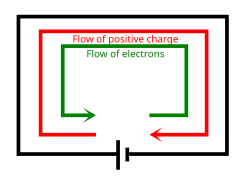

ทิศทางกระแสไฟฟ้าตามธรรมเนียม หรือที่เรียกว่ากระแสไฟฟ้าตามธรรมเนียม[ 10 ] [ 11 ] ถูกกำหนดโดยพลการว่าเป็นทิศทางที่ ประจุบวก ไหล ในวัสดุตัวนำ อนุภาคประจุที่ เคลื่อนที่ซึ่งประกอบเป็นกระแสไฟฟ้าเรียกว่าตัวนำประจุในโลหะซึ่งเป็นส่วนประกอบของสายไฟและตัวนำอื่นๆ ในวงจรไฟฟ้า ส่วนใหญ่ นิวเคลียส ของอะตอม ที่มีประจุบวกจะอยู่ในตำแหน่งคงที่ และอิเล็กตรอน ที่มีประจุลบ เป็นตัวนำประจุที่สามารถเคลื่อนที่ไปมาได้อย่างอิสระในโลหะ ในวัสดุอื่นๆ โดยเฉพาะอย่างยิ่งสารกึ่งตัวนำ ตัวนำประจุอาจเป็นบวกหรือลบก็ได้ ขึ้นอยู่กับสารเจือปนที่ใช้ ตัวนำประจุบวกและลบอาจมีอยู่พร้อมกันได้ เช่นเดียวกับที่เกิดขึ้นในอิเล็กโทรไลต์ในเซลล์ไฟฟ้าเคมี
การไหลของประจุบวกทำให้เกิดกระแสไฟฟ้าเท่ากัน และมีผลในวงจรเหมือนกับการไหลของประจุลบที่เท่ากันในทิศทางตรงกันข้าม เนื่องจากกระแสไฟฟ้าอาจเป็นการไหลของประจุบวกหรือประจุลบ หรือทั้งสองอย่าง จึงจำเป็นต้องมีข้อกำหนดสำหรับทิศทางของกระแสไฟฟ้าที่ไม่ขึ้นอยู่กับชนิดของตัวนำประจุ ตัวนำประจุลบ เช่น อิเล็กตรอน (ตัวนำประจุในสายโลหะและส่วนประกอบวงจรอิเล็กทรอนิกส์อื่นๆ อีกมากมาย) จึงไหลในทิศทางตรงกันข้ามกับการไหลของกระแสไฟฟ้าตามแบบแผนในวงจรไฟฟ้า[ 10 ] [ 11 ]
ทิศทางอ้างอิง
กระแสไฟฟ้าในสายไฟหรือองค์ประกอบวงจรสามารถไหลได้สองทิศทาง เมื่อกำหนดตัวแปรเพื่อแสดงกระแสไฟฟ้า ทิศทางที่แสดงกระแสไฟฟ้าบวกจะต้องระบุ โดยปกติจะใช้ลูกศรบนแผนผังวงจร[ 12 ] [ 13 ] : 13เรียก ว่าทิศทางอ้างอิงของกระแสไฟฟ้าเมื่อวิเคราะห์วงจรไฟฟ้าทิศทางที่แท้จริงของกระแสไฟฟ้าที่ไหลผ่านองค์ประกอบวงจรเฉพาะมักจะไม่ทราบจนกว่าการวิเคราะห์จะเสร็จสมบูรณ์ ดังนั้น ทิศทางอ้างอิงของกระแสไฟฟ้าจึงมักถูกกำหนดขึ้นโดยพลการ เมื่อแก้วงจรแล้ว ค่าลบของกระแสไฟฟ้าจะหมายความว่าทิศทางที่แท้จริงของกระแสไฟฟ้าที่ไหลผ่านองค์ประกอบวงจรนั้นตรงกันข้ามกับทิศทางอ้างอิงที่เลือกไว้[ a ] : 29

กฎของโอห์ม
กฎของโอห์มระบุว่ากระแสไฟฟ้าที่ไหลผ่านตัวนำระหว่างสองจุดเป็นสัดส่วน โดยตรง กับความต่างศักย์ระหว่างสองจุด ค่าคงที่ของสัดส่วนในความสัมพันธ์นี้คือความต้านทาน[ 14 ]สมการทางคณิตศาสตร์ทั่วไปที่อธิบายความสัมพันธ์นี้คือ: [ 15 ]

โดยที่I คือกระแสไฟฟ้าที่ ไหลผ่านตัวนำในหน่วยแอมแปร์ V คือความต่างศักย์ที่วัดคร่อมตัวนำในหน่วยโวลต์และRคือความต้านทานของตัวนำในหน่วยโอห์มโดยเฉพาะอย่างยิ่ง กฎของโอห์มระบุว่าRในความสัมพันธ์นี้มีค่าคงที่ ไม่ขึ้นอยู่กับกระแสไฟฟ้า[ 16 ]
กระแสสลับและกระแสตรง
In alternating current (AC) systems, the movement of electric charge periodically reverses direction. AC is the form of electric power most commonly delivered to businesses and residences. The usual waveform of an AC power circuit is a sine wave, though certain applications use alternative waveforms, such as triangular or square waves. Audio and radio signals carried on electrical wires are also examples of alternating current. An important goal in these applications is recovery of information encoded (or modulated) onto the AC signal.
In contrast, direct current (DC) refers to a system in which electric charge moves in only one direction (sometimes called unidirectional flow). Direct current is produced by sources such as batteries, thermocouples, solar cells, and commutator-type electric machines of the dynamo type. Alternating current can also be converted to direct current through use of a rectifier. Direct current may flow in a conductor such as a wire, but can also flow through semiconductors, insulators, or even through a vacuum as in electron or ion beams. An old name for direct current was galvanic current.[17]
Occurrences
Natural observable examples of electric current include lightning, static electric discharge, and the solar wind, the source of the polar auroras.
Man-made occurrences of electric current include the flow of conduction electrons in metal wires such as the overhead power lines that deliver electrical energy across long distances and the smaller wires within electrical and electronic equipment. Eddy currents are electric currents that occur in conductors exposed to changing magnetic fields. Similarly, electric currents occur, particularly in the surface, of conductors exposed to electromagnetic waves. When oscillating electric currents flow at the correct voltages within radio antennas, radio waves are generated.
In electronics, other forms of electric current include the flow of electrons through resistors or through the vacuum in a vacuum tube, the flow of ions inside a battery, and the flow of holes within metals and semiconductors.
A biological example of current is the flow of ions in neurons and nerves, responsible for both thought and sensory perception.
Measurement
Current can be measured using an ammeter.
Electric current can be directly measured with a galvanometer, but this method involves breaking the electrical circuit, which is sometimes inconvenient.
Current can also be measured without breaking the circuit by detecting the magnetic field associated with the current. Devices, at the circuit level, use various techniques to measure current:
- Shunt resistors[18]
- Hall effect current sensor transducers
- Transformers (however DC cannot be measured)
- Magnetoresistive field sensors[19]
- Rogowski coils
- Current clamps
Resistive heating
Joule heating, also known as ohmic heating and resistive heating, is the process of power dissipation[20]:36 by which the passage of an electric current through a conductor increases the internal energy of the conductor,[21]:846 converting thermodynamic work into heat.[21]:846,fn. 5 The phenomenon was first studied by James Prescott Joule in 1841. Joule immersed a length of wire in a fixed mass of water and measured the temperature rise due to a known current through the wire for a 30 minute period. By varying the current and the length of the wire he deduced that the heat produced was proportional to the square of the current multiplied by the electrical resistance of the wire.

ความสัมพันธ์นี้เรียกว่ากฎของจูล[ 20 ] : 36หน่วยพลังงานในระบบSIได้รับการตั้งชื่อว่าจูลและใช้สัญลักษณ์J ในเวลาต่อ มา[ 4 ] : 20หน่วยกำลังในระบบ SI ที่รู้จักกันทั่วไปคือวัตต์ (สัญลักษณ์: W) ซึ่งเทียบเท่ากับหนึ่งจูลต่อวินาที[ 4 ] : 20
แม่เหล็กไฟฟ้า
แม่เหล็กไฟฟ้า

ในแม่เหล็กไฟฟ้า ขดลวดจะทำตัวเหมือนแม่เหล็กเมื่อมีกระแสไฟฟ้าไหลผ่าน เมื่อปิดกระแสไฟฟ้า ขดลวดจะสูญเสียความเป็นแม่เหล็กทันที กระแสไฟฟ้าก่อให้เกิดสนามแม่เหล็กสนามแม่เหล็กสามารถมองเห็นได้เป็นรูปแบบของเส้นแรงสนามแม่เหล็กเป็นวงกลมล้อมรอบลวด ซึ่งจะคงอยู่ตราบใดที่มีกระแสไฟฟ้าไหลผ่าน
การเหนี่ยวนำแม่เหล็กไฟฟ้า
สนามแม่เหล็กยังสามารถใช้สร้างกระแสไฟฟ้าได้ เมื่อสนามแม่เหล็กที่เปลี่ยนแปลงถูกนำไปใช้กับตัวนำ จะ เกิด แรงเคลื่อนไฟฟ้า (EMF) ขึ้น[ 21 ] : 1004ซึ่งจะเริ่มต้นกระแสไฟฟ้าเมื่อมีเส้นทางที่เหมาะสม

คลื่นวิทยุ
เมื่อกระแสไฟฟ้าไหลผ่านตัวนำที่มีรูปร่างเหมาะสมที่ความถี่วิทยุจะสามารถสร้างคลื่นวิทยุ ได้ คลื่นเหล่านี้เดินทางด้วย ความเร็วแสงและสามารถทำให้เกิดกระแสไฟฟ้าในตัวนำที่อยู่ห่างไกลได้
กลไกการนำไฟฟ้าในตัวกลางต่างๆ
ในของแข็งที่เป็นโลหะ ประจุไฟฟ้าจะไหลโดยอาศัยอิเล็กตรอน จากศักย์ไฟฟ้าต่ำไปยัง ศักย์ไฟฟ้าสูงในตัวกลางอื่นๆ กระแสของวัตถุที่มีประจุ (เช่น ไอออน) อาจก่อให้เกิดกระแสไฟฟ้าได้ เพื่อให้คำจำกัดความของกระแสไฟฟ้าเป็นอิสระจากชนิดของตัวนำประจุกระแสไฟฟ้าตามแบบแผนจึงถูกกำหนดให้เคลื่อนที่ไปในทิศทางเดียวกับการไหลของประจุบวก ดังนั้น ในโลหะที่ตัวนำประจุ (อิเล็กตรอน) เป็นลบ กระแสไฟฟ้าตามแบบแผนจะมีทิศทางตรงกันข้ามกับการเคลื่อนที่โดยรวมของอิเล็กตรอน ในตัวนำที่ตัวนำประจุเป็นบวก กระแสไฟฟ้าตามแบบแผนจะมีทิศทางเดียวกับตัวนำประจุ
ในสุญญากาศอาจเกิดลำแสงของไอออนหรืออิเล็กตรอนขึ้นได้ ในวัสดุตัวนำอื่นๆ กระแสไฟฟ้าเกิดจากการไหลของอนุภาคที่มีประจุบวกและประจุลบพร้อมกัน ในวัสดุบางชนิด กระแสไฟฟ้าเกิดจากการไหลของประจุบวก เพียงอย่างเดียว ตัวอย่างเช่น กระแสไฟฟ้าในอิเล็กโทรไลต์ เป็นการไหลของไอออนที่มีประจุบวกและประจุลบ ในเซลล์ ไฟฟ้าเคมีแบบตะกั่ว-กรดทั่วไปกระแสไฟฟ้าประกอบด้วย ไอออน ไฮโดรเนียม ที่มี ประจุบวกไหลไปในทิศทางหนึ่ง และไอออนซัลเฟตที่มีประจุลบไหลไปในอีกทิศทางหนึ่ง กระแสไฟฟ้าในประกายไฟหรือพลาสมาเป็นการไหลของอิเล็กตรอน เช่นเดียวกับไอออนที่มีประจุบวกและประจุลบ ในน้ำแข็งและในอิเล็กโทรไลต์ของแข็งบางชนิด กระแสไฟฟ้าประกอบด้วยไอออนที่ไหลเพียงอย่างเดียว
โลหะ
In a metal , some of the outer electrons in each atom are not bound to the individual molecules as they are in molecular solids , or in full bands as they are in insulating materials, but are free to move within the metal lattice . These conduction electrons serve as charge carriers that can flow through the conductor as an electric current when an electric field is present. Metals are particularly conductive because there are many of these free electrons. With no external electric field applied, these electrons move about randomly due to thermal energy but, on average, there is zero net current within the metal. At room temperature, the average speed of these random motions is 10 6 metres per second. [ 22 ] Given a surface through which a metal wire passes, electrons move in both directions across the surface at an equal rate. ดังที่จอร์จ กาโมว์เขียนไว้ในหนังสือวิทยาศาสตร์ยอดนิยม ของเขาเรื่อง One, Two, Three...Infinity (1947) ว่า "สารโลหะแตกต่างจากวัสดุอื่นๆ ตรงที่วงโคจรชั้นนอกของอะตอมยึดเหนี่ยวกันอย่างหลวมๆ และมักปล่อยให้อิเล็กตรอนตัวหนึ่งหลุดออกไป ดังนั้นภายในของโลหะจึงเต็มไปด้วยอิเล็กตรอนอิสระจำนวนมากที่เคลื่อนที่ไปมาอย่างไม่มีจุดหมายเหมือนฝูงชนที่ไร้ที่อยู่ เมื่อลวดโลหะถูกแรงไฟฟ้ากระทำที่ปลายทั้งสองข้าง อิเล็กตรอนอิสระเหล่านี้จะพุ่งไปในทิศทางของแรง ทำให้เกิดสิ่งที่เราเรียกว่ากระแสไฟฟ้า"
When a metal wire is connected across the two terminals of a DCvoltage source such as a battery, the source places an electric field across the conductor. The moment contact is made, the free electrons of the conductor are forced to drift toward the positive terminal under the influence of this field. The free electrons are therefore the charge carrier in a typical solid conductor.
For a steady flow of charge through a surface, the current I (in amperes) can be calculated with the following equation: where Q is the electric charge transferred through the surface over a timet. If Q and t are measured in coulombs and seconds respectively, I is in amperes.

More generally, electric current can be represented as the rate at which charge flows through a given surface as:

Electrolytes
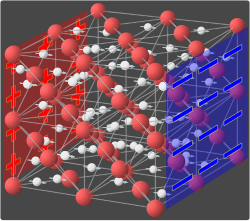
Electric currents in electrolytes are flows of electrically charged particles (ions). For example, if an electric field is placed across a solution of Na+ and Cl− (and conditions are right) the sodium ions move towards the negative electrode (cathode), while the chloride ions move towards the positive electrode (anode). Reactions take place at both electrode surfaces, neutralizing each ion.
Water-ice and certain solid electrolytes called proton conductors contain positive hydrogen ions ("protons") that are mobile. In these materials, electric currents are composed of moving protons, as opposed to the moving electrons in metals.
In certain electrolyte mixtures, brightly coloured ions are the moving electric charges. The slow progress of the colour makes the current visible.[23]
Gases and plasmas
ในอากาศและก๊าซ ทั่วไปอื่นๆ ที่อุณหภูมิต่ำกว่าจุดแตกตัว แหล่งกำเนิดการนำไฟฟ้าหลักมาจากไอออนเคลื่อนที่จำนวนน้อยที่เกิดจากก๊าซกัมมันตรังสี แสงอัลตราไวโอเลต หรือรังสีคอสมิก เนื่องจากค่าการนำไฟฟ้าต่ำ ก๊าซจึงเป็นฉนวนหรือไดอิเล็กทริกอย่างไรก็ตาม เมื่อสนามไฟฟ้า ที่ใช้ เข้าใกล้ ค่า จุดแตกตัวอิเล็กตรอนอิสระจะถูกเร่งความเร็วโดยสนามไฟฟ้ามากพอที่จะสร้างอิเล็กตรอนอิสระเพิ่มเติมโดยการชนและแตกตัวเป็นไอออนของอะตอมหรือโมเลกุลของก๊าซที่เป็นกลางในกระบวนการที่เรียกว่าการแตกตัวแบบลูกโซ่กระบวนการแตกตัวจะก่อให้เกิดพลาสมา ที่มีอิเล็กตรอนเคลื่อนที่และไอออนบวกมากพอที่จะทำให้เป็นตัวนำไฟฟ้า ในกระบวนการนี้ มันจะสร้างเส้นทางนำไฟฟ้าที่เปล่งแสง ได้เช่นประกายไฟ อา ร์คหรือฟ้าผ่า
พลาสมาเป็นสถานะของสสารที่อิเล็กตรอนบางส่วนในแก๊สถูกแยกหรือ "แตกตัวเป็นไอออน" จากโมเลกุลหรืออะตอม พลาสมาสามารถเกิดขึ้นได้จากอุณหภูมิ สูง หรือจากการใช้สนามไฟฟ้าแรงสูงหรือสนามแม่เหล็กสลับดังที่กล่าวไว้ข้างต้น เนื่องจากมวลที่ต่ำกว่า อิเล็กตรอนในพลาสมาจึงเร่งความเร็วได้เร็วกว่าเมื่อตอบสนองต่อสนามไฟฟ้าเมื่อเทียบกับไอออนบวกที่มีมวลมากกว่า และด้วยเหตุนี้จึงเป็นตัวนำกระแสไฟฟ้าส่วนใหญ่ ไอออนอิสระจะรวมตัวกันใหม่เพื่อสร้างสารประกอบทางเคมีใหม่ (ตัวอย่างเช่น การแตกตัวของออกซิเจนในบรรยากาศเป็นออกซิเจนเดี่ยว [O → 2O] ซึ่งจากนั้นจะรวมตัวกันใหม่เพื่อสร้างโอโซน [O ]) [ 24 ]
เครื่องดูดฝุ่น
Since a "perfect vacuum" contains no charged particles, it normally behaves as a perfect insulator. However, metal electrode surfaces can cause a region of the vacuum to become conductive by injecting free electrons or ions through either field electron emission or thermionic emission. Thermionic emission occurs when the thermal energy exceeds the metal's work function, while field electron emission occurs when the electric field at the surface of the metal is high enough to cause tunneling, which results in the ejection of free electrons from the metal into the vacuum. Externally heated electrodes are often used to generate an electron cloud as in the filament or indirectly heated cathode of vacuum tubes. Cold electrodes can also spontaneously produce electron clouds via thermionic emission when small incandescent regions (called cathode spots or anode spots) are formed. These are incandescent regions of the electrode surface that are created by a localized high current. These regions may be initiated by field electron emission, but are then sustained by localized thermionic emission once a vacuum arc forms. These small electron-emitting regions can form quite rapidly, even explosively, on a metal surface subjected to a high electrical field. Vacuum tubes and krytrons are some of the electronic switching and amplifying devices based on vacuum conductivity.
Superconductivity
Superconductivity is a phenomenon of exactly zero electrical resistance and expulsion of magnetic fields occurring in certain materials when cooled below a characteristic critical temperature. It was discovered by Heike Kamerlingh Onnes on April 8, 1911 in Leiden. Like ferromagnetism and atomic spectral lines, superconductivity is a quantum mechanical phenomenon. It is characterized by the Meissner effect, the complete ejection of magnetic field lines from the interior of the superconductor as it transitions into the superconducting state. The occurrence of the Meissner effect indicates that superconductivity cannot be understood simply as the idealization of perfect conductivity in classical physics.
Semiconductor
ในสารกึ่งตัวนำบางครั้งอาจเป็นประโยชน์ที่จะคิดว่ากระแสไฟฟ้าเกิดจากการไหลของ " โฮ ล " บวก (ตัวนำประจุบวกที่เคลื่อนที่ได้ ซึ่งเป็นตำแหน่งที่ผลึกสารกึ่งตัวนำขาดอิเล็กตรอนวาเลนซ์) นี่คือกรณีในสารกึ่งตัวนำชนิด p สารกึ่งตัวนำมีค่าการนำไฟฟ้าอยู่ระหว่างค่าการนำไฟฟ้าของตัวนำและฉนวนซึ่งหมายความว่าค่าการนำไฟฟ้าโดยประมาณอยู่ในช่วง 10⁻² ถึง 10⁴ ซีเมนส์ต่อเซนติเมตร ( S⋅cm⁻¹ )
ในสารกึ่งตัวนำผลึกแบบคลาสสิก อิเล็กตรอนจะมีพลังงานได้เฉพาะภายในแถบพลังงานบางแถบเท่านั้น (เช่น ช่วงระดับพลังงาน) ในเชิงพลังงาน แถบพลังงานเหล่านี้ตั้งอยู่ระหว่างพลังงานของสถานะพื้นฐาน ซึ่งเป็นสถานะที่อิเล็กตรอนถูกยึดติดกับนิวเคลียสของอะตอมของวัสดุอย่างแน่นหนา และพลังงานของอิเล็กตรอนอิสระ ซึ่งอย่างหลังนี้อธิบายถึงพลังงานที่จำเป็นสำหรับอิเล็กตรอนที่จะหลุดออกจากวัสดุไปโดยสมบูรณ์ แถบพลังงานแต่ละแถบสอดคล้องกับสถานะควอนตัม ที่ไม่ต่อเนื่องหลายสถานะ ของอิเล็กตรอน และสถานะส่วนใหญ่ที่มีพลังงานต่ำ (ใกล้กับนิวเคลียส) จะถูกครอบครอง จนถึงแถบพลังงานเฉพาะที่เรียกว่าแถบวาเลนซ์สารกึ่งตัวนำและฉนวนแตกต่างจากโลหะเนื่องจากแถบวาเลนซ์ในโลหะใด ๆ เกือบเต็มไปด้วยอิเล็กตรอนภายใต้สภาวะการทำงานปกติ ในขณะที่มีอิเล็กตรอนน้อยมาก (สารกึ่งตัวนำ) หรือแทบไม่มีเลย (ฉนวน) อยู่ในแถบนำไฟฟ้า ซึ่งเป็น แถบที่อยู่เหนือแถบวาเลนซ์โดยตรง
ความง่ายในการกระตุ้นอิเล็กตรอนในสารกึ่งตัวนำจากแถบวาเลนซ์ไปยังแถบนำไฟฟ้าขึ้นอยู่กับช่องว่างพลังงานระหว่างแถบทั้งสอง ขนาดของช่องว่างพลังงานนี้ทำหน้าที่เป็นเส้นแบ่งโดยพลการ (ประมาณ 4 eV )ระหว่างสารกึ่งตัวนำและฉนวน
ในพันธะโคเวเลนต์ อิเล็กตรอนจะเคลื่อนที่โดยการกระโดดไปยังพันธะข้างเคียงหลักการกีดกันของเปาลี (Pauli exclusion principle)กำหนดให้ต้องยกอิเล็กตรอนขึ้นไปยังสถานะแอนติบอนดิง (anti-bonding state) ที่สูงกว่าของพันธะนั้น สำหรับสถานะที่ไม่จำกัดตำแหน่ง เช่น ในมิติเดียว–นั่นคือในนาโนไวร์ – สำหรับทุกระดับพลังงานจะมีสถานะที่อิเล็กตรอนไหลไปในทิศทางหนึ่ง และอีกสถานะหนึ่งที่อิเล็กตรอนไหลไปในอีกทิศทางหนึ่ง เพื่อให้กระแสสุทธิไหลได้ จะต้องมีสถานะที่ถูกครอบครองในทิศทางหนึ่งมากกว่าในอีกทิศทางหนึ่ง เพื่อให้สิ่งนี้เกิดขึ้น จำเป็นต้องใช้พลังงาน เนื่องจากในสารกึ่งตัวนำ สถานะที่สูงกว่าถัดไปจะอยู่เหนือช่องว่างพลังงาน (band gap) มักกล่าวกันว่า: แถบพลังงานที่เต็มแล้วจะไม่ส่งผลต่อการนำไฟฟ้าอย่างไรก็ตาม เมื่ออุณหภูมิของสารกึ่งตัวนำสูงขึ้นเหนือศูนย์สัมบูรณ์จะมีพลังงานในสารกึ่งตัวนำมากขึ้นที่จะใช้ในการสั่นสะเทือนของโครงสร้างผลึกและการกระตุ้นอิเล็กตรอนเข้าสู่แถบนำไฟฟ้า อิเล็กตรอนที่นำกระแสในแถบนำไฟฟ้าเรียกว่าอิเล็กตรอนอิสระแม้ว่ามักจะเรียกง่ายๆ ว่าอิเล็กตรอนหากเข้าใจได้ชัดเจนในบริบทนั้น
ความหนาแน่นกระแสไฟฟ้าและกฎของโอห์ม
ความหนาแน่นกระแสไฟฟ้าคืออัตราที่ประจุผ่านพื้นที่หน่วยที่เลือก[ 25 ] : 31โดยนิยามว่าเป็นเวกเตอร์ที่มีขนาดเท่ากับกระแสไฟฟ้าต่อพื้นที่หน้าตัดหน่วย[ 2 ] : 749ดังที่ได้กล่าวไว้ในทิศทางอ้างอิงทิศทางนั้นเป็นไปโดยพลการ ตามธรรมเนียมแล้ว หากประจุที่เคลื่อนที่นั้นเป็นบวก ความหนาแน่นกระแสไฟฟ้าจะมีเครื่องหมายเดียวกับความเร็วของประจุ สำหรับประจุลบ เครื่องหมายของความหนาแน่นกระแสไฟฟ้าจะตรงข้ามกับความเร็วของประจุ[ 2 ] : 749ในหน่วย SIความหนาแน่นกระแสไฟฟ้า (สัญลักษณ์: j) แสดงในหน่วยฐาน SI คือแอมแปร์ต่อตารางเมตร[ 4 ] : 22
ในวัสดุเชิงเส้น เช่น โลหะ และที่ความถี่ต่ำ ความหนาแน่นกระแสไฟฟ้าที่ไหลผ่านพื้นผิวตัวนำจะมีค่าสม่ำเสมอ ในสภาวะเช่นนี้กฎของโอห์ม กล่าวว่า กระแสไฟฟ้าแปรผันตรงกับความต่างศักย์ระหว่างปลายทั้งสองข้าง (คร่อม) ของ ตัวต้านทานโลหะ (ในอุดมคติ) (หรืออุปกรณ์โอห์มิก อื่นๆ ) นั้น:

ที่ไหนคือกระแสไฟฟ้าที่วัดเป็นแอมแปร์;คือความต่างศักย์ซึ่งวัดเป็นโวลต์และ is the resistance, measured in ohms. For alternating currents, especially at higher frequencies, skin effect causes the current to spread unevenly across the conductor cross-section, with higher density near the surface, thus increasing the apparent resistance.


Speed
Drift speed
The mobile charged particles within a conductor move constantly in random directions, like the particles of a gas. (More accurately, a Fermi gas.) To create a net flow of charge, the particles must also move together with an average drift rate. Electrons are the charge carriers in most metals and they follow an erratic path, bouncing from atom to atom, but generally drifting in the opposite direction of the electric field. The speed they drift at can be calculated from the equation:

where
- is the electric current
- is number of charged particles per unit volume (or charge carrier density)
- is the cross-sectional area of the conductor
- is the drift velocity, and
- is the charge on each particle.


Typically, electric charges in solids flow slowly. For example, in a copper wire of cross-section 0.5 mm2, carrying a current of 5 A, the drift velocity of the electrons is on the order of a millimetre per second. To take a different example, in the near-vacuum inside a cathode ray tube, the electrons travel in near-straight lines at about a tenth of the speed of light.
Wavefront speed
Any accelerating electric charge, and therefore any changing electric current, gives rise to an electromagnetic wave that propagates at very high speed outside the surface of the conductor. This speed is usually a significant fraction of the speed of light, as can be deduced from Maxwell's equations, and is therefore many times faster than the drift velocity of the electrons. For example, in AC power lines, the waves of electromagnetic energy propagate through the space between the wires, moving from a source to a distant load, even though the electrons in the wires only move back and forth over a tiny distance.
The ratio of the speed of the surrounding electromagnetic wave to the speed of light in free space is called the velocity factor, and depends on the electromagnetic properties of the conductor and the insulating materials surrounding it, and on their shape and size.
The magnitudes (not the natures) of these three velocities can be illustrated by an analogy with the three similar velocities associated with gases (see also hydraulic analogy):
- ความเร็วในการเคลื่อนที่ต่ำของตัวนำประจุนั้นคล้ายคลึงกับการเคลื่อนที่ของอากาศ หรือกล่าวอีกนัยหนึ่งคือ ลม
- ความเร็วสูงของคลื่นแม่เหล็กไฟฟ้าเทียบได้กับความเร็วเสียงในแก๊ส (คลื่นเสียงเคลื่อนที่ผ่านอากาศเร็วกว่าการเคลื่อนที่ขนาดใหญ่ เช่นการพาความร้อน มาก )
- การเคลื่อนที่แบบสุ่มของประจุนั้นคล้ายคลึงกับความร้อนซึ่งก็คือความเร็วเชิงความร้อนของอนุภาคก๊าซที่สั่นไหวแบบสุ่ม
ดูเพิ่มเติม
หมายเหตุ
ลิงก์ภายนอก
 ความหมายของคำว่า"แอมแปร์"ในพจนานุกรมวิกิพีเดีย