
นโยบายความมั่นคงและการป้องกันประเทศร่วมกัน
| นโยบายความมั่นคงและการป้องกันร่วม(สหภาพป้องกันประเทศยุโรป) | |
|---|---|
 | |
| ก่อตั้ง | ปี 1999 (ในฐานะนโยบายความมั่นคงและการป้องกันประเทศของยุโรป) |
| รูปแบบปัจจุบัน | ปี 2009 ( สนธิสัญญาลิสบอน ) |
| สำนักงานใหญ่ | หน่วยวางแผนและดำเนินการทางทหาร (MPCC) และพลเรือน (CPCC) อาคารคอร์เทนเบิร์ก กรุงบรัสเซลส์ ประเทศเบลเยียม |
| เว็บไซต์ | eeas.europa.eu |
| ความเป็นผู้นำ | |
| ผู้แทนระดับสูง | กาจา คัลลาส |
| อธิบดีกรมเสนาธิการทหาร | พลโท มิเชล ฟาน เดอร์ ลาน |
| ประธานคณะกรรมการทหาร | นายพลฌอน แคลนซี |
| บุคลากร | |
| บุคลากรที่ปฏิบัติงาน | 1,410,626 (2016) [ 1 ] |
| บุคลากรสำรอง | 2,330,803 |
| ค่าใช้จ่าย | |
| งบประมาณ | 343 พันล้านยูโร (391 พันล้านดอลลาร์สหรัฐ) (2024) [ 2 ] |
| ร้อยละของ GDP | 1.9% (2024) [ 3 ] |
| บทความที่เกี่ยวข้อง | |
| ประวัติศาสตร์ | ประวัติความเป็นมาของนโยบายความมั่นคงและการป้องกันร่วม |
นโยบายความมั่นคงและการป้องกันร่วม ( CSDP ) คือ แนวทางปฏิบัติของ สหภาพยุโรป (EU) ในด้านการป้องกันประเทศและการจัดการวิกฤตและเป็นองค์ประกอบหลักของนโยบายต่างประเทศและความมั่นคงร่วม ของสหภาพยุโรป (CFSP)
CSDP เกี่ยวข้องกับการส่งภารกิจทางทหารหรือพลเรือนเพื่อรักษาสันติภาพ ป้องกันความขัดแย้ง และเสริมสร้างความมั่นคงระหว่างประเทศตามหลักการของกฎบัตรสหประชาชาติภารกิจทางทหารดำเนินการโดยกองกำลังของสหภาพยุโรปที่จัดตั้งขึ้นจากการยืมตัวจาก กองทัพของ รัฐสมาชิก CSDP ยังรวมถึงการป้องกันตนเองร่วมกันระหว่างรัฐสมาชิก[ a ]ตลอดจนความร่วมมือเชิงโครงสร้างถาวร (PESCO) ซึ่งกองทัพแห่งชาติ 26 จาก 27 ประเทศดำเนินการบูรณา การเชิงโครงสร้าง (ยกเว้นมอลตา) โครงสร้างของ CSDP – นำโดย ผู้แทนระดับสูงของสหภาพ(HR/VP) Kaja Kallasและบางครั้งเรียกว่าสหภาพป้องกันยุโรป ( EDU ) ในส่วนที่เกี่ยวข้องกับการพัฒนาในอนาคตในฐานะกองกำลังป้องกันของสหภาพยุโรป[ 4 ] [ 5 ] [ 6 ] [ b ] – ประกอบด้วย:
- สำนักอุตสาหกรรมป้องกันประเทศของคณะกรรมาธิการยุโรป
- กองอำนวยการจัดการและ วางแผนวิกฤต (CMPD) ของ สำนักงาน บริการปฏิบัติการต่างประเทศ ( EEAS ) และกองบัญชาการปฏิบัติการถาวร (OHQs) สำหรับการบัญชาการและควบคุม (C2) ในระดับยุทธศาสตร์ทางทหาร/พลเรือน ได้แก่MPCCและCPCC
- หน่วยงานเตรียมการของ คณะมนตรีการต่างประเทศ (FAC) จำนวนหนึ่งเช่นคณะกรรมการทหาร (EUMC)
- หน่วยงานทั้งสี่แห่งรวมถึงสำนักงานป้องกันประเทศ (EDA)
โครงสร้างการบังคับบัญชาและการควบคุมของสหภาพยุโรปมีขนาดเล็กกว่าโครงสร้างการบังคับบัญชา (NCS) ขององค์การสนธิสัญญาแอตแลนติกเหนือ (NATO) ซึ่งจัดตั้งขึ้นเพื่อการป้องกันดินแดน [ 7 ]มีการตกลงกันว่า อาจใช้ Allied Command Operations (ACO) ของ NATO เพื่อดำเนินการภารกิจของสหภาพยุโรป MPCC ซึ่งจัดตั้งขึ้นในปี 2017 และจะได้รับการเสริมความแข็งแกร่งในปี 2020 เป็น OHQ ทางทหารถาวรแห่งแรกของสหภาพยุโรป ในขณะเดียวกันกองทุนป้องกันประเทศยุโรป (EDF ซึ่งจัดตั้งขึ้นในปี 2017) ถือเป็นครั้งแรกที่งบประมาณของสหภาพยุโรปถูกนำมาใช้เพื่อเป็นเงินทุนสำหรับโครงการป้องกันประเทศข้ามชาติ
มติที่เกี่ยวข้องกับนโยบายความมั่นคงและความมั่นคงร่วม (CSDP) นั้น เสนอโดยผู้แทนระดับสูง รับรองโดยสภาการต่างประเทศ ซึ่งโดยทั่วไปต้องได้รับความเห็นชอบเป็นเอกฉันท์ จากนั้นผู้แทนระดับสูงจึงจะนำไปปฏิบัติใช้


ประวัติศาสตร์


ช่วงหลังสงคราม มีโครงการริเริ่มด้าน การบูรณาการการป้องกันประเทศของยุโรปหลายโครงการที่มีอายุสั้นหรือล้มเหลว โดยมีจุดประสงค์เพื่อป้องกันการรุกรานจากสหภาพโซเวียตหรือเยอรมนีที่อาจเกิดขึ้น ได้แก่สหภาพตะวันตก (WU หรือเรียกอีกอย่างว่า องค์การ สนธิสัญญาบรัสเซลส์ BTO) และประชาคมป้องกันประเทศยุโรป (EDC) ที่เสนอ ซึ่งต่อมาถูกองค์การสนธิสัญญาแอตแลนติกเหนือ (NATO) กลืนกินไป และรัฐสภาฝรั่งเศสปฏิเสธสหภาพยุโรปตะวันตก (WEU) สืบทอดต่อจาก WU ในปี 1955 [ c ]แต่ถูกบดบังรัศมีโดย NATO เป็นส่วนใหญ่[ 9 ]
ในปี 1970 ความร่วมมือทางการเมืองของยุโรป (EPC) นำมาซึ่ง การประสานงานด้านนโยบายต่างประเทศครั้งแรกของ ประชาคมยุโรป (EC) การคัดค้านการเพิ่มประเด็นด้านความมั่นคงและการป้องกันประเทศเข้าไปใน EPC นำไปสู่การฟื้นฟูสหภาพยุโรปตะวันตก (WEU) ในปี 1984 โดยประเทศสมาชิกซึ่งเป็นประเทศสมาชิกของ EC ด้วยเช่นกัน
การบูรณาการด้านการป้องกันประเทศของยุโรปได้รับแรงผลักดันมากขึ้นหลังจากสิ้นสุดสงครามเย็น ส่วนหนึ่งเป็นผลมาจากการที่ประชาคมยุโรปล้มเหลวในการป้องกันสงครามยูโกสลาเวียในปี 1992 สหภาพยุโรปตะวันตก (WEU) ได้รับมอบหมายภารกิจใหม่และในปีต่อมาสนธิสัญญามาastrichtได้ก่อตั้งสหภาพยุโรป (EU) และแทนที่ EPC ด้วยเสาหลักนโยบายต่างประเทศและความมั่นคงร่วม (CFSP) ในปี 1996 NATO ตกลงที่จะให้ WEU พัฒนาสิ่งที่เรียกว่าเอกลักษณ์ด้านความมั่นคงและการป้องกันของยุโรป ( ESDI ) [ 10 ]ปฏิญญา St. Maloปี 1998 ส่งสัญญาณว่าสหราชอาณาจักร ซึ่งลังเลมาโดยตลอด พร้อมที่จะมอบโครงสร้างการป้องกันที่เป็นอิสระให้กับสหภาพ ยุโรป [ 11 ]สิ่งนี้อำนวยความสะดวกในการเปลี่ยน ESDI เป็นนโยบายความมั่นคงและการป้องกันของยุโรป ( ESDP ) ในปี 1999 เมื่อมีการโอนไปยังสหภาพยุโรป ในปี 2546 สหภาพยุโรปได้ส่งภารกิจ CSDP ครั้งแรก และนำยุทธศาสตร์ความมั่นคงแห่งยุโรป มาใช้ โดยระบุถึงภัยคุกคามและวัตถุประสงค์ร่วมกัน ในปี 2552 สนธิสัญญาลิสบอนได้นำชื่อปัจจุบันคือ CSDP มาใช้ พร้อมทั้งจัดตั้ง EEAS ข้อตกลงการป้องกันร่วมกัน และเปิดโอกาสให้รัฐสมาชิกบางส่วนดำเนินการบูรณาการด้านการป้องกันภายใน PESCO ในปี 2554 WEU ซึ่งภารกิจได้ถูกโอนไปยังสหภาพยุโรปแล้ว ได้ถูกยุบ ในปี 2559 ได้ มีการนำ ยุทธศาสตร์ความมั่นคงใหม่มาใช้ ซึ่งควบคู่ไปกับการผนวกไครเมียของรัสเซีย การถอนตัว ของอังกฤษออกจากสหภาพยุโรป และการเลือกตั้งโดนัลด์ ทรัมป์เป็นประธานาธิบดีสหรัฐฯ ทำให้ CSDP ได้รับแรงผลักดันใหม่[ 12 ]
การปรับใช้
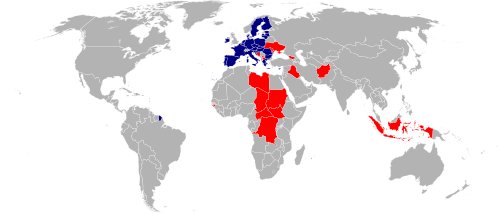
การส่งกำลังทหารยุโรปครั้งแรกภายใต้ ESDP หลังจากการประกาศเจตนารมณ์ในปี 1999 เกิดขึ้นในเดือนมีนาคม 2003 ในสาธารณรัฐมาซิโดเนีย (ปัจจุบันคือมาซิโดเนียเหนือ ) ปฏิบัติการคอนคอร์เดียใช้ทรัพยากรของนาโตและถือว่าประสบความสำเร็จ และถูกแทนที่ด้วยภารกิจตำรวจขนาดเล็กกว่าEUPOL Proximaในปีเดียวกันนั้น นับตั้งแต่นั้นมาก็มีภารกิจตำรวจ ยุติธรรม และการตรวจสอบขนาดเล็กอื่นๆ อีก นอกจากในสาธารณรัฐมาซิโดเนียแล้ว สหภาพยุโรปยังคงส่งกองกำลังรักษาสันติภาพไปประจำการในบอสเนียและเฮอร์เซโกวีนาซึ่งเป็นส่วนหนึ่งของปฏิบัติการอัลเทีย[ 13 ]
ระหว่างเดือนพฤษภาคมถึงกันยายน ปี 2546 กองกำลังสหภาพยุโรปถูกส่งไปประจำการที่สาธารณรัฐประชาธิปไตยคองโก (DRC) ในปฏิบัติการ "อาร์เทมิส " ภายใต้คำสั่งของมติคณะมนตรีความมั่นคงแห่งสหประชาชาติที่ 1484ซึ่งมีเป้าหมายเพื่อป้องกันการก่ออาชญากรรมและความรุนแรงเพิ่มเติมในความขัดแย้งอิตูริและฟื้นฟูสันติภาพใน DRC ให้กลับมาดำเนินต่อไปได้ มติดังกล่าวได้วางระบบ "ประเทศกรอบ" ที่จะใช้ในการส่งกำลังทหารไปประจำการในอนาคต สหภาพยุโรปได้กลับไปยัง DRC อีกครั้งในช่วงเดือนกรกฎาคมถึงพฤศจิกายน ปี 2549 พร้อมกับกองกำลัง EUFOR RD Congoซึ่งให้การสนับสนุนภารกิจของสหประชาชาติในระหว่างการเลือกตั้งของประเทศ
ในเชิงภูมิศาสตร์ ภารกิจ ของสหภาพยุโรปนอกคาบสมุทรบอลข่านและสาธารณรัฐประชาธิปไตยคองโกได้เกิดขึ้นในจอร์เจียอินโดนีเซียซูดานปาเลสไตน์และยูเครน - มอ ลโดวานอกจากนี้ยังมีภารกิจด้านตุลาการในอิรัก ( EUJUST Lex ) เมื่อวันที่ 28 มกราคม 2551 สหภาพยุโรปได้ส่งภารกิจที่ใหญ่ที่สุดและมีหลายชาติมากที่สุดไปยังแอฟริกา คือEUFOR Tchad/RCA [ 14 ] ภารกิจที่ได้รับมอบหมายจากสหประชาชาตินี้เกี่ยวข้องกับกองกำลังจาก 25 ประเทศสมาชิกสหภาพยุโรป (19 ประเทศอยู่ในพื้นที่) ที่ประจำการในพื้นที่ทางตะวันออกของชาดและทางตะวันออกเฉียงเหนือของสาธารณรัฐแอฟริกากลางเพื่อปรับปรุงความปลอดภัยในภูมิภาคเหล่านั้นEUFOR Tchad/RCAบรรลุขีดความสามารถในการปฏิบัติงานอย่างเต็มรูปแบบในช่วงกลางเดือนกันยายน 2551 และส่งมอบหน้าที่ด้านความปลอดภัยให้กับสหประชาชาติ (ภารกิจ MINURCAT) ในช่วงกลางเดือนมีนาคม 2552 [ 15 ]
สหภาพยุโรปได้เริ่มปฏิบัติการ CSDP ทางทะเลครั้งแรกเมื่อวันที่ 12 ธันวาคม 2551 ( ปฏิบัติการอะทาลันตา ) แนวคิดของกองกำลังทางเรือของสหภาพยุโรป (EU NAVFOR) เกิดขึ้นจากปฏิบัติการนี้ ซึ่งยังคงประสบความสำเร็จในการต่อต้านโจรสลัดนอกชายฝั่งโซมาเลียมาเกือบสิบปีแล้ว ปฏิบัติการลักษณะเดียวกันครั้งที่สองเริ่มขึ้นในปี 2558 เพื่อแก้ไขปัญหาการอพยพในทะเลเมดิเตอร์เรเนียนตอนใต้ ( EUNAVFOR Med ) โดยใช้ชื่อปฏิบัติการว่าโซเฟีย
ภารกิจ CSDP ส่วนใหญ่ที่ดำเนินการมาจนถึงปัจจุบันได้รับมอบหมายให้สนับสนุนการปฏิรูปภาคความมั่นคง (SSR) ในรัฐเจ้าภาพ หนึ่งในหลักการสำคัญของการสนับสนุน SSR ของ CSDP คือการเป็นเจ้าของในระดับท้องถิ่น สภาสหภาพยุโรปกำหนดความเป็นเจ้าของว่า "การที่หน่วยงานท้องถิ่นนำวัตถุประสงค์และหลักการที่ตกลงร่วมกันมาใช้" [ 16 ]แม้ว่าสหภาพยุโรปจะยึดมั่นในหลักการความเป็นเจ้าของในระดับท้องถิ่นอย่างมาก แต่ผลการวิจัยแสดงให้เห็นว่าภารกิจ CSDP ยังคงเป็นความพยายามที่ขับเคลื่อนจากภายนอก จากบนลงล่าง และขับเคลื่อนด้วยอุปทาน ซึ่งมักส่งผลให้ระดับการมีส่วนร่วมของท้องถิ่นอยู่ในระดับต่ำ[ 17 ]
โครงสร้าง
CSDP เกี่ยวข้องกับ การส่ง ภารกิจทางทหารหรือพลเรือนไปรักษาสันติภาพ ป้องกันความขัดแย้ง และเสริมสร้างความมั่นคงระหว่างประเทศตามหลักการของกฎบัตรสหประชาชาติภารกิจทางทหารดำเนินการโดยกองกำลังของสหภาพยุโรปที่จัดตั้งขึ้นโดยได้รับการสนับสนุนจาก กองทัพของ ประเทศสมาชิก CSDP ยังรวมถึงการป้องกันตนเองร่วมกันระหว่างประเทศสมาชิก[ a ]ตลอดจนความร่วมมือเชิงโครงสร้างถาวร (PESCO) ซึ่งกองทัพของประเทศสมาชิก 26 จาก 27 ประเทศดำเนินการบูรณา การเชิงโครงสร้าง โครงสร้างของ CSDP ซึ่งนำโดย ผู้แทนระดับสูงของสหภาพยุโรป(HR/VP) Kaja Kallas ประกอบด้วย:
- สำนักอุตสาหกรรมป้องกันประเทศแห่งคณะกรรมาธิการยุโรป
- ส่วนงานที่เกี่ยวข้องของสำนักงานกิจการต่างประเทศ (EEAS) รวมถึงกองบัญชาการทหาร (EUMS) และหน่วยงานที่เรียกว่าขีดความสามารถในการวางแผนและดำเนินการทางทหาร (MPCC)
- หน่วยงานเตรียมการของ คณะมนตรีการต่างประเทศ (FAC) จำนวนหนึ่งเช่นคณะกรรมการทหาร (EUMC)
- หน่วยงานทั้งสี่แห่งรวมถึงสำนักงานป้องกันประเทศ แห่งยุโรป (EDA)
แม้ว่าสหภาพยุโรปจะมีโครงสร้างการบังคับบัญชาและควบคุม (C2)แต่ก็ไม่มีโครงสร้างทางทหารถาวรแบบเดียวกับกองบัญชาการปฏิบัติการพันธมิตร (ACO) ของ องค์การสนธิสัญญาแอตแลนติกเหนือ (NATO) แม้ว่าจะมีการตกลงกันแล้วว่าทรัพยากรของ ACO อาจถูกนำมาใช้เพื่อดำเนินภารกิจ CSDP ของสหภาพยุโรปก็ตาม MPCC ซึ่งจัดตั้งขึ้นในปี 2017 และจะได้รับการเสริมความแข็งแกร่งในปี 2020 ถือเป็นก้าวแรกของสหภาพยุโรปในการพัฒนากองบัญชาการทางทหารถาวร ในขณะเดียวกันกองทุนป้องกันประเทศยุโรป (EDF) ที่จัดตั้งขึ้นใหม่นี้ ถือเป็นครั้งแรกที่งบประมาณของสหภาพยุโรปถูกนำมาใช้เพื่อเป็นเงินทุนสำหรับโครงการป้องกันประเทศข้ามชาติ โครงสร้าง CSDP บางครั้งถูกเรียกว่าสหภาพป้องกันประเทศยุโรป ( EDU ) โดยเฉพาะอย่างยิ่งในส่วนที่เกี่ยวข้องกับการพัฒนาในอนาคตในฐานะแขนป้องกันประเทศของสหภาพยุโรป[ 4 ] [ 5 ] [ 6 ] [ d ]
การตัดสินใจที่เกี่ยวข้องกับ CSDP นั้น เสนอโดยฝ่ายทรัพยากรบุคคล/รองประธานาธิบดี รับรองโดย FAC ซึ่งโดยทั่วไปต้องได้รับความเห็นชอบเป็นเอกฉันท์ จากนั้นจึงนำไปปฏิบัติโดยฝ่ายทรัพยากรบุคคล/รองประธานาธิบดี โครงสร้างการสั่งการและควบคุม (C2) ของสหภาพยุโรป ได้รับการกำกับดูแลโดยหน่วยงานทางการเมืองที่ประกอบด้วย ตัวแทนของ รัฐสมาชิกและโดยทั่วไปต้องอาศัยการตัดสินใจเป็นเอกฉันท์ ณ เดือนเมษายน 2562: [ 18 ]
- ผู้ประสานงาน: คำแนะนำและข้อเสนอแนะ การสนับสนุนและการติดตาม งานเตรียมการ
| ระดับกลยุทธ์ทางการเมือง: [5] | |||||||||||||||||||||||||||||||||
| สถานีอวกาศนานาชาติ (ISS) | ประธาน EUCO ( EUCO ) | ลำดับชั้นการบังคับบัญชา | |||||||||||||||||||||||||||||||
| การประสานงาน/การสนับสนุน | |||||||||||||||||||||||||||||||||
| แซทเซน | ซีไอวีคอม | ฝ่ายทรัพยากรบุคคล/รองประธาน ( FAC ) | |||||||||||||||||||||||||||||||
| อินท์เซน | ฝ่ายทรัพยากรบุคคล/รองประธาน ( PMG ) | HR/VP ( PSC ) [6] |    CEUMC ( EUMC ) CEUMC ( EUMC ) | ||||||||||||||||||||||||||||||
| ซีเอ็มพีดี |  DGEUMS [3] ( EUMS ) DGEUMS [3] ( EUMS ) | ||||||||||||||||||||||||||||||||
| ระดับยุทธศาสตร์ทางทหาร/พลเรือน: | |||||||||||||||||||||||||||||||||
| ผู้อำนวยการ MPCC [3] ( MPCC ) | เจเอสซีซี | Civ OpCdr CPCC [1] | |||||||||||||||||||||||||||||||
| ระดับปฏิบัติการ: | |||||||||||||||||||||||||||||||||
| MFCdr [4] ( MFHQ ) | HoM [1] | ||||||||||||||||||||||||||||||||
| ระดับยุทธวิธี: | |||||||||||||||||||||||||||||||||
| CC [2] CC ทางอากาศ[2] CC ทางบก[2] CC ทางทะเล อื่นๆ [2]กองทัพยุโรป[ 19 ] [ 20 ] | |||||||||||||||||||||||||||||||||
- 1. ในกรณีที่มีภารกิจพลเรือนของ CSDP อยู่ในพื้นที่ด้วย ความสัมพันธ์กับหน่วยงานวางแผนและดำเนินการพลเรือน (CPCC) และผู้บัญชาการปฏิบัติการพลเรือน (Civ OpCdr) รวมถึงหัวหน้าภารกิจ (HoM) ที่อยู่ภายใต้การบังคับบัญชา จะได้รับการประสานงานดังที่แสดงไว้
- 2. ผู้บัญชาการส่วนประกอบอื่นๆ (CCs) และเหล่าทัพต่างๆที่อาจจัดตั้งขึ้น
- 3. MPCC เป็นส่วนหนึ่งของ EUMS และ Dir MPCC มีบทบาทควบคู่กันไปคือ DGEUMS เว้นแต่ว่า MPCC จะถูกใช้เป็นกองบัญชาการปฏิบัติการ (OHQ) กองบัญชาการปฏิบัติการระดับชาติที่ประเทศสมาชิกจัดหาให้ หรือ โครงสร้างบัญชาการ ของนาโต (NCS) จะทำหน้าที่นี้แทน ในกรณีหลังรองผู้บัญชาการสูงสุดของพันธมิตรยุโรป (DSACEUR) จะทำหน้าที่เป็นผู้บัญชาการปฏิบัติการ (OpCdr) แทน Dir MPCC
- 4. เว้นแต่ว่า MPCC จะถูกใช้เป็นกองบัญชาการปฏิบัติการ (OHQ) แล้ว MFCdr จะถูกเรียกว่าผู้บัญชาการกองกำลัง (FCdr) และสั่งการกองบัญชาการกองกำลัง (FHQ) แทนที่จะเป็น MFHQ ในขณะที่ MFHQ จะทำหน้าที่ทั้งในระดับปฏิบัติการและยุทธวิธี แต่ FHQ จะทำหน้าที่เฉพาะในระดับปฏิบัติการเท่านั้น
- 5. ระดับยุทธศาสตร์ทางการเมืองไม่ได้เป็นส่วนหนึ่งของโครงสร้าง C2 โดยตรง แต่เป็นตัวแทนของหน่วยงานทางการเมือง พร้อมด้วยสิ่งอำนวยความสะดวกสนับสนุนที่เกี่ยวข้อง ซึ่งเป็นตัวกำหนดทิศทางโดยรวมของภารกิจ คณะมนตรีจะเป็นผู้กำหนดบทบาทของผู้แทนระดับสูง (HR/VP) ซึ่งทำหน้าที่เป็นรองประธานคณะกรรมาธิการยุโรปเข้าร่วมการประชุมคณะมนตรีแห่งยุโรป เป็นประธาน คณะมนตรีการต่างประเทศ (FAC) และอาจเป็นประธานคณะกรรมการการเมืองและความมั่นคง (PSC) ในช่วงเวลาวิกฤต HR/VP เป็นผู้เสนอและดำเนินการตามมติของ CSDP
- 6. มีองค์ประกอบเหมือนกับคณะกรรมการผู้แทนถาวรชุดที่ 2 (COREPER II) ซึ่งทำหน้าที่เตรียมการสำหรับงานที่เกี่ยวข้องกับ CSDP ของ FAC ด้วยเช่นกัน
กลยุทธ์
ยุทธศาสตร์ระดับโลกของสหภาพยุโรป (EUGS) เป็นหลักคำสอนที่ปรับปรุงใหม่ของสหภาพยุโรปเพื่อปรับปรุงประสิทธิผลของ CSDP ซึ่งรวมถึงการป้องกันและความมั่นคงของรัฐสมาชิก การคุ้มครองพลเรือน ความร่วมมือระหว่างกองกำลังติดอาวุธของรัฐสมาชิก การจัดการการอพยพ วิกฤตการณ์ ฯลฯ ได้รับการรับรองเมื่อวันที่ 28 มิถุนายน 2559 [ 21 ]โดยแทนที่ยุทธศาสตร์ความมั่นคงของยุโรปปี 2546 EUGS เสริมด้วยเอกสารชื่อ "แผนปฏิบัติการด้านความมั่นคงและการป้องกัน" (IPSD) [ 22 ]ทฤษฎีการป้องปรามถูกนำมาใช้เพื่อป้องปรามผู้รุกรานในฐานะหนึ่งในภารกิจหลักของนโยบายความมั่นคงและการป้องกันร่วม แต่ขาดความน่าเชื่อถือเนื่องจากทรัพยากรไม่เพียงพอ[ 23 ]
กองกำลัง
แผนปฏิบัติการใหม่เกี่ยวกับการเคลื่อนย้ายทางทหารและความยืดหยุ่นทางไซเบอร์ได้รับการเผยแพร่เมื่อวันที่ 10 พฤศจิกายน 2022 [ 24 ]
ระดับชาติ
โครงการ CSDP ดำเนินการโดยใช้เงินสนับสนุนจากพลเรือนและทหารจาก กองกำลังติดอาวุธของ ประเทศสมาชิกซึ่งมีหน้าที่ต้องป้องกันตนเองร่วมกันตามสนธิสัญญาสหภาพยุโรป (TEU)
ห้ารัฐในสหภาพยุโรปมีอาวุธนิวเคลียร์ ได้แก่ ฝรั่งเศสมีโครงการนิวเคลียร์ของตนเอง ขณะที่เบลเยียม เยอรมนี อิตาลี และเนเธอร์แลนด์มีอาวุธนิวเคลียร์ของสหรัฐฯ ซึ่งเป็นส่วนหนึ่งของนโยบายการแบ่งปันอาวุธนิวเคลียร์ ของนาโต โดยรวมแล้ว สหภาพยุโรปมีหัวรบนิวเคลียร์ 300 หัว และสหรัฐฯ มีหัวรบนิวเคลียร์ระหว่าง 90 ถึง 130 หัว อิตาลีมีระเบิดนิวเคลียร์ B61 จำนวน 70-90 ลูก ขณะที่เยอรมนี เบลเยียม และเนเธอร์แลนด์มีประเทศละ 10-20 ลูก[ 26 ]สหภาพยุโรปมีคลังอาวุธนิวเคลียร์ที่ใหญ่เป็นอันดับสาม รองจากสหรัฐอเมริกาและรัสเซีย
ค่าใช้จ่ายและบุคลากร
ตารางต่อไปนี้แสดงค่าใช้จ่ายทางทหารของประเทศสมาชิกสหภาพยุโรปเป็นเงินยูโร (€) ค่าใช้จ่ายทางทหารรวมของประเทศสมาชิกมีมูลค่า 223.4 พันล้านยูโรในปี 2018 [ 27 ]ซึ่งคิดเป็น 1.4% ของGDP ของสหภาพยุโรปค่าใช้จ่ายทางทหารของยุโรปรวมถึงการใช้จ่ายในโครงการร่วม เช่น เครื่องบินรบยูโรไฟเตอร์ ไทฟูนและการจัดซื้ออุปกรณ์ ร่วมกัน กำลังพลประจำการรวมของสหภาพยุโรปในปี 2016 มีจำนวน 1,410,626 นาย[ 1 ]
ในการกล่าวสุนทรพจน์ในปี 2012 นายพลHåkan Syrén ของสวีเดน วิจารณ์ระดับการใช้จ่ายของประเทศในสหภาพยุโรป โดยกล่าวว่าในอนาคตความสามารถทางทหารของประเทศเหล่านั้นจะลดลง ทำให้เกิด "การขาดแคลนที่สำคัญ" [ 28 ]
ในเดือนพฤษภาคม พ.ศ. 2568 ประเทศสมาชิกสหภาพยุโรปตกลงที่จะเปิดตัวกองทุนเงินกู้เพื่อซื้ออาวุธมูลค่า 150,000 ล้านยูโร โดยได้รับการสนับสนุนจากงบประมาณร่วมของกลุ่ม โครงการริเริ่มนี้จะอนุญาตให้ประเทศสมาชิกสหภาพยุโรปกู้ยืมเงินจากบรัสเซลส์และใช้จ่ายไปกับระบบอาวุธและแพลตฟอร์มผ่านการจัดซื้อร่วมกัน[ 29 ]
คำแนะนำเกี่ยวกับการใช้โต๊ะ:
- ตัวเลขทั้งหมดในตารางด้านล่างนี้มาจากสำนักงานป้องกันประเทศแห่งยุโรปสำหรับปี 2017 ยกเว้นตัวเลขบุคลากรของเยอรมนีซึ่งเป็นข้อมูลปี 2016 ตัวเลขจากแหล่งข้อมูลอื่นไม่ได้รวมไว้ในตารางนี้
- หมวด "ค่าใช้จ่ายในการดำเนินงานและการบำรุงรักษา" อาจรวมถึงเงินทุนเพิ่มเติมจากงบประมาณด้านการป้องกันประเทศในบางกรณีด้วย
- หมวดหมู่ "กำลังพลที่เตรียมพร้อมสำหรับการปฏิบัติการในพื้นที่" และ "กำลังพลที่เตรียมพร้อมสำหรับการปฏิบัติการในพื้นที่และต่อเนื่อง" นั้นรวมเฉพาะกำลังพลภาคพื้นดินเท่านั้น
| รัฐสมาชิก | รายจ่าย (ล้านยูโร) | ต่อหัว (€) | ร้อยละของ GDP | ค่าใช้จ่ายในการดำเนินงานและการบำรุงรักษา (ล้านยูโร) | บุคลากรทางการทหารที่ปฏิบัติหน้าที่อยู่ | กองกำลังภาคพื้นดินเตรียมพร้อมสำหรับการปฏิบัติการในแนวดิ่งและต่อเนื่อง | บุคลากรสำรอง |
|---|---|---|---|---|---|---|---|
 ออสเตรีย[ 1 ] ออสเตรีย[ 1 ] | 2,673 | 301 | 0.74 | 574 | 24,190 | 1,100 | 950,000 |
 เบลเยียม[ 1 ] เบลเยียม[ 1 ] | 5,672 | 349 | 1.1 | 680 | 27,789 | 1,293 | 3,300 |
 บัลแกเรีย[ 1 ] บัลแกเรีย[ 1 ] | 1,140 | 109 | 1.56 | 118 | 30,218 | 1,168 | 3,000 |
 โครเอเชีย[ 1 ] โครเอเชีย[ 1 ] | 950 | 149 | 1.5 | 154 | 14,862 | 796 | 18,343 |
 ไซปรัส[ 1 ] ไซปรัส[ 1 ] | 470 | 409 | 1.83 | 63 | 20,000 | 0 | 75,000 |
 สาธารณรัฐเช็ก[ 1 ] สาธารณรัฐเช็ก[ 1 ] | 3,310 | 184 | 1.46 | 474 | 23,036 | 672 | 3,236 |
 เอสโตเนีย[ 1 ] เอสโตเนีย[ 1 ] | 748 | 363 | 2.31 | 158 | 6,178 | 100 | 60,000 |
 ฟินแลนด์[ 1 ] ฟินแลนด์[ 1 ] | 4,873 | 523 | 2.15 | 919 | 7,515 | 1,738 | 900,000 |
 ฝรั่งเศส[ 1 ] ฝรั่งเศส[ 1 ] | 49,700 | 609 | 1.79 | 10,201 | 208,251 | 17,000 | 38,550 |
 เยอรมนี[ 1 ] เยอรมนี[ 1 ] | 57,300 | 489 | 1.53 | 177,608 | 29,200 | ||
 กรีซ[ 1 ] กรีซ[ 1 ] | 7,086 | 393 | 3.82 | 504 | 106,624 | 2,432 | |
 ฮังการี[ 1 ] ฮังการี[ 1 ] | 2,200 | 122 | 1.66 | 492 | 23,846 | 1,000 | 20,000 |
 ไอร์แลนด์[ 1 ] ไอร์แลนด์[ 1 ] | 780 | 191 | 0.31 | 103 | 9,500 | 850 | 1,778 |
 อิตาลี[ 1 ] อิตาลี[ 1 ] | 26,310 | 339 | 1.6 | 1,583 | 181,116 | 18,300 | |
 ลัตเวีย[ 1 ] ลัตเวีย[ 1 ] | 758 | 243 | 2.23 | 132 | 5,686 | 75 | 3,000 |
 ลิทัวเนีย[ 1 ] ลิทัวเนีย[ 1 ] | 1,028 | 256 | 2.13 | 145 | 14,350 | 26,000 | |
 ลักเซมเบิร์ก[ 1 ] ลักเซมเบิร์ก[ 1 ] | 389 | 484 | 0.56 | 30 | 824 | 57 | |
 มอลตา[ 1 ] มอลตา[ 1 ] | 54 | 122 | 0.51 | 8 | 1,808 | 30 | |
 เนเธอร์แลนด์[ 1 ] เนเธอร์แลนด์[ 1 ] | 12,900 | 507 | 1.5 | 2,144 | 40,196 | 1,500 | 5,046 |
 โปแลนด์[ 1 ] โปแลนด์[ 1 ] | 11,940 | 226 | 2.2 | 1,918 | 106,500 | 60 | 75,400 |
 โปรตุเกส[ 1 ] โปรตุเกส[ 1 ] | 3,975 | 235 | 1.6 | 142 | 32,726 | 1,698 | |
 โรมาเนีย[ 1 ] โรมาเนีย[ 1 ] | 5,590 | 185 | 2.0 | 277 | 69,542 | 2,961 | 50,000 |
 สโลวาเกีย[ 1 ] สโลวาเกีย[ 1 ] | 1,520 | 183 | 1.75 | 198 | 13,152 | 846 | |
 สโลวีเนีย[ 1 ] สโลวีเนีย[ 1 ] | 548 | 204 | 1.04 | 72 | 6,342 | 707 | 1,000 |
 สเปน[ 1 ] สเปน[ 1 ] | 15,660 | 231 | 1.2 | 1,891 | 120,812 | 7,410 | 15,150 |
 สวีเดน[ 1 ] สวีเดน[ 1 ] | 5,620 | 460 | 1.1 | 1,973 | 14,500 | 750 | 34,500 |
 สหภาพยุโรป[ 1 ] สหภาพยุโรป[ 1 ] | 222,194 | 365 | 1.50 | 1,287,171 | 2,330,803 |
กองทัพเรือ

กำลังรบทางทะเลรวมของประเทศสมาชิกมีจำนวนเรือรบประจำการประมาณ 514 ลำ ในจำนวนนี้มีเรือบรรทุกเครื่องบิน 4 ลำ นอกจากนี้ สหภาพยุโรปยังมีเรือจู่โจมสะเทินน้ำสะเทินบก 4 ลำ และเรือสนับสนุนสะเทินน้ำสะเทินบก 20 ลำ ส่วนเรือดำน้ำทั้งหมด 49 ลำของสหภาพยุโรปนั้น เป็นเรือดำน้ำพลังงานนิวเคลียร์ 10 ลำ และเรือดำน้ำโจมตีแบบธรรมดา 39 ลำ
ปฏิบัติการอะทาลันตา (ชื่ออย่างเป็นทางการคือ กองกำลังทางเรือของสหภาพยุโรปในโซมาเลีย) เป็นปฏิบัติการทางเรือครั้งแรก (และยังคงดำเนินอยู่) ของสหภาพยุโรป เป็นส่วนหนึ่งของปฏิบัติการระดับโลกที่ใหญ่กว่าของสหภาพยุโรปในภูมิภาคแอฟริกาตะวันออกเพื่อจัดการกับ วิกฤตการณ์ ในโซมาเลียณ เดือนมกราคม 2554 มีประเทศสมาชิกสหภาพยุโรป 23 ประเทศเข้าร่วมในปฏิบัติการนี้
ฝรั่งเศสและอิตาลีมีกองทัพเรือน้ำลึก [ 30 ]
คำแนะนำเกี่ยวกับการใช้โต๊ะ:
- เรือพิธีการ เรือวิจัย เรือขนส่งเสบียง เรือฝึก และเรือตัดน้ำแข็งไม่รวมอยู่ในขอบเขตนี้
- ตารางนี้แสดงเฉพาะเรือรบที่ได้รับการประจำการ (หรือเทียบเท่า) และยังปฏิบัติการอยู่ เท่านั้น
- เรือผิวน้ำที่มีระวางขับน้ำน้อยกว่า 200 ตันจะไม่รวมอยู่ในเกณฑ์นี้ ไม่ว่าจะมีลักษณะอื่นใดก็ตาม
- ประเภท "เรือสนับสนุนการยกพลขึ้นบก" ประกอบด้วยเรือขนส่งยกพลขึ้นบกและเรือลำเลียงรถถัง
- เรือฟริเกตที่มีระวางบรรทุกเกิน 6,000 ตัน จัดอยู่ในประเภทเรือพิฆาต
- ประเภท "เรือลาดตระเวน" รวมถึงเรือติดขีปนาวุธด้วย
- ประเภท "เรือต่อต้านทุ่นระเบิด" ประกอบด้วยเรือกวาดทุ่นระเบิดและเรือล่าทุ่นระเบิด
- โดยทั่วไปแล้ว ระวางบรรทุกรวมของเรือมีความสำคัญมากกว่าจำนวนเรือทั้งหมด เนื่องจากบ่งชี้ถึงขีดความสามารถได้ดีกว่า
| รัฐสมาชิก | ผู้ให้บริการขนส่ง | เรือโจมตีสะเทินน้ำสะเทินบก | เรือสนับสนุนสะเทินน้ำสะเทินบก | เดสทรอยเยอร์ | ฟริเกต | คอร์เว็ตต์ | เรือลาดตระเวน | เรือต่อต้านทุ่นระเบิด | เรือดำน้ำขีปนาวุธ | โจมตีย่อย | ทั้งหมด | ตัน |
|---|---|---|---|---|---|---|---|---|---|---|---|---|
| ออสเตรีย | 0 | 0 | ||||||||||
| เบลเยียม[ 31 ] | 2 | 2 | 5 | 9 | 10,009 | |||||||
| บัลแกเรีย | 1 | 4 | 3 | 1 | 10 | 18 | 15,160 | |||||
| โครเอเชีย | 5 | 2 | 7 | 2,869 | ||||||||
| ไซปรัส | 5 | 5 | 0 | |||||||||
| สาธารณรัฐเช็ก | 0 | 0 | ||||||||||
 เดนมาร์ก[ 32 ] เดนมาร์ก[ 32 ] | 5 | 4 | 9 | 18 | 51,235 | |||||||
| เอสโตเนีย | 2 | 4 | 6 | 3,633.5 | ||||||||
| ฟินแลนด์ | 4 | 4 | 12 | 20 | 5,429 | |||||||
| ฝรั่งเศส[ 33 ] | 1 [ e ] | 3 | 13 | 11 | 20 | 18 | 4 | 6 | 76 | 319,195 | ||
| เยอรมนี[ 34 ] | 3 | 7 | 5 | 8 | 15 | 6 | 44 | 82,790 | ||||
| กรีซ[ 35 ] | 9 | 13 | 33 [ 36 ] | 4 | 11 [ 36 ] | 70 | 138,565 | |||||
| ฮังการี | 0 | 0 | ||||||||||
| ไอร์แลนด์[ 37 ] | 8 | 8 | 11,219 | |||||||||
| อิตาลี[ 38 ] | 2 [ f ] | (1) [ g ] | 3 [ h ] | 4 | 16 | 5 | 11 | 10 | 8 | 59 | 303,411 | |
| ลัตเวีย | 5 | 5 | 3,025 | |||||||||
| ลิทัวเนีย[ 39 ] | 4 | 4 | 8 | 5,678 | ||||||||
| ลักเซมเบิร์ก | 0 | 0 | ||||||||||
| มอลตา[ 40 ] | 2 | 2 | 1,419 | |||||||||
| เนเธอร์แลนด์[ 41 ] | 2 | 4 | 2 | 4 | 6 | 4 | 22 | 116,308 | ||||
| โปแลนด์[ 42 ] | 5 | 2 | 1 | 3 | 19 | 3 | 28 | 19,724 | ||||
| โปรตุเกส[ 43 ] | 5 | 7 | 7 | 2 | 23 | 34,686 | ||||||
| โรมาเนีย[ 44 ] | 3 | 7 | 6 | 5 | 21 | 23,090 | ||||||
| สโลวาเกีย | 0 | 0 | ||||||||||
| สโลวีเนีย[ 45 ] | 1 | 1 | 2 | 435 | ||||||||
| สเปน[ 46 ] | 1 [ i ] | (1) [ i ] | 2 [ j ] | 5 [ k ] | 6 [ l ] | 23 | 6 | 3 | 46 | 148,607 | ||
| สวีเดน[ 47 ] | 6 | 11 | 5 | 22 | 14,256 | |||||||
| สหภาพยุโรป | 4 | 4 | 22 | 34 | 75 | 38 | 156 | 136 | 4 | 48 | ~516 | ~1,309,110 |
กองกำลังภาคพื้นดิน
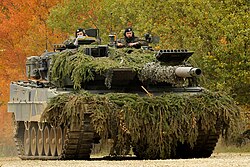
โดยรวมแล้ว ประเทศสมาชิกของสหภาพยุโรปมีจำนวนมากของยานพาหนะทางทหารและอาวุธยุทโธปกรณ์ภาคพื้นดินหลากหลายประเภท
คำแนะนำเกี่ยวกับการใช้โต๊ะ:
- ตารางนี้ไม่ได้ครอบคลุมทุกกรณี และส่วนใหญ่ประกอบด้วยยานพาหนะและประเทศสมาชิกสหภาพยุโรป- นาโต้ภายใต้สนธิสัญญาว่าด้วยกองกำลังติดอาวุธตามแบบแผนในยุโรป (สนธิสัญญา CFE) เว้นแต่จะระบุไว้เป็นอย่างอื่น
- สนธิสัญญา CFE ครอบคลุมเฉพาะยานพาหนะที่ประจำการอยู่ในยุโรปเท่านั้น ยานพาหนะที่ปฏิบัติการในต่างประเทศจะไม่ถูกนับรวม
- หมวดหมู่ "รถถังหลัก" ยังรวมถึงรถถังพิฆาต (เช่น รถถังB1 Centauro ของอิตาลี ) หรือยานรบหุ้มเกราะขับเคลื่อนด้วยตนเองใดๆ ที่มีขีดความสามารถในการยิงสูง ตามสนธิสัญญา CFE
- ประเภท "ยานรบหุ้มเกราะ" หมายรวมถึงยานเกราะทุกชนิดที่ออกแบบมาเพื่อขนส่งทหารราบเป็นหลัก และติดตั้งปืนใหญ่อัตโนมัติขนาดอย่างน้อย 20 มม. ตามสนธิสัญญา CFE
- หมวดหมู่ "ปืนใหญ่" ประกอบด้วย ปืนครกและ ปืนฮาวิ ตเซอร์แบบขับเคลื่อนด้วยตนเองหรือแบบลากจูงที่มีขนาดลำกล้อง 100 มม. ขึ้นไป ปืนใหญ่ประเภทอื่น ๆ ไม่รวมอยู่ในหมวดหมู่นี้ ไม่ว่าจะมีลักษณะอย่างไรก็ตาม ตามสนธิสัญญา CFE
- ประเภท "เฮลิคอปเตอร์โจมตี" หมายรวมถึงอากาศยานปีกหมุนทุกชนิดที่ติดตั้งอาวุธและอุปกรณ์เพื่อโจมตีเป้าหมาย หรือติดตั้งอุปกรณ์เพื่อปฏิบัติภารกิจทางทหารอื่นๆ (เช่นApacheหรือWildcat ) ตามสนธิสัญญา CFE
- หมวดหมู่ "ยานพาหนะขนส่งทางทหาร" ประกอบด้วยรถบรรทุกขนส่งขนาด 4 ตัน 8 ตัน 14 ตัน หรือใหญ่กว่านั้น ที่ออกแบบมาเพื่อภารกิจทางทหารโดยเฉพาะ ไม่อยู่ภายใต้สนธิสัญญา CFE
| รัฐสมาชิก | รถถังหลัก | ยานรบหุ้มเกราะ | ปืนใหญ่ | เฮลิคอปเตอร์โจมตี | ยานพาหนะขนส่งทางทหาร |
|---|---|---|---|---|---|
| ออสเตรีย | 56 | 364 | 90 | ||
| เบลเยียม[ 48 ] | 521 | 155 | 27 | ||
| บัลแกเรีย[ 48 ] | 362 | 681 | 1,035 | 12 | |
| โครเอเชีย[ 49 ] | 75 | 283 | 127 | 10 | |
| ไซปรัส | 134 | 169 | 234 | 15 | 398 |
| สาธารณรัฐเช็ก[ 48 ] | 123 | 501 | 182 | 24 | |
| เดนมาร์ก[ 48 ] | 46 | 229 | 56 | 12 | |
| เอสโตเนีย[ 50 ] | 74 | ||||
| ฟินแลนด์ | 200 | 1,080 | 722 | 25 | |
| ฝรั่งเศส[ 48 ] | 450 | 6,256 | 349 | 283 | 10,746 |
| เยอรมนี[ 48 ] | 815 | 1,774 | 401 | 158 | |
| กรีซ[ 48 ] | 1,622 | 2,187 | 1,920 | 29 | |
| ฮังการี[ 48 ] | 90 | 634 | 35 | 8 | 471 |
| ไอร์แลนด์[ 51 ] | 107 | 36 | |||
| อิตาลี[ 48 ] | 1,176 | 3,145 | 1,446 | 107 | 10,921 |
| ลัตเวีย | |||||
| ลิทัวเนีย[ 52 ] | 88 | 96 | |||
| ลักเซมเบิร์ก | |||||
| มอลตา | |||||
| เนเธอร์แลนด์[ 48 ] | 16 | 634 | 135 | 21 | |
| โปแลนด์[ 53 ] | 1,675 | 3,110 | 1,580 | 83 | |
| โปรตุเกส[ 48 ] | 220 | 425 | 377 | ||
| โรมาเนีย[ 48 ] | 857 | 1,272 | 1,273 | 23 | |
| สโลวาเกีย[ 48 ] | 30 | 327 | 68 | ||
| สโลวีเนีย | 76 | 52 | 63 | ||
| สเปน[ 48 ] | 484 | 1,007 | 811 | 27 | |
| สวีเดน | 120 | 978 | 268 | ||
| สหภาพยุโรป[ 48 ] | 8,413 | 25,421 | 11,259 | 822 |
กองทัพอากาศ
กองทัพอากาศของประเทศสมาชิกสหภาพยุโรปใช้ระบบและยุทโธปกรณ์ทางทหารที่หลากหลาย ซึ่งส่วนใหญ่เป็นผลมาจากความต้องการที่เป็นอิสระของแต่ละประเทศสมาชิก รวมถึงอุตสาหกรรมการป้องกันประเทศของบางประเทศสมาชิก อย่างไรก็ตาม โครงการต่างๆ เช่นEurofighter TyphoonและEurocopter Tigerทำให้หลายประเทศในยุโรปออกแบบ สร้าง และใช้งานแพลตฟอร์มอาวุธเดียวกัน 60% ของฝูงบินรบทั้งหมดได้รับการพัฒนาและผลิตโดยประเทศสมาชิก 32% มีต้นกำเนิดจากสหรัฐอเมริกา แต่บางส่วนประกอบในยุโรป ส่วนที่เหลืออีก 8% เป็นเครื่องบินที่ผลิตในสหภาพโซเวียต ณ ปี 2014 คาดว่าสหภาพยุโรปมีเครื่องบินรบที่ใช้งานได้ประมาณ 2,000 ลำ ( เครื่องบินขับไล่และเครื่องบินโจมตีภาคพื้นดิน ) [ 54 ]
ขีดความสามารถในการขนส่งทางอากาศของสหภาพยุโรปพัฒนาขึ้นด้วยการนำเครื่องบินแอร์บัส A400M มาใช้ (ซึ่งเป็นอีกตัวอย่างหนึ่งของความร่วมมือด้านการป้องกันประเทศของสหภาพยุโรป) A400M เป็นเครื่องบินขนส่งทางยุทธวิธีที่มีขีดความสามารถเชิงยุทธศาสตร์[ 55 ]ในตอนแรกคาดว่าจะมีการใช้งานประมาณ 140 ลำโดย 5 ประเทศสมาชิก (ลักเซมเบิร์ก ฝรั่งเศส เยอรมนี สเปน และเบลเยียม)
คำแนะนำเกี่ยวกับตาราง:
- ตารางเหล่านี้ได้มาจากข้อมูลที่จัดทำโดยFlight Internationalสำหรับปี 2020
- อากาศยานแบ่งออกเป็นสามประเภทหลัก (ระบุด้วยสี): สีแดงสำหรับเครื่องบินรบสีเขียวสำหรับเครื่องบินเติมเชื้อเพลิงกลางอากาศ และสีเหลืองสำหรับเครื่องบินขนส่งทางยุทธศาสตร์และยุทธวิธี
- คอลัมน์ "อื่นๆ" สองคอลัมน์นั้นประกอบด้วยเครื่องบินเพิ่มเติมโดยแบ่งตามประเภทและจัดเรียงตามสี (เช่น หมวด "อื่นๆ" สีแดงประกอบด้วยเครื่องบินรบ ในขณะที่หมวด "อื่นๆ" สีเทาประกอบด้วยทั้งเครื่องบินเติมเชื้อเพลิงกลางอากาศและเครื่องบินขนส่ง) การจัดทำเช่นนี้เนื่องจากไม่สามารถจัดให้เครื่องบินทุกประเภทมีคอลัมน์ของตัวเองได้
- อากาศยานประเภทอื่น เช่น เครื่องบินฝึกหัด เฮลิคอปเตอร์ โดรน และเครื่องบินลาดตระเวนหรือเฝ้าระวัง ไม่ได้รวมอยู่ในตารางหรือรูปภาพด้านล่างนี้
- เครื่องบินขับไล่และเครื่องบินโจมตีภาคพื้นดิน
| รัฐสมาชิก | ไต้ฝุ่น | กริเพน | ราฟาเล่ | มิราจ 2000 | พายุทอร์นาโด | เอฟ-35 | เอฟ-16 | เอฟ/เอ-18 | อื่น | ทั้งหมด |
|---|---|---|---|---|---|---|---|---|---|---|
| ออสเตรีย[ 54 ] | 15 | 15 | ||||||||
| เบลเยียม[ 54 ] | 12 (สั่งซื้อ 22 ชิ้น) | 44 | 56 | |||||||
| บัลแกเรีย[ 54 ] | 2 (สั่งซื้อ 14 รายการ) | 12 MiG-29 7 Su-25 | 21 | |||||||
| โครเอเชีย[ 54 ] | 12 | 12 | ||||||||
| ไซปรัส[ 54 ] | ||||||||||
| สาธารณรัฐเช็ก[ 54 ] | 14 | (สั่งซื้อ 24 ชิ้น) | 24 แอล-159 | 49 | ||||||
| เดนมาร์ก[ 54 ] | 20 (สั่งซื้อ 23 รายการ) | 36 | 56 | |||||||
| เอสโตเนีย[ 54 ] | ||||||||||
| ฟินแลนด์[ 54 ] | (สั่งซื้อ 64 ชุด) | 60 | 60 | |||||||
| ฝรั่งเศส[ 54 ] | 146 (สั่งซื้อ 114 รายการ) | 83 | 229 | |||||||
| เยอรมนี[ 54 ] | 127 (สั่งซื้อ 58 รายการ) | 65 IDS และ 21 Tornado ECR | (สั่งซื้อ 35 ชุด) | 213 | ||||||
| กรีซ[ 54 ] | 24 | 24 | (สั่งซื้อ 40 ชุด) | 152 [ 56 ] | 17 เอฟ-4 | 217 [ 56 ] | ||||
| ฮังการี[ 54 ] | 14 (สั่งซื้อ 4 รายการ) | 14 | ||||||||
| ไอร์แลนด์[ 54 ] | ||||||||||
| อิตาลี[ 54 ] | 88 (สั่งซื้อ 24 รายการ) | 23 IDS และ 12 Tornado ECR | 38 (สั่งซื้อ 57 รายการ) | 12 แฮร์ริเออร์ II | 173 [ 57 ] | |||||
| ลัตเวีย[ 54 ] | ||||||||||
| ลิทัวเนีย[ 54 ] | ||||||||||
| ลักเซมเบิร์ก[ 54 ] | ||||||||||
| มอลตา[ 54 ] | ||||||||||
| เนเธอร์แลนด์[ 54 ] | 46 (สั่งซื้อ 12 รายการ) | 46 | ||||||||
| โปแลนด์[ 54 ] | 3 (สั่งซื้อ 29 รายการ) | 47 | 12 T-50 (36 สั่ง) 28 มิก-29 | 90 | ||||||
| โปรตุเกส[ 54 ] | 25 | 25 | ||||||||
| โรมาเนีย[ 54 ] | (สั่งซื้อ 32 ชิ้น) | 34 (สั่งซื้อ 23 รายการ) | 34 | |||||||
| สโลวาเกีย[ 54 ] | 7 (สั่งซื้อ 5 ชิ้น) | 7 | ||||||||
| สโลวีเนีย[ 54 ] | ||||||||||
| สเปน[ 54 ] | 67 (สั่งซื้อ 45 ชุด) | 81 | 12 แฮร์ริเออร์ II | 160 | ||||||
| สวีเดน[ 54 ] | 96 (สั่งซื้อ 68 รายการ) | 96 | ||||||||
| สหภาพยุโรป[ 54 ] | 297 (127) | 124 (72) | 182 (114) | 107 | 121 | 119 (338) | 347 (42) | 141 | 135 | 1573 |
- การเติมเชื้อเพลิงและการขนส่งทางอากาศ
บริษัทข้ามชาติ
จัดตั้งขึ้นในระดับสหภาพแรงงาน

รายชื่อเป้าหมายหลักของเฮลซิงกิ (Helsinki Headline Goal Catalogue) คือรายชื่อกองกำลังตอบโต้ฉับพลันที่ประกอบด้วยทหาร 60,000 นาย ซึ่งบริหารจัดการโดยสหภาพยุโรป แต่ขึ้นอยู่กับการควบคุมของประเทศที่ส่งทหารให้สหภาพยุโรป
ปัจจัยที่นำมาใช้ในระดับสหภาพ ได้แก่:
- The battle groups (BG) adhere to the CSDP, and are based on contributions from a coalition of member states. Each of the eighteen Battlegroups consists of a battalion-sized force (1,500 troops) reinforced with combat support elements.[58][59] The groups rotate actively, so that two are ready for deployment at all times. The forces are under the direct control of the Council of the European Union. The Battlegroups reached full operational capacity on 1 January 2007, although, as of January 2013 they are yet to see any military action.[60] They are based on existing ad hoc missions that the European Union (EU) has undertaken and has been described by some as a new "standing army" for Europe.[59] The troops and equipment are drawn from the EU member states under a "lead nation". In 2004, United Nations Secretary-General Kofi Annan welcomed the plans and emphasised the value and importance of the Battlegroups in helping the UN deal with troublespots.[61]
- The Medical Command (EMC) is a planned medical command centre in support of EU missions, formed as part of the Permanent Structured Cooperation (PESCO).[62] The EMC will provide the EU with a permanent medical capability to support operations abroad, including medical resources and a rapidly deployable medical task force. The EMC will also provide medical evacuation facilities, triage and resuscitation, treatment and holding of patients until they can be returned to duty, and emergency dental treatment. It will also contribute to harmonising medical standards, certification and legal (civil) framework conditions.[63]
- The Force Crisis Response Operation Core (EUFOR CROC) is a flagship defence project under development as part of Permanent Structured Cooperation (PESCO). EURFOR CROC will contribute to the creation of a "full spectrum force package" to speed up provision of military forces and the EU's crisis management capabilities.[64] Rather than creating a standing force, the project involves creating a concrete catalogue of military force elements that would speed up the establishment of a force when the EU decides to launch an operation. It is land-focused and aims to generate a force of 60,000 troops from the contributing states alone. While it does not establish any form of "European army", it foresees an deployable, interoperable force under a single command.[65] Germany is the lead country for the project, but the French are heavily involved and it is tied to President Emmanuel Macron's proposal to create a standing intervention force. The French see it as an example of what PESCO is about.[66]
Provided through Article 42.3 TEU

This section presents an incomplete list of forces and bodies established intergovernmentally amongst a subset of member states. These organisations will deploy forces based on the collective agreement of their member states. They are typically technically listed as being able to be deployed under the auspices of NATO, the United Nations, the European Union (EU) through Article 42.3 of TEU, the Organization for Security and Co-operation in Europe, or any other international entity.
However, with the exception of the Eurocorps, very few have actually been deployed for any real military operation, and none under the CSDP at any point in its history.
Land Forces:
- The Eurocorps is an army corps of approximately 1,000 soldiers stationed in Strasbourg, France. Based in the French city of Strasbourg, the corps is the nucleus of the Franco-German Brigade.[67]
- The I. German/Dutch Corps is a multinational formation consisting of units from the Dutch and German armies. Due to its role as a NATO High Readiness Forces Headquarters, soldiers from other NATO member states, the United States, Denmark, Norway, Spain, Italy, the United Kingdom amongst others, are also stationed at Münster.
- The Multinational Corps Northeast, a Danish-German-Polish multinational corps
- The European Gendarmerie Force, an intervention force with militarised police functions which specializes in crisis management.[68]
Aerial:
- The European Air Transport Command exercises operational control of the majority of the aerial refueling capabilities and military transport fleets of its participating nations. Located at Eindhoven Airbase in the Netherlands, the command also bears a limited responsibility for exercises, aircrew training and the harmonisation of relevant national air transport regulations.[69][70] The command was established in 2010 to provide a more efficient management of the participating nations' assets and resources in this field.
Naval:
- The European Maritime Force (EUROMARFOR or EMF) is a non-standing,[71] military force[72] that may carry out naval, air and amphibious operations, with an activation time of 5 days after an order is received.[73] The force was formed in 1995 to fulfill missions defined in the Petersberg Declaration, such as sea control, humanitarian missions, peacekeeping operations, crisis response operations, and peace enforcement.
Participation, relationship with NATO
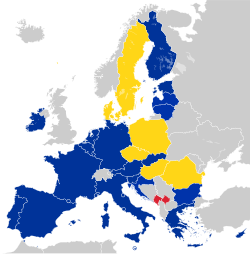
The memberships of the EU and NATO are distinct, and some EU member states are traditionally neutral on defence issues. Out of the 27 EU member states, 23 are also members of NATO. Four non-NATO member states are members of the EU: Austria, Cyprus, Ireland, and Malta. Another four NATO members are EU applicants—Albania, Montenegro, North Macedonia and Turkey. Two others—Iceland and Norway—have opted to remain outside of the EU, however participate in the EU's single market. Several EU member states were formerly members of the Warsaw Pact. Denmark had an opt-out from the CSDP,[1] however voted in a referendum in 2022 to begin to participate in the policy area.
| European Union(in respect of its defence arm, the Common Security and Defence Policy) |  NATO NATO | ||
|---|---|---|---|
| Mutual defence clause | Article 42.7 of the consolidated version of the Treaty on European Union: "If a Member State is the victim of armed aggression on its territory, the other Member States shall have towards it an obligation of aid and assistance by all the means in their power, in accordance with Article 51 of the United Nations Charter. This shall not prejudice the specific character of the security and defence policy of certain Member States. [...]" | Article 5 of the North Atlantic Treaty: "The Parties agree that an armed attack against one or more of them [on their territory] shall be considered an attack against them all and consequently they agree that, if such an armed attack occurs, each of them, in exercise of the right of individual or collective self-defence recognised by Article 51 of the Charter of the United Nations, will assist the Party or Parties so attacked by taking forthwith, individually and in concert with the other Parties, such action as it deems necessary, including the use of armed force, to restore and maintain the security of the North Atlantic area. [...]" | |
| Political strategic organisation | |||
| Highest office | High Representative (HR/VP) | Secretary General | |
| Principal decision-making body | Foreign Affairs Council | North Atlantic Council | |
| Liaison body | European External Action Service | International Staff | |
| Seat | Kortenberg building (Brussels, Belgium) |  NATO headquarters (Brussels, Belgium) NATO headquarters (Brussels, Belgium) | |
| Military strategic organisation | |||
| Supreme commander | Director of the Military Planning and Conduct Capability |  Supreme Allied Commander Europe Supreme Allied Commander Europe | |
| Headquarters | Military Planning and Conduct Capability (Brussels, Belgium) | Supreme Headquarters Allied Powers Europe (Mons, Belgium) | |
| Chair of chiefs of defence assembly | Chairman of the European Union Military Committee |  Chair of the NATO Military Committee Chair of the NATO Military Committee | |
| Chiefs of defence assembly | European Union Military Committee | NATO Military Committee | |
| Advisory body | European Union Military Staff |  International Military Staff International Military Staff | |
| EU Membership | Permanent Structured Cooperation | NATO Membership | |
| Member states of both the EU and NATO | |||
| Belgium | Founder | Founder | Founder |
| Bulgaria | 2007 | Founder | 2004 |
| Croatia | 2013 | Founder | 2009 |
| Czech Republic | 2004 | Founder | 1999 |
| Denmark | 1973 | 2023 | Founder |
| Estonia | 2004 | Founder | 2004 |
| Finland | 1995 | Founder | 2023 |
| France | Founder | Founder | Founder |
| Germany | Founder | Founder | 1955 |
| Greece | 1981 | Founder | 1952 |
| Hungary | 2004 | Founder | 1999 |
| Italy | Founder | Founder | Founder |
| Latvia | 2004 | Founder | 2004 |
| Lithuania | 2004 | Founder | 2004 |
| Luxembourg | Founder | Founder | Founder |
| Netherlands | Founder | Founder | Founder |
| Poland | 2004 | Founder | 1999 |
| Portugal | 1986 | Founder | Founder |
| Romania | 2007 | Founder | 2004 |
| Slovakia | 2004 | Founder | 2004 |
| Slovenia | 2004 | Founder | 2004 |
| Spain | 1986 | Founder | 1982 |
| Sweden | 1995 | Founder | 2024 |
| Non-NATO EU member states | |||
| Austria | 1995 | Founder | Partnership for Peace |
| Cyprus | 2004 | Founder | No |
| Ireland | 1973 | Founder | Partnership for Peace |
| Malta | 2004 | No | Partnership for Peace |
| Non-EU NATO member states | |||
 Albania Albania | Candidate | N/a | 2009 |
 Iceland Iceland | No | N/a | Founder |
 Montenegro Montenegro | Candidate | N/a | 2017 |
 North Macedonia North Macedonia | Candidate | N/a | 2020 |
 Norway Norway | Defence Agency agreement | N/a | Founder |
 Turkey Turkey | Candidate | N/a | 1952 |
 United Kingdom United Kingdom | No | N/a | Founder |
| European countries outside both the EU and NATO | |||
 Andorra Andorra | No | N/a | No |
 Armenia Armenia | No | N/a | Individual Partnership Action Plan |
 Azerbaijan Azerbaijan | No | N/a | Individual Partnership Action Plan |
 Belarus Belarus | No | N/a | Partnership for Peace |
 Bosnia and Herzegovina Bosnia and Herzegovina | Candidate | N/a | Membership Action Plan |
 Georgia Georgia | Candidate | N/a | Intensified Dialogue |
 Kazakhstan Kazakhstan | No | N/a | Individual Partnership Action Plan |
 Kosovo Kosovo | Applicant / Potential candidate | N/a | No |
 Liechtenstein Liechtenstein | No | N/a | No |
 Moldova Moldova | Candidate | N/a | Individual Partnership Action Plan |
 Monaco Monaco | No | N/a | No |
 Russia Russia | No | N/a | Partnership for Peace |
 San Marino San Marino | No | N/a | No |
 Serbia Serbia | Candidate | N/a | Individual Partnership Action Plan |
 Switzerland Switzerland | Defence Agency agreement | N/a | Partnership for Peace |
 Ukraine Ukraine | Candidate | N/a | Intensified Dialogue |
 Vatican City Vatican City | No | N/a | No |
| NATO member states located in North America, which are therefore ineligible for EU membership | |||
 Canada Canada | N/a | N/a | Founder |
 United States United States | N/a | N/a | Founder |
| Members of NATO's Partnership for Peace located outside Europe, which are therefore neither eligible for EU nor NATO membership | |||
 Kyrgyzstan Kyrgyzstan | N/a | N/a | Partnership for Peace |
 Tajikistan Tajikistan | N/a | N/a | Partnership for Peace |
 Turkmenistan Turkmenistan | N/a | N/a | Partnership for Peace |
 Uzbekistan Uzbekistan | N/a | N/a | Partnership for Peace |
The Berlin Plus agreement is the short title of a comprehensive package of agreements made between NATO and the EU on 16 December 2002.[74] These agreements were based on conclusions of NATO's 1999 Washington summit, sometimes referred to as the CJTF mechanism,[75] and allowed the EU to draw on some of NATO's military assets in its own peacekeeping operations.
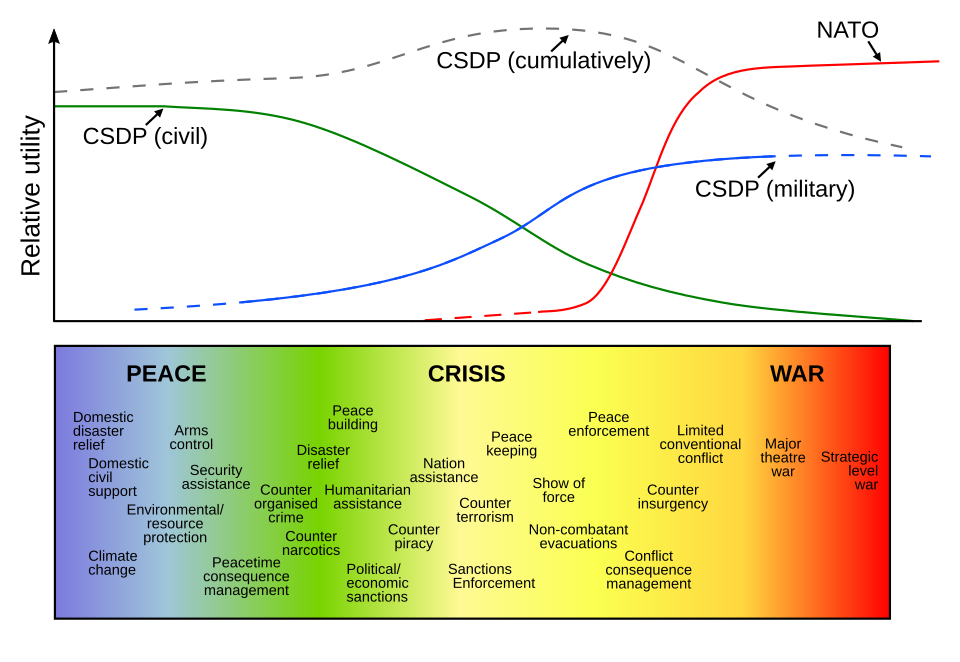
EUCAP Somalia
The EUCAP Somalia[76] is an example of an unarmed, non-executive, civilian Common Security and Defence Policy (CSDP) Mission. aimed at strengthening maritime security capacities, police sector, as well as promoting the Rule of Law in Somalia.[77] It provides strategic level advice, mentoring and training, on issues ranging from coast guard and police functions to police-prosecution cooperation and the drafting of laws. Initially launched as EUCAP Nestor[78] in 2012, the mission was reconfigured to focus on Somalia, thus renamed by the Council of the European Union, EUCAP Somalia in 2016.
In December 2024, the Council of European Union extended the Mission’s mandate to February 2027.
The most prominent goals of the Mission are to help Somalia to generate well trained police forces in line with the Somali Transition Plan, contribute to secure one of the EU’s vital maritime trade routes, and assist to draft and implement sound legislative frameworks, including accountability systems.
Background
The mission was established in response to the persistent challenges posed by maritime insecurity in the Western Indian Ocean, particularly piracy, illegal fishing, human trafficking, and arms smuggling. These issues severely impacted both the security and economic stability of Somalia and the surrounding region. Somalia’s extensive coastline (the longest in mainland Africa) was unprotected for years due to the collapse of the government in the early 1990s.[79] Piracy flourished in the absence of effective maritime governance, leading to international efforts to assist the country in reclaiming control over its waters. EUCAP Somalia emerged as part of these efforts, complementing other international missions such as Operation Atalanta and EUTM Somalia.
Mandates
From 2012 to 2016
EUCAP Nestor's mandate is divided into two objectives: strengthening the maritime capacities of the beneficiary countries (excluding Somalia) and training a coastal police force and judges in Somalia, the primary aim being to get the countries in the region to work together to strengthen action at sea. EUCAP Nestor operates in five countries: Djibouti, Kenya, Seychelles, Somalia (Puntland/Somaliland) and Tanzania. This is why it is relatively large in terms of staff numbers, with almost 200 people spread across the different countries. These experts provide legal, strategic and operational advice on maritime safety.[80]
From 2016 to 2021
When the name was changed in December 2016, so too was the mandate. EUCAP Somalia will drop its regional ambitions and focus solely on Somalia, and more specifically on the Coast Guard, with a view to strengthening ‘Somali maritime law enforcement capabilities’. The mandate is not limited to piracy, but covers any criminal activity or offence committed on the coast or in the sea.[81]
From 2021 to 2024
In December 2020, the Council of the European Union extended EUCAP's mandate until 31 December 2024. From 2021 onwards, the mission will also be helping Somalia to strengthen its police capabilities, in particular by developing the Federal Darwish police force and reinforcing the INTERPOL National Central Bureau in Mogadishu.[82] The EU's budget for the period 2023-2024 allocated is 81 million €.[83]
Current mandate from 2025 to 2027
In December 2024, the Council of European Union extended the Mission’s mandate to February 2027. EUCAP Somalia is tasked to advise, train, and equip the Somali Police Force and to support the development of a legal framework for Somalia’s internal security architecture. The mission’s work also includes providing monitoring support to regional maritime police forces, including the Somaliland and Puntland Maritime Police Forces, to bolster maritime law enforcement and security. The Mission’s budget for its current mandate is €110 million and total staff of 169 members.
Three pillars of EUCAP Somalia
- Support the development of Somali Police Forces by enhancing their capabilities through advising, training and equipping Somali Police Forces in line with the Somali Security Sector Development Plan, ensuring the police are better prepared to maintain security and stability across the country.
- Strengthen Maritime Police Capacities in and around the three main Somali ports (Mogadishu, Berbera and Bossaso) by providing capacity building on coast guard functions.
- Promote the rule of law by working with Somali authorities to enhance accountability within the police force and across the criminal justice chain. This includes supporting the development of legal frameworks necessary for the effective functioning of law enforcement, and security actors in both land and maritime domains, fostering governance and accountability.
Achievements
Since its reconfiguration in 2016, EUCAP Somalia has made significant strides in enhancing Somalia’s maritime security capabilities. Recent achievements include improving the Somali Police Force's (SPF) command, control, and communication capabilities, as well as enhancing their ability to manage security incidents in Mogadishu. EUCAP has deployed a specialized multinational team to support the SPF's Maritime Police Unit and has played a key role in the development of Somaliland’s Coast Guard, conducting joint exercises with EUNAVFOR Operation ATALANTA. The mission also trained and equipped the Puntland Maritime Police Force, enhancing their capacity to enforce maritime law. Additionally, EUCAP has supported the Somali Attorney General’s Maritime Crimes Unit by providing training in internal procedures and investigations and launching an internship program for young lawyers. Despite the progress, Somalia continues to face challenges in maritime governance due to political instability and resource limitations, but EUCAP remains committed to addressing these issues with Somali authorities and international partners.[84]
Mission's achievements during mandate 2022 - 24
- Increased the Somali Police Force command, control and communication capability.
- Trained Somali Police Force trainers for co-training activities.
- Enabling the establishment of the Maritime Rescue and Coordination Center in Mogadishu to enhance maritime security coordination along the Somali coastline and in regional waters.
- Supported the development of Somaliland Coast Guard, including through joint exercises with EUNAVFOR Operation ATALANTA and the provision of maritime equipment.
- Trained mobile training units for Somaliland Coast Guard and Somaliland Police.
- Trained and equipped the Puntland Maritime Police Force - Maritime Police Unit, enhancing their law enforcement capabilities.
- Supporting the maritime crimes unit of the Somali Attorney General's Office in internal procedures and maritime crimes investigations as well as an internship program for young lawyers in Mogadishu and Puntland.
See also
- European Union–NATO relations
- European Union as an emerging superpower
- Security and defense pacts of the European Union
- European countries by military expenditure as a percentage of government expenditure
- Neutral country § European Union
- Strategic Compass for Security and Defence
Defence-related EU initiatives
- Military Mobility
- European Centre of Excellence for Countering Hybrid Threats (Hybrid CoE), an EU-supported intergovernmental think-tank
- List of military and civilian missions of the European Union
Pan-European defence organisations (intergovernmental)
- Finabel, an organisation, controlled by the army chiefs of staff of its participating nations, that promotes cooperation and interoperability between the armies.[85]
- Organisation for Joint Armament Cooperation (OCCAR), an organisation that facilitates and manages collaborative armament programmes through their lifecycle between its participating nations.
- European Air Group (EAG), an organisation that promotes cooperation and interoperability between the air forces of its participating nations.
- European Organisation of Military Associations and Trade Unions (EUROMIL)
- European Personnel Recovery Centre (EPRC), an organisation that contributes to the development and harmonisation of policies and standards related to personnel recovery.
- European Intervention Initiative
- European Centre of Excellence for Civilian Crisis Management
Regional, integorvernmental defence organisations in Europe
- Nordic Defence Cooperation (NORDEFCO)
- Central European Defence Cooperation (CEDC)
Atlanticist intergovernmental defence organisations
- North Atlantic Treaty Organisation (NATO)
- Movement Coordination Centre Europe (MCCE), an organisation aiming to coordinate the use of airlift, sealift and land movement assets owned or leased by participating nations.
Notes
- ^ abThe responsibility of collective self-defence within the CSDP is based on Article 42.7 of TEU, which states that this responsibility does not prejudice the specific character of the security and defence policy of certain member states, referring to policies of neutrality. See Neutral country§European Union for discussion on this subject.According to the Article 42.7 "If a Member State is the victim of armed aggression on its territory, the other Member States shall have towards it an obligation of aid and assistance by all the means in their power, in accordance with Article 51 of the United Nations Charter. This shall not prejudice the specific character of the security and defence policy of certain Member States." Article 42.2 furthermore specifies that NATO shall be the main forum for the implementation of collective self-defence for EU member states that are also NATO members.
- ^Akin to the EU's banking union, economic and monetary union and customs union.
- ^While the Brussels Pact was amended in 1954, it entered into force in 1955.[8]
- ^Akin to the EU's banking union, economic and monetary union and customs union.
- ^Aircraft carrier Charles de Gaulle
- ^Aircraft carrier Cavour; New universal ship of Trieste has the function of aircraft carrier and amphibious assault ship.
- ^New universal ship of Trieste has the function of aircraft carrier and amphibious assault ship.
- ^San Giorgio-class amphibious transport dock
- ^ abSpain withdrew last classic aircraft carrier Príncipe de Asturias in 2013 (currently in reserve). New universal ship of Juan Carlos I has the function of fleet carrier and amphibious assault ship.
- ^Galicia-class landing platform dock
- ^F-100 class
- ^Santa María class
Further reading
- Book – What ambitions for European defence in 2020?, European Union Institute for Security Studies
- Book – European Security and Defence Policy: The first 10 years (1999–2009), European Union Institute for Security Studies
- Book - Smith, Michael E. (2017). 'Europe's Common Security and Defence Policy: Capacity-Building, Experiential Learning, and Institutional Change' (Cambridge University Press).
- "Guide to the ESDP" nov.2008 edition Exhaustive guide on ESDP's missions, institutions and operations, written and edited by the Permanent representation of France to the European Union.
- Dijkstra, Hylke (2013). Policy-Making in EU Security and Defense: An Institutional Perspective. European Administrative Governance Series (Hardback 240pp ed.). Palgrave Macmillan, Basingstoke. ISBN 978-1-137-35786-1.
- Nugent, Neill (2006). The Government and Politics of the European Union. The European Union Series (Paperback 630pp ed.). Palgrave Macmillan, New York. ISBN 9780230000025.
- Howorth, Joylon (2007). Security and Defence Policy in the European Union. The European Union Series (Paperback 315pp ed.). Palgrave Macmillan, New York. ISBN 978-0-333-63912-2.
- PhD Thesis on Civilian ESDP - EU Civilian crisis management (University of Geneva, 2008, 441 p. in French)Archived 29 August 2013 at the Wayback Machine
- Hayes, Ben (2009). "NeoConOpticon: The EU Security-Industrial Complex". Statewatch: Newsletter (Paperback, 84 pp ed.). Transnational Institute/Statewatch. ISSN 1756-851X.
- Giovanni Arcudi & Michael E. Smith (2013). The European Gendarmerie Force: a solution in search of problems?, European Security, 22(1): 1–20, DOI:10.1080/09662839.2012.747511
- Teresa Eder (2014). Welche Befugnisse hat die Europäische Gendarmerietruppe?, Der Standard, 5 Februar 2014.
- Alexander Mattelaer (2008). The Strategic Planning of EU Military Operations – The Case of EUFOR Tchad/RCA, IES Working Paper 5/2008.
- Benjamin Pohl (2013). The logic underpinning EU crisis management operations, European Security, 22(3): 307–325, DOI:10.1080/09662839.2012.726220
- "The Russo-Georgian War and Beyond: towards a European Great Power Concert", Danish Institute of International Studies.
- U.S Army Strategic Studies Institute (SSI), Operation EUFOR TCHAD/RCA and the EU's Common Security and Defense Policy.Archived 8 April 2018 at the Wayback Machine, U.S. Army War College, October 2010
- Mai'a K. Davis Cross "Security Integration in Europe: How Knowledge-based Networks are Transforming the European Union." University of Michigan Press, 2011.
- Butler, Graham (2020). "The European Defence Union and Denmark's Defence Opt-out: A Legal Appraisal"(PDF). European Foreign Affairs Review. 25 (1): 117–150. doi:10.54648/EERR2020008. S2CID 216432180.
External links

- Official website, European External Action Service
- Security and Defence, European External Action Service
- EU cooperation on security and defence, Council of the European Union
- CFSP operational instrument: A proposed CSDP evolution in the Eurocorps and ESDI in NATO