ในทางคณิตศาสตร์ ฟังก์ชันไฮเปอร์โบลิก เป็นอนาล็อกของฟังก์ชันตรีโกโนเมตริก ทั่วไป แต่กำหนดโดยใช้ไฮเปอร์โบลา แทนวงกลม เช่นเดียวกับที่จุด(cos t , sin t ) ก่อตัวเป็นวงกลมที่มีรัศมีหนึ่งหน่วย จุด(cosh t , sinh t ) ก่อตัวเป็นครึ่งขวาของไฮเปอร์โบลาหน่วย ในทำนองเดียวกันกับที่อนุพันธ์ของsin( t ) และcos( t ) คือcos( t ) และ –sin ( t ) อนุพันธ์ของsinh( t ) และcosh( t ) คือcosh( t ) และsinh( t )
ฟังก์ชันไฮเปอร์โบลิกใช้เพื่อแสดงมุมขนาน ในเรขาคณิตไฮเปอร์โบลิก นอกจากนี้ยัง ใช้เพื่อแสดงการเพิ่มความเร็วแบบลอเรนซ์ เป็นการหมุนแบบไฮเปอร์โบลิก ในทฤษฎีสัมพัทธภาพพิเศษ และยังพบได้ในคำตอบของ สมการเชิงอนุพันธ์ เชิงเส้นหลาย สมการ (เช่น สมการที่กำหนดเส้นโค้งแคทเทนารี ) สมการกำลังสาม และสมการลาปลาส ในพิกัดคาร์ทีเซียน สมการลาปลาส มีความสำคัญในหลายสาขาของฟิสิกส์ รวมถึงทฤษฎีแม่เหล็กไฟฟ้า การถ่ายเทความร้อน และพลศาสตร์ ของไหล
ฟังก์ชันไฮเปอร์โบลิกพื้นฐานคือ: [ 1 ]
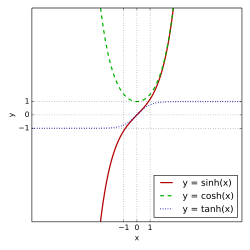
ไฮเปอร์โบลิกไซน์ " sinh " ( , [ 2 ] โคไซน์ไฮเปอร์โบลิก " cosh " ( ), [ 3 ] ซึ่งได้มาจาก: [ 4 ]
แทนเจนต์ซึ่งเกินความจริง " tanh " ( ), [ 5 ] โคแทนเจนต์ไฮเปอร์โบลิก " coth " ( ), [ 6 ] [ 7 ] ไฮเปอร์โบลิกซีแคนต์ " sech " ( ), [ 8 ] โคซีแคนต์ซึ่งเกินความจริง " csch " หรือ " cosech " ( [ 3 ] ซึ่งสอดคล้องกับฟังก์ชันตรีโกณมิติที่ได้มา
ฟังก์ชันไฮเปอร์โบลิกผกผัน ได้แก่:
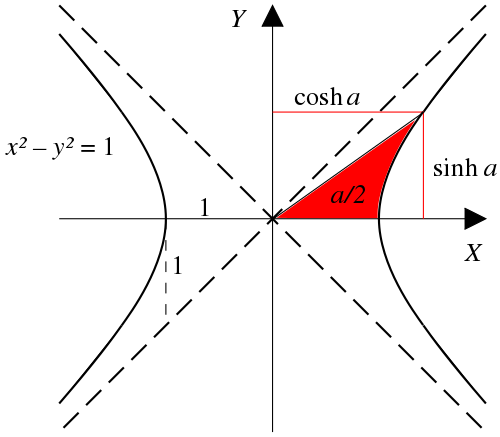
ไซน์ไฮเปอร์โบลิกผกผัน " arsinh " (หรือเขียนแทนด้วย " sinh −1 ", " asinh " หรือบางครั้ง " arcsinh ") [ 9 ] [ 10 ] [ 11 ] โคไซน์ไฮเปอร์โบลิกผกผัน " arcosh " (หรือเขียนแทนด้วย " cosh −1 ", " acosh " หรือบางครั้ง " arccosh ")แทนเจนต์ไฮเปอร์โบลิกผกผัน " artanh " (หรือเขียนแทนด้วย " tanh −1 ", " atanh " หรือบางครั้ง " arctanh ")โคแทนเจนต์ไฮเปอร์โบลิกผกผัน " arcoth " (หรือเขียนแทนด้วย " coth −1 ", " acoth " หรือบางครั้ง " arccoth ")ตัวผกผันไฮเปอร์โบลิกซีแคนต์ " arsech " (หรือเขียนแทนด้วย " sech −1 ", " asech " หรือบางครั้ง " arcsech ")โคเซแคนต์ไฮเปอร์โบลิกผกผัน " arcsch " (หรือเขียนแทนด้วย " arcosech ", " csch −1 ", " cosech −1 ", " acsch ", " acosech " หรือบางครั้งอาจเขียนว่า " arccsch " หรือ " arccosech ")รังสีที่ ลากผ่าน ไฮ เปอร์ โบลาหน่วย x² − y² = 1(cosh a , sinh a ) a คือสองเท่าของพื้นที่ระหว่างรังสี ไฮเปอร์โบลา และ แกน x สำหรับจุดบนไฮเปอร์โบลาที่อยู่ต่ำกว่า แกน x พื้นที่จะถือว่ามีค่าเป็นลบ (ดูภาพเคลื่อนไหว เปรียบเทียบกับฟังก์ชันตรีโกโนเมตริก (วงกลม)) ฟังก์ชันไฮเปอร์โบลิกมีตัวแปร ที่เรียกว่ามุมไฮเปอร์โบลิก ขนาดของมุมไฮเปอร์โบลิกคือพื้นที่ ของส่วนโค้งไฮเปอร์โบลิกที่ ลาก ผ่านเส้น ตรง xy = 1ประกอบมุมฉากของสามเหลี่ยมมุมฉาก ที่ครอบคลุมส่วนโค้งนี้
ในการวิเคราะห์เชิงซ้อน ฟังก์ชันไฮเปอร์โบลิกเกิดขึ้นเมื่อนำฟังก์ชันไซน์และโคไซน์ธรรมดาไปใช้กับมุมจินตนาการ ฟังก์ชันไซน์ไฮเปอร์โบลิกและฟังก์ชันโคไซน์ไฮเปอร์โบลิกเป็นฟังก์ชันเอนไทร์ ดังนั้น ฟังก์ชันไฮเปอร์โบลิกอื่นๆ จึงเป็นฟังก์ชันเมโรเมอร์ฟิก ในระนาบเชิงซ้อนทั้งหมด
ตามทฤษฎีบทของ Lindemann–Weierstrass ฟังก์ชันไฮเปอร์โบลิกมีค่าอดิศัย สำหรับทุก ค่าพีชคณิต ที่ไม่เป็นศูนย์ของอาร์กิวเมนต์[ 12 ]
ประวัติศาสตร์ การคำนวณครั้งแรกที่ทราบของปัญหาตรีโกณมิติไฮเปอร์โบลิกนั้นเชื่อกันว่าเป็นผลงานของGerardus Mercator เมื่อออกแผนที่ฉายภาพ Mercator ประมาณปี 1566 ซึ่งต้องใช้ตารางแสดงคำตอบของสมการอดิศัย ที่เกี่ยวข้องกับฟังก์ชันไฮเปอร์โบลิก[ 13 ]
ไอแซค นิวตัน เป็นคนแรกที่เสนอความคล้ายคลึงกันระหว่างส่วนของวงกลมและส่วนของไฮเปอร์โบลาในหนังสือ Principia Mathematica [ 14 ]
Roger Cotes เสนอให้ปรับเปลี่ยนฟังก์ชันตรีโกณมิติโดยใช้หน่วยจินตนาการ เพื่อให้ได้ทรงรี แบน จากทรงรียาว[ 14 ] ฉัน = − 1 {\displaystyle i={\sqrt {-1}}}
ฟังก์ชันไฮเปอร์โบลิกได้รับการแนะนำอย่างเป็นทางการในปี ค.ศ. 1757 โดยVincenzo Riccati [ 14 ] [ 13 ] [ 15 ] Riccati Sc. Cc. sinus/cosinus circulare Sh. Ch. sinus/cosinus hyperbolico [ 14 ] Daviet de Foncenex ได้แสดงให้เห็นถึงความสามารถในการสลับเปลี่ยนระหว่างฟังก์ชันตรีโกณมิติและฟังก์ชันไฮเปอร์โบลิกโดยใช้หน่วยจินตนาการ และขยายสูตรของ de Moivre ไปยังฟังก์ชันไฮเปอร์โบลิก[ 15 ] [ 14 ]
ในช่วงทศวรรษ 1760 โยฮันน์ ไฮน์ริช แลมเบิร์ต ได้จัดระบบการใช้ฟังก์ชันและให้สูตรเลขชี้กำลังในสิ่งพิมพ์ต่างๆ[ 14 ] [ 15 ] [ 15 ] [ 16 ]
สัญกรณ์
คำจำกัดความ รูปสามเหลี่ยมมุมฉากที่มีด้านประกอบมุมฉากเป็นสัดส่วนกับ sinh และ cosh ด้วยมุมไฮเปอร์โบลิก u ฟังก์ชันไฮเปอร์โบลิก sinh และ cosh สามารถกำหนดได้ด้วยฟังก์ชันเลขชี้กำลัง e u [ 1 ] [ 4 ] เอ = ( อี − คุณ , อี คุณ ) , บี = ( อี คุณ , อี − คุณ ) , โอ เอ + โอ บี = โอ ซี {\displaystyle A=(e^{-u},e^{u}),\ B=(e^{u},\ e^{-u}),\ OA+OB=OC}
นิยามเลขชี้กำลัง sinh x คือครึ่งหนึ่งของผลต่าง ระหว่างe x e − x cosh x คือค่าเฉลี่ย ของe x e − x ไซน์ไฮเปอร์โบลิก: ส่วนคี่ ของฟังก์ชันเลขชี้กำลัง นั่นคือสินห์ x = อี x − อี − x 2 = อี 2 x − 1 2 อี x . {\displaystyle \sinh x={\frac {e^{x}-e^{-x}}{2}}={\frac {e^{2x}-1}{2e^{x}}}.} โคไซน์ไฮเปอร์โบลิก: ส่วนคู่ ของฟังก์ชันเลขชี้กำลัง นั่นคือไม้กระบอง x = อี x + อี − x 2 = อี 2 x + 1 2 อี x . {\displaystyle \cosh x={\frac {e^{x}+e^{-x}}{2}}={\frac {e^{2x}+1}{2e^{x}}}.} sinh , cosh และtanh csch , sech และcoth แทนเจนต์ไฮเปอร์โบลิก:ตันห์ x = สินห์ x ไม้กระบอง x = อี x − อี − x อี x + อี − x = อี 2 x − 1 อี 2 x + 1 . {\displaystyle \tanh x={\frac {\sinh x}{\cosh x}}={\frac {e^{x}-e^{-x}}{e^{x}+e^{-x}}}={\frac {e^{2x}-1}{e^{2x}+1}}.} โคแทนเจนต์ไฮเปอร์โบลิก: สำหรับx ≠ 0เสื้อคลุม x = ไม้กระบอง x สินห์ x = อี x + อี − x อี x − อี − x = อี 2 x + 1 อี 2 x − 1 . {\displaystyle \coth x={\frac {\cosh x}{\sinh x}}={\frac {e^{x}+e^{-x}}{e^{x}-e^{-x}}}={\frac {e^{2x}+1}{e^{2x}-1}}.} เส้นตัดไฮเปอร์โบลิก:เซช x = 1 ไม้กระบอง x = 2 อี x + อี − x = 2 อี x อี 2 x + 1 . {\displaystyle \operatorname {sech} x={\frac {1}{\cosh x}}={\frac {2}{e^{x}+e^{-x}}}={\frac {2e^{x}}{e^{2x}+1}}.} โคเซแคนต์ไฮเปอร์โบลิก: สำหรับx ≠ 0ซีเอสเค x = 1 สินห์ x = 2 อี x − อี − x = 2 อี x อี 2 x − 1 . {\displaystyle \operatorname {csch} x={\frac {1}{\sinh x}}={\frac {2}{e^{x}-e^{-x}}}={\frac {2e^{x}}{e^{2x}-1}}.}
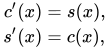
นิยามของสมการเชิงอนุพันธ์ ฟังก์ชันไฮเปอร์โบลิกอาจนิยามได้ว่าเป็นคำตอบของสมการเชิงอนุพันธ์ : ฟังก์ชันไซน์และโคไซน์ไฮเปอร์โบลิกเป็นคำตอบ( s , c ) ของระบบ ที่มีเงื่อนไขเริ่มต้นเงื่อนไขเริ่มต้นทำให้คำตอบมีเอกลักษณ์เฉพาะตัว หากไม่มีเงื่อนไขเริ่มต้น ฟังก์ชันใดๆก็จะเป็นคำตอบได้ ค ′ ( x ) = ส ( x ) , ส ′ ( x ) = ค ( x ) , {\displaystyle {\begin{aligned}c'(x)&=s(x),\\s'(x)&=c(x),\\\end{aligned}}} ส ( 0 ) = 0 , ค ( 0 ) = 1. {\displaystyle s(0)=0,c(0)=1.} ( เอ อี x + ข อี − x , เอ อี x − ข อี − x ) {\displaystyle (ae^{x}+be^{-x},ae^{x}-be^{-x})}
sinh( x ) และcosh( x ) ยังเป็นคำตอบเฉพาะของสมการf ″( x ) = f ( x )f (0) = 1f ′(0) = 0f (0) = 0f ′(0) = 1
นิยามตรีโกณมิติที่ซับซ้อน ฟังก์ชันไฮเปอร์โบลิกอาจอนุมานได้จากฟังก์ชันตรีโกณมิติที่ มี อาร์กิวเมนต์ เป็นจำนวนเชิงซ้อน :
ไซน์ไฮเปอร์โบลิก: [ 1 ] สินห์ x = − ฉัน บาป ( ฉัน x ) . {\displaystyle \sinh x=-i\sin(ix)} โคไซน์ไฮเปอร์โบลิก: [ 1 ] ไม้กระบอง x = คอส ( ฉัน x ) . {\displaystyle \cosh x=\cos(ix).} แทนเจนต์ไฮเปอร์โบลิก:ตันห์ x = − ฉัน แทน ( ฉัน x ) . {\displaystyle \tanh x=-i\tan(ix)} โคแทนเจนต์ไฮเปอร์โบลิก:เสื้อคลุม x = ฉัน เปลเด็ก ( ฉัน x ) . {\displaystyle \coth x=i\cot(ix).} เส้นตัดไฮเปอร์โบลิก:เซช x = วินาที ( ฉัน x ) . {\displaystyle \operatorname {sech} x=\sec(ix)} โคเซแคนต์ไฮเปอร์โบลิก:ซีเอสเค x = ฉัน ซีเอสซี ( ฉัน x ) . {\displaystyle \operatorname {csch} x=i\csc(ix).} โดยที่i คือหน่วยจินตนาการ ที่มีi 2 =
คำจำกัดความข้างต้นเกี่ยวข้องกับคำจำกัดความของฟังก์ชันเลขชี้กำลังผ่านสูตรของออยเลอร์ (ดูหัวข้อ§ ฟังก์ชันไฮเปอร์โบลิกสำหรับจำนวนเชิงซ้อน ด้านล่าง)
คุณสมบัติเฉพาะ
โคไซน์ไฮเปอร์โบลิก สามารถแสดงได้ว่าพื้นที่ใต้เส้นโค้ง ของโคไซน์ไฮเปอร์โบลิก (ในช่วงเวลาจำกัด) จะเท่ากับความยาวส่วนโค้ง ที่สอดคล้องกับช่วงเวลานั้นเสมอ: [ 17 ] พื้นที่ = ∫ เอ ข ไม้กระบอง x ง x = ∫ เอ ข 1 + ( ง ง x ไม้กระบอง x ) 2 ง x = ความยาวส่วนโค้ง {\displaystyle {\text{area}}=\int _{a}^{b}\cosh x\,dx=\int _{a}^{b}{\sqrt {1+\left({\frac {d}{dx}}\cosh x\right)^{2}}}\,dx={\text{ความยาวส่วนโค้ง.}}}
แทนเจนต์ไฮเปอร์โบลิก แทนเจนต์ไฮเปอร์โบลิกเป็นคำตอบ (ที่ไม่ซ้ำกัน) ของสมการเชิงอนุพันธ์ f ′ = 1 − f 2 f (0) =[ 18 ] [ 19 ]
ความสัมพันธ์ที่เป็นประโยชน์ เอกลักษณ์ตรีโกณมิติ อันที่จริงกฎของออสบอร์น [ 20 ] ร์จ ออสบอร์น ) ระบุว่าสามารถแปลงเอกลักษณ์ตรีโกณมิติใดๆ (จนถึงแต่ไม่รวมถึง sinh หรือ sinh โดยนัยของดีกรี 4) สำหรับ, , หรือและให้เป็นเอกลักษณ์ไฮเปอร์โบลิกได้ดังนี้: θ {\displaystyle \theta } 2 θ {\displaystyle 2\theta } 3 θ {\displaystyle 3\theta } θ {\displaystyle \theta } φ {\displaystyle \varphi }
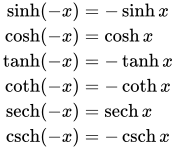
โดยขยายให้สมบูรณ์ในรูปของกำลังเชิงปริพันธ์ของไซน์และโคไซน์ เปลี่ยนไซน์เป็นซินห์ และโคไซน์เป็นโคช และ เปลี่ยนเครื่องหมายของทุกพจน์ที่มีผลคูณของ sinh สองตัว ฟังก์ชันคี่ และ ฟังก์ชัน คู่ : สินห์ ( − x ) = − สินห์ x ไม้กระบอง ( − x ) = ไม้กระบอง x ตันห์ ( − x ) = − ตันห์ x เสื้อคลุม ( − x ) = − เสื้อคลุม x เซช ( − x ) = เซช x ซีเอสเค ( − x ) = − ซีเอสเค x {\displaystyle {\begin{aligned}\sinh(-x)&=-\sinh x\\\cosh(-x)&=\cosh x\\\tanh(-x)&=-\tanh x\\\coth(-x)&=-\coth x\\\operatorname {sech} (-x)&=\operatorname {sech} x\\\operatorname {csch} (-x)&=-\operatorname {csch} x\end{aligned}}}
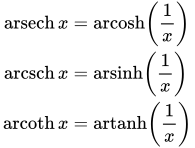
ส่วนกลับ:
อาร์เซช x = อาร์โคช ( 1 x ) arcsch x = arsinh ( 1 x ) arcoth x = artanh ( 1 x ) {\displaystyle {\begin{aligned}\operatorname {arsech} x&=\operatorname {arcosh} \left({\frac {1}{x}}\right)\\\operatorname {arcsch} x&=\operatorname {arsinh} \left({\frac {1}{x}}\right)\\\operatorname {arcoth} x&=\operatorname {artanh} \left({\frac {1}{x}}\right)\end{aligned}}}
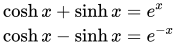
คล้ายคลึงกับสูตรของออยเลอร์ :
cosh x + sinh x = e x cosh x − sinh x = e − x {\displaystyle {\begin{aligned}\cosh x+\sinh x&=e^{x}\\\cosh x-\sinh x&=e^{-x}\end{aligned}}}
คล้ายคลึงกับเอกลักษณ์ตรีโกณมิติของพีทาโกเรียน :
cosh 2 x − sinh 2 x = 1 1 − tanh 2 x = sech 2 x coth 2 x − 1 = csch 2 x {\displaystyle {\begin{aligned}\cosh ^{2}x-\sinh ^{2}x&=1\\1-\tanh ^{2}x&=\operatorname {sech} ^{2}x\\\coth ^{2}x-1&=\operatorname {csch} ^{2}x\end{aligned}}}
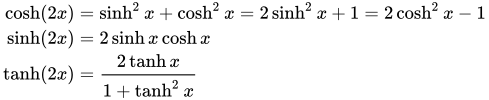
ผลรวมและผลต่างของอาร์กิวเมนต์ sinh ( x + y ) = sinh x cosh y + cosh x sinh y cosh ( x + y ) = cosh x cosh y + sinh x sinh y tanh ( x + y ) = tanh x + tanh y 1 + tanh x tanh y sinh ( x − y ) = sinh x cosh y − cosh x sinh y cosh ( x − y ) = cosh x cosh y − sinh x sinh y tanh ( x − y ) = tanh x − tanh y 1 − tanh x tanh y {\displaystyle {\begin{aligned}\sinh(x+y)&=\sinh x\cosh y+\cosh x\sinh y\\\cosh(x+y)&=\cosh x\cosh y+\sinh x\sinh y\\\tanh(x+y)&={\frac {\tanh x+\tanh y}{1+\tanh x\tanh y}}\\\sinh(x-y)&=\sinh x\cosh y-\cosh x\sinh y\\\cosh(x-y)&=\cosh x\cosh y-\sinh x\sinh y\\\tanh(x-y)&={\frac {\tanh x-\tanh y}{1-\tanh x\tanh y}}\\\end{aligned}}} cosh ( 2 x ) = sinh 2 x + cosh 2 x = 2 sinh 2 x + 1 = 2 cosh 2 x − 1 sinh ( 2 x ) = 2 sinh x cosh x tanh ( 2 x ) = 2 tanh x 1 + tanh 2 x {\displaystyle {\begin{aligned}\cosh(2x)&=\sinh ^{2}{x}+\cosh ^{2}{x}=2\sinh ^{2}x+1=2\cosh ^{2}x-1\\\sinh(2x)&=2\sinh x\cosh x\\\tanh(2x)&={\frac {2\tanh x}{1+\tanh ^{2}x}}\\\end{aligned}}}
sinh x + sinh y = 2 sinh ( x + y 2 ) cosh ( x − y 2 ) cosh x + cosh y = 2 cosh ( x + y 2 ) cosh ( x − y 2 ) sinh x − sinh y = 2 cosh ( x + y 2 ) sinh ( x − y 2 ) cosh x − cosh y = 2 sinh ( x + y 2 ) sinh ( x − y 2 ) {\displaystyle {\begin{aligned}\sinh x+\sinh y&=2\sinh \left({\frac {x+y}{2}}\right)\cosh \left({\frac {x-y}{2}}\right)\\\cosh x+\cosh y&=2\cosh \left({\frac {x+y}{2}}\right)\cosh \left({\frac {x-y}{2}}\right)\\\sinh x-\sinh y&=2\cosh \left({\frac {x+y}{2}}\right)\sinh \left({\frac {x-y}{2}}\right)\\\cosh x-\cosh y&=2\sinh \left({\frac {x+y}{2}}\right)\sinh \left({\frac {x-y}{2}}\right)\\\end{aligned}}}
cosh x cosh y = 1 2 ( cosh ( x + y ) + cosh ( x − y ) ) sinh x sinh y = 1 2 ( cosh ( x + y ) − cosh ( x − y ) ) sinh x cosh y = 1 2 ( sinh ( x + y ) + sinh ( x − y ) ) cosh x sinh y = 1 2 ( sinh ( x + y ) − sinh ( x − y ) ) {\displaystyle {\begin{aligned}\cosh x\,\cosh y&={\tfrac {1}{2}}{\bigl (}\!\!~\cosh(x+y)+\cosh(x-y){\bigr )}\\[5mu]\sinh x\,\sinh y&={\tfrac {1}{2}}{\bigl (}\!\!~\cosh(x+y)-\cosh(x-y){\bigr )}\\[5mu]\sinh x\,\cosh y&={\tfrac {1}{2}}{\bigl (}\!\!~\sinh(x+y)+\sinh(x-y){\bigr )}\\[5mu]\cosh x\,\sinh y&={\tfrac {1}{2}}{\bigl (}\!\!~\sinh(x+y)-\sinh(x-y){\bigr )}\\[5mu]\end{aligned}}}
sinh ( x 2 ) = sinh x 2 ( cosh x + 1 ) = sgn x cosh x − 1 2 cosh ( x 2 ) = cosh x + 1 2 tanh ( x 2 ) = sinh x cosh x + 1 = sgn x cosh x − 1 cosh x + 1 = e x − 1 e x + 1 {\displaystyle {\begin{aligned}\sinh \left({\frac {x}{2}}\right)&={\frac {\sinh x}{\sqrt {2(\cosh x+1)}}}&&=\operatorname {sgn} x\,{\sqrt {\frac {\cosh x-1}{2}}}\\[6px]\cosh \left({\frac {x}{2}}\right)&={\sqrt {\frac {\cosh x+1}{2}}}\\[6px]\tanh \left({\frac {x}{2}}\right)&={\frac {\sinh x}{\cosh x+1}}&&=\operatorname {sgn} x\,{\sqrt {\frac {\cosh x-1}{\cosh x+1}}}={\frac {e^{x}-1}{e^{x}+1}}\end{aligned}}}
โดยที่sgn คือฟังก์ชัน เครื่องหมาย
ถ้าx ≠ 0
tanh ( x 2 ) = cosh x − 1 sinh x = coth x − csch x {\displaystyle \tanh \left({\frac {x}{2}}\right)={\frac {\cosh x-1}{\sinh x}}=\coth x-\operatorname {csch} x}
เมื่อ t = tanh ( x 2 ) {\displaystyle t=\tanh \left({\frac {x}{2}}\right)} , sinh x = 2 t 1 − t 2 , cosh x = 1 + t 2 1 − t 2 , tanh x = 2 t 1 + t 2 , coth x = 1 + t 2 2 t , sech x = 1 − t 2 1 + t 2 , csch x = 1 − t 2 2 t . {\displaystyle {\begin{aligned}&\sinh x={\frac {2t}{1-t^{2}}},&&\cosh x={\frac {1+t^{2}}{1-t^{2}}},\\[8pt]&\tanh x={\frac {2t}{1+t^{2}}},&&\coth x={\frac {1+t^{2}}{2t}},\\[8pt]&\operatorname {sech} x={\frac {1-t^{2}}{1+t^{2}}},&&\operatorname {csch} x={\frac {1-t^{2}}{2t}}.\end{aligned}}}
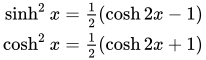
sinh 2 x = 1 2 ( cosh 2 x − 1 ) cosh 2 x = 1 2 ( cosh 2 x + 1 ) {\displaystyle {\begin{aligned}\sinh ^{2}x&={\tfrac {1}{2}}(\cosh 2x-1)\\\cosh ^{2}x&={\tfrac {1}{2}}(\cosh 2x+1)\end{aligned}}}
ความไม่เท่าเทียมกัน อสมการต่อไปนี้มีประโยชน์ในทางสถิติ: [ 21 ] cosh ( t ) ≤ e t 2 / 2 . {\displaystyle \operatorname {cosh} (t)\leq e^{t^{2}/2}.}
สามารถพิสูจน์ได้โดยการเปรียบเทียบอนุกรมเทย์เลอร์ของฟังก์ชันทั้งสองทีละพจน์
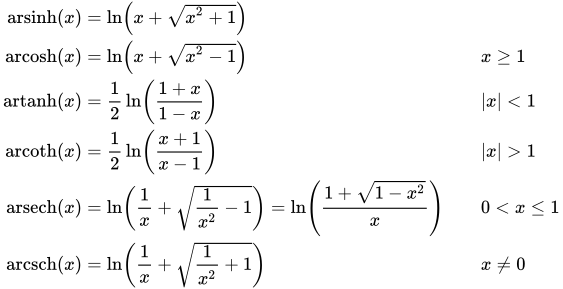
ฟังก์ชันผกผันในรูปของลอการิทึม arsinh ( x ) = ln ( x + x 2 + 1 ) arcosh ( x ) = ln ( x + x 2 − 1 ) x ≥ 1 artanh ( x ) = 1 2 ln ( 1 + x 1 − x ) | x | < 1 arcoth ( x ) = 1 2 ln ( x + 1 x − 1 ) | x | > 1 arsech ( x ) = ln ( 1 x + 1 x 2 − 1 ) = ln ( 1 + 1 − x 2 x ) 0 < x ≤ 1 arcsch ( x ) = ln ( 1 x + 1 x 2 + 1 ) x ≠ 0 {\displaystyle {\begin{aligned}\operatorname {arsinh} (x)&=\ln \left(x+{\sqrt {x^{2}+1}}\right)\\\operatorname {arcosh} (x)&=\ln \left(x+{\sqrt {x^{2}-1}}\right)&&x\geq 1\\\operatorname {artanh} (x)&={\frac {1}{2}}\ln \left({\frac {1+x}{1-x}}\right)&&|x|<1\\\operatorname {arcoth} (x)&={\frac {1}{2}}\ln \left({\frac {x+1}{x-1}}\right)&&|x|>1\\\operatorname {arsech} (x)&=\ln \left({\frac {1}{x}}+{\sqrt {{\frac {1}{x^{2}}}-1}}\right)=\ln \left({\frac {1+{\sqrt {1-x^{2}}}}{x}}\right)&&0<x\leq 1\\\operatorname {arcsch} (x)&=\ln \left({\frac {1}{x}}+{\sqrt {{\frac {1}{x^{2}}}+1}}\right)&&x\neq 0\end{aligned}}}
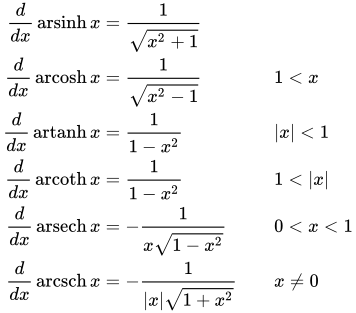
อนุพันธ์ d d x sinh x = cosh x d d x cosh x = sinh x d d x tanh x = 1 − tanh 2 x = sech 2 x = 1 cosh 2 x d d x coth x = 1 − coth 2 x = − csch 2 x = − 1 sinh 2 x x ≠ 0 d d x sech x = − tanh x sech x d d x csch x = − coth x csch x x ≠ 0 {\displaystyle {\begin{aligned}{\frac {d}{dx}}\sinh x&=\cosh x\\{\frac {d}{dx}}\cosh x&=\sinh x\\{\frac {d}{dx}}\tanh x&=1-\tanh ^{2}x=\operatorname {sech} ^{2}x={\frac {1}{\cosh ^{2}x}}\\{\frac {d}{dx}}\coth x&=1-\coth ^{2}x=-\operatorname {csch} ^{2}x=-{\frac {1}{\sinh ^{2}x}}&&x\neq 0\\{\frac {d}{dx}}\operatorname {sech} x&=-\tanh x\operatorname {sech} x\\{\frac {d}{dx}}\operatorname {csch} x&=-\coth x\operatorname {csch} x&&x\neq 0\end{aligned}}} d d x arsinh x = 1 x 2 + 1 d d x arcosh x = 1 x 2 − 1 1 < x d d x artanh x = 1 1 − x 2 | x | < 1 d d x arcoth x = 1 1 − x 2 1 < | x | d d x arsech x = − 1 x 1 − x 2 0 < x < 1 d d x arcsch x = − 1 | x | 1 + x 2 x ≠ 0 {\displaystyle {\begin{aligned}{\frac {d}{dx}}\operatorname {arsinh} x&={\frac {1}{\sqrt {x^{2}+1}}}\\{\frac {d}{dx}}\operatorname {arcosh} x&={\frac {1}{\sqrt {x^{2}-1}}}&&1<x\\{\frac {d}{dx}}\operatorname {artanh} x&={\frac {1}{1-x^{2}}}&&|x|<1\\{\frac {d}{dx}}\operatorname {arcoth} x&={\frac {1}{1-x^{2}}}&&1<|x|\\{\frac {d}{dx}}\operatorname {arsech} x&=-{\frac {1}{x{\sqrt {1-x^{2}}}}}&&0<x<1\\{\frac {d}{dx}}\operatorname {arcsch} x&=-{\frac {1}{|x|{\sqrt {1+x^{2}}}}}&&x\neq 0\end{aligned}}}
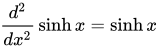
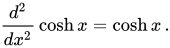
อนุพันธ์อันดับสอง ฟังก์ชัน sinh และcosh แต่ละฟังก์ชันมีค่าเท่ากับอนุพันธ์อันดับสอง ของฟังก์ชัน นั้น นั่นคือ: d 2 d x 2 sinh x = sinh x {\displaystyle {\frac {d^{2}}{dx^{2}}}\sinh x=\sinh x} d 2 d x 2 cosh x = cosh x . {\displaystyle {\frac {d^{2}}{dx^{2}}}\cosh x=\cosh x\,.}
ฟังก์ชันทั้งหมดที่มีคุณสมบัตินี้เป็นการรวมเชิงเส้น ของ และ cosh โดย เฉพาะฟังก์ชันเลขชี้กำลัง และ[ 22 e x {\displaystyle e^{x}} e − x {\displaystyle e^{-x}}
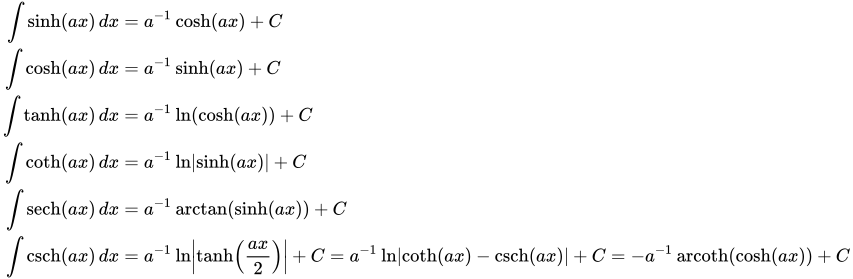
อินทิกรัลมาตรฐาน ∫ sinh ( a x ) d x = a − 1 cosh ( a x ) + C ∫ cosh ( a x ) d x = a − 1 sinh ( a x ) + C ∫ tanh ( a x ) d x = a − 1 ln ( cosh ( a x ) ) + C ∫ coth ( a x ) d x = a − 1 ln | sinh ( a x ) | + C ∫ sech ( a x ) d x = a − 1 arctan ( sinh ( a x ) ) + C ∫ csch ( a x ) d x = a − 1 ln | tanh ( a x 2 ) | + C = a − 1 ln | coth ( a x ) − csch ( a x ) | + C = − a − 1 arcoth ( cosh ( a x ) ) + C {\displaystyle {\begin{aligned}\int \sinh(ax)\,dx&=a^{-1}\cosh(ax)+C\\\int \cosh(ax)\,dx&=a^{-1}\sinh(ax)+C\\\int \tanh(ax)\,dx&=a^{-1}\ln(\cosh(ax))+C\\\int \coth(ax)\,dx&=a^{-1}\ln \left|\sinh(ax)\right|+C\\\int \operatorname {sech} (ax)\,dx&=a^{-1}\arctan(\sinh(ax))+C\\\int \operatorname {csch} (ax)\,dx&=a^{-1}\ln \left|\tanh \left({\frac {ax}{2}}\right)\right|+C=a^{-1}\ln \left|\coth \left(ax\right)-\operatorname {csch} \left(ax\right)\right|+C=-a^{-1}\operatorname {arcoth} \left(\cosh \left(ax\right)\right)+C\end{aligned}}}
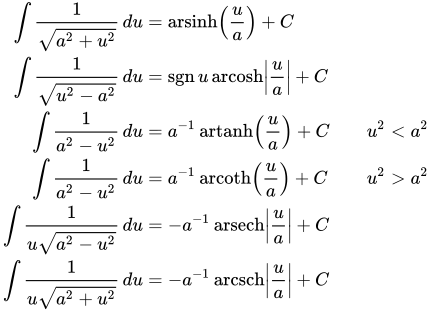
สามารถพิสูจน์ปริพันธ์ต่อไปนี้ได้โดยใช้วิธีการแทนที่แบบไฮเปอร์โบลิก : ∫ 1 a 2 + u 2 d u = arsinh ( u a ) + C ∫ 1 u 2 − a 2 d u = sgn u arcosh | u a | + C ∫ 1 a 2 − u 2 d u = a − 1 artanh ( u a ) + C u 2 < a 2 ∫ 1 a 2 − u 2 d u = a − 1 arcoth ( u a ) + C u 2 > a 2 ∫ 1 u a 2 − u 2 d u = − a − 1 arsech | u a | + C ∫ 1 u a 2 + u 2 d u = − a − 1 arcsch | u a | + C {\displaystyle {\begin{aligned}\int {{\frac {1}{\sqrt {a^{2}+u^{2}}}}\,du}&=\operatorname {arsinh} \left({\frac {u}{a}}\right)+C\\\int {{\frac {1}{\sqrt {u^{2}-a^{2}}}}\,du}&=\operatorname {sgn} {u}\operatorname {arcosh} \left|{\frac {u}{a}}\right|+C\\\int {\frac {1}{a^{2}-u^{2}}}\,du&=a^{-1}\operatorname {artanh} \left({\frac {u}{a}}\right)+C&&u^{2}<a^{2}\\\int {\frac {1}{a^{2}-u^{2}}}\,du&=a^{-1}\operatorname {arcoth} \left({\frac {u}{a}}\right)+C&&u^{2}>a^{2}\\\int {{\frac {1}{u{\sqrt {a^{2}-u^{2}}}}}\,du}&=-a^{-1}\operatorname {arsech} \left|{\frac {u}{a}}\right|+C\\\int {{\frac {1}{u{\sqrt {a^{2}+u^{2}}}}}\,du}&=-a^{-1}\operatorname {arcsch} \left|{\frac {u}{a}}\right|+C\end{aligned}}}
โดยที่C คือค่าคงที่ของการอินทิเกร ต
นิพจน์อนุกรมเทย์เลอร์ สามารถแสดงอนุกรมเทย์เลอร์ ที่จุดศูนย์ (หรืออนุกรมลอเรนต์ หากฟังก์ชันไม่นิยามที่จุดศูนย์) ของฟังก์ชันข้างต้น ได้อย่างชัดเจน
sinh x = x + x 3 3 ! + x 5 5 ! + x 7 7 ! + ⋯ = ∑ n = 0 ∞ x 2 n + 1 ( 2 n + 1 ) ! {\displaystyle \sinh x=x+{\frac {x^{3}}{3!}}+{\frac {x^{5}}{5!}}+{\frac {x^{7}}{7!}}+\cdots =\sum _{n=0}^{\infty }{\frac {x^{2n+1}}{(2n+1)!}}} ลู่เข้า สำหรับค่าx เชิงซ้อน ทุกค่า เนื่องจากฟังก์ชันsinh x ฟังก์ชันคี่ ดังนั้นเลขชี้กำลังของx
cosh x = 1 + x 2 2 ! + x 4 4 ! + x 6 6 ! + ⋯ = ∑ n = 0 ∞ x 2 n ( 2 n ) ! {\displaystyle \cosh x=1+{\frac {x^{2}}{2!}}+{\frac {x^{4}}{4!}}+{\frac {x^{6}}{6!}}+\cdots =\sum _{n=0}^{\infty }{\frac {x^{2n}}{(2n)!}}} เข้า สำหรับค่าx เชิงซ้อน ทุกค่า เนื่องจากฟังก์ชันcosh x คู่ ดังนั้นเลขชี้กำลังของx ในอนุกรมเทย์เลอร์จึงมี เฉพาะเลขคู่เท่านั้น
ผลรวมของอนุกรม sinh และ cosh คืออนุกรมอนันต์ ที่แสดงฟังก์ชัน เลขชี้กำลัง
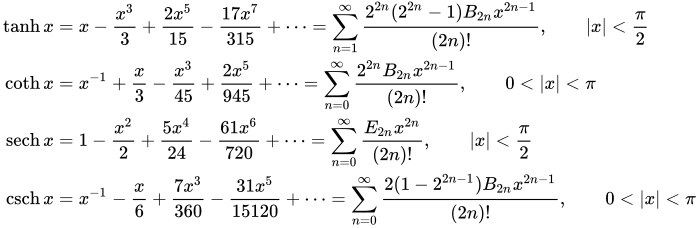
อนุกรมต่อไปนี้จะตามด้วยคำอธิบายของเซตย่อยในโดเมนการลู่เข้า ซึ่งอนุกรมนั้นลู่เข้าและผลรวมของอนุกรมเท่ากับฟังก์ชัน tanh x = x − x 3 3 + 2 x 5 15 − 17 x 7 315 + ⋯ = ∑ n = 1 ∞ 2 2 n ( 2 2 n − 1 ) B 2 n x 2 n − 1 ( 2 n ) ! , | x | < π 2 coth x = x − 1 + x 3 − x 3 45 + 2 x 5 945 + ⋯ = ∑ n = 0 ∞ 2 2 n B 2 n x 2 n − 1 ( 2 n ) ! , 0 < | x | < π sech x = 1 − x 2 2 + 5 x 4 24 − 61 x 6 720 + ⋯ = ∑ n = 0 ∞ E 2 n x 2 n ( 2 n ) ! , | x | < π 2 csch x = x − 1 − x 6 + 7 x 3 360 − 31 x 5 15120 + ⋯ = ∑ n = 0 ∞ 2 ( 1 − 2 2 n − 1 ) B 2 n x 2 n − 1 ( 2 n ) ! , 0 < | x | < π {\displaystyle {\begin{aligned}\tanh x&=x-{\frac {x^{3}}{3}}+{\frac {2x^{5}}{15}}-{\frac {17x^{7}}{315}}+\cdots =\sum _{n=1}^{\infty }{\frac {2^{2n}(2^{2n}-1)B_{2n}x^{2n-1}}{(2n)!}},\qquad \left|x\right|<{\frac {\pi }{2}}\\\coth x&=x^{-1}+{\frac {x}{3}}-{\frac {x^{3}}{45}}+{\frac {2x^{5}}{945}}+\cdots =\sum _{n=0}^{\infty }{\frac {2^{2n}B_{2n}x^{2n-1}}{(2n)!}},\qquad 0<\left|x\right|<\pi \\\operatorname {sech} x&=1-{\frac {x^{2}}{2}}+{\frac {5x^{4}}{24}}-{\frac {61x^{6}}{720}}+\cdots =\sum _{n=0}^{\infty }{\frac {E_{2n}x^{2n}}{(2n)!}},\qquad \left|x\right|<{\frac {\pi }{2}}\\\operatorname {csch} x&=x^{-1}-{\frac {x}{6}}+{\frac {7x^{3}}{360}}-{\frac {31x^{5}}{15120}}+\cdots =\sum _{n=0}^{\infty }{\frac {2(1-2^{2n-1})B_{2n}x^{2n-1}}{(2n)!}},\qquad 0<\left|x\right|<\pi \end{aligned}}}
ที่ไหน:
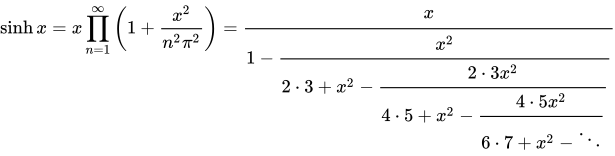
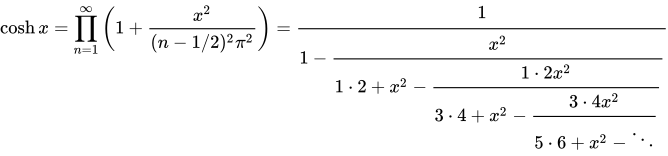
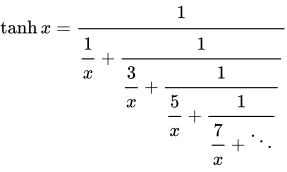
ผลคูณอนันต์และเศษส่วนต่อเนื่อง การกระจายต่อไปนี้ใช้ได้ในระนาบเชิงซ้อนทั้งหมด:
sinh x = x ∏ n = 1 ∞ ( 1 + x 2 n 2 π 2 ) = x 1 − x 2 2 ⋅ 3 + x 2 − 2 ⋅ 3 x 2 4 ⋅ 5 + x 2 − 4 ⋅ 5 x 2 6 ⋅ 7 + x 2 − ⋱ {\displaystyle \sinh x=x\prod _{n=1}^{\infty }\left(1+{\frac {x^{2}}{n^{2}\pi ^{2}}}\right)={\cfrac {x}{1-{\cfrac {x^{2}}{2\cdot 3+x^{2}-{\cfrac {2\cdot 3x^{2}}{4\cdot 5+x^{2}-{\cfrac {4\cdot 5x^{2}}{6\cdot 7+x^{2}-\ddots }}}}}}}}} cosh x = ∏ n = 1 ∞ ( 1 + x 2 ( n − 1 / 2 ) 2 π 2 ) = 1 1 − x 2 1 ⋅ 2 + x 2 − 1 ⋅ 2 x 2 3 ⋅ 4 + x 2 − 3 ⋅ 4 x 2 5 ⋅ 6 + x 2 − ⋱ {\displaystyle \cosh x=\prod _{n=1}^{\infty }\left(1+{\frac {x^{2}}{(n-1/2)^{2}\pi ^{2}}}\right)={\cfrac {1}{1-{\cfrac {x^{2}}{1\cdot 2+x^{2}-{\cfrac {1\cdot 2x^{2}}{3\cdot 4+x^{2}-{\cfrac {3\cdot 4x^{2}}{5\cdot 6+x^{2}-\ddots }}}}}}}}} tanh x = 1 1 x + 1 3 x + 1 5 x + 1 7 x + ⋱ {\displaystyle \tanh x={\cfrac {1}{{\cfrac {1}{x}}+{\cfrac {1}{{\cfrac {3}{x}}+{\cfrac {1}{{\cfrac {5}{x}}+{\cfrac {1}{{\cfrac {7}{x}}+\ddots }}}}}}}}}
การเปรียบเทียบกับฟังก์ชันวงกลม เส้นสัมผัสวงกลมและไฮเปอร์โบลาที่(1, 1) แสดงเรขาคณิตของ ฟังก์ชันวงกลมในแง่ของพื้นที่ภาควงกลม u และฟังก์ชันไฮเปอร์โบลาขึ้นอยู่กับพื้นที่ภาคไฮเปอร์โบลา u ฟังก์ชันไฮเปอร์โบลิกเป็นการขยายขอบเขตของตรีโกณมิติ ไปไกลกว่าฟังก์ชันวงกลม ทั้งสองประเภทขึ้นอยู่กับตัวแปรอาร์กิวเมนต์ ไม่ว่าจะเป็นมุมวงกลม หรือมุมไฮเปอร์โบลิ ก
เนื่องจากพื้นที่ของส่วนวงกลม ที่มีรัศมีr และมุมu (ในหน่วยเรเดียน) คือr²u / 2 ดังนั้นพื้นที่ของส่วน วงกลมu เมื่อr = √2 xy = 1 ที่ (1, 1) ส่วนวงกลมสีเหลืองแสดงถึงพื้นที่และขนาดของมุม ในทำนองเดียวกัน บริเวณสีเหลืองและสีแดงรวมกันแสดงถึงส่วนวงกลมไฮ เปอร์โบลา ที่มีพื้นที่สอดคล้องกับขนาดของมุมไฮเปอร์โบลา
ด้านประกอบมุมฉากของ สามเหลี่ยมมุมฉาก สองรูปที่มี ด้านตรงข้าม มุมฉาก อยู่บนรังสีที่กำหนดมุมนั้น มีความยาวเท่ากับ√2 เท่า ของฟังก์ชันวงกลมและฟังก์ชันไฮเปอร์โบลิก
มุมไฮเปอร์โบลิกเป็นการวัดที่ไม่เปลี่ยนแปลง เมื่อเทียบกับการแมปการบีบอัด เช่นเดียวกับมุมวงกลมที่ไม่เปลี่ยนแปลงภายใต้การหมุน[ 23 ]
ฟังก์ชันกูเดอร์มันน์ ให้ความสัมพันธ์โดยตรงระหว่างฟังก์ชันวงกลมและฟังก์ชันไฮเปอร์โบลิก โดยไม่เกี่ยวข้องกับจำนวนเชิงซ้อน
กราฟของฟังก์ชันนี้a cosh ( x / a ) {\displaystyle a\cosh(x/a)} คือเส้นโค้งแคทเทนารี ซึ่ง เป็นเส้นโค้งที่เกิดจากโซ่ที่ยืดหยุ่นสม่ำเสมอ แขวนอย่างอิสระระหว่างจุดตรึงสองจุดภายใต้แรงโน้มถ่วงสม่ำเสมอ
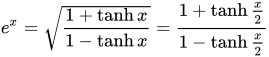
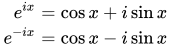
ความสัมพันธ์กับฟังก์ชันเลขชี้กำลัง การแยกฟังก์ชันเลขชี้กำลังออกเป็นส่วนคู่และส่วนคี่ ทำให้ได้เอกลักษณ์ และ เมื่อรวมกับสูตรของออยเลอร์ จะได้ สำหรับฟังก์ชันเลขชี้กำลังเชิงซ้อน ทั่วไป e x = cosh x + sinh x , {\displaystyle e^{x}=\cosh x+\sinh x,} e − x = cosh x − sinh x . {\displaystyle e^{-x}=\cosh x-\sinh x.} e i x = cos x + i sin x , {\displaystyle e^{ix}=\cos x+i\sin x,} e x + i y = ( cosh x + sinh x ) ( cos y + i sin y ) {\displaystyle e^{x+iy}=(\cosh x+\sinh x)(\cos y+i\sin y)}
นอกจากนี้ e x = 1 + tanh x 1 − tanh x = 1 + tanh x 2 1 − tanh x 2 {\displaystyle e^{x}={\sqrt {\frac {1+\tanh x}{1-\tanh x}}}={\frac {1+\tanh {\frac {x}{2}}}{1-\tanh {\frac {x}{2}}}}}
ฟังก์ชันไฮเปอร์โบลิกสำหรับจำนวนเชิงซ้อน ฟังก์ชันไฮเปอร์โบลิกในระนาบเชิงซ้อน sinh ( z ) {\displaystyle \sinh(z)} cosh ( z ) {\displaystyle \cosh(z)} tanh ( z ) {\displaystyle \tanh(z)} coth ( z ) {\displaystyle \coth(z)} sech ( z ) {\displaystyle \operatorname {sech} (z)} csch ( z ) {\displaystyle \operatorname {csch} (z)}
เนื่องจากฟังก์ชันเลขชี้กำลัง สามารถนิยามได้สำหรับอาร์กิวเมนต์ เชิงซ้อนใดๆ เราจึงสามารถขยายคำนิยามของฟังก์ชันไฮเปอร์โบลิกไปยังอาร์กิวเมนต์เชิงซ้อนได้เช่นกัน ฟังก์ชันsinh z และcosh z จึงเป็น ฟังก์ชัน โฮโลมอร์ ฟิก
ความสัมพันธ์กับฟังก์ชันตรีโกณมิติทั่วไปนั้นกำหนดโดยสูตรของออยเลอร์ สำหรับจำนวนเชิงซ้อน ดังนี้: e i x = cos x + i sin x e − i x = cos x − i sin x {\displaystyle {\begin{aligned}e^{ix}&=\cos x+i\sin x\\e^{-ix}&=\cos x-i\sin x\end{aligned}}} cosh ( i x ) = 1 2 ( e i x + e − i x ) = cos x sinh ( i x ) = 1 2 ( e i x − e − i x ) = i sin x tanh ( i x ) = i tan x cosh ( x + i y ) = cosh ( x ) cos ( y ) + i sinh ( x ) sin ( y ) sinh ( x + i y ) = sinh ( x ) cos ( y ) + i cosh ( x ) sin ( y ) tanh ( x + i y ) = tanh ( x ) + i tan ( y ) 1 + i tanh ( x ) tan ( y ) cosh x = cos ( i x ) sinh x = − i sin ( i x ) tanh x = − i tan ( i x ) {\displaystyle {\begin{aligned}\cosh(ix)&={\frac {1}{2}}\left(e^{ix}+e^{-ix}\right)=\cos x\\\sinh(ix)&={\frac {1}{2}}\left(e^{ix}-e^{-ix}\right)=i\sin x\\\tanh(ix)&=i\tan x\\\cosh(x+iy)&=\cosh(x)\cos(y)+i\sinh(x)\sin(y)\\\sinh(x+iy)&=\sinh(x)\cos(y)+i\cosh(x)\sin(y)\\\tanh(x+iy)&={\frac {\tanh(x)+i\tan(y)}{1+i\tanh(x)\tan(y)}}\\\cosh x&=\cos(ix)\\\sinh x&=-i\sin(ix)\\\tanh x&=-i\tan(ix)\end{aligned}}}
ดังนั้น ฟังก์ชันไฮเปอร์โบลิกจึงเป็นฟังก์ชันคาบเมื่อ เทียบกับส่วนจินตภาพ โดยมีคาบ( สำหรับฟังก์ชันแทนเจนต์และโคแทนเจนต์ไฮเปอร์โบลิก) 2 π i {\displaystyle 2\pi i} π i {\displaystyle \pi i}
ดูเพิ่มเติม
ลิงก์ภายนอก วิกิมีเดียคอมมอนส์มีสื่อที่เกี่ยวข้องกับฟังก์ชันไฮเปอร์โบลิ ก























![{\displaystyle {\begin{aligned}\cosh x\,\cosh y&={\tfrac {1}{2}}{\bigl (}\!\!~\cosh(x+y)+\cosh(xy){\bigr )}\\[5mu]\sinh x\,\sinh y&={\tfrac {1}{2}}{\bigl (}\!\!~\cosh(x+y)-\cosh(xy){\bigr )}\\[5mu]\sinh x\,\cosh y&={\tfrac {1}{2}}{\bigl (}\!\!~\sinh(x+y)+\sinh(xy){\bigr )}\\[5mu]\cosh x\,\sinh y&={\tfrac {1}{2}}{\bigl (}\!\!~\sinh(x+y)-\sinh(xy){\bigr )}\\[5mu]\end{aligned}}}](https://wikimedia.org/api/rest_v1/media/math/render/svg/ebcc6e905df736163061cf56b304ab50d7853739)
![{\displaystyle {\begin{aligned}\sinh \left({\frac {x}{2}}\right)&={\frac {\sinh x}{\sqrt {2(\cosh x+1)}}}&&=\operatorname {sgn} x\,{\sqrt {\frac {\cosh x-1}{2}}}\\[6px]\cosh \left({\frac {x}{2}}\right)&={\sqrt {\frac {\cosh x+1}{2}}}\\[6px]\tanh \left({\frac {x}{2}}\right)&={\frac {\sinh x}{\cosh x+1}}&&=\operatorname {sgn} x\,{\sqrt {\frac {\cosh x-1}{\cosh x+1}}}={\frac {e^{x}-1}{e^{x}+1}}\end{aligned}}}](https://wikimedia.org/api/rest_v1/media/math/render/svg/412a4ffd109486f684e515634b33447b13444954)


![{\displaystyle {\begin{aligned}&\sinh x={\frac {2t}{1-t^{2}}},&&\cosh x={\frac {1+t^{2}}{1-t^{2}}},\\[8pt]&\tanh x={\frac {2t}{1+t^{2}}},&&\coth x={\frac {1+t^{2}}{2t}},\\[8pt]&\operatorname {sech} x={\frac {1-t^{2}}{1+t^{2}}},&&\operatorname {csch} x={\frac {1-t^{2}}{2t}}.\end{aligned}}}](https://wikimedia.org/api/rest_v1/media/math/render/svg/5c5e6413116e81cae13055fdf64801ff32f597a5)