
อ่าน 26 นาที
รายชื่อฟอสซิลวิวัฒนาการของมนุษย์
ตารางต่อไปนี้แสดงภาพรวมของการค้นพบฟอสซิลและซากดึกดำบรรพ์ ของมนุษย์ยุคแรกๆ ที่เกี่ยวข้องกับวิวัฒนาการของมนุษย์โดยเริ่มต้นจากการก่อตัวของเผ่าโฮมินินี...
รายชื่อฟอสซิลวิวัฒนาการของมนุษย์
| ส่วนหนึ่งของชุดบทความเกี่ยวกับ |
| บรรพชีวินวิทยา |
|---|
 |


ตารางต่อไปนี้แสดงภาพรวมของการค้นพบฟอสซิลและซากดึกดำบรรพ์ ของมนุษย์ยุคแรกๆ ที่เกี่ยวข้องกับวิวัฒนาการของมนุษย์โดยเริ่มต้นจากการก่อตัวของเผ่าโฮมินินี (การแยกสายพันธุ์ของมนุษย์และชิมแปนซี ) ในช่วงปลายสมัยไมโอซีนเมื่อประมาณ 7 ถึง 8 ล้านปีก่อน
ภาพรวมนี้ไม่สมบูรณ์ แต่แสดงให้เห็นถึงข้อค้นพบที่สำคัญที่สุดบางส่วน การค้นพบกะโหลกหรือโครงกระดูกที่สมบูรณ์นั้นหายาก และมีฟอสซิลจำนวนหลายพันชิ้น ส่วนใหญ่เป็นชิ้นส่วนเล็กๆ มักประกอบด้วยกระดูกชิ้นเดียวหรือฟันที่แยกออกมา ทำให้ยากต่อการระบุชนิดได้อย่างแม่นยำ ฟอสซิลถูกจัดเรียงตามอายุโดยประมาณที่กำหนดโดยการหาอายุด้วยรังสีและ/หรือการหาอายุแบบเพิ่มขึ้นและชื่อสายพันธุ์แสดงถึงฉันทามติในปัจจุบัน หากไม่มีฉันทามติทางวิทยาศาสตร์ที่ชัดเจน จะมีการระบุการจำแนกประเภทอื่นๆ ที่เป็นไปได้
ฟอสซิลยุคแรกที่แสดงอยู่นั้นไม่ได้ถือว่าเป็นบรรพบุรุษของโฮโมเซเปียนส์แต่มีความสัมพันธ์ใกล้ชิดกับบรรพบุรุษ และจึงมีความสำคัญต่อการศึกษาลำดับวงศ์ตระกูล หลังจาก 1.5 ล้านปีก่อน (การสูญพันธุ์ของพารานโทรปัส ) ฟอสซิลทั้งหมดที่แสดงอยู่เป็นฟอสซิลมนุษย์ (สกุลโฮโม ) หลังจาก 11,500 ปีก่อน (11.5 ka จุดเริ่มต้นของยุคโฮโลซีน ) ฟอสซิลทั้งหมดที่แสดงอยู่เป็นโฮโมเซเปียนส์ ( มนุษย์ยุคใหม่ที่มีลักษณะทางกายวิภาคเหมือนมนุษย์ปัจจุบัน ) ซึ่งแสดงให้เห็นถึงการแยกตัวที่เกิดขึ้นเมื่อไม่นานมานี้ใน การก่อตัวของประชากรย่อยของมนุษย์ยุคใหม่
สมัยไมโอซีนตอนปลาย (อายุ 7.2–5.5 ล้านปี)
การแยกสายวิวัฒนาการของชิมแปนซีและมนุษย์น่าจะเกิดขึ้นเมื่อประมาณ 10 ถึง 7 ล้านปีก่อน[ 1 ]รายชื่อฟอสซิลเริ่มต้นด้วยSahelanthropusซึ่งมีอายุราว 7 ล้านปีก่อน ซึ่งอาจเป็นบรรพบุรุษของทั้งมนุษย์และชิมแปนซีหรือไม่ก็ได้ แม้ว่าสถานะของมันในฐานะโฮมินินหรือบรรพบุรุษของโฮมินินยังคงเป็นที่ถกเถียงกันอยู่ สำหรับประวัติศาสตร์ช่วงต้นของสายพันธุ์มนุษย์ โปรดดูที่ไทม์ไลน์ของวิวัฒนาการของมนุษย์#Hominidae , Hominidae# Phylogeny
| ภาพ | ชื่อ | อายุ ( ล้านปี ) | สายพันธุ์ | ปีที่ค้นพบ | ประเทศ | ค้นพบโดย | ขณะนี้ตั้งอยู่ที่ |
|---|---|---|---|---|---|---|---|
 | TM 266 (ตูไม) | 7.00–6.00 [ 2 ] | Sahelanthropus tchadensis | 2001 | สถานที่สำคัญ ในประเทศชาด : ทะเลทรายจูราบ | อแลง โบวิแลง, ฟาโนน กงดิเบ, มหามัต อาดุม และ อาฮุนตา จิมดูมัลบาเย | เอ็นจาเมนา (ชาด), BEAC |
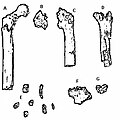 | บาร์ 1000'00 | 6.1–5.7 [ 3 ] | ออร์โรริน ทูเกเนนซิส | 2000 | เว็บไซต์ เคนยา : ลุคคิโน | มาร์ติน พิคฟอร์ด , คิปตาลัม เชบอย, โดมินิค กอเมอรี, ปิแอร์ มีน, บริจิตต์ เซนุต | |
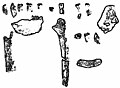 | ALA-VP 1/20 [ 4 ] | 5.65±0.150 | อาร์ดิพิเทคัส คาดับบา | พ.ศ. 2540 | แหล่ง โบราณคดีเอธิโอเปีย : บริเวณแม่น้ำอาวาชตอนกลาง | โยฮันเนส ไฮเล-เซลาสซี |
รอยเท้าของ Trachilosจากเกาะครีต รวมถึง ฟอสซิล ของ Graecopithecusไม่ได้ถูกรวมอยู่ในรายชื่อเนื่องจากความไม่แน่นอนทางอนุกรมวิธาน
ยุคไพลโอซีน (5.3–2.58 ล้านปีก่อน)



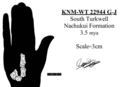
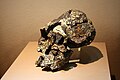
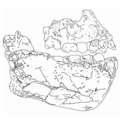
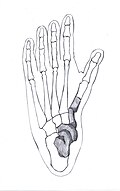
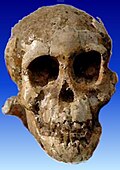
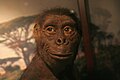

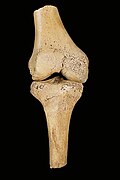
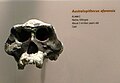
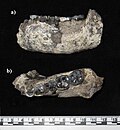
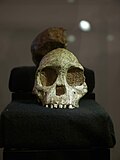
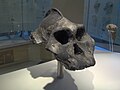
ยุคหินเก่าตอนต้น : อายุ 2.58–0.3 ล้านปี

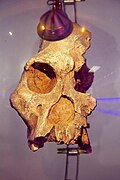
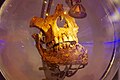
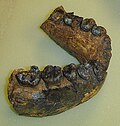
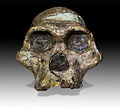
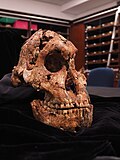
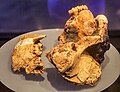
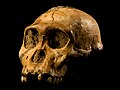
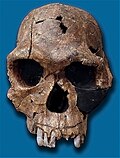
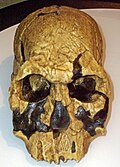

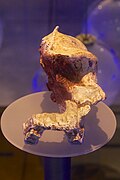
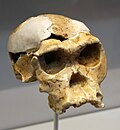
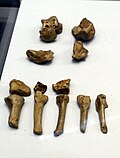
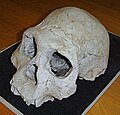


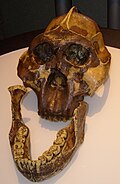
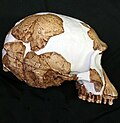


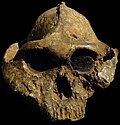

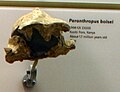
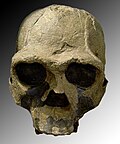
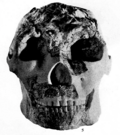
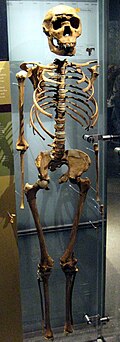
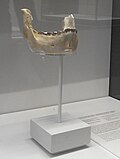
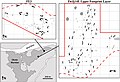
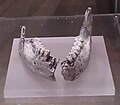
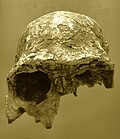
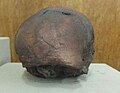
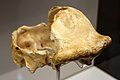
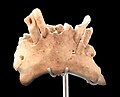
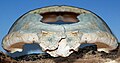
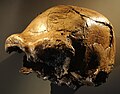
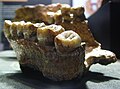
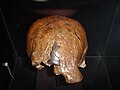
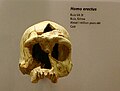
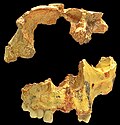
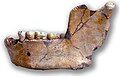
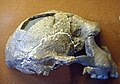

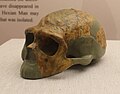
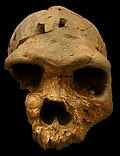
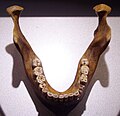
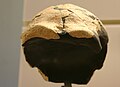
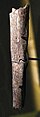
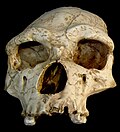
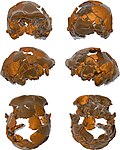

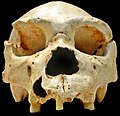

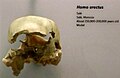
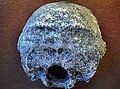
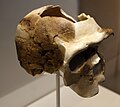
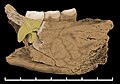
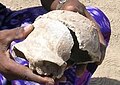
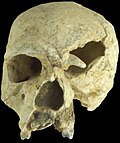
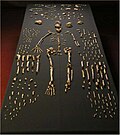
ยุคหินกลาง : อายุ 300,000–50,000 ปี

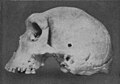

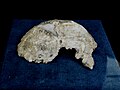
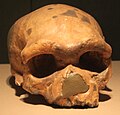

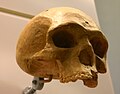
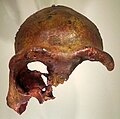

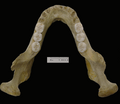
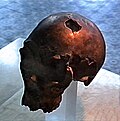
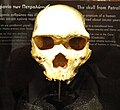
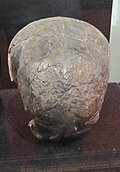

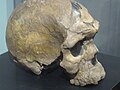
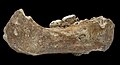
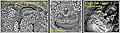

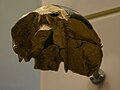
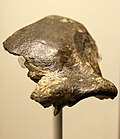
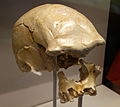

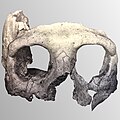
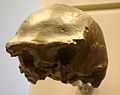
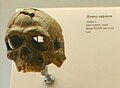
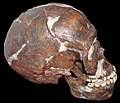
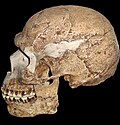
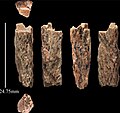
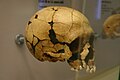
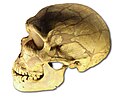
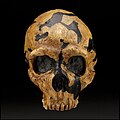

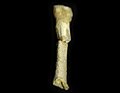

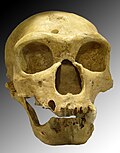
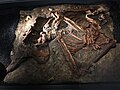
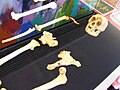

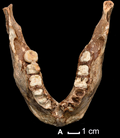
ยุคหินเก่าตอนปลาย : อายุ 50,000–11,500 ปี
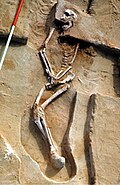
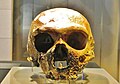
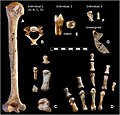
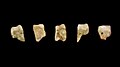

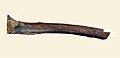
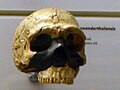
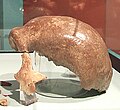
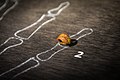
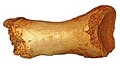
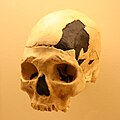
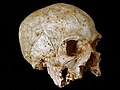
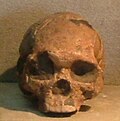


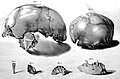


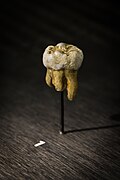

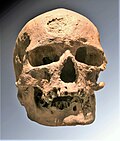

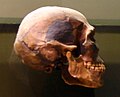


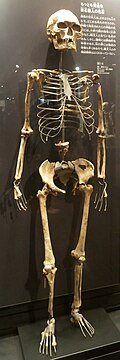

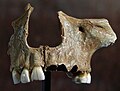
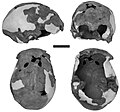


ยุคโฮโลซีน (11,500–5,000 ปีที่แล้ว)
| ชื่อ | อายุ ( ka ) | วัฒนธรรม / สมาคม | ปีที่ค้นพบ | ประเทศ | ค้นพบโดย | ขณะนี้ตั้งอยู่ที่ | |
|---|---|---|---|---|---|---|---|
 | ลูเซีย | 11.5 [ 174 ] | อินเดียนยุคโบราณ | พ.ศ. 2518 | บราซิล | ||
| [ 175 ] | เซร์โร โซตา 2 [ 176 ] | 11 | 1936 | ชิลี | |||
| " ซัตซูร์เบลีย " | 10 | ชาวคอเคเซียนยุคอีพิพาเลโอลิธิก ( CHG ) [ 168 ] | จอร์เจีย | ||||
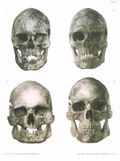
 | กะโหลกยาโฮ[ 177 ] | 10? | 1961 | ชาด | |||
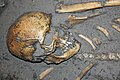
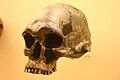 | บึงโคว์ 1 | 13–9 | 1968 | ออสเตรเลีย | |||
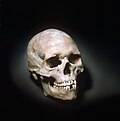
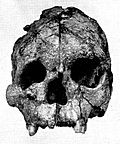 | กะโหลกทัลไก[ 178 ] | 10 ± 1 | 1886 | ออสเตรเลีย | |||
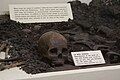 | ลา เบรีย วูแมน | 10 (8000 ปีก่อนคริสตกาล) | อินเดียนยุคโบราณ | 1914 | สหรัฐอเมริกา | ||
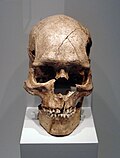 | คอมบ์ คาเปลล์ | 9.6 (7600 ปีก่อนคริสตกาล) [ 179 ] | ยุคเมโซลิธิกของยุโรป | 1909 | ฝรั่งเศส | ||
| ชายชาวอัสเซลาร์ | ระหว่าง 9500 BP และ 7000 BP ด้วยความระมัดระวัง 6390 BP [ 180 ] | ยุคหินใหม่ | 1927 | มาลี | |||
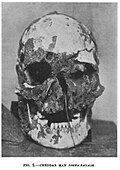 | เชดดาร์แมน | 9 (7000 ปีก่อนคริสตกาล) | ยุคเมโซลิธิกของอังกฤษ | 1903 | สหราชอาณาจักร | พิพิธภัณฑ์ประวัติศาสตร์ธรรมชาติลอนดอน | |
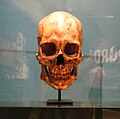 | ชายชาวเคนเนวิค | 9 (7000 ปีก่อนคริสตกาล) | ยุคโบราณ (อเมริกาเหนือ) | พ.ศ. 2539 | สหรัฐอเมริกา | ||
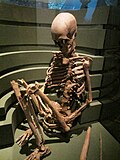 | ผู้หญิงบารัม | 8.8 (6800 ปีก่อนคริสตกาล) | ยุคเมโซลิธิกของยุโรป | 1939 | สวีเดน | ||
 | ชายชาวเทเป็กซ์ปัน | 8 ± 3 | อินเดียนยุคโบราณ | 1947 | เม็กซิโก | ||
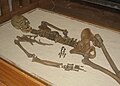 | ชายโลชบูร์[ 181 ] | 8 (6000 ปีก่อนคริสตกาล) | ยุคเมโซลิธิกของยุโรป ( WHG ) | 1935 | ลักเซมเบิร์ก | พิพิธภัณฑ์ประวัติศาสตร์ธรรมชาติแห่งชาติเมืองลักเซมเบิร์ก [ 182 ] | |
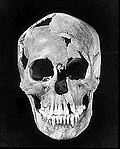 | ผู้หญิงจากมินนิโซตา | 7.9 ± 0.1 (5900 ปีก่อนคริสตกาล) | อินเดียนยุคโบราณ | 1931 | มินนิโซตาสหรัฐอเมริกา | ||
| Tumba Madžari [ 183 ] | 7.9 (5976–5760 ปีก่อนคริสตกาล) | พ.ศ. 2528 | มาซิโดเนียเหนือ | สโกเปียพิพิธภัณฑ์โบราณคดีแห่งสาธารณรัฐมาซิโดเนียเหนือ | |||
| โลธากัม 4b (โล 4b) [ 184 ] | 7.5 ± 1.5 [ 185 ] | พ.ศ. 2508–2518 | เคนยา | ||||
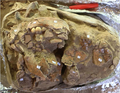 | เบสเซ่[ 186 ] | 7.3–7.2 | โทอาเลียน | 2015 | สุลาเวซีอินโดนีเซีย | ||
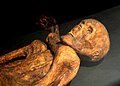 | โอตซี | 5.3 (3230 ปีก่อนคริสตกาล) | ยุคหินใหม่ของยุโรป | 1991 | เทือกเขาเอิทซ์ทาลประเทศอิตาลี | พิพิธภัณฑ์โบราณคดีเซาท์ไทโรลเมืองโบลซาโน ประเทศอิตาลี | |
| มัมมี่ทาริม | 4.1 (2135 ปีก่อนคริสตกาล) | วัฒนธรรมอาฟานาซิเอโว | ทศวรรษ 1970 | แอ่งทาริมประเทศจีน |
คำย่อที่ใช้ในชื่อแคตตาล็อกฟอสซิล
- อัล – ท้องถิ่นอันไกลโพ้น , เอธิโอเปีย
- ARA-VP – บรรพชีวินวิทยาสัตว์มีกระดูกสันหลัง Aramis, เอธิโอเปีย
- บาร์ – (Lukeino, Tugen Hills ) เขต Baringoประเทศเคนยา
- BOU-VP – บูรี บรรพชีวินวิทยาของสัตว์มีกระดูกสันหลัง ประเทศเอธิโอเปีย
- D – ดมานิซีประเทศจอร์เจีย
- ER – ตะวันออก (ทะเลสาบ) รูดอล์ฟ , เคนยา
- KGA – Konso-Gardula, เอธิโอเปีย
- KNM – พิพิธภัณฑ์แห่งชาติเคนยา
- KP – คานาโปอิ ประเทศเคนยา
- LB – เหลียงบัวประเทศอินโดนีเซีย
- LH – Laetoli Hominid 4แทนซาเนีย
- MH – มาลาปาโฮมินิน แอฟริกาใต้
- NG – งันดงประเทศอินโดนีเซีย
- โอลดูไวโฮมินิด แทนซาเนีย
- SK – Swartkransแอฟริกาใต้
- Sts, Stw – สเตอร์คฟอนเทน , แอฟริกาใต้
- TM – Transvaal Museum, South Africa
- TM – Toros-Menalla, Chad
- WT – West (Lake) Turkana, Kenya
See also
References
- ^"In effect, there is now no a priori reason to presume that human-chimpanzee split time are especially recent, and the fossil evidence is now fully compatible with older chimpanzee–human divergence dates [7 to 10 Ma]" White TD, Asfaw B, Beyene Y, et al. (October 2009). "Ardipithecus ramidus and the paleobiology of early hominids". Science. 326 (5949): 75–86. Bibcode:2009Sci...326...75W. doi:10.1126/science.1175802. PMID 19810190. S2CID 20189444.
- ^Brunet, Michel; Guy, Franck; Pilbeam, David; Mackaye, Hassane Taisso; Likius, Andossa; Ahounta, Djimdoumalbaye; Beauvilain, Alain; Blondel, Cécile; Bocherens, Hervé (2002). "A new hominid from the Upper Miocene of Chad, Central Africa"(PDF). Nature. 418 (6894): 145–51. Bibcode:2002Natur.418..145B. doi:10.1038/nature00879. PMID 12110880. S2CID 1316969.
- ^"Bar 10200'". Smithsonian National Museum of Natural History. 2010-01-23. Retrieved 2012-07-27.
- ^"Ardipithecus kadabba". efossils. Retrieved 26 March 2015.
- ^Amos, Jonathan (2009-10-01). "Fossil finds extend human story". BBC News.
- ^Kissel M, Hawks J (2015). "What are the Lothagam and Tabarin Mandibles?"(PDF). PaleoAnthropology: 37. doi:10.4207/PA.2015.ART94 (inactive 12 July 2025).
{{cite journal}}: CS1 maint: DOI inactive as of July 2025 (link) - ^McDougall, I.A.N.; Craig, Feibel (1999). "Numerical age control for the Miocene-Pliocene succession at Lothagam, a hominoid-bearing sequence in the northern Kenya Rift". Journal of the Geological Society. 156 (4): 731–45. Bibcode:1999JGSoc.156..731M. doi:10.1144/gsjgs.156.4.0731. S2CID 128952193.
- ^Bernard Wood, Wiley-Blackwell Encyclopedia of Human Evolution (2011), 887.
- ^ abcHill, Andrew; Ward, Steven (1988). "Origin of the Hominidae: the record of African large hominoid evolution between 14 My and 4 My". Yearbook of Physical Anthropology. 31 (59): 49–83. Bibcode:1988AJPA...31S..49H. doi:10.1002/ajpa.1330310505.
- ^Patterson B, Behrensmeyer AK, Sill WD (June 1970). "Geology and fauna of a new Pliocene locality in north-western Kenya". Nature. 226 (5249): 918–21. Bibcode:1970Natur.226..918P. doi:10.1038/226918a0. PMID 16057594. S2CID 4185736.
- ^Lothagam mandible fragmentArchived 2011-07-16 at the Wayback Machine
- ^Ward, Steven; Hill, Andrew (1987). "Pliocene hominid partial mandible from Tabarin, Baringo, Kenya". American Journal of Physical Anthropology. 72 (1): 21–37. Bibcode:1987AJPA...72...21W. doi:10.1002/ajpa.1330720104. PMID 3103460.
- ^Heslip, Steven (2001). "Australopithecus anamensis". Archived from the original on June 8, 2011.
- ^https://pubmed.ncbi.nlm.nih.gov/17819910/
- ^"Oldupai". Ntz.info. Retrieved 2012-10-15.
- ^Ward, C.V.; Leakey, M.G.; Brown, B.; Brown, F.; Harris, J.; Walker, A. (1999), "South Turkwel: A new Pliocene hominid site in Kenya", Journal of Human Evolution, 36 (1): 69–95, Bibcode:1999JHumE..36...69W, doi:10.1006/jhev.1998.0262, PMID 9924134
- ^Anthropology, The University of Texas at Austin, Department of. "Kenyanthropus platyops: KNM WT 40000". www.efossils.org.
{{cite web}}: CS1 maint: multiple names: authors list (link) - ^"KNM-WT 40000". 23 January 2010.
- ^"New human ancestor species from Ethiopia lived alongside Lucy's species". www.sciencedaily.com. 27 May 2015. Retrieved 2015-05-28.
- ^Article title Image at Modern Human Origins
- ^http://www.eurekalert.org/multimedia/pub/87535.phpArchived 2020-06-04 at the Wayback Machine Image at Eurekalert
- ^Villmoare, Brian; Kimbel, William H.; Seyoum, Chalachew; Campisano, Christopher J.; DiMaggio, Erin N.; Rowan, John; Braun, David R.; Arrowsmith, J. Ramón; Reed, Kaye E. (2015-03-20). "Early Homo at 2.8 Ma from Ledi-Geraru, Afar, Ethiopia". Science. 347 (6228): 1352–55. Bibcode:2015Sci...347.1352V. doi:10.1126/science.aaa1343. ISSN 0036-8075. PMID 25739410.: "The Gurumaha Tuff is radiometrically dated to 2.842±0.007 Ma, a date that is consistent with the normal magnetic polarity of the Gurumaha section, presumably the Gauss Chron. An upper bounding age for LD 350-1 is provided by an adjacent, downfaulted younger block that contains the 2.665±0.016 Ma Lee Adoyta Tuff. [...] the age of LD 350-1 can be further constrained by stratigraphic scaling. [...] Based on the current chronostratigraphic framework for Ledi-Geraru, we consider the age of LD 350-1 to be 2.80–2.75 Ma".
- ^Bouri Vertebrate Paleontology "Australopithecus garhi: BOU-VP-12/130". efossils. Retrieved 13 June 2016.
- ^Villmoare, Brian; Delezene, Lucas K.; Rector, Amy L.; DiMaggio, Erin N.; Campisano, Christopher J.; Feary, David A.; Ali, Baro'o Mohammed; Chupik, Daniel; Deino, Alan L.; Garello, Dominique I.; Hayidara, Mohammed Ahmeddin; Locke, Ellis M.; Omar, Omar Abdulla; Robinson, Joshua R.; Scott, Eric (2025-08-13). "New discoveries of Australopithecus and Homo from Ledi-Geraru, Ethiopia". Nature: 1–7. doi:10.1038/s41586-025-09390-4. ISSN 1476-4687. PMC 12893913.
- ^http://humanorigins.si.edu/evidence/human-fossils/fossils/sts-71 Image at Smithsonian
- ^At the time of its discovery considered the oldest fossil evidence of genus Homo. Ramirez Rozzi, Fernando V.; Bromage, Tim; Schrenk, Friedemann (1997). "UR 501, the Plio-Pleistocene hominid from Malawi. Analysis of the microanatomy of the enamel". Comptes Rendus de l'Académie des Sciences, Série IIA. 325 (3): 231–234. Bibcode:1997CRASE.325..231R. doi:10.1016/S1251-8050(97)88294-8.. Since the discovery of LD 350-1 (2.8 Ma, intermediate between Australopithecus and Homo) arguably demoted to the rank of second-oldest fossil of Homo.
- ^"STS 14". Archived from the original on 2006-01-18. Retrieved 2006-07-11. Image at Modern Human Origins. "Australopithecus africanus". Australian Museum. 20 January 2011.
- ^ abHerries, Andy I.R.; Shaw, John (2011). "Palaeomagnetic analysis of the Sterkfontein palaeocave deposits: Implications for the age of the hominin fossils and stone tool industries". Journal of Human Evolution. 60 (5): 523–39. Bibcode:2011JHumE..60..523H. doi:10.1016/j.jhevol.2010.09.001. ISSN 0047-2484. PMID 21392817.
- ^ abcdeHerries, Andy (2020). "Contemporaneity of Australopithecus, Paranthropus, and early Homo erectus in South Africa". Science. 368 (6486) eaaw7293. doi:10.1126/science.aaw7293. hdl:11568/1040368. PMID 32241925. S2CID 214763272.
- ^Martin, Jesse M.; Leece, A. B.; Neubauer, Simon; Baker, Stephanie E.; Mongle, Carrie S.; Boschian, Giovanni; Schwartz, Gary T.; Smith, Amanda L.; Ledogar, Justin A.; Strait, David S.; Herries, Andy I. R. (2020-11-09). "Drimolen cranium DNH 155 documents microevolution in an early hominin species". Nature Ecology & Evolution. 5 (1): 38–45. Bibcode:2020NatEE...5...38M. doi:10.1038/s41559-020-01319-6. hdl:11568/1066411. ISSN 2397-334X. PMID 33168991. S2CID 226296091.
- ^"Modernhumanorigins.net". www.modernhumanorigins.net. Archived from the original on 2010-06-17. Retrieved 2007-03-18.
- ^https://pubmed.ncbi.nlm.nih.gov/41527936/
- ^Department of Anthropology: The University of Texas at Austin. "Paranthropus robustus: TM 1517". Retrieved 2014-06-09.
- ^"Spectacular South African Skeletons Reveal New Species from Murky Period of Human Evolution". Scientific American. Archived from the original on 2013-11-11.
- ^Juliet King (June 4, 2010). "Australopithecus sediba fossil named by 17-year-old Johannesburg student". Origins Centre. Archived from the original on March 25, 2012. Retrieved 2011-07-09.
- ^Amos, Jonathan (2011-09-08). "African fossils put new spin on human origins story". BBC News. Retrieved 9 September 2011.
- ^Mai, L.L., Owl, M.Y., & Kersting, M.P. (2005), p. 286
- ^"SK 46". 24 January 2010.
- ^"Modernhumanorigins.net". www.modernhumanorigins.net. Archived from the original on 2007-09-27. Retrieved 2007-03-18.
- ^http://humanorigins.si.edu/evidence/3d-collection/oh-24Archived 2016-03-04 at the Wayback Machine Image at Smithsonian
- ^Article title OH 8 image of foot at Modern Human Origins
- ^Lordkipanidze, D.; de Leon, Ponce; Margvelashvili, A.; Rak, Y.; Rightmire, G. P.; Vekua, A.; Zollikofer, C. P. E. (2013). "A Complete Skull from Dmanisi, Georgia, and the Evolutionary Biology of Early Homo". Science. 342 (6156): 326–31. Bibcode:2013Sci...342..326L. doi:10.1126/science.1238484. PMID 24136960. S2CID 20435482.
- ^Leakey MG, Spoor F, Dean MC, et al. (August 2012). "New fossils from Koobi Fora in northern Kenya confirm taxonomic diversity in early Homo". Nature. 488 (7410): 201–04. Bibcode:2012Natur.488..201L. doi:10.1038/nature11322. PMID 22874966. S2CID 4431262.F
- ^Inverted strataArchived 2006-10-02 at the Wayback Machine
- ^Donald C. Johanson; Blake Edgar (1996). From Lucy to Language. New York: Simon & Schuster. p. 158.
- ^"Image at Smithsonian". Archived from the original on 2016-03-07. Retrieved 2013-02-08.
- ^Leakey, R. E. F.; Walker, A. C. (1988). "New Australopithecus boisei specimens from East and West Lake Turkana, Kenya". American Journal of Physical Anthropology. 76 (1): 1–24. Bibcode:1988AJPA...76....1L. doi:10.1002/ajpa.1330760102. ISSN 1096-8644. PMID 3136654.
- ^Grine, Frederick E. (2007). Grine, Frederick E. (ed.). Evolutionary History of the "Robust" Australopithecines. Transaction Publishers. pp. 99, 185–86, 247. ISBN 978-0-202-36596-1. Retrieved 16 February 2015.
- ^ abWood, Bernard (2011). Wood, Bernard (ed.). Wiley-Blackwell Encyclopedia of Human Evolution, 2 Volume Set. doi:10.1002/9781444342499. ISBN 978-1-4443-4247-5. Retrieved 11 May 2014.Access to the references of this book.
- ^Lepre, C. J.; Kent, D. V. (2010). "New magnetostratigraphy for the Olduvai Subchron in the Koobi Fora Formation, northwest Kenya, with implications for early Homo". Earth and Planetary Science Letters. 290 (3–4): 362. Bibcode:2010E&PSL.290..362L. doi:10.1016/j.epsl.2009.12.032.. "paleo-magnetic results of this study delimit the age of KNM-ER 3733 to 1.78–1.48 Ma, making it one of the most securely dated fossils of early African H. erectus when compared to the oldest Homo fossils from Europe and Asia."
- ^Toro-Moyano, Isidro; Martínez-Navarro, Bienvenido; Agustí, Jordi; Souday, Caroline; Bermúdez de Castro, José María; Martinón-Torres, María; Fajardo, Beatriz; Duval, Mathieu; Falguères, Christophe; Oms, Oriol; Parés, Josep Maria; Anadón, Pere; Julià, Ramón; García-Aguilar, José Manuel; Moigne, Anne-Marie (2013). "The oldest human fossil in Europe, from Orce (Spain)". Journal of Human Evolution. 65 (1): 1–9. Bibcode:2013JHumE..65....1T. doi:10.1016/j.jhevol.2013.01.012. hdl:10072/338463. PMID 23481345.
- ^Wood, Bernard A.; Constantino, Paul J. (28 November 2007). "Paranthropus boisei: Fifty Years of Evidence and Analysis". Yearbook of Physical Anthropology. 50 (S45): 109–10. Bibcode:2007AJPA..134S.106W. doi:10.1002/ajpa.20732. PMID 18046746.
- ^Smithsonian National Museum of Natural History (2010-01-24). "Konso KGA10-525". What does it mean to be human?. Retrieved 17 February 2015.
- ^"Modernhumanorigins.net". www.modernhumanorigins.net. Archived from the original on 2010-06-17. Retrieved 2007-03-17.
- ^ ab"Atapuerca completa el puzle con el "Homo erectus": "Es seguro, no hay dudas"". www.larazon.es (in Spanish). 2023-01-29. Retrieved 2023-08-13.
- ^Michael Hopkin (March 26, 2008). "Fossil find is oldest European yet". Nature News. doi:10.1038/news.2008.691.
- ^Lebatard, Anne-Elisabeth; Alçiçek, M. Cihat; Rochette, Pierre; Khatib, Samir; Vialet, Amélie; Boulbes, Nicolas; Bourlès, Didier L; Demory, François; Guipert, Gaspard; Mayda, Serdar; Titov, Vadim V; Vidal, Laurence; De Lumley, Henry (2014). "Dating the Homo erectus bearing travertine from Kocabas (Denizli, Turkey) at at least 1.1 Ma". Earth and Planetary Science Letters. 390: 8–18. Bibcode:2014E&PSL.390....8L. doi:10.1016/j.epsl.2013.12.031.
- ^Kappelman, J; Alçiçek, MC; Kazanci, N; Schultz, M; Ozkul, M; Sen, S (January 2008). "FirstHomo erectus from Turkey and implications for migrations into temperate Eurasia". American Journal of Physical Anthropology. 135 (1): 110–16. Bibcode:2008AJPA..135..110K. doi:10.1002/ajpa.20739. PMID 18067194.
- ^"New Skull from Eritrea – Archaeology Magazine Archive". archive.archaeology.org.
- ^Parés, J. M.; Arnold, L.; Duval, M.; Demuro, M.; Pérez-González, A.; Bermúdez de Castro, J. M.; Carbonell, E.; Arsuaga, J. L. (2013). "Reassessing the age of Atapuerca-TD6 (Spain): new paleomagnetic results"(PDF). Journal of Archaeological Science. 40 (12): 4586–95. Bibcode:2013JArSc..40.4586P. doi:10.1016/j.jas.2013.06.013.
- ^"Trinil 2". 24 January 2010.
- ^"Ternifine or Tighenif". Archived from the original on 11 July 2014. Retrieved 28 March 2015.
- ^"Modernhumanorigins.net". www.modernhumanorigins.net. Archived from the original on 2010-01-06. Retrieved 2007-03-17.
- ^Shen, G; Gao, X; Gao, B; Granger, De (2009). "Age of Zhoukoudian Homo erectus determined with (26)Al/(10)Be burial dating". Nature. 458 (7235): 198–200. Bibcode:2009Natur.458..198S. doi:10.1038/nature07741. PMID 19279636. S2CID 19264385.
- ^"Modernhumanorigins.net". www.modernhumanorigins.net. Archived from the original on 2010-01-06. Retrieved 2007-03-17.
- ^Romero, Lorena Sánchez (2020-11-27). "Prehistoria - Benjamina, la niña pre neandertal más querida de Atapuerca". Quo (in Spanish). Retrieved 2023-08-24.
- ^Gracia, Ana; Martínez-Lage, Juan F.; Arsuaga, Juan-Luis; Martínez, Ignacio; Lorenzo, Carlos; Pérez-Espejo, Miguel-Ángel (2010-06-01). "The earliest evidence of true lambdoid craniosynostosis: the case of "Benjamina", a Homo heidelbergensis child". Child's Nervous System. 26 (6): 723–727. doi:10.1007/s00381-010-1133-y. ISSN 1433-0350. PMID 20361331. S2CID 33720448.
- ^ abcStringer, Chris (2012). "The status of Homo heidelbergensis (Schoetensack 1908)". Evolutionary Anthropology: Issues, News, and Reviews. 21 (3): 101–107. doi:10.1002/evan.21311. PMID 22718477. S2CID 205826399.
- ^Schwartz, Jeffrey H.; Tattersall, Ian (2005). The Human Fossil Record, Craniodental Morphology of Genus Homo (Africa and Asia). John Wiley & Sons. pp. 248–55. ISBN 978-0-471-32644-1..
- ^Streeter; et al. (2001). ""Margret. "Histomorphometric age assessment of the Boxgrove 1 tibial diaphysis". Journal of Human Evolution. 40 (4): 331–38. doi:10.1006/jhev.2001.0460. PMID 11312585.
- ^Di Vincenzo, Fabio; Bernardini, Federico; Manzi, Giorgio. "The Ceprano calvarium, twenty years after. A new generation of (digital) studies". ResearchGate. Retrieved 26 October 2017.
- ^Fraioli, Luca. "Dopo 400mila anni, ecco il vero volto dell'Uomo di Ceprano". Retrieved 26 October 2017.
- ^""Agamenón", el homínido más famoso de Atapuerca, no estaba sordo". historia.nationalgeographic.com.es (in Spanish). 2019-10-11. Retrieved 2023-08-23.
- ^Delson, Eric; Tattersall, Ian; Couvering, John Van; Brooks, Alison S. (2004). Eric Delson; Ian Tattersall; John Van Couvering; Alison S. Brooks (eds.). Encyclopedia of Human Evolution and Prehistory: Second Edition. Routledge. p. 624. ISBN 978-1-135-58228-9. Retrieved 9 August 2015.
- ^Smithsonian National Museum of Natural History (2010-01-30). "Salé". What does it mean to be human?. Retrieved 18 May 2014.
- ^J. J. Jaeger (1975). "The mammalian faunas and hominid fossils of the Middle Pleistocene of the Maghreb". In K. W. Butzer; G. L. Isaac (eds.). After the Australopithecines. Den Hage. pp. 399–418. ISBN 978-90-279-7629-1.
{{cite book}}: CS1 maint: location missing publisher (link) - ^Bräuer, G. (2012), "Middle Pleistocene Diversity in Africa and the Origin of Modern Humans", in Hublin, Jean-Jacques; McPherron, Shannon P. (eds.), Modern Origins: A North African Perspective, Vertebrate Paleobiology and Paleoanthropology, Dordrecht: Springer Netherlands, pp. 221–240, doi:10.1007/978-94-007-2929-2_15, ISBN 978-94-007-2929-2
- ^Natural History Museum Neanderthal woman in pieces Retrieved 16 May 2018
- ^http://humanorigins.si.edu/evidence/3d-collection/ndutuArchived 2016-03-04 at the Wayback Machine Image at Smithsonian
- ^Montiel, Gustavo; Lorenzo, Carlos (2023). "A New Virtual Reconstruction of the Ndutu Cranium". Heritage. 6 (3): 2822–2850. doi:10.3390/heritage6030151. ISSN 2571-9408.
- ^Peter Brown. "Hexian". Peter Brown's Australian & Asian Palaeoanthropology. Retrieved 2014-05-18.
- ^Article title Hexian PA830 image at Modern Human Origins
- ^Rainer Grün; Pei-Hua Huang; Wanpo Huang; Frank McDermott; Alan Thorne; Chris B. Stringer; Ge Yan (1998). "ESR and U-series analyses of teeth from the palaeoanthropological site of Hexian, Anhui Province, China". Journal of Human Evolution. 34 (6): 555–564. Bibcode:1998JHumE..34..555G. doi:10.1006/jhev.1997.0211. ISSN 0047-2484. PMID 9650100.
- ^Maolin, Wu (1983). "Homo erectus from Hexian, Anhui found in 1981". Acta Anthropologica Sinica. 2 (2): 109–205.
- ^Skinner, Matthew M.; de Vries, Dorien; Gunz, Philipp; Kupczik, Kornelius; Klassen, R. Paul; Hublin, Jean-Jacques; Roksandic, Mirjana (2016-04-01). "A dental perspective on the taxonomic affinity of the Balanica mandible (BH-1)". Journal of Human Evolution. 93: 63–81. Bibcode:2016JHumE..93...63S. doi:10.1016/j.jhevol.2016.01.010. ISSN 0047-2484. PMID 27086056.
- ^Dirks, Paul HGM; Roberts, Eric M.; Hilbert-Wolf, Hannah; Kramers, Jan D.; Hawks, John; Dosseto, Anthony; Duval, Mathieu; Elliott, Marina; Evans, Mary; Grün, Rainer; Hellstrom, John; Herries, Andy IR; Joannes-Boyau, Renaud; Makhubela, Tebogo V.; Placzek, Christa J.; Robbins, Jessie; Spandler, Carl; Wiersma, Jelle; Woodhead, Jon; Berger, Lee R. (9 May 2017). "The age of Homo naledi and associated sediments in the Rising Star Cave, South Africa". eLife. 6 e24231. doi:10.7554/eLife.24231. PMC 5423772. PMID 28483040.
- ^Grün, R., Pike, A., McDermott, F., Eggins, S., Mortimer, G., Aubert, M., ... & Brink, J. (2020). Dating the skull from Broken Hill, Zambia, and its position in human evolution. Nature, 580(7803), 372-375.
- ^https://www.nhm.ac.uk/discover/news/2020/april/dating-the-broken-hill-skull--homo-heidelbergensis.html
- ^David Richter; et al. (8 June 2017). "The age of the hominin fossils from Jebel Irhoud, Morocco, and the origins of the Middle Stone Age". Nature. 546 (7657): 293–96. Bibcode:2017Natur.546..293R. doi:10.1038/nature22335. PMID 28593967. S2CID 205255853. "Here we report the ages, determined by thermoluminescence dating, of fire-heated flint artefacts obtained from new excavations at the Middle Stone Age site of Jebel Irhoud, Morocco, which are directly associated with newly discovered remains of H. sapiens8. A weighted average age places these Middle Stone Age artefacts and fossils at 315±34 thousand years ago. Support is obtained through the recalculated uranium series with electron spin resonance date of 286±32 thousand years ago for a tooth from the Irhoud 3 hominin mandible."; Smith TM, Tafforeau P, Reid DJ, et al. (April 2007). "Earliest evidence of modern human life history in North African early Homo sapiens". Proceedings of the National Academy of Sciences of the United States of America. 104 (15): 6128–33. Bibcode:2007PNAS..104.6128S. doi:10.1073/pnas.0700747104. PMC 1828706. PMID 17372199.
- ^Soukup, Václav; Mechurová, Zdenka (2018-12-14). "Mysterious Prehistoric Samuel: Homo erectus paleohungaricus in the Context of Anthropogenesis". Anthropologia Integra. 9 (2): 7–19. doi:10.5817/AI2018-2-7. ISSN 1804-6665.
- ^Article title Dali image at Modern Human Origins
- ^Sun, Xuefeng; Yi, Shuangwen; Lu, Huayu; Zhang, Wenchao (2017). "TT-OSL and post-IR IRSL dating of the Dali Man site in central China". Quaternary International. 434: 99–106. Bibcode:2017QuInt.434...99S. doi:10.1016/j.quaint.2015.05.027. "correlating the pIRIR290 ages between 267.7±13.9 ka and 258.3±14.2 ka and new pollen analysis, we proposed a new viewpoint that the Dali Man was likely to live during a transitional period from glacial to interglacial climate in the S2/L3 (MIS 7/8) stage."
- ^Lu, Z.; Meldrum, D. J.; Huang, Y.; He, J.; Sarmiento, E. E. (2011-12-01). "The Jinniushan hominin pedal skeleton from the late Middle Pleistocene of China". Homo. 62 (6): 389–401. doi:10.1016/j.jchb.2011.08.008. ISSN 0018-442X. PMID 22040649.
- ^ abJu-kang), Wu Rukang (Woo (1988-06-15). "The reconstruction of the fossil human skull from Jinniushan, Yinkou, Liaoning Province and its maintures". Acta Anthropologica Sinica. 7 (2): 97. ISSN 1000-3193.
- ^"Ariadne portal". portal.ariadne-infrastructure.eu. Retrieved 2024-01-29.
- ^Vialet, Amélie; Modesto-Mata, Mario; Martinón-Torres, María; Pinillos, Marina Martínez de; Castro, José-María Bermúdez de (2018-01-16). "A reassessment of the Montmaurin-La Niche mandible (Haute Garonne, France) in the context of European Pleistocene human evolution". PLOS ONE. 13 (1) e0189714. Bibcode:2018PLoSO..1389714V. doi:10.1371/journal.pone.0189714. ISSN 1932-6203. PMC 5770020. PMID 29337994.
- ^"Italy's first Neanderthal dates back 250,000 years". 4 November 2015.
- ^Bruner, Emiliano; Manzi, Giorgio (2008-06-01). "Paleoneurology of an "early" Neandertal: endocranial size, shape, and features of Saccopastore 1". Journal of Human Evolution. 54 (6): 729–742. Bibcode:2008JHumE..54..729B. doi:10.1016/j.jhevol.2007.08.014. hdl:11573/69600. ISSN 0047-2484. PMID 18178238.
- ^ abKaterina Harvati; Carolin Röding; Abel M. Bosman; Fotios A. Karakostis; Rainer Grün; Chris Stringer; Panagiotis Karkanas; Nicholas C. Thompson; Vassilis Koutoulidis; Lia A. Moulopoulos; Vassilis G. Gorgoulis; Mirsini Kouloukoussa (2019). "Apidima Cave fossils provide earliest evidence of Homo sapiens in Eurasia". Nature. 571 (7766): 500–04. doi:10.1038/s41586-019-1376-z. hdl:10072/397334. PMID 31292546. S2CID 195873640.
- ^ abSignals of Evolution in the Territory of Greece. Paleoanthropological Findings. Christos Valsamis. Intensive Course in Biological Anthropology. 1st Summer School of the European Anthropological Association. 16–30 June 2007, Prague, Czech Republic.
- ^Hennig, G. J.; Herr, W.; Weber, E.; Xirotiris, N. I. (6 August 1981). "ESR-dating of the fossil hominid cranium from Petralona Cave, Greece". Nature. 292 (5823): 533–36. Bibcode:1981Natur.292..533H. doi:10.1038/292533a0. S2CID 4359695.
- ^Vidal, Celine M.; Lane, Christine S.; Asfawrossen, Asrat; et al. (Jan 2022). "Age of the oldest known Homo sapiens from eastern Africa". Nature. 601 (7894): 579–583. Bibcode:2022Natur.601..579V. doi:10.1038/s41586-021-04275-8. PMC 8791829. PMID 35022610.
- ^"Modernhumanorigins.net". www.modernhumanorigins.net. Archived from the original on 2010-08-18. Retrieved 2007-03-17.
- ^Rajendran, P.; Koshy, Peter; Sadasivan, Santha (2006-12-01). "Homo Sapiens (Archaic) Baby Fossil of the Middle Pleistocene". Ancient Asia. 1: 7–13. doi:10.5334/aa.06102. ISSN 2042-5937.Rajendran, P.; Bharath Kumar, R.; Bhanu, Vijaya (2003). "Fossilized hominid baby skull from the ferricrete at Odai, Bommayarpalayam, Villupuram District, Tamil Nadu, South India"(PDF). Current Science. 84 (6): 754. Archived from the original(PDF) on 2016-03-03. Retrieved 2019-09-25. "A similar type of ferricrete on Kerala coast has been dated by electron spin resonance to 0.187 million years. Therefore, more or less the same age can be assigned to the ferricrete at Odai and to the infant baby skull found within it. In the hominid evolutionary stage this may belong to the Homo erectus or Homo sapiens (Archaic)"
- ^Hershkovitz, Israel; Weber, Gerhard W.; Quam, Rolf; Duval, Mathieu; Grün, Rainer; Kinsley, Leslie; Ayalon, Avner; Bar-Matthews, Miryam; Valladas, Helene; Mercier, Norbert; Arsuaga, Juan Luis; Martinón-Torres, María; Bermúdez de Castro, José María; Fornai, Cinzia; Martín-Francés, Laura; Sarig, Rachel; May, Hila; Krenn, Viktoria A.; Slon, Viviane; Rodríguez, Laura; García, Rebeca; Lorenzo, Carlos; Carretero, Jose Miguel; Frumkin, Amos; Shahack-Gross, Ruth; Bar-Yosef Mayer, Daniella E.; Cui, Yaming; Wu, Xinzhi; Peled, Natan; Groman-Yaroslavski, Iris; Weissbrod, Lior; Yeshurun, Reuven; Tsatskin, Alexander; Zaidner, Yossi; Weinstein-Evron, Mina (25 January 2018). "The earliest modern humans outside Africa". Science. 359 (6374): 456–59. Bibcode:2018Sci...359..456H. doi:10.1126/science.aap8369. hdl:10072/372670. PMID 29371468.
- ^Found underwater, this fossil was stratigraphically dated to younger than 450 ka, and assigned to either of two plausible low-sea-level events, but it is unknown whether it dates to the Eemian or to the LGM. Chang, Chun-Hsiang; Kaifu, Yousuke; Takai, Masanaru; Kono, Reiko T.; Grün, Rainer; Matsu'ura, Shuji; Kinsley, Les; Lin, Liang-Kong (2015). "The first archaic Homo from Taiwan". Nature Communications. 6 6037. Bibcode:2015NatCo...6.6037C. doi:10.1038/ncomms7037. PMC 4316746. PMID 25625212.
- ^Chang, C.-H.; Kaifu, M.; Kona, R. T.; Grün, R.; Matsu'ura, S.; Kinsley, L.; Lin, L.-K. (2015). "First archaic Homo from Taiwan". Nature Communications. 6 6037. Bibcode:2015NatCo...6.6037C. doi:10.1038/ncomms7037. PMC 4316746. PMID 25625212.
- ^Choi, Charles Q. (January 27, 2015). "Ancient Human Fossil Could Be New Primitive Species". Live Science.
- ^Tsutaya, Takumi; Sawafuji, Rikai; Taurozzi, Alberto J.; Fagernäs, Zandra; Patramanis, Ioannis; Troché, Gaudry; Mackie, Meaghan; Gakuhari, Takashi; Oota, Hiroki; Tsai, Cheng-Hsiu; Olsen, Jesper V.; Kaifu, Yousuke; Chang, Chun-Hsiang; Cappellini, Enrico; Welker, Frido (2025-04-11). "A male Denisovan mandible from Pleistocene Taiwan". Science. 388 (6743): 176–180. Bibcode:2025Sci...388..176T. doi:10.1126/science.ads3888. PMID 40208980.
- ^"News in Science – Missing link in human evolution found in Africa". www.abc.net.au. December 6, 2003.
- ^Chen, Fahu; Welker, Frido; Shen, Chuan-Chou; Bailey, Shara E.; Bergmann, Inga; Davis, Simon; Xia, Huan; Wang, Hui; Fischer, Roman; Freidline, Sarah E.; Yu, Tsai-Luen; Skinner, Matthew M.; Stelzer, Stefanie; Dong, Guangrong; Fu, Qiaomei; Dong, Guanghui; Wang, Jian; Zhang, Dongju; Hublin, Jean-Jacques (1 May 2019). "A late Middle Pleistocene Denisovan mandible from the Tibetan Plateau"(PDF). Nature. 569 (7756). Springer Science and Business Media LLC: 409–12. Bibcode:2019Natur.569..409C. doi:10.1038/s41586-019-1139-x. ISSN 0028-0836. PMID 31043746. S2CID 141503768.
- ^Martina Lari; Fabio Di Vincenzo; Andrea Borsato; Silvia Ghirotto; Mario Micheli; Carlotta Balsamo; Carmine Collina; Gianluca De Bellis; Silvia Frisia; Giacomo Giacobini; Elena Gigli; John C. Hellstrom; Antonella Lannino; Alessandra Modi; Alessandro Pietrelli; Elena Pilli; Antonio Profico; Oscar Ramirez; Ermanno Rizzi; Stefania Vai; Donata Venturo; Marcello Piperno; Carles Lalueza-Fox; Guido Barbujani; David Caramelli; Giorgio Manzi (2015). "The Neanderthal in the karst: First dating, morphometric, and paleogenetic data on the fossil skeleton from Altamura (Italy)"(PDF). Journal of Human Evolution. 82: 88–94. Bibcode:2015JHumE..82...88L. doi:10.1016/j.jhevol.2015.02.007. hdl:2158/1002533. PMID 25805042. S2CID 23113153. Archived from the original(PDF) on 2020-03-17. Retrieved 2019-09-26.
- ^ abcRainer Grün; Chris Stringer (2023). "Direct dating of human fossils and the ever-changing story of human evolution"(PDF). Quaternary Science Reviews. 322 (108379) 108379. Bibcode:2023QSRv..32208379G. doi:10.1016/j.quascirev.2023.108379. ISSN 0277-3791.
- ^Magori, M.H.Day (1983). "Laetoli Hominid 18: an early Homo sapiens skull". Journal of Human Evolution. 12 (8): 747–53. Bibcode:1983JHumE..12..747M. doi:10.1016/S0047-2484(83)80130-4.
- ^Article title Tabun 1 Image at Modern Human Origins
- ^Czarnetzki, A.; Gaudzinski, S.; Pusch, C. M. (2001-08-01). "Hominid skull fragments from Late Pleistocene layers in Leine Valley (Sarstedt, District of Hildesheim, Germany)". Journal of Human Evolution. 41 (2): 133–140. Bibcode:2001JHumE..41..133C. doi:10.1006/jhev.2001.0484. ISSN 0047-2484. PMID 11437523.
- ^"Krapina C Images at Modern Human Origins". Archived from the original on 2007-09-27. Retrieved 2007-03-20.
- ^ abcdefghSmith TM, Tafforeau P, Reid DJ, et al. (December 2010). "Dental evidence for ontogenetic differences between modern humans and Neanderthals". Proceedings of the National Academy of Sciences of the United States of America. 107 (49): 20923–28. Bibcode:2010PNAS..10720923S. doi:10.1073/pnas.1010906107. PMC 3000267. PMID 21078988.
- ^"Researchers determine age for last known settlement by a direct ancestor to modern humans". Nature.
- ^Zimmer, Carl (16 November 2015). "In a Tooth, DNA From Some Very Old Cousins, the Denisovans". New York Times. Retrieved 16 November 2015.
- ^Sawyer, Susanna; Renaud, Gabriel; Viola, Bence; Hublin, Jean-Jacques; Gansauge, Marie-Theres; Shunkov, Michael V.; Derevianko, Anatoly P.; Prüfer, Kay; Kelso, Janet; Pääbo, Svante (11 November 2015). "Nuclear and mitochondrial DNA sequences from two Denisovan individuals". PNAS. 112 (51): 15696–700. Bibcode:2015PNAS..11215696S. doi:10.1073/pnas.1519905112. PMC 4697428. PMID 26630009.
- ^"Modernhumanorigins.net". www.modernhumanorigins.net. Archived from the original on 2010-07-18. Retrieved 2007-03-18.
- ^Coutinho-Nogueira, Dany; Coqueugniot, Hélène; Tillier, Anne-marie (10 September 2021). "Qafzeh 9 Early Modern Human from Southwest Asia: age at death and sex estimation re-assessed". Homo. 72 (4): 293–305. doi:10.1127/homo/2021/1513. PMID 34505621. S2CID 237469414.
- ^Coutinho Nogueira, D.; Dutour, O.; Coqueugniot, H.; Tillier, A.-m. (September 2019). "Qafzeh 9 mandible (ca 90–100 kyrs BP, Israel) revisited: μ-CT and 3D reveal new pathological conditions"(PDF). International Journal of Paleopathology. 26: 104–110. Bibcode:2019IJPal..26..104C. doi:10.1016/j.ijpp.2019.06.002. PMID 31351220. S2CID 198953011.
- ^"Modernhumanorigins.net". www.modernhumanorigins.net. Archived from the original on 2010-06-10. Retrieved 2007-03-17.
- ^Warren, Matthew (22 August 2018). "Mum's a Neanderthal, Dad's a Denisovan: First discovery of an ancient-human hybrid – Genetic analysis uncovers a direct descendant of two different groups of early humans". Nature. 560 (7719): 417–18. Bibcode:2018Natur.560..417W. doi:10.1038/d41586-018-06004-0. PMID 30135540.
- ^Vogel, Gretchen (22 August 2018). "This ancient bone belonged to a child of two extinct human species". Science. doi:10.1126/science.aav1858. S2CID 188160693. Retrieved 22 August 2018.
- ^Marshall, Michael (22 August 2018). "Prehistoric girl had parents belonging to different human species". New Scientist. Retrieved 22 August 2018.
- ^Martinón-Torres, María; d'Errico, Francesco; Santos, Elena; Álvaro Gallo, Ana; Amano, Noel; Archer, William; Armitage, Simon J.; Arsuaga, Juan Luis; Bermúdez de Castro, José María; Blinkhorn, James; Crowther, Alison; Douka, Katerina; Dubernet, Stéphan; Faulkner, Patrick; Fernández-Colón, Pilar (2021). "Earliest known human burial in Africa". Nature. 593 (7857): 95–100. Bibcode:2021Natur.593...95M. doi:10.1038/s41586-021-03457-8. hdl:10072/413039. ISSN 1476-4687. PMID 33953416. S2CID 233871256.
- ^Norton, Christopher J.; Braun, David R. (2011). Asian paleanthropology: From Africa to China and beyond. Vertebrate Paleobiology and Paleoanthropology. New York: Springer. p. 107. doi:10.1007/978-90-481-9094-2. ISBN 978-90-481-9093-5.
- ^"What does it mean to be human?". Smithsonian National Museum of Natural History. 2010-02-27. Archived from the original on 2021-03-05. Retrieved July 27, 2012.
- ^ abcYokoyama, Yuji; Falguères, Christophe; Sémah, François; Jacob, Teuku; Grün, Rainer (2008-08-01). "Gamma-ray spectrometric dating of late Homo erectus skulls from Ngandong and Sambungmacan, Central Java, Indonesia". Journal of Human Evolution. 55 (2): 274–277. Bibcode:2008JHumE..55..274Y. doi:10.1016/j.jhevol.2008.01.006. ISSN 0047-2484. PMID 18479734.
- ^"La Quina 5". National Museum of Natural History. Smithsonian Institution. 30 August 2022. Retrieved 18 November 2023.
- ^Johanson, Donald; Edgar, Blake (2006). From Lucy to Language. Simon & Schuster. ISBN 978-0-7432-8064-8.
- ^"Modernhumanorigins.net". www.modernhumanorigins.net. Archived from the original on 2011-07-16. Retrieved 2007-03-18.
- ^Hershkovitz, Israel; Marder, Ofer; Ayalon, Avner; Bar-Matthews, Miryam; Yasur, Gal; Boaretto, Elisabetta; Caracuta, Valentina; Alex, Bridget; et al. (2015). "Levantine cranium from Manot Cave (Israel) foreshadows the first European modern humans". Nature. 520 (7546): 216–19. Bibcode:2015Natur.520..216H. doi:10.1038/nature14134. PMID 25629628. S2CID 4386123.
- ^ abDemeter, F.; Shackelford, L. L.; Bacon, A.-M.; Duringer, P.; Westaway, K.; Sayavongkhamdy, T.; Braga, J.; Sichanthongtip, P.; Khamdalavong, P.; Ponche, J.-L.; Wang, H.; Lundstrom, C.; Patole-Edoumba, E.; Karpoff, A.-M. (2012). "Anatomically modern human in Southeast Asia (Laos) by 46 ka". Proceedings of the National Academy of Sciences. 109 (36): 14375–80. Bibcode:2012PNAS..10914375D. doi:10.1073/pnas.1208104109. PMC 3437904. PMID 22908291.
- ^Demeter, Fabrice; Shackelford, Laura; Westaway, Kira; Duringer, Philippe; Bacon, Anne-Marie; Ponche, Jean-Luc; Wu, Xiujie; Sayavongkhamdy, Thongsa; Zhao, Jian-Xin; Barnes, Lani; Boyon, Marc; Sichanthongtip, Phonephanh; Sénégas, Frank; Karpoff, Anne-Marie; Patole-Edoumba, Elise; Coppens, Yves; Braga, José; Macchiarelli, Roberto (2015). "Early Modern Humans and Morphological Variation in Southeast Asia: Fossil Evidence from Tam Pa Ling, Laos". PLOS ONE. 10 (4) e0121193. Bibcode:2015PLoSO..1021193D. doi:10.1371/journal.pone.0121193. PMC 4388508. PMID 25849125.
- ^"Modernhumanorigins.net". www.modernhumanorigins.net. Archived from the original on 2011-05-30. Retrieved 2007-03-18.
- ^ abTorres, T.; et al. (2010). "Dating of the hominid Homo neanderthalensis remains accumulation from El Sidrón Cave Piloña, Asturias, North Spain: an example of multi-methodological approach to the dating of Upper Pleistocene sites". Archaeometry. 52 (4): 680–705. Bibcode:2010Archa..52..680D. doi:10.1111/j.1475-4754.2009.00491.x. hdl:1885/37039. S2CID 140163071.
- ^Morales, Juan I.; Cebrià, Artur; Soto, María; Rodríguez-Hidalgo, Antonio; Hernando, Raquel; Moreno-Ribas, Elena; Lombao, Diego; Rabuñal, José R.; Martín-Perea, David M.; García-Tabernero, Antonio; Allué, Ethel; García-Basanta, Andrea; Lizano, Esther; Marquès-Bonet, Tomàs; Talamo, Sahra (2023). "A new assemblage of late Neanderthal remains from Cova Simanya (NE Iberia)". Frontiers in Earth Science. 11 1230707. Bibcode:2023FrEaS..1130707M. doi:10.3389/feart.2023.1230707. hdl:10230/58416. ISSN 2296-6463.
- ^ ab"Fossils – Archaeology". National Museum of the Philippines. Retrieved 4 March 2025.
- ^https://www.kents-cavern.co.uk/evolution-of-man?utm_
- ^Article title Amud 1 Image at Modern Human Origins
- ^"Human evolution: interpreting evidence". Museum of Science, Boston, US. Archived from the original on May 2, 2004. Retrieved July 27, 2012.
- ^"Modernhumanorigins.net". www.modernhumanorigins.net. Archived from the original on 2010-06-20. Retrieved 2007-03-18.
- ^Fu, Qiaomei; Bai, Fan; Rao, Huiyun; Chen, Shaokun; Ji, Yannan; Liu, Aoran; Bennett, E. Andrew; Liu, Feng; Ji, Qiang (18 June 2025). "The proteome of the late Middle Pleistocene Harbin individual". Science. 389 (6761): 704–707. Bibcode:2025Sci...389..704F. doi:10.1126/science.adu9677. PMID 40531192.
- ^Kristina, Killgrove (18 June 2025). "1st-ever Denisovan skull identified thanks to DNA analysis". Live Science. Retrieved 22 July 2025.
- ^Ji, Qiang; Wu, Wensheng; Ji, Yannan; Li, Qiang; Ni, Xijun (28 August 2021). "Late Middle Pleistocene Harbin cranium represents a new Homo species". Innovation (Cambridge (Mass.)). 2 (3) 100132. Bibcode:2021Innov...200132J. doi:10.1016/j.xinn.2021.100132. PMC 8454552. PMID 34557772.
- ^Fu, Q.; et al. (2015). "An early modern human from Romania with a recent Neanderthal ancestor". Nature. 524 (7564): 216–219. Bibcode:2015Natur.524..216F. doi:10.1038/nature14558. PMC 4537386. PMID 26098372.
- ^Синицын, А. А., Исследование памятников древнейшего этапа верхнего палеолита Восточной Европы. Раскопки стоянки Костенки-14 (Маркина Гора), Институт истории материальной культуры РАН, 2004. Seguin-Orlando, A. (2014). "Genomic structure in Europeans dating back at least 36,200 years". Science. 346 (6213): 1113–1118. Bibcode:2014Sci...346.1113S. doi:10.1126/science.aaa0114. PMID 25378462. S2CID 206632421.
- ^canadianarchaeology.ca
- ^Storm, Paul; Nelson, Andrew (1992). "The many faces of Wadjak man". Archaeology in Oceania. 27 (1): 37–46. doi:10.1002/j.1834-4453.1992.tb00281.x. JSTOR 40386932.
- ^Wadjak 1 and Wadjak 2 are fossil human skulls discovered near Wajak, a town in Malang Regency, East Java, Indonesia in 1888/90. Dubbed "Wajak Man", and formerly classified as a separate species (Homo wadjakensis), the skulls are now recognized as early anatomically modern human. They were dated to the Holocene, 12 to 5 ka, in the 1990s, but this has been revised in a 2013 study which claimed a far earlier date, "a minimum age of between 37.4 and 28.5 ka". Storm, Paul; Wood, Rachel; Stringer, Chris; Bartsiokas, Antonis; de Vos, John; Aubert, Maxime; Kinsley, Les; Grün, Rainer (2013). "U-series and radiocarbon analyses of human and faunal remains from Wajak, Indonesia". Journal of Human Evolution. 64 (5): 356–365. Bibcode:2013JHumE..64..356S. doi:10.1016/j.jhevol.2012.11.002. PMID 23465338. J. Krigbaum in: Habu et al. (eds), Handbook of East and Southeast Asian Archaeology (2017), p. 314.
- ^Peter Bellwood, Prehistory of the Indo-Malaysian Archipelago: Revised Edition (2007), 86ff.
- ^adams, fran. "Descriptions of Fossil Neandertals". www.boneandstone.com.
- ^Lindal, Joshua A.; Radović, Predrag; Mihailović, Dušan; Roksandic, Mirjana (2020-03-20). "Postcranial hominin remains from the Late Pleistocene of Pešturina Cave (Serbia)". Quaternary International. 542: 9–14. Bibcode:2020QuInt.542....9L. doi:10.1016/j.quaint.2020.02.019. ISSN 1040-6182. S2CID 213503541.
- ^K. Killgrove (7 March 2025). "29,000-year-old remains of child unearthed in Thailand cave with 'symbols of blood and power'". Live Science. Retrieved 8 March 2025.
- ^"29,000-Year-Old Ice Age Human Skeleton "Pangpond" Discovered in Prachuap Khiri Khan". 25 February 2025. Retrieved 8 March 2025.
- ^"Modernhumanorigins.net". www.modernhumanorigins.net. Archived from the original on 2013-06-06. Retrieved 2007-03-18.
- ^Schulting RJ, Trinkaus E, Higham T, Hedges R, Richards M, Cardy B (May 2005). "A Mid-Upper Palaeolithic human humerus from Eel Point, South Wales, UK". Journal of Human Evolution. 48 (5): 493–505. Bibcode:2005JHumE..48..493S. doi:10.1016/j.jhevol.2005.02.001. PMID 15857652.
- ^"Modernhumanorigins.net". www.modernhumanorigins.net. Archived from the original on 2013-08-16. Retrieved 2007-03-18.
- ^Freedman, L.; Lofgren, M (1983). "Human skeletal remains from Lake Tandou, New South Wales". Archaeology in Oceania. 18 (2): 98–105. doi:10.1002/arco.1983.18.2.98. JSTOR 40386634.
- ^"Lake Tandou Skull". Australia: The Land Where Time Began. Retrieved 2014-05-19.
- ^Stringer, C. B. (1985). "The hominid remains from Gough's Cave"(PDF). Proceedings of the University of Bristol Spelaeological Society. 17 (2): 145–52. Archived from the original(PDF) on 2013-11-10. Retrieved 2011-05-22.
- ^McKie, Robin (June 20, 2010). "Bones from a Cheddar Gorge cave show that cannibalism helped Britain's earliest settlers survive the ice age". The Observer. Guardian. Retrieved 2012-10-15.
- ^"Mystery of a West African skull from 13,000 years ago". Natural History Museum, London. Archived from the original on 2012-08-02. Retrieved July 27, 2012.
- ^ abJones, ER; Gonzalez-Fortes, G; Connell, S; Siska, V; Eriksson, A; Martiniano, R; McLaughlin, RL; Gallego Llorente, M; Cassidy, LM; Gamba, C; Meshveliani, T; Bar-Yosef, O; Müller, W; Belfer-Cohen, A; Matskevich, Z; Jakeli, N; Higham, TF; Currat, M; Lordkipanidze, D; Hofreiter, M; Manica, A; Pinhasi, R; Bradley, DG (2015). "Upper Palaeolithic genomes reveal deep roots of modern Eurasians". Nat Commun. 6 8912. Bibcode:2015NatCo...6.8912J. doi:10.1038/ncomms9912. PMC 4660371. PMID 26567969. "We sequenced a Late Upper Palaeolithic ('Satsurblia' from Satsurblia cave, 1.4-fold coverage) and a Mesolithic genome ('Kotias' from Kotias Klde cave, 15.4-fold) from Western Georgia, at the very eastern boundary of Europe. We term these two individuals Caucasus hunter-gatherers (CHG)."
- ^Johnson, John. "Arlington Man". National Park Service. Retrieved December 25, 2014.
- ^Leroy-Gourhan, Michel Brézillon; preface by André (1969). Dictionnaire de la préhistoire (Ed. rev. & corr. ed.). Paris: Larousse. ISBN 978-2-03-075437-5.
{{cite book}}: CS1 maint: multiple names: authors list (link) - ^https://www.amicodelpopolo.it/2024/09/17/il-cacciatore-vissuto-14mila-anni-fa/
- ^ abNeubauer, Simon; Hublin, Jean-Jacques; Gunz, Philipp (2018). "The evolution of modern human brain shape". Science Advances. 4 (1) eaao5961. Bibcode:2018SciA....4.5961N. doi:10.1126/sciadv.aao5961. ISSN 2375-2548. PMC 5783678. PMID 29376123.
- ^VERWORN, Max (1919). Der Diluviale Menschenfund Von Obercassel Bei Bonn. Bearbeitet M. Verworn, R. Bonnet und G. Steinmann, Etc (in German).
- ^C. Smith (1999). "Who Was First? Untangling America's Prehistoric Roots". Discovery Communications Inc. Archived from the original on December 24, 2007. Retrieved July 2, 2014.
- ^Bird, Junius B. (1988). "Four views of skull from skeleton 99.1/779". In Hyslop, John (ed.). Travels and Archaeology in South Chile. University of Iowa Press. p. 214. ISBN 978-1-58729-014-5.
- ^Bird, Junius B.; Bird, Margaret (1988). Travels and Archeology in South Chile. New York: Cornell University. ISBN 978-1-58729-014-5. Retrieved August 21, 2013.
- ^"An Early Hominid From Chad". Current Anthropology. 7 (5): 584–585. 1966. doi:10.1086/200776. ISSN 0011-3204. S2CID 143549941.
- ^Allen, Jim (2010). "The Curious History of the Talgai Skull". Bulletin of the History of Archaeology. 20 (2): 4. doi:10.5334/bha.20202. ISSN 2047-6930.
- ^Seidler, Christoph (9 February 2011). "Forscher entzaubern Steinzeitmann". Der Spiegel (in German). Retrieved 2012-04-19.
- ^Vialet, Amélie; André, Lucile; Aoudia, Louiza. "The Fossil Man from Asselar (present-day Mali). Critical study, historical perspective and new interpretations". Kundoc. Anthropology.
- ^The identification of the WHG component in modern populations is based on the analysis of the genome of a Mesolithic hunter-gatherer buried c. 8000 years ago in the Loschbour rock shelter in Müllerthal, near Heffingen, Luxembourg. Lazaridis, Iosif (2014). "Ancient human genomes suggest three ancestral populations for present-day Europeans". Nature. 513 (7518): 409–413. arXiv:1312.6639. Bibcode:2014Natur.513..409L. doi:10.1038/nature13673. hdl:11336/30563. PMC 4170574. PMID 25230663..
- ^"L'Homme du Loschbour, le plus ancien Luxembourgeois, à la base d'un succès scientifique" (in French). Monarchy of Luxembourg. 20 October 2014. Archived from the original on 29 November 2018. Retrieved 28 November 2018.
- ^https://www.researchgate.net/figure/Remains-of-a-child-skeleton-Burial-1-1985-House-4-Tumba-Madari-Skopje-photo_fig2_355616457
- ^Angel, J.L.; Phenice, T.W.; Robbins, L.H.; Lynch, B.M. (1980). Late stone age fishermen of Lothagam, Kenya. National Anthropological Archives, Sithsonian Institution, Part 3.
- ^Lo 4b is the best preserved skull out of a sample of 30 fully modern skeletons of the period 9–6 ka, found at Lothagam, West Turkana, Kenya, excavated between 1965 and 1975. Joseph F. Powell, The First Americans (2005), 169.
- ^Carlhoff, Selina; Duli, Akin; Nägele, Kathrin; Nur, Muhammad; Skov, Laurits; Sumantri, Iwan; Oktaviana, Adhi Agus; Hakim, Budianto; Burhan, Basran; Syahdar, Fardi Ali; McGahan, David P. (2021-08-26). "Genome of a middle Holocene hunter-gatherer from Wallacea". Nature. 596 (7873): 543–547. Bibcode:2021Natur.596..543C. doi:10.1038/s41586-021-03823-6. ISSN 0028-0836. PMC 8387238. PMID 34433944.
Bibliography
- Tattersall, Ian; Schwartz, Jeffery (2000). Extinct Humans. Boulder CO: Westview Press. ISBN 978-0-8133-3482-0.
- Larsen, Clark Spencer; Matter, Robert M; Gebo, Daniel L (1991). Human Origins: the fossil record. Waveland Press, Prospect Heights, IL. ISBN 978-0-88133-575-0.
- "Smithsonian Human Origins Program". Retrieved 2006-08-29.
- "Prominent Hominid Fossils". Retrieved 2006-08-31.
- Grine, F.E.; Jungers, W.L.; Schultz, J. (1996). "Phenetic Affinities Among Early Homo Crania from East and South Africa". Journal of Human Evolution. 30 (3): 189–225. Bibcode:1996JHumE..30..189G. doi:10.1006/jhev.1996.0019.
Further reading
- Gibbons, Ann. The First Human: The Race to Discover our Earliest Ancestor. Anchor Books (2007). ISBN 978-1-4000-7696-3
- Hartwig, Walter Carl (2004) [2002]. Hartwig, Walter (ed.). The Primate Fossil Record. Cambridge University Press. Bibcode:2002prfr.book.....H. ISBN 978-0-521-08141-2..
- Johanson, Donald & Wong, Kate. Lucy's Legacy: The Quest for Human Origins. Three Rivers Press (2009). ISBN 978-0-307-39640-2
- Jones, Steve; Martin, Robert D.; Pilbeam, David R, eds. (1994). The Cambridge Encyclopedia of Human evolution. Cambridge University Press. ISBN 978-0-521-46786-5. (Note: this book contains very useful, information dense chapters on primate evolution in general, and human evolution in particular, including fossil history).
- Leakey, Richard & Lewin, Roger. Origins Reconsidered: In Search of What Makes us Human. Little, Brown and Company (1992). ISBN 0-316-90298-5
- Lewin, Roger. Bones of Contention: Controversies in the Search for Human Origins. Penguin Books (1987). ISBN 0-14-022638-9
- Morwood, Mike & van Oosterzee, Penny. A New Human: The Startling Discovery and Strange Story of the 'Hobbits' of Flores, Indonesia. Smithsonian Books (2007). ISBN 978-0-06-089908-0
- Oppenheimer, Stephen. Out of Eden: The Peopling of the World. Constable (2003). ISBN 1-84119-697-5
- Roberts, Alice. The Incredible Human Journey: The Story of how we Colonised the Planet. Bloomsbury (2009). ISBN 978-0-7475-9839-8
- Shreeve, James. The Neanderthal Enigma: Solving the Mystery of Modern Human Origins. Viking (1996). ISBN 0-670-86638-5
- Stringer, Chris. The Origin of Our Species. Allen Lane (2011). ISBN 978-1-84614-140-9
- Stringer, Chris & Andrews, Peter. The Complete World of Human Evolution. Thames & Hudson (2005). ISBN 0-500-05132-1
- Stringer, Chris & McKie, Robin. African Exodus: The Origins of Modern Humanity. Jonathan Cape (1996). ISBN 0-224-03771-4
- van Oosterzee, Penny. The Story of Peking Man. Allen & Unwin (1999). ISBN 1-86508-632-0
- Walker, Allan & Shipman, Pat. The Wisdom of the Bones: In Search of Human Origins. Weidenfeld & Nicolson (1996). ISBN 0-297-81670-5
- Wade, Nicholas. Before the Dawn: Recovering the Lost History of our Ancestors. Penguin Press (2006). ISBN 978-0-7156-3658-9
- Weiss, M.L.; Mann, A.E. (1985). 'Human Biology and Behaviour: An anthropological perspective (4th ed.). Boston: Little Brown. ISBN 978-0-673-39013-4. (Note: this book contains very accessible descriptions of human and non-human primates, their evolution, and fossil history).
- Wells, Spencer (2004). The Journey of Man: A Genetic Odyssey. New York: Random House Trade Paperbacks. ISBN 978-0-8129-7146-0.
External links
- Interactive map of primate fossil finds around the worldArchived 2012-02-22 at the Wayback Machine
- Informative lecture on Australopithecines
- The Age of Homo sapiens – Interactive Map of Human Evolution Fossils
- Human Timeline (Interactive) – Smithsonian, National Museum of Natural History (August 2016).
| Taxonomy(Hominins) |
| ||||||||||||||||||||||||||
|---|---|---|---|---|---|---|---|---|---|---|---|---|---|---|---|---|---|---|---|---|---|---|---|---|---|---|---|
| บรรพบุรุษ |
| ||||||||||||||||||||||||||
| นางแบบ |
| ||||||||||||||||||||||||||
| ไทม์ไลน์ | |||||||||||||||||||||||||||
| คนอื่น | |||||||||||||||||||||||||||


.JPG)


.JPG)


.jpg)


.jpg)


_-_cropped.png)


.jpg)
.jpg)


_presented_at_Paleozoological_Museum_of_China.jpg)


.JPG)


_at_the_National_Museum_of_Anthropology,_2025-Mar-2.jpg)


.jpg)
_with_tomb_artifacts,_Hermitage_Museum,_Saint-Petersburg.jpg)


_at_the_National_Museum_of_Anthropology,_2025-Mar-2.jpg)


สรุปเนื้อหา
ข้อมูลสำคัญจากบทความ
ข้อมูลสำคัญเกี่ยวกับ รายชื่อฟอสซิลวิวัฒนาการของมนุษย์
ตารางต่อไปนี้แสดงภาพรวมของการค้นพบฟอสซิลและซากดึกดำบรรพ์ ของมนุษย์ยุคแรกๆ ที่เกี่ยวข้องกับวิวัฒนาการของมนุษย์โดยเริ่มต้นจากการก่อตัวของเผ่าโฮมินินี...
สมัยไมโอซีนตอนปลาย (อายุ 7.2–5.5 ล้านปี)
การแยกสายวิวัฒนาการของชิมแปนซีและมนุษย์น่าจะเกิดขึ้นเมื่อประมาณ 10 ถึง 7 ล้านปีก่อน[ 1 ]รายชื่อฟอสซิลเริ่มต้นด้วยSahelanthropusซึ่งมีอายุราว 7 ล้านปีก่อน ซึ่งอาจเป็นบรรพบุรุษของทั้งมนุษย์และชิมแปนซีหรือไม่ก็ได้...
ยุคไพลโอซีน (5.3–2.58 ล้านปีก่อน)
ภาพ ชื่อ อายุ ( ล้านปี ) สายพันธุ์ ปีที่ค้นพบ ประเทศ ค้นพบโดย ขณะนี้ตั้งอยู่ที่ อาร์ดี4.40 [ 5 ]อาร์ดิพิเทคัส รามิดัสพ.ศ. 2537 เอธิโอเปียโยฮันเนส ไฮเล-เซลาสซีขากรรไกรล่าง Lothagam (KNM-LT 329) [ 6 ]4.60±0.40 [ 7 ]ออสตราโลพิเทคัส สปีชีส์หรือโฮมินิดี...
ยุคหินเก่าตอนต้น : อายุ 2.58–0.3 ล้านปี
ชื่อ อายุ ( ล้านปี ) สายพันธุ์ วันที่ค้นพบ ประเทศ ค้นพบโดย ขณะนี้ตั้งอยู่ที่ KNM-WT 17000 (กะโหลกดำ)2.50 Paranthropus aethiopicusพ.ศ. 2528 เคนยาอลัน วอล์คเกอร์BOU-VP-12/130 [ 23 ]2.50 ออสตราโลพิเทคัส การ์ฮีพ.ศ. 2540 เอธิโอเปียโยฮันเนส ไฮเล-เซลาสซีLD-760 [ 24...