
อ่าน 52 นาที
คำศัพท์เกี่ยวกับการปีนเขา
คำศัพท์เกี่ยวกับการปีนเขาเกี่ยวข้องกับการปีนหน้าผา (รวมถึง การปีน แบบใช้เครื่องมือช่วยการปีนแบบนำทาง การปี น แบบโบลเดอริ่งและการปีนแบบแข่งขัน ) การปีนเขาและ การปี นน้ำแข็ง
คำศัพท์เกี่ยวกับการปีนเขา

| ส่วนหนึ่งของชุดบทความเกี่ยวกับ |
| การปีนป่าย |
|---|
| รายการ |
| ประเภทของการปีนหน้าผา |
| ประเภทของการปีนเขา |
| ประเภทอื่นๆ |
| การดำเนินการที่สำคัญ |
| คำศัพท์สำคัญ |
คำศัพท์เกี่ยวกับการปีนเขาเกี่ยวข้องกับการปีนหน้าผา (รวมถึง การปีน แบบใช้เครื่องมือช่วยการปีนแบบนำทาง การปี น แบบโบลเดอริ่งและการปีนแบบแข่งขัน ) การปีนเขาและ การปี นน้ำแข็ง[ 1 ] [ 2 ] [ 3 ]
คำศัพท์ที่ใช้สามารถแตกต่างกันไปในแต่ละประเทศที่ใช้ภาษาอังกฤษ โดยหลายวลีที่อธิบายไว้ในที่นี้เป็นวลีเฉพาะที่ใช้ในสหรัฐอเมริกาและสหราชอาณาจักร
เอ
- เกรดเอ
- ระบบ การจัดระดับ ความยากทางเทคนิคสำหรับการปีนผาแบบใช้เครื่องมือช่วย (ทั้งแบบ "ดั้งเดิม" และแบบที่ปรับปรุงแล้วสำหรับ "คลื่นลูกใหม่") ซึ่งเรียงลำดับดังนี้: A0, A1, A2, A3, A4, A5 และจนถึง A6 (สำหรับ "คลื่นลูกใหม่") ดูระดับC [ 4 ]
- กระทู้อาบาลาคอฟ

กระทู้อาบาลาคอฟ - เอบีดี
- คำที่ใช้เรียกอุปกรณ์จับความคืบหน้าหรืออุปกรณ์ล็อคอัตโนมัติเช่นPetzl GriGriที่จะล็อคทันทีหากเชือกเคลื่อนที่ผ่านอย่างรวดเร็วในทิศทางที่กำหนด ดูauto belay
- การโรยตัวลงจากที่สูง
- เทคนิคที่นักปีนเขาใช้ในการโรยตัวลงมาจากหน้าผาโดยใช้เชือกที่ยึดติดกับ จุด ยึด อย่างแน่นหนา ซึ่งเรียกอีกอย่างว่า "สถานีโรยตัว" (abseil station) ดูเพิ่มเติมได้ที่tatและcord
- ราวสำหรับโรยตัว
- ดูราวแขวน
- ส่วนเสริม
- เกมปีนป่ายในร่มที่นักปีนป่ายผลัดกันสร้างเส้นทาง โดยเพิ่มท่าปีนสองท่าในแต่ละครั้ง[ 5 ]
- สายอุปกรณ์เสริม
- ดูสายไฟ
- การป้องกันเชิงรุก
- ระบบป้องกัน ประเภทหนึ่งที่ปรับเปลี่ยนรูปร่างและแรงกระแทกจากการตกได้อย่างอัตโนมัติ ระบบป้องกันแบบแอคทีฟนั้นตรงข้ามกับระบบป้องกันแบบพาสซีฟดูตัวอย่างเช่นแคมและ อุปกรณ์ ที่เกี่ยวข้อง
- ขวาน

ขวานน้ำแข็งพร้อมคมขวาน - การปีนเขาด้วยอุปกรณ์ช่วย
- เป็นการปีนผาประเภทหนึ่งที่ใช้อุปกรณ์เทียมช่วยในการปีนขึ้นไป (ไม่ใช่แค่เพื่อความปลอดภัย ) ซึ่งตรงข้ามกับการปีนผาแบบอิสระดูเพิ่มเติมได้ที่การปีนผาแบบใช้เครื่องมือช่วยอย่างสะอาด (Clean Aid Climbing )
- ผู้ช่วย
- ดูetrier
- การปีนเขาแบบอัลไพน์
- รูปแบบหนึ่งของการปีนเขาซึ่งรวมถึงการปีนน้ำแข็ง การ ปีน โดยใช้เครื่องมือแห้งและ การปี นหน้าผา
- ระดับอัลไพน์
- ส่วนหนึ่งของ ระบบ การปีนเขาแบบอัลไพน์สำหรับการจัดระดับความยากทางเทคนิคของเส้นทางการปีนเขาแบบอัลไพน์ ซึ่งมีระดับดังนี้: F ("ง่าย"), PD ("ยากเล็กน้อย"), AD ("ค่อนข้างยาก"), D ("ยาก"), TD ("ยากมาก") และ ED ("ยากมาก"); จากนั้น ED จะเป็น ED1, ED2, ED3, ... เป็นต้น[ 4 ] [ 6 ]
- หัวเข่าอัลไพน์
- เทคนิคการปีนป่ายที่แปลกประหลาดโดยวางเข่าไว้บนจุดยึดแทนที่จะวางเท้า[ 7 ]
- เริ่มต้นบนเทือกเขาแอลป์
- เริ่มปีนเขาตั้งแต่เช้าตรู่ โดยทั่วไปก่อน 5:00 น. (และเร็วกว่านั้นมาก) ซึ่งเป็นเรื่องปกติในการปีนเขาแบบอัลไพน์เพื่อหลีกเลี่ยงหินถล่มในช่วงบ่ายและหิมะละลายบนเส้นทาง หรือเพื่อให้ได้น้ำแข็งที่แข็งขึ้นบนธารน้ำแข็งสำหรับการเดินทางไปและกลับจากเส้นทาง[ 2 ]
- สไตล์อัลไพน์
- การแบกอุปกรณ์ทั้งหมดด้วยตนเอง (แม้แต่สำหรับการปีนเขาหลายวัน) เรียกอีกอย่างว่าการปีนเขาแบบ "น้ำหนักเบา" ซึ่งตรงข้ามกับการปีนเขาแบบเดินทางไกล
- สามเหลี่ยมมรณะอเมริกัน

แผนภาพสามเหลี่ยมมรณะของอเมริกา - แองเคอร์
- การจัดเรียงอุปกรณ์ป้องกัน คงที่ตั้งแต่หนึ่งชิ้นขึ้นไป ที่ติดตั้งเพื่อรองรับน้ำหนักของการโรยตัวเชือกด้านบนหรือการโรยตัว [ 1 ] [ 3 ] ดูเพิ่มเติมที่สมอเดดแมน
- ดัชนีลิง
- เป็นการวัดอัตราส่วนของความยาวช่วงแขนของนักปีนเขาต่อความสูงของบุคคลนั้น
- สันเขา
- 1. สันนูนเล็กๆ หรือมุมแหลมที่ยื่นออกมาด้านนอกบนหน้าผาหินสูงชัน
- 2. สันหินแคบๆ ที่เกิดจากการกัดเซาะของธารน้ำแข็ง
- 3. วิธีการปีนป่ายในร่มที่สามารถใช้มุมดังกล่าวเป็นจุดยึดได้ ดูเพิ่มเติมที่dihedral
- ล็อกแขน
- เทคนิคการปีนเขาที่นักปีนเขาสอดแขนเข้าไปในรอยแตกและล็อกไว้เพื่อช่วยในการปีนขึ้น[ 1 ]
- ชานพักเก้าอี้เท้าแขน

ชานพัก เก้าอี้เท้าแขน - ผู้ปีนขึ้น

แอสเซนเดอร์ - ด้าน
- ทิศทางทางภูมิศาสตร์ที่เนินลาดหรือกำแพงหินแห่งนั้นหันไป เช่น "ทิศเหนือ"
- เอทีซี
- อุปกรณ์ควบคุมการผูกเชือกจากบริษัท Black Diamond (รุ่น "Air Traffic Controller") ซึ่งต่อมากลายเป็นคำเรียกทั่วไปสำหรับอุปกรณ์ควบคุมการผูกเชือกแบบท่อ ทุกชนิด
- การโรยตัวแบบออสเตรเลีย

การโรยตัวแบบออสเตรเลีย - ระบบผูกเชือกอัตโนมัติ
- อุปกรณ์เบลย์แบบกลไกสำหรับปีนผาจำลอง ในร่ม ซึ่งห้อยลงมาจากด้านบนของเส้นทางปีนที่นักปีนเดี่ยวใช้เกี่ยวตัวเข้ากับอุปกรณ์นั้น


บี
- เกรดบี
- ระบบการให้คะแนนสำหรับการปีนผาแบบโบลเดอริ่งคิดค้นโดยจอห์น กิลล์ซึ่งปัจจุบันถูกแทนที่ด้วยระบบการให้คะแนนแบบ Vแล้ว
- บันไดบาชาร์

บันไดบาชาร์ - การหนีบด้านหลัง
- ข้อผิดพลาดที่อันตรายคือการเกี่ยวเชือกเข้ากับควิกดรอว์โดยให้ปลายเชือกของผู้นำอยู่ใต้ควิกดรอว์แทนที่จะอยู่ด้านบน หากผู้นำตกลงมา เชือกอาจพับทับประตูโดยตรง ทำให้ประตูเปิดออกและใช้งานไม่ได้[ 1 ] [ 10 ]
- ถอยหลัง

ก้าวถอยหลัง - การประกันตัว
- เพื่อถอยลงจากการปีนเขา
- น็อตลูกบอล
- อุปกรณ์ ป้องกันชนิดหนึ่งที่ประกอบด้วยน็อตและลูกบอลที่เคลื่อนที่ได้ ใช้สำหรับรอยแตกขนาดเล็กมาก[ 13 ]
- ประตูยุ้งฉาง

ประตูยุ้งฉางที่อาจเปิดออกทางขวา - บาชี
- ดูงูพิษชนิดหนึ่ง (Copperhead )
- ค้างคาวห้อย

การใช้ไม้เบสบอลแขวน - มัด
- เพื่อป้องกันไม่ให้นักปีนเขาที่ผูกเชือกอยู่ตกโดยการควบคุมเชือก ซึ่งโดยปกติจะเกี่ยวข้องกับอุปกรณ์ควบคุมเชือก[ 1 ] [ 2 ]
- ผู้ควบคุมเชือก
- ผู้ที่คอยดูแลความปลอดภัยของ นักปีนเขาคนแรก หรือที่รู้จักกันในชื่อผู้ช่วยปีนเขา (second )
- อุปกรณ์ผูกเชือก
- อุปกรณ์เชิงกลที่ผู้ควบคุมเชือก ใช้ เพื่อเพิ่มแรงเบรกเมื่อทำการควบคุมเชือก อาจเป็นแบบพาสซีฟ เช่นรูปเลขแปดหรือปุ่มหรืออุปกรณ์ช่วยเบรก แบบแอคทีฟ เช่นPetzl GriGri [ 1 ] [ 2 ]
- แว่นตาสำหรับปีนเขา
- แว่นตาที่ ผู้ควบคุมเชือกสวมใส่เพื่อช่วยหลีกเลี่ยงการต้องมองขึ้นด้านบน ซึ่งอาจทำให้เกิดอาการปวดคอได้[ 14 ]
- ถุงมือปีนเขา

ถุงมือปีนเขา - ห่วงสำหรับผูกเชือก
- จุดที่แข็งแรงที่สุดบนสายรัด ปีนเขา และห่วงที่ใช้ยึดอุปกรณ์ควบคุมการปีน[ 1 ] [ 2 ]
- ผูกเชือกให้แน่น
- คำสั่งปีนจากผู้ควบคุม เชือก เพื่อยืนยันว่าแรงเสียดทาน จาก การควบคุมเชือกได้ถูกขจัดออกจากเชือกปีนแล้ว ถือเป็นการตอบสนองมาตรฐานต่อคำขอ " ปลดเชือก " ของนักปีน [ 15 ]
- ผูกเชือกบน
- คำสั่งการปีนจากผู้ควบคุมเชือกเพื่อยืนยันว่าแรงเสียดทานของการควบคุมเชือกได้ถูกนำไปใช้กับเชือกปีนเขาแล้ว เป็นการตอบสนองมาตรฐานต่อคำขอ " on belay " ของนักปีนเขา [ 15 ]
- สถานีผูกเชือก

จุดผูกเชือกแบบยึดด้วยสลัก - รอยแยกภูเขา
- รอยแยกที่เกิดขึ้นบริเวณส่วนบนของธารน้ำแข็งซึ่งเป็นบริเวณที่ส่วนที่เคลื่อนที่ได้แยกตัวออกจากหน้าผาด้านบน
- เบต้า
- ข้อมูลเกี่ยวกับวิธี การปีนเส้นทางเฉพาะให้สำเร็จ (หรือป้องกัน) ดูon-sightและflash [ 1 ] [ 2 ] [ 3 ]
- เบต้าเบรก
- ในการปีนผาแบบสปอร์ตการใช้ท่าปีนที่แตกต่างจากท่าที่ผู้กำหนดเส้นทางตั้งใจไว้แต่แรก ส่วนในการปีนผาแบบโบลเดอริ่ง การใช้ท่าปีนที่แตกต่างจากท่าที่ใช้กันโดยทั่วไปบนโขดหินนั้น ก็หมายถึงการใช้ท่าปีนที่แตกต่างจากท่าปกติเช่นกัน
- เบต้าแฟลช
- เห็นแสงวาบ
- จักรยาน
- เทคนิคการปีนผาสำหรับส่วนที่ยื่นออกมาโดยที่เท้าจะ "หนีบ" รูยึดโดยเท้าข้างหนึ่งกดลง ในขณะที่เท้าอีกข้างดึงขึ้น (เช่นเดียวกับแป้นเหยียบจักรยาน) [ 17 ]
- พี่ชาย
- อุปกรณ์ท่อกลวงแบบยืดหดได้ที่ผลิตโดย Trango สำหรับใช้เป็นอุปกรณ์ป้องกันในการปีนรอยแตกที่มีความกว้างไม่มาก[ 18 ]
- ปีนกำแพงขนาดใหญ่

ปีนกำแพงขนาดใหญ่ - ค่ายพักแรม
- ที่พักหรือแคมป์ชั่วคราวแบบง่ายๆ สำหรับค้างคืนบนเส้นทางปีนเขา; บนหน้าผาชันแนวตั้งสามารถใช้พอร์ทาเลดจ์ ได้
- ถุงนอน
- เสื้อผ้าหรือถุงน้ำหนักเบาที่ให้การปกป้องร่างกายจากลมและฝนได้อย่างเต็มที่ ซึ่งใช้ใน ที่พัก แรมกลางแจ้ง
- การผูกเชือกด้วยร่างกาย
- ในกรณีที่ผู้ควบคุมเชือกใช้ร่างกายของตนเอง ไม่ใช่อุปกรณ์ควบคุมเชือก แบบกลไก เพื่อเพิ่มแรงเบรกเมื่อทำการควบคุมเชือก โดยปกติจะเกี่ยวข้องกับการพันเชือกรอบเอวหรือสะโพก[ 19 ]
- การร่วมเพศ
- เทคนิคการปีนผาแบบสปอร์ตเพื่อกลับขึ้นไปบนผนังหลังจากตกลงมาโดยการดึงเชือกเพื่อลดน้ำหนัก ทำให้ผู้ควบคุมเชือกสามารถรับเชือกที่หย่อนได้อย่างรวดเร็ว หลีกเลี่ยงไม่ให้นักปีนผาที่ตกลงมาต้องกลับลงสู่พื้น[ 20 ]
- เสาหลัก

เสาหิมะ - สายฟ้า
- จุดป้องกันที่ติดตั้งถาวรในรูที่เจาะเข้าไปในหิน ซึ่ง มี ตัวยึดสลัก โลหะ ติดอยู่ พร้อมรูสำหรับติดคาราบิเนอร์หรือควิกดรอว์ใช้ในการปีนผาแบบกีฬาและในการแข่งขันปีนผา[ 1 ] [ 2 ]
- การตัดสลักเกลียว
- การถอดสลัก ออก จากการปีนโดยเจตนา เกิดขึ้นใน เส้นทาง การปีนแบบดั้งเดิม (เช่นIndian Face ) และยังปรากฏใน "สงครามสลัก" ในช่วงทศวรรษ 1980 และ 1990 ในสหรัฐอเมริกา[ 3 ]
- บันไดสลักเกลียว
- ลำดับของสลักเกลียว ที่อยู่ใกล้กันมากจน นักปีนเขาสามารถใช้เป็นบันไดได้[ 2 ]
- ที่แขวนสลักเกลียว
- ชิ้นส่วนโลหะที่ติดอยู่กับน็อต ไว้ล่วงหน้า (เช่น ก่อนที่จะขันน็อตเข้าไป) ซึ่งสามารถเกี่ยวตัวล็อคแบบดึงเร็ว (quickdraws ) เข้าไปได้
- โบลต์รันเนอร์
- เป็นคำที่ใช้เรียกสลักที่ไม่มีตัวยึดสลักซึ่งนักปีนเขาจะต้องใช้ตัวยึดแบบหมุดย้ำ เพิ่มเติม
- กันระเบิดได้
- จุดยึด ที่ปลอดภัยสูงหรือจุดจับหรือจุดเหยียบที่มั่นคงเป็นพิเศษ[ 1 ] [ 2 ] [ 21 ]
- เก้าอี้ต้นหนเรือ
- อุปกรณ์พยุงตัวขนาดใหญ่ชนิดหนึ่งที่ออกแบบมาเพื่อช่วยลดภาระการแบกรับน้ำหนักอย่างต่อเนื่องจากอุปกรณ์พยุงตัวปีน เขา ทั่วไป ของนักปีนเขา
- ปีนผา
- การปีนป่ายบนก้อนหิน ขนาดใหญ่ ที่มีความสูงน้อยกว่า 20 ฟุต (6.1 เมตร) โดยใช้เพียงแผ่นรองกันกระแทกและการเฝ้าดูเพื่อความปลอดภัย[ 1 ] [ 2 ]
- เสื่อปีนผา
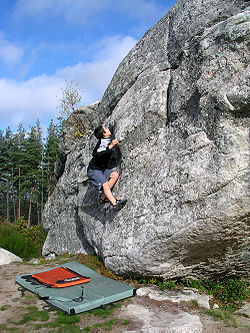
เสื่อปีนผา - การทดสอบการกระเด้ง
- เทคนิคในการปีนผาแบบใช้เครื่องช่วย โดยทดสอบการวางตำแหน่งใหม่โดยใช้น้ำหนักตัวของผู้ปีนนำ[ 22 ] แนะนำสำหรับการทดสอบสถานีโรยตัว ที่น่าสงสัยด้วย [ 23 ]
- โบว์ไลน์บนห่วง
- ปมที่สร้างห่วงขนาดคงที่สองห่วงตรงกลางเชือก[ 24 ]
- การเชื่อมต่อ
- ดูการตัดคำ[ 1 ] [ 2 ]
- ถัง
- ที่จับขนาดใหญ่ที่ใช้งานง่าย[ 2 ]
- ผู้สร้าง
- การปีนป่ายอาคาร ซึ่งมักเป็นการกระทำที่ผิดกฎหมาย
- ค้ำยัน

ค้ำยันขนาดใหญ่




ซี
- เกรดซี
- ระบบ การจัดระดับ ความยากทางเทคนิคสำหรับการปีนผาแบบใช้เครื่องมือช่วยที่ "สะอาด" (เช่น ไม่มี การ ตอกหมุด หรือสลักเกลียว ) ซึ่งมีระดับดังนี้: C0, C1, C2, C3, C4 และ C5; นอกจากนี้ยังมีระดับ Aที่เทียบเท่ากับระดับการปีนผาแบบใช้เครื่องมือช่วย "ดั้งเดิม" สำหรับ "คลื่นลูกใหม่" [ 4 ]
- ลูกเบี้ยว
- อุปกรณ์แคมแบบสปริง (SLCD) หรือที่รู้จักกันในชื่อ "friends" ใช้เป็นอุปกรณ์ป้องกันใน การปีน เขาแบบดั้งเดิม[ 1 ]
- คามาล็อต
- อุปกรณ์ปรับมุมล้อแบบสปริง (SLCD) ยี่ห้อหนึ่ง ผลิตโดย บริษัท Black Diamond Equipment
- วิทยาเขต

การปีนเขาในวิทยาเขต - คณะกรรมการวิทยาเขต
- อุปกรณ์ฝึกฝนที่ใช้สร้างความแข็งแรงของนิ้วและล็อกแขนให้แน่น[ 2 ]
- คาราบิเนอร์
- ห่วงอะลูมิเนียมที่มีประตูแบบสปริงใช้สำหรับเชื่อมต่ออุปกรณ์ปีนป่ายรับน้ำหนักต่างๆ เข้าด้วยกัน[ 1 ]
- แครอทโบลต์

น็อตแครอทพร้อมน็อต - ชอล์ก
- ชอล์ก แมกนีเซียมคาร์บอเนตสำหรับยิมนาสติกที่ใช้เพื่อลดความชื้น ปรับปรุงแรงเสียดทาน และทำเครื่องหมายจุดจับ[ 1 ] [ 2 ]
- ถุงชอล์ก

ชอล์กและถุงใส่ชอล์ก - สายรัดหน้าอก
- อุปกรณ์พยุงตัวชนิดหนึ่งที่คลุมส่วนบนของร่างกายด้วย เพื่อช่วยป้องกันการหมุนตัวในกรณีตก โดยเฉพาะอย่างยิ่งเมื่อนักปีนเขาสะพายเป้หนัก หรือปีนเขาในบริเวณที่มีรอยแยกของธารน้ำแข็ง
- แน่นหน้าอก
- การสอดลำตัวเข้าไปในรอยแตกกว้างๆ โดยเฉพาะอย่างยิ่งเพื่อให้นักปีนเขาได้พักผ่อน
- สลักไก่
- คำศัพท์ในการปีนหน้าผาขนาดใหญ่และการปีนแบบใช้เครื่องมือช่วยหมายถึงสลักเกลียวที่วางไว้เพื่อลดความเสี่ยงของส่วนที่ยากลำบาก[ 26 ]
- หัวไก่

หัวไก่ที่ถูกมัด - ปีกไก่
- เทคนิคการปีนรอยแตก โดยวางมือข้างหนึ่งไว้ที่ด้านหนึ่งของรอยแตกและวางไหล่ไว้ที่อีกด้านหนึ่ง[ 27 ]
- ปล่องไฟ

การก่อปล่องไฟ - การหั่น
- การปรับปรุงจุดยึดในการปีนเขาโดยการสกัดหินถือเป็นสิ่งที่ผิดจริยธรรมและเป็นการปฏิบัติที่ไม่ดีในการปีนเขา[ 2 ]
- หนุน
- หินที่ติดอยู่ในรอยแตกซึ่งสามารถสอดเข้าไปเพื่อสร้างจุดป้องกันใน การปีน เขาแบบดั้งเดิม[ 1 ] [ 2 ] [ 28 ]
- เส้นทางสับ
- คำศัพท์ภาษาอังกฤษแบบ บริติชสำหรับ เส้นทาง ปีนเขาแบบดั้งเดิม ที่มี การป้องกันไม่ดีนักซึ่งการตกอาจถึงแก่ชีวิตได้ ดูX [ 2 ]
- ชอส
- หินที่หลวมหรือ "ผุพัง" ทำให้การปีนป่ายไม่น่าพึงพอใจ ยากลำบาก หรืออันตราย มีประโยชน์สำหรับ การปีนป่า ยแบบแห้ง[ 2 ]
- การจำแนกประเภท
- ดูเกรด
- ทำความสะอาด
- 1. การถอด (หรือแยก) อุปกรณ์ ป้องกันออกจากเส้นทางปีนเขา
- 2. เส้นทางที่ปราศจากพืชพรรณและหินที่หลวม การทำความสะอาดอย่างเข้มข้นสามารถทำให้เกิดการบิ่นได้[ 2 ]
- 3. ปีนขึ้นไปให้สำเร็จโดยไม่ตกหรือพักบนเชือก ดูคำว่า "เรดพอยต์" (redpoint )
- การปีนเขาแบบสะอาด
- เป็นการปีนผาแบบใช้เครื่องมือช่วย โดย อนุญาตให้ใช้ เฉพาะอุปกรณ์ป้องกันการปีนผาแบบดั้งเดิม ที่ถอดออกได้เท่านั้น และห้ามใช้สลักหรือ หมุด ยึดแบบตอกดูรายละเอียดเพิ่มเติมได้ที่ระดับ C
- การปีนเขาที่สะอาด
- เป็นการเคลื่อนไหวในวงกว้างที่ต่อยอดมาจาก การเคลื่อนไหว ปีนผาแบบอิสระ ในยุคแรก ซึ่งสนับสนุนการลดการปีนผาในรูปแบบใดๆ ที่ส่งผลกระทบถาวรต่อพื้นผิวหินธรรมชาติ เช่น การใช้สลักเกลียวหรือหมุดยึดใน การปีนผา แบบสปอร์ต
- เครื่องมือทำความสะอาด

อุปกรณ์ทำความสะอาด - พื้นที่ปีนเขา
- ภูมิภาคที่มีเส้นทางปีนเขา มากมาย ดูหน้าผา
- คำสั่งปีนเขา
- วลีสั้นๆ ที่ใช้สำหรับการสื่อสารและคำแนะนำระหว่างนักปีนเขานำและผู้รับเชือกดูtake , belay off , belay on , on belay , off belay [ 15 ]
- โรงยิมปีนป่าย
- ศูนย์ ปีนป่ายในร่มเฉพาะทางโดยทั่วไปในสหราชอาณาจักรจะเรียกสั้นๆ ว่า "ศูนย์ปีนป่าย"
- ปีนยอดเขา
- มาจากภาษาเยอรมัน (Klettergipfel) ซึ่งเป็นรูปแบบที่สามารถปีนขึ้นไปได้โดยการปีนป่ายเท่านั้น[ 29 ]
- เชือกปีนเขา
- คำศัพท์ทั่วไปสำหรับเชือกเฉพาะทางหลากหลายประเภทที่ใช้ในการปีนเขาทุกรูปแบบ[ 30 ]
- เส้นทางปีนเขา
- เส้นทางที่นักปีนเขาใช้เพื่อขึ้นไปถึงยอดเขา หน้าผาหิน หรือสิ่งกีดขวาง หรือหน้าผาหรือสิ่งกีดขวางที่ปกคลุมด้วยน้ำแข็ง
- รองเท้าปีนเขา

รองเท้าปีนเขา - กำแพงปีนป่าย
- หน้าผาจำลองที่มักตั้งอยู่ภายในอาคาร ยังใช้สำหรับการแข่งขันปีนผาอีก ด้วย
- คลิปใน
- กระบวนการผูกเชือกเข้ากับ อุปกรณ์ ป้องกัน (โดยปกติจะใช้คาราบิเนอร์ ) อุปกรณ์ ควบคุมเชือกหรือจุดยึด อื่นๆ ดูคำว่าการผูกเชือก (tie in )
- คลิปสติ๊ก
- ดูคลิปหนีบกระดาษ
- การแข่งขันปีนเขา
- การปีนประเภทหนึ่งที่จัดขึ้นบนผนังปีนป่ายโดยส่วนใหญ่สำหรับนักปีนป่ายมืออาชีพหรือนักกีฬาโอลิมปิก แบ่งออกเป็นประเภทการปีนนำ (บน เส้นทาง ปีนป่าย แบบใช้สลัก ) การปีนผาและการปีนเร็ว นอกจาก นี้ยังมีประเภทที่สี่คือ "แบบผสม" ซึ่งรวมทั้งสามประเภทเข้าด้วยกัน ดูIFSC [ 31 ]
- การแข่งขันปีนน้ำแข็ง
- กีฬาปีนน้ำแข็งประเภทหนึ่งที่จัดขึ้นบนผนังปีนป่ายโดยส่วนใหญ่สำหรับนักปีนน้ำแข็งมืออาชีพ แบ่งออกเป็นสองประเภท ได้แก่การปีนน้ำแข็งแบบนำทาง (บน เส้นทางปี นป่ายแบบสปอร์ต ที่ติดตั้งสลักยึด ) และการปีนน้ำแข็งแบบเร็วบนเส้นทางที่เป็นน้ำแข็ง ดูเพิ่มเติมที่UIAA
- หัวทองแดง
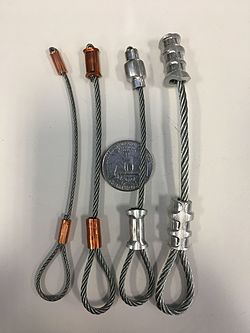
คอปเปอร์เฮด - สาย
- เชือกปีนเขาเส้นเล็กที่ใช้สำหรับวัตถุประสงค์ต่างๆ ในการปีนเขา รวมถึงการสร้างสถานีโรยตัวดูtat [ 30 ]
- ตัวล็อคสายไฟ
- ตัวล็อกหรือตัวสลับที่ใช้สำหรับยึดเชือกด้วยมือที่สวมถุงมือ พบได้ในอุปกรณ์ปีนเขาส่วนใหญ่
- เชือกผูก

คอร์เดเลตต์ - มุม
- มุมด้านในของหิน ตรงข้ามกับสันหิน (สหราชอาณาจักร) ดูdihedral [ 2 ]
- บัวเชิงชาย
- ขอบหิมะที่ยื่นออกมาบนสันเขา
- การปีนรอยแตก
- เพื่อปีนขึ้นไปโดยการสอดส่วนต่างๆ ของร่างกายเข้าไปในรอยแตกตามธรรมชาติของหิน[ 1 ] [ 2 ]ดูjamming , chimneyและoff- width
- หน้าผา
- พื้นที่หินต่อเนื่องที่มีเส้นทางปีนผา จำนวนมาก (เช่นClogwyn Du'r Arddu ) [ 2 ]
- รองเท้าปีนเขา

รองเท้าปีนเขาแบบ 12 จุด - การหมุน
- ดึงที่จับปีนเขาให้แรงที่สุดเท่าที่จะทำได้
- ที่พักพิงฉุกเฉิน
- ดู เสื่อปี นผา
- หลุมอุกกาบาต
- ดู การ ตกสู่พื้นดิน[ 2 ]
- จีบ

การหมุนเพื่อบีบย้ำ - จุดสำคัญ
- ส่วนที่ยากที่สุดของการปีนเขา มัก จะกำหนด ระดับความยากตามความยากของจุดที่ยาก ที่สุด [ 1 ] [ 2 ] [ 32 ]
- ปล่อยตัว
- เมื่อเท้าของนักปีนเขาเหวี่ยงออกจากโขดหินในพื้นที่ลาดชัน และพวกเขาห้อยตัวอยู่ด้วยมือทั้งสองข้าง





ดี
- เกรด D
- ในกรณีที่ ปี นเส้นทางผสมผสานในสภาพแห้งสนิท (เช่น ไม่มีน้ำแข็งหรือหิมะ) ตัวอักษร "M" ที่ต่อท้ายระดับความยาก Mจะถูกเปลี่ยนเป็น "D"
- แด๊บ
- คำศัพท์ในการปีนผาแบบโบลเดอริ่งหมายถึง การสัมผัสพื้นแผ่นรองกันกระแทกผู้ช่วยจับ หรือจุดยึดจากเส้นทางอื่น[ 33 ]
- พวงดอกเดซี่

สร้อยดอกเดซี่ - ห้อยตาย

แขวนคอตาย - สมอเรือคนตาย
- วัตถุที่วางในแนวนอนฝังอยู่ในหิมะ ทำหน้าที่เป็นจุดยึดสำหรับเชือกคงที่ ที่ติด อยู่[ 34 ]
- จุดตาย
- การเคลื่อนไหวแบบไดนามิกที่ควบคุมได้ โดย ที่มือข้างหนึ่งจับยึดไว้ที่จุดสูงสุดของการเคลื่อนไหวขึ้นของร่างกาย ในขณะที่เท้าข้างหนึ่งหรือทั้งสองข้างและมืออีกข้างยังคงสัมผัสกับหิน[ 35 ]ดูdynos
- ดาดฟ้า
- พื้นที่ด้านล่างเส้นทางการปีนป่าย (เช่น พวกเขาตกลงสู่พื้นและ "กระแทกพื้น") ดู การ ตกสู่พื้น[ 2 ]
- การว่ายน้ำเดี่ยวในน้ำลึก

การว่ายน้ำเดี่ยวในน้ำลึก - ผู้ที่ลงมา
- อุปกรณ์เชิงกลที่ช่วยให้สามารถควบคุมการลงจากเชือกคงที่ได้อุปกรณ์เบลย์อาจเป็นอุปกรณ์ลดระดับ[ 2 ]แร็คเป็นอุปกรณ์ลดระดับอีกประเภทหนึ่ง
- เดกซาเมทาโซน
- ยาสำหรับรักษาภาวะสมองบวมจากที่สูง (HACE) และภาวะปอดบวมจากที่สูง (HAPE) [ 36 ]
- โทรออก
- เพื่อให้มีความเข้าใจอย่างถ่องแท้เกี่ยวกับท่าปีนเขาหรือลำดับท่าปีนเขาเฉพาะบนเส้นทางใดเส้นทางหนึ่ง
- ไดม็อกซ์
- ยาที่ใช้ยับยั้งการเกิดโรคแพ้ความสูงหรือที่รู้จักกันในชื่ออะเซตาโซลาไมด์[ 36 ]
- ไดเฮดรัล

ไดเฮดรัล - ไดเร็ตติสซิมา
- คำว่า "เส้นทางที่สั้นที่สุด" ในภาษาอิตาลี หมายถึงเส้นทางที่ตรงที่สุดไปยังยอดเขาตามแนวลาดชัน (เช่น เส้นทางBrandler-Hasse DirettissimaบนยอดเขาCima Grandeในเทือกเขาโดโลไมต์ ) ที่มาของคำนี้มักถูกยกให้เป็นผลงานของEmilio Comiciที่กล่าวว่า "สักวันหนึ่งฉันหวังว่าจะสร้างเส้นทางได้ และจากยอดเขาให้หยดน้ำตกลงมา เส้นทางของฉันก็จะไปถึงจุดนั้น" [ 37 ]
- เริ่มต้นโดยตรง
- เส้นทางปีนผาแบบใหม่ที่ดัดแปลงมาจากเส้นทางเดิม โดยหลีกเลี่ยงเส้นทางอ้อมที่ยากกว่าก่อนถึงเส้นทางหลัก (เช่นSuprême Jumbo Loveเป็นจุดเริ่มต้นโดยตรงของJumbo Love )
- ไอ้สารเลว
- นักปีนเขาที่ใช้ชีวิตอย่างเรียบง่ายและมักเดินทางไปเรื่อยๆ เพื่อเพิ่มเวลาในการปีนเขาให้มากที่สุด ผู้ปฏิบัติได้แก่Jan และ Herb ConnและFred Beckey (จากภาพยนตร์เรื่องDirtbag: The Legend of Fred Beckey ) [ 38 ]
- เชือกคู่

ใช้เชือกสองเส้น - ลงเขา
- การลงจากที่สูงโดยการปีนลงมา (แทนที่จะโรยตัวหรือหย่อนตัวลงมา ) หลังจากปีนขึ้นไปจนสุด หรือ การ ถอนตัวออกจากที่สูง
- ลาก
- แรงเสียดทานจากเชือกที่วิ่งผ่านหินและผ่านการป้องกัน ด้านล่าง ดูเชือกหย่อนและเชือกคู่[ 39 ] [ 40 ] [ 41 ]
- มุมทารกที่เจาะแล้ว

มุมทารกที่เจาะแล้ว - ขับรถผ่านไป
- จุดอับที่แขนข้างหนึ่งไขว้ไปอีกข้างเพื่อเอื้อมไปจับจุดยึดที่อยู่ด้านบนและด้านข้าง
- เข่าตก
- เทคนิคการปีนผาขั้น สูงที่ลดเข่าลงเพื่อบิดสะโพกและจุดศูนย์ถ่วงให้ใกล้กับหน้าผามากขึ้น ทำให้ผู้ปีนสามารถเอื้อมและบิดตัวขึ้นได้มากขึ้น ความเครียดเฉพาะที่เกิดขึ้นกับเข่าอาจนำไปสู่การบาดเจ็บร้ายแรงได้[ 1 ] [ 11 ]
- การขึ้นรูปแห้ง

นักปีนเขาใช้เทคนิคการปีนแบบแห้ง (Dry tooling) - สไตล์การแกะสลักแบบแห้ง
- เป็นการปีนผา แบบใช้เครื่องมือแห้ง ชนิดหนึ่ง โดยมีข้อจำกัดเพิ่มเติม โดยเฉพาะอย่างยิ่งห้ามใช้ท่าYaniro
- ดัลเฟอร์ซิทซ์
- เทคนิค การโรยตัวแบบดั้งเดิมที่ไม่ใช้กลไกโดย ใช้ เชือกที่ติดตั้งไว้พันรอบตัว
- เชือกไดนามิก
- เชือกปีนเขาแบบยืดหยุ่นที่ช่วยลดแรงกระแทกจากการตกได้ในระดับหนึ่งและดูดซับพลังงานจากน้ำหนักบรรทุกมาก เปรียบเทียบกับเชือกคงที่[ 30 ]
- ไดโน
- ในการปีนหน้าผา การกระโดดหรือพุ่งตัวอย่างรวดเร็วเพื่อคว้าจุดยึดที่อยู่ไกลเกินเอื้อม การคว้าจุดยึดไม่สำเร็จมักจะทำให้ตกดูเพิ่มเติม ที่ การพายและการปีนป่าย[ 1 ] [ 2 ] [ 44 ]


อี
- เกรดอี
- ส่วนหนึ่งของระบบการให้คะแนนแบบคุณศัพท์ของอังกฤษที่ใช้ในการจัดอันดับระดับความเสี่ยง (มีการให้เกรดแยกต่างหากสำหรับความยากทางเทคนิค) ของ เส้นทาง ปีนเขาแบบดั้งเดิมซึ่งมีตั้งแต่ E1, E2, E3, ... ไปจนถึง E11 (มีการใช้เมตริกเพิ่มเติมสำหรับความยากทางเทคนิค) [ 4 ]
- ขอบ
- เทคนิคการใช้ขอบรองเท้าปีนเขาในการยึดเกาะกับที่เหยียบแคบๆ หากไม่มีที่เหยียบจะใช้วิธีการเสียดสีกับพื้นแทน
- อียิปต์

อียิปต์ - สะพานอียิปต์
- ท่าเดียวกับการทรงสะพานหรือท่าทรงปล่องไฟแต่ขาข้างหนึ่งอยู่ด้านหน้าและอีกข้างอยู่ด้านหลังลำตัว
- แปดพันเมตร
- ภูเขาที่มีความสูงเกิน 8,000 เมตร (26,247 ฟุต) เหนือระดับน้ำทะเลซึ่งมีอยู่เพียง 14 แห่งในโลก
- กำจัด
- 1. การเคลื่อนไหว แบบบูลเดอริ่งหรือชุดการเคลื่อนไหว โดยที่จุดจับบางจุดวางอยู่ "นอกขอบเขต" [ 2 ]
- 2. คำศัพท์การปีนเขาของอังกฤษสำหรับเส้นทางที่ไม่ใช้เส้นทางที่ชัดเจนหรือตรงที่สุด แต่ 'ตัด' การใช้ลักษณะอื่นๆ เพื่อสร้างเส้นทาง (เช่น ไม่อนุญาตให้นักปีนเขาใช้รอยแตกใกล้เคียงในการปีนขึ้น) [ 2 ]
- ขาเอลวิส
- ดูขาจักรเย็บผ้า[ 2 ]
- การผูกมัด
- เป็นศัพท์เฉพาะในการปีนเขาที่ใช้อธิบายการเชื่อมต่อการปีนเขาหลายๆ ครั้งเข้าด้วยกันเพื่อสร้างเป็นเส้นทางที่ใหญ่ขึ้น
- ตัวดูดซับพลังงาน

ตัวดูดซับพลังงาน - มหากาพย์
- การปีนเขาที่ดูเหมือนจะธรรมดา กลับกลายมาเป็นการต่อสู้ที่ยากลำบากอย่างยิ่ง
- เออร์เนสต์
- คำย่อของ Equalised, Redundant, No Extension, Strong, and Timely ในการสร้างจุดยึด โครงสร้าง โปรดดูSERENE
- เอทรีเออร์

การใช้etrier - ปมมรณะยุโรป
- ปมผูกแบบแบนที่ใช้สำหรับต่อเชือกสองเส้นเข้าด้วยกันเพื่อใช้ในการโรยตัว ลงมา ซึ่งในอเมริกาถือว่าเป็นวิธีการที่ไม่น่าเชื่อถือ
- สไตล์การเดินทางสำรวจ
- การใช้ทีมสนับสนุน (เช่น นักปีนเขาผู้ช่วย เชอร์ปา และ/หรือ คนแบกอุปกรณ์ ฯลฯ) และอุปกรณ์ (เช่นเชือกยึดค่ายฐาน ฯลฯ) ในการช่วยเหลือนักปีนเขาหลักให้ไปถึงยอดเขาในที่สุด ซึ่งตรงข้ามกับสไตล์การปีนเขาแบบอัลไพน์
- การรับสัมผัสเชื้อ
- ระดับพื้นที่ว่างด้านล่างหรือรอบๆ นักปีนเขาที่ไม่ได้อยู่ในตำแหน่งที่ปลอดภัย[ 2 ]


เอฟ
- การปีนหน้าผา
- การปีนป่ายบนหินแนวตั้งโดยใช้นิ้วจับขอบและรอยถลอกซึ่งแตกต่างจาก การปี นร่องหิน[ 1 ]
- ปัจจัยการตก
- อัตราส่วนของความสูง (h) ที่นักปีนเขาตกลงมาต่อความยาวเชือก (l) ที่มีอยู่เพื่อดูดซับพลังงานจากการตก[ 1 ] [ 2 ]
- จุดสูงสุดเท็จ
- ยอดเขาที่ดูเหมือนจะเป็นจุดสูงสุดของภูเขา แต่เมื่อไปถึงแล้วกลับพบว่ายอดเขาที่แท้จริง นั้น สูงกว่า (และอยู่ไกลออกไปอีก)
- เลขสี่

การเคลื่อนไหวแบบเลขสี่ - รูปเลขเก้า
- รูปแบบหนึ่งของ การเคลื่อนไหว รูปเลขสี่โดยใช้ขาข้างเดียวกันแทนขาข้างตรงข้าม[ 2 ]
- เลขแปด
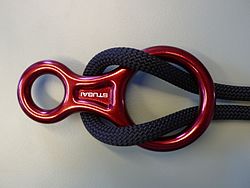
การผูกเชือกแบบเลขแปด - ปมเลขแปด

ปมเลขแปด - แยมนิ้ว
- แยม ชนิดหนึ่งที่ใช้นิ้วจิ้มลงไปในรอยแตก[ 1 ]
- กระดานนิ้ว
- อุปกรณ์ฝึกฝนที่ใช้สร้างความแข็งแรงของนิ้ว ดูเพิ่มเติมที่ แฮงบอร์ด[ 2 ]
- การปีนขึ้นครั้งแรก
- การปีนขึ้นสู่ เส้นทาง ใหม่ได้สำเร็จเป็นครั้งแรกไม่ว่าจะด้วยวิธีการใดก็ตาม รวมถึงการปีนโดยใช้เครื่องมือช่วย (เช่น ไม่ใช่การปีนแบบอิสระ )
- การขึ้นฟรีครั้งแรก
- การปีนขึ้นสู่ยอดเขา ครั้งแรก ของ เส้นทางใหม่โดยไม่ใช้เครื่องช่วยใดๆโดยปฏิบัติตาม เกณฑ์การปีน แบบฟรีไคลม์มิ่งของเรดพอยต์
- ผู้หญิงคนแรกที่ปีนเขาแบบอิสระ
- นักปีนเขาหญิงคนแรกที่ปีนเส้นทางที่เคยมีคนปีนสำเร็จโดยไม่ใช้เชือกช่วยมาก่อน
- หมัดกระแทก
- แยมชนิดหนึ่งที่ทำด้วยมือ
- เชือกคงที่

การปีนขึ้นเชือกที่ติดตั้งไว้โดยใช้เครื่องปีนเชือก (Ascender) - การโบกธง
- เทคนิคการปีนผาที่ใช้ขาข้างหนึ่งยึดไว้เพื่อรักษาสมดุล แทนที่จะใช้รับน้ำหนัก มักจะใช้เพื่อป้องกันประตูยุ้งฉาง [ 2 ] การทำเครื่องหมายมีสามประเภท: [ 12 ] [ 11 ]
- เกล็ด
- แผ่นหินบางๆ ที่แยกออกมาจากหน้าผาหลักช่วยให้ยึดเกาะได้ แม้ว่าอาจจะหลุดออกมาได้ก็ตาม[ 2 ]
- แฟลช
- การปีนเส้นทางสำเร็จในครั้งแรก แต่ต้องได้รับเบต้าก่อน หากไม่มีเบต้า จะเรียกว่าการปีนสำเร็จโดยไม่ต้องดูข้อมูลก่อน[ 1 ] [ 2 ] [ 46 ] [ 3 ]
- ฟอนต์
- ระบบการให้คะแนนการปีนผา แบบฝรั่งเศสซึ่งมีระดับตั้งแต่ 1, 2, 3, 4, 5, 6A, 6B, 6C, 7A, 7B, 7C, .... ไปจนถึง 9A ร่วมกับ ระบบการให้ คะแนนแบบ V-grade ของอเมริกา ถือเป็นระบบการให้คะแนนการปีนผาแบบฝรั่งเศสที่ใช้กันอย่างแพร่หลายทั่วโลก มักเกิดความสับสนระหว่างระดับ Font กับระดับFrench [ 6 ]
- เท้าติด
- เทคนิคการสอดเท้าเข้าไปในรอยแตกขนาดใหญ่โดยการบิดตัวเพื่อให้ส้นเท้าและนิ้วเท้าแตะกับด้านข้างของรอยแตก
- แฟลปเปอร์
- การฉีกขาดของผิวหนังและเนื้อเยื่อเนื่องจากการเสียดสีกับพื้นผิวที่คมหรือหยาบ
- สิบสี่
- ยอดเขาที่มีความสูงเกิน 14,000 ฟุต (4,300 เมตร) โดยเฉพาะอย่างยิ่งยอดเขาที่อยู่ในสหรัฐอเมริกาแผ่นดินใหญ่
- ฟรีเบส
- ปีนเขาแบบฟรีโซโลแต่มี ร่มชูชีพสำหรับ กระโดด BASE jumpingเป็นอุปกรณ์สำรองในกรณีที่ตกจากที่สูง
- ปีนป่ายอิสระ
- การปีนเขาโดยไม่ใช้อุปกรณ์ช่วย ใดๆ นอกเหนือจากการป้องกันสามารถทำได้ทั้งการปีนเขาแบบกีฬาหรือ การปีน เขาแบบดั้งเดิม[ 2 ]
- ปีนเขาแบบฟรีโซโล

การเล่นแบบฟรีโซโล - การปีนเขาแบบอิสระของฝรั่งเศส
- การใช้ เทคนิค การปีนแบบช่วยเหลือ ขั้นพื้นฐานมาก (เช่น เทคนิคการปีนแบบช่วยเหลือ ระดับ A0เช่น การดึงอุปกรณ์ป้องกันการปีน) เพื่อหลีกเลี่ยงช่วงสั้นๆ ที่ปีนได้ยาก โดยเฉพาะอย่างยิ่งใน การปี นหน้าผาขนาดใหญ่[ 47 ]
- ระดับภาษาฝรั่งเศส
- ระบบ การให้คะแนน ของฝรั่งเศสสำหรับการปีนผาแบบสปอร์ตซึ่งเรียงลำดับจาก 5a, 5b, 5c, 6a, 6b, 6c, 7a, 7b, 7c, .... ไปจนถึง 9c ร่วมกับ ระบบ YDS ของอเมริกา ถือเป็นระบบการให้คะแนนการปีนผาแบบสปอร์ตที่ใช้กันทั่วไปมากที่สุด เกรดของฝรั่งเศสมักถูกเข้าใจผิดว่าเป็นเกรดแบบฟอนต์[ 6 ]
- เริ่มต้นแบบฝรั่งเศส
- เคลื่อนตัวไปยังจุดยึดที่สองโดยไม่ได้ยึดจุดยึดเริ่มต้นไว้ จึงใช้พื้นเป็นจุดเหยียบ ในการแข่งขันปีนผา ส่วนใหญ่ รวมถึง การแข่งขัน IFSCการเริ่มต้นปีนในลักษณะนี้จะทำให้ความพยายามนั้นเป็นโมฆะ[ 48 ]
- เฟรนชี่ส์
- เป็นการออกกำลังกายเพื่อพัฒนาความแข็งแรงในการล็อกข้อศอก โดยประกอบด้วยการดึงข้อที่หยุดโดยล็อกข้อศอกไว้ที่มุมระหว่าง 20 ถึง 160 องศา
- เปราะ
- หินหรือน้ำแข็งที่บอบบางและแตกหักง่าย มักเป็นอันตรายอย่างยิ่ง
- การปีนแรงเสียดทาน
- เทคนิคการปีนผาที่ อาศัย แรงเสียดทานระหว่างหินลาดชันกับพื้นรองเท้า เพียง อย่างเดียว
- เพื่อน

เพื่อน - การชี้ไปข้างหน้า
- เทคนิคการปีนน้ำแข็งที่ใช้หนามแหลมส่วนหน้าสุดของรองเท้า ปีนน้ำแข็ง ( crampons ) ในการปีนเส้นทางน้ำแข็ง
- รองเท้าบูทผลไม้

รองเท้าบูทผลไม้




จี
- ปลอกขา
- อุปกรณ์สำหรับปีนเขาที่สวมทับรองเท้าและบริเวณน่องเพื่อเพิ่มการป้องกันและกันน้ำ
- กาสตง
- A climbing grip using one hand with the thumb down and elbow out, like a reverse side pull. The grip maintains friction against a hold by pressing outward toward the elbow. Named for Gaston Rébuffat.[1][2][11]
- gate flutter
- The unwelcome action of the gate on a carabiner opening during a fall.
- gendarme
- A rock-pinnacle or isolated rock-tower encountered along a ridge; often at the intersection of ridges.
- Geneva rappel
- A modified Dulfersitzrappel using the hip and downhill arm for friction — less complex, but less friction and control.
- GiGi
- A belay plate device for belaying a second from above that has auto-blocking; made by Kong. See also Sticht plate.
- glissade

Sitting glissade - grade
- Classifications intended as an objective measure of the technical difficulty of a climbing route (including rock, ice, bouldering, mixed, and aid). The most widely used lead climbing grading systems are the French sport climbing grades, and the American Yosemite Decimal System; for bouldering, it is the font grade and the V-grade systems.[2][6]
- grade milestone
- The first free ascent (FFA) by a lead climber of a new climbing route that sets a new grade level (e.g. the first-ever 9b (5.15b) grade milestone was Chris Sharma's FFA of Jumbo Love in 2008).
- greenpoint
- Ascending a sport climbing route but only using traditional climbing protection (e.g. Principle Hope). See redpoint.[49]
- Grigri

Belaying with a grigri - gronked
- Accidentally going off-route leading into a harder route; from the notorious climb Gronk in Avon Gorge.
- ground fall
- Where a lead climber falls and hits the ground, either because their protection failed (e.g. zipper fall), the runout was too great, or the belayer failed to arrest or hold the rope.[2]


H
- half ropes
- See double ropes.[30]
- hand jam
- A type of jam using the hand in a crack.[1]
- hand traverse
- Traversing without any definitive footholds, i.e. no edging, smearing or heelhooking.
- hangboard

Hangboard - hangdog
- To hang on the rope, or a piece of protection, after falling, and then start reclimbing without returning to the ground.[51]
- hanging belay

Using a hanging belay (bottom climber) - heel spurs
- Type of crampon attachment to the back of the heel used in mixed climbing to perform a heel hook.[52]
- high-altitude cerebral edema
- A severe and often fatal form of altitude sickness caused by physical exertion without sufficient oxygen.[36]
- high-altitude pulmonary edema
- A severe form of altitude sickness caused by physical exertion without sufficient oxygen.[36]
- harness
- A sewn nylon webbing load-bearing device that is worn around the climber's waist and thighs, and to which the climbing rope, and other load-bearing climbing devices, can be attached.[2]
- haul bag

Haul bag - headpoint
- Top-roping a traditional climbing route before lead climbing it to practice the moves. See redpoint.[49]
- headwall
- A region at the top of a cliff or rock face that steepens dramatically.
- heel hook

Heel hook - heel-toe
- A combination of a toe hook and heel hook to hold the body onto the climbing route.
- hero loop
- A short runner made of 5- to 8-mm cord tied in to a loop. Commonly used for self-belay during rappel, escaping a belay, and in crevasse rescue.[53]
- hexcentric

Hexes - highball

A high ball - hip belay
- A method of belaying, whereby the rope friction is increased by passing the rope around the hip of the belayer.
- hold
- A place to temporarily cling, grip, jam, press, or stand in the process of climbing a route.[2] See volume hold.
- HMS carabiner
- A round-ended carabiner for use with a Munter hitch (from German for the hitch; Halbmastwurfsicherung).
- hook
- A mechanical piece of climbing equipment used in aid climbing. See also skyhook.
- hueco
- A round hold consisting of a pocket in the rock with a positive lip, varying in size from a single finger (a "mono") to body-sized. The term comes from Hueco Tanks that is notable for huecos, the Spanish term for a "hole".
- hueco scale
- See V-grade.[1]


I
- ice axe

Modern ice axe - ice climbing
- Ascending iced routes (e.g. waterfalls, and couloirs), with specialized equipment. See mixed climbing.[1]
- ice hammer

Ice hammer - ice piton

Ice pitons (left), and ice screw (right) - ice screw
- Modern protection device in ice climbing, with the tubular ice screw as the strongest.[54]
- ice tool
- A specialized elaboration of the modern ice axe that is used in modern advanced ice climbing.
- IFSC
- Outdated acronym for the international body that organises and regulates competition climbing; now WC. See UIAA.
- indoor climbing
- Rock climbing that takes place on artificial climbing walls that are set up inside buildings.
- in-situ
- Denotes protection that is installed on the route (e.g. "there is a piton and sling "in-situ" at the crux").[2]
- isolation zone
- In competition climbing, an area where competitiors are kept to prevent them getting beta on the upcoming routes.[55]


J
- jamming
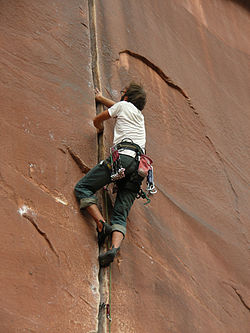
Hand jamming - jib
- A very small foothold, large enough for the big toe, relying heavily on friction to support the weight.
- jug
- See bucket.[1][2]
- jumar
- A type of mechanical ascender, and the generic term for ascending a fixed rope using a mechanical ascender.

K
- karabiner
- See carabiner.[2]
- Klemheist knot
- An alternative to the Prusik knot, useful when the climber is short of cord but has plenty of webbing.
- knee bar
Using a knee bar - knee drop
- See Egyptian.
- knee pad
- An artificial pad that is worn on the lower thigh to protect a climber when performing a knee bar; initially controversial as they raised technical standards, but came to be accepted like climbing shoes.[57][58]
L
- lache
- Modern climbing and parkour movement (most commonly used in bouldering) where the climber dynamically progresses laterally by use of momentum gainned by swinging with feet and legs, and then letting go with the hands (from the Frenchlâcher; let go).
- ladder

Aluminum ladder - lanyard

A Petzl lanyard and energy absorber - laybacking

Laybacking - lead climbing
- A form of climbing in which a lead climber clips their belay rope into protection equipment as they ascend.[1][2]
- lead climber
- The individual ascending the route in lead climbing; the other person is the belayer.[1][2]
- leader fall
- A lead climber fall while lead climbing; will be at least twice the distance to the last piece of protection.
- Leavittation
- A technique used to climb off-width cracks pioneered in the late 1970s by Randy Leavitt and Tony Yaniro that uses alternating hand-fist stacks and leg-calf locks; helpful for resting, and when placing protection.[59]
- liquid chalk
- A liquid form of climbing chalk but with a longer hold time.
- live rope
- In lead climbing, the segment of the rope between the lead climber and the belayer.[2]
- lock-off

Resting lock off - lolotte
- See Egyptian.
- lower-off
- When a lead climber is lowered down the route by the belayer holding their weight on the belay device.
- low zone
- In competition bouldering, a marked hold somewhere between the start and zone. It is either worth some number of points (less than the zone) or used as a tiebreaker.


M
- M-grade
- Part of the mixed climbing system for grading the technical difficulty of mixed climbing routes, which goes: M1, M2, M3, M4, M5, M6, and up to M14.[4] See also D-grade.
- mantel move

Mantel move - mixed climbing
- A type of climbing that involves using ice climbing tools on iced-up or snow-covered rock surfaces; mixed climbing techniques are used in dry-tooling and in alpine climbing.[52]
- mono
- A climbing hold, typically a pocket or a hueco, which only has enough room for one finger.[1][2]
- moving together
- See simul climbing.
- multi-pitch climbing
- A climb that has more than one pitch; a big wall route involves so many pitches, it takes over a day.
- Munter hitch
- A simple hitch used for belaying without a mechanical belay device.


N
- National Climbing Classification System
- A North American grading system used mainly in big wall climbing and alpine climbing; goes from I, II, III ... to VII.
- névé
- Permanent granular ice formed by repeated freeze-thaw cycles.
- new wave
- See A-grade.
- no-hand rest

No-hand rest - normal route
- The easiest and most frequently used route for ascending and descending a climb.[60]
- nunatak
- A mountain or rock formation that protrudes through an ice field.
- nut

Nuts - nut key
- See cleaning tool.


O
- off belay
- American climbing command when requesting that the belayer remove belay equipment from the climbing rope (e.g. when cleaning top protection from a lead route). Replied to with "belay off".[15]
- off-width

Off-width climb - on belay
- American climbing command when they are ready to be belayed. Replied to with "belay on".[15]
- on-sight
- To ascend a route on the first attempt, with no prior beta; with beta, it is a flash.[1][2][46]
- open book
- An inside angle in the rock. See also dihedral.
- open project
- A route that was bolted by someone (e.g. they bought and installed the bolts) but who was unsuccessful in redpointing it, and it is now considered to be "open" to any climber to try; sometimes the original bolter will leave colored tape on the first bolt(s) to note the route is "not open".[61]
- overhang
- A section of rock or ice that is angled beyond the vertical. See roof.[2]

P
- paddling
- A multi-move dyno where the climber must move quickly through a sequence of intermediate hand holds (neither of which can hold the climber for any period), with their arms mimicking a paddling action and their feet usually in mid-air, before getting to a secure position. See also campusing.[44]
- passive protection
- Type of protection that remains static during a fall; opposite of active protection. See nuts and hexcentrics.
- peak-bagging
- To systematically attain every peak of a designated class of summits (e.g. eight-thousanders), sometimes under prescribed conditions (e.g. in winter), and/or in a prescribed climbing style (e.g. no supplementary oxygen).
- peg
- A piton.
- pendulum
- 1. Swinging on a taut anchored rope to reach the next hold in a pendulum traverse.
- 2. A swing experienced during a fall caused by the last piece of protection being far to one side.
- permadraw
- A quickdraw but made from a steel cable with steel carabiners that is permanently fixed to the bolt; longer wearing than aluminum quickdraws, and climbers do not need to retrieve them after a climb.[1]
- personal anchor system
- An adjustable attachment point from a climber to a fixed anchor, give them flexibility to perform other tasks.
- picket

Picket - pinch hold
- A hold which must be "pinched" between the fingers to use it.[2][12]
- pinkpoint
- Lead climbing where the protection (e.g. quickdraws) are pre-installed. See also greenpoint and redpoint.[2][49]
- pitch
- The climbing route between two belay points with a "full pitch" being the length of the rope, circa 50 metres (160 ft).[1][2]
- piton

Piton - piton catcher
- A clip-on string fastened to a piton when inserting or removing, so as to avoid loss.
- plunge step
- An aggressive step pattern for descending on hard or steep-angle snow.
- pogo
- A dynamic, momentum-based, and often diagonal, move where one leg swings wildly to generate upward force, enabling the climber to reach distant holds with reduced upper body strain.
- poop tube

Poop tube - portaledge

Portaledge - positive
- A hold or part of a hold with a surface facing upwards, or away from the direction it is pulled, facilitating use. A positive hold is the opposite of a sloper.
- pressure breathing
- Forcefully exhaling to facilitate O2/CO2 exchange at altitude.
- problem
- Used in bouldering to describe the sequence of moves to be overcome.[2]
- progress capture device

Petzl Micro Traxion - project
- An attempt over time to climb a new (worldwide or personal) route or boulder problem as a "project".
- protection

Carrying protection - Prusik
- A knot used for ascending a fixed rope, named after Austrian Karl Prusik, who developed this knot in 1931.[2]
- pulley

Pulley (in red) - pump
- The accumulation of metabolic waste products in the forearm(s) so that holding a basic grip becomes impossible.[2]


Q

- quickdraw
- A piece of climbing protection that is used to attach a running rope to an anchor or a bolt. See permadraw.[1][2]
- quicklink
- A screw-type oval-shaped stainless steel carabiner which is smaller than the normal carabiner.
R
- rack

A traditional climbingrack on a harness 
A rack 
A whale tail (rack) - 1. Name given to the collective set of protection equipment carried by a lead climber up a climb.[1][2]
- 2. A type of heavy-duty "all-weather" descender known as an "abseil rack" or a "rappel rack", consisting of metal bars on a U-shaped chassis, which is frequently used in caving. An alternative heavier device is a "whaletail" (also "whale tail") which is a machined block often used by rescuers.[65]
- rappel
- See abseil.
- rating
- See grade.
- re-belay
- Secondary or intermediate fixed anchor point(s) along the length of a fixed rope (i.e. in addition to the main anchor at the top of the fixed rope) that is used to avoid edges that could increase rope wear.[66]
- rebolting
- The replacement of older bolts on an existing bolted sport climbing route.
- redpoint
- Free climbing a route by leading it after having failed it or practiced it beforehand (e.g. by hangdogging, headpointing, or top roping). A route climbed on the first-ever attempt (and no practice), it is an onsight or a flash. See first free ascent.[1][2]
- removable bolt
- A removable protectionbolt, similar in concept to a sliding nut, but shaped to fit into a drilled hole; popular in aid climbing.
- rest step
- An energy-saving mountaineering technique where the unweighted (uphill) leg is rested between each forward step, by "locking" the knee of the rear leg.
- retro-bolting
- The addition of bolts to a route that has already been ascended using traditional climbingprotection. The technique is controversial, with ethical debate on the issues of improving climber safety versus protecting the integrity of the original traditional climbing challenge.[67][68]
- rigging plate

Blue rigging plate - ripped
- Term to denote when a piece of protection failed and "ripped-out" of the rock. See zipper fall.[2]
- rivet hanger

Rivet hanger - rock hammer
- A lightweight hammer with a short handle used for inserting pitons, bolts, and copperheads in aid climbing and big wall climbing. See also ice hammer.
- rockover move
- A rock-climbing technique where the body weight is transferred (or "rocked-over") to the raised up-hill leg to reach a higher hold.[2]
- rodeo clipping
- To clip into the first piece of protection from the ground by swinging a loop of rope so that it is caught by a pre-placed carabiner.[69]
- roof

Climbing a roof - rope bag
- Specialist lightweight but hardwearing bag for carrying a climbing rope.[1]
- rope drag
- See drag.[1]
- rope jumping
- Jumping a full rope-length from the top of a rock face with the rope attached to a fixed anchor like a bungee cord.
- rope team
- See simul climbing.
- rose move
- A move in which the crossing arm goes behind the other arm and is so far extended that the body is forced to twist until it ends up facing away from the rock. It was introduced by Antoine Le Menestrel to climb a route in Buoux called La rose et le vampire8b (5.13d) in 1985.[70]
- route
- See climbing route.
- RP
- A small protectionnut on a wire for tiny cracks with marginal holding power; named after Roland Pauligk.[2]
- runner
- 1. In the US, a sling is made from nylon-blend materials, used by climbers for a multitude of purposes.[1]
- 2. In the UK, any item of protection placed by the lead climber to reduce the length of a fall.[2]
- runout

A long runout - RURP

RURP - R/X
- A suffix used in the yosemite decimal system for traditional climbing routes that have poor possibilities for protection where any fall could be serious (e.g. Master's Edge). See X.


S
- S-grade
- Part of the deep-water soloing system for grading the objective danger difficulty of DWS climbing routes, which goes: S0, S1, S2, and S3. See also X.
- saddle
- A high pass between two peaks, larger than a col.
- sandbag
- A rock climb with a much lower official climbing grade than probably deserved; sometimes due to a "trick-move" at the crux that once learned, does make the route easier; or due to overly conservative grading.[2]
- scrambling
- A type of climbing somewhere between hiking and graded rock climbing; involves climbing the easiest grades.
- screamer
- 1. Shock absorbing sling designed to reduce peak loads in a climbing system. Very commonly used for winter / ice climbing. Made of a nylon webbing structure consisting of one large loop sewn in multiple places to make a shorter length.
- 2. A British term for a large whipper fall.[2]
- scree
- Small, loose rocks, at the base of a cliff or slope; distinguished from talus.
- screw on
- A small climbing hold screwed onto the wall on a climbing wall.
- second

Lead climber (right) and second (left) - self-arrest
- Using the pick of an ice axe to arrest a fall, or to control a glissade.
- self-belay
- The act of using a mechanical device for belaying in solo climbing. See self-locking device.
- self-locking device

Self-locking device - self rescue
- Actions taken by a climber(s) to execute their own rescue or recovery from a difficult or dangerous situation.
- send
- To free climb a route, via an on-sight, flash, or redpoint.[2][1]
- serac
- A large tower of ice on the surface of a glacier; falling seracs are a serious hazard to mountaineers.
- SERENE
- Acronym for building anchors; stands for Strong, Equalised, Redundant, Efficient, No Extension. See also ERNEST.
- sewing-machine leg
- The involuntary vibration of the leg due to fatigue and/or panic and stress.[2]
- shadow match
- A rock climbing move to quickly switch hands on a hold that can only fit one hand at a time.
- The end of the rope that is attached to the lead climber, to denote the more serious activity they are undertaking compared to the belayer.[2]
- short fixing
- An advanced big wallclimbing technique where the lead climber fixes the rope at an anchor to allow the second to ascend using jumars, while the leader climber then continues to ascend in a rope solo climbing fashion; unlike simul climbing, neither is belaying the other.[72][73]
- side pull

A side pull - simul climbing
- An advanced technique in which two climbers move simultaneously upward, with the leader placing protection that the second removes as they advance. A protection capture device (PCD) may also be used.[73]
- single-rope technique
- The use of a single rope where one or both ends of the rope are attached to fixed anchor points. See fixed rope.
- sit start

A sit start - skyhook

Skyhook - slab
- A low-angle — significantly less than vertical — rock face that requires slab climbing techniques.[2]
- slab climbing
- A type of climbing on slabs that usually emphasizes balance, footwork, and smearing.
- slack
- In lead climbing and in top rope climbing, it is the amount of additional rope that the belayer has allowed; slack increases the distance of any fall before the protection begins to hold the rope, but is needed to reduce rope drag or aid.[75]
- sling
- A closed loop of webbing.[2]
- sloper

Sloper hold - smearing
- To make use of friction on the sole of the climbing shoe in the absence of good footholds.[1][2][12]
- snarg
- A type of tubular ice screw that is inserted by hammering with an ice hammer.
- snow cave
- A temporary shelter constructed by digging out snow to form a cave.
- snow fluke

Snow fluke - solo climbing
- When the climber is alone (with no second); if also without protection is free solo climbing. See rope solo climbing.
- speed climbing
- A competition climbing discipline where competitors race in pairs up a standardized climbing wall.[1]
- spinner
- In indoor climbing, a hold that is not secure and spins in place when weight is applied.
- splitter

A splitter crack - sport climbing
- A style of lead climbing where the protection is via pre-placed fixed bolts; opposite of traditional climbing.[3] Confusingly, competition climbing (which includes bolted lead climbing, but also free solo bouldering and top-roped speed climbing) is sometimes called "sport climbing".[2][3]
- spotting
- People standing beneath a lead climber or bouldering climber ready to absorb the energy of a ground fall.[2]
- sprag
- A type of hand position where the fingers and thumb are opposed in a tiny crack.[2]
- spring-loaded camming device
- A type of active protection device used in crack climbing. See cam.[2]
- static rope
- A non-elastic climbing rope used for abseiling or jumaring (as a fixed rope), but not lead climbing. Compare dynamic rope.[2][30]
- stein pull
- A technique in mixed climbing and dry-tooling where the ice axe is inverted and the blade wedged into a crack above the climber's head, who then pulls down on the handle of the axe to gain upward momentum. See also undercling pull.[76]
- stemming

Stemming - step cutting
- Scooping steps out of snow or ice with the adze of an ice axe.
- step kicking
- Scooping and stamping steps out of soft snow with the feet.
- Sticht plate
- A belay device consisting of a flat plate with a pair of slots, named after the inventor Fritz Sticht.[2] See also GiGi.
- stick clip

Using a stick clip - stopper
- 1. A wedge-shaped nut made by Black Diamond.
- 2. A knot used to prevent the end of a rope from running through—and detaching from—a piece of gear.[1][2]
- sure-footedness
- Sure-footedness is the ability when hiking or mountain climbing, to negotiate difficult or rough terrain safely.[77]
- swami belt
- A type of simple climbing harness


T
- tat
- Term to describe pieces of webbing or cord left on a climb (e.g. "I found some old tat") often as part of an irretrievable anchor point that was part of an abseil station.[78]
- take
- The act of taking the slack out of a rope; also a climbing command by a lead climber to the belayer.[1]
- talus

Talus rocks - talon hook
- A type of three-pronged climbing hook used for securing the climber to a horizontal edge in the rock face. Each prong contains a curved hook of differing widths for securing onto respective edge sizes when aid climbing.
- tape

Applying tape - technical grade
- See grade.
- testpiece
- A route that is representative of the hardest climbs in an area at a particular grade (e.g. Action Directe for grade 9a).
- tie in
- To physically attach the harness to the climbing rope, usually via a figure-eight knot. See clip in.
- thread
- A runner created by "threading" a sling around a jammed block or through a hole in the rock.[2]
- toe hook

A toe hook - topo
- The graphical representation – drawing or photograph – of a climbing route, with the main obstacles marked.
- top rope climbing

Top roping - top-out
- To complete a route by ascending over the top of the climb to safety.[2]
- torque pull
- A technique in mixed climbing and dry-tooling where the ice axe is wedged into a crack and twisted to generate torque to aid upward momentum. See also undercling pull and stein pull.[76]
- tracking
- See feet follow.
- traditional climbing

Traditional climbing - trail rope
- A big wall climbing technique where the lead climber carries an additional static rope (in addition to their dynamic climbing rope) that hangs (or "trails") behind them as they ascend; the trail rope enables the belayer to pass equipment to the leader during the ascent, and for the leader to haul up equipment as the belayer ascends.[22][62]
- traverse

Traversing - 2. A Tyrolean traverse is crossing a chasm using a fixed rope anchored at both ends.
- 3. A pendulum traverse is swinging across a wall suspended from a rope anchored above the climber.[22]
- 4. A tension traverse is a static version of a pendulum traverse where rope tension is used to control movement.[22]
- tricam

Tricam - tuber

Tubers - tufa

Climbing on tufas - 2. A plastic bolted-on bouldering hold to replicate such a formation on a climbing wall.
- twin ropes
- In lead climbing, using two ropes that are even thinner than double ropes, both of which need to be clipped in at each point of protection; sometimes used in long alpine climbing routes with major abseiling descents.[30]
- twist lock
- A climbing move where the hips "twist" perpendicular to the wall, the inside arm is "locked" on an upper hold, the outside arm holds the body against the wall, and the feet press down to propel the body higher.


U
- UIAA
- Acronym for the international governance body for mountaineering and other types of climbing; UIAA also regulates competition ice climbing.[1] See also IFSC.
- UIAA grade
- The UIAA grade system for rock climbing, which goes: ... VI, VII, VIII, IX, X, XI, .... , to XII; is less common than the French grade system or the American YDS grade system, but still used in Germany and parts of Eastern Europe.[6]
- UIAA Scale of Overall Difficulty
- See Alpine-grade.[6]
- undercling
- A downward hold which is gripped with the palm of the hand facing upwards.[1][2][11]
- undercling pull
- After a stein pull is completed, the undercling pull is a mixed climbing technique for continuing to use the hold to gain upward momentum by using the hold to pull into the rock; requires a lot more energy than a stein pull.[76]
- undercut
- See undercling.
V
- V-grade
- A grading system for boulderingproblems invented by John Sherman, which goes: V0, V1, V2, V3, V4, V5, V6, V7, ... , to V17. The V-scale and the French font scale are the most common boulder grading systems in use worldwide.[1][6]
- V-thread
- A type of abseiling point used especially in winter and in ice climbing.
- verglas
- A thin coating of ice that forms over rocks when rainfall or melting snow freezes, which is hard to climb on as there is insufficient depth for crampons to have penetration. See also clear ice and glaze ice.
- via ferrata

Climbing a via ferrata - volume hold

Volume holds


W
- WI-grade
- Part of the ice climbing system for grading the technical difficulty of ice climbing routes, which goes: WI1, WI2, WI3, WI4, WI5, WI6, and up to WI13.[4] See also M-grade.
- webbing

Round webbing - webolette
- A piece of webbing with eyes sewn into the ends which can be used in place of a cordelette.
- weighting
- Any time a rope sustains the weight of the climber, e.g. "weighting the rope". This can happen during a minor fall, a whipper (long fall), or simply by resting while hanging on the belay rope. See also hangdogging.
- whipper

Climber on a whipper - wire brushing
- Cleaning a rock climbing route with a wire brush before an attempt; has ethical issues due to rock damage and possible chipping.[2]
- wired
- See dialled.[2]
- wires
- See nuts.[2]
- WC
- Acronym for the international body that organises and regulates competition climbing. See UIAA.


X
- X
- A suffix used in the Yosemite decimal system for highlighting traditional climbing routes that have poor or even no possibilities for protection, where any fall could be fatal (e.g. Indian Face and Gaia). See R/X and chop route.
Y
- yaniro
- French term for a figure-four move which came from American climber Tony Yaniro's use of it on Chouca8a+ (5.13c).[80]
- yo-yo
- A free climbing term pre-redpointing, where a falling lead climber returns to the ground to restart, but leaves their rope clipped into the protection — in redpointing, the rope is pulled free from all protection before re-starting the climb.[2]
- Yosemite Decimal System
- American system for grading walks, hikes, and climbs; the rock climbing (5.x) goes: 5.7, 5.8, 5.9, 5.10a, 5.10b, 5.10c, 5.10d, 5.11a, .... , 5.14a, 5.14b, 5.14c, 5.14d, 5.15a, etc., and with the French grade system, is the most widely used grading system worldwide for sport climbing.[6]
Z
- z-clipping
- While lead climbing, clipping intoprotection with a segment of rope from beneath the previous piece of protection, resulting in rope drag.[1][10]
- z-pulley

Z-pulley system - zawn

A zawn in Wales - zipper fall
- A traditional climbingground fall where all the protection gear fails in sequence (i.e. opens like a "zip").[2][81]
- zone hold

Zone hold


See also
- Climbing equipment
- Glossary of caving and speleology
- List of climbers and mountaineers
- Mountaineering: The Freedom of the Hills
External links
สรุปเนื้อหา
ข้อมูลสำคัญจากบทความ
ข้อมูลสำคัญเกี่ยวกับ คำศัพท์เกี่ยวกับการปีนเขา
คำศัพท์เกี่ยวกับการปีนเขาเกี่ยวข้องกับการปีนหน้าผา (รวมถึง การปีน แบบใช้เครื่องมือช่วยการปีนแบบนำทาง การปี น แบบโบลเดอริ่งและการปีนแบบแข่งขัน ) การปีนเขาและ การปี นน้ำแข็ง
เอ
เกรดเอ ระบบ การจัดระดับ ความยากทางเทคนิคสำหรับ การปีนผาแบบใช้เครื่องมือช่วย (ทั้งแบบ "ดั้งเดิม" และแบบที่ปรับปรุงแล้วสำหรับ "คลื่นลูกใหม่") ซึ่งเรียงลำดับดังนี้: A0, A1, A2, A3, A4, A5 และจนถึง A6 (สำหรับ "คลื่นลูกใหม่") ดูระดับ C [ 4 ] กระทู้อาบาลาคอฟ...
บี
เกรดบี ระบบ การให้คะแนน สำหรับ การปีนผาแบบโบลเดอริ่ง คิดค้นโดย จอห์น กิลล์ ซึ่งปัจจุบันถูกแทนที่ด้วย ระบบการให้คะแนนแบบ V แล้ว บันไดบาชาร์ บันไดบาชาร์ อุปกรณ์ฝึกฝนที่ใช้เพื่อพัฒนา ทักษะการทรงตัว เสริมสร้างความแข็งแรงของกล้ามเนื้อแกนกลางลำตัวและแขน คิดค้นโดย...
ซี
เกรดซี ระบบ การจัดระดับ ความยากทางเทคนิคสำหรับ การปีนผาแบบใช้เครื่องมือช่วย ที่ "สะอาด" (เช่น ไม่มี การ ตอก หมุด หรือ สลักเกลียว ) ซึ่งมีระดับดังนี้: C0, C1, C2, C3, C4 และ C5; นอกจากนี้ยังมี ระดับ A ที่เทียบเท่ากับระดับการปีนผาแบบใช้เครื่องมือช่วย "ดั้งเดิม"...