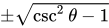
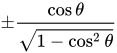
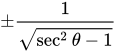
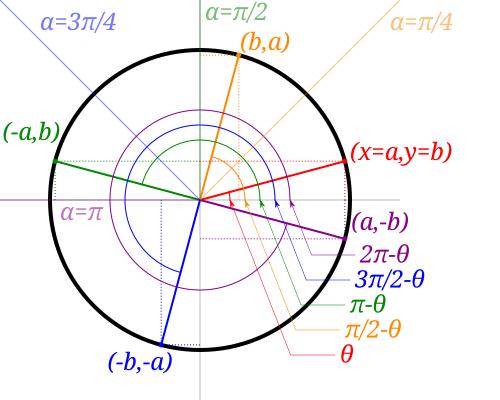
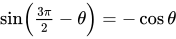
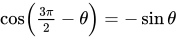
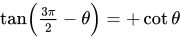
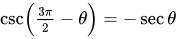
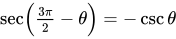
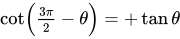
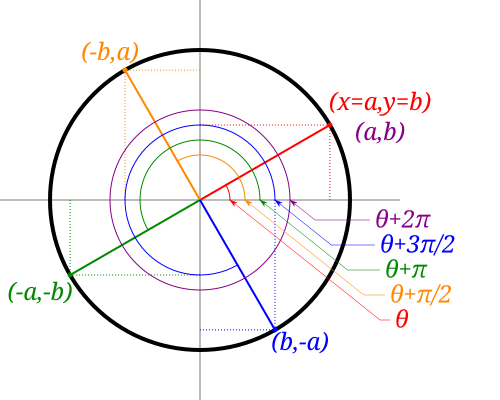
จากการพิจารณาวงกลมหนึ่งหน่วย เราสามารถกำหนดคุณสมบัติต่อไปนี้ของฟังก์ชันตรีโกโนเมตริกได้
ป้าย เครื่องหมายของฟังก์ชันตรีโกณมิติขึ้นอยู่กับควอดแรนต์ของมุม ถ้า− π < θ ≤ π {\displaystyle {-\pi }<\theta \leq \pi } sgn คือฟังก์ชันเครื่องหมาย
sgn ( บาป θ ) = sgn ( ซีเอสซี θ ) = { + 1 ถ้า 0 < θ < π − 1 ถ้า − π < θ < 0 0 ถ้า θ ∈ { 0 , π } sgn ( คอส θ ) = sgn ( วินาที θ ) = { + 1 ถ้า − π 2 < θ < π 2 − 1 ถ้า − π < θ < − π 2 หรือ π 2 < θ < π 0 ถ้า θ ∈ { − π 2 , π 2 } sgn ( แทน θ ) = sgn ( เปลเด็ก θ ) = { + 1 ถ้า − π < θ < − π 2 หรือ 0 < θ < π 2 − 1 ถ้า − π 2 < θ < 0 หรือ π 2 < θ < π 0 ถ้า θ ∈ { − π 2 , 0 , π 2 , π } {\displaystyle {\begin{aligned}\operatorname {sgn}(\sin \theta )=\operatorname {sgn}(\csc \theta )&={\begin{cases}+1&{\text{if}}\ \ 0<\theta <\pi \\-1&{\text{if}}\ \ {-\pi }<\theta <0\\0&{\text{if}}\ \ \theta \in \{0,\pi \}\end{cases}}\\[5mu]\operatorname {sgn}(\cos \theta )=\operatorname {sgn}(\sec \theta )&={\begin{cases}+1&{\text{if}}\ \ {-{\tfrac {\pi }{2}}}<\theta <{\tfrac {\pi }{2}}\\-1&{\text{if}}\ \ {-\pi }<\theta <-{\tfrac {\pi }{2}}\ \ {\text{or}}\ \ {\tfrac {\pi }{2}}<\theta <\pi \\0&{\text{if}}\ \ \theta \in {\bigl \{}{-{\tfrac {\pi }{2}}},{\tfrac {\pi }{2}}{\bigr \}}\end{cases}}\\[5mu]\operatorname {sgn}(\tan \theta )=\operatorname {sgn}(\cot \theta )&={\begin{cases}+1&{\text{if}}\ \ {-\pi }<\theta <-{\tfrac {\pi }{2}}\ \ {\text{or}}\ \ 0<\theta <{\tfrac {\pi }{2}}\\-1&{\text{if}}\ \ {-{\tfrac {\pi }{2}}}<\theta <0\ \ {\text{or}}\ \ {\tfrac {\pi }{2}}<\theta <\pi \\0&{\text{if}}\ \ \theta \in {\bigl \{}{-{\tfrac {\pi }{2}}},0,{\tfrac {\pi }{2}},\pi {\bigr \}}\end{cases}}\end{aligned}}}
ฟังก์ชันตรีโกณมิติเป็นฟังก์ชันคาบที่มีคาบร่วมกัน2 π , {\displaystyle 2\pi ,} θ ที่อยู่นอกช่วง( − π , π ] , {\displaystyle ({-\pi },\pi ],} หัวข้อ § การเลื่อนและคาบเวลา ด้านบน) เครื่องหมายของฟังก์ชันไซน์หรือโคไซน์สามารถใช้กำหนดคลื่นสี่เหลี่ยม มาตรฐานได้ ตัวอย่างเช่น ฟังก์ชันต่างๆsgn ( บาป x ) {\displaystyle \operatorname {sgn}(\sin x)} sgn ( คอส x ) {\displaystyle \operatorname {sgn}(\cos x)} 1 และสอดคล้องกับคลื่นสี่เหลี่ยมที่มีการเลื่อนเฟสเท่ากับ π / 2
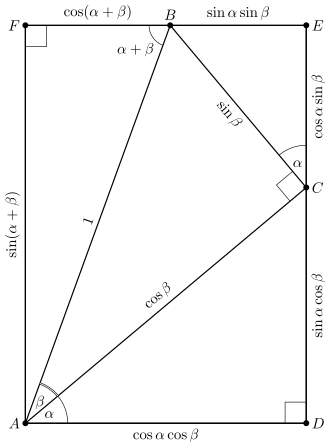
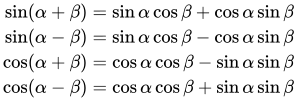
เอกลักษณ์ผลรวมและผลต่างของมุม การสร้างทางเรขาคณิตเพื่อหาเอกลักษณ์ตรีโกณมิติของผลรวมมุม แผนภาพแสดงเอกลักษณ์ความแตกต่างของมุมสำหรับบาป ( α − เบต้า ) {\displaystyle \sin(\alpha -\beta )} คอส ( α − เบต้า ) {\displaystyle \cos(\alpha -\beta )} สิ่งเหล่านี้เรียกอีกอย่างว่า ทฤษฎีบท (หรือสูตร ) การบวกและการลบมุม บาป ( α + เบต้า ) = บาป α คอส เบต้า + คอส α บาป เบต้า บาป ( α − เบต้า ) = บาป α คอส เบต้า − คอส α บาป เบต้า คอส ( α + เบต้า ) = คอส α คอส เบต้า − บาป α บาป เบต้า คอส ( α − เบต้า ) = คอส α คอส เบต้า + บาป α บาป เบต้า {\displaystyle {\begin{aligned}\sin(\alpha +\beta )&=\sin \alpha \cos \beta +\cos \alpha \sin \beta \\\sin(\alpha -\beta )&=\sin \alpha \cos \beta -\cos \alpha \sin \beta \\\cos(\alpha +\beta )&=\cos \alpha \cos \beta -\sin \alpha \sin \beta \\\cos(\alpha -\beta )&=\cos \alpha \cos \beta +\sin \alpha \sin \beta \end{aligned}}}
เอกลักษณ์ความแตกต่างของมุมสำหรับบาป ( α − เบต้า ) {\displaystyle \sin(\alpha -\beta )} คอส ( α − เบต้า ) {\displaystyle \cos(\alpha -\beta )} − เบต้า {\displaystyle -\beta } เบต้า {\displaystyle \beta } บาป ( − เบต้า ) = − บาป ( เบต้า ) {\displaystyle \sin(-\beta )=-\sin(\beta )} คอส ( − เบต้า ) = คอส ( เบต้า ) {\displaystyle \cos(-\beta )=\cos(\beta )} ผลคูณจุด และผลคูณไขว้ ของเวกเตอร์สองตัวในรูปของโคไซน์และไซน์ของมุมระหว่างเวกเตอร์ทั้งสองด้วย
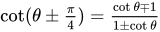
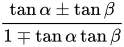
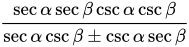
เอกลักษณ์เหล่านี้สรุปไว้ในสองแถวแรกของตารางต่อไปนี้ ซึ่งรวมถึงเอกลักษณ์ผลบวกและผลต่างสำหรับฟังก์ชันตรีโกโนเมตริกอื่นๆ ด้วย
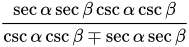
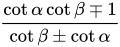
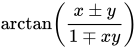
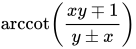
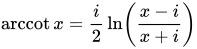
ไซน์ บาป ( α ± เบต้า ) {\displaystyle \sin(\alpha \pm \beta )} = {\displaystyle =} บาป α คอส เบต้า ± คอส α บาป เบต้า {\displaystyle \sin \alpha \cos \beta \pm \cos \alpha \sin \beta } [ 5 ] [ 6 ] โคไซน์ คอส ( α ± เบต้า ) {\displaystyle \cos(\alpha \pm \beta )} = {\displaystyle =} คอส α คอส เบต้า ∓ บาป α บาป เบต้า {\displaystyle \cos \alpha \cos \beta \mp \sin \alpha \sin \beta } [ 6 ] [ 7 ] แทนเจนต์ แทน ( α ± เบต้า ) {\displaystyle \tan(\alpha \pm \beta )} = {\displaystyle =} แทน α ± แทน เบต้า 1 ∓ แทน α แทน เบต้า {\displaystyle {\frac {\tan \alpha \pm \tan \beta }{1\mp \tan \alpha \tan \beta }}} [ 6 ] [ 8 ] โคเซแคนต์ ซีเอสซี ( α ± เบต้า ) {\displaystyle \csc(\alpha \pm \beta )} = {\displaystyle =} วินาที α วินาที เบต้า ซีเอสซี α ซีเอสซี เบต้า วินาที α ซีเอสซี เบต้า ± ซีเอสซี α วินาที เบต้า {\displaystyle {\frac {\sec \alpha \sec \beta \csc \alpha \csc \beta }{\sec \alpha \csc \beta \pm \csc \alpha \sec \beta }}} [ 9 ] เซแคนท์ วินาที ( α ± เบต้า ) {\displaystyle \sec(\alpha \pm \beta )} = {\displaystyle =} วินาที α วินาที เบต้า ซีเอสซี α ซีเอสซี เบต้า ซีเอสซี α ซีเอสซี เบต้า ∓ วินาที α วินาที เบต้า {\displaystyle {\frac {\sec \alpha \sec \beta \csc \alpha \csc \beta }{\csc \alpha \csc \beta \mp \sec \alpha \sec \beta }}} [ 9 ] โคแทนเจนต์ เปลเด็ก ( α ± เบต้า ) {\displaystyle \cot(\alpha \pm \beta )} = {\displaystyle =} เปลเด็ก α เปลเด็ก เบต้า ∓ 1 เปลเด็ก เบต้า ± เปลเด็ก α {\displaystyle {\frac {\cot \alpha \cot \beta \mp 1}{\cot \beta \pm \cot \alpha }}} [ 6 ] [ 10 ] อาร์คซีน อาร์คซิน x ± อาร์คซิน y {\displaystyle \arcsin x\pm \arcsin y} = {\displaystyle =} อาร์คซิน ( x 1 − y 2 ± y 1 − x 2 y ) {\displaystyle \arcsin \left(x{\sqrt {1-y^{2}}}\pm y{\sqrt {1-x^{2}{\vphantom {y}}}}\right)} [ 11 ] อาร์คโคซีน อาร์คคอส x ± อาร์คคอส y {\displaystyle \arccos x\pm \arccos y} = {\displaystyle =} อาร์คคอส ( x y ∓ ( 1 − x 2 ) ( 1 − y 2 ) ) {\displaystyle \arccos \left(xy\mp {\sqrt {\left(1-x^{2}\right)\left(1-y^{2}\right)}}\right)} [ 12 ] อาร์คแทงเจนต์ อาร์คตัน x ± อาร์คตัน y {\displaystyle \arctan x\pm \arctan y} = {\displaystyle =} อาร์คตัน ( x ± y 1 ∓ x y ) {\displaystyle \arctan \left({\frac {x\pm y}{1\mp xy}}\right)} [ 13 ] อาร์คโคแทนเจนต์ อาร์คคอต x ± อาร์คคอต y {\displaystyle \operatorname {arccot} x\pm \operatorname {arccot} y} = {\displaystyle =} อาร์คคอต ( x y ∓ 1 y ± x ) {\displaystyle \operatorname {arccot} \left({\frac {xy\mp 1}{y\pm x}}\right)}
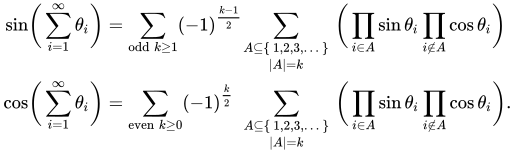
ค่าไซน์และโคไซน์ของผลรวมของมุมจำนวนอนันต์ เมื่อซีรีส์∑ ฉัน = 1 ∞ θ ฉัน {\textstyle \sum _{i=1}^{\infty }\theta _{i}} ลู่เข้าอย่างสมบูรณ์ แล้ว
บาป ( ∑ ฉัน = 1 ∞ θ ฉัน ) = ∑ แปลก เค ≥ 1 ( − 1 ) เค − 1 2 ∑ เอ ⊆ { 1 , 2 , 3 , … } | เอ | = เค ( ∏ ฉัน ∈ เอ บาป θ ฉัน ∏ ฉัน ∉ เอ คอส θ ฉัน ) คอส ( ∑ ฉัน = 1 ∞ θ ฉัน ) = ∑ สม่ำเสมอ เค ≥ 0 ( − 1 ) เค 2 ∑ เอ ⊆ { 1 , 2 , 3 , … } | เอ | = เค ( ∏ ฉัน ∈ เอ บาป θ ฉัน ∏ ฉัน ∉ เอ คอส θ ฉัน ) . {\displaystyle {\begin{aligned}{\sin }{\biggl (}\sum _{i=1}^{\infty }\theta _{i}{\biggl )}&=\sum _{{\text{odd}}\ k\geq 1}(-1)^{\frac {k-1}{2}}\!\!\sum _{\begin{smallmatrix}A\subseteq \{\,1,2,3,\dots \,\}\\\left|A\right|=k\end{smallmatrix}}{\biggl (}\prod _{i\in A}\sin \theta _{i}\prod _{i\not \in A}\cos \theta _{i}{\biggr )}\\{\cos }{\biggl (}\sum _{i=1}^{\infty }\theta _{i}{\biggr )}&=\sum _{{\text{even}}\ k\geq 0}(-1)^{\frac {k}{2}}\,\sum _{\begin{smallmatrix}A\subseteq \{\,1,2,3,\dots \,\}\\\left|A\right|=k\end{smallmatrix}}{\biggl (}\prod _{i\in A}\sin \theta _{i}\prod _{i\not \in A}\cos \theta _{i}{\biggr )}.\end{aligned}}}
เพราะซีรีส์เรื่องนี้∑ ฉัน = 1 ∞ θ ฉัน {\textstyle \sum _{i=1}^{\infty }\theta _{i}} ลิม ฉัน → ∞ θ ฉัน = 0 , {\textstyle \lim _{i\to \infty }\theta _{i}=0,} ลิม ฉัน → ∞ บาป θ ฉัน = 0 , {\textstyle \lim _{i\to \infty }\sin \theta _{i}=0,} ลิม ฉัน → ∞ คอส θ ฉัน = 1. {\textstyle \lim _{i\to \infty }\cos \theta _{i}=1.} จำกัด ส่วนพจน์ที่มีตัวประกอบไซน์จำนวนอนันต์นั้น จะต้องมีค่าเท่ากับศูนย์อย่างแน่นอน
เมื่อมีมุมเพียงจำนวนจำกัดเท่านั้นθ ฉัน {\displaystyle \theta _{i}}
เส้นแทนเจนต์และโคแทนเจนต์ของผลรวม อนุญาตอี เค {\displaystyle e_{k}} เค = 0 , 1 , 2 , 3 , … {\displaystyle k=0,1,2,3,\ldots } พหุนามสมมาตรพื้นฐาน ดีกรีk ในตัวแปร x ฉัน = แทน θ ฉัน {\displaystyle x_{i}=\tan \theta _{i}} ฉัน = 0 , 1 , 2 , 3 , … , {\displaystyle i=0,1,2,3,\ldots ,}
อี 0 = 1 อี 1 = ∑ ฉัน x ฉัน = ∑ ฉัน แทน θ ฉัน อี 2 = ∑ ฉัน < เจ x ฉัน x เจ = ∑ ฉัน < เจ แทน θ ฉัน แทน θ เจ อี 3 = ∑ ฉัน < เจ < เค x ฉัน x เจ x เค = ∑ ฉัน < เจ < เค แทน θ ฉัน แทน θ เจ แทน θ เค ⋮ ⋮ {\displaystyle {\begin{aligned}e_{0}&=1\\[6pt]e_{1}&=\sum _{i}x_{i}&&=\sum _{i}\tan \theta _{i}\\[6pt]e_{2}&=\sum _{i<j}x_{i}x_{j}&&=\sum _{i<j}\tan \theta _{i}\tan \theta _{j}\\[6pt]e_{3}&=\sum _{i<j<k}x_{i}x_{j}x_{k}&&=\sum _{i<j<k}\tan \theta _{i}\tan \theta _{j}\tan \theta _{k}\\&\ \ \vdots &&\ \ \vdots \end{aligned}}}
แล้ว
แทน ( ∑ ฉัน θ ฉัน ) = อี 1 − อี 3 + อี 5 − ⋯ อี 0 − อี 2 + อี 4 − ⋯ . {\displaystyle \tan {\Bigl (}\sum _{i}\theta _{i}{\Bigr )}={\frac {e_{1}-e_{3}+e_{5}-\cdots }{e_{0}-e_{2}+e_{4}-\cdots }}.} แทน ( ∑ ฉัน θ ฉัน ) = บาป ( ∑ ฉัน θ ฉัน ) / ∏ ฉัน คอส θ ฉัน คอส ( ∑ ฉัน θ ฉัน ) / ∏ ฉัน คอส θ ฉัน = ∑ แปลก เค ≥ 1 ( − 1 ) เค − 1 2 ∑ เอ ⊆ { 1 , 2 , 3 , … } | เอ | = เค ∏ ฉัน ∈ เอ แทน θ ฉัน ∑ สม่ำเสมอ เค ≥ 0 ( − 1 ) เค 2 ∑ เอ ⊆ { 1 , 2 , 3 , … } | เอ | = เค ∏ ฉัน ∈ เอ แทน θ ฉัน = อี 1 − อี 3 + อี 5 − ⋯ อี 0 − อี 2 + อี 4 − ⋯ เปลเด็ก ( ∑ ฉัน θ ฉัน ) = อี 0 − อี 2 + อี 4 − ⋯ อี 1 − อี 3 + อี 5 − ⋯ {\displaystyle {\begin{aligned}\tan {\Bigl (}\sum _{i}\theta _{i}{\Bigr )}&={\frac {{\sin }{\bigl (}\sum _{i}\theta _{i}{\bigr )}/\prod _{i}\cos \theta _{i}}{{\cos }{\bigl (}\sum _{i}\theta _{i}{\bigr )}/\prod _{i}\cos \theta _{i}}}\\[10pt]&={\frac {\displaystyle \sum _{{\text{odd}}\ k\geq 1}(-1)^{\frac {k-1}{2}}\sum _{\begin{smallmatrix}A\subseteq \{1,2,3,\dots \}\\\left|A\right|=k\end{smallmatrix}}\prod _{i\in A}\tan \theta _{i}}{\displaystyle \sum _{{\text{even}}\ k\geq 0}~(-1)^{\frac {k}{2}}~~\sum _{\begin{smallmatrix}A\subseteq \{1,2,3,\dots \}\\\left|A\right|=k\end{smallmatrix}}\prod _{i\in A}\tan \theta _{i}}}={\frac {e_{1}-e_{3}+e_{5}-\cdots }{e_{0}-e_{2}+e_{4}-\cdots }}\\[10pt]\cot {\Bigl (}\sum _{i}\theta _{i}{\Bigr )}&={\frac {e_{0}-e_{2}+e_{4}-\cdots }{e_{1}-e_{3}+e_{5}-\cdots }}\end{aligned}}}
จำนวนพจน์ทางด้านขวาขึ้นอยู่กับจำนวนพจน์ทางด้านซ้าย
ตัวอย่างเช่น: แทน ( θ 1 + θ 2 ) = อี 1 อี 0 − อี 2 = x 1 + x 2 1 − x 1 x 2 = แทน θ 1 + แทน θ 2 1 − แทน θ 1 แทน θ 2 , แทน ( θ 1 + θ 2 + θ 3 ) = อี 1 − อี 3 อี 0 − อี 2 = ( x 1 + x 2 + x 3 ) − ( x 1 x 2 x 3 ) 1 − ( x 1 x 2 + x 1 x 3 + x 2 x 3 ) , แทน ( θ 1 + θ 2 + θ 3 + θ 4 ) = อี 1 − อี 3 อี 0 − อี 2 + อี 4 = ( x 1 + x 2 + x 3 + x 4 ) − ( x 1 x 2 x 3 + x 1 x 2 x 4 + x 1 x 3 x 4 + x 2 x 3 x 4 ) 1 − ( x 1 x 2 + x 1 x 3 + x 1 x 4 + x 2 x 3 + x 2 x 4 + x 3 x 4 ) + ( x 1 x 2 x 3 x 4 ) , {\displaystyle {\begin{aligned}\tan(\theta _{1}+\theta _{2})&={\frac {e_{1}}{e_{0}-e_{2}}}={\frac {x_{1}+x_{2}}{1\ -\ x_{1}x_{2}}}={\frac {\tan \theta _{1}+\tan \theta _{2}}{1\ -\ \tan \theta _{1}\tan \theta _{2}}},\\[8pt]\tan(\theta _{1}+\theta _{2}+\theta _{3})&={\frac {e_{1}-e_{3}}{e_{0}-e_{2}}}={\frac {(x_{1}+x_{2}+x_{3})\ -\ (x_{1}x_{2}x_{3})}{1\ -\ (x_{1}x_{2}+x_{1}x_{3}+x_{2}x_{3})}},\\[8pt]\tan(\theta _{1}+\theta _{2}+\theta _{3}+\theta _{4})&={\frac {e_{1}-e_{3}}{e_{0}-e_{2}+e_{4}}}\\[8pt]&={\frac {(x_{1}+x_{2}+x_{3}+x_{4})\ -\ (x_{1}x_{2}x_{3}+x_{1}x_{2}x_{4}+x_{1}x_{3}x_{4}+x_{2}x_{3}x_{4})}{1\ -\ (x_{1}x_{2}+x_{1}x_{3}+x_{1}x_{4}+x_{2}x_{3}+x_{2}x_{4}+x_{3}x_{4})\ +\ (x_{1}x_{2}x_{3}x_{4})}},\end{aligned}}}
และอื่นๆ กรณีที่มีพจน์จำนวนจำกัดเท่านั้นสามารถพิสูจน์ได้ด้วย การเหนี่ยว นำทางคณิตศาสตร์ [ 14 ] [ 15 ]
สมมติเอ , ข , ค , ง , พี , q ∈ อาร์ {\textstyle a,b,c,d,p,q\in \mathbb {R} } ฉัน = − 1 {\textstyle i={\sqrt {-1}}}
เอ ฉัน + ข ค ฉัน + ง = พี ฉัน + q {\displaystyle {\frac {ai+b}{ci+d}}=pi+q} และปล่อยให้φ {\textstyle \varphi } แทน φ = ค ง . {\textstyle \tan \varphi ={\tfrac {c}{d}}.} เอ ค ≠ ข ง {\textstyle {\tfrac {a}{c}}\neq {\tfrac {b}{d}}} เป็น 0/0 ได้ แล้ว ทุกๆ θ ∈ อาร์ {\textstyle \theta \in \mathbb {R} } [ 16 ]
เอ แทน θ + ข ค แทน θ + ง = พี แทน ( θ − φ ) + q . {\displaystyle {\frac {a\tan \theta +b}{c\tan \theta +d}}=p\tan(\theta -\varphi )+q.} (ในกรณีที่ตัวส่วนของเศษส่วนนี้เป็น 0 เราจะกำหนดค่าของเศษส่วนนั้นเป็น 0)∞ {\textstyle \infty } ∞ {\textstyle \infty } + ∞ {\textstyle +\infty } − ∞ {\textstyle -\infty } ∞ {\textstyle \infty } อาร์ ∪ { ∞ } {\textstyle \mathbb {R} \cup \{\,\infty \,\}}
จากเอกลักษณ์นี้สามารถแสดงให้เห็นได้อย่างรวดเร็วว่าตระกูลของ ตัวแปรสุ่ม ที่มีการแจกแจงแบบโคชี ทั้งหมด นั้นปิดภายใต้การแปลงเศษส่วนเชิงเส้น ซึ่งเป็นผลลัพธ์ที่ทราบกันมาตั้งแต่ปี พ.ศ. 2519 [ 17 ]
เส้นตัดและเส้นร่วมตัดของผลรวม วินาที ( ∑ ฉัน θ ฉัน ) = ∏ ฉัน วินาที θ ฉัน อี 0 − อี 2 + อี 4 − ⋯ ซีเอสซี ( ∑ ฉัน θ ฉัน ) = ∏ ฉัน วินาที θ ฉัน อี 1 − อี 3 + อี 5 − ⋯ {\displaystyle {\begin{aligned}{\sec }{\Bigl (}\sum _{i}\theta _{i}{\Bigr )}&={\frac {\prod _{i}\sec \theta _{i}}{e_{0}-e_{2}+e_{4}-\cdots }}\\[8pt]{\csc }{\Bigl (}\sum _{i}\theta _{i}{\Bigr )}&={\frac {\prod _{i}\sec \theta _{i}}{e_{1}-e_{3}+e_{5}-\cdots }}\end{aligned}}}
ที่ไหนอี เค {\displaystyle e_{k}} พหุนามสมมาตรพื้นฐานดีกรี k ใน ตัวแปรn ตัว x ฉัน = แทน θ ฉัน , {\displaystyle x_{i}=\tan \theta _{i},} ฉัน = 1 , … , n , {\displaystyle i=1,\ldots ,n,} [ 18 ]
ตัวอย่างเช่น,
วินาที ( α + เบต้า + γ ) = วินาที α วินาที เบต้า วินาที γ 1 − แทน α แทน เบต้า − แทน α แทน γ − แทน เบต้า แทน γ ซีเอสซี ( α + เบต้า + γ ) = วินาที α วินาที เบต้า วินาที γ แทน α + แทน เบต้า + แทน γ − แทน α แทน เบต้า แทน γ . {\displaystyle {\begin{aligned}\sec(\alpha +\beta +\gamma )&={\frac {\sec \alpha \sec \beta \sec \gamma }{1-\tan \alpha \tan \beta -\tan \alpha \tan \gamma -\tan \beta \tan \gamma }}\\[8pt]\csc(\alpha +\beta +\gamma )&={\frac {\sec \alpha \sec \beta \sec \gamma }{\tan \alpha +\tan \beta +\tan \gamma -\tan \alpha \tan \beta \tan \gamma }}.\end{aligned}}}
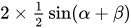
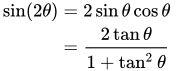
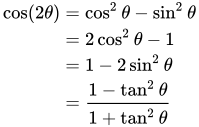
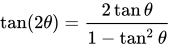
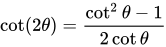
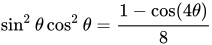
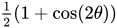
การ สาธิตเชิงภาพของสูตรมุมสอง เท่า 2θ พื้นที่ 1/2 ( ฐาน × ความ สูง ) คำนวณได้ในสองทิศทาง เมื่อตั้งตรง พื้นที่คือsin θ cos θ เมื่อ วาง ตะแคง พื้นที่ คือ 1/2 sin 2θ sin 2θ = 2sin θ cos θ
สูตรสำหรับมุมสามเท่า[ 20 ]
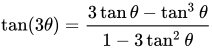
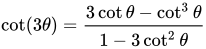
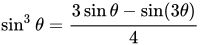
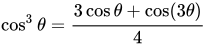
บาป ( 3 θ ) = 3 บาป θ − 4 บาป 3 θ = 4 บาป θ บาป ( π 3 − θ ) บาป ( π 3 + θ ) คอส ( 3 θ ) = 4 คอส 3 θ − 3 คอส θ = 4 คอส θ คอส ( π 3 − θ ) คอส ( π 3 + θ ) แทน ( 3 θ ) = 3 แทน θ − แทน 3 θ 1 − 3 แทน 2 θ = แทน θ แทน ( π 3 − θ ) แทน ( π 3 + θ ) เปลเด็ก ( 3 θ ) = 3 เปลเด็ก θ − เปลเด็ก 3 θ 1 − 3 เปลเด็ก 2 θ วินาที ( 3 θ ) = วินาที 3 θ 4 − 3 วินาที 2 θ ซีเอสซี ( 3 θ ) = ซีเอสซี 3 θ 3 ซีเอสซี 2 θ − 4 {\displaystyle {\begin{aligned}\sin(3\theta )&=3\sin \theta -4\sin ^{3}\theta &&=4\sin \theta \sin \left({\tfrac {\pi }{3}}-\theta \right)\sin \left({\tfrac {\pi }{3}}+\theta \right)\\\cos(3\theta )&=4\cos ^{3}\theta -3\cos \theta &&=4\cos \theta \cos \left({\tfrac {\pi }{3}}-\theta \right)\cos \left({\tfrac {\pi }{3}}+\theta \right)\\\tan(3\theta )&={\frac {3\tan \theta -\tan ^{3}\theta }{1-3\tan ^{2}\theta }}&&=\tan \theta \tan \left({\tfrac {\pi }{3}}-\theta \right)\tan \left({\tfrac {\pi }{3}}+\theta \right)\\\cot(3\theta )&={\frac {3\cot \theta -\cot ^{3}\theta }{1-3\cot ^{2}\theta }}\\\sec(3\theta )&={\frac {\sec ^{3}\theta }{4-3\sec ^{2}\theta }}\\\csc(3\theta )&={\frac {\csc ^{3}\theta }{3\csc ^{2}\theta -4}}\\\end{aligned}}}
สูตรสำหรับมุมหลายมุม[ 22 ]
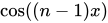
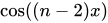
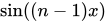
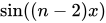
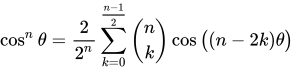
บาป ( n θ ) = ∑ เค ∈ โอ + n ( − 1 ) เค − 1 2 ( n เค ) คอส n − เค θ บาป เค θ = บาป θ ∑ ฉัน = 0 n + 1 2 ∑ เจ = 0 ฉัน ( − 1 ) ฉัน − เจ ( n 2 ฉัน + 1 ) ( ฉัน เจ ) คอส n − 2 ( ฉัน − เจ ) − 1 θ = บาป ( θ ) ∑ เค = 0 ⌊ n − 1 2 ⌋ ( − 1 ) เค ( 2 คอส ( θ ) ) n − 2 เค − 1 ( n − เค − 1 เค ) = 2 ( n − 1 ) ∏ เค = 0 n − 1 บาป ( เค π n + θ ) คอส ( n θ ) = ∑ เค ∈ อี 0 + n ( − 1 ) เค 2 ( n เค ) คอส n − เค θ บาป เค θ = ∑ ฉัน = 0 n 2 ∑ เจ = 0 ฉัน ( − 1 ) ฉัน − เจ ( n 2 ฉัน ) ( ฉัน เจ ) คอส n − 2 ( ฉัน − เจ ) θ = ∑ เค = 0 ⌊ n 2 ⌋ ( − 1 ) เค ( 2 คอส ( θ ) ) n − 2 เค ( n − เค เค ) n 2 n − 2 เค คอส ( ( 2 n + 1 ) θ ) = ( − 1 ) n 2 2 n ∏ เค = 0 2 n คอส ( เค π 2 n + 1 − θ ) คอส ( 2 n θ ) = ( − 1 ) n 2 2 n − 1 ∏ เค = 0 2 n − 1 คอส ( ( 1 + 2 เค ) π 4 n − θ ) แทน ( n θ ) = ∑ เค ∈ โอ + n ( − 1 ) เค − 1 2 ( n เค ) แทน เค θ ∑ เค ∈ อี 0 + n ( − 1 ) เค 2 ( n เค ) แทน เค θ โอ + = จำนวนเต็มคี่บวก อี 0 + = จำนวนเต็มคู่ที่ไม่เป็นลบ {\displaystyle {\begin{aligned}\sin(n\theta )&=\sum _{k\in \mathbb {O} ^{+}}^{n}(-1)^{\frac {k-1}{2}}{n \choose k}\cos ^{n-k}\theta \sin ^{k}\theta =\sin \theta \sum _{i=0}^{\frac {n+1}{2}}\sum _{j=0}^{i}(-1)^{i-j}{n \choose 2i+1}{i \choose j}\cos ^{n-2(i-j)-1}\theta \\&=\sin(\theta )\sum _{k=0}^{\left\lfloor {\frac {n-1}{2}}\right\rfloor }(-1)^{k}{\bigl (}2\cos(\theta ){\bigr )}^{n-2k-1}{n-k-1 \choose k}\\&=2^{(n-1)}\prod _{k=0}^{n-1}\sin \left({\frac {k\pi }{n}}+\theta \right)\\\cos(n\theta )&=\sum _{k\in \mathbb {E} _{0}^{+}}^{n}(-1)^{\frac {k}{2}}{n \choose k}\cos ^{n-k}\theta \sin ^{k}\theta =\sum _{i=0}^{\frac {n}{2}}\sum _{j=0}^{i}(-1)^{i-j}{n \choose 2i}{i \choose j}\cos ^{n-2(i-j)}\theta \\&=\sum _{k=0}^{\left\lfloor {\frac {n}{2}}\right\rfloor }(-1)^{k}{(2\cos(\theta ))}^{n-2k}{n-k \choose k}{\frac {n}{2n-2k}}\\\cos {\bigl (}(2n+1)\theta {\bigr )}&=(-1)^{n}2^{2n}\prod _{k=0}^{2n}\cos \left({\frac {k\pi }{2n+1}}-\theta \right)\\\cos(2n\theta )&=(-1)^{n}2^{2n-1}\prod _{k=0}^{2n-1}\cos \left({\frac {(1+2k)\pi }{4n}}-\theta \right)\\\tan(n\theta )&={\frac {\displaystyle \sum _{k\in \mathbb {O} ^{+}}^{n}(-1)^{\frac {k-1}{2}}{n \choose k}\tan ^{k}\theta }{\displaystyle \sum _{k\in \mathbb {E} _{0}^{+}}^{n}(-1)^{\frac {k}{2}}{n \choose k}\tan ^{k}\theta }}\\\mathbb {O} ^{+}&={\text{Positive odd integers}}\\\mathbb {E} _{0}^{+}&={\text{Non-negative even integers}}\\\end{aligned}}}
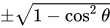
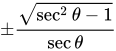
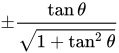
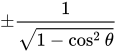
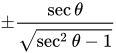
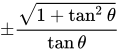
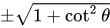
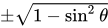
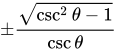
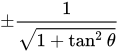
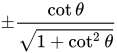
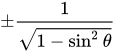
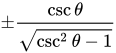
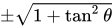
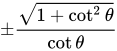
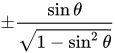
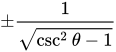
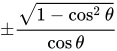
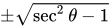
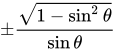
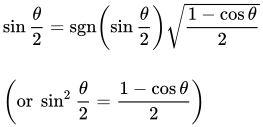
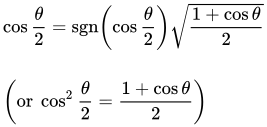
บาป θ 2 = sgn ( บาป θ 2 ) 1 − คอส θ 2 คอส θ 2 = sgn ( คอส θ 2 ) 1 + คอส θ 2 แทน θ 2 = 1 − คอส θ บาป θ = บาป θ 1 + คอส θ = ซีเอสซี θ − เปลเด็ก θ = แทน θ 1 + วินาที θ = sgn ( บาป θ ) 1 − คอส θ 1 + คอส θ = − 1 + sgn ( คอส θ ) 1 + แทน 2 θ แทน θ เปลเด็ก θ 2 = 1 + คอส θ บาป θ = บาป θ 1 − คอส θ = ซีเอสซี θ + เปลเด็ก θ = sgn ( บาป θ ) 1 + คอส θ 1 − คอส θ วินาที θ 2 = sgn ( คอส θ 2 ) 2 1 + คอส θ ซีเอสซี θ 2 = sgn ( บาป θ 2 ) 2 1 − คอส θ {\displaystyle {\begin{aligned}\sin {\frac {\theta }{2}}&=\operatorname {sgn} \left(\sin {\frac {\theta }{2}}\right){\sqrt {\frac {1-\cos \theta }{2}}}\\[3pt]\cos {\frac {\theta }{2}}&=\operatorname {sgn} \left(\cos {\frac {\theta }{2}}\right){\sqrt {\frac {1+\cos \theta }{2}}}\\[3pt]\tan {\frac {\theta }{2}}&={\frac {1-\cos \theta }{\sin \theta }}={\frac {\sin \theta }{1+\cos \theta }}=\csc \theta -\cot \theta ={\frac {\tan \theta }{1+\sec {\theta }}}\\[6mu]&=\operatorname {sgn}(\sin \theta ){\sqrt {\frac {1-\cos \theta }{1+\cos \theta }}}={\frac {-1+\operatorname {sgn}(\cos \theta ){\sqrt {1+\tan ^{2}\theta }}}{\tan \theta }}\\[3pt]\cot {\frac {\theta }{2}}&={\frac {1+\cos \theta }{\sin \theta }}={\frac {\sin \theta }{1-\cos \theta }}=\csc \theta +\cot \theta =\operatorname {sgn}(\sin \theta ){\sqrt {\frac {1+\cos \theta }{1-\cos \theta }}}\\\sec {\frac {\theta }{2}}&=\operatorname {sgn} \left(\cos {\frac {\theta }{2}}\right){\sqrt {\frac {2}{1+\cos \theta }}}\\\csc {\frac {\theta }{2}}&=\operatorname {sgn} \left(\sin {\frac {\theta }{2}}\right){\sqrt {\frac {2}{1-\cos \theta }}}\\\end{aligned}}} [ 25 ] [ 26 ]
อีกด้วย แทน η ± θ 2 = บาป η ± บาป θ คอส η + คอส θ แทน ( θ 2 + π 4 ) = วินาที θ + แทน θ 1 − บาป θ 1 + บาป θ = | 1 − แทน θ 2 | | 1 + แทน θ 2 | {\displaystyle {\begin{aligned}\tan {\frac {\eta \pm \theta }{2}}&={\frac {\sin \eta \pm \sin \theta }{\cos \eta +\cos \theta }}\\[3pt]\tan \left({\frac {\theta }{2}}+{\frac {\pi }{4}}\right)&=\sec \theta +\tan \theta \\[3pt]{\sqrt {\frac {1-\sin \theta }{1+\sin \theta }}}&={\frac {\left|1-\tan {\frac {\theta }{2}}\right|}{\left|1+\tan {\frac {\theta }{2}}\right|}}\end{aligned}}}
เอกลักษณ์ผลคูณเป็นผลรวมและเอกลักษณ์ผลรวมเป็นผลคูณ การพิสูจน์เอกลักษณ์โคไซน์ผลรวมและผลต่างสำหรับการคำนวณโปรสตาเฟอรีซิสโดยใช้สามเหลี่ยมหน้าจั่ว เอกลักษณ์ผลคูณเป็นผลรวม[ 30 ] โปรสตาเฟอรีซิส สามารถพิสูจน์ได้โดยการขยายด้านขวาโดยใช้ทฤษฎีบทการบวกมุม ในอดีต สี่ข้อแรกเหล่านี้เรียกว่าสูตรของเวอร์เนอร์ ตามชื่อ ของ โยฮันเนส เวอร์เนอร์ ผู้ใช้สูตรเหล่านี้ในการคำนวณทางดาราศาสตร์[ 31 ] การปรับแอมพลิจูด สำหรับการประยุกต์ใช้สูตรผลคูณเป็นผลรวม และบีท (อะคูสติก) และตัวตรวจจับเฟส สำหรับการประยุกต์ใช้สูตรผลรวมเป็นผลคูณ
เอกลักษณ์ผลคูณเป็นผลรวม ผลคูณของค่าไซน์หรือโคไซน์สองค่าที่มีมุมต่างกัน สามารถแปลงเป็นผลรวมของฟังก์ชันตรีโกโนเมตริกของผลรวมและผลต่างของมุมเหล่านั้นได้:
คอส θ คอส φ = 1 2 ( คอส ( θ − φ ) + คอส ( θ + φ ) ) , บาป θ บาป φ = 1 2 ( คอส ( θ − φ ) − คอส ( θ + φ ) ) , บาป θ คอส φ = 1 2 ( บาป ( θ + φ ) + บาป ( θ − φ ) ) , คอส θ บาป φ = 1 2 ( บาป ( θ + φ ) − บาป ( θ − φ ) ) . {\displaystyle {\begin{aligned}\cos \theta \,\cos \varphi &={\tfrac {1}{2}}{\bigl (}\!\!~\cos(\theta -\varphi )+\cos(\theta +\varphi ){\bigr )},\\[5mu]\sin \theta \,\sin \varphi &={\tfrac {1}{2}}{\bigl (}\!\!~\cos(\theta -\varphi )-\cos(\theta +\varphi ){\bigr )},\\[5mu]\sin \theta \,\cos \varphi &={\tfrac {1}{2}}{\bigl (}\!\!~\sin(\theta +\varphi )+\sin(\theta -\varphi ){\bigr )},\\[5mu]\cos \theta \,\sin \varphi &={\tfrac {1}{2}}{\bigl (}\!\!~\sin(\theta +\varphi )-\sin(\theta -\varphi ){\bigr )}.\end{aligned}}} แทน θ แทน φ = คอส ( θ − φ ) − คอส ( θ + φ ) คอส ( θ − φ ) + คอส ( θ + φ ) , แทน θ แทน φ = บาป ( θ + φ ) + บาป ( θ − φ ) บาป ( θ + φ ) − บาป ( θ − φ ) . {\displaystyle {\begin{aligned}\tan \theta \,\tan \varphi &={\frac {\cos(\theta -\varphi )-\cos(\theta +\varphi )}{\cos(\theta -\varphi )+\cos(\theta +\varphi )}},\\[5mu]{\frac {\tan \theta }{\tan \varphi }}&={\frac {\sin(\theta +\varphi )+\sin(\theta -\varphi )}{\sin(\theta +\varphi )-\sin(\theta -\varphi )}}.\end{aligned}}}
โดยทั่วไปแล้ว สำหรับผลคูณของค่าไซน์หรือโคไซน์จำนวนใดๆ ก็ตาม∏ เค = 1 n คอส θ เค = 1 2 n ∑ อี ∈ เอส คอส ( อี 1 θ 1 + ⋯ + อี n θ n ) ที่ไหน อี = ( อี 1 , … , อี n ) ∈ เอส = { 1 , − 1 } n , ∏ เค = 1 n บาป θ เค = ( − 1 ) ⌊ n 2 ⌋ 2 n { ∑ อี ∈ เอส คอส ( อี 1 θ 1 + ⋯ + อี n θ n ) ∏ เจ = 1 n อี เจ ถ้า n แม้กระทั่ง , ∑ อี ∈ เอส บาป ( อี 1 θ 1 + ⋯ + อี n θ n ) ∏ เจ = 1 n อี เจ ถ้า n มันแปลก . {\displaystyle {\begin{aligned}\prod _{k=1}^{n}\cos \theta _{k}&={\frac {1}{2^{n}}}\sum _{e\in S}\cos(e_{1}\theta _{1}+\cdots +e_{n}\theta _{n})\\[5mu]&{\text{where }}e=(e_{1},\ldots ,e_{n})\in S=\{1,-1\}^{n},\\\prod _{k=1}^{n}\sin \theta _{k}&={\frac {(-1)^{\left\lfloor {\frac {n}{2}}\right\rfloor }}{2^{n}}}{\begin{cases}\displaystyle \sum _{e\in S}\cos(e_{1}\theta _{1}+\cdots +e_{n}\theta _{n})\prod _{j=1}^{n}e_{j}\;{\text{if}}\;n\;{\text{is even}},\\\displaystyle \sum _{e\in S}\sin(e_{1}\theta _{1}+\cdots +e_{n}\theta _{n})\prod _{j=1}^{n}e_{j}\;{\text{if}}\;n\;{\text{is odd}}.\end{cases}}\end{aligned}}}
เอกลักษณ์ผลรวมเป็นผลคูณ แผนภาพแสดงความสัมพันธ์ระหว่างผลบวกและผลคูณของฟังก์ชันไซน์และโคไซน์ สามเหลี่ยมมุมฉากสีน้ำเงินมีมุม θθ {\displaystyle \theta } φ {\displaystyle \varphi } พี {\displaystyle p} q {\displaystyle q} พี = 1 2 ( θ + φ ) {\displaystyle p={\tfrac {1}{2}}(\theta +\varphi )} q = 1 2 ( θ − φ ) {\displaystyle q={\tfrac {1}{2}}(\theta -\varphi )} θ = พี + q {\displaystyle \theta =p+q} φ = พี − q {\displaystyle \varphi =p-q} เอ เอฟ จี {\displaystyle AFG} เอฟ ซี อี {\displaystyle FCE} คอส q {\displaystyle \cos q} พี {\displaystyle p} บาป θ + บาป φ {\displaystyle \sin \theta +\sin \varphi } 2 บาป พี คอส q {\displaystyle 2\sin p\cos q} พี {\displaystyle p} q {\displaystyle q} θ {\displaystyle \theta } φ {\displaystyle \varphi } บาป θ + บาป φ = 2 บาป 1 2 ( θ + φ ) คอส 1 2 ( θ − φ ) {\displaystyle \sin \theta +\sin \varphi =2\sin {\tfrac {1}{2}}(\theta +\varphi )\,\cos {\tfrac {1}{2}}(\theta -\varphi )} ผลรวมของไซน์หรือโคไซน์ของมุมสองมุมสามารถแปลงเป็นผลคูณของไซน์หรือโคไซน์ของค่าเฉลี่ยและครึ่งหนึ่งของผลต่างของมุมได้: [ 32 ]
บาป θ + บาป φ = 2 บาป 1 2 ( θ + φ ) คอส 1 2 ( θ − φ ) , บาป θ − บาป φ = 2 คอส 1 2 ( θ + φ ) บาป 1 2 ( θ − φ ) , คอส θ + คอส φ = 2 คอส 1 2 ( θ + φ ) คอส 1 2 ( θ − φ ) , คอส θ − คอส φ = − 2 บาป 1 2 ( θ + φ ) บาป 1 2 ( θ − φ ) . {\displaystyle {\begin{aligned}\sin \theta +\sin \varphi &=2\sin {\tfrac {1}{2}}(\theta +\varphi )\,\cos {\tfrac {1}{2}}(\theta -\varphi ),\\[5mu]\sin \theta -\sin \varphi &=2\cos {\tfrac {1}{2}}(\theta +\varphi )\,\sin {\tfrac {1}{2}}(\theta -\varphi ),\\[5mu]\cos \theta +\cos \varphi &=2\cos {\tfrac {1}{2}}(\theta +\varphi )\,\cos {\tfrac {1}{2}}(\theta -\varphi ),\\[5mu]\cos \theta -\cos \varphi &=-2\sin {\tfrac {1}{2}}(\theta +\varphi )\,\sin {\tfrac {1}{2}}(\theta -\varphi ).\end{aligned}}}
ผลรวมของแทนเจนต์ของมุมสองมุมสามารถแปลงเป็นผลหารของไซน์ของมุมหารด้วยผลคูณของโคไซน์ได้: [ 32 ] แทน θ ± แทน φ = บาป ( θ ± φ ) คอส θ คอส φ . {\displaystyle \tan \theta \pm \tan \varphi ={\frac {\sin(\theta \pm \varphi )}{\cos \theta \,\cos \varphi }}.}
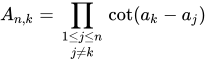
ชาร์ลส์ แอร์ไมต์ ได้แสดงเอกลักษณ์ต่อไปนี้[ 33 ] เอ 1 , … , เอ n {\displaystyle a_{1},\ldots ,a_{n}} จำนวนเชิงซ้อน ซึ่งไม่มีจำนวนเชิงซ้อนสองจำนวนใดที่แตกต่างกันด้วยผลคูณจำนวนเต็มของπ ให้
เอ n , เค = ∏ 1 ≤ เจ ≤ n เจ ≠ เค เปลเด็ก ( เอ เค − เอ เจ ) {\displaystyle A_{n,k}=\prod _{\begin{smallmatrix}1\leq j\leq n\\j\neq k\end{smallmatrix}}\cot(a_{k}-a_{j})}
(โดยเฉพาะอย่างยิ่ง,เอ 1 , 1 , {\displaystyle A_{1,1},} ผลิตภัณฑ์ที่ว่างเปล่า จึงเป็น 1) จากนั้น
เปลเด็ก ( z − เอ 1 ) ⋯ เปลเด็ก ( z − เอ n ) = คอส n π 2 + ∑ เค = 1 n เอ n , เค เปลเด็ก ( z − เอ เค ) . {\displaystyle \cot(z-a_{1})\cdots \cot(z-a_{n})=\cos {\frac {n\pi }{2}}+\sum _{k=1}^{n}A_{n,k}\cot(z-a_{k}).}
ตัวอย่างที่ไม่ธรรมดาที่ง่ายที่สุดคือกรณีn = 2 :
เปลเด็ก ( z − เอ 1 ) เปลเด็ก ( z − เอ 2 ) = − 1 + เปลเด็ก ( เอ 1 − เอ 2 ) เปลเด็ก ( z − เอ 1 ) + เปลเด็ก ( เอ 2 − เอ 1 ) เปลเด็ก ( z − เอ 2 ) . {\displaystyle \cot(z-a_{1})\cot(z-a_{2})=-1+\cot(a_{1}-a_{2})\cot(z-a_{1})+\cot(a_{2}-a_{1})\cot(z-a_{2}).}
ผลคูณจำกัดของฟังก์ชันตรีโกณมิติ สำหรับจำนวนเต็มn , m ที่เป็นจำนวน เฉพาะสัมพัทธ์
∏ เค = 1 n ( 2 เอ + 2 คอส ( 2 π เค ม n + x ) ) = 2 ( ที n ( เอ ) + ( − 1 ) n + ม คอส ( n x ) ) {\displaystyle \prod _{k=1}^{n}\left(2a+2\cos \left({\frac {2\pi km}{n}}+x\right)\right)=2\left(T_{n}(a)+{(-1)}^{n+m}\cos(nx)\right)}
โดยที่T คือพหุนามเชบิ เชฟ
ความสัมพันธ์ต่อไปนี้ใช้ได้กับฟังก์ชันไซน์
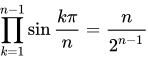
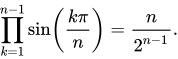
∏ เค = 1 n − 1 บาป ( เค π n ) = n 2 n − 1 . {\displaystyle \prod _{k=1}^{n-1}\sin \left({\frac {k\pi }{n}}\right)={\frac {n}{2^{n-1}}}.}
โดยทั่วไปสำหรับจำนวนเต็มn > 0 [ 34 ]
บาป ( n x ) = 2 n − 1 ∏ เค = 0 n − 1 บาป ( เค π n + x ) = 2 n − 1 ∏ เค = 1 n บาป ( เค π n − x ) . {\displaystyle \sin(nx)=2^{n-1}\prod _{k=0}^{n-1}\sin \left({\frac {k\pi }{n}}+x\right)=2^{n-1}\prod _{k=1}^{n}\sin \left({\frac {k\pi }{n}}-x\right).}
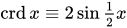
หรือเขียนในแง่ของหน้าที่ของคอร์ด เครดิต x ≡ 2 บาป 1 2 x {\textstyle \operatorname {crd} x\equiv 2\sin {\tfrac {1}{2}}x}
เครดิต ( n x ) = ∏ เค = 1 n เครดิต ( 2 เค π n − x ) . {\displaystyle \operatorname {crd} (nx)=\prod _{k=1}^{n}\operatorname {crd} \left({\frac {2k\pi }{n}}-x\right).}
สิ่งนี้ได้มาจากการแยกตัวประกอบของพหุนาม z n − 1 {\textstyle z^{n}-1} รากที่ 1 ): สำหรับจำนวนเชิงซ้อนz ใดๆ และจำนวนเต็มn >
z n − 1 = ∏ เค = 1 n ( z − เอ็กซ์ 2 เค ฉัน π n ) . {\displaystyle z^{n}-1=\prod _{k=1}^{n}\left(z-\exp {\frac {2ki\pi }{n}}\right).}
การรวมเชิงเส้น ในบางกรณี การทราบว่าผลรวมเชิงเส้น ของคลื่นไซน์ที่มีคาบหรือความถี่เดียวกันแต่มีการเลื่อนเฟส ต่างกัน ก็ยังคงได้เป็นคลื่นไซน์ที่มีคาบหรือความถี่เดียวกันแต่มีการเลื่อนเฟสต่างกันนั้น มีความสำคัญ สิ่งนี้มีประโยชน์ในการปรับข้อมูล ไซน์ให้ เข้ากับแบบจำลอง เนื่องจากข้อมูลที่วัดหรือสังเกตได้มีความสัมพันธ์เชิงเส้นกับค่า ที่ไม่ทราบค่า a และb ของส่วนประกอบเฟสตรงกันและเฟสตั้งฉาก ด้านล่าง ส่งผลให้ เมทริกซ์จาโคเบียน ง่ายขึ้นเมื่อเทียบกับเมทริกซ์ของค {\displaystyle c} φ {\displaystyle \varphi }
ไซน์และโคไซน์ การรวมเชิงเส้นหรือการบวกฮาร์มอนิกของคลื่นไซน์และโคไซน์เทียบเท่ากับคลื่นไซน์เดี่ยวที่มีการเลื่อนเฟสและแอมพลิจูดที่ปรับขนาด[ 35 ] [ 36 ]
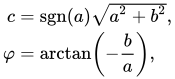
เอ คอส x + ข บาป x = ค คอส ( x + φ ) {\displaystyle a\cos x+b\sin x=c\cos(x+\varphi )}
ที่ไหนค {\displaystyle c} φ {\displaystyle \varphi }
ค = sgn ( เอ ) เอ 2 + ข 2 , φ = อาร์คตัน ( − ข เอ ) , {\displaystyle {\begin{aligned}c&=\operatorname {sgn}(a){\sqrt {a^{2}+b^{2}}},\\\varphi &=\arctan \left(-{\frac {b}{a}}\right),\end{aligned}}}
เนื่องจากเอ ≠ 0. {\displaystyle a\neq 0.}
การเลื่อนเฟสตามอำเภอใจ โดยทั่วไปแล้ว สำหรับการเลื่อนเฟสใดๆ เราจะได้ว่า
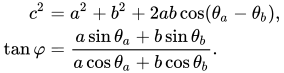
เอ บาป ( x + θ เอ ) + ข บาป ( x + θ ข ) = ค บาป ( x + φ ) {\displaystyle a\sin(x+\theta _{a})+b\sin(x+\theta _{b})=c\sin(x+\varphi )}
ที่ไหนค {\displaystyle c} φ {\displaystyle \varphi }
ค 2 = เอ 2 + ข 2 + 2 เอ ข คอส ( θ เอ − θ ข ) , แทน φ = เอ บาป θ เอ + ข บาป θ ข เอ คอส θ เอ + ข คอส θ ข . {\displaystyle {\begin{aligned}c^{2}&=a^{2}+b^{2}+2ab\cos \left(\theta _{a}-\theta _{b}\right),\\\tan \varphi &={\frac {a\sin \theta _{a}+b\sin \theta _{b}}{a\cos \theta _{a}+b\cos \theta _{b}}}.\end{aligned}}}
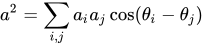
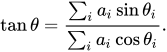
ไซนูซอยด์มากกว่าสองอัน กรณีทั่วไปอ่านว่า[ 36 ]
∑ ฉัน เอ ฉัน บาป ( x + θ ฉัน ) = เอ บาป ( x + θ ) , {\displaystyle \sum _{i}a_{i}\sin(x+\theta _{i})=a\sin(x+\theta ),} เอ 2 = ∑ ฉัน , เจ เอ ฉัน เอ เจ คอส ( θ ฉัน − θ เจ ) {\displaystyle a^{2}=\sum _{i,j}a_{i}a_{j}\cos(\theta _{i}-\theta _{j})} แทน θ = ∑ ฉัน เอ ฉัน บาป θ ฉัน ∑ ฉัน เอ ฉัน คอส θ ฉัน . {\displaystyle \tan \theta ={\frac {\sum _{i}a_{i}\sin \theta _{i}}{\sum _{i}a_{i}\cos \theta _{i}}}.}
เอกลักษณ์เหล่านี้ ซึ่งตั้งชื่อตามโจเซฟ หลุยส์ ลากรองจ์ ได้แก่: [ 37 ] [ 38 ] [ 39 ] ∑ เค = 0 n บาป เค θ = คอส 1 2 θ − คอส ( ( n + 1 2 ) θ ) 2 บาป 1 2 θ ∑ เค = 1 n คอส เค θ = − บาป 1 2 θ + บาป ( ( n + 1 2 ) θ ) 2 บาป 1 2 θ {\displaystyle {\begin{aligned}\sum _{k=0}^{n}\sin k\theta &={\frac {\cos {\tfrac {1}{2}}\theta -\cos \left(\left(n+{\tfrac {1}{2}}\right)\theta \right)}{2\sin {\tfrac {1}{2}}\theta }}\\[5pt]\sum _{k=1}^{n}\cos k\theta &={\frac {-\sin {\tfrac {1}{2}}\theta +\sin \left(\left(n+{\tfrac {1}{2}}\right)\theta \right)}{2\sin {\tfrac {1}{2}}\theta }}\end{aligned}}} θ ≢ 0 ( ม็อด 2 π ) . {\displaystyle \theta \not \equiv 0{\pmod {2\pi }}.}
ฟังก์ชันที่เกี่ยวข้องอีกอย่างหนึ่งคือเคอร์เนลของ Dirichlet :
ดี n ( θ ) = 1 + 2 ∑ เค = 1 n คอส เค θ = บาป ( ( n + 1 2 ) θ ) บาป 1 2 θ . {\displaystyle D_{n}(\theta )=1+2\sum _{k=1}^{n}\cos k\theta ={\frac {\sin \left(\left(n+{\tfrac {1}{2}}\right)\theta \right)}{\sin {\tfrac {1}{2}}\theta }}.}
เอกลักษณ์ที่คล้ายกันคือ[ 40 ]
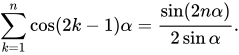
∑ เค = 1 n คอส ( 2 เค − 1 ) α = บาป ( 2 n α ) 2 บาป α . {\displaystyle \sum _{k=1}^{n}\cos(2k-1)\alpha ={\frac {\sin(2n\alpha )}{2\sin \alpha }}.}
การพิสูจน์มีดังต่อไปนี้ โดยใช้เอกลักษณ์ผลรวมและผลต่างของ มุม บาป ( เอ + บี ) − บาป ( เอ − บี ) = 2 คอส เอ บาป บี . {\displaystyle \sin(A+B)-\sin(A-B)=2\cos A\sin B.}
2 บาป α ∑ เค = 1 n คอส ( 2 เค − 1 ) α = 2 บาป α คอส α + 2 บาป α คอส 3 α + 2 บาป α คอส 5 α + ⋯ + 2 บาป α คอส ( 2 n − 1 ) α {\displaystyle 2\sin \alpha \sum _{k=1}^{n}\cos(2k-1)\alpha =2\sin \alpha \cos \alpha +2\sin \alpha \cos 3\alpha +2\sin \alpha \cos 5\alpha +\cdots +2\sin \alpha \cos(2n-1)\alpha }
2 บาป α ∑ เค = 1 n คอส ( 2 เค − 1 ) α = ∑ เค = 1 n ( บาป ( 2 เค α ) − บาป ( 2 ( เค − 1 ) α ) ) = ( บาป 2 α − บาป 0 ) + ( บาป 4 α − บาป 2 α ) + ( บาป 6 α − บาป 4 α ) + ⋯ + ( บาป ( 2 n α ) − บาป ( 2 ( n − 1 ) α ) ) = บาป ( 2 n α ) . {\displaystyle {\begin{aligned}&2\sin \alpha \sum _{k=1}^{n}\cos(2k-1)\alpha \\&\quad =\sum _{k=1}^{n}(\sin(2k\alpha )-\sin(2(k-1)\alpha ))\\&\quad =(\sin 2\alpha -\sin 0)+(\sin 4\alpha -\sin 2\alpha )+(\sin 6\alpha -\sin 4\alpha )+\cdots +(\sin(2n\alpha )-\sin(2(n-1)\alpha ))\\&\quad =\sin(2n\alpha ).\end{aligned}}}
ดังนั้น การหารสูตรนี้ด้วย2 บาป α {\displaystyle 2\sin \alpha }
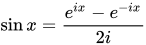
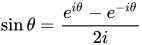
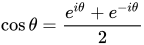
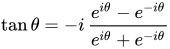
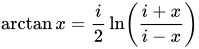
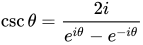
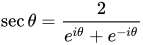
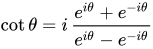
ความสัมพันธ์กับฟังก์ชันไฮเปอร์โบลิกเชิงซ้อน ฟังก์ชันตรีโกณมิติอาจอนุมานได้จากฟังก์ชันไฮเปอร์โบ ลิก ที่มีอาร์กิวเมนต์เชิงซ้อน สูตรสำหรับความสัมพันธ์แสดงไว้ด้านล่าง[ 45 ] [ 46 ] บาป x = − ฉัน สินห์ ( ฉัน x ) คอส x = ไม้กระบอง ( ฉัน x ) แทน x = − ฉัน ตันห์ ( ฉัน x ) เปลเด็ก x = ฉัน เสื้อคลุม ( ฉัน x ) วินาที x = เซช ( ฉัน x ) ซีเอสซี x = ฉัน ซีเอสเค ( ฉัน x ) {\displaystyle {\begin{aligned}\sin x&=-i\sinh(ix)\\\cos x&=\cosh(ix)\\\tan x&=-i\tanh(ix)\\\cot x&=i\coth(ix)\\\sec x&=\operatorname {sech} (ix)\\\csc x&=i\operatorname {csch} (ix)\\\end{aligned}}}
การขยายซีรีส์ เมื่อใช้ การขยาย อนุกรมกำลัง เพื่อกำหนดฟังก์ชันตรีโกณมิติ จะได้เอกลักษณ์ต่อไปนี้: [ 47 ]
บาป x = x − x 3 3 ! + x 5 5 ! − x 7 7 ! + ⋯ = ∑ n = 0 ∞ ( − 1 ) n x 2 n + 1 ( 2 n + 1 ) ! คอส x = 1 − x 2 2 ! + x 4 4 ! − x 6 6 ! + ⋯ = ∑ n = 0 ∞ ( − 1 ) n x 2 n ( 2 n ) ! {\displaystyle {\begin{aligned}\sin x&=x-{\frac {x^{3}}{3!}}+{\frac {x^{5}}{5!}}-{\frac {x^{7}}{7!}}+\cdots &&=\sum _{n=0}^{\infty }(-1)^{n}{\frac {x^{2n+1}}{(2n+1)!}}\\\cos x&=1-{\frac {x^{2}}{2!}}+{\frac {x^{4}}{4!}}-{\frac {x^{6}}{6!}}+\cdots &&=\sum _{n=0}^{\infty }(-1)^{n}{\frac {x^{2n}}{(2n)!}}\end{aligned}}}
สำหรับการประยุกต์ใช้กับฟังก์ชันพิเศษ สูตร ผลคูณอนันต์ ต่อไปนี้สำหรับฟังก์ชันตรีโกณมิติมีประโยชน์: [ 48 ] [ 49 ]
บาป x = x ∏ n = 1 ∞ ( 1 − x 2 π 2 n 2 ) , คอส x = ∏ n = 1 ∞ ( 1 − x 2 π 2 ( n − 1 2 ) ) 2 ) , สินห์ x = x ∏ n = 1 ∞ ( 1 + x 2 π 2 n 2 ) , ไม้กระบอง x = ∏ n = 1 ∞ ( 1 + x 2 π 2 ( n − 1 2 ) ) 2 ) . {\displaystyle {\begin{aligned}\sin x&=x\prod _{n=1}^{\infty }\left(1-{\frac {x^{2}}{\pi ^{2}n^{2}}}\right),&\cos x&=\prod _{n=1}^{\infty }\left(1-{\frac {x^{2}}{\pi ^{2}\left(n-{\frac {1}{2}}\right)\!{\vphantom {)}}^{2}}}\right),\\[10mu]\sinh x&=x\prod _{n=1}^{\infty }\left(1+{\frac {x^{2}}{\pi ^{2}n^{2}}}\right),&\cosh x&=\prod _{n=1}^{\infty }\left(1+{\frac {x^{2}}{\pi ^{2}\left(n-{\frac {1}{2}}\right)\!{\vphantom {)}}^{2}}}\right).\end{aligned}}}
ฟังก์ชันตรีโกณมิติผกผัน เอกลักษณ์ต่อไปนี้ให้ผลลัพธ์ของการประกอบฟังก์ชันตรีโกณมิติกับฟังก์ชันตรีโกณมิติผกผัน[ 50 ]
บาป ( อาร์คซิน x ) = x คอส ( อาร์คซิน x ) = 1 − x 2 แทน ( อาร์คซิน x ) = x 1 − x 2 บาป ( อาร์คคอส x ) = 1 − x 2 คอส ( อาร์คคอส x ) = x แทน ( อาร์คคอส x ) = 1 − x 2 x บาป ( อาร์คตัน x ) = x 1 + x 2 คอส ( อาร์คตัน x ) = 1 1 + x 2 แทน ( อาร์คตัน x ) = x บาป ( อาร์ซีเอสซี x ) = 1 x คอส ( อาร์ซีเอสซี x ) = 1 − 1 x 2 แทน ( อาร์ซีเอสซี x ) = 1 x 1 − 1 x 2 บาป ( อาร์คเซค x ) = 1 − 1 x 2 คอส ( อาร์คเซค x ) = 1 x แทน ( อาร์คเซค x ) = x 1 − 1 x 2 บาป ( อาร์คคอต x ) = 1 1 + x 2 คอส ( อาร์คคอต x ) = x 1 + x 2 แทน ( อาร์คคอต x ) = 1 x {\displaystyle {\begin{aligned}\sin(\arcsin x)&=x&\cos(\arcsin x)&={\sqrt {1-x^{2}}}&\tan(\arcsin x)&={\frac {x}{\sqrt {1-x^{2}}}}\\\sin(\arccos x)&={\sqrt {1-x^{2}}}&\cos(\arccos x)&=x&\tan(\arccos x)&={\frac {\sqrt {1-x^{2}}}{x}}\\\sin(\arctan x)&={\frac {x}{\sqrt {1+x^{2}}}}&\cos(\arctan x)&={\frac {1}{\sqrt {1+x^{2}}}}&\tan(\arctan x)&=x\\\sin(\operatorname {arccsc} x)&={\frac {1}{x}}&\cos(\operatorname {arccsc} x)&={\sqrt {1-{\frac {1}{x^{2}}}}}&\tan(\operatorname {arccsc} x)&={\frac {1}{x{\sqrt {1-{\frac {1}{x^{2}}}}}}}\\\sin(\operatorname {arcsec} x)&={\sqrt {1-{\frac {1}{x^{2}}}}}&\cos(\operatorname {arcsec} x)&={\frac {1}{x}}&\tan(\operatorname {arcsec} x)&=x{\sqrt {1-{\frac {1}{x^{2}}}}}\\\sin(\operatorname {arccot} x)&={\frac {1}{\sqrt {1+x^{2}}}}&\cos(\operatorname {arccot} x)&={\frac {x}{\sqrt {1+x^{2}}}}&\tan(\operatorname {arccot} x)&={\frac {1}{x}}\\\end{aligned}}}
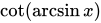
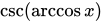
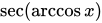
การหาตัวผกผันการคูณ ของทั้งสองข้างของแต่ละสมการข้างต้น จะได้สมการสำหรับซีเอสซี = 1 บาป , วินาที = 1 คอส , และ เปลเด็ก = 1 แทน . {\displaystyle \csc ={\frac {1}{\sin }},\;\sec ={\frac {1}{\cos }},{\text{ และ }}\cot ={\frac {1}{\tan }}.} เปลเด็ก ( อาร์คซิน x ) {\displaystyle \cot(\arcsin x)} เปลเด็ก ( อาร์คซิน x ) = 1 แทน ( อาร์คซิน x ) = 1 x 1 − x 2 = 1 − x 2 x {\displaystyle \cot(\arcsin x)={\frac {1}{\tan(\arcsin x)}}={\frac {1}{\frac {x}{\sqrt {1-x^{2}}}}}={\frac {\sqrt {1-x^{2}}}{x}}} ซีเอสซี ( อาร์คคอส x ) {\displaystyle \csc(\arccos x)} วินาที ( อาร์คคอส x ) {\displaystyle \sec(\arccos x)} ซีเอสซี ( อาร์คคอส x ) = 1 บาป ( อาร์คคอส x ) = 1 1 − x 2 และ วินาที ( อาร์คคอส x ) = 1 คอส ( อาร์คคอส x ) = 1 x . {\displaystyle \csc(\arccos x)={\frac {1}{\sin(\arccos x)}}={\frac {1}{\sqrt {1-x^{2}}}}\qquad {\text{ และ }}\quad \sec(\arccos x)={\frac {1}{\cos(\arccos x)}}={\frac {1}{x}}.}
เอกลักษณ์ต่อไปนี้ได้มาจากเอกลักษณ์การสะท้อน เอกลักษณ์ เหล่านี้จะเป็นจริงเมื่อใดก็ตามที่x , ร , ส , − x , − ร , {\displaystyle x,r,s,-x,-r,} − ส {\displaystyle -s} π 2 = อาร์คซิน ( x ) + อาร์คคอส ( x ) = อาร์คตัน ( ร ) + อาร์คคอต ( ร ) = อาร์คเซค ( ส ) + อาร์ซีเอสซี ( ส ) π = อาร์คคอส ( x ) + อาร์คคอส ( − x ) = อาร์คคอต ( ร ) + อาร์คคอต ( − ร ) = อาร์คเซค ( ส ) + อาร์คเซค ( − ส ) 0 = อาร์คซิน ( x ) + อาร์คซิน ( − x ) = อาร์คตัน ( ร ) + อาร์คตัน ( − ร ) = อาร์ซีเอสซี ( ส ) + อาร์ซีเอสซี ( − ส ) {\displaystyle {\begin{alignedat}{9}{\frac {\pi }{2}}~&=~\arcsin(x)&&+\arccos(x)~&&=~\arctan(r)&&+\operatorname {arccot}(r)~&&=~\operatorname {arcsec}(s)&&+\operatorname {arccsc}(s)\\[0.4ex]\pi ~&=~\arccos(x)&&+\arccos(-x)~&&=~\operatorname {arccot}(r)&&+\operatorname {arccot}(-r)~&&=~\operatorname {arcsec}(s)&&+\operatorname {arcsec}(-s)\\[0.4ex]0~&=~\arcsin(x)&&+\arcsin(-x)~&&=~\arctan(r)&&+\arctan(-r)~&&=~\operatorname {arccsc}(s)&&+\operatorname {arccsc}(-s)\\[1.0ex]\end{alignedat}}}
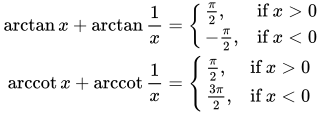
นอกจากนี้[ 51 ] อาร์คตัน x + อาร์คตัน 1 x = { π 2 , ถ้า x > 0 − π 2 , ถ้า x < 0 อาร์คคอต x + อาร์คคอต 1 x = { π 2 , ถ้า x > 0 3 π 2 , ถ้า x < 0 {\displaystyle {\begin{aligned}\arctan x+\arctan {\dfrac {1}{x}}&={\begin{cases}{\frac {\pi }{2}},&{\text{if }}x>0\\-{\frac {\pi }{2}},&{\text{if }}x<0\end{cases}}\\\operatorname {arccot} x+\operatorname {arccot} {\dfrac {1}{x}}&={\begin{cases}{\frac {\pi }{2}},&{\text{if }}x>0\\{\frac {3\pi }{2}},&{\text{if }}x<0\end{cases}}\\\end{aligned}}} อาร์คคอส 1 x = อาร์คเซค x และ อาร์คเซค 1 x = อาร์คคอส x {\displaystyle \arccos {\frac {1}{x}}=\operatorname {arcsec} x\qquad {\text{ and }}\qquad \operatorname {arcsec} {\frac {1}{x}}=\arccos x} อาร์คซิน 1 x = อาร์ซีเอสซี x และ อาร์ซีเอสซี 1 x = อาร์คซิน x {\displaystyle \arcsin {\frac {1}{x}}=\operatorname {arccsc} x\qquad {\text{ and }}\qquad \operatorname {arccsc} {\frac {1}{x}}=\arcsin x}
ฟังก์ชันอาร์คแทงเจนต์ สามารถขยายเป็นอนุกรมได้ดังนี้: [ 52 ] อาร์คตัน ( n x ) = ∑ ม = 1 n อาร์คตัน x 1 + ( ม − 1 ) ม x 2 {\displaystyle \arctan(nx)=\sum _{m=1}^{n}\arctan {\frac {x}{1+(m-1)mx^{2}}}}
เอกลักษณ์ที่ไม่มีตัวแปร ในแง่ของ ฟังก์ชัน อาร์คแทงเจนต์ เรามี[ 51 ] อาร์คตัน 1 2 = อาร์คตัน 1 3 + อาร์คตัน 1 7 {\displaystyle \arctan {\frac {1}{2}}=\arctan {\frac {1}{3}}+\arctan {\frac {1}{7}}}
ซึ่งเป็นกรณีพิเศษของเอกลักษณ์อาร์กแทนเจนต์ของออยเลอร์ [ 53 ]
อาร์คตัน 1 พี = อาร์คตัน 1 พี + q + อาร์คตัน q พี 2 + พี q + 1 . {\displaystyle \arctan {\frac {1}{p}}=\arctan {\frac {1}{p+q}}+\arctan {\frac {q}{p^{2}+pq+1}}.}
กฎของมอร์รี ซึ่ง เป็นสิ่งที่แปลกประหลาดอย่างยิ่งคอส 20 ∘ ⋅ คอส 40 ∘ ⋅ คอส 80 ∘ = 1 8 , {\displaystyle \cos 20^{\circ }\cdot \cos 40^{\circ }\cdot \cos 80^{\circ }={\frac {1}{8}},}
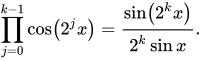
เป็นกรณีพิเศษของเอกลักษณ์ที่มีตัวแปรเพียงตัวเดียว: ∏ เจ = 0 เค − 1 คอส ( 2 เจ x ) = บาป ( 2 เค x ) 2 เค บาป x . {\displaystyle \prod _{j=0}^{k-1}\cos \left(2^{j}x\right)={\frac {\sin \left(2^{k}x\right)}{2^{k}\sin x}}.}
ในทำนองเดียวกัน บาป 20 ∘ ⋅ บาป 40 ∘ ⋅ บาป 80 ∘ = 3 8 {\displaystyle \sin 20^{\circ }\cdot \sin 40^{\circ }\cdot \sin 80^{\circ }={\frac {\sqrt {3}}{8}}} x = 20 ∘ {\displaystyle x=20^{\circ }} บาป x ⋅ บาป ( 60 ∘ − x ) ⋅ บาป ( 60 ∘ + x ) = บาป 3 x 4 . {\displaystyle \sin x\cdot \sin \left(60^{\circ }-x\right)\cdot \sin \left(60^{\circ }+x\right)={\frac {\sin 3x}{4}}.}
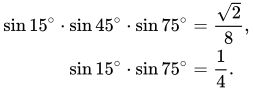
สำหรับกรณีนี้x = 15 ∘ {\displaystyle x=15^{\circ }} บาป 15 ∘ ⋅ บาป 45 ∘ ⋅ บาป 75 ∘ = 2 8 , บาป 15 ∘ ⋅ บาป 75 ∘ = 1 4 . {\displaystyle {\begin{aligned}\sin 15^{\circ }\cdot \sin 45^{\circ }\cdot \sin 75^{\circ }&={\frac {\sqrt {2}}{8}},\\\sin 15^{\circ }\cdot \sin 75^{\circ }&={\frac {1}{4}}.\end{aligned}}}
สำหรับกรณีนี้x = 10 ∘ {\displaystyle x=10^{\circ }} บาป 10 ∘ ⋅ บาป 50 ∘ ⋅ บาป 70 ∘ = 1 8 . {\displaystyle \sin 10^{\circ }\cdot \sin 50^{\circ }\cdot \sin 70^{\circ }={\frac {1}{8}}.}
เอกลักษณ์โคไซน์เดียวกันคือ คอส x ⋅ คอส ( 60 ∘ − x ) ⋅ คอส ( 60 ∘ + x ) = คอส 3 x 4 . {\displaystyle \cos x\cdot \cos \left(60^{\circ }-x\right)\cdot \cos \left(60^{\circ }+x\right)={\frac {\cos 3x}{4}}.}
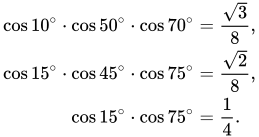
ในทำนองเดียวกัน คอส 10 ∘ ⋅ คอส 50 ∘ ⋅ คอส 70 ∘ = 3 8 , คอส 15 ∘ ⋅ คอส 45 ∘ ⋅ คอส 75 ∘ = 2 8 , คอส 15 ∘ ⋅ คอส 75 ∘ = 1 4 . {\displaystyle {\begin{aligned}\cos 10^{\circ }\cdot \cos 50^{\circ }\cdot \cos 70^{\circ }&={\frac {\sqrt {3}}{8}},\\\cos 15^{\circ }\cdot \cos 45^{\circ }\cdot \cos 75^{\circ }&={\frac {\sqrt {2}}{8}},\\\cos 15^{\circ }\cdot \cos 75^{\circ }&={\frac {1}{4}}.\end{aligned}}}
ในทำนองเดียวกัน แทน 50 ∘ ⋅ แทน 60 ∘ ⋅ แทน 70 ∘ = แทน 80 ∘ , แทน 40 ∘ ⋅ แทน 30 ∘ ⋅ แทน 20 ∘ = แทน 10 ∘ . {\displaystyle {\begin{aligned}\tan 50^{\circ }\cdot \tan 60^{\circ }\cdot \tan 70^{\circ }&=\tan 80^{\circ },\\\tan 40^{\circ }\cdot \tan 30^{\circ }\cdot \tan 20^{\circ }&=\tan 10^{\circ }.\end{aligned}}}
ต่อไปนี้เป็นสิ่งที่อาจไม่สามารถนำไปใช้กับเอกลักษณ์ที่มีตัวแปรได้โดยง่ายนัก (แต่โปรดดูคำอธิบายด้านล่าง): คอส 24 ∘ + คอส 48 ∘ + คอส 96 ∘ + คอส 168 ∘ = 1 2 . {\displaystyle \cos 24^{\circ }+\cos 48^{\circ }+\cos 96^{\circ }+\cos 168^{\circ }={\frac {1}{2}}.}
หน่วยวัดองศาจะไม่เหมาะสมไปกว่าหน่วยวัดเรเดียนอีกต่อไป เมื่อเราพิจารณาเอกลักษณ์นี้โดยมี 21 อยู่ในตัวส่วน: คอส 2 π 21 + คอส ( 2 ⋅ 2 π 21 ) + คอส ( 4 ⋅ 2 π 21 ) + คอส ( 5 ⋅ 2 π 21 ) + คอส ( 8 ⋅ 2 π 21 ) + คอส ( 10 ⋅ 2 π 21 ) = 1 2 . {\displaystyle \cos {\frac {2\pi }{21}}+\cos \left(2\cdot {\frac {2\pi }{21}}\right)+\cos \left(4\cdot {\frac {2\pi }{21}}\right)+\cos \left(5\cdot {\frac {2\pi }{21}}\right)+\cos \left(8\cdot {\frac {2\pi }{21}}\right)+\cos \left(10\cdot {\frac {2\pi }{21}}\right)={\frac {1}{2}}.}
ปัจจัย 1, 2, 4, 5, 8, 10 อาจ เริ่ม ทำให้รูปแบบชัดเจนขึ้น: พวกมันคือจำนวนเต็มที่น้อยกว่า21/2 ซึ่ง จำนวนเฉพาะสัมพัทธ์ กับ (หรือไม่มีตัวประกอบเฉพาะ ร่วมกับ) 21 ตัวอย่างสุดท้ายหลายตัวอย่างเป็นผลลัพธ์ที่ได้จากข้อเท็จจริงพื้นฐานเกี่ยวกับพหุนามไซโคลโทมิกที่ไม่สามารถแยกตัวประกอบ ได้ : ค่าโคไซน์คือส่วนจริงของศูนย์ของพหุนามเหล่านั้น ผลรวมของศูนย์คือฟังก์ชันโมเบียส ที่ประเมินค่าที่ (ในกรณีสุดท้ายข้างต้น) 21 มีเพียงครึ่งหนึ่งของศูนย์เท่านั้นที่ปรากฏอยู่ข้างต้น เอกลักษณ์ที่อยู่ก่อนหน้าอันสุดท้ายนี้เกิดขึ้นในลักษณะเดียวกันโดยแทนที่ 21 ด้วย 15
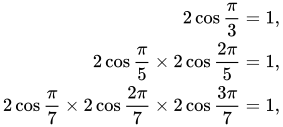
เอกลักษณ์โคไซน์อื่นๆ ได้แก่: [ 54 ] 2 คอส π 3 = 1 , 2 คอส π 5 × 2 คอส 2 π 5 = 1 , 2 คอส π 7 × 2 คอส 2 π 7 × 2 คอส 3 π 7 = 1 , {\displaystyle {\begin{aligned}2\cos {\frac {\pi }{3}}&=1,\\2\cos {\frac {\pi }{5}}\times 2\cos {\frac {2\pi }{5}}&=1,\\2\cos {\frac {\pi }{7}}\times 2\cos {\frac {2\pi }{7}}\times 2\cos {\frac {3\pi }{7}}&=1,\end{aligned}}} คอส π 3 + คอส π 5 × คอส 2 π 5 + คอส π 7 × คอส 2 π 7 × คอส 3 π 7 + ⋯ = 1. {\displaystyle \cos {\frac {\pi }{3}}+\cos {\frac {\pi }{5}}\times \cos {\frac {2\pi }{5}}+\cos {\frac {\pi }{7}}\times \cos {\frac {2\pi }{7}}\times \cos {\frac {3\pi }{7}}+\dots =1.}
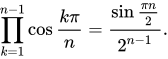
อัตลักษณ์ที่น่าสนใจเหล่านั้นจำนวนมากมีที่มาจากข้อเท็จจริงทั่วไปดังต่อไปนี้: [ 55 ] ∏ เค = 1 n − 1 บาป เค π n = n 2 n − 1 {\displaystyle \prod _{k=1}^{n-1}\sin {\frac {k\pi }{n}}={\frac {n}{2^{n-1}}}} ∏ เค = 1 n − 1 คอส เค π n = บาป π n 2 2 n − 1 . {\displaystyle \prod _{k=1}^{n-1}\cos {\frac {k\pi }{n}}={\frac {\sin {\frac {\pi n}{2}}}{2^{n-1}}}.}
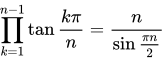
เมื่อนำสิ่งเหล่านี้มารวมกันจะได้ผลลัพธ์ดังนี้ ∏ เค = 1 n − 1 แทน เค π n = n บาป π n 2 {\displaystyle \prod _{k=1}^{n-1}\tan {\frac {k\pi }{n}}={\frac {n}{\sin {\frac {\pi n}{2}}}}}
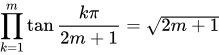
ถ้าn เป็นจำนวนคี่ (n = 2 ม + 1 {\displaystyle n=2m+1} ∏ เค = 1 ม แทน เค π 2 ม + 1 = 2 ม + 1 {\displaystyle \prod _{k=1}^{m}\tan {\frac {k\pi }{2m+1}}={\sqrt {2m+1}}}
ฟังก์ชันถ่ายโอนของตัวกรองความถี่ต่ำแบบ Butterworth สามารถแสดงได้ในรูปของพหุนามและขั้ว โดยการกำหนดความถี่เป็นความถี่ตัด จะสามารถพิสูจน์เอกลักษณ์ต่อไปนี้ได้: ∏ เค = 1 n บาป ( 2 เค − 1 ) π 4 n = ∏ เค = 1 n คอส ( 2 เค − 1 ) π 4 n = 2 2 n {\displaystyle \prod _{k=1}^{n}\sin {\frac {\left(2k-1\right)\pi }{4n}}=\prod _{k=1}^{n}\cos {\frac {\left(2k-1\right)\pi }{4n}}={\frac {\sqrt {2}}{2^{n}}}}
π วิธีที่มีประสิทธิภาพในการคำนวณค่า π ให้ได้จำนวนหลักจำนวนมาก นั้น อาศัยเอกลักษณ์ต่อไปนี้โดยไม่ต้องใช้ตัวแปร ซึ่งคิดค้นโดยมาชิน นี่เรียกว่าสูตรคล้ายมาชิน : π 4 = 4 อาร์คตัน 1 5 − อาร์คตัน 1 239 {\displaystyle {\frac {\pi }{4}}=4\arctan {\frac {1}{5}}-\arctan {\frac {1}{239}}} เลออนฮาร์ด ออยเลอร์ : π 4 = 5 อาร์คตัน 1 7 + 2 อาร์คตัน 3 79 {\displaystyle {\frac {\pi }{4}}=5\arctan {\frac {1}{7}}+2\arctan {\frac {3}{79}}} สามเหลี่ยมพีทาโกเรียน : π = อาร์คคอส 4 5 + อาร์คคอส 5 13 + อาร์คคอส 16 65 = อาร์คซิน 3 5 + อาร์คซิน 12 13 + อาร์คซิน 63 65 . {\displaystyle \pi =\arccos {\frac {4}{5}}+\arccos {\frac {5}{13}}+\arccos {\frac {16}{65}}=\arcsin {\frac {3}{5}}+\arcsin {\frac {12}{13}}+\arcsin {\frac {63}{65}}.}
อื่นๆ ได้แก่: [ 56 ] [ 51 ] π 4 = อาร์คตัน 1 2 + อาร์คตัน 1 3 , {\displaystyle {\frac {\pi }{4}}=\arctan {\frac {1}{2}}+\arctan {\frac {1}{3}},} π = อาร์คตัน 1 + อาร์คตัน 2 + อาร์คตัน 3 , {\displaystyle \pi =\arctan 1+\arctan 2+\arctan 3,} π 4 = 2 อาร์คตัน 1 3 + อาร์คตัน 1 7 . {\displaystyle {\frac {\pi }{4}}=2\arctan {\frac {1}{3}}+\arctan {\frac {1}{7}}.}
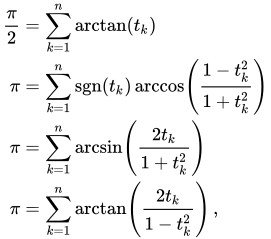
โดยทั่วไป สำหรับจำนวนt , ..., t ∈ (−1, 1)θ = Σ n −1 t ∈ ( π /4, 3 π /4)t = tan( π /2 − θ ) = cot θ t , ..., t (−1, 1) โดยเฉพาะอย่างยิ่ง ค่าt t , ..., t π 2 = ∑ เค = 1 n อาร์คตัน ( ที เค ) π = ∑ เค = 1 n sgn ( ที เค ) อาร์คคอส ( 1 − ที เค 2 1 + ที เค 2 ) π = ∑ เค = 1 n อาร์คซิน ( 2 ที เค 1 + ที เค 2 ) π = ∑ เค = 1 n อาร์คตัน ( 2 ที เค 1 − ที เค 2 ) , {\displaystyle {\begin{aligned}{\frac {\pi }{2}}&=\sum _{k=1}^{n}\arctan(t_{k})\\\pi &=\sum _{k=1}^{n}\operatorname {sgn}(t_{k})\arccos \left({\frac {1-t_{k}^{2}}{1+t_{k}^{2}}}\right)\\\pi &=\sum _{k=1}^{n}\arcsin \left({\frac {2t_{k}}{1+t_{k}^{2}}}\right)\\\pi &=\sum _{k=1}^{n}\arctan \left({\frac {2t_{k}}{1-t_{k}^{2}}}\right)\,,\end{aligned}}}
โดยในทุกนิพจน์ยกเว้นนิพจน์แรก เราได้ใช้สูตรแทนเจนต์ครึ่งมุม สูตรสองสูตรแรกใช้ได้แม้ว่า ค่า t (−1, 1) ก็ตาม โปรดสังเกตว่าถ้าt = p / q (2 t , 1 − t 2 , 1 + t 2 ) ในสูตรข้างต้นจะเป็นสัดส่วนกับสามเหลี่ยมพีทาโกรัส( 2 pq , q 2 − p 2 , q 2 + p 2 )
ตัวอย่างเช่น สำหรับn = 3π 2 = อาร์คตัน ( เอ ข ) + อาร์คตัน ( ค ง ) + อาร์คตัน ( ข ง − เอ ค เอ ง + ข ค ) {\displaystyle {\frac {\pi }{2}}=\arctan \left({\frac {a}{b}}\right)+\arctan \left({\frac {c}{d}}\right)+\arctan \left({\frac {bd-ac}{ad+bc}}\right)} a , b , c , d ใดๆ ที่ มากกว่า
เอกลักษณ์ของยูคลิด ยูคลิด ได้แสดงไว้ในหนังสือเล่มที่ 13 ข้อเสนอที่ 10 ของตำรา Elements บาป 2 18 ∘ + บาป 2 30 ∘ = บาป 2 36 ∘ . {\displaystyle \sin ^{2}18^{\circ }+\sin ^{2}30^{\circ }=\sin ^{2}36^{\circ }.}
ปโตเลมี ใช้ทฤษฎีบทนี้ในการคำนวณมุมบางมุมในตารางคอร์ดของเขา ในหนังสือ อัลมาเกสต์
การประกอบฟังก์ชันตรีโกณมิติ เอกลักษณ์เหล่านี้เกี่ยวข้องกับฟังก์ชันตรีโกณมิติของฟังก์ชันตรีโกณมิติ: [ 57 ]
คอส ( ที บาป x ) = เจ 0 ( ที ) + 2 ∑ เค = 1 ∞ เจ 2 เค ( ที ) คอส ( 2 เค x ) {\displaystyle \cos(t\sin x)=J_{0}(t)+2\sum _{k=1}^{\infty }J_{2k}(t)\cos(2kx)} บาป ( ที บาป x ) = 2 ∑ เค = 0 ∞ เจ 2 เค + 1 ( ที ) บาป ( ( 2 เค + 1 ) x ) {\displaystyle \sin(t\sin x)=2\sum _{k=0}^{\infty }J_{2k+1}(t)\sin {\big (}(2k+1)x{\big )}} คอส ( ที คอส x ) = เจ 0 ( ที ) + 2 ∑ เค = 1 ∞ ( − 1 ) เค เจ 2 เค ( ที ) คอส ( 2 เค x ) {\displaystyle \cos(t\cos x)=J_{0}(t)+2\sum _{k=1}^{\infty }(-1)^{k}J_{2k}(t)\cos(2kx)} บาป ( ที คอส x ) = 2 ∑ เค = 0 ∞ ( − 1 ) เค เจ 2 เค + 1 ( ที ) คอส ( ( 2 เค + 1 ) x ) {\displaystyle \sin(t\cos x)=2\sum _{k=0}^{\infty }(-1)^{k}J_{2k+1}(t)\cos {\big (}(2k+1)x{\big )}} โดยที่J คือฟังก์ชันเบส เซล
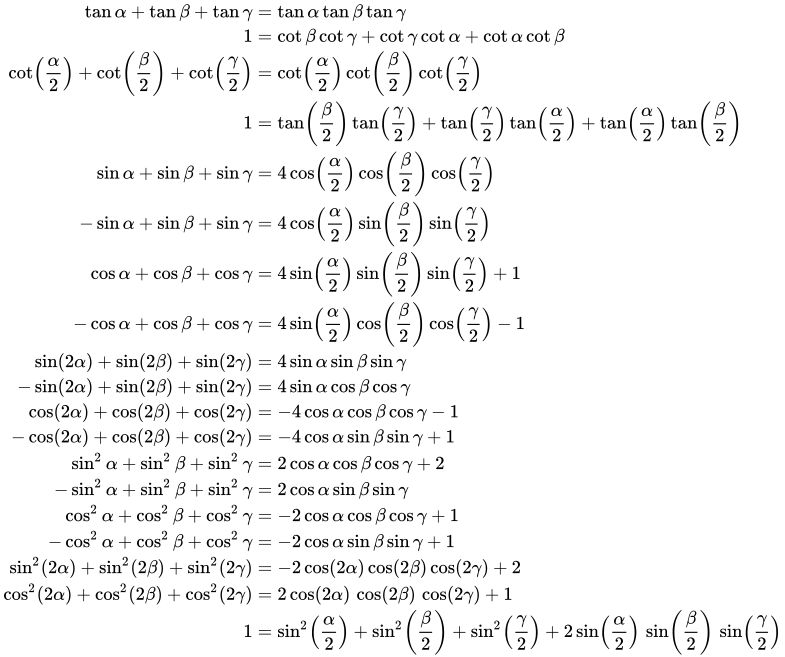
α + β + γ = 180°เอกลักษณ์ตรีโกณมิติแบบมีเงื่อนไข คือเอกลักษณ์ตรีโกณมิติที่ใช้ได้ก็ต่อเมื่อเงื่อนไขที่กำหนดไว้สำหรับอาร์กิวเมนต์ของฟังก์ชันตรีโกณมิติเป็นไปตามที่กำหนด[ 58 ] α + เบต้า + γ = 180 ∘ , {\displaystyle \alpha +\beta +\gamma =180^{\circ },} [ 59 ] แทน α + แทน เบต้า + แทน γ = แทน α แทน เบต้า แทน γ 1 = เปลเด็ก เบต้า เปลเด็ก γ + เปลเด็ก γ เปลเด็ก α + เปลเด็ก α เปลเด็ก เบต้า เปลเด็ก ( α 2 ) + เปลเด็ก ( เบต้า 2 ) + เปลเด็ก ( γ 2 ) = เปลเด็ก ( α 2 ) เปลเด็ก ( เบต้า 2 ) เปลเด็ก ( γ 2 ) 1 = แทน ( เบต้า 2 ) แทน ( γ 2 ) + แทน ( γ 2 ) แทน ( α 2 ) + แทน ( α 2 ) แทน ( เบต้า 2 ) บาป α + บาป เบต้า + บาป γ = 4 คอส ( α 2 ) คอส ( เบต้า 2 ) คอส ( γ 2 ) − บาป α + บาป เบต้า + บาป γ = 4 คอส ( α 2 ) บาป ( เบต้า 2 ) บาป ( γ 2 ) คอส α + คอส เบต้า + คอส γ = 4 บาป ( α 2 ) บาป ( เบต้า 2 ) บาป ( γ 2 ) + 1 − คอส α + คอส เบต้า + คอส γ = 4 บาป ( α 2 ) คอส ( เบต้า 2 ) คอส ( γ 2 ) − 1 บาป ( 2 α ) + บาป ( 2 เบต้า ) + บาป ( 2 γ ) = 4 บาป α บาป เบต้า บาป γ − บาป ( 2 α ) + บาป ( 2 เบต้า ) + บาป ( 2 γ ) = 4 บาป α คอส เบต้า คอส γ คอส ( 2 α ) + คอส ( 2 เบต้า ) + คอส ( 2 γ ) = − 4 คอส α คอส เบต้า คอส γ − 1 − คอส ( 2 α ) + คอส ( 2 เบต้า ) + คอส ( 2 γ ) = − 4 คอส α บาป เบต้า บาป γ + 1 บาป 2 α + บาป 2 เบต้า + บาป 2 γ = 2 คอส α คอส เบต้า คอส γ + 2 − บาป 2 α + บาป 2 เบต้า + บาป 2 γ = 2 คอส α บาป เบต้า บาป γ คอส 2 α + คอส 2 เบต้า + คอส 2 γ = − 2 คอส α คอส เบต้า คอส γ + 1 − คอส 2 α + คอส 2 เบต้า + คอส 2 γ = − 2 คอส α บาป เบต้า บาป γ + 1 บาป 2 ( 2 α ) + บาป 2 ( 2 เบต้า ) + บาป 2 ( 2 γ ) = − 2 คอส ( 2 α ) คอส ( 2 เบต้า ) คอส ( 2 γ ) + 2 คอส 2 ( 2 α ) + คอส 2 ( 2 เบต้า ) + คอส 2 ( 2 γ ) = 2 คอส ( 2 α ) คอส ( 2 เบต้า ) คอส ( 2 γ ) + 1 1 = บาป 2 ( α 2 ) + บาป 2 ( เบต้า 2 ) + บาป 2 ( γ 2 ) + 2 บาป ( α 2 ) บาป ( เบต้า 2 ) บาป ( γ 2 ) {\displaystyle {\begin{aligned}\tan \alpha +\tan \beta +\tan \gamma &=\tan \alpha \tan \beta \tan \gamma \\1&=\cot \beta \cot \gamma +\cot \gamma \cot \alpha +\cot \alpha \cot \beta \\\cot \left({\frac {\alpha }{2}}\right)+\cot \left({\frac {\beta }{2}}\right)+\cot \left({\frac {\gamma }{2}}\right)&=\cot \left({\frac {\alpha }{2}}\right)\cot \left({\frac {\beta }{2}}\right)\cot \left({\frac {\gamma }{2}}\right)\\1&=\tan \left({\frac {\beta }{2}}\right)\tan \left({\frac {\gamma }{2}}\right)+\tan \left({\frac {\gamma }{2}}\right)\tan \left({\frac {\alpha }{2}}\right)+\tan \left({\frac {\alpha }{2}}\right)\tan \left({\frac {\beta }{2}}\right)\\\sin \alpha +\sin \beta +\sin \gamma &=4\cos \left({\frac {\alpha }{2}}\right)\cos \left({\frac {\beta }{2}}\right)\cos \left({\frac {\gamma }{2}}\right)\\-\sin \alpha +\sin \beta +\sin \gamma &=4\cos \left({\frac {\alpha }{2}}\right)\sin \left({\frac {\beta }{2}}\right)\sin \left({\frac {\gamma }{2}}\right)\\\cos \alpha +\cos \beta +\cos \gamma &=4\sin \left({\frac {\alpha }{2}}\right)\sin \left({\frac {\beta }{2}}\right)\sin \left({\frac {\gamma }{2}}\right)+1\\-\cos \alpha +\cos \beta +\cos \gamma &=4\sin \left({\frac {\alpha }{2}}\right)\cos \left({\frac {\beta }{2}}\right)\cos \left({\frac {\gamma }{2}}\right)-1\\\sin(2\alpha )+\sin(2\beta )+\sin(2\gamma )&=4\sin \alpha \sin \beta \sin \gamma \\-\sin(2\alpha )+\sin(2\beta )+\sin(2\gamma )&=4\sin \alpha \cos \beta \cos \gamma \\\cos(2\alpha )+\cos(2\beta )+\cos(2\gamma )&=-4\cos \alpha \cos \beta \cos \gamma -1\\-\cos(2\alpha )+\cos(2\beta )+\cos(2\gamma )&=-4\cos \alpha \sin \beta \sin \gamma +1\\\sin ^{2}\alpha +\sin ^{2}\beta +\sin ^{2}\gamma &=2\cos \alpha \cos \beta \cos \gamma +2\\-\sin ^{2}\alpha +\sin ^{2}\beta +\sin ^{2}\gamma &=2\cos \alpha \sin \beta \sin \gamma \\\cos ^{2}\alpha +\cos ^{2}\beta +\cos ^{2}\gamma &=-2\cos \alpha \cos \beta \cos \gamma +1\\-\cos ^{2}\alpha +\cos ^{2}\beta +\cos ^{2}\gamma &=-2\cos \alpha \sin \beta \sin \gamma +1\\\sin ^{2}(2\alpha )+\sin ^{2}(2\beta )+\sin ^{2}(2\gamma )&=-2\cos(2\alpha )\cos(2\beta )\cos(2\gamma )+2\\\cos ^{2}(2\alpha )+\cos ^{2}(2\beta )+\cos ^{2}(2\gamma )&=2\cos(2\alpha )\,\cos(2\beta )\,\cos(2\gamma )+1\\1&=\sin ^{2}\left({\frac {\alpha }{2}}\right)+\sin ^{2}\left({\frac {\beta }{2}}\right)+\sin ^{2}\left({\frac {\gamma }{2}}\right)+2\sin \left({\frac {\alpha }{2}}\right)\,\sin \left({\frac {\beta }{2}}\right)\,\sin \left({\frac {\gamma }{2}}\right)\end{aligned}}}
เบ็ดเตล็ด
เคอร์เนล Dirichlet เคอร์เนลDirichlet D ( x )1 + 2 คอส x + 2 คอส ( 2 x ) + 2 คอส ( 3 x ) + ⋯ + 2 คอส ( n x ) = บาป ( ( n + 1 2 ) x ) บาป ( 1 2 x ) . {\displaystyle 1+2\cos x+2\cos(2x)+2\cos(3x)+\cdots +2\cos(nx)={\frac {\sin \left(\left(n+{\frac {1}{2}}\right)x\right)}{\sin \left({\frac {1}{2}}x\right)}}.}
การสังเคราะห์ ของฟังก์ชันที่สามารถหาปริพันธ์ได้ ใดๆ ที่มี คาบ2 π {\displaystyle 2\pi } n {\displaystyle n} มาตรวัด หรือฟังก์ชันทั่วไป ใดๆ ด้วยเช่น กัน
คอส θ 2 ⋅ คอส θ 4 ⋅ คอส θ 8 ⋯ = ∏ n = 1 ∞ คอส θ 2 n = บาป θ θ = ซินซ์ θ . {\displaystyle \cos {\frac {\theta }{2}}\cdot \cos {\frac {\theta }{4}}\cdot \cos {\frac {\theta }{8}}\cdots =\prod _{n=1}^{\infty }\cos {\frac {\theta }{2^{n}}}={\frac {\sin \theta }{\theta }}=\operatorname {sinc} \theta .}
เอกลักษณ์ของไซน์ที่ใช้ในภาพทางการแพทย์ นี่คือเอกลักษณ์ที่ค้นพบเป็นผลพลอยได้จากการวิจัยด้าน การถ่ายภาพ ทางการแพทย์ [ 61 ]
อนุญาตฉัน = − 1 {\displaystyle i={\sqrt {-1}}} ∘ แทนการประกอบกันของตัวดำเนินการเชิงอนุพันธ์ แล้วสำหรับจำนวนเต็มบวกคี่n ทุก ตัว
∑ เค = 0 n ( n เค ) ( ง ง x − บาป x ) ∘ ( ง ง x − บาป x + ฉัน ) ∘ ⋯ ⋯ ∘ ( ง ง x − บาป x + ( เค − 1 ) ฉัน ) ( บาป x ) n − เค = 0. {\displaystyle {\begin{aligned}\sum _{k=0}^{n}{\binom {n}{k}}\left({\frac {d}{dx}}-\sin x\right)&\circ \left({\frac {d}{dx}}-\sin x+i\right)\circ \cdots \\\cdots &\circ \left({\frac {d}{dx}}-\sin x+(k-1)i\right)(\sin x)^{n-k}=0.\end{aligned}}} (เมื่อk = 0 จำนวนตัวดำเนินการเชิงอนุพันธ์ที่ประกอบกันจะเป็น 0 ดังนั้นพจน์ที่สอดคล้องกันในผลรวมข้างต้นจึงเป็นเพียง(sin x ) n
บรรณานุกรม Abramowitz, Milton ; Stegun, Irene A. , บรรณาธิการ (1972). คู่มือฟังก์ชันทางคณิตศาสตร์พร้อมสูตร กราฟ และตารางทางคณิตศาสตร์ . นิวยอร์ก: สำนักพิมพ์โดเวอร์ . ISBN 978-0-486-61272-0 .นีลเซ่น, คาจ แอล. (1966), ตารางลอการิทึมและตรีโกณมิติถึงห้าตำแหน่ง ( ฉบับที่ 2), นิวยอร์ก: บาร์นส์ แอนด์ โนเบิล , LCCN 61-9103 เซลบี, ซามูเอล เอ็ม., บรรณาธิการ (1970), ตารางคณิตศาสตร์มาตรฐาน ( ฉบับที่ 18), บริษัท เคมีคอล รูเบอร์
ลิงก์ภายนอก ค่า 5 + 5 / 8 ° 

































































![{\displaystyle {\begin{aligned}\operatorname {sgn} (\sin \theta )=\operatorname {sgn} (\csc \theta )&={\begin{cases}+1&{\text{ถ้า}}\ \ 0<\theta <\pi \\-1&{\text{ถ้า}}\ \ {-\pi }<\theta <0\\0&{\text{ถ้า}}\ \ \theta \in \{0,\pi \}\end{cases}}\\[5mu]\operatorname {sgn} (\cos \theta )=\operatorname {sgn} (\sec \theta )&={\begin{cases}+1&{\text{ถ้า}}\ \ {-{\tfrac {\pi }{2}}}<\theta <{\tfrac {\pi }{2}}\\-1&{\text{ถ้า}}\ \ {-\pi }<\theta <-{\tfrac {\pi }{2}}\ \ {\text{หรือ}}\ \ {\tfrac {\pi }{2}}<\theta <\pi \\0&{\text{ถ้า}}\ \ \theta \in {\bigl \{}{-{\tfrac {\pi }{2}}},{\tfrac {\pi }{2}}{\bigr \}}\end{cases}}\\[5mu]\operatorname {sgn} (\tan \theta )=\operatorname {sgn} (\cot \theta )&={\begin{cases}+1&{\text{ถ้า}}\ \ {-\pi }<\theta <-{\tfrac {\pi }{2}}\ \ {\text{หรือ}}\ \ 0<\theta <{\tfrac {\pi }{2}}\\-1&{\text{ถ้า}}\ \ {-{\tfrac {\pi }{2}}}<\theta <0\ \ {\text{หรือ}}\ \ {\tfrac {\pi }{2}}<\theta <\pi \\0&{\text{ถ้า}}\ \ \theta \in {\bigl \{}{-{\tfrac {\pi }{2}}},0,{\tfrac {\pi }{2}},\pi {\bigr \}}\end{cases}}\end{aligned}}}](https://wikimedia.org/api/rest_v1/media/math/render/svg/3885aee3a70a73da0b369ad2f21a8122f4e78587)

![{\displaystyle ({-\pi },\pi ],}](https://wikimedia.org/api/rest_v1/media/math/render/svg/122328145a5f3a4162d21b4fbb5f4d1149932d2b)































![{\displaystyle {\begin{aligned}e_{0}&=1\\[6pt]e_{1}&=\sum _{i}x_{i}&&=\sum _{i}\tan \theta _{i}\\[6pt]e_{2}&=\sum _{i<j}x_{i}x_{j}&&=\sum _{i<j}\tan \theta _{i}\tan \theta _{j}\\[6pt]e_{3}&=\sum _{i<j<k}x_{i}x_{j}x_{k}&&=\sum _{i<j<k}\tan \theta _{i}\tan \theta _{j}\tan \theta _{k}\\&\ \ \vdots &&\ \ \vdots \end{aligned}}}](https://wikimedia.org/api/rest_v1/media/math/render/svg/cb1927ae2be96f5156e18813a20486fdb0ff72f1)

![{\displaystyle {\begin{aligned}\tan {\Bigl (}\sum _{i}\theta _{i}{\Bigr )}&={\frac {{\sin }{\bigl (}\sum _{i}\theta _{i}{\bigr )}/\prod _{i}\cos \theta _{i}}{{\cos }{\bigl (}\sum _{i}\theta _{i}{\bigr )}/\prod _{i}\cos \theta _{i}}}\\[10pt]&={\frac {\displaystyle \sum _{{\text{odd}}\ k\geq 1}(-1)^{\frac {k-1}{2}}\sum _{\begin{smallmatrix}A\subseteq \{1,2,3,\dots \}\\\left|A\right|=k\end{smallmatrix}}\prod _{i\in A}\tan \theta _{i}}{\displaystyle \sum _{{\text{even}}\ k\geq 0}~(-1)^{\frac {k}{2}}~~\sum _{\begin{smallmatrix}A\subseteq \{1,2,3,\dots \}\\\left|A\right|=k\end{smallmatrix}}\prod _{i\in A}\tan \theta _{i}}}={\frac {e_{1}-e_{3}+e_{5}-\cdots }{e_{0}-e_{2}+e_{4}-\cdots }}\\[10pt]\cot {\Bigl (}\sum _{i}\theta _{i}{\Bigr )}&={\frac {e_{0}-e_{2}+e_{4}-\cdots }{e_{1}-e_{3}+e_{5}-\cdots }}\end{aligned}}}](https://wikimedia.org/api/rest_v1/media/math/render/svg/55ff3a24e1e073c731c170651eca41efdad72212)
![{\displaystyle {\begin{aligned}\tan(\theta _{1}+\theta _{2})&={\frac {e_{1}}{e_{0}-e_{2}}}={\frac {x_{1}+x_{2}}{1\ -\ x_{1}x_{2}}}={\frac {\tan \theta _{1}+\tan \theta _{2}}{1\ -\ \tan \theta _{1}\tan \theta _{2}}},\\[8pt]\tan(\theta _{1}+\theta _{2}+\theta _{3})&={\frac {e_{1}-e_{3}}{e_{0}-e_{2}}}={\frac {(x_{1}+x_{2}+x_{3})\ -\ (x_{1}x_{2}x_{3})}{1\ -\ (x_{1}x_{2}+x_{1}x_{3}+x_{2}x_{3})}},\\[8pt]\tan(\theta _{1}+\theta _{2}+\theta _{3}+\theta _{4})&={\frac {e_{1}-e_{3}}{e_{0}-e_{2}+e_{4}}}\\[8pt]&={\frac {(x_{1}+x_{2}+x_{3}+x_{4})\ -\ (x_{1}x_{2}x_{3}+x_{1}x_{2}x_{4}+x_{1}x_{3}x_{4}+x_{2}x_{3}x_{4})}{1\ -\ (x_{1}x_{2}+x_{1}x_{3}+x_{1}x_{4}+x_{2}x_{3}+x_{2}x_{4}+x_{3}x_{4})\ +\ (x_{1}x_{2}x_{3}x_{4})}},\end{aligned}}}](https://wikimedia.org/api/rest_v1/media/math/render/svg/4c9196b8ab5e0aef6cf7d7fec7d7546f2a6e7d2f)


![{\displaystyle {\begin{aligned}{\sec }{\Bigl (}\sum _{i}\theta _{i}{\Bigr )}&={\frac {\prod _{i}\sec \theta _{i}}{e_{0}-e_{2}+e_{4}-\cdots }}\\[8pt]{\csc }{\Bigl (}\sum _{i}\theta _{i}{\Bigr )}&={\frac {\prod _{i}\sec \theta _{i}}{e_{1}-e_{3}+e_{5}-\cdots }}\end{aligned}}}](https://wikimedia.org/api/rest_v1/media/math/render/svg/b24f2b169fbe11608507c63f5bb728e03b2b4957)


![{\displaystyle {\begin{aligned}\sec(\alpha +\beta +\gamma )&={\frac {\sec \alpha \sec \beta \sec \gamma }{1-\tan \alpha \tan \beta -\tan \alpha \tan \gamma -\tan \beta \tan \gamma }}\\[8pt]\csc(\alpha +\beta +\gamma )&={\frac {\sec \alpha \sec \beta \sec \gamma }{\tan \alpha +\tan \beta +\tan \gamma -\tan \alpha \tan \beta \tan \gamma }}.\end{aligned}}}](https://wikimedia.org/api/rest_v1/media/math/render/svg/e082e69aab7a9c782f590f3a93262ba3101899b7)















![{\displaystyle {\begin{aligned}\sin {\frac {\theta }{2}}&=\operatorname {sgn} \left(\sin {\frac {\theta }{2}}\right){\sqrt {\frac {1-\cos \theta }{2}}}\\[3pt]\cos {\frac {\theta }{2}}&=\operatorname {sgn} \left(\cos {\frac {\theta }{2}}\right){\sqrt {\frac {1+\cos \theta }{2}}}\\[3pt]\tan {\frac {\theta }{2}}&={\frac {1-\cos \theta }{\sin \theta }}={\frac {\sin \theta }{1+\cos \theta }}=\csc \theta -\cot \theta ={\frac {\tan \theta }{1+\sec {\theta }}}\\[6mu]&=\operatorname {sgn} (\sin \theta ){\sqrt {\frac {1-\cos \theta }{1+\cos \theta }}}={\frac {-1+\operatorname {sgn} (\cos \theta ){\sqrt {1+\tan ^{2}\theta }}}{\tan \theta }}\\[3pt]\cot {\frac {\theta }{2}}&={\frac {1+\cos \theta }{\sin \theta }}={\frac {\sin \theta }{1-\cos \theta }}=\csc \theta +\cot \theta =\operatorname {sgn} (\sin \theta ){\sqrt {\frac {1+\cos \theta }{1-\cos \theta }}}\\\sec {\frac {\theta }{2}}&=\operatorname {sgn} \left(\cos {\frac {\theta }{2}}\right){\sqrt {\frac {2}{1+\cos \theta }}}\\\csc {\frac {\theta }{2}}&=\operatorname {sgn} \left(\sin {\frac {\theta }{2}}\right){\sqrt {\frac {2}{1-\cos \theta }}}\\\end{aligned}}}](https://wikimedia.org/api/rest_v1/media/math/render/svg/d53d104c73c4b28f1dd7bfa5d2b0c7207c68cd87)
![{\displaystyle {\begin{aligned}\tan {\frac {\eta \pm \theta }{2}}&={\frac {\sin \eta \pm \sin \theta }{\cos \eta +\cos \theta }}\\[3pt]\tan \left({\frac {\theta }{2}}+{\frac {\pi }{4}}\right)&=\sec \theta +\tan \theta \\[3pt]{\sqrt {\frac {1-\sin \theta }{1+\sin \theta }}}&={\frac {\left|1-\tan {\frac {\theta }{2}}\right|}{\left|1+\tan {\frac {\theta }{2}}\right|}}\end{aligned}}}](https://wikimedia.org/api/rest_v1/media/math/render/svg/639270245e163f1afa8682ac8aa12086db43dce1)


![{\displaystyle {\begin{aligned}\tan {\frac {\theta }{2}}&=\csc \theta -\cot \theta \\&=\pm \,{\sqrt {\frac {1-\cos \theta }{1+\cos \theta }}}\\[3pt]&={\frac {\sin \theta }{1+\cos \theta }}\\[3pt]&={\frac {1-\cos \theta }{\sin \theta }}\\[5pt]\tan {\frac {\eta +\theta }{2}}&={\frac {\sin \eta +\sin \theta }{\cos \eta +\cos \theta }}\\[5pt]\tan \left({\frac {\theta }{2}}+{\frac {\pi }{4}}\right)&=\sec \theta +\tan \theta \\[5pt]{\sqrt {\frac {1-\sin \theta }{1+\sin \theta }}}&={\frac {\left|1-\tan {\frac {\theta }{2}}\right|}{\left|1+\tan {\frac {\theta }{2}}\right|}}\\[5pt]\tan {\frac {\theta }{2}}&={\frac {\tan \theta }{1+{\sqrt {1+\tan ^{2}\theta }}}}\\&{\text{สำหรับ }}\theta \in \left(-{\tfrac {\pi }{2}},{\tfrac {\pi }{2}}\right)\end{aligned}}}](https://wikimedia.org/api/rest_v1/media/math/render/svg/3cab50a58d64b8c3341fb4f7646888bbbc67ea0c)
![{\displaystyle {\begin{aligned}\cot {\frac {\theta }{2}}&=\csc \theta +\cot \theta \\&=\pm \,{\sqrt {\frac {1+\cos \theta }{1-\cos \theta }}}\\[3pt]&={\frac {\sin \theta }{1-\cos \theta }}\\[4pt]&={\frac {1+\cos \theta }{\sin \theta }}\end{aligned}}}](https://wikimedia.org/api/rest_v1/media/math/render/svg/5c9be831a310f112ffc6e5790bc705dc7b070b87)



























![{\displaystyle {\begin{aligned}\cos \theta \,\cos \varphi &={\tfrac {1}{2}}{\bigl (}\!\!~\cos(\theta -\varphi )+\cos(\theta +\varphi ){\bigr )},\\[5mu]\sin \theta \,\sin \varphi &={\tfrac {1}{2}}{\bigl (}\!\!~\cos(\theta -\varphi )-\cos(\theta +\varphi ){\bigr )},\\[5mu]\sin \theta \,\cos \varphi &={\tfrac {1}{2}}{\bigl (}\!\!~\sin(\theta +\varphi )+\sin(\theta -\varphi ){\bigr )},\\[5mu]\cos \theta \,\sin \varphi &={\tfrac {1}{2}}{\bigl (}\!\!~\sin(\theta +\varphi )-\sin(\theta -\varphi ){\bigr )}.\end{aligned}}}](https://wikimedia.org/api/rest_v1/media/math/render/svg/dcd715f4b6380798a701537d9c067f28cc371efa)
![{\displaystyle {\begin{aligned}\tan \theta \,\tan \varphi &={\frac {\cos(\theta -\varphi )-\cos(\theta +\varphi )}{\cos(\theta -\varphi )+\cos(\theta +\varphi )}},\\[5mu]{\frac {\tan \theta }{\tan \varphi }}&={\frac {\sin(\theta +\varphi )+\sin(\theta -\varphi )}{\sin(\theta +\varphi )-\sin(\theta -\varphi )}}.\end{aligned}}}](https://wikimedia.org/api/rest_v1/media/math/render/svg/69a3a5dee2394b1ed85551729df20f0abd6770b7)
![{\displaystyle {\begin{aligned}\prod _{k=1}^{n}\cos \theta _{k}&={\frac {1}{2^{n}}}\sum _{e\in S}\cos(e_{1}\theta _{1}+\cdots +e_{n}\theta _{n})\\[5mu]&{\text{where }}e=(e_{1},\ldots ,e_{n})\in S=\{1,-1\}^{n},\\\prod _{k=1}^{n}\sin \theta _{k}&={\frac {(-1)^{\left\lfloor {\frac {n}{2}}\right\rfloor }}{2^{n}}}{\begin{cases}\displaystyle \sum _{e\in \begin{aligned}}} \cos(e_{1}\theta _{1}+\cdots +e_{n}\theta _{n})\prod _{j=1}^{n}e_{j}\;{\text{ถ้า}}\;n\;{\text{เป็นจำนวนคู่}},\\\displaystyle \sum _{e\in S}\sin(e_{1}\theta _{1}+\cdots +e_{n}\theta _{n})\prod _{j=1}^{n}e_{j}\;{\text{ถ้า}}\;n\;{\text{เป็นจำนวนคี่}}.\end{cases}}\end{aligned}}}](https://wikimedia.org/api/rest_v1/media/math/render/svg/106ce6115e77f036a95a2096bc66b01927e5dff9)


![{\displaystyle {\begin{aligned}\sin \theta +\sin \varphi &=2\sin {\tfrac {1}{2}}(\theta +\varphi )\,\cos {\tfrac {1}{2}}(\theta -\varphi ),\\[5mu]\sin \theta -\sin \varphi &=2\cos {\tfrac {1}{2}}(\theta +\varphi )\,\sin {\tfrac {1}{2}}(\theta -\varphi ),\\[5mu]\cos \theta +\cos \varphi &=2\cos {\tfrac {1}{2}}(\theta +\varphi )\,\cos {\tfrac {1}{2}}(\theta -\varphi ),\\[5mu]\cos \theta -\cos \varphi &=-2\sin {\tfrac {1}{2}}(\ทีต้า +\varphi )\,\sin {\tfrac {1}{2}}(\theta -\varphi ).\end{aligned}}}](https://wikimedia.org/api/rest_v1/media/math/render/svg/3676cbeab42be735d5fb198d843eeec23ee9b763)













![{\displaystyle {\begin{aligned}\sum _{k=0}^{n}\sin k\theta &={\frac {\cos {\tfrac {1}{2}}\theta -\cos \left(\left(n+{\tfrac {1}{2}}\right)\theta \right)}{2\sin {\tfrac {1}{2}}\theta }}\\[5pt]\sum _{k=1}^{n}\cos k\theta &={\frac {-\sin {\tfrac {1}{2}}\theta +\sin \left(\left(n+{\tfrac {1}{2}}\right)\theta \right)}{2\sin {\tfrac {1}{2}}\theta }}\end{aligned}}}](https://wikimedia.org/api/rest_v1/media/math/render/svg/4679d7bb8112018d06e7d3a849bbe4ce024ff148)





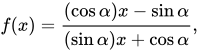
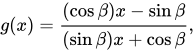





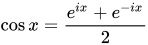








![{\displaystyle {\begin{aligned}\sin x&=x\prod _{n=1}^{\infty }\left(1-{\frac {x^{2}}{\pi ^{2}n^{2}}}\right),&\cos x&=\prod _{n=1}^{\infty }\left(1-{\frac {x^{2}}{\pi ^{2}\left(n-{\frac {1}{2}}\right)\!{\vphantom {)}}^{2}}}\right),\\[10mu]\sinh x&=x\prod _{n=1}^{\infty }\left(1+{\frac {x^{2}}{\pi ^{2}n^{2}}}\right),&\cosh x&=\prod _{n=1}^{\infty }\left(1+{\frac {x^{2}}{\pi ^{2}\left(n-{\frac {1}{2}}\right)\!{\vphantom {)}}^{2}}}\right).\end{aligned}}}](https://wikimedia.org/api/rest_v1/media/math/render/svg/6d43e1176a38b1e6b653837eb782ae79735783ac)






![{\displaystyle {\begin{alignedat}{9}{\frac {\pi }{2}}~&=~\arcsin(x)&&+\arccos(x)~&&=~\arctan(r)&&+\operatorname {arccot} (r)~&&=~\operatorname {arcsec} (s)&&+\operatorname {arccsc} (s)\\[0.4ex]\pi ~&=~\arccos(x)&&+\arccos(-x)~&&=~\operatorname {arccot} (r)&&+\operatorname {arccot} (-r)~&&=~\operatorname {arcsec} (s)&&+\operatorname {arcsec} (-s)\\[0.4ex]0~&=~\arcsin(x)&&+\arcsin(-x)~&&=~\arctan(r)&&+\arctan(-r)~&&=~\operatorname {arccsc} (s)&&+\operatorname {arccsc} (-s)\\[1.0ex]\end{alignedat}}}](https://wikimedia.org/api/rest_v1/media/math/render/svg/839db041f421b4af5890106450e2b4d3e9e183d4)