
อ่าน 15 นาที
Five-limit tuning
Five-limit tuning , 5-limit tuning , or 5-prime-limit tuning (not to be confused with 5-odd-limit tuning ), is any system for tuning a musical instrument that obtains the...
Five-limit tuning

Five-limit tuning, 5-limit tuning, or 5-prime-limit tuning (not to be confused with 5-odd-limit tuning), is any system for tuning a musical instrument that obtains the frequency of each note by multiplying the frequency of a given reference note (the base note) by products of integer powers of 2, 3, or 5 (prime numbers limited to 5 or lower), such as 2−3·31·51 = 15/8.
Powers of 2 represent intervallic movements by octaves. Powers of 3 represent movements by intervals of perfect fifths (plus one octave, which can be removed by multiplying by 1/2, i.e., 2−1). Powers of 5 represent intervals of major thirds (plus two octaves, removable by multiplying by 1/4, i.e., 2−2). Thus, 5-limit tunings are constructed entirely from stacking of three basic purely-tuned intervals (octaves, thirds and fifths). Since the perception of consonance seems related to low numbers in the harmonic series, and 5-limit tuning relies on the three lowest primes, 5-limit tuning should be capable of producing very consonant harmonies. Hence, 5-limit tuning is considered a method for obtaining just intonation.
The number of potential intervals, pitch classes, pitches, key centers, chords, and modulations available to 5-limit tunings is unlimited, because no (nonzero integer) power of any prime equals any power of any other prime, so the available intervals can be imagined to extend indefinitely in a 3-dimensional lattice (one dimension, or one direction, for each prime). If octaves are ignored, it can be seen as a 2-dimensional lattice of pitch classes (note names) extending indefinitely in two directions.
However, most tuning systems designed for acoustic instruments restrict the total number of pitches for practical reasons. It is also typical (but not always done) to have the same number of pitches in each octave, representing octave transpositions of a fixed set of pitch classes. In that case, the tuning system can also be thought of as an octave-repeating scale of a certain number of pitches per octave.
The frequency of any pitch in a particular 5-limit tuning system can be obtained by multiplying the frequency of a fixed reference pitch chosen for the tuning system (such as A440, A442, A432, C256, etc.) by some combination of the powers of 3 and 5 to determine the pitch class and some power of 2 to determine the octave.
For example, if we have a 5-limit tuning system where the base note is C256 (meaning it has 256 cycles per second and we decide to call it C), then fC = 256 Hz, or "frequency of C equals 256 Hz." There are several ways to define E above this C. Using thirds, one may go up one factor 5 and down two factors 2, reaching a frequency ratio of 5/4, or using fifths one may go up four factors of 3 and down six factors of 2, reaching 81/64. The frequencies become:

or

Diatonic scale
Assuming we restrict ourselves to seven pitch classes (seven notes per octave), it is possible to tune the familiar diatonic scale using 5-limit tuning in a number of ways, all of which make most of the triads ideally tuned and as consonant and stable as possible, but leave some triads in less-stable intervalic configurations.
The prominent notes of a given scale are tuned so that their frequencies form ratios of relatively small integers. For example, in the key of G major, the ratio of the frequencies of the notes G to D (a perfect fifth) is 3/2, while that of G to C is 2/3 (a descending perfect fifth) or 4/3 (a perfect fourth) going up, and the major third G to B is 5/4.

A just diatonic scale may be derived as follows. Imagining the key of C major, suppose we insist that the subdominant root F and dominant root G be a fifth (3:2) away from the tonic root C on either side, and that the chords FAC, CEG, and GBD be just major triads (with frequency ratios 4:5:6):
| Tone | Name | C | D | E | F | G | A | B | C | ||||||||
|---|---|---|---|---|---|---|---|---|---|---|---|---|---|---|---|---|---|
| Ratio | 1/1 | 9/8 | 5/4 | 4/3 | 3/2 | 5/3 | 15/8 | 2/1 | |||||||||
| Natural | 24 | 27 | 30 | 32 | 36 | 40 | 45 | 48 | |||||||||
| Cents | 0 | 204 | 386 | 498 | 702 | 884 | 1088 | 1200 | |||||||||
| Step | Interval | T | t | s | T | t | T | s | |||||||||
| Ratio | 9/8 | 10/9 | 16/15 | 9/8 | 10/9 | 9/8 | 16/15 | ||||||||||
| Cents step | 204 | 182 | 112 | 204 | 182 | 204 | 112 | ||||||||||
This is known as Ptolemy's intense diatonic scale. Here the row headed "Natural" expresses all these ratios using a common list of natural numbers (by multiplying the row above by the lcm of its denominators). In other words, the lowest occurrence of this one-octave scale shape within the harmonic series is as a subset of 7 of the 24 harmonics found in the octave from harmonics 24 to 48.
The three major thirds are correct (5:4), and three of the minor thirds are as expected (6:5), but D to F is a semiditone or Pythagorean minor third (equal to three descending just perfect fifths, octave adjusted), a syntonic comma narrower than a justly tuned (6:5) minor third.
As a consequence, we obtain a scale in which EGB and ACE are just minor triads (10:12:15), but the DFA triad doesn't have the minor shape or sound we might expect, being (27:32:40). Furthermore, the BDF triad is not the (25:30:36) diminished triad that we would get by stacking two 6:5 minor thirds, being (45:54:64) instead:[1][2]
It can be seen that basic step-wise scale intervals appear:
- s = 16:15 (semitone)
- t = 10:9 (minor tone)
- T = 9:8 (major tone)
which may be combined to form larger intervals (among others):
- Ts = 6:5 (minor third)
- Tt = 5:4 (major third)
- Tts = 4:3 (perfect fourth)
- TTts = 3:2 (perfect fifth)
- TTTttss 2:1 (octave)
Another way to do it is as follows. Thinking in the relative minor key of A minor and using D, A, and E as our spine of fifths, we can insist that the chords DFA, ACE, and EGB be just minor triads (10:12:15):
| Tone | Name | A | B | C | D | E | F | G | A | ||||||||
|---|---|---|---|---|---|---|---|---|---|---|---|---|---|---|---|---|---|
| Ratio | 1/1 | 9/8 | 6/5 | 4/3 | 3/2 | 8/5 | 9/5 | 2/1 | |||||||||
| Natural | 120 | 135 | 144 | 160 | 180 | 192 | 216 | 240 | |||||||||
| Cents | 0 | 204 | 316 | 498 | 702 | 814 | 1018 | 1200 | |||||||||
| Step | Interval | T | s | t | T | s | T | t | |||||||||
| Ratio | 9/8 | 16/15 | 10/9 | 9/8 | 16/15 | 9/8 | 10/9 | ||||||||||
| Cents step | 204 | 112 | 182 | 204 | 112 | 204 | 182 | ||||||||||
If we contrast that against the earlier scale, we see that for five pairs of successive notes the ratios of the steps remain the same, but one note, D, the steps C-D and D-E have switched their ratios.
The three major thirds are still 5:4, and three of the minor thirds are still 6:5 with the fourth being 32:27, except that now it's BD instead of DF that is 32:27. FAC and CEG still form just major triads (4:5:6), but GBD is now (108:135:160), and BDF is now (135:160:192).
There are other possibilities such as raising A instead of lowering D, but each adjustment breaks something else.
It is evidently not possible to get all seven diatonic triads in the configuration (4:5:6) for major, (10:12:15) for minor, and (25:30:36) for diminished at the same time if we limit ourselves to seven pitches.
นั่นแสดงให้เห็นถึงความจำเป็นในการเพิ่มจำนวนระดับเสียงเพื่อให้ได้เสียงประสานที่ต้องการอย่างถูกต้อง
บันไดเสียงสิบสองโทน
ในการสร้างบันไดเสียงสิบสองโทนในระบบปรับเสียงแบบ 5-limit เราเริ่มต้นด้วยการสร้างตารางที่มีระดับเสียงที่ถูกต้องสิบห้าระดับเสียง:
| ปัจจัย | 1/9 | 1/3 | 1 | 3 ⁄ 1 | 9 ⁄ 1 | |
|---|---|---|---|---|---|---|
| 5 ⁄ 1 | D− 10/9 182 [ 3 ] | เอ 5/3 884 | อี 5/4 386 | บี 15/8 1088 | F ♯ + 45/32 590 [ 3 ] | อัตราส่วนโน้ตเซนต์ |
| 1 | B ♭ − 16/9 996 [ 3 ] | F 4/3 498 | ซี 1 0 | จี 3/2 702 | ดี 9/8 204 | อัตราส่วนโน้ตเซนต์ |
| 1/5 | G ♭ − 64/45 610 [ 3 ] | D ♭ − 16/15 112 [ 3 ] | เอ♭ 8/5 814 | อี♭ 6/5 316 | บี♭ 9/5 1018 | อัตราส่วนโน้ตเซนต์ |
ปัจจัยที่ระบุในแถวแรกและคอลัมน์แรกคือเลขยกกำลังของ 3 และ 5 ตามลำดับ (เช่น1/9 = 3 − 2 ) สีต่างๆ แสดงถึงคู่ของ โน้ต ที่ มีระดับเสียงใกล้เคียงกัน อัตราส่วนทั้งหมดแสดงโดยเทียบกับ โน้ต C ที่อยู่ตรงกลางของแผนภาพนี้ (โน้ตพื้นฐานสำหรับสเกลนี้) การคำนวณทำในสองขั้นตอน:
- สำหรับแต่ละช่องในตาราง จะได้ อัตราส่วนพื้นฐานโดยการคูณตัวประกอบที่สอดคล้องกัน ตัวอย่างเช่น อัตราส่วนพื้นฐานสำหรับช่องด้านล่างซ้ายคือ 1/9 · 1/5 = 1/45
- จากนั้นจะนำอัตราส่วนพื้นฐานไปคูณด้วยเลขยกกำลังลบหรือบวกของ 2 ที่มีค่ามากเท่าที่จำเป็นเพื่อให้ค่าอยู่ในช่วงอ็อกเทฟที่เริ่มต้นจาก C (จาก 1/1 ถึง 2/1) ตัวอย่างเช่น อัตราส่วนพื้นฐานสำหรับเซลล์ด้านล่างซ้าย (1/45) จะถูกคูณด้วย 2⁶ และอัตราส่วนที่ได้คือ 64/45 ซึ่งเป็นตัวเลขระหว่าง 1/1 และ 2/1
โปรดทราบว่าเลขยกกำลังของ 2 ที่ใช้ในขั้นตอนที่สองอาจตีความได้ว่าเป็นอ็อกเทฟ ที่เพิ่มขึ้นหรือลดลง ตัวอย่างเช่น การคูณความถี่ของโน้ตด้วย 2⁶ หมายถึงการเพิ่มขึ้น 6 อ็อกเทฟ ยิ่งไปกว่านั้น แต่ละแถวของตารางอาจถือได้ว่าเป็นลำดับของคู่ห้า (เพิ่มขึ้นไปทางขวา) และแต่ละคอลัมน์เป็นลำดับของคู่สามเมเจอร์ (เพิ่มขึ้นไปทางซ้าย) ตัวอย่างเช่น ในแถวแรกของตาราง มีคู่ห้าที่เพิ่มขึ้นจาก D และ A และอีกหนึ่งคู่ห้า (ตามด้วยอ็อกเทฟที่ลดลง) จาก A ไปยัง E ซึ่งชี้ให้เห็นถึงวิธีการอื่นแต่เทียบเท่ากันในการคำนวณอัตราส่วนเดียวกัน ตัวอย่างเช่น คุณสามารถหา A (อัตราส่วน 5/3) โดยเริ่มจาก C ได้โดยการเลื่อนไปทางซ้ายหนึ่งช่องและขึ้นไปหนึ่งช่องในตาราง ซึ่งหมายถึงการลดลงหนึ่งคู่ห้า (2/3) และการเพิ่มขึ้นหนึ่งคู่สามเมเจอร์ (5/4)
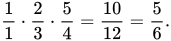
เนื่องจากโน้ตนี้ต่ำกว่า C คุณจึงต้องเลื่อนขึ้นไปหนึ่งอ็อกเทฟเพื่อให้ได้อัตราส่วนที่อยู่ในช่วงที่ต้องการ (จาก 1/1 ถึง 2/1):
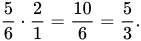
บันไดเสียง 12 โทน ได้มาจากการลบโน้ตหนึ่งตัวสำหรับทุกๆ คู่ของโน้ตที่เสียงเหมือนกัน สามารถทำได้อย่างน้อยสามวิธี ซึ่งมีจุดร่วมกันคือการลบ G ♭ตามหลักการที่ใช้ได้แม้กระทั่งกับบันไดเสียงพีทาโกเรียนแบบ C และบันไดเสียงมีนท์โทนแบบ 1/4-คอมมา โปรดทราบว่า G♭ เป็นคู่ห้าลดลงใกล้เคียงกับครึ่งอ็อกเทฟ เหนือโน้ตหลัก C ซึ่งเป็นช่วงเสียงที่ไม่กลมกลืนกัน นอกจากนี้ อัตราส่วนของ G♭ ยังมีค่ามากที่สุดในตัวเศษและตัวส่วนของโน้ตทั้งหมดในบันไดเสียง ทำให้ G♭ มีความกลมกลืนน้อยที่สุด ทั้งหมดนี้เป็นเหตุผลที่ควรหลีกเลี่ยง กลยุทธ์แรก ซึ่งเราเรียกในที่นี้ว่า บันไดเสียงสมมาตร 1ประกอบด้วยการเลือกโน้ตในมุมบนซ้ายและล่างขวาของตารางเพื่อลบออก กลยุทธ์ที่สอง ซึ่งเรียกว่าบันไดเสียงสมมาตร 2ประกอบด้วยการทิ้งโน้ตในช่องแรกและช่องสุดท้ายของแถวที่สอง (ที่ระบุว่า " 1 ") แบบที่สาม ซึ่งเรียกว่าสเกลอสมมาตรประกอบด้วยการตัดคอลัมน์แรกออก (ที่ระบุว่า " 1/9 ") สเกล 12 โทนที่ได้แสดงไว้ด้านล่าง:
| มาตราส่วนสมมาตร 1 | ||||||
|---|---|---|---|---|---|---|
| ปัจจัย | 1/9 | 1/3 | 1 | 3 | 9 | |
| 5 | 5/3 | อี 5/4 | บี 15/8 | F ♯ + 45/32 | ||
| 1 | บี♭ − 16/9 | เอฟ 4/3 | ซี 1 | จี 3/2 | ดี 9/8 | |
| 1/5 | ดี♭ − 16/15 | เอ♭ 8/5 | อี♭ 6/5 | |||
| มาตราส่วนสมมาตร 2 | ||||||
|---|---|---|---|---|---|---|
| ปัจจัย | 1/9 | 1/3 | 1 | 3 | 9 | |
| 5 | ดี -10/9 | 5/3 | อี 5/4 | บี 15/8 | F ♯ + 45/32 | |
| 1 | เอฟ 4/3 | ซี 1 | จี 3/2 | |||
| 1/5 | ดี♭ − 16/15 | เอ♭ 8/5 | อี♭ 6/5 | บี♭ 9/5 | ||
| มาตราส่วนไม่สมมาตร | ||||||
|---|---|---|---|---|---|---|
| ปัจจัย | 1/9 | 1/3 | 1 | 3 | 9 | |
| 5 | 5/3 | อี 5/4 | บี 15/8 | F ♯ + 45/32 | ||
| 1 | เอฟ 4/3 | ซี 1 | จี 3/2 | ดี 9/8 | ||
| 1/5 | ดี♭ − 16/15 | เอ♭ 8/5 | อี♭ 6/5 | บี♭ 9/5 | ||
In the first and second scale, B♭ and D are exactly the inversion of each other. This is not true for the third one. This is the reason why these two scales are regarded as symmetric (although the removal of G♭ makes all 12 tone scales, including those produced with any other tuning system, slightly asymmetric).
The asymmetric system has the advantage of having the "justest" ratios (those containing smaller numbers), nine pure fifths (factor 3/2), eight pure major thirds (factor 5/4) by design, but also six pure minor thirds (factor 6/5). However, it also contains two impure fifths (e.g., D to A is 40/27 rather than 3/2) and three impure minor thirds (e.g., D to F is 32/27 rather than 6/5), which practically limits modulation to a narrow range of keys. The chords of the tonic C, dominant G and subdominant F are pure, as well as D♭, A♭, E♭ and the minor chords Fm, Cm, Gm, Am, Bm and Em, but not the Dm.
A drawback of the asymmetric system is that it produces 14 wolf intervals, rather than 12 as for the symmetric ones.
The B♭ in the first symmetric scale differs from the B♭ in the other scales by the syntonic comma, being over 21 cents. In equally tempered scales, the difference is eliminated by making all steps the same frequency ratio.

 |
The construction of the asymmetric scale is graphically shown in the picture. Each block has the height in cents of the constructive frequency ratios 2/1, 3/2 and 5/4. Recurring patterns can be recognised. For example, many times the next note is created by replacing a 5/4-block and a 3/2-block by a 2/1-block, representing a ratio of 16/15.
For a similar image, built using frequency factors 2, 3, and 5, rather than 2/1, 3/2, and 5/4, see here.
The just ratios
The just ratios used to build these scales can be used as a reference to evaluate the consonance of intervals in other scales (for instance, see this comparison table). However, 5-limit tuning is not the only method to obtain just intonation. It is possible to construct just intervals with even "juster" ratios, or alternately, with values closer to the equal-tempered equivalents. For instance, a 7-limit tuning is sometimes used to obtain a slightly juster and consequently more consonant interval for the minor seventh (7/4) and its inversion, the major second (8/7). A list of these reference ratios, which may be referred to as pure or strictly just intervals or ratios, is provided below:
| Interval name | Short | Number ofsemitones | 5-limit tuning | 7-limit tuning | 17-limit tuning | |||
|---|---|---|---|---|---|---|---|---|
| Symmetric scales | Asymmetric scales | |||||||
| N. 1 | N. 2 | Standard | Extended | |||||
| Perfect unison | P1 | 0 | 1/1 | 1/1 | 1/1 | 1/1 | 1/1 | 1/1 |
| Minor second | m2 | 1 | 16/15 | 16/15 | 16/15 | 16/15 | 15/14 | 14/13 |
| Major second | M2 | 2 | 9/8 | 10/9 | 9/8 | 9/8 | 8/7 | 8/7 |
| Minor third | m3 | 3 | 6/5 | 6/5 | 6/5 | 6/5 | 6/5 | 6/5 |
| Major third | M3 | 4 | 5/4 | 5/4 | 5/4 | 5/4 | 5/4 | 5/4 |
| Perfect fourth | P4 | 5 | 4/3 | 4/3 | 4/3 | 4/3 | 4/3 | 4/3 |
| Augmented fourth | A4 | 6 | 45/32 | 45/32 | 45/32 | 25/18 | 7/5 | 7/5 or 17/12 |
| Diminished fifth | d5 | 6 | 64/45 | 64/45 | 64/45 | 36/25 | 10/7 | 10/7 or 24/17 |
| Perfect fifth | P5 | 7 | 3/2 | 3/2 | 3/2 | 3/2 | 3/2 | 3/2 |
| Minor sixth | m6 | 8 | 8/5 | 8/5 | 8/5 | 8/5 | 8/5 | 8/5 |
| Major sixth | M6 | 9 | 5/3 | 5/3 | 5/3 | 5/3 | 5/3 | 5/3 |
| Minor seventh | m7 | 10 | 16/9 | 9/5 | 9/5 | 9/5 | 7/4 | 7/4 |
| Major seventh | M7 | 11 | 15/8 | 15/8 | 15/8 | 15/8 | 15/8 | 13/7 |
| Perfect octave | P8 | 12 | 2/1 | 2/1 | 2/1 | 2/1 | 2/1 | 2/1 |
Cells highlighted in yellow indicate intervals that are juster than those in the non-coloured cells in the same row. Those highlighted in cyan indicate even juster ratios.
Notice that the ratios 45/32 and 64/45 for the tritones (augmented fourth and diminished fifth) are not in all contexts regarded as strictly just, but they are the justest possible in the above-mentioned 5-limit tuning scales. An extended asymmetric 5-limit scale (see below) provides slightly juster ratios for both the tritones (25/18 and 36/25), the purity of which is also controversial. 7-limit tuning allows for the justest possible ratios, namely 7/5 (about 582.512 cents, also known as septimal tritone) and 10/7 (about 617.488 cents). These ratios are more consonant than 17/12 (about 603.000 cents) and 24/17 (about 597.000 cents), which can be obtained in 17-limit tuning, yet the latter are also fairly common, as they are closer to the equal-tempered value of 600.000 cents.
The above-mentioned 7/4 interval (about 968.826 cents), also known as the septimal minor seventh, or harmonic seventh, has been a contentious issue throughout the history of music theory; it is 31 cents flatter than an equal-tempered minor seventh.
Size of intervals

The tables above only show the frequency ratios of each note with respect to the base note. However, intervals can start from any note and so twelve intervals can be defined for each interval type – twelve unisons, twelve semitones, twelve 2-semitone intervals, etc.
In 5-limit tuning, each interval type except for unisons and octaves has three or four different sizes. This is the price paid for seeking just intonation. The table on the right shows their frequency ratios for the asymmetric scale, with deviations coloured and deviations corresponding to wolf intervals in purple. The deviations arise because the notes determine four different semitones:
- ("Just" augmented unison between E♭ and E)
- (Augmented unison between D♭ and D)
- ("Just" minor second between C and D♭)
- (Minor second between A and B♭)


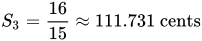

By contrast, in an equally tempered chromatic scale, all semitones measure
![{\displaystyle S_{E}={\sqrt[{12}]{2}}=100.000{\text{ cents}}}](https://wikimedia.org/api/rest_v1/media/math/render/svg/b50bf0d2901461be5393a3b513729b1a5a0d84c9)
and intervals of any given type have the same size, but none are justly tuned except unisons and octaves.
Commas
In other tuning systems, a comma may be defined as a minute interval, equal to the difference between two kinds of semitones (diatonic and chromatic, also known as minor second, m2, or augmented unison, A1). In this case, however, 4 kinds of semitones are produced (two A1, S1 and S2, and two m2, S3 and S4) and 12 different commas can be defined as the differences between their sizes in cents, or equivalently as the ratios between their ratios. Among these, we select the six ascending ones (those with ratio larger than 1/1, and positive size in cents):
| Name of comma | Equivalent definitions | Size | ||
|---|---|---|---|---|
| In meantone temperament | In 5-limit tuning(asymmetric scale) | Ratio | Cents | |
| Diaschisma (DS) | in 1/6-comma meantone | |||
| Syntonic comma (SC) | ||||
| Lesser diesis (LD) | in 1/4-comma meantone | |||
| Greater diesis (GD) | in 1/3-comma meantone | |||

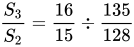


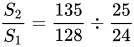


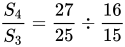
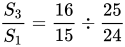


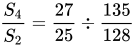
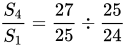


อัตราส่วนอีกหกอัตราส่วนถูกตัดทิ้งไป เพราะมันตรงกันข้ามกับอัตราส่วนเหล่านี้ ดังนั้นจึงมีความยาวเท่ากัน แต่มีทิศทางตรงกันข้าม (เช่น ทิศทางลง อัตราส่วนน้อยกว่า 1/1 และขนาดเป็นลบในหน่วยเซนต์) เราจึงได้คอมมาที่มีขนาดแตกต่างกันสี่แบบ ได้แก่ ไดแอสคิสมา ไดเอซิสเล็ก คอมมาซินโทนิก และไดเอซิสใหญ่ เนื่องจาก S1 ( A1 )และ S3 ( m2 )เป็นเซมิโทนที่เกิดขึ้นบ่อยที่สุดในบันไดเสียง 12 โทนนี้ (ดูตารางด้านบน) ไดเอซิสเล็ก ซึ่งถูกกำหนดให้เป็นอัตราส่วนระหว่างเซมิโทนทั้งสอง จึงเป็นคอมมาที่พบเห็นบ่อยที่สุด
ค่าซินโทนิกคอมมา (Syntonic comma) ในระบบปรับเสียงแบบ 5-limit นั้น ถูกกำหนดให้เป็นอัตราส่วนระหว่างเสียง เมเจอร์ (M2 ที่มีขนาด 9/8) และเสียงไมเนอร์ (M2 ที่มีขนาด 10/9) โปรดสังเกตว่า ในระบบปรับเสียงอื่นๆ ค่านี้ไม่สามารถกำหนดได้เป็นอัตราส่วนระหว่างเซมิโทนไดอะโทนิกและเซมิโทนโครมาติก (m2/A1) แต่เป็นค่าอ้างอิงที่สำคัญที่ใช้ในการปรับเสียงคู่ห้าสมบูรณ์ในระบบปรับเสียงใดๆ ใน กลุ่มระบบปรับ เสียงซินโทนิก (รวมถึงระบบปรับเสียงมีนโทนด้วย)
วินาทีที่ลดลง
คอมมาสามตัวที่กล่าวถึงข้างต้น ได้แก่ ไดแอสคิสมา ไดเอซิส และเกรตเตอร์ไดเอซิส ตรงตามนิยามของ เซคัน ด์ลด (diminished second)ซึ่งก็คือความแตกต่างระหว่างขนาดในหน่วยเซนต์ของเซมิโทนไดอะโทนิกและเซมิโทนโครมาติก (หรือเทียบเท่ากับอัตราส่วนระหว่างอัตราส่วนความถี่ของพวกมัน)
ในทางตรงกันข้าม คอมมาซินโทนิกถูกกำหนดให้เป็นผลต่างในหน่วยเซนต์ระหว่างเซมิโทนโครมาติกสองตัว (S 2และ S 1 ) หรือระหว่างเซมิโทนไดอะโทนิกสองตัว (S 4และ S 3 ) และไม่สามารถถือว่าเป็นเซคันด์ลดระดับได้
การขยายบันไดเสียงสิบสองโทน
ตารางด้านบนใช้เลขยกกำลังต่ำของ 3 และ 5 ในการสร้างอัตราส่วนพื้นฐานเท่านั้น อย่างไรก็ตาม สามารถขยายได้ง่ายๆ โดยใช้เลขยกกำลังบวกและลบที่สูงกว่าของตัวเลขเดียวกัน เช่น 5² = 25, 5⁻² = 1/25, 3³ = 27 หรือ 3⁻³ = 1/27 เราสามารถสร้างสเกลที่มี 25, 35 หรือมากกว่านั้นได้โดยการรวมอัตราส่วนพื้นฐานเหล่านี้เข้าด้วยกัน
ตัวอย่างเช่น เราสามารถสร้างระยะ 35 ระยะได้โดยการเพิ่มแถวในแต่ละทิศทางดังนี้:
| ปัจจัย | 1/9 | 1/3 | 1 | 3 | 9 | |
|---|---|---|---|---|---|---|
| 125 | อัตราส่วนโน้ตเซนต์ | A ♯ 125/72 955.0 [ 3 ] | อี♯ 125/96 457.0 | บี♯ 125/64 1158.9 | F  + 375/256 660.9 [ 3 ] + 375/256 660.9 [ 3 ] | C + 1125/1024 162.9 [ 3 ] |
| 25 | อัตราส่วนโน้ตเซนต์ | F ♯ 25/18 568.7 [ 3 ] | C ♯ 25/24 70.7 | G ♯ 25/16 772.6 | D ♯ 75/64 274.6 | A ♯ + 225/128 976.5 [ 3 ] |
| 5 | อัตราส่วนโน้ตเซนต์ | D− 10/9 182.4 | เอ5/3 884.4 | อี5/4 386.3 | บี15/8 1088.3 | F ♯ + 45/32 590.2 |
| 1 | อัตราส่วนโน้ตเซนต์ | บี♭ − 16/9 996.1 | F 4/3 498.0 | C 1/1 0.0 | จี3/2 702.0 | ดี9/8 203.9 |
| 1/5 | อัตราส่วนโน้ตเซนต์ | G ♭ − 64/45 609.8 | D ♭ − 16/15 111.7 | เอ♭ 8/5 813.7 | อี♭ 6/5 315.6 | บี♭ 9/5 1017.6 |
| 1/25 | อัตราส่วนโน้ตเซนต์ | E  − 256/225 223.5 [ 3 ] − 256/225 223.5 [ 3 ] | B − 128/75 925.4 [ 3 ] | F ♭ 32/25 427.4 | C ♭ 48/25 1129.3 | G ♭ 36/25 631.3 |
| 1/125 | อัตราส่วนโน้ตเซนต์ | C − 2048/1125 1037.1 [ 3 ] | G − 512/375 539.1 [ 3 ] | D − 128/125 41.1 [ 3 ] | A 192/125 743.0 | E 144/125 245.0 |
บางครั้ง คอลัมน์ด้านซ้าย ( 1/9 ) จะถูกลบออก (ดังเช่นในมาตราส่วนแบบไม่สมมาตรที่แสดงไว้ข้างต้น) ทำให้เกิดตารางแบบไม่สมมาตรที่มีจำนวนระดับเสียงน้อยลง สังเกตว่าอัตราส่วนที่ยุติธรรมกว่าจะเกิดขึ้นสำหรับคู่ห้าที่ลดลง (CG ♭ = 36/25) เมื่อเทียบกับการปรับจูนแบบจำกัด 5 ขีดจำกัดที่อธิบายไว้ข้างต้น (โดยที่ C ถึง G ♭ = 64/45) [ 4 ]
ประวัติศาสตร์
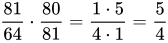
ในการปรับเสียงที่เรียกว่า "แบบพีทาโกเรียน" ซึ่งเป็นการปรับเสียงที่นำมาจากชาวบาบิโลนและเข้าใจผิดว่าเป็นของพีทาโกรัส[ 5 ]ช่วงเสียงที่กลมกลืนกันมากที่สุดมีเพียงคู่ห้าสมบูรณ์และคู่สี่สมบูรณ์ ซึ่งเป็นส่วนกลับของคู่ห้าสมบูรณ์เท่านั้น คู่สาม เมเจอร์แบบ พีทาโก เรียน (81:64) และคู่สามไมเนอร์ (32:27) นั้น ไม่กลมกลืนกันและสิ่งนี้ทำให้เหล่านักดนตรีไม่สามารถใช้ไตรแอดและคอร์ด ได้ บังคับให้พวกเขาต้องแต่งเพลงที่มีเนื้อเสียง ค่อนข้างเรียบง่ายเป็นเวลาหลายศตวรรษ ในช่วงปลายยุคกลางนักดนตรีตระหนักว่าการปรับระดับเสียงของโน้ตบางตัวเล็กน้อยจะทำให้คู่สามแบบพีทาโกเรียนกลมกลืนกันได้ ตัวอย่างเช่น หากคุณลดความถี่ของ E, CE (คู่สามเมเจอร์) และ EG (คู่สามไมเนอร์) ลงด้วยเครื่องหมายจุลภาคซินโทนิก (81:80) ความถี่นั้นก็จะพอดี กล่าวคือ CE จะถูกทำให้แคบลงเป็นอัตราส่วนที่พอดีของ
และในขณะเดียวกัน EG ก็ถูกขยายออกไปในอัตราส่วนที่เหมาะสมของ
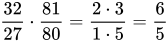

ข้อเสียคือ คู่ห้า AE และ EB เมื่อลดระดับเสียง E ลง จะกลายเป็นเสียงที่ไม่กลมกลืนเกือบเท่ากับคู่ห้าหมาป่า แบบพีทาโกเรียน แต่คู่ห้า CG ยังคงกลมกลืนอยู่ เนื่องจากมีเพียง E เท่านั้นที่ถูกลดระดับเสียงลง (CE * EG = 5/4 * 6/5 = 3/2) และสามารถใช้ร่วมกับ CE เพื่อสร้างไตรแอด C เมเจอร์ (CEG) ได้
ด้วยการสรุปเหตุผลง่ายๆ นี้จิโอเซฟโฟ ซาร์ลิโนในช่วงปลายศตวรรษที่สิบหก ได้สร้างบันไดเสียง 7 โทน ( ไดอะโทนิก ) ที่มีระดับเสียงถูกต้องเป็นครั้งแรก ซึ่งประกอบด้วยคู่ห้าสมบูรณ์บริสุทธิ์ (3:2) คู่สามเมเจอร์บริสุทธิ์ และคู่สามไมเนอร์บริสุทธิ์:
F → A → C → E → G → B → D
นี่คือลำดับของโน้ตที่ห่างกันสามขั้นใหญ่ (M3, อัตราส่วน 5:4) และโน้ตที่ห่างกันสามขั้นเล็ก (m3, อัตราส่วน 6:5) โดยเริ่มจากโน้ต F:
F + M3 + m3 + M3 + m3 + M3 + m3
เนื่องจาก M3 + m3 = P5 (คู่ห้าสมบูรณ์) กล่าวคือ 5/4 * 6/5 = 3/2 ซึ่งเทียบเท่ากับบันไดเสียงไดอะโทนิกที่ได้จากการปรับเสียงแบบจัสต์อินโทเนชันในขีดจำกัด 5 และด้วยเหตุนี้จึงสามารถมองได้ว่าเป็นส่วนย่อยของตารางการสร้างที่ใช้สำหรับบันไดเสียง 12 โทน ( โครมาติก )
| เอ | → | อี | → | บี | ||
| ↑ | ↑ | ↑ | ||||
| เอฟ | → | ซี | → | จี | → | ดี |
โดยที่ทั้งสองแถวเป็นลำดับของคู่ห้าเท่านั้น และ FA, CE, GB เป็นเพียงคู่สามหลักเท่านั้น:
| เอ็ม3 | เอ็ม3 | เอ็ม3 | ||||
| + | + | + | ||||
| เอฟ | + | พี5 | + | พี5 | + | พี5 |
ดูเพิ่มเติม
- คณิตศาสตร์ของบันไดเสียงดนตรี
- ดนตรีไมโครโทนัล
- ไมโครจูนเนอร์
- ช่วงพีทาโกเรียน
- เซมิโทน
- รายการช่วงเสียงในระบบเสียงแบบ 5-limit just intonation
- รายการช่วงเวลาเฉลี่ย
- รายการช่วงเสียงดนตรี
- รายการช่วงเสียง
- บันไดเสียงเต็มโทน
- หมายเลขปกติ
- เฮกซานี
- เครื่องจูนอิเล็กทรอนิกส์
- ความกลมกลืนและความไม่กลมกลืน
หมายเหตุ
- ^ไรท์, เดวิด (2009).คณิตศาสตร์และดนตรี , หน้า 140–141. ISBN 978-0-8218-4873-9.
- ^Johnston, Ben and Gilmore, Bob (2006). "A Notation System for Extended Just Intonation" (2003), "Maximum clarity" and Other Writings on Music, p. 78. ISBN 978-0-252-03098-7.
- ^ abcdefghijklmnoJohn Fonville. "Ben Johnston's Extended Just Intonation- A Guide for Interpreters", pp. 113–114, Perspectives of New Music, vol. 29, no. 2 (Summer 1991), pp. 106–137.
- ^The notes from G♯ down to D♭ are taken from Don Michael Randel, The Harvard Dictionary of Music, 4th edition. Cambridge, Massachusetts: Belknap Press, 2003, p. 415. Furthermore, regarding the notes from F
 down to D♭, the Tonalsoft Encyclopedia of Microtonal Music Theory states: "In fact this structure perfectly describes Salinas's just-intonation structure."
 - ^The oldest known description of the Pythagorean tuning system appears in Babylonian artifacts. See: West, M. L. "The Babylonian Musical Notation and the Hurrian Melodic Texts", Music & Letters, vol. 75, no. 2 (May 1994). pp. 161–179.
External links
- Art of the States: microtonal/just intonation works using just intonation by American composers
- The Chrysalis Foundation – Just Intonation: Two Definitions
- Dante Rosati's 21 Tone Just Intonation guitar
- Just Intonation by Mark Nowitzky
- Just Intonation Explained by Kyle Gann
- A selection of Just Intonation works edited by the Just Intonation Network web published on the Tellus Audio Cassette Magazine project archive at UbuWeb
- Medieval Music and Arts Foundation
- Music Novatory – Just IntonationArchived 2011-06-15 at the Wayback Machine
- Why does Just Intonation sound so good?
- The Wilson Archives
- Barbieri, Patrizio. Enharmonic instruments and music, 1470–1900. (2008) Latina, Il Levante
- 22 Note Just Intonation Keyboard Software with 12 Indian Instrument Sounds Libreria Editrice
สรุปเนื้อหา
ข้อมูลสำคัญจากบทความ
ข้อมูลสำคัญเกี่ยวกับ Five-limit tuning
Five-limit tuning , 5-limit tuning , or 5-prime-limit tuning (not to be confused with 5-odd-limit tuning ), is any system for tuning a musical instrument that obtains the...
Diatonic scale
Assuming we restrict ourselves to seven pitch classes (seven notes per octave), it is possible to tune the familiar diatonic scale using 5-limit tuning in a number of ways, all of which make most of the triads ideally tuned and as consonant and stable as...
บันไดเสียงสิบสองโทน
ในการสร้างบันไดเสียงสิบสองโทนในระบบปรับเสียงแบบ 5-limit เราเริ่มต้นด้วยการสร้างตารางที่มีระดับเสียงที่ถูกต้องสิบห้าระดับเสียง:
The just ratios
The just ratios used to build these scales can be used as a reference to evaluate the consonance of intervals in other scales (for instance, see this comparison table ). However, 5-limit tuning is not the only method to obtain just intonation .