
รถไฟใต้ดินปักกิ่ง
| รถไฟใต้ดินปักกิ่ง | |||
|---|---|---|---|
 | |||
 | |||
| ภาพรวม | |||
| เจ้าของ | รัฐบาลเทศบาลปักกิ่ง | ||
| ท้องถิ่น | ปักกิ่งและหลางฝาง เห อเป่ย | ||
| ประเภทการขนส่ง | ระบบขนส่งด่วน | ||
| จำนวนบรรทัด | 30 | ||
| จำนวนสถานี | 401 [ 1 ] 541 [ 2 ] | ||
| จำนวนผู้โดยสารรายวัน | 9.46 ล้าน (เฉลี่ยรายวันในปี 2023) [ 3 ] 13.75 ล้าน (12 กรกฎาคม 2019 บันทึกสูงสุด) [ 4 ] | ||
| จำนวนผู้โดยสารต่อปี | 3.45 พันล้าน (2023) [ 3 ] | ||
| เว็บไซต์ | bjsubway.com mtr.bj.cn/en bjmoa.cn | ||
| การดำเนินการ | |||
| เริ่มดำเนินการ | 15 มกราคม 2514 ( 1971-01-15 ) | ||
| ผู้ดำเนินการ |
| ||
| อักขระ | ใต้ดิน ระดับพื้นดิน และยกระดับ | ||
| จำนวนยานพาหนะ | 6,173 ตู้รถไฟขนส่งสินค้า (2019) [ 5 ] | ||
| ทางเทคนิค | |||
| ความยาวของระบบ | 909 กม. (565 ไมล์) [ 2 ] | ||
| ระยะห่างราง | รางมาตรฐาน 1,435 มม . ( 4 ฟุต8 + 1/2 นิ้ว ) | ||
| การใช้ไฟฟ้า |
| ||
| |||
| รถไฟใต้ดินปักกิ่ง | |||||||||||||||||||||||||||||||||||
|---|---|---|---|---|---|---|---|---|---|---|---|---|---|---|---|---|---|---|---|---|---|---|---|---|---|---|---|---|---|---|---|---|---|---|---|
| ภาษาจีนตัวย่อ | 北京地铁 | ||||||||||||||||||||||||||||||||||
| จีนดั้งเดิม | 北京地鐵 | ||||||||||||||||||||||||||||||||||
| |||||||||||||||||||||||||||||||||||
รถไฟใต้ดินปักกิ่งเป็น ระบบ ขนส่งมวลชนความเร็วสูงของเทศบาลนครปักกิ่ง ประกอบด้วย 30 สาย ได้แก่สายรถไฟฟ้า ระบบ ขนส่งมวลชนความเร็วสูง 25 สาย สายรถไฟเชื่อมสนามบิน 2 สาย สายรถไฟ แม่เหล็ก 1 สาย และสายรถรางเบา 2 สาย รวม 541 สถานี[ 2 ]เครือข่ายรถไฟครอบคลุมระยะ ทาง 909 กิโลเมตร (565 ไมล์) [ 2 ]ครอบคลุม12 เขตเมืองและชานเมืองของปักกิ่งและเข้าสู่เขตหลางฟางใน มณฑล เหอเป่ย ที่อยู่ใกล้เคียง ในเดือนธันวาคม 2023 รถไฟใต้ดินปักกิ่งกลายเป็นระบบรถไฟใต้ดินที่ยาวที่สุดในโลกเมื่อวัดจากความยาวเส้นทางแซงหน้ารถไฟใต้ดินเซี่ยงไฮ้ด้วยจำนวนผู้โดยสาร 3.8484 พันล้านเที่ยวในปี 2018 (10.544 ล้านเที่ยวต่อวัน[ 6 ] ) และสถิติผู้โดยสารสูงสุดในวันเดียวที่ 13.7538 ล้านคน เมื่อวันที่ 12 กรกฎาคม 2019 [ 4 ]รถไฟใต้ดินปักกิ่งจึงเป็นระบบรถไฟใต้ดินที่พลุกพล่านที่สุดในโลก ในช่วงหลาย ปีก่อนการระบาดของโรคโควิด-19
รถไฟใต้ดินปักกิ่งเปิดให้บริการในปี 1971 และเป็นระบบรถไฟใต้ดินที่เก่าแก่ที่สุดในประเทศจีนและบนแผ่นดินใหญ่ของเอเชียตะวันออกก่อนที่ระบบจะเริ่มขยายตัวอย่างรวดเร็วในปี 2002 รถไฟใต้ดินมีเพียงสองสายเท่านั้น เนื่องจากเครือข่ายที่มีอยู่ยังไม่สามารถตอบสนอง ความต้องการ การขนส่งมวลชน ของเมืองได้อย่างเพียงพอ แผนการขยายรถไฟใต้ดินปักกิ่งอย่างกว้างขวางจึงเรียกร้องให้มี เส้นทางยาว 998.5 กม. (620.4 ไมล์) [ 7 ]ซึ่งคาดว่าจะรองรับผู้โดยสาร 18.5 ล้านเที่ยวต่อวันเมื่อแผนการก่อสร้างระยะที่ 2 เสร็จสมบูรณ์[ 8 ] [ 9 ] [ 10 ]การขยายตัวครั้งล่าสุดมีผลบังคับใช้เมื่อวันที่ 27 ธันวาคม 2025 ด้วยการเปิดสาย 18และการขยายสาย 6และสาย 17
ค่าโดยสาร
ตารางค่าโดยสาร
ค่า โดยสารเที่ยวเดียว รถไฟใต้ดินปักกิ่งคิดค่าโดยสารเที่ยวเดียวตามระยะทางในการเดินทางสำหรับทุกสาย ยกเว้นสองสายด่วนสนามบิน
- สำหรับทุกสายยกเว้นสายด่วนสนามบินสองสาย ค่าโดยสารเริ่มต้นที่ 3 เยนสำหรับการเดินทางไม่เกิน 6 กม. โดยจะเพิ่ม 1 เยนสำหรับทุกๆ 6 กม. ถัดไป และทุกๆ 10 กม. หลังจากนั้นจนกว่าระยะทางในการเดินทางจะถึง 32 กม. และทุกๆ 20 กม. ที่เกิน 32 กม. แรก[ 11 ] การเดินทาง 40 กม. จะมีค่าใช้จ่าย 7 เยน
- รถไฟด่วนสนามบินมีค่าโดยสารคงที่ 25 เยนต่อเที่ยว[ 12 ]
- รถไฟด่วนสนามบินต้าซิงเป็นสายเดียวที่ยังคงใช้ระบบค่าโดยสารตามชั้น โดยค่าโดยสารชั้นธรรมดาจะแตกต่างกันไปตามระยะทางตั้งแต่ 10 ถึง 35 หยวน และค่าโดยสารชั้นธุรกิจจะคงที่ที่ 50 หยวนต่อเที่ยว[ 13 ]
การเปลี่ยนสถานีภายในสายเดียวกันนั้นฟรีในทุกสายรถไฟใต้ดิน ยกเว้นสาย Airport Express สองสาย ได้แก่สาย Xijiaoและสาย Yizhuang T1ซึ่งต้องซื้อตั๋วใหม่เมื่อเปลี่ยนไปขึ้นหรือลงจากสายเหล่านั้น
เด็กที่มีความสูงต่ำกว่า1.3 เมตร (51 นิ้ว)สามารถโดยสารได้ฟรีเมื่อมีผู้ใหญ่ที่จ่ายค่าโดยสารร่วมเดินทางด้วย[ 14 ]ผู้สูงอายุที่มีอายุมากกว่า 65 ปี ผู้พิการทางร่างกาย เจ้าหน้าที่ปฏิวัติที่เกษียณอายุแล้ว ทหารผ่านศึกตำรวจและทหารที่ได้รับบาดเจ็บจากการปฏิบัติหน้าที่ บุคลากรทางการทหาร และตำรวจติดอาวุธประชาชนสามารถโดยสารรถไฟใต้ดินได้ฟรี[ 15 ]
ตั๋วโดยสารแบบไม่จำกัดจำนวนเที่ยว ตั้งแต่วันที่ 20 มกราคม 2562 ผู้โดยสารสามารถซื้อตั๋วโดยสารแบบไม่จำกัดจำนวนเที่ยวได้โดยใช้แอปพลิเคชัน Yitongxing (亿通行; แปลตรงตัวว่า' หนึ่งร้อยล้านเที่ยว' ) บนสมาร์ทโฟน ซึ่งจะสร้างรหัส QR ที่มีระยะเวลาใช้งานได้ตั้งแต่หนึ่งถึงเจ็ดวัน
| ค่าโดยสาร | ระยะทางในการเดินทาง |
|---|---|
| 3 เยน | <6 กม. |
| 4 เยน | 6–12 กม. |
| 5 เยน | 12–22 กม. |
| 6 เยน | 22–32 กม. |
| 7 เยน | 32–52 กม. |
| 8 เยน | 52–72 กม. |
| 9 เยน | 72–92 กม. |
| 10 เยน | 92–112 กม. |
| ระยะเวลา | ราคา |
|---|---|
| 1 วัน | 20 เยน |
| 2 วัน | 30 เยน |
| 3 วัน | 40 เยน |
| 5 วัน | 70 เยน |
| 7 วัน | 90 เยน |
ตารางค่าโดยสารก่อนหน้า เมื่อวันที่ 28 ธันวาคม 2557 รถไฟใต้ดินปักกิ่งได้เปลี่ยนจากตารางค่าโดยสารคงที่ไปเป็นตารางค่าโดยสารตามระยะทางในปัจจุบันสำหรับทุกสาย ยกเว้นรถไฟด่วนท่าอากาศยาน[ 11 ] [ 13 ]ก่อนการขึ้นค่าโดยสารเมื่อวันที่ 28 ธันวาคม 2557 ผู้โดยสารจ่ายค่าโดยสารคงที่2.00 หยวน (รวมการเปลี่ยนสายฟรีไม่จำกัดจำนวนครั้ง) สำหรับทุกสาย ยกเว้นรถไฟด่วนท่าอากาศยานซึ่งมีราคา 25 หยวน[ 16 ]ค่าโดยสารคงที่นี้ถือว่าต่ำที่สุดในบรรดาระบบรถไฟใต้ดินในประเทศจีน [ 17 ] ก่อนที่จะมีการนำตารางค่าโดยสารคงที่มาใช้เมื่อวันที่ 7 ตุลาคม 2550 ค่าโดยสารมีตั้งแต่ 3 ถึง 7 หยวน ขึ้นอยู่กับสายและจำนวนการเปลี่ยนสาย
การเก็บค่าโดยสาร
แต่ละสถานีมีเครื่องจำหน่ายตั๋วอัตโนมัติ 2 ถึง 15 เครื่อง[ 18 ]เครื่องจำหน่ายตั๋วอัตโนมัติในทุกสายสามารถเติมเครดิตลงในบัตรYikatong ได้ [ 19 ]ตั๋วโดยสารเที่ยวเดียวมีลักษณะเป็นบัตรพลาสติกแบบยืดหยุ่นที่ใช้เทคโนโลยี RFID
| ส่วนลดสำหรับผู้ใช้บัตรYikatong | ||
|---|---|---|
| ค่าใช้จ่ายรายเดือน | ค่าใช้จ่ายสุทธิหลังหักส่วนลดเครดิต | ส่วนลดสุทธิ |
| 50 เยน | 50 เยน | 0% |
| 100 เยน | 100 เยน | 0% |
| 150 เยน | 140 เยน | 6.67% |
| 200 เยน | 165 เยน | 17.5% |
| 250 เยน | 190 เยน | 24% |
| 300 เยน | 215 เยน | 28.3% |
| 350 เยน | 240 เยน | 31.4% |
| 400 เยน | 265 เยน | 33.75% |
| 450 เยน | 315 เยน | 30% |
| 500 เยน | 365 เยน | 27% |
ผู้โดยสารต้องใส่ตั๋วหรือสแกนบัตรที่ประตูทั้งก่อนเข้าและออกจากสถานี ประตูเก็บค่าโดยสารของรถไฟใต้ดินรับตั๋วเที่ยวเดียวและ บัตรโดยสาร Yikatongผู้โดยสารสามารถซื้อตั๋วและเติมเงินใน บัตร Yikatongได้ที่เคาน์เตอร์จำหน่ายตั๋วหรือเครื่องจำหน่ายอัตโนมัติในทุกสถานี บัตรYikatongหรือที่รู้จักกันในชื่อบัตรการบริหารและการสื่อสารเทศบาลปักกิ่ง (BMAC) เป็นบัตรวงจรรวมที่เก็บเครดิตสำหรับรถไฟใต้ดิน รถโดยสารประจำทางในเมืองและชานเมืองและเงินอิเล็กทรอนิกส์สำหรับการซื้ออื่นๆ[ 20 ] ต้องซื้อ บัตรYikatongที่เคาน์เตอร์จำหน่ายตั๋ว ในการเข้าสถานี บัตร Yikatongต้องมีเงินคงเหลือขั้นต่ำ 3.00 หยวน[ 21 ]เมื่อออกจากระบบ ตั๋วเที่ยวเดียวจะถูกใส่เข้าไปในประตูหมุน ซึ่งระบบจะนำกลับมาใช้ใหม่
เพื่อป้องกันการฉ้อโกง ผู้โดยสารจะต้องเดินทางให้เสร็จสิ้นภายในสี่ชั่วโมงหลังจากขึ้นรถไฟใต้ดิน[ 15 ]หากเกินเวลาสี่ชั่วโมง จะมีการเรียกเก็บค่าธรรมเนียมเพิ่มเติม 3 เยน[ 22 ] บัตร Yikatongแต่ละใบสามารถเบิกเกินบัญชีได้หนึ่งครั้ง จำนวนเงินที่เบิกเกินบัญชีจะถูกหักออกเมื่อมีการเติมเงินเข้าบัตร[ 23 ]
ผู้ใช้บัตร Yikatongที่ใช้จ่ายค่าโดยสารรถไฟใต้ดินมากกว่า 100 เยนในหนึ่งเดือนปฏิทินจะได้รับเครดิตเข้าบัตรในเดือนถัดไป[ 11 ]หลังจากใช้จ่ายครบ 100 เยนในหนึ่งเดือนปฏิทินแล้ว จะได้รับเครดิต 20% ของยอดใช้จ่ายเพิ่มเติมจนถึง 150 เยน เมื่อใช้จ่ายเกิน 150 เยน จะได้รับเครดิต 50% ของยอดใช้จ่ายเพิ่มเติมจนถึง 250 เยน[ 11 ]เมื่อใช้จ่ายเกิน 400 เยน จะไม่ได้รับเครดิตเพิ่มอีก[ 11 ]เครดิตเหล่านี้ออกแบบมาเพื่อบรรเทาภาระของผู้โดยสารจากค่าโดยสารที่เพิ่มขึ้น[ 11 ]
ตั้งแต่เดือนมิถุนายน พ.ศ. 2560 สามารถซื้อตั๋วเดินทางเที่ยวเดียวผ่านแอปโทรศัพท์ได้[ 24 ]การอัปเกรดในเดือนพฤษภาคม พ.ศ. 2561 อนุญาตให้เข้าได้โดยการสแกนคิวอาร์โค้ดจากแอปเดียวกัน[ 25 ]
ตั้งแต่มกราคม 2568 เป็นต้นไป ผู้โดยสารสามารถแตะบัตรชำระเงินแบบไร้สัมผัส (รวมถึงบัตรเครดิตระหว่างประเทศ) เพื่อขึ้นรถไฟใต้ดินได้โดยตรง สำหรับ ผู้ถือบัตร JCBเฉพาะบัตรที่ออกนอกประเทศจีนแผ่นดินใหญ่เท่านั้นที่สามารถใช้แตะเพื่อขึ้นรถได้[ 26 ] [ 27 ]
 ตั๋วเดินทางเที่ยวเดียวแบบเก่า
 ผู้โดยสารสามารถแตะ บัตร ชำระเงินแบบไร้สัมผัสหรืออุปกรณ์ที่รองรับการชำระเงินเพื่อขึ้นรถไฟใต้ดิน ได้โดยตรง
สายที่กำลังใช้งานอยู่
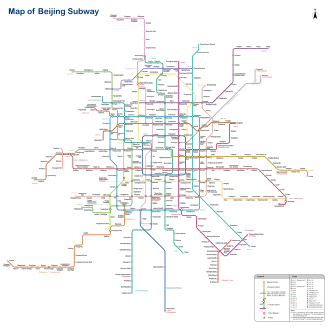
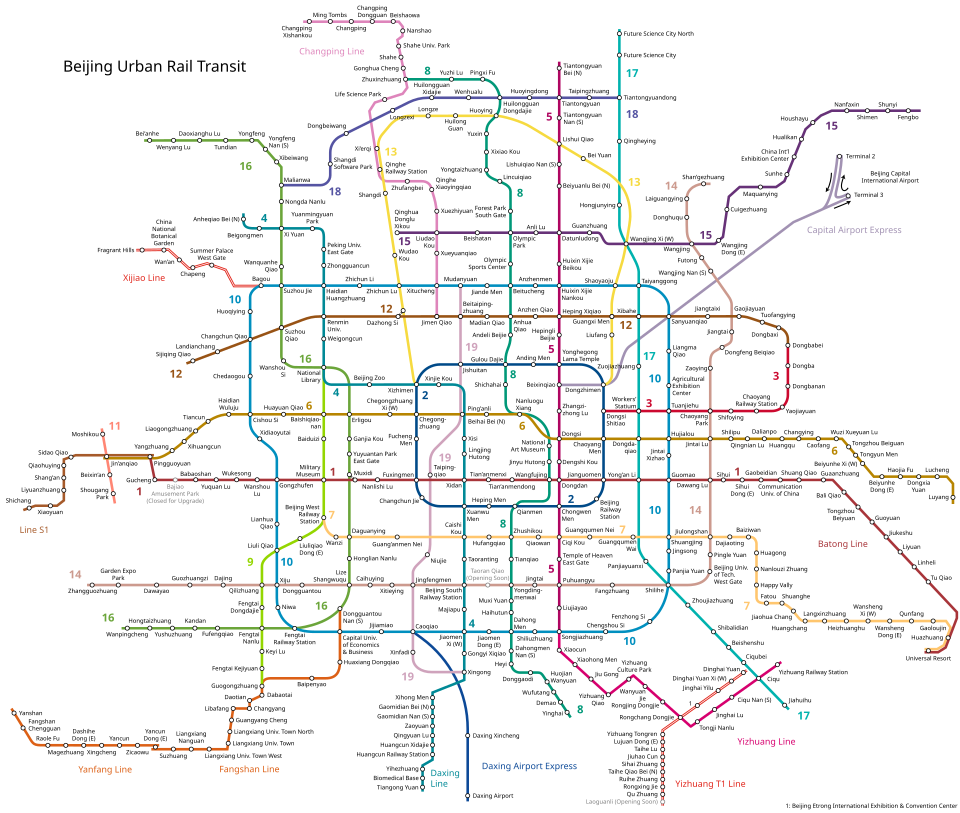
เส้นทางรถไฟใต้ดินปักกิ่งโดยทั่วไปจะวางผังเป็นรูปตารางหมากรุกตามผังเมือง เส้นทางส่วนใหญ่ที่ผ่านใจกลางเมือง (ซึ่งแสดงด้วยเส้นทางวนรอบของสาย 10) จะวิ่งขนานหรือตั้งฉากกัน และตัดกันเป็นมุมฉาก
| ชื่อบรรทัด | สถานีขนส่ง( เขต ) | เปิด[ 28 ] | ภายนอกใหม่ล่าสุด | ความยาว ( กม.) | สถานี(จำนวนสถานีเหนือพื้นดิน) | การเชื่อมต่อ | รถไฟ | ผู้ปฏิบัติงาน | รหัส | |
|---|---|---|---|---|---|---|---|---|---|---|
| 01 1และบาตง[ a ] | ผิงกั๋วหยวน ( สือจิ่งซาน ) | ยูนิเวอร์แซล รีสอร์ท ( ถงโจว ) | 1971 [ข] | 2021 | 50.9 | 36 (13) | 2 4 5 6 7 8 9 10 14 16 17 19 | รถยนต์ประเภท B 6 คัน |  | เอ็ม1 |
| 02 2ลูปไลน์ | ซีจือเหมิน ( ซีเฉิง ) | จีสุยถาน ( ซีเฉิง ) | 1984 | พ.ศ. 2530 | 23.1 | 18 | 1 3 4 5 6 8 13 19 | รถยนต์ประเภท B 6 คัน | | เอ็ม2 |
| 03 3 | ตงซี่ ซื่อเถ่า ( ตงเฉิง ) | ตงปาเป่ย ( เฉาหยาง ) | 2024 | — | 14.7 [ 30 ] | 10 | 2 10 12 14 17 | ประเภท A 4 คัน[ c ] | | เอ็ม3 |
| 04 4และต้าซิง[ d ] | อันเหอเฉียวเป่ย ( ไฮเดียน ) | เทียนกง หยวน ( ต้าซิง ) | 2009 | 2010 [ d ] | 49.4 | 35 (2) | 1 2 6 7 9 10 12 13 14 16 19 | รถยนต์ประเภท B 6 คัน |  | เอ็ม4 |
| 05 5 | เทียนถงหยวนเป่ย ( ฉางผิง ) | ซงเจียจวง ( เฟิงไท่ ) | 2007 | — | 27.6 | 23 (7) | 1 2 6 7 10 12 13 14 15 18 สนามบินแคปิตอล | รถยนต์ประเภท B 6 คัน | | เอ็ม5 |
| 06 6 | จินอันเฉียว ( สือจิงซาน ) | ลู่หยาง ( ตงโจว ) | 2012 | 2025 | 55.2 [ 33 ] | 36 | 2 4 5 8 9 10 11 14 16 17 19 ส1 | รถยนต์ประเภท B 8 คัน | | เอ็ม6 |
| 07 7 | สถานีรถไฟปักกิ่งตะวันตก ( เฟิงไท่ ) | ยูนิเวอร์แซล รีสอร์ท ( ถงโจว ) | 2014 | 2021 | 40.3 | 30 | 1 4 5 8 9 10 14 16 17 | รถยนต์ประเภท B 8 คัน | | เอ็ม7 |
| 08 8 | จูซินจวง ( ฉางผิง ) | หยิงไห่ ( ต้าซิง ) | 2008 | 2021 | 49.5 | 35 (3) | 1 2 6 7 10 12 13 14 15 18 ฉางผิง | รถยนต์ประเภท B 6 คัน | | เอ็ม8 |
| 09 9 | Guojia Tushuguan (หอสมุดแห่งชาติ) ( Haidian ) | กัวกงจวง (เฟิงไท่ ) | 2011 | 2012 | 16.5 | 13 | 1 4 6 7 10 14 16 ฟางซาน | รถยนต์ประเภท B 6 คัน | | เอ็ม9 |
| เส้นวน10 10 | บาโกว ( ไฮเดียน ) | เชเตาโกว ( ไฮเดียน ) | 2008 | 2013 | 57.1 | 45 | 1 3 4 5 6 7 8 9 12 13 14 15 16 17 19 สนาม บินอี้จวงฟางซาน ฉางผิงแคปิตอล สนามบินต้าซิงซีเจียว | รถยนต์ประเภท B 6 คัน | | เอ็ม10 |
| 11 11 | โมชิโข่ว ( สือจิงซาน ) | Xinshougang (สวน Shougang) ( ฉือจิ่งซาน ) | 2021 | 2023 | 2.9 | 4 | 6 S1 | ประเภท A 4 คัน[ c ] | | เอ็ม11 |
| 12 12 | ซือจีชิงเฉียว ( ไห่เตียน ) | ตงปาเป่ย ( เฉาหยาง ) | 2024 | — | 27.5 [ 30 ] | 20 | 3 4 5 8 10 13 16 17 19 ท่าอากาศยานนานาชาติฉางผิง | ประเภท A 4 คัน[ c ] | | เอ็ม12 |
| 13 13 | ซีจือเหมิน ( ซีเฉิง ) | ตงจือเหมิน ( ตงเฉิง ) | 2002 | 2003 | 40.9 | 17 (16) | 2 4 5 8 10 12 15 ท่าอากาศยานนานาชาติชางปิง | รถยนต์ประเภท B 6 คัน | | เอ็ม13 |
| 14 14 | จางกัวจวง (เฟิงไท่ ) | ซางเจจวง ( เฉาหยาง ) | 2013 | 2021 | 47.3 | 33 (2) [ e ] | 1 3 4 5 6 7 8 9 10 12 15 16 17 19 สนามบินต้าซิง | รถยนต์ประเภท A 6 คัน | | เอ็ม14 |
| 15 15 | ชิงหัว ตงหลู่ ซีโข่ว ( ไห่เตียน ) | เฟิ่งโป ( ซุนยี่ ) | 2010 | 2014 | 41.4 | 20 (4) | 5 8 13 14 การเปลี่ยนแปลง | รถยนต์ประเภท B 6 คัน | | เอ็ม15 |
| 16 16 | เป่ยอันเหอ ( ไฮเดียน ) | วันผิงเฉิง ( เฟิงไท่ ) | 2016 | 2023 | 49.8 [ 34 ] | 30 | 1 4 6 7 9 10 12 14 18 สนามบิน ฟางซานต้าซิง | ประเภท A 8 คัน | | เอ็ม16 |
| 17 17 | Weilaikexuechengbei (เมืองวิทยาศาสตร์แห่งอนาคตภาคเหนือ) ( ฉางผิง ) | เจียหุยหู ( ตงโจว ) | 2021 | 2025 | 48.9 [ 34 ] [ 35 ] | 20 [ e ] | 1 3 6 7 10 12 13 14 15 18 ฉางผิงอี้จวง | ประเภท A 8 คัน | | เอ็ม17 |
| 18 18 | มาเลียนวา ( ไฮเดียน ) | เทียนตงหยวนตง ( ฉางผิง ) | 2025 | — | 19.8 | 11 | 5 8 16 17 | รถยนต์ประเภท B 6 คัน | | — |
| 19 | หมู่ตันหยวน ( ไฮเดียน ) | ซิงกง ( เฟิงไท่ ) | 2021 | — | 20.9 [ 35 ] | 10 [ 36 ] | 1 2 4 6 7 10 12 14 สนามบินต้าซิง | ประเภท A 8 คัน | | เอ็ม19 |
| อี๋จวง | ซงเจียจวง ( เฟิงไท่ ) | สถานีรถไฟอี้จวง ( ตงโจว ) | 2010 | 2018 | 23.3 | 14 (8) | 5 10 17 อี้จวง T1 | รถยนต์ประเภท B 6 คัน | | เอ็ม24 |
| ฟางซาน | ตงก่วนโถวหนาน ( เฟิงไท่ ) | หยานคันตง ( ฟางซาน ) | 2010 | 2020 | 31.8 | 16 (10) | 9 10 16 หยานฟาง | รถยนต์ประเภท B 6 คัน | | ทางหลวงหมายเลข M25 เหนือ |
| หยานฟาง | หยานคันตง ( ฟางซาน ) | หยานซาน ( ฟางซาน ) | 2017 | — | 14.4 | 9 (9) | ฟางซาน | รถยนต์ 4 คัน ประเภท B |  | ทางหลวงหมายเลข M25 ใต้ |
| S1 แม็กเลฟ | ผิงกั๋วหยวน ( สือจิ่งซาน ) | ซือชัง ( เหมิ งโถวโกว ) | 2017 | 2021 | 10.2 [ 37 ] | 8 (8) | 6 11 | รถไฟแม่เหล็ก 6 ตู้ | | เอ็ม26 |
| การเปลี่ยนแปลง | ฉางผิง ซีซานโข่ว ( ฉางผิง ) | จี๋เหมินเฉียว ( ไห่เตียน ) | 2010 | 2024 | 44.2 | 20 (6) | 8 10 12 13 15 | รถยนต์ประเภท B 6 คัน | | เอ็ม27 |
| แคปิตอล แอร์พอร์ต เอ็กซ์เพรส | เป่ยซินเฉียว ( ตงเฉิง ) | 2 Hao Hangzhanlou (อาคารผู้โดยสาร 2) ( Chaoyang ) 3 Hao Hangzhanlou (อาคารผู้โดยสาร 3) ( Shunyi ) | 2008 | 2021 | 29.9 | 5 (1) | 2 5 10 12 13 | มอเตอร์เชิงเส้น 4 คัน |  | M34 [ 38 ] |
| รถไฟฟ้า ด่วนสนามบินต้าซิง | เฉาเฉียว ( เฟิงไท่ ) | ต้าซิง จีชาง (สนามบินต้าซิง) ( กวงหยาง, หลางฟาง ) | 2019 | — | 41.36 | 3 | 10 14 16 19 | รถยนต์ประเภท D 8 คัน | | M35 [ 39 ] |
| ซีเจียว LRT | บาโกว ( ไฮเดียน ) | เนินเขาหอม ( ไห่เตียน ) | 2017 | — | 8.8 | 6 (6) | 10 | รถราง 5 โบกี้ |  | เอ็ม29 |
| อี้จวง T1 LRT | ฉวีจวง ( ต้าซิง ) | ติงไห่หยวน ( ตงโจว ) | 2020 | — | 11.9 | 14 (14) | อี๋จวง | รถราง 5 โบกี้ | | — |
| ทั้งหมด | 909 [ 2 ] | 541 [ 2 ] (109) | ||||||||


เส้นทางที่ตัดผ่านใจกลางเมือง
ใจกลางเมืองปักกิ่งโดยประมาณแล้วอยู่ใน แนววงแหวน สาย 10ซึ่งวิ่งอยู่ใต้หรือเลยถนนวงแหวนรอบที่ 3 เล็กน้อย แต่ละสายต่อไปนี้ให้บริการอย่างครอบคลุมภายในวงแหวนสาย 10 ทุกสายเชื่อมต่อกับสายอื่น ๆ อย่างน้อยเจ็ดสาย สาย 1, 4, 5, 6, 8 และ 19 ยังวิ่งผ่านวงแหวนสาย 2 ซึ่งเป็นเส้นทางผ่านเมืองปักกิ่งในยุคราชวงศ์หมิงและชิง
- สาย 1 : เส้นทางตรงจากตะวันออกไปตะวันตก ใต้ถนนฉางอานตัดผ่านจัตุรัสเทียนอันเหมินสาย1 เชื่อมต่อศูนย์กลางการค้าสำคัญๆ ได้แก่ซีตาน หวังฟู่จิงตงตานและย่าน ธุรกิจใจกลางเมืองของ ปักกิ่ง
- สาย 2 : เส้นทางวงแหวนสี่เหลี่ยมผืนผ้าด้านในที่เลียบกำแพงเมืองชั้นในสมัยราชวงศ์หมิงซึ่งเคยล้อมรอบเมืองชั้นใน โดยมีสถานีจอดที่ประตูเมืองเดิม 11 แห่ง (ลงท้ายด้วยคำว่า men ) ซึ่งปัจจุบันเป็นจุดตัดที่พลุกพล่านบนถนนวงแหวนรอบที่ 2รวมถึงสถานีรถไฟปักกิ่งด้วย [ f ]
- รถไฟฟ้าสาย 3วิ่งจากขอบด้านตะวันออกของใจกลางเมืองไปยังทิศตะวันออกเฉียงเหนือ ผ่านซานลี่ถุนสวนสาธารณะเฉาหยางและสถานีรถไฟเฉาหยาง
- สาย 4 : ส่วนใหญ่เป็นเส้นทางเหนือ-ใต้ วิ่งไปทางทิศตะวันตกของใจกลางเมือง โดยมีสถานีจอดที่พระราชวังฤดูร้อนพระราชวังฤดูร้อนเก่ามหาวิทยาลัยปักกิ่งและมหาวิทยาลัยเหรินหมินจงกวนชุนหอสมุดแห่งชาติสวนสัตว์ปักกิ่งซีตาน เถาหลานติงและสถานีรถไฟปักกิ่งใต้
- สาย 5 : เส้นทางตรงจากเหนือจรดใต้ วิ่งไปทางทิศตะวันออกของใจกลางเมือง สาย 5 ผ่านวัดเถระ (วัดธรณีวิทยา) วัดหย่งเหอและวัดเทียนถาน
- สาย 6 : เส้นทางตะวันออก-ตะวันตก วิ่งขนานและอยู่ทางเหนือของสาย 1 ผ่านใจกลางเมืองทางเหนือของสวนเป่ยไห่ สาย 6 มีความยาว 53.4 กิโลเมตร เป็นสายรถไฟใต้ดินที่ยาวเป็นอันดับสองของปักกิ่งรองจากสาย 10 โดยวิ่งจากเขตซื่อจิงซานทางตะวันตกไปยังศูนย์กลางเมืองปักกิ่งในเขตถงโจวและสิ้นสุดที่ลู่เฉิง เลย ถนนวงแหวนรอบที่ 6ทางตะวันออกไปเล็กน้อย
- สาย 7 : เส้นทางตะวันออก-ตะวันตก วิ่งขนานและอยู่ทางใต้ของสาย 1 จากสถานีรถไฟปักกิ่งตะวันตกไปยังยูนิเวอร์แซลรีสอร์ทสาย 7 ให้บริการย่านเก่าแก่ทางตอนใต้ของปักกิ่ง โดยมีสถานีจอดที่จูซือโข่วไฉ่ซือโข่วและฉีฉีโข่ว
- สาย 8 : เส้นทางเหนือ-ใต้ วิ่งตามแนวแกนกลางของปักกิ่ง จากเขตฉางผิงผ่านหุยหลงกวนสวนโอลิมปิกซื่อฉาไห่และหนานหลัวกู่เซียงซึ่งเส้นทางจะเบี่ยงไปทางตะวันออกของพระราชวังต้องห้ามและจัตุรัสเทียนอันเหมิน โดยมีสถานีจอดที่พิพิธภัณฑ์ศิลปะแห่งชาติและหวังฟู่จิงก่อนจะกลับมาสู่แนวแกนกลางที่ เฉี ยนเหมินและวิ่งตรงไปทางใต้ผ่านจูซื่อโข่วและหย่งติ้งเหมินไป ยัง เหออี้ก่อนจะเลี้ยวไปทางตะวันตกเฉียงใต้ไปยังอิงไห่ในเขตต้าซิง
- สาย 9 : เส้นทางเหนือ-ใต้ วิ่งไปทางทิศตะวันตกของสาย 4 จากหอสมุดแห่งชาติผ่านพิพิธภัณฑ์ทหารและสถานีรถไฟปักกิ่งตะวันตกไปยังกัวกงจวงในชานเมืองทางตะวันตกเฉียงใต้
- สาย 10 เป็น สายวงแหวนรอบนอกที่วิ่งอยู่ใต้หรือเลยถนนวงแหวนรอบที่สามไปเล็กน้อย นอกเหนือจากสาย 2 ซึ่งอยู่ภายในวงแหวนของสาย 10 แล้ว สายอื่นๆ ทุกสายที่วิ่งผ่านใจกลางเมืองจะตัดกับสาย 10 ทางด้านเหนือ สาย 10 จะวิ่งเลียบกำแพงเมืองปักกิ่งสมัยราชวงศ์หยวนส่วนทางด้านตะวันออก สาย 10 จะวิ่งผ่านย่านธุรกิจใจกลางเมืองของปักกิ่ง
- รถไฟฟ้าสาย 12วิ่งเลียบส่วนเหนือของถนนวงแหวนรอบที่ 3 แล้วต่อไปยังทางตะวันออกเข้าสู่เขตเฉาหยาง
- รถไฟฟ้าสาย 13วิ่งโค้งผ่านชานเมืองทางเหนือของเมือง และขนส่งผู้โดยสารไปยังสถานีซีจือเหมินและสถานีตงจือเหมินซึ่งอยู่ทางมุมตะวันตกเฉียงเหนือและตะวันออกเฉียงเหนือของสาย 2
- สาย 14 : เส้นทางรูปตัว L คว่ำที่เชื่อมต่อส่วนตะวันตกเฉียงใต้ ตะวันออกเฉียงใต้ และตะวันออกเฉียงเหนือของเมือง จากสถานีจางกัวจวงทางตะวันตกเฉียงใต้ สาย 14 วิ่งตรงไปทางทิศตะวันตกและเข้าสู่เส้นทางวนรอบของสาย 10 ที่สถานีซีจู ผ่านสถานีรถไฟปักกิ่งใต้ สถานีหย่งติ้งเหมินไหว สถานีผู่หวงหยู สถานีฟางจวง และออกจากเส้นทางวนรอบของสาย 10 ที่สถานีซื่อหลี่เหอ ก่อนจะเลี้ยวไปทางทิศเหนือที่มหาวิทยาลัยเทคโนโลยีปักกิ่งและวิ่งจากทิศใต้ไปทิศเหนือนอกเส้นทางวนรอบของสาย 10 ผ่านย่านธุรกิจใจกลางเมืองปักกิ่ง สวนสาธารณะเฉาหยาง และสถานีจิ่วเซียนเฉียว ไปยังสถานีหวังจิงทางตะวันออกเฉียงเหนือ
- สาย 16 : เส้นทางจากชานเมืองทางตะวันตกเฉียงเหนือของเขตไห่เตียนทางเหนือของภูเขาไป่หวาง วิ่งส่วนใหญ่จากเหนือจรดใต้ โดยเชื่อมต่อกับสาย 10 เข้าสู่หอสมุดแห่งชาติและศาลาว่าการหยูหยวนถาน (ประตูตะวันออกของสวนหยูหยวนถาน)จากนั้นวิ่งลงใต้ผ่านหมู่บ้านมู่ซีตี้และต้ากวนหยิงก่อนจะเข้าสู่ หมู่บ้านห ลี่เจ๋อชางหวู่ฉู่และสถานีรถไฟเฟิงไท่จากนั้นจะเลี้ยวไปทางตะวันตกผ่านถนนหนานลู่เฟิงไท่ก่อนจะสิ้นสุดที่ว่านผิงเฉิงในเขตเฟิงไท่
- สาย 17 : รถไฟด่วนสายเหนือ-ใต้ ที่วิ่งจาก Weilaikexuechengbei (เมืองวิทยาศาสตร์แห่งอนาคตตอนเหนือ)ไปยัง Jiahuihuครอบคลุมเขต Changping ,เขต Chaoyang ,เขต Dongchengและเขต Tongzhouสายนี้เชื่อมต่ออุทยานวิทยาศาสตร์แห่งอนาคตใน Changping กับเขตพัฒนาเศรษฐกิจและเทคโนโลยีปักกิ่งในเมืองใหม่ Yizhuang
- สาย 19 : เส้นทางด่วนเหนือ-ใต้ จากเมืองมู่ตานหยวนไปยังเมืองซิงกงโดยมีสถานีจอดภายในเส้นทางสาย 2 ที่ผิงอันหลี่และไท่ผิงเฉียวใกล้กับถนนการเงินปักกิ่ง
เส้นทางที่ให้บริการชานเมืองรอบนอก
แต่ละสายต่อไปนี้ให้บริการเป็นหลักไปยังชานเมืองหนึ่งแห่งหรือมากกว่านั้นที่อยู่นอกวงแหวนรอบที่ 5สาย 15, S1 รวมถึงสายฉางผิง, ต้าซิง และเหยียนฟาง ขยายเส้นทางออกไปนอกวงแหวนรอบที่ 6ด้วย
- ปัจจุบันรถไฟฟ้าสาย 11 วิ่งจาก โมชิโค่วไปยังซินโชวกัง (สวนโชวกัง)ในเขตชิจิงซาน
- สาย 15 : เส้นทางตะวันออก-ตะวันตก ซึ่งวิ่งระหว่าง ถนนวงแหวน รอบที่ 4และ 5 ทางทิศเหนือ จากทางตะวันออกของมหาวิทยาลัยชิงหัวผ่านสวนโอลิมปิกและหวังจิงแล้วเลี้ยวไปทางตะวันออกเฉียงเหนือสู่เขตชานเมืองซุนยี่
- สาย 18 : เส้นทางตะวันออก-ตะวันตก สร้างขึ้นจากโครงการแยกสาย 13 โดยในระยะแรกจะวิ่งบนส่วนใต้ดินใหม่ของโครงการเป็นการชั่วคราว เชื่อมต่อพื้นที่มาเลียนหวา -ชางตี้ ใน เขตไห่เตี้ยนและ พื้นที่ หุยหลงกวนและเทียนถงหยวนในเขตฉางผิงก่อให้เกิดเส้นทางเชื่อมต่อในชานเมืองทางเหนือของปักกิ่ง
- เส้นทางรถไฟบาตงเป็นส่วนต่อขยายของสาย 1 ไปทางทิศตะวันออกจากเมืองซีฮุย ไปยัง เขตชานเมืองว
- เส้นทางรถไฟฟ้าฉางผิงเริ่มต้นที่ สถานี จี่เมินเฉียวในเขตไห่เตี้ยน ผ่านหลิวต้าโข่วและชิงเหอเสี่ยวอิงเฉียวก่อนจะตัดกับสาย 13 ที่สถานีรถไฟชิงเหอและซีเอ๋อฉีแล้ววิ่งไปทางเหนือผ่านเขตชานเมืองฉางผิงเส้นทางนี้จะผ่านอุทยานวิทยาศาสตร์ชีวภาพอุทยานมหาวิทยาลัยซาเหอและสุสานราชวงศ์หมิง
- เส้นทางรถไฟต้าซิงเป็นส่วนต่อขยายของสาย 4 ไปทางใต้สู่เขตชานเมืองต้าซิง
- เส้นทางรถไฟฟางซานวิ่งจาก ตง กวนโถวหนานในเขตเฟิงไท่ไปยังเหยียนชุนตงในเขตฟางซาน ซึ่ง อยู่ชานเมืองทางตะวันตกเฉียงใต้
- เส้นทางรถไฟเหยียนฟางทอดยาวจากปลายสุดของเส้นทางรถไฟฟางซานไปยังเขตฟางซาน ฝั่ง ตะวันตก
- เส้นทางรถไฟฟ้าสายอี้จวงทอดยาวจากสถานีปลายทางด้านใต้ของสาย 5 ไปยังเขตพัฒนาเศรษฐกิจและเทคโนโลยีอี้จวงในชานเมืองทางตะวันออกเฉียงใต้
- รถไฟด่วน Capital Airport Expressเชื่อมต่อสนามบินนานาชาติปักกิ่งแคปิตอล ซึ่งอยู่ห่าง จากตัวเมืองไปทางตะวันออกเฉียงเหนือ 27 กิโลเมตร (17 ไมล์)กับสาย 5 ที่สถานีเป่ยซินเฉียว สาย 10 และ 12 ที่สถานีซานหยวนเฉียว และสาย 2 และ 13 ที่สถานีตงจือเหมิน
- รถไฟด่วนสนามบินต้าซิงเชื่อมต่อสนามบินนานาชาติปักกิ่งต้าซิงซึ่งอยู่ห่างจากตัวเมืองไปทางใต้ 46 กิโลเมตร (29 ไมล์) กับสาย 10 และ 19 ที่สถานีเฉาเฉียว
- สาย S1เป็นรถไฟแม่เหล็กความเร็วต่ำที่เชื่อมต่อเขตชานเมืองเมิ่งโถวโก ว กับสาย 6 ในเขตซื่อจิงซาน
- สายซีเจียวเป็นรถไฟฟ้ารางเบาที่แยกจากสาย 10 ที่สถานีปาโกวและทอดยาวไปทางทิศตะวันตกถึงเขาหอม (Fragrant Hills )
- สาย Yizhuang T1ซึ่งเป็นรถไฟฟ้ารางเบาวิ่งจาก Quzhuang ในเขต Daxing ไปยัง Dinghaiyuan ในเขต Tongzhou

 สถานีตงจือเหมินสาย2

 สถานีจางจื่อจงลู่สาย 5
 สถานีซีหวงชุนสาย6
 สถานีหลางซินจวงสาย7
 สถานีจินหยูหูตงสาย 8
 สถานีอันเจิ้นเหมินสาย10
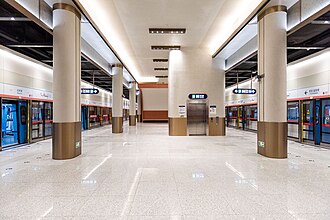 สถานีเป่ยซินอันสาย 11
 สถานีฉางชุนเฉียวสาย12
 สถานีเป่ยหยวนสาย13
 สถานีตงกวนโถวสาย 14
 สถานี Maquanyingของสาย 15
 สถานีกันเจียโข่วสาย 16
 สถานีฟิวเจอร์ไซแอนซ์ซิตี้ของสาย 17
 สถานีสวนซอฟต์แวร์ชางตี้สาย 18
 สถานีหนิวเจี้ยของสาย 19
 สถานีเสี่ยวหงเหมินสายอี้จวง
 สถานีไป่เปินเหยาสายฟางซาน
 สถานีหม่าเจจวงสายเหยียนฟาง
 สถานีชางอันสาย S1
 สถานีหลิวต้าโข่วของสายฉางผิง
 สถานี 3 Hao Hangzhanlou (อาคารผู้โดยสาร 3)ของรถไฟด่วนท่าอากาศยานนานาชาติแคปิตอลเอ็กซ์เพรส
 สถานี Daxing Jichang (สนามบินต้าซิง)ของรถไฟด่วนสนามบินต้าซิง
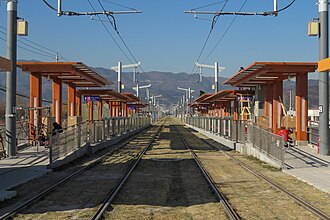 สถานีว่านอัน รถไฟสายซีเจียว
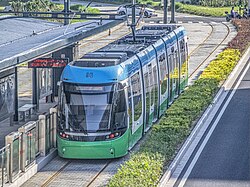 สถานีหรงชางตงเจี๋ยสายอี้จวง T1
การขยายตัวในอนาคต
ระยะที่ 2
ตามแผนการก่อสร้างระยะที่ 2 ที่ได้รับการอนุมัติจากNDRCในปี 2558 ความยาวของรถไฟใต้ดินปักกิ่งจะอยู่ที่998.5 กม. (620.4 ไมล์) [ 40 ]เมื่อการก่อสร้างระยะที่ 2 เสร็จสมบูรณ์[ 40 ]ในเวลานั้น ระบบขนส่งสาธารณะจะคิดเป็น 60% ของการเดินทางทั้งหมด โดยรถไฟใต้ดินจะคิดเป็น 62% [ 40 ]การปรับปรุงแผนการก่อสร้างระยะที่ 2 ได้รับการอนุมัติจากNDRCเมื่อวันที่ 5 ธันวาคม 2562 [ 41 ]ซึ่งได้เปลี่ยนแปลงและขยายโครงการบางส่วนในแผนการก่อสร้างระยะที่ 2 รวมถึงการปรับแนวเส้นทางของสาย 22 และสาย 28 และโครงการเพิ่มเติม เช่น ส่วนต่อขยายทางเหนือของรถไฟด่วนสนามบินต้าซิง ส่วนตะวันตกของสาย 11 และการเปลี่ยนสาย 13 เป็นสองสาย (สาย 18 และ 13 ซึ่งรู้จักกันในชื่อ 13A และ 13B ในระหว่างการก่อสร้าง) [ 42 ]
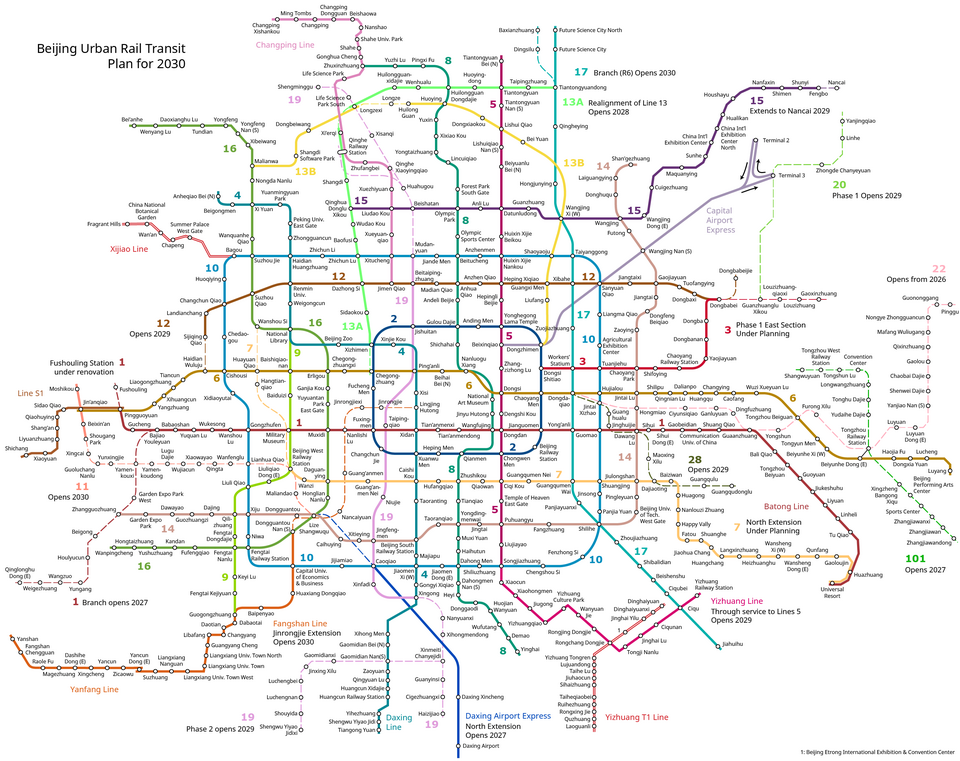
| การขยายธุรกิจในอนาคต (ระยะที่ 2) | ||||||||||
|---|---|---|---|---|---|---|---|---|---|---|
| กำหนดการเปิดทำการ | เส้น | เฟสและส่วน | สถานีขนส่ง( เขต ) | คำอธิบายเส้นทาง | การก่อสร้างตั้งแต่ | ความยาว(กม.) | สถานี | สถานะ | อ้างอิง | |
| 2026 | ปิงกู ( 22 ) | ส่วนเริ่มต้น | หงเมี่ยว ( เฉาหยาง ) | ปิงกู ( ปิงกู ) | 2021 | 78.7 | 20 | ในการทดสอบ | [ 43 ] [ 44 ] | |
| 2027 | 13 | จาก Longzexi ไปยังส่วน Longze | หลงเจ๋อซี ( ฉางผิง ) | หลงเจ๋อ (สร้างใหม่) ( ฉางผิง ) | 2024 | 1.1 | 1 | กำลังก่อสร้าง | ||
| 18 | ส่วนต่อขยายทิศใต้ (ส่วนแยกใหม่ 13A) | ต้าจงซือ ( ไห่เตียน ) | เฉอกงจวง ( ซีเฉิง ) | 2024 [ 45 ] | ยังไม่กำหนด | 3 | ||||
| สนามบินต้าซิง | ส่วนต่อขยายทางทิศเหนือ | ลิเซ่ ซ่างหวู่ฉู่ ( เฟิงไท่ ) | เฉาเฉียว ( เฟิงไท่ ) | 2020 | 3.5 | 1 | [ 46 ] | |||
| 2029 | ปิงกู ( 22 ) | ส่วนท้าย | ตงต้าเฉียว ( เฉาหยาง ) | หงเมี่ยว ( เฉาหยาง ) | 2021 | 4.1 | 2 | [ 43 ] | ||
| 28 (สาย CBD) | กวงฉูตงลู่ ( เฉาหยาง ) | วิ่งผ่านย่านธุรกิจใจกลางเมือง | 2021 [ 47 ] | 8.9 [ 48 ] | 9 | [ 48 ] [ 47 ] | ||||
| ยังไม่กำหนด | 1 | การปรับปรุงสถานีฟูโชวลิง | ผิงกั๋วหยวน ( สือจิ่งซาน ) | ฝูโชวหลิง ( สือจิ่งซาน ) | 2020 | 1.6 | 2 | [ 49 ] | ||
| 3 | ส่วนต่อขยายด้านตะวันออก | ตงปาเป่ย ( เฉาหยาง ) | เกาซินจวง ( เฉาหยาง ) | 2025 | 5.1 | 4 | [ 50 ] | |||
| 12 | ตงปา เป่ยเจี๋ย ( เฉาหยาง ) | 1.3 | 1 | [ 51 ] | ||||||
| ทั้งหมด | 102.7 | 43 | ||||||||
ระยะที่ 3
ตามข้อมูลที่เผยแพร่ในเดือนกรกฎาคม พ.ศ. 2565 "แผนการก่อสร้างรถไฟฟ้ารางเบาปักกิ่ง ระยะที่ 3" ประกอบด้วยโครงการก่อสร้าง 11 โครงการ ได้แก่ สาย 1 สาขา, สาย 7 ระยะที่ 3, สาย 11 ระยะที่ 2, สาย 15 ระยะที่ 2, สาย 17 ระยะที่ 2 (สาขา), สาย 19 ระยะที่ 2, สาย 20ระยะที่ 1, สายฟางซาน (สาย 25)ระยะที่ 3 (หรือที่รู้จักกันในชื่อสายหลี่จิน), สาย M101ระยะที่ 1, สาย S6 (สายเชื่อมเมืองใหม่) ระยะที่ 1 และสายเชื่อมระหว่างสายอี้จวงสาย5และสาย 10 [ 52 ]
| การขยายธุรกิจในอนาคต (ระยะที่ 3) | ||||||||||
|---|---|---|---|---|---|---|---|---|---|---|
| กำหนดการเปิดทำการ | เส้น | เฟสและส่วน | สถานีขนส่ง( เขต ) | คำอธิบายเส้นทาง | การก่อสร้างตั้งแต่ | ความยาว(กม.) | สถานี | สถานะ | อ้างอิง | |
| 2027 | 1 | สายย่อย | สวนสนุกปาเจียว ( สือจิ่งซาน ) | ชิงหลงหูตง( เฟิงไท่ ) | 2024 [ 53 ] | 21 [ 54 ] | 9 | กำลังก่อสร้าง | [ 52 ] | |
| เอ็ม101 | ระยะที่ 1 | ซางหวู่หยวน( ตงโจว ) | จางเจียวานตง( ตงโจว ) | 2024 [ 55 ] | 18.1 | 14 | ||||
| 2029 | 19 | ส่วนต่อขยายทางทิศเหนือ | หมู่ตันหยวน ( ไฮเดียน ) | เซิงหมิงกู่( ฉางผิง ) | 2026 [ 56 ] | 17.6 | 6 | |||
| สาขาเหนือ | ซางชิงเฉียวหนาน( ไห่เตียน ) | สถานีรถไฟชิงเหอ ( ไห่เตียน ) | 2026 [ 56 ] | 6.8 | 1 | |||||
| ยังไม่กำหนด | 15 | ส่วนต่อขยายด้านตะวันออก | เฟิ่งโป ( ซุนยี่ ) | หนานไช่( ซุนยี่ ) | 3.5 | 1 | รอการก่อสร้าง | |||
| 17 | สาขา | เทียนตงหยวนตง ( ฉางผิง ) | เป่ยชีเจีย( ฉางผิง ) | 8.9 | 2 | |||||
| ฟางซาน | ระยะที่ 3 | ตงก่วนโถวหนาน ( เฟิงไท่ ) | หลิงจิง หูถง ( ซีเฉิง ) | 10.9 | 8 | |||||
| 7 | สถานีรถไฟปักกิ่งตะวันตก ( เฟิงไท่ ) | ว่านโชวสี ( ไฮเดียน ) | 6.4 | 4 | ที่ได้รับการอนุมัติ | |||||
| 11 | ระยะที่ 2 | Xinshougang (สวน Shougang) ( ฉือจิ่งซาน ) | ลิเซ่ ซ่างหวู่ฉู่[ 57 ] ( เฟิงไท่ ) | 17.4 [ 57 ] [ 58 ] | 14 [ 58 ] | |||||
| 19 | ส่วนต่อขยายทางใต้ | ซิงกง ( เฟิงไท่ ) | ไห่ซีเจียว( ต้าซิง ) | 12.6 | 6 | |||||
| สาขาใต้ | ฐานอุตสาหกรรมสื่อใหม่ ( ต้าซิง ) | ฐานชีวการแพทย์ตะวันตก( ต้าซิง ) | 17.4 | 7 | ||||||
| 20 | ระยะที่ 1 | กวานจวง หลู่ ซีโข่ว( ซุนยี่ ) | หยานจิงเฉียว( เฉาหยาง ) | 21.3 | 5 | |||||
| S6 ( 21หรือ R6 ) [ 59 ] | อาคารผู้โดยสาร 3 ( ชุนยี่ ) | ต้าซิง ซินเฉิง ( ต้าซิง ) | 64.4 | 9 | ||||||
| อี๋จวง - 5 | การเชื่อมต่อเส้นทาง | เชื่อมต่อเสี่ยวชุนและซงเจียจวง | 1.1 | 0 | ||||||
| ทั้งหมด | 230.4 | 88 | ||||||||
เจ้าของและผู้ดำเนินการ
รถไฟใต้ดินปักกิ่งเป็นของรัฐบาลประชาชนเทศบาลปักกิ่งผ่านทางบริษัท Beijing Infrastructure Investment Co., LTD, (北京市基础设施投资有限公司 หรือ BIIC) ซึ่งเป็นบริษัทในเครือของคณะกรรมการกำกับดูแลและบริหารสินทรัพย์ที่รัฐปักกิ่งเป็นเจ้าของทั้งหมด (北京市人民政府中资产监督管理委员会 หรือ Beijing SASAC) ซึ่งเป็นหน่วยงานการถือครองทรัพย์สินของรัฐบาลเทศบาล
รถไฟใต้ดินปักกิ่งเดิมทีได้รับการพัฒนาและควบคุมโดยรัฐบาลกลางการก่อสร้างและการวางแผนรถไฟใต้ดินอยู่ภายใต้การดูแลของคณะกรรมการพิเศษของสภาแห่งรัฐในเดือนกุมภาพันธ์ พ.ศ. 2513 นายกรัฐมนตรีโจวเอ็นไหลได้มอบการบริหารจัดการรถไฟใต้ดินให้กับกองทัพปลดปล่อยประชาชนซึ่งได้จัดตั้งสำนักงานบริหารรถไฟใต้ดินปักกิ่งของกองวิศวกรรมทางรถไฟกองทัพ ปลดปล่อยประชาชนขึ้น [ 60 ]ในเดือนพฤศจิกายน พ.ศ. 2518 ตามคำสั่งของสภาแห่งรัฐและคณะกรรมการทหารกลางสำนักงานดังกล่าวจึงอยู่ภายใต้การบังคับบัญชาของกรมการขนส่งเทศบาลปักกิ่ง
เมื่อวันที่ 20 เมษายน พ.ศ. 2524 สำนักงานดังกล่าวได้กลายเป็นบริษัทรถไฟใต้ดินปักกิ่ง ซึ่งเป็นบริษัทในเครือของบริษัทขนส่งสาธารณะปักกิ่ง[ 61 ]
ในเดือนกรกฎาคม พ.ศ. 2544 รัฐบาลเทศบาลปักกิ่งได้ปรับโครงสร้างบริษัทรถไฟใต้ดินใหม่เป็นบริษัท Beijing Subway Group Company Ltd. ซึ่งเป็นบริษัทโฮลดิ้งที่เมืองเป็นเจ้าของทั้งหมด และเข้าถือครองทรัพย์สินทั้งหมดของรถไฟใต้ดิน[ 61 ]ในเดือนพฤศจิกายน พ.ศ. 2546 ทรัพย์สินของบริษัท Beijing Subway Group Company ได้ถูกโอนไปยัง BIIC ที่จัดตั้งขึ้นใหม่
รถไฟใต้ดินปักกิ่งมีผู้ให้บริการ 5 ราย:
- ผู้ให้บริการหลักคือบริษัท Beijing Mass Transit Railway Operation Corp. (北京市地铁运营有限公司 หรือ Beijing Subway OpCo) ซึ่งเป็นบริษัทของรัฐทั้งหมด ก่อตั้งขึ้นจากการปรับโครงสร้างองค์กรของบริษัท Beijing Subway Group เดิมในปี 2544 และดำเนินการเดินรถ 15 สาย ได้แก่ สาย 1, 2, 5–10, 13, 15, สาย Batong, สาย Changping, สาย Fangshan, สาย Yizhuang และสาย S1 [ 62 ]
- บริษัทBeijing MTR Corp. (北京京港地铁有限公司 หรือ Beijing MTR) เป็นบริษัทร่วมทุนระหว่างภาครัฐและเอกชน ที่ก่อตั้งขึ้นในปี 2548 โดยBeijing Capital Groupซึ่งเป็นบริษัทของรัฐภายใต้ Beijing SASAC (ถือหุ้น 49%), MTR Corporation of Hong Kong (49%) และ BIIC (2%) [ 63 ]และดำเนินการเดินรถ 5 สาย ได้แก่ สาย4 , 14 , 16 , สาย 17และสายDaxing [ 64 ] [ 65 ]
- Beijing Metro Operation Administration Corp., Ltd. [ 66 ] (北京市轨道交通运营管理有限公司 หรือ BJMOA [ 67 ] ) ซึ่งเป็นบริษัทในเครือของ Beijing Metro Construction Administration Corporation Ltd. (北京市轨道交通建设管理有限公司) ซึ่งอยู่ภายใต้ Beijing SASAC ก็กลายเป็นบริษัทที่สามที่ได้รับสิทธิ์ในการดำเนินการสำหรับรถไฟใต้ดินปักกิ่งในปี 2015 BJMOA ดำเนินการสาย Yanfang , Daxing Airport Expressและสาย 19 [ 68 ] [ 69 ] [ 70 ]บริษัทแม่ BJMCA เป็นผู้รับเหมาทั่วไปในการก่อสร้างรถไฟใต้ดินปักกิ่ง[ 71 ]
- Beijing Public Transit Tramway Co., Ltd. (北京公交有轨电车有限公司) ก่อตั้งขึ้นในปี 2560 เป็นบริษัทในเครือของ Beijing Public Transport Corporation (北京公共交通控股 (集团) 限公司 หรือ BPTC) ที่ ดำเนินการสายXijiao [ 72 ]บริษัทแม่ BPTC เป็นผู้ให้บริการรถโดยสารสาธารณะ หลักของเมือง
- บริษัทBeijing City Metro Ltd. (北京京城地铁有限公司) มีตราสินค้าว่า "Capital Metro" (京城地铁) ในโลโก้อย่างเป็นทางการ[ 73 ]ดำเนินการCapital Airport Express [ 74 ] Beijing City Metro Ltd. เป็นบริษัทร่วมทุนที่ก่อตั้งขึ้นเมื่อวันที่ 15 กุมภาพันธ์ 2016 ระหว่าง Beijing Subway OpCo (51%) และ BII Railway Transportation Technology Holdings Company Limited (49%)(京投轨道交通科技控股有限公司) ซึ่งเป็นบริษัทจดทะเบียนในฮ่องกง (1522.HK) ซึ่งควบคุมโดย BIIC [ 75 ]เมื่อวันที่ 27 มีนาคม 2017 Beijing City Metro Ltd. ได้รับสิทธิ์ 30 ปีในการดำเนินการCapital Airport Expressและส่วนต่างๆ ของสถานีรถไฟใต้ดิน Dongzhimen [ 76 ]
รถไฟ
รถไฟ ใต้ดินทุกขบวนวิ่งบน ราง มาตรฐานขนาด1,435 มิลลิเมตร (56.5 นิ้ว)ยกเว้นรถไฟแม่เหล็กบนสาย S1ซึ่งวิ่งบนรางแม่เหล็ก[ 77 ]รถไฟใต้ดินปักกิ่งให้บริการรถไฟประเภท B ในเกือบทุกสาย อย่างไรก็ตาม เนื่องจากความแออัดที่เพิ่มขึ้นในเครือข่าย จึงมีการใช้รถไฟประเภท A ที่มีความจุสูงมากขึ้น นอกจากนี้ ยังมีการใช้รถไฟประเภท D ในสายรถไฟใต้ดินด่วนอีกด้วย
จนถึงปี 2546 รถไฟเกือบทั้งหมดผลิตโดยบริษัทCRRC Changchun Railway Vehicles Co., Ltd. ซึ่งปัจจุบัน เป็นส่วนหนึ่งของCRRC [ 78 ] รถไฟ สาย 1 รุ่นใหม่ล่าสุด และรถไฟสาย 4, 8, Batong, Changping และ Daxing ผลิตโดยบริษัท CRRC Qingdao Sifang Co., Ltd. [ 79 ] [ 80 ]รถไฟแม่เหล็กของสาย S1 ผลิตโดยบริษัท CRRC Tangshan
บริษัทปักกิ่ง ซับเวย์ โรลลิ่ง สต็อก อีควิปเมนต์ จำกัดซึ่งเป็นบริษัทย่อยที่ถือหุ้นทั้งหมดของบริษัท ปักกิ่ง แมส ทรานสิต เรลเวย์ โอเปอเรชั่น จำกัดให้บริการประกอบ บำรุงรักษา และซ่อมแซมในพื้นที่
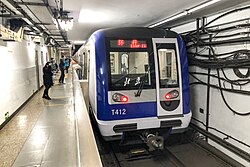
 รถไฟใต้ดินปักกิ่งส่วนใหญ่เช่น รถไฟสาย 13 รุ่น DKZ5 คันนี้ วิ่งบนรางมาตรฐาน ขนาด 1,435 มิลลิเมตร (56.5 นิ้ว) โดยใช้ ไฟฟ้ากระแสตรง 750 โวลต์ จาก รางที่สามสาย 13 เช่นเดียวกับสายอื่นๆ ส่วนใหญ่ ใช้ขบวนรถไฟแบบ Type-B จำนวน 6 ตู้
 รถไฟสาย 14 และ 16 วิ่งบนรางมาตรฐานและใช้ไฟฟ้ากระแสตรง 1500 โวลต์จากสายไฟฟ้าเหนือศีรษะรถไฟรุ่น DKZ53 สาย 14 ที่เห็นในภาพด้านบนใช้ตู้โดยสารแบบ Type-A ซึ่งแตกต่างจากตู้โดยสารแบบ Type-B ที่พบได้ทั่วไป โดยมีความยาวกว่า 3.1 เมตร และกว้างกว่า 20 เซนติเมตร มีประตู 10 ชุดแทนที่จะเป็น 8 ชุด มีความจุผู้โดยสารมากกว่า และมีความเร็วสูงสุดสูงกว่า
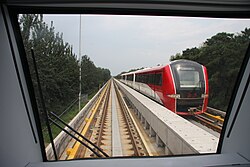 รถไฟCapital Airport Express ซึ่งแต่ละขบวน มี 4 โบกี้ ใช้ มอเตอร์เชิงเส้นแทนมอเตอร์แบบโรตารี่รถไฟ Capital Airport Express ใช้ไฟ DC 750 โวลต์จากรางที่สาม และขับเคลื่อนโดยใช้แถบอะลูมิเนียม ซึ่งเป็น "รางที่สี่" ระหว่างรางหลัก รถไฟ Capital Airport Express มีน้ำหนักเบากว่ารถไฟใต้ดินที่ใช้มอเตอร์แบบโรตารี่ และสามารถทำความเร็วสูงสุดได้ถึง 110 กิโลเมตรต่อชั่วโมง (68 ไมล์ต่อชั่วโมง)
 รถไฟ สาย S1 เป็นรถไฟ แม่เหล็กความเร็วต่ำถึงปานกลางที่วิ่งบนรางแม่เหล็กและใช้พลังงานไฟฟ้ากระแสตรง 1,500 โวลต์ รถไฟแม่เหล็กสาย S1 มี 6 โบกี้ต่อขบวน และทำความเร็วสูงสุดได้ 100 กิโลเมตรต่อชั่วโมง (62 ไมล์ต่อชั่วโมง)
 รถรางระบบรางเบาบนสายซีเจียว (ชานเมืองตะวันตก)วิ่งบนรางมาตรฐานและใช้ ไฟฟ้า กระแสสลับ (AC) 750 โวลต์จากสายส่งเหนือศีรษะ สายซีเจียวใช้รถรางห้าตู้และทำความเร็วสูงสุดได้ 70 กิโลเมตรต่อชั่วโมง (43 ไมล์ต่อชั่วโมง)
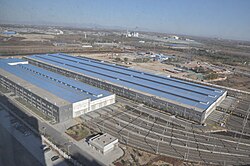
สายการผลิตอัตโนมัติ
มี สายรถไฟ อัตโนมัติ เต็มรูปแบบ 6 สายในระดับGoA4ได้แก่สาย Yanfangสาย 17สาย19รถไฟด่วนสนามบิน Daxingสาย3และสาย 12โดยใช้ระบบควบคุมรถไฟแบบสื่อสาร ที่พัฒนาขึ้นภายในประเทศ [ 81 ]
ประวัติศาสตร์

พ.ศ. 2496–2508: จุดเริ่มต้น
รถไฟใต้ดินได้รับการเสนอในเดือนกันยายน พ.ศ. 2496 โดยคณะกรรมการวางแผนของเมืองและผู้เชี่ยวชาญจากสหภาพโซเวียตหลังจากสิ้นสุดสงครามเกาหลีผู้นำจีนได้หันมาให้ความสนใจกับการฟื้นฟูประเทศ พวกเขาต้องการขยายขีดความสามารถด้านการขนส่งมวลชนของปักกิ่ง แต่ก็ให้ความสำคัญกับรถไฟใต้ดินในฐานะที่เป็นสินทรัพย์สำหรับการป้องกันพลเรือน พวกเขาศึกษาการใช้รถไฟใต้ดินมอสโกเพื่อปกป้องพลเรือน เคลื่อนย้ายกองกำลัง และตั้งกองบัญชาการทหารในช่วงยุทธการมอสโกและวางแผนรถไฟใต้ดินปักกิ่งเพื่อการใช้งานทั้งพลเรือนและทางทหาร[ 82 ]
ในเวลานั้น ชาวจีนขาดความเชี่ยวชาญในการสร้างรถไฟใต้ดินและต้องพึ่งพาความช่วยเหลือทางเทคนิคจากสหภาพโซเวียตและเยอรมนีตะวันออก อย่างมาก ในปี 1954 คณะวิศวกรชาวโซเวียต ซึ่งรวมถึงบางคนที่สร้างรถไฟใต้ดินมอสโก ได้รับเชิญให้วางแผนรถไฟใต้ดินในปักกิ่ง ตั้งแต่ปี 1953 ถึง 1960 นักศึกษามหาวิทยาลัยชาวจีนหลายพันคนถูกส่งไปยังสหภาพโซเวียตเพื่อศึกษาการก่อสร้างรถไฟใต้ดิน แผนเบื้องต้นที่เปิดเผยในปี 1957 เรียกร้องให้มีเส้นทางวงแหวนหนึ่งเส้นและสายอื่นๆ อีกหกสาย โดยมีสถานี 114 แห่งและรางยาว172 กิโลเมตร (107 ไมล์) [ 82 ]มีสองเส้นทางที่แข่งขันกันเพื่อสร้างเป็นเส้นทางแรก เส้นทางหนึ่งวิ่งจากตะวันออกไปตะวันตกจาก Wukesong ไปยัง Hongmiao ใต้ถนน Changan อีกเส้นทางหนึ่งวิ่งจากเหนือไปใต้จากพระราชวังฤดูร้อนไปยังสวน Zhongshanผ่าน Xizhimen และ Xisi เส้นทางแรกถูกเลือกเนื่องจากมีฐานทางธรณีวิทยาที่เอื้ออำนวยกว่าและมีหน่วยงานราชการที่ให้บริการมากกว่า เส้นทางที่สองจะไม่ถูกสร้างขึ้นจนกระทั่งการก่อสร้างสาย4 เริ่มขึ้นในอีกสี่สิบปีต่อมา
ข้อเสนอเดิมเรียกร้องให้มีการขุดอุโมงค์รถไฟใต้ดินลึกเพื่อรองรับการใช้งานทางทหารได้ดียิ่งขึ้น ระหว่าง กง จูเฟินและมู่ซีตี้มีการขุดอุโมงค์ลึกถึง120 เมตร (390 ฟุต) สถานีรถไฟใต้ดินที่ลึกที่สุดในโลกในขณะนั้นคือสถานีรถไฟใต้ดินเคียฟซึ่งมีความลึกเพียง100 เมตร (330 ฟุต)แต่เนื่องจากระดับน้ำใต้ดิน สูงและ แรงดัน น้ำใต้ดิน สูง ในปักกิ่ง ซึ่งทำให้การก่อสร้างซับซ้อนและมีความเสี่ยงต่อการรั่วไหล ประกอบกับความไม่สะดวกในการขนส่งผู้โดยสารเป็นระยะทางไกลจากผิวดิน ทำให้ทางการต้องยกเลิกแผนอุโมงค์ลึกในเดือนพฤษภาคม พ.ศ. 2503 และหันมาใช้ อุโมงค์ตื้น แบบขุดและกลบที่มีความลึกประมาณ20 เมตร (66 ฟุต)ใต้ผิวดินแทน[ 83 ]
ความสัมพันธ์ที่เสื่อมถอยระหว่างจีนและสหภาพโซเวียตทำให้การวางแผนรถไฟใต้ดินหยุดชะงัก ผู้เชี่ยวชาญชาวโซเวียตเริ่มทยอยออกจากประเทศในปี 1960 และถอนตัวออกไปทั้งหมดในปี 1963 [ 84 ]ในปี 1961 โครงการทั้งหมดถูกระงับชั่วคราวเนื่องจากความยากลำบากอย่างมากที่เกิดจากนโยบายก้าวกระโดดครั้งใหญ่ในที่สุดงานวางแผนก็กลับมาดำเนินการต่อ เส้นทางของสายแรกถูกเลื่อนไปทางทิศตะวันตกเพื่อสร้างทางลอดใต้ดินสำหรับขนส่งบุคลากรจากใจกลางเมืองหลวงไปยังเนินเขาทางตะวันตก เมื่อวันที่ 4 กุมภาพันธ์ 1965 ประธานเหมาเจ๋อตุงได้อนุมัติโครงการนี้ด้วยตนเอง[ 85 ]
ปี 1965–1981: จุดเริ่มต้นที่ค่อยเป็นค่อยไป
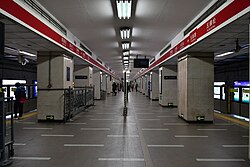
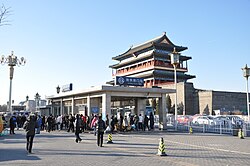
การก่อสร้างเริ่มขึ้นเมื่อวันที่ 1 กรกฎาคม พ.ศ. 2508 ใน พิธี วางศิลาฤกษ์ซึ่งมีผู้นำระดับชาติหลายคนเข้าร่วม รวมถึงจูเต๋อเติ้งเสี่ยวผิงและนายกเทศมนตรีปักกิ่งเผิงเจิ้น[ 86 ]ผลลัพธ์ที่เป็นข้อถกเถียงมากที่สุดของเส้นทางรถไฟใต้ดินสายแรกคือการรื้อกำแพงเมืองชั้นใน อันเก่าแก่ของปักกิ่ง เพื่อสร้างทางรถไฟใต้ดิน แผนการก่อสร้างรถไฟใต้ดินจากฟู่ซิงเหมินไปยังสถานีรถไฟปักกิ่งเรียกร้องให้รื้อกำแพงเมือง รวมถึงประตูและหอคอยยิงธนูที่เหอผิงเหมิน เฉียนเหมิน และฉงเหวินเหมิน สถาปนิกชั้นนำเหลียงซีเฉิงโต้แย้งให้ปกป้องกำแพงเมืองในฐานะที่เป็นแลนด์มาร์คของเมืองหลวงโบราณ ประธานเหมาเจ๋อตุงสนับสนุนการรื้อกำแพงเมืองมากกว่าการรื้อบ้านเรือน ในที่สุด นายกรัฐมนตรีโจวเอ็นไหลก็สามารถอนุรักษ์กำแพงและประตูหลายแห่งไว้ได้ เช่น ประตูเฉียนเหมินและหอคอยยิงธนู โดยการปรับเปลี่ยนเส้นทางของรถไฟใต้ดินเล็กน้อย[ 87 ]


เส้นทางแรกสร้างเสร็จและเริ่มทดลองให้บริการทันเวลาเพื่อฉลองครบรอบ 20 ปีแห่งการก่อตั้งสาธารณรัฐประชาชน จีน ในวันที่ 1 ตุลาคม พ.ศ. 2512 [ 85 ] [ 88 ]เส้นทางนี้มีความยาว21 กิโลเมตร (13 ไมล์)จากกู่เฉิงไปยังสถานีรถไฟปักกิ่งและมีสถานีทั้งหมด 16 สถานี[ 85 ]เส้นทางนี้เป็นส่วนหนึ่งของสาย 1 และ 2 ในปัจจุบันนับเป็นรถไฟใต้ดินสายแรกที่สร้างขึ้นในประเทศจีน และมีมาก่อนรถไฟใต้ดินของฮ่องกงโซลสิงคโปร์ซานฟรานซิสโกและวอชิงตันดี.ซี.แต่โครงการนี้ประสบปัญหาทางเทคนิคตลอดทศวรรษถัดมา

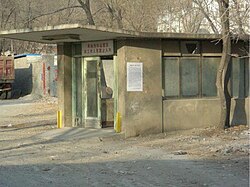

ในตอนแรก รถไฟใต้ดินเปิดให้แขกเข้าชม เมื่อวันที่ 11 พฤศจิกายน พ.ศ. 2512 เกิดเหตุเพลิงไหม้จากไฟฟ้า ทำให้มีผู้เสียชีวิต 3 ราย บาดเจ็บกว่า 100 ราย และรถไฟเสียหาย 2 คัน นายกรัฐมนตรีโจวเอ็นไหล ได้มอบรถไฟใต้ดินให้ กองทัพปลดปล่อยประชาชนควบคุมดูแลในช่วงต้นปี พ.ศ. 2513 แต่ปัญหาเรื่องความน่าเชื่อถือยังคงมีอยู่[ 85 ]
เมื่อวันที่ 15 มกราคม 1971 เส้นทางรถไฟสายแรกเริ่มเปิดให้บริการในระยะทดลองระหว่างสถานีรถไฟปักกิ่งและกงจูเฟินค่าโดยสารเที่ยวเดียวอยู่ที่ 0.10 หยวนและเฉพาะประชาชนที่มีหนังสือรับรองจากหน่วยงานที่ทำงานเท่านั้นจึงจะสามารถซื้อตั๋วได้ เส้นทางมี ความยาว 10.7 กิโลเมตร (6.6 ไมล์)มี 10 สถานี และให้บริการมากกว่า 60 เที่ยวต่อวัน โดยมีเวลารอขั้นต่ำ 14 นาที เมื่อวันที่ 15 สิงหาคม เส้นทางสายแรกได้ขยายไปยังถนนหยูฉวนและมี 13 สถานี ครอบคลุมระยะ ทาง 15.6 กิโลเมตร (9.7 ไมล์)เมื่อวันที่ 7 พฤศจิกายน เส้นทางได้ขยายอีกครั้งไปยังถนนกู่เฉิง และมี 16 สถานี ครอบคลุมระยะทาง22.87 กิโลเมตร (14.21 ไมล์)จำนวนขบวนรถไฟต่อวันเพิ่มขึ้นเป็น 100 เที่ยว โดยรวมแล้ว เส้นทางนี้ให้บริการผู้โดยสาร 8.28 ล้านคนในปี 1971 เฉลี่ย 28,000 คนต่อวัน[ 89 ]
ตั้งแต่ปี พ.ศ. 2514 ถึง พ.ศ. 2518 รถไฟใต้ดินถูกปิดให้บริการเป็นเวลา 398 วันด้วยเหตุผลทางการเมือง[ g ]เมื่อวันที่ 27 ธันวาคม พ.ศ. 2515 ผู้โดยสารไม่จำเป็นต้องแสดงจดหมายรับรองเพื่อซื้อตั๋วอีกต่อไป ในปี พ.ศ. 2515 รถไฟใต้ดินให้บริการผู้โดยสาร 15 ล้านเที่ยว โดยเฉลี่ย 41,000 คนต่อวัน ในปี พ.ศ. 2516 เส้นทางรถไฟใต้ดินได้ขยายไปยังผิงกั่วหยวนและมีความ ยาว 23.6 กิโลเมตร (14.7 ไมล์)มี 17 สถานี และมีรถไฟวิ่ง 132 เที่ยวต่อวัน เส้นทางรถไฟใต้ดินให้บริการผู้โดยสาร 11 ล้านเที่ยวในปี พ.ศ. 2516 โดยเฉลี่ย 54,000 คนต่อวัน[ 89 ]
แม้ว่าจะกลับมาอยู่ภายใต้การควบคุมของพลเรือนในปี 1976 รถไฟใต้ดินก็ยังคงมีแนวโน้มที่จะปิดให้บริการเนื่องจากเหตุไฟไหม้ น้ำท่วม และอุบัติเหตุ จำนวนผู้โดยสารรายปีเพิ่มขึ้นจาก 22.2 ล้านคนในปี 1976 และ 28.4 ล้านคนในปี 1977 เป็น 30.9 ล้านคนในปี 1978 และ 55.2 ล้านคนในปี 1980 [ 89 ]
ปี 1981–2000: สองสายสำหรับสองทศวรรษ
เมื่อวันที่ 20 เมษายน พ.ศ. 2524 บริษัทรถไฟใต้ดินปักกิ่งซึ่งในขณะนั้นเป็นบริษัทในเครือของบริษัทขนส่งสาธารณะปักกิ่ง ได้ถูกจัดตั้งขึ้นเพื่อรับช่วงการดำเนินงานรถไฟใต้ดิน เมื่อวันที่ 15 กันยายน พ.ศ. 2524 เส้นทางแรกผ่านการตรวจสอบขั้นสุดท้าย และถูกส่งมอบให้กับบริษัทรถไฟใต้ดินปักกิ่ง ซึ่งเป็นการสิ้นสุดการทดลองใช้งานเป็นเวลาหนึ่งทศวรรษ เส้นทางนี้มี 19 สถานี และวิ่งเป็นระยะทาง27.6 กิโลเมตร (17.1 ไมล์)จากฟู่โชวหลิงในเทือกเขาตะวันตกไปยังสถานีรถไฟปักกิ่ง การลงทุนในโครงการนี้มีมูลค่ารวม 706 ล้านหยวน จำนวนผู้โดยสารต่อปีเพิ่มขึ้นจาก 64.7 ล้านคนในปี พ.ศ. 2524 และ 72.5 ล้านคนในปี พ.ศ. 2525 เป็น 82 ล้านคนในปี พ.ศ. 2526 [ 91 ]
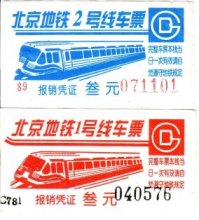
เมื่อวันที่ 20 กันยายน พ.ศ. 2527 ได้มีการเปิดเส้นทางที่สองให้บริการแก่ประชาชน เส้นทางรูปเกือกม้านี้สร้างขึ้นจากครึ่งตะวันออกของเส้นทางเดิมและตรงกับครึ่งใต้ของเส้นทางสาย 2 ในปัจจุบัน โดยวิ่งเป็นระยะ ทาง 16.1 กิโลเมตร (10.0 ไมล์)จากฟู่ซิงเหมินไปยังเจียนกัวเหมินมีสถานีทั้งหมด 16 สถานี[ 91 ]จำนวนผู้โดยสารสูงถึง 105 ล้านคนในปี พ.ศ. 2528 [ 91 ]
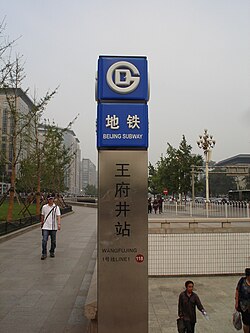
เมื่อวันที่ 28 ธันวาคม พ.ศ. 2530 เส้นทางรถไฟใต้ดินสองสายที่มีอยู่เดิมได้รับการปรับปรุงใหม่เป็นสาย ที่ 1 ซึ่งวิ่งจากผิงกั่วหยวนไปยังฟู่ซิงเหมิน และสายที่ 2 ซึ่งเป็นเส้นทางวนรอบ กำแพงเมือง หมิง ในปัจจุบัน ค่าโดยสารเพิ่มขึ้นเป็นสองเท่าเป็น 0.20 หยวนสำหรับการเดินทางสายเดียว และ 0.30 หยวนสำหรับการเดินทางที่ต้องเปลี่ยนสาย จำนวนผู้โดยสารสูงถึง 307 ล้านคนในปี พ.ศ. 2531 รถไฟใต้ดินปิดให้บริการตั้งแต่วันที่ 3-4 มิถุนายน พ.ศ. 2532 ระหว่างการปราบปรามการประท้วงที่จัตุรัสเทียนอันเหมินในปี พ.ศ. 2533 รถไฟใต้ดินมีผู้โดยสารมากกว่าหนึ่งล้านคนต่อวันเป็นครั้งแรก โดยจำนวนผู้โดยสารรวมสูงถึง 381 ล้านคน[ 91 ]หลังจากปรับขึ้นค่าโดยสารเป็น 0.50 หยวนในปี พ.ศ. 2534 จำนวนผู้โดยสารรายปีลดลงเล็กน้อยเหลือ 371 ล้านคน
เมื่อวันที่ 26 มกราคม พ.ศ. 2534 การวางแผนขยายเส้นทางรถไฟฟ้าสาย 1 ไปทางทิศตะวันออกใต้ถนนฉางอานจากฟู่ซิงเหมินได้เริ่มต้นขึ้น โครงการนี้ได้รับเงินทุนสนับสนุนจากเงินกู้เพื่อการพัฒนาดอกเบี้ยต่ำจำนวน 19.2 พันล้าน เยนจากประเทศญี่ปุ่น การก่อสร้างส่วนขยายไปทางทิศตะวันออกเริ่มต้นขึ้นเมื่อวันที่24 มิถุนายน พ.ศ. 2535 และสถานีซีตานเปิดให้บริการเมื่อวันที่ 12 ธันวาคม พ.ศ. 2535 [ 92 ]ส่วนขยายที่เหลือไปยังซีฮุยตงเสร็จสมบูรณ์เมื่อวันที่ 28 กันยายน พ.ศ. 2542 ผู้นำระดับชาติ อย่างเห วินเจียเป่า เจีย ชิง หลิน หยู เจิ้งเซิงและนายกเทศมนตรีหลิว ฉีได้เข้าร่วมในพิธีดังกล่าว[ 93 ]รถไฟฟ้าสาย 1 เปิดให้บริการเต็มรูปแบบเมื่อ วันที่ 28 มิถุนายน พ.ศ. 2543 [ 94 ]
แม้ว่าจะมีการขยายเส้นทางรถไฟเพียงเล็กน้อยในช่วงต้นทศวรรษ 1990 แต่จำนวนผู้โดยสารก็เพิ่มขึ้นอย่างรวดเร็วจนถึงระดับสูงสุดเป็นประวัติการณ์ที่ 558 ล้านคนในปี 1995 แต่ลดลงเหลือ 444 ล้านคนในปีถัดมาเมื่อค่าโดยสารเพิ่มขึ้นจาก 0.50 เยนเป็น 2.00 เยน หลังจากที่ค่าโดยสารเพิ่มขึ้นอีกครั้งเป็น 3.00 เยนในปี 2000 จำนวนผู้โดยสารรายปีก็ลดลงเหลือ 434 ล้านคนจาก 481 ล้านคนในปี 1999 [ 94 ]
ปี 2001–2008: การวางแผนสำหรับการแข่งขันกีฬาโอลิมปิก
ในช่วงฤดูร้อนของปี 2001 เมืองนี้ชนะการประมูลเพื่อเป็นเจ้าภาพจัดการแข่งขันกีฬาโอลิมปิกฤดูร้อนปี 2008และเร่งแผนการขยายรถไฟใต้ดิน ตั้งแต่ปี 2002 ถึง 2008 เมืองนี้วางแผนที่จะลงทุน 63.8 พันล้านเยน (7.69 พันล้านดอลลาร์สหรัฐ) ในโครงการรถไฟใต้ดินและสร้างเครือข่ายรถไฟใต้ดินที่ทะเยอทะยาน แผนดังกล่าวเรียกว่า "วงแหวนสามวง แนวราบสี่เส้น แนวตั้งห้าเส้น และแนวรัศมีเจ็ดเส้น" ในปี 2007 ประกอบด้วย 19 สาย: [ 95 ] [ 96 ]
- เส้นวงแหวนสามเส้น: 2 , 10และ13
- เส้นแนวนอนสี่เส้น: 1 , 6 , 7 , 14 (ทิศตะวันตก)
- เส้นแนวตั้งห้าเส้น: 4 , 5 , 8 , 9 , 14 (ทิศตะวันออก)
- เส้นรัศมีเจ็ดเส้น: Batong , Changping , Daxing , Fangshan , Shunyi (สาย 15) , Yizhuang , สาย S1
งานก่อสร้างสาย 5 ได้เริ่มขึ้นแล้วเมื่อวันที่ 25 กันยายน พ.ศ. 2543 [ 97 ]การเคลียร์พื้นที่สำหรับสาย 4 และ 10 เริ่มขึ้นในเดือนพฤศจิกายน พ.ศ. 2546 และการก่อสร้างเริ่มขึ้นภายในสิ้นปี[ 98 ]โครงการก่อสร้างรถไฟใต้ดินใหม่ส่วนใหญ่ได้รับเงินทุนจากเงินกู้จาก ธนาคารของรัฐ ขนาดใหญ่สี่แห่งสาย 4 ได้รับเงินทุนจากบริษัท Beijing MTR Corporation ซึ่งเป็นการร่วมทุนกับHong Kong MTR [ 99 ] เพื่อให้บรรลุแผนสำหรับ 19 สายและ561 กม. (349 ไมล์)ภายในปี พ.ศ. 2558 เมืองวางแผนที่จะลงทุนทั้งหมด 200 พันล้านหยวน (29.2 พันล้านดอลลาร์สหรัฐ) [ 100 ]

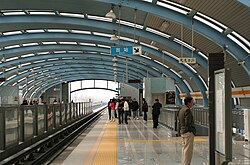 สถานีหลงเจ๋อ สาย 13 เปิดให้บริการสองช่วง ในปี 2545 และ 2546
 รถไฟจำลอง รุ่น SFX01 สายบาตงที่สถานีซวงเฉียวสายบาตงเปิดให้บริการในเดือนธันวาคม พ.ศ. 2546
The next additions to the subway were surface commuter lines that linked to the north and east of the city. Line 13, a half loop that links the northern suburbs, first opened on the western half from Huilongguan to Xizhimen on September 28, 2002 and the entire line became operational on January 28, 2003.[101]Batong line, built as an extension to Line 1 to Tongzhou District, was opened as a separate line on December 27, 2003.[102] Work on these two lines had begun respectively in December 1999 and 2000.[103] Ridership hit 607 million in 2004.
Line 5 came into operation on October 7, 2007. It was the city's first north–south line, extending from Songjiazhuang in the south to Tiantongyuan in the north. On the same day, subway fares were reduced from between ¥3 and ¥7 per trip, depending on the line and number of transfers, to a single flat fare of ¥2 with unlimited transfers. The lower fare policy caused the Beijing Subway to run a deficit of ¥600 million in 2007, which was expected to widen to ¥1 billion in 2008.[100] The Beijing municipal government covered these deficits to encourage mass transit use, and reduce traffic congestion and air pollution. On a total of 655 million rides delivered in 2007, the government's subsidy averaged ¥0.92 per ride.[104]
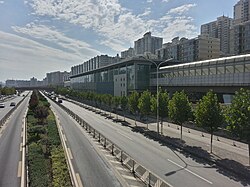 Elevated Line 5 station and platform at Tiantongyuan. Line 5 opened on Oct. 7, 2007.
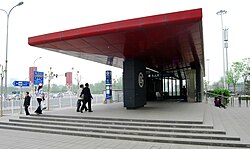 Beitucheng station for Lines 8 and 10, which along with the Capital Airport Express, opened on July 19, 2008.
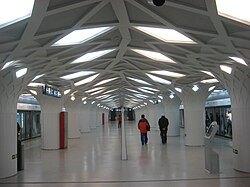 Each of the four original stations on the Olympic Branch Line (Line 8) has a unique interior decor style. (Pictured: Forest Park South Gate)
As part of the urban re-development for the 2008 Olympics, the subway system was significantly expanded.[105]:137In the summer of 2008, in anticipation of the Summer Olympic Games, three new lines—Line 10 (Phase 1), Line 8 (Phase 1) and the Capital Airport Express—opened on July 19.[106] The use of paper tickets, hand checked by clerks for 38 years, was discontinued and replaced by electronic tickets that are scanned by automatic fare collection machines upon entry and exit of the subway. Stations are outfitted with touch screen vending machines that sell single-ride tickets and multiple-ride Yikatong fare cards. The subway operated throughout the night from August 8–9, 2008 to accommodate the Opening Ceremonies of the Olympic Games, and is extending evening operations of all lines by one to three hours (to 1-2 a.m.) through the duration of the Games.[107] The subway set a daily ridership record of 4.92 million on August 22, 2008, the day of the Games' closing ceremony.[108] In 2008, total ridership rose by 75% to 1.2 billion.[109]
2008–2015: rapid expansion
After the Chinese government announced a ¥4 trillion economic stimulus package in November 2008, the Beijing urban planning commission further expedited subway building plans, especially for elevated lines to suburban districts that are cheaper to build. In December 2008, the commission moved completion dates of the Yizhuang and Daxing Lines to 2010 from 2012, finalized the route of the Fangshan Line, and unveiled the Changping and Xijiao Lines.[110]
 All stations built since 2007 have platform doors, including the Weigongcun station on Line 4, which opened September 28, 2009.
 Entrance D to Xisi station on Line 4. Each station entrance has an entrance label
 Tracks north of Xihongmen Station on the Daxing Line
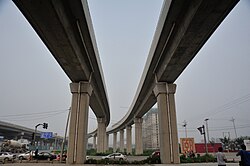 Elevated viaduct on the Fangshan Line
Line 4 started operation on September 28, 2009, bringing subway service to much of western Beijing.[111] It is managed by the MTR Corporation through a joint venture with the city. In 2009, the subway delivered 1.457 billion rides,[112] 19.24% of mass transit trips in Beijing.[113]
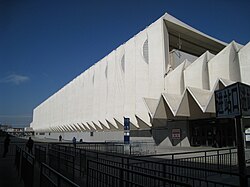 The Xi'erqi interchange for Lines 13 and Changping
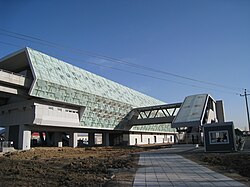 Shahe station on the Changping line
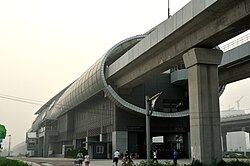 Changyang station on the Fangshan line
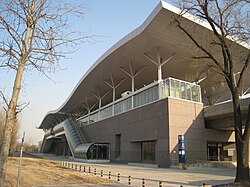 Yizhuang Culture Park station on the Yizhuang Line
In 2010, Beijing's worsening traffic congestion prompted city planners to move the construction of several lines from the 13th Five Year Plan to the 12th Five Year Plan. This meant Lines 8 (Phase III), Line 3, Line 12, Line 16, the Yanfang line, as well as additional lines to Changping District and Tiantongyuan were to begin construction before 2015.[114] Previously, Lines 3, 12 and 16 were being planned for the more distant future.[115][116] On December 30, 2010, five suburban lines: Lines 15 (Phase I from Wangjingxi to Houshayu except Wangjing East station), Changping, Fangshan (except Guogongzhuang station), Yizhuang (except Yizhuang railway station), and Daxing, commenced operation.[117] The addition of 108 km (67 mi) of track, a nearly 50% increase, made the subway the fourth longest metro in the world. One year later, on December 31, 2011, the subway surpassed the New York City Subway to become the third longest metro in revenue track length with the extension of Line 8 north from the Forest Park South Gate to Huilongguan Dongdajie, the opening of Line 9 in southwest Beijing from Beijing West railway station to Guogongzhuang (except Fengtai Dongdajie, which opened on October 12, 2012), the extension of the Fangshan Line to Guogongzhuang, and the extension of Line 15 from Houshayu to Fengbo in central Shunyi.[118] In the same year, the Beijing government unveiled an ambitious expansion plan envisioning the subway network to reach a track density of 0.51 km per km2 (0.82 mi per sq. mi.) inside the Fifth Ring Road where residents would on average have to walk 1 km (0.62 mi) to the nearest subway station.[119] Ridership reached 2.18 billion in 2011.
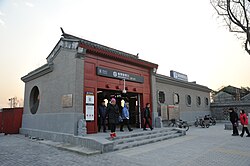 Nanluoguxiang station on Line 6 blends into the traditional courtyard neighborhood of central Beijing.
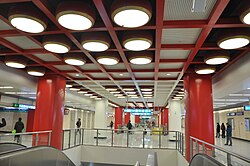 Line 8's concourse in Guloudajie station with drum-shaped lights inspired by nearby Drum Tower.
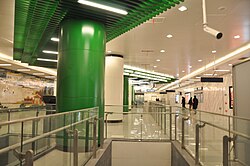 Interior décor of Beihai North station evokes the white stupa of Beihai Park.
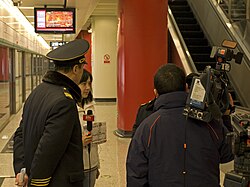
In February 2012, the city government confirmed that Lines Line 3, Line 12, Line 17, and Line 19 were under planning as part of Phase II expansion.[120] Retroactively implying that the original three ring, four horizontal, five vertical and seven radial plan was part of Phase I expansion. Line 17 was planned to run north–south, parallel and to the east of Line 5, from Future Science Park North to Yizhuang Zhanqianqu South.[121] Line 19 was planned to run north–south, from Mudanyuan to Xingong.[122]

On December 30, 2012, Line 6 (Phase I from Haidian Wuluju to Caofang), the extension of Line 8 from Beitucheng south to Gulou Dajie (except Andeli Beijie), the remainder of Line 9 (except Military Museum station) and the remainder of the Line 10 loop (except the Xiju-Shoujingmao section and Jiaomen East station) entered service. The addition of 69.8 km (43 mi) of track increased the network length to 442 km (275 mi) and allowed the subway to overtake the Shanghai Metro, for several months, as the world's longest metro.[123] The subway delivered 2.46 billion rides in 2012.[124]
On May 5, 2013, the Line 10 loop was completed with the opening of the Xiju-Shoujingmao section and the Jiaomen East Station.[125] The 57 km (35 mi) loop line became the longest underground subway loop in the world.[125] On the same day, the first section of Line 14 from Zhangguozhuang to Xiju also entered operation, ahead of the opening of the Ninth China International Garden Expo in Fengtai District.[125] The subway's total length reached 456 km (283 mi).[125] On December 28, 2013, two sections were added to Line 8, which extended the line north to Zhuxinzhuang and south to Nanluoguxiang.[126] In 2013, the subway delivered 3.209 billion rides, an increase of 30% from the year before.[127]
On December 28, 2014, the subway network expanded by 62.2 km (38.6 mi) to 18 lines and 527 km (327 mi) with the opening of Line 7, the eastern extension of line 6 (from Caofang to Lucheng), the eastern section of line 14 (from Jintai Lu to Shangezhuang), and the western extension of line 15 (from Wangjingxi to Qinghua Donglu Xikou).[128][129] At the same time, the ¥2 flat-rate fare was replaced with a variable-rate fare (a minimum of ¥3), to cover operation costs.[130] In 2014, the subway delivered 3.387 billion rides, an increase of 5.68% from the year before.[131] Average daily and weekday ridership also set new highs of 9.2786 million and 10.0876 million, respectively.[132]
From 2007 to 2014, the cost of subway construction in Beijing rose sharply from ¥0.571 billion per km to ¥1.007 billion per km.[133][134] The cost includes land acquisition, compensation to relocate residents and firms, actual construction costs and equipment purchase. In 2014, city budgeted ¥15.5 billion for subway construction, and the remainder of subway building costs was financed by the Beijing Infrastructure Investment Co. LTD, a city-owned investment firm.[133]
In 2014, Beijing planning authorities assessed mass transit monorail lines for areas of the city in which subway construction or operation is difficult.[135] Straddle beam monorail trains have lower transport capacity and operating speed (60 km/h or 37 mph) than conventional subways, but are quieter to operate, have smaller turning radius and better climbing capability, and cost only one-third to one-half of subways to build.[135][136] According to the initial environmental assessment report by the Chinese Academy of Rail Sciences, the Yuquanlu Line was planned to have 21 stations over 25 km (16 mi) in western Beijing.[137] The line was to begin construction in 2014 and would take two years to complete.[135] The Dongsihuan Line (named for the Eastern Fourth Ring Road it was to follow) was planned to have 21 stations over 33.7 km (20.9 mi).[138][136]
In early 2015, plans for both monorail lines were shelved indefinitely, due to low capacity and resident opposition.[139] The Yuquanlu Line remains on the city's future transportation plan, and it will be built as a conventional underground subway line. The Dongsihuan Line was replaced by the East extension of Line 7.[140]
On December 26, 2015, the subway network expanded to 554 km (344 mi) with the opening of the section of Line 14 from Beijing South railway station to Jintai Lu (11 stations; 16.6 km (10.3 mi)), Phase II of the Changping line from Nanshao to Changping Xishankou (5 stations; 10.6 km or 6.6 mi), Andelibeijie station on Line 8, and Datunlu East station on Line 15.[141] Ridership in 2015 fell by 4% to 3.25 billion due to a fare increase from a flat fare back to a distance based fare.[131]
 Line 8 construction site at Yongdingmenwai in March 2018, next to Beijing's central north-south axis.
 Enclosed construction site of Line 3 at Dongsishitiao along the 2nd Ring Road in December 2017.
 Viaduct of the S1 Line near Shichang under construction in March 2017.
 West Gate of Summer Palace on the Xijiao light rail line under construction in May 2017.
2015–present: Phase II projects
With the near completion of the three ring, four horizontal, five vertical and seven radial subway network, work began on Phase II expansion projects. These new extensions and lines were expected to be operational in 2019–2021.[142] The following lines were included in the approved Phase II construction plans:[143]
- Line 3
- Line 12
- Line 17
- Line 19: Phase 1
- Line 7: Phase 2 (eastern extension)
- Line 8: Phase 4
- Capital Airport Express: Phase 2 (western extension)
- Fangshan line: Phase 2 (northern extension)
- Changping line: Phase 2 (southern extension)
- Batong line: Phase 2 (southern extension)
- Line 22
- CBD line
On December 9, 2016, construction started on 126 km (78 mi) of new line with the southern extension of Batong Line, the southern extension of Changping line, the Pinggu line, phase one of the New Airport line, and Line 3 Phase I breaking ground.[144] The northern section of Line 16 opened on December 31, 2016. Ridership reached a new high of 3.66 billion.[145] On December 30, 2017, a one-station extension of Fangshan Line (Suzhuang – Yancun East), Yanfang line (Yancun Dong - Yanshan), Xijiao line (Bagou - Fragrant Hills) and S1 line (Shichang – Jin'anqiao) were opened. On December 30, 2018, the western extension of Line 6 (Jin'anqiao – Haidian Wuluju), the South section of Line 8 (Zhushikou – Yinghai), a one-station extension on Line 8 North section (Nanluoguxiang – National Art Museum), a one-station extension on Yizhuang line (Ciqu – Yizhuang Railway Station) were opened. On September 26, 2019, the Daxing Airport Express (Phase 1) (Caoqiao - Daxing Airport) was opened.[146] On December 28, 2019, the eastern extension of Line 7 (Jiaohuachang-Huazhuang) and the southern extension of Batong line (Tuqiao-Huazhuang) were opened.[147] A revision to the Phase II plans in 2019 added Line 11 (branch line for the 2022 Winter Olympics) and a project to split Line 13 to the construction schedule.[41]
 Subway staff in protective clothing check the temperature of a passenger with thermographic camera on January 27, 2020.
 Subway ridership fell sharply during the COVID-19 pandemic. The Line 2 platform of Dongsi Shitiao station was almost vacant during the Friday evening rush hour on March 20, 2020
 Passengers wear masks and maintain social distancing on a Line 4 train on March 23, 2020.
On January 24, 2020, the day after a lockdown was declared in the city of Wuhan to contain the outbreak of COVID-19 in China, the Beijing Subway began testing body temperature of passengers at the 55 subway stations including the three main railway stations and capital Airport.[148] Temperature checks expanded to all subway stations by January 27.[149]
On April 4, 2020, at 10:00am, Beijing Subway trains joined in China's national mourning of lives lost in the COVID-19 pandemic, by stopping for three minutes and sounding their horns three times, as conductors and passengers stood in silence.[150] To control the spread of COVID-19, certain Line 6 trains were outfitted with smart surveillance cameras that can detect passengers not wearing masks.[151]
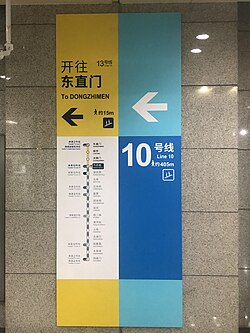
In May 2020, the Beijing Subway began to pilot a new style of wayfinding on Line 13 and Airport Express. However, since then the new designs were not rolled out to other lines or even new lines that opened afterward.[152]
On December 31, 2020, the middle section of Line 16 (Xi Yuan-Ganjia Kou), the northern section of the Fangshan line (Guogongzhuang-Dongguantou Nan(S)), and the Yizhuang T1 line tram were opened.[153]
On August 26, 2021, Line 7 and Batong line extended to Universal Resort station.[154] On August 29, 2021, through operation of Line 1 and Batong line started.[29] On December 31, 2021, the initial sections of Line 11 (Jin'anqiao - Shougang Park), Line 17 (Shilihe - Jiahuihu), Line 19 (Mudanyuan - Xingong); extensions of Capital Airport Express (Dongzhimen - Beixinqiao), Changping line (Xierqi - Qinghe Railway Station), Line S1 (Jin'anqiao - Pingguoyuan), Line 16 (Ganjiakou - Yuyuantan Park East Gate); and the central sections of Line 8 (Zhushikou - National Art Museum) and Line 14 (Beijing South Railway Station - Xiju) were opened.[155] The opening of the central sections of Lines 8 and 14 along with the final section of Line S1 completed the three ring, four horizontal, five vertical and seven radial subway network plan (retroactively named Phase I expansion).
On July 30, 2022, stations Beitaipingzhuang, Ping'anli, Taipingqiao, Jingfengmen of Line 19 were opened.[156] On December 31, 2022, the extension of Line 16 (Yuyuantan Park East Gate - Yushuzhuang) was opened.[157]
On January 18, 2023, in the morning and evening peak hours of the workday, the cross-line operation of Fangshan Line and Line 9 began.[158] On February 4, 2023, the extension of Changping Line (Qinghe Railway Station - Xitucheng) was opened.[159]
On December 15, 2024, lines 3 and 12 were opened together with the remainder of the Changping line's southern extension. By the end of 2024, all of Beijing's 7 major railway stations and 2 international airports have been connected to the metro network.[160]
Timeline
| Commencement | Line | Terminals | Length km | Station(s) | Name |
|---|---|---|---|---|---|
| 15 January 1971 | 01 1 | Beijing Railway Station — Gongzhufen | 10.7 km (6.65 mi) | 10 | Phase 1 (initial section) |
| 5 August 1971 | Yuquan Lu — Gongzhufen | 4.9 km (3.04 mi) | 3 | Yuquan Lu extension | |
| 7 November 1971 | Gucheng — Yuquan Lu | 5.4 km (3.36 mi) | 3 | Gucheng extension | |
| 23 April 1973 | Pingguoyuan — Gucheng | 2.6 km (1.62 mi) | 1 | Pingguoyuan extension | |
| 20 September 1984 | 2 | Fuxingmen — Jianguomen | 16.1 km (10.00 mi) | 12 | Phase 2 (initial section) |
| 28 December 1987 | 1 | Nanlishi Lu — Fuxingmen | 0.4 km (0.25 mi) | 1 | Line 1 & 2 realignment project |
| Changchun Jie — Beijing Railway Station | −6.1 km (−3.79 mi) | -6 | |||
| 2 | Fuxingmen — Changchun Jie | 1.2 km (0.75 mi) | 1 | ||
| Beijing Railway Station — Jianguomen | 1.0 km (0.62 mi) | 1 | |||
| Changchun Jie — Beijing Railway Station | 6.1 km (3.79 mi) | 6 | |||
| 12 December 1992 | 1 | Fuxingmen — Xidan | 1.6 km (0.99 mi) | 1 | Xidan extension |
| 28 September 1999 | Tian'anmenxi — Sihuidong | 10.1 km (6.28 mi) | 10 | Fuba line | |
| 28 June 2000 | Xidan — Tian'anmenxi | 1.3 km (0.81 mi) | 2 | Line 1 & Fuba line merging project | |
| 28 September 2002 | 13 | Xizhimen — Huoying | 20.62 km (12.81 mi) | 9 | Western section |
| 28 January 2003 | Huoying — Dongzhimen | 20 km (12.43 mi) | 7 | Eastern section | |
| 27 December 2003 | Batong | Sihui — Tuqiao | 18.964 km (11.78 mi) | 13 | Phase 1 |
| 7 October 2007 | 5 | Songjiazhuang — Tiantongyuanbei | 27.6 km (17.15 mi) | 23 | Initial phase |
| 19 July 2008 | 8 | Forest Park South Gate — Beitucheng | 3.583 km (2.23 mi) | 3 | Phase 1 (Olympic Branch Line) |
| 10 | Bagou — Jingsong | 24.680 km (15.34 mi) | 22 | Phase 1 | |
| Capital Airport | Dongzhimen — Terminal 3 / Terminal 2 | 28.1 km (17.46 mi) | 4 | Initial phase | |
| 10 October 2008 | 8 | Olympic Sports Center | — | 1 | Infill station |
| 28 September 2009 | 4 | Anheqiaobei — Gongyi Xiqiao | 28.2 km (17.52 mi) | 24 | Initial phase |
| 30 December 2010 | Daxing | Gongqi Xiqiao — Tiangongyuan | 21.76 km (13.52 mi) | 11 | |
| 6 | Haidian Wuluju — Caofang | 29.882 km (18.57 mi) | 20 | Phase 1 | |
| 15 | Wangjingxi — Houshayu | 17.725 km (11.01 mi) | 8 | Phase 1 (1st section) | |
| 10 | Xiju — Bagou | 13.843 km (8.60 mi) | 9 | Phase 2 (initial section) | |
| Jingsong — Capital University of Economics & Business | 15.932 km (9.90 mi) | 11 | |||
| Fangshan | Dabaotai — Suzhuang | 21.726 km (13.50 mi) | 10 | Phase 1 (1st section) | |
| Yizhuang | Songjiazhuang — Ciqu | 21.4 km (13.30 mi) | 13 | Initial phase | |
| Changping | Nanshao — Xi'erqi | 21.3 km (13.24 mi) | 7 | Phase 1 | |
| 25 December 2010 | 13 | Xi'erqi (new) opens, Xi'erqi (old) closes | — | — | Xi'erqi replacement project |
| 31 December 2011 | 8 | Huilongguan Dongdajie — Forest Park South Gate | 10.700 km (6.65 mi) | 6 | Phase 2 (northern section) |
| 9 | Beijing West Railway Station — Guogongzhuang | 5.379 km (3.34 mi) | 8 | Southern section | |
| 15 | Houshayu — Fengbo | 11.060 km (6.87 mi) | 4 | Phase 1 (2nd section) | |
| Fangshan | Guogongzhuang — Dabaotai | 1.438 km (0.89 mi) | 1 | ||
| 12 October 2012 | 9 | Fengtai & Dongdajie opens | — | 2 | Infill stations |
| 30 December 2012 | 6 | Caofang — Lucheng | 12.751 km (7.92 mi) | 6 | Phase 2 |
| 8 | Beitucheng — Gulou Dajie | 3.375 km (2.10 mi) | 2 | Phase 2 (1st southern section) | |
| 9 | National Library — Beijing West Railway Station | 10.282 km (6.39 mi) | 3 | Northern section | |
| 5 May 2013 | 10 | Capital University of Economics & Business — Xiju | 3.420 km (2.13 mi) | 2 | Phase 2 (final) |
| Jiaomendong opens | — | 1 | Infill station | ||
| 14 | Zhangguozhuang — Xiju | 12.4 km (7.71 mi) | 6 | Western section | |
| 21 December 2013 | 9 | Military Museum opens | — | 1 | Infill station |
| 28 December 2013 | 8 | Gulou Dajie — Nanluogu | 2.090 km (1.30 mi) | 2 | Phase 2 (2nd southern section) |
| Zhuxinzhuang — Huilongguan Dongdajie | 6.659 km (4.14 mi) | 3 | Changping Line & Line 8 connector project | ||
| 15 February 2014 | 14 | Qilizhuang opens | — | 1 | Infill station |
| 28 December 2014 | 4 | Beijing West Railway Station — Jiaohuachang | 23.7 km (14.73 mi) | 19 | Phase 1 |
| 14 | Jintai Lu — Shangezhuang | 14.8 km (9.20 mi) | 10 | 1st part of eastern section | |
| 15 | Qinghua Donglu Xikou — Wangjingxi | 9.944 km (6.18 mi) | 6 | Phase 1 (3rd section) | |
| 26 December 2015 | 8 | Andeli Beijie | — | 1 | Infill station |
| 14 | Beijing South Railway Station — Jintai Lu | 16.6 km (10.31 mi) | 9 | 2nd part of eastern section | |
| 15 | Datunludong opens | — | 1 | Infill station | |
| Changping | Changping Xishankou — Nanshao | 10.6 km (6.59 mi) | 5 | Phase 2 | |
| 31 December 2016 | 14 | Chaoyang Park opens | — | 1 | Infill station |
| 15 | Wangjingdong opens | — | 1 | ||
| Bei'anhe — Xi Yuan | 19.6 km (12.18 mi) | 9 | Northern section | ||
| 30 December 2017 | 14 | Pingleyuan opens | — | 1 | Infill station |
| 16 | Nongda Nanlu opens | — | 1 | ||
| Fangshan | Suzhuang — Yancundong | 2.2 km (1.37 mi) | 1 | Western extension | |
| Yanfang | Yancundong — Yanshan | 14.4 km (8.95 mi) | 9 | Main line | |
| S1 | Jin'anqiao — Shichang | 8.216 km (5.11 mi) | 7 | Initial phase | |
| Xijiao | Bagou — Fragrant Hills | 8.8 km (5.47 mi) | 6 | ||
| 30 December 2018 | 6 | Jin'anqiao — Haidian Wuluju | 10.556 km (6.56 mi) | 5 | Phase 3 |
| Beiyunhedong opens | — | 1 | Infill station | ||
| 7 | Fatou opens | — | 1 | ||
| 8 | Nanluogu Xiang — National Art Museum | 1.88 km (1.17 mi) | 1 | Phase 2 (3rd southern section) | |
| Zhushikou — Yinghai | 16.4 km (10.19 mi) | 12 | Phase 3 (southern section) & Phase 4 | ||
| Yizhuang | Ciqu — Yizhuang Railway Station | 1.334 km (0.83 mi) | 1 | One-station extension | |
| 26 September 2019 | Daxing Airport | Caoqiao — Daxing Airport | 41.36 km (25.70 mi) | 3 | Phase 1 |
| 28 December 2019 | 7 | Jiaohuachang — Huazhuang | 1.769 km (1.10 mi) | 8 | Phase 2 (eastern extension) |
| Shuangjing opens | — | 1 | Infill station | ||
| Batong | Tuqiao — Huazhuang | 2.731 km (1.70 mi) | 1 | Phase 2 (southern extension) | |
| 13 | Qinghe Railway Station opens | — | 1 | Infill station | |
| 18 April 2020 | 1 | Pingguoyuan closes | −2.606 km (−1.62 mi) | -1 | Under renovation (reopening on 31 May 2026) |
| 31 December 2020 | 16 | Xi Yuan — Ganjia Kou | 10.929 km (6.79 mi) | 5 | Middle section |
| Fangshan | Guogongzhuang — Dongguantounan | 4.8 km (2.98 mi) | 4 | Northern extension | |
| Yizhuang T1 | Quzhuang — Dinghaiyuan | 11.9 km (7.39 mi) | 14 | Initial section | |
| 26 August 2021 | 7 | Huazhuang — Universal Resort | 1.769 km (1.10 mi) | 1 | Phase 2 (eastern section) |
| Batong | Huazhuang — Universal Resort | 1.769 km (1.10 mi) | 1 | Phase 2 (southern extension) | |
| 31 December 2021 | 6 | Pingguoyuan opens | — | 1 | Infill station |
| 8 | National Art Museum — Zhushikou | 4.3 km (2.67 mi) | 3 | Phase 3 (northern section) | |
| 11 | Jin'anqiao — Shougang Park | 1.5 km (0.93 mi) | 3 | Phase 1 | |
| 14 | Beijing South Railway Station — Xiju | 4 km (2.49 mi) | 5 | Central section | |
| 16 | Ganjia Kou — Yuyuantan Park East Gate | 0.97 km (0.60 mi) | 1 | Middle section | |
| 17 | Shilihe — Jiahuihu | 15.8 km (9.82 mi) | 7 | Southern section | |
| 19 | Mudanyuan — Xingong | 20.6 km (12.80 mi) | 6 | Phase 1 | |
| Capital Airport | Dongzhimen — Beixinqiao | 1.8 km (1.12 mi) | 1 | Western extension | |
| Changping | Xi'erqi — Qinghe Railway Station | 1.5 km (0.93 mi) | 1 | Southern extension | |
| S1 | Jin'anqiao — Pingguoyuan | 1.149 km (0.71 mi) | 1 | Remaining section | |
| 30 July 2022 | 19 | Beitaipingzhuang, Ping'anli, Taipingqiao & Jingfengmen opens | — | 4 | Infill stations |
| 31 December 2022 | 16 | Yuyuantan Park East Gate — Yushuzhuang | 14.234 km (8.84 mi) | 9 | Southern section |
| 4 February 2023 | Changping | Qinghe Railway Station — Xitucheng | 9.7 km (6.03 mi) | 5 | Southern extension |
| 18 March 2023 | 6 | Erligou opens | — | 1 | Infill station |
| 16 | Erligou opens | — | 1 | ||
| 30 December 2023 | 11 | Moshikou — Jin'anqiao | 1.4 km (0.87 mi) | 1 | Phase 1 |
| 16 | Yushuzhuang — Wanpingcheng | 2.7 km (1.68 mi) | 2 | Southern extension | |
| Suzhou Jie opens | — | 1 | Infill station | ||
| 17 | Future Science City North — Workers' Stadium | 24.9 km (15.47 mi) | 9 | Northern section | |
| 15 December 2024 | 3 | Dongsi Shitiao — Dongbabei | 14.7 km (9.13 mi) | 10 | Initial section |
| 12 | Sijiqing Qiao — Dongbabei | 27.5 km (17.09 mi) | 20 | ||
| Changping | Xitucheng — Jimen Qiao | 0.7 km (0.43 mi) | 1 | Southern extension | |
| Zhufangbei opens | — | 1 | Infill station | ||
| 19 January 2025 | 16 | Lize Shangwuqu | — | 1 | |
| 2 June 2025 | 1 | Bajiao Amusement Park closes | — | -1 | Under renovation (reopening on 3 May 2027) |
| 8 November 2025 | 8 | Dahong Men opens | — | 1 | Infill station |
| 27 December 2025 | 6 | Lucheng — Luyang | 2.1 km (1.30 mi) | 1 | Phase 2 (southern extension) |
| 17 | Workers' Stadium — Shilihe | 8.2 km (5.10 mi) | 3 | Middle section | |
| 18 | Malianwa — Tiantongyuandong | 19.805 km (12.31 mi) | 11 | Initial section | |
| 31 January 2026 | 17 | Wangjingxi | — | 1 | Infill station |
| 15 February 2026 | 1 | Gucheng & Babaoshan stations closed | 5.353 km (3.33 mi) | -2 | Temporary closure for Line 1 branch works (reopening on 31 May 2026) |
Ridership
Average Daily Ridership | |||||||||||||||||||||||||||||||||||||||||||||||||||||||||||||||||||||||||||||||||||||||||||||||||||||||||||||||||||||||||||||||||||||||||||||||||||||||||||||||||||||||||||||||||
|
|
|
| ||||||||||||||||||||||||||||||||||||||||||||||||||||||||||||||||||||||||||||||||||||||||||||||||||||||||||||||||||||||||||||||||||||||||||||||||||||||||||||||||||||||||||||||
| Source: 北京地铁大事记回顾 1965-2006 •北京市2010年暨"十一五"期间国民经济和社会发展统计公报 •北京市2011年国民经济和社会发展统计公报 •北京市2012年国民经济和社会发展统计公报 •北京市2013年国民经济和社会发展统计公报 •[161] •北京市2015年暨"十二五"时期国民经济和社会发展统计公报 •[145] •[162] •[6] •北京市2020年国民经济和社会发展统计公报 •北京市2021年国民经济和社会发展统计公报 •北京市2022年国民经济和社会发展统计公报 •北京市2023年国民经济和社会发展统计公报 •北京市2024年国民经济和社会发展统计公报 | |||||||||||||||||||||||||||||||||||||||||||||||||||||||||||||||||||||||||||||||||||||||||||||||||||||||||||||||||||||||||||||||||||||||||||||||||||||||||||||||||||||||||||||||||
Facilities
Accessibility


Each station is equipped with ramps, lifts, or elevators to facilitate wheelchair access.[163][164] Newer model train cars now provide space to accommodate wheelchairs.[165] Automated audio announcements for incoming trains are available in all lines. On all lines, station names are announced in Mandarin Chinese and English. Under subway regulations, riders with mobility limitations may obtain assistance from subway staff to enter and exit stations and trains, and visually impaired riders may bring assistance devices and guide dogs into the subway.[166]
Cellular network coverage
Mobile phones can currently be used throughout the network. In 2014, Beijing Subway started upgrading cellular networks in the Beijing subway to 4G.[167] In 2016, the entire subway network has 4G coverage.[168] Since 2019, 5G coverage is being rolled out across the network.[169][170]
Commercial facilities
In the 1990s a number of fast food and convenience stores operated in the Beijing Subway.[171] In 2002, fourteen Wumart convenience stores opened in various Line 2 stations.[172]
After witnessing the Daegu subway fire in February 2003, the Beijing Subway gradually removed the 80 newsstands and fast food restaurants across 39 stations in Line 1 and Line 2.[173] The popular underground mall at Xidan station was closed. This is in contrast other systems in China which added more station commerce as they started to rapidly expand their networks.[173] Since the implementation of this policy new lines did not have any station commerce upon opening.
Passengers consistently complained that the lack of station commerce in the Beijing Subway is inconvenient. In the early 2010s, Beijing Subway started reversing some of these policies. Vending machines selling drinks and snacks has gradually introduced inside stations since 2013. Later machines with of common items such as flowers, earphones, masks, etc. were also introduced.[171] In 2013, China Resources Vanguard and FamilyMart expressed interest in opening convenience stores in the Beijing Subway but this never materialized.[174]

The survey report on passenger satisfaction in subway services since 2018 shows that more than 70% of passengers want convenience stores in subway stations, especially for various hot and cold drinks, ready-to-eat food, and bento meals.[171] In December 2020, "the deployment of 130 convenient service facilities at subway stations" was listed as a key project for the Beijing municipal government.[175] On July 25, 2021, Beijing Subway selected three stations, Hepingli Beijie station of Line 5, Qingnian Lu station of Line 6, and Caishikou station of Line 7, to carry out a pilot program of opening convenience stores.[176] Since December 2021, a rapid rollout of station commerce began on a large scale across the network with a variety of commercial establishments such as bookstores, pharmacies, flower shops and specialty vendors being constructed inside stations.[177]
Information hotline and app
The Beijing Subway telephone hotline was initiated on the eve of the 2008 Summer Olympic Games to provide traveler information, receive complaints and suggestions, and file lost and found reports.[178] The hotline combined the nine public service telephones of various subway departments.[179] On December 29, 2013, the hotline number was switched from (010)-6834-5678 to (010)-96165 for abbreviated dialing.[180] In December 2014, the hotline began offering fare information, as the subway switched to distance-based fare.[12] The hotline has staffed service from 5 am to midnight and has automated service during unstaffed hours.[178]
The Beijing Subway has an official mobile application and a number of third-party apps.
English station names
According to the related rules released in 2006, all the place names, common names and proper names of subway stations and bus stops should use uppercase Hanyu Pinyin. For example, Nanlishi Lu Station should be written as NANLISHILU Station. However, names of venues can use English translation, such as Military Museum.
According to the translation standard released in December 2017, station names of rail transit and public transport have to follow the laws.
Since December 2018, Beijing Subway has changed the format of names of the new subway stations every year. On the subway map of December 2018, the station names used Roman script, and it gave consideration to English writing habit and pronunciation. The format changed to verbatim in December 2019, where the positions (East, South, West and North) were written in Hanyu Pinyin and an English abbreviation was added to them.

Since December 31, 2021, Beijing Subway has started using new station name format. The Pinyin "Zhan" is used instead of English word "Station" on the light box at the subway entrance. This caused a strong disagreement.[181] Citizens criticized it, making comments like "Chinese do not need to read and foreigners cannot read it". Some of the landmark named stations uses Chinese name, Hanyu Pinyin and English translation. Some of the stations that used English translation names (such as Shahe Univ. Park, Life Science Park and Liangxiang Univ. Town) changed to Hanyu Pinyin only (These stations changed back to English translations in December 2022). Lines 3, 12 and 18 use the translation rules that announced in 2024.[182] For example, "Dongbabei", "Dongbaxi", "Jiangtaixi", "Huoyingdong", "Tiantongyuandong", "Sijiqing Qiao" and "Shangdi Software Park".
System upgrades
Capacity

With new lines drawing more riders to the network, the subway has experienced severe overcrowding, especially during the rush hour.[183] Since 2015, significant sections of Lines 1, 4 – Daxing, 5, 10,[184] 13, Batong and Changping are officially over capacity during rush hour.[185][186] By 2019, Lines 1, 2, 4, 5, 6 and 10 all have daily weekday ridership's of over 1 million passengers a day each.[187] In short term response, the subway upgraded electrical, signal and yard equipment to increase the frequency of trains to add additional capacity. Peak headways have been reduced to 1 min. 43 sec. on Line 4;[188] 1 min. 45 sec. on Lines 1/Batong,[189] 5,[190] 9,[189] and 10;[191] 2 min. on Lines 2,[192] 6,[190] 13[190] and Changping;[193] 2 min. and 35 sec. on Line 15;[190][193] 3 min. 30 sec. on Line 8;[194] and 15 min. on the Airport Express.[195] The Beijing Subway is investigating the feasibility of reducing headways of Line 10 down to 1 min 40 seconds.[196]
Lines 13 and Batong have converted 4-car to 6-car trains.[197][198] Lines 6[199] and 7 have longer platforms that can accommodate 8-car type B trains,[200] while lines 14, 16, 17 and 19 use higher capacity wide-body type A trains (all mentioned except Line 14 use eight-car trains). New lines that cross the city center such as Line 3 and Line 12, now under construction, will also adopt high capacity 8-car type A trains with a 70 percent increase in capacity over older lines using 6 car type B.[199][201] When completed these lines are expected to greatly relieve overcrowding in the existing network.

Despite these efforts, during the morning rush hour, conductors at line terminals and other busy stations must routinely restrict the number of passengers who can board each train to prevent the train from becoming too crowded for passengers waiting at other stations down the line.[202] Some of these stations have built queuing lines outside the stations to manage the flow of waiting passengers.[203] As of August 31, 2011, 25 stations mainly on Lines 1, 5, 13, and Batong have imposed such restrictions.[204] By January 7, 2013, 41 stations on Lines 1, 2, 5, 13, Batong, and Changping had instituted passenger flow restrictions during the morning rush hour.[205] The number of stations with passenger flow restrictions reached 110 in January 2019, affecting all lines except Lines 15, 16, Fangshan, Yanfang and S1.[206] Lines 4, 5, 10 and 13 strategically run several empty train runs during rush hour bound for specific stations help clear busy station queues.[190] Counter peak flow express trains started operating on Line 15, Changping and Batong to minimize line runtimes and allow the existing fleet size to serve more passengers during peak periods.[190] Additionally, investigations are being carried out on Line 15 and Yizhuang for upgrading to 120 km/h operations.[207]
Transfers

Interchange stations that permit transfers across two or more subway lines receive heavy traffic passenger flow. The older interchange stations are known for lengthy transfer corridors and slow transfers during peak hours. The average transfer distance at older interchange stations is 128 m (420 ft)[208] The transfer between Lines 2 and 13 at Xizhimen once required 15 minutes to complete during rush hours.[209] In 2011, this station was rebuilt to reduce the transfer distance to about 170 m (560 ft) long.[210][211] There are plans to rebuild other interchange stations such as Dongzhimen.[208]
In newer interchange stations, which are designed to permit more efficient transfers, the average transfer distance is 63 m (207 ft).[208] Many of the newer interchange stations including Guogongzhuang (Lines 9 and Fangshan), Nanluoguxiang (Lines 8 and 6), Zhuxinzhuang (Changping and Line 8), Beijing West railway station (Lines 9 and 7), National Library (Lines 9 and 4), Yancun East (Fangshan Line and Yanfang Line) feature cross platform transfers.[212] Nevertheless, longer transfer corridors must still be used when the alignment of the lines do not permit cross-platform transfer.[213] The transfer corridors between Lines 1 and 9 at the Military Museum, which opened on December 23, 2013, are 160 m (520 ft) in one direction and just under 300 m (980 ft) in the other.[214]
Safety
Security check

To ensure public safety during the 2008 Summer Olympic and Paralympic Games, the subway initiated a three-month heightened security program from June 29 to September 20, 2008. Riders were subject to searches of their persons and belongings at all stations by security inspectors using metal detectors, X-ray machines and sniffer dogs. Items banned from public transportation such as "guns, ammunition, knives, explosives, flammable and radioactive materials, and toxic chemicals" were subject to confiscation.[215] The security program was reinstituted during the 2009 New Year Holiday[216] and has since been made permanent through regulations enacted in February 2009.[217]
Accidents and incidents
The subway was plagued by numerous accidents in its early years, including a fire in 1969 that killed six people and injured over 200.[218] But its operations have improved dramatically and there have been few reported accidents in recent years. Most of the reported fatalities on the subway are the result of suicides.[219] Authorities have responded by installing doors on platforms of newer lines.
- On October 8, 2003, the collapse of steel beams at the construction site of Line 5's Chongwenmen station killed three workers and injured one.[220]
- On March 29, 2007, the construction site at the Suzhoujie station on Line 10 collapsed, burying six workers.
- On June 6, 2008, prior to the opening of Line 10, a worker was crushed to death inside an escalator in Zhichunlu station when an intern turned on the moving staircase.[221]
- On July 14, 2010, two workers were killed and eight were injured at the construction site of Line 15's Shunyi station when the steel support structure collapsed on them.[222]
- On September 17, 2010, Line 9 tunnels under construction beneath Yuyuantan Lake were flooded, killing one worker.[223] A city official who oversaw waterworks contracts at the site was convicted of corruption and given a death sentence with reprieve.[223]
- On June 1, 2011, one worker was killed when a section of Line 6 under construction in Xicheng District near Ping'anli collapsed.[224]
- On July 5, 2011, an escalator collapsed at Beijing Zoo Station, killing one 13-year-old boy and injuring 28.[225]
- On July 19, 2012, a man was fatally shot at Hujialou station by a sniper from the Beijing Special Weapons and Tactics Unit after taking a subway worker hostage.[226]
- On May 4, 2013, a train derailed when it overran a section of track on Line 4. The section was not open to the public and was undergoing testing. There were no injuries.[227]
- On November 6, 2014, a woman was killed when she tried to board the train at Huixinxijie Nankou station on Beijing Subway's Line 5. She became trapped between the train door and the platform edge door and was crushed to death by the departing train. The accident happened on the second day of APEC China 2014 meetings in the city during which the municipal government has banned cars from the roads on alternate days to ease congestion and reduce pollution during the summit – measures which the capital's transport authorities have estimated would lead to an extra one million passengers on the subway every day.[228]
- On March 26, 2015, a Yizhuang line train was testing when it derailed around Taihu Depot. No passengers were on board and the driver faced leg injuries.[229][230][231]
- On January 1, 2018, a Xijiao line train derailed around Fragrant Hills station. There were no injuries.[232] Fragrant Hills station was temporarily closed until March 1, 2018.[233]
- On December 14, 2023, two trains on the Changping linecollided between Xi'erqi station and Life Science Park station, causing one of the carriages to break apart and injuring over 500 passengers on board.[234][235][236]
Subway culture
Logo
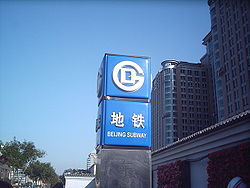
The subway's logo, a capital letter "G" encircling a capital letter "D" with the letter "B" silhouetted inside the letter D, was designed by Zhang Lide, a subway employee, and officially designated in April 1984.[237] The letters B, G, and D form the pinyin abbreviation for "北京高速电车" (pinyin:Běijīng gāosù diànchē; lit.'Beijing high-speed electric carriage').
Subway Culture Park

The Beijing Subway Culture Park, located near Xihongmen in Daxing District, opened in 2010 to commemorate the 40-year history of the Beijing Subway.[238] The 19 ha (47 acres) park was built using dirt and debris removed from the construction of the Daxing line and contains old rolling stock, sculpture, and informational displays.[238] Admission to the park is free.
Beijing Suburban Railway
The Beijing Suburban Railway, a suburban commuter train service, is managed separately from the Beijing Subway. The two systems, although complementary, are not related to each other operationally. Beijing Suburban Railway is operated by the China Railway Beijing Group.
There are 4 suburban railway lines currently in operation: Line S2, Sub-Central line, Huairou–Miyun line and Tongmi line.
Network map
. } } GROUP BY ?id ?link ?idLabel ?length ?hexcolor ?idhexcolor \"}, ]"}}">
See also
Notes
- ↑Through operation of Line 1 and Batong line started on August 29, 2021.[29]
- ↑The construnction finished in 1969 but was not open to public until 1971
- 123Lines 3, 11 and 12 currently operate shorter Type A consists but have platforms built to accommodate full-length trains (8-car for Lines 3 and 12; 6-car for Line 11) when demand warrants.
- 12With the opening of the Daxing Line on December 30, 2010 the Beijing MTR Corporation operates service on Lines 4 and Daxing as follows:[31][32]** A service that covers both lines, from Anheqiaobei, the northern terminus of Line 4, to Tiangong Yuan, the southern terminus of the Daxing Line.** A service that covers Line 4 plus one stop on the Daxing Line, from Anheqiaobei to Xingong, the northernmost stop on the Daxing Line. Travelers wishing to proceed further south on the Daxing Line have to switch to a south-bound full-route train.
- 12The following stations haven't been opened and not included in the station count: Tongyun Men on Line 6; Taoranqiao, Hongmiao and Gaojiayuan on Line 14; Guangqumen Wai on Line 17
- ↑There is no subway stop at the 12th gate, Deshengmen, between Jishuitan and Gulou Dajie.
- ↑From August 12, 1973, to June 30, 1974, and in January 1975, the subway was closed due to defense mobilization.[90] It was closed from September 13 to November 6, 1971, in the aftermath of the Lin Biao incident and on September 18, 1976, after the death of Chairman Mao.[90]
External links

- Official Beijing Subway website. Detailed information only for the lines operated by Beijing Subway.
- Official Beijing MTR WebsiteArchived January 19, 2016, at the Wayback Machine (Chinese). For the 5 lines operated by MTR Beijing.
- Official Beijing MTR Website (English)
- Official Beijing Metro Operation Administration (BJMOA) Website For Line 19, Yanfang line, Daxing Airport Express operated by Beijing Metro Operation Administration (BJMOA).
- Beijing Subway Information on UrbanRail.net
39°54′50″N116°23′30″E / 39.9138°N 116.3916°E / 39.9138; 116.3916