
อ่าน 5 นาที
พื้นผิวการแบ่งย่อยแคทมัลล์-คลาร์ก
อั ลกอริทึม Catmull–Clark เป็นเทคนิคที่ใช้ใน กราฟิกคอมพิวเตอร์ 3 มิติ เพื่อสร้างพื้นผิวโค้งโดยใช้ การสร้าง แบบจำลอง พื้นผิวแบบแบ่งย่อย คิดค้นโดย Edwin Catmull และ Jim Clark ในปี...
พื้นผิวการแบ่งย่อยแคทมัลล์-คลาร์ก


อัลกอริทึมCatmull–Clark เป็นเทคนิคที่ใช้ในกราฟิกคอมพิวเตอร์ 3 มิติเพื่อสร้างพื้นผิวโค้งโดยใช้ การสร้าง แบบจำลองพื้นผิวแบบแบ่งย่อยคิดค้นโดยEdwin CatmullและJim Clarkในปี 1978 โดยเป็นการขยาย พื้นผิว B-spline แบบ bi-cubic uniformไปสู่โทโพโลยีแบบ ใดก็ได้ [ 1 ]
ในปี 2005/06 เอ็ดวิน แคทมุลล์ ร่วมกับโทนี่ เดอโรสและโจส สแตมได้รับรางวัลออสการ์สาขาความสำเร็จทางเทคนิคจากการคิดค้นและประยุกต์ใช้พื้นผิวแบบแบ่งย่อย (subdivision surfaces) เดอโรสเขียนเกี่ยวกับ "การประมาณค่าแบบมีประสิทธิภาพและยุติธรรม" และการสร้างแอนิเมชั่นตัวละคร ส่วนสแตมอธิบายเทคนิคสำหรับการประเมินพื้นผิวขีดจำกัดโดยตรงโดยไม่ต้องใช้การเรียกซ้ำ
การประเมินแบบเรียกซ้ำ
พื้นผิว Catmull–Clark ถูกกำหนดแบบวนซ้ำโดยใช้รูปแบบการปรับปรุง ดังต่อไปนี้ [ 1 ]
เริ่มต้นด้วยตาข่ายของทรงหลาย เหลี่ยมใดๆ จุดยอดทั้งหมดในตาข่ายนี้จะเรียกว่าจุดเริ่มต้น
- สำหรับแต่ละด้าน ให้เพิ่มจุดบนใบหน้า
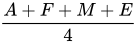
- กำหนดให้จุดแต่ละจุดบนใบหน้าเป็นค่าเฉลี่ย ของ จุดเริ่มต้นทั้งหมดสำหรับใบหน้านั้นๆ

จุดบนใบหน้า (ทรงกลมสีฟ้า)
- กำหนดให้จุดแต่ละจุดบนใบหน้าเป็นค่าเฉลี่ย ของ จุดเริ่มต้นทั้งหมดสำหรับใบหน้านั้นๆ
- สำหรับแต่ละขอบ ให้เพิ่มจุดขอบเข้าไป
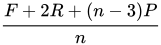
- For each original point (P), take the average (F) of all n (recently created) face points for faces touching P, and take the average (R) of all n edge midpoints for original edges touching P, where each edge midpoint is the average of its two endpoint vertices (not to be confused with new edge points above). (Note that from the perspective of a vertex P, the number of edges neighboring P is also the number of adjacent faces, hence n)
- Move each original point to the new vertex point (This is the barycenter of P, R and F with respective weights (n − 3), 2 and 1)

New vertex points (green cones)
- Move each original point to the new vertex point (This is the barycenter of P, R and F with respective weights (n − 3), 2 and 1)
- Form edges and faces in the new mesh
- Connect each new face point to the new edge points of all original edges defining the original face

New edges, 4 per face point - Connect each new vertex point to the new edge points of all original edges incident on the original vertex

3 new edges per vertex point of shifted original vertices - Define new faces as enclosed by edges

Final faces to the mesh
- Connect each new face point to the new edge points of all original edges defining the original face




Properties
The new mesh will consist only of quadrilaterals, which in general will not be planar. The new mesh will generally look "smoother" (i.e. less "jagged" or "pointy") than the old mesh. Repeated subdivision results in meshes that are more and more rounded.
The arbitrary-looking barycenter formula was chosen by Catmull and Clark based on the aesthetic appearance of the resulting surfaces rather than on a mathematical derivation, although they do go to great lengths to rigorously show that the method converges to bicubic B-spline surfaces.[1]
It can be shown that the limit surface obtained by this refinement process is (tangent plane) continuous at extraordinary vertices (valence not equal to 4) and continuous at regular points (valence equal to 4).[3] (when n indicates how many derivatives are continuous, we speak of continuity). After one iteration, the number of extraordinary points on the surface remains constant.


Exact evaluation
พื้นผิวลิมิตของพื้นผิวการแบ่งย่อย Catmull–Clark สามารถประเมินได้โดยตรงโดยไม่ต้องมีการปรับปรุงแบบวนซ้ำ ซึ่งสามารถทำได้โดยใช้เทคนิคของJos Stam (1998) [ 4 ]วิธีนี้ปรับเปลี่ยนกระบวนการปรับปรุงแบบวนซ้ำให้เป็น ปัญหา เลขชี้กำลังของเมทริกซ์ซึ่งสามารถแก้ไขได้โดยตรงโดยใช้การหาค่าเฉพาะของเมท ริกซ์
ส่วนขยาย
รอยพับกึ่งคม
พื้นผิว Catmull–Clark ได้รับการขยายเพื่อรองรับรอยพับกึ่งคมโดยใช้กฎการแบ่งย่อยที่แตกต่างกันสำหรับจำนวนรอบคงที่ที่กำหนดโดยค่าความคมชัด[ 5 ]แนวทางนี้ซึ่งนำเสนอโดยTony DeRoseและคณะในปี 1998 ช่วยให้สามารถเปลี่ยนจากกฎการแบ่งย่อยที่คมไปเป็นกฎการแบ่งย่อยที่เรียบได้อย่างควบคุม
ซอฟต์แวร์ที่ใช้อัลกอริธึม
- 3ds Max
- 3D-Coat
- เอซี3ดี
- แอนิม8ออร์
- ออโต้ซีเอดี
- Blender [ 6 ]
- คารารา
- CATIA (จินตนาการและสร้างสรรค์)
- ซีจีแอล
- ชีตาห์3D
- ซีนีม่า4ดี
- คลาร่า.ไอโอ
- ครีโอ (ฟรีสไตล์) [ 7 ]
- Daz Studio เวอร์ชัน 2.0
- DeleD รุ่นชุมชน
- ดีเลดี ดีไซเนอร์
- ค้อน
- หกเหลี่ยม
- ฮูดินี
- LightWave 3D เวอร์ชัน 9
- เมคฮิวแมน
- มายา
- เมตาเซควอยา
- โมโด
- มัดบ็อกซ์
- ส่วนเสริม Power Surfacing สำหรับ SolidWorks
- OpenSubdivของ Pixar [ 8 ] [ 9 ] [ 10 ] [ 11 ] [ 12 ]
- พีอาร์แมน
- เรียลซอฟต์3ดี
- เรโม 3 มิติ
- Rhinoceros 3D - ปลั๊กอิน Grasshopper 3D - ปลั๊กอิน Weaverbird
- ไซโล
- SketchUp - ต้องใช้ปลั๊กอิน
- ซอฟต์อิมเมจ XSI
- สแตรต้า 3D ซีเอ็กซ์
- ปีก 3 มิติ
- Zbrush
ดูเพิ่มเติม
- สัญกรณ์รูปทรงหลายเหลี่ยมของคอนเวย์ - ชุดของตัวดำเนินการรูปทรงหลายเหลี่ยมและตาข่ายรูปหลายเหลี่ยมเชิงทอพอโลยีที่เกี่ยวข้องกัน
- พื้นผิวของเขตย่อยดู-ซาบิน
- พื้นผิวการแบ่งย่อยแบบวนรอบ
อ่านเพิ่มเติม
- Derose, T.; Kass, M.; Truong, T. (1998). "พื้นผิวแบบแบ่งย่อยในแอนิเมชั่นตัวละคร" (PDF) . รายงานการประชุมประจำปีครั้งที่ 25 ว่าด้วยกราฟิกคอมพิวเตอร์และเทคนิคเชิงโต้ตอบ - SIGGRAPH '98 . หน้า 85 . CiteSeerX 10.1.1.679.1198 . doi : 10.1145/280814.280826 . ISBN 978-0897919999. S2CID 1221330 .
- Loop, C.; Schaefer, S. (2008). "การประมาณพื้นผิวการแบ่งย่อย Catmull-Clark ด้วยแพทช์ bicubic" (PDF) . ACM Transactions on Graphics . 27 : 1– 11. CiteSeerX 10.1.1.153.2047 . doi : 10.1145/1330511.1330519 . S2CID 6068564 .
- Kovacs, D.; Mitchell, J.; Drone, S.; Zorin, D. (2010). "พื้นผิวแบ่งย่อยโดยประมาณแบบพับแบบเรียลไทม์พร้อมการเคลื่อนที่" (PDF) . IEEE Transactions on Visualization and Computer Graphics . 16 (5): 742– 51. doi : 10.1109/TVCG.2010.31 . PMID 20616390 . S2CID 17138394 .บทความฉบับร่าง
- Matthias Nießner, Charles Loop, Mark Meyer, Tony DeRose, " การเรนเดอร์พื้นผิวแบบ Catmull-Clark Subdivision ด้วย GPU ที่ปรับตามคุณลักษณะ ", ACM Transactions on Graphics เล่มที่ 31 ฉบับที่ 1 มกราคม 2012, doi : 10.1145/2077341.2077347 , demo
- Nießner, Matthias; Loop, Charles; Greiner, Günther: การประเมินรอยพับกึ่งเรียบอย่างมีประสิทธิภาพในพื้นผิวแบบแบ่งย่อย Catmull-Clark : ภาคผนวก Eurographics 2012: บทความสั้น (Eurographics 2012, Cagliary) 2012, หน้า 41–44
- Wade Brainerd, Tessellation ใน Call of Duty: Ghostsยังถูกนำเสนอเป็นบทช่วยสอน SIGGRAPH2014 อีกด้วย[1]
- D. Doo และ M. Sabin: พฤติกรรมของพื้นผิวการหารแบบเรียกซ้ำใกล้จุดพิเศษ , Computer-Aided Design, 10 (6) 356–360 (1978), ( doi , pdf )
สรุปเนื้อหา
ข้อมูลสำคัญจากบทความ
ข้อมูลสำคัญเกี่ยวกับ พื้นผิวการแบ่งย่อยแคทมัลล์-คลาร์ก
อั ลกอริทึม Catmull–Clark เป็นเทคนิคที่ใช้ใน กราฟิกคอมพิวเตอร์ 3 มิติ เพื่อสร้างพื้นผิวโค้งโดยใช้ การสร้าง แบบจำลอง พื้นผิวแบบแบ่งย่อย คิดค้นโดย Edwin Catmull และ Jim Clark ในปี...
การประเมินแบบเรียกซ้ำ
พื้นผิว Catmull–Clark ถูกกำหนด แบบวนซ้ำ โดยใช้ รูปแบบการปรับปรุง ดังต่อไปนี้ [ 1 ]
Properties
The new mesh will consist only of quadrilaterals , which in general will not be planar . The new mesh will generally look "smoother" (i.e. less "jagged" or "pointy") than the old mesh. Repeated subdivision results in meshes that are more and more rounded.
Exact evaluation
พื้นผิวลิมิตของพื้นผิวการแบ่งย่อย Catmull–Clark สามารถประเมินได้โดยตรงโดยไม่ต้องมีการปรับปรุงแบบวนซ้ำ ซึ่งสามารถทำได้โดยใช้เทคนิคของ Jos Stam (1998) [ 4 ] วิธีนี้ปรับเปลี่ยนกระบวนการปรับปรุงแบบวนซ้ำให้เป็น ปัญหา เลขชี้กำลังของเมทริกซ์...