
อ่าน 96 นาที
National Security Agency
สำนักงาน ความมั่นคงแห่งชาติ ( NSA ) เป็น หน่วยงานข่าวกรอง ของ กระทรวงกลาโหมสหรัฐฯ
National Security Agency
 Seal of the National Security Agency | |
 Flag of the National Security Agency | |
 | |
 NSA headquarters building in Fort Meade, Maryland, c. 1986 NSA headquarters building in Fort Meade, Maryland, c. 1986 | |
| Agency overview | |
|---|---|
| Formed | November 4, 1952[1] |
Preceding agency |
|
| Headquarters | Fort Meade, Maryland, U.S. (39°6′32″N76°46′17″W / 39.10889°N 76.77139°W) |
| Motto | "Defending Our Nation. Securing the Future." |
| Employees | Classified (est. 30,000–40,000)[2][3][4][5] |
| Annual budget | Classified (est. $10.8 billion, 2013)[6][7] |
Agency executives |
|
Parent agency | Department of Defense |
| Website | nsa.gov |
 National Security Agency surveillance National Security Agency surveillance |
|---|
 |


| United StatesArmed Forces |
|---|
 |
| Executive departments |
| Staff |
| Military departments |
| Military services |
| โครงสร้างคำสั่ง |


สำนักงานความมั่นคงแห่งชาติ ( NSA ) เป็นหน่วยงานข่าวกรองของกระทรวงกลาโหมสหรัฐฯภายใต้การกำกับดูแลของผู้อำนวยการข่าวกรองแห่งชาติ (DNI) NSA มีหน้าที่รับผิดชอบในการตรวจสอบ รวบรวม และประมวลผลข้อมูลทั่วโลกเพื่อวัตถุประสงค์ด้านข่าวกรองและการต่อต้านข่าวกรองโดยมีความเชี่ยวชาญในด้านข่าวกรองสัญญาณ (SIGINT) นอกจากนี้ NSA ยังมีหน้าที่ในการปกป้องเครือข่ายการสื่อสารและระบบสารสนเทศ ของ สหรัฐฯ[ 10 ] [ 11 ] NSA อาศัยมาตรการที่หลากหลายเพื่อให้บรรลุภารกิจ ซึ่งส่วนใหญ่เป็นมาตรการลับ[ 12 ] NSA มีพนักงานประมาณ 32,000 คน[ 13 ]
Originating as a unit to decipher coded communications in World War II, it was officially formed as the NSA by President Harry S. Truman in 1952. Between then and the end of the Cold War, it became the largest of the U.S. intelligence organizations in terms of personnel and budget. Still, information available as of 2013 indicates that the Central Intelligence Agency (CIA) pulled ahead in this regard, with a budget of $14.7 billion.[6][14] The NSA currently conducts worldwide mass data collection and has been known to physically bug electronic systems as one method to this end.[15] The NSA is also alleged to have been behind such attack software as Stuxnet, which severely damaged Iran's nuclear program.[16][17] The NSA, alongside the CIA, maintains a physical presence in many countries across the globe; the CIA/NSA joint Special Collection Service (a highly classified intelligence team) inserts eavesdropping devices in high-value targets (such as presidential palaces or embassies). SCS collection tactics allegedly encompass "close surveillance, burglary, wiretapping, [and] breaking".[18]
Unlike the CIA and the Defense Intelligence Agency (DIA), both of which specialize primarily in foreign human espionage, the NSA does not publicly conduct human intelligence gathering. The NSA is entrusted with assisting with and coordinating SIGINT elements for other government organizations—which Executive Order prevents from engaging in such activities on their own.[19] As part of these responsibilities, the agency has a co-located organization called the Central Security Service (CSS), which facilitates cooperation between the NSA and other U.S. defense cryptanalysis components. To further ensure streamlined communication between the signals intelligence community divisions, the NSA director simultaneously serves as the Commander of the United States Cyber Command and as Chief of the Central Security Service.
การกระทำของ NSA เป็นเรื่องที่ก่อให้เกิดความขัดแย้งทางการเมืองหลายครั้ง รวมถึงบทบาทในการให้ข้อมูลข่าวกรองระหว่างเหตุการณ์อ่าวตองกินซึ่งส่งผลให้การมีส่วนร่วมของสหรัฐฯ ในสงครามเวียดนามทวีความรุนแรงขึ้น[ 20 ]เอกสารที่ถูกเปิดเผยในภายหลังระบุว่า NSA ตีความหรือกล่าวเกินจริงเกี่ยวกับข้อมูลข่าวกรองทางสัญญาณ ทำให้เกิดรายงานเกี่ยวกับการโจมตีครั้งที่สองของเวียดนามเหนือซึ่งอาจไม่เคยเกิดขึ้นจริง[ 21 ]หน่วยงานนี้ยังถูกตรวจสอบอย่างเข้มงวดในเรื่องการสอดแนมผู้นำต่อต้านสงครามเวียดนามและการมีส่วนร่วมของหน่วยงานในการจารกรรมทางเศรษฐกิจในปี 2013 โครงการสอดแนมลับหลายโครงการของ NSA ถูกเปิดเผยต่อสาธารณะโดยเอ็ดเวิร์ด สโนว์เดนอดีตผู้รับเหมาของ NSA ตามเอกสารที่รั่วไหล NSA ดักฟังและจัดเก็บการสื่อสารของผู้คนกว่าพันล้านคนทั่วโลก รวมถึงพลเมืองของสหรัฐอเมริกา เอกสารยังเปิดเผยว่า NSA ติดตามการเคลื่อนไหวของผู้คนหลายร้อยล้านคนโดยใช้ข้อมูลเมตา ของโทรศัพท์มือ ถือ ในระดับนานาชาติ งานวิจัยชี้ให้เห็นถึงความสามารถของ NSA ในการสอดแนมการรับส่งข้อมูลอินเทอร์เน็ตภายในประเทศของต่างประเทศผ่าน " การกำหนดเส้นทางบูมเมอแรง " [ 22 ]
ประวัติศาสตร์
การก่อตัว
ที่มาของสำนักงานความมั่นคงแห่งชาติสามารถสืบย้อนไปได้ถึงวันที่ 28 เมษายน พ.ศ. 2460 สามสัปดาห์หลังจากที่รัฐสภาสหรัฐฯประกาศสงครามกับเยอรมนีในสงครามโลกครั้งที่ 1หน่วยถอดรหัสและรหัสลับถูกจัดตั้งขึ้นในชื่อแผนกเคเบิลและโทรเลข ซึ่งรู้จักกันในชื่อสำนักงานรหัสลับ[ 23 ]มีสำนักงานใหญ่อยู่ที่วอชิงตัน ดี.ซี. และเป็นส่วนหนึ่งของความพยายามในการทำสงครามภายใต้ฝ่ายบริหารโดยไม่ได้รับการอนุมัติโดยตรงจากรัฐสภา ในระหว่างสงคราม หน่วยงานนี้ถูกย้ายตำแหน่งในแผนผังองค์กรของกองทัพหลายครั้ง ในวันที่ 5 กรกฎาคม พ.ศ. 2460 เฮอร์เบิร์ต โอ. ยาร์ดลีย์ได้รับมอบหมายให้เป็นหัวหน้าหน่วย ในขณะนั้น หน่วยประกอบด้วยยาร์ดลีย์และเสมียนพลเรือน สองคน หน่วยงานนี้รับหน้าที่ ถอดรหัสของกองทัพเรือในเดือนกรกฎาคม พ.ศ. 2461 สงครามโลกครั้งที่ 1 สิ้นสุดลงในวันที่11 พฤศจิกายน พ.ศ. 2461และหน่วยถอดรหัสของกองทัพบก (MI-8) ได้ย้ายไปที่นครนิวยอร์กในวันที่ 20 พฤษภาคม พ.ศ. 2462 ซึ่งหน่วยงานนี้ยังคงดำเนินกิจกรรมข่าวกรองต่อไปในฐานะบริษัทรวบรวมรหัสภายใต้การกำกับดูแลของ Yardley [ 24 ] [ 25 ]
ห้องดำ

หลังจากการยุบ หน่วยถอดรหัสลับของ กองทัพบกสหรัฐฯซึ่งรู้จักกันในชื่อ MI-8 รัฐบาลสหรัฐฯ ได้ก่อตั้งสำนักงานถอดรหัสลับ หรือที่รู้จักกันในชื่อBlack Chamber ในปี 1919 Black Chamber เป็น องค์กรถอดรหัสลับแห่งแรกของสหรัฐฯ ในช่วงเวลาสงบสุข[ 26 ]สำนักงานถอดรหัสลับได้รับการสนับสนุนทางการเงินร่วมกันจากกองทัพบกและกระทรวงการต่างประเทศ โดยปลอมตัวเป็น บริษัท รหัสทางการค้าในนครนิวยอร์ก ผลิตและจำหน่ายรหัสดังกล่าวเพื่อใช้ในธุรกิจ อย่างไรก็ตาม ภารกิจที่แท้จริงคือการถอดรหัสการสื่อสาร (ส่วนใหญ่เป็นทางการทูต) ของประเทศอื่น ๆ ในการประชุมกองทัพเรือวอชิงตัน สำนักงานถอดรหัสลับได้ช่วยเหลือผู้เจรจาชาวอเมริกันโดยให้ข้อมูลการถอดรหัสของคณะผู้แทนการประชุมหลายคณะ รวมถึงชาวญี่ปุ่น Black Chamber ประสบความสำเร็จในการโน้มน้าวให้Western Union ซึ่งเป็น บริษัทโทรเลขที่ใหญ่ที่สุดของสหรัฐฯในขณะนั้น รวมถึงบริษัทสื่อสารอื่น ๆ อีกหลายแห่ง ให้ Black Chamber เข้าถึงข้อมูลโทรเลขของสถานทูตและสถานกงสุลต่างประเทศอย่างผิดกฎหมาย[ 27 ]ในไม่ช้า บริษัทเหล่านี้ก็ยุติความร่วมมืออย่างเป็นทางการ แม้ว่าหอการค้าจะประสบความสำเร็จในช่วงแรก แต่ก็ถูกปิดตัวลงในปี พ.ศ. 2462 โดยเฮนรี แอล. สติมสัน รัฐมนตรีต่างประเทศสหรัฐฯ ซึ่งปกป้องการตัดสินใจของเขาโดยกล่าวว่า "สุภาพบุรุษไม่ควรอ่านจดหมายของกันและกัน" [ 28 ]
สงครามโลกครั้งที่สองและผลพวงหลังสงคราม
ในช่วงสงครามโลกครั้งที่สองหน่วยข่าวกรองสัญญาณ (SIS) ถูกสร้างขึ้นเพื่อดักฟังและถอดรหัสการสื่อสารของฝ่ายอักษะ[ 29 ]เมื่อสงครามสิ้นสุดลง SIS ได้รับการปรับโครงสร้างใหม่เป็นหน่วยงานความมั่นคงของกองทัพบก (ASA) และอยู่ภายใต้การนำของผู้อำนวยการหน่วยข่าวกรองทางทหาร[ 29 ]
เมื่อวันที่ 20 พฤษภาคม พ.ศ. 2492 กิจกรรมด้านการเข้ารหัสทั้งหมดถูกรวมศูนย์ไว้ภายใต้หน่วยงานระดับชาติที่เรียกว่า สำนักงานความมั่นคงกองทัพ (Armed Forces Security Agency หรือ AFSA) [ 29 ]หน่วยงานนี้ก่อตั้งขึ้นครั้งแรกภายในกระทรวงกลาโหมสหรัฐฯภายใต้การบังคับบัญชาของคณะเสนาธิการร่วม [ 30 ] AFSAมีหน้าที่กำกับดูแลกิจกรรมด้านการสื่อสารและข่าวกรองอิเล็กทรอนิกส์ของกระทรวงกลาโหม ยกเว้นหน่วยข่าวกรองทางทหาร ของสหรัฐฯ [ 30 ]อย่างไรก็ตาม AFSA ไม่สามารถรวมศูนย์ข่าวกรองด้านการสื่อสารและล้มเหลวในการประสานงานกับหน่วยงานพลเรือนที่มีผลประโยชน์ร่วมกัน เช่นกระทรวงการต่างประเทศสำนักงานข่าวกรองกลาง (CIA) และสำนักงานสอบสวนกลาง (FBI) [ 30 ]ในเดือนธันวาคม พ.ศ. 2494 ประธานาธิบดีแฮร์รี เอส. ทรูแมนได้สั่งให้ตั้งคณะกรรมการสอบสวนว่า AFSA ล้มเหลวในการบรรลุเป้าหมายได้อย่างไร ผลการสอบสวนนำไปสู่การปรับปรุงและเปลี่ยนชื่อเป็นสำนักงานความมั่นคงแห่งชาติ (National Security Agency) [ 31 ]
สภาความมั่นคงแห่งชาติออกบันทึกข้อความเมื่อวันที่ 24 ตุลาคม พ.ศ. 2495 ซึ่งแก้ไขคำสั่งข่าวกรองของสภาความมั่นคงแห่งชาติ (NSCID) 9ในวันเดียวกันนั้น ทรูแมนได้ออกบันทึกข้อความฉบับที่สองซึ่งเรียกร้องให้มีการจัดตั้ง NSA [ 32 ]การจัดตั้ง NSA อย่างเป็นทางการเกิดขึ้นจากบันทึกข้อความเมื่อวันที่ 4 พฤศจิกายน โดยโรเบิร์ต เอ. โลเว็ตต์รัฐมนตรีว่าการกระทรวงกลาโหมซึ่งเปลี่ยนชื่อ AFSA เป็น NSA และทำให้หน่วยงานใหม่นี้รับผิดชอบด้านข่าวกรองการสื่อสารทั้งหมด[ 33 ]เนื่องจากบันทึกข้อความของประธานาธิบดีทรูแมนเป็นเอกสารลับ[ 32 ]การมีอยู่ของ NSA จึงไม่เป็นที่รู้จักของสาธารณชนในขณะนั้น เนื่องจากความลับสุดยอด หน่วยงานข่าวกรองของสหรัฐฯ จึงเรียก NSA ว่า "ไม่มีหน่วยงานดังกล่าว" [ 34 ]
สงครามเวียดนาม
ในช่วงทศวรรษ 1960 NSA มีบทบาทสำคัญในการขยายความมุ่งมั่นของอเมริกาต่อสงครามเวียดนามโดยให้หลักฐานการโจมตีเรือพิฆาตUSS Maddox ของกองทัพเรือสหรัฐฯ โดยกองทัพ เวียดนามเหนือในเหตุการณ์อ่าวตองกิน [ 35 ] NSAได้จัดตั้งปฏิบัติการลับที่มีชื่อรหัสว่า " MINARET " เพื่อตรวจสอบการสื่อสารทางโทรศัพท์ของวุฒิสมาชิก แฟรงค์ เชิร์ชและฮาวาร์ด เบเกอร์รวมถึงผู้นำคนสำคัญของขบวนการสิทธิพลเมืองเช่นมาร์ติน ลูเธอร์ คิง จูเนียร์และนักข่าวและนักกีฬาชาวอเมริกันที่มีชื่อเสียงซึ่งวิพากษ์วิจารณ์สงครามเวียดนาม[ 36 ]อย่างไรก็ตาม โครงการนี้กลับกลายเป็นที่ถกเถียง และการตรวจสอบภายในของ NSA สรุปว่าโครงการ Minaret นั้น "เสื่อมเสียชื่อเสียงหากไม่ผิดกฎหมายอย่างชัดเจน" [ 36 ]
NSA ได้ทุ่มเทความพยายามอย่างมากในการรักษาความปลอดภัยการสื่อสารทางยุทธวิธีระหว่างกองกำลังติดอาวุธของสหรัฐฯ ในช่วงสงคราม โดยประสบความสำเร็จในระดับปานกลาง ระบบ เสียงที่ปลอดภัยตระกูลNESTORที่พัฒนาขึ้นนั้นถูกนำไปใช้งานอย่างแพร่หลายในช่วงสงครามเวียดนามโดยมีการผลิตชุด NESTOR ประมาณ 30,000 ชุด อย่างไรก็ตาม ปัญหาทางเทคนิคและการปฏิบัติงานต่างๆ ได้จำกัดการใช้งาน ทำให้เวียดนามเหนือสามารถใช้ประโยชน์และดักฟังการสื่อสารของสหรัฐฯ ได้[ 37 ] : เล่มที่ 1 หน้า 79
การพิจารณาคดีของคณะกรรมการคริสตจักร
In the aftermath of the Watergate scandal, a congressional hearing in 1975 led by Senator Frank Church[38] revealed that the NSA, in collaboration with Britain's SIGINT intelligence agency, Government Communications Headquarters (GCHQ), had routinely intercepted the international communications of prominent anti-Vietnam war leaders such as Jane Fonda and Dr. Benjamin Spock.[39] The NSA tracked these individuals in a secret filing system that was destroyed in 1974.[40] Following the resignation of President Richard Nixon, there were several investigations into suspected misuse of FBI, CIA and NSA facilities.[41] Senator Frank Church uncovered previously unknown activity,[41] such as a CIA plot (ordered by the administration of President John F. Kennedy) to assassinate Fidel Castro.[42] The investigation also uncovered NSA's wiretaps on targeted U.S. citizens.[43] After the Church Committee hearings, the Foreign Intelligence Surveillance Act of 1978 was passed. This was designed to limit the practice of mass surveillance in the United States.[41]
1980s to 1990s
In 1986, the NSA intercepted the communications of the Libyan government during the immediate aftermath of the Berlin discotheque bombing. The White House asserted that the NSA interception had provided "irrefutable" evidence that Libya was behind the bombing, which U.S. President Ronald Reagan cited as a justification for the 1986 United States bombing of Libya.[44][45]
ในปี พ.ศ. 2542 การสืบสวนหลายปีโดยรัฐสภายุโรปได้เน้นย้ำบทบาทของ NSA ในการจารกรรมทางเศรษฐกิจในรายงานชื่อ 'การพัฒนาเทคโนโลยีการเฝ้าระวังและความเสี่ยงของการใช้ข้อมูลทางเศรษฐกิจในทางที่ผิด' [ 46 ]ในปีนั้น NSA ได้ก่อตั้งหอเกียรติยศ NSAซึ่งเป็นอนุสรณ์สถาน ณพิพิธภัณฑ์การเข้ารหัสแห่งชาติในฟอร์ตมีด รัฐแมริแลนด์[ 47 ]อนุสรณ์สถานนี้เป็น "การยกย่องเชิดชูผู้บุกเบิกและวีรบุรุษผู้ซึ่งมีส่วนสำคัญและยั่งยืนต่อการเข้ารหัสของอเมริกา" [ 47 ]พนักงานของ NSA ต้องเกษียณอายุมาแล้วมากกว่าสิบห้าปีจึงจะมีสิทธิ์ได้รับเกียรติเข้าสู่อนุสรณ์สถาน[ 47 ]
โครงสร้างพื้นฐานของ NSA เสื่อมโทรมลงในช่วงทศวรรษ 1990 เนื่องจากการตัดงบประมาณด้านกลาโหมส่งผลให้การบำรุงรักษาถูกเลื่อนออกไป เมื่อวันที่ 24 มกราคม 2000 สำนักงานใหญ่ของ NSA ประสบปัญหาเครือข่ายล่มทั้งหมดเป็นเวลาสามวันเนื่องจากเครือข่ายโอเวอร์โหลด ข้อมูลขาเข้าถูกจัดเก็บไว้ในเซิร์ฟเวอร์ของหน่วยงานได้สำเร็จ แต่ไม่สามารถส่งต่อและประมวลผลได้ หน่วยงานได้ดำเนินการซ่อมแซมฉุกเฉินด้วยงบประมาณ 3 ล้านดอลลาร์เพื่อให้ระบบกลับมาใช้งานได้อีกครั้ง (ข้อมูลขาเข้าบางส่วนถูกส่งไปยังGCHQ ของอังกฤษ เป็นการชั่วคราว) ผู้อำนวยการไมเคิล เฮย์เดนเรียกเหตุการณ์เครือข่ายล่มครั้งนี้ว่าเป็น "สัญญาณเตือน" ถึงความจำเป็นในการลงทุนในโครงสร้างพื้นฐานของหน่วยงาน[ 48 ]
ในช่วงทศวรรษ 1990 หน่วยงานป้องกันของ NSA ซึ่งก็คือ Information Assurance Directorate (IAD) เริ่มทำงานอย่างเปิดเผยมากขึ้น การบรรยายทางเทคนิคสาธารณะครั้งแรกโดยนักวิทยาศาสตร์ของ NSA ในการประชุมการเข้ารหัสลับที่สำคัญคือการนำเสนอของ J. Solinas เกี่ยวกับอัลกอริ ทึม การเข้ารหัสลับเส้นโค้งวงรี ที่มีประสิทธิภาพ ในงาน Crypto 1997 [ 49 ]แนวทางความร่วมมือของ IAD กับสถาบันการศึกษาและอุตสาหกรรมสิ้นสุดลงด้วยการสนับสนุนกระบวนการที่โปร่งใสในการแทนที่มาตรฐานการเข้ารหัสข้อมูล (DES) ที่ล้าสมัยด้วยมาตรฐานการเข้ารหัสขั้นสูง (AES) ซูซาน แลนเดาผู้เชี่ยวชาญด้านนโยบายความปลอดภัยทางไซเบอร์ระบุว่าความร่วมมืออย่างราบรื่นของ NSA กับภาคอุตสาหกรรมและสถาบันการศึกษาในการคัดเลือก AES ในปี 2000 และการสนับสนุนของหน่วยงานในการเลือกอัลกอริทึมการเข้ารหัสที่แข็งแกร่งซึ่งออกแบบโดยชาวยุโรปแทนที่จะเป็นชาวอเมริกันนั้น เป็นผลมาจากไบรอัน สโนว์ซึ่งดำรงตำแหน่งผู้อำนวยการด้านเทคนิคของ IAD และเป็นตัวแทนของ NSA ในฐานะประธานร่วมของกลุ่มทำงานด้านเทคนิคสำหรับการแข่งขัน AES และไมเคิล จาคอบส์ ซึ่งเป็นหัวหน้า IAD ในขณะนั้น[ 50 ] : 75
หลังจากการโจมตีของผู้ก่อการร้ายเมื่อวันที่ 11 กันยายน 2544 NSA เชื่อว่าตนได้รับการสนับสนุนจากสาธารณชนสำหรับการขยายกิจกรรมการสอดแนมอย่างมาก[ 51 ]ตามที่Neal KoblitzและAlfred Menezesกล่าวไว้ ช่วงเวลาที่ NSA เป็นพันธมิตรที่น่าเชื่อถือกับสถาบันการศึกษาและอุตสาหกรรมในการพัฒนามาตรฐานการเข้ารหัสลับเริ่มสิ้นสุดลง เมื่อ Snow ถูกแทนที่ในตำแหน่งผู้อำนวยการด้านเทคนิค Jacobs เกษียณอายุ และ IAD ไม่สามารถคัดค้านการดำเนินการที่เสนอโดยหน่วยงานโจมตีของ NSA ได้อย่างมีประสิทธิภาพอีกต่อไป[ 52 ]
สงครามต่อต้านการก่อการร้าย
หลังเหตุการณ์โจมตี 11 กันยายน NSA ได้สร้างระบบไอทีใหม่เพื่อรับมือกับข้อมูลจำนวนมหาศาลจากเทคโนโลยีใหม่ๆ เช่น อินเทอร์เน็ตและโทรศัพท์มือถือThinThreadมี ความสามารถ ในการขุดข้อมูล ขั้นสูง นอกจากนี้ยังมี "กลไกความเป็นส่วนตัว" การเฝ้าระวังจะถูกจัดเก็บในรูปแบบเข้ารหัส การถอดรหัสต้องใช้หมายศาล การวิจัยที่ทำภายใต้โครงการนี้อาจมีส่วนช่วยในเทคโนโลยีที่ใช้ในระบบรุ่นหลังๆ ThinThread ถูกยกเลิกเมื่อ Michael Hayden เลือกใช้Trailblazerซึ่งไม่มีระบบความเป็นส่วนตัวของ ThinThread [ 53 ]
โครงการ Trailblazerเริ่มต้นขึ้นในปี 2545 โดยมีบริษัท Science Applications International Corporation (SAIC), Boeing , Computer Sciences Corporation , IBMและLitton Industries ร่วมกันดำเนินการ ผู้แจ้งเบาะแส ภายใน NSA บางคน ได้ร้องเรียนเกี่ยวกับปัญหาสำคัญที่เกิดขึ้นกับโครงการ Trailblazer ซึ่งนำไปสู่การสอบสวนโดยรัฐสภาและ ผู้ตรวจการทั่วไปของ NSA และกระทรวงกลาโหมโครงการนี้ถูกยกเลิกในช่วงต้นปี 2547 โครงการTurbulenceเริ่มต้นในปี 2548 โดยได้รับการพัฒนาเป็นชิ้นส่วน "ทดสอบ" ขนาดเล็กและราคาไม่แพง แทนที่จะเป็นแผนใหญ่แบบเดียวกับ Trailblazer นอกจากนี้ยังรวมถึงความสามารถในการทำสงครามไซเบอร์เชิงรุก เช่น การฉีดมัลแวร์เข้าไปในคอมพิวเตอร์ระยะไกล รัฐสภาวิจารณ์ Turbulence ในปี 2550 ว่ามีปัญหาด้านระบบราชการคล้ายกับ Trailblazer [ 54 ]โดยมีเป้าหมายที่จะทำให้การประมวลผลข้อมูลด้วยความเร็วสูงขึ้นในโลกไซเบอร์เป็นจริง[ 55 ]
การเปิดเผยข้อมูลโครงการเฝ้าระวังระดับโลก
ขอบเขตอันมหาศาลของการสอดแนมของ NSA ทั้งในประเทศและต่างประเทศ ถูกเปิดเผยต่อสาธารณชนในชุดการเปิดเผยเอกสารภายในของ NSA อย่างละเอียดถี่ถ้วน เริ่มตั้งแต่เดือนมิถุนายน 2013 การเปิดเผยส่วนใหญ่รั่วไหลโดยอดีตผู้รับเหมาของ NSA อย่างเอ็ดเวิร์ด สโนว์เดน เมื่อวันที่ 4 กันยายน 2020 ศาลอุทธรณ์ของสหรัฐฯได้ตัดสินว่าโครงการสอดแนมของ NSA นั้นไม่ชอบด้วยกฎหมายศาลยังเสริมอีกว่าผู้นำหน่วยข่าวกรองของสหรัฐฯ ที่ออกมาปกป้องโครงการนี้ต่อสาธารณะนั้นไม่ได้พูดความจริง[ 56 ]
ภารกิจ
| ส่วนหนึ่งของชุดบทความเกี่ยวกับ |
| การเฝ้าระวังทั่วโลก |
|---|
 |
| การเปิดเผยข้อมูล |
| ระบบ |
| หน่วยงานที่ได้รับการคัดเลือก |
| สถานที่ |
| กฎหมาย |
| การเปลี่ยนแปลงที่เสนอ |
| แนวคิด |
| หัวข้อที่เกี่ยวข้อง |
ภารกิจ การดักฟังของ NSA รวมถึงการออกอากาศทางวิทยุ ทั้งจากองค์กรและบุคคลต่างๆ อินเทอร์เน็ต การโทรศัพท์ และการสื่อสารรูปแบบอื่นๆ ที่ถูกดักฟัง ภารกิจการสื่อสารที่ปลอดภัยของ NSA ครอบคลุมถึงการสื่อสารทางทหาร การทูต และการสื่อสารของรัฐบาลที่มีความละเอียดอ่อน เป็นความลับ หรือเป็นความลับอื่นๆ ทั้งหมด[ 57 ]
ตามบทความในThe Washington Post ปี 2010 ระบุว่า "ในแต่ละวัน ระบบรวบรวมข้อมูลของสำนักงานความมั่นคงแห่งชาติจะดักฟังและจัดเก็บอีเมล การโทรศัพท์ และการสื่อสารประเภทอื่น ๆ จำนวน 1.7 พันล้านรายการ NSA จะคัดแยกข้อมูลเพียงบางส่วนลงในฐานข้อมูลแยกกัน 70 ฐานข้อมูล" [ 58 ]
เนื่องจากภารกิจการดักฟัง NSA/CSS จึงมีส่วนร่วมอย่างมากใน การวิจัย ด้านการวิเคราะห์รหัสลับโดยสานต่องานของหน่วยงานก่อนหน้าซึ่งถอดรหัสลับและรหัสลับ ในช่วงสงครามโลกครั้งที่สองได้สำเร็จ (ดูตัวอย่างเช่นPurple , โครงการ VenonaและJN-25 ) ในปี 2547 NSA Central Security ServiceและNational Cyber Security Divisionของกระทรวงความมั่นคงแห่งชาติ (DHS) ได้ตกลงที่จะขยายโครงการศูนย์ความเป็นเลิศทางวิชาการของ NSA ในด้านการศึกษาการประกันความปลอดภัยของข้อมูล[ 59 ]
ตามคำสั่งประธานาธิบดีด้านความมั่นคงแห่งชาติฉบับที่ 54/คำสั่งประธานาธิบดีด้านความมั่นคงภายในประเทศฉบับที่ 23 (NSPD 54) ซึ่งประธานาธิบดีบุชลงนามเมื่อวันที่ 8 มกราคม พ.ศ. 2551 NSA ได้กลายเป็นหน่วยงานหลักในการตรวจสอบและปกป้องเครือข่ายคอมพิวเตอร์ของรัฐบาลกลางทั้งหมดจากการก่อการร้ายทางไซเบอร์[ 11 ]ภารกิจส่วนหนึ่งของ NSA คือการทำหน้าที่เป็นหน่วยงานสนับสนุนการรบสำหรับกระทรวงกลาโหม[ 60 ]
การดำเนินงาน
ปฏิบัติการของสำนักงานความมั่นคงแห่งชาติสามารถแบ่งออกได้เป็น 3 ประเภท:
- การรวบรวมข้อมูลในต่างประเทศ ซึ่งอยู่ในความรับผิดชอบของแผนกปฏิบัติการเข้าถึงทั่วโลก (Global Access Operations: GAO)
- การรวบรวมภายในประเทศ ซึ่งอยู่ในความรับผิดชอบของ แผนก ปฏิบัติการแหล่งข้อมูลพิเศษ (SSO)
- การปฏิบัติการแฮ็กข้อมูล ซึ่งอยู่ในความรับผิดชอบของ แผนก ปฏิบัติการเข้าถึงแบบเฉพาะเจาะจง (Tailored Access Operations หรือ TAO)
การรับสินค้าจากต่างประเทศ
ลำดับชั้น
"Echelon" ถูกสร้างขึ้นในช่วงสงครามเย็น[ 61 ]ปัจจุบันเป็นระบบที่ล้าสมัยและสถานี NSA หลายแห่งกำลังปิดตัวลง[ 62 ] NSA/CSS ร่วมกับหน่วยงานที่เทียบเท่าในสหราชอาณาจักร ( สำนักงานใหญ่การสื่อสารของรัฐบาล ) แคนาดา ( หน่วยงานรักษาความปลอดภัยการสื่อสาร ) ออสเตรเลีย ( สำนักงานสัญญาณของออสเตรเลีย ) และนิวซีแลนด์ ( สำนักงานรักษาความปลอดภัย การสื่อสารของรัฐบาล ) หรือที่รู้จักกันในชื่อกลุ่มUKUSA [ 63 ]มีรายงานว่าเป็นผู้บัญชาการปฏิบัติการของระบบที่เรียกว่าECHELONความสามารถของระบบนี้คาดว่าจะรวมถึงความสามารถในการตรวจสอบการรับส่งข้อมูลโทรศัพท์ โทรสาร และข้อมูลของพลเรือนทั่วโลกเป็นจำนวนมาก[ 64 ]
During the early 1970s, the first of what became more than eight large satellite communications dishes were installed at Menwith Hill.[65] Investigative journalist Duncan Campbell reported in 1988 on the "ECHELON" surveillance program, an extension of the UKUSA Agreement on global signals intelligence SIGINT, and detailed how the eavesdropping operations worked.[66] On November 3, 1999, the BBC reported that they had confirmation from the Australian Government of the existence of a powerful "global spying network" code-named Echelon, that could "eavesdrop on every single phone call, fax or e-mail, anywhere on the planet" with Britain and the United States as the chief protagonists. They confirmed that Menwith Hill was "linked directly to the headquarters of the US National Security Agency (NSA) at Fort Meade in Maryland".[67] NSA's United States Signals Intelligence Directive 18 (USSID 18) strictly prohibited the interception or collection of information about "... U.S. persons, entities, corporations or organizations...." without explicit written legal permission from the United States Attorney General when the subject is located abroad, or the Foreign Intelligence Surveillance Court when within U.S. borders. Alleged Echelon-related activities, including its use for motives other than national security, including political and industrial espionage, received criticism from countries outside the UKUSA alliance.[68]

Other SIGINT overseas operations
The NSA was also involved in planning to blackmail people with "SEXINT", intelligence gained about a potential target's sexual activity and preferences. Those targeted had not committed any apparent crime nor were they charged with one.[69] To support its facial recognition program, the NSA is intercepting "millions of images per day".[70] The Real Time Regional Gateway is a data collection program introduced in 2005 in Iraq by the NSA during the Iraq War that consisted of gathering all electronic communication, storing it, then searching and otherwise analyzing it. It was effective in providing information about Iraqi insurgents who had eluded less comprehensive techniques.[71] This "collect it all" strategy introduced by NSA director, Keith B. Alexander, is believed by Glenn Greenwald of The Guardian to be the model for the comprehensive worldwide mass archiving of communications which NSA is engaged in as of 2013.[72]
A dedicated unit of the NSA locates targets for the CIA for extrajudicial assassination in the Middle East.[73] The NSA has also spied extensively on the European Union, the United Nations, and numerous governments including allies and trading partners in Europe, South America, and Asia.[74][75] In June 2015, WikiLeaks published documents showing that NSA spied on French companies.[76] WikiLeaks also published documents showing that NSA spied on federal German ministries since the 1990s.[77][78] Even Germany's Chancellor Angela Merkel's cellphones and phones of her predecessors had been intercepted.[79]
Boundless Informant
In June 2013, Edward Snowden revealed that between 8 February and 8 March 2013, the NSA collected about 124.8 billion telephone data items and 97.1 billion computer data items throughout the world, as was displayed in charts from an internal NSA tool codenamed Boundless Informant. Initially, it was reported that some of these data reflected eavesdropping on citizens in countries like Germany, Spain, and France,[80] but later on, it became clear that those data were collected by European agencies during military missions abroad and were subsequently shared with NSA.
Bypassing encryption
In 2013, reporters uncovered a secret memo that claims the NSA created and pushed for the adoption of the Dual EC DRBG encryption standard that contained built-in vulnerabilities in 2006 to the United States National Institute of Standards and Technology (NIST), and the International Organization for Standardization (aka ISO).[81][82] This memo appears to give credence to previous speculation by cryptographers at Microsoft Research.[83]Edward Snowden claims that the NSA often bypasses the encryption process altogether by lifting information before encryption or after decryption.[82]
XKeyscore rules (as specified in a file xkeyscorerules100.txt, sourced by German TV stations NDR and WDR, who claim to have excerpts from its source code) reveal that the NSA tracks users of privacy-enhancing software tools, including Tor; an anonymous email service provided by the MIT Computer Science and Artificial Intelligence Laboratory (CSAIL) in Cambridge, Massachusetts; and readers of the Linux Journal.[84][85]
Software backdoors
Linus Torvalds, the founder of Linux kernel, joked during a LinuxCon keynote on September 18, 2013, that the NSA, who is the founder of SELinux, wanted a backdoor in the kernel.[86] However, later, Linus' father, a Member of the European Parliament (MEP), revealed that the NSA actually did this.[87]
When my oldest son was asked the same question: "Has he been approached by the NSA about backdoors?" he said "No", but at the same time he nodded. Then he was sort of in the legal free. He had given the right answer, everybody understood that the NSA had approached him.
— Nils Torvalds, LIBE Committee Inquiry on Electronic Mass Surveillance of EU Citizens – 11th Hearing, 11 November 2013[88]
IBM Notes was the first widely adopted software product to use public key cryptography for client-server and server–server authentication and encryption of data. Until US laws regulating encryption were changed in 2000, IBM and Lotus were prohibited from exporting versions of Notes that supported symmetric encryption keys that were longer than 40 bits. In 1997, Lotus negotiated an agreement with the NSA that allowed the export of a version that supported stronger keys with 64 bits, but 24 of the bits were encrypted with a special key and included in the message to provide a "workload reduction factor" for the NSA. This strengthened the protection for users of Notes outside the US against private-sector industrial espionage, but not against spying by the US government.[89][90]
Boomerang routing
While it is assumed that foreign transmissions terminating in the U.S. (such as a non-U.S. citizen accessing a U.S. website) subject non-U.S. citizens to NSA surveillance, recent research into boomerang routing has raised new concerns about the NSA's ability to surveil the domestic Internet traffic of foreign countries.[22] Boomerang routing occurs when an Internet transmission that originates and terminates in a single country transits another. Research at the University of Toronto has suggested that approximately 25% of Canadian domestic traffic may be subject to NSA surveillance activities as a result of the boomerang routing of Canadian Internet service providers.[22]
Implanting hardware equipment


A document included in the NSA files released with Glenn Greenwald's book No Place to Hide details how the agency's Tailored Access Operations (TAO) and other NSA units gained access to hardware equipment. They intercepted routers, servers, and other network hardware equipment being shipped to organizations targeted for surveillance and installing covert implant firmware onto them before they are delivered. This was described by an NSA manager as "some of the most productive operations in TAO because they preposition access points into hard target networks around the world."[91]
คอมพิวเตอร์ที่ถูกยึดโดย NSA เนื่องจากการสกัดกั้นมักจะถูกดัดแปลงด้วยอุปกรณ์ทางกายภาพที่เรียกว่า Cottonmouth [ 92 ]เป็นอุปกรณ์ที่สามารถเสียบเข้ากับพอร์ต USB ของคอมพิวเตอร์เพื่อสร้างการเข้าถึงระยะไกลไปยังเครื่องเป้าหมาย ตามแคตตาล็อกการฝังของกลุ่ม Tailored Access Operations (TAO) ของ NSA หลังจากฝัง Cottonmouth แล้ว NSA สามารถสร้างสะพานเครือข่าย "ที่อนุญาตให้ NSA โหลดซอฟต์แวร์โจมตีลงในคอมพิวเตอร์ที่ดัดแปลงแล้ว รวมถึงอนุญาตให้ NSA ส่งต่อคำสั่งและข้อมูลระหว่างฮาร์ดแวร์และซอฟต์แวร์ที่ฝังไว้" [ 93 ]
การรวบรวมภายในประเทศ
ภารกิจของ NSA ตามที่ระบุไว้ในคำสั่งบริหารหมายเลข 12333ในปี 1981 คือการรวบรวมข้อมูลที่ถือเป็น "ข่าวกรองต่างประเทศหรือข่าวกรองต่อต้านต่างประเทศ" โดยไม่ "ได้รับข้อมูลเกี่ยวกับกิจกรรมภายในประเทศของบุคคลในสหรัฐอเมริกา " NSA ได้ประกาศว่าตนพึ่งพา FBI ในการรวบรวมข้อมูลเกี่ยวกับกิจกรรมข่าวกรองต่างประเทศภายในพรมแดนของสหรัฐอเมริกา ในขณะที่จำกัดกิจกรรมของตนภายในสหรัฐอเมริกาไว้ที่สถานทูตและคณะผู้แทนของประเทศต่าง ๆ[ 94 ]
การปรากฏตัวของ 'หน่วยงานเฝ้าระวังภายในประเทศ' ของ NSA ถูกเปิดโปงว่าเป็นเรื่องหลอกลวงในปี 2013 [ 95 ] [ 96 ]กิจกรรมการเฝ้าระวังภายในประเทศของ NSA ถูกจำกัดโดยข้อกำหนดที่กำหนดโดยการแก้ไขเพิ่มเติมครั้งที่สี่ของรัฐธรรมนูญสหรัฐฯ ตัวอย่างเช่น ศาลการเฝ้าระวังข่าวกรองต่างประเทศได้ตัดสินในเดือนตุลาคม 2011 โดยอ้างถึงแบบอย่างของศาลฎีกาหลายคดีว่า ข้อห้ามของการแก้ไขเพิ่มเติมครั้งที่สี่เกี่ยวกับการค้นหาและการยึดที่ไม่สมเหตุสมผลนั้นใช้กับเนื้อหาของการสื่อสารทั้งหมด ไม่ว่าจะด้วยวิธีการใดก็ตาม เพราะ "การสื่อสารส่วนตัวของบุคคลนั้นคล้ายกับเอกสารส่วนตัว" [ 97 ]อย่างไรก็ตาม การคุ้มครองเหล่านี้ไม่ใช้กับบุคคลที่ไม่ใช่ชาวสหรัฐฯ ที่อยู่นอกพรมแดนสหรัฐฯ ดังนั้นความพยายามในการเฝ้าระวังต่างประเทศของ NSA จึงอยู่ภายใต้ข้อจำกัดที่น้อยกว่ามากภายใต้กฎหมายสหรัฐฯ[ 98 ]ข้อกำหนดเฉพาะสำหรับการปฏิบัติการเฝ้าระวังภายในประเทศมีอยู่ในพระราชบัญญัติการเฝ้าระวังข่าวกรองต่างประเทศปี 1978 (FISA) ซึ่งไม่ได้ขยายการคุ้มครองไปยังพลเมืองที่ไม่ใช่ชาวสหรัฐฯ ที่อยู่นอกดินแดนสหรัฐฯ[ 98 ]
โครงการเฝ้าระวังของประธานาธิบดี
จอร์จ ดับเบิลยู. บุช ประธานาธิบดีในช่วงเหตุการณ์ก่อการร้าย 9/11ได้อนุมัติกฎหมาย Patriot Actไม่นานหลังจากการโจมตีเพื่อใช้มาตรการรักษาความปลอดภัยต่อต้านการก่อการร้าย มาตรา 1 , 2และ9ได้อนุญาตมาตรการต่างๆ ที่จะดำเนินการโดย NSA โดยเฉพาะ มาตราเหล่านี้ให้การรักษาความปลอดภัยภายในประเทศที่เพิ่มขึ้นเพื่อต่อต้านการก่อการร้าย ขั้นตอนการเฝ้าระวัง และข่าวกรองที่ดีขึ้น ตามลำดับ เมื่อวันที่ 10 มีนาคม 2547 มีการถกเถียงกันระหว่างประธานาธิบดีบุชกับที่ปรึกษาทำเนียบขาวอัลเบอร์โต กอนซาเลส อัยการสูงสุดจอห์น แอชครอฟต์และอัยการสูงสุดรักษาการเจมส์ โคมีย์ อัยการสูงสุดไม่แน่ใจว่าโครงการของ NSA จะถือว่าถูกต้องตามรัฐธรรมนูญหรือไม่ พวกเขาขู่ว่าจะลาออกในเรื่องนี้ แต่ในที่สุดโครงการของ NSA ก็ยังคงดำเนินต่อไป[ 99 ]เมื่อวันที่ 11 มีนาคม 2547 ประธานาธิบดีบุชได้ลงนามอนุมัติการเฝ้าระวังข้อมูลอินเทอร์เน็ตจำนวนมาก นอกเหนือจากการเฝ้าระวังบันทึกโทรศัพท์ สิ่งนี้ทำให้ประธานาธิบดีสามารถเพิกถอนกฎหมายต่างๆ เช่นพระราชบัญญัติการสอดแนมข่าวกรองต่างประเทศซึ่งคุ้มครองพลเรือนจากการสอดแนมเป็นวงกว้าง นอกจากนี้ ประธานาธิบดีบุชยังลงนามให้มาตรการสอดแนมเป็นวงกว้างมีผลย้อนหลังอีกด้วย[ 100 ] [ 101 ]
หนึ่งในโครงการเฝ้าระวังดังกล่าว ซึ่งได้รับอนุญาตจากคำสั่งข่าวกรองสัญญาณของสหรัฐฯ ฉบับที่ 18 ของประธานาธิบดีจอร์จ บุช คือโครงการไฮแลนเดอร์ ซึ่งดำเนินการให้กับสำนักงานความมั่นคงแห่งชาติโดยกองพลข่าวกรองทางทหารที่ 513 ของกองทัพบกสหรัฐฯ NSA ส่งต่อการสนทนาทางโทรศัพท์ (รวมถึงโทรศัพท์มือถือ) ที่ได้รับจากสถานีตรวจสอบภาคพื้นดิน ทางอากาศ และดาวเทียม ไปยังเจ้าหน้าที่ข่าวกรองสัญญาณของกองทัพบกสหรัฐฯ ต่างๆ รวมถึงกองพันข่าวกรองทางทหารที่ 201การสนทนาของพลเมืองสหรัฐฯ ถูกดักฟัง เช่นเดียวกับการสนทนาของพลเมืองของประเทศอื่นๆ[ 102 ]ผู้สนับสนุนโครงการเฝ้าระวังอ้างว่าประธานาธิบดีมีอำนาจบริหารในการสั่งการดังกล่าว โดยโต้แย้งว่ากฎหมายเช่น FISA ถูกยกเลิกโดยอำนาจตามรัฐธรรมนูญของประธานาธิบดี นอกจากนี้ บางคนยังโต้แย้งว่า FISA ถูกยกเลิกโดยปริยายโดยกฎหมายฉบับต่อมา คือการอนุญาตให้ใช้กำลังทหารแม้ว่าคำตัดสินของศาลฎีกาในคดีHamdan v. Rumsfeldจะไม่เห็นด้วยกับมุมมองนี้ก็ตาม[ 103 ]
โครงการ PRISM
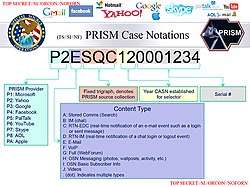
ภายใต้ โครงการ PRISMซึ่งเริ่มต้นในปี 2550 [ 104 ] [ 105 ] NSA รวบรวมการสื่อสารทางอินเทอร์เน็ตจากเป้าหมายต่างประเทศจากผู้ให้บริการการสื่อสารทางอินเทอร์เน็ตรายใหญ่ 9 รายของสหรัฐฯ ได้แก่Microsoft [ 106 ] Yahoo , Google , Facebook , PalTalk , AOL , Skype , YouTubeและAppleข้อมูลที่รวบรวมได้ประกอบด้วยอีเมล วิดีโอ รูปภาพ การสนทนา VoIPเช่น Skype และการถ่ายโอน ไฟล์
อดีตผู้อำนวยการใหญ่ NSA Keith Alexander อ้างว่าในเดือนกันยายน พ.ศ. 2552 NSA ได้ป้องกันไม่ให้Najibullah Zaziและเพื่อนๆ ของเขาก่อการร้าย[ 107 ]อย่างไรก็ตาม ไม่มีหลักฐานใดที่แสดงให้เห็นว่า NSA เคยมีบทบาทสำคัญในการป้องกันการก่อการร้าย[ 108 ] [ 109 ] [ 110 ] [ 111 ]
ฐานข้อมูล FASCIA
FASCIAเป็นฐานข้อมูลที่สร้างและใช้งานโดยสำนักงานความมั่นคงแห่งชาติของสหรัฐอเมริกา ซึ่งประกอบด้วยบันทึกตำแหน่งอุปกรณ์หลายล้านล้านรายการที่รวบรวมจากแหล่งต่างๆ[ 112 ]การมีอยู่ของมันถูกเปิดเผยในระหว่างการเปิดเผยการสอดแนมทั่วโลก ในปี 2013 โดยเอ็ดเวิร์ด สโนว์เดน[ 113 ]
ฐานข้อมูล FASCIA จัดเก็บข้อมูลหลายประเภท ได้แก่รหัสพื้นที่ตำแหน่ง (LACs), รหัสเสาสัญญาณ (CeLLIDs), ทะเบียนตำแหน่งผู้เยี่ยมชม (VLRs), หมายเลขประจำตัวอุปกรณ์สถานีเคลื่อนที่ระหว่างประเทศ (IMEIs) และMSISDNs (หมายเลขเครือข่ายดิจิทัลแบบบูรณาการบริการสมาชิกมือถือ) [ 112 ] [ 113 ]ในช่วงเวลาประมาณเจ็ดเดือน มีการรวบรวมและจัดเก็บข้อมูลตำแหน่งมากกว่า 27 เทราไบต์ในฐานข้อมูล[ 114 ]
โซลูชันเชิงพาณิชย์สำหรับข้อมูลลับ (CSfC)
โซลูชันเชิงพาณิชย์สำหรับข้อมูลลับ (CSfC) เป็นองค์ประกอบสำคัญของกลยุทธ์ด้านความปลอดภัยทางไซเบอร์เชิงพาณิชย์ของ NSA ผลิตภัณฑ์เชิงพาณิชย์ที่ผ่านการตรวจสอบโดย CSfC ได้รับการพิสูจน์แล้วว่าตรงตามข้อกำหนดด้านความปลอดภัยที่เข้มงวดสำหรับการปกป้องข้อมูลระบบความมั่นคงแห่งชาติ (NSS) ที่เป็นความลับ เมื่อได้รับการตรวจสอบแล้วกระทรวงกลาโหม (DoD)หน่วยงานข่าวกรอง กองทัพ และหน่วยงานรัฐบาลสหรัฐฯ อื่นๆ สามารถนำเทคโนโลยีฮาร์ดแวร์และซอฟต์แวร์เชิงพาณิชย์เหล่านี้ไปใช้ในโซลูชันการปกป้องข้อมูลและความปลอดภัยทางไซเบอร์ของตนได้[ 115 ]
ปฏิบัติการแฮ็ก
นอกจากวิธีการดักฟังแบบดั้งเดิมเพื่อรวบรวมข้อมูลข่าวกรองทางสัญญาณแล้ว NSA ยังมีส่วนร่วมในการแฮ็กคอมพิวเตอร์ สมาร์ทโฟน และเครือข่ายต่างๆ อีกด้วย หน่วยงานที่ดำเนินการดังกล่าวคือ หน่วยงาน Tailored Access Operations (TAO) ซึ่งดำเนินงานมาอย่างน้อยตั้งแต่ประมาณปี 1998 [ 116 ]
ตามที่ นิตยสาร Foreign Policy ระบุไว้ ว่า "...สำนักงานปฏิบัติการเข้าถึงเฉพาะทาง หรือ TAO ได้เจาะระบบคอมพิวเตอร์และโทรคมนาคมของจีนได้สำเร็จมาเกือบ 15 ปีแล้ว ทำให้เกิดข้อมูลข่าวกรองที่ดีที่สุดและน่าเชื่อถือที่สุดเกี่ยวกับสิ่งที่เกิดขึ้นภายในสาธารณรัฐประชาชนจีน" [ 117 ] [ 118 ]ในการสัมภาษณ์กับ นิตยสาร Wiredเอ็ดเวิร์ด สโนว์เดน กล่าวว่า แผนกปฏิบัติการเข้าถึงเฉพาะทางได้ทำให้เกิดการตัดสัญญาณอินเทอร์เน็ตของซีเรีย โดยไม่ได้ตั้งใจในปี 2012 [ 119 ]
โครงสร้างองค์กร

The NSA is led by the Director of the National Security Agency (DIRNSA), who also serves as Chief of the Central Security Service (CHCSS) and Commander of the United States Cyber Command (USCYBERCOM) and is the highest-ranking military official of these organizations. He is assisted by a Deputy Director, who is the highest-ranking civilian within the NSA/CSS. NSA also has an Inspector General, head of the Office of the Inspector General (OIG);[120] a General Counsel, head of the Office of the General Counsel (OGC); and a Director of Compliance, who is head of the Office of the Director of Compliance (ODOC).[121] The National Security Agency Office of Inspector General has worked on cases in collaboration with the United States Department of Justice and the Central Intelligence Agency Office of Inspector General.[122] Unlike other intelligence organizations such as the CIA or DIA, the NSA has always been particularly reticent concerning its internal organizational structure.
As of the mid-1990s, the National Security Agency was organized into five Directorates:
- The Operations Directorate, which was responsible for SIGINT collection and processing.
- The Technology and Systems Directorate, which develops new technologies for SIGINT collection and processing.
- The Information Systems Security Directorate, which was responsible for NSA's communications and information security missions.
- The Plans, Policy, and Programs Directorate, which provided staff support and general direction for the Agency.
- The Support Services Directorate, which provided logistical and administrative support activities.[123]
Each of these directorates consisted of several groups or elements, designated by a letter. There were for example the A Group, which was responsible for all SIGINT operations against the Soviet Union and Eastern Europe, and the G Group, which was responsible for SIGINT related to all non-communist countries. These groups were divided into units designated by an additional number, like unit A5 for breaking Soviet codes, and G6, being the office for the Middle East, North Africa, Cuba, and Central and South America.[124][125]
Directorates
As of 2013, NSA has about a dozen directorates, which are designated by a letter, although not all of them are publicly known.[126]
In the year 2000, a leadership team was formed consisting of the director, the deputy director, and the directors of the Signals Intelligence (SID), the Information Assurance (IAD) and the Technical Directorate (TD). The chiefs of other main NSA divisions became associate directors of the senior leadership team.[127] After President George W. Bush initiated the President's Surveillance Program (PSP) in 2001, the NSA created a 24-hour Metadata Analysis Center (MAC), followed in 2004 by the Advanced Analysis Division (AAD), with the mission of analyzing content, Internet metadata and telephone metadata. Both units were part of the Signals Intelligence Directorate.[128]
In 2016, a proposal combined the Signals Intelligence Directorate with the Information Assurance Directorate into a Directorate of Operations.[129]
NSANet

NSANet stands for National Security Agency Network and is the official NSA intranet.[130] It is a classified network,[131] for information up to the level of TS/SCI[132] to support the use and sharing of intelligence data between NSA and the signals intelligence agencies of the four other nations of the Five Eyes partnership. The management of NSANet has been delegated to the Central Security Service Texas (CSSTEXAS).[133]
NSANet เป็นเครือข่ายคอมพิวเตอร์ที่มีความปลอดภัยสูง ประกอบด้วยช่องทางการสื่อสารผ่านใยแก้วนำแสงและดาวเทียม ซึ่งแยกออกจากอินเทอร์เน็ตสาธารณะเกือบทั้งหมด เครือข่ายนี้อนุญาตให้บุคลากรของ NSA และนักวิเคราะห์ข่าวกรองพลเรือนและทหารทั่วโลกสามารถเข้าถึงระบบและฐานข้อมูลของหน่วยงานได้ การเข้าถึงนี้ถูกควบคุมและตรวจสอบอย่างเข้มงวด ตัวอย่างเช่น ทุกการกดแป้นพิมพ์จะถูกบันทึก กิจกรรมต่างๆ จะถูกตรวจสอบแบบสุ่ม และการดาวน์โหลดและการพิมพ์เอกสารจาก NSANet จะถูกบันทึกไว้[ 134 ]ในปี 1998 NSANet พร้อมกับNIPRNetและSIPRNetมี "ปัญหาสำคัญเกี่ยวกับความสามารถในการค้นหาที่ไม่ดี ข้อมูลที่ไม่เป็นระเบียบ และข้อมูลเก่า" [ 135 ]ในปี 2004 มีรายงานว่าเครือข่ายนี้ใช้ระบบปฏิบัติการเชิงพาณิชย์สำเร็จรูป มากกว่า 20 ระบบ [ 136 ]มหาวิทยาลัยบางแห่งที่ทำการวิจัยที่มีความละเอียดอ่อนสูงได้รับอนุญาตให้เชื่อมต่อกับเครือข่ายนี้[ 137 ] เอกสารลับสุดยอดภายใน NSA หลายพันฉบับที่ เอ็ดเวิร์ด สโนว์เดนนำไปในปี 2013 นั้นถูกเก็บไว้ใน "ตำแหน่งการแชร์ไฟล์บนเว็บไซต์อินทราเน็ตของ NSA" ดังนั้นเจ้าหน้าที่ NSA จึงสามารถอ่านเอกสารเหล่านั้นทางออนไลน์ได้อย่างง่ายดาย ทุกคนที่มีการอนุมัติระดับ TS/SCI สามารถเข้าถึงเอกสารเหล่านี้ได้ ในฐานะผู้ดูแลระบบ สโนว์เดนมีหน้าที่รับผิดชอบในการย้ายเอกสารที่มีความอ่อนไหวสูงซึ่งวางผิดที่โดยไม่ได้ตั้งใจไปยังสถานที่จัดเก็บที่ปลอดภัยกว่า[ 138 ]
ศูนย์เฝ้าระวัง
หน่วยงานความมั่นคงแห่งชาติ (NSA) มีศูนย์เฝ้าระวังอย่างน้อยสองแห่ง:
- ศูนย์ปฏิบัติการความมั่นคงแห่งชาติ (NSOC) เป็นศูนย์ปฏิบัติการปัจจุบันของ NSA และเป็นจุดศูนย์กลางสำหรับการรายงานข่าวกรองสัญญาณ (SIGINT) ที่ต้องดำเนินการอย่างเร่งด่วนสำหรับระบบข่าวกรองสัญญาณของสหรัฐอเมริกา (USSS) ศูนย์นี้ก่อตั้งขึ้นในปี 1968 ในชื่อศูนย์เฝ้าระวังข่าวกรองสัญญาณแห่งชาติ (NSWC) และเปลี่ยนชื่อเป็นศูนย์ปฏิบัติการข่าวกรองสัญญาณแห่งชาติ (NSOC) ในปี 1973 ศูนย์ "ศูนย์กลางประสาทของ NSA" แห่งนี้ได้รับชื่อปัจจุบันในปี 1996
- ศูนย์ปฏิบัติการภัยคุกคาม NSA/CSS (NTOC) ซึ่งเป็นพันธมิตรหลักของ NSA/CSS ใน การตอบสนองต่อเหตุการณ์ทางไซเบอร์ ของกระทรวงความมั่นคงแห่งชาติ NTOC สร้างความสามารถในการรับรู้เครือข่ายแบบเรียลไทม์และลักษณะภัยคุกคามเพื่อคาดการณ์ แจ้งเตือน และระบุแหล่งที่มาของกิจกรรมที่เป็นอันตราย และช่วยให้การประสานงานการปฏิบัติการเครือข่ายคอมพิวเตอร์เป็นไปได้ NTOC ก่อตั้งขึ้นในปี 2547 ในฐานะโครงการร่วมด้านการประกันข้อมูลและข่าวกรองสัญญาณ[ 139 ]
ตำรวจ NSA
NSA มีทีมบังคับใช้กฎหมายของตนเอง ซึ่งรู้จักกันในชื่อNSA Police (และเดิมชื่อNSA Security Protective Force ) ซึ่งให้บริการด้านการบังคับใช้กฎหมาย การตอบสนองเหตุฉุกเฉิน และการรักษาความปลอดภัยทางกายภาพแก่เจ้าหน้าที่และทรัพย์สินของตน[ 140 ]
ตำรวจ NSA เป็นเจ้าหน้าที่รัฐบาลกลางติดอาวุธ ตำรวจ NSA มีหน่วย K9 ซึ่งโดยทั่วไปจะทำการตรวจสอบการตรวจจับวัตถุระเบิดของจดหมาย ยานพาหนะ และสินค้าที่เข้ามาในพื้นที่ NSA [ 141 ]พวกเขาใช้ยานพาหนะที่มีเครื่องหมายเพื่อทำการลาดตระเวน[ 142 ]
พนักงาน
จำนวนพนักงานของ NSA เป็นความลับอย่างเป็นทางการ[ 4 ]แต่มีแหล่งข้อมูลหลายแห่งที่ให้การประมาณการ ในปี 1961 NSA มีพนักงานทหารและพลเรือน 59,000 คน ซึ่งเพิ่มขึ้นเป็น 93,067 คนในปี 1969 โดย 19,300 คนทำงานที่สำนักงานใหญ่ที่ฟอร์ตมีด ในช่วงต้นทศวรรษ 1980 NSA มีบุคลากรทหารและพลเรือนประมาณ 50,000 คน ในปี 1989 จำนวนนี้เพิ่มขึ้นอีกครั้งเป็น 75,000 คน โดย 25,000 คนทำงานที่สำนักงานใหญ่ของ NSA ระหว่างปี 1990 ถึง 1995 งบประมาณและกำลังคนของ NSA ถูกตัดลงหนึ่งในสาม ซึ่งนำไปสู่การสูญเสียประสบการณ์จำนวนมาก[ 143 ]
ในปี 2012 NSA กล่าวว่ามีพนักงานมากกว่า 30,000 คนทำงานที่ฟอร์ตมีดและสถานที่อื่นๆ[ 2 ]ในปี 2012 จอห์น ซี. อิงกลิสรองผู้อำนวยการ กล่าวติดตลกว่าจำนวนพนักงานทั้งหมดของ NSA นั้น "อยู่ระหว่าง 37,000 ถึง 1 พันล้านคน" [ 4 ]และระบุว่าหน่วยงานนี้ "น่าจะเป็นนายจ้างที่ใหญ่ที่สุดของคนเก็บตัว " [ 4 ]ในปี 2013 Der Spiegelระบุว่า NSA มีพนักงาน 40,000 คน[ 5 ]โดยทั่วไปแล้ว NSA ได้รับการอธิบายว่าเป็นนายจ้างรายเดียวที่ใหญ่ที่สุดในโลกของนักคณิตศาสตร์[ 144 ]พนักงาน NSA บางส่วนเป็นส่วนหนึ่งของกำลังคนของสำนักงานข่าวกรองแห่งชาติ (NRO) ซึ่งเป็นหน่วยงานที่ให้ ข้อมูลข่าวกรองสัญญาณดาวเทียมแก่ NSA ณ ปี 2013 มีผู้ดูแลระบบ ประมาณ 1,000 คน ทำงานให้กับ NSA [ 145 ]
การรักษาความปลอดภัยของบุคลากร
The NSA received criticism early on in 1960 after two agents had defected to the Soviet Union. Investigations by the House Un-American Activities Committee and a special subcommittee of the United States House Committee on Armed Services revealed severe cases of ignorance of personnel security regulations, prompting the former personnel director and the director of security to step down and leading to the adoption of stricter security practices.[146] Nonetheless, security breaches reoccurred only a year later when in an issue of Izvestia of July 23, 1963, a former NSA employee published several cryptologic secrets. The very same day, an NSA clerk-messenger committed suicide as ongoing investigations disclosed that he had sold secret information to the Soviets regularly. The reluctance of congressional houses to look into these affairs prompted a journalist to write, "If a similar series of tragic blunders occurred in any ordinary agency of Government an aroused public would insist that those responsible be officially censured, demoted, or fired." David Kahn criticized the NSA's tactics of concealing its doings as smug and the Congress' blind faith in the agency's right-doing as shortsighted and pointed out the necessity of surveillance by the Congress to prevent abuse of power.[146]
Edward Snowden's leaking of the existence of PRISM in 2013 caused the NSA to institute a "two-man rule", where two system administrators are required to be present when one accesses certain sensitive information.[145] Snowden claims he suggested such a rule in 2009.[147]
Polygraphing

NSA ดำเนิน การทดสอบ ด้วยเครื่องจับเท็จกับพนักงาน สำหรับพนักงานใหม่ การทดสอบนี้มีจุดประสงค์เพื่อค้นหาสายลับของศัตรูที่สมัครงานกับ NSA และเพื่อเปิดเผยข้อมูลใดๆ ที่อาจทำให้ผู้สมัครอ่อนข้อต่อการบีบบังคับ[ 148 ]ในส่วนหลังนี้ ในอดีตมีการรวมคำถาม ส่วนตัวที่น่าอับอายหรือ "คำถามส่วนตัวที่น่าอับอาย" เกี่ยวกับพฤติกรรมทางเพศไว้ในการทดสอบด้วยเครื่องจับเท็จของ NSA ด้วย [ 148 ] NSA ยังดำเนินการทดสอบด้วยเครื่องจับเท็จซ้ำเป็นระยะทุกๆ ห้าปีกับพนักงาน โดยเน้นที่โครงการต่อต้านข่าวกรอง นอกจากนี้ NSA ยังดำเนินการสอบสวนด้วยเครื่องจับเท็จเป็นระยะเพื่อค้นหาสายลับและผู้ปล่อยข้อมูลลับ ผู้ที่ปฏิเสธที่จะเข้ารับการทดสอบอาจได้รับ "การเลิกจ้าง" ตามบันทึกข้อความจากผู้อำนวยการ NSA ในปี 1982 [ 149 ]
นอกจากนี้ยังมีการทดสอบด้วยเครื่องจับเท็จแบบ "การเข้าถึงพิเศษ" สำหรับพนักงานที่ต้องการทำงานในพื้นที่ที่มีความอ่อนไหวสูง และการทดสอบด้วยเครื่องจับเท็จเหล่านั้นครอบคลุมคำถามเกี่ยวกับการต่อต้านข่าวกรองและคำถามเกี่ยวกับพฤติกรรมบางส่วน[ 149 ]โบรชัวร์ของ NSA ระบุว่าระยะเวลาการทดสอบโดยเฉลี่ยอยู่ระหว่างสองถึงสี่ชั่วโมง[ 150 ]รายงานปี 1983 ของสำนักงานประเมินเทคโนโลยีระบุว่า "ดูเหมือนว่า NSA [สำนักงานความมั่นคงแห่งชาติ] (และอาจรวมถึง CIA ด้วย) ใช้เครื่องจับเท็จไม่ใช่เพื่อตรวจสอบการโกหกหรือความจริงโดยตรง แต่เป็นเทคนิคการสอบสวนเพื่อกระตุ้นให้ยอมรับ" [ 151 ]บางครั้งผู้สมัครในกระบวนการทดสอบด้วยเครื่องจับเท็จสารภาพว่าได้กระทำความผิดร้ายแรง เช่น ฆาตกรรม ข่มขืน และขายยาเสพติด ระหว่างปี 1974 ถึง 1979 จากผู้สมัครงาน 20,511 คนที่เข้ารับการทดสอบด้วยเครื่องจับเท็จ มี 695 คน (3.4%) สารภาพว่าเคยกระทำความผิดร้ายแรงมาก่อน เกือบทั้งหมดของอาชญากรรมเหล่านั้นไม่ถูกตรวจพบ[ 148 ]
ในปี 2010 NSA ได้ผลิตวิดีโออธิบายกระบวนการตรวจจับโกหก[ 152 ]วิดีโอความยาวสิบนาทีนี้มีชื่อว่า "ความจริงเกี่ยวกับการตรวจจับโกหก" และถูกโพสต์ลงในเว็บไซต์ของหน่วยงานความมั่นคง แห่งกระทรวง กลาโหม เจฟฟ์ สไตน์ จากวอชิงตันโพสต์กล่าวว่า วิดีโอแสดงให้เห็น "ผู้สมัครหลายคน หรือนักแสดงที่รับบทเป็นพวกเขา—ไม่ชัดเจน—บรรยายถึงทุกสิ่งที่ไม่ดีที่พวกเขาเคยได้ยินเกี่ยวกับการทดสอบ โดยนัยคือไม่มีอะไรเป็นความจริงเลย" [ 153 ] AntiPolygraph.org โต้แย้งว่าวิดีโอที่ NSA ผลิตขึ้นนั้นละเว้นข้อมูลบางอย่างเกี่ยวกับกระบวนการตรวจจับโกหก และได้ผลิตวิดีโอตอบโต้กับวิดีโอของ NSA [ 152 ] [ 154 ]จอร์จ มาสช์เค ผู้ก่อตั้งเว็บไซต์ กล่าวหาว่าวิดีโอตรวจจับโกหกของ NSA นั้นเป็น " แบบออร์เวลล์ " [ 153 ]
ในปี 2013 บทความหนึ่งระบุว่าหลังจากที่เอ็ดเวิร์ด สโนว์เดนเปิดเผยตัวตนของเขาในปี 2013 NSA ได้เริ่มกำหนดให้พนักงานต้องเข้ารับการทดสอบด้วยเครื่องจับเท็จไตรมาสละครั้ง[ 155 ]
การไล่ออกโดยพลการ
จำนวนการยกเว้นจากข้อกำหนดทางกฎหมายได้รับการวิพากษ์วิจารณ์ เมื่อปี 1964 รัฐสภากำลังพิจารณาร่างกฎหมายที่ให้อำนาจผู้อำนวยการ NSA ในการไล่พนักงานออกได้ตามอำเภอใจหนังสือพิมพ์ The Washington Postเขียนว่า "นี่คือคำจำกัดความของการใช้อำนาจตามอำเภอใจอย่างแท้จริง หมายความว่าพนักงานอาจถูกไล่ออกและเสื่อมเสียชื่อเสียงโดยอาศัยข้อกล่าวหาที่ไม่ระบุชื่อโดยไม่มีโอกาสแม้แต่น้อยที่จะแก้ต่างให้ตัวเอง" อย่างไรก็ตาม ร่างกฎหมายดังกล่าวได้รับการยอมรับด้วยเสียงข้างมากอย่างท่วมท้น[ 146 ]นอกจากนี้ ทุกคนที่ได้รับการว่าจ้างให้ทำงานในสหรัฐอเมริกาหลังปี 2007 ในองค์กรเอกชน หน่วยงานของรัฐ หรือหน่วยงานของรัฐบาลกลางจะต้องถูกรายงานไปยังทะเบียนผู้ได้รับการว่าจ้างใหม่ โดยอ้างว่าเพื่อตรวจสอบ ผู้หลีกเลี่ยงการจ่ายค่าเลี้ยงดูบุตรยกเว้นพนักงานของหน่วยงานข่าวกรองที่อาจได้รับการยกเว้นจากการรายงานหากผู้อำนวยการเห็นว่าจำเป็นด้วยเหตุผลด้านความมั่นคงแห่งชาติ[ 156 ]
สิ่งอำนวยความสะดวก
สำนักงานใหญ่
ประวัติความเป็นมาของสำนักงานใหญ่

เมื่อหน่วยงานนี้ก่อตั้งขึ้นครั้งแรก สำนักงานใหญ่และศูนย์การเข้ารหัสอยู่ที่สถานีรักษาความปลอดภัยทางทะเลในวอชิงตัน ดี.ซี. ส่วนหน้าที่ COMINT นั้นตั้งอยู่ที่Arlington Hallในเวอร์จิเนียตอนเหนือซึ่งทำหน้าที่เป็นสำนักงานใหญ่ของการปฏิบัติการเข้ารหัสของกองทัพบกสหรัฐฯ[ 157 ]เนื่องจากสหภาพโซเวียตได้ทดลองระเบิดนิวเคลียร์ และเนื่องจากสถานที่นั้นแออัด รัฐบาลกลางจึงต้องการย้ายหน่วยงานหลายแห่ง รวมถึง AFSA/NSA คณะกรรมการวางแผนได้พิจารณาFort Knoxแต่ ในที่สุดก็เลือก Fort Meadeรัฐแมริแลนด์เป็นสำนักงานใหญ่ของ NSA เนื่องจากอยู่ห่างจากวอชิงตัน ดี.ซี. มากพอในกรณีที่มีการโจมตีด้วยนิวเคลียร์ และอยู่ใกล้พอที่พนักงานจะไม่ต้องย้ายครอบครัว[ 158 ]
การก่อสร้างอาคารเพิ่มเติมเริ่มขึ้นหลังจากที่หน่วยงานเข้าครอบครองอาคารที่ฟอร์ตมีดในช่วงปลายทศวรรษ 1950 ซึ่งในไม่ช้าก็คับแคบเกินไป[ 158 ]ในปี 1963 อาคารสำนักงานใหญ่แห่งใหม่สูงเก้าชั้นได้เปิดทำการ พนักงาน NSA เรียกอาคารนี้ว่า "อาคารสำนักงานใหญ่" และเนื่องจากฝ่ายบริหารของ NSA อยู่ชั้นบนสุด พนักงานจึงใช้คำว่า "ชั้นเก้า" เพื่ออ้างถึงผู้นำของพวกเขา[ 159 ] COMSEC ยังคงอยู่ในวอชิงตัน ดี.ซี. จนกระทั่งอาคารใหม่สร้างเสร็จในปี 1968 [ 158 ]ในเดือนกันยายน 1986 อาคารปฏิบัติการ 2A และ 2B ซึ่งทั้งสองหลังหุ้มด้วยทองแดงเพื่อป้องกันการดักฟังได้เปิดทำการโดยมีประธานาธิบดีโรนัลด์ เรแกน เป็นผู้ทำพิธี เปิด[ 160 ]อาคาร NSA ทั้งสี่หลังเป็นที่รู้จักกันในชื่อ "บิ๊กโฟร์" [ 160 ]ผู้อำนวยการ NSA ย้ายไปอยู่ที่อาคาร 2B เมื่อเปิดทำการ[ 160 ]

สำนักงานใหญ่ของสำนักงานความมั่นคงแห่งชาติ (NSA) ตั้งอยู่ที่ละติจูด 39°6′32″N ลองจิจูด 76°46′17″Wในฟอร์ตจอร์จ จี. มีดรัฐแมริแลนด์แม้ว่าจะแยกออกจากพื้นที่และหน่วยงานอื่นๆ ที่ตั้งอยู่ภายในฐานทัพเดียวกันนี้ก็ตาม ฟอร์ตมีดอยู่ห่างจากบัลติมอร์ไป ทางตะวันตกเฉียงใต้ประมาณ 20 ไมล์ (32 กิโลเมตร) [ 161 ]และห่างจากวอชิงตัน ดี.ซี. ไปทางตะวันออกเฉียงเหนือประมาณ 25 ไมล์ (40 กิโลเมตร) [ 162 ] NSA มีทางออกเฉพาะสองทางจากถนนบัลติมอร์-วอชิงตัน พาร์คเวย์ทางออกฝั่งตะวันออกจากพาร์คเวย์ (มุ่งหน้าไปยังบัลติมอร์) เปิดให้ประชาชนทั่วไปใช้ได้ และให้พนักงานเข้าถึงวิทยาเขตหลักและประชาชนเข้าถึงพิพิธภัณฑ์การเข้ารหัสแห่งชาติได้ ทางออกฝั่งตะวันตก (มุ่งหน้าไปยังวอชิงตัน) มีป้ายกำกับว่า "เฉพาะพนักงาน NSA เท่านั้น" [ 163 ] [ 164 ]ทางออกนี้สามารถใช้ได้เฉพาะผู้ที่มีสิทธิ์เท่านั้น และมีรถรักษาความปลอดภัยจอดอยู่ริมถนนคอยเฝ้าทางเข้า[ 165 ] / 39.10889°N 76.77139°W
NSA เป็นนายจ้างรายใหญ่ที่สุดในรัฐแมริแลนด์ และบุคลากรสองในสามทำงานที่ฟอร์ตมีด[ 166 ]สร้างขึ้นบนพื้นที่ 350 เอเคอร์ (140 เฮกตาร์; 0.55 ตารางไมล์) [ 167 ]จากพื้นที่ทั้งหมด 5,000 เอเคอร์ (2,000 เฮกตาร์; 7.8 ตารางไมล์) ของฟอร์ตมีด[ 168 ]สถานที่แห่งนี้มีอาคาร 1,300 หลัง และที่จอดรถประมาณ 18,000 คัน[ 162 ] [ 169 ]

อาคารสำนักงานใหญ่และปฏิบัติการหลักของ NSA คือสิ่งที่เจมส์ แบมฟอร์ดผู้เขียนหนังสือBody of Secretsอธิบายว่าเป็น "โครงสร้างทรงกล่องที่ทันสมัย" ซึ่งดูคล้ายกับ "อาคารสำนักงานที่มีสไตล์" [ 170 ]อาคารนี้ถูกปกคลุมด้วยกระจกสีเข้มแบบมองเห็นได้ทางเดียว ซึ่งบุด้วยแผ่นทองแดงเพื่อป้องกันการสอดแนมโดยการดักจับสัญญาณและเสียง[ 170 ]มีพื้นที่ใช้สอย 3,000,000 ตารางฟุต (280,000 ตารางเมตร)หรือมากกว่า 68 เอเคอร์ (28 เฮกตาร์) แบมฟอร์ดกล่าวว่าอาคารรัฐสภาสหรัฐฯ "สามารถเข้าไปอยู่ในนั้นได้ถึงสี่เท่าอย่างง่ายดาย" [ 170 ]
The facility has over 100 watchposts,[171] one of them being the visitor control center, a two-story area that serves as the entrance.[170] At the entrance, a white pentagonal structure,[172] visitor badges are issued to visitors and security clearances of employees are checked.[173] The visitor center includes a painting of the NSA seal.[172]
The OPS2A building, the tallest building in the NSA complex and the location of much of the agency's operations directorate is accessible from the visitor center. Bamford described it as a "dark glass Rubik's Cube".[174] The facility's "red corridor" houses non-security operations such as concessions and the drug store. The name refers to the "red badge" which is worn by someone without a security clearance. The NSA headquarters includes a cafeteria, a credit union, ticket counters for airlines and entertainment, a barbershop, and a bank.[172] NSA headquarters has its own post office, fire department, and police force.[175][176][177]
The employees at the NSA headquarters reside in various places in the Baltimore-Washington area, including Annapolis, Baltimore, and Columbia in Maryland and the District of Columbia, including the Georgetown community.[178] The NSA maintains a shuttle service from the Odenton station of MARC to its Visitor Control Center and has done so since 2005.[179]
Energy consumption

Following a major power outage in 2000, in 2003, and follow-ups through 2007, The Baltimore Sun reported that the NSA was at risk of electrical overload because of insufficient internal electrical infrastructure at Fort Meade to support the amount of equipment being installed. This problem was apparently recognized in the 1990s but not made a priority, and "now the agency's ability to keep its operations going is threatened."[180]
เมื่อวันที่ 6 สิงหาคม พ.ศ. 2549 หนังสือพิมพ์ Baltimore Sunรายงานว่า NSA ใช้ไฟฟ้าเต็มกำลังแล้ว และ Baltimore Gas & Electric (BGE ซึ่งปัจจุบันคือConstellation Energy ) ไม่สามารถขายไฟฟ้าเพิ่มให้พวกเขาได้อีก[ 181 ] NSA จึงตัดสินใจย้ายการดำเนินงานบางส่วนไปยังศูนย์ดาวเทียมแห่งใหม่ BGE จัดหาไฟฟ้าให้ NSA จำนวน 65 ถึง 75 เมกะวัตต์ที่ Fort Meade ในปี พ.ศ. 2550 และคาดว่าจะต้องเพิ่มไฟฟ้าอีก 10 ถึง 15 เมกะวัตต์ในภายหลังในปีนั้น[ 182 ]ในปี พ.ศ. 2554 NSA เป็นผู้บริโภคไฟฟ้ารายใหญ่ที่สุดของรัฐแมริแลนด์[ 166 ]ในปี พ.ศ. 2550 ในฐานะลูกค้ารายใหญ่ที่สุดของ BGE NSA ซื้อไฟฟ้ามากเท่ากับ เมือง แอนนาโพลิสเมืองหลวงของรัฐแมริแลนด์[ 180 ]มีการประมาณการว่าศักยภาพในการใช้พลังงานของศูนย์ข้อมูลยูทาห์ แห่งใหม่มีมูลค่า ถึง40 ล้านดอลลาร์สหรัฐ ต่อปี [ 183 ]
สินทรัพย์คอมพิวเตอร์
ในปี 1995 หนังสือพิมพ์ Baltimore Sunรายงานว่า NSA เป็นเจ้าของกลุ่มซูเปอร์คอมพิวเตอร์ที่ ใหญ่ที่สุด [ 184 ] NSA ได้จัดพิธีวางศิลาฤกษ์ที่ Fort Meade ในเดือนพฤษภาคม 2013 สำหรับศูนย์ประมวลผลประสิทธิภาพสูง 2 ซึ่งคาดว่าจะเปิดทำการในปี 2016 [ 185 ]ศูนย์แห่งนี้เรียกว่า Site M มีสถานีไฟฟ้าย่อยขนาด 150 เมกะวัตต์ อาคารบริหาร 14 หลัง และโรงจอดรถ 10 แห่ง[ 175 ]มีค่าใช้จ่าย 3.2 พันล้านดอลลาร์ และครอบคลุมพื้นที่ 227 เอเคอร์ (92 เฮกตาร์; 0.355 ตารางไมล์) [ 175 ]ศูนย์แห่งนี้มีพื้นที่ 1,800,000 ตารางฟุต (17 เฮกตาร์; 0.065 ตารางไมล์) [ 175 ]และเริ่มต้นใช้ไฟฟ้า 60 เมกะวัตต์[ 186 ]คาดว่าโครงการระยะที่ II และ III จะแล้วเสร็จภายในปี 2030 และจะเพิ่มพื้นที่เป็นสี่เท่า ครอบคลุมพื้นที่ 5,800,000 ตารางฟุต (54 เฮกตาร์; 0.21 ตารางไมล์) พร้อมอาคาร 60 หลังและโรงจอดรถ 40 แห่ง[ 175 ]ผู้รับเหมาด้านการป้องกันประเทศกำลังจัดตั้งหรือขยาย สิ่งอำนวยความสะดวก ด้านความปลอดภัยทาง ไซเบอร์ ใกล้กับ NSA และรอบๆเขตมหานครวอชิงตัน[ 175 ]
ศูนย์ความปลอดภัยคอมพิวเตอร์แห่งชาติ
The DoD Computer Security Center was founded in 1981 and renamed the National Computer Security Center (NCSC) in 1985. NCSC was responsible for computer security throughout the federal government.[187] NCSC was part of NSA,[188] and during the late 1980s and the 1990s, NSA and NCSC published Trusted Computer System Evaluation Criteria in a six-foot high Rainbow Series of books that detailed trusted computing and network platform specifications.[189] The Rainbow books were replaced by the Common Criteria, however, in the early 2000s.[189]
Other facilities


NSA had facilities at Friendship Annex (FANX) in Linthicum, Maryland, which is a 20 to 25-minute drive from Fort Meade;[190] the Aerospace Data Facility at Buckley Space Force Base in Aurora, Colorado; NSA Texas in the Texas Cryptology Center at Lackland Air Force Base in San Antonio, Texas; NSA Georgia, Georgia Cryptologic Center, Fort Gordon, Augusta, Georgia; NSA Hawaii, Hawaii Cryptologic Center in Honolulu; the Multiprogram Research Facility in Oak Ridge, Tennessee, and elsewhere.[178][183]
In 2009, to protect its assets and access more electricity, NSA sought to decentralize and expand its existing facilities in Fort Meade and Menwith Hill,[191] the latter expansion expected to be completed by 2015.[192]
On January 6, 2011, a groundbreaking ceremony was held to begin construction on the NSA's first Comprehensive National Cyber-security Initiative (CNCI) Data Center, known as the "Utah Data Center" for short. The $1.5B data center is being built at Camp Williams, Utah, located 25 miles (40 km) south of Salt Lake City, and will help support the agency's National Cyber-security Initiative.[193] It is expected to be operational by September 2013.[183] Construction of Utah Data Center finished in May 2019.[194]
In 2012, NSA collected intelligence from four geostationary satellites.[183] Satellite receivers were at Roaring Creek Station in Catawissa, Pennsylvania and Salt Creek Station in Arbuckle, California.[183] It operated ten to twenty taps on U.S. telecom switches. NSA had installations in several U.S. states and from them observed intercepts from Europe, the Middle East, North Africa, Latin America, and Asia.[183] The Yakima Herald-Republic cited Bamford, saying that many of NSA's bases for its Echelon program were a legacy system, using outdated, 1990s technology.[62] In 2004, NSA closed its operations at Bad Aibling Station (Field Station 81) in Bad Aibling, Germany.[195] In 2012, NSA began to move some of its operations at Yakima Research Station, Yakima Training Center, in Washington state to Colorado, planning to leave Yakima closed.[196] During 2013, NSA also intended to close operations at Sugar Grove, West Virginia.[62]
Global stations

Following the[197]UKUSA Agreement between the Five Eyes that cooperated on signals intelligence and ECHELON,[198] NSA stations were built at GCHQ Bude in Morwenstow, United Kingdom; Geraldton, Pine Gap and Shoal Bay, Australia; Leitrim and Ottawa, Ontario, Canada; Misawa, Japan; and Waihopai and Tangimoana,[199] New Zealand.[200]
NSA ดำเนินการฐานทัพอากาศ RAF Menwith Hillในนอร์ทยอร์กเชียร์ สหราชอาณาจักร ซึ่งตามรายงานของBBC Newsในปี 2550 ถือเป็นสถานีตรวจสอบอิเล็กทรอนิกส์ที่ใหญ่ที่สุดในโลก[ 201 ]ฐานทัพแห่งนี้ได้รับการวางแผนในปี 2497 และเปิดทำการในปี 2503 โดยมีพื้นที่ครอบคลุม 562 เอเคอร์ (227 เฮกตาร์; 0.878 ตารางไมล์) ในปี 2542 [ 202 ]ศูนย์การเข้ารหัสลับแห่งยุโรป (ECC) ของหน่วยงานซึ่งมีพนักงาน 240 คนในปี 2554 มีสำนักงานใหญ่ตั้งอยู่ที่ค่ายทหารสหรัฐฯ ในเมืองกรีสไฮม์ใกล้กับ แฟรง ก์เฟิร์ตประเทศเยอรมนี รายงานของ NSA ในปี 2554 ระบุว่า ECC รับผิดชอบ "การวิเคราะห์และผลิตผลที่ใหญ่ที่สุดในยุโรป" และมุ่งเน้นไปที่ลำดับความสำคัญต่างๆ รวมถึงแอฟริกา ยุโรป ตะวันออกกลาง และปฏิบัติการต่อต้านการก่อการร้าย[ 203 ]
ตั้งแต่ช่วงกลางทศวรรษ 1980 NSA และสำนักงานความมั่นคงแห่งชาติ ของไต้หวันได้ร่วมกันดำเนินการ สถานีดักฟังข่าวกรองสัญญาณ (SIGINT) ที่หยางหมิงซาน[ 204 ] [ 205 ] [ 206 ]
ในปี 2013 ศูนย์ข่าวกรองรวมแห่งใหม่ ซึ่ง NSA จะใช้ด้วยเช่นกัน กำลังถูกสร้างขึ้นที่สำนักงานใหญ่ของกองทัพบกสหรัฐฯ ในยุโรปที่เมืองวิสบาเดนประเทศเยอรมนี[ 207 ]ความร่วมมือระหว่าง NSA กับBundesnachrichtendienst (BND) หน่วยข่าวกรองต่างประเทศของเยอรมนี ได้รับการยืนยันโดย เกอร์ฮาร์ด ชินด์เลอร์ประธานBND [ 207 ]
ประเทศไทย
ประเทศไทยเป็น "พันธมิตรบุคคลที่สาม" ของ NSA ร่วมกับอีกเก้าประเทศ[ 208 ]ประเทศเหล่านี้เป็นประเทศที่ไม่ใช้ภาษาอังกฤษซึ่งได้ทำข้อตกลงด้านความมั่นคงเพื่อแลกเปลี่ยนข้อมูลดิบ SIGINT และรายงานผลิตภัณฑ์ขั้นสุดท้าย ประเทศไทยเป็นที่ตั้งของสถานีรวบรวมข้อมูล SIGINT ของสหรัฐฯ อย่างน้อยสองแห่ง แห่งหนึ่งอยู่ที่สถานทูตสหรัฐฯในกรุงเทพฯซึ่งเป็นหน่วยงานบริการรวบรวมข้อมูลพิเศษร่วม (JSCS) ของ NSA- CIAคาดว่าหน่วยงานนี้จะดักฟังสถานกงสุลต่างประเทศ สถานทูต การสื่อสารของรัฐบาล และเป้าหมายอื่นๆ ที่มีโอกาส[ 209 ]
สถานีที่สองคือสถานี FORNSAT (การดักฟังดาวเทียมต่างประเทศ) ในเมืองขอนแก่น ประเทศไทย มีชื่อรหัสว่า INDRA แต่ก็ถูกเรียกอีกชื่อหนึ่งว่า LEMONWOOD [ 209 ]สถานีนี้มีขนาดประมาณ 40 เฮกตาร์ (99 เอเคอร์) ประกอบด้วยอาคารปฏิบัติการขนาดใหญ่ 3,700–4,600 ตารางเมตร( 40,000–50,000 ตารางฟุต)ทางด้านตะวันตกของพื้นที่ปฏิบัติการ และเสาอากาศพาราโบลา แบบมี โดมครอบ 4 ต้น อาจมีเสาอากาศแบบมีโดมครอบ 2 ต้นที่ใช้สำหรับการดักฟัง SATCOM และอีก 2 ต้นใช้สำหรับการส่งต่อข้อมูลที่ดักฟังได้กลับไปยัง NSA นอกจากนี้ยังมีเสาอากาศแบบวงกลม (CDAA) ชนิด PUSHER อยู่ทางเหนือของพื้นที่ปฏิบัติการด้วย[ 210 ] [ 211 ] NSA เปิดใช้งานขอนแก่นในเดือนตุลาคม พ.ศ. 2522 ภารกิจของฐานนี้คือการดักฟังการสื่อสารทางวิทยุของ หน่วยทหารบก และกองทัพอากาศจีนในภาคใต้ของจีน โดยเฉพาะในและรอบ ๆ เมืองคุนหมิงใน มณฑล ยูนนานในช่วงปลายทศวรรษ พ.ศ. 2513 ฐานนี้ประกอบด้วยเสาอากาศ CDAA ขนาดเล็กที่ควบคุมจากระยะไกลผ่านดาวเทียมจากสถานีรับฟังของ NSA ที่เมืองคูเนีย รัฐฮาวายและกองกำลังผู้รับเหมาพลเรือนขนาดเล็กจากบริษัท Bendix Field Engineering Corp.ซึ่งมีหน้าที่ดูแลรักษาเสาอากาศและสิ่งอำนวยความสะดวกในการถ่ายทอดสัญญาณดาวเทียมให้ใช้งานได้ตลอด 24 ชั่วโมง 7 วันต่อสัปดาห์[ 210 ]ตามเอกสารของพลเอกวิลเลียม โอโดม ผู้ล่วงลับไปแล้ว สิ่งอำนวยความสะดวก INDRA ได้รับการปรับปรุงในปี พ.ศ. 2529 ด้วยเสาอากาศ CDAA PUSHER ที่ผลิตในอังกฤษใหม่ ซึ่งเป็นส่วนหนึ่งของการปรับปรุงโดยรวมของสิ่งอำนวยความสะดวก SIGINT ของ NSA และไทย ซึ่งมีวัตถุประสงค์เพื่อสอดแนมประเทศคอมมิวนิสต์เพื่อนบ้านอย่างเวียดนาม ลาว และกัมพูชา[ 210 ]ฐานทัพแห่งนี้ทรุดโทรมลงในช่วงทศวรรษ 1990 เนื่องจากจีนและเวียดนามเป็นมิตรกับสหรัฐฯ มากขึ้น และในปี 2002 ภาพถ่ายดาวเทียมที่เก็บถาวรแสดงให้เห็นว่าเสาอากาศ PUSHER CDAA ถูกรื้อถอน ซึ่งอาจบ่งชี้ว่าฐานทัพแห่งนี้ได้ปิดตัวลงแล้ว ในช่วงเวลาใดเวลาหนึ่งนับตั้งแต่เหตุการณ์9/11ฐานทัพขอนแก่นได้รับการเปิดใช้งานอีกครั้งและขยายให้ครอบคลุมภารกิจการดักฟัง SATCOM ขนาดใหญ่ เป็นไปได้ว่าการมีอยู่ของ NSA ที่ขอนแก่นมีขนาดค่อนข้างเล็ก และงานส่วนใหญ่ดำเนินการโดยผู้รับเหมาพลเรือน[ 210 ]
การวิจัยและพัฒนา
NSA มีส่วนร่วมในการอภิปรายเกี่ยวกับนโยบายสาธารณะ ทั้งทางอ้อมในฐานะที่ปรึกษาเบื้องหลังให้กับหน่วยงานอื่น ๆ และโดยตรงในช่วงและหลังจาก การดำรงตำแหน่ง ผู้อำนวยการของพลเรือโท บ็อบบี้ เรย์ อินแมน NSA เป็นผู้เล่นหลักในการอภิปรายในช่วงทศวรรษ 1990 เกี่ยวกับการส่งออกการเข้ารหัสในสหรัฐอเมริกาข้อจำกัดในการส่งออกลดลงแต่ไม่ได้ถูกยกเลิกในปี 1996 งานด้านการสื่อสารของรัฐบาลที่ปลอดภัยของ NSA ทำให้ NSA มีส่วนร่วมในด้านเทคโนโลยีมากมาย รวมถึงการออกแบบฮาร์ดแวร์และซอฟต์แวร์การสื่อสารเฉพาะทาง การผลิตเซมิคอนดักเตอร์ เฉพาะ ที่ โรงงานผลิตชิป Ft. Meadeและ การวิจัย การเข้ารหัส ขั้นสูง เป็นเวลา 50 ปีที่ NSA ออกแบบและสร้างอุปกรณ์คอมพิวเตอร์ส่วนใหญ่ด้วยตนเอง แต่ตั้งแต่ทศวรรษ 1990 จนถึงประมาณปี 2003 (เมื่อรัฐสภาสหรัฐฯ จำกัดการปฏิบัติดังกล่าว) หน่วยงานได้ทำสัญญากับภาคเอกชนในด้านการวิจัยและอุปกรณ์[ 212 ]
มาตรฐานการเข้ารหัสข้อมูล

NSA เข้าไปพัวพันกับข้อโต้แย้งบางประการเกี่ยวกับการมีส่วนร่วมในการสร้างมาตรฐานการเข้ารหัสข้อมูล (DES) ซึ่งเป็นมาตรฐานและอัลกอริทึมการเข้ารหัสแบบบล็อก สาธารณะที่ รัฐบาลสหรัฐฯและชุมชนธนาคารใช้[ 213 ]ในระหว่างการพัฒนา DES โดยIBMในช่วงทศวรรษ 1970 NSA ได้แนะนำให้เปลี่ยนแปลงรายละเอียดบางอย่างของการออกแบบ มีข้อสงสัยว่าการเปลี่ยนแปลงเหล่านี้ทำให้ประสิทธิภาพของอัลกอริทึมลดลงมากพอที่จะทำให้หน่วยงานสามารถดักฟังได้หากจำเป็น รวมถึงการคาดการณ์ว่าส่วนประกอบที่สำคัญ—ที่เรียกว่าS-boxes—ได้รับการเปลี่ยนแปลงเพื่อแทรก " ช่องโหว่ " และการลดความยาวของคีย์อาจทำให้ NSA สามารถค้นหาคีย์ DES ได้โดยใช้พลังการประมวลผลมหาศาล ต่อมาได้มีการสังเกตว่า S-boxes ใน DES มีความยืดหยุ่นเป็นพิเศษต่อการวิเคราะห์การเข้ารหัสแบบดิฟเฟอ เรนเชียล ซึ่งเป็นเทคนิคที่ไม่ได้ถูกค้นพบอย่างเป็นทางการจนกระทั่งปลายทศวรรษ 1980 แต่เป็นที่รู้จักของทีม IBM DES
มาตรฐานการเข้ารหัสขั้นสูง
การมีส่วนร่วมของ NSA ในการเลือกมาตรฐานการเข้ารหัสข้อมูลขั้นสูง (AES) ซึ่งเป็นมาตรฐานที่สืบทอดต่อจาก DES นั้นจำกัดอยู่เพียง การ ทดสอบประสิทธิภาพของฮาร์ดแวร์[ 214 ]ต่อมา NSA ได้รับรอง AES สำหรับการปกป้องข้อมูลลับเมื่อใช้ในระบบที่ NSA อนุมัติ[ 215 ]
ระบบการเข้ารหัสของ NSA

หน่วยงาน NSA มีหน้าที่รับผิดชอบส่วนประกอบที่เกี่ยวข้องกับการเข้ารหัสในระบบเก่าเหล่านี้:
- FNBDT Future Narrow Band Digital Terminal [ 216 ]
- เครื่องเข้ารหัสโรเตอร์แบบออฟไลน์KL-7 ADONIS (หลังสงครามโลกครั้งที่ 2 – ทศวรรษ 1980) [ 217 ] [ 218 ]
- เครื่องเข้ารหัสโทรเลขอิเล็กทรอนิกส์แบบอินไลน์ KW-26 ROMULUS (ช่วงปี 1960–1980) [ 219 ]
- KW-37 JASON ฟลีตออกอากาศเข้ารหัส (1960s-1990s) [ 218 ]
- เครื่องเข้ารหัสเสียงวิทยุยุทธวิธีKY-57 VINSON [ 219 ]
- KG-84การเข้ารหัส/ถอดรหัสข้อมูลเฉพาะ[ 219 ]
- หน่วยโทรศัพท์ที่ปลอดภัยSTU-III [ 219 ]ถูกยกเลิกโดยSTE [ 220 ]
หน่วยงาน NSA กำกับดูแลการเข้ารหัสในระบบต่างๆ ที่ใช้งานอยู่ในปัจจุบัน ดังต่อไปนี้:
- EKMSระบบจัดการกุญแจอิเล็กทรอนิกส์[ 221 ]
- การเข้ารหัส Fortezzaขึ้นอยู่กับโทเค็นเข้ารหัสแบบพกพาในรูปแบบPC Card [ 222 ]
- วิทยุยุทธวิธี SINCGARSพร้อมการกระโดดความถี่ที่ควบคุมด้วยการเข้ารหัส[ 223 ]
- อุปกรณ์เทอร์มินัลที่ปลอดภัยSTE [ 220 ]
- กลุ่มผลิตภัณฑ์TACLANE โดย General Dynamics C4 Systems [ 224 ]
NSA ได้กำหนด ชุดอัลกอริธึมการเข้ารหัส Suite AและSuite Bที่จะใช้ในระบบของรัฐบาลสหรัฐฯ โดยอัลกอริธึม Suite B เป็นส่วนย่อยของอัลกอริธึมที่NIST กำหนดไว้ก่อนหน้านี้ และคาดว่าจะใช้เพื่อวัตถุประสงค์ในการปกป้องข้อมูลส่วนใหญ่ ในขณะที่อัลกอริธึม Suite A เป็นความลับและมีจุดประสงค์เพื่อการปกป้องในระดับสูงเป็นพิเศษ[ 215 ]
ชา
ฟังก์ชันแฮช SHA-1และSHA-2ที่ใช้กันอย่างแพร่หลายได้รับการออกแบบโดย NSA SHA-1 เป็นการดัดแปลงเล็กน้อยของ อัลกอริธึม SHA-0 ที่อ่อนแอกว่า ซึ่งออกแบบโดย NSA ในปี 1993 การดัดแปลงเล็กน้อยนี้ได้รับการแนะนำโดย NSA สองปีต่อมา โดยไม่มีเหตุผลอื่นใดนอกจากข้อเท็จจริงที่ว่ามันให้ความปลอดภัยเพิ่มเติม การโจมตี SHA-0 ที่ไม่สามารถนำไปใช้กับอัลกอริธึมที่แก้ไขแล้วนั้นถูกค้นพบระหว่างปี 1998 ถึง 2005 โดยนักวิทยาการเข้ารหัสลับทางวิชาการ เนื่องจากจุดอ่อนและข้อจำกัดความยาวของคีย์ใน SHA-1 NIST จึงยกเลิกการใช้งานสำหรับลายเซ็นดิจิทัลและอนุมัติเฉพาะอัลกอริธึม SHA-2 ที่ใหม่กว่าสำหรับการใช้งานดังกล่าวตั้งแต่ปี 2013 เป็นต้นไป[ 225 ]
มาตรฐานแฮชใหม่SHA-3ได้รับการคัดเลือกเมื่อเร็ว ๆ นี้ผ่านการแข่งขันที่สิ้นสุดลงเมื่อวันที่ 2 ตุลาคม 2555 โดยมีการเลือกKeccakเป็นอัลกอริทึม กระบวนการคัดเลือก SHA-3 คล้ายกับกระบวนการคัดเลือก AES แต่มีข้อสงสัยบางประการเกิดขึ้น[ 226 ] [ 227 ]เนื่องจากมีการปรับเปลี่ยนพื้นฐานของ Keccak เพื่อให้กลายเป็นมาตรฐาน[ 228 ]การเปลี่ยนแปลงเหล่านี้อาจบั่นทอนการวิเคราะห์การเข้ารหัสที่ดำเนินการระหว่างการแข่งขันและลดระดับความปลอดภัยของอัลกอริทึม[ 226 ]
ชิปคลิปเปอร์
เนื่องจากความกังวลว่าการใช้การเข้ารหัสที่แข็งแกร่งอย่างแพร่หลายจะขัดขวางการใช้การดักฟัง ของรัฐบาล NSA จึงเสนอแนวคิดเรื่องการเก็บรักษากุญแจ (key escrow)ในปี 1993 และแนะนำชิป Clipper ซึ่งจะให้การป้องกันที่แข็งแกร่งกว่า DES แต่จะอนุญาตให้เจ้าหน้าที่บังคับใช้กฎหมายที่ได้รับอนุญาตเข้าถึงข้อมูลที่เข้ารหัสได้[ 229 ]ข้อเสนอดังกล่าวได้รับการคัดค้านอย่างรุนแรง และข้อกำหนดการเก็บรักษากุญแจก็ไม่ได้ถูกนำไปใช้ในที่สุด[ 230 ]อย่างไรก็ตาม การ์ดเข้ารหัสแบบฮาร์ดแวร์ Fortezza ของ NSA ซึ่งสร้างขึ้นสำหรับโครงการ Clipper ยังคงถูกใช้ภายในรัฐบาล และในที่สุด NSA ก็ได้เปิดเผยและเผยแพร่การออกแบบการเข้ารหัส Skipjackที่ใช้บนการ์ด[ 231 ] [ 232 ]
โทรจันเข้ารหัสลับตัวสร้างเลขสุ่ม Dual EC DRBG
NSA สนับสนุนการรวมตัวสร้างเลขสุ่มที่เรียกว่าDual EC DRBGใน แนวทางปฏิบัติ ของสถาบันมาตรฐานและเทคโนโลยีแห่งชาติ ของสหรัฐอเมริกา ในปี 2007 ซึ่งนำไปสู่การคาดการณ์ถึงช่องโหว่ที่จะทำให้ NSA สามารถเข้าถึงข้อมูลที่เข้ารหัสโดยระบบที่ใช้ตัวสร้างเลขสุ่มเทียม (PRNG) ดังกล่าวได้ [ 233 ]
ขณะนี้ถือว่าเป็นไปได้โดยอาศัยข้อเท็จจริงที่ว่าผลลัพธ์ของการวนซ้ำครั้งต่อไปของ PRNG สามารถพิสูจน์ได้ว่าสามารถกำหนดได้หากทราบความสัมพันธ์ระหว่างจุดเส้นโค้งวงรี ภายในสองจุด [ 234 ] [ 235 ]ทั้ง NIST และRSAต่างแนะนำอย่างเป็นทางการไม่ให้ใช้ PRNG นี้[ 236 ] [ 237 ]
พลเมืองที่สมบูรณ์แบบ
Perfect Citizen เป็นโปรแกรมที่NSA ใช้ ในการ ประเมินช่องโหว่ ใน โครงสร้างพื้นฐานที่สำคัญ ของ อเมริกา[ 238 ] [ 239 ]เดิมทีมีรายงานว่าเป็นโปรแกรมที่พัฒนาระบบเซ็นเซอร์เพื่อตรวจจับการโจมตีทางไซเบอร์บนเครือข่ายคอมพิวเตอร์โครงสร้างพื้นฐานที่สำคัญทั้งในภาครัฐและเอกชนผ่าน ระบบ ตรวจสอบเครือข่ายชื่อEinstein [ 240 ] [ 241 ]โปรแกรมนี้ได้รับทุนสนับสนุนจากโครงการริเริ่มความมั่นคงทางไซเบอร์แห่งชาติอย่างครอบคลุมและจนถึงขณะนี้Raytheon ได้รับสัญญา มูลค่าสูงถึง 100 ล้านดอลลาร์สำหรับขั้นตอนเริ่มต้น
งานวิจัยเชิงวิชาการ
สำนักงานความมั่นคงแห่งชาติ (NSA) ได้ลงทุนหลายล้านดอลลาร์ในการวิจัยทางวิชาการภายใต้รหัสทุนวิจัยMDA904ส่งผลให้มีเอกสารทางวิชาการมากกว่า 3,000 ฉบับ ณ วันที่ 11 ตุลาคม 2550 NSA เผยแพร่เอกสารต่างๆ ผ่านสื่อสิ่งพิมพ์หลายฉบับ
- Cryptologจัดพิมพ์รายเดือนโดย PI, Techniques and Standards สำหรับบุคลากรฝ่ายปฏิบัติการ ฉบับที่เปิดเผยข้อมูลแล้วมีให้ดูทางออนไลน์[ 242 ]
- Cryptologic Almanacเป็นวารสารวิชาการด้าน การเข้ารหัสลับ ที่เผยแพร่ภายใน NSA [ 243 ]โดยจะเผยแพร่บทความสั้น ๆ เกี่ยวกับ NSA หรือหัวข้อที่เกี่ยวข้องกับ NSA บทความที่คัดเลือกบางส่วนที่เผยแพร่แล้วนั้นสามารถเข้าถึงได้ทางออนไลน์[ 244 ]
- วารสาร Cryptologic Quarterlyเกิดจากการควบรวมกิจการของวารสาร NSA Technical JournalและCryptologic Spectrumในปี 1981 โดยขยายขอบเขตการรายงานข่าวให้ครอบคลุมกลุ่มผู้อ่านของ NSA ในวงกว้างขึ้น
- Cryptologic Spectrumเป็น วารสาร ด้านการเข้ารหัสลับที่ตีพิมพ์ภายในโดย NSA [ 243 ]ก่อตั้งขึ้นในปี 1969 จนกระทั่งรวมเข้ากับNSA Technical Journalในปี 1981 บทความที่คัดเลือกมาตีพิมพ์ระหว่างปี 1969 ถึง 1981 สามารถเข้าถึงได้ทางออนไลน์[ 244 ]วารสารนี้ถูกจัดเป็นความลับจนกระทั่งมีการเผยแพร่สารบัญทางออนไลน์ในเดือนกันยายน 2006 หลังจากมี การร้องขอ ตามพระราชบัญญัติเสรีภาพในการเข้าถึงข้อมูลในปี 2003 [ 245 ]
- วารสารNSA Technical Journalก่อตั้งขึ้นในปี 1954 โดยRalph J. Canineเพื่อ "ส่งเสริมการแลกเปลี่ยนความคิดและสร้าง 'ชุมชนทางปัญญา' ภายในหน่วยงาน" [ 246 ]ในปี 1981 สิ่งพิมพ์ดังกล่าวได้รวมเข้ากับCryptologic Spectrumเป็นสิ่งพิมพ์เดียวที่เรียกว่าCryptologic Quarterly
ถึงกระนั้นก็ตาม NSA/CSS ก็พยายามจำกัดการเผยแพร่ผลงานวิจัยทางวิชาการเกี่ยวกับการเข้ารหัสลับอยู่บ้าง ตัวอย่างเช่น รหัสบล็อก Khufu และ Khafreถูกระงับไว้โดยสมัครใจตามคำขอของ NSA ในการตอบสนองต่อคดี ฟ้องร้องตามกฎหมาย FOIAในปี 2556 NSA ได้เผยแพร่เอกสารวิจัย 643 หน้าชื่อ "Untangling the Web: A Guide to Internet Research" [ 247 ]ซึ่งเขียนและรวบรวมโดยพนักงาน NSA เพื่อช่วยเหลือพนักงาน NSA คนอื่นๆ ในการค้นหาข้อมูลที่หน่วยงานสนใจบนอินเทอร์เน็ตสาธารณะ[ 248 ]
สิทธิบัตร
NSA สามารถยื่นขอรับสิทธิบัตรจากสำนักงานสิทธิบัตรและเครื่องหมายการค้าของสหรัฐอเมริกาภายใต้คำสั่งปิดปากได้ซึ่งแตกต่างจากสิทธิบัตรทั่วไป สิทธิบัตรเหล่านี้จะไม่ถูกเปิดเผยต่อสาธารณะและไม่มีวันหมดอายุ อย่างไรก็ตาม หากสำนักงานสิทธิบัตรได้รับคำขอสิทธิบัตรที่เหมือนกันจากบุคคลที่สาม พวกเขาจะเปิดเผยสิทธิบัตรของ NSA และอนุมัติสิทธิบัตรดังกล่าวให้แก่ NSA อย่างเป็นทางการตามระยะเวลาเต็มในวันนั้น[ 249 ]
หนึ่งในสิทธิบัตรที่เผยแพร่ของ NSA อธิบายถึงวิธีการระบุตำแหน่งทางภูมิศาสตร์ของไซต์คอมพิวเตอร์แต่ละเครื่องในเครือข่ายที่คล้ายอินเทอร์เน็ต โดยอาศัยความหน่วงของการเชื่อมต่อเครือข่ายหลายรายการ[ 250 ]แม้ว่าจะไม่มีสิทธิบัตรสาธารณะ แต่มีรายงานว่า NSA ได้ใช้เทคโนโลยีการระบุตำแหน่งที่คล้ายกันที่เรียกว่า trilateralization ซึ่งช่วยให้สามารถติดตามตำแหน่งของบุคคลแบบเรียลไทม์ รวมถึงระดับความสูงจากพื้นดิน โดยใช้ข้อมูลที่ได้รับจากเสาสัญญาณโทรศัพท์มือถือ[ 251 ]
ตราสัญลักษณ์และอนุสรณ์สถาน
ตรา สัญลักษณ์ ประจำหน่วยงาน NSA ประกอบด้วยนกอินทรีอยู่ภายในวงกลม กำลังจับกุญแจ ไว้ ในกรงเล็บ[ 252 ]นกอินทรีเป็นสัญลักษณ์แทนภารกิจระดับชาติของหน่วยงาน[ 252 ]บริเวณหน้าอกของนกอินทรีมีโล่ที่มีแถบสีแดงและสีขาว ซึ่งนำมาจากตราประทับใหญ่ของสหรัฐอเมริกาและเป็นสัญลักษณ์ของรัฐสภา[ 252 ]กุญแจนำมาจากตราสัญลักษณ์ของนักบุญปีเตอร์และเป็นสัญลักษณ์ของความมั่นคง[ 252 ]
เมื่อ NSA ก่อตั้งขึ้น หน่วยงานนี้ไม่มีตราสัญลักษณ์และใช้ตราสัญลักษณ์ของกระทรวงกลาโหมแทน[ 253 ]หน่วยงานนี้ได้นำตราสัญลักษณ์แรกจากสองตราสัญลักษณ์มาใช้ในปี 1963 [ 253 ]ตราสัญลักษณ์ปัจจุบันของ NSA ถูกใช้มาตั้งแต่ปี 1965 เมื่อพลโทมาร์แชลล์ เอส. คาร์เตอร์ ( สหรัฐอเมริกา ) ซึ่งดำรง ตำแหน่งผู้ อำนวยการในขณะนั้น ได้สั่งให้สร้างตราสัญลักษณ์เพื่อเป็นตัวแทนของหน่วยงาน[ 254 ]ธงของ NSA ประกอบด้วยตราประทับของหน่วยงานบนพื้นหลังสีฟ้าอ่อน

ลูกเรือที่เกี่ยวข้องกับภารกิจของ NSA ต้องเผชิญกับสถานการณ์อันตรายและถึงแก่ชีวิตหลายครั้ง[ 255 ]เหตุการณ์เรือ USS Libertyในปี 1967 และเหตุการณ์เรือUSS Pueblo ในปี 1968 เป็นตัวอย่างของการสูญเสียที่เกิดขึ้นในช่วงสงครามเย็น[ 255 ]อนุสรณ์สถานการเข้ารหัสลับของสำนักงานความมั่นคงแห่งชาติ/หน่วยบริการความมั่นคงกลาง สร้างขึ้นเพื่อเป็นเกียรติและระลึกถึงบุคลากรที่เสียชีวิต ทั้งทหารและพลเรือน จากภารกิจข่าวกรองเหล่านี้[ 256 ]อนุสรณ์สถานนี้ทำจากหินแกรนิตสีดำ และมีชื่อสลักไว้ 171 ชื่อ ณ ปี 2013 [ 256 ]ตั้งอยู่ที่สำนักงานใหญ่ของ NSA ประเพณีการเปิดเผยเรื่องราวของผู้เสียชีวิตเริ่มต้นขึ้นในปี 2001 [ 256 ]
ความชอบด้วยรัฐธรรมนูญ ความชอบด้วยกฎหมาย และความเป็นส่วนตัวเกี่ยวกับการดำเนินงาน
ในสหรัฐอเมริกา อย่างน้อยตั้งแต่ปี 2001 [ 257 ]มีข้อโต้แย้งทางกฎหมายเกี่ยวกับสิ่งที่สามารถใช้ข่าวกรองสัญญาณได้ และหน่วยงานความมั่นคงแห่งชาติมีอิสระในการใช้ข่าวกรองสัญญาณมากน้อยเพียงใด[ 258 ]ในปี 2015 รัฐบาลได้ทำการเปลี่ยนแปลงเล็กน้อยในวิธีการใช้และรวบรวมข้อมูลบางประเภท[ 259 ]โดยเฉพาะบันทึกการโทร รัฐบาลไม่ได้วิเคราะห์บันทึกการโทร ณ ต้นปี 2019 [ 260 ]โครงการเฝ้าระวังถูกตัดสินว่าผิดกฎหมายในเดือนกันยายน 2020 ในคดีของศาลอุทธรณ์[ 56 ]
การเฝ้าระวังโดยไม่ได้รับอนุญาต
เมื่อวันที่ 16 ธันวาคม พ.ศ. 2548 หนังสือพิมพ์นิวยอร์กไทมส์รายงานว่า ภายใต้ แรงกดดัน จากทำเนียบขาวและคำสั่งบริหารจากประธานาธิบดีจอร์จ ดับเบิลยู. บุชสำนักงานความมั่นคงแห่งชาติได้พยายามขัดขวางการก่อการร้ายโดยการดักฟังการโทรศัพท์ไปยังบุคคลภายนอกประเทศโดยไม่ได้รับหมายศาลจากศาลการสอดแนมข่าวกรองต่างประเทศของสหรัฐอเมริกาซึ่งเป็นศาลลับที่จัดตั้งขึ้นเพื่อจุดประสงค์ดังกล่าวภายใต้พระราชบัญญัติการสอดแนมข่าวกรองต่างประเทศ (FISA) [ 101 ]
เอ็ดเวิร์ด สโนว์เดน อดีตผู้รับเหมาข่าวกรองชาวอเมริกัน เปิดเผยในปี 2013 ถึงการมีอยู่ของโครงการรวบรวมข้อมูลลับที่ครอบคลุมกว้างขวางซึ่งดำเนินการโดยสำนักงานความมั่นคงแห่งชาติ (NSA) [ 261 ]โดยเฉพาะอย่างยิ่ง สโนว์เดนได้เปิดเผยข้อมูลที่แสดงให้เห็นว่ารัฐบาลสหรัฐฯ กำลังรวบรวมข้อมูลการสื่อสารส่วนบุคคล อีเมล ตำแหน่งที่ตั้งของโทรศัพท์ ประวัติการเข้าชมเว็บไซต์ และอื่นๆ อีกมากมายของพลเมืองอเมริกันโดยที่พวกเขาไม่รู้ตัว[ 262 ]หนึ่งในแรงจูงใจหลักของสโนว์เดนในการเปิดเผยข้อมูลนี้คือความกลัวว่ารัฐที่สอดส่องดูแลจะพัฒนาขึ้นอันเป็นผลมาจากโครงสร้างพื้นฐานที่ NSA สร้างขึ้น ดังที่สโนว์เดนเล่าว่า “ผมเชื่อว่า ณ จุดนี้ในประวัติศาสตร์ อันตรายที่ยิ่งใหญ่ที่สุดต่อเสรีภาพและวิถีชีวิตของเรามาจากความกลัวที่สมเหตุสมผลต่ออำนาจรัฐที่รู้ทุกอย่างซึ่งถูกควบคุมไว้ด้วยเอกสารนโยบายเท่านั้น... ไม่ใช่ว่าผมไม่ให้คุณค่ากับข่าวกรอง แต่ผมต่อต้าน... การเฝ้าระวังแบบอัตโนมัติและครอบคลุมในวงกว้าง... สำหรับผมแล้ว นั่นดูเหมือนจะเป็นภัยคุกคามที่ยิ่งใหญ่กว่าต่อสถาบันของสังคมเสรีมากกว่ารายงานข่าวกรองที่พลาดไป และไม่คุ้มค่ากับต้นทุน” [ 263 ]
ในเดือนมีนาคม พ.ศ. 2557 พลเอกมาร์ติน เดมป์ซีย์ประธานคณะเสนาธิการร่วมกล่าวต่อคณะกรรมการบริการกองทัพของสภาผู้แทนราษฎรว่า "เอกสารส่วนใหญ่ที่สโนว์เดน ... ขโมยมาจากระบบรักษาความปลอดภัยระดับสูงสุดของเรา ... ไม่มีส่วนเกี่ยวข้องกับการเปิดเผยการกำกับดูแลกิจกรรมภายในประเทศของรัฐบาล เอกสารส่วนใหญ่เกี่ยวข้องกับขีดความสามารถทางทหาร การปฏิบัติการ ยุทธวิธี เทคนิค และขั้นตอนของเรา" [ 264 ]เมื่อถูกถามในการสัมภาษณ์ในเดือนพฤษภาคม พ.ศ. 2557 ให้ระบุจำนวนเอกสารที่สโนว์เดนขโมยไป คีธ อเล็กซานเดอร์ อดีตผู้อำนวยการ NSA กล่าวว่าไม่มีวิธีใดที่จะนับสิ่งที่เขาเอาไปได้อย่างแม่นยำ แต่สโนว์เดนอาจดาวน์โหลดเอกสารมากกว่าหนึ่งล้านฉบับ[ 265 ]
โปรแกรมเฝ้าระวังอื่นๆ
เมื่อวันที่ 17 มกราคม พ.ศ. 2549 ศูนย์เพื่อสิทธิรัฐธรรมนูญได้ยื่นฟ้องคดีCCR v. Bushต่อ ประธานาธิบดี จอร์จ ดับเบิลยู . บุช คดีนี้ท้าทายการสอดแนมของสำนักงานความมั่นคงแห่งชาติ (NSA) ต่อประชาชนในสหรัฐอเมริกา ซึ่งรวมถึงการดักฟังอีเมลของ CCR โดยไม่ได้รับหมายศาลก่อน[ 266 ] [ 267 ]
ในคดีACLU v. NSAเมื่อ เดือนสิงหาคม พ.ศ. 2549 ผู้พิพากษาศาลแขวงสหรัฐฯAnna Diggs Taylorสรุปว่าโครงการสอดแนมโดยไม่ได้รับอนุญาตของ NSA นั้นผิดกฎหมายและขัดต่อรัฐธรรมนูญ เมื่อวันที่ 6 กรกฎาคม พ.ศ. 2550 ศาลอุทธรณ์เขตที่ 6ได้ยกเลิกคำตัดสินดังกล่าว เนื่องจาก ACLU ไม่มีสิทธิ์ฟ้องร้อง[ 268 ]
ในเดือนกันยายน พ.ศ. 2551 มูลนิธิ Electronic Frontier Foundation (EFF) ได้ยื่น ฟ้องคดี แบบกลุ่มต่อ NSA และเจ้าหน้าที่ระดับสูงหลายคนของรัฐบาลบุช [ 269 ]โดยกล่าวหาว่า "ดำเนินโครงการสอดแนมการสื่อสารแบบครอบคลุมที่ผิดกฎหมายและขัดต่อรัฐธรรมนูญ" [ 270 ]โดยอ้างอิงจากเอกสารที่จัดทำโดยมาร์ค ไคลน์อดีตช่างเทคนิคของ AT&T [ 271 ]
ผลจากพระราชบัญญัติเสรีภาพแห่งสหรัฐอเมริกาที่ผ่านโดยรัฐสภาในเดือนมิถุนายน พ.ศ. 2558 ทำให้ NSA ต้องยุติโครงการสอดแนมโทรศัพท์จำนวนมากในวันที่ 29 พฤศจิกายนของปีเดียวกัน พระราชบัญญัติเสรีภาพแห่งสหรัฐอเมริกาห้ามไม่ให้ NSA รวบรวมข้อมูลเมตาและเนื้อหาของการโทร เว้นแต่จะมีหมายศาลเพื่อการสืบสวนการก่อการร้าย ในกรณีนั้น หน่วยงานต้องขอ ข้อมูลจาก บริษัทโทรคมนาคมซึ่งจะเก็บไว้เพียงหกเดือนเท่านั้น การที่ NSA ใช้บริษัทโทรคมนาคมขนาดใหญ่เพื่อช่วยในการสอดแนมทำให้เกิดข้อกังวลด้านความเป็นส่วนตัวหลายประการ[ 272 ] : 1568–69
การตรวจสอบอินเทอร์เน็ตของ AT&T
ในเดือนพฤษภาคม พ.ศ. 2551 มาร์ค ไคลน์อดีต พนักงานของ AT&Tกล่าวหาว่าบริษัทของเขาร่วมมือกับ NSA ในการติดตั้ง ฮาร์ดแวร์ Narusเพื่อทดแทนโปรแกรม FBI Carnivoreเพื่อตรวจสอบการสื่อสารเครือข่าย รวมถึงการรับส่งข้อมูลระหว่างพลเมืองสหรัฐฯ[ 273 ]
การขุดข้อมูล
รายงานในปี 2551 ระบุว่า NSA ใช้ความสามารถในการประมวลผลเพื่อวิเคราะห์ข้อมูล "ธุรกรรม" ที่ได้รับจากหน่วยงานรัฐบาลอื่น ๆ เป็นประจำ ซึ่งหน่วยงานเหล่านั้นรวบรวมข้อมูลภายใต้อำนาจหน้าที่ของตน[ 274 ]
กลุ่มที่ปรึกษาในปี 2013 สำหรับฝ่ายบริหารของโอบามา ซึ่งพยายามปฏิรูปโครงการสอดแนมของ NSA หลังจากการเปิดเผยเอกสารที่เผยแพร่โดยเอ็ดเวิร์ด เจ. สโนว์เดน[ 275 ]ได้กล่าวถึงใน 'คำแนะนำที่ 30' ในหน้า 37 ว่า "...เจ้าหน้าที่สภาความมั่นคงแห่งชาติควรจัดการกระบวนการระหว่างหน่วยงานเพื่อตรวจสอบกิจกรรมของรัฐบาลสหรัฐฯ อย่างสม่ำเสมอเกี่ยวกับการโจมตีที่ใช้ประโยชน์จากช่องโหว่ที่ไม่เคยรู้จักมาก่อนในแอปพลิเคชันคอมพิวเตอร์" ริชาร์ด เอ. คลาร์ก ผู้เชี่ยวชาญด้านความปลอดภัยทางไซเบอร์ที่เกษียณแล้วเป็นสมาชิกของกลุ่มและระบุเมื่อวันที่ 11 เมษายน 2014 ว่า NSA ไม่มีความรู้ล่วงหน้าเกี่ยวกับHeartbleed [ 276 ]
หลักฐานที่ได้มาโดยมิชอบด้วยกฎหมาย
ในเดือนสิงหาคม พ.ศ. 2556 มีการเปิดเผยว่าเอกสารการฝึกอบรม IRS ปี พ.ศ. 2548 แสดงให้เห็นว่าการดักฟังและการดักฟังโทรศัพท์ของ NSA ทั้งในและต่างประเทศ ถูกส่งต่อให้กับสำนักงานปราบปรามยาเสพติด (DEA) และกรมสรรพากร (IRS) และถูกนำไปใช้โดยผิดกฎหมายเพื่อเริ่มการสืบสวนคดีอาญาของพลเมืองสหรัฐฯ เจ้าหน้าที่บังคับใช้กฎหมายได้รับคำสั่งให้ปกปิดวิธีการเริ่มต้นการสืบสวนและสร้างเส้นทางการสืบสวนทางกฎหมายขึ้นใหม่โดยการได้มาซึ่งหลักฐานเดียวกันด้วยวิธีการอื่น[ 277 ] [ 278 ]
รัฐบาลโอบามา
ในช่วงหลายเดือนก่อนถึงเดือนเมษายน พ.ศ. 2552 NSA ได้ดักฟังการสื่อสารของพลเมืองสหรัฐฯ รวมถึงสมาชิกสภาคองเกรส แม้ว่ากระทรวงยุติธรรมจะเชื่อว่าการดักฟังนั้นไม่ได้ตั้งใจ กระทรวงยุติธรรมจึงดำเนินการแก้ไขปัญหาและทำให้โครงการเป็นไปตามกฎหมายที่มีอยู่[ 279 ]อัยการสูงสุดของสหรัฐอเมริกาเอริค โฮลเดอร์ได้กลับมาดำเนินโครงการอีกครั้งตามความเข้าใจของเขาเกี่ยวกับ การแก้ไข พระราชบัญญัติการสอดแนมข่าวกรองต่างประเทศพ.ศ. 2551 โดยไม่ได้อธิบายว่าเกิดอะไรขึ้น[ 280 ]
ผลสำรวจความคิดเห็นที่จัดทำขึ้นในเดือนมิถุนายน พ.ศ. 2556 พบว่าชาวอเมริกันมีความคิดเห็นที่แตกต่างกันเกี่ยวกับการรวบรวมข้อมูลลับของ NSA [ 281 ] Rasmussen Reportsพบว่า 59% ของชาวอเมริกันไม่เห็นด้วย[ 282 ] Gallupพบว่า 53% ไม่เห็นด้วย[ 283 ]และPewพบว่า 56% เห็นด้วยกับการรวบรวมข้อมูลของ NSA [ 284 ]
การรวบรวมข้อมูลเมตา มาตรา 215
เมื่อวันที่ 25 เมษายน 2556 NSA ได้รับคำสั่งศาลให้บริการเครือข่ายธุรกิจของVerizon ส่ง ข้อมูลเมตาของการโทรทั้งหมดในระบบให้กับ NSA "เป็นประจำทุกวัน" เป็นเวลาสามเดือน ตามที่The Guardian รายงาน เมื่อวันที่ 6 มิถุนายน 2556 ข้อมูลนี้รวมถึง "หมายเลขของทั้งสองฝ่ายในการโทร ... ข้อมูลตำแหน่งที่ตั้ง ระยะเวลาการโทร ตัวระบุเฉพาะ และเวลาและระยะเวลาของการโทรทั้งหมด" แต่ไม่รวมถึง "[เนื้อหาของการสนทนาเอง]" คำสั่งนี้อาศัยบทบัญญัติที่เรียกว่า "บันทึกทางธุรกิจ" ของกฎหมาย Patriot Act [ 285 ] [ 286 ]
ในเดือนสิงหาคม พ.ศ. 2556 หลังจากการรั่วไหลของข้อมูลโดยสโนว์เดน รายละเอียดใหม่เกี่ยวกับกิจกรรมการขุดข้อมูลของ NSA ก็ถูกเปิดเผย รายงานระบุว่าอีเมลส่วนใหญ่ที่เข้าหรือออกจากสหรัฐอเมริกาจะถูกดักจับที่ "ลิงก์การสื่อสารที่เลือก" และวิเคราะห์โดยอัตโนมัติสำหรับคำหลักหรือ "ตัวเลือก" อื่นๆ อีเมลที่ไม่ตรงกันจะถูกลบ[ 287 ]ประโยชน์ของการรวบรวมข้อมูลเมตาจำนวนมหาศาลเช่นนี้ในการป้องกันการโจมตีของผู้ก่อการร้ายนั้นเป็นที่ถกเถียงกัน การศึกษาหลายชิ้นแสดงให้เห็นว่าระบบแบบลากอวนนี้ไม่มีประสิทธิภาพ รายงานฉบับหนึ่งที่เผยแพร่โดยมูลนิธิ New America Foundationสรุปว่าหลังจากการวิเคราะห์คดีก่อการร้าย 225 คดี NSA "ไม่มีผลกระทบที่เห็นได้ชัดเจนในการป้องกันการก่อการร้าย" [ 288 ]
ผู้สนับสนุนโครงการกล่าวว่า แม้ว่าเมตาเดตาเพียงอย่างเดียวจะไม่สามารถให้ข้อมูลทั้งหมดที่จำเป็นในการป้องกันการโจมตีได้ แต่ก็รับประกันความสามารถในการ "เชื่อมโยงจุดต่างๆ" [ 289 ]ระหว่างหมายเลขต่างประเทศที่น่าสงสัยและหมายเลขในประเทศด้วยความเร็วที่ซอฟต์แวร์ของ NSA เท่านั้นที่ทำได้ ประโยชน์อย่างหนึ่งคือสามารถระบุความแตกต่างระหว่างกิจกรรมที่น่าสงสัยและภัยคุกคามที่แท้จริงได้อย่างรวดเร็ว[ 290 ]ตัวอย่างเช่น พลเอกKeith B. Alexander ผู้อำนวยการ NSA กล่าวในการประชุมสุดยอดด้านความปลอดภัยทางไซเบอร์ประจำปี 2013 ว่า การวิเคราะห์เมตาเดตาของบันทึกการโทรในประเทศหลังจากการวางระเบิดในงานวิ่งมาราธอนบอสตันช่วยให้ระบุได้ว่าข่าวลือเกี่ยวกับการโจมตีต่อเนื่องในนิวยอร์กนั้นไม่มีมูลความจริง[ 289 ]นอกเหนือจากข้อสงสัยเกี่ยวกับประสิทธิภาพแล้ว หลายคนยังโต้แย้งว่าการรวบรวมเมตาเดตาเป็นการละเมิดความเป็นส่วนตัวที่ขัดต่อรัฐธรรมนูญ ณ ปี 2015 กระบวนการรวบรวมยังคงถูกกฎหมายและมีพื้นฐานมาจากคำตัดสินของศาลในคดีSmith v. Maryland (1979) ผู้คัดค้านที่โดดเด่นของการเก็บรวบรวมข้อมูลและความชอบด้วยกฎหมายคือผู้พิพากษาศาลแขวงสหรัฐฯRichard J. Leonซึ่งได้ออกรายงานในปี 2013 [ 291 ]โดยระบุว่า: "ผมไม่สามารถจินตนาการถึงการบุกรุกที่ 'ไม่เลือกปฏิบัติ' และ 'ตามอำเภอใจ' ยิ่งกว่าการเก็บรวบรวมและเก็บรักษาข้อมูลส่วนบุคคลของพลเมืองแทบทุกคนอย่างเป็นระบบและใช้เทคโนโลยีขั้นสูงเพื่อวัตถุประสงค์ในการสอบถามและวิเคราะห์โดยไม่ได้รับการอนุมัติจากศาลล่วงหน้า... แน่นอนว่าโครงการดังกล่าวละเมิด 'ระดับความเป็นส่วนตัว' ที่ผู้ก่อตั้งได้บัญญัติไว้ในบทแก้ไขเพิ่มเติมที่สี่ "
เมื่อวันที่ 7 พฤษภาคม 2558 ศาลอุทธรณ์แห่งสหรัฐอเมริกาประจำเขตที่สองได้ตัดสินว่าการตีความมาตรา 215 ของกฎหมาย Patriot Act นั้นผิด และโครงการของ NSA ที่รวบรวมบันทึกโทรศัพท์ของชาวอเมริกันจำนวนมากนั้นผิดกฎหมาย[ 292 ]ศาลระบุว่ามาตรา 215 ไม่สามารถตีความให้รัฐบาลรวบรวมข้อมูลโทรศัพท์ระดับชาติได้ และด้วยเหตุนี้จึงหมดอายุลงในวันที่ 1 มิถุนายน 2558 คำตัดสินนี้ "เป็นครั้งแรกที่ศาลระดับสูงในระบบยุติธรรมปกติได้ตรวจสอบโครงการบันทึกโทรศัพท์ของ NSA" [ 293 ]กฎหมายทดแทนที่รู้จักกันในชื่อUSA Freedom Actซึ่งจะทำให้ NSA สามารถเข้าถึงข้อมูลเมตาของพลเมืองจำนวนมากต่อไปได้ แต่มีข้อกำหนดว่าข้อมูลจะถูกจัดเก็บโดยบริษัทเหล่านั้นเอง[ 293 ]การเปลี่ยนแปลงนี้จะไม่มีผลกระทบต่อขั้นตอนอื่นๆ ของหน่วยงาน—นอกเหนือจากการรวบรวมข้อมูลเมตา—ซึ่งถูกกล่าวหาว่าท้าทายสิทธิตามบทแก้ไขเพิ่มเติมที่สี่ของชาวอเมริกัน[ 294 ]รวมถึงการรวบรวมข้อมูลต้นทาง ซึ่ง เป็นเทคนิคจำนวนมากที่หน่วยงานใช้ในการรวบรวมและจัดเก็บข้อมูล/การสื่อสารของชาวอเมริกันโดยตรงจากโครงข่ายหลักของอินเทอร์เน็ต [ 295 ]
ภายใต้โครงการรวบรวมข้อมูล Upstream หน่วยงาน NSA ได้จ่ายเงินให้กับบริษัทโทรคมนาคมหลายร้อยล้านดอลลาร์เพื่อรวบรวมข้อมูลจากบริษัทเหล่านั้น[ 296 ]แม้ว่าบริษัทต่างๆ เช่น Google และ Yahoo! จะอ้างว่าพวกเขาไม่ได้ให้ "การเข้าถึงโดยตรง" จากเซิร์ฟเวอร์ของตนแก่ NSA เว้นแต่จะได้รับคำสั่งศาล[ 297 ] แต่ NSA ก็สามารถเข้าถึงอีเมล การโทร และข้อมูลมือถือของผู้ใช้ได้[ 298 ]ภายใต้กฎใหม่นี้ บริษัทโทรคมนาคมจะเก็บรักษาข้อมูลเมตาของผู้ใช้จำนวนมากไว้ในเซิร์ฟเวอร์ของตนเป็นเวลาอย่างน้อย 18 เดือน เพื่อให้ NSA สามารถเข้าถึงได้เมื่อมีการร้องขอ[ 293 ]กฎนี้ทำให้การจัดเก็บบันทึกการโทรเฉพาะจำนวนมากไว้ในศูนย์ข้อมูลของ NSA เป็นสิ่งผิดกฎหมาย แต่ไม่ได้ตัดสินเกี่ยวกับความชอบด้วยรัฐธรรมนูญของมาตรา 215 [ 293 ]
การรุกล้ำของบทแก้ไขเพิ่มเติมที่สี่
ในเอกสารที่ถูกเปิดเผย มีการเปิดเผยว่ามีสายโทรศัพท์ 17,835 สายที่อยู่ใน "รายการแจ้งเตือน" ที่ไม่ได้รับอนุญาตอย่างไม่ถูกต้อง ตั้งแต่ปี 2006 ถึง 2009 ซึ่งเป็นการละเมิดการปฏิบัติตามกฎระเบียบ โดยสายโทรศัพท์เหล่านี้จะถูกติดแท็กเพื่อการตรวจสอบรายวัน[ 299 ] [ 300 ] [ 301 ]ร้อยละ 11 ของสายโทรศัพท์ที่ถูกตรวจสอบเหล่านี้ตรงตามมาตรฐานทางกฎหมายของหน่วยงานสำหรับ "ความสงสัยที่สามารถอธิบายได้อย่างสมเหตุสมผล" (RAS) [ 299 ] [ 302 ]
NSA ติดตามตำแหน่งของโทรศัพท์มือถือหลายร้อยล้านเครื่องต่อวัน ทำให้สามารถทำแผนที่การเคลื่อนไหวและความสัมพันธ์ของผู้คนได้อย่างละเอียด[ 303 ]มีรายงานว่า NSA สามารถเข้าถึงการสื่อสารทั้งหมดที่ทำผ่าน Google, Microsoft, Facebook, Yahoo, YouTube, AOL , Skype, Apple และ Paltalk [ 304 ]และรวบรวมรายชื่อผู้ติดต่อหลายร้อยล้านรายการจากอีเมลส่วนบุคคลและ บัญชี ข้อความโต้ตอบแบบทันทีทุกปี[ 305 ]นอกจากนี้ยังสามารถทำให้การเข้ารหัสที่ใช้บนอินเทอร์เน็ตอ่อนแอลงได้มาก (โดยการร่วมมือ บีบบังคับ หรือแทรกซึมเข้าไปในบริษัทเทคโนโลยีจำนวนมากเพื่อทิ้ง "ช่องโหว่" ไว้ในระบบของพวกเขา) ทำให้การเข้ารหัสส่วนใหญ่มีความเสี่ยงต่อการโจมตีในรูปแบบต่างๆ โดยไม่ตั้งใจ[ 306 ] [ 307 ]
ในประเทศ หน่วยงาน NSA ได้รับการพิสูจน์แล้วว่าสามารถรวบรวมและจัดเก็บบันทึกข้อมูลเมตาของการโทรศัพท์[ 308 ] รวมถึง ผู้ใช้บริการ Verizonในสหรัฐอเมริกามากกว่า 120 ล้านราย[ 309 ]ตลอดจนดักฟังการสื่อสารจำนวนมหาศาลผ่านทางอินเทอร์เน็ต ( Upstream ) [ 304 ] สถานะทางกฎหมายของรัฐบาล นั้นอาศัยการตีความกฎหมายPatriot Act อย่างลับๆ โดยถือว่าการสื่อสารทั้งหมดในสหรัฐอเมริกานั้น "เกี่ยวข้อง" กับการสืบสวนคดีก่อการร้าย หากคาดว่าแม้เพียงส่วนน้อยก็อาจเกี่ยวข้องกับการ ก่อการร้าย [ 310 ]นอกจากนี้ NSA ยังส่งข้อมูลการดักฟังจากต่างประเทศให้กับDEA , IRSและหน่วยงานบังคับใช้กฎหมายอื่นๆ ซึ่งใช้ข้อมูลเหล่านี้ในการเริ่มต้นการสืบสวนคดีอาญา จากนั้นเจ้าหน้าที่รัฐบาลกลางจะได้รับคำสั่งให้ "สร้าง" เส้นทางการสืบสวนขึ้นใหม่ผ่านการสร้างแบบคู่ขนาน[ 311 ]
นอกจากนี้ NSA ยังสอดแนมสังคมมุสลิมที่มีอิทธิพลเพื่อรวบรวมข้อมูลที่อาจใช้ในการทำลายชื่อเสียงของพวกเขา เช่น การใช้สื่อลามก เป้าหมายทั้งในประเทศและต่างประเทศไม่ได้ถูกสงสัยว่ากระทำความผิดใดๆ แต่มีมุมมองทางศาสนาหรือการเมืองที่ NSA ถือว่า "หัวรุนแรง" [ 312 ]ตามรายงานในThe Washington Postในเดือนกรกฎาคม 2014 โดยอ้างอิงข้อมูลที่ Snowden ให้ไว้ 90% ของผู้ที่ถูกเฝ้าระวังในสหรัฐอเมริกาเป็นชาวอเมริกันทั่วไปและไม่ใช่เป้าหมายที่ตั้งใจไว้ หนังสือพิมพ์กล่าวว่าได้ตรวจสอบเอกสารต่างๆ รวมถึงอีเมล ข้อความ และบัญชีออนไลน์ที่สนับสนุนข้อกล่าวอ้างดังกล่าว[ 313 ]
การกำกับดูแลโดยรัฐสภา
คณะกรรมการข่าวกรองของสภาผู้แทนราษฎรและวุฒิสภาสหรัฐฯ มีอำนาจกำกับดูแล NSA เป็นหลัก สมาชิกสภาคองเกรสคนอื่นๆ ถูกปฏิเสธการเข้าถึงเอกสารและข้อมูลเกี่ยวกับหน่วยงานและกิจกรรมต่างๆ ของหน่วยงาน[ 314 ]ศาลการสอดแนมข่าวกรองต่างประเทศแห่งสหรัฐอเมริกาซึ่งเป็นศาลลับที่มีหน้าที่ควบคุมกิจกรรมของ NSA นั้น ตามคำกล่าวของหัวหน้าผู้พิพากษา ไม่สามารถสืบสวนหรือตรวจสอบได้ว่า NSA ละเมิดกฎลับของตนเองบ่อยเพียงใด[ 315 ]มีรายงานในภายหลังว่า NSA ละเมิดกฎเกี่ยวกับการเข้าถึงข้อมูลของตนเองหลายพันครั้งต่อปี การละเมิดเหล่านี้หลายครั้งเกี่ยวข้องกับการดักฟังข้อมูลขนาดใหญ่[ 316 ]เจ้าหน้าที่ NSA ยังใช้การดักฟังข้อมูลเพื่อสอดแนมคนรักอีกด้วย[ 317 ] "การละเมิดของ NSA ส่วนใหญ่เป็นการรายงานตนเอง และแต่ละครั้งส่งผลให้มีการดำเนินการทางปกครองโดยการเลิกจ้าง" [ 318 ]
NSA ได้ "เพิกเฉยต่อกฎพิเศษสำหรับการเผยแพร่ข้อมูลส่วนบุคคลของสหรัฐอเมริกา" โดยการแบ่งปันข้อมูลการดักฟังกับหน่วยงานบังคับใช้กฎหมายต่างๆ อย่างผิดกฎหมาย[ 319 ]ความเห็นของศาล FISA ในเดือนมีนาคม 2552 ซึ่งศาลได้เผยแพร่ ระบุว่า โปรโตคอลที่จำกัดการสอบถามข้อมูลนั้น "ถูกละเมิดบ่อยครั้งและเป็นระบบ จนอาจกล่าวได้ว่าองค์ประกอบที่สำคัญนี้ของระบบโดยรวม...ไม่เคยทำงานได้อย่างมีประสิทธิภาพ" [ 320 ] [ 321 ]ในปี 2554 ศาลเดียวกันนี้ได้ตั้งข้อสังเกตว่า "ปริมาณและลักษณะ" ของการดักฟังอินเทอร์เน็ตต่างประเทศจำนวนมากของ NSA นั้น "แตกต่างอย่างสิ้นเชิงจากสิ่งที่ศาลได้รับรู้" [ 319 ]รายชื่อผู้ติดต่อทางอีเมล (รวมถึงของพลเมืองสหรัฐฯ) ถูกรวบรวมไว้ในหลายสถานที่ในต่างประเทศเพื่อหลีกเลี่ยงความผิดกฎหมายของการกระทำดังกล่าวในดินแดนสหรัฐฯ[ 305 ]
ความเห็นทางกฎหมายเกี่ยวกับโครงการรวบรวมข้อมูลจำนวนมากของ NSA มีความแตกต่างกัน ในช่วงกลางเดือนธันวาคม 2013 ผู้พิพากษาศาลแขวงสหรัฐฯ ริชาร์ด ลีออน ตัดสินว่าโครงการที่ "เกือบจะเหมือนในนิยายของออร์เวลล์" น่าจะละเมิดรัฐธรรมนูญ และเขียนว่า "ผมไม่อาจจินตนาการถึงการ 'บุกรุกอย่างไม่เลือกปฏิบัติ' และ 'บุกรุกโดยพลการ' ได้มากกว่าการรวบรวมและเก็บรักษาข้อมูลส่วนบุคคลของพลเมืองแทบทุกคนอย่างเป็นระบบและใช้เทคโนโลยีขั้นสูงเพื่อวัตถุประสงค์ในการสอบถามและวิเคราะห์โดยไม่ได้รับการอนุมัติจากศาลก่อน แน่นอนว่าโครงการดังกล่าวละเมิด 'ความเป็นส่วนตัวในระดับนั้น' ที่ผู้ก่อตั้งได้บัญญัติไว้ในบทแก้ไขเพิ่มเติมที่สี่ อันที่จริง ผมแทบไม่สงสัยเลยว่าผู้เขียนรัฐธรรมนูญของเราเจมส์ แมดิสันผู้ซึ่งเตือนเราให้ระวัง 'การจำกัดเสรีภาพของประชาชนโดยการบุกรุกอย่างค่อยเป็นค่อยไปและเงียบๆ โดยผู้มีอำนาจ' คงจะตกใจ" [ 322 ]
ต่อมาในเดือนนั้น ผู้พิพากษาเขตสหรัฐฯวิลเลียม พอลลีย์ตัดสินว่าการรวบรวมบันทึกโทรศัพท์ของ NSA นั้นถูกต้องตามกฎหมายและมีคุณค่าในการต่อสู้กับการก่อการร้าย ในความเห็นของเขา เขาเขียนว่า "โปรแกรมการรวบรวมข้อมูลเมตาโทรศัพท์จำนวนมาก [เป็น] เครือข่ายขนาดใหญ่ที่สามารถค้นหาและแยกการติดต่อที่กระจัดกระจายในหมู่ผู้ก่อการร้ายที่ต้องสงสัยในมหาสมุทรของข้อมูลที่ดูเหมือนไม่เกี่ยวข้องกัน" และตั้งข้อสังเกตว่าการรวบรวมข้อมูลที่คล้ายกันก่อนเหตุการณ์ 9/11 อาจป้องกันการโจมตีได้[ 323 ]
คำตอบอย่างเป็นทางการ
ใน การพิจารณาคดี ของคณะกรรมการข่าวกรองวุฒิสภา เมื่อเดือนมีนาคม 2013 วุฒิสมาชิกRon Wydenถามผู้อำนวยการหน่วยข่าวกรองแห่งชาติJames Clapperว่า "NSA รวบรวมข้อมูลประเภทใด ๆ เกี่ยวกับชาวอเมริกันหลายล้านหรือหลายร้อยล้านคนหรือไม่" Clapper ตอบว่า "ไม่ครับ ... ไม่ได้ตั้งใจ มีบางกรณีที่พวกเขาอาจรวบรวมโดยไม่ได้ตั้งใจ แต่ไม่ใช่โดยตั้งใจ" [ 324 ]คำกล่าวนี้ถูกตรวจสอบอย่างละเอียดในอีกหลายเดือนต่อมา ในเดือนมิถุนายน 2013 เมื่อมีการเผยแพร่รายละเอียดของ โครงการสอดแนม PRISMซึ่งแสดงให้เห็นว่า "NSA สามารถเข้าถึงเซิร์ฟเวอร์ของบริษัทอินเทอร์เน็ตเก้าแห่งเพื่อเข้าถึงข้อมูลดิจิทัลหลากหลายประเภทได้" [ 324 ] Wyden กล่าวว่า Clapper ล้มเหลวในการให้ "คำตอบที่ตรงไปตรงมา" ในคำให้การของเขา Clapper ตอบโต้คำวิจารณ์โดยกล่าวว่า "ผมตอบในสิ่งที่ผมคิดว่าเป็นความจริงที่สุด หรืออย่างน้อยก็เป็นเท็จน้อยที่สุด" แคลปเปอร์เสริมว่า "มีความแตกต่างที่ตรงไปตรงมาเกี่ยวกับความหมายของคำ—เมื่อมีคนพูดว่า 'คอลเลกชัน' กับฉัน มันมีความหมายเฉพาะเจาะจง ซึ่งอาจมีความหมายที่แตกต่างออกไปสำหรับเขา" [ 324 ]
นอกจากนี้ เอ็ดเวิร์ด สโนว์เดนยังเปิดเผยถึงการมีอยู่ของXKeyscoreซึ่งเป็นโปรแกรมสอดแนมลับสุดยอดที่อนุญาตให้ NSA ค้นหาฐานข้อมูลขนาดใหญ่ของ "เมตาเดตา ตลอดจนเนื้อหาของอีเมลและกิจกรรมทางอินเทอร์เน็ตอื่นๆ เช่น ประวัติการเข้าชมเบราว์เซอร์" โดยสามารถค้นหาตาม "ชื่อ หมายเลขโทรศัพท์ ที่อยู่ IP คำสำคัญ ภาษาที่ใช้ในกิจกรรมทางอินเทอร์เน็ต หรือประเภทของเบราว์เซอร์ที่ใช้" [ 325 ] XKeyscore "ให้ความสามารถทางเทคโนโลยี หากไม่ใช่สิทธิทางกฎหมาย ในการกำหนดเป้าหมายแม้กระทั่งบุคคลในสหรัฐอเมริกาเพื่อการสอดแนมทางอิเล็กทรอนิกส์อย่างกว้างขวางโดยไม่ต้องมีหมายศาล ตราบใดที่นักวิเคราะห์ทราบข้อมูลระบุตัวตนบางอย่าง เช่น อีเมลหรือที่อยู่ IP ของพวกเขา" [ 325 ]
เกี่ยวกับความจำเป็นของโครงการ NSA เหล่านี้ อเล็กซานเดอร์กล่าวเมื่อวันที่ 27 มิถุนายน 2013 ว่าการดักฟังโทรศัพท์และอินเทอร์เน็ตจำนวนมากของ NSA มีบทบาทสำคัญในการป้องกัน "เหตุการณ์" ก่อการร้าย 54 ครั้ง รวมถึง 13 ครั้งในสหรัฐอเมริกา และในทุกกรณี ยกเว้นเพียงกรณีเดียว ได้ให้เบาะแสเริ่มต้นในการ "คลี่คลายภัยคุกคาม" [ 326 ]เมื่อวันที่ 31 กรกฎาคม จอห์น อิงกลิส รองผู้อำนวยการ NSA ยอมรับต่อวุฒิสภาว่าการดักฟังเหล่านี้ไม่ได้มีความสำคัญในการหยุดยั้งการโจมตีของผู้ก่อการร้ายใดๆ แต่มีความสำคัญ "ใกล้เคียง" กับการระบุตัวและตัดสินลงโทษชายชาวซานดิเอโก 4 คน ในข้อหาส่งเงิน 8,930 ดอลลาร์สหรัฐ ให้กับอัล-ชาบาบซึ่งเป็นกลุ่มติดอาวุธที่ก่อการร้ายในโซมาเลีย[ 327 ] [ 328 ] [ 329 ]รัฐบาลสหรัฐฯ พยายามอย่างหนักที่จะยกเลิกและท้าทาย คดี แก้ไขเพิ่มเติมรัฐธรรมนูญฉบับที่ 4ที่ยกขึ้นมาต่อต้าน และได้ให้ความคุ้มครองย้อนหลังแก่ ISP และบริษัทโทรคมนาคมที่เข้าร่วมในการเฝ้าระวังภายในประเทศ[ 330 ] [ 331 ]
กองทัพสหรัฐฯ ยอมรับว่าได้ปิดกั้นการเข้าถึงบางส่วนของ เว็บไซต์ The Guardianสำหรับบุคลากรด้านการป้องกันประเทศหลายพันคนทั่วประเทศ[ 332 ] [ 333 ]และปิดกั้น เว็บไซต์ The Guardian ทั้งหมด สำหรับบุคลากรที่ประจำการอยู่ทั่วอัฟกานิสถาน ตะวันออกกลาง และเอเชียใต้[ 334 ]ในเดือนตุลาคม 2014 รายงานของสหประชาชาติประณามโครงการเฝ้าระวังขนาดใหญ่ที่ดำเนินการโดยหน่วยข่าวกรองของสหรัฐฯ และประเทศอื่นๆ ว่าเป็นการละเมิดสนธิสัญญาและอนุสัญญาระหว่างประเทศหลายฉบับที่รับประกันสิทธิความเป็นส่วนตัวขั้นพื้นฐาน[ 335 ]
ความรับผิดชอบต่อการโจมตีด้วยแรนซัมแวร์ทั่วโลก
ช่องโหว่ที่เรียกว่าEternalBlueซึ่งสร้างโดย NSA ถูกนำมาใช้ในการโจมตีแรนซัมแวร์ WannaCryในเดือนพฤษภาคม 2017 [ 336 ]ช่องโหว่นี้ถูกกลุ่มแฮ็กเกอร์ The Shadow Brokers เผยแพร่ทางออนไลน์เกือบหนึ่งเดือนก่อนการโจมตี ผู้เชี่ยวชาญหลายคนชี้ไปที่การที่ NSA ไม่เปิดเผยช่องโหว่พื้นฐาน และการที่พวกเขาควบคุมเครื่องมือโจมตี EternalBlue ที่ใช้ประโยชน์จากช่องโหว่นั้นไม่ได้ เอ็ดเวิร์ด สโนว์เดน กล่าวว่า หาก NSA " เปิดเผยช่องโหว่ที่ใช้โจมตีโรงพยาบาลเป็นการส่วนตัวเมื่อพวกเขาพบมัน ไม่ใช่เมื่อพวกเขาควบคุมมันไม่ได้ [การโจมตี] อาจจะไม่เกิดขึ้น" [ 337 ]จิมมี่ เวลส์ผู้ร่วมก่อตั้งวิกิพีเดียกล่าวว่า เขาเข้าร่วม "กับ Microsoft และผู้นำคนอื่นๆ ในอุตสาหกรรมในการกล่าวว่านี่เป็นความผิดพลาดครั้งใหญ่ของรัฐบาล ... ทันทีที่ NSA พบช่องโหว่นี้ พวกเขาควรแจ้ง Microsoft เพื่อที่พวกเขาจะได้ออกแพทช์ อย่างเงียบๆ และกระตุ้นให้ผู้คนปฏิบัติตาม ก่อนที่มันจะกลายเป็นปัญหาใหญ่" [ 338 ]
กิจกรรมของอดีตพนักงาน
เดวิด เอเวนเดน อดีตพนักงานที่ลาออกจาก NSA ไปทำงานให้กับบริษัทรับเหมาด้านการป้องกันประเทศของสหรัฐฯ อย่างไซเพอร์พอยต์ ในตำแหน่งที่สหรัฐ อาหรับเอ มิเรตส์ได้รับมอบหมายให้แฮ็กกาตาร์ ประเทศเพื่อนบ้านของสหรัฐอาหรับเอมิเรตส์ ในปี 2015 เพื่อตรวจสอบว่ากาตาร์ให้เงินสนับสนุนกลุ่มก่อการร้ายมุสลิม บราเธอร์ฮู ดหรือไม่เขาลาออกจากบริษัทหลังจากทราบว่าทีมของเขาแฮ็ก อีเมลที่ชีคกา โมซา บินต์ นัสเซอร์ แห่งกาตาร์แลกเปลี่ยนกับมิเชล โอบามา ก่อนที่เธอจะเดินทางไปเยือนโดฮา [ 339 ] เมื่อเอเวนเดนกลับมายังสหรัฐฯ เขาได้รายงานประสบการณ์ของเขาต่อFBIเหตุการณ์นี้เน้นให้เห็นถึงแนวโน้มที่เพิ่มขึ้นของอดีตพนักงานและผู้รับเหมาของ NSA ที่ลาออกจากหน่วยงานเพื่อก่อตั้งบริษัทของตนเอง แล้วรับจ้างทำงานในประเทศต่างๆ เช่นตุรกีซูดานและแม้แต่รัสเซีย ซึ่ง เป็นประเทศที่เกี่ยวข้องกับ การโจมตีทางไซเบอร์หลายครั้ง ต่อสหรัฐฯ[ 339 ]
การเฝ้าระวังร่วมกันระหว่างเดนมาร์กและ NSA ปี 2021
ในเดือนพฤษภาคม พ.ศ. 2564 มีรายงานว่าหน่วยข่าวกรองกลาโหมของเดนมาร์กร่วมมือกับ NSA เพื่อดักฟังสมาชิกและผู้นำของสหภาพยุโรป[ 340 ] [ 341 ]ซึ่งนำไปสู่การต่อต้านอย่างกว้างขวางในหมู่ประเทศสมาชิกสหภาพยุโรปและมีการเรียกร้องให้รัฐบาลเดนมาร์กและสหรัฐอเมริกาชี้แจง[ 342 ]
การซื้อข้อมูลโดยไม่มีหมายศาล
ผู้อำนวยการ NSA Paul Nakasoneเปิดเผยในจดหมายถึงผู้แทนRon Wydenว่า NSA ซื้อข้อมูลโดยไม่ต้องมีหมายศาล[ 343 ] [ 344 ]
ดูเพิ่มเติม
- กองอำนวยการสัญญาณออสเตรเลีย (ASD) – ออสเตรเลีย
- คริติคอมม์
- FAPSI – รัสเซีย (1991–2003)
- หน่วยเฝ้าระวังแห่งชาติของตำรวจไอริช (NSU) – ไอร์แลนด์
- GCHQ – สหราชอาณาจักร
- กิดรา (ซอฟต์แวร์)
- กรมความมั่นคงภายใน (สิงคโปร์) (ISD) – สิงคโปร์
- เที่ยวบิน 007 ของสายการบินโคเรียนแอร์ไลน์
- แฮโรลด์ ที. มาร์ติน ที่ 3
- รายชื่อประเด็นถกเถียงของ NSA
- การเฝ้าระวังอย่างเข้มงวดในสหราชอาณาจักร
- กระทรวงความมั่นคงแห่งรัฐ (สตาซี) – อดีตสาธารณรัฐประชาธิปไตยเยอรมนี
- กระทรวงความมั่นคงแห่งรัฐ (จีน) (MSS) – ประเทศจีน
- กรอบลำดับความสำคัญด้านข่าวกรองแห่งชาติ
- องค์การวิจัยทางเทคนิคแห่งชาติ (NTRO) – อินเดีย
- ปฏิบัติการไอวี่เบลล์
- ปฏิบัติการไอโคนาล
- หน่วยข่าวกรองการสื่อสารพิเศษของรัสเซีย (Spetssvyaz) – รัสเซีย
- หน่วย 8200 — หน่วยงานเทียบเท่า NSA ของอิสราเอล
- ยุทธศาสตร์ของกระทรวงกลาโหมสหรัฐฯ ในการปฏิบัติการในโลกไซเบอร์
- การวิเคราะห์รหัสลับทางทหาร
หมายเหตุ
- ^เบิร์นส์, โทมัส แอล. (1990). "ต้นกำเนิดของสำนักงานความมั่นคงแห่งชาติ" (PDF) . ประวัติศาสตร์การเข้ารหัสลับของสหรัฐอเมริกา. สำนักงานความมั่นคงแห่งชาติ. หน้า 97. เก็บถาวรจากต้นฉบับ(PDF)เมื่อวันที่ 22 มีนาคม 2016. สืบค้นเมื่อ23 สิงหาคม 2016 .
- ^ a b "60 ปีแห่งการปกป้องประเทศชาติของเรา" ( PDF)สำนักงานความมั่นคงแห่งชาติ 2012 หน้า 3 เก็บถาวรจากต้นฉบับ(PDF)เมื่อวันที่ 14 มิถุนายน 2013 สืบค้น เมื่อ 6 กรกฎาคม 2013
เมื่อวันที่ 4 พฤศจิกายน 2012 สำนักงานความมั่นคงแห่งชาติ (NSA) เฉลิมฉลองครบรอบ 60 ปีของการให้ข้อมูลที่สำคัญแก่ผู้กำหนดนโยบายของสหรัฐฯ และบุคลากรของกองทัพในการปกป้องประเทศชาติของเรา NSA ได้พัฒนาจากเจ้าหน้าที่ประมาณ 7,600 คน ทั้งทหารและพลเรือน ซึ่งตั้งอยู่ในโรงเรียนร้างในเมืองอาร์ลิงตัน รัฐเวอร์จิเนีย ในปี 1952 ไปสู่กำลังคนมากกว่า 30,000 คน ทั้งชายและหญิงที่มีความหลากหลายทางประชากร ซึ่งประจำอยู่ที่สำนักงานใหญ่ของ NSA ในฟอร์ตมีด รัฐแมริแลนด์ ในศูนย์การเข้ารหัสลับแห่งชาติ 4 แห่ง และที่สถานที่ต่างๆ ทั่วโลก
- ^ Priest, Dana (21 กรกฎาคม 2013). "การเติบโตของ NSA ได้รับแรงผลักดันจากความจำเป็นในการกำหนดเป้าหมายผู้ก่อการร้าย" . The Washington Post . เก็บถาวรจากต้นฉบับเมื่อวันที่ 16 กุมภาพันธ์ 2014 . สืบค้น เมื่อ 22 กรกฎาคม 2013 .
นับตั้งแต่การโจมตีเมื่อวันที่ 11 กันยายน 2001 จำนวนบุคลากรพลเรือนและทหารของ NSA เพิ่มขึ้นหนึ่งในสาม เป็นประมาณ 33,000 คน ตามข้อมูลของ NSA งบประมาณของ NSA เพิ่มขึ้นเกือบสองเท่า
- ^ a b c d Tuutti, Camille (16 เมษายน 2555). "เป็นคนเก็บตัวเหรอ? งั้น NSA ต้องการคุณ" . Florida Championship Wrestling . เก็บถาวรจากต้นฉบับเมื่อวันที่ 6 พฤศจิกายน 2563 . สืบค้นเมื่อ1 กรกฎาคม 2556 .
- ^ a b Rosenbach, Marcel; Stark, Holger; Stock, Jonathan (10 มิถุนายน 2013). "Prism Exposed: Data Surveillance with Global Implications" . Spiegel Online . Spiegel Online International. หน้า 2. เก็บถาวรจากต้นฉบับเมื่อวันที่ 13 มิถุนายน 2013 . สืบค้นเมื่อ 13 มิถุนายน 2013 ."หน่วยงานข่าวกรอง แม้แต่หน่วยงานขนาดใหญ่และมีบุคลากรครบครันอย่าง NSA ที่มีพนักงานถึง 40,000 คน จะทำงานได้อย่างมีประสิทธิภาพได้อย่างไรในเมื่อมีข้อมูลมากมายมหาศาลเช่นนี้?"
- ^ a b Gellman, Barton; Greg Miller (29 สิงหาคม 2013). "รายละเอียดความสำเร็จ ความล้มเหลว และวัตถุประสงค์ของเครือข่ายสายลับสหรัฐฯ ในบทสรุป 'งบประมาณลับ'" . The Washington Post . หน้า 3. เก็บถาวรจากต้นฉบับเมื่อวันที่ 1 กันยายน 2013 . สืบค้นเมื่อ29 สิงหาคม 2013 .
- ^เชน, สก็อตต์ (29 สิงหาคม 2556). "เอกสารรั่วไหลฉบับใหม่เผยรายละเอียดการใช้จ่ายของสหรัฐฯ ในหน่วยงานข่าวกรอง"เดอะนิวยอร์กไทมส์ . เก็บถาวรจากต้นฉบับเมื่อ 30 สิงหาคม 2556. สืบค้นเมื่อ29 สิงหาคม 2556 .
- ^ Zengerle, Patricia (10 มีนาคม 2026). "วุฒิสภาสหรัฐฯ ยืนยันการแต่งตั้งผู้อำนวยการสำนักงานความมั่นคงแห่งชาติ สิ้นสุดตำแหน่งว่างที่รอคอยมานาน" . Reuters . สืบค้นเมื่อ10 มีนาคม 2026 .
- ^ "ทิม โคซิบา ได้รับแต่งตั้งเป็นรองผู้อำนวยการ NSA" 12 มกราคม 2026
- ^ "เกี่ยวกับ NSA: ภารกิจ"สำนักงานความมั่นคงแห่งชาติเก็บถาวรจากต้นฉบับเมื่อวันที่ 18 กันยายน 2014 เรียกดูเมื่อวันที่ 14 กันยายน 2014
- ^ a b Ellen Nakashima (26 มกราคม 2008). "คำสั่งของบุชขยายการตรวจสอบเครือข่าย: หน่วยงานข่าวกรองจะติดตามการบุกรุก" . เดอะ วอชิงตัน โพสต์ . เก็บถาวรจากต้นฉบับเมื่อ 24 มิถุนายน 2017 . สืบค้นเมื่อ9 กุมภาพันธ์ 2008 .
- ^คำสั่งบริหารที่ 13470 –การแก้ไขเพิ่มเติมคำสั่งบริหารที่ 12333 ปี 2008 เก็บถาวรเมื่อวันที่ 13 พฤศจิกายน 2018 ที่ Wayback Machineหน่วยงานข่าวกรองของสหรัฐอเมริกา วันที่ 30 กรกฎาคม 2008 (PDF)
- ^ Schorr, Daniel (29 มกราคม 2549). "ประวัติโดยย่อของ NSA" . NPR . เก็บถาวรจากต้นฉบับเมื่อ 15 กันยายน 2564 . เรียกดูเมื่อ15 กันยายน 2564 .
- ^แบมฟอร์ด, เจมส์ .กายแห่งความลับ : กายวิภาคของหน่วยงานความมั่นคงแห่งชาติที่เป็นความลับสุดยอด ,สำนักพิมพ์ Random House Digital, Inc. , 18 ธันวาคม 2007
- ^มัลกิน, บอนนี่. "การสอดแนมของ NSA: สหรัฐฯ ดักฟังสำนักงานในสหภาพยุโรป".เดอะเดลีเทเลกราฟ , 30 มิถุนายน 2013.
- ^ Ngak, Chenda. "NSA leaker Snowden claimed US and Israel co-wrote Stuxnet virus" Archived 2024-05-12 at the Wayback Machine , CBS , July 9 2013
- ^แบมฟอร์ด, เจมส์ (12 มิถุนายน 2013). "สงครามลับ" . Wired . เก็บถาวรจากต้นฉบับเมื่อ 25 มกราคม 2014.
- ^ Lichtblau, Eric (28 กุมภาพันธ์ 2544). "ผู้ต้องสงสัยสายลับอาจเปิดเผยการดักฟังของสหรัฐฯ; การจารกรรม: เจ้าหน้าที่กล่าวว่า Hanssen ทิ้งร่องรอยที่บ่งชี้ว่าเขาบอกรัสเซียเกี่ยวกับตำแหน่งที่ตั้งของอุปกรณ์ดักฟังลับสุดยอดในต่างประเทศ" Los Angeles Times . หน้า A1. เก็บถาวรจากต้นฉบับเมื่อวันที่ 17 เมษายน 2544. สืบค้นเมื่อ1 เมษายน 2558 .
- ^ คำสั่งบริหารที่ 13470 – การแก้ไขเพิ่มเติมคำสั่งบริหารที่ 12333 ปี 2008 เก็บถาวรเมื่อวันที่ 13 พฤศจิกายน 2018 ที่Wayback Machine , หน่วยงานข่าวกรองของสหรัฐอเมริกา , ส่วน C.2, 30 กรกฎาคม 2008
- ^เชน, สก็อตต์ (31 ตุลาคม 2548). "การศึกษาเกี่ยวกับเวียดนามที่ก่อให้เกิดข้อสงสัยยังคงเป็นความลับ"เดอะนิวยอร์กไทมส์ . ISSN 0362-4331 . สืบค้นเมื่อ2 กุมภาพันธ์ 2568 .
- ^ "แมทธิว เอ็ม. เอด นักวิจัยอิสระผู้ เขียนประวัติศาสตร์ของ NSA เสียชีวิตในวัย 60 ปี"เดอะวอชิงตัน โพสต์ 29 สิงหาคม 2018 สืบค้นเมื่อ2 กุมภาพันธ์ 2025
- ^ a b c Obar, Jonathan A.; Clement, Andrew (1 กรกฎาคม 2013) [5–7 มิถุนายน 2012] Ross, P.; Shtern, J. (บรรณาธิการ). การเฝ้าระวังทางอินเทอร์เน็ตและการกำหนดเส้นทางแบบบูมเมอแรง: การเรียกร้องให้แคนาดามีอำนาจอธิปไตยทางเครือข่าย TEM 2013: รายงานการประชุมของ Technology & Emerging Media Track – การประชุมประจำปีของสมาคมการสื่อสารแห่งแคนาดาวิกตอเรีย บริติชโคลัมเบียdoi : 10.2139/ssrn.2311792 . SSRN 2311792 .
- ^ "ห้องดำ" . nsa.gov . 20 สิงหาคม 2021. เก็บถาวรจากต้นฉบับเมื่อ 4 พฤศจิกายน 2021 . เรียกดูเมื่อ23 กุมภาพันธ์ 2018 .
- ^ "บันทึกของสำนักงานความมั่นคงแห่งชาติ/หน่วยบริการความมั่นคงกลาง [NSA/CSS]"หอจดหมายเหตุแห่งชาติเก็บถาวรจากต้นฉบับเมื่อวันที่ 14 ตุลาคม 2549 เรียกดูเมื่อวันที่ 22 พฤศจิกายน 2556
- ^ "ชีวิตมากมายของเฮอร์เบิร์ต โอ. ยาร์ดลีย์" (PDF) . เก็บถาวร(PDF)จากต้นฉบับเมื่อวันที่ 1 กรกฎาคม 2559 . เรียกดูเมื่อวันที่ 26 พฤษภาคม 2559 .
- ^ Yardley, Herbert O. (1931). The American Black Chamber . แอนนาโพลิส, แมริแลนด์: สำนักพิมพ์ Naval Institute . ISBN 978-1-59114-989-7.
{{cite book}}: ISBN / Date incompatibility (help) - ^เจมส์ แบมฟอร์ด. "การสร้างรัฐสอดแนมลับของอเมริกา" . รอยเตอร์ส . เก็บถาวรจากต้นฉบับเมื่อวันที่ 13 มิถุนายน 2013. สืบค้นเมื่อ9 พฤศจิกายน 2013 .
- ^ Hastedt, Glenn P.; Guerrier, Steven W. (2009). สายลับ การดักฟัง และปฏิบัติการลับ: สารานุกรมการจารกรรมของอเมริกา ABC -CLIOหน้า 32 ISBN 978-1-85109-807-1.
- ^ a b cสำนักงานประวัติศาสตร์ USAICoE (6 กันยายน 2013) "จัดตั้งหน่วยงานรักษาความปลอดภัยกองทัพบก 15 กันยายน 1945" army.mil กองทัพบกสหรัฐอเมริกาเก็บถาวรจากต้นฉบับเมื่อวันที่ 16 กรกฎาคม 2020 สืบค้นเมื่อ 9 พฤศจิกายน 2013
- ^ a b c Burns, Thomas L. "ต้นกำเนิดของสำนักงานความมั่นคงแห่งชาติ 1940–1952 (U)" (PDF) . gwu.edu . สำนักงานความมั่นคงแห่งชาติ. หน้า 60. เก็บถาวร(PDF)จากต้นฉบับเมื่อวันที่ 29 พฤศจิกายน 2020 . สืบค้นเมื่อเมื่อวันที่ 28 พฤศจิกายน 2020 .
- ^ "การก่อตั้ง NSA – ตอนที่ 2 จาก 3: คณะกรรมการบราวน์เนลล์" (PDF) . nsa.gov . สำนักงานความมั่นคงแห่งชาติ. เก็บถาวรจากต้นฉบับ(PDF)เมื่อวันที่ 18 กันยายน 2013 . เรียกดูเมื่อวันที่ 2 กรกฎาคม 2013 .
- ^ a b Truman, Harry S. (24 ตุลาคม 1952). "บันทึกข้อความ" (PDF) . nsa.gov . สำนักงานความมั่นคงแห่งชาติ. เก็บถาวรจากต้นฉบับ(PDF)เมื่อวันที่ 21 สิงหาคม 2013. สืบค้นเมื่อ2 กรกฎาคม 2013 .
- ^เบิร์นส์, โทมัส แอล. (1990). "ต้นกำเนิดของสำนักงานความมั่นคงแห่งชาติ" (PDF) . ประวัติศาสตร์การเข้ารหัสลับของสหรัฐอเมริกา. สำนักงานความมั่นคงแห่งชาติ. หน้า 107–108 . เก็บถาวรจากต้นฉบับ(PDF)เมื่อวันที่ 22 มีนาคม 2016. สืบค้นเมื่อ23 สิงหาคม 2016 .
- ↑แอนน์ เกียร์แรน (7 มิถุนายน พ.ศ. 2556) "“ไม่มีหน่วยงานใดสอดแนมการสื่อสารของโลก”วอชิงตันโพสต์เก็บถาวรจากต้นฉบับเมื่อวันที่ 25 ธันวาคม 2013 เรียกดูเมื่อวันที่ 9 พฤศจิกายน 2013
- ^เชน, สก็อตต์ (31 ตุลาคม 2548). "การศึกษาเรื่องเวียดนามที่ก่อให้เกิดข้อสงสัยยังคงเป็นความลับ" . เดอะนิวยอร์กไทมส์ . เก็บถาวรจากต้นฉบับเมื่อวันที่ 28 มีนาคม 2558 . สืบค้นเมื่อ7 มิถุนายน 2567 .
สำนักงานความมั่นคงแห่งชาติได้ปกปิดข้อค้นพบของนักประวัติศาสตร์ของหน่วยงานตั้งแต่ปี 2544 ว่าในช่วงเหตุการณ์อ่าวตองกิน ซึ่งเป็นส่วนหนึ่งที่ทำให้เกิดสงครามเวียดนาม
- ^ a b "เอกสารลับของ NSA ที่ถูกเปิดเผยแสดงให้เห็นว่าหน่วยงานนี้สอดแนมมูฮัมหมัด อาลี และมาร์ติน ลูเธอร์ คิง จูเนียร์ ปฏิบัติการมินาเร็ตถูกจัดตั้งขึ้นในทศวรรษ 1960 เพื่อเฝ้าติดตามผู้ที่วิพากษ์วิจารณ์สงครามเวียดนาม ซึ่ง NSA เองตราหน้าว่าเป็น 'ไม่น่าเชื่อถือ หากไม่ผิดกฎหมายอย่างโจ่งแจ้ง'" เก็บถาวรเมื่อ 2013-09-26 ที่Wayback Machine เดอะการ์เดียน 26 กันยายน 2013
- ^ Boak, David G. (กรกฎาคม 1973) [1966]. ประวัติศาสตร์ความปลอดภัยด้านการสื่อสารของสหรัฐฯ; การบรรยายของ David G. Boak เล่ม 1 (PDF) (ฉบับปลดชั้นความลับบางส่วนปี 2015). ฟอร์ต จอร์จ จี. มีด, แมริแลนด์: สำนักงานความมั่นคงแห่งชาติสหรัฐฯ. เก็บถาวร(PDF)จากต้นฉบับเมื่อวันที่ 25 พฤษภาคม 2017. สืบค้นเมื่อ 23 เมษายน 2017 .
- ^ "การป้องกันล่วงหน้า – NSA และบริษัทโทรคมนาคม – การสอดแนมในประเทศ – FRONTLINE – PBS" . pbs.org . เก็บถาวรจากต้นฉบับเมื่อวันที่ 18 พฤษภาคม 2550 . เรียกดูเมื่อวันที่ 7 มิถุนายน 2567 .
- ^โคเฮน, มาร์ติน (2006). ไม่มีวันหยุด: 80 สถานที่ที่คุณไม่อยากไปเยือน . นิวยอร์ก: บริษัท ดิสอินฟอร์เมชั่น จำกัด. ISBN 978-1-932857-29-0สืบค้นข้อมูลเมื่อ วัน ที่14 มีนาคม 2557
- ^ William Burr, บรรณาธิการ (25 กันยายน 2017). "หน่วยงานความมั่นคงแห่งชาติติดตามพลเมืองสหรัฐฯ – "แนวปฏิบัติที่น่าสงสัย" จากช่วงทศวรรษ 1960 และ 1970" . หอจดหมายเหตุความมั่นคงแห่งชาติ . เก็บถาวรจากต้นฉบับเมื่อวันที่ 3 มกราคม 2020 . สืบค้นเมื่อ2 สิงหาคม 2018 .
- ^ a b c Bill Moyers Journal (26 ตุลาคม 2550). "คณะกรรมการเชิร์ชและ FISA" . Public Affairs Television. เก็บถาวรจากต้นฉบับเมื่อ 16 มิถุนายน 2556. สืบค้นเมื่อ 28 มิถุนายน 2556 .
- ^ "หนังสือเล่มที่ 4 รายงานเจ้าหน้าที่โดยละเอียดเพิ่มเติมเกี่ยวกับข่าวกรองต่างประเทศและทางทหาร (สภาคองเกรสที่ 94 รายงานวุฒิสภา 94-755)" (PDF)คณะกรรมการคัดเลือกวุฒิสภาสหรัฐอเมริกาด้านข่าวกรอง 23 เมษายน 2519 หน้า 67 (72) เก็บถาวรจากต้นฉบับ(PDF)เมื่อวันที่ 22 กันยายน 2556 สืบค้นเมื่อ 28 มิถุนายน 2556
- ^ "หนังสือเล่มที่ 2 กิจกรรมข่าวกรองและสิทธิของชาวอเมริกัน (สภาคองเกรสที่ 94 รายงานวุฒิสภา 94-755)" (PDF)คณะกรรมการคัดเลือกวุฒิสภาสหรัฐอเมริกาด้านข่าวกรอง 26 เมษายน 2519 หน้า 124 (108) เก็บถาวรจากต้นฉบับ(PDF)เมื่อวันที่ 21 พฤษภาคม 2556 สืบค้นเมื่อ 28 มิถุนายน 2556
- ^ Seymour M. Hersh (22 กุมภาพันธ์ 1987). "เป้าหมายคือกัดดาฟี" . เดอะนิวยอร์กไทมส์ . เก็บถาวรจากต้นฉบับเมื่อ 24 มกราคม 2014 . สืบค้นเมื่อ12 มกราคม 2014 .
- ^เดวิด ไวส์ (18 พฤษภาคม 1986). "คดีจารกรรมทำให้ซีไอเอปะทะกับสื่อ"เดอะลอสแอนเจลิส ไทมส์ . เก็บถาวรจากต้นฉบับเมื่อวันที่ 13 มกราคม 2014. สืบค้นเมื่อ12 มกราคม 2014.
ประธานาธิบดีได้ดำเนินการที่ไม่เคยเกิดขึ้นมาก่อนในการหารือเกี่ยวกับเนื้อหาของโทรเลขลิเบีย โดยนัยแล้ว เขากำลังเปิดเผยว่าเอ็นเอสเอได้ถอดรหัสลับของลิเบียได้
แล้ว - ^ Peggy Becker (ตุลาคม 1999). การพัฒนาเทคโนโลยีการเฝ้าระวังและความเสี่ยงของการใช้ข้อมูลทางเศรษฐกิจในทางที่ผิด (รายงาน). STOA, รัฐสภายุโรป. หน้า 12. เก็บถาวรจากต้นฉบับเมื่อวันที่ 25 มกราคม 2014. สืบค้นเมื่อ3 พฤศจิกายน 2013 .
- ^ abcStaff (June 13, 2003). "NSA honors 4 in the science of codes". The Baltimore Sun. Tribune Company. Archived from the original on June 14, 2013. Retrieved June 11, 2013.
- ^James Bamford (2007). Body of Secrets: Anatomy of the Ultra-Secret National Security Agency. Knopf Doubleday Publishing Group. p. 454. ISBN 978-0-307-42505-8.
- ^Koblitz, Neal (2008). Random Curves: Journeys of a Mathematician. Springer-Verlag. p. 312. ISBN 9783540740773.
- ^Landau, Susan (2015), "NSA and Dual EC_DRBG: Déjà Vu All Over Again?", The Mathematical Intelligencer, 37 (4): 72–83, doi:10.1007/s00283-015-9543-z, S2CID 124392006
- ^Curtis, Sophie (November 13, 2014). "Ex-NSA technical chief: How 9/11 created the surveillance state". The Daily Telegraph. Archived from the original on January 11, 2022.
- ^"In 2002 Brian Snow was moved from the technical directorship of IAD to a different position within the NSA that had high status but little influence, particularly about actions that were being proposed by SIGINT; Mike Jacobs retired from the NSA the same year." Koblitz, Neal; Menezes, Alfred J. (2016), "A riddle wrapped in an enigma", IEEE Security & Privacy, 14 (6): 34–42, Bibcode:2016ISPri..14f..34K, doi:10.1109/MSP.2016.120, S2CID 2310733 Footnote 9 in the full version, see "A riddle wrapped in an enigma"(PDF). Archived(PDF) from the original on December 3, 2017. Retrieved April 12, 2018.
- ^Gorman, Siobhan (May 17, 2006). "NSA killed system that sifted phone data legally". The Baltimore Sun. Tribune Company (Chicago, IL). Archived from the original on September 27, 2007. Retrieved March 7, 2008.
The privacy protections offered by ThinThread were also abandoned in the post–September 11 push by the president for a faster response to terrorism.
- ^Bamford, Shadow Factory, pp. 325–340.
- ^Baltimore Sun (May 6, 2007). "Management shortcomings seen at NSA". baltimoresun.com. Archived from the original on April 22, 2013. Retrieved January 31, 2013.
- ^ ab"NSA surveillance exposed by Snowden ruled unlawful". BBC News. September 3, 2020. Archived from the original on September 3, 2020. Retrieved September 4, 2020.
- ^Bamford, James (December 25, 2005). "The Agency That Could Be Big Brother". The New York Times. Archived from the original on February 3, 2012. Retrieved September 11, 2005.
- ^Dana Priest, William Arkin (July 19, 2010). "A hidden world, growing beyond control". The Washington Post. Archived from the original on May 15, 2013. Retrieved April 12, 2015.
- ^"National Security Agency and the U.S. Department of Homeland Security Form New Partnership to Increase National Focus on Cyber Security Education" (Press release). NSA Public and Media Affairs. April 22, 2004. Archived from the original on January 17, 2009. Retrieved July 4, 2008.
- ^"Mission & Combat Support". www.nsa.gov. Archived from the original on January 19, 2022. Retrieved January 21, 2022.
- ^Hager, Nicky (1996). Secret Power: New Zealand's Role in the International Spy Network. Craig Potton Publishing. p. 55. ISBN 978-0-908802-35-7.
- ^ abc"It's kind of a legacy system, this whole idea, the Echelon," Bamford said. "Communications have changed a great deal since they built it." in Muir, Pat (May 27, 2013). "Secret Yakima facility may be outdated, expert says". Yakima Herald-Republic. Seattle Times. Retrieved June 15, 2013.
{{cite news}}: CS1 maint: deprecated archival service (link) - ^Richelson, Jeffrey T.; Ball, Desmond (1985). The Ties That Bind: Intelligence Cooperation Between the UKUSA Countries. London: Allen & Unwin. ISBN 0-04-327092-1
- ^Patrick S. Poole, Echelon: America's Secret Global Surveillance Network (Washington, D.C.: Free Congress Foundation, October 1998)
- ^Echelon"Archived 2014-01-20 at the Wayback Machine, 60 Minutes, February 27, 2000
- ^Campbell, Duncan (August 12, 1988). "They've Got It Taped"(PDF). New Statesman via duncancampbell.org. Archived from the original(PDF) on June 14, 2013. Retrieved June 19, 2007.
- ^Bomford, Andrew (November 3, 1999). "Echelon spy network revealed". BBC. Archived from the original on June 14, 2013. Retrieved June 7, 2013.
- ^"European Parliament Report on Echelon"(PDF). July 2001. Archived(PDF) from the original on June 28, 2019. Retrieved July 4, 2008.
- ^Glenn Greenwald (November 26, 2013). "Top-Secret Documents Reveal NSA Spied on Porn Habits as Part of Plan to Discredit 'Radicalizers'". The Huffington Post. London. Archived from the original on July 4, 2014. Retrieved May 6, 2014.
- ^James Risen; Laura Poitras (May 31, 2014). "N.S.A. Collecting Millions of Faces From Web Images". The New York Times. Archived from the original on June 1, 2014. Retrieved June 1, 2014.
- ^Ellen Nakashima; Joby Warrick (July 14, 2013). "For NSA chief, terrorist threat drives passion to 'collect it all,' observers say". The Washington Post. Archived from the original on March 1, 2017. Retrieved July 15, 2013.
Collect it all, tag it, store it. . . . And whatever it is you want, you go searching for it.
- ^Glenn Greenwald (July 15, 2013). "The crux of the NSA story in one phrase: 'collect it all': The actual story that matters is not hard to see: the NSA is attempting to collect, monitor, and store all forms of human communication". The Guardian. Archived from the original on March 10, 2017. Retrieved July 16, 2013.
- ^Greg Miller and Julie Tate, October 17, 2013, "Documents reveal NSA's extensive involvement in targeted killing programArchived 2017-08-23 at the Wayback Machine", The Washington Post. Retrieved October 18, 2013.
- ^Laura Poitras, Marcel Rosenbach, Fidelius Schmid und Holger Stark. "Geheimdokumente: NSA horcht EU-Vertretungen mit Wanzen ausArchived 2024-05-18 at the Wayback Machine". Der Spiegel (in German). Retrieved June 29, 2013.
- ^"US-Geheimdienst hörte Zentrale der Vereinten Nationen abArchived 2024-05-12 at the Wayback Machine". Der Spiegel (in German). Retrieved August 25, 2013.
- ^Spiegel.de: Wikileaks-Enthüllung, NSA soll auch französische Wirtschaft bespizelt haben (German)Archived 2016-09-19 at the Wayback Machine, June 2015
- ^"Wikileaks: Und täglich grüßt die NSA". Handelsblatt.com. July 9, 2015. Archived from the original on October 18, 2017. Retrieved March 10, 2017.
- ^Schultz, Tanjev (July 9, 2015). "US-Spionage ist eine Demütigung für Deutschland". Süddeutsche.de. Archived from the original on February 23, 2022. Retrieved February 23, 2022.
- ^"NSA tapped German Chancellery for decades, WikiLeaks claims". The Guardian. Reuters. July 8, 2015.
- ^France in the NSA's crosshair: phone networks under surveillanceArchived 2024-05-12 at the Wayback Machine Le Monde October 21, 2013
- ^Perlroth, Nicole (September 10, 2013). "Government Announces Steps to Restore Confidence on Encryption Standards". The New York Times (Bits blog). Archived from the original on July 12, 2014. Retrieved June 7, 2024.
- ^ abPerlroth, Nicole, Larson, Jeff, and Shane, Scott (September 5, 2013). "The NSA's Secret Campaign to Crack, Undermine Internet Security". ProPublica. Archived from the original on February 21, 2020. Retrieved June 7, 2024.
This story has been reported in partnership between The New York Times, the Guardian and ProPublica based on documents obtained by The Guardian. For the Guardian: James Ball, Julian Borger, Glenn Greenwald; For the New York Times: Nicole Perlroth, Scott Shane; For ProPublica: Jeff Larson
{{cite news}}: CS1 maint: multiple names: authors list (link) - ^"Schneier on Security: The Strange Story of Dual_EC_DRBG". Schneier.com. November 15, 2007. Archived from the original on April 23, 2019. Retrieved October 9, 2013.
- ^J. Appelbaum; A. Gibson; J. Goetz; V. Kabisch; L. Kampf; L. Ryge (July 3, 2014). "NSA targets the privacy-conscious". Panorama. Norddeutscher Rundfunk. Archived from the original on July 3, 2014. Retrieved July 4, 2014.
- ^Lena Kampf, Jacob Appelbaum & John Goetz, Norddeutscher Rundfunk (July 3, 2014). "Deutsche im Visier des US-Geheimdienstes: Von der NSA als Extremist brandmark" (in German). ARD. Archived from the original on July 3, 2014. Retrieved June 7, 2024.
- ^"TechWeekEurope: Linus Torvalds Jokes The NSA Wanted A Backdoor In Linux". linuxfoundation.org. Archived from the original on September 16, 2015. Retrieved May 23, 2014.
- ^"NSA Asked Linus Torvalds To Install Backdoors Into GNU/Linux". falkvinge.net. November 17, 2013. Archived from the original on May 19, 2024. Retrieved June 7, 2024.
- ^"Civil Liberties, Justice and Home Affairs – Hearings". europa.eu. Archived from the original on September 16, 2016. Retrieved June 7, 2024.
- ^"The Swedes discover Lotus Notes has key escrow!"The Risks Digest, Volume 19, Issue 52, December 24, 1997,
- ^Only NSA can listen, so that's OK Heise, 1999.
- ^Gallagher, Sean (May 14, 2014). "Photos of an NSA "upgrade" factory show Cisco router getting implant". Ars Technica. Archived from the original on June 4, 2024. Retrieved June 7, 2024.
- ^Whitwam, Ryan (December 30, 2013). "The NSA regularly intercepts laptop shipments to implant malware report says". extremetech.com. Archived from the original on December 5, 2022. Retrieved June 7, 2024.
- ^"Archived copy". Archived from the original on March 10, 2015. Retrieved March 10, 2015.
{{cite web}}: CS1 maint: archived copy as title (link) - ^nsa.gov: The NSA storyArchived 2014-12-09 at the Wayback Machine, Retrieved January 19, 2015 – Page 3: 'NSA ... will work with the FBI and other agencies to connect the dots between foreign-based actors and their activities in the U.S.'
- ^Domestic Surveillance Directorate websiteArchived 2024-05-28 at the Wayback Machine, Nsa.gov1.info, Retrieved January 19, 2015
- ^The Definitive NSA Parody Site Is Actually InformativeArchived 2024-05-12 at the Wayback Machine, Forbes.com, Retrieved January 19, 2015
- ^John D Bates (October 3, 2011). "[redacted]"(PDF). pp. 73–74. Archived(PDF) from the original on August 24, 2013. Retrieved June 7, 2024.
- ^ abDavid Alan Jordan. Decrypting the Fourth Amendment: Warrantless NSA Surveillance and the Enhanced Expectation of Privacy Provided by Encrypted Voice over Internet ProtocolArchived 2007-10-30 at the Wayback Machine. Boston College Law Review. May 2006. Last access date January 23, 2007.
- ^Provost, Colin (2009). President George W. Bush's Influence Over Bureaucracy and Policy. Palgrave Macmillan. pp. 94–99. ISBN 978-0-230-60954-9.
- ^Charlie Savage (September 20, 2015). "George W. Bush Made Retroactive N.S.A. 'Fix' After Hospital Room Showdown". The New York Times. Archived from the original on May 12, 2024. Retrieved June 7, 2024.
- ^ abJames Risen & Eric Lichtblau (December 16, 2005), Bush Lets U.S. Spy on Callers Without CourtsArchived 2015-05-24 at the Wayback Machine, The New York Times
- ^"Gwu.edu". Gwu.edu. Archived from the original on June 2, 2010. Retrieved October 9, 2013.
- ^"Hamdan v. Rumsfeld, Secretary of Defense, Et Al. Certiorari to the United States Court of Appeals for the District of Columbia Circuit"(PDF). Supreme Court of the United States. Archived from the original(PDF) on December 7, 2020. Retrieved March 12, 2022.
- ^Gellman, Barton; Poitras, Laura (June 7, 2013). "U.S. intelligence mining data from nine U.S. Internet companies in broad secret program". The Washington Post. Retrieved June 6, 2013.
{{cite news}}: CS1 maint: deprecated archival service (link) - ^Greenwald, Glenn (June 6, 2013). "NSA taps in to internet giants' systems to mine user data, secret files reveal". The Guardian. London. Archived from the original on August 18, 2006. Retrieved June 6, 2013.
- ^"Microsoft handed the NSA access to encrypted messages". The Guardian. July 12, 2013. Archived from the original on November 19, 2015. Retrieved September 7, 2013.
- ^Angwin, Julia (2014). Dragnet Nation: A Quest for Privacy, Security, and Freedom in a World of Relentless Surveillance. Times Books / Henry Holt and Company. p. 47. ISBN 978-0-8050-9807-5.
- ^"Elliott, Justin and Meyer, Theodoric ProPublica. Retrieved October 7, 2016". October 23, 2013. Archived from the original on June 7, 2024. Retrieved June 7, 2024.
- ^"Goldman, Adam and Apuzzo, Matt Associated Press. Retrieved October 7, 2016". Archived from the original on July 3, 2015. Retrieved October 7, 2016.
- ^"NSA program stopped no terror attacks, says White House panel member". NBC News. December 20, 2013. Archived from the original on December 21, 2013. Retrieved June 7, 2024.
- ^Masnick, Mike (December 23, 2013). "Judge And Intelligence Task Force Both Seem Stunned By Lack Of Evidence That Bulk Phone Collection Program Stops Terrorists". Techdirt. Archived from the original on October 10, 2016. Retrieved October 10, 2017.
- ^ abNarayan Lakshman (December 5, 2013). "NSA tracking millions of cellphones globally". The Hindu. Archived from the original on April 24, 2014. Retrieved March 23, 2014.
- ^ abThe Washington Post (December 4, 2013). "FASCIA: The NSA's huge trove of location records"(2 slides). The Washington Post. Archived from the original on November 1, 2014. Retrieved March 23, 2014.
- ^The Washington Post (December 4, 2013). "GHOSTMACHINE: The NSA's cloud analytics platform"(4 slides). The Washington Post. Archived from the original on November 20, 2017. Retrieved March 23, 2014.
- ^"Commercial Solutions for Classified". nsa.gov. NSA. Retrieved June 5, 2025.
- ^Aid, Matthew M. (June 10, 2013). "Inside the NSA's Ultra-Secret China Hacking Group". Foreign Policy. Archived from the original on February 12, 2022. Retrieved June 11, 2013.
- ^"U.S. NSA Unit 'TAO' Hacking China For YearsArchived 2024-05-12 at the Wayback Machine". Business Insider. June 11, 2013
- ^"Secret NSA hackers from TAO Office have been pwning China for nearly 15 yearsArchived 2018-02-07 at the Wayback Machine". Computerworld. June 11, 2013.
- ^"Flubbed NSA Hack Caused Massive 2012 Syrian Internet Blackout, Snowden SaysArchived 2024-05-12 at the Wayback Machine". International Business Times. August 13, 2013.
- ^"National Security Agency Office of the Inspector General". Archived from the original on June 3, 2024. Retrieved June 7, 2024.
- ^These offices are for example mentioned in a FISA court orderArchived 2024-05-12 at the Wayback Machine from 2011.
- ^"Office of Public Affairs | Six Charged in Scheme to Defraud the Federal Government | United States Department of Justice". October 29, 2024.
- ^"National Security Agency". fas.org. Archived from the original on November 6, 2012. Retrieved October 9, 2013.
- ^Matthew M. Aid, The Secret Sentry, New York, 2009, pp. 130, 138, 156–158.
- ^See also the information about the historical structure of NSA that is archived at FAS.orgArchived 2012-11-06 at the Wayback Machine
- ^TheWeek.com: The NSA's secret org chartArchived 2015-01-11 at the Wayback Machine, September 15, 2013
- ^National Security Agency – 60 Years of Defending Our NationArchived 2018-06-23 at the Wayback Machine, Anniversary booklet, 2012, p. 96.
- ^Marc Ambinder, 3008 SelectorsArchived 2015-01-11 at the Wayback Machine, June 27, 2013.
- ^Ellen Nakashima. National Security Agency plans major reorganizationArchived 2023-05-26 at the Wayback Machine. The Washington Post, 2 Feb 2016.
- ^National Security Agency (2009). "ARC Registration"(PDF). NSA ARC. Archived from the original(PDF) on January 18, 2012. Retrieved April 13, 2011.
- ^DNI (2009). "2009 National Intelligence Consumer's Guide"(PDF). Director of National Intelligence. Archived from the original(PDF) on May 24, 2012. Retrieved April 13, 2011.
- ^US Army. "Theater Army Operations, Field Manual No. 3-93 (100–7)"(PDF). Archived from the original(PDF) on August 24, 2011. Retrieved April 13, 2011.
- ^Lackland Security Hill Enterprise Infrastructure and Computer Systems ManagementArchived 2014-02-04 at the Wayback Machine, October 1, 2010, p. 2.
- ^Marc Ambinder, How a single IT tech could spy on the worldArchived 2015-01-11 at the Wayback Machine, June 10, 2013.
- ^Misiewicz (September 1998). "Thesis; Modeling and Simulation of a Global Reachback Architecture ..."(PDF). Archived from the original(PDF) on August 12, 2011. Retrieved April 13, 2011.
- ^Joe Jarzombek (2004). "Systems, Network, and Information Integration Context for Software Assurance"(PDF). Carnegie Mellon University. Archived(PDF) from the original on October 28, 2011. Retrieved April 13, 2011.
- ^Christopher Griffin (2010). "Dealing with Sensitive Data at Penn State's Applied Research Laboratory: Approach and Examples"(PDF). msu.edu. Retrieved April 13, 2011.
- ^NPR.org: Officials: Edward Snowden's Leaks Were Masked By Job DutiesArchived 2024-05-12 at the Wayback Machine, September 18, 2013.
- ^National Security Agency – 60 Years of Defending Our NationArchived 2018-06-23 at the Wayback Machine, Anniversary booklet, 2012, p. 102.
- ^"Making a Difference over 30 Years with the NSA Police > National Security Agency Central Security Service > Article View". Archived from the original on June 24, 2021. Retrieved June 18, 2021.
- ^"NSA Police K-9 Unit Celebrates 140 Dog Years! > National Security Agency Central Security Service > Article View". Archived from the original on June 24, 2021. Retrieved June 18, 2021.
- ^"Photographic image of vehicle"(JPG). Washington.cbslocal.com. Archived from the original on June 24, 2021. Retrieved February 23, 2022.
- ^Matthew M. Aid, The Secret Sentry, New York, 2009, pp. 128, 148, 190, and 198.
- ^Harvey A. Davis (March 12, 2002). Statement for the Record (Speech). 342 Dirksen Senate Office Building, Washington, D.C. Archived from the original on June 19, 2009. Retrieved November 24, 2009.
{{cite speech}}: CS1 maint: location (link) - ^ abDrew, Christopher & Somini Sengupta (June 24, 2013). "N.S.A. Leak Puts Focus on System Administrators". The New York Times. Archived from the original on June 25, 2013. Retrieved June 25, 2013.
- ^ abcDavid Kahn, The Codebreakers, Scribner Press, 1967, chapter 19, pp. 672–733.
- ^Barton Gellman (December 25, 2013). "Edward Snowden, after months of NSA revelations, says his mission's accomplished". The Washington Post. Archived from the original on December 1, 2015. Retrieved June 7, 2024.
- ^ abcBauer, Craig P. (2013). Secret History: The Story of Cryptology. CRC Press. p. 359. ISBN 978-1-4665-6186-1.
- ^ abBamford (December 18, 2007). "page 538". Body of Secrets. Knopf Doubleday Publishing. ISBN 9780307425058.
- ^"Your Polygraph Examination: An Important Appointment to Keep"(PDF). National Security Agency. Archived from the original(PDF) on September 3, 2013. Retrieved June 17, 2013.
- ^McCarthy, Susan. "The truth about the polygraph". Salon. Archived from the original on August 16, 2013. Retrieved July 5, 2013.
- ^ abNagesh, Gautham (June 14, 2010). "NSA video tries to dispel fear about polygraph use during job interviews". The Hill. Archived from the original on April 1, 2023. Retrieved June 15, 2013.
- ^ abStein, Jeff. "NSA lie detectors no sweat, video saysArchived 2013-10-29 at the Wayback Machine." The Washington Post. June 14, 2010. Retrieved July 5, 2013.
- ^Maschke, George (June 13, 2010). "The Truth About the Polygraph (According to the NSA)". Youtube. Archived from the original on December 11, 2021. Retrieved July 15, 2020.
- ^Drezner, Daniel. "Tone-Deaf at the Listening PostArchived 2014-08-25 at the Wayback Machine." Foreign Policy. December 16, 2013. Retrieved March 1, 2014. "Snowden has also changed the way the NSA is doing business. Analysts have gone from being polygraphed once every five years to once every quarter."
- ^"Is anyone exempt from this law? | District of Columbia New Hire Registry FAQ". dc-newhire.com. Archived from the original on November 18, 2021. Retrieved November 18, 2021.
- ^"60 Years of Defending Our Nation"(PDF). National Security Agency. 2012. p. 15. Archived from the original(PDF) on June 14, 2013. Retrieved July 6, 2013.
- ^ abc"60 Years of Defending Our Nation"(PDF). National Security Agency. 2012. p. 10. Archived from the original(PDF) on June 14, 2013. Retrieved July 6, 2013.
- ^"60 Years of Defending Our Nation"(PDF). National Security Agency. 2012. p. 23. Archived from the original(PDF) on June 14, 2013. Retrieved July 6, 2013.
- ^ abc"60 Years of Defending Our Nation"(PDF). National Security Agency. 2012. p. 39. Archived from the original(PDF) on June 14, 2013. Retrieved July 6, 2013.
- ^"Marine Cryptologic Support Battalion: Intelligence Department: Fort Meade, MD: New Joins". United States Marine Corps. Archived from the original on June 14, 2013. Retrieved June 11, 2013.
- ^ ab"Just off the Baltimore-Washington Parkway, about 25 miles northeast of Washington, is a secret city. Fort Meade, in suburban Maryland, is home to the National Security Agency—the NSA, sometimes wryly referred to as No Such Agency or Never Say Anything." "It contains almost 70 miles of roads, 1,300 buildings, each identified by a number, and 18,000 parking spaces as well as a shopping center, golf courses, chain restaurants and every other accouterment of Anywhere, USA." in "Free introduction to Who's reading your emails?". The Sunday Times. June 9, 2013. Archived from the original on June 14, 2013. Retrieved June 11, 2013.(subscription required)
- ^Sernovitz, Daniel J. "NSA opens doors for local businessesArchived 2013-06-14 at the Wayback Machine." Baltimore Business Journal. August 26, 2010. Updated August 27, 2010. Retrieved June 11, 2013. "But for many more, the event was the first time attendees got the chance to take the "NSA Employees Only" exit off the Baltimore-Washington Parkway beyond the restricted gates of the agency's headquarters."
- ^Weiland and Wilsey, p. 208. "[...]housing integration has invalidated Montpelier's Ivory Pass and the National Security Agency has posted an exit ramp off the Baltimore-Washington Parkway that reads NSA."
- ^Grier, Peter, and Harry Bruinius. "In the end, NSA might not need to snoop so secretlyArchived 2013-06-26 at the Wayback Machine." The Christian Science Monitor. June 18, 2013. Retrieved July 1, 2013.
- ^ abcBarnett, Mark L. (April 26, 2011). "Small Business Brief"(PDF). Office of Small Business Programs, NSA, via The Greater Baltimore Committee. p. 3. Archived from the original(PDF) on June 17, 2013. Retrieved June 11, 2013.
- ^Gorman, Siobhan (August 6, 2006). "NSA risking electrical overload". The Baltimore Sun. Tribune Company. Archived from the original on June 14, 2013. Retrieved June 10, 2013.
- ^Dozier, Kimberly (June 9, 2013). "NSA claims know-how to ensure no illegal spying". Associated Press. Archived from the original on June 14, 2013. Retrieved June 12, 2013.
- ^"Geeks 'R' us". The Baltimore Sun. Tribune Company. January 13, 2010. Archived from the original on June 14, 2013. Retrieved June 11, 2013.
- ^ abcdBamford, Body of Secrets: Anatomy of the Ultra-Secret National Security Agency, p. 488. "At the heart of the invisible city is NSA's massive Headquarters/Operations Building. With more than sixty-eight acres of floor space,[...]" and "Entrance is first made through the two-story Visitor Control Center, one[...]"
- ^Bamford, Body of Secrets: Anatomy of the Ultra-Secret National Security Agency, p. 488–489. "[...]one of more than 100 fixed watch posts within the secret city manned by the armed NSA police. It is here that clearances are checked and visitor badges are issued."
- ^ abcBamford, Body of Secrets: Anatomy of the Ultra-Secret National Security Agency, p. 490. "And then there is the red badge—[...]and is normally worn by people working in the "Red Corridor"—the drugstore and other concession areas[...]Those with a red badge are forbidden to go anywhere near classified information and are restricted to a few corridors and administrative areas—the bank, the barbershop, the cafeteria, the credit union, the airline and entertainment ticket counters." and "Once inside the white, pentagonal Visitor Control Center, employees are greeted by a six-foot painting of the NSA seal[...]"
- ^Bamford, Body of Secrets: Anatomy of the Ultra-Secret National Security Agency, p. 489. "It is here that clearances are checked and visitor badges are issued."
- ^Bamford, Body of Secrets: Anatomy of the Ultra-Secret National Security Agency, p. 491. "From the Visitor Control Center, one enters the eleven-story, million OPS2A, the tallest building in the City. Shaped like a dark glass Rubik's Cube, the building houses much of NSA's Operations Directorate, which is responsible for processing the ocean of intercepts and prying open the complex cipher systems."
- ^ abcdefBamford, James (June 12, 2013). "The Secret War". Wired. Archived from the original on August 2, 2013. Retrieved June 12, 2013.
- ^"Career Fields/Other Opportunities/NSA Police Officers section of the NSA website". Nsa.gov. Archived from the original on October 11, 2013. Retrieved October 9, 2013.
- ^T.C. Carrington; Debra L.Z. Potts (September 1999). "National Security Agency Newsletter, Protective Services-More Than Meets the Eye. An Overview of NSA's Protective Services Volume XLVII, No. 9"(PDF). nsa.gov. pp. 8–10. Archived from the original(PDF) on March 18, 2016. Retrieved August 23, 2016.
- ^ ab"Explore NSA." (Archive) National Security Agency. Retrieved June 12, 2013. "Other Locations" and "Our employees live along the Colonial-era streets of Annapolis and Georgetown; in the suburban surroundings of Columbia; near the excitement of Baltimore's Inner Harbor; along rolling hills adjacent to working farms; near the shores of the Chesapeake Bay; and amid the monumental history of Washington, DC."
- ^McCombs, Alan J. (February 23, 2009). "Fort Meade launches commuter shuttle service". United States Army. Archived from the original on June 25, 2017. Retrieved June 25, 2017.
- ^ abSabar, Ariel (January 2, 2003). "NSA still subject to electronic failure". Archived from the original on June 14, 2013. Retrieved June 11, 2013. and "Agency officials anticipated the problem nearly a decade ago as they looked ahead at the technology needs of the agency, sources said, but it was never made a priority, and now the agency's ability to keep its operations going is threatened." and "The NSA is Baltimore Gas & Electric's largest customer, using as much electricity as the city of Annapolis, according to James Bamford...." in Gorman, Siobhan (August 6, 2006). "NSA risking electrical overload". Archived from the original on June 14, 2013. Retrieved June 11, 2013. and Gorman, Siobhan (January 26, 2007). "NSA electricity crisis gets Senate scrutiny". Archived from the original on June 14, 2013. Retrieved June 11, 2013. and Gorman, Siobhan (June 24, 2007). "Power supply still a vexation for the NSA". The Baltimore Sun. Tribune Company. Archived from the original on June 14, 2013. Retrieved June 11, 2013.
- ^GORMAN, SIOBHAN. "NSA risking electrical overload". baltimoresun.com. Archived from the original on August 13, 2020. Retrieved December 23, 2018.
- ^"The NSA uses about 65 to 75 megawatt-hours of electricity, The Sun reported last week. Its needs are projected to grow by 10 to 15 megawatt-hours by next fall." in Staff (January 26, 2007). "NSA electricity crisis gets Senate scrutiny". The Baltimore Sun. Tribune Company. Archived from the original on June 14, 2013. Retrieved June 11, 2013.
- ^ abcdefBamford, James (March 15, 2012). "The NSA Is Building the Country's Biggest Spy Center (Watch What You Say)". Wired. Condé Nast. Archived from the original on April 4, 2012. Retrieved December 13, 2025.
- ^Scott Shane and Tom Bowman (December 10, 1995). "No Such Agency Part Four – Rigging the Game". The Baltimore Sun. Archived from the original on August 27, 2011. Retrieved October 3, 2015.
- ^Brown, Matthew Hay (May 6, 2013). "NSA plans new computing center for cyber threats". The Baltimore Sun. Tribune Company. Archived from the original on June 14, 2013. Retrieved June 11, 2013.
- ^"National Security Agency: FY 2014 Military Construction, Defense-Wide"(PDF). Office of the Under Secretary of Defense (Comptroller), USA.gov. pp. 3–4. Archived from the original(PDF) on January 25, 2014. Retrieved June 13, 2013.
- ^"The DoD Computer Security Center (DoDCSC) was established in January 1981..." and "In 1985, DoDCSC's name was changed to the National Computer Security Center..." and "its responsibility for computer security throughout the federal government..." in "A Guide to Understanding Audit in Trusted Systems". National Computer Security Center via National Institute of Standards and Technology CSRC. Archived from the original on November 6, 2012. Retrieved June 30, 2013.
- ^"NSA and its National Computer Security Center (NCSC) have responsibility for..." in "Computer Systems Laboratory Bulletin". National Institute of Standards and Technology CSRC. February 1991. Archived from the original on July 2, 2013. Retrieved June 30, 2013.
- ^ ab"NSA/NCSC Rainbow Series". Federation of American Scientists. Archived from the original on June 14, 2013. Retrieved June 30, 2013.
- ^"Fort Meade". Expeditionary Combat Readiness Center, United States Navy. Archived from the original on June 14, 2013. Retrieved June 11, 2013.
- ^LaPlante, Matthew D. (July 2, 2009). "New NSA center unveiled in budget documents". The Salt Lake Tribune. MediaNews Group. Archived from the original on January 26, 2021. Retrieved June 9, 2013.
- ^ abNorton-Taylor, Richard (March 1, 2012). "Menwith Hill eavesdropping base undergoes massive expansion". The Guardian. London: Guardian News and Media. Archived from the original on January 26, 2014. Retrieved June 10, 2013.
- ^Steve Fidel (January 6, 2011). "Utah's billion cyber-security center under way". Deseret News. Archived from the original on January 9, 2011. Retrieved January 6, 2011.
- ^Office of the Under Secretary of Defense for Acquisition, Technology, and Logistics (September 17, 2014). "MilCon Status Report – August 2014 – Under Secretary of Defense for AT&L". Archived from the original on December 10, 2014. Retrieved April 16, 2015.
{{cite web}}: CS1 maint: multiple names: authors list (link) - ^Richelson, Jeffrey T. (August 2012). "Eavesdroppers in Disguise". Air Force Magazine. Air Force Association. Archived from the original on June 14, 2013. Retrieved June 10, 2013.
- ^Troianello, Craig (April 4, 2013). "NSA to close Yakima Training Center facility". Yakima Herald-Republic. Retrieved June 15, 2013.
{{cite news}}: CS1 maint: deprecated archival service (link) - ^"UKUSA Agreement Release: 1940–1956". National Security Agency. Archived from the original on July 2, 2013. Retrieved July 11, 2013.
- ^Bamford, James (September 13, 2002). "What big ears you have". The Guardian. London. Retrieved July 11, 2013.
- ^Tangimoana listed in: "Government Communications Security Bureau [GCSB]". Federation of American Scientists. Archived from the original on September 11, 2013. Retrieved July 11, 2013.
- ^"ECHELON Main Stations". World-Information.org. Archived from the original on October 22, 2013. Retrieved July 11, 2013.
- ^"UK agrees missile defense request". BBC News. July 25, 2007. Archived from the original on December 8, 2019. Retrieved June 10, 2013.
- ^Campbell, Duncan (December 6, 1999). "1980 – America's big ear on Europe". New Statesman. Archived from the original on June 2, 2013. Retrieved June 15, 2013.
- ^Laura Poitras, Marcel Rosenbach and Holger Stark, Ally and Target: US Intelligence Watches Germany CloselyArchived 2013-08-20 at the Wayback Machine, August 12, 2013.
- ^Hsu, Brian (January 30, 2001). "Taiwan and US jointly spying on China: report". Taipei Times. Retrieved August 17, 2025.
- ^"Secret station helps US to eavesdrop on China". Taipei Times. Agence France-Presse. January 18, 2003. Retrieved August 17, 2025.
- ^Tucker, Nancy Bernkopf (March 18, 2011). Strait Talk: United States-Taiwan Relations and the Crisis with China. Harvard University Press. pp. 260. doi:10.2307/j.ctv1pncpw2. ISBN 978-0-674-26172-3. JSTOR j.ctv1pncpw2. OCLC 1493250635.
- ^ ab"Snowden Interview: NSA and the Germans 'In Bed Together'". Spiegel International. July 7, 2013. Archived from the original on July 8, 2013. Retrieved July 8, 2013.
- ^Campbell, Duncan (May 27, 2001). "Paper 1: Echelon and its role in COMINT". heise online. Archived from the original on August 16, 2016. Retrieved March 11, 2015.
- ^ ab"NSA's global interception network". electrospaces.net. July 17, 2014. Archived from the original on December 25, 2014. Retrieved March 11, 2015.
- ^ abcd"NSA Satellite Communications SIGINT Station in Thailand Found". matthewaid.com/. July 27, 2013. Archived from the original on March 17, 2015. Retrieved March 11, 2015.
- ^"Thai map". Google Maps. Archived from the original on October 16, 2015. Retrieved March 11, 2015.
- ^Sabar, Ariel (July 20, 2013). "Congress curbs NSA's power to contract with suppliers". Baltimore Sun. Tribune Company. Archived from the original on May 10, 2013. Retrieved June 17, 2013.
- ^"The NSA Comes Out of the Closet: The Debate over Public Cryptography in the Inman Era (U)"(PDF). Cryptologic Quarterly. U.S. National Security Agency. Archived(PDF) from the original on May 12, 2024. Retrieved June 7, 2024.
Public cryptography issues were overwhelming Inman and the NSA. (p.12)
- ^Weeks, Bryan; et al. "Hardware Performance Simulations of Round 2 Advanced Encryption Standard Algorithms"(PDF). National Institute of Standards and Technology. Archived from the original(PDF) on October 24, 2011. Retrieved June 29, 2013.
- ^ ab"the NIST standards that define Suite B..." in "Suite B Cryptography / Cryptographic Interoperability". National Security Agency. Archived from the original on January 1, 2016. Retrieved June 29, 2013.
- ^Committee on C4ISR for Future Naval Strike Groups, National Research Council (2006). C4ISR for Future Naval Strike Groups. National Academies Press. p. 167. ISBN 978-0-309-09600-3.
{{cite book}}: CS1 maint: numeric names: authors list (link) - ^"Adkins Family asked for a pic of the KL-7. Here you go!..." in "NSA – National Cryptologic Museum". Facebook. March 20, 2013. Archived from the original on June 5, 2013. Retrieved June 30, 2013.
- ^ ab"Cryptographic Damage Assessment: DOCID: 3997687"(PDF). National Security Agency. 1968. Archived from the original(PDF) on September 18, 2013. Retrieved June 30, 2013.
- ^ abcd"Cryptologic Excellence: Yesterday, Today and Tomorrow"(PDF). National Security Agency. 2002. p. 17. Archived from the original(PDF) on September 18, 2013. Retrieved June 30, 2013.
- ^ abHickey, Kathleen (January 6, 2010). "NSA certifies Sectera Viper phone for classified communications". GCN. 1105 Media. Archived from the original on January 25, 2014. Retrieved June 30, 2013.
- ^"JITC Networks, Transmissions, and Integration Division Electronic Key Management System (EKMS)". U.S. Department of Defense: Defense Information Systems Agency: Joint Interoperability Certifier. February 1991. Archived from the original on May 15, 2013. Retrieved June 30, 2013.
- ^"6.2.6 What is Fortezza?". RSA Laboratories, EMC Corporation. Archived from the original on July 15, 2012. Retrieved June 30, 2013.
- ^"AN/ARC-231 Airborne Communication System". Raytheon. Archived from the original on December 25, 2012. Retrieved June 30, 2013.
- ^"NSA approves TACLANE-Router". United Press International. October 24, 2007. Archived from the original on December 15, 2012. Retrieved June 30, 2013.
- ^Draft NIST SP 800-131, June 2010.
- ^ abLorenzo, Joseph (September 24, 2013). "What the heck is going on with NIST's cryptographic standard, SHA-3? | Center for Democracy & Technology". Cdt.org. Archived from the original on January 25, 2014. Retrieved October 9, 2013.
- ^"Twitter / marshray: Believe it or not, NIST is". Twitter.com. Archived from the original on February 28, 2019. Retrieved October 9, 2013.
- ^"kelsey-invited-ches-0820.pdf – Google Drive". Retrieved October 9, 2013.
- ^Baker, Stewart A. "Don't Worry Be Happy". Wired. Vol. 2, no. 6. Archived from the original on October 11, 2008. Retrieved June 28, 2013.
- ^"Key Escrow, Key Recovery, Trusted Third Parties & Govt. Access to Keys". Electronic Frontier Foundation. Archived from the original on April 29, 2012. Retrieved June 28, 2013.
- ^Schneier, Bruce (July 15, 1998). "Declassifying Skipjack". Crypto-Gram (schneier.com). Archived from the original on June 23, 2013. Retrieved June 28, 2013.
- ^"SKIPJACK and KEA Algorithm Specifications"(PDF). National Institute of Standards and Technology. May 29, 1998. Archived from the original(PDF) on October 21, 2011. Retrieved June 28, 2013.
- ^Schneier, Bruce (November 15, 2007). "Did NSA Put a Secret Backdoor in New Encryption Standard?". Wired News. Archived from the original on October 24, 2012. Retrieved July 4, 2008.
- ^Matthew Green (September 18, 2013). "A Few Thoughts on Cryptographic Engineering: The Many Flaws of Dual_EC_DRBG". Blog.cryptographyengineering.com. Archived from the original on August 20, 2016. Retrieved October 9, 2013.
- ^"Dual_Ec_Drbg backdoor: a proof of concept at Aris' Blog – Computers, ssh and rock'n roll". 0xbadc0de.be. December 31, 2013. Archived from the original on December 17, 2014. Retrieved June 7, 2024.
- ^"itlbul2013 09 Supplemental". ProPublica. Archived from the original on October 8, 2013. Retrieved October 9, 2013.
- ^Matthew Green (September 20, 2013). "A Few Thoughts on Cryptographic Engineering: RSA warns developers not to use RSA products". Blog.cryptographyengineering.com. Archived from the original on October 10, 2013. Retrieved October 9, 2013.
- ^NSA Denies It Will Spy on UtilitiesArchived 2014-02-09 at the Wayback Machine, Threat Level, Wired.com
- ^Mick, Jason (July 8, 2010). "DailyTech – NSA's "Perfect Citizen" Program: Big Brother or Cybersecurity Savior?". DailyTech. Archived from the original on July 11, 2010. Retrieved July 8, 2010.
- ^Whitney, Lance (July 8, 2010). "Report: NSA initiating program to detect cyberattacks". CNET.com. Archived from the original on June 17, 2011. Retrieved July 8, 2010.
- ^Gorman, Siobhan (July 7, 2010). "U.S. Program to Detect Cyber Attacks on Infrastructure". The Wall Street Journal. Archived from the original on May 7, 2018. Retrieved July 7, 2010.
- ^"NSA Communicators - NSA/CSS". www.nsa.gov. Archived from the original on May 14, 2012.
- ^ abSingel, Ryan (April 29, 2008). "Declassified NSA Document Reveals the Secret History of TEMPEST". Wired. CondéNet, Inc. Retrieved May 1, 2008.
{{cite magazine}}: CS1 maint: deprecated archival service (link) - ^ ab"Cryptologic Spectrum Articles". Declassification Initiatives. National Security Agency. Archived from the original on March 18, 2016. Retrieved March 27, 2010.
- ^Singel, Ryan (September 27, 2006). "Peek at NSA's Secret Reading List". Wired. CondéNet, Inc. Archived from the original on February 20, 2007. Retrieved May 1, 2008.
- ^"A Peek Behind the Scenes Part 2"(PDF). National Security Agency. Retrieved November 24, 2024.
- ^Robyn Winder & Charlie Speight (April 19, 2013). "Untangling the Web: A Guide to Internet Research"(PDF). National Security Agency Public Information. Archived from the original(PDF) on May 9, 2013. Retrieved May 9, 2013.
- ^Zetter, Kim (May 9, 2013). "Use These Secret NSA Google Search Tips to Become Your Spy Agency". Wired Magazine. Archived from the original on March 22, 2014. Retrieved June 7, 2024.
- ^Schneier, Bruce (1996). Applied Cryptography, Second Edition. John Wiley & Sons. pp. 609–610. ISBN 978-0-471-11709-4.
- ^"United States Patent 6,947,978 – Method for geolocating logical network addresses". United States Patent and Trademark Office. September 20, 2005. Archived from the original on September 4, 2015. Retrieved July 4, 2008.
- ^James Risen and Eric Lichtblau (June 10, 2013). "How the U.S. Uses Technology to Mine More Data More Quickly". The New York Times. Archived from the original on June 13, 2013. Retrieved June 13, 2013.
- ^ abcd"Frequently Asked Questions About NSA: 9. Can you explain the NSA and CSS seals?". National Security Agency. Archived from the original on July 25, 2013. Retrieved July 18, 2013.
- ^ ab"History of The Insignia". National Security Agency. Archived from the original on July 8, 2013. Retrieved July 18, 2013.
- ^"The National Security Agency Insignia". National Security Agency via Internet Archive. Archived from the original on April 13, 2008. Retrieved July 18, 2013.
- ^ ab"A Dangerous Business: The U.S. Navy and National Reconnaissance During the Cold War"(PDF). National Security Agency. Archived from the original(PDF) on September 18, 2013. Retrieved June 13, 2013.
- ^ abc"National Cryptologic Memorial (List of Names) – NSA/CSS". NSA.gov. Archived from the original on June 14, 2013. Retrieved June 13, 2013.
- ^Echelon and the Legal Restraints on Signals Intelligence: A Need For ReevalualtionArchived 2024-06-06 at the Wayback Machine by Lawrence D. Sloan on April 30, 2001
- ^Liu, Edward C. et al. (May 21, 2015) Overview of Constitutional Challenges to NSA Collection ActivitiesArchived 2021-03-08 at the Wayback Machine. Washington, DC: Congressional Research Service.
- ^Sanger, David E. (February 3, 2015). "Obama's changes to NSA data collection published on February 5, 2015, by Christina Murray quoting David E. Sanger of The New York Times". The New York Times. Archived from the original on May 12, 2024. Retrieved June 7, 2024.
- ^Savage, Charlie (March 4, 2019). "Disputed N.S.A. Phone Program Is Shut Down, Aide Says". The New York Times. ISSN 0362-4331. Archived from the original on March 6, 2019. Retrieved March 6, 2019.
- ^"Edward Snowden". Archived from the original on February 2, 2022. Retrieved February 6, 2022.
- ^"Why Edward Snowden should be pardoned". Archived from the original on February 7, 2022. Retrieved February 6, 2022.
- ^"Why NSA IT Guy Edward Snowden Leaked Top Secret Documents". Forbes. June 10, 2013. Archived from the original on May 12, 2024. Retrieved June 7, 2024.
- ^Capra, Tony (March 6, 2014). "Snowden Leaks Could Cost Military Billions: Pentagon". NBC News. Archived from the original on April 10, 2015. Retrieved April 11, 2015.
- ^Joye, Christopher. "Interview transcript: former head of the NSA and commander of the US cyber command, General Keith Alexander". Australian Financial Review. Archived from the original on October 6, 2014. Retrieved May 30, 2014.
- ^Mike Rosen-Molina (May 19, 2007). "Ex-Guantanamo lawyers sue for recordings of client meetings". The Jurist. Archived from the original on May 2, 2008. Retrieved May 22, 2007.
- ^"CCR v. Bush". Center for Constitutional Rights. Archived from the original on June 17, 2009. Retrieved June 15, 2009.
- ^"6th Circuit Court of Appeals Decision"(PDF). Archived from the original(PDF) on January 17, 2013. Retrieved October 9, 2013.
- ^KJ Mullins (September 20, 2008). "Jewel Vs. NSA Aims To Stop Illegal Surveillance". Digital Journal. Archived from the original on January 25, 2014. Retrieved December 30, 2011.
- ^Jewel v. NSA (complaint)Archived 2018-05-28 at the Wayback Machine. September 18, 2008. Electronic Frontier Foundation. Retrieved December 30, 2011.
- ^Kravets, David (July 15, 2009). "Obama Claims Immunity, As New Spy Case Takes Center Stage". Wired. Archived from the original on December 31, 2011. Retrieved December 30, 2011.
- ^Van Loo, Rory (October 1, 2019). "The Missing Regulatory State: Monitoring Businesses in an Age of Surveillance". Vanderbilt Law Review. 72 (5): 1563. Archived from the original on May 12, 2024. Retrieved June 7, 2024.
- ^"For Your Eyes Only?". NOW. February 16, 2007. Archived from the original on April 9, 2014. Retrieved June 7, 2024. on PBS
- ^Gorman, Siobahn (March 10, 2008). "NSA's Domestic Spying Grows As Agency Sweeps Up Data". The Wall Street Journal Online. Archived from the original on January 24, 2009. Retrieved March 14, 2014.
- ^Liberty and Security in a Changing WorldArchived 2017-01-24 at the Wayback Machine – Report and Recommendations of The President's Review Group on Intelligence and Communications Technologies, December 12, 2013, 308 pages
- ^Mark Hosenball; Will Dunham (April 11, 2014). "White House, spy agencies deny NSA exploited 'Heartbleed' bug". Reuters. Archived from the original on April 15, 2014. Retrieved April 16, 2014.
- ^John Shiffman and Kristina Cooke (August 5, 2013) Exclusive: U.S. directs agents to cover up program used to investigate AmericansArchived 2013-08-14 at the Wayback Machine. Reuters. Retrieved August 12, 2013.
- ^John Shiffman and David Ingram (August 7, 2013) Exclusive: IRS manual detailed DEA's use of hidden intel evidenceArchived 2020-07-19 at the Wayback Machine. Reuters. Retrieved August 12, 2013.
- ^Lichtblau, Eric & Risen, James (April 15, 2009). "N.S.A.'s Intercepts Exceed Limits Set by Congress". The New York Times. Archived from the original on September 2, 2012. Retrieved April 15, 2009.
- ^Ackerman, Spencer (April 16, 2009). "NSA Revelations Spark Push to Restore FISA". The Washington Independent. Center for Independent Media. Archived from the original on April 18, 2009. Retrieved April 19, 2009.
- ^"Statistics on whether the NSA's Secret Data Collection is Acceptable". Statista. Archived from the original on November 4, 2013. Retrieved July 19, 2013.
- ^"59% Oppose Government's Secret Collecting of Phone Records". Rasmussen Reports. June 9, 2013. Archived from the original on July 17, 2013. Retrieved July 19, 2013.
- ^Newport, Frank (June 12, 2013). "Americans Disapprove of Government Surveillance Programs". Gallup. Archived from the original on July 29, 2013. Retrieved July 19, 2013.
- ^"Majority Views NSA Phone Tracking as Acceptable Anti-terror Tactic". Pew Research Center. June 10, 2013. Archived from the original on July 14, 2013. Retrieved July 19, 2013.
- ^Glenn Greenwald (June 6, 2013). "Revealed: NSA collecting phone records of millions of Americans daily". The Guardian. London. Archived from the original on October 12, 2019. Retrieved June 6, 2013.
- ^Charlie Savage, Edward Wyatt (June 5, 2013). "U.S. Is Secretly Collecting Records of Verizon Calls". The New York Times. Archived from the original on May 12, 2024. Retrieved June 7, 2024.
- ^Savage, Charlie (August 8, 2013). "N.S.A. Said to Search Content of Messages to and From U.S". The New York Times. Archived from the original on August 13, 2013. Retrieved August 13, 2013.
- ^Nakashima, Ellen. "NSA phone record collection does little to prevent terrorist attacks, the group says", The Washington Post, January 12, 2014
- ^ abNakashima, Ellen. / "NSA chief defends collecting Americans' data"Archived 2023-03-26 at the Wayback Machine, The Washington Post, September 25, 2013
- ^National Research Council (2007). Engaging Privacy and Information Technology in a Digital Age. Bibcode:2007nap..book11896N. doi:10.17226/11896. ISBN 978-0-309-10392-3. Archived from the original on March 27, 2022. Retrieved June 7, 2024.
- ^Federal judge rules NSA program is likely unconstitutionalArchived 2017-08-30 at the Wayback Machine, The Washington Post, December 16, 2013
- ^New Rules for the National Security AgencyArchived 2023-03-26 at the Wayback Machine by the editorial board on May 10, 2015
- ^ abcdCharlie Savage, Jonathan Weisman (May 7, 2015). "N.S.A. Collection of Bulk Call Data is Ruled Illegal". The New York Times. Archived from the original on May 18, 2024. Retrieved June 7, 2024.
- ^"Rand Paul vs. Washington DC on the USA Freedom Act". HotAir. Archived from the original on June 2, 2015. Retrieved June 2, 2015.
- ^Top Level Telecommunications, Slides about NSA's Upstream collectionArchived 2019-11-08 at the Wayback Machine, January 17, 2014
- ^NSA paying U.S. companies for access to communications networksArchived 2014-03-28 at the Wayback Machine by Craig Timberg and Barton Gellman on August 29, 2013
- ^NSA PRISM Controversy: Apple, Facebook, Google, more deny knowledgeArchived 2015-10-16 at the Wayback Machine by Digital Spy on June 6, 2013
- ^Microsoft, Facebook, Google and Yahoo release US surveillance requestsArchived 2017-01-06 at the Wayback Machine by Spencer Ackerman and Dominic Rushe on February 3, 2014
- ^ abMemorandum of the United States in Response to the Court's Order Dated January 28, 2009(PDF). Washington DC: Foreign Intelligence Surveillance Court Washington DC. January 28, 2009. p. 11. Archived(PDF) from the original on May 12, 2024. Retrieved June 7, 2024.
- ^Greenberg, Andy. "NSA Secretly Admitted Illegally Tracking Thousands Of 'Alert List' Phone Numbers For Years". Forbes. Archived from the original on March 1, 2014. Retrieved February 25, 2014.
- ^Brandon, Russel (September 10, 2013). "NSA illegally searched 15,000 suspects' phone records, according to declassified report". The Verge. Archived from the original on February 28, 2014. Retrieved February 25, 2014.
- ^Timm, Trevor (September 10, 2013). "Government Releases NSA Surveillance Docs and Previously Secret FISA Court Opinions in Response to EFF Lawsuit". Electronic Frontier Foundation. Archived from the original on February 9, 2014. Retrieved February 25, 2014.
- ^Barton Gellman and Ashton Solanti, December 5, 2013, "NSA tracking cellphone locations worldwide, Snowden documents show"Archived 2017-07-19 at the Wayback Machine, The Washington Post. Retrieved December 7, 2013.
- ^ abGreenwald, Glenn; MacAskill, Ewen (June 6, 2013). "NSA Prism program taps in to user data of Apple, Google and othersArchived 2006-08-18 at the Wayback Machine". The Guardian. Retrieved June 15, 2013.
- ^ abGellman and Soltani, October 15, 2013 "NSA collects millions of e-mail address books globallyArchived 2014-01-27 at the Wayback Machine", The Washington Post. Retrieved October 16, 2013.
- ^Perlroth, Larson and Shane, "N.S.A. Able to Foil Basic Safeguards of Privacy on WebArchived 2024-05-22 at the Wayback Machine", The New York Times September 5, 2013. Retrieved September 23, 2013.
- ^Arthur, Charles "Academics criticise NSA and GCHQ for weakening online encryption", The Guardian September 16, 2013. Retrieved September 23, 2013.
- ^"Senators: Limit NSA snooping into US phone records". Associated Press. Archived from the original on October 29, 2013. Retrieved October 15, 2013.
" Is it the goal of the NSA to collect the phone records of all Americans?" Udall asked at Thursday's hearing. "Yes, I believe it is in the nation's best interest to put all the phone records into a lockbox that we could search when the nation needs to do it. Yes," Alexander replied.
- ^Glenn Greenwald (June 6, 2013). "NSA collecting phone records of millions of Verizon customers dailyArchived 2019-10-12 at the Wayback Machine". The Guardian. Retrieved September 16, 2013.
- ^Court Reveals 'Secret Interpretation' Of The Patriot Act, Allowing NSA To Collect All Phone Call DataArchived 2022-02-24 at the Wayback Machine, September 17, 2013. Retrieved September 19, 2013.
- ^"Exclusive: U.S. directs agents to cover up program used to investigate Americans". Reuters. August 5, 2013. Archived from the original on August 14, 2013. Retrieved August 14, 2013.
- ^Glenn Greenwald, Ryan Gallagher & Ryan Grim, November 26, 2013, "Top-Secret Document Reveals NSA Spied On Porn Habits As Part Of Plan To Discredit 'Radicalizers'Archived 2013-11-27 at the Wayback Machine", Huffington Post. Retrieved November 28, 2013.
- ^"Vast majority of NSA spy targets are mistakenly monitored". Philadelphia News.Net. Archived from the original on July 14, 2014. Retrieved July 7, 2014.
- ^Greenwald, Glen, "Members of Congress denied access to basic information about NSA", The Guardian, August 4, 2013. Retrieved September 23, 2013.
- ^Loennig, C., "Court: Ability to police U.S. spying program limitedArchived 2023-10-08 at the Wayback Machine", The Washington Post, August 16, 2013. Retrieved September 23, 2013.
- ^Gellman, B. NSA broke privacy rules thousands of times per year, audit finds, The Washington Post, August 15, 2013. Retrieved September 23, 2013.
- ^Gorman, S. NSA Officers Spy on Love InterestsArchived 2014-04-01 at the Wayback Machine, Wall St Journal, August 23, 2013. Retrieved September 23, 2013.
- ^Andrea Peterson, LOVEINT: When NSA officers use their spying power on love interestsArchived 2023-09-24 at the Wayback Machine, The Washington Post (August 24, 2013).
- ^ abSpencer Ackerman, November 19, 2013, "Fisa court documents reveal extent of NSA disregard for privacy restrictions", The Guardian. Retrieved November 21, 2013.
- ^John D Bates (October 3, 2011). "[redacted]Archived 2013-08-24 at the Wayback Machine". p. 16.
- ^Ellen Nakashima, Julie Tate, and Carol Leonnig (September 10, 2013). "Declassified court documents highlight NSA violations in data collection for surveillanceArchived 2022-02-28 at the Wayback Machine". The Washington Post. Retrieved September 14, 2013.
- ^Richard Leon, December 16, 2013, Memorandum Opinion, Klayman vs. Obama. U.S. District Court for the District of Columbia. Reproduced on The Guardian website. Retrieved February 3, 2013.
- ^Bazzle, Steph (December 27, 2013). "Judge Says NSA's Data Collection Is Legal". Indyposted. Archived from the original on December 28, 2013. Retrieved December 28, 2013.
- ^ abcKessler, Glenn, James Clapper's 'least untruthful' statement to the SenateArchived 2023-06-22 at the Wayback Machine, June 12, 2013. Retrieved September 23, 2013.
- ^ abGlenn Greenwald, XKeyscore: NSA tool collects 'nearly everything a user does on the internet'Archived 2014-03-20 at the Wayback Machine, The Guardian (July 31, 2013).
- ^Kube, C., June 27, 2013, "NSA chief says surveillance programs helped foil 54 plots"Archived 2020-09-21 at the Wayback Machine, US News on nbcnews.com. Retrieved September 27, 2013.
- ^"NSA Confirms Dragnet Phone Records Collection, But Admits It Was Key in Stopping Just 1 Terror Plot". Democracy Now. August 1, 2013. Archived from the original on May 12, 2024. Retrieved September 27, 2013.
- ^"Indictment: USA vs Basaaly Saeed Moalin, Mohamed Mohamed Mohamud and Issa Doreh"Archived 2023-10-05 at the Wayback Machine. Southern District of California July 2010 Grand Jury. Retrieved September 30, 2013.
- ^"54 Attacks in 20 Countries Thwarted By NSA Collection" (Press release). The Permanent Select Committee on Intelligence. July 23, 2013. Archived from the original on October 23, 2013.
- ^"Senate caves, votes to give telecoms retroactive immunity". Ars Technica. February 13, 2008. Archived from the original on July 8, 2017. Retrieved September 16, 2013.
- ^"Forget Retroactive Immunity, FISA Bill is also about Prospective Immunity". The Progressive. July 10, 2008. Archived from the original on September 18, 2013. Retrieved September 16, 2013.
- ^"Restricted Web access to the Guardian is Armywide, say officials"Archived 2014-10-20 at the Wayback Machine, Philipp Molnar, Monterey Herald, June 27, 2013. Retrieved October 15, 2014.
- ^Ackerman, Spencer; Roberts, Dan (June 28, 2013). "US Army Blocks Access to Guardian Website to Preserve 'Network Hygiene'—Military Admits to Filtering Reports and Content Relating to Government Surveillance Programs for Thousands of Personnel"Archived 2017-01-03 at the Wayback Machine. The Guardian. Retrieved June 30, 2013.
- ^Ackerman, Spencer (July 1, 2013). "US military blocks entire Guardian website for troops stationed abroad". The Guardian. Archived from the original on February 2, 2017. Retrieved June 7, 2024.
- ^Greenwald, Glenn (October 16, 2014). "UN Report Finds Mass Surveillance Violates International Treaties and Privacy Rights". Archived from the original on January 3, 2015. Retrieved October 23, 2014.
- ^Nakashima, Ellen; Timberg, Craig (May 16, 2017). "NSA officials worried about the day its potent hacking tool would get loose. Then it did". Washington Post. ISSN 0190-8286. Archived from the original on September 1, 2022. Retrieved December 19, 2017.
- ^Wong, Julia Carrie; Solon, Olivia (May 12, 2017). "Massive ransomware cyber-attack hits 74 countries around the world". The Guardian. Archived from the original on May 21, 2017. Retrieved May 12, 2017.
- ^Kharpal, Arjun (May 19, 2017). "Cyberattack that hit 200,000 users was 'huge screw-up' by government, Wikipedia's Jimmy Wales says". CNBC. Archived from the original on May 24, 2017. Retrieved June 2, 2017.
- ^ abPerlroth, Nicole (February 6, 2021). "How the United States Lost to Hackers". The New York Times. Archived from the original on December 28, 2021. Retrieved February 6, 2021.
- ^"Danish secret service helped US spy on Germany's Angela Merkel: report". Deutsche Welle. May 30, 2021. Archived from the original on May 12, 2024. Retrieved June 7, 2024.
- ^"How Denmark became the NSA's listening post in Europe". France 24. June 1, 2021. Archived from the original on May 12, 2024. Retrieved June 7, 2024.
- ^"NSA spying row: US and Denmark pressed over allegations". BBC News. May 31, 2021. Archived from the original on May 17, 2024. Retrieved June 7, 2024.
- ^Whittaker, Zack (January 26, 2024). "NSA is buying Americans' internet browsing records without a warrant". TechCrunch.
- ^"Wyden Releases Documents Confirming the NSA Buys Americans' Internet Browsing Records; Calls on Intelligence Community to Stop Buying U.S. Data Obtained Unlawfully From Data Brokers, Violating Recent FTC Order". wyden.senate.gov. January 25, 2024.
{{cite web}}: CS1 maint: deprecated archival service (link)
Further reading
- Adams, Sam, War of Numbers: An Intelligence Memoir Steerforth; new edition (June 1, 1998).
- Aid, Matthew, The Secret Sentry: The Untold History of the National Security Agency, 432 pages, ISBN 978-1-59691-515-2, Bloomsbury Press (June 9, 2009).
- Mandatory Declassification ReviewArchived 2024-05-12 at the Wayback Machine – Interagency Security Classification Appeals Panel
- Bamford, James, The Puzzle Palace, Penguin Books, 1982, ISBN 0-14-006748-5.
- Bamford, James, "The Agency That Could Be Big BrotherArchived 2015-03-02 at the Wayback Machine", The New York Times, December 25, 2005.
- Bamford, James, The Shadow Factory, Anchor Books, 2009, ISBN 978-0-307-27939-2.
- Budiansky, Stephen (2017). Code Warriors: NSA's Codebreakers and the Secret Intelligence War Against the Soviet Union. ISBN 978-080-417-097-0.
- Hanyok, Robert J. (2002). Spartans in Darkness: American SIGINT and the Indochina War, 1945–1975. National Security Agency. Archived from the original on January 11, 2009. Retrieved November 16, 2008.
- Jackson, David (June 18, 2013). "Obama: NSA surveillance programs are 'transparent'". USA Today. Archived from the original on June 18, 2013. Retrieved June 18, 2013.
- Johnson, Thomas R. (2008). American Cryptology during the Cold War. National Security Agency: Center for Cryptological History. Archived from the original on December 24, 2008. Retrieved November 16, 2008.
{{cite book}}: CS1 maint: publisher location (link) - Radden Keefe, Patrick, Chatter: Dispatches from the Secret World of Global Eavesdropping, Random House, ISBN 1-4000-6034-6.
- Kent, Sherman, Strategic Intelligence for American Public Policy.
- Kahn, David, The Codebreakers, 1181 pp., ISBN 0-684-83130-9. Look for the 1967 rather than the 1996 edition.
- Laqueur, Walter, A World of secrets.
- Liston, Robert A., The Pueblo Surrender: A Covert Action by the National Security Agency, ISBN 0-87131-554-8.
- Levy, Steven, Crypto: How the Code Rebels Beat the Government—Saving Privacy in the Digital Age, Penguin Books, ISBN 0-14-024432-8.
- Prados, John, The Soviet estimate: U.S. intelligence analysis & Russian military strength, hardcover, 367 pages, ISBN 0-385-27211-1, Dial Press (1982).
- Perro, Ralph J. "Interviewing With an Intelligence Agency (or, A Funny Thing Happened on the Way to Fort Meade)". (Archive) Federation of American Scientists. November 2003. Updated January 2004. – About the experience of a candidate of an NSA job in pre-employment screening. "Ralph J. Perro" is a pseudonym that is a reference to Ralph J. Canine (perro is Spanish for "dog", and a dog is a type of canine)
- Shaker, Richard J. "The Agency That Came in from the Cold." (ArchiveNotices. American Mathematical Society. May/June 1992 pp. 408–411.
- Tully, Andrew, The Super Spies: More Secret, More Powerful than the CIA, 1969, LC 71080912.
- Church Committee, Intelligence Activities and the Rights of Americans: 1976 US Senate Report on Illegal Wiretaps and Domestic Spying by the FBI, CIA and NSA, Red and Black Publishers (May 1, 2008).
- "Just what is the NSA?Archived 2014-10-22 at the Wayback Machine" (video). CNN. June 7, 2013.
- "The NSA Files". The Guardian. London. June 8, 2013. Archived from the original on October 3, 2014. Retrieved June 7, 2024.
- "National Security Agency Releases History of Cold War Intelligence ActivitiesArchived 2008-12-24 at the Wayback Machine." George Washington University. National Security Archive Electronic Briefing Book No. 260. Posted November 14, 2008.
- "The Snowden Archive". The Intercept. London. June 8, 2013. Archived from the original on May 12, 2024. Retrieved June 7, 2024.
External links

- Official website

- National Security Agency – 60 Years of Defending Our Nation
- Records of the National Security Agency/Central Security ServiceArchived 2006-10-14 at the Wayback Machine
- The National Security Archive at George Washington UniversityArchived 2015-03-19 at the Wayback Machine
- "United States Intelligence Community: Who We Are / NSA section". Archived from the original on September 25, 2006.
- National Security Agency (NSA) Archive on the Internet Archive
- Declassification and Transparency page on the Internet Archive


สรุปเนื้อหา
ข้อมูลสำคัญจากบทความ
ข้อมูลสำคัญเกี่ยวกับ National Security Agency
สำนักงาน ความมั่นคงแห่งชาติ ( NSA ) เป็น หน่วยงานข่าวกรอง ของ กระทรวงกลาโหมสหรัฐฯ
การก่อตัว
ที่มาของสำนักงานความมั่นคงแห่งชาติสามารถสืบย้อนไปได้ถึงวันที่ 28 เมษายน พ.ศ. 2460 สามสัปดาห์หลังจากที่ รัฐสภาสหรัฐฯ
ห้องดำ
หลังจากการยุบ หน่วยถอดรหัสลับของ กองทัพบกสหรัฐฯ ซึ่งรู้จักกันในชื่อ MI-8 รัฐบาลสหรัฐฯ ได้ก่อตั้งสำนักงานถอดรหัสลับ หรือที่รู้จักกันในชื่อ Black Chamber ในปี 1919 Black Chamber เป็น องค์กร ถอดรหัสลับ แห่งแรกของสหรัฐฯ
สงครามโลกครั้งที่สองและผลพวงหลังสงคราม
ในช่วง สงครามโลกครั้งที่สอง หน่วย ข่าวกรองสัญญาณ (SIS) ถูกสร้างขึ้นเพื่อดักฟังและถอดรหัสการสื่อสารของ ฝ่ายอักษะ [ 29 ] เมื่อสงครามสิ้นสุดลง SIS ได้รับการปรับโครงสร้างใหม่เป็น หน่วยงานความมั่นคงของกองทัพบก (ASA) และอยู่ภายใต้การนำของผู้อำนวยการหน่วยข่าวกรองทาง...