
Book of Deuteronomy
 | |||||
| Tanakh(Judaism) | |||||
|---|---|---|---|---|---|
| Old Testament(Christianity) | |||||
| Bible portal | |||||
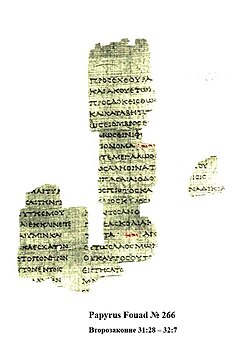
Deuteronomy (Ancient Greek: Δευτερονόμιον, romanized: Deuteronómion, lit.'second law'; Latin: Liber Deuteronomii)[1] is the fifth and final book of the Torah (in Judaism), where it is called Devarim (Biblical Hebrew: דְּבָרִים, romanized: Dəḇārīm, lit.'[the] words [of Moses]'). It is the fifth book of the Hebrew Bible and Christian Old Testament.
Chapters 1–30 of the book consist of three sermons or speeches delivered to the Israelites by Moses on the Plains of Moab, shortly before they enter the Promised Land. The first sermon recounts the forty years of wilderness wanderings which had led to that moment and ends with an exhortation to observe the law. The second sermon reminds the Israelites of the need to follow Yahweh and the laws (or teachings) he has given them, on which their possession of the land depends. The third sermon offers the comfort that, even should the nation of Israel prove unfaithful and so lose the land, with repentance all can be restored.[2] The final four chapters (31–34) contain the Song of Moses, the Blessing of Moses, and the narratives recounting the passing of the mantle of leadership from Moses to Joshua and, finally, the death of Moses on Mount Nebo.
One of its most significant verses is Deuteronomy 6:4, the Shema Yisrael, which has been described as the definitive statement of Jewish identity for theistic Jews: "Hear, O Israel: The Lᴏʀᴅ is our God, the Lᴏʀᴅ alone." This was also quoted by Jesus in Mark 12:28–34 as the Great Commandment.
Traditionally, it was believed that God dictated the Torah to Moses, but most modern scholars date Deuteronomy to the 7th–5th centuries BCE.[3]
Structure
Patrick D. Miller in his commentary on Deuteronomy suggests that different views of the structure of the book will lead to different views on what it is about.[4] The structure is often described as a series of three speeches or sermons (chapters 1:1–4:43, 4:44–29:1, 29:2–30:20) followed by a number of short appendices[5] or some kind of epilogue (31:1–34:12), consist of commission of Joshua, the song of Moses and the death of Moses.[6]
Other scholars have compared the structure of Deuteronomy with Hittite treaties or other ancient Near Eastern treaty texts. But it is clear that Deuteronomy is not in itself simply the text of a treaty, as Deuteronomy is more than simply applying the secular model of treaty to Israel's relationship with God.[7]
The Ten Commandments (Decalogue) in chapter 5 serve as a blueprint for the rest of the book, as chapters 12–26 are the exposition of the Decalogue, thus the expanded Decalogue.[7]
| Commandments | Chapters |
| 1–3 | 12–13 |
| 4 | 14:28–16:17 |
| 5 | 16:18–18:22 |
| 6 | 19:1–21:9 |
| 7 | 22:13–30 |
| 8–10 | 23–26 |
Summary

(The following "literary" outline of Deuteronomy is from John Van Seters;[8] it can be contrasted with Alexander Rofé's "covenantal" analysis in his Deuteronomy: Issues and Interpretation.[9])
- Chapters 1–3: The journey through the wilderness from Horeb (Sinai) to Kadesh and then to Moab is recalled.
- Chapters 4–11: After a second introduction at 4:44–49 the events at Mount Horeb are recalled, with the giving of the Ten Commandments. Heads of families are urged to instruct those under their care in the law, warnings are made against serving gods other than Yahweh, the land promised to Israel is praised, and the people are urged to obedience.
- Chapters 12–26, the Deuteronomic Code: Laws governing Israel's worship (chapters 12–16a), the appointment and regulation of community and religious leaders (16b–18), social regulation (19–25), and confession of identity and loyalty (26).
- Chapters 27–28: Blessings and curses for those who keep and break the law.
- Chapters 29–30: Concluding discourse on the covenant in the land of Moab, including all the laws in the Deuteronomic Code (chapters 12–26) after those given at Horeb; Israel is again exhorted to obedience.
- Chapters 31–34: Joshua is installed as Moses's successor, Moses delivers the law to the Levites (a priestly caste) and ascends Mount Nebo or Pisgah, where he dies and is buried by God. The narrative of these events is interrupted by two poems, the Song of Moses and the Blessing of Moses.
The final verses, Deuteronomy 34:10–12, "Never since has there arisen a prophet in Israel like Moses," make a claim for the authoritative Deuteronomistic view of theology and its insistence that the worship of Yahweh as the sole deity of Israel was the only permissible religion, having been sealed by the greatest of prophets.[10]
Deuteronomic Code
เฉลยธรรมบัญญัติ 12–26 หรือที่เรียกว่าประมวลกฎหมายเฉลยธรรมบัญญัติเป็นส่วนที่เก่าแก่ที่สุดของหนังสือและเป็นแกนหลักที่ส่วนที่เหลือพัฒนาขึ้นมา[ 11 ]เป็นชุดของบัญญัติ ( คำสั่ง ) ที่ให้กับชาวอิสราเอลเกี่ยวกับวิธี ที่ พวกเขาควรปฏิบัติตนในดินแดนแห่งพันธสัญญา
องค์ประกอบ

ประวัติการแต่งเพลง
ความเชื่อที่ว่าโมเสส เป็นผู้ประพันธ์คัมภีร์โทราห์ ซึ่งรวมถึงหนังสือเฉลยธรรมบัญญัติด้วย ได้รับการบอกเล่าจากพระเจ้าแก่โมเสสบนภูเขาซีนาย เป็นประเพณีโบราณของชาวยิวที่ได้รับการรวบรวมโดยไมโมนิเดส (ค.ศ. 1135–1204) ให้เป็นหลัก ความเชื่อข้อที่ 8 จาก 13 ข้อของชาว ยิว[ 12 ]นักวิชาการฆราวาสสมัยใหม่เกือบทั้งหมด และนักวิชาการคริสเตียนและชาวยิวส่วนใหญ่ ปฏิเสธความเชื่อที่ว่าโมเสสเป็นผู้ประพันธ์หนังสือเฉลยธรรมบัญญัติ และกำหนดช่วงเวลาของหนังสือเล่มนี้ให้ช้ากว่านั้น คือระหว่างศตวรรษที่ 7 ถึง 5 ก่อนคริสต์ศักราช[ 3 ]ผู้เขียนน่าจะเป็น วรรณะ เลวีซึ่งเรียกโดยรวมว่าผู้ประพันธ์เฉลยธรรมบัญญัติซึ่งหนังสือเล่มนี้สะท้อนให้เห็นถึงความต้องการทางเศรษฐกิจและสถานะทางสังคมของพวกเขา[ 13 ]ปัจจุบันภูมิหลังทางประวัติศาสตร์ของการประพันธ์หนังสือเล่มนี้ถูกมองในแง่ทั่วไปดังต่อไปนี้: [ 14 ]
- ในช่วงปลายศตวรรษที่ 8 ก่อนคริสตกาล ทั้งยูดาห์และอิสราเอลต่างเป็นข้าราชบริพารของอัสซีเรียอิสราเอลก่อกบฏและถูกทำลายลงราวปี 722 ก่อนคริสตกาล ผู้ลี้ภัยที่หนีจากอิสราเอลไปยังยูดาห์ได้นำประเพณีใหม่ๆ มาสู่ยูดาห์ด้วย หนึ่งในนั้นคือพระเจ้ายาห์เวห์ ซึ่งเป็นที่รู้จักและได้รับการบูชาในยูดาห์อยู่แล้ว ไม่ใช่เพียงแค่เทพเจ้าที่สำคัญที่สุดเท่านั้น แต่เป็นเทพเจ้าองค์เดียวที่ควรได้รับการบูชา[ 15 ]ทัศนคตินี้มีอิทธิพลต่อชนชั้นปกครอง ที่เป็นเจ้าของที่ดินในยูดาห์ ซึ่งมีอำนาจอย่างมากในแวดวงราชสำนักหลังจากที่โย สิยาห์วัยแปดขวบขึ้นครองบัลลังก์ภายหลังการสังหารอาโมนแห่งยูดาห์ บิดาของเขา
- ในรัชสมัยของโยสิยาห์ปีที่สิบแปด อำนาจของอัสซีเรียกำลังเสื่อมถอยอย่างรวดเร็ว และขบวนการเรียกร้องเอกราชกำลังแข็งแกร่งขึ้นในราชอาณาจักรยูดาห์หนึ่งในปรากฏการณ์ของขบวนการนี้คือหลักศาสนศาสตร์ของรัฐที่เน้นความจงรักภักดีต่อพระยาห์เวห์ในฐานะพระเจ้าองค์เดียวของราชอาณาจักรยูดาห์ ตามที่ระบุใน2 พงศ์กษัตริย์ 22:1–23:30ในเวลานั้นฮิลคียาห์ ( มหาปุโรหิตและบิดาของเยเรมี ย์ผู้เผย พระวจนะ) ได้ค้นพบ “หนังสือธรรมบัญญัติ” – ซึ่งนักวิชาการหลายคนเชื่อว่าเป็นประมวลกฎหมายเฉลยธรรมบัญญัติ (ชุดกฎหมายในบทที่ 12–26 ซึ่งเป็นแก่นหลักของหนังสือเฉลยธรรมบัญญัติ) – ในพระวิหารต่อมาโยสิยาห์ได้เริ่มการปฏิรูปการนมัสการอย่างเต็มรูปแบบโดยอิงจาก "หนังสือแห่งธรรมบัญญัติ" เล่มนี้ ซึ่งมีรูปแบบเป็นพันธสัญญาระหว่างยูดาห์และยาห์เวห์ เพื่อแทนที่สนธิสัญญาระหว่างกษัตริย์ เอซาร์ฮัดดอนแห่งอัสซีเรียและกษัตริย์มานาเสห์แห่งยูดาห์ที่มีมานานหลายทศวรรษ[ 16 ]
- ขั้นตอนต่อไปเกิดขึ้นในช่วงที่อิสราเอลถูกจับเป็นเชลยในบาบิโลนการทำลายล้างอาณาจักรยูดาห์โดยบาบิโลนในปี 586 ก่อนคริสตกาลและการสิ้นสุดของระบอบกษัตริย์เป็นสาเหตุให้ชนชั้นสูงที่นับถือคัมภีร์เฉลยธรรมบัญญัติซึ่งถูกเนรเทศไปยังเมืองบาบิโลน ได้ไตร่ตรองและคาดเดาทางศาสนศาสตร์กันอย่างมาก พวกเขาเชื่อว่าภัยพิบัตินี้เป็นการลงโทษของพระยาห์เวห์ที่ไม่ปฏิบัติตามกฎหมาย ดังนั้นพวกเขาจึงสร้างประวัติศาสตร์ของอิสราเอล (หนังสือโยชูวาถึงกษัตริย์) เพื่อแสดงให้เห็นถึงเรื่องนี้
- เมื่อสิ้นสุดการเนรเทศ เมื่อชาวเปอร์เซียตกลงว่าชาวยิวสามารถกลับมาและสร้างพระวิหารในเยรูซาเล็ม ขึ้นใหม่ ได้ บทที่ 1-4 และ 29-30 จึงถูกเพิ่มเข้ามา และหนังสือเฉลยธรรมบัญญัติถูกกำหนดให้เป็นหนังสือนำของประวัติศาสตร์นี้ เพื่อให้เรื่องราวเกี่ยวกับผู้คนที่กำลังจะเข้าสู่ดินแดนแห่งพันธสัญญา กลายเป็นเรื่องราวเกี่ยวกับผู้คนที่กำลังจะกลับมายังดินแดนนั้น ส่วนที่เกี่ยวกับกฎหมายในบทที่ 19-25 ถูกขยายความเพื่อให้สอดคล้องกับสถานการณ์ใหม่ที่เกิดขึ้น และบทที่ 31-34 ถูกเพิ่มเข้ามาเป็นบทสรุปใหม่
บทที่ 12–26 ซึ่งประกอบด้วยประมวลกฎหมายเฉลยธรรมบัญญัติเป็นส่วนที่เก่าแก่ที่สุด[ 17 ] นับตั้งแต่ WML de Wetteเสนอแนวคิดนี้เป็นครั้งแรกในปี 1805 นักวิชาการส่วนใหญ่ยอมรับว่าส่วนนี้ของหนังสือถูกแต่งขึ้นในเยรูซาเล็มในศตวรรษที่ 7 ก่อนคริสต์ศักราช ในบริบทของการปฏิรูปศาสนาที่ริเริ่มโดยกษัตริย์เฮเซ คียาห์ (ครองราชย์ราว 716–687 ก่อนคริสต์ศักราช) [ 18 ] [ 19 ]แม้ว่าบางคนจะโต้แย้งถึงช่วงเวลาอื่น[ 20 ]เช่น ในรัชสมัยของมานาสเสห์ ผู้สืบทอดตำแหน่งของพระองค์ (687–643 ก่อนคริสต์ศักราช) หรือแม้แต่ในภายหลังมาก เช่น ในช่วงยุคเนรเทศหรือ หลังเนรเทศ (597–332 ก่อนคริสต์ศักราช) [ 3 ] [ 21 ]
มีข้อเสนอแนะในงานแปลและคำอธิบายของโมเช ไวน์เฟลด์ เกี่ยวกับเฉลยธรรมบัญญัติ โดยอิงจากความสัมพันธ์เชิงเนื้อหาระหว่างพรและคำสาปแช่งที่ปรากฏในหนังสือและสนธิสัญญากับ เอซาร์ฮัดดอน (ซึ่งให้คำมั่นว่าจะจงรักภักดีต่อพระเจ้าแห่งอิสราเอลและพระบัญญัติในฉบับหนึ่ง และต่อเอซาร์ฮัดดอนในเอกสารที่ขุดพบจากบันทึกทางโบราณคดี) ว่าช่วงเวลาสำคัญในการรวบรวมกฎหมายเฉลยธรรมบัญญัติเกิดขึ้นในเวลาเดียวกันกับ (และอาจจะเหมือนกันบางส่วนกับ) การปฏิรูปของโยสิยาห์[ 22 ]ไวน์เฟลด์ปฏิเสธและรื้อถอนแนวคิดที่ว่าเนื้อหาหลักของงานอาจจะเกิดขึ้นหลังการเนรเทศอย่างเข้มงวด โดยไม่ละทิ้งความจริงที่ชัดเจนและไม่น่าแปลกใจที่ว่าการเปลี่ยนแปลงข้อความที่เกิดขึ้นตลอดหลายชั่วอายุคนของการคัดลอกที่ยืดเยื้อมาหลายศตวรรษน่าจะเกิดขึ้นและอาจปรากฏให้เห็นในข้อความ[ 22 ]ช่วงเวลาที่เอซาร์ฮัดดอนครองราชย์เป็นกษัตริย์แห่งจักรวาลของ อัสซีเรีย มีแนวโน้มที่จะขัดขวางความคิดที่ว่าหนังสือเล่มนี้ใกล้จะถึงรูปแบบที่ใกล้เคียงกับฉบับร่างสุดท้ายในช่วงรัชสมัยของเฮเซคียาห์ [ 22 ] อย่างไรก็ตาม การปรากฏตัวของเยเรมีย์และการปรากฏตัวโดยทั่วไปของผู้ลี้ภัยจากทางเหนือในดินแดนยูดาห์ในช่วงรัชสมัยของโยสิยาห์และตลอดการปฏิรูปของพระองค์ ช่วยให้การตีความนี้สอดคล้องกับแนวคิดที่ว่าหนังสือเฉลยธรรมบัญญัติถูกส่งต่อมายังยูดาห์ในฐานะประเพณีโมเสสจากทางเหนือ ตราบใดที่เยเรมีย์ได้รับการตีความว่าเป็นผู้ประสานงานระหว่างผู้ลี้ภัยของอิสราเอลและพลเมืองพื้นเมืองของยูดาห์ที่เห็นอกเห็นใจทั้งสองฝ่ายและมีชื่อเสียงในด้านอำนาจในทั้งสองชุมชน[ 23 ]
นอกเหนือจากเนื้อหาหลักของกฎของโมเสสในเฉลยธรรมบัญญัติแล้ว บทนำที่สอง (บทที่ 5–11) และบทนำแรก (บทที่ 1–4) ปรากฏเป็นหน่วยที่แยกจากกันของข้อความ บทต่อจากบทที่ 26 ก็มีการเรียงซ้อนกันในลักษณะเดียวกัน[ 17 ]
การแบ่งอิสราเอล-ยูดาห์
ศาสดาอิสยาห์ซึ่งอยู่ในกรุงเยรูซาเล็มราวหนึ่งศตวรรษก่อนโยสิยาห์ ไม่ได้กล่าวถึงการอพยพพันธสัญญากับพระเจ้า หรือการไม่เชื่อฟังพระบัญญัติของพระเจ้า ในทางตรงกันข้าม โฮเซอา ผู้ร่วมสมัยกับอิสยาห์ซึ่งอยู่ในอาณาจักรทางเหนือของอิสราเอลได้กล่าวถึงการอพยพ การเดินทางในทะเลทราย พันธสัญญา อันตรายจากเทพเจ้าต่างชาติ และความจำเป็นที่จะต้องนมัสการพระยาห์เวห์แต่เพียงผู้เดียวบ่อยครั้ง ความแตกต่างนี้ทำให้นักวิชาการสรุปว่าประเพณีเหล่านี้ที่อยู่เบื้องหลังเฉลยธรรมบัญญัติมีต้นกำเนิดมาจากทางเหนือ[ 24 ]ไม่ว่าประมวลกฎหมายเฉลยธรรมบัญญัติจะเขียนขึ้นในสมัยของโยสิยาห์ (ปลายศตวรรษที่ 7 ก่อนคริสตกาล) หรือก่อนหน้านั้นก็ยังเป็นที่ถกเถียงกันอยู่ แต่กฎหมายแต่ละข้อหลายข้อนั้นเก่าแก่กว่าประมวลกฎหมายทั้งหมด[ 25 ]บทกวีสองบทในบทที่ 32–33 – บทเพลงของโมเสสและคำอวยพรของโมเสส –น่าจะแยกจากกันแต่เดิม[ 24 ]
ตำแหน่งในพระคัมภีร์ฮิบรู
เฉลยธรรมบัญญัติอยู่ในตำแหน่งที่น่าสงสัยในพระคัมภีร์ โดยเชื่อมโยงเรื่องราวการเดินทางของชาวอิสราเอลในทะเลทรายเข้ากับเรื่องราวประวัติศาสตร์ของพวกเขาในคานาอันโดยไม่ได้เป็นส่วนหนึ่งของเรื่องใดเรื่องหนึ่งอย่างสมบูรณ์ เรื่องราวในทะเลทรายสามารถจบลงได้ง่ายๆ ด้วยกันดารวิถี และเรื่องราวการพิชิตของโยชูวาสามารถดำรงอยู่ได้โดยไม่ต้องมีกันดารวิถี อย่างน้อยก็ในระดับโครงเรื่อง แต่ในทั้งสองกรณี จะมีองค์ประกอบเชิงธีม (เทววิทยา) ขาดหายไป นักวิชาการได้ให้คำตอบต่างๆ กันสำหรับปัญหานี้[ 26 ]
ทฤษฎีประวัติศาสตร์แบบดิวเทโรโนมิสต์เป็นที่นิยมมากที่สุดในปัจจุบัน เดิมทีหนังสือดิวเทโรโนมิสต์เป็นเพียงประมวลกฎหมายและพันธสัญญาที่เขียนขึ้นเพื่อเสริมสร้างการปฏิรูปศาสนาของโยสิยาห์ และต่อมาได้ขยายออกไปเพื่อเป็นบทนำของประวัติศาสตร์ทั้งหมด แต่มีทฤษฎีที่เก่ากว่าซึ่งมองว่าดิวเทโรโนมิสต์เป็นส่วนหนึ่งของกันดารวิถี และโยชูวาเป็นเหมือนส่วนเสริมของดิวเทโรโนมิสต์ แนวคิดนี้ยังคงมีผู้สนับสนุนอยู่ แต่ความเข้าใจกระแสหลักคือ ดิวเทโรโนมิสต์หลังจากที่กลายเป็นบทนำของประวัติศาสตร์แล้ว ต่อมาได้ถูกแยกออกจากประวัติศาสตร์และรวมเข้ากับปฐมกาล-อพยพ-เลวีนิติ-กันดารวิถี เนื่องจากมีโมเสสเป็นตัวละครหลักอยู่แล้ว ตามสมมติฐานนี้ การตายของโมเสสเดิมทีเป็นตอนจบของกันดารวิถี และถูกย้ายจากตรงนั้นไปยังตอนจบของดิวเทโรโนมิสต์[ 26 ]
ธีม
ภาพรวม
เฉลยธรรมบัญญัติเน้นย้ำถึงความเป็นเอกลักษณ์ของพระเจ้า ความจำเป็นในการรวมศูนย์การนมัสการอย่างเด็ดขาด และความห่วงใยต่อสถานะของคนยากจนและผู้ด้อยโอกาส[ 27 ]หัวข้อต่างๆ มากมายของเฉลยธรรมบัญญัตินี้สามารถจัดเรียงตามสามขั้วของอิสราเอล พระยาห์เวห์ และพันธสัญญาที่ผูกมัดพวกเขาไว้ด้วยกัน
อิสราเอล
หัวข้อหลักของหนังสือเฉลยธรรมบัญญัติที่เกี่ยวข้องกับอิสราเอล ได้แก่ การเลือกสรร ความซื่อสัตย์ การเชื่อฟัง และพระสัญญาแห่งพระพรของพระยาห์เวห์ ซึ่งทั้งหมดนี้แสดงออกผ่านทางพันธสัญญา: “การเชื่อฟังไม่ใช่หน้าที่ที่ฝ่ายหนึ่งกำหนดให้แก่อีกฝ่ายหนึ่งเป็นหลัก แต่เป็นการแสดงออกถึงความสัมพันธ์ตามพันธสัญญา” [ 28 ]พระยาห์เวห์ทรงเลือกอิสราเอลให้เป็นสมบัติพิเศษของพระองค์ (เฉลยธรรมบัญญัติ 7:6 และที่อื่นๆ) [ 29 ]และโมเสสเน้นย้ำกับชาวอิสราเอลถึงความจำเป็นในการเชื่อฟังพระเจ้าและพันธสัญญา และผลที่ตามมาจากการไม่ซื่อสัตย์และการไม่เชื่อฟัง[ 30 ]อย่างไรก็ตาม บทแรกๆ ของหนังสือเฉลยธรรมบัญญัติเป็นการเล่าเรื่องการไม่เชื่อฟังในอดีตของอิสราเอลอย่างยาวนาน – แต่ยังรวมถึงการดูแลด้วยพระคุณของพระเจ้า ซึ่งนำไปสู่การเรียกร้องให้อิสราเอลเลือกชีวิตเหนือความตายและพระพรเหนือคำสาปแช่ง (บทที่ 7–11)
ยาห์เวห์
แนวคิดเรื่องพระเจ้าในหนังสือเฉลยธรรมบัญญัติเปลี่ยนแปลงไปตามกาลเวลา ชั้นแรกสุดในศตวรรษที่ 7 เป็นแบบบูชาพระเจ้าองค์เดียวไม่ได้ปฏิเสธความจริงของเทพเจ้าอื่น ๆ แต่บังคับให้บูชาเฉพาะพระยาห์เวห์ในเยรูซาเล็มเท่านั้น ในชั้นต่อมาในช่วงยุคเนรเทศตั้งแต่กลางศตวรรษที่ 6 โดยเฉพาะบทที่ 4 แนวคิดนี้กลายเป็นลัทธิเอกเทวนิยมคือความคิดที่ว่ามีพระเจ้าเพียงองค์เดียว[ 31 ]พระเจ้าทรงสถิตอยู่พร้อมกันทั้งในพระวิหารและในสวรรค์ ซึ่งเป็นแนวคิดที่สำคัญและสร้างสรรค์ที่เรียกว่า "เทววิทยาแห่งพระนาม" [ 32 ]
หลังจากทบทวนประวัติศาสตร์ของอิสราเอลในบทที่ 1 ถึง 4 แล้ว จะมีการกล่าวถึงพระบัญญัติสิบประการอีกครั้งในบทที่ 5 การจัดเรียงเนื้อหานี้เน้นย้ำถึงความสัมพันธ์อันทรงอำนาจของพระเจ้ากับอิสราเอลก่อนการประทานพระบัญญัติ[ 33 ]
พันธสัญญา
แก่นแท้ของหนังสือเฉลยธรรมบัญญัติคือพันธสัญญาที่ผูกมัดพระยาห์เวห์และอิสราเอลด้วยคำสาบานแห่งความซื่อสัตย์และการเชื่อฟัง[ 34 ]พระเจ้าจะประทานพรแก่อิสราเอลในเรื่องแผ่นดิน ความอุดมสมบูรณ์ และความเจริญรุ่งเรือง ตราบใดที่อิสราเอลยังคงซื่อสัตย์ต่อคำสอนของพระเจ้า การไม่เชื่อฟังจะนำไปสู่คำสาปแช่งและการลงโทษ[ 35 ]แต่ตามที่ผู้เขียนเฉลยธรรมบัญญัติกล่าวไว้ บาปหลักของอิสราเอลคือการขาดศรัทธาการละทิ้ง ความเชื่อ ซึ่ง ขัดต่อพระบัญญัติข้อแรกและข้อพื้นฐานที่สุด ("เจ้าอย่ามีพระเจ้าอื่นใดอยู่ต่อหน้าเรา") ประชาชนได้เข้าไปมีความสัมพันธ์กับพระเจ้าอื่น[ 36 ]
Dillard and Longman in their Introduction to the Old Testament stress the living nature of the covenant between Yahweh and Israel as a nation: The people of Israel are addressed by Moses as a unity, and their allegiance to the covenant is not one of obeisance, but comes out of a pre-existing relationship between God and Israel, established with Abraham and attested to by the Exodus event, so that the laws of Deuteronomy set the nation of Israel apart, signaling the unique status of the Jewish nation.[37]
The land is God's gift to Israel, and many of the laws, festivals and instructions in Deuteronomy are given in the light of Israel's occupation of the land. Dillard and Longman note that "In 131 of the 167 times the verb "give" occurs in the book, the subject of the action is Yahweh."[38] Deuteronomy makes the Torah the ultimate authority for Israel, one to which even the king is subject.[39]
Judaism's weekly Torah portions in the Book of Deuteronomy
- Devarim, on Deuteronomy 1–3: Chiefs, scouts, Edom, Ammonites, Sihon, Og, land for two and a half tribes
- Va'etchanan, on Deuteronomy 3–7: Cities of refuge, Ten Commandments, Shema, exhortation, conquest instructions
- Eikev, on Deuteronomy 7–11: Obedience, taking the land, golden calf, Aaron's death, Levites' duties
- Re'eh, on Deuteronomy 11–16: Centralized worship, diet, tithes, sabbatical year, pilgrim festivals
- Shofetim, on Deuteronomy 16–21: Basic societal structure for the Israelites
- Ki Teitzei, on Deuteronomy 21–25: Miscellaneous laws on civil and domestic life
- Ki Tavo, on Deuteronomy 26–29: First fruits, tithes, blessings and curses, exhortation
- Nitzavim, on Deuteronomy 29–30: covenant, violation, choose blessing and curse
- Vayelech, on Deuteronomy 31: Encouragement, reading and writing the law
- Haazinu, on Deuteronomy 32: Punishment, punishment restrained, parting words
- V'Zot HaBerachah, on Deuteronomy 33–34: Farewell blessing and death of Moses
Influence on Judaism and Christianity
Judaism

The Shema Yisrael is the fundamental creed of Judaism, and its twice-daily recitation is a mitzvah (religious commandment) for religious Jews.[40] The recitation of the Shema continues with Deuteronomy 6:5–9:
And you shall love the eternal your God with all your heart and with all your soul and with all your might. Take to heart these instructions with which I charge you this day. Impress them upon your children. Recite them when you stay at home and when you are away, when you lie down and when you get up. Bind them as a sign on your hand and let them serve as a symbol on your forehead; inscribe them on the doorposts of your house and on your gates (RJPS).[41]
"Love the eternal your God with all your heart and with all your soul and with all your might" became a principle central to Judaism: to return God's love in faith, relationship, and fulfillment of God's commandments.
Christianity
In the Gospel of Matthew, Jesus cited Deuteronomy 6:5 as the Great Commandment. The earliest Christian authors interpreted Deuteronomy's prophecy of the restoration of Israel as having been fulfilled (or superseded) by Jesus and the establishment of the Christian Church (Luke 1–2, Acts 2–5); Jesus was interpreted to be the "one (i.e., prophet) like me" predicted by Moses in Deuteronomy 18:15 (Acts 3:22–23). While the exact position of Paul the Apostle and Judaism is still debated, a common view is that in place of mitzvot given by God to the Jewish people in Deuteronomy and the rest of the Torah, Paul the Apostle, drawing on Deuteronomy 30:11–14, claimed that the keeping of the Mosaic covenant was superseded by faith in Jesus and the Gospel (the New Covenant).[42]
See also
- 613 commandments
- Documentary hypothesis
- Hebrew Bible
- Kashrut
- Mosaic authorship
- Papyrus Rylands 458 – the oldest Greek manuscript of Deuteronomy
Citations
- ^"Definition of Deuteronomy | Dictionary.com". www.dictionary.com. Retrieved 11 March 2023.
- ^Philips, pp.1–2
- ^ abcStackert 2022, p. 136.
- ^Miller, p.10
- ^Christensen, p.211
- ^Woods, Edward J. (2011). Deuteronomy: An Introduction and Commentary. Nottingham, England: Inter-Varsity Press. p. 38.
- ^ abWright, Christopher J. H. (1996). Deuteronomy. New International Biblical Commentary. Peabody, Massachusetts: Hendrickson Publishers. pp. 4–5.
- ^Van Seters 1998, pp. 15–17.
- ^Rofé, pp.1–4
- ^Tigay, pp.137ff.
- ^Van Seters 1998, p. 16.
- ^Levenson 1993, pp. 63.
- ^Sommer 2015, p. 18.
- ^Rogerson 2003, pp. 153–154.
- ^McKenzie 1990, p. 1287.
- ^Miller & Hayes 1986, pp. 391–397.
- ^ abVan Seters 2015, pp. 79–82.
- ^Miller & Hayes 1986, pp. 393–394.
- ^Rofé 2002, p. 4–5.
- ^Before and after de Wette works by Spinoza, Wellehausen, Martin Noth, Gerard von Rad, Moshe Weinfeld and others represent major phases in the understanding of this book. These discussions and reconsiderations of Deuteronomy have had a tendency to stand out as a paradigm-shifting contributions to source criticism from its beginnings as a discipline. The argument about Deuteronomy begins effectively at the same moment that arena opens for secular or non-ecclesiastically determined explorations of Biblical history opens up, with Spinoza’s seminal work in the subject terrain, Tractatus Theologico-Politicus. The double-entry of the law of Moses in the Torah, and the non-identity of the two versions of the law is a starting point for Spinoza’s investigations into how the Bible might have been put together, when and by whom in the Treatise.
- ^Davies 2013, p. 101-103.
- ^ abcWeinfeld, Moše (2008). Deuteronomy 1-11: a new translation with introduction and commentary. The Anchor Bible (1. Yale Univ. Press impr ed.). New Haven: Yale Univ. Press. pp. 6–438. ISBN 978-0-300-13943-3.
- ^Bright, John (1986). Jeremiah. The Anchor Bible. Garden City, N. Y: Doubleday. pp. 90–91. ISBN 978-0-385-00823-5.
- ^ abVan Seters 1998, p. 17.
- ^Knight, p.66
- ^ abBandstra, pp.190–191
- ^McConville
- ^Block, p.172
- ^McKenzie, p.266
- ^Bultman, p.135
- ^Romer (1994), p.200-201
- ^McKenzie, p.265
- ^Thompson, Deuteronomy, 112.
- ^Breuggemann, p.53
- ^Laffey, p.337
- ^Phillips, p.8
- ^Dillard & Longman, p.102.
- ^Dillard & Longman, p.117.
- ^Vogt, p.31
- ^Deut 6:4
- ^Deut 6:5–9
- ^McConville, p.24
General and cited references
Translations
- Deuteronomy in NIV
- Deuteronomy in Tanakh (Hebrew Bible)
Commentaries
- Craigie, Peter C (1976). The Book of Deuteronomy. Eerdmans. ISBN 9780802825247.
- Miller, Patrick D (1990). Deuteronomy. Cambridge University Press. ISBN 9780664237370.
- Phillips, Anthony (1973). Deuteronomy. Westminster John Knox Press. ISBN 9780521097727.
- Plaut, W. Gunther (1981). The Torah: A Modern Commentary. ISBN 0-8074-0055-6
- Miller, Avigdor (2001). Fortunate Nation: Comments and notes on DVARIM.
General
- Ausloos, Hans (2015-10-22). The Deuteronomist's History: The Role of the Deuteronomist in Historical-Critical Research into Genesis-Numbers. BRILL. ISBN 9789004307049.
- Bandstra, Barry L (2004). Reading the Old Testament: An Introduction to the Hebrew Bible. Wadsworth. ISBN 9780495391050.
- Block, Daniel I (2005). "Deuteronomy". In Kevin J. Vanhoozer (ed.). Dictionary for Theological Interpretation of the Bible. Baker Academic.
- Braulik, G (1998). The Theology of Deuteronomy: Collected Essays of Georg Braulik. D&F Scott Publishing. ISBN 9780941037303.
- Brueggemann, Walter (2002). Reverberations of Faith: A Theological Handbook of Old Testament Themes. Westminster John Knox. ISBN 9780664222314.
- Bultman, Christoph (2001). "Deuteronomy". In John Barton; John Muddiman (eds.). Oxford Bible Commentary. Oxford University Press. ISBN 9780198755005.
- Christensen, Duane L (1991). "Deuteronomy". In Watson E. Mills; Roger Aubrey Bullard (eds.). Mercer Dictionary of the Bible. Mercer University Press. ISBN 9780865543737.
- Clements, Ronald (1968). God's Chosen People: A Theological Interpretation of the Book of Deuteronomy. In series, Religious Book Club, 182. London: S.C.M. Press.
- Davies, Philip R. (2013). Rethinking Biblical Scholarship. Changing Perspectives. Vol. 4. New York: Routledge. ISBN 978-1-84465-727-8.
- Gottwald, Norman, review of Stephen L. Cook, The Social Roots of Biblical Yahwism, Society of Biblical Literature, 2004
- Knight, Douglas A (1995). "Deuteronomy and the Deuteronomists". In James Luther Mays; David L. Petersen; Kent Harold Richards (eds.). Old Testament Interpretation. T&T Clark. ISBN 9780567292896.
- Gili Kugler, Kugler, Moses died and the people moved on - a hidden narrative in Deuteronomy
- Laffey, Alice L (2007). "Deuteronomistic Theology". In Orlando O. Espín; James B. Nickoloff (eds.). An Introductory Dictionary of Theology and Religious Studies. Liturgical Press. ISBN 9780814658567.
- Levenson, Jon Douglas (1993). The Hebrew Bible, the Old Testament, and Historical Criticism: Jews and Christians in Biblical Studies. Westminster John Knox Press. ISBN 978-0-664-25407-0.
- Markl, Dominik (2013). "Moses' Praise and Blame – Israel's Honour and Shame: Rhetorical Devices in the Ethical Foundations of Deuteronomy". Verbum et Ecclesia. 34 (2). 34. doi:10.4102/ve.v34i2.861. hdl:2263/32114.
- McConville, J.G (2002). "Deuteronomy"(PDF). In T. Desmond Alexander; David W. Baker (eds.). Dictionary of the Old Testament: The Pentateuch. Eisenbrauns. Archived from the original(PDF) on 2008-04-13. Retrieved 2007-11-02.
- McKenzie, John L. (1990). Raymond Edward Brown; Joseph A. Fitzmyer; Roland Edmund Murphy (eds.). The New Jerome Biblical Commentary (Reissue ed.). Englewood Cliffs, New Jersey: Prentice Hall. ISBN 978-0136149347.
- McKenzie, Steven L (1995). "Postscript". In Linda S. Schearing; Steven L McKenzie (eds.). Those Elusive Deuteronomists: The Phenomenon of Pan-Deuteronomism. T&T Clark. ISBN 9780567563361.
- Mendenhall, George E (September 1, 1954). Covenant Forms in Israelite Tradition. Biblical Archeology 3/17.
- Miller, James Maxwell; Hayes, John Haralson (1986). A History of Ancient Israel and Judah. Philadelphia: The Westminster Press. ISBN 978-0-664-21262-9.
- Pakkala, Juha (2009). "The date of the oldest edition of Deuteronomy". Zeitschrift für die Alttestamentliche Wissenschaft. 121 (3): 388–401. doi:10.1515/ZAW.2009.026. hdl:10138/328053. S2CID 170672330.
- Richter, Sandra L (2002). The Deuteronomistic History and the Name Theology. Walter de Gruyter. ISBN 9783110173765.
- Rofé, Alexander (2002). Deuteronomy: Issues and Interpretation. T&T Clark. ISBN 9780567087546.
- Rogerson, John W. (2003). "Deuteronomy". In James D. G. Dunn; John William Rogerson (eds.). Eerdmans Commentary on the Bible. Eerdmans. ISBN 9780802837110.
- Romer, Thomas (2000). "Deuteronomy In Search of Origins". In Gary N. Knoppers; J. Gordon McConville (eds.). Reconsidering Israel and Judah: Recent Studies on the Deuteronomistic History. Eisenbrauns. ISBN 9781575060378.
- Romer, Thomas (1994). "The Book of Deuteronomy". In Steven L. McKenzie; Matt Patrick Graham (eds.). The history of Israel's Traditions: The Heritage of Martin Noth. Sheffield Academic Press. ISBN 9780567230355.
- Sommer, Benjamin D. (June 30, 2015). Revelation and Authority: Sinai in Jewish Scripture and Tradition. Anchor Yale Bible Reference Library.
- Stackert, Jeffrey (2022). Deuteronomy and the Pentateuch. Anchor Yale Reference Library. Yale University Press. ISBN 978-0-300-16751-1.
- Tigay, Jeffrey (1996). "The Significance of the End of Deuteronomy". In Michael V. Fox; et al. (eds.). Texts, Temples, and Traditions: A Tribute to Menahem Haran. Eisenbrauns. ISBN 9781575060033.
- Van Seters, John (1998). "The Pentateuch". In Steven L. McKenzie; Matt Patrick Graham (eds.). The Hebrew Bible Today: An Introduction to Critical Issues. Westminster John Knox Press. ISBN 9780664256524.
- Van Seters, John (2015). The Pentateuch: A Social-Science Commentary. Bloomsbury T&T Clark. ISBN 978-0-567-65880-7.
- Vogt, Peter T (2006). Deuteronomic Theology and the Significance of Torah: A Reappraisal. Eisenbrauns. ISBN 9781575061078.
External links


- Deuteronomy at Bible Gateway
- Paterson, James Alexander (1911). . Encyclopædia Britannica (11th ed.).
- Jastrow, Morris (1905). . New International Encyclopedia.
- Jewish translations:
- Deuteronomy at Mechon-Mamre (modified Jewish Publication Society translation)
- Deuteronomy (The Living Torah)Archived 2005-03-05 at the Wayback Machine Rabbi Aryeh Kaplan's translation and commentary at Ort.org
- Devarim – Deuteronomy (Judaica Press) translation [with Rashi's commentary] at Chabad.org
- דְּבָרִים Devarim – Deuteronomy (Hebrew – English at Mechon-Mamre.org)
- Christian translations:
- Online Bible at GospelHall.org (King James Version)
- oremus Bible Browser (New Revised Standard Version)
- oremus Bible Browser (AnglicizedNew Revised Standard Version)
- Deuteronomy at Wikisource (Authorized King James Version)
 Deuteronomy public domain audiobook at LibriVox Various versions