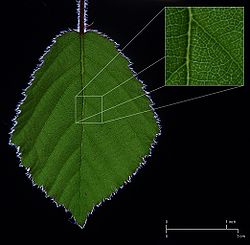
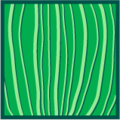
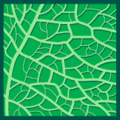
The veins arise pinnately (feather like) from a single primary vein (mid-vein) and subdivide into secondary veinlets, known as higher order veins. These, in turn, form a complicated network. This type of venation is typical for (but by no means limited to) "dicotyledons" (non monocotyledon angiosperms). E.g., Ostrya. There are three subtypes of pinnate venation:
Craspedodromous
The major veins reach to the margin of the leaf.
Camptodromous
Major veins extend close to the margin, but bend before they intersect with the margin.
Hyphodromous
All secondary veins are absent, rudimentary or concealed
These in turn have a number of further subtypes such as eucamptodromous, where secondary veins curve near the margin without joining adjacent secondary veins.
Two or more primary veins originating beside each other at the leaf base, and running parallel to each other to the apex and then converging there. Commissural veins (small veins) connect the major parallel veins. Typical for most monocotyledons, such as grasses. The additional terms marginal (primary veins reach the margin), and reticulate (net-veined) are also used.
Parallelodromous
3. Campylodromous (campylos – curve)
Several primary veins or branches originating at or close to a single point and running in recurved arches, then converging at apex. E.g. Maianthemum .
Campylodromous
4. Acrodromous
Two or more primary or well developed secondary veins in convergent arches toward apex, without basal recurvature as in Campylodromous. May be basal or suprabasal depending on origin, and perfect or imperfect depending on whether they reach to two-thirds of the way to the apex. E.g., Miconia (basal type), Endlicheria (suprabasal type).
Acrodromous
Imperfect basal
Imperfect suprabasal
Perfect basal
Perfect suprabasal
5. Actinodromous
Three or more primary veins diverging radially from a single point. E.g., Arcangelisia (basal type), Givotia (suprabasal type).
Actinodromous
Imperfect marginal
Imperfect reticulate
6. Palinactodromous
Primary veins with one or more points of secondary dichotomous branching beyond the primary divergence, either closely or more distantly spaced. E.g., Platanus.
Types 4–6 may similarly be subclassified as basal (primaries joined at the base of the blade) or suprabasal (diverging above the blade base), and perfect or imperfect, but also flabellate.
At about the same time, Melville (1976) described a system applicable to all Angiosperms and using Latin and English terminology.[57] Melville also had six divisions, based on the order in which veins develop.
Arbuscular (arbuscularis)
Branching repeatedly by regular dichotomy to give rise to a three dimensional bush-like structure consisting of linear segment (2 subclasses)
Flabellate (flabellatus)
Primary veins straight or only slightly curved, diverging from the base in a fan-like manner (4 subclasses)
Palmate (palmatus)
Curved primary veins (3 subclasses)
Pinnate (pinnatus)
Single primary vein, the midrib, along which straight or arching secondary veins are arranged at more or less regular intervals (6 subclasses)
Collimate (collimatus)
Numerous longitudinally parallel primary veins arising from a transverse meristem (5 subclasses)
Conglutinate (conglutinatus)
Derived from fused pinnate leaflets (3 subclasses)
A modified form of the Hickey system was later incorporated into the Smithsonian classification (1999), which proposed seven main types of venation, based on the architecture of the primary veins, adding Flabellate as an additional main type. Further classification was then made on the basis of secondary veins, with 12 further types, such as;
Brochidodromous
Closed form in which the secondaries are joined in a series of prominent arches, as in Hildegardia.
Craspedodromous
Open form with secondaries terminating at the margin, in toothed leaves, as in Celtis.
Eucamptodromous
Intermediate form with upturned secondaries that gradually diminish apically but inside the margin, and connected by intermediate tertiary veins rather than loops between secondaries, as in Cornus.
Cladodromous
Secondaries freely branching toward the margin, as in Rhus.
terms that had been used as subtypes in the original Hickey system.[58]
Several to many equal fine basal veins diverging radially at low angles and branching apically. E.g. Paranomus.
Flabellate
Analyses of vein patterns often fall into consideration of the vein orders, primary vein type, secondary vein type (major veins), and minor vein density. A number of authors have adopted simplified versions of these schemes.[59][28] At its simplest the primary vein types can be considered in three or four groups depending on the plant divisions being considered;
pinnate
palmate
parallel
where palmate refers to multiple primary veins that radiate from the petiole, as opposed to branching from the central main vein in the pinnate form, and encompasses both of Hickey types 4 and 5, which are preserved as subtypes; e.g., palmate-acrodromous (see National Park Service Leaf Guide).[60]
Several main veins of approximately equal size diverge from a common point near the leaf base where the petiole attaches, and radiate toward the edge of the leaf. Palmately veined leaves are often lobed or divided with lobes radiating from the common point. They may vary in the number of primary veins (3 or more), but always radiate from a common point.[61] e.g. most Acer (maples).
Dichotomous venation of the dorsal side of the Ginkgo biloba leaf.Dichotomous
Veins successively branching into equally sized veins from a common point, forming a Y junction, fanning out. Among temperate woody plants, Ginkgo biloba is the only species exhibiting dichotomous venation. Also some pteridophytes (ferns).[61]
Parallel
Primary and secondary veins roughly parallel to each other, running the length of the leaf, often connected by short perpendicular links, rather than form networks. In some species, the parallel veins join at the base and apex, such as needle-type evergreens and grasses. Characteristic of monocotyledons, but exceptions include Arisaema, and as below, under netted.[61]
Netted (reticulate, pinnate)
A prominent midvein with secondary veins branching off along both sides of it. The name derives from the ultimate veinlets, which form an interconnecting net like pattern or network. (The primary and secondary venation may be referred to as pinnate, while the net like finer veins are referred to as netted or reticulate); most non-monocot angiosperms, exceptions including Calophyllum. Some monocots have reticulate venation, including Colocasia, Dioscorea and Smilax.[61]
However, these simplified systems allow for further division into multiple subtypes. Simpson,[28] (and others)[62] divides parallel and netted (and some use only these two terms for Angiosperms)[63] on the basis of the number of primary veins (costa) as follows;
Single central prominent midrib, secondary veins from this arise perpendicularly to it and run parallel to each other toward the margin or tip, but do not join (anastomose). The term unicostate refers to the prominence of the single midrib (costa) running the length of the leaf from base to apex. e.g. Zingiberales, such as Bananas etc.
Palmate-parallel (multicostate parallel)
Several equally prominent primary veins arising from a single point at the base and running parallel toward tip or margin. The term multicostate refers to having more than one prominent main vein. e.g. "fan" (palmate) palms (Arecaceae)
Mid-veins diverge more or less parallel toward the margin e.g. Borassus (Poaceae), fan palms
Netted (Reticulate)
Pinnately (veined, netted, unicostate reticulate)
Single prominent midrib running from base to apex, secondary veins arising on both sides along the length of the primary midrib, running toward the margin or apex (tip), with a network of smaller veinlets forming a reticulum (mesh or network). e.g. Mangifera, Ficus religiosa, Psidium guajava, Hibiscus rosa-sinensis, Salix alba
Palmately (multicostate reticulate)
More than one primary veins arising from a single point, running from base to apex. e.g. Liquidambar styraciflua This may be further subdivided;
Multicostate convergent
Major veins diverge from origin at base then converge toward the tip. e.g. Zizyphus, Smilax, Cinnamomum
These complex systems are not used much in morphological descriptions of taxa, but have usefulness in plant identification, [28] although criticized as being unduly burdened with jargon.[66]
An older, even simpler system, used in some flora[67] uses only two categories, open and closed.
Open: Higher order veins have free endings among the cells and are more characteristic of non-monocotyledon angiosperms. They are more likely to be associated with leaf shapes that are toothed, lobed or compound. They may be subdivided as;
Pinnate (feather-veined) leaves, with a main central vein or rib (midrib), from which the remainder of the vein system arises
Palmate, in which three or more main ribs rise together at the base of the leaf, and diverge upward.
Dichotomous, as in ferns, where the veins fork repeatedly
Closed: Higher order veins are connected in loops without ending freely among the cells. These tend to be in leaves with smooth outlines, and are characteristic of monocotyledons.
They may be subdivided into whether the veins run parallel, as in grasses, or have other patterns.
Other descriptive terms
There are also many other descriptive terms, often with specialized usage and confined to specific taxonomic groups.[68] The conspicuousness of veins depends on a number of features. These include the width of the veins, their prominence in relation to the lamina surface and the degree of opacity of the surface, which may hide finer veins. In this regard, veins are called obscure and the order of veins that are obscured and whether upper, lower or both surfaces, further specified.[69][61]
Terms that describe vein prominence include bullate, channelled, flat, guttered, impressed, prominent and recessed (Fig. 6.1 Hawthorne & Lawrence 2013).[66][70] Veins may show different types of prominence in different areas of the leaf. For instance Pimenta racemosa has a channeled midrib on the upper surface, but this is prominent on the lower surface.[66]
Describing vein prominence:
Bullate
Surface of leaf raised in a series of domes between the veins on the upper surface, and therefore also with marked depressions. e.g. Rytigynia pauciflora,[71]Vitis vinifera
Channelled (canalicululate)
Veins sunken below the surface, resulting in a rounded channel. Sometimes confused with "guttered" because the channels may function as gutters for rain to run off and allow drying, as in many Melastomataceae.[72] e.g. (see) Pimenta racemosa (Myrtaceae),[73]Clidemia hirta (Melastomataceae).
Guttered
Veins partly prominent, the crest above the leaf lamina surface, but with channels running along each side, like gutters
Impressed
Vein forming raised line or ridge lying below the plane of the surface that bears it, as if pressed into it, and are often exposed on the lower surface. Tissue near the veins often appears to pucker, giving them a sunken or embossed appearance
Obscure
Veins not visible, or not at all clear; if unspecified, then not visible with the naked eye. e.g. Berberis gagnepainii. In this Berberis, the veins are only obscure on the undersurface.[74]
More than one main vein (nerve) at the base. Lateral secondary veins branching from a point above the base of the leaf. Usually expressed as a suffix, as in 3-plinerved or triplinerved leaf. In a 3-plinerved (triplinerved) leaf three main veins branch above the base of the lamina (two secondary veins and the main vein) and run essentially parallel subsequently, as in Ceanothus and in Celtis. Similarly, a quintuplinerve (five-veined) leaf has four secondary veins and a main vein. A pattern with 3–7 veins is especially conspicuous in Melastomataceae. The term has also been used in Vaccinieae. The term has been used as synonymous with acrodromous, palmate-acrodromous or suprabasal acrodromous, and is thought to be too broadly defined.[76][76]
Scalariform
Veins arranged like the rungs of a ladder, particularly higher order veins
Submarginal
Veins running close to leaf margin
Trinerved
2 major basal nerves besides the midrib
Diagrams of venation patterns
Image
Term
Description
Arcuate
Secondary arching toward the apex
Dichotomous
Veins splitting in two
Longitudinal
All veins aligned mostly with the midvein
Parallel
All veins parallel and not intersecting
Pinnate
Secondary veins borne from midrib
Reticulate
All veins branching repeatedly, net veined
Rotate
Veins coming from the center of the leaf and radiating toward the edges
Transverse
Tertiary veins running perpendicular to axis of main vein, connecting secondary veins
Size
The terms megaphyll, macrophyll, mesophyll, notophyll, microphyll, nanophyll and leptophyll are used to describe leaf sizes (in descending order), in a classification devised in 1934 by Christen C. Raunkiær and since modified by others.[77][78]
Bayer, M. B. (1982). The New Haworthia Handbook. Kirstenbosch: National Botanic Gardens of South Africa. ISBN 978-0-620-05632-8. Archived from the original on September 6, 2023. Retrieved July 25, 2018.
Berg, Linda (March 23, 2007). Introductory Botany: Plants, People, and the Environment, Media Edition. Cengage Learning. ISBN 978-1-111-79426-2.
Cullen, James; Knees, Sabina G.; Cubey, H. Suzanne Cubey, eds. (2011) [1984–2000]. The European Garden Flora, Flowering Plants: A Manual for the Identification of Plants Cultivated in Europe, Both Out-of-Doors and Under Glass. 5 vols (2nd ed.). Cambridge: Cambridge University Press. Archived from the original on December 28, 2016. Retrieved March 8, 2017.
Cutter, E.G. (1969). Plant Anatomy, experiment and interpretation, Part 2 Organs. London: Edward Arnold. p. 117. ISBN 978-0-7131-2302-9.
Dickison, William C. (2000). Integrative Plant Anatomy. Academic Press. ISBN 978-0-08-050891-7.
Esau, Katherine (2006) [1953]. Evert, Ray F (ed.). Esau's Plant Anatomy: Meristems, Cells, and Tissues of the Plant Body: Their Structure, Function, and Development (3rd. ed.). New York: John Wiley & Sons Inc. ISBN 978-0-470-04737-8. Archived from the original on September 6, 2023. Retrieved September 2, 2017.
Ettingshausen, C. (1861). Die Blatt-Skelete der Dicotyledonen mit besonderer Ruchsicht auf die Untersuchung und Bestimmung der fossilen Pflanzenreste. Vienna: Classification of the Architecture of Dicotyledonous.
Haupt, Arthur Wing (1953). Plant morphology. McGraw-Hill.
Hawthorne, William; Lawrence, Anna (2013). Plant Identification: Creating User-Friendly Field Guides for Biodiversity Management. Routledge. ISBN 978-1-136-55972-3.
Hemsley, Alan R.; Poole, Imogen, eds. (2004). The Evolution of Plant Physiology. Academic Press. ISBN 978-0-08-047272-0.
Heywood, V.H.; Brummitt, R.K.; Culham, A.; Seberg, O. (2007). Flowering plant families of the world. New York: Firefly books. p. 287. ISBN 978-1-55407-206-4.
Hickey, LJ. A revised classification of the architecture of dicotyledonous leaves. pp. i 5–39., in Metcalfe & Chalk (1979)
Judd, Walter S.; Campbell, Christopher S.; Kellogg, Elizabeth A.; Stevens, Peter F.; Donoghue, Michael J. (2007) [1st ed. 1999, 2nd 2002]. Plant systematics: a phylogenetic approach (3rd ed.). Sinauer Associates. ISBN 978-0-87893-407-2. Archived from the original on September 6, 2023. Retrieved September 2, 2017.
Krogh, David (2010), Biology: A Guide to the Natural World (5th ed.), Benjamin-Cummings Publishing Company, p. 463, ISBN 978-0-321-61655-5, archived from the original on January 24, 2023, retrieved May 24, 2016
Leaf Architecture Working Group (1999). Manual of Leaf Architecture - morphological description and categorization of dicotyledonous and net-veined monocotyledonous angiosperms(PDF). Smithsonian Institution. ISBN 978-0-9677554-0-3. Archived(PDF) from the original on October 20, 2016. Retrieved February 15, 2017.
Marloth, Rudolf (1913–1932). The Flora of South Africa: With Synopical Tables of the Genera of the Higher Plants. 6 vols. Cape Town: Darter Bros. & Co. Archived from the original on September 6, 2023. Retrieved August 27, 2020.
Mauseth, James D. (2009). Botany: an introduction to plant biology (4th ed.). Sudbury, Mass.: Jones and Bartlett Publishers. ISBN 978-0-7637-5345-0.
Metcalfe, CR; Chalk, L, eds. (1979) [1957]. Anatomy of the Dicotyledons: Leaves, stem and wood in relation to taxonomy, with notes on economic uses. 2 vols (2nd ed.). Oxford: Clarendon Press. ISBN 978-0-19-854383-1.
1st ed.
Prance, Ghillean Tolmie (1985). Leaves: the formation, characteristics and uses of hundreds of leaves found in all parts of the world. Photographs by Kjell B. Sandved. London: Thames and Hudson. ISBN 978-0-500-54104-3.
Rudall, Paula J. (2007). Anatomy of flowering plants: an introduction to structure and development (3rd ed.). Cambridge: Cambridge University Press. ISBN 978-0-521-69245-8. Archived from the original on September 6, 2023. Retrieved August 27, 2020.
Simpson, Michael G. (2011). Plant Systematics. Academic Press. ISBN 978-0-08-051404-8. Archived from the original on January 17, 2023. Retrieved May 24, 2016.
Stewart, Wilson N; Rothwell, Gar W. (1993) [1983]. Paleobotany and the Evolution of Plants (2nd ed.). Cambridge University Press. ISBN 978-0-521-38294-6.
Verdcourt, Bernard; Bridson, Diane M. (1991). Flora of tropical East Africa - Rubiaceae Volume 3. CRC Press. ISBN 978-90-6191-357-3.
Whitten, Tony; Soeriaatmadja, Roehayat Emon; Afiff, Suraya A. (1997). Ecology of Java and Bali. Oxford University Press. p. 505. ISBN 978-962-593-072-5. Archived from the original on September 6, 2023. Retrieved August 27, 2020.
Willert, Dieter J. von; Eller, BM; Werger, MJA; Brinckmann, E; Ihlenfeldt, H-D (1992). Life Strategies of Succulents in Deserts: With Special Reference to the Namib Desert. CUP Archive. ISBN 978-0-521-24468-8.
Articles and theses
Bagchi, Debjani; Dasgupta, Avik; Gondaliya, Amit D.; Rajput, Kishore S. (2016). "Insights from the Plant World: A Fractal Analysis Approach to Tune Mechanical Rigidity of Scaffolding Matrix in Thin Films". Advanced Materials Research. 1141: 57–64. doi:10.4028/www.scientific.net/AMR.1141.57. S2CID 138338270.
Clements, Edith Schwartz (December 1905). "The Relation of Leaf Structure to Physical Factors". Transactions of the American Microscopical Society. 26: 19–98. doi:10.2307/3220956. JSTOR 3220956. Archived from the original on August 4, 2023. Retrieved September 6, 2023.
Cooney-Sovetts, C.; Sattler, R. (1987). "Phylloclade development in the Asparagaceae: An example of homoeosis". Botanical Journal of the Linnean Society. 94 (3): 327–371. Bibcode:1987BJLS...94..327C. doi:10.1111/j.1095-8339.1986.tb01053.x.
Corson, Francis; Adda-Bedia, Mokhtar; Boudaoud, Arezki (2009). "In silico leaf venation networks: Growth and reorganization driven by mechanical forces"(PDF). Journal of Theoretical Biology. 259 (3): 440–448. Bibcode:2009JThBi.259..440C. doi:10.1016/j.jtbi.2009.05.002. PMID 19446571. S2CID 25560670. Archived from the original(PDF) on December 9, 2017.
Cote, G. G. (2009). "Diversity and distribution of idioblasts producing calcium oxalate crystals in Dieffenbachia seguine (Araceae)". American Journal of Botany. 96 (7): 1245–1254. Bibcode:2009AmJB...96.1245C. doi:10.3732/ajb.0800276. PMID 21628273.
Couder, Y.; Pauchard, L.; Allain, C.; Adda-Bedia, M.; Douady, S. (July 1, 2002). "The leaf venation as formed in a tensorial field"(PDF). The European Physical Journal B. 28 (2): 135–138. Bibcode:2002EPJB...28..135C. doi:10.1140/epjb/e2002-00211-1. S2CID 51687210. Archived from the original(PDF) on December 9, 2017.
Döring, T. F; Archetti, M.; Hardie, J. (January 7, 2009). "Autumn leaves seen through herbivore eyes". Proceedings of the Royal Society B: Biological Sciences. 276 (1654): 121–127. Bibcode:2009PBioS.276..121D. doi:10.1098/rspb.2008.0858. PMC2614250. PMID 18782744.
Eckardt, N. A.; Baum, D. (July 20, 2010). "The Podostemad Puzzle: The Evolution of Unusual Morphology in the Podostemaceae". The Plant Cell Online. 22 (7): 2104. Bibcode:2010PlanC..22.2104E. doi:10.1105/tpc.110.220711. PMC2929115. PMID 20647343.
Feugier, François (December 14, 2006). Models of Vascular Pattern Formation in Leaves(PhD Thesis). University of Paris VI. Archived(PDF) from the original on March 7, 2017. Retrieved March 6, 2017.
Feild, T. S.; Lee, D. W.; Holbrook, N. M. (October 1, 2001). "Why Leaves Turn Red in Autumn. The Role of Anthocyanins in Senescing Leaves of Red-Osier Dogwood". Plant Physiology. 127 (2): 566–574. Bibcode:2001PlanP.127..566F. doi:10.1104/pp.010063. PMC125091. PMID 11598230.
Hallé, F. (1977). "The longest leaf in palms". Principes. 21: 18.
Hickey, Leo J. (January 1, 1973). "Classification of the Architecture of Dicotyledonous Leaves"(PDF). American Journal of Botany. 60 (1): 17–33. doi:10.2307/2441319. JSTOR 2441319. Archived(PDF) from the original on August 11, 2017. Retrieved February 14, 2017.
Hickey, Leo J.; Wolfe, Jack A. (1975). "The Bases of Angiosperm Phylogeny: Vegetative Morphology". Annals of the Missouri Botanical Garden. 62 (3): 538–589. Bibcode:1975AnMBG..62..538H. doi:10.2307/2395267. JSTOR 2395267. Archived from the original on October 31, 2022. Retrieved September 6, 2023.
James, S. A.; Bell, D. T. (2000). "Influence of light availability on leaf structure and growth of two Eucalyptus globulus ssp. globulus provenances"(PDF). Tree Physiology. 20 (15): 1007–1018. doi:10.1093/treephys/20.15.1007. PMID 11305455. Archived(PDF) from the original on April 1, 2022. Retrieved May 10, 2019.
Lacroix, C.; Jeune, B.; Purcell-Macdonald, S. (2003). "Shoot and compound leaf comparisons in eudicots: Dynamic morphology as an alternative approach". Botanical Journal of the Linnean Society. 143 (3): 219–230. Bibcode:2003BJLS..143..219L. doi:10.1046/j.1095-8339.2003.00222.x. Archived from the original on June 22, 2020. Retrieved September 8, 2019.
Laguna, Maria F.; Bohn, Steffen; Jagla, Eduardo A.; Bourne, Philip E. (2008). "The Role of Elastic Stresses on Leaf Venation Morphogenesis". PLOS Computational Biology. 4 (4) e1000055. arXiv:0705.0902. Bibcode:2008PLSCB...4E0055L. doi:10.1371/journal.pcbi.1000055. PMC2275310. PMID 18404203.
Melville, R. (November 1976). "The Terminology of Leaf Architecture". Taxon. 25 (5/6): 549–561. Bibcode:1976Taxon..25..549M. doi:10.2307/1220108. JSTOR 1220108.
Pedraza-Peñalosa, Paola; Salinas, Nelson R.; Wheeler, Ward C. (April 26, 2013). "Venation patterns of neotropical blueberries (Vaccinieae: Ericaceae) and their phylogenetic utility"(PDF). Phytotaxa. 96 (1): 1. Bibcode:2013Phytx..96....1P. doi:10.11646/phytotaxa.96.1.1. Archived(PDF) from the original on February 18, 2017. Retrieved February 17, 2017.
Read, J.; Stokes, A. (October 1, 2006). "Plant biomechanics in an ecological context". American Journal of Botany. 93 (10): 1546–1565. Bibcode:2006AmJB...93.1546R. doi:10.3732/ajb.93.10.1546. PMID 21642101.
Roth-Nebelsick, A; Uhl, Dieter; Mosbrugger, Volker; Kerp, Hans (May 2001). "Evolution and Function of Leaf Venation Architecture: A Review". Annals of Botany. 87 (5): 553–566. Bibcode:2001AnBot..87..553R. doi:10.1006/anbo.2001.1391.
Runions, Adam; Fuhrer, Martin; Lane, Brendan; Federl, Pavol; Rolland-Lagan, Anne-Gaëlle; Prusinkiewicz, Przemyslaw (January 1, 2005). "Modeling and visualization of leaf venation patterns". ACM SIGGRAPH 2005 Papers. Vol. 24. pp. 702–711. CiteSeerX10.1.1.102.1926. doi:10.1145/1186822.1073251. ISBN 978-1-4503-7825-3. S2CID 2629700.
Rutishauser, R.; Sattler, R. (1997). "Expression of shoot processes in leaf development of Polemonium caeruleum". Botanische Jahrbücher für Systematik. 119: 563–582.
Sack, Lawren; Scoffoni, Christine (June 2013). "Leaf venation: structure, function, development, evolution, ecology and applications in the past, present and future". New Phytologist. 198 (4): 983–1000. Bibcode:2013NewPh.198..983S. doi:10.1111/nph.12253. PMID 23600478.
Shelley, A.J.; Smith, W.K.; Vogelmann, T.C. (1998). "Ontogenetic differences in mesophyll structure and chlorophyll distribution in Eucalyptus globulus ssp. globulus (Myrtaceae)". American Journal of Botany. 86 (2): 198–207. doi:10.2307/2656937. JSTOR 2656937. PMID 21680359.
Ueno, Osamu; Kawano, Yukiko; Wakayama, Masataka; Takeda, Tomoshiro (April 1, 2006). "Leaf Vascular Systems in C3 and C4 Grasses: A Two-dimensional Analysis". Annals of Botany. 97 (4): 611–621. doi:10.1093/aob/mcl010. PMC2803656. PMID 16464879.
Walls, R. L. (January 25, 2011). "Angiosperm leaf vein patterns are linked to leaf functions in a global-scale data set". American Journal of Botany. 98 (2): 244–253. Bibcode:2011AmJB...98..244W. doi:10.3732/ajb.1000154. PMID 21613113.
Websites
Bucksch, Alexander; Blonder, Benjamin; Price, Charles; Wing, Scott; Weitz, Joshua; Das, Abhiram (2017). "Cleared Leaf Image Database". School of Biology, Georgia Institute of Technology. Archived from the original on September 25, 2014. Retrieved March 12, 2017.
Geneve, Robert. "Leaf"(PDF). PLS 220: Introduction to plant identification. University of Kentucky: Department of Horticulture. Archived from the original(PDF) on March 15, 2016.
Kling, Gary J.; Hayden, Laura L.; Potts, Joshua J. (2005). "Botanical terminology". University of Illinois, Urbana-Champaign. Archived from the original on March 8, 2017. Retrieved March 7, 2017.
de Kok, Rogier; Biffin, Ed (November 2007). "The Pea Key: An interactive key for Australian pea-flowered legumes". Australian Pea-flowered Legume Research Group. Archived from the original on February 26, 2017. Retrieved March 9, 2017.
Kranz, Laura. "The Vein Patterns of Leaves"(Drawings). Archived from the original on March 6, 2017. Retrieved March 5, 2017.
Massey, Jimmy R.; Murphy, James C. (1996). "Vascular plant systematics". NC Botnet. University of North Carolina at Chapel Hill. Archived from the original on January 17, 2016. Retrieved January 19, 2016.
"Leaves". Archived from the original on July 25, 2016. Retrieved January 19, 2016., in Massey & Murphy (1996)
Purcell, Adam (January 16, 2016). "Leaves". Basic Biology. Adam Purcell. Archived from the original on April 19, 2015. Retrieved February 17, 2017.
Simpson, Michael G. "Plants of San Diego County, California". College of Science, San Diego State University. Archived from the original on March 3, 2017. Retrieved March 2, 2017.
"Plant Database". School of Horticulture, Kwantlen Polytechnic University. 2015. Archived from the original on September 21, 2017. Retrieved March 9, 2017.
"Angiosperm Morphology". TutorVista. 2017. Archived from the original on June 21, 2020. Retrieved March 9, 2017.
Glossaries
Hughes, Colin. "The virtual field herbarium". Oxford University Herbaria. Archived from the original on March 5, 2017. Retrieved March 4, 2017.
"Plant Characteristics". Archived from the original(Glossary) on March 5, 2017. Retrieved March 4, 2017., in Hughes (2017)
"Glossary of botanical terms". Neotropikey. Royal Botanic Gardens, Kew. Archived from the original on January 21, 2017. Retrieved February 18, 2017.
"Illustrated glossary of leaf shapes"(PDF). Center for Aquatic and Invasive Plants, Institute of Food and Agricultural Sciences, University of Florida. 2009. Archived(PDF) from the original on January 10, 2020. Retrieved January 8, 2020.
"Leafshapes". Donsgarden. Archived from the original on February 4, 2016. Retrieved January 9, 2020.
External links
Wikimedia Commons has media related to Leaves and Leaf veins.


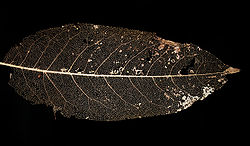


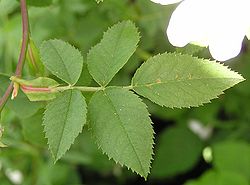




 ภาพตัดขวางของใบไม้
 เซลล์ผิวหนัง
 เซลล์มีโซฟิลล์แบบฟองน้ำ