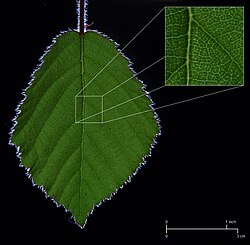
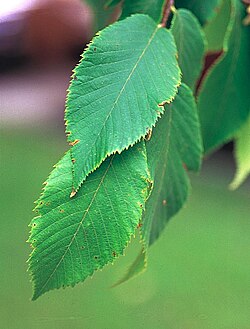
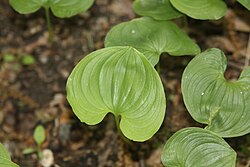
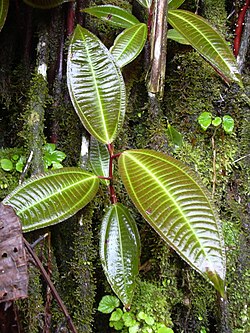
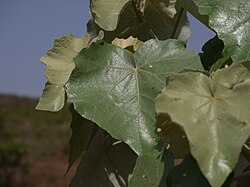
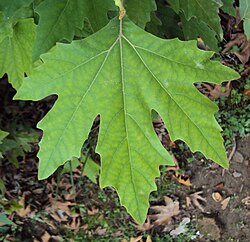
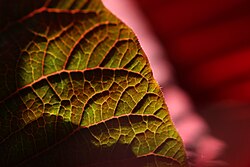
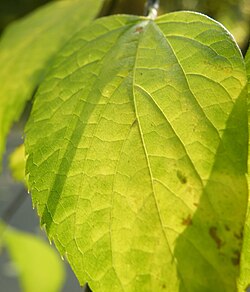
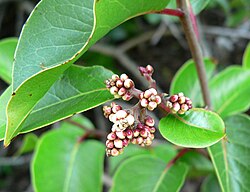
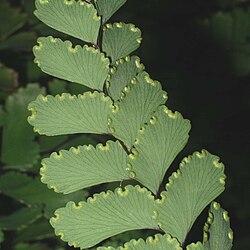
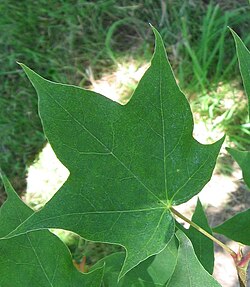
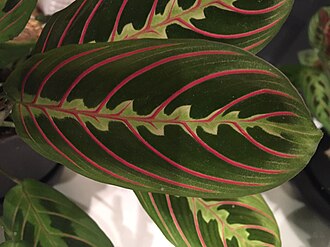
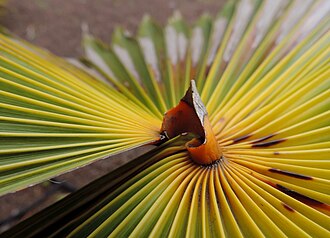
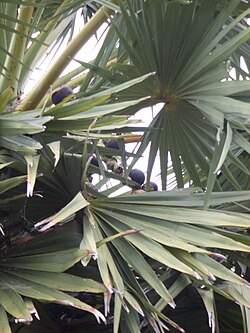
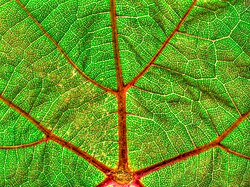
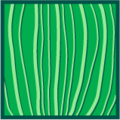
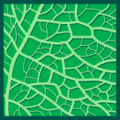
There are also many other descriptive terms, often with specialized usage and confined to specific taxonomic groups.[68] The conspicuousness of veins depends on a number of features. These include the width of the veins, their prominence in relation to the lamina surface and the degree of opacity of the surface, which may hide finer veins. In this regard, veins are called obscure and the order of veins that are obscured and whether upper, lower or both surfaces, further specified.[69][61]
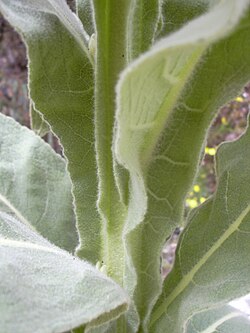
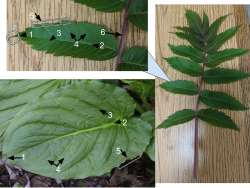
Terms that describe vein prominence include bullate, channelled, flat, guttered, impressed, prominent and recessed (Fig.6.1 Hawthorne & Lawrence 2013).[66][70] Veins may show different types of prominence in different areas of the leaf. For instance Pimenta racemosa has a channeled midrib on the upper surface, but this is prominent on the lower surface.[66]
Describing vein prominence:
Bullate
Surface of leaf raised in a series of domes between the veins on the upper surface, and therefore also with marked depressions. e.g. Rytigynia pauciflora,[71]Vitis vinifera
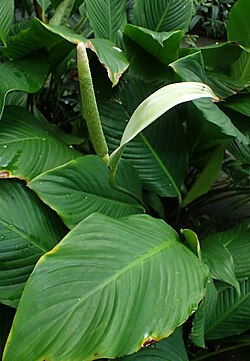
Channelled (canalicululate)
Veins sunken below the surface, resulting in a rounded channel. Sometimes confused with "guttered" because the channels may function as gutters for rain to run off and allow drying, as in many Melastomataceae.[72] e.g. (see) Pimenta racemosa (Myrtaceae),[73]Clidemia hirta (Melastomataceae).
Guttered
Veins partly prominent, the crest above the leaf lamina surface, but with channels running along each side, like gutters
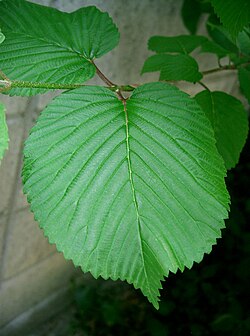
Impressed
Vein forming raised line or ridge lying below the plane of the surface that bears it, as if pressed into it, and are often exposed on the lower surface. Tissue near the veins often appears to pucker, giving them a sunken or embossed appearance
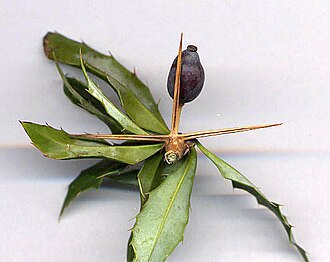
Obscure
Veins not visible, or not at all clear; if unspecified, then not visible with the naked eye. e.g. Berberis gagnepainii. In this Berberis, the veins are only obscure on the undersurface.[74]
More than one main vein (nerve) at the base. Lateral secondary veins branching from a point above the base of the leaf. Usually expressed as a suffix, as in 3-plinerved or triplinerved leaf. In a 3-plinerved (triplinerved) leaf three main veins branch above the base of the lamina (two secondary veins and the main vein) and run essentially parallel subsequently, as in Ceanothus and in Celtis. Similarly, a quintuplinerve (five-veined) leaf has four secondary veins and a main vein. A pattern with 3–7 veins is especially conspicuous in Melastomataceae. The term has also been used in Vaccinieae. The term has been used as synonymous with acrodromous, palmate-acrodromous or suprabasal acrodromous, and is thought to be too broadly defined.[76][76]
Scalariform
Veins arranged like the rungs of a ladder, particularly higher order veins
Submarginal
Veins running close to leaf margin
Trinerved
2 major basal nerves besides the midrib
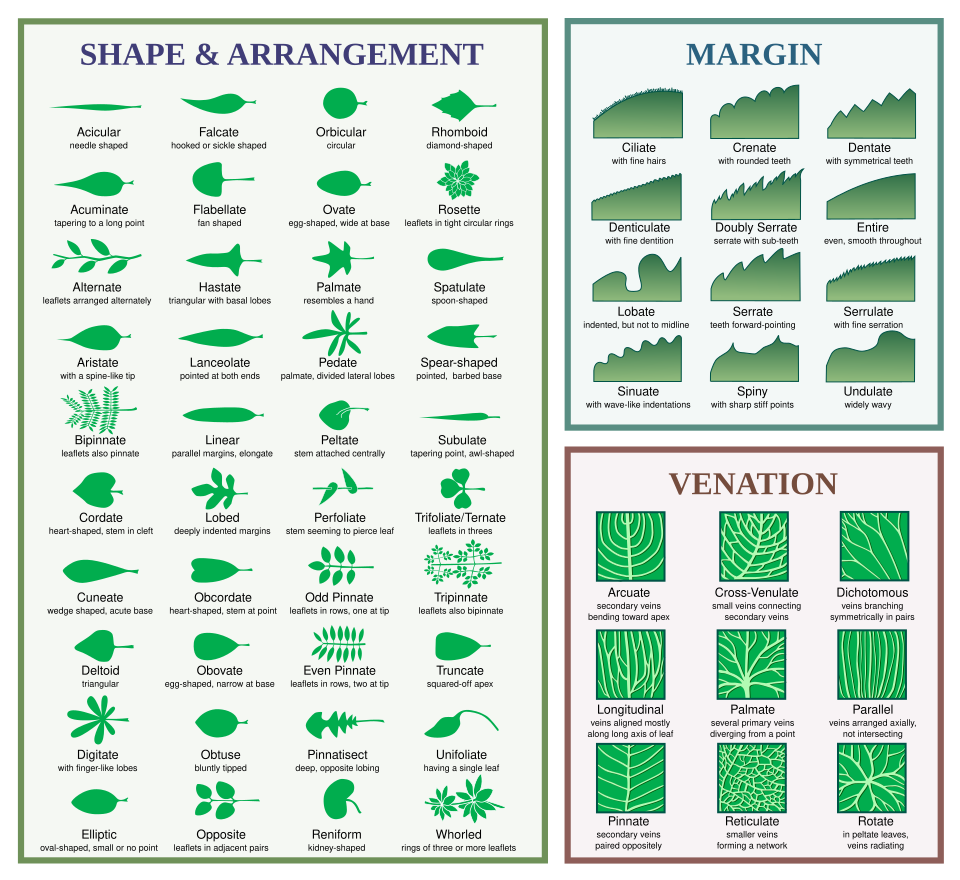
Diagrams of venation patterns
Image
Term
Description
Arcuate
Secondary arching toward the apex
Dichotomous
Veins splitting in two
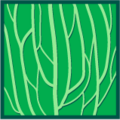
Longitudinal
All veins aligned mostly with the midvein
Parallel
All veins parallel and not intersecting
Pinnate
Secondary veins borne from midrib
Reticulate
All veins branching repeatedly, net veined
Rotate
Veins coming from the center of the leaf and radiating toward the edges
Transverse
Tertiary veins running perpendicular to axis of main vein, connecting secondary veins
Size
The terms megaphyll, macrophyll, mesophyll, notophyll, microphyll, nanophyll and leptophyll are used to describe leaf sizes (in descending order), in a classification devised in 1934 by Christen C. Raunkiær and since modified by others.[77][78]
123Botany Illustrated: Introduction to Plants Major Groups Flowering Plant Families. Thomson Science. 1984. p.21.
↑Didier Reinhardt and Cris Kuhlemeier, "Phyllotaxis in higher plants", in Michael T. McManus, Bruce Veit, eds., Meristematic Tissues in Plant Growth and Development, January 2002, ISBN978-1-84127-227-6, Wiley-Blackwell.
↑Coxeter HS (1961). Introduction to geometry. Wiley. p.169.
↑Yonekura, Takaaki; Iwamoto, Akitoshi; Fujita, Hironori; Sugiyama, Munetaka (June 6, 2019). Umulis, David (ed.). "Mathematical model studies of the comprehensive generation of major and minor phyllotactic patterns in plants with a predominant focus on orixate phyllotaxis". PLOS Computational Biology. 15 (6) e1007044. Bibcode:2019PLSCB..15E7044Y. doi:10.1371/journal.pcbi.1007044. ISSN1553-7358. PMC6553687. PMID31170142.
↑Poiré, Richard; Wiese-Klinkenberg, Anika; Parent, Boris; Mielewczik, Michael; Schurr, Ulrich; Tardieu, François; Walter, Achim (2010). "Diel time-courses of leaf growth in monocot and dicot species: endogenous rhythms and temperature effects". Journal of Experimental Botany. 61 (6): 1751–1759. doi:10.1093/jxb/erq049. ISSN1460-2431. PMC2852670. PMID20299442.
↑Mielewczik, Michael; Friedli, Michael; Kirchgessner, Norbert; Walter, Achim (July 25, 2013). "Diel leaf growth of soybean: a novel method to analyze two-dimensional leaf expansion in high temporal resolution based on a marker tracking approach (Martrack Leaf)". Plant Methods. 9 (1): 30. Bibcode:2013PlMet...9...30M. doi:10.1186/1746-4811-9-30. hdl:20.500.11850/76534. ISSN1746-4811. PMC3750653. PMID23883317.
↑Friedli, Michael; Walter, Achim (2015). "Diel growth patterns of young soybean (G lycine max) leaflets are synchronous throughout different positions on a plant". Plant, Cell & Environment. 38 (3): 514–524. Bibcode:2015PCEnv..38..514F. doi:10.1111/pce.12407. ISSN0140-7791. PMID25041284.
↑Greeney, Harold F; Jones, Meg T (2003). "Shelter building in the Hesperiidae: a classification scheme for larval shelters". The Journal of Research on the Lepidoptera. 37: 27–36. doi:10.5962/p.266551. Retrieved January 13, 2025.
↑"Kew Glossary – definition of hysteranthous". December 3, 2013. Archived from the original on December 3, 2013. Retrieved May 12, 2017.{{cite web}}: CS1 maint: bot: original URL status unknown (link)
↑"Kew Glossary – definition of synanthous". December 3, 2013. Archived from the original on December 3, 2013. Retrieved May 12, 2017.{{cite web}}: CS1 maint: bot: original URL status unknown (link)
↑Webb, Len (October 1, 1959). "A Physiognomic Classification of Australian Rain Forests". Journal of Ecology. 47 (3). British Ecological Society: Journal of Ecology Vol. 47, No. 3, pp. 551–570: 555. Bibcode:1959JEcol..47..551W. doi:10.2307/2257290. JSTOR2257290.
Bayer, M. B. (1982). The New Haworthia Handbook. Kirstenbosch: National Botanic Gardens of South Africa. ISBN978-0-620-05632-8. Archived from the original on September 6, 2023. Retrieved July 25, 2018.
Berg, Linda (March 23, 2007). Introductory Botany: Plants, People, and the Environment, Media Edition. Cengage Learning. ISBN978-1-111-79426-2.
Cullen, James; Knees, Sabina G.; Cubey, H. Suzanne Cubey, eds. (2011) [1984–2000]. The European Garden Flora, Flowering Plants: A Manual for the Identification of Plants Cultivated in Europe, Both Out-of-Doors and Under Glass. 5 vols (2nded.). Cambridge: Cambridge University Press. Archived from the original on December 28, 2016. Retrieved March 8, 2017.
Cutter, E.G. (1969). Plant Anatomy, experiment and interpretation, Part 2 Organs. London: Edward Arnold. p.117. ISBN978-0-7131-2302-9.
Dickison, William C. (2000). Integrative Plant Anatomy. Academic Press. ISBN978-0-08-050891-7.
Esau, Katherine (2006) [1953]. Evert, Ray F (ed.). Esau's Plant Anatomy: Meristems, Cells, and Tissues of the Plant Body: Their Structure, Function, and Development (3rd.ed.). New York: John Wiley & Sons Inc. ISBN978-0-470-04737-8. Archived from the original on September 6, 2023. Retrieved September 2, 2017.
Ettingshausen, C. (1861). Die Blatt-Skelete der Dicotyledonen mit besonderer Ruchsicht auf die Untersuchung und Bestimmung der fossilen Pflanzenreste. Vienna: Classification of the Architecture of Dicotyledonous.
Haupt, Arthur Wing (1953). Plant morphology. McGraw-Hill.
Hawthorne, William; Lawrence, Anna (2013). Plant Identification: Creating User-Friendly Field Guides for Biodiversity Management. Routledge. ISBN978-1-136-55972-3.
Hemsley, Alan R.; Poole, Imogen, eds. (2004). The Evolution of Plant Physiology. Academic Press. ISBN978-0-08-047272-0.
Heywood, V.H.; Brummitt, R.K.; Culham, A.; Seberg, O. (2007). Flowering plant families of the world. New York: Firefly books. p.287. ISBN978-1-55407-206-4.
Hickey, LJ. A revised classification of the architecture of dicotyledonous leaves. pp.i 5–39., in Metcalfe & Chalk (1979)
Judd, Walter S.; Campbell, Christopher S.; Kellogg, Elizabeth A.; Stevens, Peter F.; Donoghue, Michael J. (2007) [1st ed. 1999, 2nd 2002]. Plant systematics: a phylogenetic approach (3rded.). Sinauer Associates. ISBN978-0-87893-407-2. Archived from the original on September 6, 2023. Retrieved September 2, 2017.
Krogh, David (2010), Biology: A Guide to the Natural World (5thed.), Benjamin-Cummings Publishing Company, p.463, ISBN978-0-321-61655-5, archived from the original on January 24, 2023, retrieved May 24, 2016
Leaf Architecture Working Group (1999). Manual of Leaf Architecture - morphological description and categorization of dicotyledonous and net-veined monocotyledonous angiosperms(PDF). Smithsonian Institution. ISBN978-0-9677554-0-3. Archived(PDF) from the original on October 20, 2016. Retrieved February 15, 2017.
Marloth, Rudolf (1913–1932). The Flora of South Africa: With Synopical Tables of the Genera of the Higher Plants. 6 vols. Cape Town: Darter Bros. & Co. Archived from the original on September 6, 2023. Retrieved August 27, 2020.
Mauseth, James D. (2009). Botany: an introduction to plant biology (4thed.). Sudbury, Mass.: Jones and Bartlett Publishers. ISBN978-0-7637-5345-0.
Metcalfe, CR; Chalk, L, eds. (1979) [1957]. Anatomy of the Dicotyledons: Leaves, stem and wood in relation to taxonomy, with notes on economic uses. 2 vols (2nded.). Oxford: Clarendon Press. ISBN978-0-19-854383-1.
1st ed.
Prance, Ghillean Tolmie (1985). Leaves: the formation, characteristics and uses of hundreds of leaves found in all parts of the world. Photographs by Kjell B. Sandved. London: Thames and Hudson. ISBN978-0-500-54104-3.
Rudall, Paula J. (2007). Anatomy of flowering plants: an introduction to structure and development (3rded.). Cambridge: Cambridge University Press. ISBN978-0-521-69245-8. Archived from the original on September 6, 2023. Retrieved August 27, 2020.
Simpson, Michael G. (2011). Plant Systematics. Academic Press. ISBN978-0-08-051404-8. Archived from the original on January 17, 2023. Retrieved May 24, 2016.
Stewart, Wilson N; Rothwell, Gar W. (1993) [1983]. Paleobotany and the Evolution of Plants (2nded.). Cambridge University Press. ISBN978-0-521-38294-6.
Verdcourt, Bernard; Bridson, Diane M. (1991). Flora of tropical East Africa - Rubiaceae Volume 3. CRC Press. ISBN978-90-6191-357-3.
Whitten, Tony; Soeriaatmadja, Roehayat Emon; Afiff, Suraya A. (1997). Ecology of Java and Bali. Oxford University Press. p.505. ISBN978-962-593-072-5. Archived from the original on September 6, 2023. Retrieved August 27, 2020.
Willert, Dieter J. von; Eller, BM; Werger, MJA; Brinckmann, E; Ihlenfeldt, H-D (1992). Life Strategies of Succulents in Deserts: With Special Reference to the Namib Desert. CUP Archive. ISBN978-0-521-24468-8.
Articles and theses
Bagchi, Debjani; Dasgupta, Avik; Gondaliya, Amit D.; Rajput, Kishore S. (2016). "Insights from the Plant World: A Fractal Analysis Approach to Tune Mechanical Rigidity of Scaffolding Matrix in Thin Films". Advanced Materials Research. 1141: 57–64. doi:10.4028/www.scientific.net/AMR.1141.57. S2CID138338270.
Clements, Edith Schwartz (December 1905). "The Relation of Leaf Structure to Physical Factors". Transactions of the American Microscopical Society. 26: 19–98. doi:10.2307/3220956. JSTOR3220956. Archived from the original on August 4, 2023. Retrieved September 6, 2023.
Cooney-Sovetts, C.; Sattler, R. (1987). "Phylloclade development in the Asparagaceae: An example of homoeosis". Botanical Journal of the Linnean Society. 94 (3): 327–371. Bibcode:1987BJLS...94..327C. doi:10.1111/j.1095-8339.1986.tb01053.x.
Corson, Francis; Adda-Bedia, Mokhtar; Boudaoud, Arezki (2009). "In silico leaf venation networks: Growth and reorganization driven by mechanical forces"(PDF). Journal of Theoretical Biology. 259 (3): 440–448. Bibcode:2009JThBi.259..440C. doi:10.1016/j.jtbi.2009.05.002. PMID19446571. S2CID25560670. Archived from the original(PDF) on December 9, 2017.
Cote, G. G. (2009). "Diversity and distribution of idioblasts producing calcium oxalate crystals in Dieffenbachia seguine (Araceae)". American Journal of Botany. 96 (7): 1245–1254. Bibcode:2009AmJB...96.1245C. doi:10.3732/ajb.0800276. PMID21628273.
Couder, Y.; Pauchard, L.; Allain, C.; Adda-Bedia, M.; Douady, S. (July 1, 2002). "The leaf venation as formed in a tensorial field"(PDF). The European Physical Journal B. 28 (2): 135–138. Bibcode:2002EPJB...28..135C. doi:10.1140/epjb/e2002-00211-1. S2CID51687210. Archived from the original(PDF) on December 9, 2017.
Döring, T. F; Archetti, M.; Hardie, J. (January 7, 2009). "Autumn leaves seen through herbivore eyes". Proceedings of the Royal Society B: Biological Sciences. 276 (1654): 121–127. Bibcode:2009PBioS.276..121D. doi:10.1098/rspb.2008.0858. PMC2614250. PMID18782744.
Eckardt, N. A.; Baum, D. (July 20, 2010). "The Podostemad Puzzle: The Evolution of Unusual Morphology in the Podostemaceae". The Plant Cell Online. 22 (7): 2104. Bibcode:2010PlanC..22.2104E. doi:10.1105/tpc.110.220711. PMC2929115. PMID20647343.
Feugier, François (December 14, 2006). Models of Vascular Pattern Formation in Leaves(PhD Thesis). University of Paris VI. Archived(PDF) from the original on March 7, 2017. Retrieved March 6, 2017.
Feild, T. S.; Lee, D. W.; Holbrook, N. M. (October 1, 2001). "Why Leaves Turn Red in Autumn. The Role of Anthocyanins in Senescing Leaves of Red-Osier Dogwood". Plant Physiology. 127 (2): 566–574. Bibcode:2001PlanP.127..566F. doi:10.1104/pp.010063. PMC125091. PMID11598230.
Hallé, F. (1977). "The longest leaf in palms". Principes. 21: 18.
Hickey, Leo J. (January 1, 1973). "Classification of the Architecture of Dicotyledonous Leaves"(PDF). American Journal of Botany. 60 (1): 17–33. doi:10.2307/2441319. JSTOR2441319. Archived(PDF) from the original on August 11, 2017. Retrieved February 14, 2017.
Hickey, Leo J.; Wolfe, Jack A. (1975). "The Bases of Angiosperm Phylogeny: Vegetative Morphology". Annals of the Missouri Botanical Garden. 62 (3): 538–589. Bibcode:1975AnMBG..62..538H. doi:10.2307/2395267. JSTOR2395267. Archived from the original on October 31, 2022. Retrieved September 6, 2023.
James, S. A.; Bell, D. T. (2000). "Influence of light availability on leaf structure and growth of two Eucalyptus globulus ssp. globulus provenances"(PDF). Tree Physiology. 20 (15): 1007–1018. doi:10.1093/treephys/20.15.1007. PMID11305455. Archived(PDF) from the original on April 1, 2022. Retrieved May 10, 2019.
Lacroix, C.; Jeune, B.; Purcell-Macdonald, S. (2003). "Shoot and compound leaf comparisons in eudicots: Dynamic morphology as an alternative approach". Botanical Journal of the Linnean Society. 143 (3): 219–230. Bibcode:2003BJLS..143..219L. doi:10.1046/j.1095-8339.2003.00222.x. Archived from the original on June 22, 2020. Retrieved September 8, 2019.
Laguna, Maria F.; Bohn, Steffen; Jagla, Eduardo A.; Bourne, Philip E. (2008). "The Role of Elastic Stresses on Leaf Venation Morphogenesis". PLOS Computational Biology. 4 (4) e1000055. arXiv:0705.0902. Bibcode:2008PLSCB...4E0055L. doi:10.1371/journal.pcbi.1000055. PMC2275310. PMID18404203.
Melville, R. (November 1976). "The Terminology of Leaf Architecture". Taxon. 25 (5/6): 549–561. Bibcode:1976Taxon..25..549M. doi:10.2307/1220108. JSTOR1220108.
Pedraza-Peñalosa, Paola; Salinas, Nelson R.; Wheeler, Ward C. (April 26, 2013). "Venation patterns of neotropical blueberries (Vaccinieae: Ericaceae) and their phylogenetic utility"(PDF). Phytotaxa. 96 (1): 1. Bibcode:2013Phytx..96....1P. doi:10.11646/phytotaxa.96.1.1. Archived(PDF) from the original on February 18, 2017. Retrieved February 17, 2017.
Read, J.; Stokes, A. (October 1, 2006). "Plant biomechanics in an ecological context". American Journal of Botany. 93 (10): 1546–1565. Bibcode:2006AmJB...93.1546R. doi:10.3732/ajb.93.10.1546. PMID21642101.
Roth-Nebelsick, A; Uhl, Dieter; Mosbrugger, Volker; Kerp, Hans (May 2001). "Evolution and Function of Leaf Venation Architecture: A Review". Annals of Botany. 87 (5): 553–566. Bibcode:2001AnBot..87..553R. doi:10.1006/anbo.2001.1391.
Rutishauser, R.; Sattler, R. (1997). "Expression of shoot processes in leaf development of Polemonium caeruleum". Botanische Jahrbücher für Systematik. 119: 563–582.
Sack, Lawren; Scoffoni, Christine (June 2013). "Leaf venation: structure, function, development, evolution, ecology and applications in the past, present and future". New Phytologist. 198 (4): 983–1000. Bibcode:2013NewPh.198..983S. doi:10.1111/nph.12253. PMID23600478.
Shelley, A.J.; Smith, W.K.; Vogelmann, T.C. (1998). "Ontogenetic differences in mesophyll structure and chlorophyll distribution in Eucalyptus globulus ssp. globulus (Myrtaceae)". American Journal of Botany. 86 (2): 198–207. doi:10.2307/2656937. JSTOR2656937. PMID21680359.
Ueno, Osamu; Kawano, Yukiko; Wakayama, Masataka; Takeda, Tomoshiro (April 1, 2006). "Leaf Vascular Systems in C and C Grasses: A Two-dimensional Analysis". Annals of Botany. 97 (4): 611–621. doi:10.1093/aob/mcl010. PMC2803656. PMID16464879.
Walls, R. L. (January 25, 2011). "Angiosperm leaf vein patterns are linked to leaf functions in a global-scale data set". American Journal of Botany. 98 (2): 244–253. Bibcode:2011AmJB...98..244W. doi:10.3732/ajb.1000154. PMID21613113.
Websites
Bucksch, Alexander; Blonder, Benjamin; Price, Charles; Wing, Scott; Weitz, Joshua; Das, Abhiram (2017). "Cleared Leaf Image Database". School of Biology, Georgia Institute of Technology. Archived from the original on September 25, 2014. Retrieved March 12, 2017.
Geneve, Robert. "Leaf"(PDF). PLS 220: Introduction to plant identification. University of Kentucky: Department of Horticulture. Archived from the original(PDF) on March 15, 2016.
Kling, Gary J.; Hayden, Laura L.; Potts, Joshua J. (2005). "Botanical terminology". University of Illinois, Urbana-Champaign. Archived from the original on March 8, 2017. Retrieved March 7, 2017.
de Kok, Rogier; Biffin, Ed (November 2007). "The Pea Key: An interactive key for Australian pea-flowered legumes". Australian Pea-flowered Legume Research Group. Archived from the original on February 26, 2017. Retrieved March 9, 2017.
Kranz, Laura. "The Vein Patterns of Leaves"(Drawings). Archived from the original on March 6, 2017. Retrieved March 5, 2017.
Massey, Jimmy R.; Murphy, James C. (1996). "Vascular plant systematics". NC Botnet. University of North Carolina at Chapel Hill. Archived from the original on January 17, 2016. Retrieved January 19, 2016.
"Leaves". Archived from the original on July 25, 2016. Retrieved January 19, 2016., in Massey & Murphy (1996)
Purcell, Adam (January 16, 2016). "Leaves". Basic Biology. Adam Purcell. Archived from the original on April 19, 2015. Retrieved February 17, 2017.
Simpson, Michael G. "Plants of San Diego County, California". College of Science, San Diego State University. Archived from the original on March 3, 2017. Retrieved March 2, 2017.
"Plant Database". School of Horticulture, Kwantlen Polytechnic University. 2015. Archived from the original on September 21, 2017. Retrieved March 9, 2017.
"Angiosperm Morphology". TutorVista. 2017. Archived from the original on June 21, 2020. Retrieved March 9, 2017.
Glossaries
Hughes, Colin. "The virtual field herbarium". Oxford University Herbaria. Archived from the original on March 5, 2017. Retrieved March 4, 2017.
"Plant Characteristics". Archived from the original(Glossary) on March 5, 2017. Retrieved March 4, 2017., in Hughes (2017)
"Glossary of botanical terms". Neotropikey. Royal Botanic Gardens, Kew. Archived from the original on January 21, 2017. Retrieved February 18, 2017.

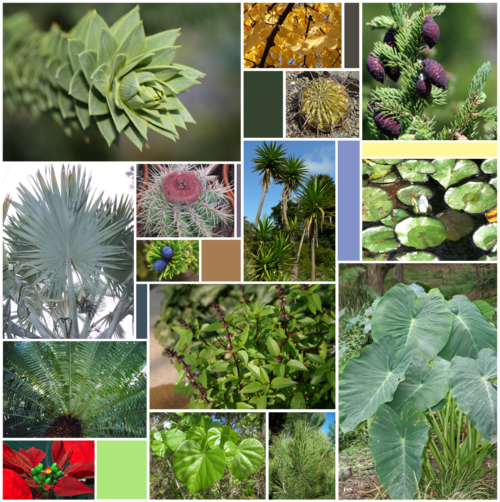
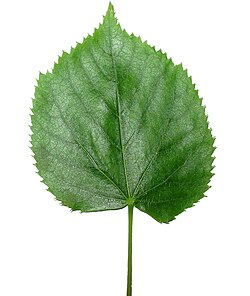


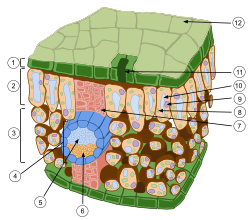







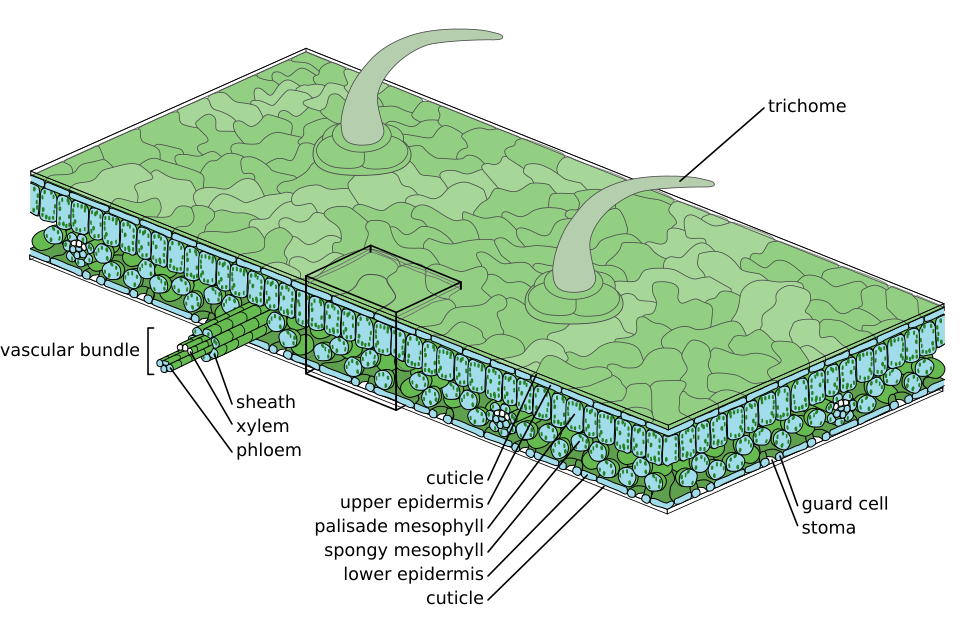
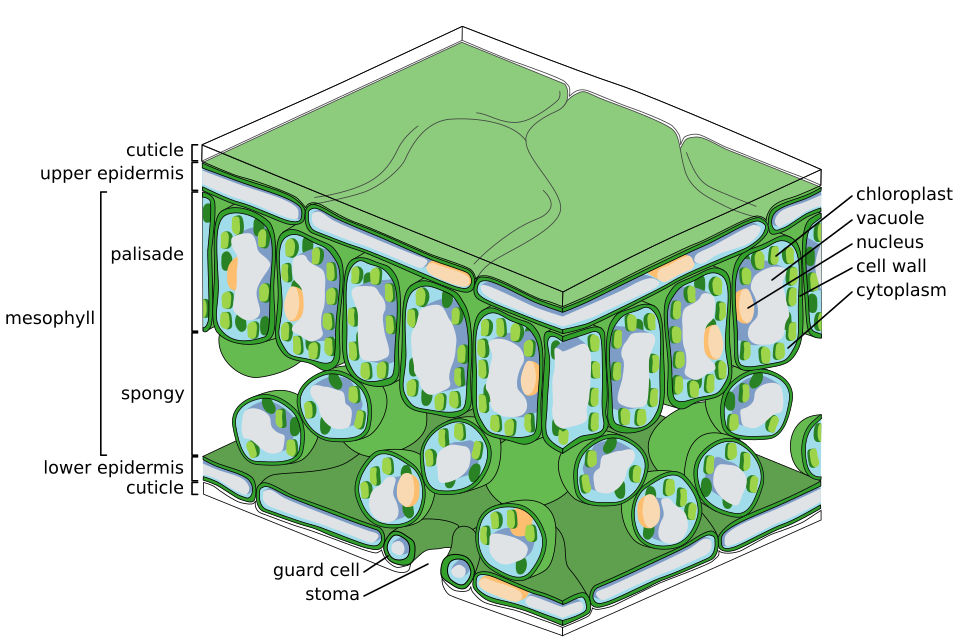
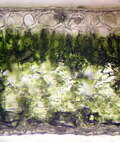 ภาพตัดขวางของใบไม้
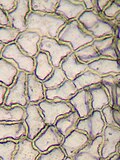 เซลล์ผิวหนัง
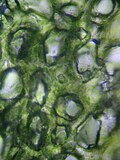 เซลล์มีโซฟิลล์แบบฟองน้ำ