
อ่าน 87 นาที
ธงประจำกองทัพ ธงมาตรฐาน และธงนำขบวน
ในองค์กรทางทหาร การใช้ ธง หรือ ธง ประจำ กองร้อย ซึ่งใช้เป็นจุดรวมพลและบ่งบอกตำแหน่งของผู้บัญชาการนั้น เชื่อกันว่ามีต้นกำเนิดมาจากอียิปต์ โบราณ เมื่อประมาณ 5,000 ปีที่แล้ว...
ธงประจำกองทัพ ธงมาตรฐาน และธงนำขบวน


ในองค์กรทางทหาร การใช้ธงหรือธงประจำกองร้อยซึ่งใช้เป็นจุดรวมพลและบ่งบอกตำแหน่งของผู้บัญชาการนั้น เชื่อกันว่ามีต้นกำเนิดมาจากอียิปต์โบราณเมื่อประมาณ 5,000 ปีที่แล้ว กองทัพของจักรวรรดิโรมันก็ใช้ ธงรบ ที่ เรียกว่า vexillaซึ่งมีอักษรSPQR เช่นกัน การใช้ ธงรบ ในรูป แบบนี้ได้รับการทำให้เป็นทางการในกองทัพของยุโรปในยุคกลางตอนปลายโดยมีการประดับตราประจำตระกูลของผู้บัญชาการไว้บน ธง
การใช้งานทั่วไป


เดิมทีธงประจำกองทหารมีประโยชน์ใช้สอยในสมรภูมิรบ เมื่อกองทัพได้รับการฝึกฝนและใช้รูปแบบการจัดทัพที่แน่นอน ความสามารถของแต่ละกรมในการรักษารูปขบวนจึงมีความสำคัญอย่างยิ่งต่อความสำเร็จของกรมนั้นๆ และด้วยเหตุนี้จึงส่งผลต่อความสำเร็จของกองทัพทั้งหมด ในความวุ่นวายของการรบ เนื่องจากมีฝุ่นและควันจำนวนมากในสนามรบ ทหารจึงจำเป็นต้องสามารถระบุตำแหน่งของกรมตนได้
โดยทั่วไปแล้ว ธงประจำกรมทหารจะได้รับพระราชทานจากประมุขของรัฐในพิธี ดังนั้นจึงได้รับการปฏิบัติด้วยความเคารพ เนื่องจากเป็นสัญลักษณ์แห่งเกียรติยศและประเพณีของกรมทหาร ธงอาจมีการจารึกชื่อของสมรภูมิหรือสัญลักษณ์อื่นๆ ที่แสดงถึงความสำเร็จในอดีต (ดูเกียรติยศจากการรบ )
โดยทั่วไปแล้ว กองทหารมักจะจัดตั้ง " หน่วยรักษาธง " ซึ่งประกอบด้วยทหารที่มีประสบการณ์หรือทหารชั้นยอด เพื่อปกป้องธงประจำกอง ดังนั้น การยึดธงของฝ่ายศัตรูจึงถือเป็นความสำเร็จทางการทหารที่ยิ่งใหญ่
ธงและเครื่องหมายประจำหน่วยจะไม่ถูกทำลายโดยพลการ – เมื่อเก่าเกินกว่าจะใช้ได้ ก็จะถูกเปลี่ยนใหม่และเก็บรักษาไว้ในพิพิธภัณฑ์ อาคารทางศาสนา และสถานที่สำคัญอื่นๆ ที่เกี่ยวข้องกับหน่วยนั้นๆ อย่างไรก็ตาม ในกองทัพสมัยใหม่ส่วนใหญ่ คำสั่งที่กำหนดไว้แล้วคือให้ทำลายธงประจำหน่วยโดยเจตนา หากธงนั้นตกอยู่ในอันตรายที่จะถูกศัตรูยึดครอง
เนื่องจากการเกิดขึ้นของอาวุธสมัยใหม่และการเปลี่ยนแปลงทางยุทธวิธี สีประจำหน่วยจึงไม่ได้ถูกนำเข้าสู่การรบอีกต่อไป แต่ยังคงใช้ในงานพิธีการต่างๆ
สีต่างๆ
เอเชีย
กัมพูชา
ในประเทศกัมพูชาสีของกองทัพหลวงกัมพูชา (RCAF) และหน่วยงานที่มีเครื่องแบบอื่นๆ นั้นเป็นไปตามแบบอย่างของอังกฤษ สหรัฐอเมริกา และฝรั่งเศส
จนถึงปี 2022 ธงชาติกัมพูชาขนาดใหญ่ที่มีชื่อหน่วยอยู่ด้านล่างเป็นสีขาวในแถบสีน้ำเงินด้านล่าง ถูกใช้เป็นสีประจำพระองค์ของหน่วยทหารอากาศกัมพูชา (RCAF) ก่อนที่จะถูกกำหนดใหม่ให้เป็นสีประจำชาติสำหรับขบวนพาเหรดและพิธีการต่างๆ ในปี 2023 ได้มีการเปิดตัวดีไซน์ใหม่ที่ได้รับแรงบันดาลใจจากจีน แต่ก็ยังคงไว้ซึ่งกลิ่นอายของอาณาจักรโบราณในดินแดนกัมพูชา ดีไซน์นี้เป็นแบบรวม โดยมีตราสัญลักษณ์ของหน่วยหรือกองกำลังอยู่ตรงกลาง และชื่อหน่วยเป็นภาษาเขมรอยู่ด้านล่าง แต่สีจะแตกต่างกันไปตามแต่ละเหล่าทัพ
- กองทัพบกและตำรวจทหารแห่งกัมพูชา : สีแดง
- กองทัพเรือกัมพูชา : สีน้ำเงินเข้ม
- กองทัพอากาศกัมพูชา : สีฟ้าอ่อน
สาธารณรัฐประชาชนจีน (จีนแผ่นดินใหญ่)

กองทัพปลดปล่อยประชาชน จีน (PLA) เป็นองค์กรหลักของกองกำลังติดอาวุธทั้งหมดของสาธารณรัฐประชาชนจีนและมีธงเดียวเป็นสัญลักษณ์ ซึ่งใช้เป็นธงพิธีการสำหรับทุกกรมและหน่วยขนาดใหญ่ ธงนี้มีพื้นฐานมาจากธงชาติแต่แทนที่จะมีดาวสีทองขนาดเล็กสี่ดวง กลับมีอักษรจีนแสดงตัวเลข '8' และ '1' ซึ่งหมายถึง วันที่ 1 สิงหาคมปี 1927 ซึ่งเป็นวันที่กองทัพปลดปล่อยประชาชนจีนก่อตั้งขึ้น เมื่อทำการสวนสนาม ธงจะมีขอบสีทองและติดตั้งบนเสาสีแดงและสีทอง
แต่ละเหล่าทัพของกองทัพปลดปล่อยประชาชนจีน (PLA) มีธงประจำเหล่าทัพของตนเอง โดยอิงจากธงประจำกองทัพบก ( ธงประจำกองทัพปลดปล่อยประชาชนจีน ):
- ธงกองกำลังภาคพื้นดิน : เหมือนกับธงกองทัพบกทุกประการ แต่ส่วนล่าง 40% เป็นสีเขียว
- ธงกองทัพเรือ : เหมือนกับธงกองทัพบกทุกประการ แต่ส่วนล่าง 40% มีแถบสีน้ำเงิน 3 แถบและแถบสีขาว 2 แถบแนวนอนที่มีความกว้างเท่ากัน
- กองทัพอากาศ : มีลักษณะเหมือนกับธงกองทัพบก แต่ส่วนล่าง 40% เป็นสีน้ำเงินของกองทัพอากาศ
- ธงกองกำลังจรวด : มีลักษณะเหมือนกับธงกองทัพบก แต่ส่วนล่าง 40% เป็นแถบสีทอง
สิ่งเหล่านี้ก็ไม่ได้ถูกนำมาแห่ในที่สาธารณะเช่นกัน เว้นแต่จะมีขอบสีทองเช่นเดียวกับธงกองทัพบก
การใช้สีประจำหน่วยตามสีประจำกองทัพบกปลดปล่อยประชาชนจีน (PLA) จะเริ่มใช้ตั้งแต่ปี 2018 (และเป็นเพียงการทดลองเท่านั้น) โดยหน่วยเคลื่อนที่ของกองบัญชาการภาคเหนือที่เข้าร่วมการฝึกซ้อมทางทหารร่วม "Vostok 2018" กับกองทัพรัสเซียได้ใช้สีประจำหน่วยสีแดงที่มีชื่อหน่วยอยู่บนขอบสีขาวด้านใกล้เสาธง ก่อนหน้านี้ หลายปี หน่วยตำรวจติดอาวุธประชาชนจีน เคยใช้สีประจำหน่วยทดลอง นี้มาก่อนแล้ว ในขบวนพาเหรดพลเรือน-ทหารเมื่อวันที่ 1 ตุลาคม 2019 เนื่องในโอกาสครบรอบ 70 ปีแห่งการก่อตั้งสาธารณรัฐประชาชนจีนหน่วยรักษาธงเคลื่อนที่ได้เปิดตัวสีประจำหน่วยอีกครั้งหลังจากหายไปหลายปี ซึ่งเป็นสีสีแดงที่มีชื่อหน่วยหรือหน่วยงานเป็นภาษาจีนกลางด้วยตัวอักษรสีขาวหรือสีทอง (แต่ไม่มีขอบสีขาว) และบางสีอาจมีข้อความเพิ่มเติมที่ระบุเกียรติยศในการรบหรือเครื่องราชอิสริยาภรณ์ที่ได้รับมอบให้แก่หน่วยหรือหน่วยงานนั้นๆ
สาธารณรัฐจีน (ไต้หวัน)

กองทัพบกของสาธารณรัฐจีน (ไต้หวัน) ก็มีธงประจำหน่วยเพียงธงเดียวเช่นกัน คือสีแดง มีรูปท้องฟ้าสีครามและดวงอาทิตย์สีขาวอยู่ตรงกลาง เสาธงเป็นสีแดงปลาย เสาเป็นรูปหอกสีเงิน และมีพู่สีแดงอยู่ด้านล่าง หน่วยย่อยแต่ละหน่วยใช้ธงประจำหน่วยในรูปแบบที่แตกต่างกันไป โดยจะมีแถบสีขาวอยู่ข้างเสาธง ซึ่งมีชื่อหน่วยเป็นตัวอักษรสีดำ และมีพู่สีทอง (เช่นเดียวกับที่ใช้มาตั้งแต่ปี 1961 สำหรับทุกหน่วยของกองทัพสาธารณรัฐจีนแต่ตั้งแต่ปี 1947 จำกัดเฉพาะหน่วยทหารบกที่สูงกว่าระดับกรม) ส่วนธงประจำกองเกียรติยศของกองทัพบกจะเป็นสีทอง โดยมีตราประจำหน่วยอยู่ตรงกลาง
กองทัพเรือสาธารณรัฐจีนมีสีแดง แต่มีตราสัญลักษณ์ของกองทัพเรืออยู่ในกรอบสีน้ำเงินเข้มตรงกลาง จนกระทั่งถึงช่วงทศวรรษ 1980 ปัจจุบันกองร้อยทหารเกียรติยศใช้เพียงสีน้ำเงินเข้มและตราสัญลักษณ์ของกองทัพเรือ ซึ่งเป็นสีเดียวกับที่หน่วยอื่นๆ ของกองทัพเรือสาธารณรัฐจีนใช้ในปัจจุบัน
สำหรับนาวิกโยธินสาธารณรัฐจีนธงประจำหน่วยตั้งแต่ปี 1960 มีลักษณะคล้ายคลึงกับของนาวิกโยธินสหรัฐฯ แต่ตั้งแต่ทศวรรษ 1980 เป็นต้นมา ชื่อหน่วยจะอยู่บนแถบสีขาวใกล้กับเสาธง (เช่นเดียวกับกองทัพส่วนอื่นๆ ในอดีตเคยอยู่บนม้วนกระดาษคล้ายกับของนาวิกโยธินสหรัฐฯ)
สีที่กองทัพอากาศสาธารณรัฐจีน ใช้ เป็นสีฟ้าอ่อน โดยมีตราสัญลักษณ์กองทัพอากาศอยู่ตรงกลาง (เดิมทีเป็นสีแดง โดยมีแถบสีฟ้าอ่อนด้านบนและด้านล่างเป็นตราแผ่นดิน ซึ่งเป็นแบบเก่าที่ปัจจุบันใช้เฉพาะกับกองเกียรติยศเท่านั้น)
หน่วยตำรวจทหารสาธารณรัฐจีนซึ่งเดิมใช้สีน้ำเงิน ปัจจุบันเปลี่ยนมาใช้สีน้ำตาลพร้อมตราสัญลักษณ์ของตำรวจทหารสาธารณรัฐจีน
หน่วยที่ขึ้นตรงกับกระทรวงกลาโหมจะใช้สีส้ม โดยมีตราประจำกระทรวงอยู่ตรงกลาง หน่วยรักษาการณ์จะใช้สีน้ำเงิน โดยมีตราสัญลักษณ์ของพรรคกั๋วหมิงตัง พวงข้าวสาลี และวงกลมสามวงที่เกี่ยวพันกันเป็นสีเหลือง แดง และน้ำเงินตามลำดับ หน่วยสำรองจะใช้สีแดง ในขณะที่หน่วยสำรองของไต้หวันจะใช้สีเขียว
มีเพียงสถาบันการทหารต่อไปนี้เท่านั้นที่ใช้สีประจำสถาบัน เนื่องจากสีประจำกองทัพอากาศสาธารณรัฐจีน (ROCAF) เป็นสีที่ใช้โดยสถาบันการทหารอากาศสาธารณรัฐจีน :
ในการแข่งขันทุกครั้งที่กองทัพอากาศสาธารณรัฐจีนเข้าร่วม ธงชาติสาธารณรัฐจีนจะถูกใช้เป็นสีประจำชาติ
อินโดนีเซีย
ในประเทศอินโดนีเซียธงประจำกองทัพแห่งชาติอินโดนีเซียตำรวจแห่งชาติอินโดนีเซียและหน่วยงานที่มีเครื่องแบบอื่นๆ เรียกว่าปันจิ-ปันจิปันจิ-ปันจิจะถูกถือและคุ้มกันโดยกองรักษาธงที่เรียกว่า "ปาตากา" ซึ่งเป็นคำย่อจากPasukan Tanda Kehormatanในภาษาอินโดนีเซีย[ 1 ]
สีประจำชาติและสีประจำหน่วยงาน

ในระหว่างพิธีสำเร็จการศึกษาและพิธีสวนสนาม เมื่อใดก็ตามที่มีการกล่าวคำปฏิญาณในการเข้ารับราชการทหารหรือการรับตำแหน่งธงชาติอินโดนีเซียจะถูกใช้เป็นสีประจำชาติ
โดยทั่วไปแล้ว ในขบวนพาเหรด เรามักเห็นธงประจำเหล่าทัพของกองทัพบกอินโดนีเซีย (TNI) ตำรวจแห่งชาติอินโดนีเซีย และตำรวจเทศบาล (เรียกอีกอย่างว่าPanji-Panji Kesatuan/Lambang-Lambang Kesatuan ) ในกองทัพบกอินโดนีเซียเองก็มีธงประจำเหล่าทัพทั้งสามเหล่าทัพเช่นกัน คำว่า Panji-panjiในภาษาอินโดนีเซียหมายถึง ธงประจำเหล่าทัพ
- เหรียญกองทัพอินโดนีเซีย (สามเหล่าทัพ) สี: สีแดง ด้านหน้ามีตราแผ่นดิน ด้านหลังมีตราแผ่นดิน
- สีประจำ กองทัพอินโดนีเซีย : สีเขียว มีตราแผ่นดินอยู่ด้านหน้า
- สีของ เหรียญกองทัพเรืออินโดนีเซีย : สีน้ำเงินเข้ม มีตราแผ่นดินอยู่ด้านหน้า
- สี ของกองทัพอากาศอินโดนีเซีย : สีฟ้าอ่อน มีตราแผ่นดินอยู่ด้านหน้า
ไม่ใช่บุคลากรทางการทหาร:
- สีประจำ หน่วยตำรวจแห่งชาติอินโดนีเซีย : สีดำ และมีตราแผ่นดินอยู่ด้านหลัง
- สีประจำ ตำรวจเทศบาล : สีน้ำเงินเข้ม
สีของคำสั่งและด้านล่าง
ตุงกุลและปาทากาเป็นคำที่ใช้ระบุสีประจำหน่วยที่ต่ำกว่าระดับบังคับบัญชาหรือระดับเหล่าทัพภายในกองทัพ ตำรวจแห่งชาติ และตำรวจเทศบาล ตุงกุลใช้สำหรับหน่วยระดับกองพัน/กองร้อย และกองบัญชาการทหารภาคพื้นดินหรือเทียบเท่า ส่วนปาทากาใช้สำหรับกองพลน้อย/กรม กองพล/กองบัญชาการภูมิภาค และกองบัญชาการเฉพาะทางและปฏิบัติการ ทั้งสองแบบมีรูปแบบที่เหมือนกัน คือ ตราประจำหน่วยจะอยู่ด้านหน้า ส่วนตราสัญลักษณ์ของหน่วยที่ขึ้นตรงจะอยู่ด้านหลัง สีประจำหน่วยทุกสีมีขอบสีทองและมีรูปครุฑเป็นยอดแหลม ซึ่งได้แรงบันดาลใจจากตราประจำชาติ
ภายในกองทัพบกตำรวจและตำรวจเทศบาลสีประจำหน่วยเฉพาะกิจมีดังนี้:
- สีเขียว : ทหารราบ , กองทหารช่าง, กองบัญชาการทหารระดับภูมิภาค, กองบัญชาการปฏิบัติการและบริหาร, หน่วยงานและกรมต่างๆ
- สีแดง : กองบัญชาการสำรองยุทธศาสตร์กองทัพบก , กองพันและกองพลน้อยหน่วย รบพิเศษกองทัพบก , หน่วยสำรอง
- สีดำ : ยานเกราะและทหารม้า, ทหารราบกองทัพอากาศ , ทหารราบจู่โจม (รวมหน่วยพลร่มและหน่วยยานยนต์), ตำรวจเทศบาล, ตำรวจ
- บราวน์ : ปืนใหญ่และปืนต่อต้านอากาศยาน, โรงเรียนนายทหารอินโดนีเซีย
- เกรย์ : โลจิสติกส์และการขนส่ง, ตำรวจทหาร, บริการกองทัพบก
- สีน้ำเงินเข้ม : กองทัพเรือ ซึ่งรวมถึงกองกำลังทางเรือและการขนส่งทางทะเลของกองทัพ
- สีน้ำเงินอัลตรามารีน : กองทัพอากาศ
- สีแดงเข้ม : กองพลเคลื่อนที่เร็ว (ตำรวจ)
- สีม่วงแดง : นาวิกโยธิน
- ไวโอเล็ต : กองบัญชาการการบินกองทัพบก
สาธารณรัฐประชาธิปไตยประชาชนเกาหลี (เกาหลีเหนือ)

กองทัพประชาชนเกาหลีเป็นองค์กรโดยรวมของกองกำลังติดอาวุธทั้งหมดของสาธารณรัฐประชาธิปไตยประชาชนเกาหลีจนถึงปี 1993 กองทัพประชาชนเกาหลีใช้ธงเพียงผืนเดียว ซึ่งทำหน้าที่เป็นธงพิธีการสำหรับทุกกรม สถาบันการศึกษา และหน่วยขนาดใหญ่ ธงนี้มีพื้นฐานมาจากธงชาติแต่มีตราสัญลักษณ์ประจำชาติแทนที่ดาว[ 2 ]และในการสวนสนาม ธงจะมีขอบสีทองล้อมรอบ ตัวอักษรสีทองในภาษาอังกูลจนถึงปี พ.ศ. 2504 คือ "เพื่อความเป็นอิสระของมาตุภูมิและประชาชน" ( 조과 독립과 FANMIN을 위하여 ) หรือ "เพื่ออิสรภาพและอิสรภาพของปิตุภูมิ" ( 조성의 자유와 독립을 위하여 , หน่วยองครักษ์เท่านั้น) จากนั้นแทนที่ด้วย "เพื่อการรวมกันเป็นหนึ่ง" และความเป็นอิสระของปิตุภูมิ และเสรีภาพและความสุขของประชาชน" ( 조공을 위하여 )
ในปี 1993 เนื่องในโอกาสครบรอบ 40 ปีของการสิ้นสุดสงครามเกาหลี และครบรอบ 45 ปีของการก่อตั้งสาธารณรัฐประชาธิปไตยประชาชนเกาหลี สีเดิมได้ถูกแทนที่ด้วยลวดลายที่ใช้มานานกว่าสามทศวรรษในขบวนพาเหรดวันหยุดสำคัญต่างๆ เหรียญทุกสีมีด้านหลังเหมือนกัน โดยมีตราสัญลักษณ์ของพรรคแรงงานเกาหลี (WPK) เป็นสีทอง และยกเว้นเหรียญของกองกำลังพิทักษ์แดงกรรมกรชาวนาแล้ว จะมีตัวอักษรเกาหลี (ฮันกุล) สีทองเหมือนกัน ซึ่งระบุว่า "กองกำลังติดอาวุธปฏิวัติของพรรคแรงงานเกาหลี กองทัพประชาชนเกาหลี [ชื่อหน่วย] / หน่วยที่ 425 (ในพิธีการ)" ( 조선로동당의 혁명적무장력인 조선인민군 제425 군부대 ) โดยหมายเลข 425 เป็นเกียรติแก่ปีที่ 25 เมษายน (1932) ซึ่งเป็นปีที่ก่อตั้งกองทัพกองโจรต่อต้านญี่ปุ่นของประชาชน ซึ่งสืบทอดต่อมายังกองทัพในปัจจุบัน แต่ใช้สีเดียวกับด้านหน้า ซึ่งแสดงหมายเลข 4.25 เป็นสีทองเช่นกัน หน่วยรักษาการณ์ยังมีตราสัญลักษณ์อยู่ใต้เครื่องหมาย 4.25 ด้วย ในปี 2023 จากการประชุมของคณะกรรมการทหารส่วนกลางของพรรคแรงงานเกาหลี (WPK)ได้มีการนำเสนอแบบร่างใหม่ที่แก้ไขแล้วโดยอิงจากแบบแผนปี 1992-1993 สำหรับกองทัพประชาชนเกาหลี (KPA) พร้อมคำขวัญใหม่ว่า "เพื่อความเจริญรุ่งเรืองอันไม่มีที่สิ้นสุดของปิตุภูมิและความมั่นคงของประชาชน!" ( 조국의 무궁한 번영과 인민의 안녕을 위하여 ) หรืออีกนัยหนึ่งคือ "เพื่อคณะกรรมการกลางพรรคของเรา หัวใจแห่งการปฏิวัติเกาหลี!" ( 조선혁명의 심장인 우리 당중앙위원회를 위하여 , เฉพาะทหารองครักษ์) และเครื่องหมาย 4.25 ถูกลบออกในที่สุด โดยแทนที่ด้วยวันที่ก่อตั้งหน่วยงานหรือเหล่าทัพ หน่วยทหารองครักษ์ยังคงมีตราสัญลักษณ์อย่างเป็นทางการอยู่ด้านล่างวันที่ก่อตั้ง ด้านหลังของธงได้รับการปรับปรุงใหม่ด้วยลวดลายกราฟิกที่ประกอบด้วยภาพเงาของสำนักงานใหญ่พรรคแรงงานเกาหลีและโล่สีแดงที่มีตราสัญลักษณ์ของพรรคแรงงานเกาหลีอยู่ตรงกลาง พร้อมคำขวัญเพิ่มเติมว่า "ขอให้เราปกป้องคณะกรรมการกลางพรรคภายใต้การนำของสหายคิม จองอุนผู้เป็นที่รักด้วยชีวิตทั้งหมดของเรา!" ( 경애하는 Kim정현동지를 수반으ロ 하는 당중앙위원회를 목숨으ロ 사수하자! ) ที่ด้านบน[ 3 ]สีเหล่านี้เป็นขอบสีทองเมื่อนำออกมาในขบวนพาเหรดสาธารณะใน กรุง เปียงยางเมืองหลวงของประเทศ และในระหว่างการเยือนของรัฐโดยองครักษ์กองบัญชาการรักษาดินแดนสูงสุดซึ่งเป็นรูปแบบการให้บริการระหว่างหน่วยต่างจากหน่วยบัญชาการส่วนที่เหลือซึ่งมีบุคลากรถูกดึงมาจากกองกำลังภาคพื้นดิน สีประจำหน่วยที่ใช้ในช่วงปี 1948–1961 นั้น นับตั้งแต่การเฉลิมฉลองครบรอบ 60 ปีของการสิ้นสุดสงครามเกาหลีในปี 2013 เป็นต้นมา ได้ถูกนำออกมาใช้เฉพาะโดยหน่วยรักษาการณ์และกองพันของกองทัพประชาชนเกาหลี (KPA) ที่สวมเครื่องแบบเต็มยศในยุคปี 1940 และต้นปี 1950 เท่านั้น โดยสีประจำหน่วยปี 1948 จะมีตราสัญลักษณ์หน่วยรักษาการณ์สีทองอยู่ด้านหลังเพื่อแสดงสถานะของหน่วยรักษาการณ์ และใช้ตราประจำหน่วยและคำขวัญของปี 1948 แทนของปัจจุบัน
- สีเดิมของกองทัพประชาชนเกาหลี (KPA) จนถึงปี 1997: สีแดง มีตราสัญลักษณ์ประจำชาติสีทอง – เดิมทีตราสัญลักษณ์ของ KPA เป็นสีทอง (รวงข้าวและเขื่อนจำลองที่มีดาวสีแดงล้อมรอบด้วยวงกลมสีทอง มีพวงมาลัยอยู่ด้านล่าง) ธงเดิมไม่มีคำขวัญด้านหน้า แต่มีเฉพาะด้านหลัง คำขวัญภาษาเกาหลีสีทองอ่านว่า "เพื่อการรวมชาติและเอกราชของมาตุภูมิ และเพื่อเสรีภาพและความสุขของประชาชน"
- เหรียญ KPA รุ่นปี 2023: สีแดง มีพวงมาลัยลอเรล วงแหวนสีทอง และดาวสีแดงที่มีตราแผ่นดินสีทอง พร้อมคำขวัญภาษาเกาหลีสีทองอยู่ด้านบนและด้านล่างของตราแผ่นดิน ด้านหน้า และชื่อหน่วยงานภาษาเกาหลีอยู่ด้านล่างของลวดลายกราฟิก พร้อมสำนักงานใหญ่พรรคแรงงานเกาหลี ดาบสองเล่ม และโล่ที่มีตราแผ่นดินของพรรคแรงงานเกาหลี ด้านหลัง คำขวัญภาษาเกาหลีสีทองด้านหน้า อ่านว่า "เพื่อความเจริญรุ่งเรืองอันไม่มีที่สิ้นสุดของปิตุภูมิและความมั่นคงของประชาชน!"
- ธงกองทัพบก ค.ศ. 1993–2023 (ใช้เป็นธงอย่างไม่เป็นทางการของกองทัพประชาชนเกาหลีทั้งหมด): สีเป็นสีธงชาติ แต่ตราแผ่นดินเป็นสีทอง – เดิมเป็นตราสัญลักษณ์กองทัพประชาชนเกาหลีสีทอง – และมีคำขวัญภาษาเกาหลีสีทองว่า "เพื่อการรวมชาติและเอกราชของมาตุภูมิ และเสรีภาพและความสุขของประชาชน" ( 조국의 통일, 독립과 인민의 자유와 행복을 위하여 ) อยู่ด้านหน้า
- สีเพิ่มเติมของกองกำลังภาคพื้นดิน พ.ศ. 2536-2537 (ใช้เป็นธงอย่างไม่เป็นทางการของ KPA ทั้งหมด) มีคำขวัญอังกูลสีทองที่แถบสีน้ำเงินด้านบนและด้านล่างอ่านว่า "ให้เราปกป้องคณะกรรมการกลางของพรรคซึ่งนำโดยสหายคิม อิลซุงที่รักด้วยชีวิตของเรา!" ( 경애하는 Kim일성동지를 수반으ロ 하는 당중앙위원회를 목숨으ロ 사수하자! ) [ 3 ]ด้วยชื่อของ คิม อิล ซุง ที่ขยายใหญ่ขึ้นเล็กน้อย คำขวัญทองคำยังใช้ในธงของสาขาอื่น ๆ
- สีเพิ่มเติมของกองกำลังภาคพื้นดิน พ.ศ. 2540-2554 (ใช้เป็นธงอย่างไม่เป็นทางการของ KPA ทั้งหมด) มีคำขวัญอังกูลสีทองที่แถบสีน้ำเงินด้านบนและด้านล่างอ่านว่า "ให้เราปกป้องสำนักงานใหญ่ของการปฏิวัติที่นำโดยสหายผู้ยิ่งใหญ่คิมจองอิลด้วยชีวิตของเรา!" ( 위da한 Kim정일동지를 수반으ロ 하는 혁명의 수뇌부를 목숨으ロ 사수하자! ) [ 2 ] [ 3 ]ด้วยชื่อของ คิม จอง อิล ขยายใหญ่ขึ้นเล็กน้อย คำขวัญทองคำยังใช้ในธงของสาขาอื่น ๆ
- สีเพิ่มเติมของกองกำลังภาคพื้นดิน 2012–2023 (ใช้เป็นธงที่ไม่เป็นทางการของกองทัพประชาชนเกาหลีทั้งหมดด้วย): สีเป็นสีธงชาติ แต่มีตราสัญลักษณ์กองทัพประชาชนเกาหลีเป็นสีทองและคำขวัญภาษาเกาหลีสีทองบนแถบสีน้ำเงินด้านบนและด้านล่าง อ่านว่า "ขอให้เราปกป้องคณะกรรมการกลางพรรคที่นำโดยสหายคิม จอง อุนผู้ยิ่งใหญ่ด้วยชีวิตของเรา!" ( 위대한 김정은동지를 수반으로 하는 당중앙위원회를 목숨으로 사수하자! ) [ 3 ]โดยมีชื่อของคิม จอง อุน ขยายใหญ่ขึ้นเล็กน้อย คำขวัญสีทองยังใช้ในธงของสาขาอื่นๆ ด้วย
- กองกำลังภาคพื้นดินตั้งแต่ปี 2023: สีเป็นสีธงชาติ แต่มีวงแหวนสีทองและดาวสีแดงที่มีตราสัญลักษณ์ประจำชาติสีทอง ประดับด้วยใบอะแคนทัส คำขวัญภาษาเกาหลีสีทองอยู่ด้านบนและแถบสีน้ำเงินด้านล่างอ่านว่า "เพื่อความเจริญรุ่งเรืองอันไม่มีที่สิ้นสุดของปิตุภูมิและความมั่นคงของประชาชน!"
- กองทัพอากาศ ค.ศ. 1993–2023: ตราสัญลักษณ์ของกองทัพประชาชนเกาหลี (KPA) มีปีก (ปรับปรุงตราสัญลักษณ์ในปี 2012) ครึ่งบนขนาดใหญ่เป็นสีน้ำเงินเข้ม และครึ่งล่างขนาดเล็กเป็นสีน้ำเงินเข้ม มีแถบสลับกัน 6 แถบ (3 แถบสีน้ำเงินเข้ม 3 แถบสีน้ำเงินเข้ม) เดิมเป็นปีกสีทองและมีดาวสีทองอยู่เหนือตราสัญลักษณ์
- ตราสัญลักษณ์กองทัพอากาศปี 2023: ส่วนบนครึ่งเล็กเป็นสีดำและขาว ส่วนกลางเป็นสีฟ้าอ่อนของกองทัพอากาศ และส่วนล่างเป็นสีดำแบ่งด้วยแถบรูปตัววีสีขาว ฟ้าอ่อน ดำ และขาว ส่วนกลางมีวงแหวนสีทองพร้อมดาวสีทองห้าดวงอยู่ด้านบน และปีกสีทองอยู่ด้านล่าง มีดาวสีแดงที่มีตราสัญลักษณ์ประจำชาติสีทอง และปิดท้ายด้วยภาพเงาของเครื่องบินรบ
- กองทัพเรือ ค.ศ. 1993–2023: ตราสัญลักษณ์ของกองทัพประชาชนเกาหลี (KPA) มีสมอเรือสีทองสี่อันอยู่ด้านบน แถบสีสองสีคือขาวและน้ำเงินเข้ม มีแถบสลับกัน 5 แถบระหว่างแถบใหญ่ (สีน้ำเงินเข้ม 3 แถบ สีขาว 2 แถบ) ตรงกลาง
- ตราประจำกองทัพเรือปี 2023: แหวนสีทองด้านบนและพวงมาลัยลอเรลด้านล่าง ดาวสีแดงที่มีตราสัญลักษณ์ประจำชาติสีทอง ธงชาติสองสีคือขาวและน้ำเงินเข้ม มีแถบสลับกัน 5 แถบระหว่างแถบใหญ่ (สีน้ำเงินเข้ม 3 แถบ สีขาว 2 แถบ) ตรงกลาง และแถบสีน้ำเงินเพิ่มเติมด้านบน
- กองกำลังยุทธศาสตร์ (สีปี 2018): สีเขียว พร้อมตราสัญลักษณ์ของกองทัพประชาชนเกาหลี (KPA) และพวงมาลารูปวงกลมขนาดใหญ่เหนือยอดลูกโลกที่ออกแบบอย่างมีสไตล์ โดยมีแถบสีเหลืองอ่อนอยู่ด้านล่างลูกโลก
- กองกำลังปฏิบัติการพิเศษ (สีปี 2018): สีน้ำเงินเข้ม พร้อมตราสัญลักษณ์ของกองทัพประชาชนเกาหลี (KPA) และพวงหรีดขนาดใหญ่ โดยมีกลุ่มดาวหมีใหญ่ (Big Dipper)อยู่ด้านล่างของเครื่องหมาย 4.25
- พลทหารม้ากิตติมศักดิ์ตั้งแต่ปี 2020: ด้านหน้าเหรียญเป็นพื้นสีขาว มีแถบสีแดงอยู่ด้านบน และมีแถบแคบๆ 8 แถบสลับกันระหว่างสีขาวและสีแดง และมีแถบสีแดงกว้างอยู่ด้านล่าง ตรงกลางด้านบนมีสำนักงานใหญ่พรรคแรงงานเกาหลี (WPK) สีแดง และมีโล่สีแดงที่มีตราสัญลักษณ์ WPK สีทองอยู่ตรงกลาง โดยมีม้าสองตัวรองรับอยู่ ด้านหลังเหรียญสีสลับกัน และมีตราสัญลักษณ์ WPK สีทองอยู่ตรงกลาง
- ตราสัญลักษณ์สำนักงานขีปนาวุธ: สีดำ มีแถบสีทองสองแถบอยู่ใกล้ด้านบนและด้านล่าง และมีดาวสีน้ำเงินเข้มหรือสีน้ำเงินอ่อน ตราสัญลักษณ์ของสำนักงานขีปนาวุธประดับด้วยลวดลายแบบบาโรกและภาพเงาของขีปนาวุธ คำขวัญภาษาเกาหลี (ฮันกุล) สีทองอยู่ด้านบนและด้านล่าง แบ่งด้วยแถบสีทอง อ่านว่า "เพื่อการป้องกันสาธารณรัฐประชาธิปไตยประชาชนเกาหลี และความมั่นคงของประชาชน!" ( 조선민주주의인민공화국의 안전과 인민의 안녕을 위하여 )
- ตราประจำโรงเรียนนายทหารตั้งแต่ปี 2023: ส่วนบนขนาดใหญ่เป็นสีแดง ส่วนล่างขนาดเล็กเป็นสีเขียวทหาร และด้านบนสุดเป็นแถบสีขาวแคบๆ สองแถบ มีวงแหวนสีทองพร้อมดาวสีแดงที่มีตราสัญลักษณ์ประจำชาติสีทองอยู่ตรงกลาง
- ตราประจำโรงเรียนนายทหารเรือตั้งแต่ปี 2025: สีน้ำเงินเข้มและสีขาวสลับกัน 5 แถบ ระหว่างแถบใหญ่ (สีขาว 2 แถบ สีน้ำเงินเข้ม 2 แถบ) ตรงกลาง และมีวงแหวนสีทองพร้อมดาวสีแดงที่มีตราสัญลักษณ์ประจำชาติสีทองอยู่ตรงกลาง
- โรงเรียนนายทหารอากาศตั้งแต่ปี 2025: สีทูโทน ดำและทอง แบ่งด้วยแถบรูปตัววี (2 แถบสีทอง 2 แถบสีดำ)
- โรงเรียนทหารปฏิวัติจนถึงปี 2023: สีแดง มีตราสัญลักษณ์กองทัพประชาชนเกาหลี (KPA) และคำขวัญภาษาเกาหลีเป็นตัวอักษรสีทองอยู่ด้านบนและด้านล่าง
- โรงเรียนทหารปฏิวัติ (สีปี 2023): ครึ่งบนเล็ก ๆ เป็นสีแดงและมีแถบสีทองแคบ ๆ ตรงกลางเป็นสีเขียวทหารมีแถบสีแดงสี่แถบ ครึ่งล่างเล็ก ๆ เป็นสีแดงและด้านบนสุดเป็นแถบสีทองแคบ ๆ มีวงแหวนสีทองพร้อมดาวสีแดงที่มีตราสัญลักษณ์ประจำชาติสีทอง
- โรงเรียนทหารปฏิวัติ (สีปี 2025): ครึ่งบนเป็นสีแดงและครึ่งล่างเป็นสีเขียว แบ่งด้วยแถบแคบๆ (3 แถบสีแดง 3 แถบสีเขียว) ด้านบนมีคำขวัญภาษาเกาหลีสีเหลืองว่า "เพื่อเกาหลี จงเรียน!" ( 조선을 위하여 배우자! ) ตรงกลางเป็นตราสัญลักษณ์ของโรงเรียน และด้านล่างเป็นชื่อโรงเรียนสีเหลือง
- กองกำลังพิทักษ์แดงกรรมกร-ชาวนา : สีแดง มีตราสัญลักษณ์ (ดาวแดงและพวงมาลัยสีทอง) อยู่ตรงกลาง และมีคำขวัญภาษาเกาหลีสีทองอยู่ด้านบนและด้านล่างของตราสัญลักษณ์ในด้านหน้า ส่วนชื่อหน่วยงานเป็นภาษาเกาหลีอยู่ด้านล่างของตราสัญลักษณ์พรรคแรงงาน-ชาวนาในด้านหลัง ตั้งแต่ปี 1997 ถึง 2011 คำขวัญภาษาเกาหลีสีทองเขียนว่า "ขอให้เราปกป้องการนำการปฏิวัติของสหายคิม จอง อิล ผู้ยิ่งใหญ่ด้วยชีวิตของเรา!" ตั้งแต่ปี 2012 ถึง 2023 เขียนว่า "ขอให้เราปกป้องคณะกรรมการกลางพรรคที่นำโดยสหายคิม จอง อุน ผู้เป็นที่รักด้วยชีวิตของเรา!"
- เหรียญกองกำลังพิทักษ์แดงกรรมกร-ชาวนา ปี 2023: สีแดง มีตราสัญลักษณ์ประจำหน่วย (ดาวแดงและพวงมาลัยสีทอง) อยู่ตรงกลาง และมีคำขวัญภาษาเกาหลีสีทองอยู่ด้านบนและด้านล่างของตราสัญลักษณ์ ด้านหลังมีชื่อหน่วยเป็นภาษาเกาหลีอยู่ด้านล่างของลวดลายกราฟิก พร้อมด้วยสำนักงานใหญ่พรรคแรงงาน-ชาวนา ดาบสองเล่ม และโล่ที่มีตราสัญลักษณ์พรรคแรงงาน-ชาวนา คำขวัญภาษาเกาหลีสีทองอ่านว่า "เพื่อความเจริญรุ่งเรืองอันไม่มีที่สิ้นสุดของปิตุภูมิและความมั่นคงของประชาชน!"
สาธารณรัฐเกาหลี (เกาหลีใต้)

ธรรมเนียมการใช้สีประจำหน่วยและเหล่าทัพของกองทัพสาธารณรัฐเกาหลีส่วนใหญ่ได้รับอิทธิพลมาจากแบบอย่างของตะวันตก โดยธงชาติเกาหลีใต้ถือเป็นสีประจำชาติ
ปัจจุบันแต่ละเหล่าทัพของกองทัพอากาศสาธารณรัฐเกาหลี (ROKAF) มีธงประจำเหล่าทัพ ซึ่งทั้งหมดมีขอบสีทอง และถูกถือโดยทหารรักษาธงที่ปฏิบัติตามประเพณีผสมผสานกับตะวันตก ธงประจำเหล่าทัพมีดังนี้:
- กองทัพบก : สีน้ำเงินและขาว พร้อมตราสัญลักษณ์ประจำเหล่าทัพ
- กองทัพเรือ : สีน้ำเงินมีแถบสีขาวที่มุมบนซ้าย ( แทกึกพร้อมรูปสมอเรือไขว้)
- นาวิกโยธิน : สีแดงสดพร้อมตราสัญลักษณ์ประจำหน่วย
- กองทัพอากาศ : สีฟ้าอ่อน/สีกองทัพอากาศ พร้อมตราสัญลักษณ์สีทอง
ในขบวนพาเหรดวันหยุดสำคัญ จะมีการแห่ธงเพิ่มเติมอีกสองผืน ซึ่งเป็นส่วนหนึ่งของกองเกียรติยศธงชาติ
- สีเกียรติยศของกองทัพและกระทรวงกลาโหม: สีแดงพร้อมตราสัญลักษณ์กองทัพ
- สีประจำคณะเสนาธิการร่วมแห่งกระทรวงกลาโหมและกองทัพอากาศเกาหลีใต้: สีแดงเข้ม
สีประจำหน่วยและสีพิเศษนั้นผสมผสานรูปแบบของตะวันตก โดยได้รับอิทธิพลจากรูปแบบของตะวันตก และตั้งแต่ทศวรรษ 1990 เป็นต้นมาได้ใช้การออกแบบร่วมกัน โดยมีชื่อหน่วยเป็นภาษาเกาหลีอยู่ด้านล่างตราสัญลักษณ์ (ในกองทัพเรือ ชื่อหน่วย/กองบัญชาการจะอยู่บนแถบสีขาวด้านล่าง ตามแบบอย่างของสหรัฐฯ)
- สีประจำหน่วยต่างๆ ภายใต้กองทัพบกสาธารณรัฐเกาหลี
- ธงประจำกรม กองพลน้อย กองพล และเหล่าทัพ: ธงประจำกองทัพบก โดยมีตราประจำหน่วย/สัญลักษณ์ประจำหน่วยแทนที่ตราประจำเหล่าทัพ
- ทหารราบ: สีน้ำเงิน
- เกราะ: สีเหลือง
- กองบัญชาการปืนใหญ่และขีปนาวุธ: สีแดงเบอร์กันดี
- ปืนใหญ่ต่อต้านอากาศยาน: สีเขียว
- วิศวกร: สีฟ้าอ่อน
- ปฏิบัติการพิเศษ: สีดำ
- การสนับสนุนด้านโลจิสติกส์และบริการ: สีขาว/สีส้ม
- หน่วยสำรอง: สีน้ำเงินเข้ม
- การบินของกองทัพบก: สีน้ำเงิน
- สีประจำหน่วยต่างๆ ภายใต้กองทัพเรือสาธารณรัฐเกาหลี
- กองกำลังทางเรือและหน่วยบัญชาการอื่นๆ: สีน้ำเงินกรมท่า
- นาวิกโยธิน: สีแดงสด
- ฝ่ายสนับสนุนบริการ: สีขาว
- สถาบันการศึกษาและการฝึกอบรม: สีขาว/สีกรมท่า
- หน่วยบินทั้งหมดของกองทัพอากาศเกาหลีใต้: สีฟ้าอ่อน
นอกจากนี้ หน่วยรักษาพระองค์แบบดั้งเดิมภายใต้กองพลทหารราบที่ 3 ของกองทัพสาธารณรัฐเกาหลี (ROKA) ยังถือธงจำลองที่คล้ายกับที่ใช้ในสมัยจักรวรรดิ ซึ่งเคยใช้โดยซูมุนจังหรือหน่วยรักษาพระราชวัง พร้อมวงดนตรีทหารแบบดั้งเดิม แดชวิทาโดยจะนำออกมาใช้เฉพาะในระหว่างการเยือนสาธารณรัฐอย่างเป็นทางการและในวันหยุดสำคัญเท่านั้น
ลาว
ในประเทศลาวเครื่องแบบของกองทัพและหน่วยงานที่มีเครื่องแบบอื่นๆ นั้นยึดตามแบบอย่างของเกาหลีเหนือ โดยพื้นฐานแล้วจะเป็นธงชาติลาว ขนาดใหญ่ มีชื่อหน่วยอยู่ด้านล่างเป็นสีขาว และแถบสีแดงอยู่ด้านบนและด้านล่าง
ฟิลิปปินส์
ธงประจำกองทัพฟิลิปปินส์ประกอบด้วยธงชาติฟิลิปปินส์ (สีประจำชาติ) ธงประจำหน่วย และธงประจำกองพลธงชาติฟิลิปปินส์เป็นสีประจำชาติของกองทัพฟิลิปปินส์แต่ต่างจากธงชาติสหรัฐฯ ตรงที่ไม่มีเครื่องหมายใดๆ บนธง ธงประจำหน่วยเป็นธงของกองบัญชาการหลักทั้งสี่ของกองทัพฟิลิปปินส์ ส่วนธงประจำกองพลจะแตกต่างกันไปตามเหล่าทัพและหน่วย เช่นเดียวกับสหรัฐฯ ฟิลิปปินส์ก็มีธงนำชั้นที่สองสำหรับกองร้อยและกองพัน แต่ธงเหล่านี้มีพื้นฐานมาจากธงนำและธงประจำกองทัพของสเปน ไม่ใช่ของอเมริกา ซึ่งสะท้อนถึงประวัติศาสตร์อันยาวนานของกองทัพที่นี่ ดังนั้นธงนำเหล่านี้จึงไม่มีหางนกนางแอ่น ยกเว้นของโรงเรียนนายร้อยทหารฟิลิปปินส์ (PMA) กองพันคุ้มกันและรักษาความปลอดภัยของกองทัพบกฟิลิปปินส์ และหน่วยอื่นๆ บางหน่วยภายใต้กองทัพบกฟิลิปปินส์
สีที่ใช้แทนสีประจำองค์กรมีดังนี้:
- กองทัพบก : สีเขียว
- กรมทหารเรือ : สีน้ำเงินอัลตรามารีน
- กองทัพอากาศ : สีน้ำเงินกองทัพอากาศ
- กองบัญชาการใหญ่ AFP: สีน้ำเงินกองทัพอากาศ สีน้ำเงินเข้ม และสีเขียว
ประเทศไทย

แต่ละเหล่าทัพของกองทัพไทยจะได้รับธงประจำหน่วยที่เรียกว่า " ธงชัยเฉลิมพล " หรือ " ธงชัยเฉลิมพล " ซึ่งพระบาทสมเด็จ พระเจ้าอยู่หัวทรงพระราชทานให้ด้วยพระองค์เอง ธงเหล่านี้แบ่งออกเป็น 4 แบบ สำหรับกองทัพบกกองทัพเรือ กองทัพอากาศและกอง ทหาร รักษาพระองค์ ธงของกองทัพ เรือไม่มีพู่ ส่วนธงของกองทัพบก และกองทัพเรือจะมีพู่สีทอง และทุกธงจะมีพระบรมสัญลักษณ์ของพระมหากษัตริย์ประทับอยู่มุมบนขวาใกล้กับเสาธง
ก่อนการถวายสีต่างๆ สีเหล่านั้นจะได้รับการอวยพรอย่างเป็นทางการในพิธีทางศาสนาซึ่งมีพระสงฆ์และบุคคลสำคัญระดับสูงเข้าร่วมภายในวัดพระแก้วในกรุงเทพฯในระหว่างพิธีท่ามกลางเสียงสวดมนต์ของพระสงฆ์ พระบาทสมเด็จพระเจ้าอยู่หัวจะทรงตอกตะปูทองเหลืองลงบนด้ามไม้แต่ละสีด้วยค้อนเงิน โดยแต่ละสีจะมีตะปูประมาณ 32-35 ตัว ซึ่งใช้ยึดผ้าเข้ากับด้ามไม้ ในพิธีเดียวกันนี้ พระบาทสมเด็จพระเจ้าอยู่หัวจะทรงนำพระเกศาของพระองค์เองมาซ่อนไว้ในช่องที่ส่วนบนของด้ามไม้ ซึ่งปิดด้วยฝาเกลียวกลมสีเงิน พระบาทสมเด็จพระเจ้าอยู่หัวจะทรงติดพระพุทธรูปประจำสีแต่ละสี และทรงอวยพรด้วยน้ำมนต์แก่แต่ละสี พิธีนี้มีรากฐานมาจากมรดกทางพุทธศาสนาและพราหมณ์ เป็นสัญลักษณ์และตอกย้ำบทบาทของพระบาทสมเด็จพระเจ้าอยู่หัว ในฐานะ กษัตริย์ผู้ปกครองอาณาจักร และยังเน้นย้ำบทบาทตามรัฐธรรมนูญของพระองค์ในฐานะ ประมุขและผู้บัญชาการ ทหาร สูงสุดของกองทัพไทย อีกด้วย
สีเหล่านี้คล้ายคลึงกับธงชาติไทยดังนั้นจึงได้รับการปฏิบัติเช่นเดียวกับสีประจำชาติของเครือจักรภพ แต่จะไม่ถูกลดลงสู่พื้น แต่จะยกขึ้นเหนือพื้นพร้อมกับบรรเลง เพลง สรรเสริญพระบารมี (เพลงชาติ) เมื่อมีการถวายความเคารพต่อพระราชวงศ์ไทย (โดยเฉพาะอย่างยิ่งพระบาทสมเด็จพระเจ้าอยู่หัวและสมเด็จพระนางเจ้าฯ พระบรมราชินีนาถ) ในงานพิธีทางทหารทุกครั้งที่เสด็จพระราชดำเนินไป
 สีประจำหน่วยทหารบกไทย
 สีประจำหน่วยกองทัพเรือไทย
 สีประจำหน่วยกองทัพอากาศไทย
 สีประจำหน่วยองครักษ์หลวง


เวียดนาม

ธงชาติเวียดนามถูกใช้เป็นธงชาติโดยหน่วยทหารเกือบทั้งหมดของกองทัพประชาชนเวียดนามโดยมีคำขวัญว่า " Quyết thắng" ( แปลว่า" มุ่งมั่นที่จะชนะ" ) ประดับอยู่ ในขบวนพาเหรดและพิธีการต่างๆ ธงอาจมีขอบสีทองและประดับด้วยเครื่องประดับหรือเหรียญต่างๆ ติดไว้ บริเวณ มุมธงข้างๆ คำขวัญ ในพิธีการต่างๆ อาจมีการเขียนชื่อหรือตำแหน่งของหน่วยทหารไว้ใต้ดาวสีทองด้วย โดยทั่วไปแล้ว เวียดนามไม่ได้ใช้สีหรือแบบธงที่แตกต่างกันสำหรับแต่ละเหล่าทัพและหน่วย กองกำลังทางทะเล เช่นกองทัพเรือกองรักษาชายแดนหรือกองกำลังอาสาสมัคร มี ธง ประจำหน่วย หรือธงย่อยสีของตนเอง ควบคู่ไปกับสีแดงสด "Quyết thắng"มาตรฐานอย่างไรก็ตาม ธงเหล่านั้นส่วนใหญ่ใช้เพื่อแสดงถึงอำนาจรัฐบาลและสถานะการปฏิบัติหน้าที่ ไม่ได้ใช้ในขบวนพาเหรดหรือพิธีการ
 ธงชาติเวียดนาม
 ธงทหารของเวียดนาม คือธงชาติที่ถูกประดับด้วยคำขวัญทางทหารว่า " QUYẾT THẮNG "
 ธงชาติป้องกันภัยทางอากาศเวียดนาม - กองทัพอากาศเป็นธงกองทัพ โดยมีชื่อกองทัพเวียดนามว่า " QUÂN CHỦNG PHÒNG KHÔNG – KHÔNG QUÂN " อยู่ใต้ดาว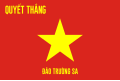



ในขณะเดียวกัน กองกำลังรักษาความมั่นคงสาธารณะของประชาชนเวียดนามก็ปฏิบัติตามธรรมเนียมที่คล้ายคลึงกันมากเช่นกัน แต่ใช้คำขวัญที่แตกต่างออกไป คือBảo vệ an ninh Tổ quốc ( แปลตรงตัวว่า' ปกป้องความมั่นคงของปิตุภูมิ' )
เครือจักรภพแห่งชาติ
ผ้าขี้ริ้วขาดรุ่งริ่งบนเสาผุพัง ไม่น่าจะปลุกเร้าจิตวิญญาณของมนุษย์ได้ แต่สิ่งที่น่าสะพรึงกลัวยิ่งกว่าคือการกระทำที่เกิดขึ้นใต้ผ้าขี้ริ้วขาดรุ่งริ่งนั้น ในสมัยที่เสายังเป็นไม้เท้า และผ้าขี้ริ้วยังเป็นธง
ตราบใดที่ธงประจำกองทหารยังคงอยู่ และยังมีชายคนหนึ่งเหลืออยู่เพื่อถือธงนั้น กองทหารก็ไม่มีวันล่มสลาย พวกเขาสามารถเกณฑ์ทหารใหม่ได้โดยมีชายคนนั้นเป็นแกนนำ และกองทหารก็จะยังคงเดินหน้าสู่ความรุ่งโรจน์ในอนาคตด้วยประเพณีเก่าแก่และบรรยากาศเดียวกันกับที่หล่อหลอมบรรพบุรุษให้กล้าหาญ ดังนั้น แม้ว่าธงประจำกองทหารจะไม่ใช่จิตวิญญาณของกองทหารโดยตรง แต่ก็เป็นสัญลักษณ์ที่จับต้องได้ของกองทหาร และศักดิ์สิทธิ์ยิ่งกว่าพระมหากษัตริย์เสียอีก
ธงประจำหน่วยทหารราบและธงประจำหน่วยทหารม้าเป็นชุดธงขนาดใหญ่ที่มีเอกลักษณ์เฉพาะสำหรับแต่ละกรม ซึ่งทหารทั่วไปสามารถจดจำได้ทันที
ออสเตรเลีย แคนาดา และนิวซีแลนด์


กองทัพเรือและกองทัพอากาศของทั้งสามประเทศนี้ยังมีสีที่คล้ายคลึงกันโดยอิงจากธงประจำหน่วยของตนเอง กฎที่กำหนดโดยกระทรวงกลาโหมของ แคนาดา ระบุว่าสีแรกหรือสีอาวุโสเป็นสัญลักษณ์แสดงถึงความจงรักภักดีของหน่วยต่อพระมหากษัตริย์การอนุญาตให้ครอบครองสีของพระมหากษัตริย์จะได้รับพระราชทานและมอบสีนั้นโดยพระมหากษัตริย์หรือผู้แทนพระองค์เท่านั้น การออกแบบโดยอิงจากธงชาติแคนาดาสะท้อนถึงธรรมเนียมที่กำหนดขึ้นสำหรับกรมทหารราบในช่วงกลางศตวรรษที่ 18 เมื่อสีของพระมหากษัตริย์อิงจากธงชาติ เช่นเดียวกับการปฏิบัติในหน่วยของอังกฤษและฝรั่งเศสในแคนาดา[ 5 ]
กองทัพอากาศ
- กองทัพอากาศออสเตรเลีย (Royal Australian Air Force - RAAF): ธงประจำกองทัพอากาศออสเตรเลียคือธงประจำกองทัพอากาศออสเตรเลียมีลักษณะคล้ายกับธงของกองทัพอากาศอังกฤษ (Royal Air Force - RAF) แต่เพิ่มเติมด้วยตราสัญลักษณ์ RAAF ที่ด้านล่างของธง รวมถึงดาวแห่งเครือจักรภพ (Commonwealth Star) ที่ด้านล่างของธง และดาวกางเขนใต้ (Southern Cross) ที่ด้านบนของธง พร้อมด้วยพระนามย่อของพระมหากษัตริย์อยู่ตรงกลาง ธงมีขอบเป็นสีทองและมีพู่สีทองด้วย สีประจำฝูงบินและหน่วยบัญชาการเป็นสีน้ำเงินของกองทัพอากาศ พร้อมด้วยเครื่องหมายเกียรติยศและตราประจำหน่วย
- กองทัพอากาศแคนาดา (Royal Canadian Air Force ): สีประจำพระองค์ของกองทัพอากาศแคนาดาแตกต่างจากกองทัพอากาศเครือจักรภพอื่นๆ ตรงที่ไม่ได้อิงตามธงประจำกองพล แต่คล้ายกับสีประจำพระองค์ของกรมทหารราบ คือเป็นธงชาติแคนาดาที่ทำจากผ้าไหม มีวงกลมสีแดงบนใบเมเปิลที่จารึกชื่อหน่วยบัญชาการ ล้อมรอบพระนามย่อของพระมหากษัตริย์ และประดับด้วยมงกุฎของพระมหากษัตริย์ กองทัพอากาศแคนาดาเป็นกองทัพอากาศเครือจักรภพที่มีสีประจำหน่วยบัญชาการ ซึ่งคล้ายคลึงกับสีประจำกรมทหารราบ เป็นสีฟ้าอ่อน มีตราสัญลักษณ์กองทัพอากาศแคนาดาอยู่ตรงกลาง และมีใบเมเปิลอยู่ที่มุมแต่ละด้าน โดยก้านใบหันเข้าด้านใน[ 6 ] ฝูงบินที่มีระยะเวลาปฏิบัติการ 25 ปีขึ้นไปจะได้รับธงประจำฝูงบินที่มีเกียรติประวัติการรบ ล้อมรอบตราสัญลักษณ์ของหน่วย บนพื้นหลังสีฟ้าอ่อนเดียวกัน ขอบด้วยดอกไม้ ( สัญลักษณ์ดอกไม้ประจำจังหวัดทั้งสิบ)
กองทัพบก

- กองพันทหารราบออสเตรเลียที่ก่อตั้งขึ้นก่อนหรือระหว่างสงครามโลกครั้งที่ 1มีธงประจำกองพันสองผืน (หนึ่งชุด) คือ ธงพระมหากษัตริย์ซึ่งมีพื้นฐานมาจากธงสหราชอาณาจักร และธงประจำกรมแยกต่างหาก ซึ่งประดับด้วยหมายเลขกองพันและตราประจำกรม (ตราติดบ่า) เกียรติยศในการรบก็ถูกประดับไว้บนธงประจำกรมด้วยเช่นกัน ธรรมเนียมเหล่านี้เป็นไปตามแบบอย่างของอังกฤษ กองพันบางส่วนในสงครามโลกครั้งที่ 1 ได้รวมกันก่อนหรือระหว่างสงครามโลกครั้งที่ 2ตัวอย่างเช่นกองพันที่ 57รวมกับกองพันที่ 60ในปี 1930 ก่อตั้งเป็นกองพันที่ 57/60ซึ่งเข้าร่วมการรบในยุทธการแปซิฟิกตะวันตกเฉียงใต้ระหว่างสงครามโลกครั้งที่ 2 กองพันที่ 57/60ไม่มีธงประจำกองพันของตนเอง แต่ด้วยประวัติศาสตร์จึงได้รับสืบทอดธงทั้งสองผืนจากกองพันที่ 57 และ 60 ตามลำดับการรบ กองพันที่ 57/60 สวมเครื่องหมายสีของกองพันที่ 57 บนเครื่องแบบ แต่พวกเขายังคงเดินสวนสนามและนำเสนอสีประจำกองพันทั้งที่ 57 และ 60 สมเด็จพระราชินีนาถเอลิซาเบธที่ 2 ทรงอนุญาตในปี 1960 ให้ประดับเกียรติยศจากการรบในสงครามโลกครั้งที่ 2 (แปซิฟิกตะวันตกเฉียงใต้ 1943–45 การปลดปล่อยนิวกินีของออสเตรเลีย ถนนคอมมานโด ฯลฯ) บนสีประจำพระองค์ แทนที่จะเป็นสีประจำกรม ซึ่งประดับด้วยเกียรติยศจากสงครามโลกครั้งที่ 1 อยู่แล้ว (ซอมม์ ปาสเชนเดล วิลเลอร์ส-เบรโตเนอซ์ อาเมียง ฯลฯ) สถานการณ์ที่คล้ายคลึงกันนี้เกิดขึ้นกับการรวม กองพันที่ 58และกองพันที่ 59ในปี 1942 เพื่อจัดตั้งเป็นกองพันที่ 58/59ซึ่งติดเครื่องหมายสีของกองพันที่ 58 บนเครื่องแบบ แต่ได้รับสืบทอดและใช้ในการเดินสวนสนามธงประจำกองพันจากทั้งสองกองพันที่ 58และ59 กองพันที่ 57/60และกองพันที่ 58/59ถูกยุบเลิกหลังจากสงครามโลกครั้งที่สองไม่นาน และธงประจำกองพันถูกเก็บรักษาไว้ที่อนุสรณ์สถานแห่งความทรงจำในเมลเบิร์นซึ่งจัดแสดงอยู่ในห้องใต้ดิน อนุสรณ์ สถาน แห่ง นี้และอนุสรณ์สถานสงครามและโบสถ์อื่นๆ ทั่วออสเตรเลียจัดแสดงธงประจำกองพันอื่นๆ อีกมากมายที่ได้รับการเก็บรักษาไว้ เช่น โบสถ์เซนต์สตีเฟนส์ซิดนีย์
- ในขณะที่สีประจำกรมทหารราบของกองทัพบกออสเตรเลียยังคงยึดตามธรรมเนียมของอังกฤษ แต่ตั้งแต่ทศวรรษ 1960 เป็นต้นมา สีที่ใช้ เป็นสี ประจำราชสำนักของพระมหากษัตริย์ได้เปลี่ยนมาใช้สีที่อิงจากธงชาติออสเตรเลียหน่วยยานเกราะจะใช้ธงมาตรฐาน (Standards) และธงนำ (Guidons) ซึ่งเป็นธงที่มีขนาดเล็กกว่าสีประจำกรม และโดยทั่วไปแล้วจะใช้โดยหน่วยทหารม้า หน่วยทหารหอก หน่วยทหารม้าเบา และหน่วยทหารราบติดม้า กรมยานเกราะที่ 1 เป็นหน่วยเดียวในกองทัพบกออสเตรเลียที่ใช้ธงมาตรฐาน ตามธรรมเนียมของหน่วยยานเกราะหนัก ธงนำยังใช้โดยหน่วยบินด้วย มีเพียงกรมทหารปืนใหญ่ของกองทัพบกออสเตรเลียเท่านั้นที่ใช้ปืนใหญ่แทนธงเป็นสีประจำกรม ยกเว้นกองปืนใหญ่สนาม Aซึ่งใช้ธงพระราชาเพื่อเป็นการยกย่องการเป็นกองปืนใหญ่แห่งแรกของออสเตรเลีย กรมปืนใหญ่สนาม A จะใช้ธงพระราชาของตนเอง หน่วยที่ไม่ใช่หน่วยรบ (หน่วยสนับสนุนการรบ) จะไม่มีสีประจำกรม แต่จะใช้ธงมาตรฐานหรือธงนำแทน วิทยาลัยทหารหลวงดันทรูนยังมีธงประจำพระองค์เพิ่มเติมอีกผืนหนึ่ง คือ ธงพระมหากษัตริย์ ซึ่งกองร้อยแชมเปี้ยนของวิทยาลัยทหารหลวงจากกองร้อยนายทหารฝึกหัดที่คัดเลือกจากกองร้อยนายทหารฝึกหัดที่ดีที่สุดของปี จะเป็นผู้ถือธงนี้ทุกปี และในการสวนสนาม กองร้อยนี้จะมีลำดับความสำคัญเหนือกว่ากองร้อยอื่นๆ ในฐานะกองร้อยพระมหากษัตริย์[ 7 ]กองทัพบกเองก็มีธงประจำกองทัพบกตั้งแต่ปี 2001 ซึ่งถือในทุกกิจกรรมของกองทัพ (เนื่องจากกองทัพบกเป็นผู้พิทักษ์ประเพณีของธงชาติออสเตรเลีย จึงไม่มีธงประจำกองทัพของตนเอง) ธงนี้ประดับด้วยพู่สีทอง มีเชือกและพู่สีทองและสีแดงเข้ม และติดตั้งบนหอกที่มีตราสัญลักษณ์ราชวงศ์อังกฤษตามปกติ[ 8 ]ธงประจำกองทัพบกมีตราแผ่นดินของออสเตรเลียอยู่ด้านหน้า โดยมีวันที่ "1901–2001" เป็นสีทองอยู่ด้านบนฝั่งเสาธง ด้านหลังเหรียญเป็นตราสัญลักษณ์ "พระอาทิตย์ขึ้น"ของกองทัพออสเตรเลีย ขนาบข้างด้วยเกียรติยศจากการรบ เจ็ด ครั้งบนแถบกระดาษขอบทองขนาดเล็ก ได้แก่แอฟริกาใต้สงครามโลกครั้งที่ 1 สงครามโลกครั้งที่ 2 เกาหลีมาลายา-บอร์เนียวเวียดนามใต้การรักษาสันติภาพ และติมอร์ตะวันออก เหรียญนี้มอบให้แก่กองทัพเพื่อเฉลิมฉลองครบรอบ 100 ปีในปี 2001
- ในกองทัพแคนาดา กองทหารยานเกราะหลวงแคนาดา (RCAC) ซึ่งประกอบด้วยกรมทหารม้ารักษาพระองค์และกรมทหารม้าเบา รวมถึงกรมทหารปฏิบัติการพิเศษแคนาดา (CSOR) มีธงประจำกรม ธงประจำกรมของ RCAC มีพื้นสีแดงเข้ม และธงประจำกรมของ CSOR มีพื้นสีน้ำตาลอ่อน กรมทหาร RCAC อื่นๆ นอกเหนือจากกรมทหารม้ารักษาพระองค์และกรมทหารม้าเบาจะมีธงนำประจำกรมสีแดงเข้ม กองพันแต่ละกองของกองทหารราบหลวงแคนาดายกเว้นกองพันของกรมทหารปืนไรเฟิล มีธงสองผืน คือ ธงพระมหากษัตริย์และธงประจำกรม สำหรับกรมทหารราบรักษาพระองค์ ธงพระมหากษัตริย์มีพื้นสีแดงเข้ม และธงประจำกรมมีพื้นฐานมาจากธงชาติแคนาดาสำหรับกรมทหารราบอื่นๆ ธงพระมหากษัตริย์มีพื้นฐานมาจากธงชาติ และธงประจำกรมจะมีสีตามสีของกรมนั้นๆ มีเพียงกรมทหารปืนใหญ่หลวงแคนาดาเท่านั้นที่ใช้ปืนใหญ่เป็นธงประจำกรม กรมทหารราบเบาเหล่านี้สืบทอดประเพณีจากกรมทหารราบเบาของอังกฤษในอดีต คือการเชิดชูเกียรติการรบด้วยกลอง ส่วนกรมทหารช่างหลวงแคนาดาไม่มีธงประจำหน่วย แต่มีคำขวัญว่าubiqueซึ่งเป็นภาษาละตินแปลว่า 'ทุกหนทุกแห่ง' ปรากฏอยู่บนตราบนหมวกและเครื่องหมายอื่นๆ เพื่อแสดงถึงการปฏิบัติหน้าที่ในทุกหนทุกแห่ง
- เฉพาะกรมทหารราบหลวงนิวซีแลนด์ ซึ่งเป็นกรมทหารราบเพียงกรมเดียวของกองทัพนิวซีแลนด์เท่านั้นที่มีธงประจำกรม โดยธงของพระมหากษัตริย์ในปัจจุบันมีพื้นฐานมาจากธงชาตินิวซีแลนด์ส่วนมุมบนซ้ายเป็นรูปธงสหราชอาณาจักรและมีตราประจำกรม และธงประจำกรมเป็นสีน้ำเงินเข้มเนื่องจากสถานะเป็นกรมทหารหลวง กรมทหารนี้มีธงประจำกรมอยู่ในสองกองพันประจำการและสามกองพันสำรอง จนกระทั่งปี 1964 เมื่อกองทัพราบของนิวซีแลนด์ได้รับการจัดระเบียบใหม่เป็นกรมเดียว กรมทหารราบสำรองทั้งหมดก็มีธงประจำกรมของตนเองเช่นกัน ส่วนกรมทหารยานเกราะเพียงกรมเดียวคือกรมทหารม้าควีนอเล็กซานดรามีธงนำตามประเพณีของหน่วยทหารม้าที่จัดตั้งขึ้นในนิวซีแลนด์ตั้งแต่ศตวรรษที่ 19
กองทัพเรือ
- ราชนาวีออสเตรเลีย : ธงประจำราชสำนักของราชนาวีออสเตรเลียคือธงขาวออสเตรเลีย (Australian White Ensign ) ซึ่งเป็นธงกลับด้านของธงชาติออสเตรเลีย (สีขาวมีดาวสีน้ำเงิน) โดยมีพระบรมสัญลักษณ์ของสมเด็จพระราชินีนาถเอลิซาเบธที่ 2 และแถบเครื่องราชอิสริยาภรณ์การ์เตอร์อยู่ระหว่างดาวเครือจักรภพและดาวที่แสดงถึงกลุ่มดาวกางเขนใต้ (ดูธงเดิมได้ที่โบสถ์ทหารเรือ เกาะการ์เดน รัฐนิวเซาท์เวลส์ ) ราชนาวีออสเตรเลียมีธงประจำกองเรือสองผืน คือ ผืนแรกคือธงประจำกองเรือ (Fleet Colour) ซึ่งกองบัญชาการกองเรือ HMAS Kuttabulถือครองในนามของหน่วยต่างๆ ในกองเรือ และผืนที่สองคือธงประจำหน่วยงาน (Establishment Colour) ซึ่งHMAS Cerberus ถือครอง ในนามของหน่วยงานบนฝั่ง
- กองทัพเรือแคนาดา : ธงประจำพระองค์ของพระมหากษัตริย์ (King's Colour) เป็นธงประจำกองทัพเรือแคนาดา แบบดัดแปลง มีสีขาว ส่วนบนสุดเป็นธงชาติแคนาดาตรงกลางเป็นอักษรย่อจากธงส่วนพระองค์ของสมเด็จพระราชินีนาถเอลิซาเบธที่ 2 (ตัว "E" มีมงกุฎล้อมรอบด้วยพวงกุหลาบ) และส่วนล่างสุดเป็นสัญลักษณ์กองทัพเรือ ขอบธงเป็นสีทอง จนถึงปี 1979 กองทัพเรือแคนาดามีธงประจำพระองค์สองผืนที่เหมือนกัน คือผืนหนึ่งสำหรับกองเรือแอตแลนติก และอีกผืนหนึ่งสำหรับกองเรือแปซิฟิก หลังจากนั้นเป็นต้นมา กองบัญชาการทหารเรือได้เก็บรักษาธงประจำพระองค์เพียงผืนเดียว
- กองทัพเรือนิวซีแลนด์ : ตั้งแต่ปี 1968 ธงประจำพระองค์ของกองทัพเรือนิวซีแลนด์ (RNZN King's Colour) เป็นรูปแบบหนึ่งของธงประจำกองทัพเรือนิวซีแลนด์ (Naval Ensign of New Zealand) ซึ่งเป็นธงชาติของนิวซีแลนด์แต่เป็นสีขาว โดยมีพระบรมสัญลักษณ์ของสมเด็จพระราชินีนาถเอลิซาเบธที่ 2 และแถบเครื่องราชอิสริยาภรณ์การ์เตอร์อยู่ใกล้กับกลุ่มดาวกางเขนใต้
 เครื่องหมายประจำพระองค์ของพระมหากษัตริย์แห่งกองทัพเรือออสเตรเลีย
 ธงชาติแคนาดา (King's Colour of the Royal Canadian Navy)
 เครื่องหมายประจำพระองค์ของพระมหากษัตริย์แห่งกองทัพเรือนิวซีแลนด์


อินเดีย
ด้วยความเป็นมาของเครือจักรภพในฐานะอดีตอาณานิคมของอังกฤษและต่อมาเป็นดินแดนในปกครองกองทัพอินเดียจึงใช้สีประจำกองทัพที่เทียบเท่ากับสีที่ใช้ในกองทัพอังกฤษ
ธงประจำตำแหน่งประธานาธิบดีมอบให้แก่เหล่าทัพต่างๆ ของกองทัพ
 สีประจำตำแหน่งประธานาธิบดีของกองทัพเรืออินเดีย
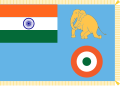 สีประจำตำแหน่งประธานาธิบดีของกองทัพอากาศอินเดีย


มีเพียงกองทัพเรือและกองทัพอากาศ เท่านั้นที่ใช้ธง ประจำกองทัพของประธานาธิบดี ซึ่งเป็นธงประจำกองทัพเรือและกองทัพอากาศ ตามลำดับ โดยมีขอบสีทองและมีการดัดแปลงเพิ่มเติม:
- ตราประจำตำแหน่งของกองทัพเรือ ซึ่งใช้มาตั้งแต่ปี 2022 นั้น มีรูปสิงห์แห่งอโศกซึ่งเป็นพื้นฐานของตราแผ่นดิน อยู่ด้านบนของตราประจำกองทัพเรือ และมีคำขวัญประจำชาติว่าสัตยเมวะ ชยเต ( ความจริงเท่านั้นย่อมชนะ ) อยู่ด้านล่าง
- กองบัญชาการบริการพลเรือนของกองทัพอากาศมีรูปช้างอยู่เหนือตราสัญลักษณ์กองทัพอากาศ
ธงประจำหน่วยทหาร/ธงประจำหน่วย/ธงนำทางของประธานาธิบดี

ธงประจำหน่วยของประธานาธิบดี (ธงมาตรฐานและธงนำสำหรับหน่วยทหารม้าของกองทัพบกและหน่วยบินของกองทัพอากาศ และธงสำหรับเหล่าทัพและทหารราบเบา) มอบให้แก่หน่วยที่โดดเด่นของกองทัพโดยประธานาธิบดีแห่งอินเดียซึ่งเป็นผู้บัญชาการสูงสุดของกองทัพ ธงเหล่านี้เทียบเท่ากับธงประจำกรมของอังกฤษ ในกองทัพบกธงเหล่านี้จะมีตราประจำกรม/กองพันและเกียรติยศจากการรบที่หน่วยนั้นได้รับ
- กองทัพบก
- ธงประจำหน่วยทหารม้า – แยกตามสี
- ธงนำขบวนทหารม้า – เหมือนกับธงประจำหน่วย
- ธงประจำหน่วยปืนใหญ่และหน่วยป้องกันภัยทางอากาศ - สีแดงเลือดหมูและสีน้ำเงิน
- ธงประจำหน่วยทหารราบ – แยกตามสีที่หันหน้าไป
- ธงประจำหน่วยทหารราบเบาและหน่วยปืนไรเฟิล – เหมือนกับธงประจำหน่วยทหารราบทั่วไป
- ธง/สีประจำหน่วยบริการ – ตามสีที่กำหนด
- กองทัพอากาศ – สีฟ้าอ่อน
มีเพียงองครักษ์ของประธานาธิบดีเท่านั้นที่เคยมีธงประจำหน่วยอย่างครบถ้วนตามแบบอังกฤษ ซึ่งประกอบด้วยธงประจำประธานาธิบดีและธงประจำกรมทหาร
มาเลเซีย
รูปแบบเดียวกันนี้ใช้กับธงประจำพระองค์และธงประจำกรมในมาเลเซียด้วย ธงประจำพระองค์และธงประจำกรมของกองทัพมาเลเซียเป็นธงที่พระมหากษัตริย์แห่งมาเลเซียพระราชทานในฐานะผู้บัญชาการสูงสุดของกองทัพ และโดยพระมหากษัตริย์อีก 8 รัฐ ธงเหล่านี้จะมอบให้แก่หน่วยที่ได้รับการยอมรับว่าเป็นหน่วยราชวงศ์ และธงของหน่วยขนาดใหญ่ (ธงประจำพระองค์) และหน่วยที่ได้รับธงประจำกรมใหม่ (ธงประจำกรมของหน่วย)
ธงประจำพระองค์ของพระมหากษัตริย์เป็นสีเหลือง มีตราแผ่นดินล้อมรอบด้วยทุ่งนาอยู่ตรงกลาง ดังนั้น มาเลเซียจึงเป็นหนึ่งในสองประเทศในเครือจักรภพ อีกประเทศหนึ่งคือบรูไนที่ไม่ได้ใช้ธงชาติเป็นธงประจำพระองค์ (ธงประจำพระองค์เป็นธงประจำพระองค์ของกองทัพทั้งหมด) ด้านข้างของธงประดับด้วยเกียรติยศในการรบของหน่วย ส่วนที่มุมบนซ้ายจะมีตราประจำเหล่าทัพ (กองทัพบก กองทัพเรือ และกองทัพอากาศ) ปรากฏอยู่ อย่างไรก็ตาม ธงประจำกรมจะแตกต่างกันไปตามเหล่าทัพ (กรณีหลังใช้ในกองทัพบก) และหน่วย ธงทั้งสองแบบมีขอบสีทองล้อมรอบ ธงเหล่านี้จะปรากฏเฉพาะในพิธีสวนสนามอย่างเป็นทางการเท่านั้น
ในระหว่างขบวนพาเหรดวันประกาศอิสรภาพและวันกองทัพในวันที่ 21 กันยายน เนื่องจากเหล่าทัพที่เข้าร่วมขบวนพาเหรดไม่ได้สวมเครื่องแบบเต็มยศ มีเพียงกองพันที่ 1 กรมทหารราบมาเลย์หลวง เท่านั้น ที่สวมเครื่องแบบเต็มยศและถือธงประจำกรมและธงพระมหากษัตริย์ สำหรับเหล่าทัพอื่นๆ ที่เข้าร่วมขบวนพาเหรดต่อสาธารณะ ลำดับการเข้าร่วมจะเป็นดังนี้:
- ธงประจำหน่วย/ธงค่ายทหาร
- ธงชาติมาเลเซีย (สีประจำชาติ)
- สีประจำกองทัพมาเลเซีย
นอกจากนี้ ในช่วงทศวรรษ 1910 กองกำลังทหารหลวงยะโฮร์ได้รับสิทธิพิเศษในฐานะกองกำลังป้องกันรัฐเพียงแห่งเดียวในประเทศ ให้มีธงประจำกรมของตนเอง
โรงเรียนวิคตอเรีย อินสติทิวชั่นเป็นสถาบันการศึกษาเอกชนแห่งเดียวที่ได้รับเกียรติเชิดชูเกียรติ (Colours) จากบทบาทสำคัญในสงครามโลกครั้งที่สอง
สิงคโปร์
ธงประจำกองทัพสิงคโปร์ในปัจจุบันแบ่งออกเป็น ธงประจำเหล่าทัพ และ ธงประจำกรม ก่อนปี 1997 ยังมีทั้ง ธงประจำกรม และ ธงประจำหน่วย ธงประจำเหล่าทัพนั้นคล้ายกับธงชาติสิงคโปร์แต่แตกต่างกันไปตามเหล่าทัพ โดยมีตราสัญลักษณ์ของเหล่าทัพอยู่ในส่วนสีขาว ส่วนธงประจำกรมนั้นแตกต่างออกไป และแตกต่างกันไปตามหน่วยหรือเหล่าทัพ (ยกเว้นธงของกองทัพอากาศและกองทัพเรือที่แสดงสีประจำเหล่าทัพแทน และหน่วยบัญชาการระดับเหล่าทัพบางแห่ง เช่น ตำรวจทหาร) ลักษณะทั่วไปคือ ตราสัญลักษณ์ของกรมหรือหน่วยบัญชาการอยู่ตรงกลางธง ซึ่งเป็นสีเดียวกับสีของเครื่องแบบหน่วยหรือเหล่าทัพที่สังกัด ทั้งสองแบบมีขอบสีทอง และจะนำออกมาใช้ในโอกาสสำคัญเท่านั้น ส่วนธงประจำหน่วยแบบเดิมนั้น จะมีตราสัญลักษณ์หรือตราประจำหน่วยอยู่ในส่วนสีขาวของธงชาติ
ศรีลังกา

เมื่อศรีลังกาประกาศตนเป็นสาธารณรัฐในปี 1972 หน่วยงานที่เคยใช้ธงประจำพระองค์ (โดยเริ่มจากธงยูเนี่ยนแจ็กและต่อมาคือธงชาติปัจจุบัน ) ได้ปลดระวางธงเหล่านั้น และแทนที่ด้วยธงประจำประธานาธิบดีซึ่งได้รับพระราชทานครั้งแรกในปี 1972 ธงประจำพระองค์ที่เคยพระราชทานมีดังนี้:
- กองทัพศรีลังกา
- กรมทหาร
- กองทหารราบเบาศรีลังกา – 1978
- นาฬิกา Gemunu – ปี 1980
- กองทหารกาจาบา – ปี 2007
- กองทัพยานเกราะศรีลังกา
- ปืนใหญ่ศรีลังกา
- สถานประกอบการ
- ศูนย์ฝึกอบรมกองทัพบก – สร้างขึ้นในปี 1972 ปิดทำการเมื่อวันที่ 20 สิงหาคม 1992
- โรงเรียนนายทหารศรีลังกา – ปี 1997
- กรมทหาร
- กองทัพอากาศศรีลังกา
- กองทัพอากาศศรีลังกา – 1976
- กรมทหารอากาศศรีลังกา – ปี 2009
- ฝูงบิน
- กองบินฝึกหัดที่ 1 – ปี 2001
- ฝูงบินขนส่งหนักที่ 2 – ปี 2009
- ฝูงบินเฮลิคอปเตอร์ที่ 4 (วีไอพี) – ปี 2009
- ฝูงบินเฮลิคอปเตอร์โจมตีที่ 9 – ปี 2009
- ฝูงบินขับไล่ที่ 10 – ปี 2009
- สถานี
- กองทัพเรือศรีลังกา
- ผู้บัญชาการ
- สถานประกอบการ
- โรงเรียนนายทหารเรือและกิจการทางทะเล – ปี 2000
ธงประจำกรมทหารเป็นไปตามแบบอย่างของอังกฤษ และกรมทหารราบเบา 2 กรม ( กรมทหารสิงหะศรีลังกาและกองพันปืนไรเฟิลศรีลังกา ) ไม่มีธงประจำกรมเลย ต่างจากกองปืนใหญ่หลวงของอังกฤษกองปืนใหญ่ศรีลังกามีธงประจำประธานาธิบดีและธงประจำกรม เช่นเดียวกับกองวิศวกรศรีลังกา
ต่างจากกองทัพอากาศที่ใช้การออกแบบสีเดียวคล้ายกับกองทัพอากาศอังกฤษ กองทัพเรือใช้สีประจำหน่วยและกองบัญชาการในลักษณะเดียวกับกองทัพบก
ธงประจำพระองค์ของประธานาธิบดีสำหรับหน่วยทหารเรือและกองทัพอากาศนั้น ออกแบบโดยใช้ธงประจำเหล่าทัพที่มีขอบสีทอง ส่วนธงประจำพระองค์ของประธานาธิบดีสำหรับหน่วยทหารบกนั้น เป็นธงชาติที่มีขอบสีทอง โดยมีตราแผ่นดินอยู่ระหว่างแถบสีฟ้าอมเขียวและสีส้มทางด้านซ้าย
สหราชอาณาจักร
ทหารราบแนวหน้าและทหารรักษาพระองค์


ในกรมทหารราบของกองทัพบกอังกฤษและกองทัพของประเทศอื่นๆ ในเครือจักรภพแต่ละกองพันจะถือธงสองผืน ซึ่งเรียกรวมกันว่า "เสาธง" ธงเหล่านี้มีขนาดใหญ่ โดยปกติจะมีขนาด 36 x 45 นิ้ว (91 ซม. x 114 ซม.) และติดตั้งบนหอกครึ่งท่อนซึ่งยาว8 ฟุต7 นิ้ว+ธง ประจำ กองทหารมีความยาว 1/2 นิ้ว (2.629 เมตร) สีประจำพระมหากษัตริย์หรือพระราชินี (สีประจำรัฐหรือประธานาธิบดีหากประเทศเป็นสาธารณรัฐ) มักจะเป็นสีที่คล้ายกับธงชาติ ของประเทศนั้นๆ โดยมักจะตกแต่งด้วยผ้าสีทอง และมีตราประจำ กองทหารอยู่ตรงกลาง ส่วนธงประจำกรมทหารจะเป็นธงสีเดียว โดยปกติจะเป็นสีเดียวกับส่วนตกแต่งบนเครื่องแบบ (ปกเสื้อและข้อมือ) ของกรมทหาร ซึ่งมักจะตกแต่งด้วยผ้า สีทองและมีตราประจำกรมอยู่ตรงกลางเช่นกัน กรมทหารส่วนใหญ่ที่ได้รับการกำหนดให้เป็นกรมทหาร "หลวง" (กล่าวคือมีคำว่า "หลวง" หรือได้รับการสนับสนุนจากบุคคลสำคัญในราชวงศ์ในชื่อ) จะมี สีประจำกรม เป็นสีน้ำเงินเข้มและส่วนใหญ่จะมีธงยูเนียนแฟล็กอยู่มุมบนซ้ายของธง กรมทหารไอริช ซึ่งปัจจุบันคือกรมทหารไอริชหลวงจะมีสีประจำกรมเป็นสีเขียวเข้ม
สีประจำกรมทหารราบ รักษาพระองค์ทั้งห้ากรม มีรูปแบบที่กลับด้านจากกรมทหารราบ โดยสีประจำพระองค์ของกองพันที่ 1 แต่ละกองพันจะเป็นสีแดงเลือดหมูพร้อมตราประจำกรม มงกุฎ และเกียรติยศ ส่วนสีประจำกรมจะเป็นธงสหราชอาณาจักรแบบต่างๆ พร้อม ปัก เกียรติยศในการรบ สีประจำพระองค์ของกองพันเพิ่มเติมจากกรมเหล่านี้ (ปัจจุบันประกอบด้วยกองร้อยเสริมห้ากองจากสี่ในหกกรม) จะมีธงสหราชอาณาจักรอยู่ที่มุมบน
สีเพิ่มเติม

- กรมทหาร เกรนาเดียร์โคลด์สตรีมและสก็อตส์การ์ดแต่ละกรมมีธงประจำรัฐอย่างน้อยหนึ่งผืน โดยปกติจะเป็นสีแดงเข้ม มีเครื่องหมายและเกียรติยศต่างๆ ของกรม และพระนามย่อของพระมหากษัตริย์อยู่ที่มุมทั้งสี่ ธงเหล่านี้ใช้เฉพาะโดยกองเกียรติยศจากหน่วยใดๆ ของกรมเหล่านี้ที่ไม่ใช่กององครักษ์ของพระมหากษัตริย์เท่านั้น โดยจะใช้ในโอกาสสำคัญเมื่อพระมหากษัตริย์เสด็จพระราชดำเนิน และจะลดลงเฉพาะต่อหน้าพระมหากษัตริย์และพระราชินีในโอกาสสำคัญเมื่อพระมหากษัตริย์เสด็จพระราชดำเนินเท่านั้น แม้ว่ากองเกียรติยศนั้นจะจัดขึ้นเพื่อเป็นเกียรติแก่บุคคลอื่นก็ตาม ขนาดของธงจะใหญ่กว่าธงปกติของกองทหารรักษาพระองค์ที่ใช้ในพิธีการต่างๆ
- กองพันที่ 1 แห่งกรมทหารราบเจ้าหญิงแห่งเวลส์ในฐานะผู้สืบทอดโดยตรง ได้รับพระราชทานธงประจำกองพันที่ 3 ซึ่งเดิมเป็นของกรมทหารราบที่ 2 ซึ่งต่อมาเปลี่ยนชื่อเป็นกรมทหารราบพระราชินี (เวสต์เซอร์เรย์)และด้วยเหตุผลบางประการ ธงนี้ก็ไม่เคยถูกริบไปจากกรมทหารนี้ในศตวรรษที่ 18 เมื่อมีการบังคับใช้ระเบียบใหม่เกี่ยวกับธงประจำกองพัน
- กองพันที่ 1 แห่งกรมทหารราบหลวงฟิวซิเลียร์สถือธงประจำพลกลอง ซึ่งได้รับรางวัลหลังยุทธการวิลเฮล์มสทาลแก่กรมทหารราบที่ 5 (ต่อมา คือ กรมทหารราบหลวงนอร์ธัมเบอร์แลนด์ฟิวซิเลียร์ส ) ซึ่งเป็นหน่วยสืบเชื้อสายโดยตรงของกรมทหารดังกล่าว
- กองพันที่ 3 กรมทหารยอร์กเชอร์ (ดยุคแห่งเวลลิงตัน)ในฐานะทายาทโดยตรง ได้รับพระราชทานธงประจำกรมและธงพระมหากษัตริย์ ซึ่งบริษัทอีสต์อินเดียได้มอบให้แก่กรมทหารราบที่ 76ภายหลังการปฏิบัติการที่เดลีและอัลลิกูร์
- กองพันที่ 2 กรมทหารราบหลวงไฮแลนด์ฟิวซิเลียร์ ราชกรมทหารแห่งสกอตแลนด์ถือธงอัสเซย์ ซึ่งได้รับพระราชทานเป็นธงเกียรติยศแก่กรมทหารราบที่ 74ภายหลังยุทธการอัสเซย์ซึ่งมีการจัดขบวนพาเหรดทุกปีในวันอัสเซย์
- กองร้อยปืนใหญ่เกียรติยศมีทั้งธงประจำกอง (ธงพระมหากษัตริย์และธงประจำกรม) และปืนใหญ่ ซึ่งปืนใหญ่เหล่านั้นก็ได้รับการยกย่องเช่นเดียวกับที่กองปืนใหญ่หลวงยกย่องปืนใหญ่ของตนว่าเป็นธงประจำกอง
กรมทหารราบปืนไรเฟิล
ตามธรรมเนียมแล้วกรมทหารราบเบาจะไม่ถือธงประจำกรม ซึ่งสืบเนื่องมาจากการจัดตั้งกรมทหารนี้ในสมัยที่พวกเขาถูกใช้เป็นหน่วยลาดตระเวนและพลแม่นปืน แม้ว่าแต่ละหน่วยอาจจะมีธงหรือธงเล็กเพื่อแยกแยะตัวเองจากหน่วยอื่น ๆ แต่กรมทหารโดยรวมไม่จำเป็นต้องมีธงประจำกรมเต็มรูปแบบ ปัจจุบัน กรมทหารราบเบา 2 กรมในกองทัพอังกฤษ คือ กรมทหารราบเบา ( The Rifles)และกรมทหารราบเบาหลวงกูร์กา (Royal Gurkha Rifles)ประดับเกียรติยศการรบไว้บนกลอง ขณะที่ กรมทหารราบเบา หลวงกรีนแจ็กเก็ต (Royal Green Jackets ) ก็ประดับเกียรติยศการรบไว้บนตราหมวก ด้วย ธรรมเนียมนี้ยังคงสืบทอดโดยกรมทหารราบเบา (The Rifles) ซึ่งสวม ตรา กากบาทมอลตาของกรมทหารราบเบาหลวงกรีนแจ็กเก็ต ที่สลักเกียรติยศของกรมทหารไว้ เป็นตราเข็มขัด ส่วนกรมทหารกูร์กาจะถือกระบองของพระราชินี (Queen's Truncheon)ที่ได้รับพระราชทานในปี 1863 แทนธงประจำกรม
กรมทหารสิงหะแห่งศรีลังกาเป็นกรมทหารสมัยใหม่ที่ไม่ใช่ของอังกฤษหน่วยแรกที่ได้รับกระบองประจำกรม โดยได้รับรางวัลในปี 2017 ในปี 2019 กระบองที่มีลักษณะคล้ายกัน คือ กระบองรานา ปาราชูวา ได้ถูกมอบให้กับกรมทหารหน่วยรบพิเศษของกองทัพบกศรีลังกาซึ่งเป็นกระบองประเภทแรกที่มอบให้กับหน่วยรบพิเศษของเครือจักรภพ ก่อนหน้านี้กรมทหารราบหลวงแห่ง กองทัพบกมาเลเซีย ได้รับกระบองประจำกรมในปี 1966
ในอินเดียประธานาธิบดีของอินเดียจะมอบธงหรือป้ายแทนกระบอง ตามแบบอย่างของรัสเซียและสอดคล้องกับประเพณีโบราณของอินเดีย ให้แก่กองทหารราบปืนไรเฟิลและกองทหารลาดตระเวนทั้งหมด
สีประจำกรมทหารม้า
ในหน่วยทหารม้าของกองทัพบกอังกฤษธงประจำหน่วยทหารม้าของพระมหากษัตริย์และธงประจำกรม (สำหรับทหารม้าหนัก) และธงนำหน่วยทหารม้าของพระมหากษัตริย์และธงนำหน่วยประจำกรม (สำหรับทหารม้าเบา) เทียบเท่ากับธงประจำหน่วยทหารราบ ธงประจำหน่วยทหารม้าของพระมหากษัตริย์เป็นสีแดงเข้ม มีตราแผ่นดินและพระนามย่อของพระมหากษัตริย์ พร้อมด้วยเครื่องหมายเกียรติยศของกรม ในขณะที่ธงประจำกรม (กองร้อย/สหภาพ) มีสีพื้นหลังที่ปรับเปลี่ยนได้ตามหน่วย (บางครั้งเป็นสีแดงสด) และบางครั้งมีตราสหภาพอยู่ใต้พระมงกุฎและพระนามย่อของพระมหากษัตริย์อยู่ด้านข้างของตรา พร้อมด้วยเครื่องหมายเกียรติยศของหน่วยอยู่ด้านล่าง ธงนำหน่วยทหารม้าเบาเป็นรูปหางนกนางแอ่นและมีตราแผ่นดินและเครื่องหมายเกียรติยศของกรม อย่างไรก็ตาม ก่อนทศวรรษ 1950 กลองทิมปานีในวงดนตรีบนหลังม้า (และต่อมาคือกลองสแนร์ กลองเบส และกลองเทเนอร์ในวงดนตรีที่ลงจากม้า) จะเป็นผู้ถือเครื่องหมายและตราประจำกรมทหารม้าเบา สำหรับ กรมทหาร รักษาพระองค์ดรากูน ลำดับจะสลับกัน เนื่องจากกรมเหล่านี้มีธงประจำพระองค์ของพระมหากษัตริย์และธงนำประจำกรม
หน่วยทหารม้าหลวงมีสีประจำหน่วยที่เป็นเอกลักษณ์ดังต่อไปนี้:
- หน่วยองครักษ์ส่วนพระองค์: ธงประจำหน่วยทหารม้าของพระมหากษัตริย์เท่านั้น
- กรม ทหารม้าบลูส์แอนด์รอยัลส์ : ธงประจำกรมทหารม้าของพระมหากษัตริย์, ธงนำขบวน
เครื่องประดับ
ธง ประจำกรมทหารมีการปัก ลวดลายเกียรติยศจาก การรบ โดยธงของพระมหากษัตริย์จะมีเกียรติยศจากสงครามโลกครั้งที่หนึ่งและสงครามโลกครั้งที่สอง ส่วนธงประจำกรมจะมีเกียรติยศจากสงครามอื่นๆ ธงประจำกรมอาจมีเครื่องหมายอื่นๆ เพิ่มเติม เช่น ตราสัญลักษณ์ประจำหน่วยหรือเกียรติยศพิเศษ ตัวอย่างที่สำคัญคือ ตราสัญลักษณ์ สฟิงซ์ที่กรมทหารที่เข้าร่วมในสงครามที่อียิปต์ในปี ค.ศ. 1801ใช้ กรมทหารราบรักษาพระองค์มีเกียรติยศจากการรบในทุกสมรภูมิอยู่ในธงทั้งสองผืน หากกรมทหารมีมากกว่าหนึ่งกองพัน ก็จะมีเครื่องหมายระบุบนธงเพื่อแสดงว่าธงนั้นเป็นของกองพันใด
นอกจากนี้ ยังมีการตกแต่งเพิ่มเติมอีกหลากหลายรูปแบบที่สามารถเพิ่มเข้าไปในสีสันต่างๆ ได้ในโอกาสต่างๆ ดังนี้:
- ในวันครบรอบเกียรติยศจากการรบต่างๆ และเหตุการณ์สำคัญอื่นๆ จะมีการประดับพวงมาลาใบไม้ไว้ที่ปลายหอก
- เครื่องหมายเกียรติยศเทียบเท่าการรบที่ได้รับจากต่างประเทศ สามารถเพิ่มลงในธงได้ โดยต้องได้รับอนุญาตจากประมุขของรัฐในเครือจักรภพ กองพันทหารราบสามกองพันได้รับอนุญาตให้แสดงธงยาวสีน้ำเงิน 4 ฟุต (1.2 เมตร) ซึ่งเป็นสัญลักษณ์ของรางวัลเกียรติยศหน่วยดีเด่นจากประธานาธิบดี (Presidential Unit Citation/Distinguished Unit Citation - PUC) ซึ่งเป็นรางวัลสูงสุดที่สหรัฐอเมริกามอบให้
ในสหราชอาณาจักรหน่วย 41 Commandoแห่งราชนาวิกโยธินและกองพันที่ 1 แห่งกรมทหารกลอสเตอร์เชอร์ก็ได้รับพระราชทานเครื่องหมาย PUC และได้รับอนุญาตให้แสดงแถบสีประจำกรมทหารของตนเช่นกัน
เนื่องจากธงเหล่านี้มีความสำคัญต่อกรมทหาร จึงต้องมีการทำพิธีศักดิ์สิทธิ์ให้กับ ธงเหล่านั้นก่อนที่จะมีการมอบธงประจำหน่วยใหม่
กองทัพอากาศหลวง

ธงประจำกองทัพอากาศอังกฤษ (RAF) ทำจากผ้าไหมสีฟ้าอ่อน มีขนาดประมาณ 36 x 36 นิ้ว (91 ซม. x 91 ซม.) ธงประจำกองทัพอากาศอังกฤษเคยได้รับรางวัลสีดังต่อไปนี้:
- วิทยาลัยกองทัพอากาศแครนเวลล์ได้รับอนุมัติเมื่อวันที่ 27 ธันวาคม 1947 และมอบให้เมื่อวันที่ 6 กรกฎาคม 1948
- กองทัพอากาศอังกฤษ (RAF) ในสหราชอาณาจักร อนุมัติเมื่อวันที่ 27 ธันวาคม 1947 นำเสนอเมื่อวันที่ 16 พฤษภาคม 1951
- โรงเรียนฝึกอบรมด้านเทคนิคแห่งที่ 1 ของกองทัพอากาศอังกฤษได้รับอนุมัติเมื่อวันที่ 27 ธันวาคม 1947 และนำเสนอเมื่อวันที่ 25 กรกฎาคม 1952
- กองทหารอากาศแห่งกองทัพอากาศอังกฤษ (RAF Regiment)มอบให้เมื่อวันที่ 17 มีนาคม 1953
- เครื่องบินของกองทัพอากาศตะวันออกใกล้มอบให้เมื่อวันที่ 14 ตุลาคม 1960 และปลดประจำการเมื่อวันที่ 31 พฤษภาคม 1976
- เครื่องบินกองทัพอากาศตะวันออกไกลจัดแสดงเมื่อวันที่ 13 กรกฎาคม 1961 เก็บรักษาไว้เมื่อวันที่ 30 มกราคม 1972
- โรงเรียนการบินกลางนำเสนอเมื่อวันที่ 26 มิถุนายน 1969
- เครื่องบิน RAF Germany ลำนี้ มอบให้เมื่อวันที่ 16 กันยายน 1970 และปลดประจำการเมื่อวันที่ 27 มิถุนายน 1993
- กองทัพอากาศสำรองแห่งราชวงศ์อังกฤษมอบให้เมื่อวันที่ 12 มิถุนายน 1989
- ฐานทัพอากาศฮัลตันมอบให้เมื่อวันที่ 31 ตุลาคม 1997
- กรมทหารอากาศหลวงนำเสนอเมื่อเดือนกรกฎาคม 2560 [ 9 ]
ธงประจำพระองค์ของกองทัพอากาศสหราชอาณาจักร (Royal Air Force: RAF) เป็นธงที่ดัดแปลงมาจาก ธงประจำกองทัพอากาศ (RAF Ensign)โดยมีการปรับเปลี่ยนขนาด ตราสัญลักษณ์วงกลมของกองทัพอากาศ (RAF Roundel)ถูกย้ายไปอยู่ที่ด้านล่าง และตรงกลางแทนที่ด้วยพระนามพระมหากษัตริย์ที่อยู่เหนือมงกุฎ ส่วนธงประจำหน่วยอื่นๆ จะมีตราประจำหน่วยอยู่ตรงกลาง โดยมีพระนามพระมหากษัตริย์และมงกุฎอยู่ในส่วนแรกของธง
ธงประจำฝูงบินของกองทัพอากาศอังกฤษ (RAF) เปรียบเสมือนธงประจำกรม โดยเป็นสีน้ำเงินของกองทัพอากาศ ล้อมรอบด้วยขอบสีทอง พร้อมด้วยตราสัญลักษณ์และเกียรติยศของฝูงบิน
สีทั้งหมดของกองทัพอากาศอังกฤษ (RAF) จะมีขอบสีฟ้าอ่อนล้อมรอบ
โรงพยาบาลรอยัล เชลซี
โรงพยาบาลรอยัลเชลซีไม่มีสีประจำโรงพยาบาลหรือสัญลักษณ์พิเศษใดๆ ตลอดประวัติศาสตร์ จนกระทั่งปี 2002 เมื่อสมเด็จพระราชินีนาถเอลิซาเบธที่ 2 ทรงพระราชทาน คทาประจำพระองค์แก่โรง พยาบาล ปัจจุบันคทาประจำพระองค์นี้จะถูกแห่โดยกลุ่มผู้รับบำนาญในงานพิธีการต่างๆ ของโรงพยาบาลรอยัล
นาวิกโยธินหลวง
กองทหารนาวิกโยธินหลวงมีธงประจำพระองค์แบบเดียว คือ ธงยูเนียนแฟล็กที่มีสมอเรือและพระนามย่อของพระมหากษัตริย์ประทับอยู่ตรงกลาง ด้านบนเป็นแถบกระดาษที่มีเกียรติประวัติการรบที่สำคัญคือ ยุทธการที่ยิบรอลตาร์ เหนือมงกุฎเซนต์เอ็ดเวิร์ดด้านล่างเป็นลูกโลก (ซึ่งแสดงถึงเกียรติประวัติการรบมากมายที่กองทหารนาวิกโยธินหลวงได้รับ) ล้อมรอบด้วยพวงมาลัยลอเรล (ซึ่งแสดงถึงยุทธการที่เบลล์ไอล์) และด้านล่างสุดเป็นแถบกระดาษที่มีคำขวัญของกองทหาร แต่ละหน่วยคอมมานโด (หน่วยขนาดกองพันซึ่งเป็นส่วนใหญ่ของกองทหาร) มีธงประจำพระองค์ของตนเอง โดยแตกต่างกันเพียงสีของเชือกและพู่ แต่ละหน่วยคอมมานโดก็มีธงประจำกรมของตนเองด้วย ธงประจำกรมเป็นสีน้ำเงินเข้ม (เนื่องจากกองทหารนี้จัดเป็น 'กรมทหารหลวง') โดยมีธงยูเนียนแฟล็กขนาดเล็กอยู่ที่หัวหอก ธงประจำกรมทหารนี้มีลวดลายประดับตรงกลางคล้ายกับธงประจำพระองค์ของพระมหากษัตริย์ ยกเว้นว่าพระนามย่อของพระเจ้าจอร์จที่ 4 แทนที่พระนามย่อย่อของพระมหากษัตริย์องค์ปัจจุบัน และหมายเลขประจำหน่วยอยู่ด้านล่าง ส่วนพระนามย่อย่อของพระมหากษัตริย์จะอยู่ที่มุมอื่นๆ ธงประจำกรมทหารนี้ยังมีเชือกและพู่สี ซึ่งเป็นสีทองผสมกับสีอื่นๆ ดังต่อไปนี้:
- 40 คอมมานโด : สีฟ้าอ่อน
- 42 คอมมานโด : สีขาว
- 43 คอมมานโด : สีทองและสีแดงสดแบบเก่า
- 45 คอมมานโด : สีแดง
กองพันคอมมานโดที่ 41เดิมได้รับรางวัลหน่วยดีเด่นจากการปฏิบัติหน้าที่ในสงครามเกาหลีและได้รับอนุญาตให้ติดธงประจำกรมไว้[ 10 ]
ราชนาวี
สีประจำเรือรบของพระบาทสมเด็จพระเจ้าอยู่หัวในราชนาวีประกอบด้วย:
- ธงสีขาว (ติดไว้ที่ท้ายเรือ หรือที่เสากระโดงเรือหรือเสาหลักเมื่ออยู่กลางทะเล)
- ธงยูเนี่ยนแจ็ก (ซึ่งประดับอยู่ที่เสาธงหัวเรือเมื่อเรือไม่ได้แล่นหรือเมื่อเรือจอดประดับธง)
- ธงหัวเสา (ติดไว้ที่หัวเสา ยกเว้นเมื่อถูกแทนที่ด้วยธงของพลเรือเอก หรือ ธงกว้างของนายพลเรือ )
นอกจากนี้ กองบัญชาการหลักแต่ละแห่งในราชนาวียังมีธงประจำพระองค์ของตนเอง ซึ่งเป็นรูปแบบหนึ่งของธงไวท์เอนไซน์โดยมีการปรับขนาดให้เหมือนกับธงประจำกรมทหารราบ ตรงกลางเป็นพระยศของพระมหากษัตริย์ที่ครองราชย์อยู่ภายในเครื่องราชอิสริยาภรณ์การ์เตอร์ และมี มงกุฎอยู่ด้านบน
ต่างจากสีประจำกรมทหารในกองทัพบก สีประจำพระองค์ของราชนาวีนั้นเหมือนกันทุกประการโดยไม่มีการประดับเกียรติประวัติจากการรบ หน่วยต่อไปนี้เป็นหน่วยที่ได้รับพระราชทานสีประจำพระองค์ของราชนาวี:
- กองบัญชาการการบินทหารเรือ (ACOS (AV)), HMS Heron )
- กองบัญชาการเรือดำน้ำ (CAPTFASFLOT), เรือ HMS Neptune )
- กองเรือ ( กองบัญชาการกองเรือสูงสุด)
- วิทยาลัยราชนาวีบริทาเนีย
- กองเรือผิวน้ำ (MWS, HMS Collingwood )
- กองกำลังสำรองราชนาวี (ผู้บัญชาการเรือHMS Vivid )
กองเรือสนับสนุนราชนาวี ( Royal Fleet Auxiliary)ยังมีธงประจำพระองค์ของพระมหากษัตริย์ ซึ่งเป็นเอกลักษณ์สำหรับองค์กรพลเรือน ธงนี้เป็นแบบที่ดัดแปลงมาจากธงสีน้ำเงิน ของกองเรือสนับสนุนราชนาวี (RFA) โดยมีการปรับเปลี่ยนขนาดให้เหมือนกับธงประจำพระองค์ของพระมหากษัตริย์แห่งราชนาวี (Royal Navy King's Colour) และมีพระยศของพระมหากษัตริย์อยู่ตรงกลางเช่นเดียวกัน
ยุโรป
เบลเยียม
หน่วยทหารราบมีธงประจำหน่วย(drapeau / vaandel)ซึ่งเป็นธงสามสีแนวตั้งรูปสี่เหลี่ยมจัตุรัส สีดำ เหลือง และแดง โดยอิงจากธงชาติ ล้อมรอบด้วยขอบสีทองกว้าง 15 มิลลิเมตร ขนาดโดยรวม 90 เซนติเมตรสี่เหลี่ยมจัตุรัส ชื่อของเกียรติยศในการรบที่หน่วยได้รับการยกย่องจะถูกปักด้วยด้ายสีทองเป็นภาษาฝรั่งเศสที่ด้านหน้า และเป็นภาษาดัตช์ที่ด้านหลัง เป็นเส้นตรง
เดนมาร์ก

หน่วยทหารเรือ กองทัพบก และกองทัพอากาศของเดนมาร์กมีธงประจำหน่วย ( ภาษาเดนมาร์ก : regimentsfane ) และสำหรับหน่วยรักษาพระองค์มีธงประจำกองพัน ( bataljonsfane ) ซึ่งมีขนาด 105 × 140 ซม. ส่วนหน่วยทหารม้าเดิมจะมีธงประจำหน่วยที่เล็กกว่าเล็กน้อย[ 11 ]ธงเป็นแบบดัดแปลงจากธงDannebrogโดยมีกากบาท Dannebrog สีขาวโค้งมน เรียกว่ากากบาท Mantova ตั้งอยู่โดยให้จุดศูนย์กลางอยู่ห่างจากขอบด้านที่ติดกับเสาธงประมาณครึ่งหนึ่งของความกว้างของด้านที่ติดกับเสาธง พระราชกฤษฎีกาปักด้วยด้ายสีทองเหนือจุดศูนย์กลางของกากบาท ตราประจำหน่วยปักด้วยด้ายสีทองที่ด้านบน และหมายเลขหน่วย ชื่อหน่วย หรือทั้งสองอย่างปักด้วยด้ายสีทองที่ด้านล่าง บางกรมมีเครื่องหมายเพิ่มเติมที่ด้านบนตัวอย่างเช่นกรมทหารมังกร Jyske มีพระราชกฤษฎีกา ของเจ้าชายเฮนริกที่ด้านบนส่วนยอดธงเป็นหัวหอกฉลุลายสีทองประดับประดาอย่างสวยงามโดยมีพระราชกฤษฎีกาอยู่ตรงกลาง ด้านล่างของหัวหอกอาจมีธงประจำการ ( fanebånd ) หนึ่งผืนหรือมากกว่านั้น ธงประดับด้วยเชือกสีทองมีพู่สองอันและขอบด้วยเชือกสีทองบางๆ ปลอกที่ยึดธงกับปลายหอกติดด้วยตะปูประดับ โดยสามตัวแรกเป็นตัวแทนของพระมหากษัตริย์ ประเทศชาติ และสหภาพ
ฟินแลนด์
หน่วยของกองทัพฟินแลนด์จะมีสีประจำหน่วยเพียงสีเดียวหากเป็นกองพลน้อยหรือเทียบเท่ากองพลน้อย ( joukko-osasto ) หน่วยที่เป็นกองพันหรือเทียบเท่า ( joukkoyksikkö ) อาจมีสีประจำหน่วยได้ สีประจำกองพันเรียกว่า "แบบดั้งเดิม" หากเป็นของกองพันหรือกรมที่เคยแยกตัวออกมา แต่ปัจจุบันเป็นส่วนหนึ่งของกองพลน้อย เมื่อใช้ในการสวนสนาม สีประจำกองพลน้อยและกองพันทั้งหมดจะได้รับการคุ้มครองอย่างเป็นทางการโดยนายทหารติดอาวุธสองนายที่ถือดาบ ในขณะที่ผู้ถือสีมักจะเป็นนายสิบ กองร้อยและหน่วยที่เทียบเท่าอาจมีธงหรือธงเล็ก แต่จะถูกถือไว้ภายในแถวของหน่วยและไม่เคยมีทหารองครักษ์ถือสีประจำหน่วย[ 12 ] [ 13 ] : 30–35 เฉพาะหน่วยที่ให้การฝึกอบรมทางทหาร (ไม่ว่าจะโดยการฝึกทหารเกณฑ์หรือโดยการเป็นสถาบันการศึกษาทางทหารสำหรับบุคลากรประจำการ) เท่านั้นที่มีสิทธิ์มีสีประจำหน่วยของตนเอง กองบัญชาการระดับต่างๆ วงดนตรีทหาร และสถาบันทางทหารภายใต้กองบัญชาการป้องกันประเทศไม่มีสีประจำหน่วยเป็นของตนเอง และเมื่อจำเป็น จะใช้ธงชาติฟินแลนด์รูปหางนกนางแอ่นเป็นสีประจำรัฐแทนสีประจำหน่วยปกติ

กองทัพบก กองทัพเรือ และกองทัพอากาศของฟินแลนด์ไม่มีสีประจำเหล่าทัพเฉพาะ ในขบวนพาเหรดระดับชาติ เหล่าทัพเหล่านี้จะถูกส่งไปโดยหน่วยระดับกองพลน้อยที่ถือสีประจำเหล่าทัพของตนเสมอ อย่างไรก็ตาม สีประจำกองพันทหารราบที่ 27 (Jaeger Colour )ซึ่งเป็นสีประจำกองพันทหารราบที่ 27จะถูกนำมาในขบวนพาเหรดระดับชาติของกองกำลังป้องกันประเทศในวันที่ 4 มิถุนายนและ 6 ธันวาคมของทุกปี โดยจะอยู่ด้านหลังธงชาติทันที ตำแหน่งนี้เป็นการยอมรับถึงอิทธิพลอย่างลึกซึ้งของขบวนการทหารราบและสมาชิก ซึ่งต่อมาได้กลายเป็นผู้ฝึกสอนและผู้นำของทหารหนุ่ม และหลายคนในจำนวนนี้ได้เป็นผู้บัญชาการกองพลและกองทัพน้อยในสงครามโลกครั้งที่สอง ที่มีต่อกองกำลังป้องกันประเทศของฟินแลนด์ในทุกระดับ ทั้งในด้านวัฒนธรรม หลักคำสอน และความเป็นผู้นำ[ 13 ] : 30–35 [ 14 ]
คำสาบานทางทหารจะกระทำต่อหน้าหน่วยระดับกองพลที่มีสีประจำหน่วยเสมอ[ 15 ]
การออกแบบธงทหารของฟินแลนด์เป็นการผสมผสานระหว่างประเพณีของสแกนดิเนเวีย เยอรมัน และรัสเซีย ธงประจำหน่วยดั้งเดิมที่ออกในปี 1918–19 ส่วนใหญ่จำลองมาจากธงประจำกรมทหารของสวีเดนในศตวรรษที่ 17 ซึ่งหมายความว่าไม่มีการพยายามออกแบบธงประจำหน่วยในรูปแบบประจำชาติเลย ธงของสวีเดนในศตวรรษที่ 17 มีสัญลักษณ์ประจำจังหวัดและหน่วยที่หลากหลาย ซึ่งถูกนำมาใช้เป็นธีมหลัก นอกจากนี้ บางหน่วยยังได้รับธงที่ชวนให้นึกถึงประเพณีของรัสเซียหรือเยอรมัน[ 16 ]หลังสงครามโลกครั้งที่สอง เมื่อไม่เพียงแต่ทหารราบเท่านั้น แต่ยังรวมถึงปืนใหญ่ หน่วยสนับสนุนการรบ กองทัพอากาศ และกองทัพเรือ ได้รับธงตามอิทธิพลของตะวันตกและสหภาพโซเวียต ธงใหม่เหล่านี้มีสีดั้งเดิมของเหล่าทัพหรือองค์ประกอบการออกแบบร่วมกัน เช่น ธงสีดำของหน่วยวิศวกร ส่วนใหญ่ [ 13 ] : 32 เมื่อรวมกับการเปลี่ยนแปลงองค์กรตลอดศตวรรษ ส่งผลให้สีและสัญลักษณ์มีความหลากหลายมาก ดังที่แสดงในแกลเลอรีด้านล่าง
เป็นไปได้ที่สีประจำหน่วยจะประดับด้วยเครื่องประดับระดับหน่วย ซึ่งอาจเป็นกางเขนแห่งเสรีภาพชั้นที่ 4 หรือเพียงแค่ริบบิ้นของกางเขนนั้น[ 17 ]หน่วยที่ไม่ใช่โรงเรียนทั้งหมดที่ได้รับเครื่องประดับจะประดับด้วยเครื่องประดับเนื่องมาจากคุณความดีในสงครามกลางเมืองฟินแลนด์แต่โรงเรียนและสถาบันการทหารจำนวนหนึ่งประดับด้วยเครื่องประดับที่มอบให้เนื่องมาจากคุณความดีโดยรวมของนักเรียนนายร้อยและศิษย์เก่าในช่วงสงครามโลกครั้งที่ 2 [ 18 ] [ 19 ] [ 20 ] [ 17 ]
ส่วนปลายของไม้เท้าเป็นหัวหอกฉลุลายที่มีรูปสิงโตฟินแลนด์เว้นแต่หน่วยนั้นจะได้รับกางเขนแห่งเสรีภาพ ซึ่งใช้เป็นหัวหอก อย่างไรก็ตาม กองพลน้อยโปริใช้หัวหอกที่ไม่มีการตกแต่งใดๆ เป็นหัวหอกของธงประจำหน่วย เนื่องจากได้รับธงประจำหน่วยแล้วในเดือนเมษายน พ.ศ. 2461 ก่อนที่จะมีการออกระเบียบเกี่ยวกับธงประจำหน่วย[ 16 ] [ 13 ] : 33
หน่วยและสถาบันของกองทัพฟินแลนด์ที่ยังไม่ได้รับสีประจำหน่วยของตนเองจะใช้ธงหางนกนางแอ่นที่ไม่มีการตกแต่งของฟินแลนด์เป็นสีประจำรัฐ ในทางปฏิบัติของฟินแลนด์ ธงชาติฟินแลนด์ไม่เคยมีพู่ อย่างไรก็ตาม สีประจำหน่วยของหน่วยทหารม้า พลทหารราบ หน่วยสื่อสาร และหน่วยปืนใหญ่จะมีพู่[ 21 ] [ 13 ]
 สีของกรมทหารรักษาพระองค์ ฟินแลนด์ รูปทรงกากบาทของธง ซึ่งเป็นแบบฉบับของสีจักรวรรดิรัสเซียและใช้ในJääkärilippu ด้วยนั้น เป็นสัญลักษณ์ของเชื้อสายของกรมทหารในฐานะส่วนหนึ่งของกองทหารรักษาพระองค์รัสเซีย[ 13 ] : 150
 สีของกองพลยานเกราะซึ่งเริ่มใช้ในปี 1988 ประกอบด้วยสีดำและสีเงิน ซึ่งเป็นสีประจำหน่วยทหารยานเกราะของฟินแลนด์ ในขณะที่ตราสัญลักษณ์หลักคือ หมวกเกราะของทหารม้า เกราะซึ่งเป็นสัญลักษณ์ของกองกำลังยานเกราะ ตราสัญลักษณ์รองคือตราประจำหน่วยของกองพล[ 13 ] : 155
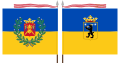 สีของกองพล Poriประกอบด้วยสีน้ำเงินและสีเหลืองของ Satakunta และตราแผ่นดินของSatakuntaและฟินแลนด์บนทั้งสองด้าน ธงมีริบบิ้นของเครื่องราชอิสริยาภรณ์กางเขนแห่งเสรีภาพเป็นริ้ว[ 13 ] : 164–165
![The traditional colour of the Kymi Jaeger Battalion, today a part of the Karelia Brigade, is of the form defined for light infantry. The Kymi Jaeger Battalion follows the traditions of the 3rd Bicycle Battalion and carries that number on its colour, and the Order of the Cross of Liberty both as a streamer and as the point of the staff.[22]](//upload.wikimedia.org/wikipedia/commons/thumb/d/dc/Kymen_j%C3%A4%C3%A4k%C3%A4ripataljoonan_lippu.svg/120px-Kymen_j%C3%A4%C3%A4k%C3%A4ripataljoonan_lippu.svg.png) สีประจำกองพัน Kymi Jaeger ซึ่งปัจจุบันเป็นส่วนหนึ่งของกองพลน้อย Kareliaนั้นมีรูปแบบที่กำหนดไว้สำหรับทหารราบเบา กองพัน Kymi Jaeger ปฏิบัติตามประเพณีของกองพันจักรยานที่ 3 และใช้หมายเลขนั้นบนธงประจำกองพัน รวมถึงเครื่องราชอิสริยาภรณ์กางเขนแห่งเสรีภาพทั้งในรูปแบบริบบิ้นและปลายไม้เท้า[ 22 ]
สีประจำกองพัน Kymi Jaeger ซึ่งปัจจุบันเป็นส่วนหนึ่งของกองพลน้อย Kareliaนั้นมีรูปแบบที่กำหนดไว้สำหรับทหารราบเบา กองพัน Kymi Jaeger ปฏิบัติตามประเพณีของกองพันจักรยานที่ 3 และใช้หมายเลขนั้นบนธงประจำกองพัน รวมถึงเครื่องราชอิสริยาภรณ์กางเขนแห่งเสรีภาพทั้งในรูปแบบริบบิ้นและปลายไม้เท้า[ 22 ]![The traditional colour of the Eastern Finland Signals Battalion, part of the Karelia Brigade, has the branch colours of signals corps: purple and gold. The device featuring a western capercaillie is a throwback to the earlier designation as Central Finland Signals Battalion, with capercaillie being the heraldic symbol of that province. The main device, the three lightning bolts, is symbolic of communication.[23]](//upload.wikimedia.org/wikipedia/commons/thumb/d/d5/It%C3%A4-Suomen_viestipataljoonan_lippu.svg/120px-It%C3%A4-Suomen_viestipataljoonan_lippu.svg.png) สีประจำกองพันสัญญาณฟินแลนด์ตะวันออก ซึ่งเป็นส่วนหนึ่งของกองพลน้อยคาเรเลีย มีสีประจำเหล่าทหารสัญญาณคือ สีม่วงและสีทอง ตราสัญลักษณ์ที่มีรูปไก่ป่าตะวันตกเป็นการย้อนกลับไปถึงการกำหนดเดิมในชื่อกองพันสัญญาณฟินแลนด์กลาง โดยไก่ป่าเป็นสัญลักษณ์ประจำจังหวัดนั้น ตราสัญลักษณ์หลักคือสายฟ้าสามเส้น ซึ่งเป็นสัญลักษณ์ของการสื่อสาร[ 23 ]
สีประจำกองพันสัญญาณฟินแลนด์ตะวันออก ซึ่งเป็นส่วนหนึ่งของกองพลน้อยคาเรเลีย มีสีประจำเหล่าทหารสัญญาณคือ สีม่วงและสีทอง ตราสัญลักษณ์ที่มีรูปไก่ป่าตะวันตกเป็นการย้อนกลับไปถึงการกำหนดเดิมในชื่อกองพันสัญญาณฟินแลนด์กลาง โดยไก่ป่าเป็นสัญลักษณ์ประจำจังหวัดนั้น ตราสัญลักษณ์หลักคือสายฟ้าสามเส้น ซึ่งเป็นสัญลักษณ์ของการสื่อสาร[ 23 ] The traditional colour of the 7th Surface Combat Flotilla of the Coastal Fleet features a blue merlion adapted from the Lion of Finland, striking with a trident.
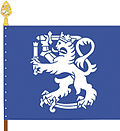 The colour of the Finnish Defence Forces International Centre features a Lion of Finland holding a herald's staff in addition to a sword. The shade of blue is the same as in the flag of the United Nations.[13]: 58
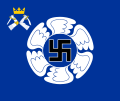 The colour of the Karelian Air Command features, like all Finnish Air Force colours, a swastika within a winged circle. The identifying device is a small coat of arms of Karelia[13]: 275
 The colour of the Utti Jaeger Regiment features a griffin, representing domination of both air and land. The stylized swastika resembles the spinning rotor of a helicopter and reminds of unit emblem used by the Detached Battalion 4 of World War II.[13]: 116
![The colour of the Kainuu Jaeger Battalion, part of the Kainuu Brigade, follows the traditional swallow-tailed format of infantry units. The flag features the family crest of the founder of the city of Kajaani, count Brahe, as well as the symbol of the 14th Division which was formed and fought in the vicinity.[24]](//upload.wikimedia.org/wikipedia/commons/thumb/6/64/Kainuun_j%C3%A4%C3%A4k%C3%A4ripataljoonan_lippu.svg/120px-Kainuun_j%C3%A4%C3%A4k%C3%A4ripataljoonan_lippu.svg.png) The colour of the Kainuu Jaeger Battalion, part of the Kainuu Brigade, follows the traditional swallow-tailed format of infantry units. The flag features the family crest of the founder of the city of Kajaani, count Brahe, as well as the symbol of the 14th Division which was formed and fought in the vicinity.[24]
The colour of the Kainuu Jaeger Battalion, part of the Kainuu Brigade, follows the traditional swallow-tailed format of infantry units. The flag features the family crest of the founder of the city of Kajaani, count Brahe, as well as the symbol of the 14th Division which was formed and fought in the vicinity.[24]![The colour of the Finland Proper Logistics Battalion, introduced in 2016, features the coat of arms of the eponymic province.[25]](//upload.wikimedia.org/wikipedia/commons/thumb/6/6f/Varsinais-Suomen_huoltopataljoonan_lippu.svg/120px-Varsinais-Suomen_huoltopataljoonan_lippu.svg.png) The colour of the Finland Proper Logistics Battalion, introduced in 2016, features the coat of arms of the eponymic province.[25]
The colour of the Finland Proper Logistics Battalion, introduced in 2016, features the coat of arms of the eponymic province.[25]



![The traditional colour of the Kymi Jaeger Battalion, today a part of the Karelia Brigade, is of the form defined for light infantry. The Kymi Jaeger Battalion follows the traditions of the 3rd Bicycle Battalion and carries that number on its colour, and the Order of the Cross of Liberty both as a streamer and as the point of the staff.[22]](https://upload.wikimedia.org/wikipedia/commons/thumb/d/dc/Kymen_j%C3%A4%C3%A4k%C3%A4ripataljoonan_lippu.svg/120px-Kymen_j%C3%A4%C3%A4k%C3%A4ripataljoonan_lippu.svg.png)
![The traditional colour of the Eastern Finland Signals Battalion, part of the Karelia Brigade, has the branch colours of signals corps: purple and gold. The device featuring a western capercaillie is a throwback to the earlier designation as Central Finland Signals Battalion, with capercaillie being the heraldic symbol of that province. The main device, the three lightning bolts, is symbolic of communication.[23]](https://upload.wikimedia.org/wikipedia/commons/thumb/d/d5/It%C3%A4-Suomen_viestipataljoonan_lippu.svg/120px-It%C3%A4-Suomen_viestipataljoonan_lippu.svg.png)




![The colour of the Kainuu Jaeger Battalion, part of the Kainuu Brigade, follows the traditional swallow-tailed format of infantry units. The flag features the family crest of the founder of the city of Kajaani, count Brahe, as well as the symbol of the 14th Division which was formed and fought in the vicinity.[24]](https://upload.wikimedia.org/wikipedia/commons/thumb/6/64/Kainuun_j%C3%A4%C3%A4k%C3%A4ripataljoonan_lippu.svg/120px-Kainuun_j%C3%A4%C3%A4k%C3%A4ripataljoonan_lippu.svg.png)
![The colour of the Finland Proper Logistics Battalion, introduced in 2016, features the coat of arms of the eponymic province.[25]](https://upload.wikimedia.org/wikipedia/commons/thumb/6/6f/Varsinais-Suomen_huoltopataljoonan_lippu.svg/120px-Varsinais-Suomen_huoltopataljoonan_lippu.svg.png)
France
In January 1188, in a meeting between Henry II of England and Philip II of France, it was agreed that both would go on a crusade, and that Henry II would use a white cross and Philip II would use a red cross.[26] Later on, this usage was inverted, and the English took to using a red cross on white, and the French a white cross on red.
Background
As the use of regimental colours spread in Europe, the habit developed of using a symmetric white cross as the basis of the design of the French regimental flags, and by the 18th century almost every regiment had a white cross. The regiments were distinguished by the colours of the cantons.
After the French Revolution and the appearance of the new Tricolore, crosses disappear in 1794 and various arrangements of the tricolour come into use. Napoleon standardizes first in 1804 to a white field chape-chausse of red and blue, and in 1812 to the modern French flag. Atop of the staff of colours of the Napoleonic army the Imperial Eagle (modelled after the Ancient Roman Aquila) was placed, which actually rose to be more important symbol of the regiment than colours itself.
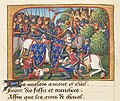 French, white cross, and English, red cross, fighting at the battle of Formigny during the Hundred Years' War.
 Regiment of Auvergne.
 Regiment of Normandy.
 King's Regiment (Régiment du Roi).
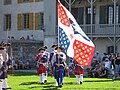 The pre-revolutionary regimental flags inspired the flag of Quebec (here, the Compagnies Franches de la Marine).
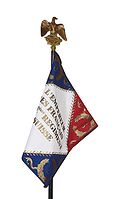 French Imperial regimental flag with its Eagle (1804–1812).
 Regimental flag of the 1st Regiment of Grenadiers of the French Imperial Guard (1812).






Battle honours on current colours

The modern French Armed Forces are not officially considered to be the successors of the Royal Army and Navy, although many of their individual units trace their histories to before the foundation of the First Republic. Accordingly, battles fought and won by the Royal Army and Navy before the French Revolution (such as Patay, Fontenoy, Chesapeake, Porto Praya and so on) do not appear as battle honours on regimental colours. The names of battles of the old times, however, which are rightly still considered as glorious by the modern French Army, are honoured by being given to ships or armoured vehicles, and remembered by anniversaries.
As an example, the 1st Infantry Regiment, founded in 1479 during the reign of Louis XI, has fought a number of battles since the 15th century, but its battle honours are only recorded from 1792 onwards:
- Valmy 1792
- Fleurus 1794
- Moeskirch 1800
- Biberach 1800
- Miliana 1842
- Guise 1914
- Verdun – L'Yser 1916–1917
- La Somme 1916
- L'Ourcq 1918
- Résistance Berry 1944
- AFN 1952–1962.
Latest official regulations
The following official documents relate to the colours of the Land Army (armée de Terre) :
- recommendation (circulaire) 808 EMM/CAB of 5 December 1985 rules what sorts of units can be given colours, abiding to previous regulations of joint services;
- decision 12350/SGA/DPMA/SHD/DAT of 14 September 2007 deals with the inscriptions of battle honours upon the colours and standards of the units of the Army, the Defence Health service and the Military Fuel Service;[27]
- government order of 19 November 2004 relates to the award of the AFN 1952–1962 battle honour to the colours and standards of Army and Services units.[28]
Army in general
- Regimental colours of units which are traditionally on foot, such as Infantry regiments of the line, Marine Infantry, Foreign Legion Infantry, Parachute Infantry, Engineers, Signal Corps and Military Colleges are called drapeaux (flags).
- Regimental colours of the (traditionally) mounted units of the Armoured Cavalry Branch and other cavalry units such as Dragoon Paratroopers, Hussar Paratroopers, Legion Cavalry, Artillery (including Marine Artillery, Legion Artillery, etc.), Transportation, Army Aviation, and Materiel, are called étendards (standards).

Regimental colours are 90 cm × 90 cm Tricolore silk square flags – standards are smaller: 64 cm × 64 cm – surrounded by a golden fringe. Both are set on a stave (2.11 m long and 32 mm diameter – staves for standards are slightly shorter) ended by a 38 cm pike-shaped finial with a cartouche bearing the initials "RF" for République française on one side, and the name or number of the unit on the other side.
The cravate hanging from the pike is made of two tricolour silk ribbons, 90 cm long and 24 cm wide, ended by an 8 cm gold fringe on which the unit number or monogram is embroidered in gold, encircled by an oak and laurel wreath. French decorations and fourragères[note 1] awarded to the unit are pinned or tied to the cravate; foreign awards and decorations are borne on a red velvet cushion.
All writings on the colour are embroidered in gold, as well the unit number (or monogram) encircled in antique oak and laurel wreath in each corner of the colour.
Obverse of a colour:
- République française
- (Name of the unit)
Reverse of a colour:
- Honneur (Honour)
- Et (and)
- Patrie (Fatherland)
- (Battle Honours)
Rifle battalions (chasseurs à pied)

By tradition, all the Army's rifle battalions (the bataillons de chasseurs à pied together with the chasseurs alpins) share a single collective colour. Individual battalions have pennants (fanions) and the Colour of the Rifles (Drapeau des chasseurs) is held each year in turn by a different rifle battalion. As a result, the single gold-fringed colour displays all the battle honours earned by every rifle infantry battalion.
Other specific colours

- Since 1844, the obverse of Foreign Legion regimental colours do not carry the motto "Honneur et Patrie" but "Honneur et Fidélité" (Honour and Fidelity). This motto was originally written on the flags of the Swiss regiments in French service, such as the Régiment de Diesbach (85th Infantry of the line).
- The École polytechnique, as a military college, also has a colour which does not carry "Honneur et Patrie" but instead "Pour la Patrie, les Sciences et la Gloire" (For the Fatherland, Sciences and Glory). The reverse of the École polytechnique's colour has one battle honour written under the motto: Défense de Paris 1814, awarded in 1901 by President Émile Loubet.
- Since 1880, the motto of the Paris Fire Brigade (which is a military unit belonging to the Engineering Arm), "Dévouement et Discipline" (Devotion and Discipline), is written under "Honneur et Patrie".
- The reverse of the Saint-Cyr Military College's colour has seven lines: Honneur / et / patrie / Ils s'instruisent pour vaincre / Premier / bataillon / de France (Honour / and / Fatherland / They study for victory / First / battalion / of France).
Air Force

The colours of Air Force (armée de l'Air) units are by all means similar to those of the Army from which it separated as an independent military arm in 1933. Colours are generally not bestowed to Air Force units smaller than escadres (wings), land combat wings, air force and space bases, instruction centres or air force training colleges.
National Gendarmerie
The units of the National Gendarmerie (Gendarmerie nationale) have colours which are very similar to those of the Army. Each region (formerly legion), instruction centre, college or Republican Guard Regiment has its colour or standard, altogether 56 colour and 2 standards. The reverse of colours of the Departmental Gendarmerie units and Gendarmerie instruction centres have the same motto as the Land Army units (Honneur et Patrie), but the colours of the Mobile Gendarmerie have their own particular motto: Valeur et Discipline (Valour and Discipline). Most subordinate or smaller units use 50 cm large × 40 cm high pennants.
The National Gendarmerie also has its own official colour, under the armed guard of the Directorate General, on which five battle honours are registered:
- Hondschoote 1793
- Villodrigo 1812
- Taguin 1843
- Sébastopol 1855
- Indochine 1945–1954
National Navy

The Colours worn by the ships of the National Navy (Marine nationale) consist of the National Ensign and the jack:
- the National Ensign[note 2] is flown at the stern and at the bowsprit if not replaced there by the FNFL jack or a military award jack;
- the FNFL jack is flown at the ship's jackstaff if the ship has fought with the Free French Naval Forces, or is named after such a ship;
- military award jacks may also be flown at the ship's jackstaff if the ship has received mention in dispatches (in which case crew members wear the corresponding fourragère).
Currently, only eight individual National Navy units have colours[29] other than the National Ensign or the FNFL jack. Under recommendation 808 EMM/CAB of 5 December 1985, naval units to which colours can be bestowed must be those with manpower equivalent to that of a regiment, which are specialised in combat or services on land (or corps which have inherited their traditions from such units), and naval instruction centres or colleges. The flags are quite similar to those of Land Army units, the difference being the wreaths in corners which encircle anchors instead of the name of unit, except for the Naval Gunners (initials CM) and the Fleet Engineering Cadets College (initials EAMF).
As of today, these units are (between brackets is where the colours are currently kept):
- the 1er Régiment de fusiliers marins (École des fusiliers marins) – the 1st Naval Fusiliers Regiment (Naval Fusiliers College);
- the Demi-brigade de fusiliers marins (Compagnie de fusiliers marins de Cherbourg) – the Naval Fusiliers Half-Brigade (Cherbourg Naval Fusiliers Company);
- the Canonniers marins (Centre d' instruction naval de Saint-Mandrier) – the Naval Gunners (Saint-Mandrier Naval Instruction Centre);
- the École navale (Groupe des écoles du Poulmic) – the Naval College (Poulmic Schools Group);
- the École militaire de la flotte (Groupe des écoles du Poulmic) – the Fleet Military College (Poulmic Schools Group);
- the École des mousses (Centre d'instruction naval de Brest) – the Cabin Boys College (Brest Naval Instruction Centre);
- the École des apprentis mécaniciens de la flotte (Centre d' instruction naval de Saint-Mandrier)' – the Fleet Engineering Cadets College (Saint-Mandrier Naval Instruction Centre);
- the Bataillon de marins pompiers de Marseille (Bataillon de marins pompiers de Marseille) – the Marseille Marine Fire Battalion (The Marseille Marine Fire Battalion).
French influence
Nations of the former French Empire
Many of today's armed forces of independent countries that once were part of the French Empire share customs and traditions closely similar if not identical to those of the French military regarding organisation of military arms, army and navy rank structures and uniform styles. Indeed, in countries where the decolonisation process had been conducted through peaceful political negotiations (chiefly French West Africa and French Equatorial Africa), French colonial units were sometimes directly inherited by the former colonies where they had been raised to form the basis of the new national armies. This legacy not only included colour etiquette (the way colours are respected, taken care of and paraded), but also design, adapted to new national flag designs.
On the contrary, in countries where independence came as the aftermath of bloody wars of liberation, such as in Vietnam and Algeria, due to the Cold War context, French military culture was strongly rejected often only to be replaced by communistSoviet or Chinese style military culture (colours, ranks, uniforms, parade pace, etc.).
Other nations
As one of the World's great powers together with Great Britain, France did not only exercise its influence by conquest, but also by the prestige of its military. At the height of European colonial expansion in the 19th century, France's army and Britain's navy were each regarded as the most powerful forces ever on land and at sea. This lead many a military to copy both powers' military and naval cultures. As most navies in the World adopted the British naval looks (double-breasted navy blue jacket and peaked cap for officer, blue jean collar for ratings, etc.), numerous land armies adopted French-inspired uniforms during the 1860s and 1870s (both Union and Confederate armies during the American Civil War, the Chilean Army of the War of the Pacific, the Imperial Russian Army, etc.) and even sometimes imported types of French units (e.g. Zouave regiments). France's influence on military fashion dimmed for the time being after the unexpected French defeat ending the Franco-Prussian War of 1870–1871. Many armies then changed to adopt Prussian military style (as a perfect example of this trend, Chilean soldiers traded their kepis for Pickelhauben).
As far as regimental colours are concerned, French influence was mainly to be seen in armies of smaller European powers with strong cultural, economical or political ties to France, notably in such countries whose national flag itself was patterned after the French national flag, such as Belgium or Romania.
 Djiboutian colours: French influence through legacy.
 Belgian colours: French influence through common culture.
 Romanian colours: French influence through prestige.


Germany

Units of the Bundeswehr have only a single Colour. The Truppenfahne is a square version of the national flag with the Bundesadler (national shield) overall in the centre. The flag is surrounded by a black, red, and gold lacework border and edged on three sides by gold fringe. The finial is a gilt bronze openwork spearhead surrounding a black and silver Iron Cross. Below the finial, a streamer is attached with the unit badge at the top and its designation embroidered in gold at the end. These streamers are red for army (Heer) units, blue for the navy (Marine), and white for the air force (Luftwaffe). The streamer is the same length as the hoist of the flag.[30]
The tradition was also observed by the National People's Army of East Germany, whose unit colours mirrored the national flag.
Until the Second World War German military units maintained colours of the Prussian pattern regardless of service branch, while the Waffen-SS followed the national flag pattern.
Greece

Traditionally, Army infantry and tank/cavalry regiments have a single colour/standard or war flag (Greek: Πολεμική Σημαία). This is blue, with a white cross and features St George and the Dragon in the centre.[31] The flag has no distinguishing features for individual regiments, although battle honours are sometimes added to the flag; the regiment's identity is inscribed on the flagstaff. The pattern has been in use since the 1830s, with no changes between the periods of monarchy or republic. The Hellenic Army Academy has also been awarded a war flag, its cadets having participated in the Battle of Crete in 1941. Similar flags exist also for the Air Force, featuring the archangelMichael. Recently war flags were assigned to the Army NCO Academy and the Police Academy.
Unlike the Army, Police and Air Force, the Hellenic Navy uses as both the naval ensign and national colour the flag that later became the modern official national Flag of Greece. The Hellenic Coast Guard and the Hellenic Fire Service use the Navy pattern.
Holy See

The official colour of the Swiss Guard, the army of the Vatican City, consists of four-quarters. The Coat of Arms of the current pope is in the first quarter, while the arms of Pope Julius II are in the fourth quarter. In the second and third quarters are horizontal stripes of red, yellow and blue, the colours of the unit's uniforms. It has no gold fringe.
The flag also has the coat of arms of the commander within a wreath, on a background of the colour of his canton. The design of the flag changes with the election of a new pope and the appointment of a new commander.
Hungary

The 120 cm × 140 cm Unit colour of the Hungarian Defence Force is the current regulation colour of all Hungarian Defence Forces units since 15 March 1991. The flag is made of white fibres-satin. The height of the coat of arms with the crown is 57, and the width is 58 cm along with the crown. The coat of arms is made of silk with gold and silver embroidery. The edges of the flagship are surrounded by 11–11, and 9–9, 10 cm, red and green flames on the longer sides, extending 15 centimetres. The flames of the flames start and end on each side with a red colour, with the flaming tongues separated by a green circle in the four corners of the flag. The flagpole has a 5 mmm national-colour silk ribbon on its 3 free edges that do not fit the rod, with 10–10 centimetres national colour silk ribs on two free tips. The white part of the flagpole outside the party is twisted once on the pole, fixed with 3 equally spaced brass nails - 25-25-25 mm equally spaced. The flagpole is a 21-centimeter long, stylized leaf-shaped sandblasted brass, on both sides with a baroque, bronze Coat of arms of Hungary, without shield holders. The rod is 238 centimetres long, cylindrical, scarlet-lacquered, bottom-foldable in the lower third. Brass rings at the pole separation lines and a brass cap at the bottom end.[32]
Italy

The colour (bandiera di guerra) for army units (other than cavalry) is a square version of the national tricolour in silk, 99 cm × 99 cm. It is mounted on a pike 2.2 m long, made of wood covered with green velvet and decorated with ornate brass nails arranged in a spiral. The pike is topped by a 35 cm high finial consisting of an ornate gilt brass spearhead chased with a five-pointed star and the monogram RI (for Repubblica Italiana), which is in turn mounted atop a gilt brass ball on which is the name and date of establishment of the unit. The pike is adorned with two silver cords 67 cm long, each with a 10 cm long silver tassel and a blue silk cravat 8 cm × 66 cm with an 8 cm silver fringe at each end, to which the unit's decorations are pinned, the ribbons of the decorations overlapping so that the medals hang down the cravat. Italian Army cavalry units carry a stendardo (standard) of the same pattern as the bandiera di guerra, but which measures 60 cm × 60 cm.
Lithuania

Lithuania's military colours under the Lithuanian Armed Forces tend to follow a mix of the Russian and British practice, as well as of US tradition, with the national flag being designated as a National Colour, but only flown by guards of honour in ceremonies. Unit colours of the Land Forces follow the Imperial Russian pattern, with the fringe in gold or bi-colour of red/green and bearing Vytis (obverse) and unit emblem (reverse) in the centre. The Naval Forces uses a ceremonial form of the naval ensign as an overall branch colour with gold fringe following British precedence.
Netherlands

In the Dutch armed forces, the colour (or standard in case of the mounted (i.e. cavalry and field and horse artillery) regiments) is orange (except for the colour of the midshipman corps, which is red). All are gold fringed.
On the obverse is the royal cypher of the monarch that gave the regiment its (original) colour, with the unit's name underneath (including the year the regiment or corps was established), both in gold; around the four edges is a laurel branch. Battle honours are added in the corners of the obverse and sometimes also on the left and right of the royal cypher; if additional honours are awarded, they are placed on streamers that are attached to the pike until the presentation of a new colour. Battle honours refer to places (e.g. Waterloo or Rotterdam), areas (West-Java or Afghanistan) (seas included, for example Java-zee), or to a military campaign (Tiendaagse Veldtocht or Veldtocht van 1815); the year or years of engagement are always added, except on the colours of the Netherlands Marine Corps.
On the reverse is the arms of the Kingdom of the Netherlands without the mantle. The shield is blue and is strewn with small upright rectangles; the main device is a crowned rampant lion, holding a sword in its upper paw and a bundle of seven arrows in its lower paw. The lion and rectangles are gold, whilst the blade of the sword is silver. Supporting the shield on either side is a gold rampant lion, facing outwards towards the viewer. There is a gold crown above the shield; whilst below it is a blue scroll with the royal motto Je maintiendrai (French for 'I will maintain') in gold. The shield and lions are surrounded by a wreath of green palm and oak leaves tied together with an orange and blue ribbon, and there is another wavy gold laurel wreath around the four edges.
The Military Order of William or other decorations are attached to the pike when awarded. The pike has a finial of a lion on a plinth holding a sword and a bunch of seven arrows. Traditionally a colour is 87 cm × 87 cm (with a pike 2.50 m long). Guards regiments carry the same colour, with some differing details. The same applies to the colours carried by the Royal Military Academy and the Royal Military School. Standards measure 50 cm × 50 cm with a pike 2 m long.[33]
Only Regiment van Heutsz has a full British-styled stand as a variant of the national flag used by the regiment in the Korean War is used as the Regimental Colour with the orange colour as the King's Colour (or Queen's).
Norway
Norwegian infantry units have a stand of colours – the first (King's Colour) is the national flag, while the second (Regimental Colour) is unique to each unit:
- Infantry: Norwegian line infantry units carry regimental colours, either of a solid colour or divided vertically into two or three stripes, with the Norwegian lion in the centre, the name of the unit, and battle honours embroidered on the field. The colours vary by regiment and derive either from historic associations with predecessor regiments or from the colours of the regiment's oldest known uniform.
- Guards: The Royal Norwegian Guards regiment has a regimental colour that is all white, again with the lion in the centre, and with the royal cypher of the reigning monarch in each corner.
Poland

The standard military colours of the Polish Armed Forces are in red and white with gold fringe, with the design tracing back to the Polish Second Republic, a standardized form based on earlier colours. The motto of the Armed Forces, "God, Honour, Fatherland" (Polish: Bóg, Honor, Ojczyzna) are at the reverse while the Polish military eagle (which differs per service) surrounded by a gold wreath is at the centre of the obverse. The unit's name is inscribed on the obverse. The eagle is also featured as the finial in all colours.
Portugal

Each of the commands, units, forces and establishments of the Portuguese Armed Forces has a national colour, which is considered the parade version of the Flag of Portugal. The National Republican Guard, the Public Security Police and some fire departments also have national colours.
The traditional distinction between colours (Portuguese: bandeiras, literally "flags") - carried by foot units - and standards (estandartes) - carried by mounted units - was abolished in the 1960s, with all of them being uniformly reclassified as "national standards" (estandartes nacionais). At the same time, another type of standard was introduced, this being the heraldic standard, each of which reflects the particular heraldic symbology of the corresponding unit.
The official model for the military colours was established in 1911 and states that they should measure 120 cm in the hoist by 130 cm in the fly, the field being vertically divided in green and red, with the National coat of arms in the centre, surrounded by two golden olive branches tied by a white scroll containing the motto Esta é a Ditosa Pátria Minha Amada (This is my Beloved Blissful Fatherland). Despite the existence of this official model, the various branches of the Armed Forces adopted different models of colours over the years, with various designs and dimensions.
In March 2020, a uniform model of national colours was adopted for all the branches. This is based in the 1911 official model, but measuring 120 cm both in the hoist and in the fly. The name of the unit, its heraldic symbol and their battle honours are embroidered in a gravat attached to the base of the finial, the colour of the gravate varying accordingly with the branch of service. Naval units were allowed to keep the traditional Order of Christ Cross embroidered in the canton of the cloth of their national colours. The several commands, units, forces and establishments of the Armed Forces will have to replace their old national colours by the new model within 10 years.
The national colours of the National Republican Guard and of the Public Security Police follow the 1911 model and continue to keep the traditional practice of having the names of the units inside white scrolls which are inserted on the field of the flag itself.
Romania
According to the Romanian General Staff, "The military colours (drapel de luptă) are the symbol of military honour, bravery and glory. They evoke the past struggle of the Romanian people for national liberty and the traditions of unity, reminding each soldier of his sacred duty to serve the Fatherland with trust, and to defend at all costs the unity, sovereignty and independence of Romania".
The military colours are granted to military units by presidential decree, on the advice of the Minister of National Defence, the Minister of Internal Affairs or the director of the Romanian Intelligence Service. According to the Ministry of National Defence, the complete description of this military insignia is as follows:

The military colours of Romania are made of double silk cloth and have dimensions of 100 × 66 cm (2:3 ratio). The canvas has the colours of the Romanian flag and its obverse is identical with the reverse. The national coat of arms, measuring 29 × 21.5 cm, is applied in the middle of the yellow stripe, 18 cm above its base. In each corner, 5 cm from the edge of the canvas, is sewed a wreath of oak leaves, which surrounds the weapon signs, all of golden thread:
- two crossed swords for land forces units
- a helicopter blade juxtaposed over a pair of wings in downward flight, a radar and a crossed rocket and telescope for the Air Force
- an anchor for the Naval Forces
- the letter J in a rhombus over two crossed swords for gendarmerie units
- the emblem of the Romanian Intelligence Service for its units
The three sides of the flag not attached to the pole are decorated with fringes of golden thread (5–7 cm long) and tassels of the same material (10–12 cm long) hang from the corners of the fly. The flag is attached to the pole by an antioxidant metal rod 70 cm long.
The pole, of brown wood, is 240 cm high and 3.5 cm in diameter. A brass cylinder is at the base, 4 cm long and closed on the bottom. The rod is attached to the pole by a brass ring, gilt on its lower part, and a 6 cm high cylindrical protective tube of the same material and gilt on its upper part. The ring (3.2 cm high) is inscribed with the name of the unit. Another brass cylinder is placed on the tip of the pole, 6 cm long and of brass. The eagle (similar to the Roman aquila), of gilt copper, sheet, 15 cm high and 11.5 cm wide, is placed over this. Looking rightward, the eagle's wings are pointed downward and it holds the thunderbolts of Jupiter in its talons. It is placed on a parallelepipedal support of the same metal (10 × 3.5 × 2 cm), which has a 3.4 cm high ornament on its lower part. The support is screwed onto the brass cylinder and has inscribed into the front the motto Onoare și Patrie ("Honour and Fatherland"). The name of the respective unit is engraved into the reverse.
Other features of the military colours are a tie for attaching decorations, six sashes for the armed escort of the colour guard and the colour ensign and a protective cover of impermeable fabric.
The military colours of navy vessels are identical to their ensign. The ensign is in turn identical to the national flag, being made of ordinary canvas in various dimensions, according to the ship's rank, size and place of hoisting. They are flown in their vessels in accordance with relevant regulations.
Russia and Soviet Union
Until Peter the Great assumed the office and throne of Tsar in 1685, various flag designs were used by land and naval units of Imperial Russia.
In the 18th century the Imperial Russian Army started to have colours of its own. Starting from the 1730s, Cross style flags in the colours of the various military units appeared in various units: large flags for the infantry and the other arms and small flags for the cavalry and horse artillery. These flags mirrored the Commonwealth military colours of today, with one colour set as the state colour and the rest as the regimental and battalion or squadron colours. 1797 regulations introduced new designs for the infantry—for regular units, the state colour being white with the state emblem and the company, battalion and/or regimental colours using the assigned colours of their units, for the Imperial Guard a different emblem was used, and the design was identical. New colours were issued in 1800, but only Guards units used them.
Regulations set in 1813 unified infantry unit colours into one. Guards units used the orange and black of the Order of Saint George with the facing colours and unit emblem at the centre.
All these years, the cavalry colours were different.
Naval flags, until 1861–62 (with a brief break in the late 1790s) whilst using the St. Andrew's cross in blue on white, mirrored the British Royal Navy.

From 1942 onwards, each regiment in the armed forces of the Soviet Union (especially the Army and Air Force) had its own colour, which was produced to a standard design:
- Obverse: red field, a red star yellow bordered and the full name and number of a military unit/school below. Each unit has its own inscription.
- Reverse: red field, a gold hammer and sickle and the motto "For our Soviet Motherland!" (За нашу советскую родину!, Za nashu sovyetskuyu rodinu)
The colour was gold fringed.
The former designs had a red star on the reverse with the name of the Central Executive Committee and later, the Supreme Soviet of the USSR surrounding it, and the obverse had the unit inscription below the coat of arms of the Soviet Union, which had the Soviet Union state motto ("Workers of the world, unite!") and the red star with the hammer and sickle inside (both were on the flag of the Soviet Union) above it (the latter was near the hoist). Naval flags until 1935 sported different designs. (Distinguished units would be given a second colour, the Revolutionary Red Banner of Honour, by the all-Union CEC (before 1924 by the All-Russian Central Executive Committee).)
The Soviet Navy colours had the 1935 official design with them (it was later revised in 1950), with additions for units honoured with the Order of the Red Banner, but in 1964 the Supreme Commander's and Defence Minister's own naval colour and the colours of the Navy Commander-in-Chief (formerly the Minister for the Navy) and Chief of Naval Operations were issued with different designs used, with the addition of the Armed Forces General Staff's own naval colour. The first colour was red with the USSR state arms, the next two had the arms with blue stripes indicating office rank, and the final two were adaptations of the naval ensign (with a different ensign with the rank) plus the stripes. The 1935 design (that of a white field with a blue lower stripe and the red star plus the hammer and sickle above the blue stripe) replaced a much earlier, post-revolutionary naval colours design adopted in 1925. In 1944 a different flag was issued to the Navy for its land based units – the same design used by the Army with a different obverse having the unit name below the naval ensign.
Early flags even had the RKKA and RKKF insignia (the Army General Staff, represented by crossed blue rifles and later became the General Staff's naval colour until 1964, the Naval General Staff and the Army Naval Operations Staff, later the flag of the People's Comissariat for the Navy on its 1938 creation and was issued with two new colours for the Navy Commissar and Deputy Commissar) beside the hammer and sickle, even the flags of the People's Commissar for National Defence and that of the Navy General Staff and the various flags of naval officers which had the ensign on a canton surrounded by a red field, derived from the Navy Commissar's. The cruiser Aurora since 1968 has had a different version of the ensign, flanked by the Order of the Red Banner and of the Order of the October Revolution on the top sides of the star, as the Aurora was the only naval recipient of the latter order in 1967 while in 1918, the Order of the Red Banner was conferred to the ship.
Regimental colours of the Guards units
The colours of those regiments that were classed as "Guards" was slightly different as per 1942 regulations. These had the portrait of Lenin, the Za nashu motto and the abbreviation "USSR" (СССР, SSSR) on the obverse and the small star with hammer and sickle in its centre, unit's name and a motto on the reverse of the colour. The mottoes were different for every regiment (for example, those regiments made Guards in the Great Patriotic War bore the motto "Death to the German invaders", Смерть Немецким захватчикам, Smyert' Nyemyetskim zahvatchikam). In some Guards Armies and Corps, different designs on the obverse and reverse were used. Even the Lenin portrait was different in these colours. All of them were gold fringed.
The Navy's Guards units still had the 1935 design, with the addition of the Guards ribbon below, except for units which were honoured with the Order of the Red Banner and became Guard units later. The difference is in the red five-pointed star, in which Red Banner Guard unit flags had applied the Guards ribbon below aside from the Order of the Red Banner on the star for units that had the order bestowed on their colours earlier. Units which used the 1944 regimental colour design but adapted for the navy's guards units[34] included air and marine units which still had the obverse of Army and Air Force guards units standards.
Colours of the present-day Russian Armed Forces
Since the birth of the Armed Forces of the Russian Federation in the aftermath of the dissolution of the Soviet Union, the old Soviet unit colours were retained. Starting in 1998, the traditional Imperial Russian Armed Forces flag designs were reinstated; however, the new designs began to appear in the early years of the 21st century in the Army and Air Force. But the Russian Navy's old naval colour (St. Andrew's cross in blue on a white field) began to be used again in 1992. It has several variations, and the old jack colour of the Soviet Navy (pre-1935) soon became its jack colour, with the red star with the hammer and sickle removed. The unit colours (especially those of the Navy honour guards) have the same design with the unit insignia at the centre of it while Guards units and bemerited and decorated units apply a different version of the colour.
The new Army and Air Force unit colours are square shaped, have a St. Andrew's cross in the colours of the Ribbon of Saint George, and with the unit insignia in the middle of the obverse and the national arms at the reverse, with the service branch emblem on the corners. These colours are the basis for similar ones used today in the various Russian uniformed services.
Spain

- Standard colours: Units of the Spanish Armed Forces have a single colour based on the national flag. This has the coat of arms in the centre of the flag, surrounded by the regiment's name in black lettering. It is fringed in gold. Red and yellow tassels are attached to the finial which have the battle honours embroidered on them. The flag is in gold fringe. Formerly a white regimental colour known as the sencilla with a red Cross of Burgundy with unit insignia on each of the ends of was used by these units until the adoption of the present colours in 1843. Large colours are the standard of infantry formations, small standards for the cavalry and artillery.
- Coronelas: Up until the early 20th century, some Spanish regiments had a coronela, or King's Colour in addition to their Regimental Colour based on the national flag. Although officially the only colour is the standard one, some older regiments continue to carry a copy of their old coronela which are used on some occasions to maintain regimental traditions. However, the coronelas no longer have any official standing and are not used on official occasions. The design of such colours are white with the royal arms at the centre and the unit insignia and honours at the sides. These had no gold fringe.
 Recreated Coronela of the 1st Infantry Regiment from 1788-1808.

- Second order colours – regimental/wing guidons and banners: In Spain's Armed Forces, guidons and banners are second order colours, but are smaller (guidons are medium square shaped while banners are small square shaped). Guidons are used by battalions, squadrons and groups (even vessels) in the Armed Forces while the banners are used by companies, troops, flights and batteries. All have different and unique designs with some having the old Burgundy cross on them. These also have the unit insignia in the centre. Like the Regimental Colour, the finials of these colours have the attached unit battle honours and decorations.
Sweden

The design of the colours of the Swedish Armed Forces of today dates back to several separate regulations from early 19th century up to the first united regulations of the three fighting services in 1972. The majority of the army colours are dated back to the summarized regulations of 1950. The colours of the Swedish Amphibious Corps (former Swedish Coastal Artillery) were decided in model 1944. The colours of the Swedish Air Force were modelled in 1938. Most older colours are embroidered by hand while younger ones can be both machine and handmade.[35] When a military unit, as regards traditions, is amalgamated with another, both colours will be carried together. In principle this will go on as long as both colours are usable. When one of the two (or more) no longer can be repaired, the unit will be granted a new colour. This new colour will reflect the traditions of both units without altering the prescribed model.[35]
Exceptions from this rule are:[35]
- The Life Guards (LG) which maintains its privilege to present both the colour of the former Svea Life Guards (I 1) and the standard of the former Life Guard Dragoons (K 1)
- The South Scanian Regiment (P 7) which maintains its privilege to present both the colour of the South Scanian Regiment (P 7) and the standard of the former Scanian Dragoon Brigade (Skånska dragonbrigaden, MekB 8)
- The Artillery Regiment (A 9) which maintains its privilege to present both the standard of the Artillery Regiment (A 9) and the honorary standard of the former Wendes Artillery Regiment (A 3)
- The Uppland Regiment (S 1) which maintains its privilege to present both the colour of the former Royal Signal Regiment (S 1) and the colour of the former Royal Uppland Regiment (I 8)
A colour is normally granted to the following by the King, by the Prime Minister or the Commander of the Armed Forces:[35]
- an army unit belonging to the Infantry Branch, the Armoured Troops, the Engineer Troops, the Signal Troops and the Service Troops
- the regiments of the Amphibious Corps
- the wings of the Swedish Air Force
Turkey
The Flag of Turkey is used by the Turkish Armed Forces as a National Colour, and thus has distinguishing features:

- the golden TC (Turkish monogram for Republic of Turkey) on the top left corner, surrounded by golden rays
- the regimental name, abbreviated, below the crescent and star in white
- gold fringe surrounding the colour, cords and tassles
It is presented and uncased with a ceremony and moves under the command of the Colour Guard. This unit consists of 4 personnel: the ensign holding the flag, two armed colour guards and the Colour Officer. There are selection criteria for the colour guard. The ensign, flag guard and colour officer must be distinguished among their peers with their education and discipline. The colour officer must be ranking as a subaltern officer.
The General Directorate of Security of the Ministry of the Interior has two Colours, only in the offices of the General Director of Security and the Superintendent of the Police Academy. It has defined the colours as the symbols of honor of the Police in its own regulations. These have a white tassel, cords and fringe unlike the colours used in the Turkish Armed Forces.
All colours salute only the President and foreign Heads of State. As long as the colour is uncased and visible especially in military events, it is saluted by everyone standing and with a frontal salute.

The Ottoman army often used verses from the Quran and Shahada (There is no god but God alone, and Muhammad is his messenger) on their colours, which were usually in scarlet. This tradition continued during the First World War. When Ottoman Turkey joined the war on the side of the Central Powers in 1914, it declared a jihad against the Entente States. The modern Ottoman Turkish army used the Ottoman state coat of arms on one side of their standard regimental flags/standards and the Shahada on the other side in gold lettering. Gold fringe was introduced as well to match those of other national armies. After the empire was abolished in 1922, this practice continued for a while in modern Turkey with the national republican arms replacing the Ottoman.[36]
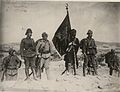 Ottoman Turkish Regimental Standard at Gallipoli,1915
 Ottoman Turkish Regimental Standards with Ottoman Turkish National Flag
 Ceremony to decorate the standard of the 27th Regiment with silver and gold Imtiyaz medals
 Standards of the Turkish Army at Military Parade
 Turkish Army Marine Brigade Standard



Ukraine
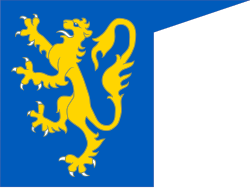
At the turn of the 13th and 14th centuries, quadrangular flags with wedge panels on the free end appeared. The most used colors were red, followed by white, blue, and occasionally yellow. The most widely used flag images were crosses, holy and princely symbols and ancestral tridents-bidents. The flag of the Galicia-Volynia principality was blue with a golden lion.
In 1410, Ruthenian troops took part in the Battle of Grunwald on the side of the Kingdom of Poland and the Grand Duchy of Lithuania against their old ally from the time of the Principality of Galicia-Volhynia, the Teutonic Order. The Polish chronicler Jan Dlugosz left a description of the banners of the troops from the ruthenian lands who appeared to fight the crusaders.
The Zaporozhian Army received their first flags from foreign monarchs from the 16th century: during the Moldavian campaigns of the Austro-Turkish war and the campaign of the Holy League.[37]

In 1646, for the campaign against the Turks, Wladyslav IV Vasa provided a flag: ironically, it was under this banner that the Cossacks won their first resounding victories over the Polish army during the Khmelnytskyj uprising — at Yellow Waters, Korsun, and Pyliavtsi.
According to the system, there were regimental, sotnia and kish banners. Among the flags of the day, rectangular and trapezoidal panels prevailed. The insignia of numerous units had a triangular shape of various shades of red. Instead of a single state flag, the highest heraldic symbol of the Hetmanate was the image of the Archangel Michael on a red background. Most of the flags that have survived to our time contain an equilateral Cossack cross and eight-pointed stars, sometimes combined with images of the crescent moon, a symbol of the Christian-Muslim civilizational confrontation, the latter, from 1572 (in honor of Lepanto), had a pan-European distribution as a symbol of victory in the confrontation with the Islamic threat.[38] From the 18th century, primarily in the Poltava (1717) and Lubny (1758) regiments, two-color flags of yellow and blue became widespread.
In general, until the second half of the 18th century. there are relatively fragmentary data available, more detailed information from the time of the unification of flags during the time of Kyril Razumovsky: on March 8/18, 1755, he issued a form for the manufacture of flags according to a single model according to the project of Colonel Ivan Kulyabka of Lubny — one side was to contain the Coat of Arms of the Nation, and the other symbol of a military unit. Despite this, the colors and sizes of the flags were arbitrary. Similar standards existed until 1768 - the reign of Peter Rumyantsev, who began to introduce imperial symbols in the Cossack army.

The unification of the banners of the Hetmanate did not in any way affect the ensign of the Zaporozhian Army, the general banner — the Great Banner — still contained Archangel Michael on a red background, the flags of the kurin and palanquins were mostly crimson in color. The banner of sea campaigns with the image of St. Nicholas was white, besides it, after the Oleshkivsk sich period, there was also a titular red banner of imperial origin. Among the kurin banners, the red ones with the image of St. George.
The first Cossack colonizers of the Sloboda region formed the Slobid regiments, the banner of which also featured Christian and religious themes. In total, there were 36 flags in the five regiments, together with the sotnias. The reverse side of the sotnia flags contained the name of the regiment and the sotnia. In contrast to the banners of the rest of the Ukrainian Cossacks, the Slobid banners contained the image of the Mother of God, the patroness of the Cossacks, as the main motif. With the reorganization into regular hussars, the previous symbols of the units were abolished.
In 1792, the Zaporozhians were moved to the Kuban, where the Tmutarakan Principality was located, forming the Black Sea Cossack Army.


Following the collapse of the Russian Empire, the Tsentralna Rada came to power in Ukraine in spring of 1917, it was forced to promptly put together an army to defend the new republic against their enemies. Nearly all units of the newly created army were detached from the Imperial Russian Army. After the first all-Ukrainian military congress that took place on May 18–21, 1917 in Kyiv, the Ukrainian General Military Committee was created. The committee was placed in charge for creation and restructuring of the army.
The next congress, defying a ban placed by the Russian Provisional Government, took place on June 18–23, 1917 in Kyiv. The main requests of the congress were proclamation of the Ukrainian Democratic Republic, full Ukrainization of army and navy, and an immediate peace treaty.
On January 27, 1918, the Ukrainian Central Rada approved the project of the Ukrainian naval ensign, developed by the Ukrainian Maritime Council (it consisted of two stripes: blue at the top, yellow at the bottom; on the top - the golden sign of Prince Volodymyr - the Trident with a cross at the top), modeled after the British White Ensign.

In 1919, blue-yellow unit colours based on the national flag were adopted for units of both the regular Army of the Ukrainian People's Republic and the Ukrainian Galician Army.

With restored independence the Armed Forces of Ukraine adopted a maroon design for its colours, which were gold fringed and contained the official heraldic arms of the armed forces.
Maroon and gold are the colours used in the current military colours used in the Armed Forces of Ukraine, with origins in the Imperial Russian Army's Cossacks and Ukrainian units. In the obverse the Coat of arms of Ukraine, surrounded by a gold wreath, is at the centre of an Orthodox Cross – both symbols form the emblem of the Armed Forces – with a St. Andrew's Cross under it with the same emblem in the sides, with the Armed Forces Motto (For Ukraine, for her Freedom) surrounding the emblem and crosses. The unit's name is in the reverse. The colour is gold fringed and is mounted on a pole with a trident finial modeled on the national arms. The same design is used in the National Guard of Ukraine but in blue and with the 2015 grenade badge. Active duty NG units sport dark blue colours with the Orthodox Cross, grenade and the coat of arms at the corners.
Only the 93rd Mechanized Brigade (Ground Forces), the Ukrainian Air Assault Forces and the Ukrainian Marine Corps have been granted additional colours so far in addition to the official maroon unit colours.
The State Border Guard Service of Ukraine shares a similar colour design to the Armed Forces but with the green colour added to distinguish its units.
Yugoslavia and post-Yugoslav nations
The first Yugoslav military colours came about when the Kingdom of Yugoslavia was established in 1918. These were the square versions of the Flag of the Kingdom of Yugoslavia with the state coat of arms and the motto of the Yugoslav Royal Army. The unit names were attached to a ribbon at the pole. The colours were inspired by the military colours of Serbia and of the Croat, Slovene and Bosnian military units of resistance against Austria-Hungary during the First World War.
With the birth of the communist Partisans in 1941 in time for the Second World War, their flags showed the same Pan-Slavic colours on them (arranged according to nationality) but this time a red star was added in the middle. The naval units had a different ensign used and these flags became the basis for the military colours of Democratic Federal Yugoslavia at the time of its 1943 proclamation.
By the time, these flags had the unit name on the pole pennants and were gold fringed. The Partisan General Staff had their own version of it.
Post-war colours (from 1947, when the nation became a Federal People's Republic) used various flag design with the Yugoslav People's Army motto in Serbo-Croatian (For the freedom and independence of the socialist fatherland) both in Cyrillic and Latin and differed per unit or service arm of the YPA, but was longer and were gold fringed. Just as before, the unit name stayed on the attached ribbon. Both the Flag of Yugoslavia and the flag of the League of Communists of Yugoslavia were used as National Colours in parades. Unique colours were issued to the Navy, to YPA reserve units and the Territorial Defence Forces of the republics.
Today all the nations of the former Yugoslavia have separate colour traditions per armed forces, but keep their unique appearance.
Serbia
The Serbian Armed Forces colour design is very much unique, while gold fringe can be seen in these colours. At the obverse is the national flag design, a tricolour with the national coat of arms in the center of the colour, while the emblem and facing colour of the unit represented (combat formation or support unit) is in the reverse.
Croatia
Since independence, Croatia adopted a more Western style of colours for its armed forces with the Flag of Croatia as the National Colour. All are not gold fringed and their longer length suggests American and British influence in the design and traditions.
North America
Cuba
Cuba's military colours under the Cuban Revolutionary Armed Forces tend to follow a mix of the Soviet and US practice, as the Cuban flag is treated as a National Colour.
- Regiments/Wings: bicolour vertical flag with a white field in the centre with the Coat of arms of Cuba and the service or branch colour at the sides
- Infantry Divisions of the Revolutionary Army, Territorial Troops Militias, Youth Labour Army and Camilio Cienfuegos Military Schools System: Red with coat of arms with title on gold or white surrounding
- Armoured Divisions: Black with coat of arms with title on white
- Air Force Brigades: Blue with coat of arms with title on white surrounding
- Antonio Maceo Military College and Jose Maceo Military College: Red and Black with coat of arms
- Naval Academy: White with two blue stripes
El Salvador
El Salvador's military colours under the Salvadoran Armed Forces heavily follow US models, as the Salvadoran flag, with gold fringe, is treated as a National Colour- but its design is based on the American Civil War example and Argentine and Mexican precedence: the name of the unit is on the bottom blue stripe of the colour in gold lettering.
Honduras
Honduran military colours under the Honduran Armed Forces heavily follow US models, as the Honduran flag is treated as a National Colour.
Mexico
The Mexican Armed Forces use the Flag of Mexico as the National Colour, with the unit inscription below the Coat of arms of Mexico and the official name of the country (Estados Unidos Mexicanos, "United Mexican States") above it. It is the standard design for infantry units and other general services. The same design is used as the National Standard of all Mexican Army cavalry and artillery units as well as artillery units of the Mexican Naval Infantry (under the Navy). Colours and standards are both gold fringed, and the lettering is also in gold.
As a uniformed federal force, the National Guard's units are entitled to a National Colour or Standard.
Mexican Navy units and the Heroic Military Academy are the only ones entitled to regimental colours. Navy schools carry a white gold fringed colour with the heraldic emblem of the school.
Nicaragua
Nicaragua's military colours under the Nicaraguan Armed Forces are heavily following US practice, as the Nicaraguan flag is treated as a National Colour. The unit colours are in red, with a gold outline of Nicaragua with the service, unit or branch insignia in the centre.
United States

In the United States military, each branch has its own flag, an organizational colour, sometimes also called a ceremonial flag. Each of these is 4 ft 4 in (132 cm) × 5 ft 6 in (168 cm), some using 2+1⁄2 in (6.4 cm) gold fringe during specific instances. The ceremonial flag is paraded with a National Color of equal dimensions in a colour guard, with gold fringe as necessary. The National Color is never dipped in salute, but remains vertical at all times, while the organizational colours and any guidons are dipped as necessary. When the National Color is not cased, all persons salute the Colors. The finial is a nickel or chrome-plated spearhead, though the Navy uses different finials on occasion.

Each service attaches campaign/battle streamers, sometimes known as battle honours, for actions in which the service as a whole has taken part. These can either be war service streamers, which are in the colours of the appropriate campaign medal and have the name of the campaign embroidered; or unit citation streamers, which have the name of the action embroidered and signify that the unit's performance in a specific action has been worthy of special mention. Units are also permitted to wear streamers of overseas awards they may have been presented with. These streamers are in the colours of the appropriate medal ribbon.[40] The streamers are 3 ft (91 cm) × 2+3⁄4 in (7.0 cm). The Army, for instance, currently has 178 service streamers,[41] embroidering the name of each battle on each, as does the Air Force. The Marine Corps and Navy instead embroider award devices onto streamers to consolidate them, having 62 and 34, respectively.
 United States Army
 United States Marine Corps
 United States Navy
 United States Air Force
 United States Space Force
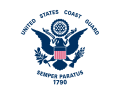 United States Coast Guard



United States Air Force
U.S. Air Force (USAF) groups and above have the same National Color as the Army; the Organizational Color is ultramarine blue, with the group's coat of arms beneath the USAF crest, which is an eagle on a cloud background. The fringe is in gold. Wing and force colours have their heraldic emblem used instead of the eagle.
This is the same design for Air Force commands and educational institutions but with the eagle replaced by the emblem of the formation.
United States Army

In the Army, most regiments, battalions of regiments, and separate battalions also have a stand of colours. The first is the National Color, which is a 36 in × 48 in (91 cm × 122 cm) version of the national flag trimmed with a 2+1⁄2 in-wide (6.4 cm) gold fringe, and is the equivalent of the King's Colour in the British Army. The second is the Organizational Color, which is the equivalent of the regimental colour; this is the same dimensions as the National Color, but is of a single colour representing the branch of the service that the unit is from; each branch also has its own fringe colour, which the Organizational Color is trimmed with. In the centre of the colour, for regiments is the eagle from the Great Seal of the United States, but with the regimental coat of arms in the shield. The eagle has in its beak a scroll bearing the regimental motto, with the crest of the regiment's coat of arms above it and the regiment's name below. Attached to the Organizational Color are the campaign and unit citation streamers awarded to the individual unit – these are equivalent to the battle honours embroidered directly onto the colours of British and Commonwealth units. The Organizational Color was carried in lieu of a National Color until shortly before the American Civil War, when the Stars and Stripes became the National Color.[42] Civil War era units sometimes carried alternative Organizational Colors based on their home state flags or of other designs.
Brigade, division and corps colours, also gold fringed, are in the facing colour of the service branch, for brigades the colour is of a bicolour design. These colours have the command heraldic arms at the centre.
United States Marine Corps


In the Marine Corps, each battalion-sized unit or larger maintains a set of colours.[43][44] The organizational colour is identical to the Marine Corps battle colour, except that the scroll has the unit's name instead of "United States Marine Corps". It also bears the streamers authorized to the unit, or scarlet and gold tassels if none are authorized.
Fringe is never used on the national colors when carried by Marine Corps unit.[45] Instead, a red, white, and blue tassel can be used to decorate.
United States Navy
Prior to Executive Order 10812 of 24 April 1959, the United States Navy used the U.S. Naval Infantry Battalion Flag as its unofficial colours.[46] While the Navy uses a number of maritime flags, such as the Ensign and Jack of the United States, the Flag of the United States Navy is normally seen only at ceremonies and parades. The display of streamers and fringe is consistent with that of the Marine Corps.
United States Naval Construction Force
When Naval Construction Battalions (Seabees) were first formed in 1942 the Naval Infantry Battalion Flag was mandated by Naval Regulation as the colours of the Naval Construction Force.[46] Each battalion-sized unit or larger maintains a set of colours. The organizational colours of each unit is identical, excepting that each will have the unit's name and number in white on the flag.[46] The display of streamers authorized to the unit is consistent with that of the Marine Corps.
Other shore establishment units and commands of the Navy
Organizational colours of the US Navy's other shore establishment commands and units and all command formations are in navy blue with the arms of the unit or command, with appropriate displayed streamers attached if authorized.
South America
Argentina
Each unit of the Argentine Armed Forces, the Argentine National Gendarmerie, the Argentine Federal Police and the Argentine Naval Prefecture bears the national colours on flags, called the National War Flags, which are the national flag with the unit's name embroidered on it in gold lettering. The colours are carried by the unit's most junior officer, escorted by two armed NCOs, except in academies and schools, where it is carried by the top-ranked student of the senior course, and escorted by his or her second- and third-ranked classmates. If a decoration has been awarded to the unit, it is attached to the national colours' cravat. The national colours are never dipped in salute, except to salute another national colours which pass by or are being the subject of a special honour. Besides the national colours, each unit has its unique regimental colours, normally in the arm or service's colour background, with the unit's coat of arms on it. However not all units have such a common background. For example the Regiment of Patricians has the Cross of Burgundy as its official regimental colours because of its lineage dating back from 1806. Units which were made part of the Army of the Andes during Argentina's independence war also carry the Flag of the Army of the Andes as a 3rd Colour.
Brazil
Units of the Brazilian Armed Forces carry a stand of two Colours, differing per service.
The standard of the Brazilian Army measures 80 × 120 cm, white with the Army coat of arms in the centre, trimmed with gold fringe. The name of the service is inscribed in gold letters on a green scroll beneath the shield. Above the shield is a knight's helmet with red and sky blue mantling. The staff is topped by a nickel-plated lance-head finial, 32 cm high. Below the lance-head, there is a cravat (laço militar) divided lengthwise, sky blue and red, with a gold fringe at the end, tied in a bow and fastened with a cockade of blue with the Southern Cross in white stars, red, and blue. Ten red streamers with campaign honours inscribed in sky blue letters are also attached below the lance-head. The staff is 212 cm long, not including the lance-head, and 3.5 cm in diameter. It is covered in sky blue velvet with a red spiral strip. The colour belt is 10 cm in width, covered with sky blue velvet with red velvet stripes. The Brazilian Navy's flag uses dark blue colours; the Brazilian Air Force flag uses ultramarine blue.
Brazilian military units also carry the national flag as a National Colour. This is in the dimensions 90 × 128 cm. It is mounted on the same size staff and with the same finial as the Army standard, but the cravat is divided lengthwise yellow and green, with a gold fringe at the end, tied in a bow and fastened with a cockade of blue with the Cruzeiro do Sul in white stars, yellow, and green. The staff is covered in green velvet with a yellow spiral strip. The colour belt is 10 cm in width, covered with green velvet with yellow velvet stripes of width and number varying with the rank of the organization's commander.
Unit colours differ per service branch and speciality.
Chile
Units of the Chilean Army carry one main colour, known as the estandarte de combate (combat standard). This is the same as the national flag, but with an embroidered star and with the unit designation, honorific title, founding date and place, and, depending on the unit, other historic information and honours embroidered diagonally across the fly in gold. The flag is also trimmed with gold fringe. It is mounted on a staff with a gilt condor finial; below the finial is a cravat in the national colours with decorations attached. In addition to the military colour, particularly distinguished units, and long serving units may carry a second Colour known as a bandera coronela (colonel's colour). This is a red field with a large white five-pointed star. In the angles of the star are the names and dates of battle honours surrounded by laurel wreaths, all in gold, while in an arc above the star is the designation of the unit, also in gold. The flag is also surrounded by gold fringe. Since 2017, the 16th Infantry Regiment Talca became the first to sport a blue coloured bandera coronela in honour of its origins as a city guard battalion formed during the War of the Pacific.
The Chilean Air Force, the Chilean Navy, the Carabineros de Chile and the Chilean Gendarmerie all use the estandarte de combate as their main colour, and do not use the bandera coronela at all. The design is the same as in the Army's.
Colombia
The main state colours of the Military Forces of Colombia and the National Police of Colombia is the Flag of Colombia with the Coat of arms of Colombia in the centre inside a circle with a red border, used by all the services. These flags also carry medals and decorations attached to the flag. The MFC and the NPC also uses unit battle colours (brigade-level, regiment-level and battalion-level), that differ accordingly per service. All of them are gold fringed. Uniquely for Colombia, the battle colour tradition is mainly US-influenced. In addition, the service colour is used as a secondary color, also gold fringed, to denote service affiliation.
The Navy, given the British influence, uses the national flag as a State Colour for ships and commands, and few naval units have a full strand of colours.
Uruguay
Aside from the three state colours (the Flag of Uruguay, the Artigas flag and the Flag of the Treinta y Tres), the Uruguayan military also has regimental colours that differ per service and unit. The national colours have armed colour guards while the regimental colour has none at all. All are gold fringed.
Venezuela
In the National Bolivarian Armed Forces of Venezuela, aside from the Flag of Venezuela as the National Colour, there are also Organizational Colours for each of the 6 service branches and the Ministerial Colour of the Ministry of Defence and Unit Colours, which differ per service branch and arm. Every military unit from the Ministry of defence down to all individual units have a stand of colours like in the United Kingdom, but differ from the battalion to the service and the national level. The national flag, until the 1940s, served also as the unit state colour in the same manner as the National Colour of the United States Army and the State/Sovereign's Colour in the Commonwealth of Nations, and was based on the national flag but with the unit inscription replacing the stars in the centre in white lettering. The Venezuelan National Militia is the only service branch that uses a battle colour, similar to the flag of the Cuban July 26 Movement: the colour is red and black with the service name on it in white, and a separate colour is used for the service headquarters at the Montana Barracks in Caracas. Starting from July 2013 onward it was granted permission to use a 4th colour for its battalions: red with the eyes of the late President Hugo Chávez and the inscription Chavez Vive (Chavez Lives On) below, topped with a scarlet star.
Since 2014 the National Armed Forces uses two additional colours (the National Militia its 5th and 6th): that of the Supreme Commander's Colour, which is red bearing the portrait of the late President Chávez surrounded by a wreath and the Armed Forces Motto (Independence and Socialist Fatherland, we will live on and triumph!) below and the inscription Supreme Commander of the Bolivarian Revolution (Comandante Supremo de la Revolución Bolivariana) and the eight golden stars from the National Flag above it, plus the Memorial Colour of the Liberator and Father of the Nation (introduced in the summer of 2016), which is of the same colour facing but with the wreath containing the portrait of Simon Bolivar, the eight gold stars and his title above and the words Freedom, Sovereignty, Independence (Libertad, Soberania e Independencia) below the title, all in gold.
The colours used on the Unit Colours are as follows:
- Red: Ministry of Defence (formerly grey), Service units, Marine Corps, National Militia, Military Technical Academy, Presidential Honour Guard Brigade, Caracas HQ Battalion of the Ministry of Defence
- Dark blue and red: Venezuelan Army HQ and units directing to Army HQ, Division and Brigade Colours
- Yellow: Infantry, Jungle Infantry, Airborne Units
- Orange: Rangers
- Green: Army Engineers
- Dark blue: Venezuelan Army Special Forces
- Red and Black: Rapid Action (Infantry) Battalions
- Black: Armor
- Burgundy red: Artillery and Air Defence Artillery
- Grey: Logistics, National Armed Forces Communications and Electronics College
- Navy blue: Navy
- Ultramarine blue: Air Force (formerly light green)
- Maroon: National Guard
- Dark blue and white: Bolivarian Military University of Venezuela, Military Academy of the Bolivarian Army and Armed Forces Health Sciences Academy
- Light blue and white: Venezuelan Naval Academy
- White: Venezuelan Army military high schools
Guidons and standards
Commonwealth of Nations
The standard is the colours-equivalent for the heavy cavalry (e.g., horse guards and dragoon guards). At 27 by 30 in (69 by 76 cm), on an 8 ft 6 in-long (259 cm) pole, it is much smaller than infantry colours, so that it can be carried by a soldier on horseback. The guidon is the equivalent for the light cavalry (e.g., dragoons, light dragoons, hussars and lancers). It is swallow-tailed, 27 by 41 in (69 by 104 cm), with an 8 ft 6 in-long pole.
The word guidon is a corruption of the French guyde homme – 'the guide man'.[note 3] Originally each troop had its own, but this was quickly reduced to a single, regimental one. With the increased dispersion of troops required in the light cavalry role, their operational function had ceased by the 1830s and they were discontinued. The regiment's kettledrums, with the battle honours woven onto the drum banners (with the exception of 3rd The King's Own Hussars and its successors, where they are uncovered, with the battle honours engraved onto the kettledrums themselves) became the focal point of the regiment's loyalty. In 1952 King George VI reintroduced the guidons of the light cavalry for ceremonial purposes.
Both the standard and the guidon are usually of crimson trimmed in gold fringe and with the regiment's insignia in the centre. The regiment's battle honours are emblazoned on both the obverse and reverse, up to a maximum of 22 on each side.
Denmark

Cavalry (armour) units carry a standard (Danish: estandart), of similar design to the infantry colour, but smaller and square, with the cross centred on the field. The royal cypher is in the upper hoist and the initials of the regiment in the lower hoist. The Guard Hussar Regiment's standard is unique, as it has two monograms – with King Frederick VI's monogram in top right corner.[47]
France
In the French Army, mounted units carry étendards (standards). Mounted units include armoured corps and cavalry, artillery, transportation, army aviation, and supplies. The étendard is a 64 × 64 cm square flag similar to the drapeaux carried by the units of foot, with the same design: the regimental name at the obverse and the battle honours at the reserve.
Italy
In the Italian Army, cavalry units carry a stendardo (standard) of the same pattern as the bandiera di guerra, but which measures 60 cm × 60 cm.
Netherlands
The two hussar regiments of the Royal Netherlands Army carry a standaard (standard), of similar design to the infantry colour, but smaller (50 cm × 50 cm).
Portugal

Until the 1960s, the Portuguese Military followed the traditions of its foot units having colours (Portuguese: bandeiras, literally "flags"), while mounted units had standards (estandartes), the latter being smaller versions of the colours. Standards were also carried by naval and aviation units. In the 1960s, the traditional separation between colours and standards was abolished, with all being reclassified as "national standards" (estandartes nacionais). At the same time, a new type of standard, the heraldic standard, was introduced. Presently, the military units, commands, forces and establishments have both a national standard and an heraldic standard. While the design of the national standards reflects the National Flag, the designs of the heraldic standards reflect the individual heraldic symbology of each of the units.
In the Portuguese military parlance, a guidon (guião) is a small square flag of a battalion sized unit. Guidons of a very simple design were introduced in the 19th century, as the tactical field signs of the foot units that didn't carry colours, namely the second battalions of the infantry regiments and the independent caçadores (light infantry) battalions. In the early 20th century, the tactical role of the guidons was discontinued. The guidons assumed then a ceremonial role, coming to have a more elaborate design which incorporated the symbology of their respective units. Guidelines for the design of guidons accordingly with heraldic rules were introduced in the 1950s, these becoming mandatory and standardized in the 1960s. The present guidon design - similar in all branches of the Military - consists in the quadrature of the coat of arms of the corresponding unit or of its parent unit, framed by a bordure. The colours of the bordure can be used to identify a sub-unit inside its parent unit.
Besides heraldic standards and guidons, the Portuguese military units also use heraldic pennants (flâmulas). These are small swallow-tailed or triangular flags used to identify company sized units.
Some of the Portuguese uniformed security forces and civil emergency organizations also make use of heraldic standards, guidons and pennants, usually modelled after the military ones.
United States
In the United States armed forces, guidons are much more prevalent, with units below battalion size being authorized to use them. In the US Army, these are swallow tailed flags that are 20 in × 27 in, and are in the colour of the branch of the service the unit is from, with the branch's insignia the most prominent device. Also on the guidon is included the unit's identifying letter, and the number(s) of its parent unit. War service and campaign streamers are not attached to these guidons, but unit citation streamers can be.
Guns

In regiments of the (British) Royal Artillery, and artillery regiments of other Commonwealth countries, the guns are afforded the status of colours.[48] This is due to the difficulty of artillery regiments being able to carry flags onto the battlefield, and the fact that the guns themselves were the rallying points for the soldiers manning them. As a consequence, whenever artillery regiments parade, the etiquette that would normally be applied to the colours is applied to the guns. During the Battle of Balaclava gunners abandoned their guns, in effect abandoning their colours, causing disgrace.
Because the guns have the status of colours, gunners of commonwealth countries will attempt to prevent their guns falling intact into enemy hands both for practical reasons (so that the guns can not be turned and used against their own side) and for the honour of the regiment.[49] For example, the last action of gunners of the Royal Artillery during the fall of Singapore was to destroy their guns.[50][51]
The Honourable Artillery Company, the oldest regiment in the British Army, and not part of the Royal Artillery, is the only artillery regiment to have both colours and guns, which are treated with equal respect.
In Singapore, however, since its independence the Singapore Army's artillery arm (the Singapore Artillery) uses colours instead of guns; this is also the case for the Malaysian Army, Pakistan Army, Royal Cambodian Army and the Royal Thai Army, whose artillery units use colours and not guns on parade. This has been the same case for the Indian Regiment of Artillery, which presents colours in dismounted parades, and the Sri Lanka Artillery, which has a strand of colours similar to the HAC.
Etiquette
In some countries, the following etiquette is followed:
- The Regimental Colour (or Standard or Guidon) is always paraded whenever the regiment is on a formal parade. However, the Sovereign's (King's or Queen's)/Presidential Colour is only paraded on certain occasions.
- Compliments (for example saluting and presenting arms) are always paid to the (uncased) Colours.
- When the Colours are being paraded, they are carried either by a subaltern or warrant officer, dependent on the regiment. On parade, the Colours always have an armed escort, the Colour Party, who would normally be non-commissioned officers. In the infantry this role usually falls to Colour Sergeants.
- When the Colours are not being paraded, most regiments house them in their Officers' Mess. They are cased and secured every night.
- When a regiment is presented with new Colours, the old Colours, which will now never again be paraded, are laid up (i.e.: put on permanent display) in a place sacred to the Regiment (for example the Regimental Chapel).
Ceremonies of colours
Royal Navy
The British Royal Navy and other navies of the Commonwealth of Nations call the flag-raising ceremony that happens every morning when a ship is in harbour colours. In British home waters, colours is conducted at 0800 (eight bells in the morning watch) from 15 February to 31 October inclusive, and at 0900 (two bells in the forenoon watch) during the winter.
When sunset is at or before 2100, flags are lowered at sunset at the ceremony of sunset. When sunset is after 2100, the evening flag lowering ceremony is called evening colours and carried out at 2100.
United States Navy
The United States Navy performs the same ceremonies, called "Morning Colors" and "Evening Colors", at 0800 and sunset each day. When "Colors" is played aboard Navy and Marine Corps bases, those outdoors must stop to render proper courtesies by saluting if in uniform or, if out of uniform, by standing at attention, until "Carry On" is sounded. Marines and sailors driving on base during this time are expected to stop their vehicles and stand at attention until the ceremony is over.
Yacht clubs
Many traditional yacht clubs worldwide also conduct morning and evening colour ceremonies. At 0800 each morning and at sunset during the club's active sailing season the ceremony is performed by the launchmen or harbourmaster.
- First, a bell is sounded as an alert for all members and guests present to stand at attention.
- A cannon is then fired and the national ensign hoisted (or lowered if sunset).
- At the conclusion of the ceremony the most senior officer present says: "As you were" and members and guests may carry on.
In games
Capturing an enemy's flag was formerly a major goal in war, and it is still practised today, and so capturing the enemy flag also appears in several games:
- Capture the flag
- Stratego, a board game where the goal is to capture the enemy's flag
- Chess: In Estonian the queen is known as lipp ("standard"), while in Italian the bishop is called alfiere ("standard-bearer")
Notes
- ^The modern fourragère of the French Army is awarded to all members of military units which have been awarded a mention in despatches. It should not be confused with unit awards of particular decorations, where the medal itself is hung on the colour of the unit. For example, there are many units wearing the fourragère of the Médaille militaire, whereas only six units wore the medal on their colours. See also the article dealing with the Croix de Guerre.
- ^The ensign of the National Navy differs from the French national flag by its slightly darker blue shade, and by the dimensions of the stripes: while the stripes of the national flag has 1:1:1 proportions, the naval ensign has 30:33:37.
- ^The medieval "guidon, a name derived from the Fr. Guyd-homme, was somewhat similar to the standard, but without the cross of St George, rounded at the end, less elongated and altogether less ornate. It was borne by a leader of horse, and according to a medieval writer 'must be two and a half yards or three yards long, and therein shall no armes be put, but only the man's crest, cognisance, and devyce.'" (Swinburne 1911, pp. 457, 458)
See also
- Glossary of vexillology
- Historical colours, standards and guidons
- Presentation of Colours
- Trooping the Colour
- Vexillum
- War flag
- With flying colours
External links
 Media related to Military flags at Wikimedia Commons
- Flags of the World
