
Sequential space
In topology and related fields of mathematics, a sequential space is a topological space whose topology can be completely characterized by its convergent/divergent sequences. They can be thought of as spaces that satisfy a very weak axiom of countability, and all first-countable spaces (notably metric spaces) are sequential.
In any topological space if a convergent sequence is contained in a closed set then the limit of that sequence must be contained in as well. Sets with this property are known as sequentially closed. Sequential spaces are precisely those topological spaces for which sequentially closed sets are in fact closed. (These definitions can also be rephrased in terms of sequentially open sets; see below.) Said differently, any topology can be described in terms of nets (also known as Moore–Smith sequences), but those sequences may be "too long" (indexed by too large an ordinal) to compress into a sequence. Sequential spaces are those topological spaces for which nets of countable length (i.e., sequences) suffice to describe the topology.


Any topology can be refined (that is, made finer) to a sequential topology, called the sequential coreflection of

The related concepts of Fréchet–Urysohn spaces, T-sequential spaces, and -sequential spaces are also defined in terms of how a space's topology interacts with sequences, but have subtly different properties.

Sequential spaces and -sequential spaces were introduced by S. P. Franklin.[1]
History
Although spaces satisfying such properties had implicitly been studied for several years, the first formal definition is due to S. P. Franklin in 1965. Franklin wanted to determine "the classes of topological spaces that can be specified completely by the knowledge of their convergent sequences", and began by investigating the first-countable spaces, for which it was already known that sequences sufficed. Franklin then arrived at the modern definition by abstracting the necessary properties of first-countable spaces.
Preliminary definitions
Let be a set and let be a sequence in ; that is, a family of elements of , indexed by the natural numbers. In this article, means that each element in the sequence is an element of and, if is a map, then For any index the tail of starting at is the sequence A sequence is eventually in if some tail of satisfies








Let เป็นโทโพโลยีบนและลำดับในนั้น ลำดับนั้นบรรจบกันที่จุดหนึ่งเขียนไว้(เมื่อบริบทเอื้ออำนวย)ถ้าหากสำหรับทุกย่านของในท้ายที่สุดอยู่ในจากนั้นจึงเรียกว่าจุดลิมิตของ


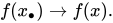
ฟังก์ชันระหว่างปริภูมิเชิงทอพอโลยีจะมีความต่อเนื่องตามลำดับก็ต่อเมื่อหมายความว่า
การปิดตามลำดับ/ภายใน
อนุญาตเป็นปริภูมิเชิงทอพอโลยี และให้เป็นเซตย่อยการปิดเชิงทอพอโลยี (หรือส่วนภายในเชิงทอพอโลยี ) ของในถูกกำหนดโดย(ตอบ))


การปิดตามลำดับของในคือชุดซึ่งกำหนดแผนที่ตัวดำเนินการปิดแบบลำดับบนเซตกำลังของหากจำเป็นเพื่อให้เกิดความชัดเจน ชุดข้อมูลนี้อาจเขียนได้อีกแบบหนึ่งว่าหรือเป็นเช่นนั้นเสมอว่าแต่ในทางกลับกันอาจล้มเหลว




ภายในแบบเรียงลำดับของในคือชุด(โดยระบุพื้นที่เชิงทอพอโลยีด้วยตัวห้อยหากจำเป็น)

การปิดแบบลำดับและภายในเป็นไปตามคุณสมบัติที่ดีหลายประการของการปิดและภายในเชิงโทโพโลยี : สำหรับเซตย่อยทั้งหมด

- และ;
การพิสูจน์ แก้ไขถ้าแล้วก็มีอยู่จริงกับแต่ตามนิยามของโครงสร้างภายในแบบลำดับ ในที่สุดแล้วอยู่ในขัดแย้งกัน
ในทางกลับกัน สมมติว่าดังนั้นจึงมีลำดับอยู่กับซึ่งไม่ใช่สิ่งที่ในที่สุดแล้วจะเกิดขึ้นโดยการเปลี่ยนไปสู่ลำดับย่อยขององค์ประกอบที่ไม่อยู่ในเราอาจสันนิษฐานได้ว่าแต่แล้ว▮ - และ;
- ;
- ; และ











กล่าวคือ การปิดแบบลำดับ (sequential closure) เป็นตัวดำเนินการปิดล่วงหน้า (preclosure operator ) ต่างจากการปิดเชิงโทโพโลยี (topological closure) การปิดแบบลำดับไม่ใช่ ตัวดำเนินการเอกลักษณ์ ( idempotent ) กล่าวคือ การบรรจุครั้งสุดท้ายอาจเป็นการบรรจุแบบเข้มงวด (strict containment) ดังนั้น การปิดแบบลำดับจึงไม่ใช่ตัวดำเนินการปิด ( Kuratowski closure operator )
ชุดปิดและชุดเปิดตามลำดับ
ชุดหนึ่งจะถูกปิดตามลำดับหากหรือเทียบเท่ากับสำหรับทั้งหมดและโดยที่เราต้องมี[หมายเหตุ 1 ]


ชุดหนึ่งจะถูกนิยามว่าเป็นแบบเปิดตามลำดับ หากส่วนเติมเต็ม ของมัน เป็นแบบปิดตามลำดับ เงื่อนไขที่เทียบเท่ากันได้แก่:
- หรือ
- สำหรับทุกคนและโดยที่ในท้ายที่สุดอยู่ใน(นั่นคือ มีจำนวนเต็มบางจำนวนอยู่)เช่นนั้นหาง)


ชุดหนึ่งคือย่านใกล้เคียงตามลำดับของจุดหนึ่งถ้ามันมีในส่วนภายในที่เป็นลำดับนั้น พื้นที่ใกล้เคียงที่เป็นลำดับไม่ จำเป็น ต้องเปิดเป็นลำดับเสมอไป (ดูหัวข้อ § พื้นที่แบบ T และ N ที่เป็นลำดับด้านล่าง)
เป็นไปได้สำหรับกลุ่มย่อยของอาจเป็นเซตเปิดตามลำดับแต่ไม่ใช่เซตเปิด ในทำนองเดียวกัน อาจมีเซตย่อยที่ปิดตามลำดับแต่ไม่ใช่เซตปิดได้
พื้นที่ลำดับและภาพสะท้อนร่วม
ดังที่กล่าวไว้ข้างต้น การปิดแบบลำดับโดยทั่วไปไม่ใช่ตัวดำเนินการเอกลักษณ์ และดังนั้นจึงไม่ใช่ตัวดำเนินการปิดของโทโพโลยี เราสามารถได้การปิดแบบลำดับที่เอกลักษณ์ผ่านการวนซ้ำแบบอนันต์ : สำหรับลำดับผู้สืบทอดกำหนด (ตามปกติ)และสำหรับลำดับจำกัดกำหนดกระบวนการนี้จะสร้างลำดับของเซตที่มีดัชนีเรียงลำดับเพิ่มขึ้นเรื่อยๆ และปรากฏว่าลำดับนั้นจะคงที่ตามดัชนีเสมอ( ลำดับที่นับไม่ได้ตัวแรก ) ในทางกลับกันลำดับต่อเนื่องของคือลำดับขั้นต่ำสุดที่สำหรับตัวเลือกใดๆ ของลำดับข้างต้นจะเสถียร[ 2 ]



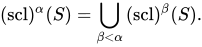

การปิดลำดับอนันต์ของคือชุดเทอร์มินัลที่เรียงลำดับตามข้างต้น:ผู้ดำเนินการเป็นตัวดำเนินการเอกลักษณ์และเป็นตัวดำเนินการปิด โดยเฉพาะ โดยเฉพาะอย่างยิ่ง มันกำหนดโทโพโลยี การสะท้อนร่วมตามลำดับ ในการสะท้อนร่วมตามลำดับ เซตปิดตามลำดับทุกเซตจะเป็นเซตปิด (และเซตเปิดตามลำดับทุกเซตจะเป็นเซตเปิด) [ 3 ]


ช่องว่างตามลำดับ
ปริภูมิเชิงทอพอโลยีถือว่าเป็นลำดับหากตรงตามเงื่อนไขเทียบเท่าข้อใดข้อหนึ่งต่อไปนี้:
- เป็นการสะท้อนกลับตามลำดับของมันเอง[ 4 ]
- เซตย่อยที่เปิดตามลำดับทุกเซตของเปิดแล้ว
- เซตย่อยปิดตามลำดับทุกเซตของปิดทำการแล้ว
- สำหรับเซตย่อยใดๆที่ไม่ได้ปิดในมีอยู่บ้าง[หมายเหตุ 2 ]และลำดับในที่บรรจบกันที่[ 5 ]
- (คุณสมบัติสากล) สำหรับปริภูมิเชิงทอพอโลยีทุกแห่งแผนที่ต่อเนื่องก็ต่อเมื่อต่อเนื่องตามลำดับ (ถ้าแล้ว). [ 6 ]
- คือผลหารของปริภูมิที่นับได้อันดับแรก
- คือผลหารของปริภูมิเมตริก

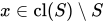


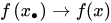
โดยการนำและเพื่อเป็นแผนที่แสดงอัตลักษณ์บนในคุณสมบัติสากลนั้น เป็นผลให้ชั้นของปริภูมิเชิงลำดับประกอบด้วยปริภูมิเหล่านั้นที่มีโครงสร้างทางทอพอโลยีถูกกำหนดโดยลำดับลู่เข้า หากทอพอโลยีสองแบบเห็นพ้องต้องกันในลำดับลู่เข้าแล้ว ทอพอโลยีทั้งสองแบบก็จะต้องมีการสะท้อนร่วมเชิงลำดับเดียวกันด้วย ยิ่งไปกว่านั้น ฟังก์ชันจากจะมีความต่อเนื่องตามลำดับก็ต่อเมื่อมันมีความต่อเนื่องบนการสะท้อนร่วมตามลำดับ (นั่นคือ เมื่อประกอบล่วงหน้าด้วย))


พื้นที่ลำดับTและN
พื้นที่ลำดับTคือพื้นที่โทโพโลยีที่มีลำดับ 1 ซึ่งเทียบเท่ากับเงื่อนไขใดเงื่อนไขหนึ่งต่อไปนี้: [ 1 ]
- การปิดตามลำดับ (หรือส่วนภายใน) ของเซตย่อยทุกเซตของปิด (หรือเปิด) ตามลำดับ
- หรือเป็นไอเดมโพเทนต์
- หรือ
- บริเวณใกล้เคียงลำดับใด ๆ ของสามารถลดขนาดลงเหลือเซตเปิดตามลำดับที่ประกอบด้วยในทางทฤษฎีแล้ว ย่านที่เปิดตามลำดับถือเป็นพื้นฐานของย่านแบบลำดับ
- สำหรับใดๆและย่านใกล้เคียงตามลำดับใดๆของมีละแวกบ้านที่เป็นลำดับอยู่ของโดยที่สำหรับทุกๆชุดเป็นย่านใกล้เคียงแบบลำดับของ






การเป็นปริภูมิแบบT -sequential นั้นไม่สามารถเปรียบเทียบกับการเป็นปริภูมิแบบ sequential ได้ เพราะมีปริภูมิแบบ sequential บางแบบที่ไม่ใช่แบบT -sequential และในทางกลับกัน อย่างไรก็ตาม ปริภูมิเชิงทอพอโลยีเรียกว่า-ลำดับ (หรือลำดับย่านใกล้เคียง ) ถ้าเป็นทั้งลำดับและ ลำดับ Tเงื่อนไขที่เทียบเท่ากันคือย่านใกล้เคียงลำดับทุกย่านจะมีย่านใกล้เคียงแบบเปิด (คลาสสิก) [ 1 ]
ทุกปริภูมิที่นับได้เป็นอันดับแรก (และด้วยเหตุนี้ ทุกปริภูมิที่สามารถวัดได้ ) คือ-ลำดับ. มีปริภูมิเวกเตอร์เชิงทอพอโลยีที่เป็นลำดับแต่ไม่ใช่-ลำดับ (และดังนั้นจึงไม่ใช่ ลำดับ T ) [ 1 ]
พื้นที่ Fréchet–Urysohn
ปริภูมิเชิงทอพอโลยีเรียกว่าFréchet–Urysohnหากตรงตามเงื่อนไขเทียบเท่าข้อใดข้อหนึ่งต่อไปนี้:
- เป็นการเรียงลำดับทางพันธุกรรม กล่าวคือ ปริภูมิย่อยเชิงทอพอโลยีทุกปริภูมิเป็นการเรียงลำดับ
- สำหรับทุกเซตย่อย
- สำหรับเซตย่อยใดๆที่ไม่ได้ปิดในและทุกๆมีลำดับอยู่ที่บรรจบกันที่



ปริภูมิ Fréchet–Urysohn บางครั้งก็ถูกเรียกว่า "Fréchet" แต่ไม่ควรสับสนกับปริภูมิ Fréchetในการวิเคราะห์เชิงฟังก์ชันหรือเงื่อนไขT
ตัวอย่างและเงื่อนไขที่เพียงพอ
CW-complexทุกตัวเป็นแบบลำดับ เนื่องจากสามารถพิจารณาได้ว่าเป็นผลหารของปริภูมิเมตริก
สเปกตรัมหลักของวงแหวน Noetherian สลับตำแหน่ง ที่มีโทโพโลยี Zariskiเป็นแบบลำดับ[ 7 ]
ใช้เส้นจริงและระบุชุดของจำนวนเต็มถึงจุดหนึ่ง เมื่อเป็นผลหารของปริภูมิเมตริก ผลลัพธ์จะเป็นลำดับ แต่ไม่ใช่ปริภูมิที่นับได้เป็นอันดับแรก


ปริภูมิที่นับได้อันดับแรกทุก ปริภูมิ เป็นปริภูมิ Fréchet–Urysohn และปริภูมิ Fréchet-Urysohn ทุกปริภูมิเป็นปริภูมิแบบลำดับ ดังนั้นปริภูมิ ที่สามารถระบุเมตริกได้หรือปริภูมิ เสมือนเมตริกได้—โดยเฉพาะอย่างยิ่งปริภูมิที่นับได้อันดับสอง ปริภูมิเมตริกหรือปริภูมิแบบไม่ต่อเนื่อง— ทุก ปริภูมิเป็นปริภูมิแบบลำดับ
อนุญาตเป็นชุดแผนที่จากปริภูมิFréchet–Urysohn ไปยังจากนั้นจึงเป็นโครงสร้างทางเรขาคณิตขั้นสุดท้ายที่กระตุ้นให้เกิดเป็นลำดับ

ปริภูมิเวกเตอร์เชิงทอพอโลยีของ Hausdorff เป็นแบบลำดับก็ต่อเมื่อไม่มีทอพอโลยีที่ละเอียดกว่าอย่างเคร่งครัดที่มีลำดับลู่เข้าเดียวกัน[ 8 ] [ 9 ]
พื้นที่ที่มีลำดับต่อเนื่องแต่ไม่ใช่แบบ Fréchet-Urysohn
พื้นที่ชวาร์ตซ์และพื้นที่ของฟังก์ชันเรียบดังที่ได้กล่าวไว้ในบทความเกี่ยวกับการกระจาย ต่างก็เป็นปริภูมิลำดับที่ใช้กันอย่างแพร่หลาย[ 10 ] [ 11 ]


โดยทั่วไปแล้ว พื้นที่Montel DF ที่มีมิติอนันต์ทุกแห่งจะเป็นแบบลำดับ แต่ไม่ใช่แบบ Fréchet– Urysohn [ 12 ]
พื้นที่ของ Arens เป็นไปตามลำดับ แต่ไม่ใช่ Fréchet–Urysohn [ 13 ] [ 14 ]
ตัวอย่างที่ไม่ถูกต้อง (ช่องว่างที่ไม่เรียงลำดับ)
พื้นที่ที่ง่ายที่สุดที่ไม่เรียงลำดับคือโทโพโลยีโคเคานต์เทเบิลบนเซตที่นับไม่ได้ ลำดับลู่เข้าทุกลำดับในพื้นที่ดังกล่าวจะคงที่ในที่สุด ดังนั้นทุกเซตจึงเปิดตามลำดับ แต่โทโพโลยีโคเคานต์เทเบิลไม่ใช่แบบไม่ต่อเนื่อง (เราอาจเรียกโทโพโลยีว่า "ไม่ต่อเนื่องตามลำดับ") [ 15 ]
อนุญาตแสดงถึงพื้นที่ของ-ฟังก์ชันทดสอบที่ราบรื่นด้วยโทโพโลยีมาตรฐานและปล่อยให้แทนพื้นที่ของการกระจายพื้นที่คู่ที่แข็งแกร่งของทั้งสองอย่างไม่เรียงลำดับ (หรือแม้แต่พื้นที่ Ascoli ) [ 10 ] [ 11 ]ในทางกลับกัน ทั้งสองและพื้นที่Montel [ 16 ]และในพื้นที่คู่ของพื้นที่ Montel ใดๆลำดับของฟังก์ชันเชิงเส้นต่อเนื่องจะลู่เข้าในโทโพโลยีคู่ที่แข็งแกร่งก็ต่อเมื่อมันลู่เข้าในโทโพโลยีที่อ่อนแอ* (นั่นคือ ลู่เข้าแบบจุดต่อจุด) [ 10 ] [ 17 ]


ผลที่ตามมา
ปริภูมิเชิงลำดับทุกปริภูมิมีความแน่นที่นับได้และถูกสร้างขึ้นอย่างกะทัดรัด
ถ้าถ้าเป็นการส่งแบบ ทั่วถึง เปิด ต่อเนื่อง ระหว่างปริภูมิลำดับเฮาส์ดอร์ฟสองปริภูมิแล้ว เซตจะเป็นดังนี้เซตของจุดที่มีรูปประจำตัวที่ไม่ซ้ำกันเป็นเซตปิด (โดยความต่อเนื่อง รูปประจำตัวของมันในเซตปิดเช่นกัน)เซตของจุดทั้งหมดที่(เป็นฟังก์ชันหนึ่งต่อหนึ่ง)

ถ้าเป็นการส่งแบบทั่วถึง (ไม่จำเป็นต้องต่อเนื่อง) ไปยังปริภูมิลำดับเฮาส์ดอร์ฟและฐานสำหรับโทโพโลยีบนแล้วจะเป็นแผนที่เปิดก็ต่อเมื่อ สำหรับทุกๆละแวกบ้านพื้นฐานของและลำดับในมีลำดับย่อยของซึ่งในที่สุดก็อยู่ใน





คุณสมบัติเชิงหมวดหมู่
หมวดหมู่ย่อยSeqทั้งหมดของปริภูมิเชิงลำดับนั้นปิดภายใต้การดำเนินการต่อไปนี้ในหมวดหมู่Topของปริภูมิเชิงทอพอโลยี:
- ผลหาร
- ภาพต่อเนื่องแบบปิดหรือเปิด
- ผลรวม
- ขีดจำกัดแบบอุปนัย
- Open and closed subspaces
The category Seq is not closed under the following operations in Top:
- Continuous images
- Subspaces
- Finite products
Since they are closed under topological sums and quotients, the sequential spaces form a coreflective subcategory of the category of topological spaces. In fact, they are the coreflective hull of metrizable spaces (that is, the smallest class of topological spaces closed under sums and quotients and containing the metrizable spaces).
The subcategory Seq is a Cartesian closed category with respect to its own product (not that of Top). The exponential objects are equipped with the (convergent sequence)-open topology.
P.I. Booth and A. Tillotson have shown that Seq is the smallest Cartesian closed subcategory of Top containing the underlying topological spaces of all metric spaces, CW-complexes, and differentiable manifolds and that is closed under colimits, quotients, and other "certain reasonable identities" that Norman Steenrod described as "convenient".[18]
Every sequential space is compactly generated, and finite products in Seq coincide with those for compactly generated spaces, since products in the category of compactly generated spaces preserve quotients of metric spaces.
See also
- Axiom of countability
- Closed graph property – Property of functions in topology
- First-countable space – Topological space where each point has a countable neighbourhood basis
- Fréchet–Urysohn space – Type of topological space
- Sequence covering map
Notes
- ↑You cannot simultaneously apply this "test" to infinitely many subsets (for example, you can not use something akin to the axiom of choice). Not all sequential spaces are Fréchet-Urysohn, but only in those spaces can the closure of a set can be determined without it ever being necessary to consider any set other than
- ↑A Fréchet–Urysohn space is defined by the analogous condition for all (not "some") such :
For any subset that is not closed in for any there exists a sequence in that converges to


Citations
- 1 2 3 4สไนปส์, เรย์ (1972) "ช่องว่างทอพอโลยีลำดับ T" (PDF ) พื้นฐานคณิตศาสตร์ . 77 (2): 95– 98. ดอย : 10.4064/fm-77-2-95-98 . ISSN 0016-2736 .
- ↑
- Arhangel'skiĭ, AV; Franklin, SP (1968). "ตัวแปรเชิงลำดับสำหรับปริภูมิโทโพโลยี" . Michigan Math. J . 15 (3): 313– 320. doi : 10.1307/mmj/1029000034 .
- ↑ Baron, S. (ตุลาคม 1968). "หมวดหมู่ย่อยสะท้อนร่วมของปริภูมิเชิงลำดับ"วารสารคณิตศาสตร์แคนาดา 11 (4): 603– 604. doi : 10.4153/CMB-1968-074-4 . ISSN 0008-4395 . S2CID 124685527 .
- ↑ "โทโพโลยีของเซตเปิดตามลำดับเป็นแบบลำดับหรือไม่?" . Mathematics Stack Exchange .
- ↑ Arkhangel'skii, AV และ Pontryagin LS, โทโพโลยีทั่วไป 1, คำนิยาม 9 หน้า 12
- ↑ Baron, S.; Leader, Solomon (1966). "วิธีแก้ปัญหา #5299" . The American Mathematical Monthly . 73 (6): 677– 678. doi : 10.2307/2314834 . ISSN 0002-9890 . JSTOR 2314834 .
- ↑ "เกี่ยวกับคุณสมบัติเชิงลำดับของปริภูมิโทโพโลยีแบบโนเธอร์เรียน" (PDF) . 2004 . สืบค้นเมื่อ30 กรกฎาคม 2023 .
- ↑วิลานสกี 2013 , หน้า 224.
- ↑ Dudley, RM, ว่าด้วยการลู่เข้าแบบลำดับ - วารสาร Transactions of the American Mathematical Society เล่มที่ 112, 1964, หน้า 483-507
- 1 2 3 Gabrielyan, Saak (2019). "คุณสมบัติทางทอพอโลยีของความเข้มงวด-ช่องว่างและคู่ที่แข็งแกร่งของ Montel อย่างเคร่งครัด-ช่องว่าง" Monatshefte für Mathematik . 189 (1): 91– 99. arXiv : 1702.07867 . doi : 10.1007/s00605-018-1223-6 .
- 1 2 T. Shirai, Sur les Topologies des Espaces de L. Schwartz, Proc. อาคาดญี่ปุ่น. 35 (1959), 31-36.
- ↑ Webb, JH (1968). "การลู่เข้าตามลำดับในปริภูมิเว้าเฉพาะที่" . วารสารคณิตศาสตร์ของสมาคมปรัชญาเคมบริดจ์ . 64 (2). สำนักพิมพ์มหาวิทยาลัยเคมบริดจ์: 341– 364. รหัสบรรณานุกรม : 1968PCPS...64..341W . doi : 10.1017/S0305004100042900 . สืบค้นเมื่อ2025-04-24 .ข้อเสนอ 5.7
- ↑ Engelking 1989, ตัวอย่าง 1.6.19
- ↑ Ma, Dan (19 สิงหาคม 2010). "หมายเหตุเกี่ยวกับพื้นที่ของ Arens" . สืบค้นเมื่อ1 สิงหาคม 2013 .
- ↑คณิตศาสตร์; Sleziak, Martin (6 ธันวาคม 2016). "ตัวอย่างของโทโพโลยีที่แตกต่างกันแต่มีลำดับลู่เข้าเหมือนกัน" . Mathematics Stack Exchange . StackOverflow . สืบค้นเมื่อ27 มิถุนายน 2022 .
- ↑ "ปริภูมิเวกเตอร์เชิงทอพอโลยี"สารานุกรมคณิตศาสตร์สืบค้นเมื่อ6 กันยายน 2020
เป็นปริภูมิ Montel ดังนั้นจึงเป็นปริภูมิพาราคอมแพ็กต์ และจึงเป็นปริภูมิ
ปกติ - ↑เทรฟส์ 2006 , หน้า 351–359.
- ↑สตีนรอด 1967
