
Demihypercube
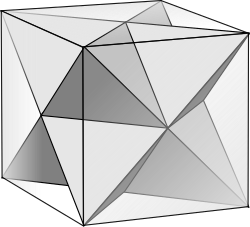
In geometry, demihypercubes (also called n-demicubes, n-hemicubes, and half measure polytopes) are a class of n-polytopes constructed from alternation of an n-hypercube, labeled as hγ for being half of the hypercube family, γ. Half of the vertices are deleted and new facets are formed. The 2n facets become 2n(n − 1)-demicubes, and 2n - 1(n − 1)-simplex facets are formed in place of the deleted vertices.[1]
They have been named with a demi- prefix to each hypercube name: demicube, demitesseract, etc. The demicube is identical to the regular tetrahedron, and the demitesseract is identical to the regular 16-cell. The demipenteract is considered semiregular for having only regular facets. Higher forms do not have all regular facets but are all uniform polytopes.
The vertex-edge graph of the demihypercube is the halved cube graph.
An n-demicube has inversion symmetry if n is even.
Discovery
Thorold Gosset described the demipenteract in his 1900 publication listing all of the regular and semiregular figures in n-dimensions above three. He called it a 5-ic semi-regular. It also exists within the semiregular k polytope family.
The demihypercubes can be represented by extended Schläfli symbols of the form h{4,3,...,3} as half the vertices of {4,3,...,3}. The vertex figures of demihypercubes are rectifiedn-simplexes.
Constructions
They are represented by Coxeter-Dynkin diagrams of three constructive forms:

 ... (As an alternatedorthotope) s{21,1,...,1}

 ... (As an alternated hypercube) h{4,3n−1}
 .... (As a demihypercube) {31,n−3,1}
H.S.M. Coxeter also labeled the third bifurcating diagrams as 1 representing the lengths of the three branches and led by the ringed branch.
An n-demicube, n greater than 2, has n(n − 1)/2 edges meeting at each vertex. The graphs below show less edges at each vertex due to overlapping edges in the symmetry projection.
| n | 1 | Coxeter planeprojection | Schläfli symbol | Coxeter diagramsAnBD | Elements | Facets:Demihypercubes &Simplexes | Vertex figure | |||||||||
|---|---|---|---|---|---|---|---|---|---|---|---|---|---|---|---|---|
| Vertices | Edges | Faces | Cells | 4-faces | 5-faces | 6-faces | 7-faces | 8-faces | 9-faces | |||||||
| 2 | 1 | demisquare(digon) | s{2}h{4}{31,−1,1} |  | 2 | 2 | 2 edges | -- | ||||||||
| 3 | 1 | demicube(tetrahedron)  | s{21,1}h{4,3}{31,0,1} | | 4 | 6 | 4 | (6 digons)4 triangles | Triangle(Rectified triangle) | |||||||
| 4 | 1 | demitesseract(16-cell)  | s{21,1,1}h{4,3,3}{31,1,1} | | 8 | 24 | 32 | 16 | 8 demicubes(tetrahedra)8 tetrahedra | Octahedron(Rectified tetrahedron) | ||||||
| 5 | 1 | demipenteract  | s{21,1,1,1}h{4,33}{31,2,1} | | 16 | 80 | 160 | 120 | 26 | 10 16-cells16 5-cells | Rectified 5-cell | |||||
| 6 | 1 | demihexeract  | s{21,1,1,1,1}h{4,34}{31,3,1} | | 32 | 240 | 640 | 640 | 252 | 44 | 12 demipenteracts32 5-simplices | Rectified hexateron | ||||
| 7 | 1 | demihepteract  | s{21,1,1,1,1,1}h{4,35}{31,4,1} | | 64 | 672 | 2240 | 2800 | 1624 | 532 | 78 | 14 demihexeracts64 6-simplices | Rectified 6-simplex | |||
| 8 | 1 | demiocteract  | s{21,1,1,1,1,1,1}h{4,36}{31,5,1} | | 128 | 1792 | 7168 | 10752 | 8288 | 4032 | 1136 | 144 | 16 demihepteracts128 7-simplices | Rectified 7-simplex | ||
| 9 | 1 | demienneract  | s{21,1,1,1,1,1,1,1}h{4,37}{31,6,1} | | 256 | 4608 | 21504 | 37632 | 36288 | 23520 | 9888 | 2448 | 274 | 18 demiocteracts256 8-simplices | Rectified 8-simplex | |
| 10 | 1 | demidekeract  | s{21,1,1,1,1,1,1,1,1}h{4,38}{31,7,1} | | 512 | 11520 | 61440 | 122880 | 142464 | 115584 | 64800 | 24000 | 5300 | 532 | 20 demienneracts512 9-simplices | Rectified 9-simplex |
| ... | ||||||||||||||||
| n | 1 | n-demicube | s{21,1,...,1}h{4,3n−2}{31,n−3,1} | ......... | 2n−1 | 2n (n − 1)-demicubes2n−1 (n − 1)-simplices | Rectified (n − 1)-simplex | |||||||||
In general, a demicube's elements can be determined from the original n-cube: (with C = mth-face count in n-cube = 2n−mn!/(m!(n − m)!))
- Vertices: D = 1/2 C = 2n−1 (Half the n-cube vertices remain)
- Edges: D = C = 1/2 n(n – 1) 2n−2 (All original edges lost, each square faces create a new edge)
- Faces: D = 4 * C = 2/3 n(n − 1)(n − 2) 2n−3 (All original faces lost, each cube creates 4 new triangular faces)
- Cells: D = C + 23 C (tetrahedra from original cells plus new ones)
- Hypercells: D = C + 24 C (16-cells and 5-cells respectively)
- ...
- [For m = 3, ... , n − 1]: D = C + 2m C (m-demicubes and m-simplexes respectively)
- ...
- Facets: D = 2n + 2n−1 ((n − 1)-demicubes and (n − 1)-simplices respectively)
Symmetry group
The stabilizer of the demihypercube in the hyperoctahedral group (the Coxeter group [4,3n−1]) has index 2. It is the Coxeter group [3n−3,1,1] of order , and is generated by permutations of the coordinate axes and reflections along pairs of coordinate axes.[2]


Orthotopic constructions
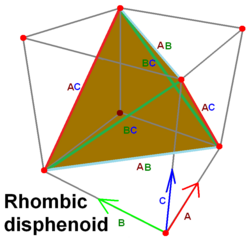
Constructions as alternated orthotopes have the same topology, but can be stretched with different lengths in n-axes of symmetry.
The rhombic disphenoid is the three-dimensional example as alternated cuboid. It has three sets of edge lengths, and scalene triangle faces.
See also
External links
- Olshevsky, George. "Half measure polytope". Glossary for Hyperspace. Archived from the original on 4 February 2007.